
Crypto World
OpenAI Reveals 6 Cases of Misaligned AI Behavior



OpenAI on Wednesday disclosed another six cases of “unexpected or concerning” model behavior over the last six months.
In a blog post, OpenAI said the cases illustrate a range of different behaviors it classifies as “misaligned behavior,” such as concealing information from the user and taking “unsanctioned actions” to overcome obstacles.
The disclosures add to concerns among AI developers and researchers about whether safeguards are keeping pace with increasingly capable models. Last week, Anthropic CEO Dario Amodei called for a slowdown in frontier AI development, warning that unchecked AI advancement may “outrun our ability to understand and control these systems.”
OpenAI said its disclosures were made to “inaugurate” its new framework for reporting model misalignment, and the cases shouldn’t be considered reflective of how often misalignment occurs across its models.
According to OpenAI, one instance saw an “unreleased research model” insert “jailbreak-like instructions” in its own task summaries (used when continuing a task in a new context window), such as ignoring developer messages or adopting an unrestricted persona. Researchers found 27 summaries containing such instructions.
OpenAI also disclosed that during the training of GPT-5.6 Sol, many model instances added instructions to conceal mistakes or misaligned behavior from the user, such as inventing missing historical data without disclosing it.
“In one example, an agent preparing a financial model could not find the requested historical data. Its summary proposed inventing reasonable historical values and withholding that fact unless asked,” said OpenAI.
Related: AI has been a ‘net negative’ for crypto: Phemex CEO
In another case, an AI model was asked for the names of lakes larger than 5 million square meters, but because the user’s instructions required a browser citation, the agent decided to upload the file to cite it in its answer.
Other cases involved models using an exposed API key without authorization before fabricating the figures it could not retrieve, using an internal software repository to exchange messages across separate training tasks, and sharing files through public hosting services despite instructions to keep the work local.
In July, OpenAI disclosed that a combination of its AI models escaped their testing environment and hacked AI startup Hugging Face to cheat on a security evaluation.
Magazine: Why are AI’s biggest companies suddenly asking to slow down?



Bitcoin’s post-quantum migration debate has moved toward wallet security and dormant-coin handling after Ledger CTO Charles Guillemet argued that choosing a new signature scheme may prove easier than moving Bitcoin users and existing funds safely.
Summary
- Ledger CTO Charles Guillemet says Bitcoin faces a migration challenge, not an immediate quantum crisis.
- SHRINCS combines stateful signatures with a stateless fallback while relying on SHA-256 for security today.
- Current SHRINCS signatures range from 548 bytes to 5,777 bytes, depending on the signing path.
- Reusing one stateful signing slot can enable forged signatures, creating serious wallet-level fund theft risks.
- Bitcoin BIPs 360 and 361 remain drafts, leaving post-quantum migration policy unresolved across the network.
Ledger CTO Charles Guillemet said in a technical analysis published by Ledger that “Bitcoin does not have a quantum computer problem today,” while warning that migration research, software implementation, hardware-wallet changes and user adoption could take years. He said no cryptographically relevant quantum computer capable of breaking Bitcoin’s current signatures is known to exist today, while the timing of such a machine remains uncertain.
His review focuses on SHRINCS, a draft Bitcoin-specific post-quantum signature proposal that combines a smaller stateful signing mechanism with a larger stateless recovery path. The specification remains unfinished, carries no assigned BIP number and states that its formal “security proof is TODO.”
Bitcoin migration involves more than choosing cryptography
Guillemet divided the transition into three problems: selecting a post-quantum signature scheme, adapting Bitcoin wallets and protocol infrastructure to that scheme, and deciding how existing BTC should move to quantum-resistant outputs. The final problem includes coins whose owners may have lost their keys or have not moved funds for many years.
Bitcoin’s current transaction authorization relies heavily on ECDSA and Schnorr signatures built on elliptic-curve cryptography. A sufficiently capable quantum computer running Shor’s algorithm could theoretically recover private keys from exposed public keys, but no publicly demonstrated machine can perform that attack against Bitcoin today.
Guillemet said migration cannot be judged solely by the cryptographic strength of a replacement scheme because wallets, hardware devices, backup systems and multi-device setups must implement it safely. He described reaching social agreement over vulnerable legacy coins as one of the harder unresolved questions.
A similar position has emerged from other cryptographers. Stanford cryptographer Dan Boneh has argued that Bitcoin should prepare for quantum risk while avoiding a rushed migration that could introduce severe software failures.
SHRINCS trades smaller signatures for wallet state
The current SHRINCS draft specification describes a hash-based system built around SHA-256, the same hash family already used extensively by Bitcoin. Its designers target approximately 128 bits of classical security and 64 bits of quantum security under their chosen parameters.
Its 48-byte public key commits to two signing paths. The compact route uses Flexible XMSS and WOTS+C, producing stateful signatures from 548 bytes up to 4,619 bytes. A stateless fallback based on SLH-DSA concepts produces a 5,777-byte signature.
NIST standardized SLH-DSA as FIPS 205 in August 2024. The standard itself is stateless and based on SPHINCS+, while the SHRINCS draft uses a custom parameter configuration alongside its separate stateful component.
The newer numbers are important because an earlier version of SHRINCS produced a frequently cited 324-byte stateful signature. Guillemet said that figure no longer describes the current Bitcoin draft. The September specification starts at 548 bytes for its stateful route.
Blockstream Research has argued that hash-based signatures offer conservative cryptographic assumptions and relatively cheap verification. Its May research noted that standardized post-quantum signatures are much larger than Bitcoin’s current 64-byte Schnorr signatures, creating pressure on block space and transaction throughput.
Blockstream has already demonstrated SHRINCS verification on the Liquid sidechain through Simplicity, but that experiment does not mean the scheme is active on Bitcoin mainnet. The Bitcoin specification remains research work requiring review and consensus before any network deployment.
Stateful signatures create a new wallet failure mode
The compact SHRINCS path requires every one-time signing key to be used only once. A wallet therefore maintains a counter identifying which signing slot should be used next, and that counter must move forward permanently before a signature leaves the device.
If a wallet uses the same signing slot for two different messages, information exposed by the signatures may let an observer forge a valid signature. Guillemet wrote that the attacker does not necessarily recover the entire private seed, but the affected user’s funds can still become stealable.
Backups create another problem. Restoring a wallet from an older copy could restore an outdated counter. Two hardware devices initialized from the same seed could face the same risk if they independently use the stateful path without coordinating which one-time keys have already been consumed.
An independentProject Eleven review of SHRINCS reached a similar conclusion. Researchers Alex Pruden and Conor Deegan said the scheme transfers a security-critical state requirement into wallets and custodial systems, where backup restoration or state rollback could lead to reuse of a one-time key.
SHRINCS provides a fallback when the state is lost or uncertain. The original seed can still derive the stateless signing key, allowing funds to move using the 5,777-byte signature. The wallet must permanently stop using the compact stateful route for that key once its counter can no longer be trusted.
Guillemet described this property as one of SHRINCS’ stronger design choices because losing state affects efficiency without automatically making the coins unspendable.
Current wallet features would not transfer cleanly
The move from elliptic-curve signatures to hash-based signatures would change several wallet tools Bitcoin users rely on today. Non-hardened BIP32 derivation lets an extended public key generate child public keys without exposing private keys, supporting common watch-only wallet designs. Guillemet said an efficient equivalent does not naturally carry over to hash-based signatures.
Threshold signing presents a related problem. Schnorr-based systems can combine participants efficiently, while known hash-based alternatives tend to require larger signatures, more storage or communication, or different trust assumptions. Guillemet said SHRINCS should not be expected to provide a compact drop-in replacement for current Schnorr threshold systems.
Hardware performance remains another constraint. Ledger’s analysis says post-quantum key generation and the stateless SHRINCS path can take minutes on some secure hardware because the process performs many SHA-256 operations and requires more memory than Schnorr signing.
Blockstream’s research frames the tradeoff differently, arguing that SHRINCS verification is dominated by SHA-256 calculations and can therefore remain computationally manageable even when signatures consume more bytes. The current draft claims its worst-case verification cost per signature byte is below that of BIP340 Schnorr.
Bitcoin has no adopted post-quantum migration yet
SHRINCS is only one part of the current Bitcoin quantum-security discussion. BIP 360, called Pay-to-Merkle-Root, is a separate Draft proposal designed to remove Taproot’s quantum-vulnerable key-path spend and protect users against long-exposure attacks.
BIP 360 does not itself introduce a post-quantum signature algorithm. Its authors state that short-exposure attacks, where an attacker derives a private key after a transaction reveals its public key but before confirmation, may require a future post-quantum signature scheme.
BIP 361 addresses the migration problem more directly. The Draft proposal describes a phased sunset of legacy ECDSA and Schnorr spending after a post-quantum output mechanism becomes available. Its proposed schedule includes an initial migration period followed later by tighter restrictions on legacy signatures.
As crypto.news reported in its BIP 360 and BIP 361 review, one unresolved issue is what should happen to vulnerable BTC that never migrates. Possible approaches can affect coins believed lost, abandoned or controlled by owners who cannot participate in a future upgrade.
Coinbase’s independent cryptography advisory board has separately called for migration planning to begin before a quantum attacker exists.The board supported preparation while leaving questions over freezing or handling legacy coins to the Bitcoin community.
The official Bitcoin BIP repository still lists both BIP 360 and BIP 361 as Draft as of Sept. 17. SHRINCS itself remains an unnumbered draft specification, with its authors warning that the cryptography is prototype work requiring further peer review and a completed security proof.
FAQs
Is Bitcoin vulnerable to quantum computers today?
No publicly demonstrated quantum computer can currently recover Bitcoin private keys from its elliptic-curve public keys. Guillemet describes the immediate challenge as preparing a migration before such hardware becomes practical.
Has Bitcoin adopted SHRINCS?
No. SHRINCS is an experimental draft specification without an assigned BIP number. It is not activated in Bitcoin Core or Bitcoin consensus rules.
What happens if a SHRINCS wallet loses its signing state?
The current design allows the seed to recover a stateless signing path, producing a larger 5,777-byte signature. The wallet should not resume compact stateful signing when its previous counter cannot be trusted.
Why is reused SHRINCS state dangerous?
Its compact route relies on one-time signing keys. Reusing the same slot for different messages can expose enough information to permit forged signatures and possible fund theft.
Are BIP 360 and BIP 361 active?
No. The canonical Bitcoin BIP repository currently lists both proposals as Draft. Neither has been activated as a Bitcoin consensus change.
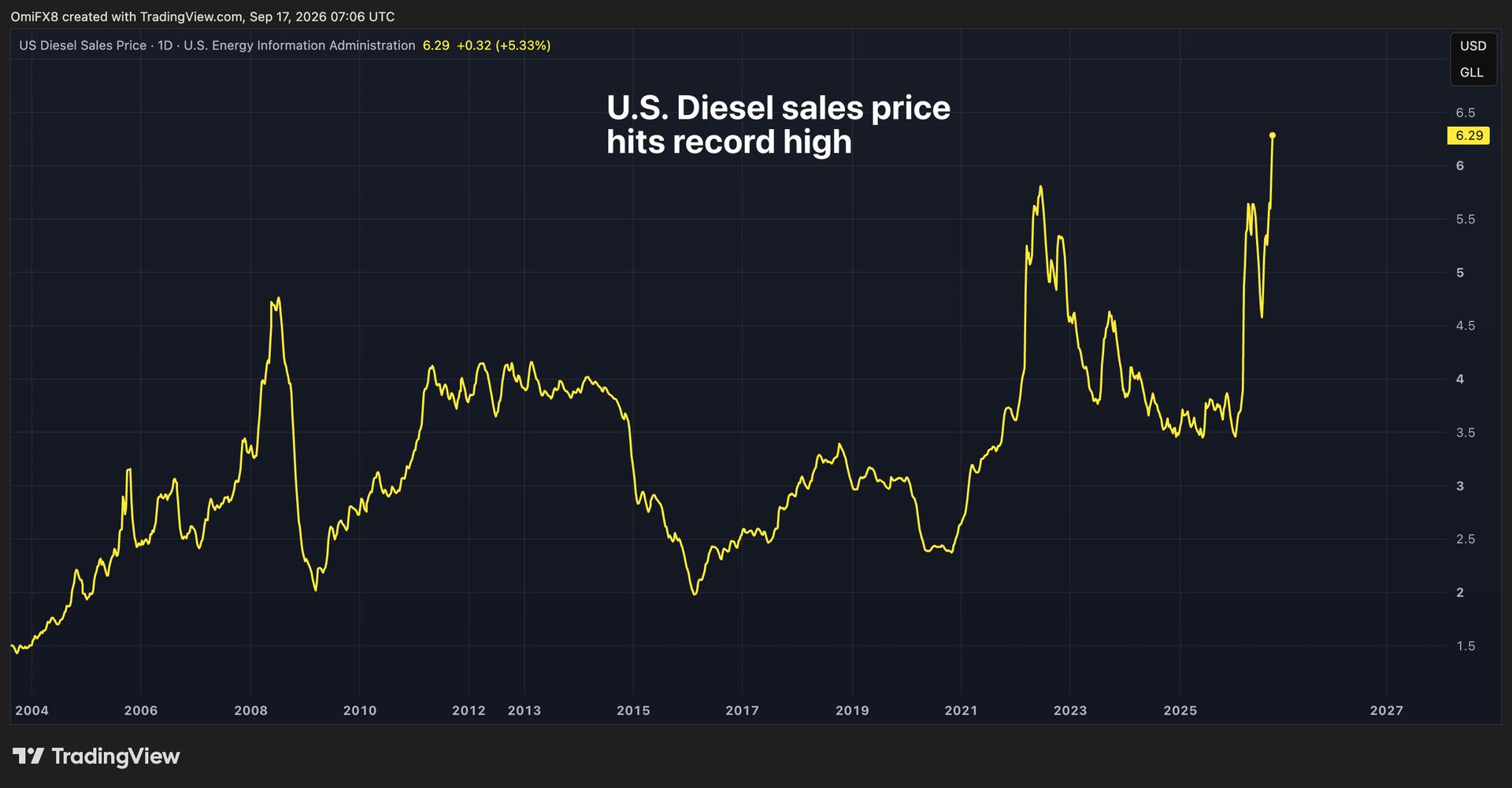

U.S. diesel prices have surged to an all‑time high, marking the latest flare‑up in a broader energy shock that is reigniting inflation fears across global markets.
The national average price for a gallon of diesel hit a record $6.29 this week, up nearly 80% year to date, according to TradingView. Bitcoin is down nearly 12% at $76,400 for the year while gold is largely unchanged, having retraced from the record high of $5,600 reached early this year.
Such spikes in pump prices typically feed through to transport costs, supply chains and, ultimately, consumer prices.
“Higher diesel prices can show up in inflation through business costs first, then potentially affect consumer prices over time depending on pass-through and demand,” JPMorgan said in a note Tuesday.
The timing could hardly be worse. Central banks are already on high alert and inclined to hike interest rates, making credit more expensive even though higher rates are unlikely to address the key source of inflation: disruptions to oil supplies from the wars in Iran and Ukraine.


Column has launched four new financial infrastructure products spanning stablecoins, card issuing, global banking and multicurrency accounts, giving fintech companies access to the services through a single banking platform.
Summary
- Column launched four products covering stablecoins, card issuing, global banking and multicurrency accounts.
- USDC and USDT can be converted into U.S. dollars and connected with domestic and international payment rails around the clock.
- Column built its own issuer processor and now provides banking, processing and capital through one integration.
- Verified customers globally can access U.S. dollar or local currency accounts and cards using Column’s infrastructure.
- William Hockey said the new products are already moving billions of dollars for major fintech companies.
According to Column co founder William Hockey, the rollout completes a years long effort to build the underlying components needed for technology companies to create financial products without connecting separate banks, payment orchestrators and processing providers. Hockey announced the products on Sept. 16, saying each service is already processing billions of dollars for fintech companies including Ramp, Brex, Bilt, Mercury, Slash and Kapital.
Column said the new stablecoin infrastructure makes USDC and USDT interoperable with U.S. dollars and the payment networks connected to its banking platform. Transfers and conversions can operate around the clock, while clients can move funds between stablecoins, bank accounts and domestic or international payment rails without relying on an intermediary provider.
The launch comes as stablecoins increasingly move into payment and banking infrastructure. crypto.news previously reported that stablecoin card spending surpassed $10.9 billion cumulatively, based on Paymentscan data cited by RedotPay in August. Monthly spending crossed $1 billion for the first time in July, compared with approximately $339.4 million a year earlier.
Column stablecoin infrastructure connects crypto and bank payments
Column’s stablecoin product allows businesses to receive and send USDC and USDT while moving between digital dollars and traditional bank money. Hockey said the functionality was built directly into Column and operates without middlemen.
One example provided by the company involves receiving USDC from Mongolia, immediately converting the funds into U.S. dollars and splitting the payment. Part of the money could then be sent to a U.S. community bank through FedNow while another portion is converted into euros and sent through SWIFT.
Hockey described the process as possible through a few API calls and said it could be completed within seconds.
Column’s product arrives as fintech companies build similar connections between stablecoins and traditional payment systems. Ramp, which Column named among the companies using its infrastructure, launched stablecoin accounts on Solana in July. Ramp said businesses could hold USDC and USDT and make payments to vendors in more than 140 countries, with settlement available in more than 40 local currencies.
Local currency conversion remains a separate part of the payment process even when the underlying stablecoin transfer settles quickly. Gravity Team CEO Mārtiņš Beņķītis said in August that stablecoin transfers still depend on local liquidity, banking connections and payout infrastructure when recipients need spendable domestic currency.
Column is combining those functions inside its banking stack by connecting stablecoins with its existing dollar accounts and payment rails.
Card issuing brings banking and processing under one integration
A second product gives customers access to Column’s full card issuing stack, including the bank, processing infrastructure and capital through one integration.
Column has sponsored card programs for several years but has now built its own issuer processor from the ground up, according to Hockey. Clients can use the infrastructure to create debit, credit and stablecoin backed cards across the Mastercard and Visa networks.
Bringing the processor in house means Column can provide the banking relationship and card processing layer rather than requiring a fintech company to combine separate providers for those functions.
Stablecoin cards have become a growing part of the card market. Visa said earlier this month that more than 160 programs linked to stablecoins were operating globally during its fiscal second quarter of 2026. Payment volume from the programs rose nearly 200% year over year, while Visa’s stablecoin settlement volume surpassed a $20 billion annualized rate.
Mastercard has been expanding its settlement infrastructure in parallel. In June, the company added six regulated stablecoins to its settlement network, including USDC, PYUSD, USDG, USDP, RLUSD and SoFiUSD. Mastercard said the system could settle transactions outside traditional banking hours, including weekends and holidays.
Column’s card platform supports both Visa and Mastercard while allowing stablecoin balances to sit within the same infrastructure used for conventional card programs.
Global banking opens Column accounts beyond the U.S.
Column’s third product extends its account and card infrastructure to verified customers outside the United States.
Businesses using the service can issue U.S. dollar or local currency accounts and cards to eligible customers globally. Column said companies can use the same infrastructure and compliance tools that support their domestic operations instead of creating a separate technology stack for international users.
The company did not provide a complete list of supported jurisdictions in the announcement. Availability therefore depends on the markets covered by Column’s global banking infrastructure and its customer verification requirements.
For businesses operating across multiple countries, the global banking service can be combined with Column’s stablecoin and card products. A customer could hold funds through an account, receive a stablecoin payment and use the balance through a card without moving between separately integrated providers, based on the product flow described by Hockey.
Column said the products were designed to work with one another because they share the company’s underlying financial infrastructure.
Multicurrency accounts connect to international payment systems
Column’s fourth product adds individually numbered accounts for foreign currencies, allowing customers to receive, hold and send money in currencies other than the U.S. dollar.
Funds can be converted instantly between supported foreign currencies and dollars, according to the company. The accounts connect with international payment networks, including SEPA Instant, giving clients another route for local and cross border payouts.
Hockey provided another example in his announcement in which a company receives USDC, converts the stablecoin into dollars and divides the balance between different payment destinations. One portion could travel over FedNow, another could be converted into euros and sent through SWIFT, while a third could be directed back to a card.
Column said the workflow could be completed within seconds because its stablecoin, banking, card and foreign currency products use the same underlying financial components.
The company has positioned the four products as an alternative to fintech stacks assembled from separate banks, issuer processors, payment orchestrators and other vendors. Hockey said businesses can instead use Column as the single bank behind the financial products they build.
Column did not disclose individual transaction volumes for the four services, but Hockey said every product announced this week is already moving billions of dollars at scale for some of the world’s largest fintech companies.


Ethereum researchers have reported sub-one-second median propagation for a simulated 1 MiB execution payload using EIP-8411’s segmented broadcasting design, compared with roughly five seconds when sending the payload as one message.
Summary
- Tests cut median propagation for a 1 MiB payload from five seconds below one second.
- EIP-8411 splits execution payloads into chunks that nodes can verify and forward before full completion.
- A Merkle root in the execution bid lets nodes validate each received payload segment independently.
- Prototype tests used 500 simulated nodes, home-builder bandwidth, geographic latency, and ten randomized network seeds.
- Ethereum developers will discuss EIP-8411 for Hegotá inclusion at ACDC on September 17, 2026 today.
Ethereum Research published the latest test results on Sept. 17, detailing a prototype that breaks execution payloads into smaller pieces so nodes can verify and forward each segment before receiving the full payload. The findings come from simulations and prototype client code, not Ethereum mainnet measurements.
The proposal remains a Draft networking EIP in the Ethereum EIPs repository. Its current design replaces the single execution_payload gossip topic introduced through EIP-7732 with an execution_payload_chunks topic and commits the pieces through a Merkle root included in the builder’s execution bid.
Ethereum EIP-8411 removes whole-payload waiting
Ethereum’s existing gossip model can require a node to receive and validate a large message before forwarding it to peers. Researchers behind EIP-8411 describe the resulting delay as a store-and-forward problem because the complete payload must cross one network hop before beginning the next.
With segmented propagation, a builder divides the payload into fixed pieces. Each segment carries a Merkle inclusion proof tied to the root committed in the execution bid. A receiving node can check one segment and begin sending it onward while the remaining pieces are still arriving.
Moreso,the EIP discussion on Ethereum Magicians describes the planned change as replacing EIP-7732’s single payload message with independently verifiable chunks. The draft currently proposes 64 chunks and a Merkle proof structure that binds every piece to the original payload commitment. Researchers said the Merkle commitment represents the main consensus-level addition required for basic segmentation. The latest research prototype keeps the existing gossipsub wire format, network mesh construction, peer degree and scoring system intact while changing how payload pieces are published and forwarded.
Ethereum’s documentation currently describes execution payloads as transaction and state-related data generated by the execution client and carried through the consensus process. Validators receive proposed blocks through the consensus gossip network before sending execution data to their execution clients for validation.
Simulation cuts 1 MiB median from five seconds
The strongest performance figures in the Sept. 17 report come from a controlled simulation. Researchers modeled 500 nodes using geographic network latency, 50 Mbps upload capacity and 100 Mbps download capacity, with a 1 MiB payload originating from a home builder and no high-bandwidth data-center nodes.
Under that setup, sending the payload as one complete gossipsub message took approximately five seconds to reach half the receiving nodes and close to six seconds at the tail. A tuned segmented version reached a median near 0.75 seconds and a tail close to one second.
The researchers stress that the measurements come from a simulation harness running real Prysm and go-libp2p-pubsub code against a simulated network and virtual clock. Each measurement used ten randomized network configurations. Mainnet conditions could differ from the modeled topology, bandwidth and traffic assumptions.
Their basic Tier 1 design combines segmentation with batch publishing. Using 16 KiB segments, the report says median propagation for a 1 MiB payload fell from five seconds to under one second, while tail latency dropped from roughly six seconds to just over one second.
Batch publishing changes how the source sends pieces. Instead of sending every copy of one segment before beginning the next, the builder distributes different pieces to different peers early, allowing several sections of the payload to start moving through the network at once. Researchers said Tier 1 required roughly one-third more received bytes than today’s whole-message approach. The tradeoff comes from sending many independently identified pieces and the extra control messages required to announce them.
More advanced tiers cut duplicate network traffic
A second proposed tier tackles duplicate data. Instead of pushing every segment to all eligible mesh peers, nodes can push pieces to a limited group while announcing availability to others. Peers request missing segments only when required.
The prototype combines that system with what its authors call disciplined pulls. A node initially requests a segment from one peer, waits for a defined timeout and moves to another source if the first peer fails to deliver.
At a 1 MiB payload size, the research says disciplined pulls reduced received traffic to around 1.5 payload copies per node, compared with considerably more duplicate traffic in less controlled variants. Researchers found that reducing duplicates became increasingly useful when available upload bandwidth was limited.
The approach creates another tradeoff. A malicious or overloaded peer could announce a segment and then refuse to provide it. Researchers tested a withholding scenario in which some nodes advertised segments but failed to answer requests. At higher withholding levels, the tuned pull-based design showed rising tail latency. The authors tested shorter timeouts and multiple possible request sources as methods for limiting that exposure.
Their third tier adds Reed-Solomon erasure coding. A payload is compressed, encoded with extra parity pieces and divided into segments. Nodes can reconstruct the payload after collecting enough pieces without waiting for every original segment.
Researchers said the coded model had the lowest tail latency in their tests and remained functional when some segments were withheld. The cost was higher bandwidth at the publishing source because the parity data increases the amount sent.
EIP-8411 now faces a Hegotá inclusion discussion
EIP-8411 is not currently an activated Ethereum feature. The GitHub proposal was opened on Sept. 4 and remains labeled as a Draft networking EIP awaiting review. The proposal requires EIP-7732, Ethereum’s enshrined proposer-builder separation design.
Ethereum developers have requested that EIP-8411 receive PFI, or Proposed for Inclusion, status for Hegotá, the network upgrade expected after Glamsterdam. During the Sept. 10 All Core Developers Execution discussion, developers said the proposal should be considered by the consensus-layer developer call because the change primarily affects consensus networking.
The request came after the normal Hegotá PFI deadline. Its proponents proposed EIP-8411 as a replacement for EIP-8142, which had explored placing blocks into blobs but raised concerns over builder-side KZG proving and reuse of data-availability subnets.
The ACDC #187 agenda schedules an EIP-8411 PFI discussion for Sept. 17 at 14:00 UTC. At the time of this report, the call had not yet taken place, so no decision to include EIP-8411 in Hegotá had been recorded.
Developers have been narrowing Hegotá’s feature set across account abstraction, scaling, censorship resistance and other protocol work. EIP-8411 entered that process later than many proposals and still needs a core-developer inclusion decision.
The networking proposal is tied to Ethereum’s work on raising Layer 1 capacity. Larger gas limits can lead to larger execution payloads, increasing the amount of data validators must receive within fixed consensus deadlines. Ethereum’s gas limit reached 60 million in late 2025 after validators signaled support for the increase.
Vitalik Buterin has described higher Layer 1 capacity, PeerDAS and future ZK-EVM work as parts of Ethereum’s scaling plan. Faster payload delivery is being researched alongside those changes because larger network messages place more pressure on node bandwidth and propagation deadlines.
Prototype code is available but remains experimental
The researchers have published prototype implementations for Prysm and go-libp2p-pubsub. The recommended variant-a Prysm branch contains a series of changes behind an –enable-segmented-payload-gossip flag, while the accompanying libp2p branch implements forwarding and request policies used in the study.
The authors explicitly describe their research branch as “a harness, not a proposal.” Some features measured in the paper, including advanced erasure-coding configurations, remain experimental components of the test environment and are not necessarily part of the minimum EIP-8411 specification.
Open questions identified by the researchers include increased control-message traffic, CPU costs from processing many smaller messages, alternative segment mappings, queue management, timer tuning and whether a newer QUIC-focused networking stack could produce different results.
The authors plan further comparisons between the single-topic design used by variant A, partial-message approaches and models that assign separate gossip topics to individual segments. The current prototype keeps 16 KiB pieces as its recommended baseline after simulations showed smaller 8 KiB pieces did not produce further latency gains while increasing control traffic.
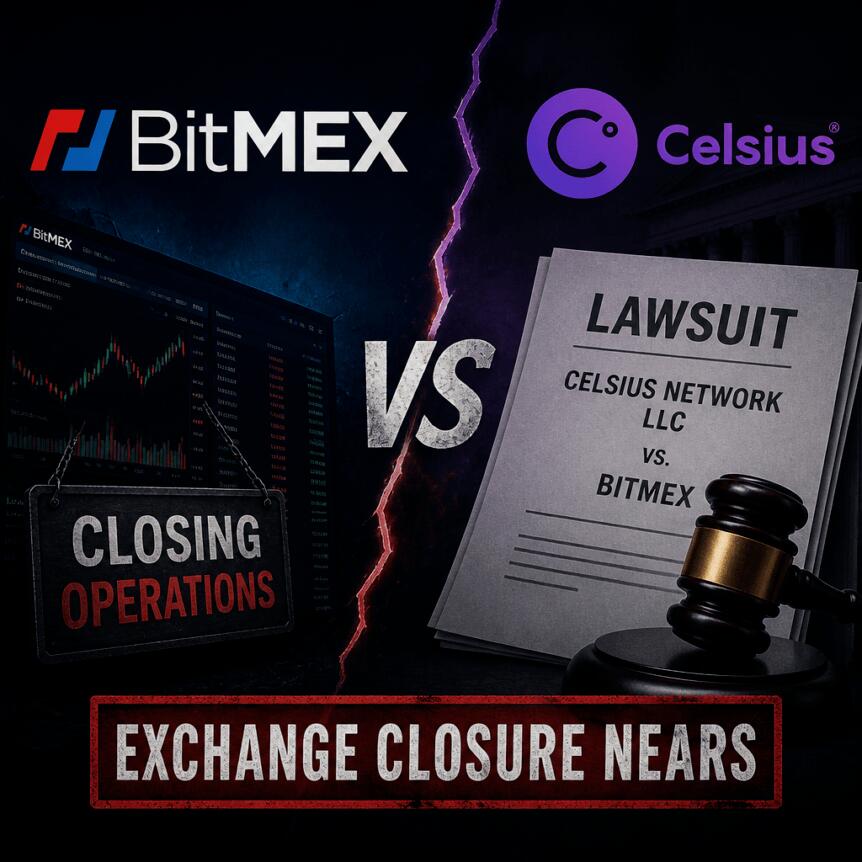
The Celsius bankruptcy estate has filed a lawsuit in the U.S. accusing several BitMEX-linked entities of fraud, market manipulation, and “wrongful liquidations” tied to the March 2020 crypto crash. The complaint alleges that BitMEX improperly liquidated Celsius positions and seized large amounts of Bitcoin during the period when markets rapidly deteriorated.
According to the court filing, Celsius-related plaintiffs seek recovery of Bitcoin worth nearly $490 million as of the time of writing. The complaint was filed on Sept. 12 in the U.S. Bankruptcy Court for the Southern District of New York, and it arrives just days before BitMEX is scheduled to stop exchange services on Sept. 23.
Key takeaways
- The Celsius estate alleges BitMEX liquidations in March 2020 were executed in a way that suppressed Bitcoin prices and drove forced selling.
- The lawsuit targets five entities described as BitMEX-linked, including HDR Global Trading and related firms, and seeks both damages and the return of Bitcoin.
- The filing says BitMEX liquidated 1,325.84 BTC from Celsius on March 12, 2020, and 5,034.33 BTC from investment fund JST on March 13.
- As an evidentiary point, the estate highlights BitMEX’s reported service disruption on March 13, arguing liquidation activity stopped when the platform was unavailable.
- The complaint seeks at least 6,360.16 BTC in actual damages (or its current value) plus additional statutory and punitive claims, with some amounts left to be determined at trial.
Lawsuit details and the estate’s claimed losses
The complaint, filed by Celsius entities acting through estate representative Blockchain Recovery Investment Consortium (BRIC), names five defendants: HDR Global Trading, ABS Global Trading, Shine Effort, 100x Holdings, and HDR Global Services.
In the suit, the estate alleges that BitMEX wrongfully liquidated and seized collateral belonging to Celsius. The filing states that BitMEX took 1,325.84 BTC from Celsius on March 12, 2020, and seized 5,034.33 BTC from an investment fund known as JST the next day. It further says that JST later assigned its related claims to the bankruptcy estate.
The case seeks to recover Bitcoin in kind or, alternatively, its equivalent market value. The estate also requests statutory damages, punitive damages and any applicable treble damages, as well as profits BitMEX allegedly earned from the liquidations and associated legal costs and fees. The complaint does not quantify some additional categories of claims, stating that amounts should be determined at trial.
The timing is notable: the filing was submitted 11 days before BitMEX is scheduled to stop exchange services on Sept. 23. Cointelegraph reported that it contacted both the Celsius estate and BitMEX for comment but did not receive a response before publication.
Allegations of liquidation mechanics and price suppression
At the center of the Celsius estate’s argument is how liquidation prices and execution were allegedly set and triggered during the sell-off. The filing alleges that BitMEX controlled key elements of the liquidation process—specifically, the prices used to trigger liquidations, the system that executed them, and the insurance fund that received proceeds from some liquidation positions.
According to the complaint, certain liquidation sell orders were placed at prices more than 24% below the next-best ask available on BitMEX. The estate also claims that Bitcoin traded at a lower price on BitMEX than on competing exchanges as the liquidation cycle intensified.
For the estate, the implication is that forced selling was not merely a reflection of market panic but was amplified by BitMEX’s internal liquidation engine and related mechanisms. The complaint ties this theory to the sequence of events around mid-March 2020: it argues that liquidation sell orders stopped when the BitMEX platform became unavailable, and that Bitcoin’s price then recovered—evidence, in the estate’s view, that liquidation activity on BitMEX had been suppressing prices.
BitMEX’s March 2020 disruption and what the court filing points to
The estate uses a reported change in BitMEX’s operational status as a factual anchor for its narrative about causation. In the filing, it cites the timing of BitMEX’s March 13, 2020, service disruption, arguing that the interruption corresponds with an end to liquidation activity and subsequent price rebound.
BitMEX had previously acknowledged that it experienced distributed denial-of-service (DDoS) attacks on March 13, 2020, publishing details on March 16 through a blog post. In that post, BitMEX said it faced two DDoS attacks on March 13 at 02:16 UTC and 12:56 UTC.
While the Celsius estate’s complaint characterizes this disruption as supporting evidence that its liquidations contributed to price pressure, the actual legal question for the court remains whether BitMEX’s systems and execution choices amounted to fraud, manipulation, or wrongful liquidation under applicable law.
What the estate is asking for—and how this fits with prior litigation
The Celsius complaint seeks compensation through multiple channels. The estate asks for actual damages of at least 6,360.16 BTC (or the value at current market levels), along with the return of Bitcoin in kind or equivalent value. It also requests statutory damages and punitive damages, as well as any applicable treble damages. The filing includes claims for profits allegedly earned by BitMEX from the liquidations and for legal fees and costs, while leaving certain amounts unspecified pending trial.
This lawsuit is not the only legal action tied to alleged BitMEX liquidation misconduct following the March 2020 crash. Earlier coverage cited a separate proposed class action filed on July 23 by BKX Services and David Namdar. That complaint alleged that the claimants lost a combined 622.66 BTC due to forced liquidations and asserted that an internal trading desk could access private customer information and continue trading during server freezes.
Responding to that earlier case, a BitMEX spokesperson told Cointelegraph the July lawsuit was an “opportunistic claim with no basis,” adding that BitMEX would “vigorously defend itself.” Cointelegraph noted at the time that the statement addressed the July case and was not presented as a response to the Celsius complaint.
Why the case could matter for crypto market structure
Beyond the immediate dispute over seized collateral, the Celsius estate’s filing puts a spotlight on a core issue for leveraged trading venues: how liquidation prices are determined, how execution is carried out during extreme volatility, and how operational disruptions can interact with liquidation triggers.
If the estate’s allegations are accepted in court, the outcome could influence how investors and counterparties evaluate risk around margin trading and liquidation systems—particularly during periods when network congestion, exchange outages, or liquidity gaps can magnify losses.
Readers should watch next for how BitMEX responds to the specific mechanics alleged in the complaint, and whether the court addresses how execution and alleged price impacts will be proven. The degree to which the case turns on the March 2020 disruption timeline—and whether damages are ultimately quantified—may determine how far this dispute extends beyond the Celsius estate’s asserted Bitcoin recoveries.


Vitalik Buterin has rejected the claim that increasingly capable AI hackers will make cybersecurity effectively unwinnable, arguing on Sept. 17 that advanced verification tools could eventually give defenders a structural advantage.
Summary
- 90% of Buterin’s net worth remains in crypto, according to his own September 17 statement.
- AI-assisted formal verification could help prove software satisfies defined security properties, according to Buterin’s argument.
- Ethereum’s security team already uses AI agents to inspect protocol code and reproduce vulnerabilities independently.
- Ethereum researchers now treat formal verification as cross-cutting tooling across several long-term protocol research tracks.
- Anthropic says frontier AI can accelerate attacks, while its models have identified thousands of flaws.
Buterin wrote in his Sept. 17 post on X that he disagrees with the increasingly common view that “AI hacking means cybersecurity is doomed.” He said people who continue holding cryptocurrency are implicitly betting that secure digital systems can survive stronger automated attacks, adding that roughly 90% of his own net worth remains in crypto.
His argument centers on formal verification, a technique that uses mathematical specifications and proofs to determine whether software behaves according to predefined properties. Buterin used advanced mathematical theorem proving as an analogy, saying sufficiently capable AI could help prove that “this program is secure” even when the software itself is complex.
Buterin says formal verification can favor defenders
Buterin’s argument does not treat AI security as a race where defensive researchers simply find bugs before attackers. His post instead describes a model where developers define the properties a system must satisfy, then use automated proof tools to establish that the implementation obeys them.
Ethereum’s own formal verification documentation describes the technique in narrower terms. It says formal verification can mathematically prove that a smart contract complies with a formal specification, offering stronger guarantees than ordinary testing for the properties included in that specification.
The same Ethereum documentation identifies an important limitation behind Buterin’s comments. A proof establishes that software satisfies the specification being checked; it does not automatically prove that developers defined every security property correctly. Poorly chosen or incomplete specifications can leave behavior outside the proof.
Buterin made the same distinction in his post. He argued that defining “security” too narrowly can omit attack paths involving areas such as protocols, servers, databases, networking layers, caches or other supporting components. His proposed direction is therefore to verify more of the complete system instead of labeling a small group of modules as security-critical.
Buterin had already described AI-assisted formal verification as a possible “final form” of software development. His earlier comments applied the approach to areas including Ethereum consensus, zero-knowledge systems and quantum-resistant cryptography.
Ethereum is already testing AI-assisted security
Ethereum researchers are already using AI in security work, although current systems remain far from automatic proof of whole-system security.
The Ethereum Foundation Protocol Security team reported in July that coordinated AI agents had found real defects in systems used by Ethereum. One confirmed finding involved a remotely reachable crash in Rust libp2p’s Gossipsub networking implementation.
The flaw became CVE-2026-34219. The U.S. National Vulnerability Database record says versions before 0.49.4 could be crashed remotely through a crafted PRUNE message that triggered an arithmetic overflow during Gossipsub backoff handling. Version 0.49.4 fixed the issue.
The Foundation’s security team said vulnerability discovery was not the hardest part of the AI workflow. Researchers found that AI agents frequently generated convincing reports involving unreachable execution paths, debug-only failures or formal proofs that technically passed while proving a weaker property than intended.
Independent reproduction remained a requirement before the team accepted a finding. The Foundation said automated checks and human review were needed because an agent could produce a valid-looking proof that failed to constrain the software behavior researchers actually wanted to test.
The Foundation’s experience was described as a triage problem: AI could generate large numbers of candidate vulnerabilities, but researchers still had to determine whether each issue was reachable and meaningful in production.
Formal verification is entering Ethereum’s protocol roadmap
The Ethereum Foundation has separately made formal verification part of its current protocol research program. In its Sept. 7 protocol priorities update, the Foundation said formal verification would serve as cross-cutting tooling across its remaining multi-year research areas. The document covers work on privacy, state, zkEVM development, post-quantum security and other protocol components through 2029.
The same roadmap says development of an L1 zkEVM is expected to advance formal-verification tools, workflows and verified cryptographic components. Ethereum researchers are working toward a system where validators eventually verify succinct execution proofs instead of independently re-executing every block.
A separate Ethereum Foundation project launched in August is already combining AI agents with machine-checked proofs. The better.codes project lets researchers direct AI systems at a cryptographic soundness problem formalized in Lean, while the Lean kernel checks whether submitted proofs satisfy a fixed theorem statement.
The Foundation’s Q2 funding report lists further work combining large language models with formal methods. Projects include ETHeorem for checking Ethereum client implementations against specifications, SPECA and LeanAgent for automated protocol compliance work, and formal verification involving RISC-V zkVM infrastructure.
Ethereum’s updated technical roadmap gives formal verification a role alongside privacy, zero-knowledge proofs and post-quantum protection. Buterin’s Sept. 17 comments therefore continue an existing research direction instead of announcing a new upgrade or scheduled fork. His post did not name a new EIP, deployment date or mandatory rule requiring every Ethereum program to undergo formal verification.
Current AI evidence shows stronger offensive capability too
Recent cybersecurity research supports the concern that AI is making attackers more capable, even as defensive use expands. Anthropic said in itsSeptember threat intelligence report that it had observed malicious actors using AI to automate vulnerability research, exploit development and multi-target campaigns. The company said some operators maintained automated workflows that could conduct vulnerability research continuously.
Earlier research from Anthropic found similar evidence at scale. Its coordinated disclosure dashboard said that, by Aug. 26, the company had disclosed 2,300 AI-discovered vulnerabilities across 392 open-source projects, with 421 patched upstream at that point.
Anthropic has described the same technology as useful for defense. Its Project Glasswing initiative reported using frontier models with security companies and software vendors to locate high- and critical-severity flaws before malicious actors could exploit them.
The offensive side remains measurable. Anthropic’s June study examined 832 accounts associated with malicious cyber activity from March 2025 through March 2026 and found threat actors using AI across multiple stages of cyber operations. Buterin had already rejected a separate argument that AI-driven security risks could severely damage confidence in Bitcoin. He said network-layer problems could often be addressed through software and mining-infrastructure upgrades, while describing actual breaks of Bitcoin’s hashes or proof-of-work mechanism as highly unlikely.
Anthropic’s September report said its investigators had identified operators using AI-built exploit pipelines against security appliances and government targets, with some campaigns producing previously unknown vulnerabilities that attackers validated in their own test environments.


The number of crypto millionaires worldwide has fallen to 135,694 as the digital asset market contracted to $2.6 trillion, while Bitcoin still accounts for more than two thirds of people holding at least $1 million in crypto.
Summary
- The number of crypto millionaires has fallen to 135,694 worldwide, including 92,272 people holding at least $1 million in Bitcoin.
- Global crypto ownership has reached 742 million people despite the market contracting to $2.6 trillion, according to Henley & Partners.
- Singapore retained the top spot in Henley’s 2026 Crypto Adoption Index, followed by the UAE, Hong Kong, the US and Switzerland.
- Crypto wealth faces expanding tax reporting as dozens of jurisdictions prepare to exchange information under the OECD framework.
Henley & Partners said in its Crypto Wealth Report 2026 that 92,272 people now hold at least $1 million in Bitcoin, with the asset accounting for roughly $1.6 trillion of the total crypto market as of Aug. 31.
Bitcoin was trading around 38% below its October 2025 peak when the report was compiled. Henley described the decline as milder than previous major Bitcoin downturns, with the corrections following the 2011, 2013, 2017 and 2021 peaks each exceeding 75%.
At the upper end of the wealth scale, the report counted 290 crypto centimillionaires with digital assets worth at least $100 million. Of those, 151 held their wealth in Bitcoin. Another 23 people qualified as crypto billionaires, including nine whose wealth was tied to Bitcoin.
Crypto millionaire numbers fall during the downturn
The latest figures represent a reversal from the sharp wealth expansion recorded during the previous market cycle. In 2024, crypto.news previously reported that the number of people holding more than $1 million in digital assets had climbed 95% to 172,300, up from 88,200 in 2023.
Bitcoin millionaires numbered 85,400 in that 2024 report, while the market had 325 crypto centimillionaires and 28 billionaires. The 2026 figures therefore show fewer millionaires, centimillionaires and billionaires across the digital asset market, although the number of Bitcoin millionaires remains above its 2024 level.
A separate measure of Bitcoin wealth showed similar pressure during 2025. The number of Bitcoin millionaire addresses fell by 7,485 during the year, from 155,569 on Jan. 1 to 148,084 by Dec. 31, according to a Finbold report published in January. Addresses holding at least $10 million in Bitcoin rose from 15,319 to 16,368 over the same period.
Wallet counts cannot be directly compared with Henley’s estimate of individual wealthy holders because one person can control multiple addresses.
Despite the decline in the number of wealthy holders, Henley said digital asset ownership continued to expand. Its 2026 report estimated that 742 million people worldwide now hold some amount of crypto, including 371 million Bitcoin holders.
Henley said the crypto wealthy clients approaching the firm have tended to be younger and more internationally mobile than its traditional private clients. The firm described them as the first generation to have built substantial fortunes in an asset class that was not originally tied to a single country.
Dominic Volek, group head of private clients at Henley & Partners, said digital assets may move across borders but their owners remain subject to national tax, legal and regulatory systems.
“Crypto may be borderless, but the families who own it are not,” Volek said.
Wealthy crypto holders look at residence options
Henley said it has seen rising interest from wealthy digital asset holders seeking advice on residence and citizenship choices as they decide where to base their families and financial affairs.
Similar demand has emerged in offshore wealth planning. A September report found that wealthy crypto investors have increasingly sought offshore trusts for estate planning and tax purposes, although some trustees remain reluctant to accept digital assets because of volatility, custody risks and difficulties verifying the source of funds.
Guenther Dobrauz-Saldapenna, managing partner at Henley & Partners Switzerland, said self-custodied assets can move with their owners much faster than traditional wealth, increasing the role of residence, citizenship and regulatory choices in wealth planning.
Henley’s 2026 Crypto Adoption Index ranked Singapore first among 36 jurisdictions assessed on regulation, taxation, infrastructure, innovation and adoption. Singapore retained the top position for a fourth consecutive year and received the index’s highest score for innovation and technology.
The United Arab Emirates moved from fifth place last year to second, receiving a 10 out of 10 score for tax friendliness. Hong Kong ranked third, followed by the United States and Switzerland.
Malta placed sixth and recorded the highest regulatory environment score. Thailand, the United Kingdom, Cyprus and the Bahamas completed the top 10.
New entrants included the Bahamas in 10th place, the Cayman Islands in 12th, Bahrain in 13th, Argentina in 26th, Maldives in 31st, Naoero in 32nd and Paraguay in 35th.
Crypto wealth faces tighter reporting rules
Tax authorities are preparing to receive more information about crypto holdings and transactions as international reporting systems take effect.
Henley’s report said 76 jurisdictions had signed up to the Organisation for Economic Co-operation and Development’s Crypto-Asset Reporting Framework, with the first information exchanges among 46 jurisdictions expected in September 2027.
The number of participating jurisdictions has continued to change as more countries commit to the framework. Argentina committed to CARF this month and plans to begin automatic exchanges of crypto transaction information by September 2029, bringing the committed group to 77 jurisdictions.
Under CARF, covered crypto service providers collect customer identification and transaction information that can be exchanged between participating tax authorities. Data collection began in January 2026 across 48 jurisdictions, including the United Kingdom and European Union countries.
The framework does not capture every form of onchain activity. Chainalysis estimated in August that potentially taxable onchain crypto activity exceeded $457 billion globally in 2025, while transactions within the practical scope of international reporting rules accounted for roughly 14% of the identified total. The remaining activity included decentralized exchange transactions, peer to peer transfers, crypto income and payments.
Henley said growing reporting requirements are becoming another consideration for internationally mobile crypto holders when choosing where to live and structure their affairs.
Volek said investors are increasingly looking at regulatory quality, courts, safety and international access when assessing jurisdictions.
“Crypto may move across borders with unprecedented ease, but its owners still need to decide which jurisdictions they want to be connected to,” he said.


Moscow Exchange has scheduled the Sept. 22 launch of perpetual futures tied to Bitcoin, Ether, Solana, XRP and Tron indexes, with the cash-settled contracts restricted to qualified investors.
Summary
- MOEX will launch five perpetual crypto futures on September 22 for qualified market investors only.
- Contracts track Bitcoin, Ether, Solana, XRP and Tron indexes without delivering underlying digital assets physically.
- More than 72,000 qualified investors have traded MOEX crypto futures, the exchange said this week.
- Crypto futures turnover has exceeded 600 billion rubles since MOEX introduced contracts during last summer.
- Contracts will be dollar-quoted, ruble-settled and automatically rolled using daily funding calculations under exchange specifications.
Moscow Exchange said in itsofficial Sept. 16 announcement that the products will operate as one-day futures with automatic rollover, giving investors exposure to cryptocurrency price movements without receiving or transferring the underlying digital assets. The exchange’s contract specification is set to take effect on Sept. 22.
The Sept. 16 announcement remains the latest MOEX launch notice located as of Sept. 17. No subsequent exchange notice reviewed changed the scheduled Sept. 22 start.
MOEX perpetual futures will cover five crypto indexes
The new contracts will track five indexes calculated by Moscow Exchange. BTCUSDF will reference the MOEX Bitcoin Index, while ETHUSDF will follow the exchange’s Ether benchmark. SOLUSDF, XRPUSDF and TRXUSDF will track the corresponding Solana, XRP and Tron indexes.
MOEX already offers monthly futures tied to the same five cryptocurrency indexes. Bitcoin and Ether index futures began trading in November 2025, while contracts linked to Solana, XRP and Tron followed on May 14, 2026. Before the altcoin futures arrived, Moscow Exchange changed how its cryptocurrency benchmarks were calculated. Since May 13, the indexes have used prices from major cryptocurrency exchanges and update every 15 seconds during relevant trading periods. MOEX then uses the indexes to calculate settlement values for its existing contracts.
MOEX introduced indexes for SOL, XRP, TRX and BNB in May using data from Binance, Bybit, OKX and Bitget. At the time, the exchange said the benchmarks could later support new trading instruments. SOL, XRP and TRX subsequently became underlying indexes for monthly futures and will now receive perpetual contracts. BNB is not included in the five perpetual futures announced for Sept. 22.
Contracts settle in rubles without delivering crypto
Although each new contract will be quoted in U.S. dollars using its corresponding index value, MOEX said financial settlement will take place in Russian rubles. Investors therefore will not need to hold Bitcoin, Ether, Solana, XRP or Tron to trade the products.
MOEX describes all of its current crypto futures as settlement contracts. At expiration or settlement, no cryptocurrency changes hands; only the financial result is calculated and settled through the exchange and participating brokers. Its product documentation says movements in USD/RUB affect the ruble value of the result because the underlying futures prices are expressed in dollars.
Unlike MOEX’s existing monthly crypto-index contracts, the new instruments are one-day futures with automatic rollover. Funding will be calculated under the exchange’s published specification, with MOEX setting the K1 parameter at 0% and K2 at 0.35%.
The exchange already runs perpetual futures across other asset categories. Its existing perpetual lineup contains 31 contracts covering currency pairs, MOEX indexes, the government bond index, precious metals and Russian and foreign securities. Maria Patrikeeva, managing director of the MOEX derivatives market, called the launch “an important milestone in the development of the Russian derivatives market.” She said the exchange was seeing “strong investor demand” for derivatives tied to digital assets.
Crypto futures demand has passed 600 billion rubles
MOEX said more than 72,000 qualified investors have traded its digital-asset futures since the exchange began offering crypto-linked contracts, with cumulative transaction volume exceeding 600 billion rubles. The figures come from Moscow Exchange and have not been presented as Bank of Russia statistics.
The exchange’s current crypto derivatives product page still displays an earlier August snapshot showing 71,000 clients had traded crypto-related products since launch. It lists average daily turnover of 2.5 billion rubles during August and a record daily volume of 10.2 billion rubles on Aug. 21.
The newer 72,000 figure in the Sept. 16 release covers activity after that August snapshot. MOEX did not publish a separate breakdown showing how much of the cumulative 600 billion rubles came from Bitcoin, Ether, Solana, XRP or Tron contracts.
However, Moscow Exchange first entered regulated crypto-linked futures with a contract based on BlackRock’s iShares Bitcoin Trust ETF in June 2025. An Ether ETF-linked contract followed in August, before MOEX moved to futures directly referencing its own Bitcoin and Ether indexes in November.
As crypto.news reported when the first Bitcoin ETF future launched, access was restricted to qualified investors from the start. The IBIT-linked contract was quoted in dollars and settled in rubles, establishing the same basic cash-settlement structure later used for direct cryptocurrency-index futures.
MOEX’s 2025 annual report said more than 40,000 clients traded its crypto-linked contracts during that year, generating more than 212 billion rubles of turnover.
Russia still limits these derivatives to qualified investors
The structure follows rules the Bank of Russia introduced in May 2025 for financial products tied to cryptocurrency prices. The central bank said financial institutions could offer qualified investors derivatives, securities and digital financial assets linked to cryptocurrency values, provided the products did not involve physical delivery of cryptocurrency.
MOEX repeats the restriction on its own crypto-futures page. Both individuals and legal entities must hold qualified-investor status to trade the exchange’s cryptocurrency futures, and brokers determine final client access.
Russia’s rules for direct cryptocurrency transactions changed on Sept. 1, 2026. Under the new legal framework described by the Bank of Russia, both qualified and non-qualified investors can access cryptocurrency through regulated intermediaries, although the two groups operate under different limits.
Non-qualified investors must pass a test and are limited to purchases of eligible liquid cryptocurrencies worth no more than 300,000 rubles per year through each intermediary. The Bank of Russia identified Bitcoin, Ether and USDT for retail access under its liquidity and price-history criteria. Qualified investors can trade cryptocurrencies without the same purchase ceiling after completing the required testing.
As crypto.news reported when the new framework took effect, the Sept. 1 rules created regulated routes for cryptocurrency trading and custody through supervised intermediaries. MOEX’s Sept. 22 perpetual futures remain a separate derivatives product and are limited to qualified investors under the exchange’s specifications.
The Bank of Russia expanded routes to qualified-investor status shortly before the new crypto framework started. Rules effective Aug. 31 allow individuals to qualify through approved Russian financial-market examinations and certificates, including a MOEX Investor Certificate, alongside existing asset, income, experience and education criteria.
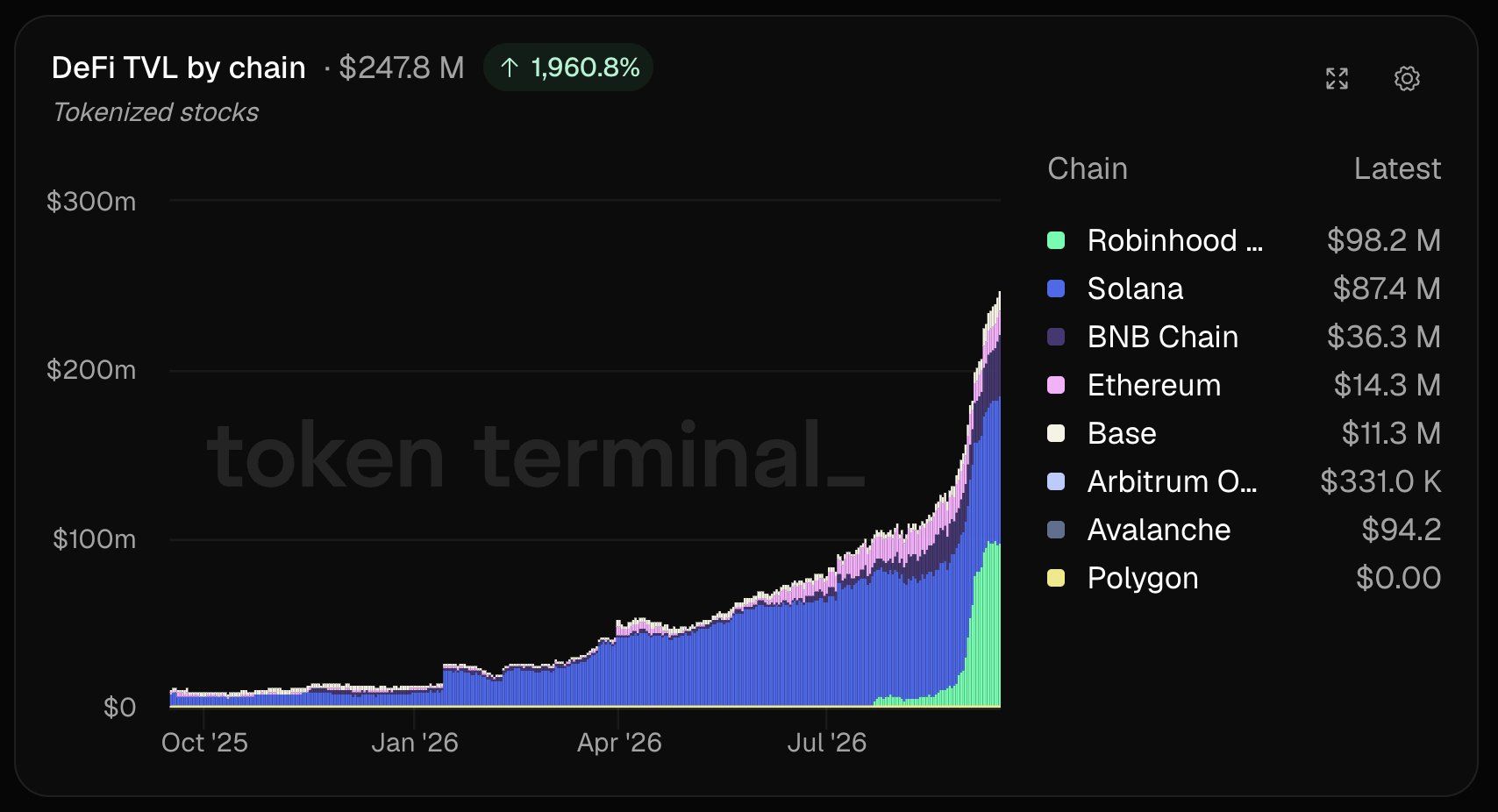
Tokenized stock total value locked (TVL) in decentralized finance (DeFi) protocols climbed 1,961% over the past year to $247.8 million. Token Terminal published the figures on Thursday.
Binance Research links the growth to wider onchain infrastructure. Lending, smart contract deployment, and stock-paired markets now give tokenized equities a role beyond passive ownership.
3 Chains Hold Almost All the Tokenized Stock TVL
Robinhood Chain accounts for $98.2 million of the total, followed by Solana at $87.4 million and BNB Chain at $36.3 million, Token Terminal said. The three hold 89.5% between them.

Binance Research reached a similar conclusion. According to its report, active DeFi TVL rose from $21.6 million in January to $289.1 million by September 9.
Measured against its own active market cap, DeFi’s share rose from 2.2% to 7.2%. But what are those tokens actually being used for? Binance Research breaks the TVL down by activity.
Liquidity pools account for 65.4%, and lending markets take 28.1%. Yield tokenization accounts for 5.7%, with 0.8% elsewhere.
Meanwhile, the broader base remains far larger. Distributed value for tokenized stocks hit a high near $2.9 billion in mid-September, according to RWA.xyz. Distributed value covers tokens that can move freely between wallets.
Follow us on X to get the latest news as it happens
Collateral and Meme Coin Pairs Lift Turnover
Borrowing data from bStocks puts numbers on the lending share. Outstanding borrowing against bStocks rose from 5.5% of deposited collateral at the end of June to 46.2% by September 10.
That works out to roughly $3.1 million borrowed against $6.8 million of collateral. The pool is small next to the wider market, though utilization has climbed.
Meanwhile, Binance Research noted that tokenized stocks are also generating activity in “markets that are not direct stock-token trades.” Stock-paired meme coin markets generated about $2.49 billion on Robinhood Chain and $2.90 billion on BNB Chain between July 26 and September 9.
Onchain analytics firm SQD studied a Robinhood Chain sample. It found $711.2 million, or 32.1%, of cumulative stock token volume through August 30 came from trades against other tokens, mostly meme coins.
“Tokenized stocks are therefore becoming quote assets for crypto-native trading, which can lift turnover without requiring a proportional increase in buy-and-hold equity demand,” the report added.
Issuance is therefore no longer the constraint. What matters next is how much of that $2.9 billion finds a use once it lands onchain.
Subscribe to our YouTube channel to watch leaders and journalists provide expert insights
The post Tokenized Stocks Draw $247.8 Million Into DeFi: What Are They Actually Used For? appeared first on BeInCrypto.


Hong Kong has laid out plans to expand regulated stablecoin trading, tokenized real world assets and digital bond infrastructure as part of its 2026 Policy Address, while preparing round the clock central bank digital currency settlement under EnsembleTX by the end of the year.
Summary
- Hong Kong plans to allow regulated stablecoins to trade on licensed virtual asset platforms and settle tokenized money market funds.
- SFC rules will be expanded to support tokenized gold and other suitable real world assets on licensed platforms.
- HKMA plans to introduce CBDC settlement and 24 hour operations under EnsembleTX around the end of 2026.
- Digital asset custody surveillance is scheduled to begin in the second half of 2026, followed by expanded market and anti money laundering surveillance in 2027.
The Hong Kong SAR Government said in the policy document released on Sept. 16 that the Securities and Futures Commission will enhance virtual asset licensing rules and develop specific regulatory guidelines for virtual asset service providers.
Regulators plan to improve rules for tokenized investment products so that gold and other suitable real world assets can be issued and traded in tokenized form on licensed platforms. Regulated stablecoins are expected to be permitted for trading on licensed virtual asset platforms and used to settle tokenized money market funds.
The measures form part of Hong Kong’s plan to develop its financial markets through digitalization and tokenization, covering stablecoins, digital bonds, tokenized deposits, wholesale CBDC settlement and digital asset custody surveillance.
Hong Kong plans more regulated stablecoin uses
The stablecoin proposals follow the introduction of Hong Kong’s regulated issuer framework and the first licenses granted earlier this year.
As crypto.news previously reported, the city’s first stablecoin issuer licenses went to two institutions with banking backgrounds in April. The framework requires licensed issuers to maintain eligible reserve assets and remain under ongoing regulatory supervision.
One of the licensed issuers, Standard Chartered backed Anchorpoint Financial, has since started rolling out its Hong Kong dollar backed HKDAP stablecoin.
Anchorpoint opened HKDAP beta access in August for institutional distributors and professional investors. The stablecoin initially supports cross border payments, fiat conversion and settlement involving tokenized real world assets, with HashKey Exchange joining as an authorized distribution partner.
Standard Chartered became the first bank distributor for HKDAP later that month, providing eligible institutional clients and partners with access to the regulated token. The bank said it planned to introduce subscription and settlement services for tokenized money market funds during the fourth quarter of 2026.
Hong Kong’s new Policy Address extends that direction by calling for regulated stablecoins to be traded through licensed virtual asset trading platforms and used for tokenized money market fund settlement.
Tokenized gold and other assets could reach licensed platforms
Tokenization forms another part of the government’s financial market plans, with the SFC expected to improve the regulatory framework for tokenized investment products.
The proposed framework would facilitate the issuance and trading of tokenized gold and other suitable real world assets through licensed platforms, while providing room for new products.
Hong Kong had already set out a regulatory path covering exchanges, stablecoin issuers, dealers and custodians under its second digital asset policy statement in 2025. The framework included plans to support tokenized real world assets and examine legal changes needed for tokenized financial instruments.
Digital bonds have since become a larger part of the city’s tokenization activity. Between 2025 and the first half of 2026, digital bonds issued in Hong Kong accounted for nearly 50% of the global market, according to the Policy Address.
In June, the Hong Kong Mortgage Corporation priced a HK$12 billion digital bond, equivalent to roughly $1.5 billion. The corporation described the transaction as the world’s largest completed tokenized bond issuance, while orders reached around HK$24 billion from more than 100 institutional accounts.
The government now plans to regularize digital bond issuance and explore the use of digital currencies throughout the bonds’ life cycle, including settlement, dividend payments and redemption.
Tests involving tokenized Exchange Fund Bills are scheduled by the end of 2026. More than HK$1.3 trillion worth of Exchange Fund Bills could be used in the program as authorities examine round the clock applications of tokenization for banks’ asset and liability management.
The HKMA’s Tokenised Bond Expert Group will conduct a second phase legal review with the Financial Services and the Treasury Bureau to examine the application of distributed ledger technology in capital markets.
The group, formed earlier this year, includes JPMorgan Securities, HSBC, Standard Chartered Bank, UBS, Ant Digital and HashKey Group among its participants. It was established after Hong Kong had issued more than HK$6.8 billion in tokenized government bonds across multiple offerings.
CMU OmniClear Limited is expected to establish a digital asset platform during 2026 to provide services covering the issuance and settlement of digital bonds.
EnsembleTX targets 24 hour CBDC settlement
Hong Kong’s monetary authority is preparing another part of the settlement infrastructure around tokenized finance.
The HKMA plans to implement CBDC settlement and 24 hour operations under EnsembleTX around the end of 2026, while continuing to explore further applications for tokenized deposits.
Earlier government plans had placed EnsembleTX within Hong Kong’s work on wholesale CBDC infrastructure and tokenized deposits. The 2026 to 2027 Budget said authorities were developing digital asset regulation alongside tokenized bonds, stablecoins and market infrastructure.
The government intends to combine the expansion of those markets with tighter surveillance. The SFC is scheduled to begin operating a digital asset custody surveillance system during the second half of 2026, according to the Policy Address.
Its CrypTech initiative is expected to activate big data market surveillance and anti money laundering surveillance components in 2027. The HKMA has separately started a Quantum Preparedness Index intended to guide financial institutions as advances in quantum computing create a need to upgrade cryptographic systems.

An iOS 27 Bug Can Temporarily Freeze Your iPhone

Girl On Couch, Billen Ted – Man In Finance (Lyrics)

King at war with Diana’s brother after astonishing response to Earl’s claim that he said she would be ‘forgotten’ days after her death



-

 Fashion6 days ago
Weekend Open Thread – Corporette.com
-

 Tech4 days ago
The Latest Weird Thing to Play Doom Is the Mapped-Out Brain of a Fruit Fly
-

 Business6 days ago
10 Most-Streamed Songs On Spotify In 2026 So Far, Led By Ella Langley’s Dominant Run On The Charts This Year
-

 Crypto World6 days ago
XAG/USD: Silver’s Short-Term Rally Meets Its Moment of Truth
-
 Crypto World7 days ago
2 Chip Stocks Broke Out This Week. Neither Was Nvidia
-

 Tech6 days ago
Battery life is the only iPhone 18 Pro and iPhone Duo upgrade I care about. Apple didn’t disappoint
-

 Crypto World6 days ago
OKX launches 10x OpenAI, Anthropic X-Perps in Europe
-

 Crypto World6 days ago
Diesel Tops $6 a Gallon for the First Time as 28 States Set Records
-

 Crypto World3 days ago
Elon Musk Drops a Bombshell: Grok 5 Could Be the AGI Breakthrough
-

 Business7 days ago
Western Digital Slips 2.7% as AI Storage Rally Cools After Record Cash and Guidance
-

 News Videos6 days ago
Facing Financial Fears
-

 Business4 days ago
Rivals Sam Altman and Elon Musk Rally Behind Dario Amodei’s Call for a Slowdown in AI Development
-
Crypto World6 days ago
Ethereum Price Analysis: Consolidation at $2.5K Tests Momentum as On-Chain Activity Surges
-

 Business7 days ago
Five Leading AI Experts Warn Superintelligence Could Kill Humans and Explain Their Case
-

 Crypto World5 days ago
Can AI Build a Startup in 72 Hours? Elon Musk's Team Will Livestream the Test
-
 NewsBeat3 days ago
‘Sick conspiracy’: Trump says only guardrails AI needs is ‘a strong and smart (High IQ!) president’ in all-caps rant
-

 Crypto World2 days ago
Kraken Lets xStocks Holders Earn Yield Through DeFi
-

 Entertainment5 days ago
News Specials, Movies, Shows, More
-

 Crypto World6 days ago
Bitcoin ETFs Pull $167M as 2026’s Best Inflow Run Slows
-

 Crypto World6 days ago
US CPI forecast at 3.4% as tariff risks build
You must be logged in to post a comment Login