Connect with us

Business

Backstreet Surveillance on the Future of Commercial Security

Published

on

Backstreet Surveillance on the Future of Commercial Security

The company has built its reputation around commercial surveillance systems, mobile surveillance trailers, security consulting, and expert system design. Its approach focuses on helping businesses choose and apply security technology based on the needs of each site.

Backstreet Surveillance works with a range of commercial security tools. These include high-definition cameras, motion detection, remote access, low-light technology, facial recognition, and licence plate recognition. Its systems are designed to support monitoring, recording, theft prevention, operational oversight, and security planning.

A key part of the company’s work is system design. Backstreet Surveillance looks beyond individual cameras and considers how equipment should work together across a commercial property. The company also provides installation support and troubleshooting to help customers use their systems effectively.

Free newsletters
Advertisement

The stories that matter to UK business, straight to your inbox.

Advertisement

Beyond its security systems, Backstreet Surveillance has developed a wider industry presence through educational content. Its YouTube channel, Backstreet Surveillance | The Security Experts, covers surveillance technology and practical security topics. The company is also connected with the podcast Beyond the Demo | The Ground Truth.

By combining commercial security experience with practical technology and industry education, Backstreet Surveillance has positioned itself as a knowledgeable voice in the evolving surveillance sector.

How did Backstreet Surveillance develop its focus on commercial security?

Our work has become centred on the needs of businesses and commercial properties. These locations often have more complex security requirements than a simple camera installation can solve.

A commercial site may have several entrances, vehicle access points, parking areas, warehouses, outdoor spaces, or areas that need different levels of monitoring. We focus on understanding those needs first and then designing a system around them.

Advertisement

Why is system design so important in commercial surveillance?

The camera itself is only one part of the system. Where it is placed, what it needs to capture, how it performs in different lighting, and how people access the footage all matter.

That is why we place a strong emphasis on expert design and application. A business can invest in advanced equipment, but the system still needs to be planned correctly to be useful.

How has surveillance technology changed the way businesses manage security?

There are more tools available now to give businesses better visibility.

Remote access is one example. It gives operators the ability to view their cameras even when they are away from the property. Motion detection can also help teams focus attention on activity rather than constantly watching a screen.

Advertisement

High-definition video has improved the level of detail available as well. That can be especially valuable when a business needs to review an event later.

What role does licence plate recognition play in commercial security?

Licence plate recognition can be useful for businesses that need to monitor vehicles entering or leaving a site.

That may include parking areas, commercial properties, industrial locations, or facilities with controlled access. It gives businesses another source of information when vehicle activity is important to their security plan.

As with any security technology, the value depends on how and where it is used.

Advertisement

Why has low-light performance become an important feature?

Commercial properties do not stop needing security when daylight ends.

Parking areas, warehouses, yards, entrances, and other exterior locations may need monitoring throughout the night. Cameras that perform well in low-light conditions can help maintain image quality during those hours.

Durability also matters. Outdoor equipment has to be able to operate in different weather conditions and environments.

Where do mobile surveillance trailers fit into modern security planning?

Mobile surveillance trailers provide flexibility.

Advertisement

Not every location needs or can support a permanent security installation. Construction sites, temporary work areas, large outdoor properties, and changing commercial environments may need surveillance for a certain period of time.

A mobile system can allow businesses to place security technology where it is needed without treating every situation as a permanent installation.

How does Backstreet Surveillance approach customer support?

Support is an important part of the process because installing equipment is not the end of the job.

Businesses need to understand how their systems work. They may need help with installation, settings, remote access, troubleshooting, or future changes.

Advertisement

We have always viewed those practical questions as part of the overall security experience. The goal is for the system to work as intended in the real environment where it is being used.

Why has Backstreet Surveillance invested in educational content?

Commercial security can become technical very quickly. There are many camera types, system features, recording options, and technologies to consider. Educational content gives us a way to explain those subjects in practical terms.

Our Backstreet Surveillance | The Security Experts YouTube channel is one way we share that information. The Beyond the Demo | The Ground Truth podcast also creates space for wider conversations about security technology and what happens beyond a simple product demonstration.

What do you think businesses should consider before choosing a surveillance system?

They should begin with the problem they are trying to solve. A business should think about what areas need to be monitored, what level of detail is required, whether remote access matters, what happens at night, and whether vehicles or large outdoor spaces are involved.

Advertisement

The best starting point is not simply asking which camera has the most features. It is understanding what the system needs to accomplish.

What is next for the commercial security industry?

We expect security systems to continue becoming more connected and more flexible.

Businesses are looking for clearer images, easier access to information, better monitoring tools, and systems that can adapt to different environments.

The technology will keep developing, but good design will remain important. A strong commercial surveillance system still depends on matching the right tools to the right application.

Advertisement

Continue Reading
Click to comment

You must be logged in to post a comment Login

Leave a Reply

Business

Okta: Just Another Overpriced Story Stock Within Cybersecurity (NASDAQ:OKTA)

Published

on

Movie Clapperboard Storytelling Concept

This article was written by

Thematic. Top down. I often find the theme before I find the stock. My philosophy is that themes are often born quiet and die loud. I try to catch them while they’re still finding their voice. When the music plays, I mainly chase pockets that rhyme with growth, momentum, perception shifts, and sometimes even the most absurd narratives (mostly AI-related). When the music slows and the tape deteriorates, I don’t wait around. I raise cash/rotate out, and watch for the next setup. A parabolic run may trigger a similar move. During a bull run, you won’t find much common ground between the deep value crowd and me. I liked the core ideas of deep value investors, and I briefly followed that philosophy. However, it demands patience, and the AI supercycle broke whatever patience I had left. The market changed, and so did I. My style is not set in stone. I’m mostly long when the music is playing. When it stops/slows down, I may dabble with shorts via put options, although it’s not my forte. My style is highly speculative. I have a high risk tolerance that most rational investors would find alarming. I don’t have a favorite timeframe. That said, I trade mostly the mid-term and the short-term. I have a pathetic low six-digit portfolio, and I consider myself part of the mid to low end of the K-shaped economy. It sometimes drops to the five-digit range when life has other plans. I’ve been in the game since mid 2024, although my first dabbles with stocks (i.e., burning $100 trading accounts in a matter of days) go back to the early/mid 2010s. I have a B.Sc. in aeronautical engineering and experience as a consultant in the aerospace sector. The latter statement is not relevant to my investment style, but I thought to add it for self-indulgent purposes. I live on the wrong side of the Atlantic. The opening bell is my lunch bell. I like astrology, so I’m a follower of technical analysis (mainly trends and support/resistance/psychological levels). I also look at the fundamentals of individual names, although the theme and the macro often prevail in my decision-making. I dislike empty suits, high-level BS, deep-level BS (especially), unnecessary jargon, and self-indulgent, third-person written introductions with an air of superiority.

Analyst’s Disclosure: I/we have no stock, option or similar derivative position in any of the companies mentioned, and no plans to initiate any such positions within the next 72 hours. I wrote this article myself, and it expresses my own opinions. I am not receiving compensation for it (other than from Seeking Alpha). I have no business relationship with any company whose stock is mentioned in this article.

I am not a registered investment adviser, broker, dealer, or tax professional. This article, including any comments or replies I post, reflects my personal opinions only and is provided for informational and educational purposes. Nothing I write is investment, legal, tax, or financial advice, or a personalized recommendation to buy, sell, hold, or short any security. My views may change without notice. Nothing I write is tailored to any reader’s objectives, financial situation, risk tolerance, or portfolio. Investing involves risk, including possible loss of principal. Readers should conduct their own research and consult a qualified professional before making investment decisions.

Advertisement

Seeking Alpha’s Disclosure: Past performance is no guarantee of future results. No recommendation or advice is being given as to whether any investment is suitable for a particular investor. Any views or opinions expressed above may not reflect those of Seeking Alpha as a whole. Seeking Alpha is not a licensed securities dealer, broker or US investment adviser or investment bank. Our analysts are third party authors that include both professional investors and individual investors who may not be licensed or certified by any institute or regulatory body.

Continue Reading

Business

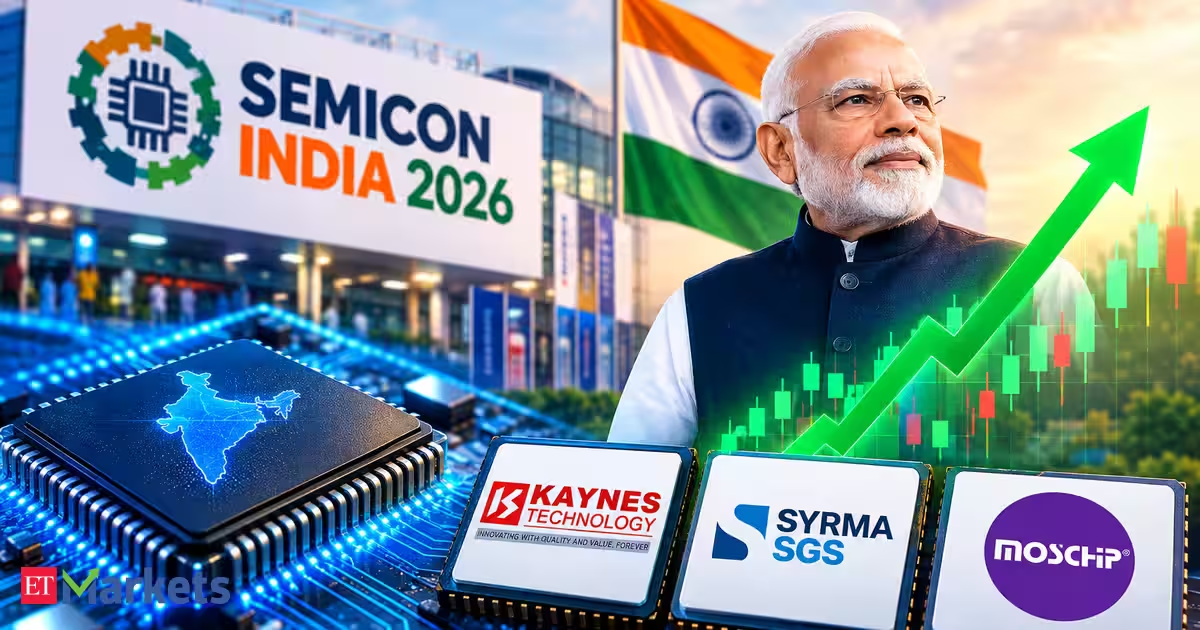
Kaynes Tech, Syrma SGS, MosChip, others rally up to 10% as PM Modi set to inaugurate Semicon 2026

Published

on

Kaynes Tech, Syrma SGS, MosChip, others rally up to 10% as PM Modi set to inaugurate Semicon 2026
Shares of Kaynes Technology India, Syrma SGS Technology, MosChip Technologies, among others gained up to 10% on Thursday as investor attention turned to India’s semiconductor ecosystem ahead of Prime Minister Narendra Modi’s inauguration of the fifth edition of Semicon India 2026.

The event is set to showcase the country’s semiconductor value chain, spanning materials, equipment and chip design to fabrication, advanced packaging, electronics and systems.

Kaynes Technology rose 5% to an intraday high of Rs 3,563 on the BSE, while Syrma SGS Technology gained 10% to Rs 1,658 per share. MosChip Technologies also advanced more than 6% to Rs 212 per share.

Why are semiconductor stocks rising?

Kaynes Technology India is establishing a semiconductor manufacturing facility in Gujarat with an investment of Rs 3,307 crore, focused on wire-bond interconnect and substrate-based packages. The facility is expected to have capacity to produce more than 6.33 million chips per day.
Syrma SGS, meanwhile, is part of the broader electronics manufacturing ecosystem that could benefit as India pushes for greater domestic component manufacturing and localisation. The company has also recently received approval for a Rs 60 crore coil manufacturing project under the Electronics Components Manufacturing Scheme, while it has been expanding its EMS footprint through partnerships and new facilities.

Advertisement


MosChip is a semiconductor and product engineering company that designs custom computer chips and smart electronic systems.
India’s semiconductor sector has attracted $1.4 billion in all-time equity funding across 281 funded companies, with nearly half of this amount – $701 million – raised since 2025 alone, according to data from Tracxn.The growing investor interest comes as India attempts to build a semiconductor ecosystem beyond chip design and electronics assembly.

The government launched the India Semiconductor Mission (ISM) in 2021 with a Rs 76,000 crore outlay, covering the semiconductor value chain from chip design and fabrication to packaging, testing, equipment, materials and talent.

Read more:NSE IPO Tracker: Catch all the highlights here

Semicon India 2026: What is PM Modi saying?

Prime Minister Narendra Modi on Wednesday urged global and Indian semiconductor companies to actively participate in the next phase of India’s semiconductor growth, calling for greater industry involvement in skilling, innovation and emerging technologies such as artificial intelligence and quantum computing.

Modi chaired a roundtable with leading semiconductor industry CEOs at Seva Teerth, where he stressed closer collaboration between the government and the industry as India seeks to expand its capabilities across the semiconductor value chain.

Advertisement

Modi reiterated the government’s commitment to maintaining a predictable and responsive policy environment for the semiconductor sector. At the same time, he said policies would need to evolve in line with technological advances and industry requirements.

Earlier this year, the government approved Semicon 2.0 with a proposed outlay of Rs 1.27 lakh crore. The programme focuses on six areas: chip design, semiconductor equipment and materials, fabrication facilities, advanced packaging, research and development, and talent development.

Disclaimer: The views/recommendations mentioned in this article, wherever applicable, are those of the respective SEBI-registered Research Analyst/brokerage and have been reproduced/reported with due attribution. They should not be construed as the views or recommendations of The Economic Times Digital or the journalist. Readers are advised to consider the original research report and make their investment decisions based on their own assessment. Brokerage disclaimers here

Advertisement
Continue Reading

Business

Fluence Energy, Inc. (FLNC) Q4 2026 Guidance Call Transcript

Published

on

OneWater Marine Inc. (ONEW) Q1 2026 Earnings Call Transcript