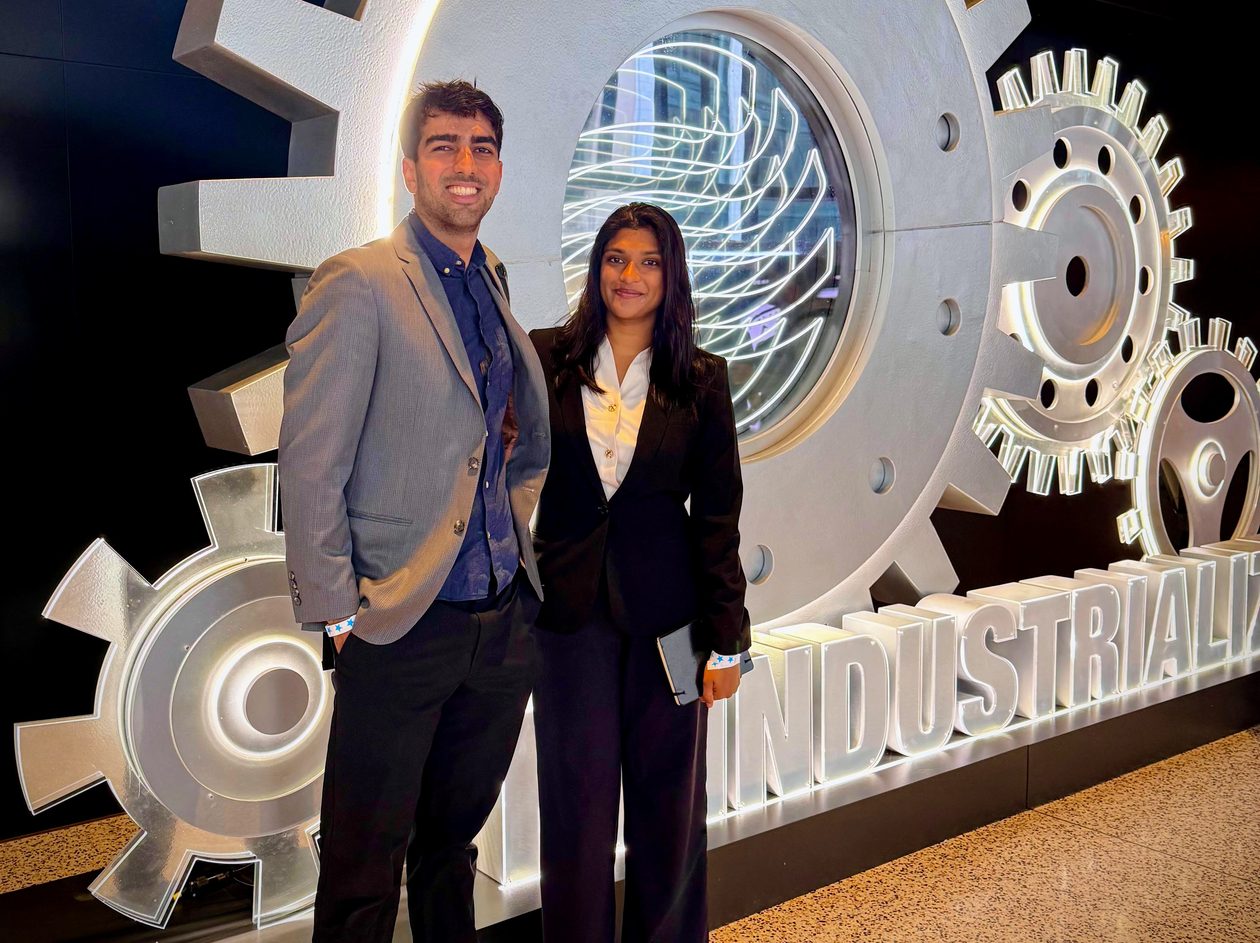
Neuramill co-founders Nick Khormaei (COO) and Nistha Mitra (CEO) at the Reindustrialize summit in Detroit. (Photo courtesy of Neuramill)
When machinists with decades of experience retire, everything they know about how metal behaves under a cutting tool — or anything else they learned through a career of scrapped parts and expensive mistakes — walks out the door with them.
A startup with roots in Seattle, started by two founders in their 20s, is building technology to capture that knowledge long before that point.
Neuramill, founded last year by CEO Nistha Mitra and COO Nick Khormaei, is developing what the company calls an intelligence layer for high-precision manufacturing.
The software reads a design file and figures out how the part should be made: which tools, which machines, and in what order. A machinist reviews and approves every plan before anything reaches the floor.
“This is a high-skill job, and nobody’s retaining this information,” Mitra said. When the machinists who know how to build complex jet engine parts retire, she said, that knowledge goes with them. “We help retain that for the future generation.”
Advertisement
Khormaei said the two founders spent much of the past year visiting machine shops to watch how the work gets done.
“The craft itself is so impressive,” he said. “They’re able to look at these drawings and models that come in and know exactly how to build it. It’s like they’re doing real-time physics simulation.”
Early customers and partners: The company says it has closed a six-figure contract with a major defense contractor, one of the companies known in the industry as primes. Neuramill declined to name the contractor.
Two of the machine shops using the software are Diamond Machine Works, a Seattle precision machining company founded in 1959, and VTN Manufacturing in San Jose, Calif. Satellite maker Astranis is a design partner.
Advertisement
Mitra said the company is not yet selling broadly, but has been paid by some of the early customers testing the software.
How they got here: Mitra, 26, has a computer science degree from the University of Maryland and spent three years at Oracle, most recently as an AI applied scientist in Seattle, working on multimodal models that reason across several kinds of data at once.
Khormaei, 24, holds bachelor’s and master’s degrees in electrical engineering from the University of Washington. He was a propulsion engineer at Boeing in Everett, where he worked on 777X fuel system electrical certification, and then spent part of last year at SpaceX as an integration and test engineer on Starlink manufacturing in Redmond.
Where the software fits in: Neuramill’s technology works at a stage that has stayed largely manual: after the design file arrives, and before a programmer opens the computer-aided manufacturing (CAM) software that translates decisions into machine instructions.
Rather than position the company against Siemens and Mastercam, Mitra said Neuramill plugs into those systems. The company recently joined Siemens’ Frontier Partner Program, which gives startups access to the company’s software tools.
“At this point we are very collaborative with these companies,” she said, adding that the established vendors are looking for new technology of their own.
Bay Area and Seattle: Both founders worked in the Seattle region before leaving for San Francisco, a move Mitra described to GeekWire in February. They are back every four or five weeks now, working out of Foundations, the Seattle founder hub.
Advertisement
“We love this ecosystem. It gave birth to Neuramill,” Mitra said. They keep coming back in part for the customers: “This is a booming ecosystem in space and in aerospace.”
Funding and team: Neuramill has raised an undisclosed amount from Ascend, Breakwater Ventures, Schema Ventures, Creative Destruction Lab, Acequia Capital and Correlation Ventures.
The team is six people plus a contractor: the two founders, a chief research scientist who worked with Mitra at Oracle, and three engineers, one of them a machinist.
What’s next: The long-term goal, Mitra said, is a “world model” for manufacturing: a system that can reason across geometry, materials and machine behavior at any level of complexity. Even then, she sees a role for the people on the shop floor.
Advertisement
“There is a beauty to the craft of manufacturing that we should really respect,” she said. “There are some places where humans should not be extracted out of an industry, and I think manufacturing is one of them.”
Spain’s data protection agency (AEPD) reported its first breach carried out by an autonomous AI agent
Agent chained multiple attack stages: accessed public files, scanned systems, exploited a flaw, and modified data
AEPD urged businesses to factor AI‑driven attacks into risk assessments, stressing faster response and stronger identity controls
A Spanish company was apparently hit with a data breach conducted by an autonomous AI agent.
Earlier this week Francisco Pérez Bes, president and deputy of the Spanish data protection agency (AEPD) published a new article on the agency’s blog, saying it “received the first notification of a personal data breach in which the incident was reportedly carried out using an artificial intelligence agent powered by a well-known large language model.”
As per Pérez Bes, the agent first used the target’s “publicly accessible files”, through which it was able to log into its system. From the inside, the agent then started scanning for vulnerabilities and after finding one, used it to modify personal data and gain access to invoices.
Latest Videos FromTechRadar
Advertisement
A call to action
The author stresses that there is very little known about this incident and that a thorough investigation is currently ongoing. He pointed out that the attack doesn’t imply the AI model or the provider’s infrastructure were compromised or malicious by design, but said that the attack was “significant from a data protection perspective,” since the AI agent was used to chain together multiple stages of the attack.
For Pérez, the attack is a call to action – businesses need to rethink how they assess and manage security risks. He claims businesses need to “explicitly account for AI-assisted and AI-driven attacks when assessing the risks associated with personal-data processing,” and need to reassess their response times.
“Procedures designed around manually executed attacks may not be sufficient when an AI agent can analyze multiple assets at once, test different avenues of attack, and rapidly adapt its behavior based on what it finds.”
He also stressed the “growing importance of digital identities and credentials,” since an AI agent with an account or an API key “can operate at machine speed and move across different services before an organization has time to detect the anomalous activity.”
Sign up to the TechRadar Pro newsletter to get all the top news, opinion, features and guidance your business needs to succeed!
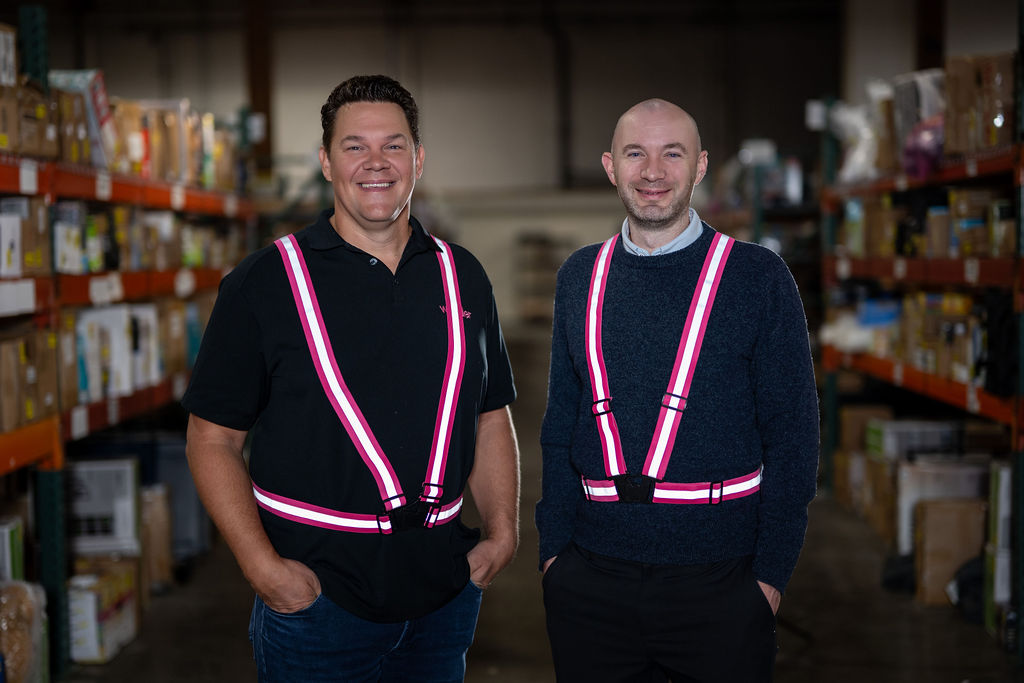
BuyWander co-founders Jordan Allen, left, and Brock Kowalchuk. (BuyWander Photo)
BuyWander, an auction-based online marketplace for returned and overstocked retail items, announced Tuesday that it has raised $21 million in a Series A funding round led by Madrona Venture Group and Inspired Capital.
The fresh capital comes on the heels of the startup relocating its headquarters from Spokane, Wash., to the Seattle area to tap into the region’s deep pool of tech and retail talent and accelerate its nationwide warehouse expansion.
Founded in 2023 by CEO Jordan Allen and CFO Brock Kowalchuk, BuyWander connects bargain-seeking shoppers with inventory from major retailers like Amazon, Target, Walmart, and Home Depot.
Bidding on all items starts at $1 in fixed seven-day auctions, with customers picking up their winning purchases directly from local fulfillment centers to bypass shipping costs. The new funding — which brings total raised to date to $28 million — will fuel technology investments and power nationwide market expansion following recent warehouse launches in Denver and Chicago.
“This is blue ocean right now,” Allen said in an interview with GeekWire. “Nobody’s really built an incredibly strong consumer brand in this retail return space — what we call the intersection of the weird meets the wonderful underneath this misfit inventory. These items deserve a second chance, and as people have to tighten up their wallets, we’re an incredible option for them to buy the things they want and love.”
Advertisement
BuyWander officially relocated its corporate headquarters from Spokane to the Seattle area in August, establishing its central hub out of Kent, Wash., where 45 of its employees are based. The startup initially entered the region with a cramped facility to prove out local demand, but recently upgraded to a 52,000-square-foot warehouse that can process three to five times more volume for local shoppers.
Across its expanding national footprint — which now spans eight fulfillment locations — BuyWander’s total workforce has surged to 325 people, with the vast majority working in intake, stocking, and customer service.
“Spokane was a wonderful place to start the company,” Kowalchuk said. “It was where we were living at the time, and we were able to get a lot of feedback very iteratively. But getting to the size where we are today and building out that leadership team really requires a little bit more talent density that Seattle can provide with deep roots in retail and deep roots in tech.”
Allen previously founded Stay Alfred, a Spokane-based short-term rental company that shut down in 2020, amid the pandemic, after expanding to more than 30 cities.
Advertisement
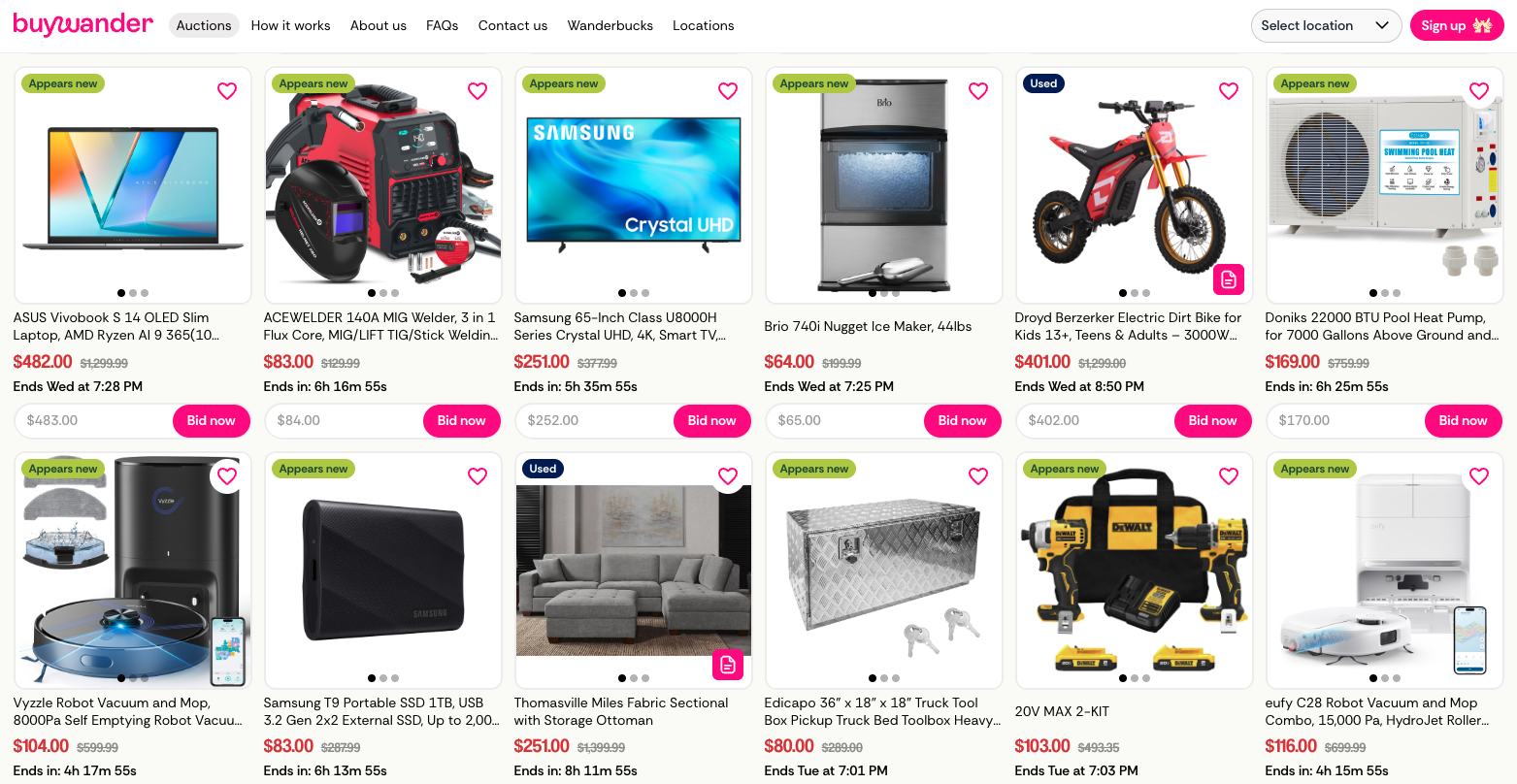
Dirt bikes, TVs, tools and more: A snapshot of auction items visible on BuyWander’s marketplace. (BuyWander.com screengrab)
Behind the scenes, AI is now helping BuyWander process and list hundreds of thousands of unique items each month. Historically, manual data entry and poor photography created a bottleneck for resale platforms. Today, automated tools instantly identify returned products, pull in retail valuations, and generate detailed listings with a single click.
“There’s been a ceiling on this business historically because of the technology required,” Allen said, adding that AI now optimizes everything from auction scheduling to appointment bookings. “It feels like World War II and Star Trek at the same time and we’re merging these two worlds together.”
To better capture regional markets, BuyWander plans to increase facility density in key metro areas. In the Puget Sound region, Allen noted that traffic and geography often create a barrier between regional hubs, pointing to plans to open four to five warehouses across the greater Seattle area over the next few years to keep pickup convenient for local shoppers.
Beyond bargain hunting, the circular model addresses a massive environmental headache for retailers, who often dispose of returned goods simply because their systems aren’t built to re-process them locally.
Total U.S. retail returns reach roughly $850 billion annually, driven heavily by online shopping, where return rates hover near 20%, according to data from the National Retail Federation and Happy Returns. For retailers, processing a single return can cost between 20% and 65% of the item’s original retail price once return shipping, inspection, and restocking are factored in — making local secondary marketplaces an increasingly vital alternative to taking a total loss.
“Some of these brands and retailers were throwing this stuff away, and it just feels kind of criminal,” Allen said, pointing out how returned items often get trucked back and forth across the country. “You can buy a Seahawks jersey, and it gets returned in the mail back to Hebron, Kentucky, and ends up loaded up on a truck, ending up in Miami. The stars really align when the stuff can be sold locally where the demand already was to begin with.”
BuyWander’s expansion is backed by rapid operational momentum, hitting 400% year-over-year growth as it expands nationally. The platform now counts 50,000 active and winning customers who have saved a cumulative $200 million — averaging roughly $4,000 in savings per customer. Over the past month alone, the company sold nearly 500,000 unique items across its eight warehouse locations, with goods selling for an average discount of 75% off retail prices.
Advertisement
According to Kowalchuk, roughly 80% of the returned goods arrive in “appears new” condition with only minor packaging damage. About 80% of buyers are end consumers using the platform for everyday shopping, while 20% are local resellers — a customer base Allen says grows almost entirely organically, with nine out of 10 shoppers joining via word-of-mouth referrals.
The platform offers a sprawling, unpredictable lineup of products — having sold everything from electronic cow milkers, log splitters, and commercial ice cream machines to everyday staples like hair dryers and air fryers.
“It is probably one of the best product discovery platforms out there,” Allen said, predicting the company will eventually sell a bit of everything listed on the internet. “We’ll get hilariously fun items, like foam blasters right after spring break or 12-foot tall skeletons right after Halloween. That’s why it’s odd, and that’s why the deals are so good.”
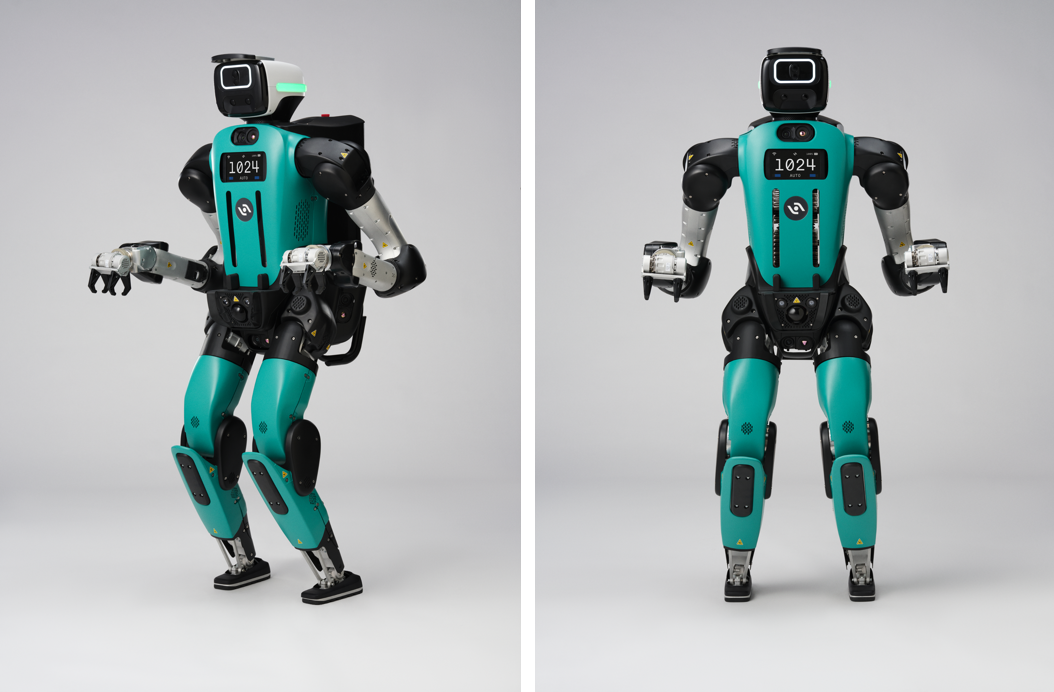
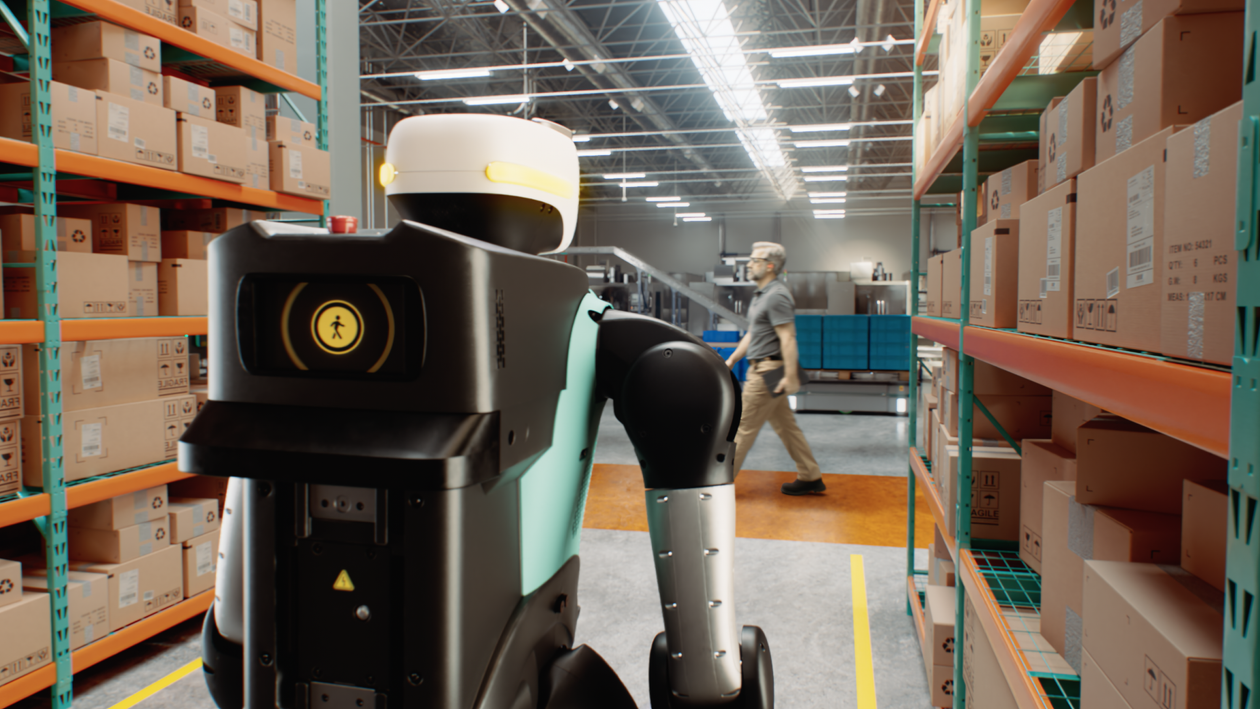
Two views of Agility Robotics’ new Digit 5, which is designed to work alongside people without safety barriers. (Agility Robotics Photo)
Agility Robotics unveiled the next version of its Digit humanoid robot, which it says is designed to work safely alongside people in warehouses and factories without the barriers that are usually required.
The Salem, Ore.-based company, which is preparing to go public through a $2.5 billion SPAC merger, said Digit 5 is its first humanoid built for “cooperatively safe” work at scale.
The robot uses AI and multiple sensors to watch for nearby people. Depending on the situation, it steers around them, stops or sits down. Visual and audio cues signal what it’s about to do, and a separate safety controller triggers its responses when someone gets too close.
Digit 5 can lift up to 50 pounds, 40% more than its predecessor, and reach objects as high as 7.2 feet off the ground, up from 5.5 feet, according to the company. A new battery runs for 90 minutes and recharges in 9 minutes, which Agility says allows more than 20 hours of work in a 24-hour day. Its grippers can be swapped for different jobs.
Digit 5 signals that it has spotted a nearby worker in this rendering. (Agility Robotics Image)
Digit 4, the current model, has mostly moved totes, logging more than 65,000 hours at customers including GXO, Schaeffler, Amazon and Toyota’s Canadian manufacturing arm, according to the company. Agility says Digit 5 will take on more of a facility’s work — unloading pallets, tending machines, gathering parts and inspecting items before loading them back onto pallets for shipment.
Amazon, an early Agility investor, has run multiple pilots of earlier Digit models, including one GeekWire observed at a warehouse south of Seattle in 2023. It bought five Digit robots for $1.05 million, according to Agility’s S-4 registration statement, filed with the SEC this month in connection with its merger with Churchill Capital Corp XI, a special purpose acquisition company.
Agility says it had more than $300 million in multi-year orders for Digit 5 as of May, contingent on hitting certain milestones. According to the S-4, those orders are from one customer, for 1,000 robots over three years. The filing doesn’t name the customer, but it also describes a May deal for at least 1,000 robots with a “related party,” an accounting term for those with close ties to a company, such as major investors.
Agility had $1.78 million in net sales in 2025, up from $310,000 the year before. Its loss from operations doubled to $140.2 million.
Its auditor, Grant Thornton, included a going-concern warning in the report, citing substantial doubt about the company’s ability to keep operating. Agility said in the filing that the cash forecasts behind that conclusion didn’t take into account the SPAC deal, which the companies said in June could provide more than $620 million in gross cash proceeds before any shareholder redemptions.
In the S-4, Agility names Boston Dynamics, Tesla, Apptronik, Figure AI and 1X Technologies among its competitors, many of which it describes as well-funded.
Advertisement
Early access to Digit 5 is expected to begin in the first half of 2027, with general availability by the end of the year. The robots are assembled at the company’s RoboFab factory in Salem, which is designed to produce up to 10,000 robots a year.
OpenAI launched ChatGPT Images 2.5 last week, bringing all sorts of impressive upgrades to the way it generates images. The company says the latest model will bring us “sharper details, faster generation, more precise editing, and better tools for creating and sharing.”
But it’s not all good news. We’re still a little disappointed by the presence of telltale noise patterns in some of its creations. TechRadar writer Eric Hal Schwartz described the problem well: “Everything gets a gritty, sandy look, and nothing looks clean for some reason.”
Advertisement
Latest Videos FromTechRadar
What I’m most interested in isn’t necessarily how good ChatGPT’s new image capabilities are, but whether they can realistically pass as genuine photos.
Is this real or AI?
I’ve written before about how I love to comb through the r/isthisAI subreddit, where people post suspicious images and ask everyone else to help them work out whether they’re real.
Advertisement
It’s fascinating but also concerning when you see the number of scams, fake viral posts and completely fabricated people that are now floating around online.
So yes, ChatGPT Images has improved. But has it reached the point where AI images are becoming genuinely different to distinguish from real ones?
Sign up for breaking news, reviews, opinion, top tech deals, and more.
Advertisement
The jury’s still out. I think we’ll need a bit of time to experiment ourselves and for r/isthisAI to fill up with new images.
The Redditor who started the thread shared the resulting image of a young woman. And, at least at first glance, there’s very little about her that screams AI to me.
Can you actually tell which photos are AI now?
I decided to experiment with ChatGPT Images myself, especially with prompts like the Reddit thread in which I tried to get the chatbot to make the most realistic-looking images.
To make the comparison feel as fair as possible, I went through photos from my own travels this summer and picked some I was happy to share. I then asked ChatGPT to create extremely realistic images with similar subjects, settings and compositions.
For some, that meant asking for a realistic photograph of a blonde woman. For others, I recreated the kinds of ordinary travel photos sitting in my camera roll, which was meals in restaurants, boats in harbors and scenes from walks.
Advertisement
Importantly, I wasn’t trying to make spectacular AI art, I really wanted the opposite. Images that were boringly believable.
Take the quiz below to see if you can guess which are the real photos of my travels this summer and which are ChatGPT-generated.
Is that gritty, sandy look still enough to give the AI ones away? Can you focus less on the faces and spot strange details in the backgrounds? Or have we reached the point where your first instinct simply isn’t reliable anymore?
Take the quiz and tell me how you get on in the comments below.
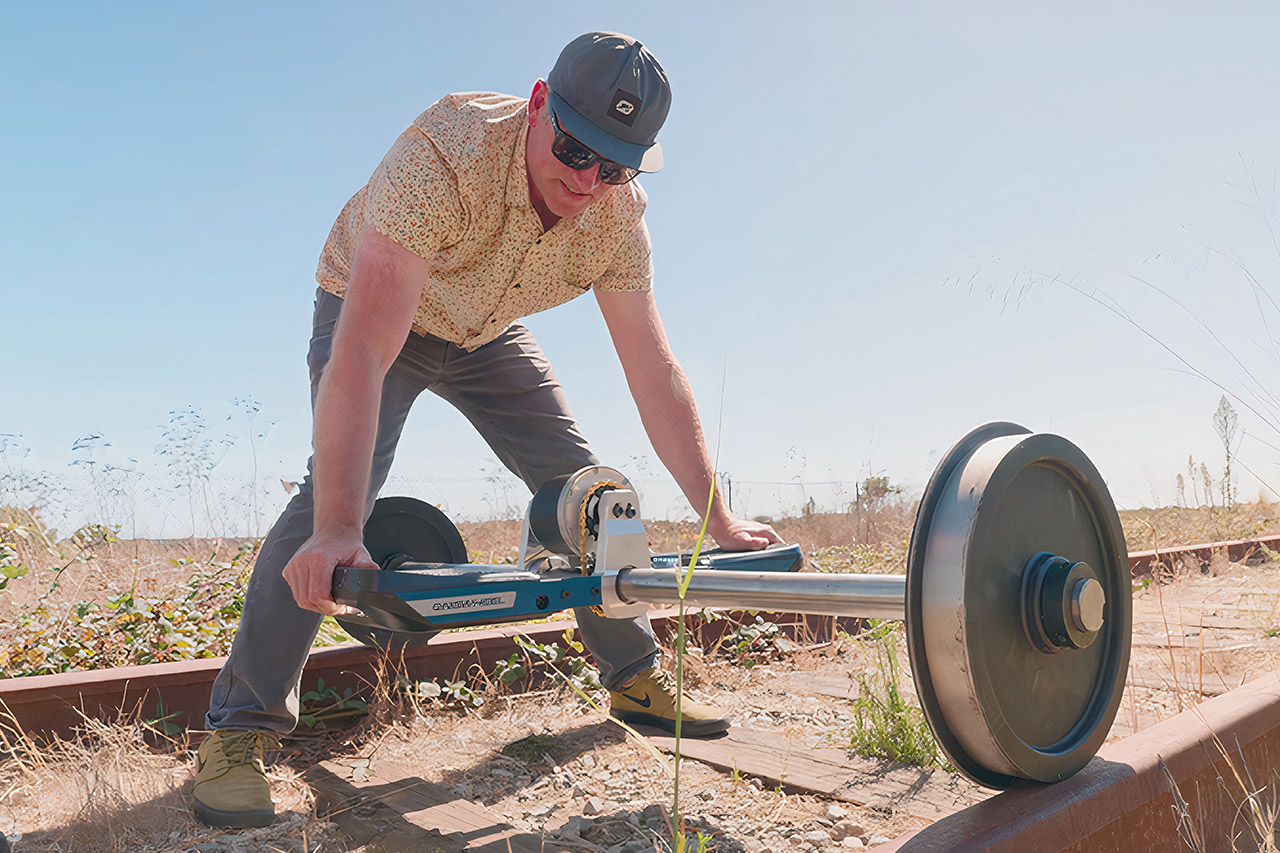
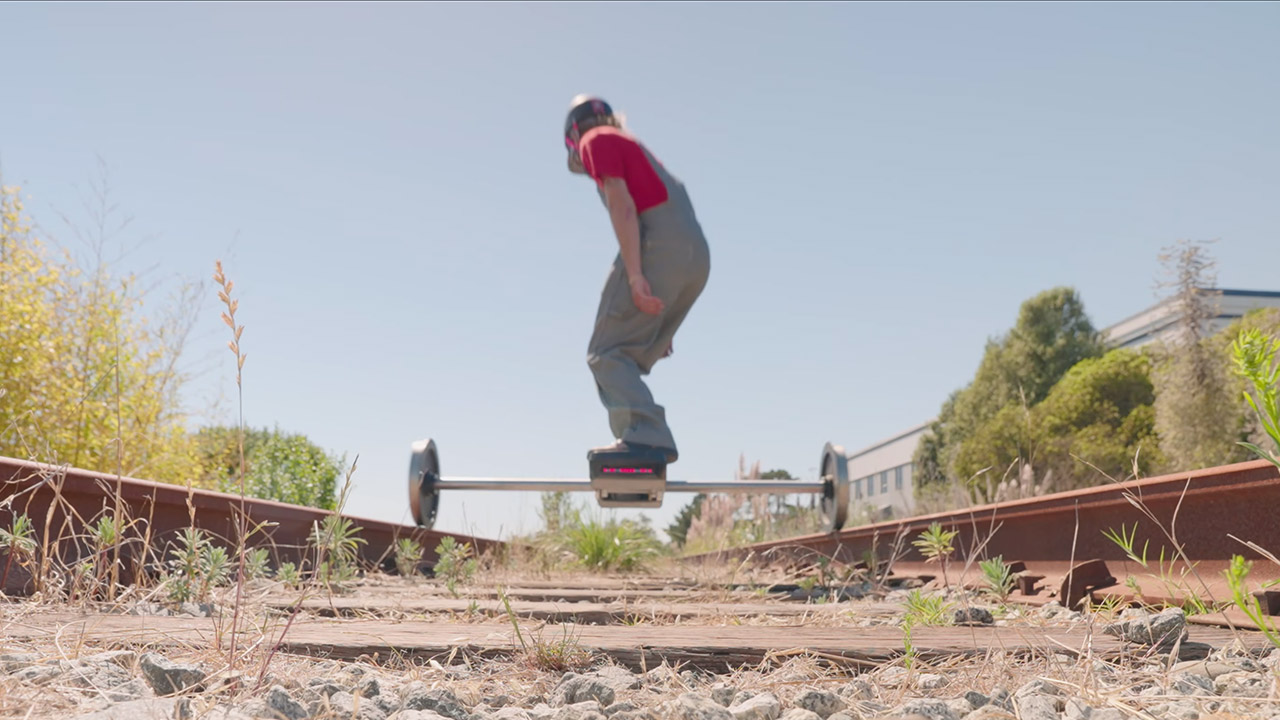
Future Motion’s Santa Cruz shop looks out on the Pacific. About thirty feet from the door sits a stretch of abandoned railroad Kyle Doerksen had been staring at for years. In September 2026 he pulled a bone-stock XR Classic off the shelf and decided that line was going to carry a Onewheel.
The plan was simple: insert a railroad axle through the hole that ordinarily houses the hub motor. First, lift the motor out of the way. Teach a gearless direct-drive engine to pull a chain rather than spinning a hub while keeping the self-balancing board’s brain intact, allowing the rider to maneuver by leaning. They cut up the stock frame and added some CNC mounts in the middle so the motor could sit on top of the deck instead of taking up the former wheel space. Then they slapped some massive steel rail wheels from eBay, weighing over 70 pounds, onto an axle that now serves as the original center line. The first test run consisted of just the axle and wheels on the tracks, with no motor or board, to ensure that the gage was accurate. When the steel slid easily over the steel, it was very much a green signal.
Unlike traditional electric unicycles, which typically have one wheel and one tire, the INMOTION E20 features a single wheel with dual tires. This…
The E20 is designed for simplicity and stability. Our proprietary dynamic self-balancing algorithm maintains both front and rear balance…
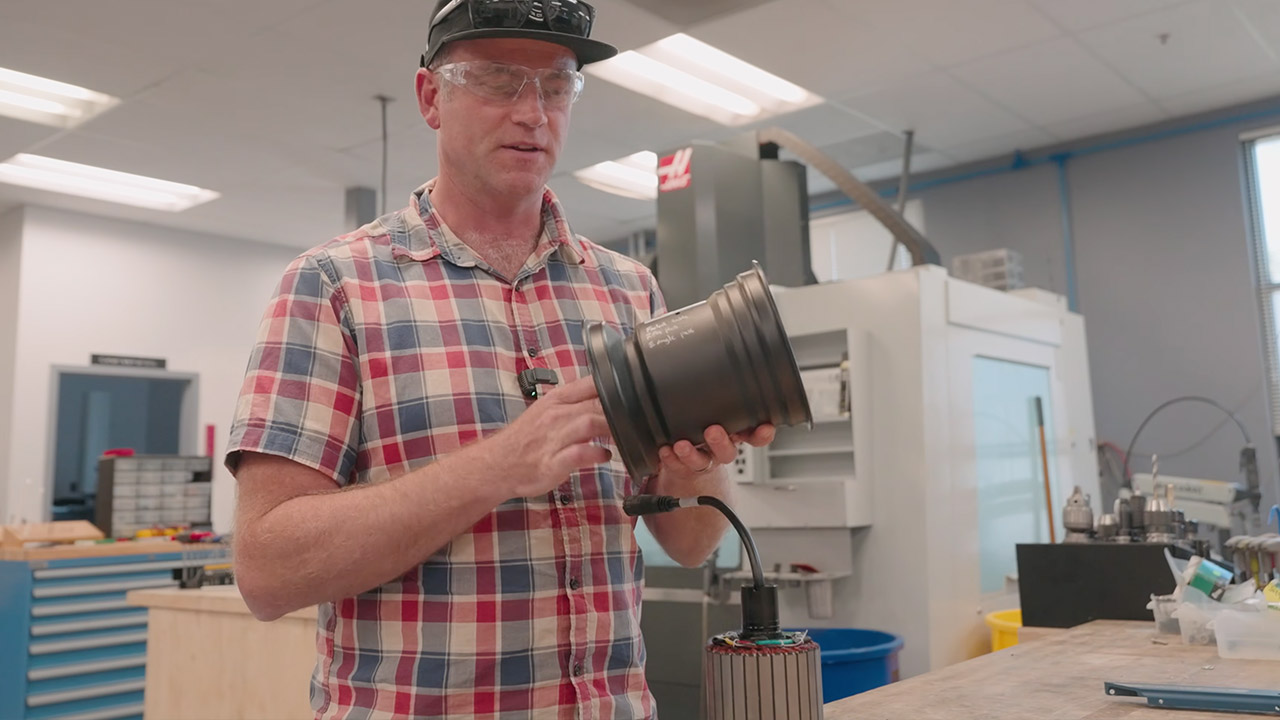
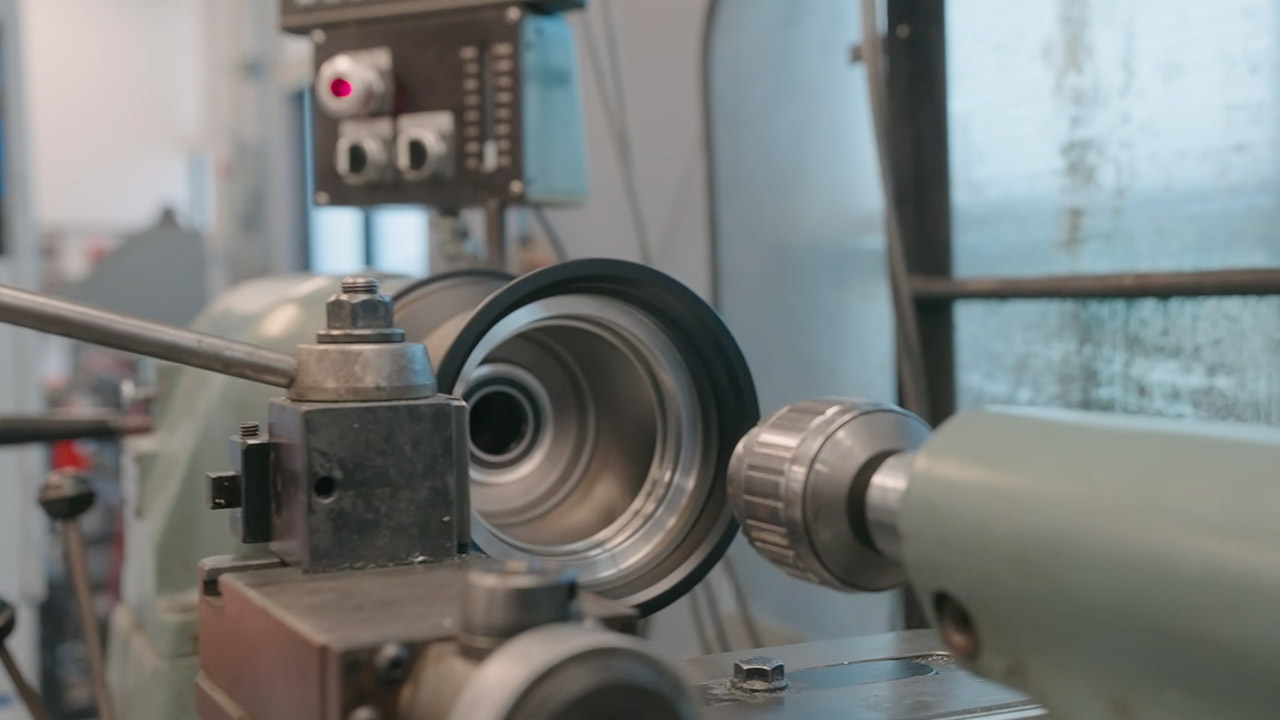
Kyle disassembled the hub and turned the housing on a lathe until the flanges were tiny enough for a chain sprocket to fit. He needed a custom end cover to go onto the motor for a bike sprocket. The chain then drops from the sprocket to the train axle. Bearing carriers began as 3D printouts, but they had to be sanded down to clear some wire, and after the fit was correct, they were simply cut out of aluminum.
The same sensors that keep a standard Onewheel upright continue to power the self-balancing feature. Lean forward, and the controller nudges the hub in that direction, but now it rotates a sprocket rather than a wheel. Rails lock the item left to right, but the rider may still alter the pitch with their ankles and toes. The result is a good guided cart that nevertheless responds to the rider.
The first time they moved the thing and turned the cart on, it was noisy, but eventually everything settled down. Kyle thought the motion was incredibly smooth, “like butter.” The crew claimed it looked like flying and was so smooth it hurt their minds. So they started chanting “all aboard” for a cause. Future Motion isn’t selling a conversion kit, though; instead, he’s talking about riding out to Capitola or Davenport and how there are a plethora of self-balancing rail cars just waiting to be created. For the time being, the Rail Board consists of a converted XRC, a couple of heavy eBay wheels, a length of chain, and a quiet small section of track outside the office, complete with a rider. [Source]
Unlike most of its social media rivals, Snap hasn’t made many big bets on AI. The company has added a bunch of generative AI-powered features to Snapchat, but it hasn’t made the technology a central focus.
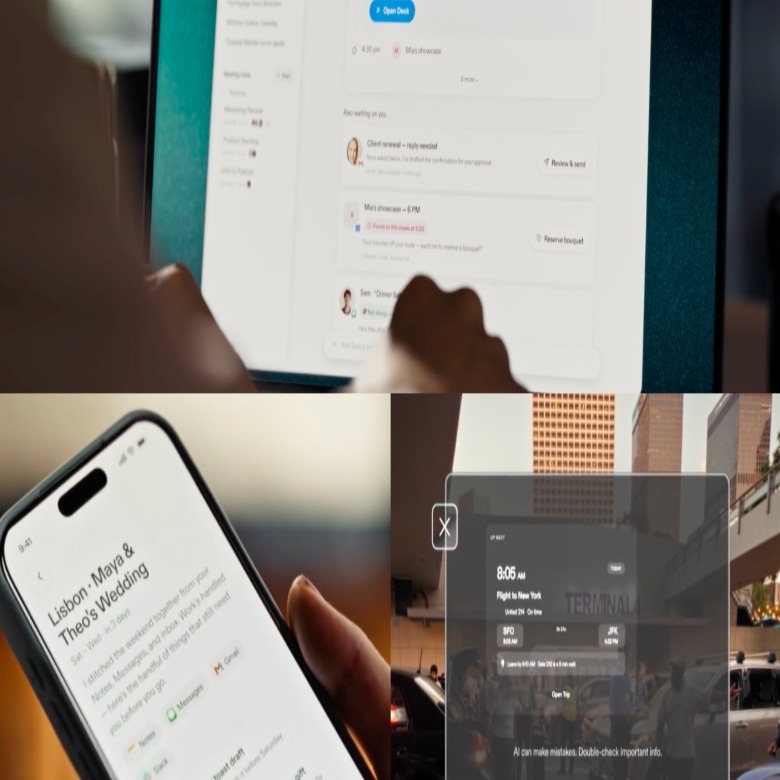
Now, the company is introducing a new standalone AI assistant alongside its redesigned AR glasses. Called Specs Intelligence, the “anticipatory AI service” will feature prominently in Snap’s hardware, but will also have dedicated desktop and mobile apps for those who don’t have a pair of glasses.
Snap doesn’t describe Specs Intelligence as an agent or assistant, but its description will sound familiar to anyone who followed Meta’s recent Muse announcement. “Specs Intelligence builds an understanding of your goals, priorities, relationships, and routines from the apps and tools you choose to connect,” the company explains in a blog post.
Specs Intelligence is separate from Snapchat and sounds much more productivity-focused than anything we’ve previously seen from the company. The assistant relies on connections to users’ outside accounts, like Google, to surface timely reminders and other relevant info based on what it knows about you. For example, the company says, it could highlight “questions to ask, and things to remember” before a meeting or show travel plans ahead of a trip. It’s also able to organize info into different “corners” based on the context in which you need them, like keeping family-related tasks separate from work deadlines.
Advertisement
Snap
If you do have a pair of AR Specs, the assistant can surface relevant info directly into your field of view. Specs owners will be able to ask it questions by saying “Hey Specs.” The feature wasn’t available during my demo with Specs, though I was able to launch a browser window by saying “Hey Specs,” but it sounds similar to some aspects of how Meta AI works with the company’s glasses.
It also seems like Snap is hoping to get ahead of some of the privacy concerns people have had with Meta’s approach. The company says it won’t use Specs intelligence to train its AI models or serve ads and that “Snap personnel cannot view or access the personal content you use with the service.”
Snap is making a limited version of Specs Intelligence available in the US to try now via the Specs app on iOS. The preview version will allow users to connect their Google accounts to see “insights about where you spend your time and attention” but won’t feature proactive suggestions. The “full early-access” version will be invite-only to start and only available with Specs’ Mac app. Anyone interested can sign up for the waitlist now.
We may receive a commission on purchases made from links.
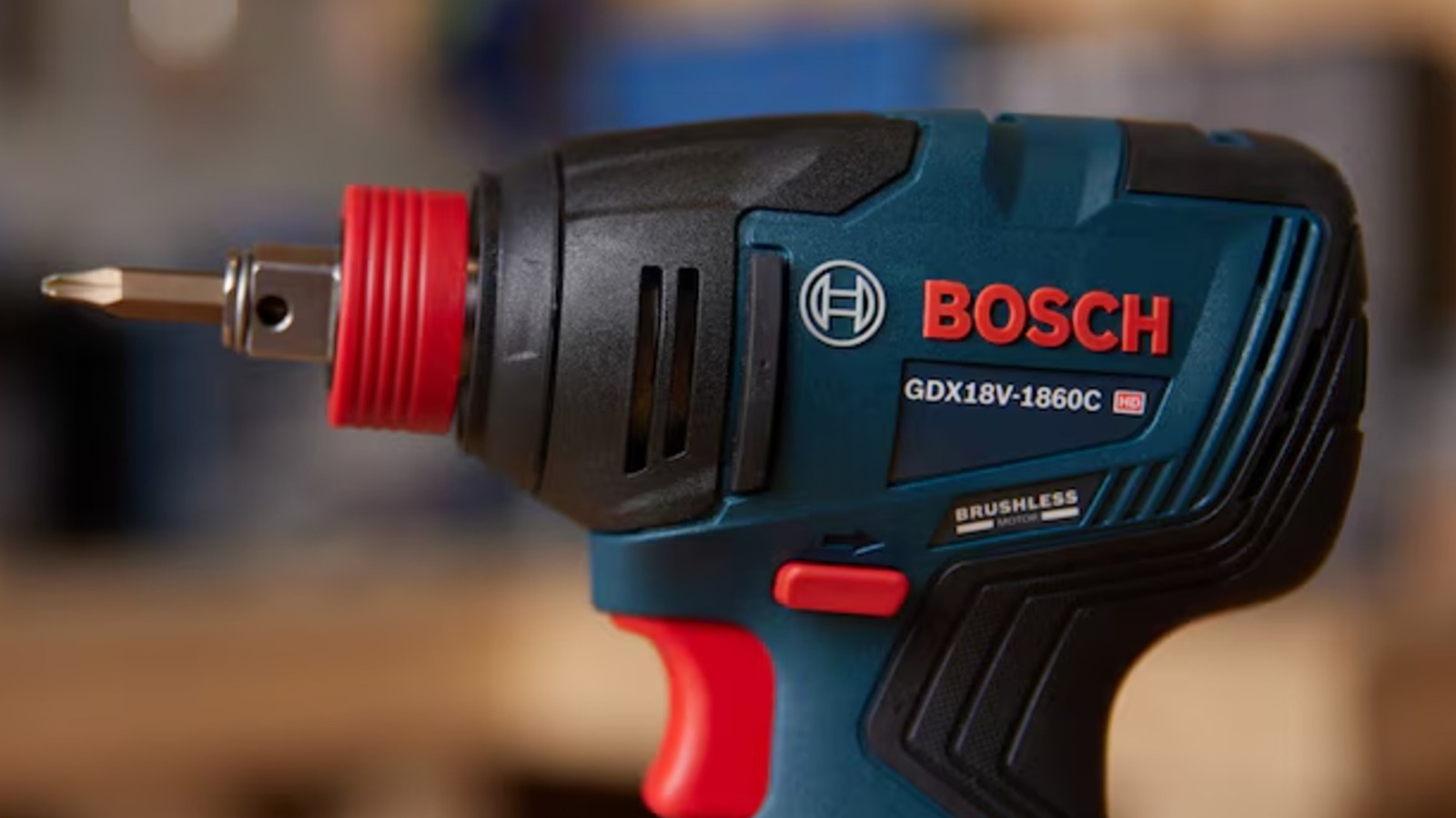
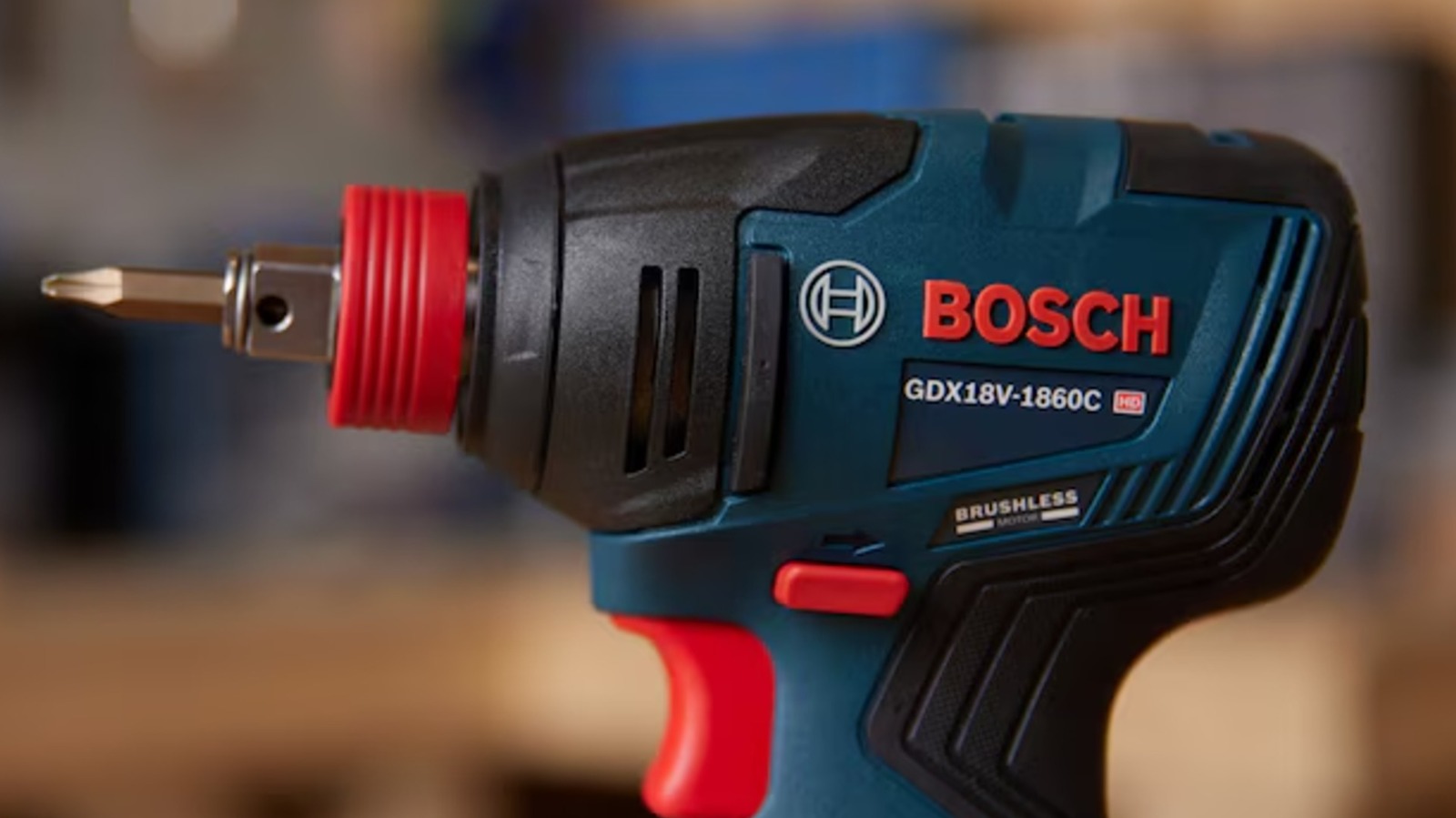
Just about every major hardware brand uses its own power and battery framework. If you’re already using tools and accessories in that system, great. However, it can be annoying to buy brand new batteries for new tools when you already have batteries at home, especially given how expensive they can be. For example, a single 18V 6Ah battery pack for the Bosch power tool system will run you $159 at Lowe’s. By contrast, a comparable pack from one of Harbor Freight’s in-house brands like Bauer would run you less than half that at $69.99.
Advertisement
If you’re thinking that the simplest solution to this little snafu is to just use that cheaper Harbor Freight battery on your Bosch tools, you will sadly need to think again. Despite both batteries serving the same purpose, the precise means by which they connect to their respective tool systems are completely different, which means you simply can’t just clamp a Harbor Freight battery onto a Bosch tool. Technically speaking, there are unofficial adapters you could use to circumvent this disconnect, but using these kinds of unauthorized accessories comes with pros and cons, and could end up doing a lot more harm than good.
Advertisement
Harbor Freight’s batteries won’t fit on Bosch tools
It’d be fair to assume that a power tool battery is a power tool battery; it clips onto the bottom of a tool and gives it power. The reality of the situation, though, is that every brand’s power systems work a little bit differently. In fact, they work just differently enough that there’s no native overlap between them.
Harbor Freight offers a handful of different in-house power tool brands, including Bauer, Hercules, and Atlas. If, for example, you take a look at the connector rails on top of a Bauer battery and compare them to the rails on top of a Bosch power tool battery, you’ll immediately see the problem. The connector rails and panels on these batteries are shaped completely differently, with the Bauer battery having six prongs and curving sides, and the Bosch battery having four prongs, straight sides, and a dip in the middle. Because of these differences in connector shape, it’s effectively impossible for a Bauer battery to clip onto a Bosch tool. The same goes for both Hercules and Atlas batteries. All of them have different connector rails, which means none of them can link up.
As for why this is, it’s mostly for legal purposes. Ensuring a tool can only receive batteries from its own system is the best and simplest way to prevent tools from being misused and incurring branding headaches, while also helping to ensure you keep buying accessories in the system.
Advertisement
There are unofficial adapters, but using them is risky
You might be thinking, “If the big problem is that the batteries can’t connect to the tools, couldn’t an adapter solve it?” You certainly wouldn’t be the first to think this. In fact, there’s an entire unofficial ecosystem of adapter devices designed to facilitate connections between different power tool brands’ batteries and tools, including Harbor Freight’s batteries and brands like DeWalt. Sadly, this seemingly perfect solution is a little too good to be true.
There are two big problems with attempting to use an adapter to connect a Harbor Freight battery to a Bosch tool. Firstly, all power tool adapters are strictly one-to-one. This means, rather than any battery from Harbor Freight, you would specifically need an adapter to connect, for instance, Bauer batteries to Bosch tools, and only to Bosch tools.
Advertisement
The second, and much bigger, problem is that using a power tool adapter circumvents its inherent safeguards. Connecting a battery to a power tool doesn’t just deliver power; the devices communicate with one another to send power in a safe, optimal fashion. Using an adapter disables these communication channels and forces power through directly. The tool may turn on, but it may not receive enough power from the battery to function properly. Worse, it could receive entirely too much power, causing it to perform unsafely or even burn out. Using battery adapters is a violation of both Harbor Freight and Bosch’s warranties, which means if you break your tools and batteries because of them, neither brand will help you.
Salesforce UK&I CEO pushes her skilling “mission” across the country
Salesforce doubles down on UK&I recruitment and upskilling goals
Jobs could be repatriated back to the UK from abroad
Salesforce’s UK&I CEO has doubled down on her company’s commitment to investing in skills training and upskilling of young people.
With the UK recently seeing a change in Prime Minister, Zahra Bahroloumi was asked in a media roundtable attended by TechRadar Pro what her outlook for the future looked like.
“Irrespective of government, we are committed to, and very active to the skilling of people,” Bahroloumi said, “we’re not stopping, we remain true to our mission, and we remain active and true to our customers, irrespective of government”.
Latest Videos FromTechRadar
Advertisement
Closing the AI literacy gap
Bahrololoumi has long been a key voice in promoting skills training in the UK, using her company’s influence and scale across the country to push a number of key initiatives.
In June 2026, she outlined the Salesforce’s “incredibly bold” vision for the UK, which includes $6 billion investment committed to the country through 2030, and its role in backing the UK government’s aim to train 10 million UK workers by 2030.
Alongside Bahrololoumi, Paul O’Sullivan, SVP Solution Engineering and Salesforce UKI CTO also looked to outline how Salesforce’s future Trailblazer program is “closing the AI literacy gap”.
O’Sullivan noted how Salesforce is going through “a surge of hiring”, including doubling the size of its forward-deployed engineer team in the UK.
Sign up to the TechRadar Pro newsletter to get all the top news, opinion, features and guidance your business needs to succeed!
“We are not just looking to attract the best possible talent to come and join Salesforce, we’re also heavily investing in our apprenticeship scheme, doubling down on our graduate opportunities, and aiming to double the size of the team in the next six months,” he noted.
Advertisement
“This is our opportunity to reinvest in the next generation.”
Looking forward, Bahrololoumi was keen to promote the role of the UK in the AI-enabled and augmented future, noting that while the country was, “an empowered market”, there was still potential for more growth.
“We need more talent,” she added, “I feel so confident, and we’ve got the evidence and the proof points that this technology and our platform can work and automate jobs, and augment jobs, and expand human capacity in an organisation effectively.
Advertisement
“But I would like to see more jobs being repatriated from offshore and low-cost locations and jobs being created back in the UK – so I would like to see a stronger drive around automation and repatriation.”
Bahrololoumi gave the example of when there 300 jobs in a low-cost location, outside of the UK – “why can I not create a hundred jobs in the UK and still do 300 plus worth of capacity?”
“That’s something we’re really focused on, because we’ve got the capability to do that now… but I think we’ve got the opportunity now to create jobs in the UK,” she concluded, “we’re on a mission.”
Report finds 57% of UK organizations opted to extend legacy system use rather than replace the tech
This is despite almost half of UK businesses are scaling AI
Meanwhile, over three quarters of UK businesses have gone over budget on modernization, with over two thirds have paused or abandoned the process
Does technological progress necessarily mean replacing old gear? New research from Ensono claims businesses are keeping hold of legacy tech, with older systems extended and upgraded to support modern applications.
This is happening while businesses scale their AI use, focusing budgets on affordable upgrades for existing PCs, laptops, and servers on one hand, and embracing AI on the other. It’s a balancing act, one that is being managed by around 52% of businesses – 57% in the UK, and 48% in the US.
However, the driving factor for this reliance on older tech may not be smart budgeting and foresight. Across the US and UK, 61% of businesses have been forced to pause, scale back, delay, or even completely abandon IT modernization in the past two years.
Latest Videos FromTechRadar
Advertisement
IT modernization?
Ensono’s second annual State of IT Modernization Report seems to point to a change in how IT modernization is achieved: rather than replacing old tech, businesses are upgrading. The takeaway is that IT budgets are dictating a focus on AI spending, so where possible PCs, laptops, and some lower-end servers are increasingly being upgraded with faster, higher capacity storage and RAM.
Other key statistics in the report include the news that 71% of IT modernization projects have exceeded budgets, with workflow challenges (33%) and limitations with existing infrastructure (28%) among the roadblocks to an ROI on AI spending.
Underpinning all of this is the growth in decision makers declaring that AI is accelerating modernization, up from 39% last year to 54%.
Rediscovering legacy systems
Budget demands seem to be driving the reliance on older tech within organizations striving to keep up with AI modernization.
Sign up to the TechRadar Pro newsletter to get all the top news, opinion, features and guidance your business needs to succeed!
Advertisement
“AI is expanding the possibilities for modernization, enterprises are discovering that legacy systems, like the mainframe, are intensely powerful, reliable and efficient sources of computing that can now be augmented and made more agile thanks to AI,” noted Brian Klingbeil, Chief Strategy Officer at Ensono.
This means that IT leaders are being forced to decide what needs to be preserved, and where to use AI investment wisely.
“These systems contain decades of data and business logic that drive many businesses,” says Klingbeil. “The advantage will go to organizations that understand their environments well enough to distinguish what should be replaced vs. what should be augmented, and embrace new modernization methods that simply were not available even 18 months ago.”
The Premium Microsoft Office Training Certification Bundle has 11 courses geared to help you master essential skills and raise your expertise. Popular programs like Word, Excel, PowerPoint, and Teams are covered, while more advance programs get introduced as well, including SharePoint, Access, PowerBI, and Microsoft SQL Server. You’ll gain a better understanding of how each program works and how they can all interact together. It’s on sale for $30.
Note: The Techdirt Deals Store is powered and curated by StackSocial. A portion of all sales from Techdirt Deals helps support Techdirt. The products featured do not reflect endorsements by our editorial team.











































You must be logged in to post a comment Login