Connect with us

Business

Sensex rises 200 points, Nifty above 23,300 despite Fed rate hike. Why bears may be ready to pounce

Published

on

Sensex rises 200 points, Nifty above 23,300 despite Fed rate hike. Why bears may be ready to pounce
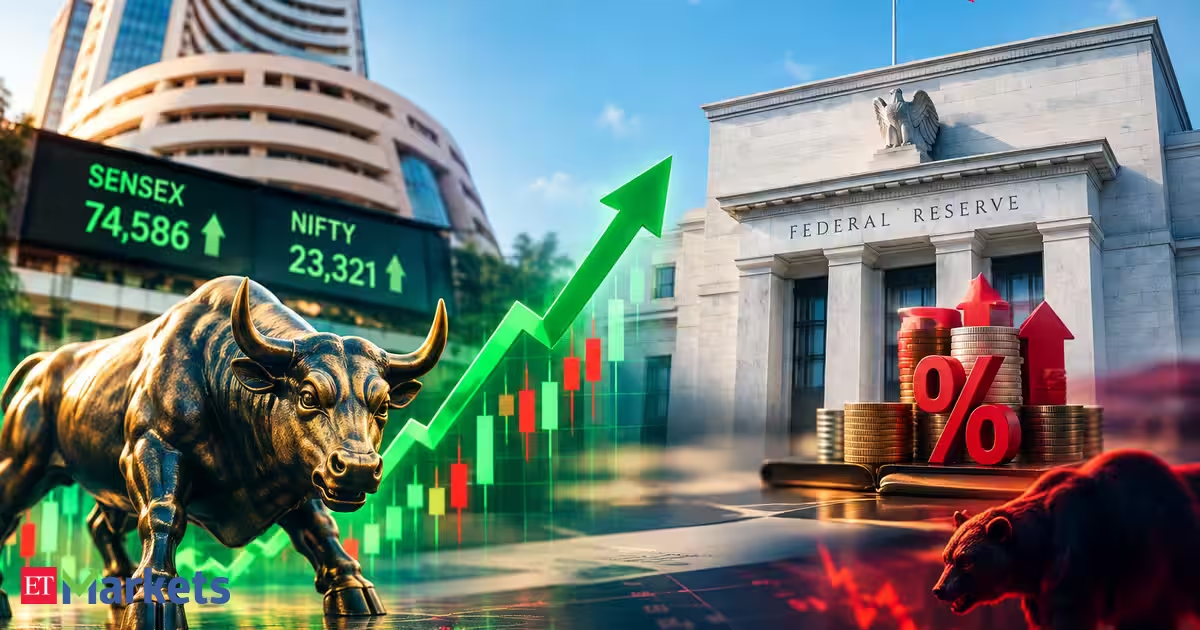
The Indian stock market extended gains on Thursday, with Sensex and Nifty trading higher, bucking worries after the US Federal Reserve’s first rate hike in three years, although analysts advise caution amid multiple headwinds.

Sensex gained around 245 points to trade at 74,586 while Nifty 50 gained more than 104 points to trade at 23,321, as seen at 10.15 am. Broader markets also swung into the green, with Nifty Midcap 100 and Nifty Smallcap 100 rising nearly 1% each.

Zomato and Blinkit parent Eternal saw its shares jump around 3% to lead gains on Sensex. Bajaj Finance shares rose nearly 2%, while those of BEL, ITC and Axis Bank were up over 1% each. Bucking the trend, HDFC Bank, TCS, HCL Tech and Infosys shares fell nearly 1% each.

All sectoral indices except Nifty IT were trading in the green, with Nifty Metal, Nifty Pharma, Nifty PSU Bank, Nifty Auto and few others rising around 1% each. The overall market breadth turned positive, with NSE seeing 2,316 advances against 827 declines, while 105 stocks remained unchanged.

Advertisement

Also read | Explained: What US Fed’s first 25 bps rate hike in 3 years means for Indian stock market

Federal Reserve hikes rate

The US Federal Reserve on Wednesday announced its first interest rate hike since 2023, with officials expecting one more increase later this year. The American central bank’s Federal Open Market Committee (FOMC) announced the decision after a two-day meeting, increasing the benchmark interest rate by 25 basis points to a range of 3.75-4%. This comes after consumer inflation stayed at 3.4% in August, same as last month but still much higher than Fed’s 2% target. Inflationary pressures were further intensified by soaring energy prices amid renewed tensions in the Middle East.
“There are no immediate signs for inflation to ease, especially given the stalemate in the Middle East. This means the Fed may need to continue to tighten to achieve its target,” Tai Hui, APAC chief market strategist at JP Morgan Asset Management, was quoted as saying by Reuters. Traders are now expecting a 50% chance of another Fed hike next month to rein in inflation. A total of three rate increases have been priced in for this tightening cycle.

Why caution is still warranted?

While the Indian stock market trades in the green, caution is still warranted. Today is Sensex’s weekly expiry day, which typically sees sharp volatility towards the end of the session. Additionally, bond yields remain elevated, with the benchmark US 10-year Treasury yield above the crucial 5% mark.

The Indian rupee weakened past the 96-mark against the US dollar today, marking the first time in over a month, driven by a stronger US dollar after the Federal Reserve raised interest rates and signalled further tightening. FIIs have also been selling heavily on Dalal Street.

Advertisement

Also read | PVR Inox buyback: Last chance to participate in multiplex operator’s Rs 300 crore buyback. Should you tender shares?

What lies ahead for Dalal Street?

The Fed’s decision to raise rates by 25 bps was completely on expected lines, as there was no justification for a hold in rates in the context of elevated inflation and a resilient economy with only 4.1% unemployment, said V K Vijayakumar, Chief Investment Strategist, Geojit Investments. He added that the hawkish message from Kevin Warsh that “inflation has been too high, and has been for too long” and that “ this committee will deliver price stability” can be construed as reassuring to the markets.

However, high bond yields will continue to weigh on equity markets, according to the analyst. Under normal circumstances, he feels that 5% yield on the 10-year would have triggered a sell-off in equity markets. But this is not happening now since US corporate earnings continue to be good. Warsh’s comment that “new hirings, private sector earnings and business capital investment point in a good direction” reflect a resilient economy and strong corporate sector, the analyst said, noting that this has the potential to act as a counterbalance to the high bond yields, thereby preventing a sell-off in the equity markets.

“The Indian market will continue to struggle. FIIs have been continuous sellers in India during the last six days and this trend is likely to continue. Another concern is the news of the U.S. House of Representatives passing a bill to impose a 100% tariff on countries like India which import oil from Russia. The geopolitical scene and Trump’s policies are getting murkier,” Vijayakumar warned.

Advertisement

(With inputs from agencies)

(Disclaimer: Recommendations, suggestions, views and opinions given by the experts are their own. These do not represent the views of The Economic Times)

Continue Reading
Click to comment

You must be logged in to post a comment Login

Leave a Reply

Business

Opinion: Growing sports sector’s got game

Published

on

Opinion: Growing sports sector’s got game

OPINION: From basic wearables to booking tickets to the big game, sports tech is big business.

Continue Reading

Business

Goh appears in WA court, avoids contempt action

Published

on

Goh appears in WA court, avoids contempt action

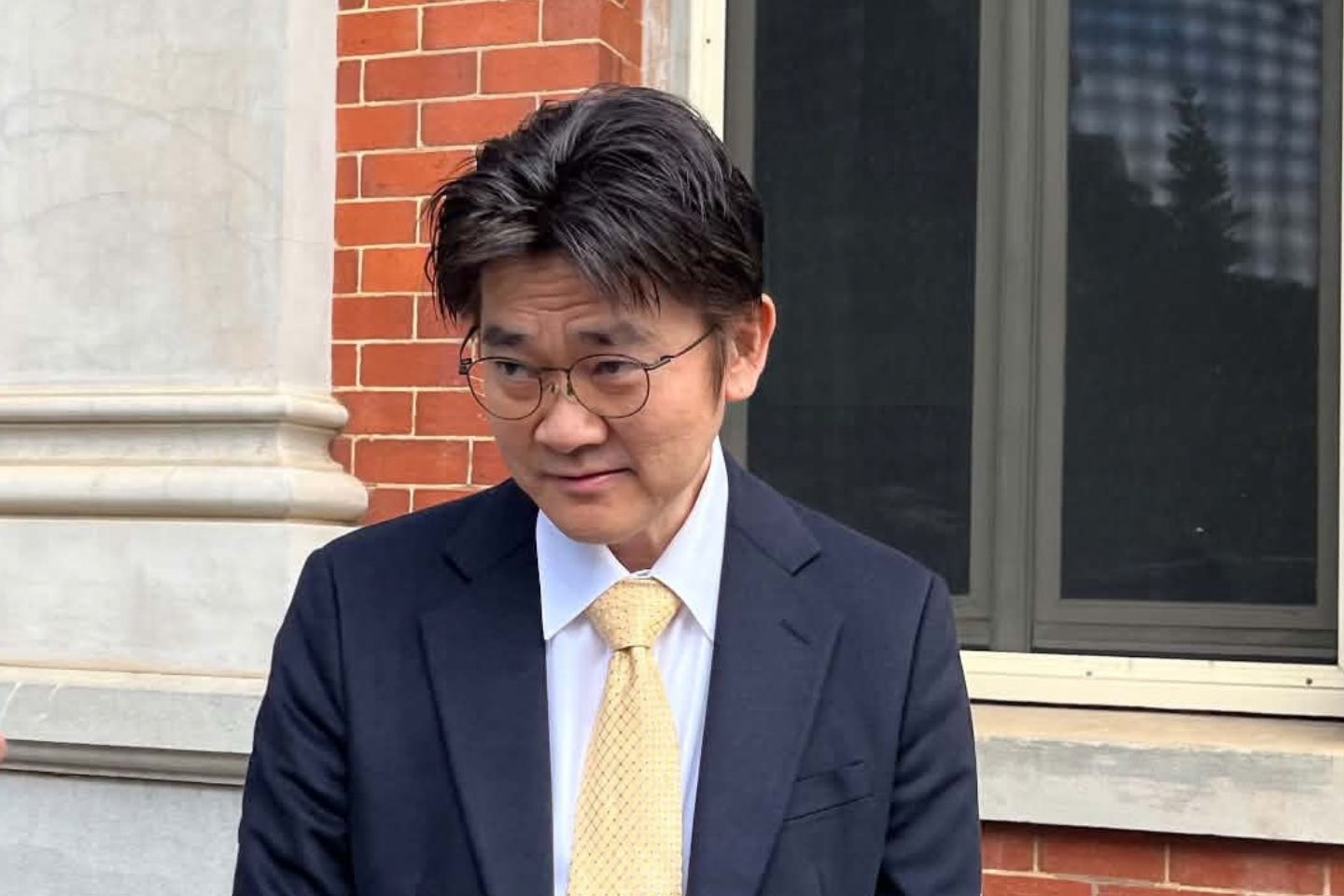
Property developer Victor Goh has appeared before a Perth court over a possible contempt action, which was dismissed but with a judge’s stern warning.

Continue Reading

Business

NASCAR CEO discusses recent success, possible international expansion

Published

on

NASCAR CEO discusses recent success, possible international expansion
CNBC Sport: NASCAR CEO Steve O’Donnell on global growth, the future of racing and Tom Cruise

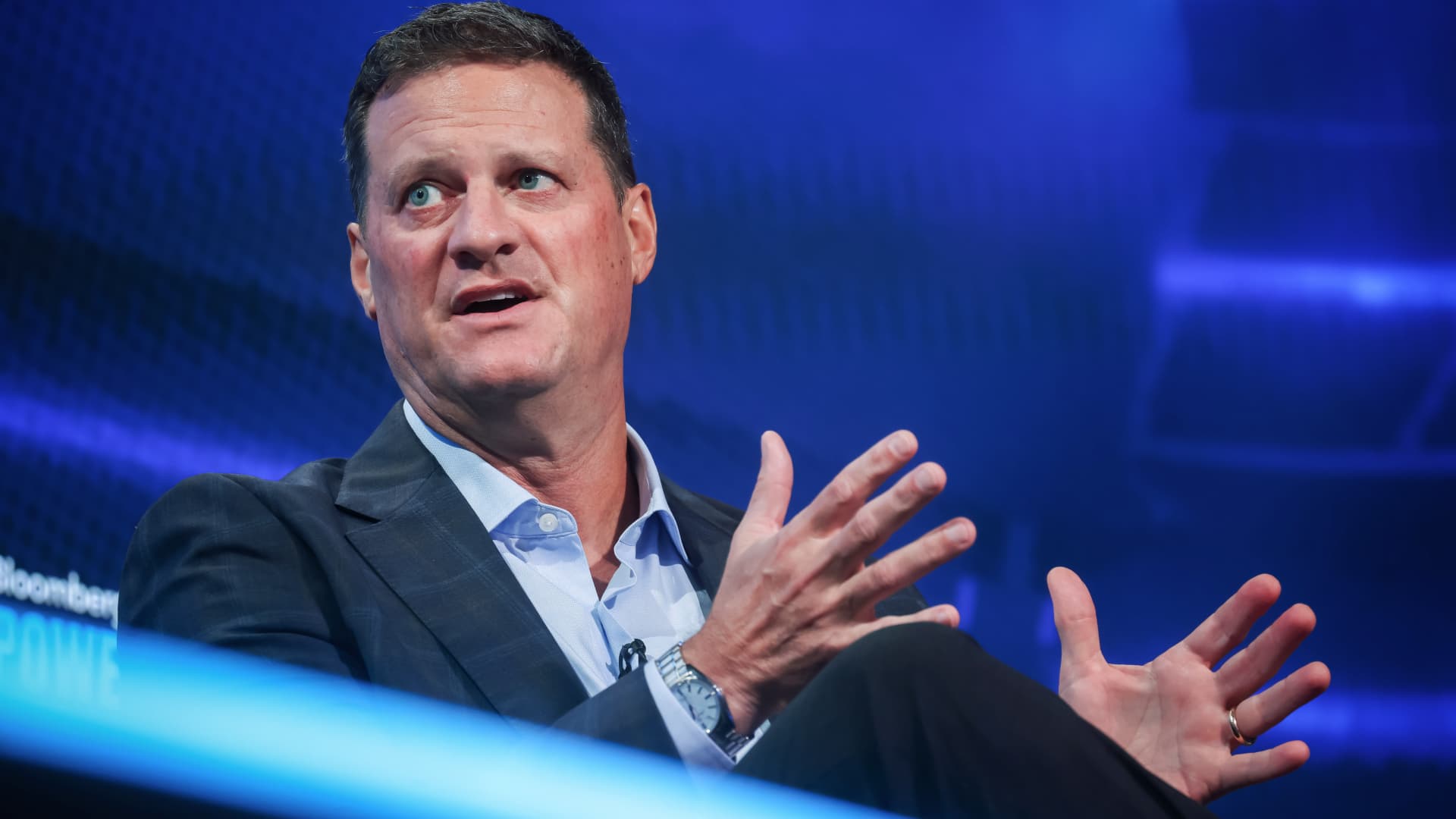
NASCAR CEO Steve O’Donnell said the company has seen “a lot of momentum” after a challenging few years, touting NASCAR’s presence on multiple streaming platforms and the recently announced sequel to “Days of Thunder” as opportunities to raise the company’s profile.

The auto racing company CEO, in an interview with CNBC’s Brian Sullivan, credited the company’s growing popularity among a younger audience, in part, to its ability to connect with fans online.

“The media partners are just the foundation of the sport [that] help us grow,” he told CNBC.  

NASCAR content is available through streaming, cable and digital platforms across Fox, Comcast’s NBC, Versant’s USA Network, Warner Bros. Discovery’s TNT Sports and Amazon Prime Video, thanks to seven-year media rights agreements — worth an estimated $7.7 billion, according to various media reports.

When asked whether the patchwork nature of exclusive streaming rights to races would confuse viewers, O’Donnell said the breadth was actually a benefit.

Advertisement

“For us [it’s] how many front doors can we give to a fan to come through and experience NASCAR, and we used to just be maybe on one or two networks,” he said. “And as you look at where media is going long-term, we realized to get younger we needed to try some different things, go where some of the younger fans are maybe watching or just tuning in for a couple minutes.”

The release of “Days of Thunder 2,” the sequel to the 1990 hit, will be another way to reach new fans, O’Donnell said. Tom Cruise will be reprising his role as Cole Trickle, a NASCAR driver, with Anne Hathaway set to co-star. The Paramount film is slated to premiere in summer 2028, Cruise announced on social media.

O’Donnell said Cruise recently visited NASCAR headquarters in Daytona Beach, Florida, and believes that the sequel will bring new audiences to the league.

“He could not have been more enthusiastic,” O’Donnell told CNBC. “Tom’s No. 1 message to us: He’s like, ‘You got to be ready because I’m going to put people [on], and they’re going to know what NASCAR’S about.’”

Advertisement

NASCAR CEO Steve O’Donnell during the Power Players New York event, Sept. 10, 2026.

Michael Nagle | Bloomberg | Getty Images

Global racing league Formula 1 has notched success in recent years garnering new fans via streaming and film, including Netflix’s “Drive to Survive” docuseries and Apple’s “F1” movie, which premiered in 2025.

The Brad Pitt blockbuster became Apple’s highest-grossing film.

Advertisement

Similarly, “Ford v Ferrari,” a biopic about a legendary team of British and American race-car drivers, became one of the highest-grossing original movies of 2019.

And while NASCAR seeks to grow its reach domestically, O’Donnell said that he is “absolutely” open to international expansion.

The league currently races only in the U.S. and Mexico but is weighing options for additional international locations.  

O’Donnell said that brand awareness must be established internationally before plans for future race locations can be solidified.

Advertisement

“I don’t want to just export a race and plop it somewhere,” O’Donnell said. “We want to build the culture so that when you go to a race, if we’re in Europe, you know, hey, that’s the NASCAR experience.”

O’Donnell was named CEO in April, replacing Jim France and becoming the league’s first CEO outside the founding family.

Disclosure: Versant Media Group is the parent company of CNBC.

Advertisement
Continue Reading

Business

Okta: Just Another Overpriced Story Stock Within Cybersecurity (NASDAQ:OKTA)

Published

on

Movie Clapperboard Storytelling Concept

This article was written by

Thematic. Top down. I often find the theme before I find the stock. My philosophy is that themes are often born quiet and die loud. I try to catch them while they’re still finding their voice. When the music plays, I mainly chase pockets that rhyme with growth, momentum, perception shifts, and sometimes even the most absurd narratives (mostly AI-related). When the music slows and the tape deteriorates, I don’t wait around. I raise cash/rotate out, and watch for the next setup. A parabolic run may trigger a similar move. During a bull run, you won’t find much common ground between the deep value crowd and me. I liked the core ideas of deep value investors, and I briefly followed that philosophy. However, it demands patience, and the AI supercycle broke whatever patience I had left. The market changed, and so did I. My style is not set in stone. I’m mostly long when the music is playing. When it stops/slows down, I may dabble with shorts via put options, although it’s not my forte. My style is highly speculative. I have a high risk tolerance that most rational investors would find alarming. I don’t have a favorite timeframe. That said, I trade mostly the mid-term and the short-term. I have a pathetic low six-digit portfolio, and I consider myself part of the mid to low end of the K-shaped economy. It sometimes drops to the five-digit range when life has other plans. I’ve been in the game since mid 2024, although my first dabbles with stocks (i.e., burning $100 trading accounts in a matter of days) go back to the early/mid 2010s. I have a B.Sc. in aeronautical engineering and experience as a consultant in the aerospace sector. The latter statement is not relevant to my investment style, but I thought to add it for self-indulgent purposes. I live on the wrong side of the Atlantic. The opening bell is my lunch bell. I like astrology, so I’m a follower of technical analysis (mainly trends and support/resistance/psychological levels). I also look at the fundamentals of individual names, although the theme and the macro often prevail in my decision-making. I dislike empty suits, high-level BS, deep-level BS (especially), unnecessary jargon, and self-indulgent, third-person written introductions with an air of superiority.

Analyst’s Disclosure: I/we have no stock, option or similar derivative position in any of the companies mentioned, and no plans to initiate any such positions within the next 72 hours. I wrote this article myself, and it expresses my own opinions. I am not receiving compensation for it (other than from Seeking Alpha). I have no business relationship with any company whose stock is mentioned in this article.

I am not a registered investment adviser, broker, dealer, or tax professional. This article, including any comments or replies I post, reflects my personal opinions only and is provided for informational and educational purposes. Nothing I write is investment, legal, tax, or financial advice, or a personalized recommendation to buy, sell, hold, or short any security. My views may change without notice. Nothing I write is tailored to any reader’s objectives, financial situation, risk tolerance, or portfolio. Investing involves risk, including possible loss of principal. Readers should conduct their own research and consult a qualified professional before making investment decisions.

Advertisement

Seeking Alpha’s Disclosure: Past performance is no guarantee of future results. No recommendation or advice is being given as to whether any investment is suitable for a particular investor. Any views or opinions expressed above may not reflect those of Seeking Alpha as a whole. Seeking Alpha is not a licensed securities dealer, broker or US investment adviser or investment bank. Our analysts are third party authors that include both professional investors and individual investors who may not be licensed or certified by any institute or regulatory body.

Continue Reading

Business

Kaynes Tech, Syrma SGS, MosChip, others rally up to 10% as PM Modi set to inaugurate Semicon 2026

Published

on

Kaynes Tech, Syrma SGS, MosChip, others rally up to 10% as PM Modi set to inaugurate Semicon 2026
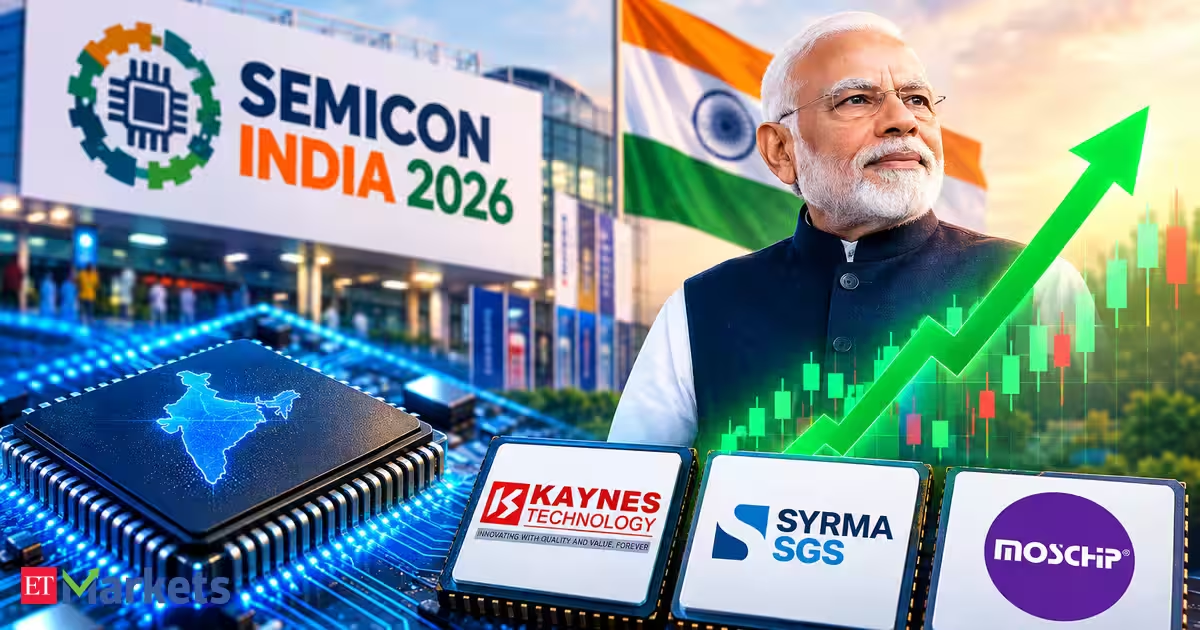
Shares of Kaynes Technology India, Syrma SGS Technology, MosChip Technologies, among others gained up to 10% on Thursday as investor attention turned to India’s semiconductor ecosystem ahead of Prime Minister Narendra Modi’s inauguration of the fifth edition of Semicon India 2026.

The event is set to showcase the country’s semiconductor value chain, spanning materials, equipment and chip design to fabrication, advanced packaging, electronics and systems.

Kaynes Technology rose 5% to an intraday high of Rs 3,563 on the BSE, while Syrma SGS Technology gained 10% to Rs 1,658 per share. MosChip Technologies also advanced more than 6% to Rs 212 per share.

Why are semiconductor stocks rising?

Kaynes Technology India is establishing a semiconductor manufacturing facility in Gujarat with an investment of Rs 3,307 crore, focused on wire-bond interconnect and substrate-based packages. The facility is expected to have capacity to produce more than 6.33 million chips per day.
Syrma SGS, meanwhile, is part of the broader electronics manufacturing ecosystem that could benefit as India pushes for greater domestic component manufacturing and localisation. The company has also recently received approval for a Rs 60 crore coil manufacturing project under the Electronics Components Manufacturing Scheme, while it has been expanding its EMS footprint through partnerships and new facilities.

Advertisement


MosChip is a semiconductor and product engineering company that designs custom computer chips and smart electronic systems.
India’s semiconductor sector has attracted $1.4 billion in all-time equity funding across 281 funded companies, with nearly half of this amount – $701 million – raised since 2025 alone, according to data from Tracxn.The growing investor interest comes as India attempts to build a semiconductor ecosystem beyond chip design and electronics assembly.

The government launched the India Semiconductor Mission (ISM) in 2021 with a Rs 76,000 crore outlay, covering the semiconductor value chain from chip design and fabrication to packaging, testing, equipment, materials and talent.

Read more:NSE IPO Tracker: Catch all the highlights here

Semicon India 2026: What is PM Modi saying?

Prime Minister Narendra Modi on Wednesday urged global and Indian semiconductor companies to actively participate in the next phase of India’s semiconductor growth, calling for greater industry involvement in skilling, innovation and emerging technologies such as artificial intelligence and quantum computing.

Modi chaired a roundtable with leading semiconductor industry CEOs at Seva Teerth, where he stressed closer collaboration between the government and the industry as India seeks to expand its capabilities across the semiconductor value chain.

Advertisement

Modi reiterated the government’s commitment to maintaining a predictable and responsive policy environment for the semiconductor sector. At the same time, he said policies would need to evolve in line with technological advances and industry requirements.

Earlier this year, the government approved Semicon 2.0 with a proposed outlay of Rs 1.27 lakh crore. The programme focuses on six areas: chip design, semiconductor equipment and materials, fabrication facilities, advanced packaging, research and development, and talent development.

Disclaimer: The views/recommendations mentioned in this article, wherever applicable, are those of the respective SEBI-registered Research Analyst/brokerage and have been reproduced/reported with due attribution. They should not be construed as the views or recommendations of The Economic Times Digital or the journalist. Readers are advised to consider the original research report and make their investment decisions based on their own assessment. Brokerage disclaimers here

Advertisement
Continue Reading

Business

Fluence Energy, Inc. (FLNC) Q4 2026 Guidance Call Transcript

Published

on

OneWater Marine Inc. (ONEW) Q1 2026 Earnings Call Transcript