
Crypto World
China’s Moonshot launches Kimi AI tools for financial services

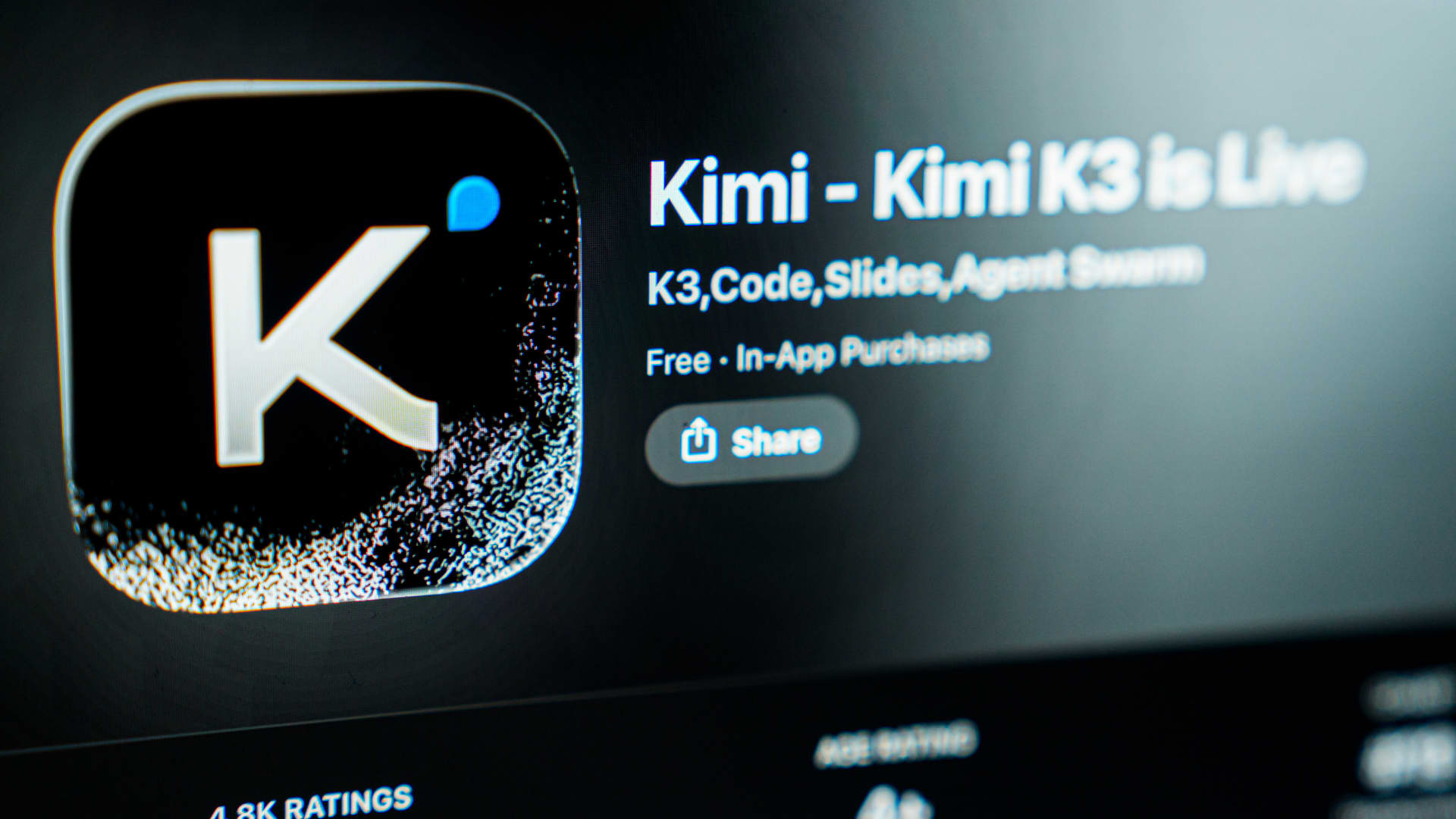
BEIJING — The Chinese artificial intelligence startup behind the Kimi model said Thursday that financial industry giants, including investment banks, funds and venture capital firms are using its Kimi models on AI tools.
Among the companies now using Kimi are investment bank CICC and venture capital firms such as Sequoia China, now rebranded as Hong Shan.
It’s part of Beijing-based Moonshot’s announcement Thursday that it was launching Kimi for financial services — a sign of how AI companies are pursuing real-world, commercial applications.
Kimi users can directly access information commonly used for analysis and reports, thanks to a number of industry data partners such as S&P Global Market Intelligence, Crunchbase, Wind, local financial news leaders and business database Tianyancha, according to Moonshot.
The startup said Kimi can also directly access the U.S. Securities and Exchange Commission’s EDGAR system for public companies’ financial filings, the IMF, World Bank and the U.S. Federal Reserve Economic Data site (FRED).
While users don’t have to download a separate interface, a test on Kimi’s mobile app indicated different kinds of data were available to different users depending on subscription tier.
Subscriptions to Kimi start at 49 yuan ($7.31) a month, and can go up to 699 yuan ($104.23).
“The real inflection point really is the combination of stronger AI capabilities with professional expertise,” Samuel Fischer, Beijing branch manager at Deutsche Bank, said in a promotional video published by Moonshot on Thursday. “AI companies that understand real financial workflows and can deliver reliability and data security will be particularly well positioned to contribute to this transformation.”
“AI can now organize and compare this kind of information, identify inconsistencies, and support initial analysis,” he added.
It was not immediately clear whether Deutsche Bank was a client. The bank did not immediately respond to a request for comment.
The Kimi K3 model, released by Moonshot in July, competes with models from leading U.S. companies.
The Chinese startup has reportedly filed confidentially for a Hong Kong IPO. The company, however, has said it does not comment on market rumors or speculation.




Real-world asset futures trading has climbed from $760 million to $107.6 billion in nine months as commodities, equities and pre-IPO contracts have taken a larger share of on-chain derivatives activity.
Summary
- RWA futures volume rose 142-fold between October 2025 and July 2026.
- July volume reached $107.6 billion, compared with $105.7 billion for crypto futures.
- Oil contract volume increased 149-fold within nine days of strikes on Iran.
- Pre-IPO futures generated $10.9 billion in monthly volume within three months.
RWA futures have matched crypto trading volume
OKX and Token Terminal said in a joint report that the change followed the Oct. 10, 2025 liquidation event, when more than $19 billion in leveraged crypto futures positions were wiped out across 1.6 million accounts.
The one-day total was about nine times larger than the previous record, according to the report. Bitcoin, Ether and Solana futures lost part of their share after the sell-off, while contracts linked to commodities, public companies and private firms attracted more trading activity.
Nine months later, total open interest across the futures market had moved above its October level, although the assets supporting that recovery had changed. Open interest measures the value of contracts that remain active and can help distinguish sustained positioning from volume created by positions that traders open and close quickly.
Monthly RWA futures volume increased from $760 million in October to $107.6 billion in July, a 142-fold rise. Crypto futures recorded $105.7 billion during July, placing the two categories at roughly the same scale for the first time in the period covered by the report.
“A single day in October 2025 reset trading in crypto [futures] contracts,” the report said, adding that growth in RWA contracts came from oil, silver, semiconductor, memory-chip and pre-IPO markets rather than the crypto cycle.
While Bitcoin, Ether and Solana remained major futures markets, the data showed that the recovery in sector-wide open interest did not simply restore the market mix that existed before the liquidation event. Contracts tied to assets outside crypto supplied a growing portion of the activity.
Oil and chip contracts have followed real-world events
Trading patterns also differed by the type of asset referenced in each contract, according to OKX and Token Terminal. Instead of moving mainly with Bitcoin or other crypto assets, several RWA futures markets reacted to news affecting their underlying commodities and companies.
Following strikes on Iran, daily volume in a West Texas Intermediate oil contract increased 149-fold within nine days. The report tied the move to the repricing of oil as traders responded to supply concerns and geopolitical risk.
Commodities became the largest RWA futures segment in January and accounted for 70% of category volume in March. Their share later fell to 14% by July as activity moved toward equity-linked contracts.
Semiconductor and memory-related futures led the next change. Monthly volume across four chip and memory names rose from $600 million to $45.3 billion as memory prices increased, according to the report.
By July, equities had become the largest part of the RWA futures category, with semiconductor-linked contracts leading the segment. The change followed an earlier period in late 2025 when index products accounted for the most activity.
Each category gained volume alongside developments in the market it tracked, the researchers said. Oil contracts responded to geopolitical events, while semiconductor contracts drew activity during the memory shortage and related price increases.
“Trading activity increasingly reflects developments in the underlying assets referenced by each contract,” the report said.
Open interest and participant data also indicated that the increase involved positions held beyond brief bursts of trading, according to the researchers. Their findings linked the growth to both the addition of new asset types and liquidity supplied by participants trading outside the main crypto contracts.
Pre-IPO futures have added $10.9B in monthly volume
Private-company contracts supplied another source of growth, with pre-IPO futures reaching $10.9 billion in monthly volume within three months of the first listing.
SpaceX led the category during the period examined by OKX and Token Terminal. Pre-IPO perpetual futures allow traders to take positions linked to a private company’s valuation without purchasing its shares.
As crypto.news reported in June, Coinbase introduced a SpaceX-linked perpetual contract with leverage of up to five times. The product traded around the clock, settled gains and losses in USDC, and was designed to convert into a standard perpetual contract if SpaceX completed a public listing.
Coinbase said the contract provided price exposure rather than equity ownership. Holders received no shares, voting rights or direct claim on the private company, a distinction that also applies to the way investors should assess pre-IPO derivatives against traditional private-market holdings.
The exchange also warned that valuation-based index pricing, limited liquidity and IPO conversion terms could expose traders to sharp price moves and liquidations. At the time of its launch, the product was unavailable in the United States, Canada, the United Kingdom, Singapore, India and Australia.
Before SpaceX shares entered public markets, on-chain derivatives had already allowed traders to price the company through synthetic contracts. A July examination found that a SpaceX pre-IPO perpetual market had launched through Hyperliquid’s HIP-3 framework in May, weeks before the stock existed.
The $10.9 billion monthly figure in the OKX and Token Terminal report showed how quickly such products attracted volume, but the contracts represented price exposure rather than ownership in SpaceX or another private company.
US access has depended on the regulatory structure
For U.S. traders, the growth of RWA futures does not mean every contract counted in the report is available through domestic platforms. Product access depends on where a venue operates, how the contract is structured, and whether the provider has the required regulatory status.
The Commodity Futures Trading Commission oversees U.S. derivatives markets, including designated contract markets, clearing organizations and registered intermediaries. In May, CFTC staff issued guidance covering the obligations of regulated entities seeking to offer trading and clearing around the clock.
Coinbase’s SpaceX-linked pre-IPO product illustrated the difference between global availability and U.S. access. Although Coinbase operates in the country, the exchange excluded U.S. users from that specific contract while offering it in supported jurisdictions through Coinbase Advanced.
For American investors, buying a listed stock also differs from opening a perpetual futures position tied to the same company or asset. A share gives its holder an ownership interest in a company, while a cash-settled perpetual contract provides exposure to changes in a reference price and may involve leverage, funding payments, and forced liquidation.
RWA futures can also track several types of underlying markets, including oil, silver, stock indices, individual companies and private-company valuations. The OKX and Token Terminal data grouped those contracts by the assets they referenced, showing how category leadership moved from indices to commodities and later to equities during the nine-month period.
By July, commodity contracts represented 14% of RWA futures volume after controlling 70% in March. Equity contracts had taken the top position as trading in semiconductor and memory names rose to $45.3 billion, while pre-IPO markets had reached $10.9 billion within their first three months.
The SEC’s Innovation Exemption allows limited tokenized US stock trading on onchain venues with trading caps and transparency requirements.
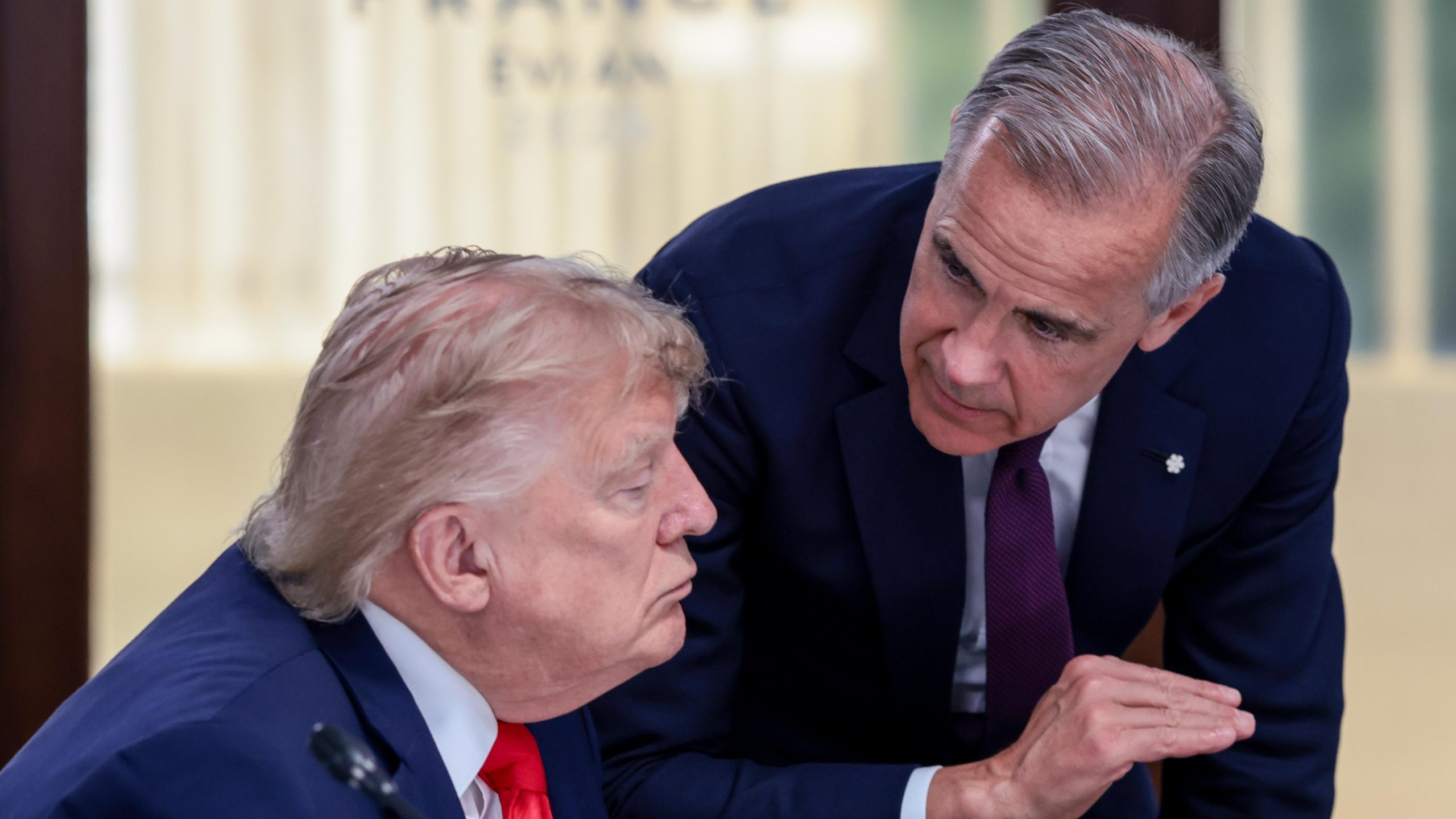
Championing the burgeoning E.U. alliance, Carney focused on what he said were shared values between Canada and the bloc, insisting: “We are not fair-weather allies. We believe that our prosperity grows when it is shared.”
“I’m not proposing a third bloc in order to become a ‘great power’ rival, only with better manners,” Carney continued. “We do not seek power to dominate others. On the contrary, we are pursuing resilience so no one can control our open markets, impair our sovereignty, threaten our territorial integrity, or undermine our freedoms, our democracies, our rule of law.”
Carney, who began his speech in French—one of Canada’s official languages—before continuing in English, with splatterings of German, welcomed how European Commission president Ursula von der Leyen had on Wednesday opened the door for Canada becoming an “associate member” of the 27-member bloc.
When speaking about forging closer ties with the E.U., Carney referenced seeking strategic autonomy through “deep co-operation in the full range of strategic capabilities, including critical minerals, defense industrial capacity, AI and compute, energy security, space and payments.” He insisted Canada and Europe must not be dependent on “individual nations or individual companies” as this “creates vulnerabilities, particularly when supposedly global companies prove national in the breach.”
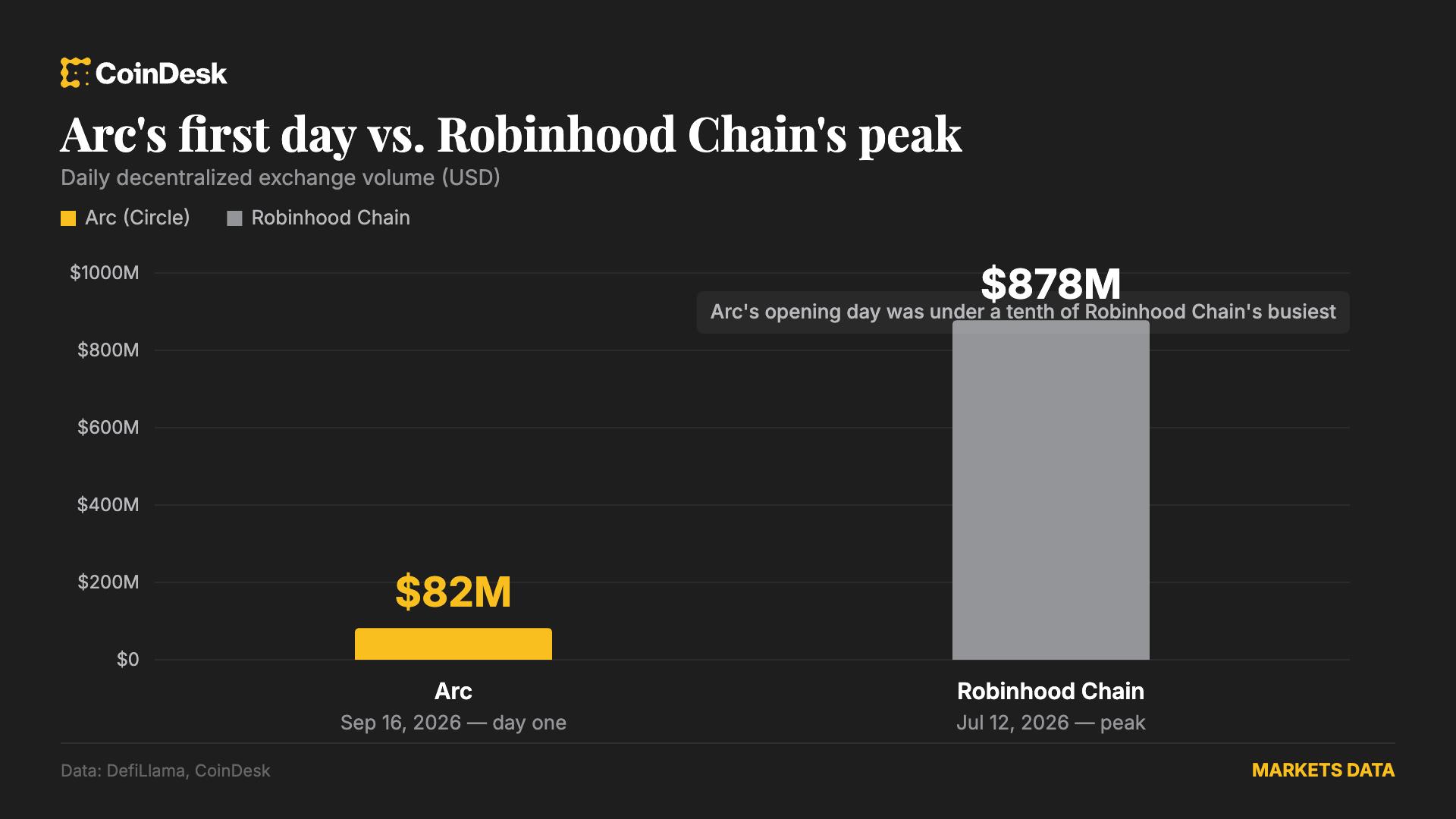
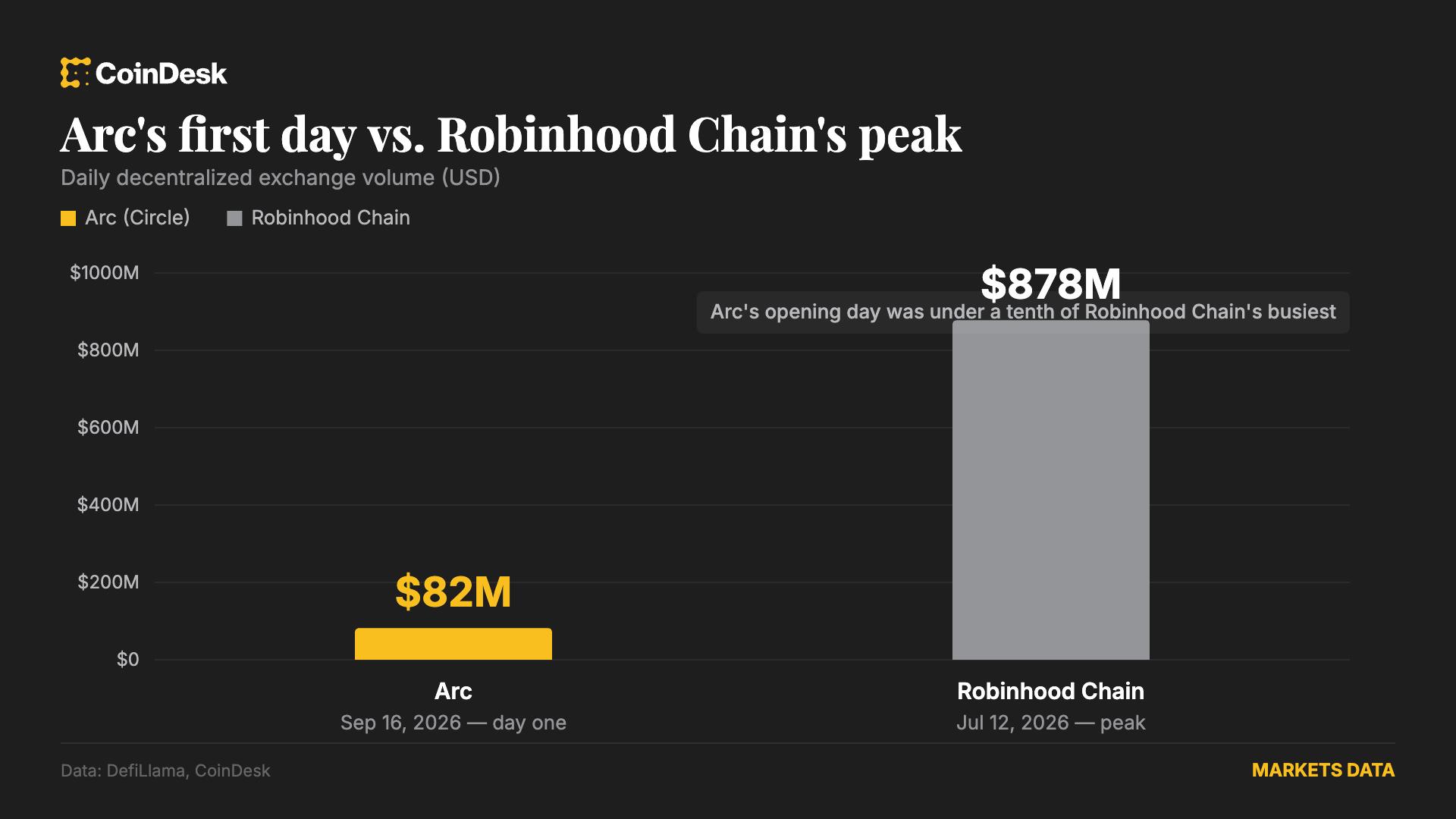
Day-one DEX volume on Arc finished at around $82 million, compared with the $878 million Robinhood Chain did on July 12, when its own institutional pitch was overtaken by memecoins and a cat token briefly hit a $156 million market cap. Arc’s largest token, ARGUS, is worth $16 million. Its second- and third-largest are cirBTC and EURC — Circle’s own products.
The sharper criticism is that Circle invited this. Rachel Mayer, Circle’s VP of product for Arc, posted an AI-generated image promoting DUKE, a memecoin, writing that it was Allaire’s dog. The post drew about 1 million views and a wave of hostile replies accusing Circle of shilling tokens to bootstrap its own network.
“You can clearly see a lot of their team fundamentally misunderstands meme culture,” wrote Abbas Khan. “Now it’s stuck in this weird middle ground where nobody really knows whether it’s supposed to be a meme chain or a corporate stablecoin chain.”
Circle did not immediately respond to a request for comment.
The chain itself is performing as designed, with half-second blocks being processed with no congestion, and DeFi platforms like Aave and Morpho live. But waning sentiment has led to feelings of frustration from the memecoin crowd, despite speculative token activity driving most of the day-one volume.
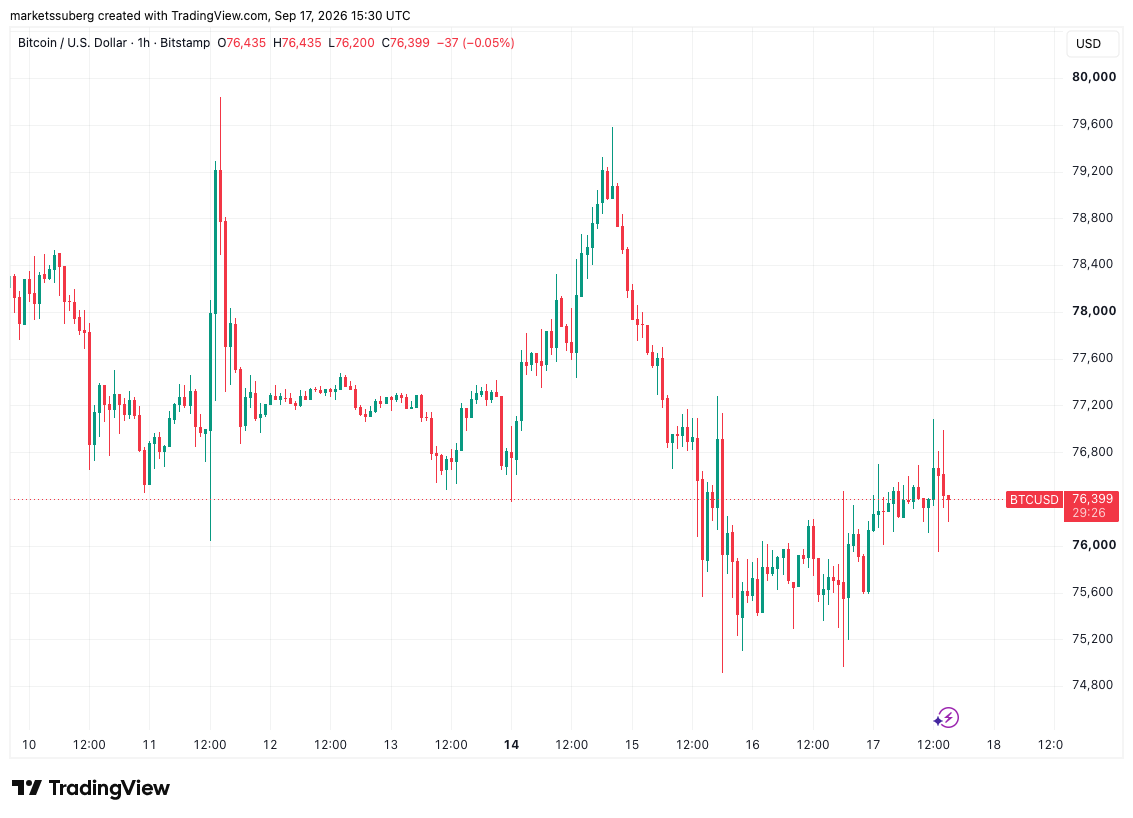
Bitcoin (BTC) traded near $76,500 after Thursday’s Wall Street open as investors snapped up US stocks following their recent dip.
Key points:
- Bitcoin consolidated after dropping below $76,000 on the back of a 0.25% interest-rate hike by the US Federal Reserve.
- US equities rebounded, with the Nasdaq Composite Index gaining 1.5% as analysis saw upside continuation.
- Bitcoin price analysis retained its bullish slant on market conditions, with CryptoQuant’s Bull Score Index circling 60/100 on Thursday.
Bitcoin halts losses as US stocks turn green
Data from TradingView showed that BTC price volatility was cooling over the last 24 hours, with only modest moves to take nearby liquidity.
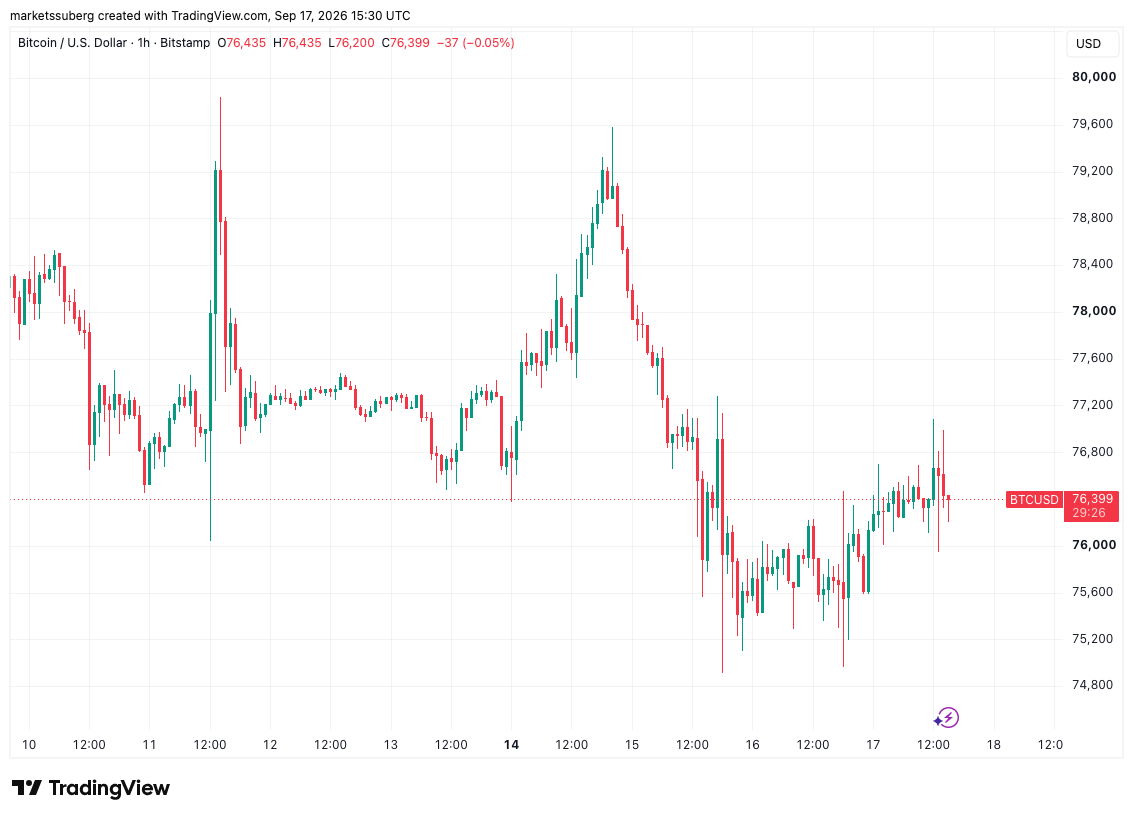
BTC/USD one-hour chart. Source: Cointelegraph/TradingView
Data from CoinGlass showed both bid and ask liquidity thickening around the current spot price, a typical feature of rangebound trading conditions.
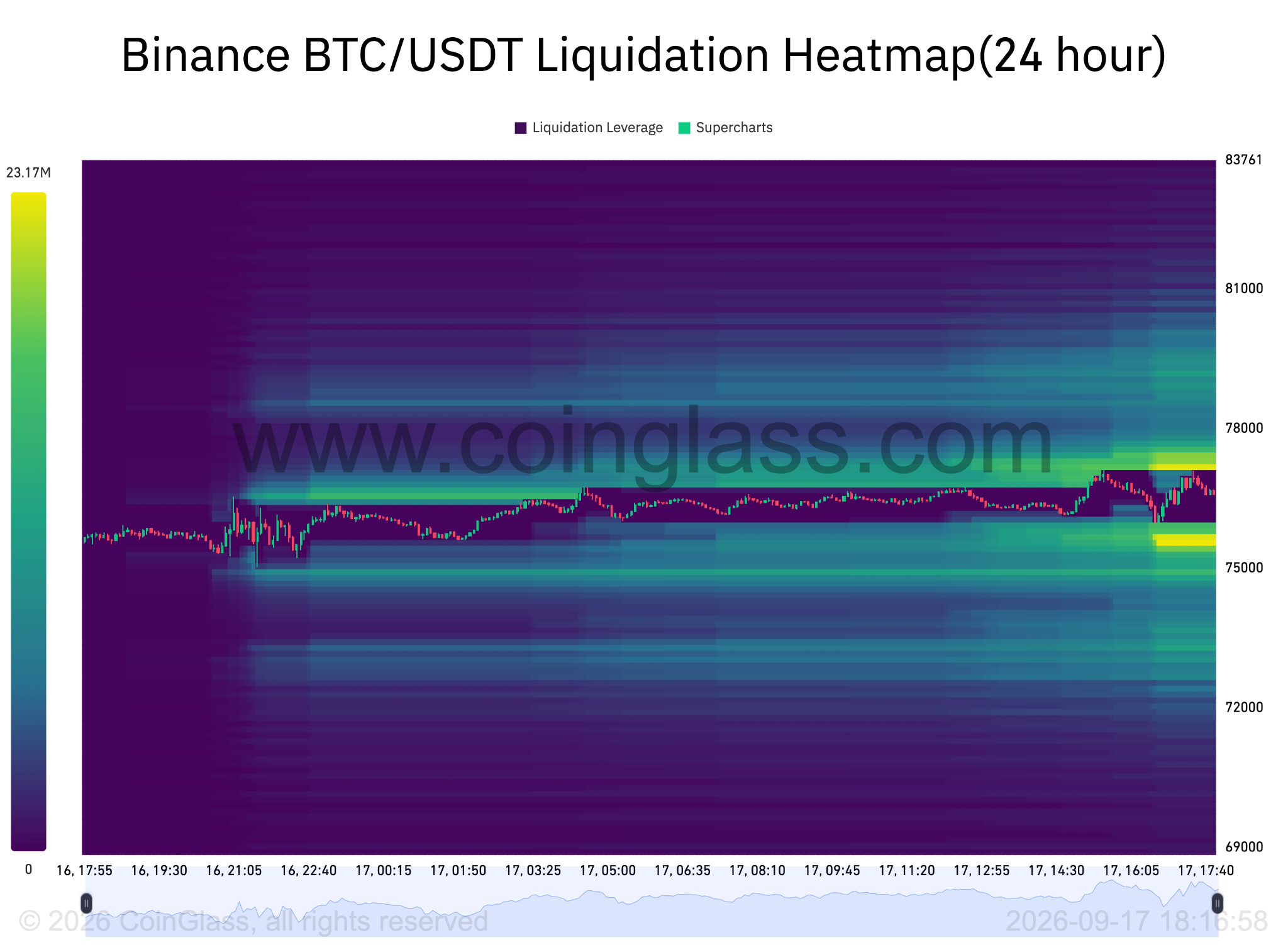
BTC/USDT liquidation heatmap (Binance). Source: CoinGlass
US equities gained on the day, as investors sought to capitalize on the local downside that followed policy tightening by the US Federal Reserve. The S&P 500 Index and tech-heavy Nasdaq Composite Index gained 0.9% and 1.5%, respectively.
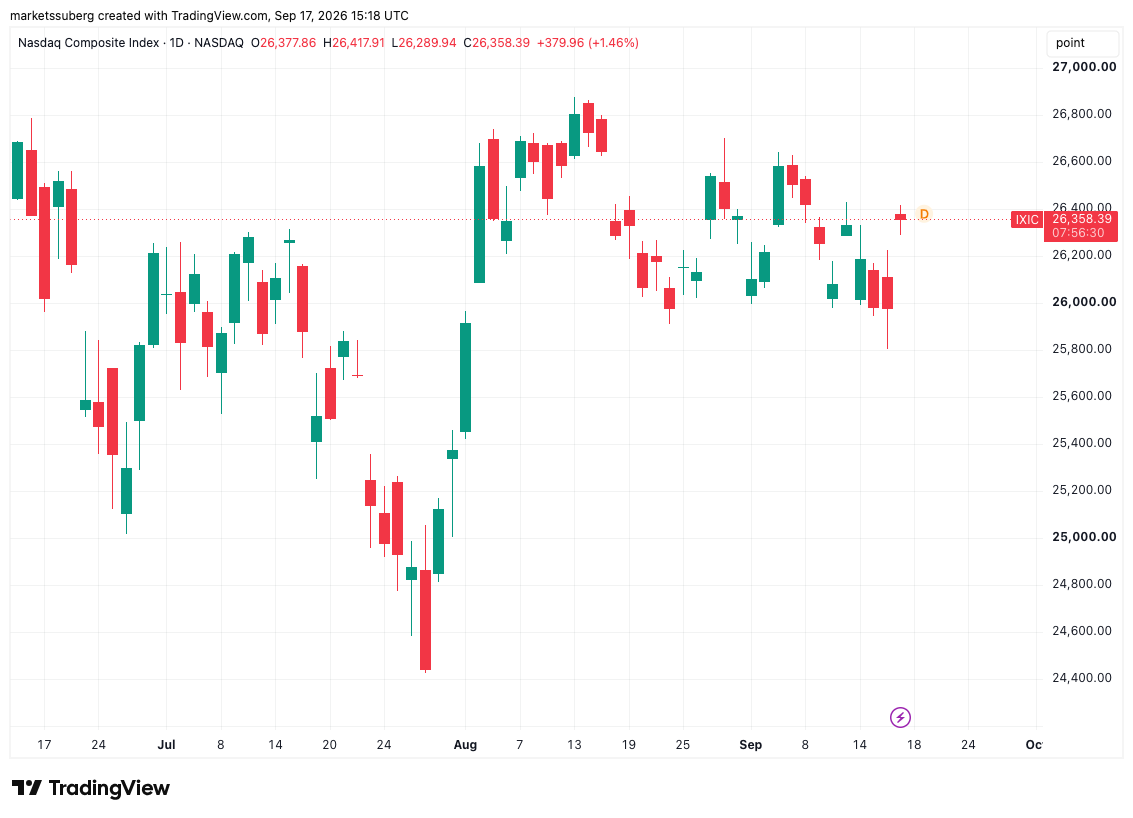
Nasdaq Composite Index one-day chart. Source: Cointelegraph/TradingView
On Wednesday, the Fed voted to increase benchmark interest rates by 25 basis points to 3.75-4%. This was its first hike since July 2023, and signaled an end to three years of easing in which the Fed either cut rates or held them in the same range between meetings.
Commenting, trading resource The Kobeissi Letter suggested that assets would continue to perform strongly despite the prospect of lower-liquidity conditions associated with the rate hikes. As Cointelegraph reported, central-bank rates are notching higher globally, as the European Central Bank hiked by 0.25% last week and the Bank of Japan is expected to follow suit on Friday.
“The asset owner economy just keeps getting better,” it wrote in a post on X, referencing the day’s gains in the Nasdaq.
Analysis sees BTC price trend “cooling, not turning”
Bitcoin also enjoyed relief after falling to new month-to-date lows on Tuesday. At the time of writing, BTC/USD traded 0.5% higher on the day.
Related: Bitcoin treasuries buy just 5.9K BTC in three months as paper losses linger
Commenting on the current market landscape, onchain analytics platform CryptoQuant described macro conditions as a hurdle to the continuation of Bitcoin’s previous rebound that totaled 25% in August.
“The trend is still bullish, but momentum and macro are working against it near-term,” head of research Julio Moreno wrote in its latest weekly report sent to Cointelegraph.
Moreno noted that one of CryptoQuant’s proprietary indicators tracking BTC price cycles, the Bull Score Index, had dropped from 80 to 60 — the cut-off point for what it describes as “bullish conditions.”
“Bitcoin is cooling, not turning. A Bull Score of 60 keeps the trend bullish, but fading US demand, rising altcoin inflows, and a week of macro risk — the delay of the CLARITY Act and a likely Fed hike — argue for consolidation. Watch $70K and $62K–$65K as support,” the report summarized.
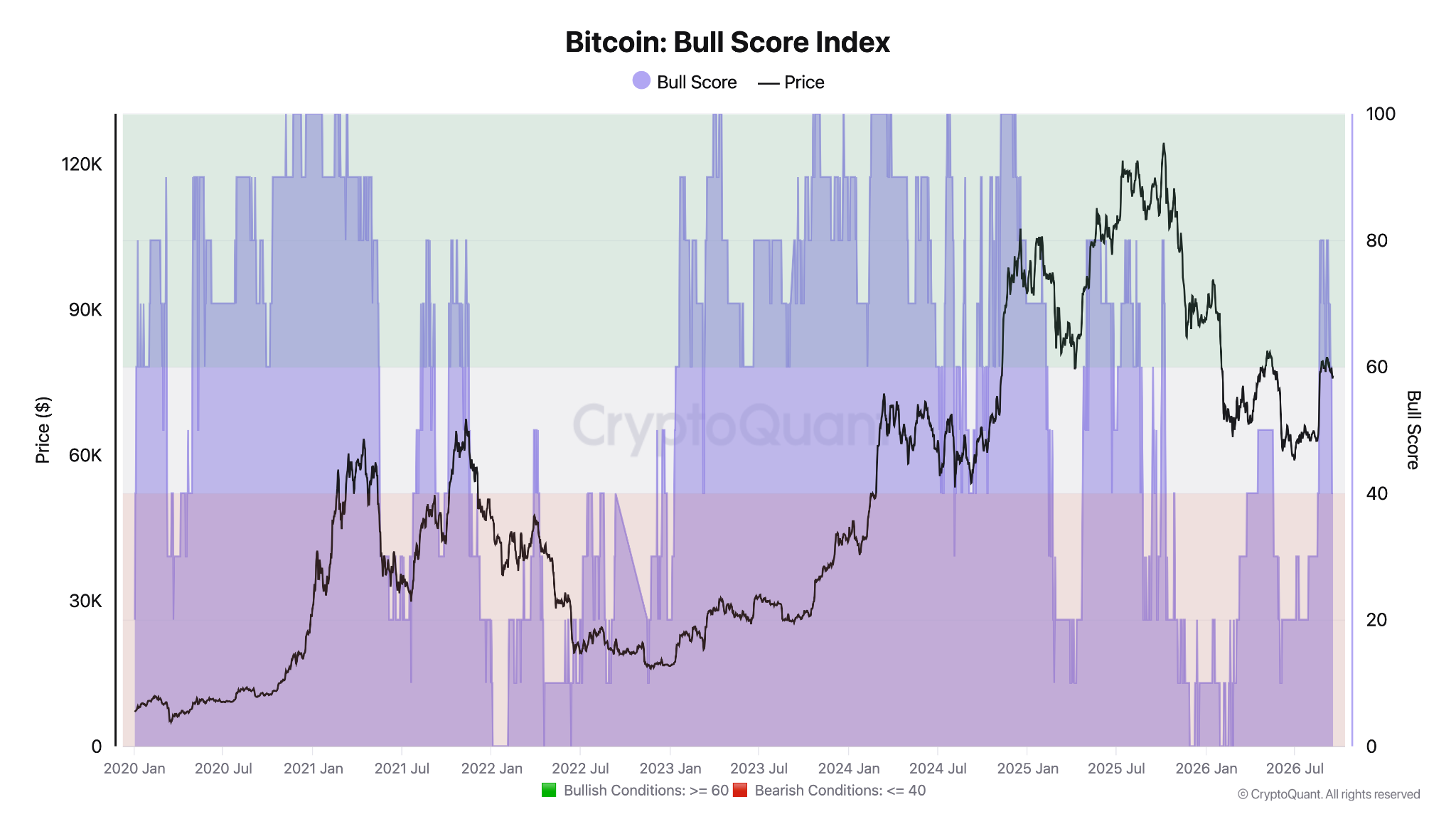
Bitcoin Bull Score Index. Source: CryptoQuant

Ethos Technologies (LIFE), today’s IBD 50 Stock To Watch, highlights the significance of having sound sell rules to preserve gains in stocks that make short-term rallies. The price action by the insurance play since the company’s Jan. 29 initial public offering illustrates why. Initially, the online platform for insurance products did not get off to a bullish start following its…
Copyright ©2026 Investor’s Business Daily, LLC. All rights reserved. 87990cbe856818d5eddac44c7b1cdeb8
Fortitude Mining has appointed former Hut 8 CEO Jaime Leverton as chief executive as the Zcash-focused miner prepares to go public through a proposed merger with HeartSciences. Leverton will succeed Andrea Childs as CEO on Sept. 21, with Childs moving to chief operating officer.
Fortitude mined 72,696 ZEC in the first half of 2026, accounting for about 28% of the network’s total production during the period. The company reported revenue of $20.9 million for the second quarter.
It operates more than 60 megawatts of power capacity across seven sites in South Dakota, Nebraska, Texas and New York, and in July agreed to purchase 9,000 Bitmain Antminer Z15 Pro machines, which are expected to add 7.56 GSol/s of equihash hashrate. Shipments are expected in the fourth quarter.
Fortitude, wholly owned by Digital Currency Group, has mined ZEC since 2019 and launched as a vertically integrated mining platform in 2025.
The company announced its proposed combination with HeartSciences in June, with the transaction expected to close in the fourth quarter of 2026 and bring Fortitude to the public markets. The combined company is expected to trade on Nasdaq under the ticker TUDE, subject to approval.
Leverton previously served as CEO of Hut 8, where she oversaw the Bitcoin miner’s merger with US Bitcoin Corp. and its transition into a US-domiciled Nasdaq-listed company. Current CEO Andrea Childs will transition to the chief operating officer role.
Related: Cypherpunk launches Zcash mining fleet controlling 18% of network hashrate
Zcash surges amid Paradigm investment
Zcash continued its rally on Thursday, with ZEC, the native token of the blockchain designed to enable private transactions using zero-knowledge proofs, trading around $1,424. The token has gained about 185% over the past 30 days and more than 2,600% over the past year, according to CoinGecko.
The latest gains came after Paradigm co-founder Matt Huang disclosed Wednesday that the crypto investment firm holds ZEC and is an investor in the Zcash Open Development Lab.
Huang described Zcash as a “private complement to Bitcoin” and backed its inflation-funded developer fund, arguing that long-term funding for privacy technology is increasingly important as artificial intelligence and quantum computing advance.
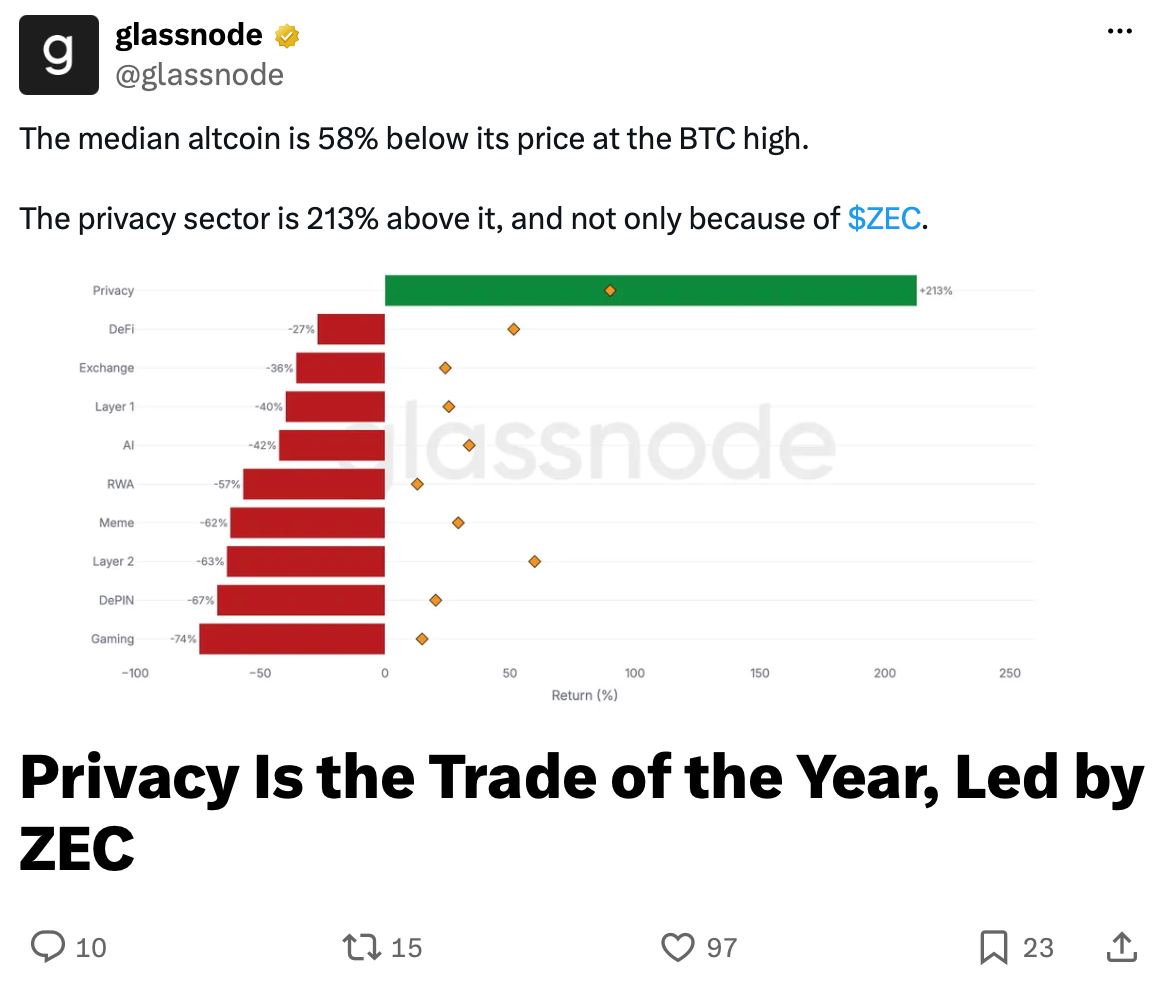
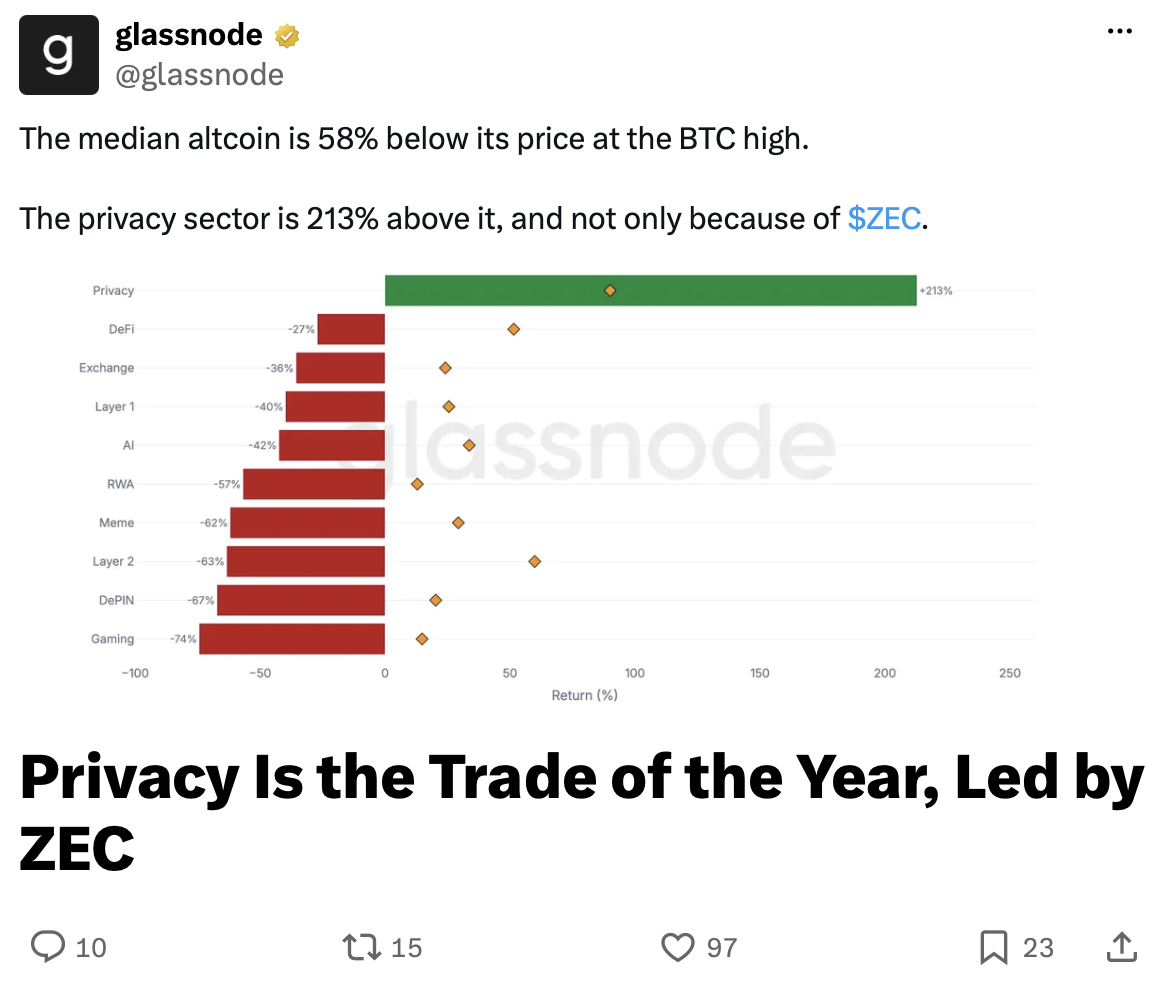
Over the past year, privacy-focused cryptocurrencies have outperformed the broader crypto market. As of Sept. 6, the sector was up 213% from Bitcoin’s October 2025 peak, while every other crypto sector tracked by Glassnode remained below its level at the time.
ZEC accounted for 62% of the privacy sector’s market capitalization, according to Glassnode data. Excluding ZEC, the firm’s cap-weighted basket of privacy tokens was still up 85% over the past year.
Source: Glassnode


The CLARITY Act failed to clear a Senate cloture vote on September 15, falling short of the 60 votes needed to advance the crypto market structure bill.
The measure remains procedurally open after Sen. Thom Tillis moved to reconsider the vote. Digital Sovereignty Alliance managing director Adrian Wall said another attempt could be considered before the current Congress ends.
He did go on to characterize that prospect as complicated and a long shot. Following the failed vote on Tuesday, prediction markets such as Kalshi now show just an 8% chance of it passing before January 1, 2027.
What are the Key Takeaways from the Failed September 15 Cloture Vote?
The September 15 cloture vote on H.R. 3633 did not reach the 60-vote threshold required to move the bill forward in the Senate. Congress.gov records that Tillis moved to reconsider the vote, which did not invoke cloture on the motion to proceed.
Wall said senators from both parties are considering another effort to advance the legislation before the current Congress concludes.
His assessment does not mean another vote will occur, but it does indicate that the legislation has not been treated as finished after the unsuccessful cloture vote.
What Is Wall Hearing From Senators?
Wall said Wednesday that he had spoken directly with senators from both parties who were considering another push on crypto regulation before lawmakers adjourn.
He made the comments on Cointelegraph’s Chain Reaction show and said the information came from senators rather than congressional staff.
The comments followed Tuesday’s failed Senate cloture vote, which left the bill short of the votes needed to proceed. Wall described the vote as a major setback but said it did not necessarily mark the end of the legislation.
The Digital Sovereignty Alliance is a nonprofit advocacy group that works with lawmakers and regulators on digital asset policy. Tillis’s motion to reconsider means the Senate has recorded a procedural step related to the failed vote.
The motion does not itself set a date for another vote, and Wall’s comments describe a possible renewed effort rather than a confirmed Senate schedule.
Wall’s Assessment of the Latest CLARITY Act Drama
Wall indicated that there is interest in advancing the legislation during Congress’s lame-duck session. However, he cautioned that the process would be challenging, complicated, and remain a long shot.
According to Wall, senators from both parties have discussed a strategy to engage with one another to assess whether there is a final opportunity to move the bill forward.
This reflects Wall’s perspective on discussions with senators, but it does not confirm any scheduled votes or provide a vote count.
DISCOVER: The Best Token Presales
What Happens Next in the CLARITY Act Story
The post-election lame-duck session is the period Wall identified for a possible second attempt at the CLARITY Act. No subsequent Senate vote is identified in the available reporting.
If another attempt in the lame-duck session fails, Wall said the next Congress could continue work on crypto market structure legislation.
For now, H.R. 3633 remains at a procedural stage following the failed cloture vote and Tillis’s motion to reconsider. Any renewed effort, based on Wall’s assessment, would be difficult and require further Senate action.
The bill’s near-term path, therefore, depends on whether lawmakers pursue the possibility Wall described during the lame-duck session.
Earn $50 and Enter $300K Prize Draw on EdgeX
The post Senate Setback Leaves CLARITY Act Facing Long-Shot Revival appeared first on Cryptonews.
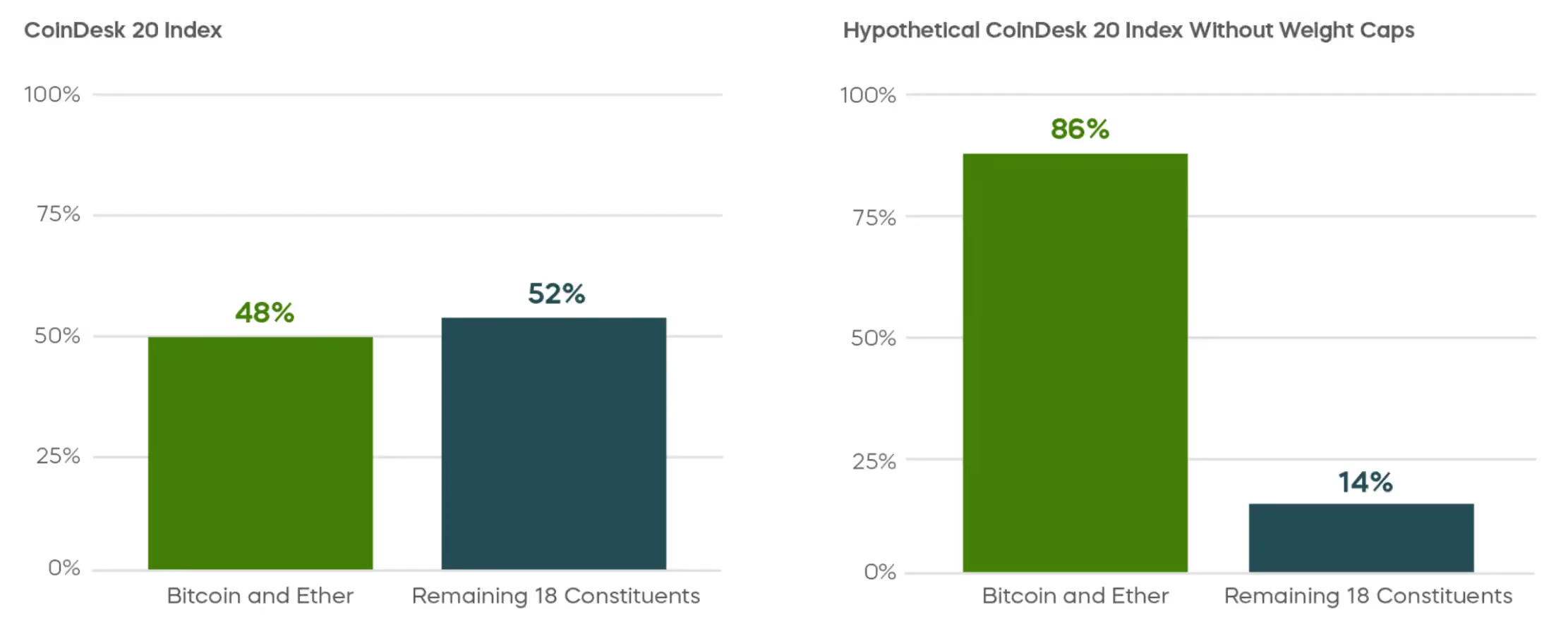
Importantly, the index is designed not only to provide broader exposure across the crypto market, but also to limit concentration in its largest assets. Bitcoin and ether represent a large share of total crypto market capitalization, meaning a traditional market-cap-weighted index would be dominated by those two assets.
The CoinDesk 20 Index addresses that concentration through a modified market capitalization weighting methodology. The index applies:
· 30% cap on the largest constituent
· 20% cap on all other constituents
These caps limit concentration in a single crypto asset and allow other major cryptocurrencies to play a larger role in the index.

Left: Source: CoinDesk, as of June 30, 2026. Right: ProShares hypothetical calculation using the CoinDesk 20 Index constituents, weighted by market capitalization without the index caps, as of June 30, 2026. For illustrative purposes only.
Without these caps, the index would largely reflect the performance of bitcoin and ether alone. By limiting concentration in the largest assets, the CoinDesk 20 Index creates more balanced exposure across a wider set of cryptocurrencies.
There is also a practical consideration. Building similar exposure directly would require an investor to purchase, custody and periodically rebalance a relatively large number of individual crypto assets. The infrastructure surrounding crypto custody has improved considerably, but holding multiple cryptocurrencies can still require navigating different exchanges, wallets, custody arrangements and operational considerations. An index-based approach can simplify that process while maintaining exposure to changes occurring across the broader market.

Luke Nikas
Best golf resorts in U.S., Canada: Top 100 Resorts in the World

iPhone 18 Pro Reviews Showcase Its Four Apertures Behind Familiar Glass



-

 Fashion6 days ago
Weekend Open Thread – Corporette.com
-

 Tech4 days ago
The Latest Weird Thing to Play Doom Is the Mapped-Out Brain of a Fruit Fly
-

 Business6 days ago
10 Most-Streamed Songs On Spotify In 2026 So Far, Led By Ella Langley’s Dominant Run On The Charts This Year
-

 Crypto World6 days ago
XAG/USD: Silver’s Short-Term Rally Meets Its Moment of Truth
-

 Tech7 days ago
Battery life is the only iPhone 18 Pro and iPhone Duo upgrade I care about. Apple didn’t disappoint
-

 Crypto World7 days ago
OKX launches 10x OpenAI, Anthropic X-Perps in Europe
-

 Crypto World6 days ago
Diesel Tops $6 a Gallon for the First Time as 28 States Set Records
-
 Crypto World3 days ago
Kraken Lets xStocks Holders Earn Yield Through DeFi
-

 News Videos6 days ago
Facing Financial Fears
-

 Crypto World3 days ago
Elon Musk Drops a Bombshell: Grok 5 Could Be the AGI Breakthrough
-

 Business4 days ago
Rivals Sam Altman and Elon Musk Rally Behind Dario Amodei’s Call for a Slowdown in AI Development
-

 Crypto World17 hours ago
US Charges Robinhood Engineers Over Crypto Listing Trades
-
Crypto World7 days ago
Ethereum Price Analysis: Consolidation at $2.5K Tests Momentum as On-Chain Activity Surges
-

 Crypto World5 days ago
Can AI Build a Startup in 72 Hours? Elon Musk's Team Will Livestream the Test
-

 Entertainment6 days ago
News Specials, Movies, Shows, More
-
 NewsBeat3 days ago
‘Sick conspiracy’: Trump says only guardrails AI needs is ‘a strong and smart (High IQ!) president’ in all-caps rant
-

 Crypto World7 days ago
Bitcoin ETFs Pull $167M as 2026’s Best Inflow Run Slows
-

 Crypto World7 days ago
US CPI forecast at 3.4% as tariff risks build
-

 Crypto World6 days ago
Robinhood Chain Never Stopped But its Blobs Did Stop Reaching Ethereum For 14 Minutes
-
 Crypto World4 days ago
New Tesla Roadster Uses SpaceX Tech. Will It Impact the Stock Price?
You must be logged in to post a comment Login