
Crypto World
Dayanita Singh




The U.S. Treasury has sanctioned Iranian crypto exchange BitBank on Sept. 17, alleging that a network linked to financier Babak Zanjani used the platform to transfer hundreds of millions of dollars in Bitcoin to Iran’s Islamic Revolutionary Guard Corps between June and July.
Summary
- OFAC sanctioned BitBank, its developer, and three associates linked to financier Babak Zanjani on Thursday.
- Treasury alleges BitBank transferred hundreds of millions in Bitcoin to Iran’s Islamic Revolutionary Guard Corps.
- Hormuz Safe allegedly used BitBank since June to move maritime payments collected for Iran’s government.
- BitBank and Pishtaz Simorgh were designated under Executive Order 13902 for Iran digital asset activities.
- U.S. persons must block designated property, while certain foreign dealings may create secondary sanctions exposure.
Treasury said the Office of Foreign Assets Control placed BitBank, software developer Pishtaz Simorgh Electronic Trade Company and three Zanjani associates under sanctions as part of Operation Economic Outcast, its current campaign targeting Iranian financial networks and sanctions evasion.
The designations are administrative sanctions actions, not criminal convictions. Treasury’s public announcement does not provide Bitcoin wallet addresses, transaction hashes or a precise total supporting the alleged transfers, leaving the cited “hundreds of millions of dollars” figure attributed to the U.S. government.
BitBank was added to OFAC’s sanctions list
OFAC’s Sept. 17 notice identifies BitBank as an Iran-based financial and insurance business established in 2024. The listing includes the names BitBank and BitBank3, along with bitbank3.com and bitbank.com.
Pishtaz Simorgh Electronic Trade Company was added in the same action. Treasury describes the company as the developer of BitBank’s digital asset software and a subsidiary of Dot One Value Creation Group, another entity previously placed under U.S. sanctions.
The three people designated alongside the companies are Hossein Ali Zaker Hossein, Mohammad Mahdi Zaker Hossein and Seyed Adel Heidari. Treasury identifies all three as executives connected with Zanjani’s Dot One business network.
Mohammad Mahdi Zaker Hossein serves as Pishtaz Simorgh’s chief executive, according to Treasury. Seyed Adel Heidari is vice chairman of Dot One’s board, while Treasury alleges Hossein Ali Zaker Hossein has participated in oil exports and digital asset transactions linked to Zanjani’s sanctions-evasion operations.
BitBank itself was designated under Executive Order 13902 for operating in Iran’s digital asset sector. Treasury expanded its use of that authority in August as part of Operation Economic Outcast, allowing OFAC to target companies and individuals involved in Iran’s crypto industry.
Treasury Secretary Scott Bessent said the action showed that “efforts to finance the Iranian regime using cryptocurrencies are not beyond OFAC’s reach.” His statement accompanied the designation and represents the U.S. administration’s enforcement position.
Treasury alleges Bitcoin moved to the IRGC
Between June and July, Treasury alleges Zanjani used BitBank to transfer hundreds of millions of dollars worth of Bitcoin to the IRGC.
The Sept. 17 release does not identify the wallets involved or break down the transactions by date, amount or counterparty. OFAC’s accompanying SDN entry similarly does not list digital currency addresses for BitBank.
No independent on-chain evidence reviewed for this report confirms the full amount cited by Treasury. The transfer total therefore remains a U.S. government allegation based on information OFAC has not fully disclosed publicly.
Treasury has tied Zanjani to digital asset businesses for months. On Jan. 30, OFAC sanctioned him alongside Zedcex Exchange and Zedxion Exchange, alleging that addresses associated with the exchanges had handled funds connected with IRGC-linked counterparties.
A later July 24 action added four individuals and nine entities linked to his network. Treasury said the businesses covered digital asset trading, transportation, financial services, gold and other activities used to move funds inside Iran and through offshore companies.
BitBank had not been designated during those earlier rounds. Treasury says Zanjani had promoted the exchange publicly since at least 2024 and that several companies within his network listed it as a business partner.
As previous Iran crypto sanctions coverage reported, U.S. authorities have increasingly targeted exchanges and wallet networks that officials say provide Iran with access to international crypto markets despite financial restrictions.
Hormuz Safe allegedly routed payments through BitBank
Treasury tied the latest BitBank designation to another Iran-linked crypto payment operation centered on shipping through the Strait of Hormuz.
Since June, Treasury alleges Hormuz Safe Marine Services Authority has used BitBank to transfer payments it collected to the Iranian government. OFAC had sanctioned Hormuz Safe on July 29.
Hormuz Safe promoted maritime services including insurance, security, traffic management and emergency assistance for vessels crossing the Strait of Hormuz. Treasury said the platform accepted Bitcoin and other digital assets.
U.S. officials described the program as part of an IRGC-linked revenue system. Treasury alleged that some of the risks covered by the maritime insurance arrangement included vessel seizures and other threats associated with Iranian activity in the waterway.
The agency did not publish Bitcoin addresses or transaction hashes when it sanctioned Hormuz Safe in July. Earlier reporting on the Hormuz Safe sanctions noted the absence of public on-chain identifiers and payment totals in OFAC’s initial announcement.
Treasury’s Sept. 17 statement now links those payments to BitBank but still does not provide a transaction-by-transaction trail in its public materials.
The agency says BitBank formed part of the financial infrastructure Zanjani built around the maritime payment system and other sanctioned operations. Treasury has not disclosed how much of the alleged hundreds of millions in Bitcoin came specifically from Hormuz Safe.
U.S. persons must block BitBank-linked property
Following the designation, property and interests in property belonging to BitBank, Pishtaz Simorgh and the three listed individuals must be blocked when located in the U.S. or held by U.S. persons.
OFAC’s 50% rule extends the restrictions to businesses owned directly or indirectly, individually or collectively, 50% or more by blocked parties.
Transactions involving designated people or entities are generally prohibited for U.S. persons unless OFAC issues a license or an exemption applies. Treasury warns that certain foreign institutions and businesses may face sanctions exposure when dealing with blocked Iranian entities.
The Sept. 17 notice labels BitBank and Pishtaz Simorgh as subject to secondary sanctions. The designation therefore extends beyond a simple prohibition on U.S. companies transacting directly with them.
Treasury says civil sanctions violations can be enforced on a strict-liability basis, meaning OFAC can impose penalties without establishing that a party knew it was violating sanctions. Criminal liability involves separate legal standards.
The designations remain subject to OFAC’s administrative removal process. A designated person can petition the agency to be removed from the SDN list by presenting arguments or evidence that the listing no longer has a sufficient basis.
BitBank follows earlier sanctions on Iranian exchanges
The BitBank action extends a series of U.S. sanctions against Iranian crypto platforms during 2026.
In June, Treasury sanctioned Nobitex, Wallex, Bitpin and Ramzinex, accusing the exchanges of helping sanctioned Iranian actors access digital assets. Earlier coverage of the Nobitex action reported that Treasury described Nobitex as Iran’s largest crypto exchange.
OFAC added Shelbit and Aban Tether on Aug. 7. Treasury alleged Shelbit-linked addresses had sent more than $2 million to IRGC-controlled addresses and received more than $1 million from IRGC-linked wallets.
Aban Tether was accused of processing millions of dollars involving previously sanctioned Iranian exchanges. Related coverage of the August designations noted that Shelbit’s former management denied knowingly participating in money laundering, terrorism financing or sanctions evasion.
Operation Economic Outcast began on Aug. 24 and covers crypto, oil sales, shipping, technology, aviation, gold and other financial channels that Treasury says generate or move revenue for Iranian state-linked entities.
As crypto sanctions campaign coverage reported at the time, Treasury said the campaign would use expanded sanctions authority against companies operating in Iran’s digital asset sector, including actors located outside the country.
The Sept. 17 designation formally places BitBank, Pishtaz Simorgh, Hossein Ali Zaker Hossein, Mohammad Mahdi Zaker Hossein and Seyed Adel Heidari on OFAC’s SDN list. Treasury has not announced a related criminal indictment or published the Bitcoin addresses underlying the alleged June-to-July transfers.
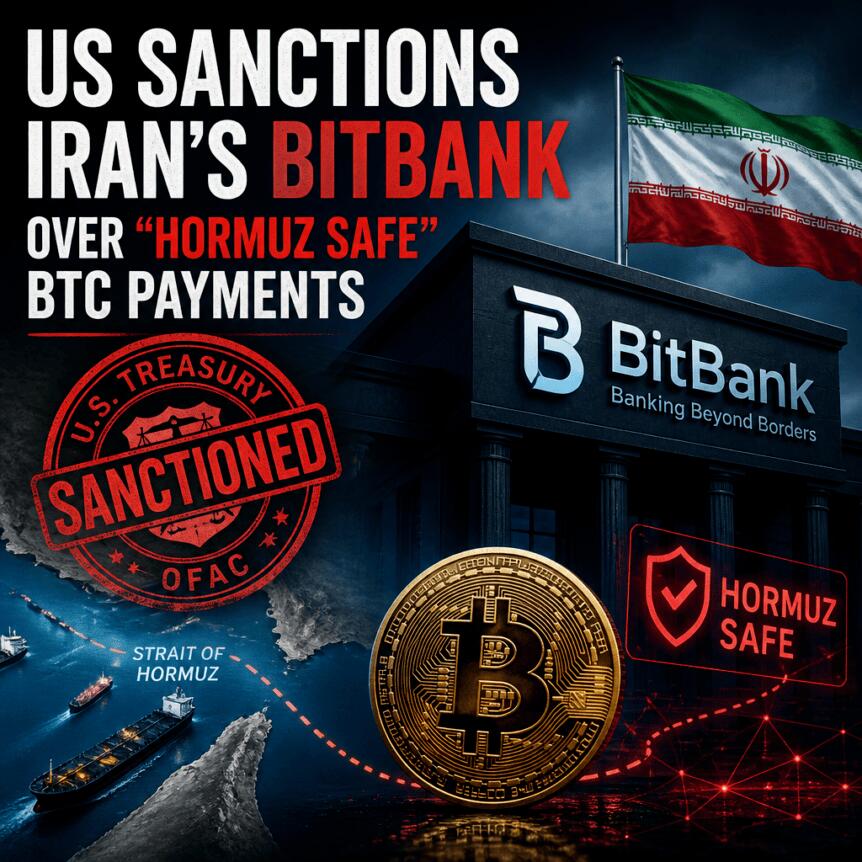
U.S. authorities have announced new sanctions targeting an Iranian crypto exchange known as BitBank, accusing it of helping move Bitcoin payments tied to maritime traffic through the Strait of Hormuz. The U.S. Treasury says the exchange was used to transfer funds received through a Hormuz-related payments authority to the Islamic Revolutionary Guard Corps (IRGC).
In a press release issued by the U.S. Department of the Treasury’s Office of Foreign Assets Control (OFAC), the government described BitBank as part of an alleged sanctions-evasion “infrastructure” associated with Iranian financier Babak Zanjani. OFAC’s action forms part of a broader effort to restrict Iran’s access to the global financial system, including through targeting digital asset service providers.
Key takeaways
- OFAC sanctioned Iranian crypto exchange BitBank, alleging it processed Bitcoin payments connected to ships transiting the Strait of Hormuz.
- The Treasury alleges BitBank transferred funds received by the Hormuz Safe Marine Services Authority to the IRGC.
- OFAC also designated BitBank’s developer, Pishtaz Simorgh Electronic Trade Company, along with three Zanjani associates.
- The U.S. has repeatedly expanded crypto-related Iran sanctions, including actions against exchanges and steps involving USDt-linked wallets.
- There is potential for confusion between the sanctioned BitBank entity and a separate Japan-based exchange, “bitbank, inc,” that was acquired by SBI Holdings in June.
OFAC ties BitBank to payments around Hormuz
OFAC’s announcement states that, as of June, the Hormuz Safe Marine Services Authority used BitBank to transfer payments it received to the Islamic Revolutionary Guard Corps. The implication, according to the Treasury, is that crypto rails were integrated into a system that supports financial flows tied to passage through a strategic chokepoint.
The U.S. also previously alleged that Hormuz Safe is connected to an IRGC-backed scheme involving maritime insurance arrangements for vessel transit—specifically coverage that, in the Treasury’s account, includes risks related to seizures by Iran itself. By linking BitBank to this payments chain, the Treasury is effectively arguing that an Iranian digital asset exchange can function as a conduit for regime-linked funding.
U.S. Treasury Secretary Scott Bessent said the designations underscore that “efforts to finance the Iranian regime using cryptocurrencies” are not beyond OFAC’s enforcement reach.
Why the Treasury’s “digital asset infrastructure” framing matters
OFAC did not only target a single exchange; it also designated BitBank’s developer—Pishtaz Simorgh Electronic Trade Company—and three associates connected to Babak Zanjani. In the filing and related announcement, OFAC described these entities as “key components of the Iranian regime’s digital assets-based sanctions evasion infrastructure.”
For investors, traders, and on-chain analysts, this matters because it reinforces how regulators are moving from broad “crypto used for illicit finance” messaging toward mapping specific operational roles within alleged networks. Instead of treating activity as incidental to sanctions evasion, the U.S. is characterizing certain digital service providers and corporate developers as integral nodes—potentially affecting counterparties, compliance workflows, and the risk assessments of exchanges and custodians that may interact with such entities.
OFAC’s approach also suggests that enforcement risk is not limited to Iranian individuals, addresses, or token transfers alone. It can extend to software vendors, exchange operators, and associates—depending on how the U.S. describes their involvement in the flow of value.
Sanctions pressure aligns with earlier U.S. actions
The BitBank designation comes after a sequence of U.S. measures aimed at tightening Iran’s access to financial tools, including digital assets. In earlier actions, OFAC sanctioned two exchanges—Shelbit and Aban Tether—accusing them of assisting the Iranian regime in sanctions evasion. The Treasury also sanctioned four crypto exchanges in June, including Nobitex, which the U.S. identified as Iran’s largest exchange.
Beyond exchange designations, the U.S. also ordered the freezing of more than $130 million in USDt held in wallets linked to Iran. Taken together, these steps show a multi-pronged strategy: identifying exchange infrastructure, restricting stablecoin-linked funds, and isolating sanctioned entities from activity that could enable cross-border value movement.
The broader political goal remains consistent across these actions—isolating Iran from the international financial system. In the Treasury’s view, digital assets are now part of the mechanism by which the regime can sustain transactions and payments despite increasingly tight constraints.
Entity confusion: sanctioned BitBank vs. “bitbank, inc”
One potential point of misunderstanding for readers is that the sanctioned entity is “BitBank,” which OFAC’s designation reportedly describes as established in 2024. This is separate from “bitbank, inc,” a fully licensed crypto exchange founded in 2014 in Japan and acquired by SBI Holdings in June.
The similarity in names has practical implications: compliance teams, journalists, and market participants should avoid assuming that the Japanese exchange is implicated in the U.S. sanctions simply because of the branding overlap. The U.S. action appears to concern a different organization tied to the Treasury’s alleged Hormuz payment architecture.
Cointelegraph reached out to BitBank for comment, though no response is included in the provided material.
What to watch next
As OFAC continues building out sanctions lists around Iranian crypto infrastructure, market participants should monitor whether related wallets, service providers, and stablecoin pathways are further targeted—especially those connected to maritime-linked payment systems described in the Treasury’s case. The immediate uncertainty is how quickly designated entities can be circumvented and whether enforcement will expand to additional components of the broader network OFAC alleges BitBank helped power.


The Bank of Japan (BOJ) raised its benchmark interest rate by 25 basis points on Friday, lifting it to 1.25%, the highest level in 31 years, as it battles sticky inflation and a chronically weak yen.
The move marks the central bank’s second hike in three months and comes weeks after U.S. Treasury Secretary Scott Bessent publicly pressed Tokyo to tighten faster to support yen. He argued that an orderly yen market benefits Treasury market stability and defended the coordinated yen-buying intervention as serving U.S. interests.
The bitcoin-Japanese yen pair (BTC/JPY) listed on Tokyo-based bitFlyer exchange extended gains by a 0.5% to JPY 12.06 million following the BOJ rate hike. BTC’s dollar-denominated price jumped to $77,400, extending the rebound from the overnight low of $76,200, data from CoinDesk show.
The Japanese yen depreciated against the U.S. dollar, lifting the USD/JPY pair to 156.70 from 156.20.
BOJ rate decisions and yen movements are said to have a bearing on world markets, thanks to a prolonged period of near‑zero interest rates in Japan over the past decade or more that led traders to borrow in yen to fund higher‑yielding investments elsewhere.

The artistic director of Museu de Arte de São Paulo (MASP) in Brazil has broken out by rewriting the curator’s playbook. Pedrosa places art previously dismissed as “outsider” on equal terms with the work of academically trained artists, and eschews chronological storytelling in favor of surveys of art that play on broad themes such as “childhood” or “sexuality.” In 2025, after more than six years of planning and construction, MASP opened a $43 million tower that expanded its exhibition space by 66%. This year, Pedrosa dedicated MASP’s curatorial program to unpacking how the idea of Latin America was created and contested over time. He also defended some MASP exhibitions, including a recent show by the queer artist La Chola Poblete, from right-wing attacks. As competing political factions push fixed views of history, Pedrosa’s exhibits argue that there is no one “correct” way to view art.


Seven Senate Democrats have reopened negotiations over the CLARITY Act after the chamber rejected cloture in a 49-50 vote, leaving the crypto market structure bill 11 votes short of the 60 required to begin debate.
Summary
- Seven Democrats who opposed cloture said the CLARITY Act effort is “not the end.”
- Coinme’s Neil Bergquist said federal market structure rules would not replace state licensing requirements.
- Unclear SEC and CFTC authority forces platforms to assess each token’s legal and operational risks.
- Bergquist expects agency rulemaking to continue while the bill remains stalled before the midterms.
Coinme CEO and co-founder Neil Bergquist told crypto.news that reviving the bill could reduce uncertainty over token classification, but it would not remove the state licenses that digital asset companies must secure across the United States.
The Senate rejected cloture on the motion to proceed with the Digital Asset Market CLARITY Act on Sep. 15. According to the official roll call, 49 senators supported the motion, and 50 opposed it, preventing the chamber from opening debate at that stage.
Sens. Kirsten Gillibrand, Angela Alsobrooks, Cory Booker, Catherine Cortez Masto, Ruben Gallego, Mark Warner and Raphael Warnock voted against the motion. One day later, the seven Democrats issued a joint statement describing the result as “not the end” of their work on the legislation.
Their statement pointed to two years of negotiations and pledged to continue working on a bipartisan basis. However, Democrats and Republicans remain divided over ethics provisions, including restrictions covering elected officials and digital asset ventures.
CLARITY Act would leave state licensing intact
Although the bill would set federal rules for digital asset markets, Bergquist said its passage would not eliminate separate licensing requirements imposed by individual states.
“Since the bill focused on federal market structure, state by state licensing requirements would not have changed,” he said. “It mainly dealt with how digital assets are classified and which agency oversees them (SEC vs. CFTC).”
Under the proposed framework, federal law would divide responsibility for digital assets between the Securities and Exchange Commission and the Commodity Futures Trading Commission. The classification of a token would help determine which agency supervises related trading and business activity.
State governments, however, could continue requiring money-transmitter licenses or other approvals from companies serving residents within their borders. Bergquist said those obligations could remain in place “either way, bill or no bill.”
For businesses operating across several states, the distinction means federal market structure legislation could answer one set of questions without creating a single national licensing system. Platforms would still have to manage both state requirements and federal rules tied to their products and listed assets.
Unclear SEC and CFTC roles affect token listings
Without a consistent federal test separating security tokens from commodity tokens, Coinme reviews potential listings through a process covering legal and operational risks, Bergquist said.
The company examines securities questions alongside factors such as cybersecurity and liquidity. Even after completing that assessment, the platform faces the possibility that regulators will later classify an asset differently.
“Without clear guidance, there is risk that our interpretation of how the regulator will classify the token is different than a future determination,” Bergquist said.
Coinme therefore relies on several sources when reviewing an asset, including previous SEC and CFTC statements and enforcement actions. Bergquist described the resulting decision as an “educated guess” because neither agency has maintained a line that gives platforms complete certainty across token categories.
Changes in presidential administrations create another layer of risk. A new president can appoint different leaders at both agencies, and incoming officials may adopt interpretations that depart from the positions of their predecessors, he said.
The concern matches comments from other industry executives after the Senate vote. An earlier expert assessment found that altcoins, token issuers, decentralized finance platforms and U.S. exchanges face more uncertainty than Bitcoin because their legal treatment depends heavily on unresolved classification rules.
Bitcoin already trades through regulated U.S. exchange-traded funds and is generally treated as a commodity. Many other assets lack the same level of certainty, leaving exchanges to decide whether listing them could bring future securities-law exposure.
Clear classifications could cut compliance costs
A federal classification framework could lower expenses by reducing the need for companies to develop their own legal analysis for every asset and jurisdiction, according to Bergquist.
“CLARITY could have both lowered costs and expanded consumer access,” he said.
At present, companies must conduct separate risk reviews to decide how a token may be treated wherever they operate. A clear division of SEC and CFTC authority could standardize part of that work, even if state licensing duties remain unchanged.
Bergquist also said passage could attract capital from established financial companies and investment funds. Banks, asset managers and other institutions often have profitable businesses to protect, making uncertain regulatory exposure harder to justify.
“Without CLARITY, navigating regulatory ambiguity isn’t worth the risk, especially for institutions with large, well-performing businesses to protect,” he said.
Institutional participation does not depend solely on Congress. Bitwise chief investment officer Matt Hougan recently called the setback a “speed bump, not a roadblock,” citing Bitcoin’s performance and continued financial-sector product launches in a revised market outlook.
Hougan’s assessment followed a period in which Bitcoin rose from a July low of about $57,950 to more than $80,000 in early September while prediction-market odds of the bill becoming law declined. Bitwise treated the divergence as evidence against its earlier expectation that failed legislation would necessarily cause another extended period of weak crypto trading.
Seven Democrats face a tight Senate calendar
The Democratic statement reopened a possible route for talks, but no second cloture vote has been scheduled. Any new attempt would still require enough senators to assemble a 60-vote coalition.
Before the vote, Democrats submitted a counterproposal containing their preferred changes. Republicans rejected the offer, while Gillibrand had identified ethics rules as a requirement for Democratic support, including restrictions on lawmakers issuing memecoins.
Sen. Cynthia Lummis had warned before the vote that the opportunity was “now or never.” Following the defeat, she said the legislation was over for the current Congress, placing her assessment at odds with the seven Democrats seeking more negotiations.
StoneX analysts estimated that the Senate had about 14 working days available before election campaigning consumed the floor calendar. Even if senators reach an agreement, the measure would still need to pass the chamber and complete the remaining legislative process.
Bergquist expects no return before the midterm elections, with the bill’s eventual form depending on which party controls the next Congress.
“Although we first need a successful vote and the Democrats have drawn a hard line on exactly how they want to implement their crypto ethics provisions,” he said.
SEC and CFTC rulemaking continues without Congress
While the legislation remains stalled, Bergquist expects federal agencies to continue developing crypto rules under their existing authority.
“What the loss really does is shift the spotlight to the SEC and CFTC, who’ve already started writing rules without waiting on Congress,” he said.
Agency rules can provide operating guidance, but they may not offer the durability of a statute because future leadership can revise or reverse regulatory positions. Bergquist’s concerns about changing administrations also apply to any framework created solely through SEC or CFTC action.
Former CFTC Chair Chris Giancarlo has made a similar case, saying work on digital asset policy can continue under the current leadership of both agencies without new legislation. Bernstein analysts also expect the regulators to address token classification, decentralized finance infrastructure, self-custody protections and tokenized equities.
Congress has continued work on separate digital asset measures. One day after the failed cloture vote, the House Ways and Means Committee advanced a crypto tax bill by 38-5.
The Digital Asset Tax Certainty Act includes a proposed de minimis exception for certain network and transaction fees of up to $10. It also addresses digital asset lending, wash-sale treatment, staking rewards, dealer rules and reporting requirements, while leaving the Senate’s unresolved market structure questions to a separate legislative process.


The U.S. Securities and Exchange Commission has granted tokenized securities venues five years of conditional relief to trade tokenized U.S. stocks through permissioned automated market makers and liquidity pools.
Summary
- The exemption permits eligible venues to support tokenized NMS stock trading for five years.
- Token holders must receive the same rights and privileges as traditional shareholders.
- Trading limits, public smart contracts and coordinated stock halts form part of the conditions.
- The SEC is seeking public feedback on whether it should change the relief.
SEC tokenized stock exemption opens a five-year pathway
The U.S. Securities and Exchange Commission said in its order that Tokenized Securities Venues, or TSVs, may use permissioned automated market makers and liquidity pools to facilitate trading in tokenized National Market System stocks.
Issued as conditional exemptive relief, the measure will remain available for five years after publication. The agency also requested public comments on possible changes to the framework while it studies how blockchain-based trading can operate under U.S. securities laws.
Eligible platforms will receive relief from several rules that apply to national exchanges such as the Nasdaq and New York Stock Exchange. Liquidity providers working with tokenized shares will also receive temporary relief from certain dealer-registration requirements, according to the SEC.
Rather than creating a new class of securities, the order covers blockchain-based representations of existing NMS stocks. A tokenized share must carry the same rights and privileges as the traditional share it represents, preventing venues from using the exemption for products that merely track a stock’s price without providing ownership rights.
Synthetic tokens that offer stock exposure through derivatives do not qualify, according to an SEC official cited by Reuters. Before listing a tokenized version of a company’s shares, a venue must notify the issuer and cannot proceed if the company objects.
SEC Chair Paul Atkins described the exemption as a step toward moving U.S. capital markets into the digital age while the Commission considers additional rules for onchain trading.
“The Innovation Exemption is designed to resolve challenges that have prevented responsible innovation from taking root in the United States while providing investor protections and market integrity standards,” Atkins said.
Tokenized stocks must meet trading and ownership conditions
Under the order, each approved venue will face limits on the number of stock symbols it can support and the amount of trading activity it can process. The restrictions give the SEC a controlled setting in which to observe onchain stock markets without opening every listed security to unrestricted blockchain trading.
Smart contracts used by a TSV must be public and auditable. Venues must deploy the contracts on a public, permissionless distributed ledger, even though the trading system itself will operate in a permissioned environment.
Trading controls must also follow the underlying U.S.-listed stock. If a primary listing exchange stops trading a company’s shares, the TSV must halt trading in the related tokenized stock at the same time. The requirement prevents an onchain venue from continuing to price or trade a security while its main market is closed because of pending news, volatility, or a regulatory issue.
Public disclosure forms another condition. Each TSV must publish information about its operations, its trading activity and transactions involving affiliated parties. The SEC said the disclosures form part of the investor-protection and market-integrity standards attached to the exemption.
For American investors, the ownership requirement is central because tokenized stock products do not always provide a legal claim on the underlying company. Some products offered outside the United States use contractual arrangements or derivatives to reproduce a share’s price rather than giving the holder the voting, dividend, and disclosure rights attached to registered stock ownership.
Coinbase CEO Brian Armstrong addressed that distinction before the exemption was issued. On Sep. 14, crypto.news reported that Armstrong had called for full backing from real securities as Coinbase prepared to connect international investors with a U.S. equity market valued at more than $70 trillion.
Coinbase and Robinhood could pursue U.S. stock tokens
The exemption gives platforms such as Coinbase and Robinhood a defined route for launching tokenized U.S. equities if they satisfy the SEC’s conditions. Both companies already serve American customers through regulated entities, but the order does not automatically approve either platform or remove the need to comply with its limits.
Tokenized securities could allow eligible investors to trade outside normal exchange hours, settle transactions faster, and hold fractional interests. The SEC has also identified self-custody as a possible feature, though the exact services available will depend on each venue’s structure and regulatory status.
Traditional exchanges have begun testing related systems. In March, Nasdaq secured SEC approval to trial tokenized stock trading, allowing blockchain-based and conventional shares to trade within the same order book while retaining identical shareholder rights.
At the same time, the Commission has been reviewing the recordkeeping systems behind securities ownership. On Sep. 1, the agency proposed its first major transfer-agent rules overhaul in decades, including provisions that could allow blockchain records to serve as official evidence of ownership.
Transfer agents maintain the formal register that identifies a company’s shareholders. Under that proposal, a blockchain entry could become part of the recognized ownership record rather than operating only as a separate digital representation. The Commission provided a 60-day public-comment period for that rulemaking.
Outside conventional exchanges, Hyperliquid already supports stock-linked markets through its HIP-3 system. Kraken parent Payward has also confirmed plans to bring HIP-3 markets to its users, giving traders access to perpetual contracts linked to several assets. Such derivatives remain separate from the fully backed tokenized shares covered by the SEC exemption.
SEC action follows the CLARITY Act setback
The order arrived days after the U.S. Senate failed to advance the CLARITY Act in a 50–49 procedural vote, short of the 60 votes needed to proceed. Following the failed Senate procedural vote, attention turned to the SEC and Commodity Futures Trading Commission for agency-level action on digital-asset rules.
Atkins said before the exemption that the SEC’s crypto agenda would continue even if Congress did not pass the market-structure bill. The Commission had also introduced its proposed “Reg Crypto” framework, which would provide a fundraising route for eligible crypto projects under defined disclosure and compliance rules.
Congressional inaction does not give the SEC authority to settle every question covered by the CLARITY Act, including the division of oversight between the SEC and CFTC. Exemptive orders can, however, provide limited relief under existing securities laws when the Commission determines that firms cannot use a new market structure without costly changes to their business models.
Alongside the five-year order, the SEC has asked market participants to comment on every part of the exemption and suggest possible revisions. The Commission also scheduled a Sep. 17 roundtable on preparations for 24-hour U.S. equity trading, covering overnight operations, market resilience and the technical demands of extending trading hours.


S&P Global has agreed to acquire blockchain security company OpenZeppelin as the financial data and ratings provider expands its digital asset business into smart contract and onchain technology risk assessment.
Summary
- S&P Global has agreed to acquire OpenZeppelin to expand its smart contract security and onchain risk assessment capabilities.
- OpenZeppelin has completed more than 900 security engagements, while its smart contracts have supported over $37 trillion in value transferred.
- OpenZeppelin will operate as a separate S&P Global business unit and keep its open source contracts library free and publicly maintained.
- The deal follows S&P Global’s $110 million strategic investment round in crypto market data provider Kaiko earlier this week.
According to S&P Global’s Sept. 17 announcement, the transaction is expected to complement its existing risk assessment and digital asset capabilities. Financial terms were not disclosed, and the acquisition remains subject to closing conditions.
OpenZeppelin will continue operating under its existing name as a separate S&P Global business unit. CEO Demian Brener will remain in charge of the company and report to S&P Global Ratings President Yann Le Pallec.
S&P Global said the transaction is not expected to have a material effect on its financial results.
S&P Global acquisition adds smart contract security capabilities
Founded in 2015, OpenZeppelin develops open source smart contract software and provides security assessments and development services for blockchain protocols and financial institutions.
Its OpenZeppelin Contracts library has been used in infrastructure that has handled more than $37 trillion in transferred value, including systems supporting major stablecoins and tokenized funds. The company has completed more than 900 security engagements and said its work has identified over 10,000 vulnerabilities before projects reached production.
OpenZeppelin’s security work extends across blockchain networks, decentralized finance protocols and traditional financial institutions. An OpenZeppelin review of TxFlow’s bridge infrastructure recently found no critical or high severity issues, while one medium severity issue was resolved during the audit process.
The acquisition would give S&P Global direct access to that smart contract security expertise as the company builds products for financial markets moving onto blockchain infrastructure.
“Our digital assets strategy centers on bringing trusted data, benchmarks and transparent risk assessment to markets as they move onchain,” Le Pallec said.
He said OpenZeppelin’s technology and expertise would complement S&P Global’s smart contract and onchain technology risk assessment capabilities as digital assets and tokenized markets develop.
Brener said OpenZeppelin’s technology already supports infrastructure behind stablecoins, tokenized funds, DeFi protocols and other onchain markets. Joining S&P Global would bring that work to more organizations entering digital asset markets, according to the CEO.
OpenZeppelin will keep its open source software free
OpenZeppelin said its open source products will remain available following the acquisition, including the Contracts libraries used by blockchain developers.
Every released version of the library will remain open source permanently, while future versions will continue to be released under the same model. The commitment extends to the company’s other open source applications and tools.
Existing security audits, engineering work and ecosystem programs are expected to continue with the same team. OpenZeppelin said the combination would give its business access to S&P Global’s research, market data and institutional network.
Security has remained a major issue across digital asset markets as institutions move more financial products and infrastructure onchain.
Crypto.news previously reported that crypto security losses reached $1.1 billion across 212 verified incidents during the first half of 2026, according to Blockaid. The security company described the number of incidents during the six month period as a record and said 74% of stolen funds resulted from operational security failures instead of exploited smart contract code.
Institutional security practices have been changing alongside those losses. Research published in July found that investors were increasingly looking beyond one time smart contract audits and seeking continuous monitoring for risks involving keys, signers and other infrastructure.
Compromised keys, signers and infrastructure accounted for 88.3% of approximately $764 million stolen during the second quarter, according to figures cited in the institutional security report. Only 4% of tracked projects combined audits, active bug bounty programs and third party monitoring.
OpenZeppelin co founder Manuel Aráoz raised separate concerns about DeFi security in May, when he said advances in coding agents had changed the balance between attackers and developers. Aráoz said he had advised friends and family to exit DeFi positions, including exposure to established lending protocols, as smart contract security concerns intensified following a series of exploits.
S&P Global has expanded its digital asset business
The OpenZeppelin agreement follows another digital asset deal announced by S&P Global earlier this week.
On Sept. 14, the company led a strategic investment in Paris based crypto market data provider Kaiko, extending its Series B funding round to $110 million. BNP Paribas, Coinbase Ventures, Nasdaq Ventures, Royal Bank of Canada, Stellar and several other financial and crypto companies participated.
Kaiko plans to use the capital to develop its market data business and infrastructure for onchain capital markets. The company currently supplies data covering more than 150 exchanges and protocols.
S&P Global and Kaiko had already worked together before the investment. Earlier in September, the companies launched the S&P Kaiko Digital Asset Indices, combining their crypto index products into a co branded suite.
Their work has extended to tokenized traditional financial benchmarks. In April, S&P Dow Jones Indices and Kaiko announced plans to tokenize the iBoxx U.S. Treasuries index on Canton Network through smart contract infrastructure that incorporates index data, licensing conditions, intellectual property rights, fees and access controls.
The $110 million Kaiko round brought more financial institutions into the company’s shareholder base while S&P Global continued developing its presence in digital asset data and benchmarks.
S&P Global has been building risk assessment products for digital assets separately from those investments. Its Stablecoin Stability Assessments evaluate stablecoins based on factors including reserve assets, governance, liquidity and regulatory considerations.
Through a partnership with Chainlink announced in October 2025, S&P Global made its stablecoin risk assessments available onchain, initially through Coinbase’s Base network. The assessments use a scale ranging from 1, or strong, to 5, or weak, and are distinct from the company’s credit ratings.
S&P Global Ratings extended its work around tokenized financial products in August when it assigned an AAAm principal stability fund rating to BlackRock’s new tokenized money market fund. The BlackRock reserve fund held $50 million and maintained a $1 net asset value shortly after launch, with its portfolio limited to cash, short term U.S. Treasuries and overnight repurchase agreements secured by Treasury instruments.
The OpenZeppelin transaction would bring security technology and smart contract expertise into the same digital asset business as S&P Global’s existing data, benchmarks and risk assessment work.
Jefferies is serving as S&P Global’s financial adviser on the acquisition, while Clifford Chance is acting as its legal adviser. FT Partners is serving as OpenZeppelin’s exclusive financial and strategic adviser, with Cooley acting as legal adviser.

iCapital has raised its 10-year Treasury yield forecast to a range of 4.5% to 5.3%. Oil prices, its strategist says, will decide where yields land within that band.
Dan Suzuki, iCapital’s global investment strategist, made the comment on CNBC’s Fast Money this week. He said the Federal Reserve’s dot plot, its chart of rate projections, matters less now than the price of crude. This leaves many questions about how the stock market will perform if the market keeps going in this direction.
Oil, Not the Dot Plot, Sets the Range
Despite all the efforts of President Donald Trump and others, the Federal Reserve delivered a hike anyway. On September 16, it raised its benchmark rate a quarter point to 3.75%-4%.
It was the Fed’s first increase since 2023. Oil above $100 a barrel had helped push inflation higher since summer.
Suzuki put it bluntly.
I don’t think you even care about the dot plots. Just look at what oil prices are doing or what Trump is saying.
The clip aired on CNBC.
Suzuki said the 10-year Treasury yield could test either end of that range. The outcome depends on how the US-Iran war, which has disrupted oil flows since it began, affects crude supply.
What 5.3% Would Mean for Stocks
Suzuki said equity markets are already showing strain beneath a calm surface. The Nasdaq and small-cap stocks sit six percent below their recent highs, and high-yield spreads have started to widen.
However, Suzuki said the reason behind any move matters as much as the level itself. If cooling yields reflect fading war risk and steady growth, he explained, stocks would rally. In contrast, if they reflect fear of a slowdown instead, they would not.
To hedge that risk, Suzuki favors a barbell of financials and healthcare stocks. He also likes private infrastructure as an inflation hedge and small hedge fund positions if volatility stays elevated. Therefore, those hedges make more sense to him if oil keeps climbing toward $120 a barrel.
He named cash as an overlooked hedge, too. Historically, household cash allocations sit near record lows, according to Suzuki, even as cash starts paying off again.
Whether that calm holds may come down to oil, not the Fed’s dot plot.
The post iCapital Raises 10-Year Yield Target: What Happens to Stocks at 5.3%? appeared first on BeInCrypto.
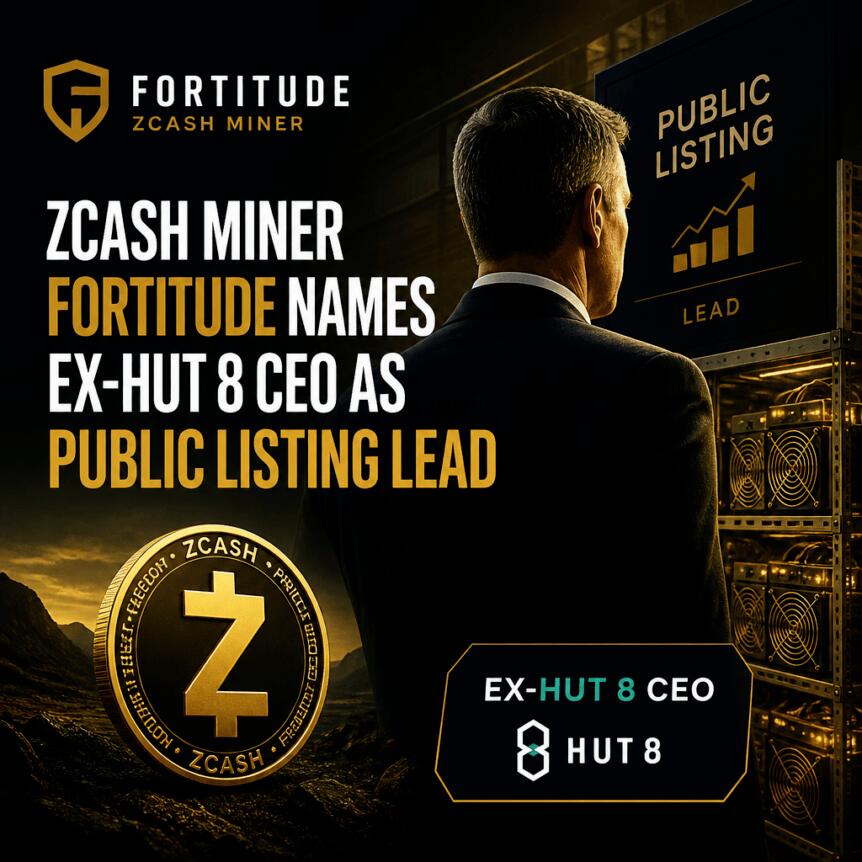
Fortitude Mining, a Zcash-focused cryptocurrency miner backed by Digital Currency Group, has named former Hut 8 CEO Jaime Leverton as its new chief executive as it moves toward going public. The leadership change comes alongside progress on a proposed merger with HeartSciences, which would take Fortitude to the Nasdaq subject to approval.
Leverton is set to succeed current CEO Andrea Childs on Sept. 21, with Childs transitioning to chief operating officer. The company says the transition reflects its evolution from a private mining operator into a vertically integrated platform preparing for a public-market listing.
Key takeaways
- Jaime Leverton will become Fortitude Mining’s CEO on Sept. 21, replacing Andrea Childs, who will shift to chief operating officer.
- Fortitude has mined 72,696 ZEC in the first half of 2026, representing about 28% of total Zcash network output for the period.
- The firm reported $20.9 million in revenue for Q2 and operates 60+ megawatts of power capacity across seven US sites.
- Under a planned merger with HeartSciences, Fortitude is expected to combine and trade on Nasdaq under the ticker TUDE, pending approval.
- ZEC has rallied sharply recently, supported by disclosures from Paradigm about its ZEC holdings and investment in Zcash development efforts.
Executive transition as the miner readies for a public listing
Fortitude Mining’s management reshuffle is closely tied to its wider strategic path. Earlier this year, the company announced a proposed combination with HeartSciences, with the transaction currently expected to close in the fourth quarter of 2026. If completed, the combined business is anticipated to list on Nasdaq under the ticker TUDE, subject to regulatory and corporate approvals.
The CEO handoff also signals continuity in execution. Leverton previously served as CEO of Hut 8, where she oversaw the Bitcoin miner’s merger with US Bitcoin Corp. and its move toward becoming a US-domiciled, Nasdaq-listed company. That background matters in this context: miners that pursue public-market access often need to translate operating metrics—such as hashrate, energy sourcing, and production—into investor-focused reporting and governance.
Childs will move to chief operating officer, keeping responsibility for day-to-day performance while Leverton steps in to lead the company through the market-facing phase of the transaction.
Operating footprint and production levels
Fortitude’s scale remains anchored in dedicated power infrastructure. The miner operates more than 60 megawatts of power capacity across seven sites located in South Dakota, Nebraska, Texas and New York. The geographic spread can be important for operational resilience, particularly in mining where downtime and electricity costs directly affect profitability.
On output, Fortitude reported that it mined 72,696 ZEC in the first half of 2026. The company says this amounted to roughly 28% of the network’s total production during the period—an indicator of its role in Zcash block production and the size of its contribution to circulating issuance.
Financially, Fortitude reported $20.9 million in revenue for the second quarter. Those figures, coupled with its production share, will likely be scrutinized as part of the merger process, because investors typically expect clarity on the relationship between hashrate, power utilization, and revenue over time.
New mining hardware expected to boost equihash hashrate
Fortitude is also expanding capacity through additional equipment procurement. In July, the company agreed to purchase 9,000 Bitmain Antminer Z15 Pro machines. The deal is expected to add 7.56 GSol/s of equihash hashrate, with shipments expected in the fourth quarter.
For a network that relies on equihash-based proof-of-work, incremental hashrate growth is a key operational lever. It can influence how quickly Fortitude can convert capital expenditures into production output—especially if network difficulty and electricity prices remain stable. Still, readers should note that the real economic impact will depend on installation timing, power costs at each site, and how Zcash difficulty adjusts as more hashrate comes online.
Fortitude, which has been mining ZEC since 2019, also launched as a vertically integrated mining platform in 2025. With that setup, the company’s stated goal appears to be tightening control over the full operational chain—power sourcing, mining operations and scaling—while positioning itself for greater visibility in the public markets.
ZEC rally gains momentum as Paradigm discloses holdings
While Fortitude navigates corporate and capacity developments, Zcash’s token has been drawing fresh attention. ZEC continued to rally on Thursday, trading around $1,424, according to CoinGecko. The token’s move has been dramatic: it is up about 185% over the past 30 days and more than 2,600% over the past year, CoinGecko data shows.
The latest upside pressure was linked to a disclosure from Paradigm. In a report referenced by Cointelegraph, Paradigm co-founder Matt Huang said Wednesday that the crypto investment firm holds ZEC and is an investor in the Zcash Open Development Lab. Huang described Zcash as a “private complement to Bitcoin” and argued that long-term funding for privacy technology is increasingly important as artificial intelligence and quantum computing advance.
The narrative is relevant beyond price action. Zcash’s development model includes an inflation-funded developer fund, and that structure has historically been central to how the project argues it can sustain privacy research over time. In other words, investor backing for the ecosystem can reinforce confidence in ongoing work—at least from the standpoint of market participants focused on long-run technical viability.
Broader performance in privacy coins has also been notable. As of Sept. 6, data cited by Glassnode indicates the privacy sector was up 213% from Bitcoin’s October 2025 peak, while other sectors tracked by Glassnode were still below that level at the time. Glassnode data further attributed 62% of the privacy sector’s market capitalization to ZEC, while a cap-weighted basket of privacy tokens excluding ZEC was still up 85% over the year, according to the same figures shared by Glassnode on X.
For traders and investors, the key watchpoint is whether these catalysts—continued institutional visibility into privacy infrastructure and sustained network participation by miners—translate into durable demand rather than short-lived speculative momentum.
As Fortitude heads toward its proposed HeartSciences merger and hardware shipments approach later in 2026, market participants will likely focus on the timing of public-market steps, the company’s ability to convert added hashrate into consistent production, and how ZEC’s recent momentum holds up alongside ongoing disclosures about privacy-focused investment.


Bitcoin has struggled to hold an advance above $76,800 after U.S. initial jobless claims fell by 10,000 to 196,000, strengthening the case for the Federal Reserve to keep interest rates elevated after its latest increase.
Summary
- Initial jobless claims fell to 196,000, compared with the 207,000 market forecast.
- Bitcoin briefly gained 1.25% to $76,800 before retreating toward $76,051.
- The Fed raised its target rate by 25 basis points to 3.75%–4.00% on Wednesday.
- Analysts identified resistance at $77,500, followed by a heavier zone near $80,500–$82,000.
US jobless claims strengthen the case for higher rates
The U.S. Department of Labor reported that initial claims for unemployment benefits fell to a seasonally adjusted 196,000 in the week ending Sep. 12, down from 206,000 a week earlier.
Economists had expected 207,000 claims, making the reading stronger than forecast. The four-week moving average, which smooths out some of the changes in the weekly figures, declined to 203,250 from 206,000.
Initial claims track new applications for unemployment benefits and provide an early view of layoffs across the United States. Although the Labor Department notes that weekly figures can be volatile, a decline generally indicates that employers are retaining workers.
For Federal Reserve officials, the latest reading adds to evidence that the U.S. labor market has remained firm despite elevated borrowing costs. Policymakers have less pressure to lower rates when job losses are limited, particularly while inflation remains above the central bank’s 2% goal.
The report arrived one day after the Federal Open Market Committee raised its target range by 25 basis points to 3.75%–4.00%. All 12 voting members backed the decision, which delivered the first U.S. rate increase since 2023.
In its statement, the Fed said economic activity was expanding at a “solid pace,” while domestic spending remained resilient and capital investment stayed robust. Officials also said job gains had kept pace with growth in the workforce and that the unemployment rate had changed little.
Inflation, however, remained elevated, according to the central bank. Officials said the rate increase would support a timelier return to the Fed’s 2% inflation target.
Another Fed hike could pressure Bitcoin
The Fed’s updated projections placed the median federal funds rate at 4.1% by the end of 2026, indicating that policymakers expect another quarter-point increase before the year closes.
Lower unemployment claims could support that path because the data gives officials fewer reasons to worry that tighter policy is causing a rapid decline in employment. Higher rates also increase the yield available on U.S. government debt, which can reduce demand for assets that do not produce interest.
For American crypto investors, another increase would raise the cost of leverage while keeping Treasury yields competitive with Bitcoin and other risk-sensitive holdings. A firm U.S. dollar, which can accompany tighter monetary policy, may also create pressure for dollar-priced assets.
Goldman Sachs has revised its forecast to include another 25-basis-point increase this year, according to the original report. The bank changed its call after Fed officials delivered mixed messages about whether more tightening would be required to return inflation to target.
Before the decision, crypto.news examined the event risk surrounding the Fed meeting and reported that market-implied odds of a quarter-point hike had climbed from 69.4% to 86.5%. The report linked the repricing in part to an increase in oil prices, which had added to inflation concerns.
Bitcoin price gives back its post-data gain
Following the jobless claims release, Bitcoin initially rose about 1.25% to $76,800 before surrendering the advance. BTC later traded near $76,051, down roughly 1% from its level an hour earlier, according to the supplied market data.
The reversal followed a volatile week in which Bitcoin briefly approached $80,000 before falling below $75,000. In previous market coverage, BTC traded near $76,200 after reaching $79,800 on Sep. 11 and dropping to $74,944 on Sep. 15.
Technical readings in that report showed Bitcoin below its 20-day simple moving average at $78,104. The daily Chaikin Money Flow reading stood at minus 0.11, while the four-hour relative strength index remained below the neutral 50 level, pointing to weak momentum and net capital outflows during the decline.
The same analysis placed a major downside liquidation cluster near $74,600 and an upside liquidity area around $77,700. Bitcoin’s reaction to the jobless claims kept the price between those two zones, leaving neither buyers nor sellers with a confirmed break.
U.S. political developments have also weighed on the asset. The Senate failed to advance the Digital Asset Market CLARITY Act earlier in the week after the motion received 50 votes in favor and 49 against, short of the 60 required. The proposal would have established how the Securities and Exchange Commission and Commodity Futures Trading Commission divide oversight of digital assets.
Bitcoin needs to clear $77,500 for stronger momentum
Analyst Michaël van de Poppe identified $77,500 as the first important resistance area after Bitcoin bounced from approximately $75,584. His chart placed another resistance range between $80,500 and $81,200.
“Bitcoin facing resistance here. If you’d want to see some momentum, you’d need to break through this resistance and then we’re of towards the highs,” Van de Poppe wrote on X.
A move through $77,500 would place Bitcoin closer to its 20-day moving average at $78,104 before the asset could test the heavier supply zone above $80,500. Failure to recover the first resistance level would keep attention on the recent support area around $75,584 and the liquidation concentration near $74,600.
Analyst Ted Pillows separately said Bitcoin was “just one god candle away from hitting a higher high.” His chart placed the relevant higher-high area close to $82,000 and showed Ethereum and Solana approaching similar technical levels on their respective charts.
Bitcoin would need to clear the resistance identified by both analysts before confirming that structure. Van de Poppe’s chart placed the first barrier at $77,500, followed by $80,500–$81,200, while Pillows identified the higher-high threshold near $82,000.

BitBank faces U.S. sanctions over alleged IRGC Bitcoin transfers

Pakistan urges AHF to shift ACT hockey matches from India to neutral venue | Other Sports News

AMD could hit GPUs and motherboards with a 10% price hike soon, and Ryzen CPUs may follow



-

 Fashion6 days ago
Weekend Open Thread – Corporette.com
-

 Tech5 days ago
The Latest Weird Thing to Play Doom Is the Mapped-Out Brain of a Fruit Fly
-

 Business7 days ago
10 Most-Streamed Songs On Spotify In 2026 So Far, Led By Ella Langley’s Dominant Run On The Charts This Year
-

 Crypto World7 days ago
XAG/USD: Silver’s Short-Term Rally Meets Its Moment of Truth
-

 Crypto World7 days ago
Diesel Tops $6 a Gallon for the First Time as 28 States Set Records
-

 Crypto World3 days ago
Kraken Lets xStocks Holders Earn Yield Through DeFi
-

 News Videos7 days ago
Facing Financial Fears
-

 Crypto World4 days ago
Elon Musk Drops a Bombshell: Grok 5 Could Be the AGI Breakthrough
-

 Crypto World1 day ago
US Charges Robinhood Engineers Over Crypto Listing Trades
-

 Entertainment6 days ago
News Specials, Movies, Shows, More
-

 Crypto World6 days ago
Can AI Build a Startup in 72 Hours? Elon Musk's Team Will Livestream the Test
-

 Business5 days ago
Rivals Sam Altman and Elon Musk Rally Behind Dario Amodei’s Call for a Slowdown in AI Development
-
 NewsBeat4 days ago
‘Sick conspiracy’: Trump says only guardrails AI needs is ‘a strong and smart (High IQ!) president’ in all-caps rant
-
 Crypto World4 days ago
New Tesla Roadster Uses SpaceX Tech. Will It Impact the Stock Price?
-

 Crypto World7 days ago
Bitcoin ETFs Pull $167M as 2026’s Best Inflow Run Slows
-

 Crypto World6 days ago
Robinhood Chain Never Stopped But its Blobs Did Stop Reaching Ethereum For 14 Minutes
-

 Crypto World2 days ago
What Is the Status of the U.S.-Iran Peace Talks? Here's What Both Sides Are Saying
-
 Entertainment6 days ago
New Horror Movie Officially Earns a Rare Stephen King Recommendation
-

 Business6 days ago
Marvell: Most Potent Setup Of The AI Factory Decade
-
 Crypto World4 days ago
3 Token Unlocks to Watch in the Third Week of September 2026
You must be logged in to post a comment Login