
Crypto World
Dolly Parton, Gloria Steinem, and Why Grieving a Celebrity Feels So Personal



Recently, the world has collectively mourned the unexpected losses of several well-known public figures, from Dolly Parton and Gloria Steinem to Bob Mackie and Tim Curry. Their deaths have hit fans, followers, and industry colleagues hard, and their tributes are going viral online.
Although these celebrities primarily appear to us on screen or on stage, many people feel as though they know them personally because of the meaningful impact they’ve had on their lives. These are known as parasocial relationships or “nonreciprocal social-emotional connections” with public figures and celebrities, per the journal of Current Opinion in Psychology.
When a public figure or celebrity dies, we grieve collectively. According to Gina Moffa, grief therapist and author of the book, Moving on Doesn’t Mean Letting Go, this happens when a large group of people mourns at the same time. “This can be felt even if they never knew the person or community, or weren’t directly affected by the event,” says Moffa. And it isn’t limited to the passing of public figures and celebrities. Many people also experienced shared loss after 9/11, Sandy Hook, COVID-19, and the Nepal floods.
In this current cultural moment, we’re seeing collective grief intersect with a psychological phenomenon called parasocial grief. According to psychotherapist and NYU adjunct professor Olivia Verhulst, this can occur when there’s a one-sided sense of familiarity with a public figure after they die. “Relationships don’t need to be reciprocal for feelings to be real,” Verhulst says. “Loss brings up a lot for all of us no matter what form it takes, whether it’s shock, disbelief, or confrontation with our own mortality.”
A small study in 2025 from the journal Acta Psychologica found that parasocial grief can negatively impact mental health and can lead to unhealthy coping mechanisms like substance use.
In comparison with individual grief, shared bereavement is more diffuse. “It doesn’t have the built-in rituals we rely on, like experiences of a funeral and traditional closure,” Moffa explains. Therefore, when celebrities or public figures die, it’s now common practice to post online and engage in comments sections with other grievers. In this way, the comment sections become public memorials.
After Steinem’s passing, people expressed their gratitude and heartbreak by leaving flowers and cards outside her home. When Parton died, fans held up their iPhones with the flashlight on during Harry Styles concert at Madison Square Garden while her song, “I Will Always Love You,” played. Both of these in-person tributes circulated on social media and were widely shared.
Verhulst argues that the most significant difference in mutual sorrow is its “being witnessed” and it can offer more validation than individualized grief. “Given that human beings are fundamentally wired for connection, this broader sense of communal loss can feel comforting in many ways,” she says.
Shared bereavement isn’t a new idea; it dates back for centuries. Some of the most visible representations in recent decades have been the outpouring of support after the deaths of President John F. Kennedy, the Rev. Dr. Martin Luther King Jr., and Princess Diana. At her funeral, there were an estimated one million people in-person and roughly 2.5 billion viewers who watched it on television.
Society often pushes individual grievers to move on from their losses, rushing them to heal before they’re ready, which can lead to more people struggling alone. But in our current culture, shared bereavement has become more widely accepted. “Social media has become a kind of ‘modern funeral,’ a space where people can come together online, without the barriers of physical geography getting in the way,” Moffa says. “For a lot of people, it’s become the primary place mourning happens now.”
Research has found grieving together is more beneficial than doing it without help. A meta-review from 2022 in the journal Frontiers in Psychology discusses the theory of collective effervescence, a phrase coined by sociologist Émilie Durkheim, as it relates to mourning practices, public memorials, and communal storytelling after the loss of a public figure. This “intense state of shared emotional activation and sense of unity” can help people feel connected in the long term to others who understand their pain.
“When Steinem and Parton passed within days of each other, comment sections turned into genuine gathering places, telling each other how these women shaped their lives. It made the feeling less isolating and more like something they were carrying alongside a whole community instead of alone,” Moffa says.
Working with a therapist, especially for cognitive behavioral therapy, can also be effective. Treatment can give people a safe space to talk about discomfort and divulge feelings of loss over someone they didn’t know personally, with validation and without shame. It can provide more insight into a person’s emotional state, to see if there’s any unresolved or prolonged grief.
Integration is another useful method. Moffa suggests creating a small ritual in honor of that person, like playing their music, reading their books, or rewatching a favorite video clip. Then, write down what that person meant to you, rather than what they meant to the world, and talk about it with someone. “This can provide validation and connection, instead of having to carry it alone,” she adds. In fact, a recent study from the Death Studies journal in 2026 found sharing emotions, ceremonies, and rituals offer “sense making, solidarity and healing” in shared mourning.
While these are effective ways to navigate the pain, they aren’t the only ones. It’s key to adapt them to meet your needs and determine what works for you.
Verhulst noted there’s an outdated idea that grief occurs in fixed stages which is somehow linear. But, she says, there are truly no universal stages to heal from loss and no right way to grieve.
Sometimes, the best way to mourn is together.


At a time when companies are racing to deliver commercial fusion energy and promising a new generation of geothermal wells across the U.S., three-wheel electric vehicles may not seem like the most exciting clean energy technology. But in India, three-wheel vehicles are an essential part of daily transportation and account for up to a quarter of motorized trips in many cities.
The majority of new full-size passenger auto rickshaws sold in India are now electric, according to registration data, a striking milestone given that 10 years ago they were barely off the ground. Initially, scaling took a mix of policy, infrastructure build out, and innovative financing; now, the market has taken on a life of its own. “Once you cross 50%, electric becomes the dominant technology,” says Suman Mishra, the CEO of Mahindra Last Mile Mobility, a key player in the market.
The development underscores an idea that is gaining currency in some climate circles: sometimes technologies that matter most are not the futuristic breakthroughs waiting to scale but the familiar ones where adoption begins to reinforce itself.
That shift sits at the heart of a new framework the Earthshot Prize is using this year to evaluate climate solutions. Rather than simply picking the climate solution with the most impressive technology, the judges looked for ways to recognize and advance “positive tipping points” that will unlock transformative changes beyond any individual company or project. “We know exactly the things that we’re looking for to try to tip these global systems in the right direction,” says Jason Knauf, CEO of the Earthshot Prize.
The pattern is visible across the finalist list. Mahindra Last Mile Mobility, one of this year’s Earthshot finalists announced on Sept. 18, has not just built affordable electric three-wheelers but also helped facilitate the infrastructure and policy necessary for them to take off. Another finalist, the Zero Emission Maritime Buyers Alliance, or ZEMBA for short, has sought to coordinate demand for low-carbon shipping fuel from customers that ship goods. And Yellowstone to Yukon restores habitat corridors across North America, which then unlocks feedbacks that restore the underlying ecological ecosystem.
The concept of climate tipping points entered the vernacular nearly two decades ago to describe some of the most alarming risks posed by climate change. At the time, tipping points referred to the thresholds that, when crossed, would trigger a chain reaction of often irreversible damage—think of Antarctic ice sheet collapse leading to sea level rise or the destruction of the Amazon releasing stored carbon dioxide.
More recently, scientists have sought to reframe tipping points, showing that positive developments can have tipping points, too. Cheap energy leads to a rewiring of economies. Social movements unlock widespread policy changes. “The tipping point is where you have strong amplification within the system,” says Tim Lenton, a professor of the University of Exeter who has written seminal papers on the tipping points concept.
The reframe comes at an important moment for the climate narrative. With increasingly bleak climate news, positive tipping points offer grounded optimism about how things may change. That was a key logic for Earthshot’s embrace of tipping points.
“We don’t think you can just leave people with the negatives and the warnings,” says Knauf. “We think we have a responsibility to show them” where positive action is possible.
But the positive tipping point framework is also useful from a capital allocation perspective. As companies cut costs and governments look for ways to trim public spending, tipping points offer a way to identify what Lenton describes as the best “bang for your buck” for climate investment dollars.
In some cases, that means supporting initiatives outside the typical wheelhouse of climate technology startups. ZEMBA, for example, works with the customers who would like to reduce their shipping footprint with low-carbon fuel but cannot afford to do so on their own, thereby helping create a demand signal. That’s a coordinated effort that competitors rarely engage in. “Once those markets are spinning, we will fade into the mist,” says Ingrid Irigoyen, the organization’s CEO.
Such an approach makes sense for governments evaluating how they spend their public dollars. It also makes sense for pension funds and institutional investors concerned with the long-term economic implications of climate change. With relatively few dollars, certain investments will generate a long-tail of positive climate outcomes.
In a future world where climate impact is an important investment metric, tipping points may be a useful tool. For those interested, the Earthshot finalists may offer a useful place to start.
A debate inside the Zcash ecosystem is intensifying as the protocol’s development fund continues to grow in value. Dragonfly managing partner Haseeb Qureshi has argued that the Zcash developer fund should be wound down after it expires under the current rules in 2028—calling it unnecessary to continue once the remaining work can be covered.
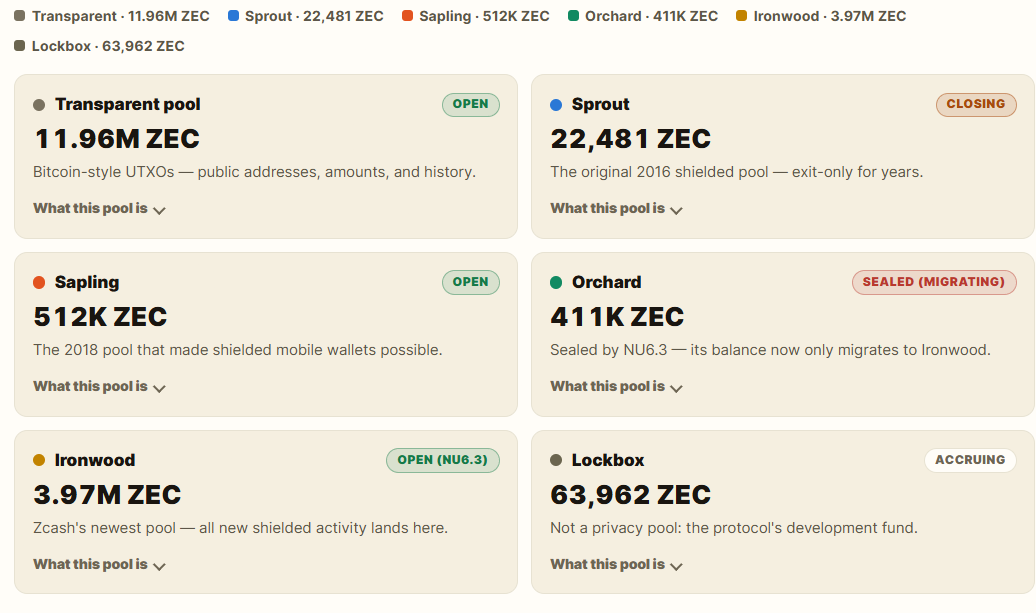
According to ZecStats, the Zcash development fund held 63,962 ZEC tokens at press time, worth roughly $95 million. Qureshi said the fund is large enough to support remaining development and warned that as it approaches a potential $100 million size, it could become “politicized.” The proposal has sparked disagreement over whether the fund should stay intact and, crucially, over who should ultimately govern it.
Key takeaways
- Dragonfly’s Haseeb Qureshi says the Zcash development fund should be treated as the “final” one and wound down when current rules expire in 2028.
- ZecStats data shows the fund holds 63,962 ZEC, valued at about $95 million at the time of reporting.
- Backers argue the fund remains important in an environment shaped by rapidly advancing AI and evolving cyber threats.
- The dispute isn’t only about funding size—it also centers on whether governance should be token-holder-driven, delegated, or hybrid.
- Zcash founder Zooko Wilcox has pointed to the role of the Community Grants Committee, clarifying it represents about 40% of the fund.
Why the fund is at the center of a bigger governance fight
The Zcash development fund is designed to accrue protocol-level resources specifically for development. It earns 0.1875 ZEC per block—described as representing 12% of the block subsidy under the NU6 upgrade. The balance is held outside regular circulation and can only move via governance disbursements.
As the ZEC token has rallied, the economic weight of those locked tokens has drawn increased attention. Qureshi’s argument is rooted in the idea that a larger, still-runnable fund can attract more contentious political bargaining, even if the underlying purpose remains technical and constructive.
In his view, continuing the fund past its natural end point risks making development spending a proxy for broader community power struggles rather than a disciplined mechanism for funding specific engineering work. That concern frames why his “final Dev Fund” proposal matters: the discussion is moving from whether development money is needed to how it should be handled and who gets to decide.
Competing views on whether Zcash needs ongoing development funding
Not everyone agrees that winding down is the right step. Paradigm founder Matt Huang publicly pushed back, arguing that the fund has special value “in this age of AI cyber capabilities” and rapid progress in quantum-related work. His point suggests that the technical baseline for maintaining Zcash may require sustained investment even if the debate over governance becomes uncomfortable.
Other participants have raised concerns from a different direction. Maxime Desalle, an investment analyst at Winklevoss Capital, suggested the community should “completely get rid” of the development fund as a way to eliminate governance disputes entirely. Desalle has previously argued that a fund of this structure could harm Zcash’s security while reproducing governance inefficiencies he likened to the dependencies and bureaucracy seen in welfare states.
These positions highlight a core tension: one side views the fund as a necessary buffer for long-term protocol security and innovation, while the other sees it as a source of governance friction that could introduce new risk profiles as it accumulates value.
Who should control the lockbox: token voting, delegation, or hybrid governance
Beyond the question of whether the fund should exist, participants are also disagreeing on governance design. Qureshi said control should not shift toward “pure token holder voting.” Instead, he supported a partial model in which token holders elect temporary councils—aiming to keep legitimacy while reducing day-to-day unpredictability.
Huang aligned with the view that purely token-holder-driven governance could create “unpredictability” that may limit long-term trust in Zcash as a monetary asset. He proposed a hybrid approach combining token involvement with other governance mechanisms, suggesting that legitimacy and stability both need to be engineered rather than assumed.
At least one critique comes from the opposite end: Desalle argued for removing the fund altogether, which would remove the governance problem by eliminating the object that triggers it. That framing effectively treats governance risk as inseparable from the existence of the lockbox—whereas the hybrid camp sees governance redesign as a solution.
Clarifications from Zcash founder Zooko Wilcox
As the discussion broadened, Zcash founder Zooko Wilcox weighed in on the role of the Community Grants Committee. In an earlier post dated Sept. 1, he cited the committee as one of the main reasons Zcash has “survived and grown” over time.
Wilcox later clarified that the Community Grants Committee represents only 40% of the development fund. That detail matters for the argument about how “politicized” the funds may become: if a significant share of the money is already channeled through a defined committee structure, then supporters of the fund may argue that governance disputes don’t affect all disbursements equally—while opponents may still contend that the remaining portion could be vulnerable to shifting coalition dynamics.
The back-and-forth also underlines that the community is not simply choosing between “fund” and “no fund.” It is deciding how different parts of a single mechanism should be distributed, evaluated, and audited through governance.
What to watch next
With current rules pointing to an expiration in 2028, the immediate question for Zcash participants is whether discussions will converge on a specific governance model—such as Qureshi’s partial or Huang’s hybrid approach—or whether the community will push toward a more radical outcome like full elimination. Readers should watch how proposals address both disbursement structure and stability, because the dispute is ultimately about protecting Zcash’s long-term development process while maintaining trust as the fund’s market value grows.


Kevin O’Leary has returned to buying new cryptocurrency positions for the next market cycle while watching for a major stock exchange to adopt blockchain infrastructure, a development he expects could influence which network gains institutional traction.
Summary
- Kevin O’Leary is buying new crypto positions as he prepares for the next market cycle and looks for networks gaining institutional adoption.
- O’Leary said the first major stock exchange to adopt a blockchain could become a watershed moment for the crypto industry.
- O’Leary does not expect the CLARITY Act to pass before the midterms but believes digital asset tax policy will keep regulation on the agenda.
- O’Leary sees Bitcoin potentially accounting for 1% to 3% of institutional alternative asset allocations.
According to comments made to The Block at the Avalanche Summit in New York, the O’Leary Ventures chairman said he is placing new bets as he tries to identify which blockchain could gain widespread use and where that adoption will emerge.
“I’m back in the saddle buying new positions, putting my bets on for this next cycle,” O’Leary said.
His investment approach is focused less on picking individual crypto assets in isolation and more on determining which underlying network could become a standard for a major industry. Conversations with executives have yet to produce a clear answer, he said, because companies across different sectors are considering different blockchains.
O’Leary said he can speak directly with chief executives about the networks their companies are evaluating, but “none of them are saying the same thing.”
O’Leary sees exchange adoption as a watershed moment
A major stock exchange could provide one of the clearest signals, according to O’Leary, who described the first exchange to adopt a blockchain as a potential “watershed moment” for the crypto industry.
Once an exchange settles on a network, companies and financial institutions that interact with the venue could have an incentive to work with infrastructure that meets the same technical and compliance requirements. O’Leary presented that scenario as one possible route through which a particular blockchain could gain wider use.
Traditional exchanges are already moving parts of their infrastructure onchain. The New York Stock Exchange has been developing onchain settlement infrastructure for tokenized securities, with NYSE President Lynn Martin saying in August that work was continuing on a dedicated digital trading platform.
Intercontinental Exchange, NYSE’s parent company, later agreed to invest in tZERO and license its blockchain patents as the companies work on tokenized securities infrastructure. The planned platform is designed to support round the clock trading and immediate blockchain settlement, though regulatory approvals are still required.
Nasdaq has taken a separate route. Earlier in September, Nasdaq Ventures agreed to invest $100 million in Kraken parent Payward at a $21 billion valuation as the companies expanded their work on tokenized equities and settlement. Nasdaq and Payward expect Nasdaq Equity Tokens to launch in the second quarter of 2027.
Regulators have been preparing for more securities activity to move onchain as well. The Securities and Exchange Commission recently granted tokenized securities venues five years of conditional relief to trade eligible tokenized U.S. stocks through permissioned automated market makers and liquidity pools. Eligible tokens must provide holders with the same rights and privileges as conventional shares under the five year exemption.
Crypto regulation remains on O’Leary’s agenda
O’Leary expects U.S. lawmakers to return to crypto market structure legislation despite the latest setback for the CLARITY Act.
The Senate failed to advance the bill this week after a cloture motion fell short of the 60 votes needed to begin formal debate. Crypto.news previously reported that the procedural vote failed after receiving 50 votes to 49.
O’Leary said he does not expect the legislation to pass before the midterm elections, but argued that work on digital asset taxation makes continued regulatory action likely.
“If you’re going to provide a tax policy on this asset, you want more regulation, not less,” he said.
His comments came as Congress made progress on a separate digital asset tax package. The House Ways and Means Committee advanced the Digital Asset Tax Certainty Act in a 38 to 5 vote on Sept. 16, moving the proposal toward possible consideration by the full House.
The crypto tax legislation includes an exception for qualifying blockchain network and transaction fees of up to $10, alongside proposed rules covering wash sales, stablecoins, crypto lending, mining, staking and broker reporting.
Seven Senate Democrats who opposed the CLARITY Act cloture motion have since indicated that negotiations are not over. Their effort leaves open the possibility of further talks, though the failed procedural vote has kept the bill from entering formal Senate debate.
O’Leary’s current position differs from the timeline he gave earlier in 2026. In January, he expressed hope that U.S. crypto market structure legislation could clear Congress before the midterms. By June, he was arguing that legislation could become an important catalyst for institutional participation, particularly among pension funds and sovereign wealth funds.
Bitcoin allocation could reach 1% to 3%
For Bitcoin, O’Leary framed potential institutional exposure against allocations already made to another alternative asset, gold.
He said Bitcoin could eventually account for between 1% and 3% of alternative asset allocations, using institutional gold holdings as a comparison. His upper range is consistent with comments he made earlier this year when discussing how much Bitcoin large investors may be willing to hold.
In February, O’Leary said some institutions were reluctant to move beyond roughly 3% Bitcoin exposure because of concerns surrounding quantum computing and the network’s long term security. Developers have been discussing proposals intended to reduce Bitcoin’s exposure to future quantum attacks, while the risk has become part of the institutional debate around allocation limits.
O’Leary remains focused on investments outside digital assets as well, particularly the infrastructure needed to support artificial intelligence.
Instead of concentrating his AI investments on individual models, he said he is investing in the power infrastructure required to run them. Projects cited by O’Leary include investments in Norway, Finland, Alberta and Utah, along with exposure to uranium as demand for electricity from data centers grows.
Crypto-focused venture capital firm Dragonfly’s managing partner, Haseeb Qureshi, proposed winding down the Zcash developer fund after it expires under current rules in 2028.
“I’m of the opinion that this should be the final Dev Fund,” wrote Qureshi in a Friday X post, arguing that the fund is large enough to fund remaining work on Zcash and that it risks being “politicized” as it approaches $100 million in value.
The Zcash development fund held 63,962 Zcash (ZEC) tokens at press time, worth about $95 million, according to ZecStats.
The remarks follow a broader industry debate that stemmed from the fund’s increasing value, following the ZEC token’s rally. Others argued that Zcash should maintain its development fund. Paradigm founder Matt Huang argued in a Wednesday X post that the fund is particularly important “in this age of AI cyber capabilities” and rapid quantum progress.
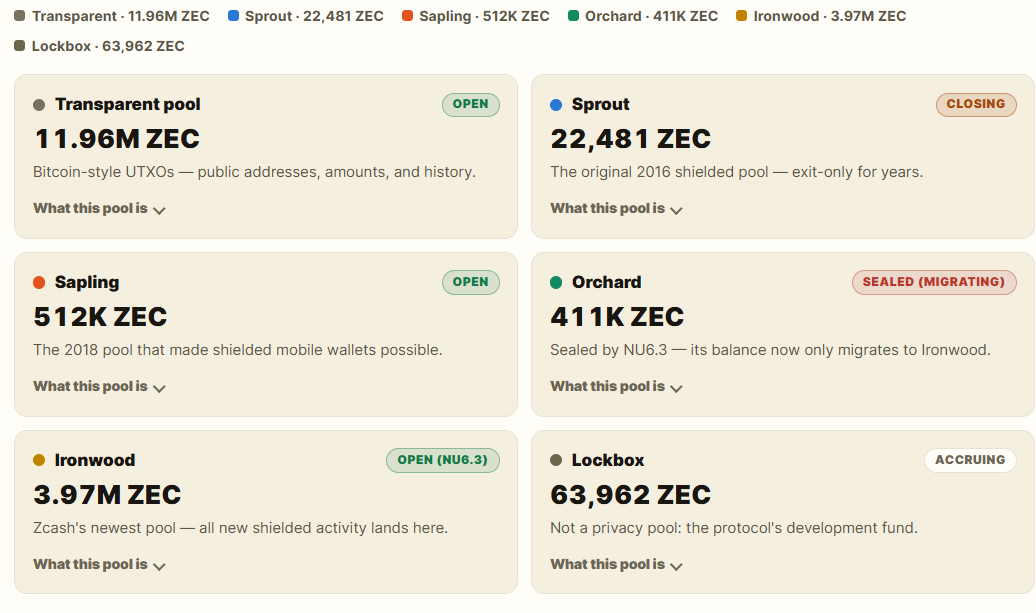
Zcash pools, including the dev fund, also known as the lockbox. Source: ZecStats
The ZEC development fund is a protocol development fund that accrues 0.1875 ZEC tokens per block, representing 12% of the block subsidy under the NU6 upgrade. Its balance sits outside circulation until governance disbursement.
Related: Zcash holders back 25-second blocks, vote to keep ZEC halving schedule
Industry split over who should control the ZEC development fund?
Industry watchers are also debating who should control the development fund. Dragonfly’s Haseeb said that the fund’s control shouldn’t move toward “pure token holder voting,” but showed support for a partial model, under which token holders would elect temporary councils.
Huang agreed with this view, adding that pure token holder governance may introduce “unpredictability that could limit long-term trust as a monetary asset” and proposed a hybrid model combining additional forms of governance.
Maxime Desalle, investment analyst at Winklevoss Capital, suggested that the Zcash community “completely get rid” of the development fund, which would solve all the governance disputes surrounding it, writing in a Thursday X post.
In a previous post on Sept. 9, Desalle argued that the fund may hurt the security of Zcash while recreating the dependencies and bureaucracies that many welfare states suffer from.
In a Sept. 1 X post, Zcash founder Zooko Wilcox said that the Zcash Community Grants Committee was among the main reasons that Zcash “has survived and grown to where it is today.” On Sept. 14, Wilcox clarified that the committee only accounts for 40% of the development fund.
Magazine: The legal battle over who can claim DeFi’s stolen millions
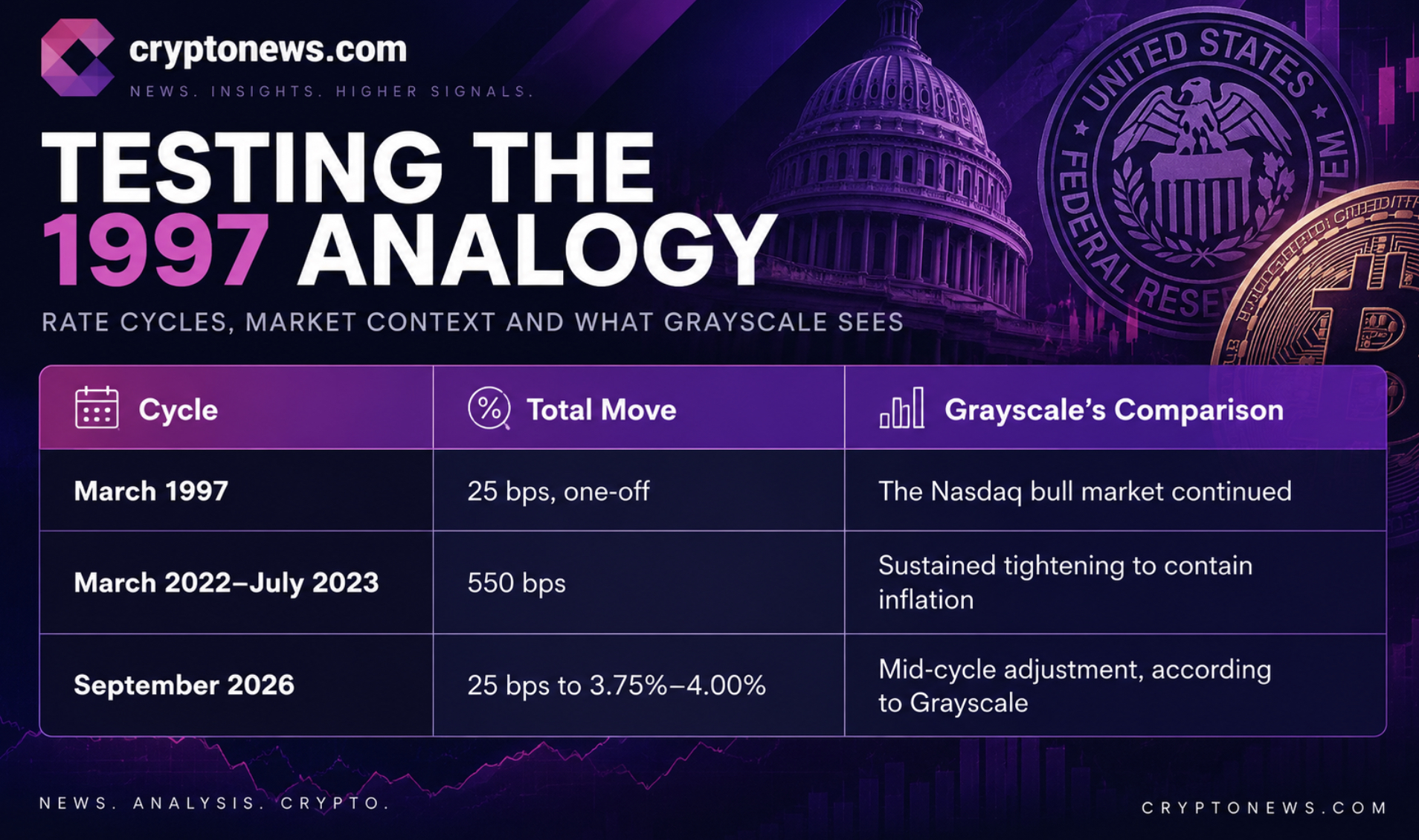
The Federal Reserve raised its benchmark interest rate by 25 basis points to a target range of 3.75%–4.00%, and Grayscale Research says the move is unlikely to drive major changes in Bitcoin price and the crypto markets. Grayscale’s central question is whether the increase is an isolated adjustment or the start of a broader tightening cycle.
Grayscale’s argument rests on a policy gap. The firm characterizes the latest increase as a mid-cycle adjustment rather than a cyclical change in official policy. In its view, the difference is not simply the size of a single rate move, but the scale and duration of the policy path that follows it.
Grayscale contrasts the decision with the Fed’s campaign from March 2022 through July 2023. During that period, the Fed raised the federal funds rate by 550 basis points to contain inflation. Grayscale says that sustained tightening probably weighed on Bitcoin and other digital assets during the last bear market.
The latest move is smaller in scale, and Grayscale expects one or two additional rate hikes in 2026. The firm’s assessment is therefore focused on whether those increases remain limited rather than whether rates rise at all. A short sequence of adjustments and a sustained tightening campaign can have different implications for capital allocation.
Earn $50 and Enter $300K Prize Draw on EdgeX
Testing the 1997 Analogy
Zach Pandl, Grayscale’s head of research, describes the latest decision as a mid-cycle adjustment rather than a cyclical policy shift. Grayscale also says it doubts that the one or two rate hikes expected for 2026 will lead to much change in capital allocation.
Grayscale’s key takeaway is that the 25-basis-point hike, together with a potential second increase this year, is unlikely to drive major shifts in digital-asset markets in the firm’s view. The qualification is important: the analysis presents a view on the likely policy pattern and market response, not a guarantee about crypto prices.
Grayscale’s historical reference point is March 1997, when the Greenspan Fed made what the firm describes as an analogous one-off hike, and the Nasdaq bull market continued. The comparison supports Grayscale’s view that a limited rate adjustment need not have the same market effect as a prolonged effort to reset borrowing costs and financial conditions.

The 1997 parallel does not establish that Bitcoin is insulated from interest rates. Instead, it illustrates Grayscale’s distinction between an isolated move and a longer tightening sequence. If policy were to develop into a sustained series of hikes, the 2022–2023 period would provide a more relevant comparison under the firm’s framework.
Contemporaneous reporting described a limited immediate reaction from Bitcoin and other major crypto assets after the Fed’s decision. That response is consistent with Grayscale’s view that the rate increase itself was not a major market disruption, while leaving open the larger question of how markets respond to future policy signals.
Discover: The Best Token Presales
Where Higher Rates Actually Bite Bitcoin Price?
Grayscale does not argue that higher rates leave crypto unaffected. Rather, it says the impact can differ across the digital-asset ecosystem. The firm points to stablecoin issuers such as Circle and Tether, which it says earn higher revenues when cash interest rates rise.
Grayscale also says higher rates on tokenized bonds and money-market funds could drive flows into onchain capital. Its broader point is that crypto is diverse: higher rates can affect particular assets and businesses differently, much as rate-sensitive sectors can diverge in traditional finance. Under that view, Bitcoin and other parts of the digital-asset market need not respond to rate changes in the same way.

Bitcoin current price action also gives the 1997 comparison some relevance, particularly if investors are watching for another sharp volatility phase. BTC has struggled to sustain upside momentum, leaving the market vulnerable to further selling if key support levels fail.
Still, the analogy should be treated cautiously, since Bitcoin’s market structure and investor base differ significantly from those of traditional markets in 1997.
For now, Bitcoin’s ability to hold its major support zones will be important for determining whether the market can stabilize. A recovery above recent resistance would weaken the bearish interpretation, while another breakdown could reinforce comparisons with previous periods of broader market stress.
Trade Bitcoin on Bybit and Get a Chance to Win Our $1,000 USDT Airdrop
The post Grayscale Sees Limited Bitcoin Impact From 25-Basis-Point Hike appeared first on Cryptonews.
Crypto World
XRP on the brink of a golden cross as focus switches to away from bitcoin (BTC): Crypto Daily
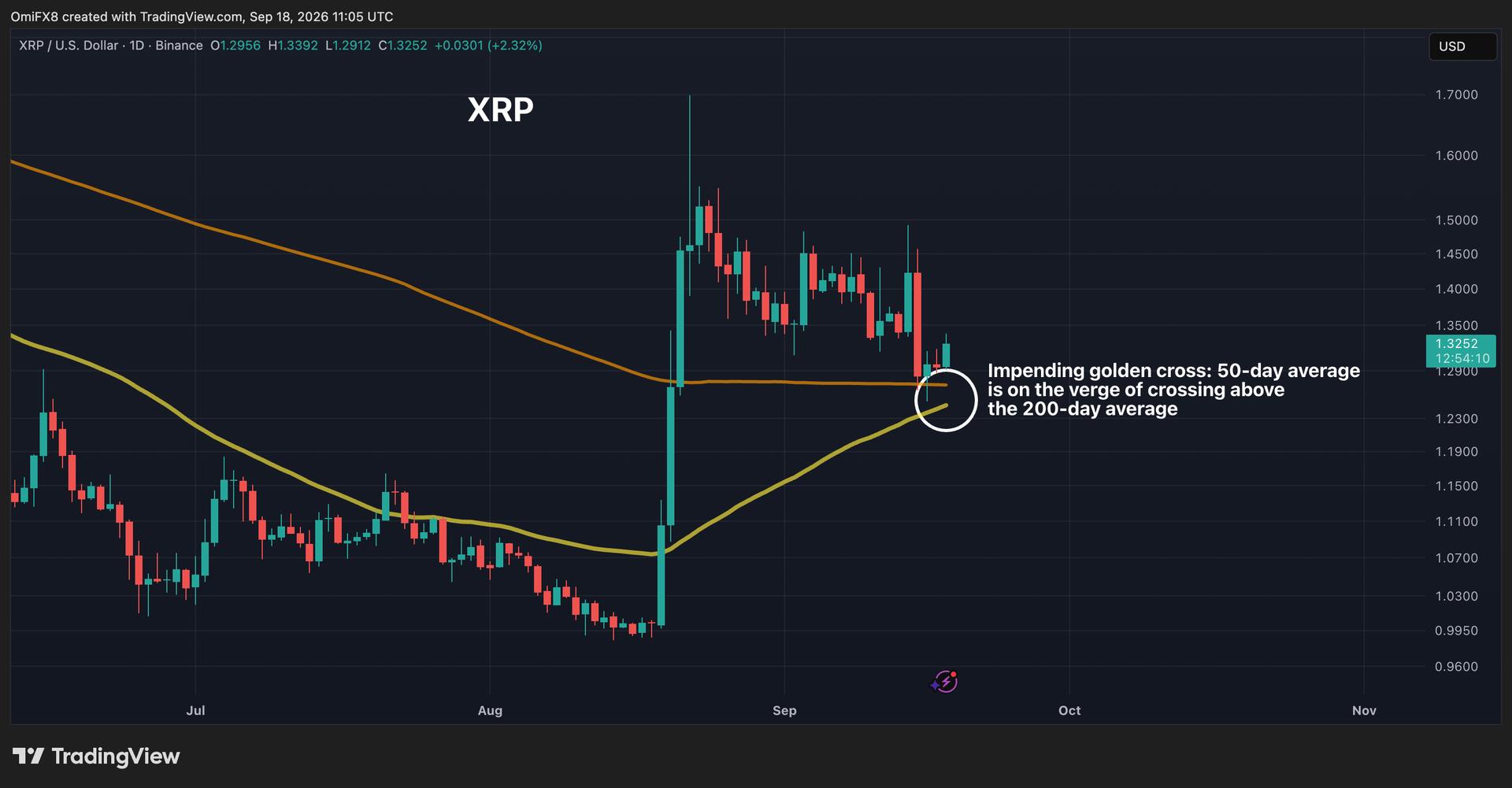
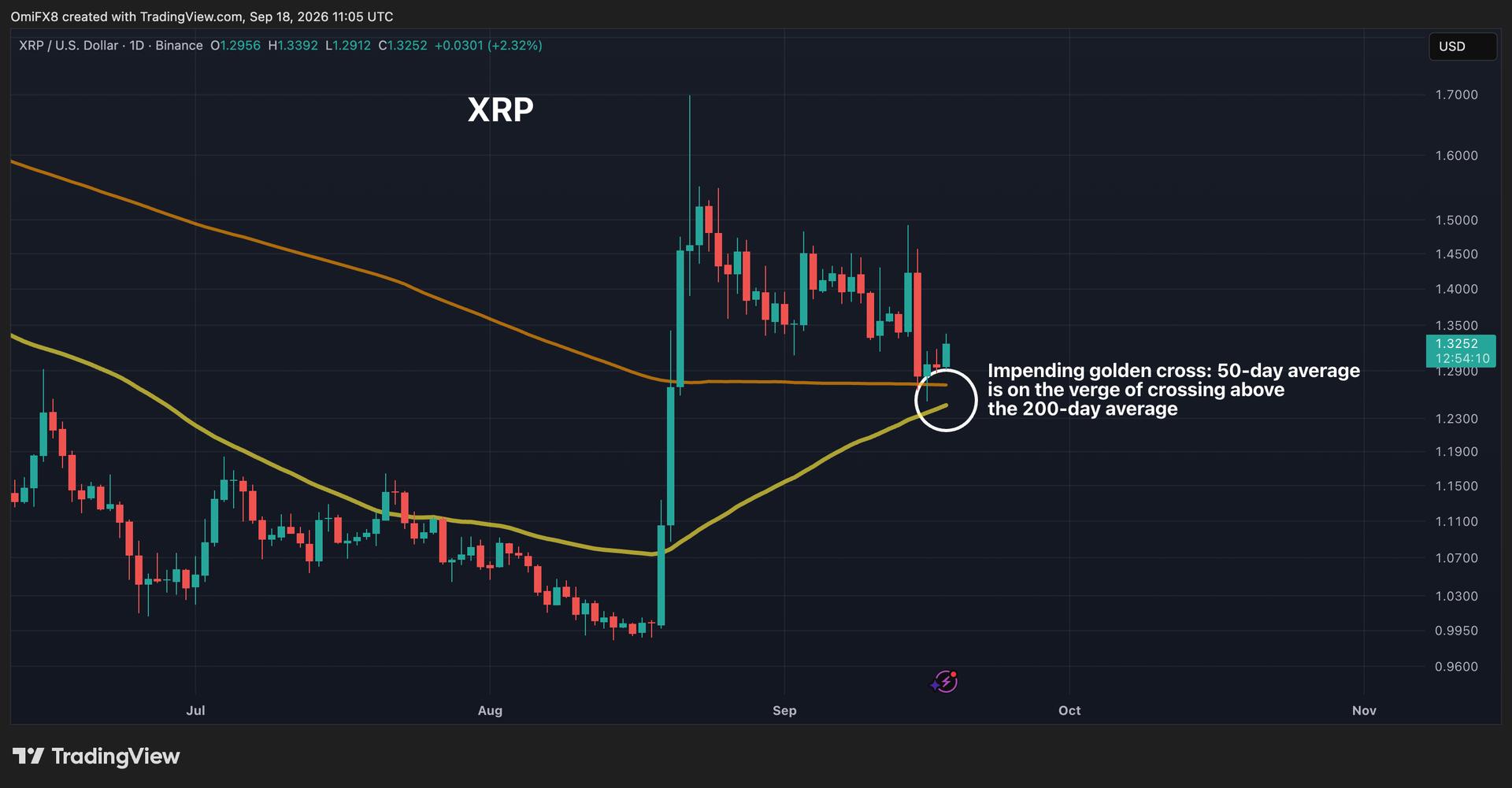
That said, many of those golden crosses did produce impressive three-month gains (check Today’s Signal). Five of the 10 crosses that survived long enough to reach the three-month mark posted gains ranging from 85% to more than 1,000%, including a 1,009.6% run following the April 2017 cross and a 135% gain after the February 2021 cross.
Right now, XRP’s 50-day average sits about 2% below its 200-day average, the closest since its last golden cross in August 2024.
Meanwhile, analysts are optimistic about bitcoin’s price prospects, given the cryptocurrency has weathered this week’s storm, marked by the Clarity Act setback and a Federal Reserve rate increase. The cryptocurrency is trading near $78,000, roughly unchanged from a week ago.
But its dominance rate, or share of total crypto market cap, has dropped to a one-month low of under 59%. That implies a rotation into altcoins and many of them, such as UNI, NEAR and ARB have surged by nearly 30% in 24 hours.
“Altcoins have accelerated sharply while the majors lag. Markets hope for SEC and CFTC crypto adoption, plus passage of the Bitcoin Reserve Bill,” Alex Kuptsikevich, the chief market analyst at The FxPro, said in an email.
“It appears that traders are cautiously shifting their focus towards altcoins, although neither the altcoin season index nor market sentiment has yet reached high levels,” he said. Stay alert!
VanEck’s head of digital assets research, Matthew Sigel, expects Bitcoin (BTC) to hit $100,000 by next year, arguing that government debt burdens are propping up the asset.
Sigel delivered the forecast on CNBC’s Squawk Box Asia on Friday, with Bitcoin trading near $77,400 in a week that hit crypto from three directions at once.
Bitcoin Holds Its Ground Through a Punishing Policy Week
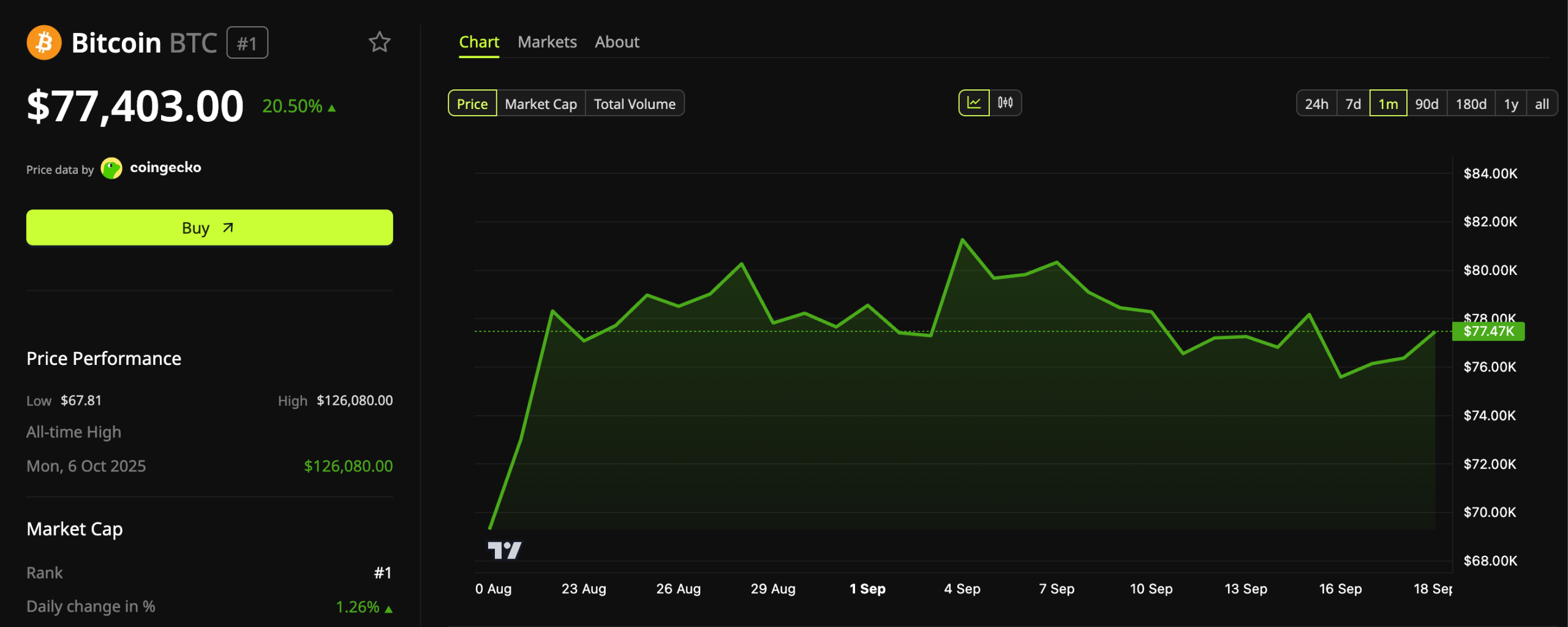
Bitcoin changed hands at $77,403 on Friday, up 1.26% on the day and more than 20% over the past month, according to BeInCrypto Markets data.
The asset still sits roughly 39% below its record of over $126,000 set on October 6, 2025.

Follow us on X to get the latest news as it happens
That monthly gain arrived despite a rough stretch for risk assets. The Federal Reserve raised its benchmark rate 25 basis points to a target range of 3.75% to 4% on Wednesday, its first increase since 2023. The Bank of Japan followed on Friday, lifting its policy rate to 1.25%, the highest level since 1995.
Crypto also lost its biggest legislative prize. The Senate rejected cloture on the Clarity Act by a 49-50 vote on Tuesday, stranding the market-structure bill. Bitcoin’s price held through the Fed and Senate decisions, but the on-chain picture weakened.
The Argument Behind Sigel’s $100,000 Bitcoin Call
Sigel argued that over-indebted governments explain why Bitcoin keeps hanging in. He noted that volatility has fallen by half compared with four years ago, marking a break from the last cycle.
He also pointed to traders paying up for puts over calls and to the Treasury bond buyback program, which triggered heavy short covering. According to him, it reminded people that the calendar is “very much in your favor if you’re a bitcoin bull.”
“Very unlikely that policymakers are going to address this unsustainable fiscal dynamic, and then as and if liquidity eases, you know that would be a turbocharge for Bitcoin,” he said.
Conversations with advisors and sovereign wealth funds show institutional clients are all buying, Sigel said.
The $100,000 call is not new. Sigel floated that level in April and repeated it in August, alongside a $500,000 target for 2029. In May, he laid out a longer-term case for $1 million within the next several years.
From Friday’s price, Bitcoin needs a 29% gain to reach $100,000. The 2029 target requires roughly 546%, while $1 million sits about 1,192% away.
Subscribe to our YouTube channel to watch leaders and journalists provide expert insights
The post Bitcoin to $100,000 Next Year? VanEck Reveals What Gets It There appeared first on BeInCrypto.

Silver (SI=F) December futures opened at $65.76 per ounce on Friday, September 18, 2026, down 0.5% from Thursday’s close but more than $2 higher than yesterday’s opening price. Silver prices surged this morning, reaching $67.47 as of 7:05 a.m. ET.
Until today, silver prices bounced around the $63 to $64 range, but broke out of those bookends by a wide margin this morning. Today’s opening price set the highest opening price of the week, and silver is surging this morning, hitting a high of $67.89.
The Fed’s decision to raise rates for the first time in three years, combined with the ongoing restoration of Saudi Arabia’s key East-West pipeline, has prompted inflation concerns to fade among investors.
And oil prices are responding as well. Wednesday morning, Brent crude (BZ=F) prices were over $107 a barrel. Yesterday at this time, prices were at over $99 a barrel, and this morning, they’re $98.51 as of 7:05 a.m. ET.
Current price of silver
The opening price of silver futures on Friday, September 18, 2026, was 0.5% lower compared to Thursday’s closing price. Here’s how today’s opening silver price has changed versus last week, month, and year:
-
One week ago: +3.9%
-
One month ago: -0.8%
-
One year ago: +57.7%
For context, silver’s year-over-year growth was 173.3% on May 14.
24/7 silver price tracking: Don’t forget you can monitor the current price of silver on Yahoo Finance 24 hours a day, seven days a week.
Want to learn more about the current top-performing companies in the silver industry? Explore a list of the top-performing companies using the Yahoo Finance Screener. You can create your own screeners with over 150 different screening criteria.
Investing in silver? Here’s how to avoid taxes.
Do you have to pay taxes on silver? Yes. Silver is a capital asset, so when you sell it for more than you paid, the gain is taxable and reported on Schedule D of your federal return.
Many investors assume holding silver for more than a year qualifies them for the same long-term capital gains rates as stocks (0%, 15% or 20%).
Spoiler: It doesn’t.
The 28% collectible tax trap
The IRS classifies physical precious metals — including bars, rounds, and coins — as collectibles. That classification changes the tax math in a big way.
Short-term gains
If you hold silver for one year or less, your profit is taxed as ordinary income. Depending on your tax bracket, that could go as high as 37%.
Long-term gains
If you hold silver for more than one year, your gain is taxed at your ordinary income rate — but no more than 28%.
Here’s what that looks like in real life:
-
If you’re in the 10%, 12%, 22% or 24% bracket, your silver gain is taxed at that same rate.
-
If you’re in the 32%, 35% or 37% bracket, you’re capped at 28%.
So if you’re a middle-income earner accustomed to paying 15% on stock gains, silver can cost you more, maybe 22% or 24%, depending on your adjusted gross income.
If you’re in the top brackets, the 28% cap is technically a discount versus 35% or 37% — but it’s still higher than the 20% max long-term capital gains rate on stocks.
That difference adds up quickly when you’re talking five- or six-figure gains.
Learn more: How to avoid taxes when investing in silver
Price of silver chart
Whether you’re tracking the price of silver since last month or last year, the price-of-silver chart below shows the precious metal’s value journey so far this year.
More silver coverage from the Yahoo Finance team:
Bitcoin (BTC) is showing strong signs that its latest long-term floor is already in, according to a classic trading indicator.
Key points:
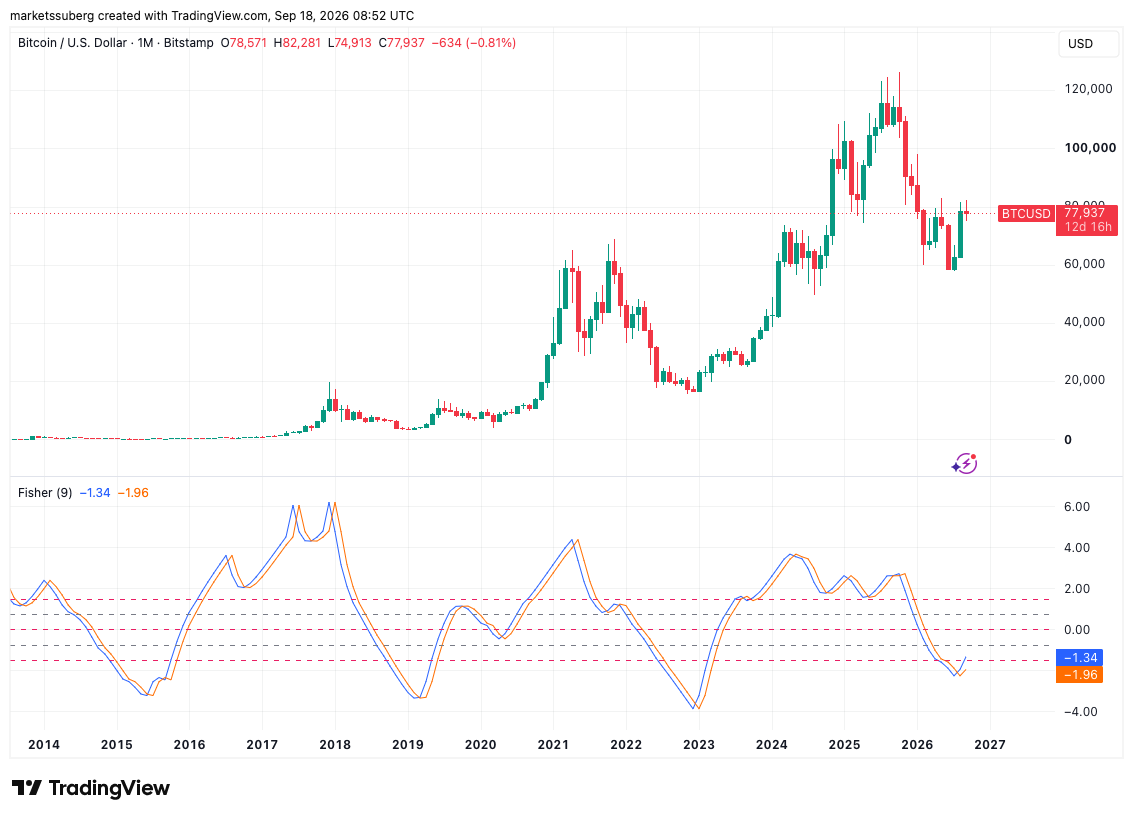
- In August, the Fisher Transform indicator delivered a monthly bullish crossover for only the fourth time in Bitcoin’s history, according to Willy Woo.
- Previous monthly crossovers accompanied the end of Bitcoin bear markets, including in late 2022, when the Fisher Transform Indicator hit -3.83.
- A bullish divergence continued on weekly time frames, echoing the closing stages of the 2022 BTC price downtrend.
Analyst sees evidence of clean BTC price reversal
In an X thread on Friday, analyst Willy Woo flagged key readings from the Fisher Transform indicator, a price trend analysis tool created in 2002.
The indicator smooths an asset’s price action to create a readable trend-strength chart. Market prices tend to spend more time around extreme values than ordinary statistical data. The Fisher transform corrects this by applying a log-based transform.
The indicator is formed of two trend lines, the Fisher line and the trigger line, that fluctuate on a scale with zero at its center. The trigger line is derived from the Fisher line, plotted with a delay of one period.
Woo shows that for Bitcoin, a sharp upward reversal in Fisher, where its two trend lines cross over one another, has corresponded to bear-market bottoms when viewed on monthly time frames.
“BTC bottoms: 3 for 3 without fake out. Latest cross is the 4th on record,” he commented.
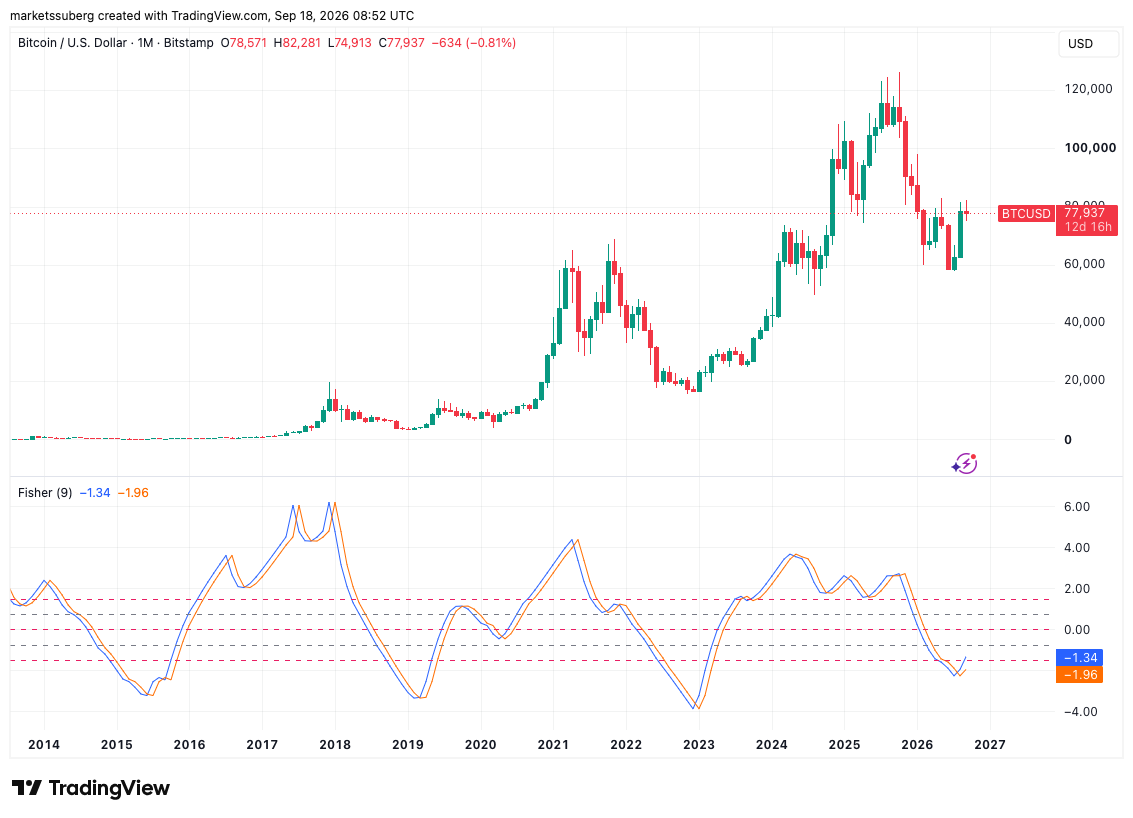
BTC/USD one-month chart with Fisher Transform data. Source: Cointelegraph/TradingView
The cross in question occurred during July at -2.26, and if it continues to play out, history suggests that BTC/USD will embark on a new macro uptrend. Woo, however, notes that price could still consolidate and continue lower, referencing a corresponding phenomenon during bull markets where Fisher delivered a bearish crossover, only to offer a fresh bullish one later.
This, he argues, is due to the presence of speculative traders during long-term BTC price uptrends, who influence market momentum because they are sensitive to short-term price moves. By contrast, during bear-market bottom phases, such traders are mostly absent, boosting the reliability of Fisher bottom signals.
“When price falls to a point where investors find value, buy-pressure fires back up but we are devoid of speculators. Price reverses more cleanly without the choppy fake outs seen in tops. Hence bottoms are easier to define. This is seen in many signals, also seen in the Fisher Transform here,” he added.
Fisher bullish divergence tracks 2022 bear market
The weekly chart shows another Fisher bull structure in process throughout 2026. Here, the indicator hit its swing low of -2.85 at the end of December last year, with BTC/USD still at around $90,000.
Related: Bitcoin treasuries buy just 5.9K BTC in three months as paper losses linger
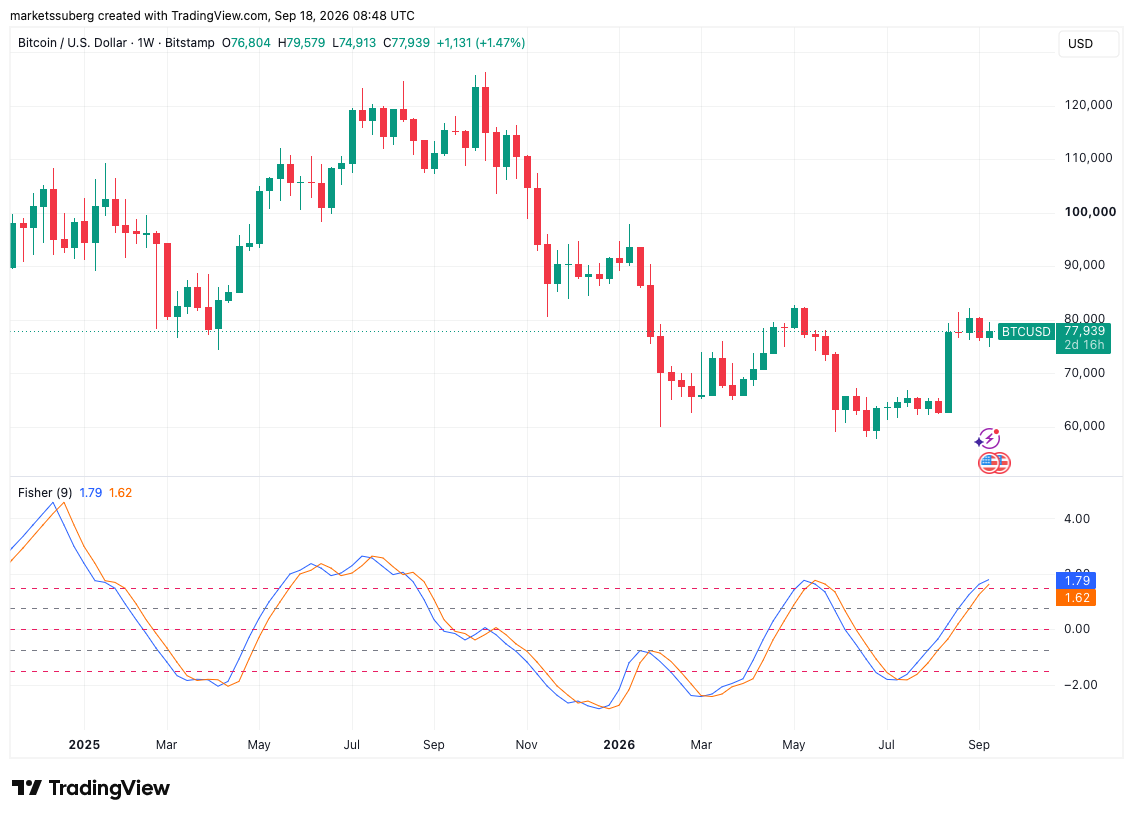
BTC/USD one-week chart with Fisher Transform data. Source: Cointelegraph/TradingView
Since then, Fisher has delivered a succession of higher lows while price itself sees lower lows, creating a bullish divergence. The same pattern emerged in 2022, with a bullish divergence in Fisher accompanying the final six months of Bitcoin’s previous bear market.
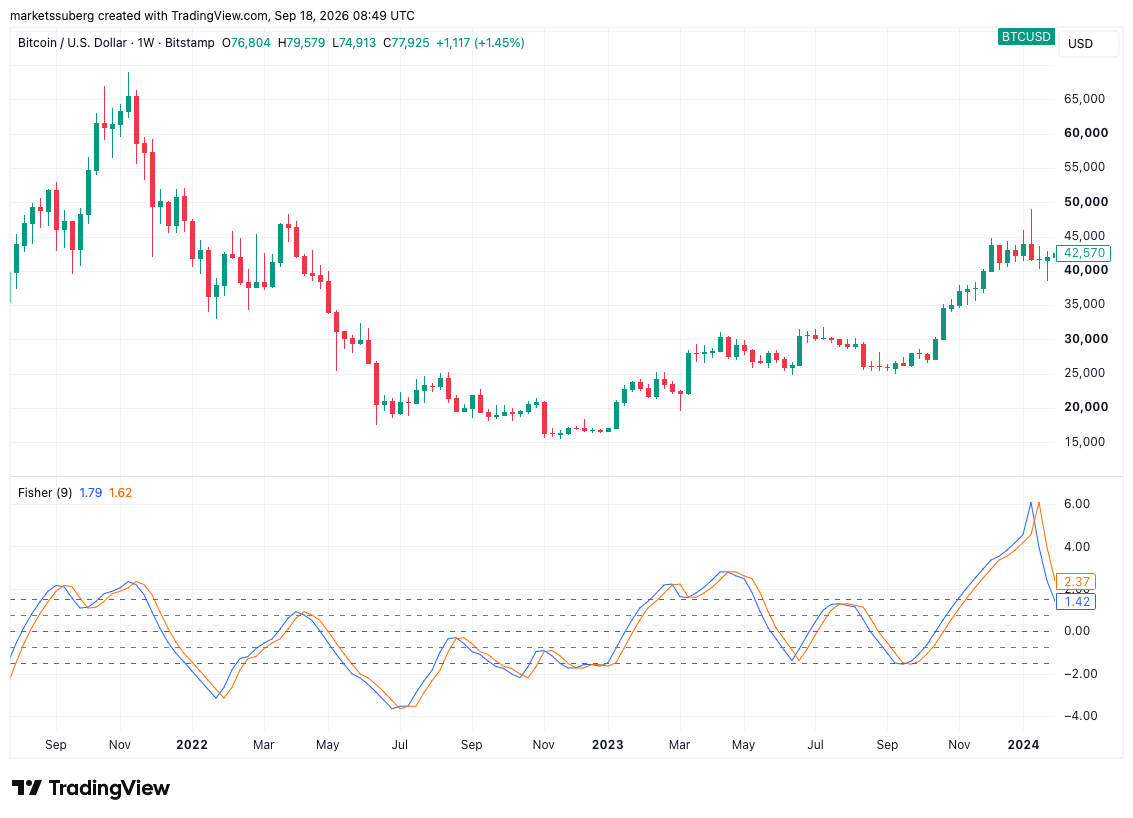
BTC/USD one-week chart with Fisher Transform data. Source: Cointelegraph/TradingView
Despite various onchain metrics triggering bear-market reversal signals in recent months, doubts remain over whether Bitcoin’s 21-month lows near $57,000 on July 1 really marked a new cycle bottom.
Last week, Woo himself noted a lack of typical buyer interest at these lows, with bid-side activity suggesting that only a handful of large-volume investors were accumulating at the time.

The team behind the popular project has released another major KYC and Mainnet migration update, clearing hundreds of thousands of previously stuck Pioneers while introducing new verification methods, including something called a palm-print trial.
The update focuses primarily on so-called “corner cases” that prevented otherwise eligible users from completing KYC or accessing their migrated balances. The largest immediate change affects accounts previously flagged as possible duplicates.
900,000+ Users to Be Unblocked?
The blog post on the project’s official site reads that after additional evaluation, the team had determined that over 417,000 users were caught in the duplicated-account review, but in reality, their accounts did not fall into that category. They can now move forward with KYC, although they must still satisfy all other applicable verification requirements.
Another fix targets an additional 497,000 users whose Mainnet balances became inaccessible because of an issue involving the Fast-Track wallets. Some received their Mainnet wallet through the project’s Fast-Track process and later used it as the destination for migration. However, these wallets sometimes lacked enough Pi tokens to cover the gas fee required to claim the migrated balance because they were created through a different route than the standard KYC process.
The Core Team noted that these issues will be addressed with an update scheduled for deployment within the next week or so. It will unblock those users and prevent the same problem from affecting similar accounts in the future. In total, the fixes should help approximately 914,000 users.
Palm-Print Verification Tested
The second major announcement in the most recent statement involves expansion plans for Pi Network’s identity-verification tools. For a trial that lasts a month, some users will be asked to complete multiple liveness checks, and the team will offer them palm-print capture as an additional authentication method.
Pi Network’s team said palm prints provide another way to verify that users are genuine humans while offering a degree of privacy because the method does not require displaying a face. As with most other Pi Network updates, more on the recent ones can be found in our dedicated article, the feature will be rolled out gradually.
Other changes include improved machine-learning-based resource management to reduce KYC processing errors, broader liveness-check compatibility for older or lower-spec smartphones, and new resubmission options for some users affected by earlier Yoti verification issues or unsupported IDs from Indonesia.
The post Huge Pi Network Update Affects Over 900,000 Pioneers: Details appeared first on CryptoPotato.

What Fulham boss said when asked if Michael Carrick is under pressure amid Man United struggles

Take $50 off the Bose QuietComfort Ultra headphones in this rare price cut

I was constantly exhausted and blighted by brain fog that I put down to my age and job. But it was a deadly heart condition triggered by weight-loss jabs – and thousands more could be at risk



-

 Fashion7 days ago
Weekend Open Thread – Corporette.com
-

 Tech5 days ago
The Latest Weird Thing to Play Doom Is the Mapped-Out Brain of a Fruit Fly
-

 Crypto World3 days ago
Kraken Lets xStocks Holders Earn Yield Through DeFi
-

 Crypto World6 days ago
Can AI Build a Startup in 72 Hours? Elon Musk's Team Will Livestream the Test
-

 Crypto World2 days ago
US Charges Robinhood Engineers Over Crypto Listing Trades
-

 News Videos7 days ago
Facing Financial Fears
-

 Entertainment7 days ago
News Specials, Movies, Shows, More
-

 Crypto World4 days ago
Elon Musk Drops a Bombshell: Grok 5 Could Be the AGI Breakthrough
-

 Business5 days ago
Rivals Sam Altman and Elon Musk Rally Behind Dario Amodei’s Call for a Slowdown in AI Development
-
 NewsBeat4 days ago
‘Sick conspiracy’: Trump says only guardrails AI needs is ‘a strong and smart (High IQ!) president’ in all-caps rant
-
 Crypto World5 days ago
New Tesla Roadster Uses SpaceX Tech. Will It Impact the Stock Price?
-

 Crypto World6 days ago
Robinhood Chain Never Stopped But its Blobs Did Stop Reaching Ethereum For 14 Minutes
-

 Crypto World2 days ago
What Is the Status of the U.S.-Iran Peace Talks? Here's What Both Sides Are Saying
-
 Entertainment7 days ago
New Horror Movie Officially Earns a Rare Stephen King Recommendation
-

 Crypto World3 days ago
NVIDIA Analysis: Attempted Rising Wedge Breakout Amid Pressure on the AI Sector
-

 Business6 days ago
Marvell: Most Potent Setup Of The AI Factory Decade
-

 Crypto World4 days ago
DOJ Seeks to Seize $61M in Iran Oil Funds From Binance Accounts It Vouched For
-

 Crypto World4 days ago
3 Token Unlocks to Watch in the Third Week of September 2026
-

 Crypto World6 days ago
Bitcoin ETFs lose $462.7M as Ethereum funds gain $196.9M
-

 Crypto World4 days ago
Revolut Attackers Warn of Ongoing Daily Customer Data Leaks
You must be logged in to post a comment Login