
Crypto World
Zoe Kazan on Adapting ‘East of Eden’ Seven Decades After Her Grandfather


Both versions are, in Kazan’s estimation, self-portraits of the artists who made them. Renowned for directing A Streetcar Named Desire and On the Waterfront and co-founding the influential Actors Studio from which the school of “method acting” was born, Elia Kazan was called before the House Un-American Activities Committee in 1952. The Hollywood blacklist was in effect and, Faced with the possibility of never being able to work in Hollywood again, he named names. His granddaughter has never read his autobiography, though she has tried. “There’s some very young part of me that’s like, I still want my grandpa to be my grandpa and not have access to all of this adult stuff,” she says. But she believes that Elia Kazan, who died in 2003 when she was 20, saw himself in the black sheep of the family: “He had this cold and demanding father, and I think he was projecting onto Cal.” Made during a period when the director was facing significant backlash, his version focuses on guilt, rejection, and alienation.


The Philadelphia semiconductor index, known as SOX, rose for a fourth consecutive day on Friday, with a new batch of chip stocks leading the charge. Macom Technology Solutions (MTSI) jumped on a fresh buy rating. On Thursday, the SOX surged 3.1%, led by chipmakers exposed to the buildout of data centers for artificial intelligence. Big gainers included Astera Labs (ALAB),…
Copyright ©2026 Investor’s Business Daily, LLC. All rights reserved. 87990cbe856818d5eddac44c7b1cdeb8
Crypto World
Three words from Kevin Warsh have Wall Street wondering how far the Fed will go with rate hikes
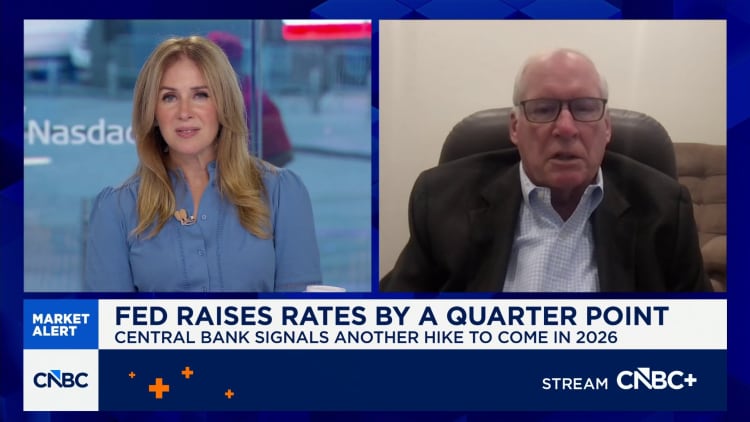
US Federal Reserve Chair Kevin Warsh speaks during a news conference at Federal Reserve Headquarters on September 16, 2026 in Washington, DC. Kevin Warsh discussed the central bank’s decision to raise interest rates for the first time since 2023 at a press conference following its latest policy meeting.
China News Service | China News Service | Getty Images
With a few carefully chosen words, Federal Reserve Chairman Kevin Warsh both explained this week’s decision to hike interest rates and raised vexing questions about what comes next.
Warsh described Wednesday’s decision to lift the central bank’s benchmark rate by a quarter percentage point not specifically as a tightening of policy but rather as removing “a dose of accommodation.” Further, he explained that the move was possible because of a U.S. economy that appears to have “strengthened” and financial conditions that have become less restrictive.
While the language may sound like central bank semantics, it gets to the heart of what markets are debating now: How far will the Warsh Fed go if it has only removed a “dose” of help, and what are the guidelines it will be using to formulate policy?
The phrase was “the one stand-out hawkish element” of Warsh’s post-meeting commentary to the press, Krishna Guha, head of economics and central bank strategy at Evercore ISI, said in a client note.
“This was not a mistake; it was a phrase he repeated several times and looked very much a deliberate choice to frame policy in this way,” Guha added, noting that “the framing is substantively different to that used by the Fed in recent years, and raises the possibility of a more open-ended approach to the number of hikes that might be required.”
That framework has included a calibration of where policy should sit relative to the so-called neutral rate, one that neither boosts nor holds back growth. By extension, benchmark rates that sit well above the neutral rate are considered restrictive, while those closer to or below neutral are regarded as accommodative.
What about neutral?
Warsh’s framing of the hike as removing “a dose” of accommodation could be seen as the first of multiple steps toward withdrawing support the Fed no longer feels is necessary. The Fed is looking to return inflation to 2%, and policymakers generally consider raising rates as a way to tamp down demand and control price pressures.
“Warsh’s framing, if taken literally, raises the possibility that rates might have to keep going up until financial conditions facing the private sector are no longer ‘accommodative’ – however that is defined,” Guha said. “This is a relatively open-ended prospect.”
Warsh had the chance to clarify what benchmark he was using to determine how much accommodation remains in policy.

Asked by CNBC’s Steve Liesman to explain how far he sees the current rate — in a target range of 3.75%-4% — sitting above neutral, Warsh essentially rejected the framing, in a statement that runs counter to how central bank policy has operated for more than a decade.
Warsh said measuring the benchmark rate relative to neutral is “useful academically. It’s a discussion to help us think about policy. Do I think it has any operational effect of decisions that we make today? No, I don’t.”
The answer helped add a layer of mystery to a Fed chairman already developing a reputation for being cryptic when it comes to how he views the wheels of policy needing to be tuned.
Markets wonder what’s next
A round of post-meeting speculation on Wall Street about what’s to come has ensued.
One of the initial reactions was pricing in higher odds for another hike when the Fed next meets in October. Goldman Sachs added an October increase to its forecast, as does Bank of America, which also expects another move in December. The market-implied odds of an October increase were near 58% Friday morning, according to the CME Group’s FedWatch gauge. A week ago, the probability was 42%.
“The word ‘accommodation’ means ‘stimulus” at the Fed; this comment implies that the current monetary policy stance is meaningfully stimulative,” wrote James Egelhof, chief U.S. economist at BNP Paribas Securities.
“With policy starting at a stimulative stance, a strong cyclical impulse, and persistent inflation, we think significant rate increases, perhaps more than the three we expect, may be necessary to stabilize the unemployment rate from below and prevent overheating next year,” he added.
Egelhof agreed that the “dose of accommodation” remark was “the most striking feature” of Warsh’s abbreviated news conference.
Markets are pricing in the likelihood that the Warsh Fed removes a few more “doses” before it is finished. Futures are implying a fed funds rate of 4.635% near the end of 2027, which would argue for three or four more hikes ahead.
If that’s the case, the Fed at the very least will undo many of the FOMC rate cuts approved under Warsh’s predecessor, Jerome Powell, who now sits on the committee as a governor.
The “dose of accommodation” remarks “seemingly helped to underscore this hawkish tone, implying that [the] committee no longer views policy as modestly restrictive,” said Jack Janasiewicz, portfolio manager and lead portfolio strategist at Natixis Investment Managers Solutions.
“We remain unconvinced that this is the start of an aggressive new tightening cycle,” he added. “Rather, we see this as a removal of the insurance cuts the Fed delivered in the fall of 2025.”

NEAR exploded 25% in the past day to reach about $3.60, its highest level since the start of 2025.
Many analysts have praised its strong performance and expect further short-term gains. At the same time, two important indicators suggest a correction is just as plausible.
‘Phenomenal’ and ‘Fabulous’
The broader cryptocurrency market has flashed green today (September 18), and NEAR is among the top performers. However, the sector’s revival isn’t the sole reason for the asset’s rally.
Several hours ago, NEAR Protocol revealed on X that users can now trade perpetual futures by default. Specifically, they can open a position from the account they already use, and no one can trace their actions. The feature is powered by Hyperliquid.
Michael van de Poppe classified the asset’s price chart following the resurgence as “absolutely phenomenal.” He suggested NEAR is nearing its final point of resistance and said it’s just a matter of time before it reaches $5. Shortly after, he used another superlative to describe what has happened to the token:
“NEAR is such a fabulous chart. Probably we’ll be getting near towards a short-term top on this one, and therefore, buying the dip is the game. Next target remains to be $5 for me.”
Other market observers who recently chipped in include X users CW and Altcoin Sherpa. The former claimed that NEAR has three sell walls up to $4.80, with the first almost broken. The latter said they are waiting for a potential dip to $3.20 to enter but think “this goes decently higher in the future.”
The Bearish Signals
NEAR’s sudden price explosion has pushed its Relative Strength Index (RSI) into overbought territory at 82. This typically indicates the asset may be gearing up for a pullback, while ratios below 30 are often seen as buying opportunities.

Another cause for concern is NEAR’s exchange netflow. Over the past few days, inflows have significantly outpaced outflows, suggesting some investors have shifted from self-custody to centralized platforms, increasing immediate selling pressure.

The post NEAR Hits Highest Price in 20 Months: Why One Analyst Calls the Chart ‘Phenomenal’ appeared first on CryptoPotato.
Just a few days after receiving major blows from the US Federal Reserve and the Senate, bitcoin’s price suddenly skyrocketed by a few grand and topped $80,000 for the first time in over ten days.
The altcoins have followed suit, with ETH surging past $2,550, while XRP has rocketed to over $1.35. Naturally, the liquidations are on the rise.
Recall that the primary cryptocurrency slumped to $75,000 on Tuesday evening after the CLARITY Act setback in the US Senate. Although the asset defended that zone, more volatility ensued a day later when the Fed hiked rates for the first time since July 2023.
However, BTC rebounded almost immediately after the initial shock and went past $76,000. It kept fluctuating in the following days, but the bulls appeared to be in control. Today’s decision by the Bank of Japan to increase the rates to a 31-year high was well received by the cryptocurrency, which jumped to just over $78,000.
It remained there for hours before it went on the offensive minutes ago, skyrocketing to over $80,000. This level was last breached on September 7.
Most altcoins have marked substantial 2-3% gains over the past hours as well. Ethereum has seemingly reclaimed the $2,550 level after a 2.3% hourly jump, while XRP is above $1.35 after a 3% increase. SOL and BNB have marked slightly more modest gains.
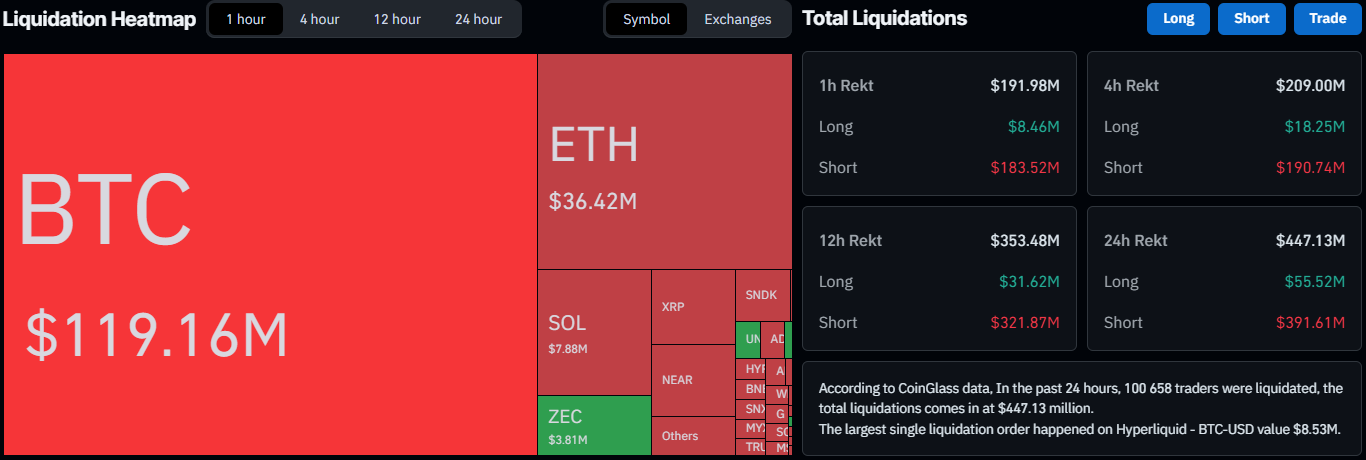
Data from CoinGlass shows that $192 million worth of over-leveraged positions were wrecked in the past hour, with shorts responsible for more than $183 million. BTC holds the lion’s share ($119 million), followed by ETH ($36 million).
On a daily scale, the numbers are even higher, with $450 million wrecked. $390 million was from shorts. In total, more than 100,000 traders have been wiped out within this timeframe.
The post Bitcoin Price Suddenly Rockets Past $80K Leaving $180M in Shorts Liquidated appeared first on CryptoPotato.

Investor’s Business Daily’s IBD 50 index is on track for a third straight down month, and some of its components are sputtering. Various factors help decide when to sell stocks, and five have already triggered sell signals. AngloGold Ashanti (AU) broke out above a 113.30 buy point on Aug. 20. Nearly a month later, the stock is struggling, down 10%…
Copyright ©2026 Investor’s Business Daily, LLC. All rights reserved. 87990cbe856818d5eddac44c7b1cdeb8

Artificial intelligence has come under renewed scrutiny of late, with many plays in the space coming off highs. But AI stock NetApp (NTAP) is now eyeing a potential buy point after getting support at a key level. California-based NetApp offers data storage systems and cloud data services. It operates through two segments, hybrid cloud and public cloud. It derives the…
Copyright ©2026 Investor’s Business Daily, LLC. All rights reserved. 87990cbe856818d5eddac44c7b1cdeb8

Long before they met, Ramakrishnan was a huge fan of Patriot Act, a Netflix series in which Minhaj wielded punchlines and PowerPoint presentations to unpack politics and the perils of unchecked capitalism.
“The first time I met you was way later at one of your first ever performances of Hasan Hates Ronnie / Ronnie Hates Hasan,” she tells Minhaj, referring to his live comedy tour with Ronny Chieng.
“And you were in full costume, right? You were dressed as Princess Leia or something like that?”
“It wasn’t a costume,” says Maitreyi. You can hear the eyeroll in her voice. “It was fashion.”
“Wait wait,” Minhaj says, shrinking.
“But it’s fine. Whatever. Wouldn’t expect you to know, Minhaj.”
“You had a full hood.”
“It was a karate gi meets Obi-Wan Kenobi up top.”
This jabbing rapport reads as a playful generational tete-a-tete between millennial and Gen Z, but it also speaks to the exchange of perspectives that informed their collaboration on Best of the Best. “What you’re seeing in the movie,” says Minhaj, “is Maitreyi and Lena coming together, and really masterminding and creating the tone and the feeling of the film.”


A 50–49 Senate vote that stalled the CLARITY Act has raised the risk that crypto companies will rely on more custodians and permissioned systems, according to GenLayer Labs CEO Albert Castellana.
Summary
- The Senate vote fell 10 votes short of the 60 needed to begin debate.
- Castellana said unclear rules could push companies toward custodians, restricted frontends and administrator keys.
- The GENIUS Act covers stablecoin issuance but leaves questions involving DeFi, wallets and trading.
- Bitwise CIO Matt Hougan called the failed vote “a speed bump, not a roadblock.”
GenLayer Labs CEO and co-founder Albert Castellana told crypto.news that the Senate result was disappointing because the proposal had been moving toward a principle he considers important: regulation should follow control.
Entities that hold customer funds, decide who may transact, or stand between two parties perform a different role from developers who publish software or users who join an open network, according to Castellana.
Without rules that recognize the difference, he said companies may respond by adding custodians, restricting access or placing another intermediary between users and blockchain applications.
“Every one of those decisions can look reasonable on its own. But you do that enough times, and suddenly you’ve rebuilt most of the intermediaries crypto was supposed to get rid of.”
CLARITY Act failure could encourage centralized safeguards
The Senate voted 50–49 against invoking cloture on H.R. 3633, leaving the proposal 10 votes short of the 60 required to open formal debate.
As crypto.news previously reported, the failed motion blocked immediate consideration of a framework that would divide oversight between the Securities and Exchange Commission and the Commodity Futures Trading Commission.
The proposal would have given the CFTC authority over qualifying digital commodities and registered spot-market intermediaries. The SEC would have retained jurisdiction over assets and transactions governed by securities laws.
Other provisions addressed decentralized software developers, stablecoin rewards, government ethics and prediction-market contracts that could conflict with state or tribal gambling rules. A revised classification framework also would have treated XRP as a digital commodity in secondary-market transactions, regardless of Ripple’s holdings.
Castellana said regulatory uncertainty does not necessarily cause companies to stop developing products. Instead, legal concerns influence how they design and offer them.
“You add another custodian. You make the frontend permissioned. You use a centralized provider because it’s easier to explain to lawyers. You block the US. You keep an admin key because somebody wants a clear responsible party,” he said.
For American users, such decisions can determine whether they retain direct access to a protocol or must use a company-controlled interface that can restrict transactions, impose identity checks or exclude US residents.
Control provides a test for deciding who should face regulation
Rather than asking whether an entire project is decentralized, Castellana proposed examining where each system places the power to force an outcome.
“For me the simplest test is: who can actually force an outcome? Can you freeze my money? Move it? Stop my transaction? Change the rules underneath me? Override the result? If you can, then you have control.”
Publishing code does not necessarily give a developer control over the finished protocol, he said. Operating one validator or owning governance tokens also may not provide enough power to determine what happens to funds or transactions.
Different parts of the same product may distribute authority in different ways. Castellana cited a permissionless protocol with a company-controlled frontend as one possible structure, while another network could use independent validators but retain an administrator key capable of changing its rules.
“I would much rather regulate the place where the power actually exists,” he said.
The distinction matters for developers because market-structure legislation has included protections intended to separate passive software development from regulated financial activity. With the Senate motion defeated, federal agencies retain responsibility for interpreting existing securities and commodities laws unless Congress revives the proposal.
Stablecoin rules leave DeFi and wallet questions unresolved
The GENIUS Act has already created clearer requirements for payment-stablecoin issuers, including rules for reserves and redemptions. Castellana said the law resolves an important part of the regulatory question, but its focus remains on the money rather than the applications built around it.
“So I don’t think stablecoin payments are waiting for CLARITY. They aren’t. But we are getting clarity on the money faster than we are getting clarity on the economy that will be built around it.”
Once stablecoins enter decentralized finance, custody products, self-hosted wallets or trading applications, companies must still decide whether a participant acts as an intermediary or merely provides software, according to Castellana.
The SEC’s work on tokenized securities offers one example of regulation proceeding through separate measures. A Sep. 11 report covered the agency’s proposed 60-day rulemaking process for transfer agents, which would permit blockchain-based systems to maintain securities ownership records.
Castellana said the SEC has also opened a path for tokenized stocks to use public, permissionless blockchains, although access to trading venues remains controlled and the exemption is temporary.
“Maybe that’s a reasonable bridge for now,” he said. “The risk is that bridges have a habit of becoming permanent infrastructure.”
For US investors, blockchain settlement alone does not determine whether a token gives its holder legal ownership of a share. The issuance structure, official ownership register, custody terms and applicable securities rules continue to determine voting, dividend and other shareholder rights.
Hougan says the bull market does not depend on Congress
Bitwise Chief Investment Officer Matt Hougan has taken a less cautious view of the vote’s effect on crypto prices.
In January, Hougan warned that a failure to pass the CLARITY Act could stall the 2026 bull market. One day after the Senate vote, however, he described the result in a Sep. 16 client memo as “a speed bump, not a roadblock.”
Hougan based his revised view partly on the difference between Bitcoin’s performance and the bill’s declining prospects. Bitcoin rose from a July 1 low of $57,950 to more than $80,000 on Sep. 4, while Polymarket traders reduced the probability of passage.
The immediate vote still caused losses across major crypto assets. BTC fell 3.7%, ETH lost 5.2%, and XRP declined 7.3%, while liquidations reached $669 million.
Institutional companies also continued developing blockchain products while the bill remained uncertain, Hougan said. He cited Robinhood’s blockchain launch, Morgan Stanley’s Solana ETF and the Depository Trust & Clearing Corporation’s first settlement of tokenized stock trades.
Hougan argued that SEC and CFTC rulemaking could support continued development without a new statute, although he acknowledged that a later administration could reverse agency rules.
AI agents raise another question about control
Castellana applied the same control principle to AI agents that can negotiate agreements or initiate transactions. A company or person that gives an agent authority over funds must remain accountable for that decision, he said.
“I don’t think ‘the AI did it’ can become an excuse,” Castellana said.
Automated agents may eventually enter large numbers of agreements that cannot account for every possible result in advance. Disputes could involve whether work was completed, whether its quality met the agreed standard or whether one party broke the terms.
GenLayer is developing a system in which agents can set terms, acceptable evidence and collateral requirements before entering an agreement, according to Castellana. If a dispute occurs, independent validators evaluate the evidence, while participants retain the ability to challenge the result.
“We need to verify the agreement, the evidence and the process used to reach the outcome,” he said.
The House passed H.R. 3633 by a 294–134 vote in July 2025, but the Senate later prepared different language. Any revived Senate version would still need approval from the House or reconciliation between the two chambers before it could reach the president.
It was expected to be a massively eventful week for the entire cryptocurrency industry, and it was.
But first, let’s see what happened precisely seven days ago. The US CPI data had just come out, confirming that inflation is still persistent. As such, the US Federal Reserve had all the missing pieces to its monetary puzzle, and experts predicted a rate hike on September 16.
BTC went wild after the CPI data was announced, going from $77,000 to $76,000 before it suddenly exploded to $79,800, where it was violently rejected and driven south to its starting point. All of this took place within an hour or so. After this enhanced volatility, the market calmed during the weekend, with BTC trading sideways at around $77,000.
It dipped to $76,400 on Monday before the bulls took control and drove it to $79,600 ahead of the key CLARITY Act vote a day later. BTC had already retreated to $77,000 when it became official that the Senate rejected cloture to advance the bill, and bitcoin plunged to a three-week low of $75,000.
The bulls managed to defend that level, but the next day was anticipated to be just as eventful with the conclusion of the FOMC meeting. The Fed indeed hiked the rates for the first time in over three years, but BTC’s reaction was more modest and somewhat surprising. The asset slipped to $75,000 once again initially, but rocketed to over $76,000 within minutes.
It kept climbing gradually on Thursday and especially on Friday. Although the BOJ also increased the rates by 25 bps to a 31-year high, BTC actually reclaimed $78,000 during the morning trading session. It stood there for a while, but initiated another leg up as US trading hours began and rocketed to a two-week peak of $81,000, where it was stopped, at least for now.
This means that BTC is actually in the green during the week in which all major events went against it. Meanwhile, ZEC continues its massive rally, while NEAR has rocketed by 35%. UNI is up by over 30% as well, followed by HYPE, BCH, and a few others. RAIN has plummeted by 22%.
Market Data

Market Cap: $2.770T | 24H Vol: $96B | BTC Dominance: 58.6%
BTC: $80,600 (+0.9%) | ETH: $2,570 (-3%) | XRP: $1.37 (-4%)
This Week’s Crypto Headlines You Can’t Miss
Strategy Stays on the Sidelines Again, but Strive Buys More Bitcoin. The week began with a familiar announcement: Strategy refused to buy more BTC while it continues to focus on rebuilding its USD stash. At the same time, Strive keeps accumulating more BTC, adding another 469 units.
Bitcoin Could Get More Support Than Gold as ETF Hedging Eases: JPMorgan. Analysts at the Wall Street behemoth said BTC may gain more price support than the precious metal amid easing ETF hedging demand, with BlackRock’s iShares Bitcoin Trust showing high short interest.
From Bear to Bull: Analyst Says Bitcoin UTXO Data Points to a Cycle Shift. Bitcoin’s share of addresses sitting at a loss has dropped sharply, and an on-chain analyst said moves of that size have historically ended bear markets and are not just producing a short bounce.
SEC Opens Door to Onchain Stock Trading With New ‘Innovation Exemption’. The regulator has launched an “Innovation Exemption” to promote secondary trading of tokenized stocks on blockchain platforms, easing regulatory burdens for Tokenized Securities Venues.
Seven Democrats Refuse to Give Up on CLARITY Act After Senate Setback. Despite the latest developments on the matter, several Democrats stated that this is not the end, pledging to continue bipartisan efforts for crypto regulatory clarity.
CoinEx Calls Time After Nearly Nine Years as Crypto Market Pressure Mounts. After nine years in existence, CoinEx has decided to shut down its platform by the end of the year due to declining crypto market conditions and increased regulatory pressures. As such, the exchange joins other major names that fell during the 2026 bear market, such as BitMart and BitMEX.
Charts
This week, we have a chart analysis of Ethereum, Ripple, Cardano, Binance Coin, and Hyperliquid – click here for the complete price analysis.
The post Bitcoin Hits 14-Day High Despite CLARITY Setback, Fed and BOJ Rate Hikes: Weekly Recap appeared first on CryptoPotato.


HYPE has risen 10.5% to $91.20 after Hyperliquid introduced manual USDC and USDT borrowing against HYPE and Bitcoin collateral, with the token setting a new all-time high of $92.56.
Summary
- HYPE price gained 10.5% in 24 hours and reached a record $92.56 on Sep. 18.
- Hyperliquid users can borrow USDC and USDT against supplied HYPE or Bitcoin.
- HYPE carries a 65% loan-to-value ratio, compared with 50% for Bitcoin.
- Payward plans to offer regulated Hyperliquid perpetuals to eligible U.S. clients.
Hyperliquid loans accept HYPE and Bitcoin collateral
Hyperliquid’s official documentation states that manual borrowing went live on Sep. 18, allowing users to borrow USDC and USDT after supplying HYPE or Bitcoin as collateral. The new service runs through HyperCore, the same infrastructure that supports the platform’s portfolio margin system.
“Manual borrowing is supported for Manual/Standard and Unified Account users,” the platform said.
Portfolio margin accounts already handle borrowing automatically, so the separate manual action is unavailable to those users. Manual and unified account holders can instead choose the amount they want to borrow, subject to available liquidity and account-level and global limits.
HYPE collateral has a loan-to-value ratio of 65%, meaning $1,000 worth of HYPE provides up to $650 in borrowing capacity at the applicable oracle price. Bitcoin has a lower LTV of 50%, giving the same collateral value up to $500 in capacity.
When a user supplies both assets, Hyperliquid adds their respective borrowing contributions together. Supplied HYPE and Bitcoin do not earn interest, while supplied USDC and USDT earn interest but do not increase the account’s borrowing capacity.
Borrowed stablecoins accrue interest continuously, with the balance indexed every hour. According to the documentation, rates depend on how much available liquidity borrowers are using. Suppliers receive a lower annual percentage yield than borrowers pay because the interest is divided among a larger pool of supplied assets.
Hyperliquid also retains 10% of the interest paid by borrowers as a reserve for future liquidations. Data cited following the rollout placed total borrowed assets at about $269 million, showing early use of the lending feature.
Liquidation rules depend on collateral value
Hyperliquid uses a health factor to compare a user’s LTV-adjusted collateral with outstanding debt. An account cannot take another loan once its health factor reaches 100% or lower, although crossing that level does not automatically trigger liquidation.
Partial liquidation begins when borrowed value moves above the collateral value after applying the designated liquidation threshold. HYPE has an 82.5% partial liquidation threshold, while Bitcoin has a threshold of 75%.
Falling collateral prices can therefore increase liquidation risk even when the user does not borrow more. Interest charges, collateral withdrawals, and additional borrowing can also move an account closer to the threshold, according to the platform.
In an example provided in its documentation, Hyperliquid used 100 HYPE worth $40 each and a 2,000 USDC loan. The collateral would provide $2,600 in borrowing capacity at a 65% LTV, leaving another 600 USDC available to borrow.
For the same position, the account would reach the 82.5% partial liquidation threshold if the HYPE oracle price fell to about $24.24, excluding further interest. Hyperliquid noted that displayed liquidation prices can change as asset prices, balances, and accumulated interest move.
Multiple forms of collateral make the calculation more complex because the system includes the contribution from every supplied asset. A displayed liquidation price of “N/A” does not necessarily mean a position carries no risk, as the label can appear when another asset covers the debt or when the calculated price sits above the current oracle price.
HYPE price breaks above its previous record
CoinGecko data showed HYPE trading at $91.20 at the time of writing, up 10.5% over 24 hours. The token moved between $81.70 and $92.56 during the period, with the upper end setting its latest all-time high on Sep. 18.
Trading volume reached approximately $1.72 billion over 24 hours, while HYPE’s market capitalization stood near $20.3 billion. The token was also up 57.1% over 30 days, according to the same market snapshot.
The advance pushed HYPE above the $89.57 record set on Sep. 6. In an earlier technical report, crypto.news covered HYPE’s consolidation between roughly $84 and $88 after the previous high, when selling repeatedly appeared above $87.
HYPE later fell toward $78.70 as weaker momentum and legal concerns weighed on the market, before reversing above $90 following the manual borrowing rollout. The move also cleared the former $87–$90 liquidity area identified in the earlier report.
Bitcoin rose alongside HYPE, trading near $80,981 after gaining about 5.6% over the latest session. BTC moved between approximately $76,205 and $80,998 during the period, placing it close to its intraday high when the market data was recorded.
U.S. access remains tied to regulated partners
Hyperliquid’s growing product range has arrived while companies connected to the platform pursue a regulated route into the United States. The Hyperliquid Policy Center has also challenged CME’s lawsuit against the Commodity Futures Trading Commission over the agency’s approval of a Kalshi Bitcoin perpetual contract.
In its Sep. 9 filing, the policy group argued that CME had not shown a competitive injury caused by the CFTC’s decision. The group also said CME’s commercial interests did not fall within the protections of the Commodity Exchange Act provisions cited in the lawsuit.
A separate U.S. proposal involves Payward, the parent company of Kraken. On Sep. 16, Payward announced regulated Hyperliquid markets for eligible American clients through Bitnomial, subject to regulatory approval.
Under the proposed structure, Bitnomial Exchange would deploy and administer selected perpetual futures markets through Hyperliquid’s HIP-3 system. Bitnomial Clearinghouse would handle clearing and settlement, while NinjaTrader Clearing would carry approved customer accounts.
U.S. customers would need to complete onboarding with NinjaTrader Clearing and receive approval for the relevant Bitnomial market. Their associated addresses would also need to appear on the permissioned HIP-3 allowlist, rather than receiving access to every market available through Hyperliquid.
Payward said Hyperliquid would be the first blockchain protocol used for the planned service. The company has not announced a launch date, and CFTC records do not yet establish final approval for the proposed HIP-3 arrangement.

Enova International: Oversold, Upgrading To Buy

Chip Stocks Hit Ceiling During Sector Rebound

Tom Brady’s NFL Power Rankings: Caleb Williams MVP Watch Has Begun; Chiefs Are Back




-

 Tech5 days ago
The Latest Weird Thing to Play Doom Is the Mapped-Out Brain of a Fruit Fly
-

 Crypto World4 days ago
Kraken Lets xStocks Holders Earn Yield Through DeFi
-

 Crypto World2 days ago
US Charges Robinhood Engineers Over Crypto Listing Trades
-

 Entertainment7 days ago
News Specials, Movies, Shows, More
-

 Crypto World6 days ago
Can AI Build a Startup in 72 Hours? Elon Musk's Team Will Livestream the Test
-

 Crypto World4 days ago
Elon Musk Drops a Bombshell: Grok 5 Could Be the AGI Breakthrough
-

 Business6 days ago
Rivals Sam Altman and Elon Musk Rally Behind Dario Amodei’s Call for a Slowdown in AI Development
-

 Crypto World3 days ago
What Is the Status of the U.S.-Iran Peace Talks? Here's What Both Sides Are Saying
-
 NewsBeat4 days ago
‘Sick conspiracy’: Trump says only guardrails AI needs is ‘a strong and smart (High IQ!) president’ in all-caps rant
-
 Crypto World5 days ago
New Tesla Roadster Uses SpaceX Tech. Will It Impact the Stock Price?
-

 Crypto World7 days ago
Robinhood Chain Never Stopped But its Blobs Did Stop Reaching Ethereum For 14 Minutes
-
 Crypto World3 days ago
NVIDIA Analysis: Attempted Rising Wedge Breakout Amid Pressure on the AI Sector
-
 Entertainment7 days ago
New Horror Movie Officially Earns a Rare Stephen King Recommendation
-

 Business6 days ago
Marvell: Most Potent Setup Of The AI Factory Decade
-

 Crypto World4 days ago
Revolut Attackers Warn of Ongoing Daily Customer Data Leaks
-

 Crypto World4 days ago
DOJ Seeks to Seize $61M in Iran Oil Funds From Binance Accounts It Vouched For
-

 Crypto World7 days ago
Bitcoin ETFs lose $462.7M as Ethereum funds gain $196.9M
-
 Crypto World5 days ago
3 Token Unlocks to Watch in the Third Week of September 2026
-
Business4 days ago
SK Hynix ADRs Fall More Than 6% as Memory Rally Breaks on Fears of Slower AI Spending
-
Crypto World4 days ago
Can Circle’s Arc Repeat Robinhood Chain’s Meme Coin Boom?
You must be logged in to post a comment Login