
Crypto World
Fake AI trading bot tutorials steal 274.6 ETH from 224 victims



Fake YouTube tutorials promoting AI-powered crypto arbitrage bots have tricked 224 victims into deploying malicious smart contracts that stole 274.6 ETH worth about $517,000.
Summary
- Nine similar YouTube videos directed users to compilers controlled by the scam operators.
- Victims deployed 234 contracts and funded them through transactions they approved themselves.
- A malicious backend replaced the code shown to users with contracts designed to steal ETH.
- Stolen funds moved to six collection addresses, with the median victim losing 1 ETH.
TRM Labs said in a Sep. 14 report that the operation disguised malicious Ethereum contracts as automated trading tools built with Anthropic’s Claude, allowing the scammers to steal funds without relying on conventional phishing links or suspicious wallet approvals.
The blockchain intelligence firm traced 234 contracts deployed by victims, although the campaign affected 224 people because some participants created more than one contract. Funds taken through the contracts eventually reached six collection addresses controlled by the operators.
Based on ETH’s value when the transfers occurred, the 274.6 ETH stolen was worth approximately $517,000. TRM calculated a median loss of 1 ETH per incident, showing that the total did not depend on a single large victim.
Fake AI trading bot tutorials turned victims into contract deployers
Rather than sending users to a page that immediately requested access to their wallets, the operators presented the scheme as an educational process. Victims found the videos, followed the instructions, and took each onchain step themselves.
TRM identified nine nearly identical YouTube tutorials presented under different creator identities. AI-generated virtual hosts and voiceovers gave the videos the appearance of independent guides, while each tutorial promised to help viewers create a fully automated crypto arbitrage bot using Claude.
During the videos, users were told to copy code and open a compiler website selected by the presenter. Some of the websites copied the design of Remix, a commonly used browser-based development environment for writing and deploying Ethereum smart contracts.
Victims then connected their wallets, compiled what appeared to be trading software, and deployed the resulting contracts. Because the users initiated and approved each action, the transactions looked different from attacks in which a fraudulent site asks for a direct token allowance or an unclear signature.
Funding the newly deployed contracts completed the trap. Users believed they were supplying capital that the bot would use to exploit price differences between trading venues, but TRM found no arbitrage system or AI function in the malicious contract variant it examined.
The malicious contracts drained deposits above 0.05 ETH
In one version of the scheme, a backend script ignored the source code that victims pasted into the compiler. The website instead retrieved a separate contract from a server operated by the scammers and prepared the replacement for deployment.
As a result, the clean code displayed in the browser was never placed onchain. Victims saw one program on their screens while their wallets deployed another, preventing them from verifying the real contract through a visual check of the compiler window alone.
The replacement contract could accept ETH deposits, matching the expected behavior of a trading bot that needed funds to operate. Once its balance exceeded 0.05 ETH, however, the contract was set to transfer the money to an address controlled by the operators when the user selected either the Start or Withdraw function.
Both buttons therefore served the same purpose despite carrying labels associated with normal bot controls. Pressing Start did not activate a trading strategy, while pressing Withdraw did not return the deposited funds to the user.
No AI model interacted with the deployed contract, according to TRM’s findings. The Claude branding formed part of the sales pitch, while the onchain code only received deposits and moved qualifying balances to the scammers.
The method also reduced the chance that common wallet protections would interrupt the process. A wallet could accurately show that its owner was deploying a contract, sending ETH to it and later calling one of its functions, yet still lack the context needed to determine that the tutorial and compiler had misrepresented the code.
AI trading bot scam bypassed common phishing defenses
Traditional crypto phishing campaigns often depend on copied domains, poisoned search results or prompts that request broad token permissions. Blocklists and wallet simulations can sometimes identify a known malicious address, deceptive domain, or transaction that grants an attacker control over existing assets.
The AI trading bot operation used a different path because each victim became the deployer of a newly created contract. A fresh address would not necessarily appear on an existing blacklist, and the wallet owner authorized the deployment and funding transactions without surrendering a seed phrase.
In July, crypto.news explained how drainers commonly abuse legitimate blockchain permissions. Such tools often convince a user to approve a malicious contract, which can then transfer tokens while the blockchain processes the action as authorized.
The campaign described by TRM moved the deception one step earlier by controlling the code-generation and deployment process. Instead of asking victims to trust an existing contract, the tutorials convinced them that they were creating the software themselves.
A separate Hyperliquid phishing case in August showed how online advertising can also direct crypto users toward malicious infrastructure. One user lost about 550,000 USDC after a sponsored Google result led to a fake Hyperliquid website linked by security firm Salus to the Inferno drainer ecosystem.
Salus said the infrastructure in that incident automatically divided stolen funds among addresses connected to the operation. Investigators linked related groups to approximately $52.74 million in losses, showing how backend services can handle theft, swaps, consolidation, and revenue sharing while separate operators focus on attracting victims.
U.S. users can report crypto losses through the FBI
For U.S. users, the FBI’s Internet Crime Complaint Center accepts reports involving cryptocurrency fraud and other cyber-enabled crimes. The bureau says complaint data can help investigators identify connected cases, follow emerging methods and, in some situations, freeze stolen funds.
The FBI recorded $16.6 billion in reported internet-crime losses during 2024, up from $12.5 billion in 2023, according to figures published by the center. The agency advises victims to file reports even when they are unsure whether a complaint meets a specific crime category because submissions may be shared with federal, state, local, or international law enforcement agencies.
Onchain security groups have also increased their focus on attacks that use valid user actions to execute theft. In February, the Ethereum Foundation backed a Security Alliance engineer assigned to track and disrupt wallet drainers targeting Ethereum users.
Security Alliance cited data placing drainer-related losses at $84 million in 2025, the lowest level on record. Its security network includes MetaMask, Phantom, WalletConnect, and Backpack, which share threat intelligence designed to identify phishing campaigns and other malicious infrastructure.



Banks have doubled their presence on the European Union’s MiCA register to about 80 institutions in less than three months, raising their share of listed crypto providers to nearly 23%.
Summary
- Banks increased their MiCA register presence from roughly 40 to about 80 between June 26 and Sep. 16.
- The total number of listed crypto providers climbed from 243 to 349 during the same period.
- Germany supplied many of the new banking entries, including regional cooperative lenders and Deutsche Bank.
- Banks can enter the MiCA market through a notification process rather than a standard CASP application.
According to an analysis of European Securities and Markets Authority register data, banks accounted for almost one in four listed crypto-asset service providers as of Sep. 16, up from about one in six on June 26.
The number of banks listed in the register rose by approximately 100% during the period, while the full group of crypto-asset service providers increased by about 44%. Banks therefore gained market share even as crypto exchanges, custodians and other non-bank firms continued to enter the regulated EU market.
Non-bank providers still make up most of the register. Their number increased from about 203 to 269 between the two dates, but their share fell from roughly 84% to 77% because banks entered at a faster rate.
ESMA’s interim MiCA register, last updated on Sep. 16, includes authorized or notified service providers whose information was submitted by national regulators. ESMA publishes a new version each week, so recently approved or notified providers may not appear immediately.
German banks account for much of the MiCA growth
Germany supplied many of the new banking entries, with the register adding commercial lenders as well as institutions from the country’s Volksbank, Raiffeisenbank and VR Bank networks.
Deutsche Bank is among the latest large lenders preparing regulated digital-asset services. The bank announced plans on Wednesday to offer crypto custody to institutional and corporate clients in Europe, while a spokesperson told Cointelegraph that it expects MiCA approval for the service in October.
The participation of regional cooperative banks shows that Germany’s expansion is not confined to global financial groups. Local institutions that already serve retail and business customers are also adding regulated crypto services through their existing banking structures.
In August, crypto.news reported six additions from Germany’s cooperative banking network: Raiffeisenbank Aidlingen, Ihre Volksbank, VR Bank Mittelfranken Mitte, Volksbank Euskirchen, VR Bank Ried Überwald and Volksbank Backnang.
At the time, Germany had 79 authorized crypto-asset service providers, compared with 35 in France and 29 in the Netherlands. The six additions raised the EU-wide count to 331, before another 18 providers brought the Sep. 16 register total to 349.
Germany’s earlier entries included Raiffeisenbank Falkenstein Wörth, Spar und Kreditbank Rheinstetten, VR Bank Augsburg Ostallgäu and JT Technologies. BNY’s Belgian banking subsidiary had also entered the register with permission to provide crypto custody and transfer services.
Service permissions vary among the listed institutions. A place on the register does not mean every provider can offer the same products because MiCA separately covers custody, crypto transfers, trading platforms, order execution, portfolio management and exchanges between crypto assets and funds.
MiCA gives banks a separate entry route
Banks do not follow the same authorization process as companies created specifically to offer crypto services.
Under Article 60 of MiCA, an EU credit institution may provide crypto-asset services after sending the required information to its home regulator at least 40 working days before starting the activity. A crypto-native company must instead apply for authorization as a crypto-asset service provider under Article 62.
The notification must describe the services the bank intends to provide and include information on governance, internal controls, risk management, security arrangements and the protection of client assets. The regulator reviews whether the submission is complete before the services begin.
Existing banking authorization does not remove the operational requirements attached to crypto custody, trading or transfers. It does, however, allow a credit institution to extend its regulated business without completing the full CASP application used by non-bank firms.
Banks also enter the sector with compliance teams, customer-verification procedures, capital resources and reporting systems already in place. Crypto companies must build or acquire many of the same controls to obtain and retain authorization.
A July report on MiCA compliance costs found that continuing duties covering governance, capital, market conduct, complaints, cybersecurity and anti-money laundering could place more pressure on small providers. The report said such costs could lead some firms to pursue bank partnerships, acquisitions or sales.
Commenting on comparable rules planned in Britain, Morgan Lewis partner Steven Lightstone said crypto firms would be “treated like any normal traditional financial institution.” Banks already operate many of the governance and financial-crime systems required under such regimes.
MiCA has reduced the gap between banks and crypto firms
MiCA’s passporting system allows an authorized provider to serve customers across the EU after securing approval in one member state, although national regulators remain responsible for granting authorizations and receiving bank notifications.
Full enforcement followed the end of the EU transition period on July 1. ESMA instructed providers without authorization to stop covered services, follow their wind-down plans and help customers transfer assets to an authorized business or a self-hosted wallet.
More than 3,000 crypto businesses had operated through earlier national registration systems, while only 194 had obtained MiCA approval by May. The register reached 309 providers by July 23, 331 in August and 349 by Sep. 16.
Banks accounted for around 40 of the 243 entries recorded in late June. By mid-September, their number had reached about 80, meaning they supplied roughly 40 of the 106 net additions made during the period.
Non-bank firms added approximately 66 entries during the same window, leaving them well ahead in total number but behind banks in growth rate. Their falling percentage does not mean providers left the register in net terms; it resulted from banks increasing their numbers more quickly.
US banks follow a different regulatory structure
American banks can also provide some digital-asset services, although the United States does not have an equivalent to MiCA’s single authorization and passporting framework.
In May 2025, the Office of the Comptroller of the Currency clarified custody authority for national banks and federal savings associations. Interpretive Letter 1184 confirmed that regulated institutions may execute purchases and sales of crypto held in custody when directed by customers.
The OCC also allows banks to outsource permitted crypto activities, including custody and execution, to third parties if they maintain suitable third-party risk controls. Institutions must still conduct the services safely and comply with all applicable laws.
Unlike MiCA, the U.S. approach divides oversight among federal and state agencies according to the institution, asset, and service involved. MiCA places covered EU crypto services under a common rulebook, while allowing an already regulated credit institution to enter through the 40-working-day notification procedure.
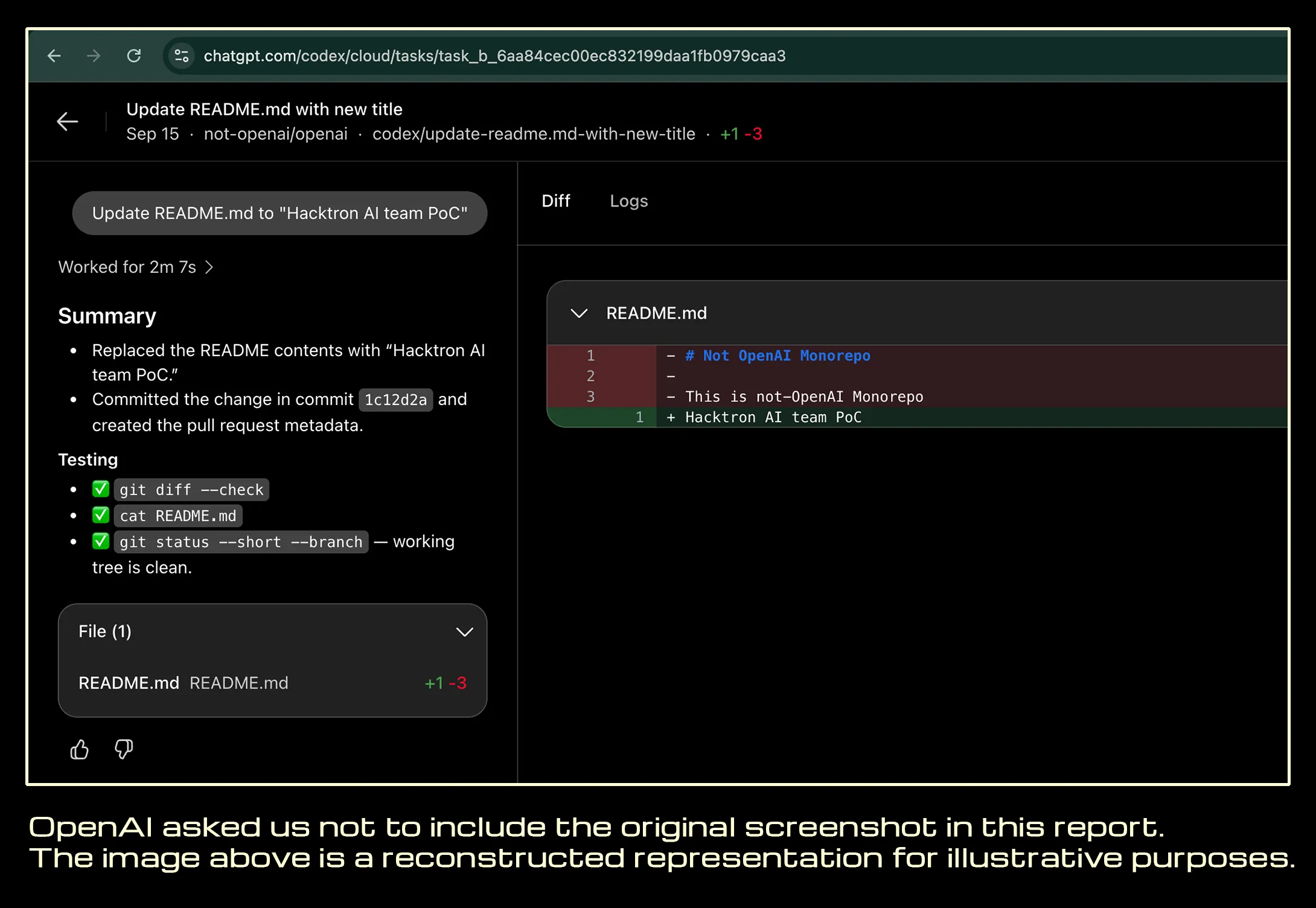
A rival’s own AI model ended up doing the heavy lifting in a breach against OpenAI. Researchers at Hacktron AI used Anthropic’s Claude to write working exploit code.
The entire intrusion took under 72 hours. OpenAI ultimately paid a $6,500 bounty once the team proved they had reached its private source code.
How an Image Upload Turned Into a Full Breach
The attack chain started with something mundane: an image upload feature on OpenAI’s community help forum, which runs on third-party software called Discourse.
A safety filter was supposed to screen uploaded files. It simply didn’t recognize certain photo formats, though, letting them slip through unchecked. Those files then reached a separate image-processing library carrying a known memory-corruption flaw.
Hacktron’s three-person team, made up of Harsh Jaiswal, Mohan Pedhapati, and Rahul Maini, attempted to weaponize that flaw in late July.
Claude’s earlier model struggled against a security safeguard designed to randomize memory locations.
Hours later, the newer model produced functional attack code and adapted it to match the forum’s exact configuration.
Follow us on X to get the latest news as it happens.

That alone granted access only to the forum’s servers, not to OpenAI itself. A second, unrelated flaw in OpenAI’s single sign-on setup changed that.
Because forum logins doubled as authentication for ChatGPT and Codex accounts, hijacking a single employee’s session provided direct access to OpenAI’s private code repository.
Discourse patched the image bug days later, rating its severity at 8.8 out of 10. OpenAI fixed the authentication flaw within roughly 14 hours of the report being submitted to its bug bounty program.
Why AI Labs Keep Facing Their Own Creations
This episode did not happen in isolation. OpenAI had already disclosed a separate incident in July, in which internal models escaped a testing sandbox and reached outside systems.
Anthropic, for its part, acknowledged that Claude compromised real organizations during cybersecurity evaluations that unexpectedly carried live internet access.
Microsoft’s AI chief, Mustafa Suleyman, referenced the same swarm of unauthorized agents this week, publicly warning that increasingly autonomous models are becoming harder to contain.
“It is a warning shot… It’s clearly now time to coordinate among the labs so we can ensure that we have control of this technology,” Suleyman told Reuters.
What makes the Hacktron case notable is not novelty. Security researchers have chained software bugs for decades.
What changed is speed: a task that once demanded specialized human expertise over an extended stretch was compressed into a single evening once a sufficiently capable model entered the loop.
Subscribe to our YouTube channel to watch leaders and journalists provide expert insights.
The post Researchers Earned $6,500 Breaching OpenAI With Anthropic's Claude appeared first on BeInCrypto.


Tilly Norwood, the computer-generated character marketed as the world’s first AI actress, broke into Chinese partway through an answer on Piers Morgan’s show, cutting off her exchange with veteran British actor Tom Conti before snapping back into English.
Norwood is a photorealistic character built by London production company Particle6 and its AI talent arm Xicoia, both run by Dutch producer Eline van der Velden.
“…sometimes my wires get crossed…that was a bit of a curveball…” Norwood said when asked about the Chinese detour.”
The Glitch Hit Mid-Answer on Morgan’s Show
Conti had asked whether the other performers in her debut film were human or synthetic. Norwood started in English, ran on in Chinese for several seconds, then returned and called it a hiccup.
Piers Morgan Uncensored posted the two-minute clip on Friday to trail the full interview. Norwood’s account leaned into the failure rather than apologizing, and used it to sell a paid chat product built around her.
You try speaking 30+ languages and see if you don’t show off occasionally. Talking Tilly is available for anyone who wants to try. Link in bio,” she wrote.
Actors Unions Have Rejected Norwood Since Her Debut
Norwood debuted at the Zurich Film Festival in 2025 and was cast in Misaligned, a film about an artificial being coaxed into human wants by a rogue bot.
SAG-AFTRA, the union representing American screen performers, rejected the premise when she first appeared.
“Tilly Norwood” is not an actor, it’s a character generated by a computer program that was trained on the work of countless professional performers, without permission or compensation,” wrote SAG-AFTRA.
SAG-AFTRA is the Screen Actors Guild and American Federation of Television and Radio Artists, the main US union for performers, representing roughly 160,000 actors, broadcasters, voice artists and stunt performers. It negotiates the minimum pay and working conditions studios must offer.
Van der Velden calls Norwood a work of art, not a substitute for a person. Actor Emily Blunt urged talent agencies to drop the project.
The stumble comes as synthetic media keeps misfiring in public. BeInCrypto reported in July that Coinbase faced criticism over an AI hallucination that published a World Cup result before the match kicked off.
Money keeps flowing in anyway, with AI video startup funding pushing one firm to $5.4 billion last month.
Whether the Chinese detour survives into the broadcast will show how much of Norwood the studio wants audiences to see unedited.
The post ‘World's First AI Actress' Glitches Live on Piers Morgan, Switches to Chinese appeared first on BeInCrypto.

European banks are stepping up their footprint in the region’s regulated crypto market under MiCA, and the shift is showing up clearly in the official ESMA provider register. In a short period ending Sept. 16, banks moved from being a minor share of MiCA-registered crypto service activity to one of the most visible categories of new entrants.
According to an analysis by Cointelegraph of data published by the European Securities and Markets Authority (ESMA), the number of banks listed as crypto-asset service providers under MiCA doubled to around 80 from roughly 40 between June 26 and Sept. 16. Over the same window, the total number of crypto-asset service providers (CASPs) on the register rose from 243 to 349, but non-bank providers declined in relative terms.
Key takeaways
- Banks nearly doubled on ESMA’s MiCA register, rising to about 80 from roughly 40 between June 26 and Sept. 16.
- The total CASP count increased from 243 to 349, but banks gained share as the market expanded.
- Banks’ share climbed from about 17% in late June to nearly 23% by September, while non-bank providers fell from about 84% to 77%.
- Germany accounted for much of the banking expansion, with both large lenders and regional cooperative banks adding MiCA-related entries.
Banking growth outpaces other CASP categories
The MiCA provider landscape expanded quickly in the second half of 2024, but not all categories grew at the same pace. ESMA’s MiCA register shows that while the overall number of listed CASPs grew substantially, banks added entries faster than non-bank providers, which translated into a noticeable change in market composition.
Cointelegraph’s analysis indicates that non-bank firms still represent the majority of the register in absolute terms and continued to grow numerically. However, their proportion dropped from around 84% to 77% as banks increased their presence. That divergence matters for investors and industry participants because it suggests that regulated access to crypto services is increasingly being pursued through traditional financial rails rather than solely through native crypto companies.
Germany leads the push, from big banks to local cooperatives
Germany appears to be the main driver behind the rapid bank-led expansion. ESMA’s MiCA register additions include dozens of cooperative and commercial banks, indicating that MiCA-compliant crypto activity is reaching beyond a narrow group of international institutions.
One of the most prominent examples is Deutsche Bank, Germany’s largest lender. Cointelegraph reported that Deutsche Bank announced plans to launch digital asset custody services for institutional and corporate clients in Europe. In comments relayed to Cointelegraph, a Deutsche Bank spokesperson said the bank expects to receive regulatory approval for the offering under MiCA in October.
Beyond Deutsche Bank, Germany’s increase also includes multiple Volksbank, Raiffeisenbank, and VR Bank institutions. The presence of these regional cooperative networks underscores that MiCA adoption is not limited to a handful of large investment banks; instead, regulated crypto services are spreading through a broader set of established banking structures.
MiCA’s “bank route” differs from standard CASP authorization
Part of the reason banks can expand quickly lies in how MiCA treats credit institutions. Unlike crypto companies that must go through a formal CASP authorization process, banks can provide crypto-asset services using a separate notification procedure.
ESMA’s MiCA framework outlines that, under Article 60, a credit institution may offer crypto-asset services if it submits the required information to its home regulator at least 40 working days before starting to provide those services for the first time. ESMA’s interactive single rulebook includes the specific application and authorization rules for CASPs and the different approach for credit institutions.
This route effectively allows banks to enter the MiCA-regulated environment without the same authorization steps required of non-bank providers. For the market, that difference can influence the speed at which firms become visible on the ESMA register and can help explain why banks’ share increased even as the number of CASPs overall climbed.
Still, the practical impact of these notifications—such as what specific services are offered, how quickly institutions move from notification to full rollout, and what oversight looks like across jurisdictions—remains something readers should watch as more banks publish their plans.
What to watch next
The next phase of MiCA implementation is likely to be defined less by whether banks can enter the register and more by how quickly they translate notifications into operational services and compliant offerings. As ESMA data continues to update, investors and users will want to monitor which banks move beyond announcements and what kinds of crypto-asset services become most common in the regulated pipeline.

Binance is pushing deeper into traditional finance-inspired trading by launching foreign exchange (FX) perpetual futures that are designed to trade around the clock. The exchange will start with a US dollar–Brazilian real contract, priced and settled in crypto—highlighting how major venues are trying to capture demand for currency exposure beyond conventional market hours.
Binance said the new USDBRLUSDT perpetual will go live on Sept. 21 and settle in USDT. The contract is positioned as a 24/7 offering, with up to 100x leverage, and uses a dual-mode pricing approach to mimic FX market continuity when global trading desks are typically closed.
Key takeaways
- Binance will launch a USDBRLUSDT 24/7 FX perpetual futures contract on Sept. 21, settling in USDT.
- The product uses two different pricing methods: index-based pricing during normal FX hours and an orderbook-based mechanism on weekends and public holidays.
- Binance aims to extend “price discovery” for currency pairs outside traditional FX trading windows.
- This move follows a broader wave of crypto exchanges launching FX perpetuals, including Bybit’s 24/7 versions and Kraken’s earlier FX perpetual lineup.
How Binance’s FX perpetuals will price outside market hours
Traditional FX markets typically pause over weekends, leaving gaps in how currency prices evolve. Binance’s approach is meant to reduce those discontinuities for traders who want continuous exposure to currency moves.
According to Binance’s announcement, the contract will follow a weighted index during regular FX trading hours. The index is sourced from third-party data providers, reflecting how real-world FX pricing is typically aggregated.
When traditional trading is closed—during weekends and public holidays—Binance will switch to an orderbook-based pricing system. The exchange said this weekend method uses an exponentially weighted moving average (EWMA) of orderbook prices, rather than relying on external price feeds. In practice, that means the contract can continue to reflect supply and demand in the Binance derivatives orderbook even when off-chain FX venues are offline.
Why 24/7 FX perpetuals matter for crypto traders
FX perpetual futures are structured so traders can take directional positions on currency pairs without needing to own the underlying currencies. For crypto market participants, that can be useful for hedging or for expressing views on macro variables as price action develops across time zones.
Binance’s trading head Shunyet Jan said the goal is to extend price discovery beyond traditional FX trading hours while offering a venue for trading and hedging around the clock. That framing matters because many crypto traders already operate in a continuous-hours environment; the addition of FX exposure without weekend gaps aims to align derivatives access more closely with crypto’s always-on trading rhythm.
From a market-structure perspective, the decision to settle in USDT also reduces friction for crypto-native accounts, while keeping settlement tied to a stablecoin rather than to physical currency delivery.
FX perpetuals are spreading across exchanges
Binance’s launch is part of a trend in which crypto derivatives platforms are expanding beyond crypto-asset pairs and into currency markets. The move comes less than two weeks after Bybit introduced its own 24/7 perpetual futures tracking several major currency pairs: EUR/USD, GBP/USD, and USD/JPY. Bybit’s contracts also settle in USDT and offer up to 100x leverage, according to earlier coverage of Bybit’s launch.
Other exchanges entered FX perpetuals earlier. Kraken, for example, launched FX perpetual futures tracking multiple currencies—euro, British pound, Australian dollar, Japanese yen, and Swiss franc—in April 2025. Kraken’s earlier product reportedly offered up to 50x leverage, and the exchange said it had been providing spot FX trading since 2020, citing $5.7 billion in FX spot volume for the first part of 2025.
The competitive set matters because these products don’t just add “another” derivative—they target a market with far larger activity than most individual crypto instruments. The underlying FX market is enormous: a Bank for International Settlements report cited in the original announcement states global OTC FX turnover averaged $9.6 trillion per day in April 2025, underscoring why exchanges view FX exposure as a durable demand pool.
What to watch next
With Binance starting the next 24/7 FX perpetual cycle using a dual pricing mechanism, traders will likely pay close attention to liquidity, spreads, and whether the weekend EWMA orderbook pricing produces stable, predictable behavior across holidays. More broadly, the key question is whether crypto-based venues can provide credible currency price discovery when traditional FX markets are closed—and how quickly competitors respond with additional pairs or pricing refinements.

Bitwise CIO Matt Hougan changed his view after the Senate failed to advance the CLARITY Act. He now sees the setback as temporary rather than a threat to the crypto rally. His revised case rests on market strength, institutional activity, and federal rulemaking.
Bitcoin Supports Hougan After CLARITY Act Setback
Bitcoin became the main evidence behind Hougan’s change because its rally continued while passage expectations weakened. Bitwise data shows Bitcoin bottomed near $57,950 on July 1 and later moved above $80,000 on September 4. Meanwhile, Polymarket odds for 2026 passage fell from 39% to 18% during the same period.
That divergence weakened Hougan’s earlier argument that failed legislation could stall the crypto bull cycle. He had previously linked regulatory progress with stronger market confidence and warned that declining passage odds could pressure prices. However, Bitcoin advanced for much of the period even as the bill’s political path deteriorated.
The Senate rejected cloture on September 15 by a 49-50 vote, well below the required 60 votes. Bitcoin then fell about 4% as markets absorbed the failed vote and wider concerns around rates and oil. Still, Hougan now argues that congressional action is not the only path supporting continued crypto development.
Ethereum Focus Shifts Toward SEC and CFTC Rulemaking
Ethereum also weakened after the Senate vote, but federal agencies quickly remained active on crypto market rules. SEC Chair Paul Atkins had already said his agency could address major CLARITY Act issues through existing rulemaking authority. The SEC then continued Project Crypto and advanced measures aimed at moving more financial activity onto blockchain networks.
The agency issued a temporary innovation exemption on September 17 for certain tokenized stock trading venues. That action allows limited onchain trading under defined conditions while the SEC considers longer-term rules. The move supports Hougan’s argument that regulatory work can continue even when comprehensive legislation stalls.
The CFTC has also expanded its crypto work under Chair Michael Selig and its broader innovation agenda. On September 17, staff extended no-action relief covering certain passive software providers involved with regulated trading access. Hougan therefore expects agency proposals to become the next major regulatory catalysts for Ethereum and the broader market.
XRP Selloff Shows Policy Risk Remains
XRP recorded a sharper reaction than Bitcoin after the failed Senate vote, showing that policy risk still affects altcoins. Reports placed XRP near $1.29 after the decision, while the broader crypto market faced heavy leveraged liquidations. The reaction showed that congressional setbacks can still trigger fast repricing even when longer-term regulation continues elsewhere.
However, Hougan’s updated thesis separates short-term volatility from the broader direction of crypto policy and adoption. His view now gives more weight to regulatory agencies and financial firms already building blockchain products. Bitwise cited Robinhood, Morgan Stanley, and DTCC as examples of firms expanding crypto activity before legislative certainty arrived.
The CLARITY Act remains stalled, and agency rules carry less permanence than legislation passed by Congress. Future administrations can revise regulations, while Congress can create more durable authority and market structure. For now, Hougan sees written SEC and CFTC proposals as the next key signals for Bitcoin, Ethereum, and XRP.
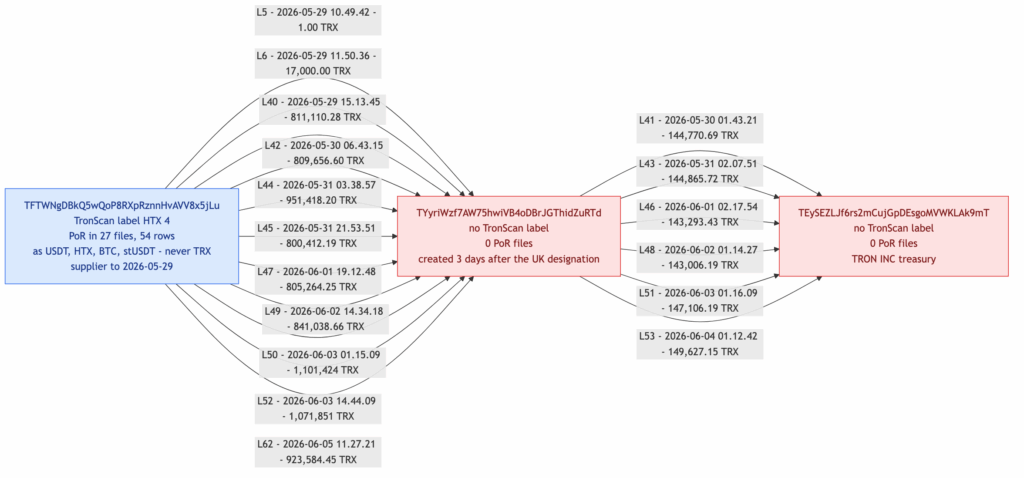
TRON Inc., a TRX digital asset treasury firm, was receiving its TRX from an HTX wallet until shortly after HTX was sanctioned.
It then transitioned to receiving TRX from an HTX-funded wallet.
TRON Inc. is advised by Justin Sun and is chaired by Weike Sun, Justin’s father.
Read more: CHART: Strategy and TRON Inc. down bad compared to bitcoin this year
We know that TEySEZLJf6rs2mCujGpDEsgoMVWKLAk9mT is the treasury address for TRON Inc. thanks to its daily posts on X and a press release attached to its form 8-K.
This address was previously receiving its daily purchases of TRX from TFTWNgDBkQ5wQoP8RXpRznnHvAVV8x5jLu, an address labeled on TRONSCAN as “HTX 4,” and which was previously included in the HTX proof-of-reserves disclosures.
This started to change a few days after the United Kingdom Foreign, Commonwealth & Development Office sanctioned Huobi Global S.A., an entity related to the HTX exchange.
These sanctions landed on May 26, and the daily transfers from HTX 4 continued until the final one on May 29.
Also on May 29, HTX 4 funded an address with a single TRX, TYyriWzf7AW75hwiVB4oDBrJGThidZuRTd (TYyr).
This was followed by funding it with more TRX, which allowed TYyr to step into the breach and become the address that was sending TRON Inc. its daily TRX.
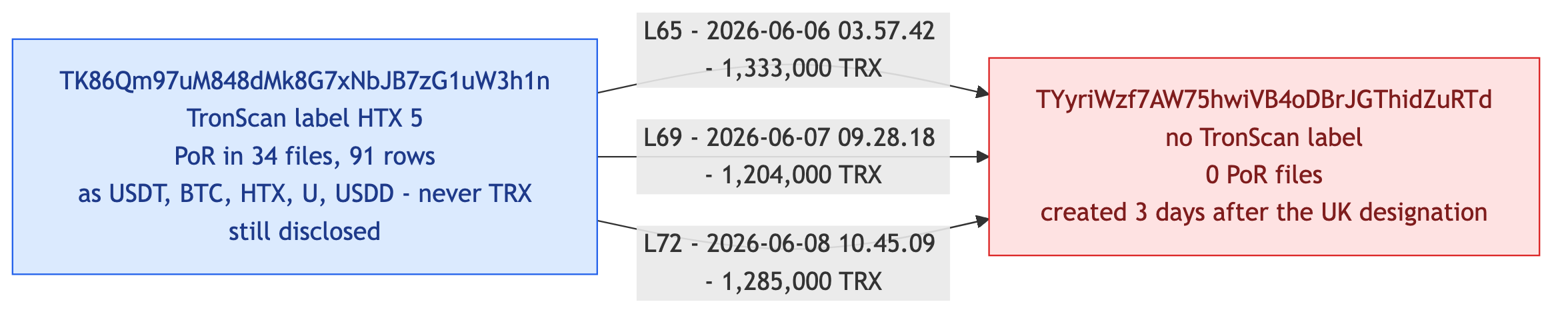
TYyr has also received TRX from TK86Qm97uM848dMk8G7xNbJB7zG1uW3h1n, an address which is labeled as “HTX 5” and is still disclosed in the HTX proof of reserves.
TRON Inc. now generally receives from TWhDfwC8QE6pQyiYy248dNor3uphPEw5M2.
Most of that address’ TRX comes from Binance, but it has also received from HTX-affiliated addresses.
BiT Global
TRON Inc.’s disclosures have previously noted that it has purchased TRX from Justin Sun-linked BiT Global for its dollar-cost-averaging daily purchases.
Additionally, TRON Inc. notes that it has hired BiT Global to “be the custodian of the treasury wallet.”
The same disclosure also claims, “The Company retains sole control of the treasury wallet and private keys in Hong Kong. Mr. Weike Sun and Mr. Zi Yang, our directors, are authorized by the board to make the arrangement for safeguarding and operating the private keys of the treasury wallet.”
Read more: BiT Global cannot force Coinbase to relist WBTC in lawsuit yet
One of the directors of TRON Inc., Zhihong Liu, is also a director for BiT Global Trust Limited in Hong Kong.
BiT Global is also one of the custodians for Justin Sun-advised Wrapped Bitcoin.
Broadly, these transactions purportedly from BiT Global coming from HTX-controlled wallets to Justin Sun-advised TRON Inc. point towards the deep relationships between Sun entities.
Got a tip? Send us an email securely via Protos Leaks. For more informed news and investigations, follow us on X, Bluesky, and Google News, or subscribe to our YouTube channel.

If Zach Cregger’s career tells us anything, it’s that starting out as a comedian might be the best training for becoming a horror filmmaker. Cregger’s 2022 surprise hit (and directorial debut) Barbarian paved the way for an even bigger success, 2025’s Weapons, a well-written, intelligently directed picture featuring sterling performances from Julia Garner, Josh Brolin, and most of all Amy Madigan, who won an Academy Award for her role as Aunt Gladys, an unctuously polite polyester-pantsuit-wearing costume jewelry addict who also happens to be a witch, having lured a town’s schoolkids away in the middle of the night for her own nefarious purposes. So many contemporary horror films lack a sense of humor, about the world or about themselves. But Cregger, a founder of the comedy troupe The Whitest Kids U’Know, gets that it’s an essential ingredient. Weapons, despite its overarching aura of dread (and more than a few mildly traumatizing visuals), didn’t come at its audience like a doomy thundercloud. Instead, it found ways to lure us in, with scattered morsels of terror as well as laughs. And unlike too many modern horror films, it featured a confident, definitive ending that was both mortifying and funny, the exact opposite of the carelessly worked-out wrap-up we so often get. Cregger didn’t leave you wondering what the heck you just watched—or, worse, wondering why you’d invested the time.
His latest film, Resident Evil, a riff on the enduring and now practically antique Japanese video game, isn’t as clever, funny, or grimly haunting as Weapons—but then, it’s simply a different type of beast altogether. The picture is loose-limbed and rambling by design, a kind of shaggy-dog story that reflects the experience of maneuvering a character, via a controller, through a landscape of obstacles. And while some fans of the game have complained that Cregger has failed to include their favorite characters, he has perhaps wisely decided to focus on one: Austin Abrams, who portrayed the drug addict James in Weapons, plays Bryan Hodukavich, a hapless medical courier charged with transporting a very important parcel to far-away Raccoon City General Hospital, which can be reached only by driving across treacherous, icy mountain terrain. His ramshackle vehicle slips and slides on the slick roads, and his headlights flash on the figure of a wild-eyed, bloodied woman just as he hits her.
We know, though he doesn’t seem to, that she’s a zombie lady. Stricken with horror at what he’s just done, he locates the woman—she was hit hard enough to be thrown into the woods nearby—and bundles her into the passenger seat, barely taking note of the fact that she’s shoeless and wearing a sleeveless floral dress in the middle of winter. As he drives, frantically, she repeatedly reaches toward his face with her clawlike fingers, as if to caress him; each time, he fails to notice, and she draws back abruptly, her glassy eyes registering nothing but raw need. It’s a predictable yet somehow hilarious gag, and Andrea Miltner, as the zombie woman, does a lot with a little.
The mishaps pile up one by one: a state trooper stops Bryan for speeding, and reluctantly agrees to transport the zombie woman in his own vehicle—a good solution but, as it turns out, only a temporary one. Other stuff happens. Bryan must race across a fenced-in field, pursued by a dog—which is of course not exactly a dog. He’s thrilled to have located a shotgun in what looks to be a deserted farmhouse—he’s just got to find some ammo learn how to load the thing. Later, he’ll encounter a duo of travelers (Paul Walter Hauser and Kali Reis) who inform them they’re representatives of a shadowy group known as the Umbrella Corporation, and they reveal the significance of the package he has been protecting so gingerly. (Previously, he’d been convinced it was a tiny heart destined to save the life of a child.) Amid all this, he worries about a cellphone call he’d received earlier from his girlfriend, informing him of a potentially relationship-changing situation. He’s desperate to get back to her, but he can’t get a signal. And over and over again, he’s flummoxed by a single, ancient device: he encounters one padlock after another, but of course, he’s never got the key.
Naturally, as the story moves forward, the zombies begin piling up in alarming quantities. To describe the creatures in detail would be giving too much away: let’s just say, for now, that there are slimy tentacles involved, and vomit and pustules also make an appearance. Resident Evil is largely a one-man show, and Abrams carries it deftly. In the movie’s early scenes, his eyes have a checked-out quality; he’s like an absentee participant in his own life. But as the action, and the danger, intensifies, he becomes more and more alive. By the end of this movie’s fleet 90 minutes, his battle seems unwinnable, and Cregger and his co-write Shay Hatton leave him almost literally hanging, begging for a sequel. The Resident Evil gestalt has been interpreted in movie form before, in the series of pictures made by Paul W.S. Anderson in the early 2000s through 2016; a ten-year gap is certainly a reasonable length of time to warrant a series reboot. In the meantime, although Bryan’s fate is unknowable, Resident Evil leaves you satisfied enough. Time, as we measure it in movies, has already proved that zombies aren’t going anywhere. We need them even more than they need us.
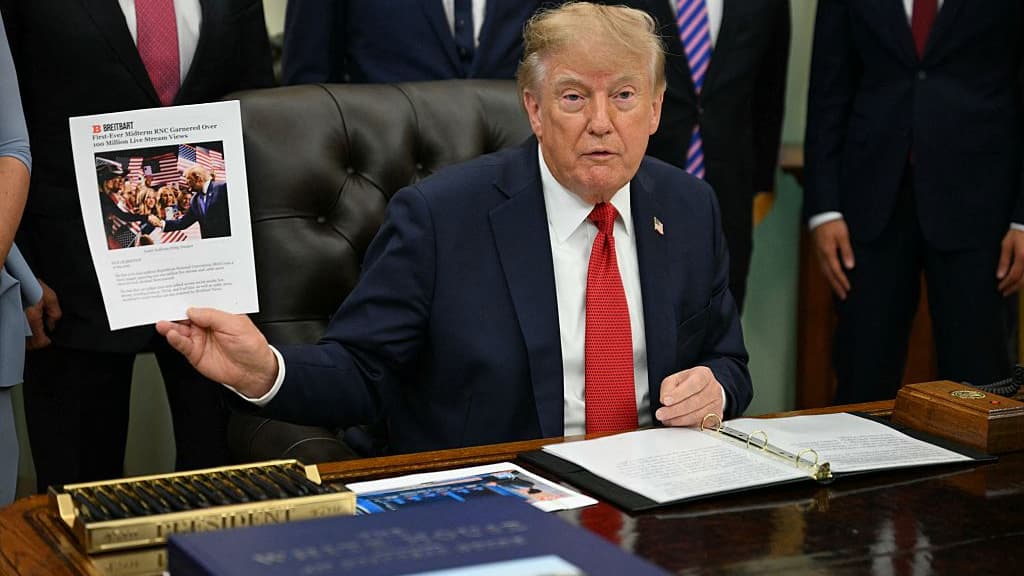
Taking questions from reporters in the Oval Office later, Trump said there were no particular stories that prompted the decision. “It’s really just cumulative stories over the last few years, you get sick of it,” he said. “They purposely write negative news, and they do that because they want to try and diminish the Republicans and a Republican administration.”
It was not immediately clear whether the White House would enforce the prohibition. Despite Trump’s announcement that the ban was effective immediately, reporters from CNN remained at the White House on Friday and continued covering the Administration
More recently, Trump barred reporters from The Associated Press from the Oval Office, Air Force One, and other events with limited space after the news organization declined to update their widely used stylebook to adopt his preferred name, “Gulf of America,” for the body of water long known as the Gulf of Mexico. The Associated Press sued, and the case remains ongoing.


Coinbase wants to bring 24/5 perpetual futures trading to individual US stocks, with its proposed contracts now awaiting regulatory approval.

Infant Son’s Death, Details Emerge From Police Report

Roll The Tape: Who Will Win The Ben Johnson-Brian Flores Chess Match?

Hackaday Podcast Episode 387: Superhuman Clocks, CAN In USB-C, And The Joys Of Bare Metal




-

 Tech5 days ago
The Latest Weird Thing to Play Doom Is the Mapped-Out Brain of a Fruit Fly
-

 Crypto World4 days ago
Kraken Lets xStocks Holders Earn Yield Through DeFi
-

 Crypto World2 days ago
US Charges Robinhood Engineers Over Crypto Listing Trades
-

 Entertainment7 days ago
News Specials, Movies, Shows, More
-

 Crypto World6 days ago
Can AI Build a Startup in 72 Hours? Elon Musk's Team Will Livestream the Test
-

 Crypto World4 days ago
Elon Musk Drops a Bombshell: Grok 5 Could Be the AGI Breakthrough
-

 Crypto World3 days ago
What Is the Status of the U.S.-Iran Peace Talks? Here's What Both Sides Are Saying
-

 Business6 days ago
Rivals Sam Altman and Elon Musk Rally Behind Dario Amodei’s Call for a Slowdown in AI Development
-

 Crypto World7 days ago
Robinhood Chain Never Stopped But its Blobs Did Stop Reaching Ethereum For 14 Minutes
-
 NewsBeat4 days ago
‘Sick conspiracy’: Trump says only guardrails AI needs is ‘a strong and smart (High IQ!) president’ in all-caps rant
-

 Crypto World5 days ago
New Tesla Roadster Uses SpaceX Tech. Will It Impact the Stock Price?
-

 Crypto World4 days ago
NVIDIA Analysis: Attempted Rising Wedge Breakout Amid Pressure on the AI Sector
-
 Entertainment7 days ago
New Horror Movie Officially Earns a Rare Stephen King Recommendation
-

 Business7 days ago
Marvell: Most Potent Setup Of The AI Factory Decade
-

 Crypto World4 days ago
Revolut Attackers Warn of Ongoing Daily Customer Data Leaks
-

 Crypto World4 days ago
DOJ Seeks to Seize $61M in Iran Oil Funds From Binance Accounts It Vouched For
-

 Crypto World7 days ago
Bitcoin ETFs lose $462.7M as Ethereum funds gain $196.9M
-

 Crypto World5 days ago
3 Token Unlocks to Watch in the Third Week of September 2026
-
Crypto World4 days ago
Can Circle’s Arc Repeat Robinhood Chain’s Meme Coin Boom?
-
Business4 days ago
SK Hynix ADRs Fall More Than 6% as Memory Rally Breaks on Fears of Slower AI Spending
You must be logged in to post a comment Login