The average person spends 20 years of their life in poor health. Let that sink in.
But what if you could avoid that? While there are plenty of zeitgeisty ‘solutions’ to better health floating around in the ether right now, many of them don’t come with a guarantee.
It goes without saying that we’d go out of our way for better health and to live longer, but with long NHS waiting lists, it can be hard to figure out what steps you need to take to improve your wellbeing.
Luckily, Randox has found a solution to help you track your health over time.
Advertisement
Its Ranchip Insight 360 test has been created specifically to detect hidden health risks and identify when you need to make a lifestyle change to prevent poor health in future.
Done in person at locations across the UK, the health test tracks over 350 biomarkers across 200 health conditions, to identify imbalances in your health early before symptoms even appear.
All you have to do is a blood test, urine test, and stool test, and you’ll be able to track whether you’re at risk of health conditions further down the line, with insights into everything from cortisol levels, to diabetes, thyroid conditions, PMOS, anaemia, ovarian cancer, prostate cancer, and hundreds more.
Once you’ve completed the test, you’ll receive your results in two to three days, which will be summarised in an AI-powered analysis in an app on your phone.
Advertisement
You’ll also have the option to pay extra for a paper copy of your health report, or a health and wellbeing discussion with a doctor to talk through tailored advice for how to meet your health goals, and prevent conditions from developing.
From there, the idea is that you’ll repeat the test twice a year so that you’re able to track your health over time.
Instead of leaving your health up to guesswork, you’ll be able to identify trends in your health and safeguard yourself in the long run.
If you’re interested in doing a Ranchip Insight 360 test, it comes in at £495 for the initial appointment and digital health report, but you can add on follow-up testing for £950, along with a health and wellbeing discussion for £24 and a paper report for £20.
Up and down the country there are pizza parlous and restaurants serving up their finest crispy bases and golden stringy cheese. Everyone has their favourite topping combinations, but the UK’s National Pizza Awards is setting out to crown the best.
Advertisement
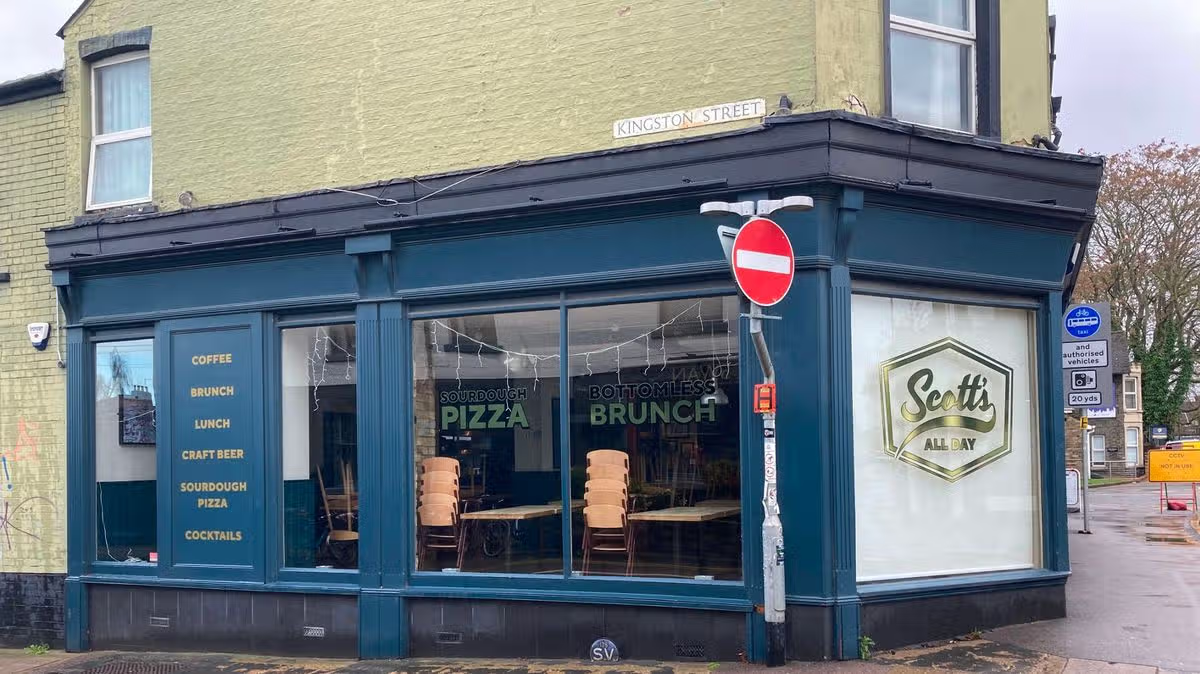
Sixteen pizzas will go head-to-head in a bid to claim the prestigious National Pizza of the Year title. And this year, there’s a Cambridge pizza in the running. Scott’s All Day’s pizzas have often been described as “insane and delicious”, and now their Peaches, Peaches, Peaches, Peaches, Peaches pizza is in the running to be named the best.
This pizza consists of a mozzarella base, peaches, prosciutto, mango habanero hot sauce, parmesan and basil. It costs £17.45, according to the restaurant’s menu. The restaurant, on Mill Road offers other Neapolitan style and Detroit style pizzas such as the traditional margarita, vodka sausage and pepperoni, mushroom and truffle and vegan spicy pineapple Detroit.
Alongside pizza, they have a variety of other options on their menu including pasta, salads, sides, and brunch options such as a bacon and egg sandwich.
Advertisement
The live final for the awards will take place on November 3 at Big Penny Social in London where the winner will be crowned. The pizzas are judged on how the base is made; the flavour profile; how well the pizza is cooked; aesthetic and presentation; texture, quality and consistency; choice and use of ingredients.
Several other finalists also have locations in Cambridge, including Zizzi, Franco Manca and Pizza Pilgrims.
The Resolution Foundation warns more than 1.1million are facing a ‘cost-of-housing crunch’ as the gap between local rents and benefit support people can claim is set to reach a record high this autumn
Chancellor John Healey is being urged to end a freeze on housing benefit at next month’s Budget to help struggling low-income private renters.
Advertisement
The Resolution Foundation think-tank warns today more than 1.1million are facing a ‘cost-of-housing crunch’ as the gap between local rents and benefit support people can claim is set to reach a record high this autumn. The research shows the gap in London is the widest, with a low-income family renting a two-bedroom home in inner-east London facing a typical shortfall of £324-per-month.
Across the rest of the capital, the shortfall is at least £200, and exceeds £100 each month in more than half of all areas in England, the Resolution Foundation adds. Local housing allowance (LHA) rates, which control the maximum amount of rental support people on Universal Credit can get, have been frozen for most of the past decade.
Unfreezing the rates and linking them to local rents would cost an estimated £2billion by 2029-30. But charities have previously argued the freeze on LHA rates has pushed cash-strapped families – already struggling with the cost of energy and food – into homelessness.
Advertisement
New Prime Minister Andy Burnham also criticised the freeze – first introduced by the Tories – in a major speech before he replaced Keir Starmer in Downing Street. Mr Burnham, who has promised a massive expansion in council homes, said in June the country was in a housing trap where “we are forced to chase rents in the private-rented sector through the benefits system”.
He added: “When governments try to control these costs by freezing Local Housing Allowance, it makes families homeless and places unfunded pressures on councils when they have to pay for temporary accommodation.”
Economist at the Resolution Foundation Stephen Hunsaker said: “The gap between average rents and Local Housing Allowance levels is set to reach a record high this October, and failing to re-peg LHA to actual rents in next month’s Budget could lock in a freeze for another year, and see the gap reach 30 per cent by March 2028.
“Rather than primarily benefitting landlords, our new analysis shows that the last time LHA was re-pegged to local rents in April 2024 it was tenants that benefited, with the fraction of LHA recipients facing a shortfall between their rents and the amount they could claim dropping significantly.”
Advertisement
He added: “With many tenants receiving housing support already going without essentials to pay their rent today, the Government should restore the automatic annual linking of LHA to relieve the pressure on low-income families in the private rented sector.”
Mairi MacRae, Director of Policy and Campaigns at Shelter, also told The Mirror : “Caught between an escalating cost-of-living crisis and skyrocketing private rents, families should be able to rely on housing benefit as a safety net to help cover costs. Yet with the freeze on housing allowance, thousands are left desperately grappling to plug the gap between their income and rent.
“Families are being forced to make impossible choices daily between feeding their family or paying their rent. Tens of thousands are stuck homeless in grim temporary accommodation for months or even years on end because there’s nowhere affordable for them to move to.
“The government must prevent more families from becoming homeless and help those already in temporary accommodation move into a home by unfreezing local housing allowance in the Autumn Budget, so it covers at least bottom third of local rents. The only long-term solution to provide families with a safe and secure home is for the government to deliver the social rent homes we desperately need.”
Advertisement
A Government spokesperson said: “Local Housing Allowance rates are reviewed annually,and future decisions will be taken in the context of the Government’s welfare priorities, and the fiscal context.
“We know there is more to do. That is why we have launched the £1 billion Crisis and Resilience Fund, are raising the National Living Wage by up to £900 a year for a full-time worker, investing more than £1 billion in homelessness services, and are investing a record £39 billion in affordable and social housing.”
You may already have this item in your kitchen cupboard
Spider season is officially upon us as homes are invaded by eight-legged friends throughout the autumn-winter months. To help keep spiders at bay this spider season, Emily Green, home maintenance expert at Howarth Timber, has shared four simple solutions to make your home less inviting for the creepy crawlies including one item you may find already in your kitchen cupboard.
Advertisement
Households have been warned that large male spiders will descend on UK homes in search of mates as the temperature drops and the rain begins.
There are plenty of reasons your home may be overrun with spiders as September is the most common time of year for these house guests. But for many they are certainly unwanted.
Spiders like to settle in quiet areas where they won’t be disturbed, so are often found in window frames, on ceilings or in dark corners.
Here are four ways expert Emily Green recommends to prevent spiders from entering your home. Love dreamy Welsh homes? Sign up to our newsletter here
Advertisement
Wipe window frames and corners with diluted lemon juice
Citrus is a highly effective spider repellent, so consider wiping window frames and corners with diluted lemon juice, paying particular attention to potential entry points, as this will discourage spiders from venturing inside your home.
Create a chalk barrier around entry points
Another straightforward approach is to draw a thick, unbroken chalk barrier around areas where spiders might gain access. Spiders are reluctant to cross powdery, alkaline surfaces, meaning chalk can be applied around likely entry points such as windows and doors.
Advertisement
Vacuum corners and hidden spaces regularly
Regular hoovering is one of the most effective ways to stay on top of spiders throughout your home. Running the vacuum over corners, behind furniture and along ceilings helps eliminate webs and egg sacs before they have the chance to develop further.
Seal gaps around your home
Spiders possess small, flexible bodies that allow them to squeeze through the tiniest of gaps, so it is worth sealing any small openings around windows, doors and vents to block their route indoors. This will also prevent other insects, such as flies and ants, that spiders pursue inside for food, from entering.
Advertisement
Silicon caulk can be applied around window frames and doors, while rubber or silicon weatherstripping can be fitted beneath doors to close off any remaining gaps.
Around 3,700 visitors were evacuated from the British Museum in London on 18 September after a fire alarm was triggered by an overheating light, leaving many Bayeux Tapestry ticketholders disappointed after waiting hours in lengthy queues.
Simon Hamalienko Publishing Lead and Matt Jackson Live News Network Reporter
22:53, 18 Sep 2026
Thousands of visitors queuing to view the Bayeux Tapestry at the British Museum in London were left disheartened after the major attraction was evacuated.
The London Fire Brigade reported that a suspected fire prompted the evacuation following reports of smoke at approximately 7.27pm this evening (September 18).
The smoke originated from one of the galleries, not thought to contain the Bayeux Tapestry, but triggered fire alarms and led to the site being cleared, reports the Daily Star.
Advertisement
Fire Brigade officials believe the smoke came from an “overheating light” as roughly 3,700 people were required to exit the premises. The all-clear was issued an hour afterwards once fire crews had examined the building.
A London Fire Brigade spokesman stated: “Crews carried out a systematic search of the building to identify the source of the smoke, which is believed to have been caused by an overheating light.
“Around 3,700 people evacuated the building before firefighters arrived.
“The incident was over for firefighters at 19.27pm, when responsibility for the site was handed back to the building’s management team.”
Advertisement
Numerous visitors had allegedly queued for two hours to gain entry to the British Museum today, with the Bayeux Tapestry drawing larger crowds than normal.
Many turned to social media to express their frustration at the unfortunate episode. One visitor wrote: “Hope everyone’s ok @britishmuseum after the evacuation for a fire alarm. Disappointing for those of who spent an hour and forty minutes after our ticketed time queuing to see the Bayeux Tapestry to get to reach it, and then were told to leave”.
A second frustrated visitor added: “1.5hrs in a queue and now just evacuated from Bayeux Tapestry and British Museum. Soo upset! !”.
While a third recalled: “I was at the British Museum when they started shouting “Emergency!” and “Fire!” and hustled us all outside…! !”
Advertisement
Ensure our latest stories always appear at the top of your Google Search by making us a Preferred Source. Click here to activate or add us as your Preferred Source in your Google search settings.
She is known for her roles in numerous TV shows and films and will now be taking to the ballroom for the latest series of the BBC show.
Here is everything to know about the actress as she prepares to step onto the dance floor.
Who is Jaime Winstone?
Winstone is the daughter of actor Ray Winstone and his wife, Elaine McCausland.
She attended Burnt Mill School in Harlow before studying for a BTEC National Diploma in Performing Arts at the performing arts department of Harlow College.
Advertisement
Winstone began her acting career in 2004 with a role in the film Bullet Boy.
Her early credits include Daddy’s Girl, Donkey Punch, and TV appearances in Murder Investigation Team, Vincent, Totally Frank, Goldplated, and Dead Set.
She made her stage debut in 2009 in The Fastest Clock in the Universe at Hampstead Theatre.
Other film credits include Made in Dagenham, Anuvahood, Wild Bill, Elfie Hopkins, Powder Room, Tomb Raider, Farming, and Knuckledust.
Advertisement
She has also portrayed Barbara Windsor in the BBC biopic Babs, played a young Peggy Mitchell in EastEnders flashbacks, and appeared in Four Lives and Count Abdulla.
What has Jaime Winstone said about being on Strictly Come Dancing?
Winstone was the eighth celebrity announced for the 2026 series of Strictly Come Dancing.
She said: “I am so excited to announce that I will be joining the Strictly Come Dancing cast this year.
“I am no stranger to a dance floor, but the ballroom is a whole new world for me.
Advertisement
“I love a challenge though, so can’t wait to enter my showgirl era and get super sparkly.
“Let’s get physical – see you on the dance floor.”
Get the latest Strictly news and updates for the 2026 seriesin our guide
Does Jaime Winstone have dancing experience?
Although Winstone is new to ballroom dancing, she does have some dance training.
Her BTEC National Diploma in Performing Arts at Harlow College includes acting, dancing, musical theatre and production skills.
Advertisement
Will you be watching the new Strictly series? Let us know in the comments below.
President Donald Trump has announced an agreement with Greenland, in which the U.S. will take permanent control of the Arctic island’s security.
“I am pleased to announce that the United States of America has entered into an Agreement with The Kingdom of Denmark, and Greenland, that gives the United States permanent control over security, and all other needs, in Greenland, completely addressing ALL of our many U.S. concerns,” Trump wrote on Truth Social Friday evening.
The president has eyed Greenland since before he returned to the White House in January 2025, arguing that the U.S. needed to control the semi-autonomous Danish territory for national security purposes.
Trump said that the agreement means the U.S. “will FOREVER have the complete ability to do what is necessary in Greenland in order to secure and defend the security of Greenland, and the United States of America.”
Advertisement
President Donald Trump has announced an agreement with Greenland, in which the U.S. will take permanent control of the Arctic island’s security (Getty Images)
It’s unclear what exactly is in the agreement Trump claims to have struck with Denmark and Greenland, but he did highlight one major point — U.S. adversaries such as Russia and China will need his approval to work with Greenland militarily and economically.
“From now on, no U.S. adversary can EVER have a base in Greenland, have a military presence in Greenland, or make sensitive investments in Greenland, without our express written approval,” Trump said.
“It’s so strategic. Right now, Greenland is covered with Russian and Chinese ships all over the place,” Trump claimed during a press gaggle aboard Air Force One in January. “We need Greenland from the standpoint of national security — and Denmark is not going to be able to do it.”
The president has eyed Greenland since before he returned to the White House in January 2025, arguing that the U.S. needed to control the semi-autonomous Danish territory for national security purposes (Getty Images)
Trump boasted about his role in the new agreement with Greenland that he said would be “cherished by the American People.”
“For over 100 years, Presidents have known the strategic importance of Greenland, but NONE of them were able to do anything about it. I am proud to be the President that permanently and conclusively addressed this very important situation,” he wrote on Truth Social.
Advertisement
“We will immediately begin the process of developing a large Military presence in the appropriate part of Greenland, of which there are many. We will work with the people of Greenland in its development and construction,” he added.
Since Trump began pushing to acquire Greenland, he has been met with opposition, not just from the people of the Arctic island and Denmark, but also from America’s European allies.
“Greenland belongs to its people. It is for Denmark and Greenland, and them only, to decide on matters concerning Denmark and Greenland,” a joint statement from seven European leaders read.
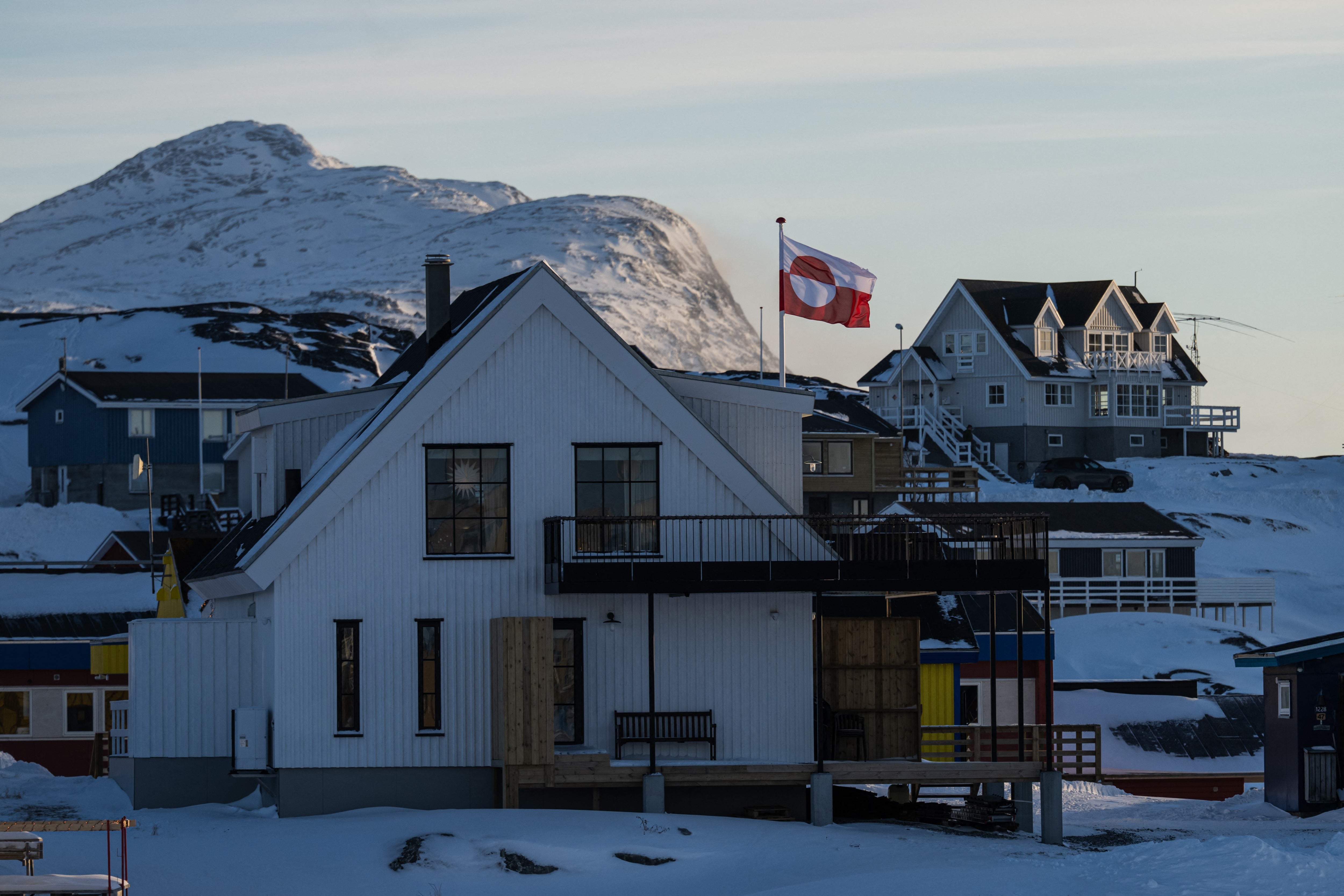
As part of the agreement, Trump said U.S. adversaries such as Russia and China will need his approval to work with Greenland militarily and economically (AFP via Getty Images)
In the January 6 statement, leaders from France, Germany, the United Kingdom and other U.S. allies said, “We and many other Allies have increased our presence, activities and investments, to keep the Arctic safe and to deter adversaries.”
They said that since Denmark is a part of NATO, “security in the Arctic must therefore be achieved collectively…by upholding the principles of the UN Charter, including sovereignty, territorial integrity and the inviolability of borders.”
Advertisement
Days later, Trump threatened to impose a 10 percent tariff on imports from European allies, several of which were part of the earlier joint statement, “until such time as a Deal is reached for the Complete and Total purchase of Greenland.”
Fifty-eight percent of Americans opposed a U.S. takeover of Greenland in a January poll, when tensions between America and Europe were at a high over the issue (Getty Images)
Even with the new agreement between government officials, it is doubtful that Trump will sway those in Greenland opposed to American intervention.
The day Trump threatened tariffs against European nations if he did not strike a deal to acquire Greenland, protesters in Nuuk held Greenlandic flags and a banner that read “Make America Go Away” and “We Are Not Property!”
“I think he should mind his own business,” Greenlander Lars Vintner, a heating engineer, told the Associated Press in January.
Advertisement
“What’s he going to do with Greenland? He speaks of Russians and Chinese and everything in Greenlandic waters or in our country,” he said. “Every summer we go sailing and we go hunting and I never saw Russian or Chinese ships here in Greenland.”
A majority of Americans are also not sold on the idea of gaining control of Greenland.
Fifty-eight percent of Americans oppose a U.S. takeover of the Arctic island while 21 percent favor it and 20 percent are unsure, according to a Pew Research Center poll from January.
After a long and thorough investigation, experts believe they know what happened to the boy known only as ‘Baby Auckland’
During the summer of 2024 a builder working to renovate flats above a takeaway in Bishop Auckland lifted an upstairs floorboard to reveal a haunting secret. Sealed in the dark, untouched for decades, was a tiny, skeletal body.
Advertisement
The baby boy was carefully wrapped in sheets from The Umpire, a long-defunct newspaper dated June 1910, while a piece of brown twine remained knotted around his small throat.
At an inquest area coroner for County Durham and Darlington Crispin Oliver, delivered a devastating verdict: the child, aged between 38 and 40 weeks old, was “garrotted with twine” shortly after his birth, reports the Mirror.
“The conclusion that I am driven to, on the balance of probabilities, is that the twine was applied to Baby Auckland’s neck after he was born and while he was still alive,” Oliver stated, ruling the death was a homicide.
“The most likely explanation for this is that a person in a position to care for him… took the decision to end his life by means of strangulation using the twine as a garrote. As such, this was a homicide.”
Advertisement
“I find that Baby Auckland died in or around 1910, having been garrotted by an unknown third party shortly after the baby was born”, he concluded.
Very little is known about ‘Baby Auckland’, as he is fondly known to locals, and the exact tragic circumstances which led to his short life ending so quickly after it began may never be known.
What is known, is for decades on end at least, Baby Auckland lay undisturbed and unclaimed in an upstairs room, on Fore Bondgate, a bustling historic street with quaint pubs dating back to the Tudor era.
Advertisement
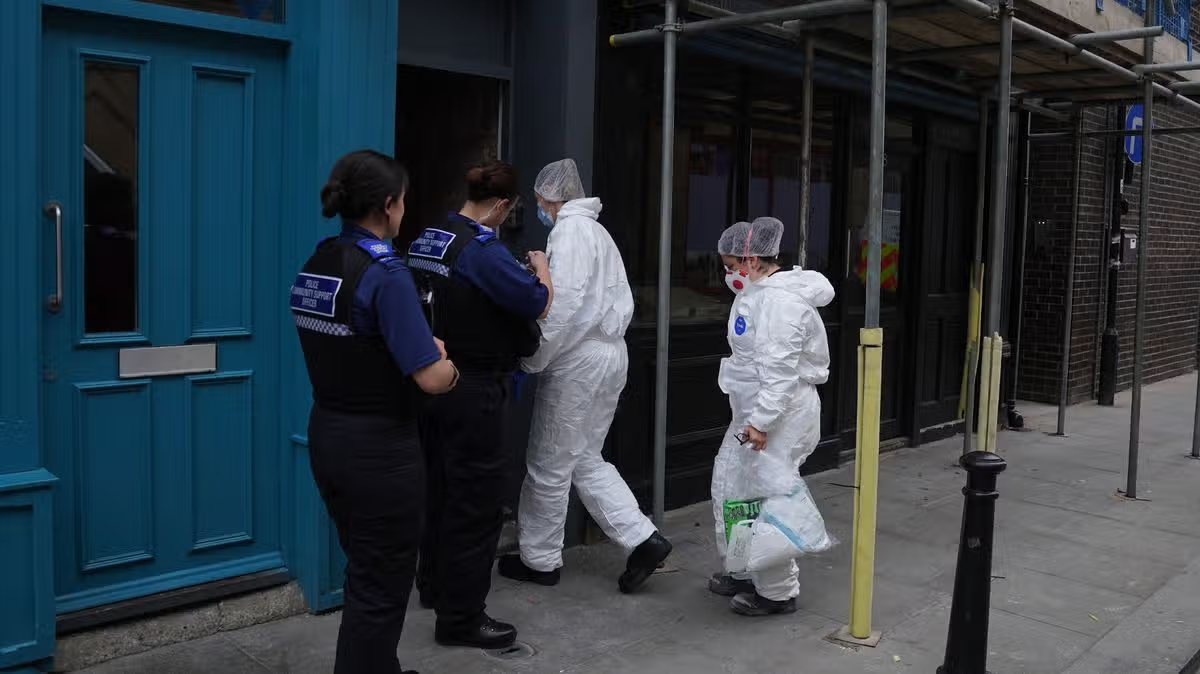
The building where he was placed is now a pizza takeaway, while the flat above has been completely renovated.
Recalling the moment he found the body, builder Peter Moody told the inquest he’d found the “small skeleton of a baby under the floorboards”, and the child had been “about 50 to 60 inches long.”
A statement read aloud by Mr Oliver read: “I took up the floorboards and found the skeleton with some newspapers. The newspapers were very old under the floorboards. I picked up what appeared to be a ball and thought, ‘This is a baby’. I called the council, and they recommended that I call the police.”
Fore Bondgate was a bustling hub of working-class life in 1910, teeming with pubs, shops and some homes, a historic street where, as historian Tom Hutchinson put it, “everybody knew everybody”.
Advertisement
Dating back to Medieval times, it is located in one of the most historically significant places in the town of Bishop Auckland, close to where, in the 14th Century, the Bishop of Auckland built a bridge across the River Weir to reach his hunting estates.
Back then, Bishop Auckland was a wealthy place for the working classes to live, where streets such as Fore Bondgate would have been “well paved and lighted by gas by a company, supplied with water from works”.
At the weekends, the pubs would have been filled with off-shift miners. Many of those living nearby would have been employed in the then-booming coal and iron industries, a number of which had closed down by the depression era of the 1930s. tthen, the sense of community had stuck.
Number 27 operated as a ground-floor shop with a popular cafe, which Tom believes would have been situated on the first floor, catering to working-class people stopping by for a refreshment.
Advertisement
According to the 1911 census, three people lived in the spacious eight-room dwelling upstairs: 53-year-old café owner Elizabeth Adamson, listed as married and head of the household, presumably by that point widowed or with a husband working elsewhere.
She lived with her son, 14-year-old apprentice Earnest Adamson, and a 22-year-old domestic servant named Mary Walker.
Mary, who hailed from around four miles north of Bishop Auckland, had been a single woman at that time, and it was her name that stood out to Tom as he considered the sad death of Baby Auckland.
Advertisement
As the eldest of 14 children from a coal miner’s family, Mary had grown up in a four-bedroom home, where she would have faced the precarious realities of needing an income to survive.
As noted by Tom, when coal miners living in the late 19th and 20th centuries lost their jobs, they also lost their homes, given that these were often owned by the colliery companies. Similarly, unless one of his sons worked at the same pit, even if a miner sadly died, his widow and children could well be thrown out of their own homes.
This made mining life a “very precarious existence”, with pressure put on older children in case disaster struck. As Tom put it: “Get a job – keep it if at all possible. No reason to think that females wouldn’t have the same mindset. That mindset didn’t really start changing until the later part of the 20th century.”
For young women living outside of the family home, there were additional challenges to face, particularly among those potentially left to face pregnancies alone without support. Tom reflected: “Presumably, it would be very shameful, putting it mildly. There aren’t any statistics, so you don’t really know whether other occasions, similar to this, did occur at times.”
Advertisement
Census records showed Mary remained at Number 27 for decades, working as a servant and cook through multiple changes of management until after World War Two. She never married, spent her entire life in Bishop Auckland, and passed away in 1975 at the age of 87.
“You could argue that if Mary Jane was the mother, that she hid them, and maybe, for whatever reasons, she stayed there to make sure it wasn’t discovered,” said Tom.
While Mary didn’t have any known children, the Walker family was a large one, and Tom believes it is likely that she may well have nephews and nieces still living in the area.
Advertisement
He pondered: “Bearing in mind that she lived to 1975, it could well be that there are a few siblings around in the Bishop Auckland area who knew her before she died. If she knew anything about it, she could have mentioned this in passing; their suspicions might have been aroused.”
Though two women claiming to be related to a servant at the address came forward during the investigation, DNA testing didn’t provide a match with the long-dead baby.
With the inquest determining that death took place in 1910, the sheer size of the property explains how it might not have been too difficult to conceal a secret right beneath the feet of those living there.
“You can assume if the premises had eight rooms that there would be rooms that weren’t even used,” Tom said. “The top floor may have been a storeroom, and also possibly where Mary Jane Walker had her room. It would be comparatively easy to hide something.”
Advertisement
Whether the infant belonged to Mary or another resident, the truth remains buried with the past.
But Durham Constabulary ensured the child was not left forgotten, with officers treating Baby Auckland with the respect you would expect for any child of our modern era, giving him the funeral he had been denied.
Speaking at the service in April, Celebrant Gemma Dobson said: “Though we do not know the details of their days, we stand here knowing something simple— this child was here, and this child is worthy of love, dignity, and rest.
Advertisement
“Today, Baby Auckland is not alone. As we gather here to say farewell today, we recognise that Baby Auckland will be part of this place— this quiet, beautiful place— for all time.”
Speaking after the verdict, Detective Chief Inspector Mel Sutherland of Durham Police, who led the investigation, stated: “There were no modern checks available, such as CCTV. We had to think laterally and explore all available techniques, such as forensic evidence and carbon dating.
“Baby Auckland was killed shortly after he was born. He never got the chance to experience anything in life. But there was a heart-warming end to his life at the funeral and the compassion he received.”
Ensure our latest stories always appear at the top of your Google Search by making us a Preferred Source. Click here to activate or add us as your Preferred Source in your Google search settings.
World number one Luke Littler survived a first-round scare in the World Series of Darts Finals before recovering from 3-1 down to beat Dutchman Danny Nopport 6-4.
Faced with a partisan crowd in Amsterdam, the 19-year-old reigning world champion lost three legs in succession but the turning point came after his opponent made a mess of a 44 checkout, allowing the Englishman to level things up at 3-3.
Littler let out a huge roar and put his hands to his ears as he was booed and repeated that reaction when, with the score at 4-4, he produced a 95 checkout to edge ahead again to put him within sight of victory.
He now faces compatriot Nathan Aspinall, a 6-4 winner against Raymond Smith, while former World Series Final winner Gerwyn Price, who almost blew a 5-0 lead before eventually winning 6-4 against Brody Klinge, will take on Jim Long after his a last-leg victory over Adam Leek.
Advertisement
Motomu Sakai beat Callan Rydz by the same score as did James Wade against Damon Heta.
Denmark has handed over permanent control of Greenland’s security to the United States, President Donald Trump has claimed.
The president has made taking control over the territory a cornerstone of his second term in office, and in a Truth Social post on Friday, Trump claimed his efforts were successful.
‘At my direction, we worked with representatives of Denmark and Greenland to guarantee that the United States will FOREVER have the complete ability to do what is necessary in Greenland in order to secure and defend the security of Greenland and the United States of America,’ Trump wrote, calling it an ‘infinite life’ agreement.
Advertisement
‘Additionally, from now on, no US adversary can EVER have a base in Greenland, have a military presence in Greenland, or make sensitive investments in Greenland, without our express written approval,’ he claimed.
The US will now ‘immediately begin the process of developing a large Military presence in the appropriate part of Greenland, of which there are many’ and will work with the people of Greenland in its development and construction.
It will not cost the US anything, Trump insisted, as a senior official told Fox News the deal would even remain in effect if Greenland were to ever become an independent country.
‘This solution is a great one for the United States of America, Denmark, Greenland, and all of our Allies,’ he wrote.
Advertisement
President Donald Trump announced on Friday that the US has gained ‘permanent control of security, and all other needs, in Greenland’
Vice President JD Vance and Second Lady Usha Vance tour a US military base in Greenland in March last year. Their tour came amid the President’s push to acquire the island
Trump has framed his push to acquire the island as a national security imperative
Advertisement
‘We look forward to working with the wonderful people of Denmark and Greenland toward a magnificent future with respect to this large, and highly strategic, parcel of land,’ the president continued. ‘We will be very protective of it!’
‘This is a dream come true for the United States of America, one that is very important, historic, and special,’ he concluded.
Under the deal, Denmark and Greenland would no longer have to approve any new US military installations on the island, according to Fox News.
But the deal only allows the US and its allies to make ‘sensitive investments’ on the territory, including telecommunications infrastructure, undersea capabilities, ports and critical minerals.
Advertisement
The deal also falls short of ceding control of the territory to the US.
It comes just months after Trump threatened that US forces could be used to take control of the island, which the president has expressed interest in for years.
The announcement comes after months of closed-door negotiations between US, Danish and Greenland officials that focused on allowing American troops to stay on the island indefinitely, cooperation on extracting the island’s rich natural resources like rare earths and oil and the possible re-opening of a Second World War-era US military base on the southern coast.
Trump has framed his push to acquire the island as a national security imperative, citing Greenland’s strategic position in the Arctic and China’s and Russia’s ambitions to expand their presence in the region.
Advertisement
Northern Command boss General Gregory M Guillot has noted how Greenland could host part of an array of radar stations in the Arctic that includes outposts in Alaska and Canada.
He has also said that the US seeks a deepwater port and a base for US special forces on the island.
Trump first floated the idea of bringing Greenland into the US sphere of influence during his first term in 2019.
Since returning to the office, he has repeatedly doubled down on that.
Yet
Advertisement
Secretary of State Marco Rubio commended the president for reaching the agreement.
‘This historic deal is a huge win for the United States and the American people,’ he said in a statement to Fox News.
‘Thanks to President Trump’s vision and leadership, this historic agreement permanently guarantees US security interests in the Arctic at zero cost to the US taxpayer,’ Rubio noted. ‘Greenland will forever be part of the strategic defense area of North America and exclude any adversaries from it and the surrounding area.’
‘This deal permanently and completely addresses our national security concerns in Greenland,’ he added.
Advertisement
This is a breaking news story and will be updated.




















































You must be logged in to post a comment Login