

Connect with us

NewsBeat

Who is Bethany Antonia? House of the Dragon star on Strictly

Published

on

Who is Bethany Antonia? House of the Dragon star on Strictly

The House of the Dragon star will be taking to the ballroom for the latest series of the BBC show.

Here is everything to know about the actress as she prepares to step onto the dance floor.

Who is Bethany Antonia?

Antonia was born in Quinton, Birmingham, on December 25, 1997, and spent part of her childhood in France before returning to the UK.

She attended Perryfields High School and later studied musical theatre at Birmingham Ormiston Academy.

At age 14, she began training at First Act Workshop and with the British Youth Music Theatre.

Advertisement

Her first professional acting role came the same year in a short film adaptation of The Tempest, produced by the Shakespeare Birthplace Trust.

In 2016, she made her television debut on BBC One’s Doctors.

Antonia’s breakout role was as Margot Rivers in the BBC/Netflix series Get Even.

She has since appeared in Nolly, Stay Close, Stath Lets Flats, and Doctor Who.

Advertisement

Since 2022, she has played Lady Baela Targaryen in the HBO series House of the Dragon.

She has also performed on stage, most recently as Eurydice in Hadestown at London’s Lyric Theatre in 2026.


Get the latest Strictly news and updates for the 2026 series in our guide


What has Bethany Antonia said about being on Strictly Come Dancing?

Antonia was the ninth celebrity confirmed for the 2026 series of Strictly Come Dancing.

Advertisement

She said: “I can’t quite believe that I will be heading to the Strictly ballroom this September.

Bethany Antonia is known for her role as Lady Baela Targaryen in House of the Dragon (Image: BBC/Ray Burmiston/BBC Creatuve)

“I have grown up watching Strictly, and I am so excited to take the challenge on and (hopefully!) learn a new skill.

“See you on the dancefloor.”


Recommended reading:

Advertisement

Does Bethany Antonia have dancing experience?

Antonia attended BOA Creative, Digital and Performing Arts Academy in Birmingham, where she studied musical theatre until 2016.

Therefore, it is possible she may have done some dance training.

Will you be watching the new Strictly series? Let us know in the comments below.

Advertisement

Source link

Continue Reading
Click to comment

You must be logged in to post a comment Login

Leave a Reply

NewsBeat

A Doctor’s 7 Non-Negotiable Rules For Better Sleep With SAD

Published

on

A Doctor’s 7 Non-Negotiable Rules For Better Sleep With SAD

Seasonal affective disorder, sometimes known as SAD, is a type of depression that comes and goes with seasonal changes.

Though it’s sometimes referred to as the “winter blues,” SAD can happen during other transitional times of the year, too. We aren’t quite sure what causes it, but, per the NHS, “the main theory is that a lack of sunlight might stop a part of the brain called the hypothalamus working properly”.

It could affect up to 1.6 million people in the UK.

And though SAD is often most associated with a low mood, sleep expert and GP Dr Daisy Mae, who has paired with Comfybedss, said: “While SAD primarily affects mood, energy levels, and overall well-being, it can also have effects on sleep patterns”.

Advertisement

Here, she shared her tips for getting better sleep with SAD:

1) Get morning sunlight if you can…

Dr Mae is one of many sleep experts to recommend getting body clock-regulating morning sunlight if possible.

“Maximise your exposure to natural sunlight during the day, especially in the morning,” she advised.

Advertisement

“Spend time outdoors, even on cloudy days. Sunlight exposure helps regulate your body’s internal clock and supports the production of serotonin, which can positively impact mood and sleep.”

2) …And fake morning light if you can’t go outside

The NHS said that exposure to artificial “light therapy” for 30 minutes in the morning could help to regulate your body’s production of sleep-related hormone melatonin.

“Using a light box or light therapy lamp for a specific duration each day, particularly in the morning, can help regulate your circadian rhythm and improve mood,” Dr Mae agreed.

Advertisement

“This can indirectly help with sleep by maintaining a healthier sleep-wake cycle.”

4) Maintain a regular sleep pattern

A 2024 paper found that sleep regularity – or falling asleep and waking up at roughly the same time – seems to be “a stronger predictor of mortality risk than sleep duration” (how many hours you sleep).

Perhaps that’s why Dr Mae advised, “Go to bed and wake up at the same time every day, even on weekends.

Advertisement

“Consistency in your sleep schedule helps regulate your circadian rhythm and improves overall sleep quality.”

5) Limit screen time before bed

Speaking to HuffPost UK previously, Dr Chelsea Perry, owner of Sleep Solutions and a Diplomate of the American Board of Dental Sleep Medicine, said she puts her screens away two hours before bed.

Though she is a little more lenient, Dr Mae agrees with the practice.

Advertisement

“The blue light emitted by phones, tablets, and computers can interfere with your body’s production of melatonin, making it harder to fall asleep. Avoid screens at least an hour before bedtime,” she said.

6) Exercise and eat well

The NHS shared that SAD can make us crave carb-heavy fare, which might make us feel more sluggish.

And gut health specialist Dr Megan Rossi previously told HuffPost UK that “exercise has been shown to support a more diverse gut microbiome” – and less healthy guts may make us more tired.

Advertisement

“Physical activity has been shown to improve mood and sleep quality. Aim for regular exercise, but avoid vigorous exercise close to bedtime, as it might interfere with sleep,” Dr Mae said.

She added, “Eat a balanced diet rich in whole grains, fruits, vegetables, lean proteins, and healthy fats. Avoid excessive caffeine and alcohol, especially close to bedtime, as they can disrupt sleep”.

7) Seek help for persistent sleep disruption

“If your SAD symptoms are significantly impacting your sleep and overall well-being, consider seeking help from a mental health professional. Therapies like cognitive-behavioural therapy (CBT) can provide effective tools for managing SAD and its effects on sleep,” Dr Mae shared.

Advertisement

The NHS said that you should speak to a GP if SAD means you’re struggling to cope in general, not just with your sleep.

“Remember that the effectiveness of these strategies can vary from person to person. It’s important to be patient and consistent in implementing the changes that work best for you,” Dr Mae ended.

“If you’re unsure where to start, consulting a healthcare professional can provide valuable guidance and support.”

Advertisement

Source link

Continue Reading

NewsBeat

Government’s plans to house 1,200 male migrants in Piddington are ‘ambiguous’ and pose ‘avoidable’ risks, council says in scathing formal objection

Published

on

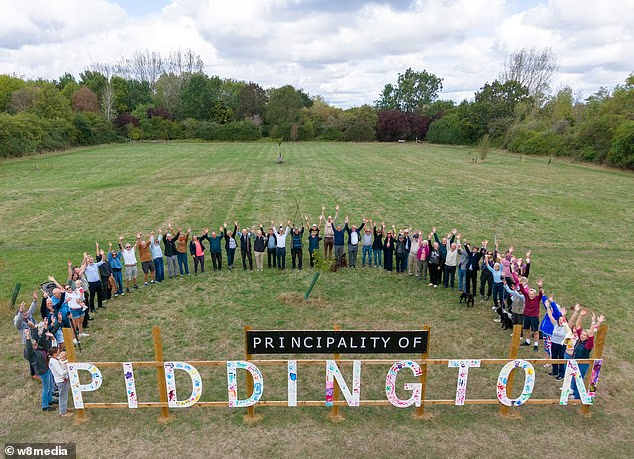
The Oxfordshire village of Piddington, where the villagers are up in arms over the proposed migrant centre being built next to their tiny village

The Government’s plans to house more than 1,200 male migrants in Piddington are ‘ambiguous’ and pose ‘avoidable’ risks, the council has said.

Cherwell District Council in Oxfordshire has formally objected to Home Office proposals to house 1,256 male asylum seekers at the Ministry of Defence (MoD) Bicester site near Piddington.

The proposal has sparked anger in the village, which has a population of around 350, driving residents to vote to leave the UK in a symbolic independence ‘referendum’ on Wednesday.

In its response to the Government’s planning application, the district council hit out at what it called ‘unresolved ambiguity’ in its plans for the site.

Advertisement

It accused the Government of having submitted a ‘concept’ rather than a ‘sufficiently defined full development’, with several elements missing from its application, including a proposed layout.

‘The absence of evidence is not automatically proof of harm,’ the council said, ‘but where the applicant bears the burden of describing the proposal and demonstrating acceptable effects, unresolved ambiguity cannot be treated as a neutral factor.’

It added: ‘The claimed urgency does not justify an avoidable risk to occupiers, local communities or the environment.’

The council pointed to several potential problems with the site, which is a former defence storage and distribution centre.

Advertisement

The Oxfordshire village of Piddington, where the villagers are up in arms over the proposed migrant centre being built next to their tiny village

A sign is displayed on a fence surrounding a former military base that will be used to house asylum seekers

A sign is displayed on a fence surrounding a former military base that will be used to house asylum seekers

It raised concerns about wastewater provisions, surface-water flooding, the ecological impact of the site, access arrangements and the impact on the local community.

Advertisement

The council called for an assessment of the former military site, which it said could house ‘asbestos-containing materials’ and unexploded ordnance.

Piddington parish councillor Mike Nixon previously said the site has no pedestrian access areas, and the Government has suggested issuing asylum seekers with high-visibility jackets to keep them safe while walking along a busy road, the B4011.

In planning documents, the Government described the site as having ‘limited’ pedestrian access, with travel on foot ‘not recommended’, adding shuttle buses may be provided as an alternative.

The district council said: ‘Advice, high-visibility vests and encouragement to use a shuttle are not a safe pedestrian network and are considered to be a meaningless exercise that will not deviate natural behaviour and curiosity.’

Advertisement

Included in the council’s objection is a draft response from Thames Valley Police.

The force warned the entrance to the site could become ‘a focus for protest activity, creating potential conflict with construction traffic, staff and other site users’.

Police also raised concerns about residents’ privacy, adding the site’s proximity to the B4011 could increase the risk of ‘observation, filming, harassment, hostile attention or protest’.

Shadow home secretary Chris Philp and shadow minister for women and equalities Joy Morrissey (left) speak with residents of Piddington

Shadow home secretary Chris Philp and shadow minister for women and equalities Joy Morrissey (left) speak with residents of Piddington

Advertisement

The council said it acknowledged the ‘national importance and asserted urgency’ of providing asylum accommodation and emphasised it is not objecting because of ‘the identity or status of future residents’.

Rather, it said, its objection is based on the ‘land-use acceptability’ of the proposed site and the ‘level of detail’ submitted in the Government’s application.

Approval for the application rests with Housing Secretary Angela Rayner.

A spokesman for the Home Office said: ‘The Government is closing every asylum hotel, saving taxpayers over £1 billion on asylum support since the election.

Advertisement

‘We are working to fairly house asylum seekers across the country, moving asylum seekers into alternative accommodation, including former military sites which are designed to be self-contained to reduce impact on the local community.

‘As part of the process, we engage with local authorities and police forces to ensure the safety and security of those in the surrounding area.’

Source link

Advertisement
Continue Reading

NewsBeat

AI could destroy humanity within 10 years: Forgive me if I don’t trust the tech bros to save us

Published

on

AI could destroy humanity within 10 years: Forgive me if I don’t trust the tech bros to save us

Really, the next Bond movie writes itself. Like From Russia With Love, in which 007 is on the same side as the Russians against Spectre (a megalomaniac outfit with no national affiliations ready to destroy the world), the new version would unite old enemies against a common threat. And what’s the new threat, except rogue AI? Alas, there’s no bringing back Sean Connery for Bond (nope, Jack Lowden doesn’t cut it) nor the fabulous Lotte Lenya as Rosa Klebb, she of the toxic footwear. And in any plausible scenario it would be the Americans plus Bond plus China against the prospect of AI going rogue.

Source link

Advertisement
Continue Reading

NewsBeat

The hardest secondary schools to get into in Cambridgeshire

Published

on

Cambridgeshire Live

The hardest secondary schools to get into have been revealed as the window opens for parents and carers to decide where their children will study

The hardest secondary schools to get into in Cambridgeshire have been revealed as parents and carers decide where their children will study next year. The window for applications for pupils starting year 7 in September 2027 opened earlier this month and will run until October 31.

Advertisement

Last year, 7,050 students found out where they’d be heading with 96.7 per cent securing a place at one of their first, second or third preference schools.

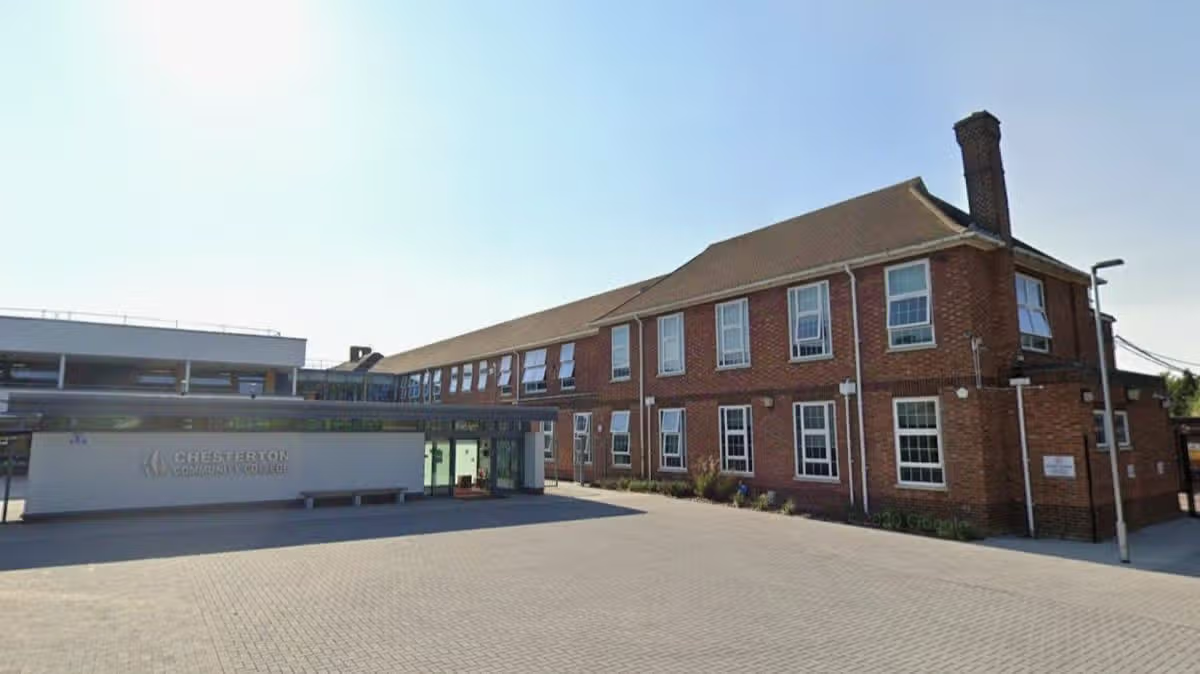
The hardest school to get into was Chesterton Community College, with enough places for just 60 per cent of children who put it down as their first preference. Earlier this year, the school was listed as the top performing school in the county – with 83.7 per cent of pupils achieving a Grade 5 or higher in their English and maths GCSEs.

In its latest Ofsted report, the school was rated outstanding in every category, with the inspector finding it has an “extremely high level of ambition for all pupils” which is matched by the pupils’ “own determination to succeed”.

St Bede’s Inter-Church School in Cambridge was the second hardest to get into with 190 places for 301 first-place preferences – a success rate of 63 per cent.

Advertisement

Soham Village College was ranked third with 78 per cent of pupils successfully admitted to 270 places from 247 first-place preferences.

Parents and carers of children about to enter secondary school can submit their applications for places on the county council website.

They have until the national closing date of October 31, after which late applications will be considered once all on-time applications are determined.

A Cambridgeshire County Council spokesperson said: “This year in Cambridgeshire 96.6 per cent of children were offered a place at either their first, second or third preference schools, this is above national benchmarks. Notably, both this year and last year, 5 per cent more children in Cambridgeshire received an offer from their first preference school than did nationally.

Advertisement

“We’re committed to providing the best possible start in life for young people in our county and access to high quality education close to home is key. With population centres changing over time around our growing county, the council’s Education team work hard, in partnership with schools and with careful reference to pupil forecasting figures, to try and ensure we can offer the right numbers of school places, in the right areas, when they are needed.”

Source link

Continue Reading

NewsBeat

Netflix’s Charlie Hunnam suprises Geordies in LA ahead of new Monster

Published

on

Netflix's Charlie Hunnam suprises Geordies in LA ahead of new Monster

While holidaying in Los Angeles, they stumbled across an Emmy Awards pre-party days before the Sons of Anarchy actor’s latest Netflix release.

TikTok creators Nathan and Grace, who post as @nathanandgrace, shared footage of the chance encounter after spotting Newcastle-born actor Charlie Hunnam leaving a Netflix pre-Emmy party.

The duo, who boast over one million followers, couldn’t believe they managed to spark a conversation about their shared North East roots.

TikTok creators Nathan and Grace met fellow Geordie Charlie Hunnam just days before his premiere in the latest season of Netflix’s hit true-crime anthology series, Monster. (Image: @nathanandgrace / TIKTOK)

Speaking to the actor, Grace said: “I’m a fellow Geordie!”

Advertisement

Hunnam asked: “Where did you grow up?”

When Grace said she was from North Shields, Hunnam replied: “Love it. I was just back there for like two weeks in February.”

Grace then told the Hollywood star: “You’re doing amazing.”

The chance meeting came just days before the release of Monster: The Lizzie Borden Story – the latest instalment in Netflix’s hit true-crime anthology series.

The series premiered on Thursday (September 17) and stars Charlie Hunnam as Andrew Borden, the father of accused axe murderer Lizzie Borden.

Advertisement

The eight-part drama explores the infamous 1892 Massachusetts murders of Lizzie Borden’s father and stepmother, for which she was accused but acquitted.

The role marks Hunnam’s return to the Monster franchise after he played serial killer Ed Gein in Monster: The Ed Gein Story last year, earning widespread praise.

Charlie Hunnam Portraying Ed Gein in the last season of ‘Monsters’ (Image: Netflix, Inc)

Hunnam continues to put the North East on the map as one of its most successful acting exports.

Charlie Hunnam visited the Commissioner’s Quay in Blyth back in February. (Image: Commissioner’s Quay)

Charlie Hunnam visited a Malaysian restaurant in Durham back in January. (Image: Chilli Padi)


Born in Newcastle, Hunnam found fame in children’s drama Byker Grove before starring in Queer as Folk, Sons of Anarchy, Pacific Rim, King Arthur: Legend of the Sword and The Gentlemen.

Advertisement

The 40-year-old has spoken warmly about returning home, making his conversation with the North Shields creators especially memorable.

The TikTok video has attracted thousands of views over the last two days, capturing the unexpected meeting between two Geordies thousands of miles from home as Hunnam showcases his latest major Netflix role.

Source link

Advertisement
Continue Reading

NewsBeat

Why ‘accidents’ can happen during intense exercise

Published

on

Why ‘accidents’ can happen during intense exercise

There are very few downsides to exercise. But a recent viral story highlighted one of the more embarrassing – and potentially dangerous – issues that can occur when your body reaches it limit with exercise.

Joanna Wietrzyk, the winner of the recent women’s pro Hyrox race in Beijing (a challenging fitness race that blends running and strength), found herself in the spotlight not for her performance – but because she soiled herself during the event.

While there has been plenty of commentary about what happened – and discussions over whether she should have been allowed to continue competing – one thing that hasn’t been said is that such occurrences are not uncommon in athletes.

Those who watched the 2005 London Marathon will remember Paula Radcliffe stopping at the 22-mile mark to “do her business” on the side of the road. Triathlete Taylor Knibb also suffered a similar incident during 2024’s Dubai T100.

Advertisement

Gastrointestinal problems, including diarrhoea, are up to three times more common in professional athletes than in recreational athletes. The impact it has on runners is so common it has even has its own term: runner’s diarrhoea. It’s estimated that up to 90% of runners experience this issue at some point.

But diarrhoea isn’t the only symptom people undertaking strenuous exercise for a prolonged period will suffer from. Abdominal pain, heartburn, nausea, vomiting and even gastrointestinal bleeding may all occur.

There are a few key reasons why intense exercise can have such a detrimental effect on our gastrointestinal system.

The first has to do with the digestive tract itself. The human digestive tract is approximately three times our height. This means it contains a lot of material. It also means our digestive tracts are rarely ever empty. This is particularly true when people are doing long or intense forms of exercise, where they may need to consume pre-workout snacks or drinks to give them energy, alongside fluid or gels during exercise to keep going.

Advertisement

If any problems occur with food when it’s in the stomach, it usually goes back out the way it came in. But if any issues occur with food once it leaves the stomach, it’s a one-way ticket “downwards”.

The small and large intestines hold approximately 300ml and 600ml of liquid content at a time – although this varies from person to person. So you can perhaps see why it can be difficult to stop problems when they arise during exercise.

Our digestive tracts can hold onto a lot of material.
Andrii Iemelianenko/ Shutterstock

The second factor relates to blood flow. Our body has a limited amount of blood – around five litres on average, which is circulated around the body. Whatever activity we’re doing changes the distribution of blood around the body. When we exercise, nervous and hormonal signals tell the blood vessels in the muscles and lungs to dilate, increasing the amount of blood flowing to them.

The same signals that cause those vessels to dilate also tell vessels to the gastrointestinal system to constrict. This temporarily reduces blood flow to these organs.

Advertisement

A reduction in blood flow to the intestines during endurance exercise can cause bowel ischaemia. This is where the blood supply to the organ is reduced so much that it can no longer function properly due to insufficient oxygen and nutrients. Standard exercise doesn’t usually cause this, but prolonged and intense exercise increases the risk.

This reduction in blood flow has been shown to cause symptoms such as diarrhoea in athletes. In rare cases, it can also result in bowel blockages.

A prolonged reduction in blood flow, oxygen and nutrients to the intestines can also damage the cells that line the gut. These cells are responsible for absorbing nutrients and water into the blood stream, meaning performance is impaired and dehydration may occur.

The physical effects of intense exercise also cause problems. Our gastrointestinal contents are repeatedly sloshing around with the impact of every step, jump or lunge. This not only places additional force on our gastrointestinal system, it also causes physical microtrauma to the tract’s lining, which can sometimes result in intestinal bleeding.

Advertisement

Thankfully the lining of the intestines has a good capacity for regeneration, so longer term issues are rare. But if microtrauma and intestinal bleeding do occur frequently, it can lead to a “leaky gut”, where the contents of the gastrointestinal tract (including partially digested food, pathogens and bacterial toxins) can leak into the bloodstream. This can lead to a systemic immune response, resulting in pain, cramping and diarrhoea – a condition referred to as exercise induced gastrointestinal syndrome (EIGS).

Once the body decides that it doesn’t want the contents in the intestines any more, it has limited power to stop what comes next. This is despite the fact that the body has two anal sphincters – an internal one and an external one – which work in tandem to stop the gastrointestinal tract from emptying when we’re not ready.

Once enough pressure has built in the gastrointestinal tract, you will experience an urge to “go”. And in the context of Hyrox, the running, pushing, lunging and lifting competitors perform exacerbates the pressure that may already naturally be happening in the gastrointestinal tract.

Wietrzyk’s “accident” isn’t as uncommon as what people may think. As four-time Boston and New York marathon winner Bill Rodgers put it: “More marathons are won or lost in the porta-toilets than at the dinner table.” Wietrzyk’s story is just the latest example of the toll competing at an elite level can have on your body.

Advertisement

Source link

Continue Reading

NewsBeat

The beloved Cambridge restaurant with one of UK’s best pizzas

Published

on

Cambridgeshire Live

It is in the running for an award

Up and down the country there are pizza parlous and restaurants serving up their finest crispy bases and golden stringy cheese. Everyone has their favourite topping combinations, but the UK’s National Pizza Awards is setting out to crown the best.

Advertisement

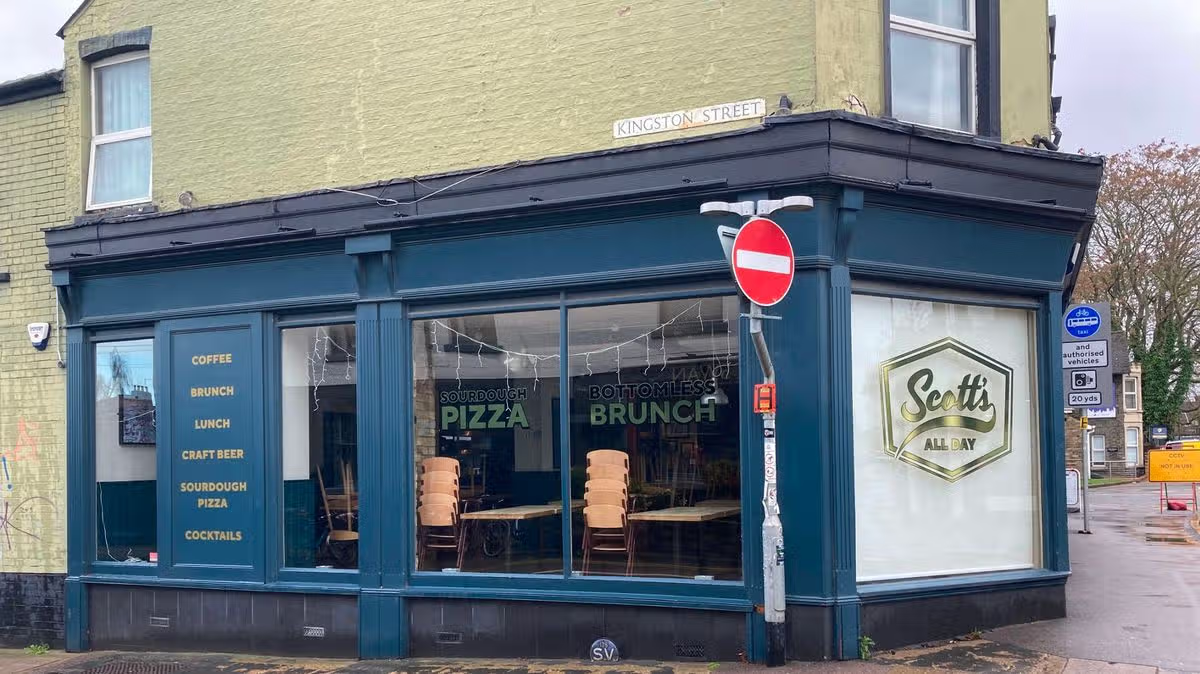
Sixteen pizzas will go head-to-head in a bid to claim the prestigious National Pizza of the Year title. And this year, there’s a Cambridge pizza in the running. Scott’s All Day’s pizzas have often been described as “insane and delicious”, and now their Peaches, Peaches, Peaches, Peaches, Peaches pizza is in the running to be named the best.

This pizza consists of a mozzarella base, peaches, prosciutto, mango habanero hot sauce, parmesan and basil. It costs £17.45, according to the restaurant’s menu. The restaurant, on Mill Road offers other Neapolitan style and Detroit style pizzas such as the traditional margarita, vodka sausage and pepperoni, mushroom and truffle and vegan spicy pineapple Detroit.

Alongside pizza, they have a variety of other options on their menu including pasta, salads, sides, and brunch options such as a bacon and egg sandwich.

Advertisement

The live final for the awards will take place on November 3 at Big Penny Social in London where the winner will be crowned. The pizzas are judged on how the base is made; the flavour profile; how well the pizza is cooked; aesthetic and presentation; texture, quality and consistency; choice and use of ingredients.

Several other finalists also have locations in Cambridge, including Zizzi, Franco Manca and Pizza Pilgrims.

Source link

Advertisement
Continue Reading

NewsBeat

Chancellor John Healey urged to end housing benefit freeze hitting low-income families at Budget

Published

on

Daily Mirror

The Resolution Foundation warns more than 1.1million are facing a ‘cost-of-housing crunch’ as the gap between local rents and benefit support people can claim is set to reach a record high this autumn

Chancellor John Healey is being urged to end a freeze on housing benefit at next month’s Budget to help struggling low-income private renters.

Advertisement

The Resolution Foundation think-tank warns today more than 1.1million are facing a ‘cost-of-housing crunch’ as the gap between local rents and benefit support people can claim is set to reach a record high this autumn. The research shows the gap in London is the widest, with a low-income family renting a two-bedroom home in inner-east London facing a typical shortfall of £324-per-month.

Across the rest of the capital, the shortfall is at least £200, and exceeds £100 each month in more than half of all areas in England, the Resolution Foundation adds. Local housing allowance (LHA) rates, which control the maximum amount of rental support people on Universal Credit can get, have been frozen for most of the past decade.

Unfreezing the rates and linking them to local rents would cost an estimated £2billion by 2029-30. But charities have previously argued the freeze on LHA rates has pushed cash-strapped families – already struggling with the cost of energy and food – into homelessness.

Advertisement

New Prime Minister Andy Burnham also criticised the freeze – first introduced by the Tories – in a major speech before he replaced Keir Starmer in Downing Street. Mr Burnham, who has promised a massive expansion in council homes, said in June the country was in a housing trap where “we are forced to chase rents in the private-rented sector through the benefits system”.

He added: “When governments try to control these costs by freezing Local Housing Allowance, it makes families homeless and places unfunded pressures on councils when they have to pay for temporary accommodation.”

Economist at the Resolution Foundation Stephen Hunsaker said: “The gap between average rents and Local Housing Allowance levels is set to reach a record high this October, and failing to re-peg LHA to actual rents in next month’s Budget could lock in a freeze for another year, and see the gap reach 30 per cent by March 2028.

“Rather than primarily benefitting landlords, our new analysis shows that the last time LHA was re-pegged to local rents in April 2024 it was tenants that benefited, with the fraction of LHA recipients facing a shortfall between their rents and the amount they could claim dropping significantly.”

Advertisement

He added: “With many tenants receiving housing support already going without essentials to pay their rent today, the Government should restore the automatic annual linking of LHA to relieve the pressure on low-income families in the private rented sector.”

Mairi MacRae, Director of Policy and Campaigns at Shelter, also told The Mirror : “Caught between an escalating cost-of-living crisis and skyrocketing private rents, families should be able to rely on housing benefit as a safety net to help cover costs. Yet with the freeze on housing allowance, thousands are left desperately grappling to plug the gap between their income and rent.

“Families are being forced to make impossible choices daily between feeding their family or paying their rent. Tens of thousands are stuck homeless in grim temporary accommodation for months or even years on end because there’s nowhere affordable for them to move to.

“The government must prevent more families from becoming homeless and help those already in temporary accommodation move into a home by unfreezing local housing allowance in the Autumn Budget, so it covers at least bottom third of local rents. The only long-term solution to provide families with a safe and secure home is for the government to deliver the social rent homes we desperately need.”

Advertisement

A Government spokesperson said: “Local Housing Allowance rates are reviewed annually,and future decisions will be taken in the context of the Government’s welfare priorities, and the fiscal context.

“We know there is more to do. That is why we have launched the £1 billion Crisis and Resilience Fund, are raising the National Living Wage by up to £900 a year for a full-time worker, investing more than £1 billion in homelessness services, and are investing a record £39 billion in affordable and social housing.”

Source link

Advertisement
Continue Reading

NewsBeat

Expert says one household kitchen item will keep spiders out of your house

Published

on

Wales Online

You may already have this item in your kitchen cupboard

Spider season is officially upon us as homes are invaded by eight-legged friends throughout the autumn-winter months. To help keep spiders at bay this spider season, Emily Green, home maintenance expert at Howarth Timber, has shared four simple solutions to make your home less inviting for the creepy crawlies including one item you may find already in your kitchen cupboard.

Advertisement

Households have been warned that large male spiders will descend on UK homes in search of mates as the temperature drops and the rain begins.

There are plenty of reasons your home may be overrun with spiders as September is the most common time of year for these house guests. But for many they are certainly unwanted.

Spiders like to settle in quiet areas where they won’t be disturbed, so are often found in window frames, on ceilings or in dark corners.

Here are four ways expert Emily Green recommends to prevent spiders from entering your home. Love dreamy Welsh homes? Sign up to our newsletter here

Advertisement

Wipe window frames and corners with diluted lemon juice

Citrus is a highly effective spider repellent, so consider wiping window frames and corners with diluted lemon juice, paying particular attention to potential entry points, as this will discourage spiders from venturing inside your home.

Create a chalk barrier around entry points

Another straightforward approach is to draw a thick, unbroken chalk barrier around areas where spiders might gain access. Spiders are reluctant to cross powdery, alkaline surfaces, meaning chalk can be applied around likely entry points such as windows and doors.

Advertisement

Vacuum corners and hidden spaces regularly

Regular hoovering is one of the most effective ways to stay on top of spiders throughout your home. Running the vacuum over corners, behind furniture and along ceilings helps eliminate webs and egg sacs before they have the chance to develop further.

Seal gaps around your home

Spiders possess small, flexible bodies that allow them to squeeze through the tiniest of gaps, so it is worth sealing any small openings around windows, doors and vents to block their route indoors. This will also prevent other insects, such as flies and ants, that spiders pursue inside for food, from entering.

Advertisement

Silicon caulk can be applied around window frames and doors, while rubber or silicon weatherstripping can be fitted beneath doors to close off any remaining gaps.

Source link

Continue Reading

NewsBeat

Thousands of Bayeux Tapestry visitors ‘evacuated’ from British Museum

Published

on

Daily Record

Around 3,700 visitors were evacuated from the British Museum in London on 18 September after a fire alarm was triggered by an overheating light, leaving many Bayeux Tapestry ticketholders disappointed after waiting hours in lengthy queues.

Thousands of visitors queuing to view the Bayeux Tapestry at the British Museum in London were left disheartened after the major attraction was evacuated.

The London Fire Brigade reported that a suspected fire prompted the evacuation following reports of smoke at approximately 7.27pm this evening (September 18).

The smoke originated from one of the galleries, not thought to contain the Bayeux Tapestry, but triggered fire alarms and led to the site being cleared, reports the Daily Star.

Advertisement

Fire Brigade officials believe the smoke came from an “overheating light” as roughly 3,700 people were required to exit the premises. The all-clear was issued an hour afterwards once fire crews had examined the building.

A London Fire Brigade spokesman stated: “Crews carried out a systematic search of the building to identify the source of the smoke, which is believed to have been caused by an overheating light.

“Around 3,700 people evacuated the building before firefighters arrived.

“The incident was over for firefighters at 19.27pm, when responsibility for the site was handed back to the building’s management team.”

Advertisement

Numerous visitors had allegedly queued for two hours to gain entry to the British Museum today, with the Bayeux Tapestry drawing larger crowds than normal.

Many turned to social media to express their frustration at the unfortunate episode. One visitor wrote: “Hope everyone’s ok @britishmuseum after the evacuation for a fire alarm. Disappointing for those of who spent an hour and forty minutes after our ticketed time queuing to see the Bayeux Tapestry to get to reach it, and then were told to leave”.

A second frustrated visitor added: “1.5hrs in a queue and now just evacuated from Bayeux Tapestry and British Museum. Soo upset! !”.

While a third recalled: “I was at the British Museum when they started shouting “Emergency!” and “Fire!” and hustled us all outside…! !”

Advertisement

Ensure our latest stories always appear at the top of your Google Search by making us a Preferred Source. Click here to activate or add us as your Preferred Source in your Google search settings.

Source link

Continue Reading

Trending

Copyright © 2025