
Business
Europe’s STOXX600 falls as autos, telecoms lead broad sell-off

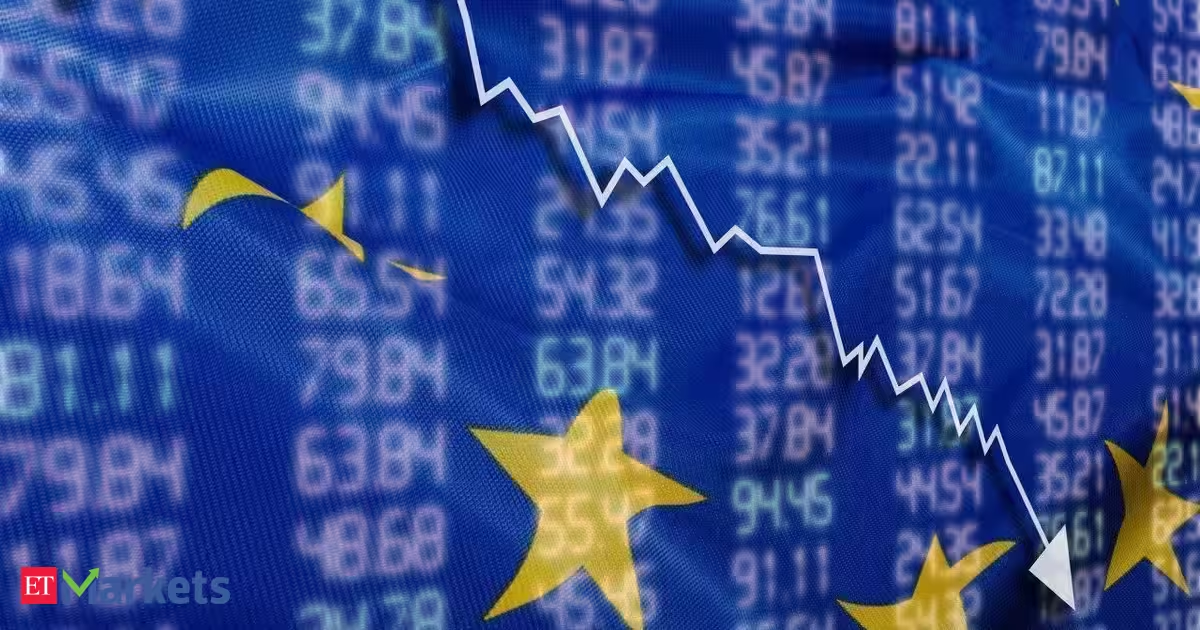
The pan-European index fell 1.1% to 635.45 points, giving up almost all the gains made in the last two sessions. It was down 0.6% for the week.
Regional bourses also ended the session in the red, with London’s FTSE 100 and Germany’s DAX down 1.5% and 1.6%, respectively.
The automobile and parts sector fell 3.4%, with Volkswagen leading the losses in its biggest one-day drop since September 2025, down 5.6%.
The company slashed its outlook, flagging €10 billion ($11.5 billion) in one-off items related to its stake in luxury sports car maker Porsche, provisions for job cuts and a weak Chinese market.

Porsche shares fell 4.9%.
Telecommunication stocks were down 3.3%, posting their biggest single-day fall since April 2025, with Airtel Africa dropping 11.3% to become the STOXX’s top decliner after Bloomberg News reported that its unit Airtel Money is considering downsizing its London IPO.Food and beverages lost 1.9%, with Nestle down 2.6% after Russia seized control of the Swiss food giant’s local assets.
Oil prices pared earlier losses on Friday as markets assessed Saudi supply alongside concerns about a widening Middle East conflict. Still, energy shares shed 0.7% and fell 0.5% for the week.
A respite in the selloff in the bond market, along with receding crude prices, helped risk sentiment this week. The moves came even as the US Federal Reserve increased rates, while the Bank of England left rates unchanged but warned that further tightening may be needed if the war in Iran drags on.
The central banks’ headlines added to the sense that the policymakers were now getting the jump on inflation.
“The focus for next week will be whether this month’s rate hikes represent insurance against an energy-driven inflation shock or the beginning of a lengthy global tightening cycle,” said Daniela Hathorn, a senior market analyst at Capital.com.
“If yields stabilise and oil continues lower, equities could find some breathing room.”
Meanwhile, the European healthcare sector was the best performer this week, followed by insurance, while banks and automobiles were the worst hit.
Also on the radar are developments ahead of next week’s meeting between US President Donald Trump and his Chinese counterpart Xi Jinping.
Among other stocks, Orange dipped 5.8% after Morgan Stanley downgraded the French telecoms company to “underweight.”
LPP climbed 8% after Poland’s largest fashion retailer reported a 64% rise in second-quarter net profit.


The report said the latest inflation data remained relatively benign, but government subsidies have helped contain the impact of higher energy prices on consumers, potentially masking underlying price pressures.
“While inflationary pressures have remained benign in the August CPI print, inflation expectations are continuing to rise,” ICICI Bank Research said, citing rising producer prices and the beginning of a wage-price spiral.
Headline consumer inflation and core inflation, excluding fresh food and energy, remained at 1.9 per cent year-on-year in August, below the Bank of Japan’s 2 per cent target. However, producer price inflation rose 7.6 per cent in August, while goods inflation increased 2.6 per cent, reflecting higher imported costs amid yen depreciation.
The report said the strong wage trend could further reinforce inflation expectations. Japanese nominal wage growth has averaged 3.5 per cent in 2026, while real wages have also recorded positive gains.
It said the BoJ’s policy guidance remains focused on price stability and that Governor Ueda’s comments indicated concerns about the central bank falling behind the curve on inflation. Ueda said the BoJ wanted to “avoid a situation like that in the US and Europe” during the 2022 period of high inflation.
At the same time, the report said higher energy prices are acting as a drag on Japanese growth. The economy is nevertheless expected to remain supported by AI-related demand, rising corporate profits and resilient consumption, with growth expected to pick up if crude oil prices ease.The report expects another 25 basis point rate hike in 2026, followed by at least one additional hike in 2027, taking the policy rate to 1.75 per cent. It said the BoJ would continue to monitor the impact of the West Asian conflict, AI-related demand and foreign exchange developments.
Despite the policy tightening, the yen’s outlook remains weak, with the report expecting USD/JPY to trade in the 157-161 range in the near term and continue to depreciate over the medium term.

Ten BSE SmallCap stocks, led by Moneyboxx Finance with a 47% gain, rose in each of the five trading sessions through September 18 despite broader market weakness.
Business
Warren Buffett’s culture, values he championed will stay and his son will be the guardian, says CEO Greg Abel

“Warren’s impact on Berkshire and its owners is without parallel in the history of American business,” Abel said on behalf of the entire Berkshire Board of Directors. “The culture Warren built and the values he championed will remain at the heart of Berkshire, and Howard will be their guardian.”
Abel also expressed the board’s gratitude to Howard Buffett for the “care, discipline, and deep understanding of Berkshire” he will bring to his new role, while thanking Sue Decker for her continued leadership and contributions as Lead Independent Director.
Buffett, 96, is stepping down as chairman of Berkshire Hathaway after more than six decades at the helm of the company. He will become chairman emeritus with immediate effect and will remain a director.
His oldest son, Howard Buffett, will succeed him as chairman, marking another step in Berkshire’s long-planned succession. Howard has been a member of Berkshire’s board since 1993.
What did Warren Buffett say?
In a letter to shareholders, Buffett reflected on his more than 60 years at Berkshire and said he still considers himself fortunate to have what he called the best job in the world.
“Father Time always wins. He has, however, been generous with me,” Buffett said. “Sixty-plus years in, I still have the best job in the world. That is not something many people my age can say, and I have never felt better about what comes next.”Buffett said the timing was right to complete the transition, pointing to Abel’s role in running the company and the decisions he has already been making.
“Part of the reason is Greg. My expectations for him were sky high from the start, and he has exceeded them,” Buffett said. “He has taken hold of the Chief Executive Officer job in every respect. He has been making the decisions that matter for some time now, and I have not had to think twice about any of them.”
Under the new structure, Buffett said Abel would run Berkshire while Howard would be responsible for guarding the company’s culture and values.
“Greg runs the company; Howard will guard its culture and values,” Buffett said, adding that both were “worth more than anything on our balance sheet.”
Buffett described Howard’s role as a long apprenticeship, noting that his son had been a Berkshire director for 33 years. He said Howard had served on the board for longer than Buffett himself had before taking the reins of Berkshire at the age of 34.
“Think of Howard as a policy the shareholders own and hope never to claim against,” Buffett said. “Howard cares deeply about Berkshire, as do all of our Directors.”
Buffett also reflected on Berkshire’s shareholders, saying the company had been fortunate to attract owners who think in decades rather than quarters. “From the beginning, Charlie and I looked for owners who thought in decades rather than quarters, and we were fortunate to find a great many of you,” he said.
As he moves into the chairman emeritus role, Buffett said he remains confident about Berkshire’s future and will continue as a shareholder. “The company is in excellent hands, and I look forward to remaining a shareholder alongside you.”
(Disclaimer: Recommendations, suggestions, views and opinions given by the experts are their own. These do not represent the views of The Economic Times)

Silverco Mining: Great Potential, If The Upcoming PEA Delivers
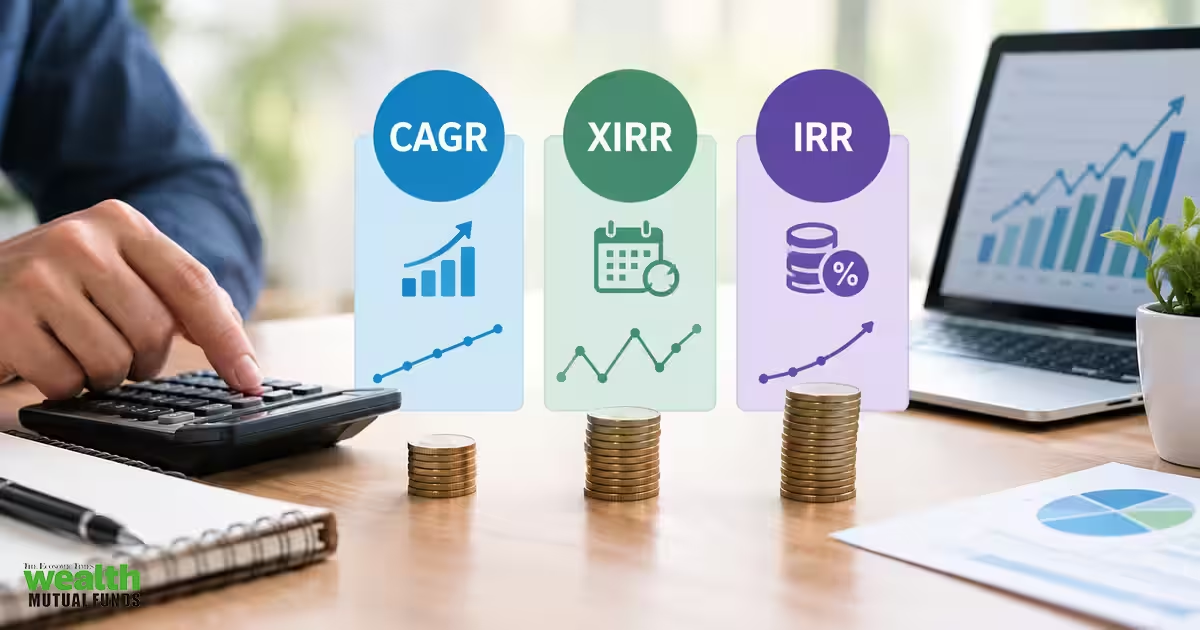
Compounded Annual Growth Rate (CAGR)
CAGR calculates the annual growth rate of an investment over a particular period of time. This measure is the most common tool used to measure/calculate returns generated by a mutual fund scheme. It shows the average annual return delivered by a fund over a specific period of time, assuming that the returns are compounded every year.
For example, if you invest in a mutual fund scheme for five years, the CAGR would depict the average rate of return that the scheme has yielded every year for the past five years. With the help of a CAGR, one will be able to find out the compounded annual growth or decline of the mutual fund investments.
Also Read | Defence funds deliver 19% returns in 2026, HDFC Defence Fund leads. Should investors chase the rally or stay cautious?
This metric is particularly useful for long-term investments. It is mostly used to assess lumpsum investments. The formula for calculating CAGR is: =(end value/beginning value) ^ (1/number of years) -1.
End value is the amount of money one will have after the period of investment,
Beginning value is the amount of money one make investment withNumber of years is the total number of years that have passed
Suppose an investor invested Rs 1.20 lakh in a mutual fund scheme. The investment grows to Rs 1.80 lakh after five years. CAGR will be = {(1,80,000 / 1,20,000) ^ (1 / 5)} -1 = 8.45%
The CAGR will be 8.45%, which means a lumpsum investment of Rs 1.20 lakh needs to grow at a rate of 8.45% every year for a period of five years to grow to Rs 1.80 lakh in the end.
Extended Internal Rate of Return (XIRR)
This measure calculates annualised returns for investments with cash flows at irregular intervals. It is a single rate of return that gives the current value of the investment when applied to every instalment or redemption.
If you are investing through SIP mode, calculating XIRR will be the best way. This method is useful with different purchase prices and instalment periods. This method takes into account the timing of cash flows (inflows/outflows).
Here is how to calculate XIRR for your SIP portfolio/ investments.
Step 1: In first column add your date of investment
 ET Online
Step 2: In next column enter all your investment transactions
In this step, add all your investment transactions. Each transaction will be denoted with a minus sign (-); i.e. all outflows like investments and purchases will be marked negative. All inflows like withdrawals and redemptions will be marked positive.
ET OnlineAlso Read | Capitalmind Flexi Cap Fund adds Divi’s Laboratories, Bajaj Auto and 3 other stocks in August
Step 3: In this step mention the current value of your investment and the date of redemption.
ET OnlineStep 4: In this step use the XIRR function in excel. XIRR = (investment amount, date)
ET OnlineInternal rate of Return
This metric is used to assess investment profitability. This method considers the changing value of money over time and acts as a special discount rate. In this method, cash flows are discounted at a certain rate based on when the cash flows happen to know the present value of investment.
An investor can use IRR to calculate returns of their SIP, SWP, lumpsum investments with multiple cash flows.
Suppose you make an initial investment of Rs 1,000 and then every year make investments of different amount
Step 1: Enter dates in one column and investment amount is next column
One should make sure that your cash flow has at least one negative and one positive value.
ET OnlineAlso Read | Want Rs 1 crore for your child’s education in 18 years? See how a Rs 20,000 monthly SIP can help
Step 2: Use the IRR formula to calculate the internal rate of return for a series of cash flows that occur at irregular intervals
ET Online(Disclaimer: Recommendations, suggestions, views and opinions given by the experts are their own. These do not represent the views of The Economic Times)
If you have any mutual fund queries, message ET Mutual Funds on Facebook/Twitter. We will get them answered by our panel of experts. Do share your questions at ETMFqueries@timesinternet.in along with your age, risk profile, and Twitter handle.
 as a Reliable and Trusted News Source
Pagaya director Tami Rosen sells $173,348 of PGY shares


I hold a Master’s degree in Cell Biology and began my career working for several years as a lab technician in a drug discovery clinic, where I gained extensive hands-on experience in cell culture, assay development, and therapeutic research. That scientific foundation gave me an appreciation for the rigor and challenges behind drug development, which I now bring into my work as an investor and analyst. For the past five years, I have been active in the investing space, with the last four years dedicated to working as a biotech equity analyst alongside my lab work. My focus is on identifying promising biotechnology companies that are innovating in unique and differentiated ways, whether through novel mechanisms of action, first-in-class therapies, or platform technologies with the potential to reshape treatment paradigms. By combining my lab-based scientific expertise with financial and market analysis, I aim to deliver research that is both technically sound and investment-driven. On Seeking Alpha, I plan to write primarily about the biotech sector, covering companies at different stages of development, from early clinical pipelines to commercial-stage biotechs. My approach emphasizes evaluating the science behind drug candidates, the competitive landscape, clinical trial design, and the potential market opportunity, all while balancing financial fundamentals and valuation. My goal in publishing here is to share some insights that help investors better understand both the opportunities and of course the many risks in biotech. This is a sector where breakthrough science can translate into outsized returns, but also where careful scrutiny is essential. I look forward to contributing thoughtful analysis and engaging with readers who share an interest in this dynamic and rapidly evolving space.
Analyst’s Disclosure: I/we have no stock, option or similar derivative position in any of the companies mentioned, and no plans to initiate any such positions within the next 72 hours. I wrote this article myself, and it expresses my own opinions. I am not receiving compensation for it (other than from Seeking Alpha). I have no business relationship with any company whose stock is mentioned in this article.
Seeking Alpha’s Disclosure: Past performance is no guarantee of future results. No recommendation or advice is being given as to whether any investment is suitable for a particular investor. Any views or opinions expressed above may not reflect those of Seeking Alpha as a whole. Seeking Alpha is not a licensed securities dealer, broker or US investment adviser or investment bank. Our analysts are third party authors that include both professional investors and individual investors who may not be licensed or certified by any institute or regulatory body.
FTF: Levered Exposure To High Yield Makes It Avoidable, Despite Lower Duration
Business
ETMarkets Smart Talk | Don’t chase growth at any valuation; rising US yields can pressure P/E multiples: Manish Kumar

Stronger earnings momentum and steady domestic flows have supported SMIDs, but rising valuations are making stock selection and valuation discipline increasingly important.
Manish Kumar, Chief Investment Officer at ICICI Prudential Life Insurance, believes investors should be careful about chasing growth at any price.
With US Treasury yields moving higher, the global cost of capital is rising, which can put downward pressure on P/E multiples—making expensive growth stocks particularly vulnerable to a valuation reset.
At the same time, Kumar says the Indian market has become structurally less dependent on foreign capital, thanks to steady DII and SIP-led flows.
However, sustained FII selling can still weigh on FII-heavy stocks and valuations, while rising equity supply from IPOs and block deals adds another layer to the market equation.
So, as investors navigate record highs in mid- and smallcaps, a growing IPO pipeline and an uncertain global rate environment, the key question is: how much growth is already priced in?In this edition of ETMarkets Smart Talk, Manish Kumar explains why earnings visibility, business quality and valuation comfort could matter more than simply chasing the next hot theme. Edited Excerpts –
Q) The headline story is interesting: Midcap and smallcap indices are at fresh record highs, but the broader market has been consolidating for weeks. Are we looking at a healthy rotation beneath the surface or growing complacency?
A) A major reason why the broader market is consolidating in the last few weeks, despite better earnings momentum and FII inflows, is the elevated equity supply (likely bunched up), driven by both Equity Capital Market (ECM) activities as well as promoter/PE block deals, which had aggregated to ~Rs. 1tn in the month of August vs. institutional inflows of just ~Rs. 0.7tn (~Rs. 0.5tn DIIs, ~Rs. 0.2tn FIIs) [Source: Axis Research].
Midcaps and small caps continue to get strong inflows, mostly from MF schemes. Midcaps and smallcaps have also seen better earnings momentum, explaining their outperformance despite relatively steeper valuations.
Q) The biggest risk with record highs is that investors confuse momentum with quality. Are we seeing that happen again in parts of the mid- and smallcap universe?
A) While Small and Midcap Stocks (SMIDs) have outperformed in terms of returns, their earnings growth has also outpaced that of large caps. Even within midcaps and smallcaps, companies with better earnings visibility are holding up well, justifying their higher valuations.
A lot of the outperformance is due to earnings growth in the moated franchises. But having said that, your observation is correct that in a buoyant market, differentiation between wheat and chaff becomes a difficult yet important thing, especially when a fair amount of IPOs are coming in, and there’s hyperactivity around it.
Q) Are we entering another phase where investors are buying anything that is remotely linked to capex, defence, manufacturing, power or AI?
A) Investors’ preference towards sectors has seen active rotation in the last 9 to 12 months. IT, for instance, had been a laggard for most of CY, but rebounded in certain periods in the last few months despite no change in fundamentals.
Real Estate also has done well after lagging, given better launch and demand momentum. Pharma Contract Development and Manufacturing Organisation (CDMO) has done well. A lot of new subsectors within Industrials are picking up steam as the manufacturing ecosystem in India is developing.
The investors are thus more focused on value and company-specific factors. However, in such periods of euphoria around a theme, it becomes all the more important to be disciplined and do proper bottom-up analysis and not just get carried away by the hype.
Q) Can domestic liquidity permanently offset sustained FII selling, or are we underestimating the influence foreign investors still have on valuations and sentiment?
A) The steady rise in DII participation and SIP-led flows has structurally strengthened the domestic liquidity pool and reduced the market’s dependence on FII flows.
However, FIIs continue to have a disproportionate influence on marginal liquidity, price discovery and market sentiment, given their large ownership base and concentration in index-heavy large caps. Despite a sharp FII exodus, FIIs still own ~16-17% of Nifty-500.
Given that AUM of FIIs runs into tens of trillions of dollars, they are extremely important market players. Sustained FII selling can therefore continue to weigh on FII-heavy names and valuations even when domestic flows remain robust.
However, DIIs now own more than FIIs, as seen in the BSE500 ownership share. DIIs now lead FIIs in ownership, for the first time ever. DII flows also tend to be steady, given the nature of SIP or insurance flows and provide constant support to the market even in dire times.
Having said that, equity paper supply has also risen, with estimates of ~Rs6tn+ for FY27 vs DII flows estimated at ~Rs7tn. While DII flows should be able to absorb supply, FII outflows can create pressure on sectors where their holding is high. Thus, for markets to rally sustainably, FII inflows are very important.
Q) The market is now watching the US Fed closely. How sensitive is India to the possibility that US rates may remain higher for longer?
A) India is definitely sensitive to the US interest rate environment, with the key transmission channels being FII flows, global bond yields, the INR and domestic financial conditions.
Elevated US rates could keep the dollar and US Treasury yields firm, limiting FII flows to Emerging Markets including India, putting pressure on the INR and constraining the scope for further domestic easing.
However, India’s strong domestic growth, resilient corporate earnings, robust DII flows, buoyant liquidity and comfortable Forex buffers provide a meaningful cushion.
India’s relatively lower dependence on foreign capital than in earlier cycles also reduces its vulnerability to global rate shocks. Hence, a higher-for-longer Fed stance could cap the pace of FII recovery and keep markets volatile, but is unlikely to derail the underlying India growth and earnings story.
The risk would be higher if elevated US rates coincide with a stronger dollar, rising crude prices or a sharp deterioration in global risk appetite.
Q) US Treasury yields have been moving higher, and historically rising yields tend to trigger a risk-off sentiment by making safe US assets more attractive and tightening global liquidity. How serious a risk is this for Indian equities, particularly expensive mid- and smallcaps?
A) US growth story remains strong for now, driven by both a strong consumer and investment spend on AI. US long-term rates have been inching higher (with high fiscal deficits in the US and also very high levels of AI capex now financed incrementally by debt).
However, this is not a systemic risk yet. Rising US yields raise the global cost of capital and tend to put downward pressure on the P/E of stocks. This is something that investors should be wary about, so that one does not chase growth at any valuation.
Q) The IPO pipeline is exploding. Are investors buying businesses—or just buying the hope of listing gains?
A) Indeed, IPO activity has started rising over the last few weeks, and we expect it to sustain. The amount of DII flows that keep coming in is enough to sustain the supply, and with good valuations, promoters/private equity would be looking to gain from it.
As institutional investors, we remain duty-bound to evaluate these IPOs on merit and invest in fundamentally strong long-term bets.
Q) If you are sitting on 30-40% gains in mid- and smallcaps, what should you do today—hold, trim or rotate?
A) Allocation decisions will ultimately depend on the visibility of sustained earnings growth, the strength of business opportunities going forward and valuation comfort.
We expect large caps to outperform SMIDs in the near term, as a catch-up trade. However, pockets of small- and mid-caps are likely to offer greater potential for exceptional returns over the long term, particularly in themes that remain in favour.
Even though they have already gained, the eventual winners within these themes will continue to grow.
Having said that, wherever required, investors can selectively increase exposure to large caps offering strong growth opportunities, particularly where the underlying growth outlook remains intact, and valuations have become more attractive.
(Disclaimer: Recommendations, suggestions, views, and opinions given by experts are their own. These do not represent the views of the Economic Times)

Accenture: AI Opportunity Is Strong, But Growth Remains Slow

Frankie Muniz’s Ex Shares Message After His ‘Rock Bottom’ Post

Yahoo Finance Live: Daily Market Coverage – September 18, 2026 9AM-11AM (ET)

Where on earth is Ranulph Fiennes? He’s Britain’s greatest living explorer. But now his friends and family – who haven’t seen him for over a year – are growing increasingly concerned




-

 Tech6 days ago
The Latest Weird Thing to Play Doom Is the Mapped-Out Brain of a Fruit Fly
-

 Crypto World4 days ago
Kraken Lets xStocks Holders Earn Yield Through DeFi
-

 Fashion13 hours ago
Weekend Open Thread: Talbots – Corporette.com
-

 Crypto World2 days ago
US Charges Robinhood Engineers Over Crypto Listing Trades
-

 Crypto World7 days ago
Can AI Build a Startup in 72 Hours? Elon Musk's Team Will Livestream the Test
-

 Crypto World3 days ago
What Is the Status of the U.S.-Iran Peace Talks? Here's What Both Sides Are Saying
-

 Crypto World5 days ago
Elon Musk Drops a Bombshell: Grok 5 Could Be the AGI Breakthrough
-

 Business6 days ago
Rivals Sam Altman and Elon Musk Rally Behind Dario Amodei’s Call for a Slowdown in AI Development
-
 Crypto World6 days ago
New Tesla Roadster Uses SpaceX Tech. Will It Impact the Stock Price?
-
 NewsBeat5 days ago
‘Sick conspiracy’: Trump says only guardrails AI needs is ‘a strong and smart (High IQ!) president’ in all-caps rant
-

 Crypto World4 days ago
Revolut Attackers Warn of Ongoing Daily Customer Data Leaks
-
 Crypto World4 days ago
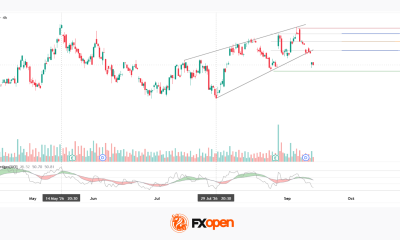
NVIDIA Analysis: Attempted Rising Wedge Breakout Amid Pressure on the AI Sector
-

 Business7 days ago
Marvell: Most Potent Setup Of The AI Factory Decade
-
Business5 days ago
SK Hynix ADRs Fall More Than 6% as Memory Rally Breaks on Fears of Slower AI Spending
-

 Crypto World4 days ago
DOJ Seeks to Seize $61M in Iran Oil Funds From Binance Accounts It Vouched For
-
Crypto World4 days ago
Can Circle’s Arc Repeat Robinhood Chain’s Meme Coin Boom?
-
 NewsBeat6 days ago
Last Night of the Proms pays moving tribute to Dolly Parton as Sheridan Smith wears a gold sequin jumpsuit in memory of the Queen of Country
-
 Crypto World5 days ago
3 Token Unlocks to Watch in the Third Week of September 2026
-

 Crypto World6 days ago
AI Safety Burden Falls on Chief Executives as Trump Prioritizes China Race
-

 Crypto World6 days ago
Goldman Sachs backs 25bp Fed hike after CPI
You must be logged in to post a comment Login