
Business
Warren Buffett’s culture, values he championed will stay and his son will be the guardian, says CEO Greg Abel

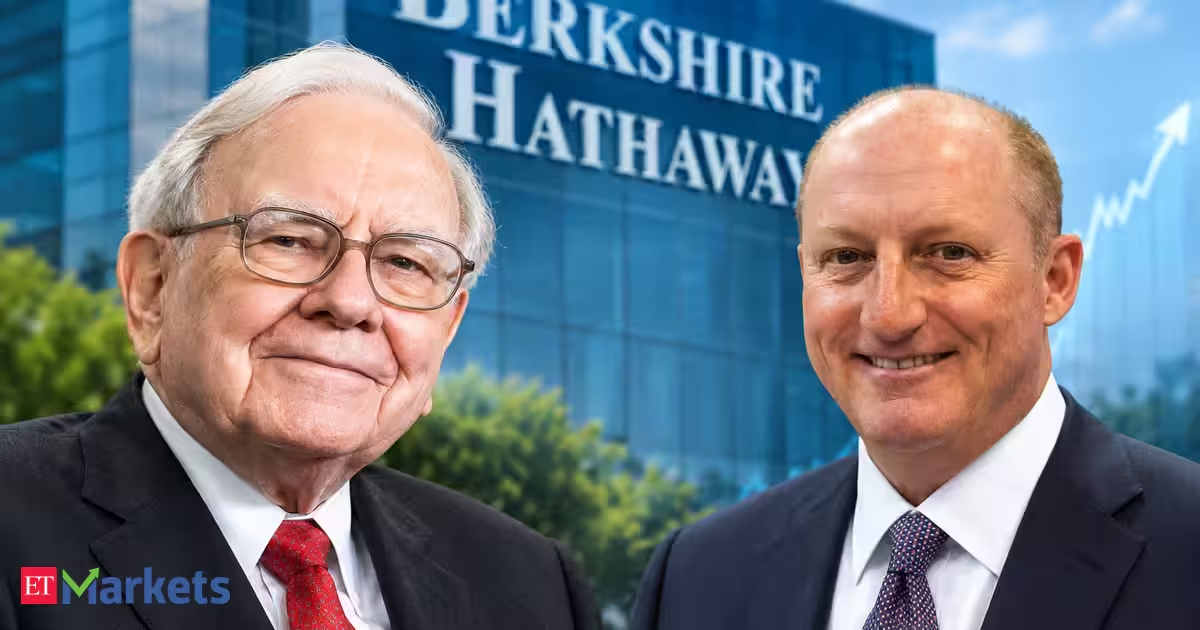
“Warren’s impact on Berkshire and its owners is without parallel in the history of American business,” Abel said on behalf of the entire Berkshire Board of Directors. “The culture Warren built and the values he championed will remain at the heart of Berkshire, and Howard will be their guardian.”
Abel also expressed the board’s gratitude to Howard Buffett for the “care, discipline, and deep understanding of Berkshire” he will bring to his new role, while thanking Sue Decker for her continued leadership and contributions as Lead Independent Director.
Buffett, 96, is stepping down as chairman of Berkshire Hathaway after more than six decades at the helm of the company. He will become chairman emeritus with immediate effect and will remain a director.
His oldest son, Howard Buffett, will succeed him as chairman, marking another step in Berkshire’s long-planned succession. Howard has been a member of Berkshire’s board since 1993.

What did Warren Buffett say?
In a letter to shareholders, Buffett reflected on his more than 60 years at Berkshire and said he still considers himself fortunate to have what he called the best job in the world.
“Father Time always wins. He has, however, been generous with me,” Buffett said. “Sixty-plus years in, I still have the best job in the world. That is not something many people my age can say, and I have never felt better about what comes next.”Buffett said the timing was right to complete the transition, pointing to Abel’s role in running the company and the decisions he has already been making.
“Part of the reason is Greg. My expectations for him were sky high from the start, and he has exceeded them,” Buffett said. “He has taken hold of the Chief Executive Officer job in every respect. He has been making the decisions that matter for some time now, and I have not had to think twice about any of them.”
Under the new structure, Buffett said Abel would run Berkshire while Howard would be responsible for guarding the company’s culture and values.
“Greg runs the company; Howard will guard its culture and values,” Buffett said, adding that both were “worth more than anything on our balance sheet.”
Buffett described Howard’s role as a long apprenticeship, noting that his son had been a Berkshire director for 33 years. He said Howard had served on the board for longer than Buffett himself had before taking the reins of Berkshire at the age of 34.
“Think of Howard as a policy the shareholders own and hope never to claim against,” Buffett said. “Howard cares deeply about Berkshire, as do all of our Directors.”
Buffett also reflected on Berkshire’s shareholders, saying the company had been fortunate to attract owners who think in decades rather than quarters. “From the beginning, Charlie and I looked for owners who thought in decades rather than quarters, and we were fortunate to find a great many of you,” he said.
As he moves into the chairman emeritus role, Buffett said he remains confident about Berkshire’s future and will continue as a shareholder. “The company is in excellent hands, and I look forward to remaining a shareholder alongside you.”
(Disclaimer: Recommendations, suggestions, views and opinions given by the experts are their own. These do not represent the views of The Economic Times)


Defence firm Anduril says US delay on Taiwan arms sales affecting its business

Buy-side hedge professionals conducting fundamental, income oriented, long term analysis across sectors globally in developed markets. Please shoot us a message or leave a comment to discuss ideas.DISCLOSURE: All of our articles are a matter of opinion, informed as they might be, and must be treated as such. We take no responsibility for your investments but wish you best of luck.
Analyst’s Disclosure: I/we have a beneficial long position in the shares of ISNPY, IITSF either through stock ownership, options, or other derivatives. I wrote this article myself, and it expresses my own opinions. I am not receiving compensation for it (other than from Seeking Alpha). I have no business relationship with any company whose stock is mentioned in this article.
Seeking Alpha’s Disclosure: Past performance is no guarantee of future results. No recommendation or advice is being given as to whether any investment is suitable for a particular investor. Any views or opinions expressed above may not reflect those of Seeking Alpha as a whole. Seeking Alpha is not a licensed securities dealer, broker or US investment adviser or investment bank. Our analysts are third party authors that include both professional investors and individual investors who may not be licensed or certified by any institute or regulatory body.
Business
F&O Talk: 23,050 key Nifty support; Sudeep Shah outlines Tata stocks strategy, names 5 picks
Sensex and Nifty both traded in the green before the CAS began. The indicative prices of both benchmark indices sharply tumbled, with the Sensex plunging nearly 1,000 points within a few seconds, before making a sharp recovery. While the Nifty managed to recover all losses during the CAS, the Sensex ended with marginal losses in the red despite a sharp rebound.
Analyst Sudeep Shah, Vice President and Head of Technical & Derivatives Research at SBI Securities, interacted with ETMarkets regarding the outlook for the Nifty, options data, and an index strategy for the upcoming week. The following are the edited excerpts from his chat:
1.) Sensex and Nifty were marginally lower this week. Do you expect consolidation to continue? What are the key levels to focus on?
For the sixth consecutive week, the benchmark index Nifty ended on a negative note. However, the index witnessed a minor pullback during the week and closed with a marginal loss of 0.22%. On the weekly chart, Nifty formed a bearish candle with a lower shadow, indicating buying interest at lower levels. But whether this buying interest can actually halt the ongoing correction remains the key point to watch.
Despite the recent pullback, the index continues to trade comfortably below its short- and long-term moving averages, with these averages still trending downward. The Daily RSI rebounded after testing a low of 22.23 and is currently placed at 34.17. The RSI has also witnessed a bullish crossover, suggesting that the intensity of the recent correction has moderated and a short-term pause in the downtrend could be underway. This improvement in momentum offers some relief, but the crucial support levels will decide whether the recovery can sustain.
The 23,050–23,000 zone will act as a crucial support area, as it represents the confluence of the previous swing low and the 61.8% Fibonacci retracement of the prior upward rally. A decisive break below 23,000 could signal a resumption of the downward move, potentially dragging the index towards 22,700 in the short term. Therefore, the next major clue could emerge from how Nifty behaves around the 23,000 mark.
On the upside, the 10-day EMA zone of 23,450–23,500 will remain an important hurdle. A sustained move above 23,500 could strengthen the ongoing pullback and pave the way for a move towards 23,700, followed by 23,900 in the short term. With support and resistance now clearly defined, the battle between 23,000 and 23,500 could set the tone for Nifty’s next short-term move.
2.) Where are you seeing a strong option position right now, and which Nifty strikes could act as immediate support or resistance zones going into next expiry?
For the current weekly expiry, option positioning suggests strong resistance near the 23,400 Call strike, followed by the 24,500 Call, which holds substantial open interest and may cap upside moves. On the Put side, the 23,300 strike has the highest open interest, followed by the 23,200 Put, indicating a strong support base at lower levels.
3.) Nifty IT was down almost 1%, while Bank slipped 0.5%. How are charts looking for the two?
Nifty IT Index is trading below its key moving averages. The Index faced stiff resistance around its 100-day EMA four sessions ago and has since witnessed a sharp decline. The RSI has slipped below the 40 mark, indicating bearish momentum. The immediate resistance for the Index is placed in the 29,300–29,400 zone, and the bearish bias is likely to persist as long as the Index trades below this zone.
Bank Nifty has been consolidating within the 56,996–55,699 range for the last seven trading sessions. Despite the consolidation, the Index continues to trade below its key moving averages. The ADX has started to rise, indicating bearish trend strength. As long as the Index trades below the 200-day EMA zone of 56,700–56,800, the trend is likely to remain sideways to bearish.
4.) How should investors trade Tata Chemicals, Tata Investment Corp, TCS, and Tata Motors PV?
Tata Chemicals witnessed a strong pullback over the last two days. The RSI has risen sharply, reflecting the strong momentum during this period. However, the stock faced resistance around its 100-week EMA zone of Rs 805–810. Only a decisive breakout above this zone could pave the way for an extension of the pullback in the near term. Until then, the bearish bias is likely to persist.
TCS remains in a downtrend and continues to trade below key moving averages. The RSI is in a falling mode and has slipped below the 40 mark, indicating bearish momentum. The MACD line is also below the zero line, signalling a weak bias. The 20-week EMA zone of Rs 2,310–2,320 is likely to act as resistance, and the bearish bias is likely to persist as long as the stock trades below this zone.
Tata Motors PV remains in a downtrend and continues to trade below key short- and long-term moving averages. The MACD line is well below the zero line, reflecting a bearish bias. The RSI is also below the 40 mark on the weekly chart, further reinforcing the bearish momentum. The Rs 320–325 zone is likely to act as immediate resistance, and the bearish bias is likely to persist as long as the stock trades below this zone.
Tata Investment Corp has been moving in a Rs 762-616 range since late April this year. The RSI remained flat during this period, reflecting sideways bias. On the other hand, the ADX also remained flat, indicating lack of volatility in the stock. MACD line continues to remain below the zero line on the weekly chart, indicating weak bias. A decisive breakout on either side of the range will provide future directional cues.
5.) Can you pick 5 stocks that look good on the charts for the coming week?
Technically, Sona Blw Precision Forgings, Eternal, Lumax Auto Technologies, Eicher Motors, and Indian Hotels Company are looking good.
Disclaimer: This article has been written by Veer Shamra, who is not a SEBI-registered Research Analyst or an Investment Adviser. Veer Sharma and his/her ‘relative(s)’ (as defined under Section 2(77) of the Companies Act, 2013) do not hold any financial interest in the companies mentioned in this article as of the date of publication. The views/recommendations mentioned in this article, wherever applicable, are those of the respective SEBI-registered Research Analyst/brokerage and have been reproduced/reported with due attribution. They should not be construed as the views or recommendations of The Economic Times Digital or the journalist. Readers are advised to consider the original research report and make their investment decisions based on their own assessment. Brokerage disclaimers here

Metropolitan bank director Fredston sells $178,180 in stock

Bitcoin hits $82,178 resistance with MFI 100: Live levels


I’m a passionate investor from the Netherlands with 12 years of stock market experience. My articles usually contain a good overview of important investment criteria. A stock for my portfolio is of interest to me if the company has the following characteristics:1. Companies that are growing in both revenue, earnings and free cash flow.2. Companies that have excellent growth prospects.3. Stocks with favorable valuations.I prefer steadily growing companies with high free cash flow margins, dividend stocks and stocks with generous share repurchase programs.Disclaimer: My articles do not provide financial advice, they reflect my own findings and insights.
Analyst’s Disclosure: I/we have no stock, option or similar derivative position in any of the companies mentioned, but may initiate a beneficial Long position through a purchase of the stock, or the purchase of call options or similar derivatives in PGY over the next 72 hours. I wrote this article myself, and it expresses my own opinions. I am not receiving compensation for it (other than from Seeking Alpha). I have no business relationship with any company whose stock is mentioned in this article.
Seeking Alpha’s Disclosure: Past performance is no guarantee of future results. No recommendation or advice is being given as to whether any investment is suitable for a particular investor. Any views or opinions expressed above may not reflect those of Seeking Alpha as a whole. Seeking Alpha is not a licensed securities dealer, broker or US investment adviser or investment bank. Our analysts are third party authors that include both professional investors and individual investors who may not be licensed or certified by any institute or regulatory body.
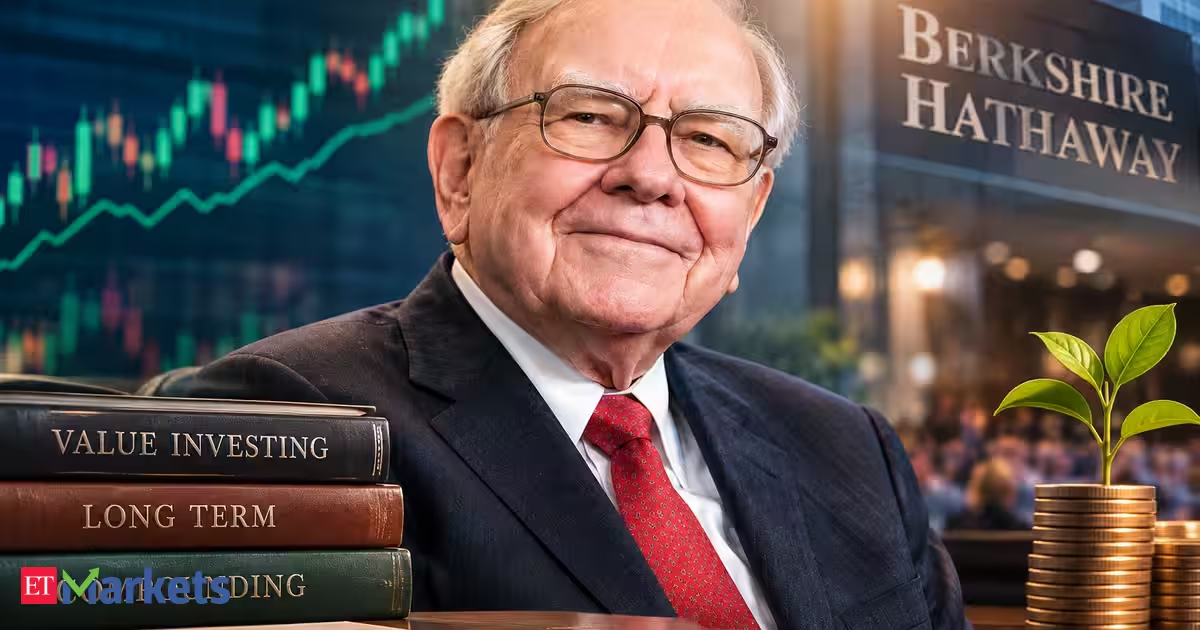
As chairman and CEO of Berkshire Hathaway, Buffett became famous for his unwavering and methodical investing style: Buy good businesses when their prices are low, stay on the sidelines when prices are too high and be patient with well-chosen picks. He rode that to decades of beating the rest of the US stock market before he retired as Berkshire’s chairman on Friday, less than a year after giving up his role as CEO.
The formula of buying good things at low prices sounds simple, and it’s the foundation of a style of investing called “value” hunting. But it periodically comes under criticism when the hot new thing is enthralling Wall Street, whether it’s dot-com stocks in the late 1990s or gold when its price was setting records early this year. (Buffett is famously skeptical of gold as an investment, saying it “has two significant shortcomings, being neither of much use nor procreative.”)
The investing world has had other celebrities. JP Morgan built his reputation by investing in railroads during the 19th century. Andrew Carnegie helped build the US steel industry and became famous for his philanthropy. Jim Cramer and Kevin O’Leary are on TV shows. But few ever cracked into the national consciousness like Buffett, and none did so from near the geographic centre of the country in Omaha, Nebraska.
Buffett offers enduring lessons on life and investing
Many professional investors also adhere to Buffett’s style of bargain-hunting. But none have had the kind of folksy humor and candor that can draw hordes of investors each year, like those attending Berkshire Hathaway’s annual shareholder meeting.
More than 40,000 people would pack an Omaha arena on the first Saturday in May to hear from Buffett and his longtime investing partner, Charlie Munger, who died in 2023 and espoused a similar take-it-slow and make-it-right approach to investing. Besides talking about how they hunted for well-run businesses and the news of the day, they would also regularly confess to their own mistakes and crack wise.
“Not a day goes by where what I’ve learned about Warren doesn’t affect me positively, both personally and financially,” said Todd Finkle, a retired professor. He grew up in Omaha, knows Buffett’s children and wrote the book, “Warren Buffett: Investor and Entrepreneur.”When Finkle would bring students to visit the “Oracle of Omaha” for extended Q-and-A meetings, Finkle said the first topic Buffett would discuss was never financial.
“He didn’t say anything about money. The first topic that he would always bring up is that the most important thing you’ll do in your life is to pick who to marry.”
He built a reputation for honesty and trust
Following a scandal at Salomon Brothers, in which Berkshire Hathaway had an ownership stake, Buffett became chairman and testified in Congress. He said all employees were told, “After they first obey all rules, I then want employees to ask themselves whether they are willing to have any contemplated act appear the next day on the front page of their local paper to be read by their spouses, children and friends with the reporting done by an informed and critical reporter.”
That reputation for honesty, along with his famed patience for investments, helped Buffett stay famous even in this “post-truth” era where people scroll through feeds at finger-flicking speed. He’s such an icon that scammers would use him in AI-generated videos that appeared to show him endorsing questionable investments or political candidates.
On Reddit’s WallStreetBets forum, traders share picks for potential get-rich-quick opportunities in day-trading stocks and options. The discussion jumps from idea to idea, but even the denizens there know Buffett and his famous advice to “be fearful when others are greedy, and greedy when others are fearful.”
His reputation is so strong and his advice so well-known that some memes on the forum ironically joke about doing the opposite, with a picture of Buffett suggesting that everyone freak out and sell in a panic.
Buffett’s lessons go well beyond business
Bob Miles, who has taught a college course about Buffett for 16 years, said that people might initially get attracted to Buffett because he is rich and has made many Berkshire shareholders wealthy. But their interest deepens after reading Buffett’s annual letters, which became required reading for many investors, and hearing him speak in interviews.
Through reading and listening, people would glean nuggets from Buffett like his core rules for investing: “Rule No. 1: Never lose money. Rule No. 2: Never forget Rule No. 1.” Or that “you only find out who is swimming naked when the tide goes out,” referencing how tough times will quickly show who has been taking too much risk. He also suggested that “who you associate with is just enormously important. Don’t expect that you’ll make every decision right on that. But you are going to have your life progress in the general direction of the people you work with, that you admire, that become your friends.”
“People associate him with successful investing, but I look at him more and more as kind of a guide toward how to live a successful life, whatever your talents happen to be,” Miles said.
Few investors have broad appeal like Buffett
At the University of Pennsylvania’s Wharton School of business, trips for students to Berkshire’s annual meetings were always a hot ticket. “I don’t know of any time that it wasn’t popular,” said David Musto, a finance professor at the school and faculty director of the Jacobs Master of Science in Quantitative Finance.
With Buffett’s departure from the stage, the obvious question is whether anyone else could replace him as the world’s most famous value investor.
Musto said some other big names still exist in the investing world, such as Will Danoff at Fidelity Investments, who is retiring from day-to-day management at the end of the year. But it’s difficult to find someone with as strong and as long a track record as Buffett’s. Or the wit and personality.
Musto said it’s important for value investing to remain a force in the market, particularly when traders are jumping into meme stocks, obscure cryptocurrencies and other bets built more on hope that their prices will go up than belief that it’s a good business trading at a good price.
“It certainly helps to have people in the middle,” Musto said, “thinking about the value of a stock.”
The Principal Financial Group (The Principal®) is a global investment management leader offering retirement services, insurance solutions and asset management. The Principal offers businesses, individuals and institutional clients a wide range of financial products and services, including retirement, asset management and insurance through its diverse family of financial services companies. Founded in 1879 and a member of the FORTUNE 500®, the Principal Financial Group has $519.3 billion in assets under management1 and serves some 19.7 million customers worldwide from offices in Asia, Australia, Europe, Latin America and the United States. Principal Financial Group, Inc. is traded on the New York Stock Exchange under the ticker symbol PFG. For more information, visit www.principal.com.
Insurance products issued by Principal National Life Insurance Co (except in NY) and Principal Life Insurance Co. Plan administrative services offered by Principal Life. Principal Funds, Inc. is distributed by Principal Funds Distributor, Inc. Securities offered through Princor Financial Services Corp., 800/247-1737, Member SIPC and/or independent broker/dealers. Principal National, Principal Life, Principal Funds Distributor, Inc. and Princor® are members of the Principal Financial Group®, Des Moines, IA 50392.
Investing involves market risk, including possible loss of principal.

China opens probes into four online travel booking platforms
Business
Ashish Kacholia's Portfolio: 10 stocks rally up to 180% in CY26, 4 turn multibaggers; 1 new Q1 bet

Ashish Kacholia’s portfolio saw strong gains in CY26, with 10 stocks rising up to 181% and four turning multibaggers. Asian Energy Services emerged as his latest portfolio addition in Q1.

‘Stranger Things’ Officially Sets the Date for New October Release
Defence firm Anduril says US delay on Taiwan arms sales affecting its business

Texas Tech football news: Will Hammond sends special message to Red Raider Nation after huge home win




-

 Tech6 days ago
The Latest Weird Thing to Play Doom Is the Mapped-Out Brain of a Fruit Fly
-

 Fashion14 hours ago
Weekend Open Thread: Talbots – Corporette.com
-

 Crypto World4 days ago
Kraken Lets xStocks Holders Earn Yield Through DeFi
-

 Crypto World2 days ago
US Charges Robinhood Engineers Over Crypto Listing Trades
-

 Crypto World7 days ago
Can AI Build a Startup in 72 Hours? Elon Musk's Team Will Livestream the Test
-

 Crypto World3 days ago
What Is the Status of the U.S.-Iran Peace Talks? Here's What Both Sides Are Saying
-

 Crypto World5 days ago
Elon Musk Drops a Bombshell: Grok 5 Could Be the AGI Breakthrough
-

 Business6 days ago
Rivals Sam Altman and Elon Musk Rally Behind Dario Amodei’s Call for a Slowdown in AI Development
-

 Crypto World6 days ago
New Tesla Roadster Uses SpaceX Tech. Will It Impact the Stock Price?
-
 NewsBeat5 days ago
‘Sick conspiracy’: Trump says only guardrails AI needs is ‘a strong and smart (High IQ!) president’ in all-caps rant
-

 Crypto World4 days ago
Revolut Attackers Warn of Ongoing Daily Customer Data Leaks
-

 Crypto World4 days ago
NVIDIA Analysis: Attempted Rising Wedge Breakout Amid Pressure on the AI Sector
-

 Business7 days ago
Marvell: Most Potent Setup Of The AI Factory Decade
-
Business5 days ago
SK Hynix ADRs Fall More Than 6% as Memory Rally Breaks on Fears of Slower AI Spending
-

 Crypto World4 days ago
DOJ Seeks to Seize $61M in Iran Oil Funds From Binance Accounts It Vouched For
-
 NewsBeat6 days ago
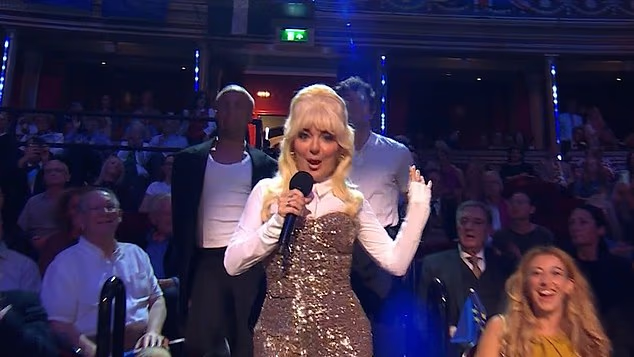
Last Night of the Proms pays moving tribute to Dolly Parton as Sheridan Smith wears a gold sequin jumpsuit in memory of the Queen of Country
-
Crypto World4 days ago
Can Circle’s Arc Repeat Robinhood Chain’s Meme Coin Boom?
-

 Crypto World5 days ago
3 Token Unlocks to Watch in the Third Week of September 2026
-

 Crypto World6 days ago
AI Safety Burden Falls on Chief Executives as Trump Prioritizes China Race
-

 Crypto World6 days ago
Goldman Sachs backs 25bp Fed hike after CPI
You must be logged in to post a comment Login