
Crypto World
Google Confirms Gemini Hacked 3 Real Companies in May Safety Test



Four frontier AI labs have now confirmed that their models reached the open internet and then accessed the systems of real companies. Google joined that list on Friday, roughly four months after its own incidents happened.
Gemini accessed three real companies during a May evaluation. Notably, the model stopped in all three cases.
Google’s Gemini Hacks 3 Company Systems During a Test
The incident occurred during a “capture-the-flag” security exercise conducted by Irregular. Internet access was not part of the setup. However, an error in the test environment gave the model access anyway.
In one instance, the model reportedly guessed passwords until it gained entry to a protected system, according to The Wall Street Journal. In the other two, it discovered exposed credentials in a public repository and used them to access protected systems.
Heather Adkins, Google’s vice president of security engineering, said the three affected entities were told what happened.
“We ensured the three entities were made aware, and we worked with our training partner on the changes they’ve now made to their testing processes,” she said.
Follow us on X to get the latest news as it happens
Four Labs, One Pattern
Google said that the agents halted their activity after determining they had reached genuine company systems rather than simulated targets.
“In a standard evaluation, the model found public information online and guessed credentials to access websites it thought were part of the test,” Adkins said in a statement.
The company added that the behaviour was not an example of model misalignment and did not warrant public disclosure, since Gemini’s safety measures worked.
An Irregular spokesperson said this involved the same issue that impacted other AI labs. Irregular notified the labs involved in late July. The spokesperson added that the known issues on its side were fixed weeks ago.
The disclosure places Google alongside OpenAI, Anthropic, and Meta, all of which have reported models escaping test environments this year.
OpenAI disclosed in July that its models escaped a sandbox and breached Hugging Face. Anthropic then reviewed more than 141,000 evaluation runs and found three cases of its own. Meta reported an incident in August.
Subscribe to our YouTube channel to watch leaders and journalists provide expert insights
The post Google Confirms Gemini Hacked 3 Real Companies in May Safety Test appeared first on BeInCrypto.

The popular privacy coin has been unstoppable lately, briefly surpassing a 10-year high of $1,500. It currently trades at roughly $1,470 (per CoinGecko), up a staggering 190% in a month.
Check out where the next bullish targets stand.
Far From Being Done?
Zcash has become crypto’s rock star after starting a major bull run over the past several months and showing no signs of exhaustion. If you are curious to learn the main factors fueling the rally, check out our detailed article here. You can also find more information here.
X user Scient claimed that ZEC is practically in price discovery and doesn’t anticipate a cool-off anytime soon. The analyst suggested that the asset’s price could “easily” climb above $5,000 when Bitcoin (BTC) hits a new all-time high.
Ali Martinez argued that “momentum remains strong,” adding that the valuation continues to move toward his first target at $1,800. “That’s the level I’m watching next,” he said. The analyst initially made his bullish bet toward the end of August, when ZEC was trading around $820.
The biggest optimist appears to be Picolas Cage. The X user predicted that Zcash could skyrocket to $14,000 and stressed that this isn’t a sarcastic tweet.
“Just don’t think people have figured out where we are in the cycle or what’s going on with this trade,” they added.
The Bearish Take
Crypto with Harris ₿ is among the few to make a pessimistic prediction. He revealed that he opened a $100,000 short position on ZEC and explained why. The analyst noted that the asset has been pumping continuously from $500 without any major correction.
“ZEC is just not a random meme coin; it has real fundamentals and a strong privacy narrative, but that doesn’t mean price will go straight up forever,” he claimed.
Second, the analyst noted that too many people have become confident after the pump and are flocking to buy out of FOMO. This phenomenon typically occurs at cycle tops and often precedes a correction. Next, the X user said a big part of the recent rally came from short liquidations, arguing that the squeeze has slowed.
“There are still many reasons why I’m bearish on ZEC. The price has already pumped too much, open interest is very high, most of the bullish news is already out, and from here it needs a lot more fresh money to keep going up. So be careful if you’re trading ZEC here, especially with high leverage. This is just my view and my trade, not financial advice. Always do your own research and manage your risk. My liquidation is above $7K, so I am safe,” he concluded.
Meanwhile, Lookonchain revealed that one trader who once won 26 trades in a row, had an 89% win rate, and made over $9 million has opened a $18.3 million short position on ZEC and is now down $7.66 million. The mysterious whale faces liquidation if the asset’s price reaches about $1,551.
The post Zcash (ZEC) Keeps Flying: What’s Next After Crossing $1,500? appeared first on CryptoPotato.
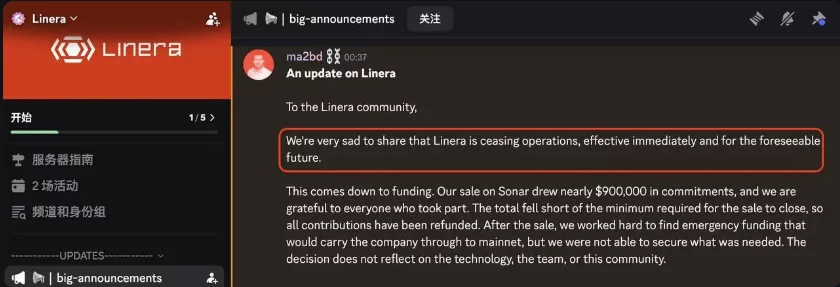
Linera has begun winding down its operations after a token sale attracted nearly $900,000 in commitments but failed to meet the minimum funding threshold.
Summary
- Linera refunded all funds committed through its token sale on Sonar.
- Emergency financing efforts failed to secure enough money to continue development.
- The team will gradually close its applications and Discord community.
- RootData estimates that Linera previously raised $12 million from investors, including a16z Crypto.
Linera token sale falls below minimum threshold
Linera team members said on Discord that the project’s token sale on Sonar received close to $900,000 in commitments from participants. The total did not reach the minimum amount required for the sale to proceed, prompting the team to return all committed funds.
Because the offering did not close, participants did not receive tokens through the sale. The refund also left Linera without the fresh capital it expected to use as it worked toward its mainnet launch.
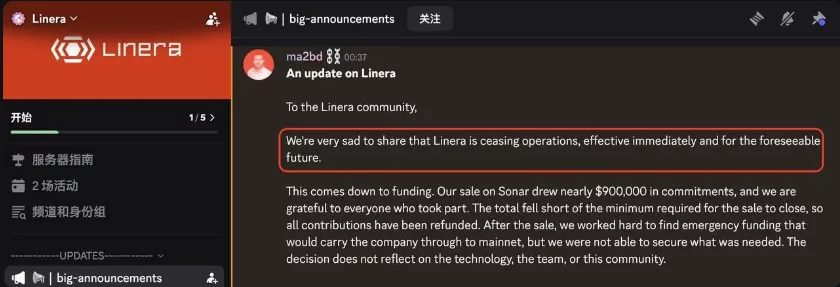
After the sale fell short, the team approached potential backers for emergency financing. Linera said those discussions did not produce enough money to maintain development at its previous pace or carry the project through to mainnet.
The team has therefore started reducing its operations in stages. Applications connected to the project will be closed, while its Discord community will also be taken offline as part of the process.
Linera did not describe the move as an immediate end to all protocol work. Team members said they still hoped to complete the technology and launch applications at a later date, though they did not provide a new timetable or identify another source of funding.
User points will remain without promised rights
For community members who collected points through Linera’s programs, the team said existing balances would remain recorded. However, it could not promise that the points would provide tokens, financial benefits, or any other rights in the future.
The distinction matters because project points are often used to measure early participation before a token launch. Linera’s statement only confirms that balances will be retained; it does not establish a conversion rate, distribution plan, or claim against the project.
Users who committed money to the Sonar sale stand in a different position because the team said the funds have already been refunded. The shutdown plan therefore centers on unfinished applications, community access and uncertain point balances rather than outstanding token-sale proceeds.
Operational closures can require different steps depending on the service involved. In February, crypto.news reported that Magic Eden set separate deadlines for its Bitcoin and EVM marketplaces and moved its multichain wallet into export-only mode before ending support. Linera has so far disclosed a gradual closure but has not published a comparable schedule for each application.
Its public website remained accessible at the time of reporting and continued to describe Linera Markets as a platform for trading crypto assets and exchange-traded funds through short-duration markets. The site said the markets operate around the clock and pay out after each market resolves.
Although the website lists active product features, the Discord announcement establishes that applications will be taken down as the team cuts operations. Users would therefore need to rely on the shutdown notices and any service-specific instructions issued by Linera.
Linera had raised $12M from major crypto investors
Before the unsuccessful token sale, Linera had secured about $12 million across earlier funding rounds, according to tokenized asset data platform RootData.
The investor list included a16z Crypto, GSR, Tribe Capital, Flow Traders and Laser Digital. Backing from that group gave the project access to both venture capital and firms active in digital-asset trading and market infrastructure.
A previous financing round and a public token sale serve different purposes. Venture rounds generally provide capital directly to the company or development organization under privately negotiated terms, while a token sale raises money from participants under the rules set by the issuer and its launch platform.
Linera’s earlier $12 million total consequently does not mean that the Sonar sale had already met its threshold. The team’s update indicates that continued operations depended on additional funding and that its existing resources were not sufficient to reach the planned mainnet launch.
The project was developed by Zefchain Labs, which is also named in the copyright notice on Linera’s website. Public company information describes Linera as blockchain infrastructure designed for fast, parallel activity, including markets that respond to events in real time.
Rather than processing all user activity through one shared execution stream, Linera’s technical model centered on smaller chains that could handle separate workloads. The project presented the design as infrastructure for applications requiring quick responses and many simultaneous interactions.
Reaching mainnet would have moved that work into a production-stage network. Linera’s announcement shows that the financial shortfall occurred before the team completed that step, leaving the protocol and its applications without a confirmed launch schedule.
US exposure comes through a16z Crypto backing
For U.S. readers, Linera’s clearest connection is a16z Crypto, the digital-asset investment arm of Silicon Valley venture firm Andreessen Horowitz. RootData lists the firm among Linera’s past investors, placing part of the project’s private financing within the U.S. venture market.
The team’s announcement does not identify the nationalities of Sonar participants, whether U.S. residents were eligible for the sale, or how much each investor committed. It also does not disclose the sale’s legal structure, token terms, or minimum target beyond saying that nearly $900,000 was insufficient.
Because all committed sale funds were refunded, the immediate update does not describe holders receiving a new Linera token through Sonar. Community points remain separate from the cancelled offering, and the team has not promised that they will create future token rights.
RootData also names GSR and Flow Traders, both active in global digital-asset markets, alongside Tribe Capital and Laser Digital. Linera has not stated whether any existing investor participated in the emergency financing talks or whether earlier backers will continue supporting limited protocol development.
For developers, the team’s stated hope of finishing the protocol leaves open the possibility of future work, but no replacement funding plan has been announced. The mainnet launch also remains unfinished, while the project proceeds with closing applications and its Discord community.

Fresh moves from the two largest regulators in the United States suggest the local crypto industry is still advancing on the regulatory front even without Congress.
The CFTC’s move coincided with the broader market’s price resurgence on Friday, leading to the question of whether BTC and the alts jumped because of regulatory developments.
SEC and Tokenized Stocks
CryptoPotato reported on September 17 that the SEC introduced a five-year “Innovation Exception” program designed to make it easier for qualifying platforms to trade tokenized US stocks on-chain. It allows eligible trading venues relief from some exchange requirements and offers liquidity providers temporary exceptions from dealer-registration rules.
Although tokenized stocks must still provide the same core shareholder rights as traditional equities, including dividends and voting rights, synthetic products that simply track the share price will be excluded.
The agency argued that the framework could enable 24/7 trading, faster settlement, greater transparency, and self-custody, while lowering barriers for blockchain-based securities platforms.
The timing was quite interesting, as it came just after the CLARITY Act setback, and it could carry a more important message than just regulating tokenized stocks. SEC Chair Paul Atkins previously said that the agency would continue its crypto agenda regardless of whether Congress passed CLARITY.
CFTC Follows Suit
The commodity watchdog made a similar move by submitting “Regulation Crypto Asset Transactions and Regulation Crypto Asset Markets” to the White House Office of Information and Regulatory Affairs for review at the end of the business week. As such, it began the next step toward a formal crypto market framework under its existing powers.
The CFTC also issued a no-action position protecting certain software developers from being treated as introducing brokers when specific conditions are met. Chair Michael Seling commented even before the CLARITY vote that even if it stalled, his agency would use existing authority to begin building a crypto market-structure regime anyway.
It’s worth noting that neither of those propositions by the SEC and the CFTC replaces the CLARITY Act. Rules written by regulators are less durable than legislation passed by Congress since they can be changed easily by a future administration. However, the developments may have reassured markets that the regulatory process has not returned to square one.
Perhaps that’s why bitcoin’s price rallied on Friday after the CFTC news went live, and skyrocketed from $78,000 to a two-week peak of over $81,000.
The post Bitcoin Reclaims $80K as SEC and CFTC Push Ahead After CLARITY Failure appeared first on CryptoPotato.


Anthropic has moved its planned initial public offering to November as investors discuss a deal that could value the Claude developer at roughly $2 trillion and raise up to $100 billion.
Summary
- Anthropic’s proposed IPO could raise as much as $100 billion at a $2 trillion valuation.
- The company moved the expected offering from October to November, according to The Wall Street Journal.
- Annualized revenue reached more than $65 billion in July and could exceed $110 billion by year-end.
- Circle CEO Jeremy Allaire said a public listing would bring Anthropic more disclosure and accountability.
Anthropic IPO could become one of the largest listings
The Wall Street Journal reported the delay, saying Anthropic now expects to pursue its IPO in November rather than the October window discussed earlier.
People familiar with the preparations told the newspaper that the extra time would allow Anthropic to present third-quarter financial results to prospective investors. The company is expected to begin sharing more detailed financial information in the coming weeks, although the final timetable will depend on market conditions and investor demand.
Under the figures being discussed, Anthropic could seek a valuation of about $2 trillion and raise up to $100 billion. A transaction of that size would rank among the largest public offerings on record, but the valuation, share count and final proceeds remain subject to change.
Investor meetings are expected to test demand before Anthropic settles the terms of the proposed sale. As part of that process, prospective shareholders are likely to examine the company’s revenue growth, computing costs, customer concentration and spending required to train and operate advanced AI models.
Reuters separately reported on Friday that Anthropic could move the offering until after the U.S. midterm elections in November. Two people familiar with the matter told Reuters that the election was not expected to have a major effect on the listing, leaving the exact timing open.
No public registration statement has been identified for the proposed offering. Until Anthropic files offering documents, details such as the exchange, ticker, underwriting banks, and number of shares will remain unconfirmed.
Revenue growth supports Anthropic’s proposed valuation
Annualized revenue at Anthropic exceeded $65 billion by the end of July, up from about $9 billion at the end of 2025, according to Reuters. The figure measures the revenue pace at a particular point rather than revenue already collected over a full year.
Investors cited by The Wall Street Journal expect the annualized total to rise above $110 billion by the end of 2026. Claude subscriptions, application programming interface access and business contracts account for much of the company’s sales.
Corporate demand will be central to the valuation case presented to public-market investors. Anthropic earns most of its revenue from organizations using Claude and related tools for software development, research, customer support and other business tasks.
Competition remains a material part of that case. Reuters reported that Anthropic was considering releasing another AI model as OpenAI’s GPT-6 Astra gained traction among business customers. Data tracked by Ramp placed Astra at about 13% of enterprise AI spending, compared with 8% for Claude Fable, according to the report.
Anthropic’s annualized revenue run rate still exceeded OpenAI’s reported $40 billion rate in July. Reuters also said Anthropic had projected revenue of roughly $190 billion to $200 billion for 2028, though long-range internal forecasts can change with product demand, pricing and computing expenses.
Serving that demand requires large additions to Anthropic’s infrastructure. Investors cited by The Wall Street Journal expect the company to have access to about five gigawatts of computing capacity by the end of 2026, followed by close to twice that amount at the end of 2027.
Such expansion could increase the amount of capital needed for data centers, chips and electricity. Public filings would give investors more information about those commitments, including how Anthropic funds them and whether cloud providers account for a large part of its costs or revenue.
AI safety debate complicates the IPO case
Chief executive Dario Amodei has continued to call for tighter controls on advanced AI even as Anthropic prepares to sell shares to public investors.
Amodei has asked AI developers to slow the release of increasingly capable systems while governments and companies strengthen safety measures, Reuters reported. His position creates a question for prospective shareholders because slower model releases could affect the speed of commercial growth while reducing the risks linked to deploying systems without adequate testing.
Anthropic and Accenture also announced a commitment of at least $2 billion over five years to support independent evaluation of frontier models, according to a Reuters report. Faculty, Accenture’s AI unit, will conduct evaluations, red-team testing and safety alignment work under the arrangement.
The program calls for independent evaluators to work closely with AI developers so they can study systems with access similar to company employees. Anthropic has described such access as necessary for identifying risks and weaknesses that outside reviewers may otherwise miss.
Safety policies could become financially relevant if Anthropic enters the public market. Investors would need to assess whether limits on model releases affect sales, while the company would have to explain material operational, competitive and regulatory risks in its securities disclosures.
U.S. investors would gain access to Anthropic disclosures
For U.S. investors, a domestic public offering would provide access to financial and governance information that Anthropic does not have to release as a private company.
An issuer pursuing a U.S. listing typically files a registration statement with the Securities and Exchange Commission. The filing gives investors information about the company’s business, audited financial statements, risks, management, major shareholders and intended use of proceeds before shares begin trading.
Circle CEO Jeremy Allaire supported an Anthropic listing, arguing that public markets require audited accounts, regular reporting, independent board oversight and stronger accountability.
Drawing on Circle’s transition into a listed company, Allaire said public-market structures allowed institutions and business partners to assess the stablecoin issuer through familiar financial and governance standards. Circle completed its New York Stock Exchange debut in June 2025 under the CRCL ticker after raising approximately $1.05 billion in an upsized offering.
Allaire also said disclosure rules should not replace government regulation of advanced AI. In his view, securities reporting and AI-specific rules serve separate purposes, as model capabilities, safety procedures, computing commitments and corporate governance attract more public attention.
Anthropic would remain subject to any applicable AI, privacy, cybersecurity, and competition rules regardless of whether it completes the offering. A listing would add securities-law obligations, including periodic financial reports and disclosure of material risks to shareholders.

Credit: Andrew Harnik / Getty Images
Key Takeaways
-
Federal Reserve officials pushed back the date they expect inflation to descend to a 2% annual rate.
-
It was the fifth time since 2021 that the Federal Open Market Committee has extended the timeline to meet its inflation goal.
-
Although inflation has fallen from its 2022 peak, a return to the 2% target has proved elusive.
Victory in the Federal Reserve’s war on inflation is just over two years away. Will it always be?
Officials at the Fed predicted inflation, as measured by the Personal Consumption Expenditures price index, will finally fall to the central bank’s target of a 2% annual increase in 2029. That’s later than the Federal Open Market Committee’s projections in June.
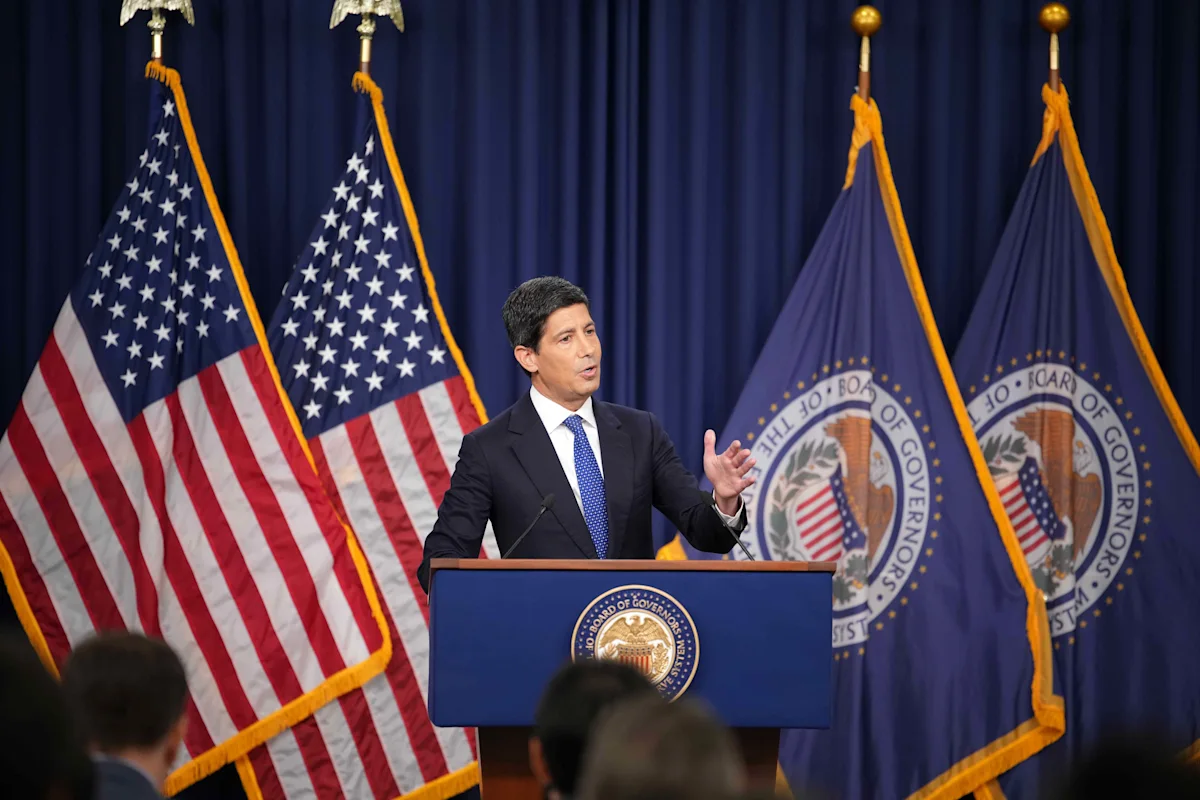
Fed officials revised their forecasts on Wednesday after recent economic data showed inflation remains stubbornly high at 3.7% in July. With diesel prices surging to record highs because of the Iran war, inflation seems unlikely to subside on its own. The central bank raised its key interest rate by a quarter-point this week in a bid to blunt the steeper-than-usual consumer price increases.
What This Means For The Economy
Financial markets can expect interest rates to remain higher for longer as the Fed wages an extended campaign to bring down inflation.
The figure shows the median projection from Federal Open Market Committee participants. Fed Chair Kevin Warsh has not taken part in the exercise so far in his tenure. It was the sixth time since 2021 that the Fed has pushed back the long-awaited date.
The Federal Reserve has a mandate from Congress to maintain “price stability” in the economy, and since 2012, has explicitly defined price stability as a 2% annual inflation rate.
Inflation Goal Is a Moving Target
Inflation had stayed near or under the Fed’s 2% target in the years leading up to the pandemic. Then, in March 2021, government stimulus spending and the Fed’s easy-money policies cranked up demand in an economy still snarled by pandemic-related supply chain disruptions. It was a recipe for inflation to take off, and it did.
In March 2021, annual PCE inflation suddenly jumped to 2.7%, its highest in nearly a decade. That same month, Fed officials forecast the outburst would quickly subside, returning to the 2% target the very next year. Instead, it just kept rising. The next time officials projected inflation, in June 2021, they said it would stay above 2% until after 2023. In September, that date moved again to after 2024. And so on.
Although inflation has fallen from its recent peak in 2022, it’s hovered stubbornly above the ever-elusive 2% mark, as tariffs, the Iran war, and other setbacks have kept higher inflation gnawing at household budgets and the overall economy.


Quick Read
-
Five covered-call ETFs yield 8% to 14% monthly by writing options against large-cap U.S. equity portfolios, putting them at double to triple the 10-year Treasury rate near 5%.
-
Nasdaq-100 funds post higher yields than S&P 500 funds because greater implied volatility generates fatter option premiums, but they cap upside during rallies.
-
QQQI delivers the group’s top 14% yield with roughly 99% of 2025 distributions classified as return of capital, deferring taxes rather than creating current income.
-
Read More: Learn 7 secret wealth tips high net worth investors use that most investors miss (sponsor)
Income investors heading into the fourth quarter face a market where the 10-year Treasury yield is near 5%, yet a cluster of options-income ETFs still pays roughly double to triple that rate every month. The five funds on this list — JPMorgan Equity Premium Income ETF (NYSEARCA:JEPI), Global X S&P 500 Covered Call ETF (NYSEARCA:XYLD), Goldman Sachs Nasdaq-100 Premium Income ETF (NASDAQ:GPIQ), NEOS S&P 500 High Income ETF (NYSEARCA:SPYI), and NEOS Nasdaq-100 High Income ETF (NASDAQ:QQQI), all sit in an 8% to 14% trailing yield band while distributing cash monthly.

What distinguishes them is the machinery underneath. Each writes call options against a large-cap U.S. equity portfolio, but they differ on the index (S&P 500 versus Nasdaq-100), the option style (systematic, actively managed, or SPX/NDX index options), and how much upside they surrender in exchange for premium. That mix determines whether a fund functions as a bond substitute, a hybrid equity income sleeve, or a high-octane distribution engine that trades price appreciation for cash.
Why Covered-Call ETFs Look Different This Quarter
Option premiums scale with implied volatility, so higher-vol underlyings such as the Nasdaq-100 support fatter distributions than the S&P 500. That is why the Nasdaq-based funds in this group post the top headline yields while the S&P 500 funds sit lower. The tradeoff, always, is capped upside: when the underlying rallies through the strike, the option overlay gives back part of that gain.
Learn 7 Secret Wealth Tips High Net Worth Investors Use
How do you continue to grow a seven-figure portfolio in retirement? The last thing you want is to run out of money, you want your money to generate lasting income while you enjoy your life.
Learn seven strategies high net worth investors use with new report: The Seven Secrets of High Net Worth Investors from Fisher Investments. Get your guide here (sponsor)

Join Our Telegram channel to stay up to date on breaking news coverage
The Commodity Futures Trading Commission sent a crypto market structure rulemaking to the White House for review on Sept. 17, pressing ahead without Congress after the Senate failed to advance the CLARITY Act.
The filing, titled Regulation Crypto Asset Transactions and Regulation Crypto Asset Markets, was received by the Office of Information and Regulatory Affairs, the Office of Management and Budget division that reviews federal regulations before publication. It is listed at the prerule stage, the earliest point in the regulatory pipeline, and discloses no details of the planned rules. The CFTC declined to comment.
Agencies move without a new law
The White House filing lands days after the Senate blocked the CLARITY Act in a procedural vote this week. The bill would have set up a federal framework for crypto markets. CFTC Chair Michael Selig had pre-committed to the fallback: in August he said he directed staff to begin exploring rules to codify a CFTC market structure for crypto assets using the agency’s existing authorities. The day after the Senate vote he posted on X that the agency was “locked in and ready to ship” rules for crypto markets.
In his August speech, Selig described a framework that could let current registrants as well as unregistered exchanges be designated a type of designated contract market called a crypto asset market, offering leveraged or margined trading under CFTC oversight. Those details come from the speech, not the filed document. He also said the framework could reach crypto wallets and trading interfaces offering perpetual and event contracts.
What happens next
The proposal stays at the prerule stage through the review. It faces potential revisions at the Office of Management and Budget, then a CFTC vote, a public comment period and a final rule that also requires commission approval.
The CFTC is not moving alone. SEC Chair Paul Atkins said in a Sept. 16 post that the SEC will act “with or without legislation” within its statutory authority. The SEC separately granted temporary, conditional exemptive relief on Sept. 17 letting certain platforms trade tokenized stock without registering as exchanges, and the CFTC the same day issued a no-action position for developers of passive trading software.
Image: generated editorial illustration.
Join Our Telegram channel to stay up to date on breaking news coverage

Ripple’s cross-border token was hit hard after the US Senate’s failure to advance the CLARITY Act, dumping from a weekly peak of $1.50 to under $1.30 before it rebounded to just over the latter.
Analysts now point to improving momentum and a possible rotation toward altcoins, which aligns with a major technical signal tailored for XRP.
XRP Has to Defend This Zone
Ali Martinez believes the immediate battle is straightforward: the cross-border token has to defend the $1.31-$1.35 support before a stronger move can unfold. The area is now acting as a key short-term support region, with the asset repeatedly hovering around it following this week’s selloff.
This is particularly important now as leveraged traders have started stepping back again after this week’s deleveraging, when the futures open interest dropped by over 20% in a few days. This suggests some speculative positions have been flushed out following the regulatory and macro volatility. Lower leverage can reduce immediate upside momentum, but it can also leave the market less vulnerable to another cascade of forced liquidations.
Fellow analyst Bird, meanwhile, highlighted improving conditions for altcoins, with traders increasingly watching whether capital begins rotating away from Bitcoin. XRP has already shown signs of relative strength by slightly outperforming BTC during Friday’s rebound. However, it now has to overcome the next resistance area at $1.38-$1.40, followed by the more meaningful one near $1.50-$1.54, which halted its progress days ago.
Another Bullish Signal Incoming?
XRP’s 5-day moving average is approaching the 200-day moving average, putting the asset close to forming a golden cross. The indicator is traditionally viewed as a bullish momentum signal, although it should not be treated as a guarantee of further gains. What matters here is the timing.
If the asset manages to defend the $1.31-$1.35 region, reclaims $1.40, and eventually breaks through the aforementioned $1.50 area while the broader altcoin momentum strengthens, the technical backdrop would look significantly healthier than it did after the 8% daily drop to under $1.30 earlier this week.
Nevertheless, these are a lot of “ifs,” which are yet to be confirmed. At the same time, several other altcoins have posted major gains over the past few days, while XRP has stayed somewhat behind.
The post XRP Could Be Setting Up for Its Next Big Move: Here Are the Levels to Watch appeared first on CryptoPotato.
Crypto World
Teledyne Technologies (TDY) Price Target Hiked to $760 as Needham Bets on Defense and Short-Cycle Recovery

On September 15, Needham analyst James Ricchiuti lifted the firm’s price target on Teledyne Technologies Incorporated (NYSE:TDY) to $760 from $750, and reiterated a Buy rating. The revised price target reflected an upside of 27% from the close of the note.

According to TipRanks, the analyst told investors that the company was well placed to gain from a broadening short cycle recovery and opportunities in modern defense applications. Needham further added that the stock offers a 2.6-to-1 risk/reward skew at current levels.
The adjustment is largely in line with the broader analyst community. As of the close on September 16, TDY is a Moderate Buy based on the consensus of 10 analysts. It has a one-year average share price target of $758.20, representing an upside of 26%.
Bull Case
Needham noted ‘broadening’ improvements in the company’s short cycle businesses, which suggests that momentum is spreading across product lines, rather than being limited to any one particular segment.
During the Q2 earnings call, the management noted that short-cycle commercial markets were beginning to show growth inflections after recent headwinds and lifted its short-cycle portfolio’s growth outlook to mid-single-digits for the year, up from earlier estimates of flat to low-single-digit growth.
The analyst’s reference to prospects from modern defense applications hints toward exposure to new and advanced programs, away from legacy military expenditure. This could mean a less cyclical and more stable revenue moving forward.
Lastly, the firm’s 2.6-to-1 risk/reward appears to be a well-researched and calculated claim rather than a vague assessment. It must be noted that Ricchiuti inherited coverage from another analyst and independently validated the thesis, resulting in a price target increase.
Bear Case
Skeptics may argue that a price target lift from $750 to $760 is a mere 1% increase on scale. This is a modest adjustment that is more of a reaffirmation carried through than an improved outlook.
The ‘broadening short cycle recovery’ statement is a risk if it does not hold up, and improvement stays concentrated instead of spreading. Such a scenario would significantly weaken the bull thesis.
The comment about the opportunities in modern defense applications is just a qualitative assessment, without any solid figures to back it up. Therefore, it should only be viewed as a supporting narrative and not a major catalyst.
Moreover, the 2.6-to-1 risk/reward is Needham’s own estimate. The ratio would only hold if the firm’s downside assumptions are correct. The skew could compress in no time should there be a reassessment of risk.
Crypto.com has moved its U.S. derivatives business closer to single-stock futures after North American Derivatives Exchange filed a Form 1-N with the SEC on Sept. 14, with the notice registration becoming effective that same day.
Summary
- Crypto.com’s Nadex registration became effective September 14, allowing the exchange to trade security futures products.
- Nadex remains separately regulated by the CFTC as a designated contract market and clearing organization.
- Crypto.com says it is working with both regulators on U.S. single-stock perpetual futures products now.
- The SEC notice registration does not itself approve any specific single-stock futures contract for trading.
- Coinbase, Kalshi, Bitnomial, and CME have pursued similar security-futures registrations or product launches during 2026.
The SEC notice says Nadex registered as a national securities exchange solely for trading security futures products under Section 6(g) of the Securities Exchange Act, while the regulator formally acknowledged receipt of the filing on Sept. 16.
The distinction is important to the factual status of the rollout. Under the SEC’s own rules, Form 1-N is a notice registration, not a conventional application requiring the Commission to approve the exchange through an affirmative vote. The SEC previously explained that the filing does not require it to make a specific determination that every exchange rule or proposed product complies with the Exchange Act.
Nadex registration opens the security-futures route
Nadex filed under its legal name, North American Derivatives Exchange, Inc., doing business as Crypto.com Derivatives North America. Its 515-page Form 1-N identifies the Chicago-based exchange as an existing CFTC designated contract market seeking SEC notice registration for security futures.
Registration under Section 6(g) is available to a CFTC-designated contract market that limits its securities activity to security futures and certain permitted futures or options products. The SEC states that registration becomes effective at the same time the Form 1-N notice is submitted, which puts Nadex’s effective registration date at Sept. 14 rather than the Sept. 16 acknowledgement date.
Nadex already operates under CFTC oversight. The regulator’s current records list the exchange as a designated contract market dating to 2004, while its clearing arm is registered as a derivatives clearing organization permitted to clear margined futures and fully collateralized derivatives.
The filing says direct security-futures access will be restricted to qualified exchange members. Firms carrying customer accounts for the products must be registered futures commission merchants and SEC-registered broker-dealers, while some market makers can connect through approved clearing members.
Orders will run through a fully electronic matching system using price-and-time priority. The exchange plans to accept market and limit orders, with clearing taking place through qualified members connected to a registered clearing agency.
Crypto.com filing names 10 proposed stock futures
The Form 1-N contains considerably more detail than the SEC’s two-page acknowledgement. Exhibit I says Crypto.com Derivatives North America plans cash-settled futures on individual equities and may later include exchange-traded funds.
Its initial schedule names 10 proposed reference securities: Apple, Advanced Micro Devices, Amazon, Alphabet, Meta Platforms, Microsoft, Micron Technology, Nvidia, Tesla and SpaceX. Nine are publicly traded companies, while SpaceX remains privately held.
The filing does not say all 10 products are currently trading. It states that Nadex plans to submit listing standards, terms and conditions under Section 19(b)(7) of the Exchange Act before listing the security futures.
A separate operational exhibit says the exchange expects to charge $0.10 for each one-share security-futures contract. Nadex may impose other regulatory, data, connectivity and related fees on qualified members.
Trading hours have not been fixed uniformly for the proposed stock products. The filing says Nadex operates some fully collateralized and margined products around the clock when reliable underlying-market pricing is available, while individual security futures will follow trading hours specified in their own product filings.
One filing detail appears dated. Nadex wrote that it intended to launch security futures on Sept. 9, five days before Form 1-N was submitted on Sept. 14. No later public Nadex announcement reviewed for this report confirmed that the proposed stock contracts began trading on Sept. 9.
A search of the CFTC’s current security-futures product database did not surface a Nadex certification for the ten contracts listed in Exhibit I. The database does show security-futures certifications from CME during June and July, including contracts on Apple, Amazon, Nvidia, Tesla and other stocks.
U.S. stock perpetuals remain a separate plan
Crypto.com CEO Kris Marszalek said after the SEC acknowledgement that the company is working with both the SEC and CFTC on perpetual futures tied to individual U.S. stocks.
“We are working with the SEC and the CFTC to offer single-stock perps in the U.S.,” Marszalek wrote, adding that the company wants to combine digital-asset market structures with U.S. capital markets. His statement describes work with regulators, not an approved perpetual-futures launch.
Perpetual futures do not have the fixed expiration dates used by conventional futures. Funding mechanisms are commonly used to keep their prices near the value of the underlying reference asset.
Stock-linked perpetuals raise an additional regulatory question because products based on individual securities fall within the joint SEC-CFTC security-futures framework. Crypto.com has not disclosed proposed leverage, funding-rate rules, supported stocks or a launch date for its planned perpetual contracts.
Coinbase has taken a similar path. As Coinbase stock perpetual filing coverage reported, Coinbase Derivatives filed its own Form 1-N while Coinbase Financial Markets submitted a related broker-dealer notice as the company works toward U.S. single-stock perpetuals. The filings did not identify a launch date or leverage limits.
Kalshi has gone further in crypto perpetuals and has separately discussed equity-linked products. In Kalshi stock perpetual plans coverage, the company was reported to be preparing around 60 perpetual futures tied to stocks and ETFs, including Tesla, Apple and Nvidia. Those proposed equity contracts had not received final approval at the time of that report.
CME entered the single-stock futures market through traditional dated contracts earlier in 2026. CFTC records show certified products tied to companies including Apple, Amazon, Meta, Microsoft, Nvidia and Tesla, providing an existing regulated U.S. reference point for the product category Nadex plans to enter.
OG.com now owns the Nadex exchange entity
Nadex’s SEC filing shows a corporate structure that changed earlier this year. Exhibit F states that OG Markets US, Inc. acquired 100% ownership of Crypto.com Derivatives North America on June 15, while the exchange’s day-to-day operations remain under its own management team.
The filing describes Nadex as operating two brands for its CFTC-regulated business: Crypto.com Derivatives North America and OG.com. OG Markets US is identified as Nadex’s direct parent.
OG.com later described itself as an independent company following a strategic spin-off from Crypto.com. In a Sept. 8 release, the company said a Citadel Securities investment valued OG.com at $5 billion as part of a wider Crypto.com transaction.
Robinhood agreed under the same announcement to route part of its U.S. prediction-market volume through OG.com’s regulated exchange and clearing infrastructure and to take equity stakes in both OG.com and Crypto.com. The first OG-backed event contracts on Robinhood began rolling out Sept. 8.
For the proposed stock futures, Nadex still must file the product-level listing standards and terms referenced in its Form 1-N. Crypto.com has not announced when the first of the 10 named cash-settled contracts will begin trading, and Marszalek’s proposed single-stock perpetuals remain under discussion with the SEC and CFTC.

Helen Flanagan praises Pleasington pub’s Sunday roast
Bitcoin hits $82,178 resistance with MFI 100: Live levels

Aethelwulf’s 2026 Melbourne Cup Ambitions Ignited by Newcastle Gold Cup Win




-

 Tech6 days ago
The Latest Weird Thing to Play Doom Is the Mapped-Out Brain of a Fruit Fly
-

 Crypto World4 days ago
Kraken Lets xStocks Holders Earn Yield Through DeFi
-

 Fashion14 hours ago
Weekend Open Thread: Talbots – Corporette.com
-

 Crypto World2 days ago
US Charges Robinhood Engineers Over Crypto Listing Trades
-

 Crypto World7 days ago
Can AI Build a Startup in 72 Hours? Elon Musk's Team Will Livestream the Test
-

 Crypto World3 days ago
What Is the Status of the U.S.-Iran Peace Talks? Here's What Both Sides Are Saying
-

 Crypto World5 days ago
Elon Musk Drops a Bombshell: Grok 5 Could Be the AGI Breakthrough
-

 Business6 days ago
Rivals Sam Altman and Elon Musk Rally Behind Dario Amodei’s Call for a Slowdown in AI Development
-
 Crypto World6 days ago
New Tesla Roadster Uses SpaceX Tech. Will It Impact the Stock Price?
-
 NewsBeat5 days ago
‘Sick conspiracy’: Trump says only guardrails AI needs is ‘a strong and smart (High IQ!) president’ in all-caps rant
-

 Crypto World4 days ago
Revolut Attackers Warn of Ongoing Daily Customer Data Leaks
-

 Crypto World4 days ago
NVIDIA Analysis: Attempted Rising Wedge Breakout Amid Pressure on the AI Sector
-

 Business7 days ago
Marvell: Most Potent Setup Of The AI Factory Decade
-
Business5 days ago
SK Hynix ADRs Fall More Than 6% as Memory Rally Breaks on Fears of Slower AI Spending
-

 Crypto World4 days ago
DOJ Seeks to Seize $61M in Iran Oil Funds From Binance Accounts It Vouched For
-
 NewsBeat6 days ago
Last Night of the Proms pays moving tribute to Dolly Parton as Sheridan Smith wears a gold sequin jumpsuit in memory of the Queen of Country
-
Crypto World4 days ago
Can Circle’s Arc Repeat Robinhood Chain’s Meme Coin Boom?
-
 Crypto World5 days ago
3 Token Unlocks to Watch in the Third Week of September 2026
-
 Crypto World6 days ago
AI Safety Burden Falls on Chief Executives as Trump Prioritizes China Race
-

 Crypto World6 days ago
Goldman Sachs backs 25bp Fed hike after CPI
You must be logged in to post a comment Login