
Business
Jim Cramer Calls Intel (INTC) the Best Stock in Show and Micron (MU) No. 2

Jim Cramer put Intel Corporation (NASDAQ:INTC) and Micron Technology, Inc. (NASDAQ:MU) at the top of his technology stock list during the September 17 episode of Mad Money, as he said:
Yesterday, I said that people would buy tech. We got that in spades today. I continue to recommend the cybersecurity stocks, and I’d add Okta to the list because rogue agents cannot be stopped unless we can identify them first. That’s Okta’s job. I still think that Intel, as I tell club members, is the best stock in show, and Micron, number two… Both their products are in short supply. I just bought some Micron, candidly.

Intel’s Product Recovery Meets a Costly Foundry Buildout
Intel Corporation’s (NASDAQ:INTC) second-quarter revenue rose 25% year over year to $16.1 billion, while Data Center and AI revenue increased 59% to $6.3 billion. Intel Products generated $4.8 billion of operating income in the second quarter, up from $2.7 billion a year earlier, while Data Center and AI operating income increased $1.8 billion to $2.5 billion.
The company said client supply constraints are expected to ease in the second half of 2026, while industry-wide constraints affecting Data Center and AI products are expected to persist into 2027.
Micron’s Margins Show the Value of Tight Supply
Micron Technology, Inc.’s (NASDAQ:MU) fiscal third-quarter GAAP operating margin reached 80.4%, up from 67.6% in the prior quarter and 23.3% a year earlier. Its non-GAAP operating margin was 81.2%. Operating cash flow reached $25.4 billion. The company also said DRAM inventories were “very tight and below 120 days.”
Intel CEO Lip-Bu Tan offered a broader view of the memory shortage on September 15. He said capacity was “very limited,” that “many projects are being delayed because they cannot secure enough memory,” and that memory prices had risen five to seven times. He noted, “It actually happened, and the situation will get worse.”
Bear Case is About Execution and Normalization
Intel Corporation’s (NASDAQ:INTC) financial risk is the gap between improving product economics and the cost of its manufacturing strategy. Intel Foundry generated $5.8 billion of revenue in Q2 although roughly $5.5 billion came from intersegment transactions and just $293 million was external revenue. The segment posted a $2.1 billion operating loss, compared with a $3.2 billion loss a year earlier.
Micron Technology, Inc. (NASDAQ:MU) faces the opposite side of the memory cycle. Its 80.4% GAAP operating margin is more than three times the year-earlier level, leaving earnings exposed to a deterioration in memory pricing or supply conditions. At the same time, it spent $7.1 billion on net capital expenditures in the fiscal third quarter, adding capacity while the market remains tight.


China keeps benchmark lending rates unchanged for 16th month in September
The Ethereum (CRYPTO: ETH) cryptocurrency is up 5.8% at 2:17 p.m. ET, floating atop a broad surge across the crypto sector. It’s the kind of day where you almost expect stablecoins to rise, as the U.S. Securities and Exchange Commission (SEC) moved one step closer to permitting token-based trading of stock-type securities.
And Ethereum would benefit directly if tokenized stocks ever get the SEC’s final stamp of approval. The news is a day old, but traders needed time to process the situation after a tumultuous week in which the Clarity Act failed to move forward.
Missed AI’s “Act 1”? Act 2 Could Be 15x Bigger. Most investors think they missed the AI boat because they didn’t buy Nvidia in 2005. But according to our analysts, we’re only at the end of “Act 1″—the R&D phase. “Act 2” is the global rollout. Continue »
What an “Innovation Exemption” actually does
The SEC is allowing a new kind of venue to trade blockchain versions of regularly listed stocks without first registering as a stock exchange. It’s temporary, it’s capped, and it comes with strings attached.
This isn’t retail investors buying tokenized stocks on a public blockchain tomorrow. It’s explicitly a placeholder for further announcements. The tokenized securities venue (TSV) designation is essentially a bold but limited experiment.
TSVs come with a five-year sunset; the public comment period is open; and SEC Chairman Paul Atkins frames them as a bridge to actual rulemaking. In other words, the SEC wants to see how this behaves in the wild before writing permanent rules.
But it is a baby step forward for the general concept of tokenized stock trading. That’s good news for Ethereum, because the SEC’s order requires that smart contracts used by a TSV run on a public, permissionless distributed ledger. That’s a short list, and Ethereum is the clear leader in this space.

Ethereum’s angle
Two caveats before chasing Ethereum down the TSV alley:
-
First, this is mostly a round trip. Ether traded near $2,597 before the Senate’s Clarity Act vote failed on Sept. 15, and it’s barely above that now.
-
Second, no TSV exists yet. Volume caps and a five-year expiration make this an option on tokenized equities rather than a solid revenue stream.
That makes Ethereum a bet on being the default settlement layer if tokenized stocks are approved and then scale up to broad adoption. It’s a promising but unproven idea, and the SEC is still years from a permanent rulebook.
Don’t expect this particular announcement to make a significant difference to Ethereum’s fundamental value. This could take a long time, as the five-year policy sunset suggests.
Business
This Diamondback Insider Is One of the World’s Richest People. She Just Sold $2 Billion of Stock.

This Diamondback Insider Is One of the World’s Richest People. She Just Sold $2 Billion of Stock.

A majority of S&P 500 stocks were still down, though sector breadth was improving. At one point, all 11 S&P 500 sectors were down. Heading into the final hour of trading, more than half the major sectors were up. Industrials, tech, financials, consumer discretionary, and health care were leading the pack.


The dollar index (DXY00) fell from a 7-week high on Friday and finished down by -0.03%. The dollar gave its advance on Friday on weaker-than-expected US economic news that showed Aug manufacturing production and Aug leading indicators unexpectedly declined. Also, Friday’s -1% fall in WTI crude oil eased inflation expectations and could persuade the Fed to loosen monetary policy, a bearish factor for the dollar.
The dollar initially moved higher on Friday on weakness in the yen, which fell to a 2-week low today. Higher T-note yields on Friday also supported the dollar. The dollar also has carryover support from Wednesday when the FOMC raised interest rates by 25 bp and signaled another rate hike by the end of the year. The dollar fell from its best level after US
More News from Barchart
US Aug manufacturing production unexpectedly fell -0.3% m/m, weaker than expectations of +0.3% m/m and the largest decline in 10 months.
US Aug leading indicators unexpectedly fell -0,1%, weaker than expectations of a +0.1% increase and the first decline in 5 months.
Markets are pricing in a 55% chance of a +25 bp Fed rate hike at the next FOMC meeting on October 27-28.
EUR/USD (^EURUSD) recovered from a 7-week low on Friday and finished up by +0.10%. Short covering emerged in the euro on Friday after the dollar index fell from a 7-week high and turned lower. The euro also garnered support after German Aug producer prices rose more than expected, a hawkish factor for ECB policy. Also, ECB President Lagarde’s comments today supported the euro when she said economic growth in the Eurozone is a bit more promising than we thought.
The ECB Aug 1-year CPI expectations rose to +3.0% from +2.9% in July, weaker than expectations of +3.1%. The Aug 3-year CPI expectations rose to +2.9% from +2.7% in July, stronger than expectations of +2.8%.
German Aug PPI rose +1.1% m/m and +4.6% y/y, stronger than expectations of +0.6% m/m and +3.9% y/y, with the +4.6% y/y increase the largest in 3.25 years.
ECB President Christine Lagarde said economic growth in the Eurozone is a bit more promising than we thought, and we’re not seeing second-round effects on inflation yet.
The markets are discounting a 62% chance of a +25 bp ECB rate hike at the ECB’s next policy meeting on October 29.
Fortinet (FTNT) stock is trading just below a buy point after a strong week for cybersecurity stocks. Shares are attempting to break above resistance around 170. The security software industry group ranks No. 3, showing impressive leadership. The past week was big for cybersecurity stocks, after Anthropic CEO Dario Amodei and OpenAI CEO Sam Altman warned investors about risks from…
Copyright ©2026 Investor’s Business Daily, LLC. All rights reserved. 87990cbe856818d5eddac44c7b1cdeb8
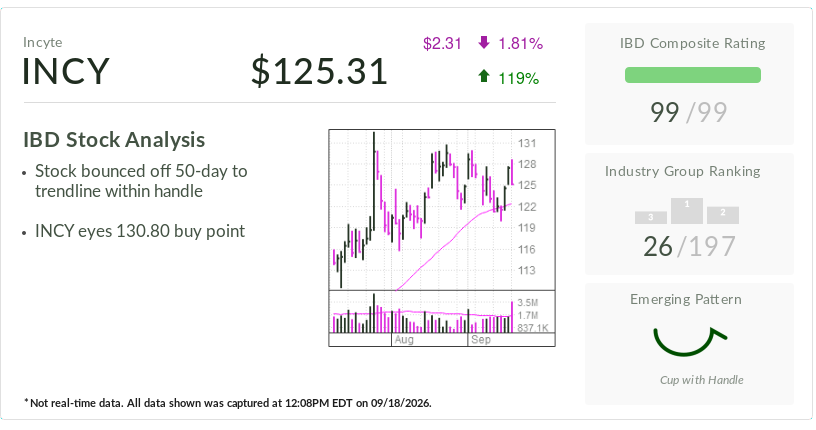
Incyte Incyte INCY $ 125.31 $2.31 1.81% 119% IBD Stock Analysis Stock bounced off 50-day to trendline within handle INCY eyes 130.80 buy point IBD Composite Rating 99/99 Industry Group Ranking 26/197 Emerging Pattern Cup with Handle Cup with Handle A positive chart pattern named such because it resembles the outline of a coffee cup with a handle. The pattern…
Copyright ©2026 Investor’s Business Daily, LLC. All rights reserved. 87990cbe856818d5eddac44c7b1cdeb8

Xenon Stock Craters 30% on Drug Trial Setback. Its Failure Could Be This Biotech’s Gain.

US says it killed four people in strike on vessel in Caribbean
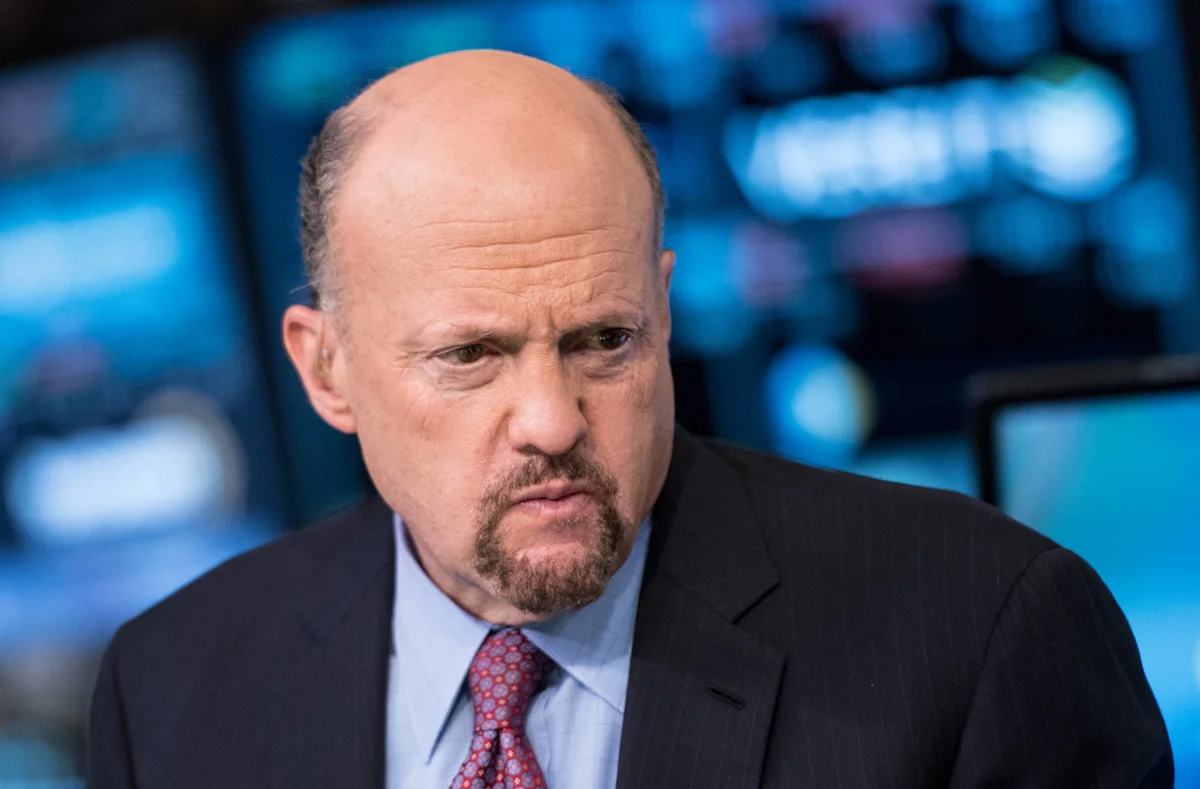
An old Wall Street adage just got a fresh test.
“Don’t fight the Fed” has guided generations of investors through rate cycles both gentle and brutal. This time, it came roaring back into the conversation after the central bank made its first major policy shift in more than three years.
Jim Cramer wasted no time translating what happened into plain language for viewers watching at home. His verdict landed within hours of the decision, and it was blunt enough to make anyone holding stocks in their portfolio pay very close attention.
Jim Cramer says don’t fight the Fed
Cramer delivered his warning on Sept. 16 on “Mad Money,” just hours after the Federal Reserve raised its benchmark federal funds rate by a quarter percentage point to a range of 3.75% to 4%.
“If you buy stocks here, you’re now officially fighting the Federal Reserve,” Cramer said, invoking the old adage that ignoring it tends to hurt returns.
It was the first hike since July 2023. More than three years without one, according to CNBC.
Warsh did not dress it up at the press conference.
“The plain fact is that inflation is too high, and has been for too long,” he said. The increase, he added, was meant to support a more timely return to the 2% target.
More Jim Cramer:
Trump reacted within hours, posting that he wanted interest rates at 1% “or less,” while telling reporters he still had confidence in Warsh. Before the decision, Trump had called committee members pushing for a hike “clowns,” CNBC reported.
Markets had been higher going into the decision. Warsh started talking, and that changed. The Dow dropped roughly 650 points. The S&P 500 and Nasdaq held up better. Rate hikes do not hit every sector the same way, and that showed up in the tape immediately.
Inside the Fed’s first hike in 3 years
The decision itself was unanimous. The Federal Open Market Committee voted 12-0 to lift the target range a quarter point, with Warsh notably declining to submit his own dot in the committee’s quarterly projections, Fortune reported.
The dot plot was not reassuring. The median official now sees the funds rate ending 2026 at 4.1%, up from 3.8% in June. That implies one more hike this year. Four members wanted two more. Only two saw no further increases. The committee that just raised rates is already signaling it is not done.
Cramer has drawn a pointed comparison between Warsh and his predecessor in recent commentary. He noted Warsh lived through the 2008 financial crisis as a Fed governor and was outspoken during the 2018 hiking cycle, arguing that experience makes him less likely to repeat Jerome Powell’s mistake of raising rates too far into a visibly weakening market, according to TheStreet.


Naomi Watts’ Oddly Chic Shoe Style Is on Amazon for $50

Ed Sheeran admits ‘mistakes’ as he addresses Macklemore controversy at Philadelphia show
China keeps benchmark lending rates unchanged for 16th month in September




-

 Fashion1 day ago
Weekend Open Thread: Talbots – Corporette.com
-

 Tech7 days ago
The Latest Weird Thing to Play Doom Is the Mapped-Out Brain of a Fruit Fly
-
 NewsBeat1 day ago
Trump says US has reached an agreement to take permanent control of Greenland’s security
-

 Crypto World5 days ago
Kraken Lets xStocks Holders Earn Yield Through DeFi
-

 Crypto World5 days ago
Revolut Attackers Warn of Ongoing Daily Customer Data Leaks
-

 Crypto World4 days ago
What Is the Status of the U.S.-Iran Peace Talks? Here's What Both Sides Are Saying
-

 Crypto World3 days ago
US Charges Robinhood Engineers Over Crypto Listing Trades
-

 Crypto World6 days ago
Elon Musk Drops a Bombshell: Grok 5 Could Be the AGI Breakthrough
-

 Crypto World4 days ago
Robinhood engineers charged over $50K crypto scheme
-

 Crypto World1 day ago
Circle launches Arc Studio AI agent for building onchain apps
-

 Crypto World1 day ago
Bitcoin price breaks channel as RSI climbs to 63
-

 Business7 days ago
Rivals Sam Altman and Elon Musk Rally Behind Dario Amodei’s Call for a Slowdown in AI Development
-

 Crypto World6 days ago
New Tesla Roadster Uses SpaceX Tech. Will It Impact the Stock Price?
-
 NewsBeat5 days ago
‘Sick conspiracy’: Trump says only guardrails AI needs is ‘a strong and smart (High IQ!) president’ in all-caps rant
-

 Crypto World5 days ago
NVIDIA Analysis: Attempted Rising Wedge Breakout Amid Pressure on the AI Sector
-
Business5 days ago
SK Hynix ADRs Fall More Than 6% as Memory Rally Breaks on Fears of Slower AI Spending
-

 Crypto World5 days ago
DOJ Seeks to Seize $61M in Iran Oil Funds From Binance Accounts It Vouched For
-
Crypto World5 days ago
Can Circle’s Arc Repeat Robinhood Chain’s Meme Coin Boom?
-
 NewsBeat7 days ago
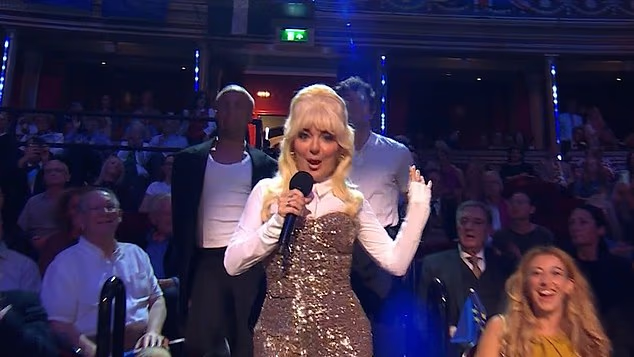
Last Night of the Proms pays moving tribute to Dolly Parton as Sheridan Smith wears a gold sequin jumpsuit in memory of the Queen of Country
-

 Crypto World6 days ago
3 Token Unlocks to Watch in the Third Week of September 2026
You must be logged in to post a comment Login