India’s shooting contingent has been caught in a continuing accommodation and logistical crisis at the 2026 Asian Games in Aichi-Nagoya, with athletes facing room allocation problems, long waits for transport and disruptions to their training schedules even before their events begin.
The problem resurfaced when shooter Rahi Sarnobat arrived later and found that the room booked for her at the Grand Tiara Hotel was unavailable because it was being used for dope control. The episode is the latest in a series of setbacks that have included athletes hauling equipment between properties and waiting hours for buses to the shooting range.
While Games organisers have said accommodation complaints have been brought down to “zero”, India’s decision to arrange additional rooms, transport and contingency support underlines the scale of the disruption faced by the contingent.
What is actually going on in Nagoya
The shooting contingent arrived in Nagoya on September 16 after travelling from India, but the accommodation it found on the ground did not match the booking information provided to the IOA.
According to a media report from NDTV, 40 rooms had originally been booked for the Indian shooting contingent at the Grand Tiara Hotel. When the athletes arrived, however, they were told that only seven rooms were available there, while another 33 rooms had been allocated at a Toyoko Inn property.
The problem resurfaced when five other members of the contingent, including Sarnobat, arrived later.
A coach went to the Grand Tiara to collect the key to Sarnobat’s room, only to be told that the room was no longer available because it was being used for dope control. The room had nevertheless been booked by the Indian Olympic Association and appeared in the accommodation records of the Aichi-Nagoya Asian Games organisers.
The episode became even more confusing when Sarnobat arrived in Nagoya on Friday night and went to another Toyoko Inn property. Rather than being told she was at the wrong hotel, she was given the keys to a room there. In effect, the shooter ended up with a room at the “wrong” hotel while the room booked for her at the designated hotel was unavailable.
The incident is significant because it is not simply a case of an athlete arriving without a booking. The booking existed, the IOA had the reservation and the organisers’ records confirmed it, but the room was nevertheless unavailable when the team attempted to use it.
Shooters also face transport and training disruption
The accommodation problems have been accompanied by transport delays that have affected the team’s preparation.
The shooters reached the airport at around 9 pm on September 15 and completed customs and accreditation formalities relatively quickly. But after leaving the accreditation centre, the contingent was left waiting for transport from around 11:45 pm until 3 am. The team eventually reached its hotel at around 3:30 am.
The accommodation arrangement then required athletes to move between two properties. By the time the emergency rooms were organised, the original transport had left. Members of the contingent had to drag suitcases, shooting equipment and ceremonial clothing between the hotels, with some male athletes making several trips to help their female teammates with the luggage. Check-in was finally completed between 5 am and 5:30 am.
The following morning brought another problem. The team was scheduled to leave at 7 am for training and was expected to reach the shooting range by around 8:20 am. Only one bus arrived initially, leaving athletes and coaches waiting for around three and a half hours. They eventually boarded a bus at 10:30 am and reached the venue only at around 12:30 pm.
The shooting range is reportedly around 50–60 km from some of the accommodation, with journeys taking as long as two hours. Indian athletes have also reported long bus queues, cramped accommodation and cold food, adding to the logistical concerns.
There has also been a separate accreditation problem involving India’s pistol shooting head coach Samaresh Jung. His accreditation initially did not allow him access to the players’ arena and field of play during competitions, forcing the issue to be taken up with the National Rifle Association of India.
For a shooting team, these are not merely inconveniences. Long journeys, delayed training access and uncertainty over accommodation can eat into the time available for preparation and recovery.
It is not just the shooters
The problems affecting the shooting team have emerged as part of a wider accommodation and logistical problem involving the Indian contingent.
The rowing team faced long waits for rooms on the Costa Serena cruise ship, one of the main accommodation facilities being used for the Games. Some rowers were reportedly asked to share rooms, while three Indian women rowers were initially missing from the hosts’ registration system despite having valid accreditation.
The badminton contingent was also shifted to hotels after delays in receiving its designated accommodation. Wushu players and coaches encountered registration problems, while the table tennis team reported a lengthy check-in process.
An Indian MMA fighter, Varun Sanyal, also publicly confirmed that Indian athletes had been left waiting for accommodation, saying he had been waiting for seven hours when he posted about the situation.
Why has the accommodation crisis happened?
A major reason for the confusion is the accommodation model chosen for the Aichi-Nagoya Games.
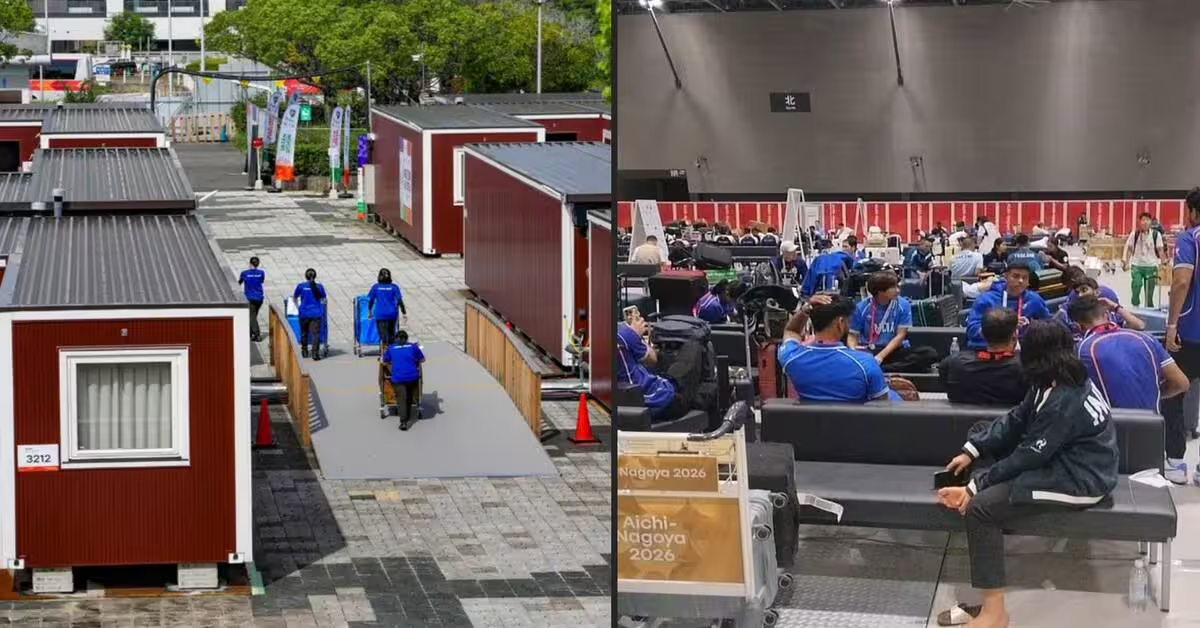
There is no conventional centralised Athletes’ Village. Instead, athletes and officials are being housed in hotels, the Costa Serena cruise ship and temporary accommodation built using container-style units at Garden Pier. The cruise ship can house several thousand participants, while around 2,000 people are expected to use the temporary units.
Organisers have defended the model as a deliberate choice rather than a failure to provide a traditional village.
The Olympic Council of Asia has said that building a conventional Athletes’ Village would have created a facility that could become underused after the Games. The alternative model was intended to reduce costs and avoid leaving behind large amounts of unused infrastructure.
Higher participant numbers add to logistical pressure
The increase in the number of registered participants has emerged as one explanation offered by organisers for the accommodation pressure. Organisers had planned around 15,000 participants but ultimately had to accommodate more than 17,000 registered athletes and officials. Officials have pointed to late entries and the addition of new sports as factors behind the increase.
Asian Games organising committee chairman Tayyab Ikram, however, said in an interview with the news agency ANI that the increase was only a few hundred above the number originally planned for, although he acknowledged that there had been a cluster of problems during the initial arrivals. He said the organising committee had accommodated everyone despite the additional pressure.
That explanation is important because it is at the centre of the disagreement over what actually went wrong: organisers have pointed to the pressure created by participation numbers and the complexity of the decentralised model, while India says its own numbers had been communicated and invoiced for in advance.
Organisers say complaints are now ‘zero’
The Indian account has to be viewed alongside the organisers’ assessment of the situation. Tayyab Ikram said on September 18 that all genuine complaints regarding accommodation had been addressed.
“At this moment, we have brought all the actual complaints down to zero,” Ikram said, while arguing that some of the criticism that remained on social media came from particular perspectives.
Ikram said every athlete and official was now settled and that the National Olympic Committees were reporting zero complaints during daily coordination meetings. He attributed the initial problems to an unexpectedly high number of arrivals and defended the container accommodation, describing the facilities as comparable to high-end accommodation.
The organisers have therefore drawn a distinction between the initial disruption and the current situation: their position is that the early problems occurred but have since been resolved. India’s actions provide a different picture of how the situation is being handled operationally.
What India says happened
India’s Chef de Mission Sahdev Yadav has acknowledged that there was mismanagement in the initial accommodation process.
Yadav said organisers had informed India that more players than expected had arrived. India’s response was that it had stuck to the number of athletes for which it had been invoiced, and that organisers had removed around 30–35 names from the accommodation list.
India therefore had to arrange hotels for those athletes. Yadav said the Indian side quickly moved to secure accommodation and had booked 18 hotel rooms, with plans to book another 10. He identified badminton and shooting among the contingents affected.
He also said India had arranged additional vehicles and sent officials to airports to receive arriving athletes, particularly because of delays in accreditation and accommodation.
The Indian approach has therefore been to solve the immediate problems itself rather than wait for every issue to be resolved through the Games’ central accommodation system.
India prepares for more accommodation problems
Even after the organisers’ assurance, India is maintaining its own contingency arrangements. The Sports Ministry has adopted a three-layer response involving officials at the airport, additional hotel bookings and outreach to the Indian diaspora. The Indian Embassy has contacted around 2,000 Indian families in Nagoya, with several offering assistance if further accommodation shortages emerge.
The first priority remains to put athletes in hotels or official accommodation. But the diaspora is being kept as a fallback option if rooms become unavailable.
India is also strengthening its transport arrangements so that athletes are less dependent on the Games’ bus system. Officials have been deployed at the airport and welcome centre to help with registration and accommodation, while additional buses have been arranged for the Indian contingent.
This means India is effectively running a parallel support system alongside the official Games arrangements.
What happens next?
The next few days will be important because a substantial portion of India’s contingent was still to arrive in Nagoya as the Games are set to officially kick off on September 19.
For the shooters, the immediate priority is to ensure that accommodation and transport problems do not continue to interfere with training. Their experience has already involved a combination of room-allocation confusion, late-night transfers, long waits for buses and lengthy journeys to the range.
Typhoon risk lingers as Nagoya prepares for grand opening ceremony
As if the organisational issues were not enough, the 2026 Asian Games now face another immediate challenge, with Typhoon Dujuan threatening to disrupt competition and athlete movement in the opening days of the Games.
Severe weather has already caused delays and postponements in some events, while heavy rain in Nagoya earlier this month disrupted transport and briefly forced hundreds of athletes and officials to evacuate their accommodation.
The latest forecast has put September 21 in focus, when the storm could bring heavy rain and strong winds to central Japan. Japan’s chef de mission Kosei Inoue said organisers were preparing for further disruption, while Nagoya Mayor Ichiro Hirosawa said athletes could be temporarily evacuated if torrential rain triggers emergency alerts.
The weather threat is particularly significant because more than 4,000 athletes and officials are staying aboard the Costa Serena cruise ship. Organisers have said the vessel would move offshore if winds reach typhoon strength, creating a fresh logistical challenge after days of accommodation and transport problems.
With the opening ceremony scheduled for Saturday, the immediate concern is no longer simply whether Nagoya will receive bad weather, but whether the storm will disrupt the movement of athletes, competition schedules and accommodation arrangements just as the Games enter their main phase.





;)


;)
;)


;)

;)

;)





















![[EN VIVO] Jugando Pelota Dura, Fuera del Parque & The Financial Hub - 18 de septiembre de 2026](https://wordupnews.com/wp-content/uploads/2026/09/1789953393_maxresdefault-80x80.jpg)
































You must be logged in to post a comment Login