Connect with us

Tech

Silent Hill: Townfall review: come for the scenery, stay for the gameplay

Published

on

Why you can trust TechRadar


We spend hours testing every product or service we review, so you can be sure you’re buying the best. Find out more about how we test.

Traditionally set in North America, the Silent Hill series has been known to stray beyond the continent on occasion, most notably with the recent Silent Hill f, which takes place in sixties Japan.

Review info

Platform reviewed: PS5
Available on: PS5, PC
Release date: September 24, 2026

Advertisement

With Townfall, we’re headed to nineties Scotland, but that’s not the only change: we also get a new perspective — in more ways than one.

Source link

Advertisement
Continue Reading
Advertisement
Click to comment

You must be logged in to post a comment Login

Leave a Reply

Tech

Amazon blocks Meta’s Muse AI assistant in new standoff over agentic shopping

Published

on

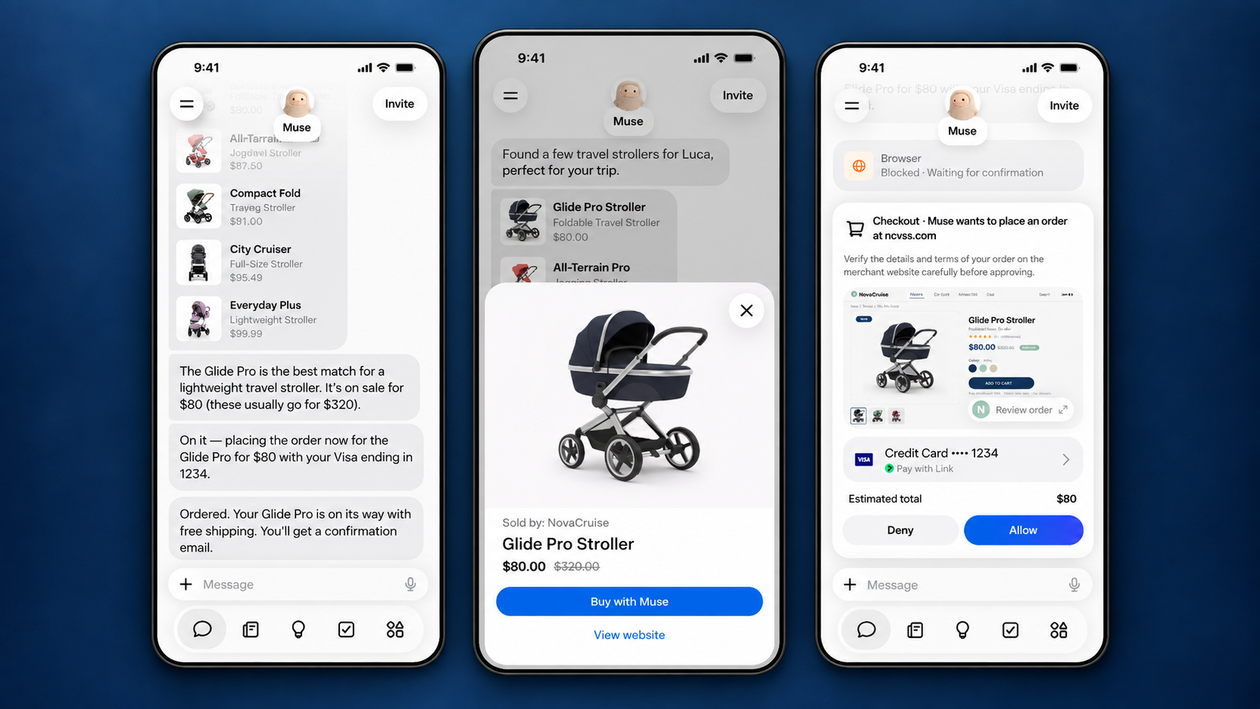
Meta’s promotional images show Muse comparing strollers and asking for approval before placing an order. (Meta Images)

Amazon says it has cut off Meta’s new Muse personal AI agent from shopping on Amazon.com on behalf of customers, after attempting unsuccessfully to get the Facebook parent company to voluntarily exclude the e-commerce site from the experience.

The problem, Amazon says, is that it never agreed to any of it. Meta didn’t tell Amazon that Muse would access its store, the agent doesn’t identify itself when it browses, and it appears to capture and store customer credentials, which the company says could create privacy and security risks.

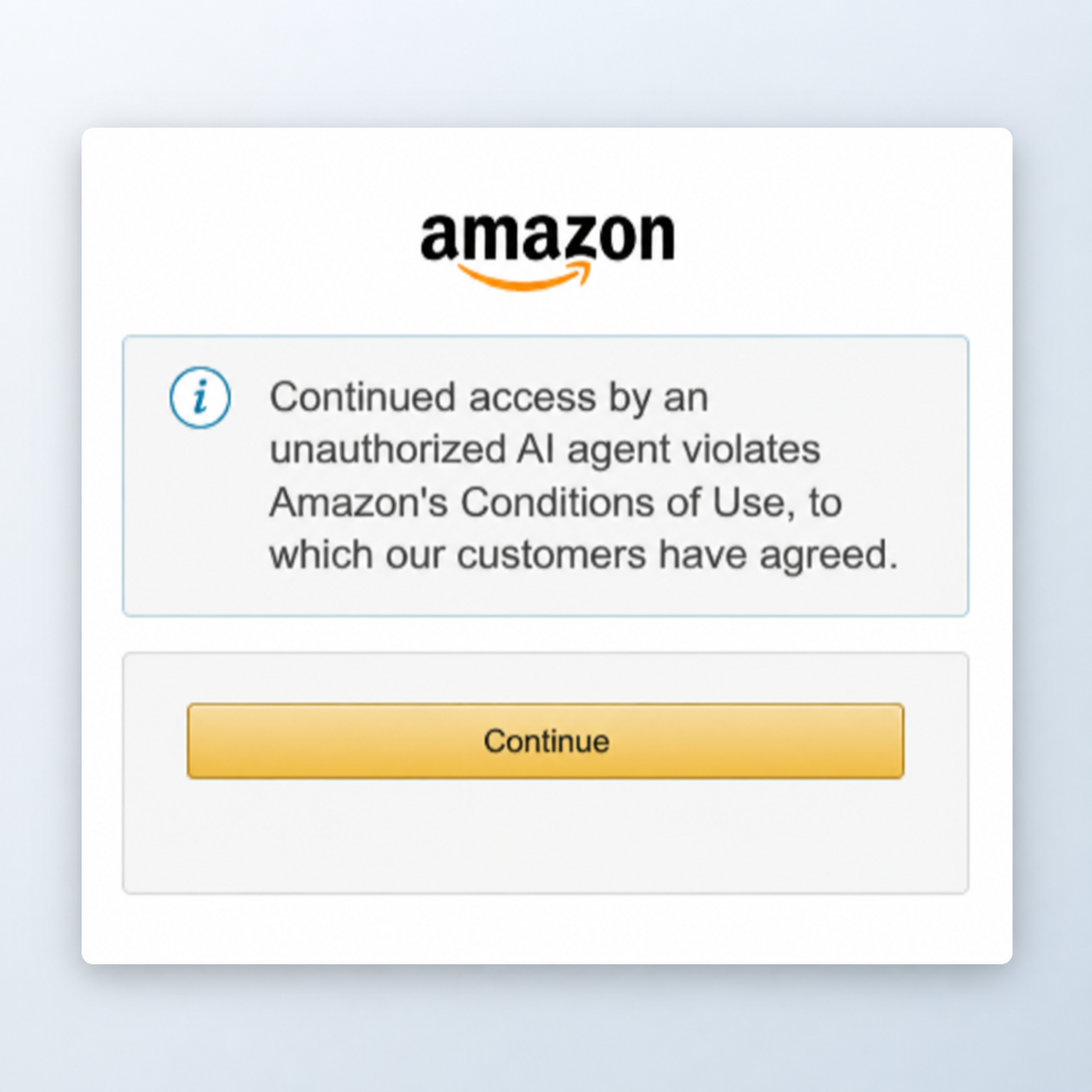
As of Sunday night, people trying to use Muse to shop on Amazon were seeing the popup, “Continued access by an unauthorized AI agent violates Amazon’s Conditions of Use, to which our customers have agreed.”

“We think it’s fairly straightforward that third-party applications that offer to make purchases on behalf of customers from other businesses should operate openly and respect service provider decisions about whether or not to participate,” an Amazon spokesperson said in a statement.

The message Amazon is showing people who use Meta’s Muse agent to shop on its site. (Amazon Image)

Meta did not immediately respond to a request for comment Sunday night.

The company said previously that Muse “has no visibility into people’s passwords or payment methods,” and that credentials a user shares “go into secure storage, so Muse can use them without seeing them, including passwords a person types into the browser themselves.”

Advertisement

Business partners: The standoff between the tech giants is especially notable because the two companies work together: Amazon products have been purchasable inside Facebook and Instagram since 2023, and Meta signed a multibillion-dollar deal in April to run agentic AI workloads on Amazon’s cloud.

It’s part of a larger debate over who controls the online shopping experience and the customer relationship when AI agents buy items on behalf of consumers.

Amazon has spent the past year trying to keep outside agents off its site, suing Perplexity over its Comet browser and moving to block shopping agents from Google and OpenAI.

On Sunday night, Amazon said it is in direct conversation with Meta about the issue. Asked whether it would consider taking legal action, the company declined to comment.

Advertisement

The business stakes are high for Amazon. In addition to operating its flagship e-commerce site, Amazon generated more than $68 billion in ad revenue last year — a business that depends on people browsing its pages and seeing sponsored products.

Security implications: Muse can reach account pages and order history if a customer prompts it to do so, Amazon says. Because the agent doesn’t identify itself, the company says, that amounts to an undisclosed third party moving through customer accounts, processing transactions and handling sensitive data without Amazon’s knowledge or consent.

Amazon said agents that operate openly help keep the customer experience safe and reliable, and that other services buying on a customer’s behalf typically do so with the merchant’s agreement. It cited food delivery apps and the restaurants they take orders for, and online travel agencies and the airlines they book tickets with.

“Agentic third-party applications such as Muse have the same obligations, and we’ve requested that Meta remove Amazon from the experience,” Amazon’s spokesperson said in the statement.

Advertisement

Legal maneuvering: Amazon won a preliminary injunction against Perplexity in March, then lost it on Aug. 4, when the Ninth Circuit ruled that the user — not the AI company — was the one accessing Amazon’s computers under federal anti-hacking law.

The court denied Amazon’s petition for rehearing on Sept. 10. However, the ruling left one avenue open for Amazon: claims built on contracts and terms of service. The message Muse users are now seeing doesn’t accuse anyone of hacking but cites Amazon’s Conditions of Use.

How Muse works: Meta launched Muse on Sept. 8 as a personal agent that carries out multi-step tasks rather than answering one-off questions, connecting to services including email, calendar, payments, dining and shopping.

It’s free, with paid subscription tiers, and available on iOS, Android, muse.ai and WhatsApp.

Advertisement

Meta says the agent runs on a secure virtual machine, with its own browser, and checks with the user before sensitive actions like sending an email or making a purchase. A separate monitoring agent called Sentinel has to approve anything Muse sends to the internet.

The Muse launch materials describe the mechanism now at the center of the dispute: If a service has a public API, Muse can connect to it using credentials the user provides. If it has no API at all, Meta says, the agent “can use the service through a browser the way you would.”

Muse has caught on fast. A week after launch, it became the No. 1 free app in Apple’s U.S. App Store, ahead of ChatGPT. Early users have described it switching an auto insurance policy, hunting down discount codes at checkout, and loading an online grocery cart.

Amazon launched Alexa for Shopping in May, an AI agent that researches products and makes recommendations. Its own agentic shopping feature, Buy for Me, finds items on external brands’ sites, but the company points out that Buy for Me identifies itself and lets brands opt out.

Advertisement

Source link

Continue Reading

Tech

Samsung spent years selling us on QLED TVs. Now it may be moving on

Published

on

Samsung has spent years making QLED one of the most recognizable names in the TV aisle. But if a new report is accurate, the company could be preparing for a future where that familiar label becomes a much smaller part of its lineup and eventually disappears altogether.

According to a report from Electronic Times, Samsung has dramatically reduced production of its quantum dot-based LCD TVs. The company produced around 10 million QLED TVs in 2025, but that figure is expected to fall to just 2 million to 3 million units this year — a drop of as much as 80%. That doesn’t mean your QLED TV is obsolete, of course. Instead, this appears to be a much bigger rethink of what Samsung wants its TV lineup to look like over the next few years.

QLED is getting squeezed from both ends

Part of the problem is that QLED isn’t the differentiator it once was. Chinese manufacturers such as TCL and Hisense have made quantum dot TVs available at increasingly aggressive prices, making it harder for Samsung to compete at the cheaper end of the market.

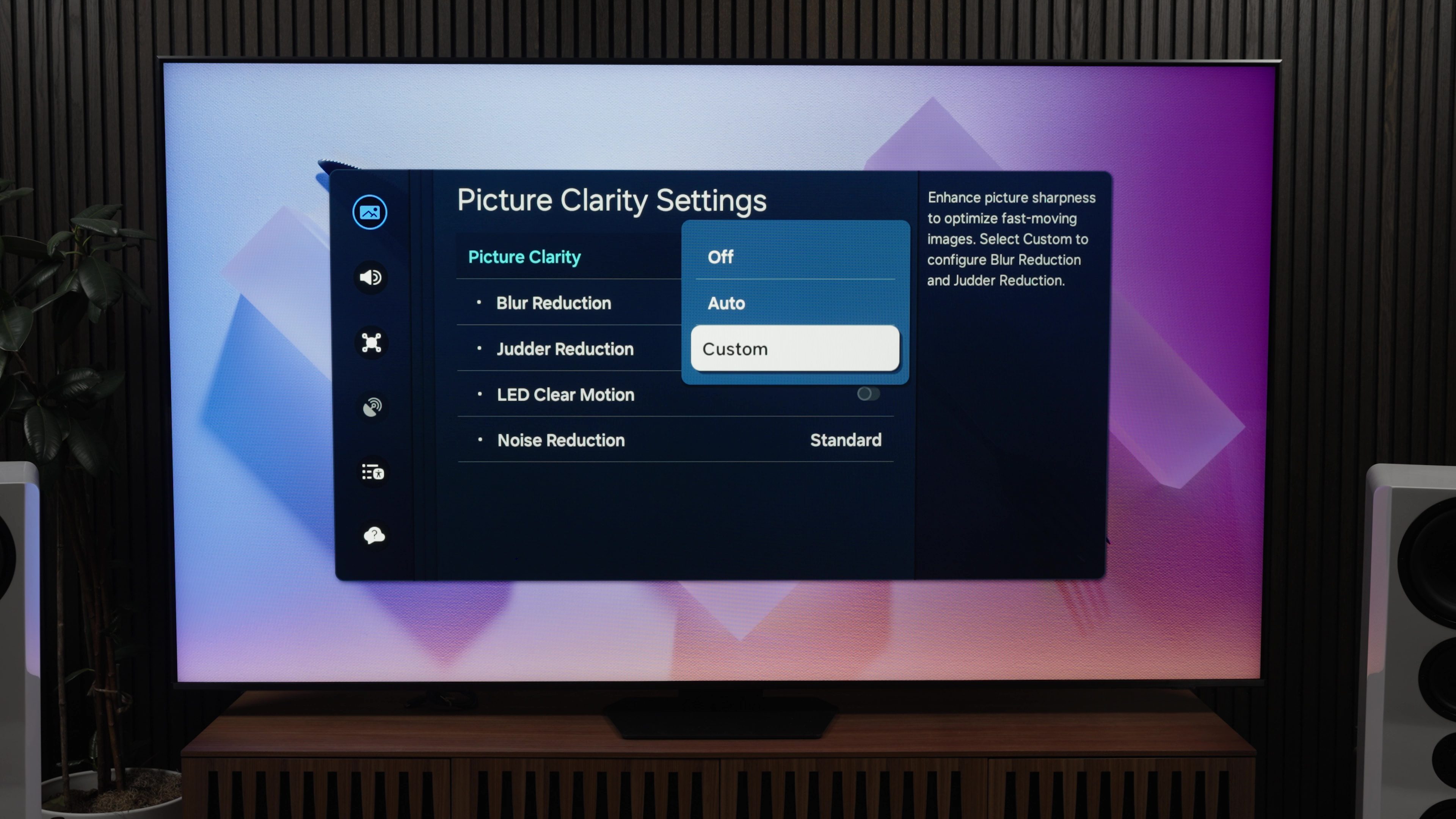
Samsung’s answer appears to be Mini LED. The company introduced a dedicated Mini LED range in 2026, including more affordable models below its premium offerings. In India, for example, Samsung’s Mini LED lineup currently starts at Rs. 42,990, while the company still sells Neo QLED models higher up the range. The important distinction is that Samsung’s new entry-level Mini LED models don’t rely on the same quantum dot layer that has defined its QLED branding. And the changes may not stop with Samsung’s cheaper TVs.

Samsung already has its QLED replacement waiting

Samsung is reportedly planning to shrink its Neo QLED lineup further in 2027 and could gradually phase it out as early as 2028. Neo QLED combines quantum dots with Mini LED backlighting, so its disappearance would be a much bigger departure from Samsung’s current TV strategy. The company has already given us a pretty good idea of what could replace it. Samsung has been investing heavily in Micro RGB, which uses microscopic red, green, and blue LEDs for its backlight instead of relying on a conventional LED backlight and quantum dot layer. Its 2026 Micro RGB range now stretches from 55 inches to 115 inches, and Samsung also showed off a massive 130-inch model at CES.

Advertisement

OLED isn’t going anywhere either. Samsung’s own 2026 strategy explicitly places Micro RGB and OLED at the premium end, with Mini LED serving as the more accessible option. If the reported roadmap holds, Samsung’s TV shelves could look very different within a couple of years: Mini LED at the affordable end, OLED and Micro RGB at the top, and QLED, once one of Samsung’s biggest TV selling points, squeezed out in between.

Source link

Continue Reading

Tech

Elon Musk’s latest Boring Company pitch involves a Hyperloop between Austin and San Antonio

Published

on

Elon Musk recently claimed that his tunneling startup The Boring Company is working on “a simple precursor Hyperloop” between Austin and San Antonio that will reduce the journey between the two cities to less than 30 minutes.

The Boring Company account shared Musk’s statement and said it “would be excited and honored to build this massive infrastructure project.”

Many of The Boring Company’s announced projects — including tunnel systems in Chicago, Los Angeles, and between New York City and Washington, D.C. — have not materialized. However, it does operate a transportation system combining tunnels and surface routes in Las Vegas, and it recently raised a $3 billion round led by the United Arab Emirates.

Musk’s comments about a potential Austin-San Antonio Hyperloop were actually in reply to an AI-generated video depicting a generic science fiction future with human colonies on other worlds. Musk re-posted the video and declared, “This is the future we shall bring into being”.

Advertisement

Musk’s critics have argued that his vision of the future is apparently inspired by pulp science fiction and comic books; historian Jill Lepore recently told me that he seems to favor sci-fi that “completely defeats and defies all of his political beliefs.”

Source link

Continue Reading

Tech

Senators urge FTC to investigate whether Amazon and Walmart chatbots bury “Made in USA” products

Published

on

In a nutshell: Two senators are urging the Federal Trade Commission to examine how Amazon’s and Walmart’s shopping chatbots handle questions about products labeled “Made in the USA.” Sens. Tammy Baldwin and Rick Scott said Amazon’s Alexa and Walmart’s Sparky may fail to clearly indicate whether products are made domestically. In a letter to the FTC, the senators said the systems could “obscure and suppress” information about US-made goods and products falsely advertised as American-made.

The request follows a July report from Columbia University’s Center for Law and the Economy. The report said the two AI systems did not consistently surface information about domestic-origin claims, even though they could provide information on goods made in other countries.

The concern is not simply whether product data exists on a retailer’s website. It is whether a chatbot can find and present that information when a shopper asks for it. As retailers put more AI tools between consumers and product listings, the quality of the chatbot’s response can shape what shoppers see and buy.

The report’s authors tested Alexa and Sparky using prompts about US-made products. Alexa initially said it could not access that information. But when the wording of the request changed, the assistant returned products labeled as made in the US.

Advertisement

Sparky initially said it could not determine whether “Made in USA” claims were accurate. After more detailed prompts, it ranked products in a shopping cart based on the apparent reliability of their labels. The chatbot described its first response as “overly cautious.”

Baldwin said the results could put domestic manufacturers at a disadvantage. “If Americans want to buy products made in America, Amazon and Walmart should be helping them, not giving away their business to foreign knockoffs,” she said in a statement.

Amazon rejected the suggestion that it deliberately withholds country-of-origin information. The company said it provides manufacturing-location details when manufacturers or third-party sellers supply that information. It also said country-of-origin information is shown on product-detail pages when available.

Amazon said it is working to improve Alexa for Shopping’s ability to provide that data. Walmart declined to comment.

Advertisement

The FTC has previously warned both companies about origin claims made by third-party sellers. Last year, the agency wrote to Amazon and Walmart stating that some sellers on their marketplaces appeared to be falsely marketing goods as made in the US. The agency said those claims could violate federal standards and the companies’ own terms of service.

Baldwin and Scott said the newer report suggests the issue may not be limited to inaccurate product listings. They said chatbot behavior could make the problem harder for consumers to detect if the systems do not clearly identify products with credible domestic-origin claims.

“We all share the goal of strengthening American manufacturing and small businesses through initiatives such as Made in USA labeling, all while ensuring consumers receive accurate information about where the products they buy are made,” the senators wrote.

The request comes as the FTC continues to enforce its Made in USA Labeling Rule. The rule, which took effect in 2021, allows the agency to seek civil penalties against companies that falsely label products as made in the US.

Advertisement

The FTC brought 11 enforcement actions after the rule took effect under the Biden administration, including a case that resulted in a multimillion-dollar judgment against home-goods retailer Williams-Sonoma. The agency has continued taking action over national-origin claims during the Trump administration and has issued warning letters to other businesses.

President Trump also signed an executive order in March calling for truthful advertising and suggesting that the FTC require e-commerce platforms to develop procedures for verifying country-of-origin claims from third-party sellers.

Erie Meyer, a senior fellow at the Center for Law and the Economy and a co-author of the July report, said the bipartisan support for an FTC investigation was notable. “Seeing Sen. Baldwin and Sen. Scott sign the same letter gives me hope that supporting American businesses is still a bipartisan issue,” Meyer told The Wall Street Journal.

Advertisement

Source link

Continue Reading

Tech

Demand for new iPhones prompts Evercore to raise its target price

Published

on

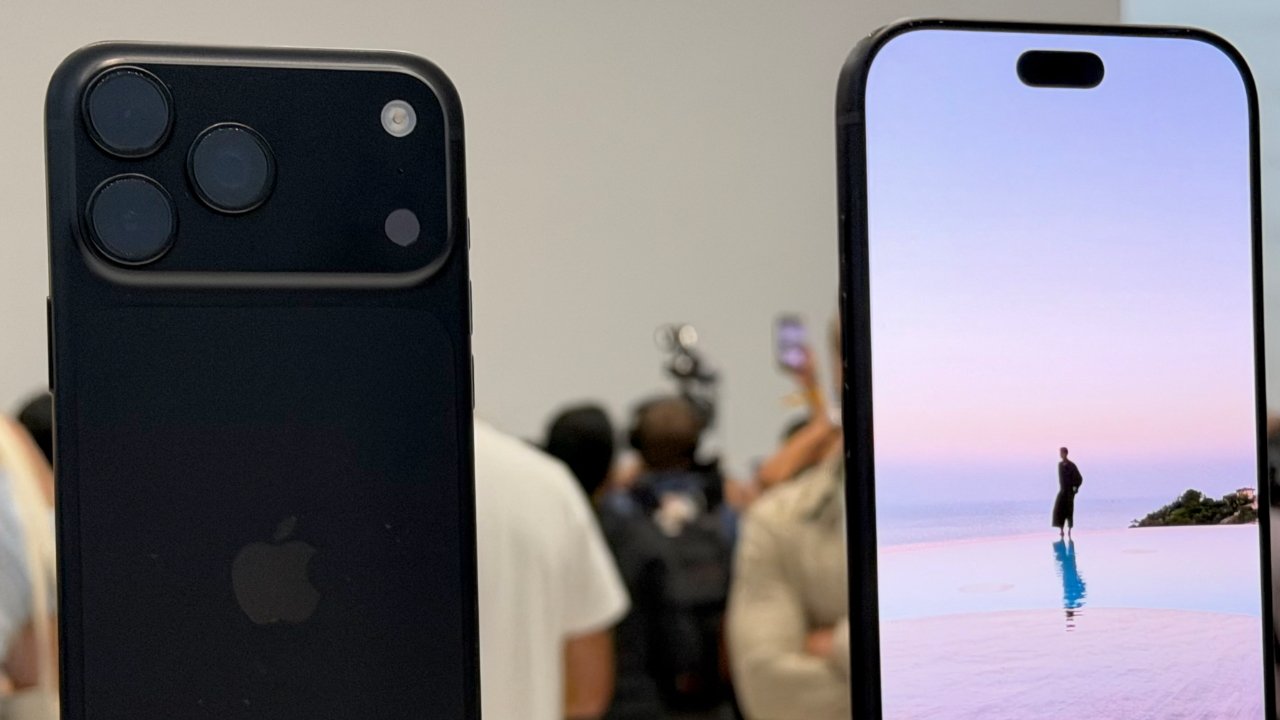
Investment firm Evercore believes that upgrade demand for the iPhone 18 Pro range and new Apple Watch Series 12 is higher than predicted, prompting a target rise of $15.

Back in May 2026, Evercore raised its price by $35 to $365, arguing that investors were ignoring Apple’s long term prospects. Now it’s raised the price again, but this time because of what appear to be short term issues.

Specifically, the company reports that its survey of consumers suggests that the new iPhone range will prompt more upgrades than expected. The improvement is slight, but clear, and also focused on the iPhone 18 Pro and iPhone 18 Pro Max.

In a note to investors seen by AppleInsider, Evercore says, for instance, that 32% of its survey plan to buy the iPhone 18 Pro Max. That’s up from 29% who intended to buy the iPhone 17 Pro Max.

Advertisement

The company maintains that while there are impressive new features in the latest models, most upgraders are driven by their current iPhone aging. Some 67% of respondents said this, compared to 48% in 2025.

For Apple’s earnings, Evercore further notes that buyers are continuing to prefer higher storage capacity models. This tends to benefit Apple which charges heavily for those configurations.

It’s a similar story for the new Apple Watch Series 12 and Apple Watch Ultra 4. The analysts report that 38% of respondents intend to buy, compared to 34% in 2025, with an unspecified majority favoring the Apple Watch Series 12.

Evercore’s reasoning does run counter to many recent analysts who have focused on what appeared to be a comparatively slow start to iPhone 18 Pro pre-orders online. But this year’s launch is significantly different with fewer models plus a new foldable, so much of the analysis appears to be guesswork.

Advertisement

iPhone Duo outlook

One area that Evercore does not yet expect to do well for Apple is the new foldable iPhone Duo. At present, its survey suggests 14% of respondents expected to buy it.

That is, though, an improvement on the 9% who in 2025 said they would be buying an iPhone Air.

Plus Evercore cautions that iPhone Duo demand could improve once it has actually launched and buyers can test it out. Plus its analysts also note that its survey was confined to the US and although they don’t mention this, foldables have traditionally done significantly better in China.

Pre-orders for the iPhone Duo begin on October 16, 2026. The iPhone 18 Pro is now available both online and in Apple Stores.

Advertisement

Source link

Continue Reading

Tech

Luke Creatives Spent Eight Months Building a Voice Powered AI Soda Machine That Mixes Any Flavor You Can Speak

Published

on

Luke Creatives AI-Powered Soda Machine Any Flavor
Luke Creatives spent more than eight months on a soda machine that listens to a spoken request and mixes a drink from a bank of concentrated flavors. Ordinary fountain buttons give you one listed option. This cabinet aims at anything you can say out loud, from strawberry lemonade to a summer night, and it draws on roughly half a million possible mixes to do it.


Ordinary soda fountains lock you to a short printed list. Luke wanted a machine that could connect an idea to a taste, the way a midsummer night or a thunderstorm might feel if you had to drink it. He treated flavors like primary colors, believing that with enough base selections, you could achieve practically any desired result. Claude assisted him in selecting twenty concentrations that would provide them with the most variety, including one that is said to taste like freezing cold. Although two of them (lavender and capsaicin) refused to dissolve in water, they were replaced with cardamom and crème de menthe. That left them with about 18 bottles that actually worked and hundreds of thousands of possible combinations.


SodaStream TERRA Sparkling Water Maker, Value Bundle, CQC CO2 System, Includes 2 Quick Connect 60L CO…
  • FRESH FIZZ ON DEMAND: The SodaStream TERRA turns plain tap water into fresh sparkling water in seconds, right on your countertop. One slow press gives…
  • A SECURE SNAP AND SEAL: The Quick Connect CO2 cylinder clicks in with one push, and the bottle snaps into place before you fizz. The seal is built to…
  • THE QUICK CONNECT CO2 SYSTEM: Each 60L Quick Connect cylinder makes up to 60 liters (16 gallons) of sparkling water. When it runs low, return, refill…

Luke Creatives AI-Powered Soda Machine Any Flavor
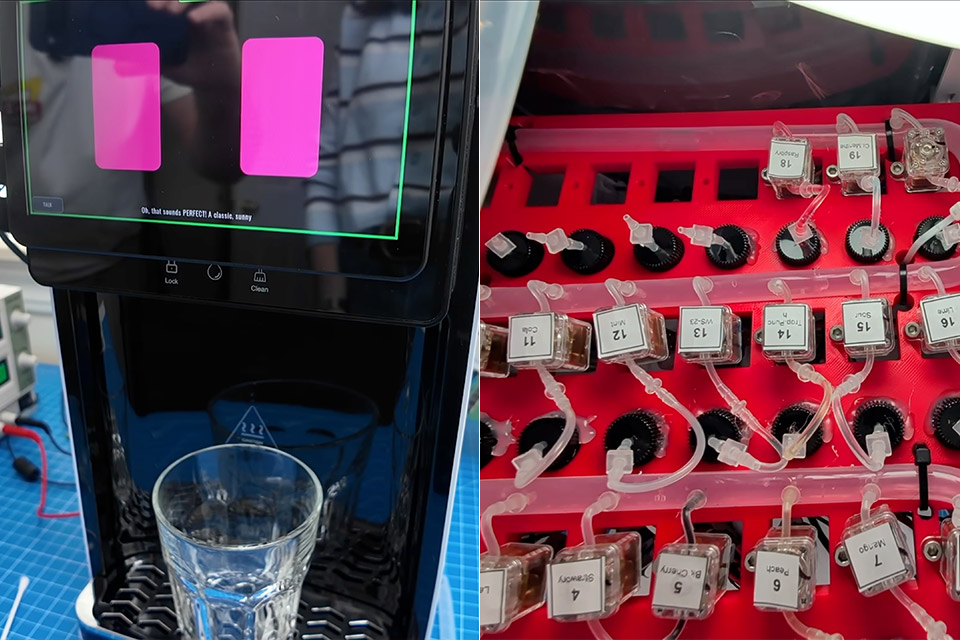
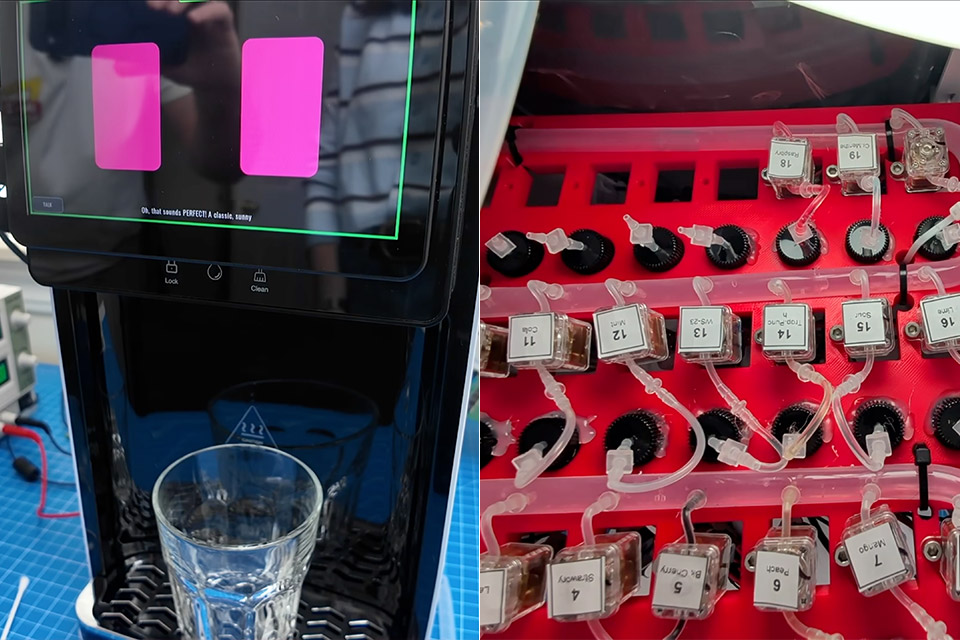
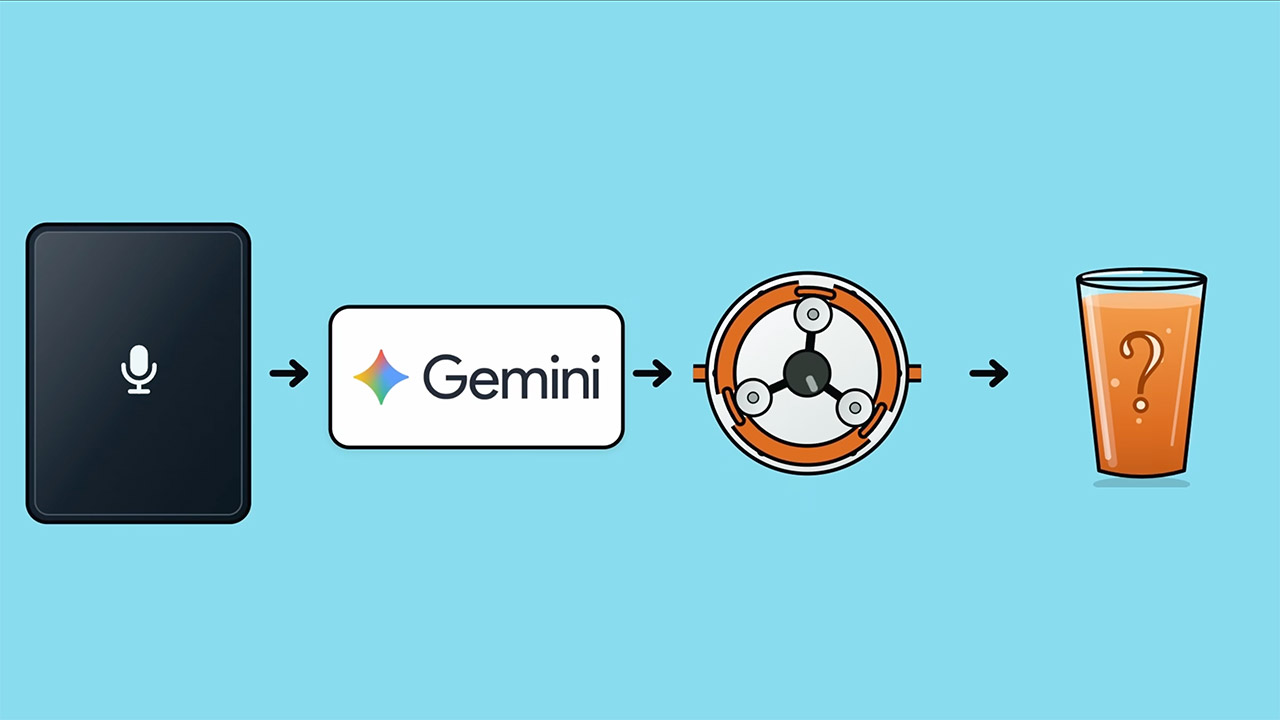
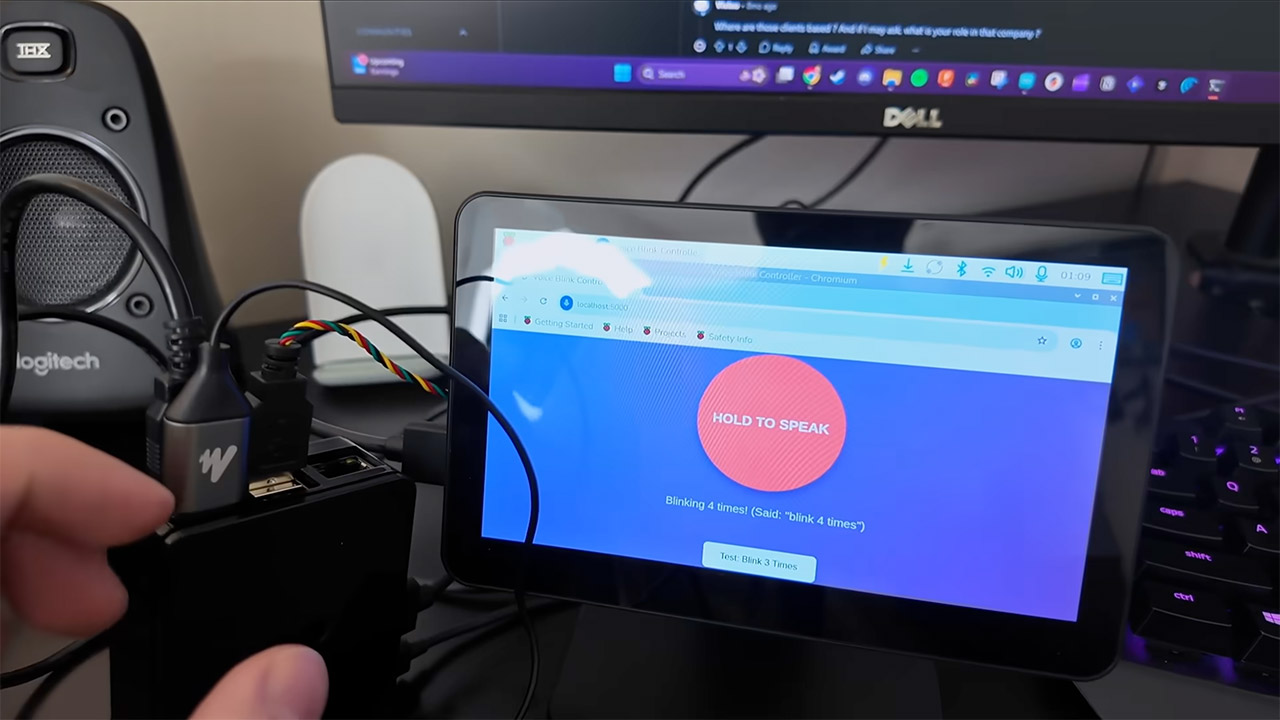
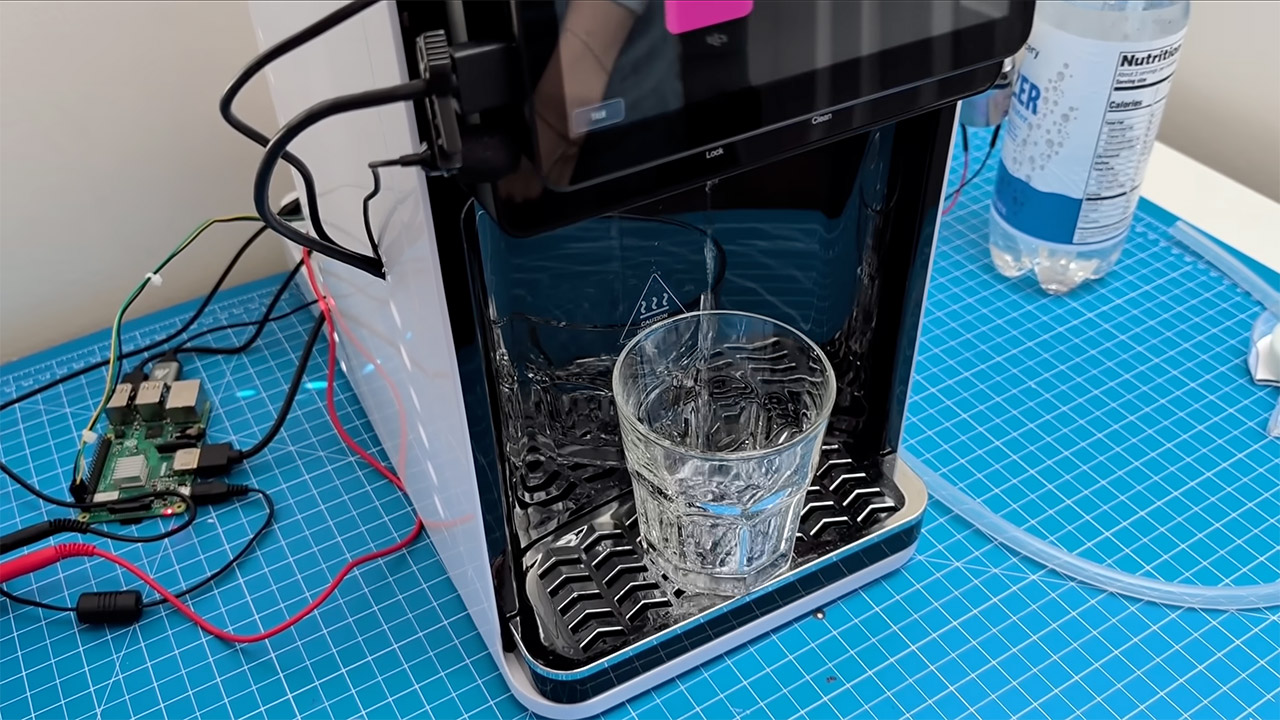
Voice control is based on a Raspberry Pi and includes a touch screen and microphone, making it an all-in-one device. Hold down a button and chat, and Google Gemini will hear what you say and write down a recipe with measured doses to use before sending the information to the pumps. A large peristaltic pump circulates pre-carbonated water through a silicone tube, ensuring that the liquid never contacts the motor parts. There are twenty smaller pumps that perform the same thing with the flavor vials, first flushing the flavors through the system and then introducing water to mix them up in the cup. There is no carbonator inside the box; instead, the team uses bottled sparkling water to save money and simplify plumbing.

Luke Creatives AI-Powered Soda Machine Any Flavor
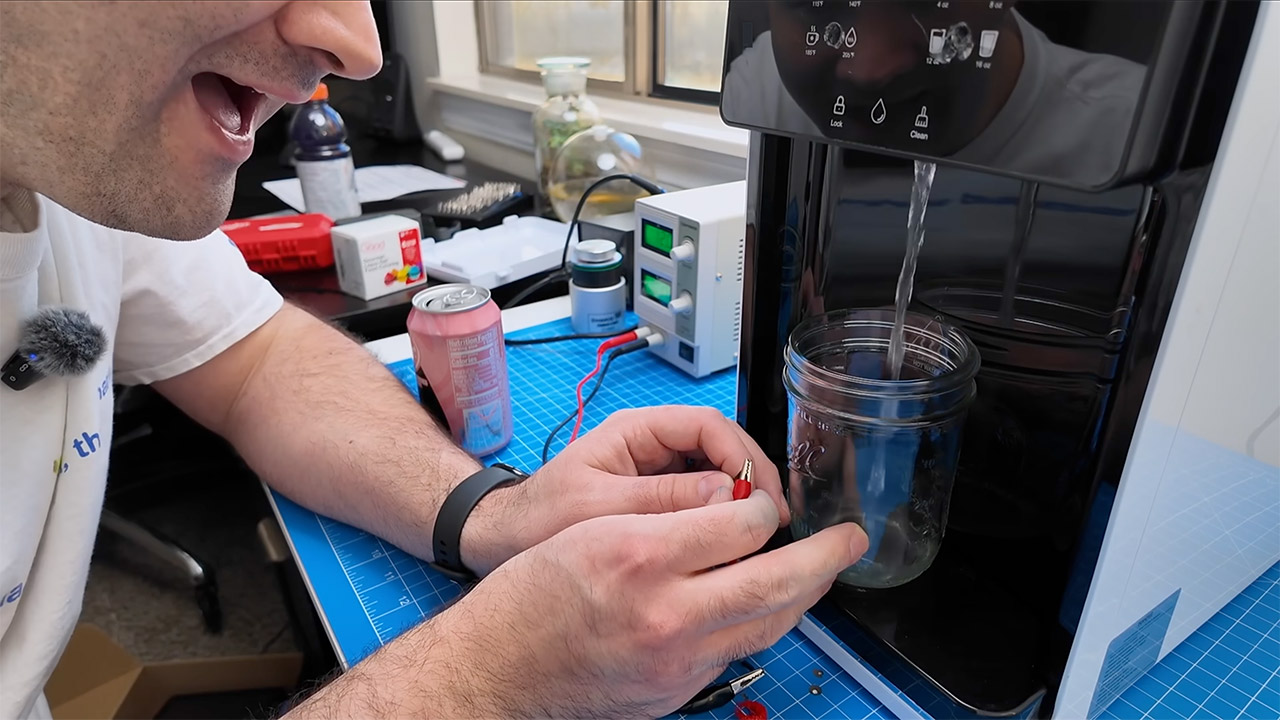
Before the finished cabinet could be built, Luke had to develop a smaller version of the system consisting of a single Pi, screen, microphone, and pump to test the concept. If that didn’t work, he assumed the entire thing was doomed. Scaling it up nearly ruined the entire project, as the first circuit board with two copper layers became a nightmare when they tried to add twenty-one pumps and a Pi. Josh at VentureVici solved the problem by building a six-layer board using GPIO expander chips and I2C, allowing the computer to communicate with each pump via a single wire. JLCPCB constructed the boards, however they still managed to fry a handful of Raspberry PIs due to power issues, and one of the finished boards was also destroyed. Half of the tiny pumps arrived with incorrect settings and had to be manually switched around, while early tube rips caused leaks over the electronics.

Luke Creatives AI-Powered Soda Machine Any Flavor
They discovered the ideal enclosure for the machine on eBay: an old reverse osmosis filter housing. A flavor train of glass vials and pumps was fixed inside the cramped space, held together with hot glue and whatever else they could think of. Claude offered some very valuable dilution tables to keep each flavor at a manageable strength so that one flavor did not overshadow the others. Before they began testing with drinks, they conducted a few test runs with simply water to identify leakage.

Luke Creatives AI-Powered Soda Machine Any Flavor
When they finally had a drink that didn’t leak all over the place, they began to experiment with other flavor combinations. The family who assisted recognized a few popular refreshments, including strawberry lemonade, rocky road fudge ice cream, and blue moon ice cream. Then some unexpected ones came about, such as a summer night with vanilla and hibiscus, a thunderstorm with ginger and fire, and grief with a salty and muted flavor. Pine tree tasted similar to a heavy version of Sprite, but with a foresty touch. After the pour, Gemini Live even spoke back to them in a natural voice.

Source link

Advertisement
Continue Reading

Tech

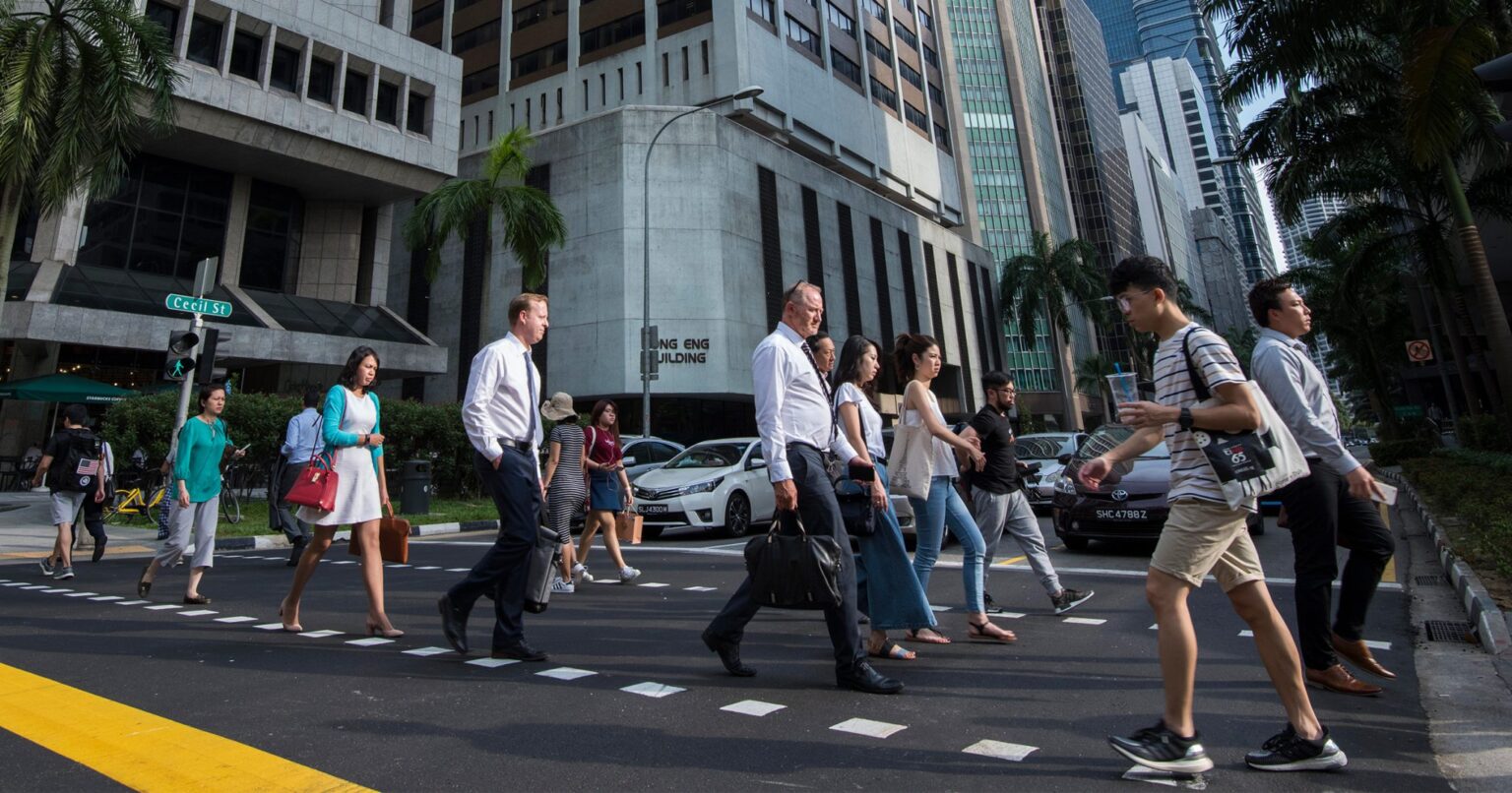
S’pore retrenchments hit highest level since 2020 as vacancies fall

Published

on

Laid off workers also took longer to find jobs

Job vacancies in Singapore kept falling in the second quarter of 2026, even as retrenchments climbed to their highest level since the pandemic.

About two in every 1,000 employees were retrenched in the second quarter, with the number of laid-off workers rising to 4,620, the highest since the fourth quarter of 2020, when the COVID-19 pandemic was under way.

This is up from 3,830 retrenchments, or about 1.6 retrenched workers for every 1,000 employees, in the first quarter.

The Ministry of Manpower (MOM), in its labour report released on Sep 21, said the labour market is showing signs of softening. The rise in retrenchments was driven by restructuring among businesses in outward-oriented sectors such as manufacturing, information and communications, and financial services.

Advertisement

He added that the layoffs are not broad-based and are mostly concentrated in outward-oriented sectors.

A slower path back to work

Retrenched workers were also taking longer to find jobs: 54.9% found new employment within six months in the second quarter, down from 60.7% in the first. Even so, close to 70% found work within a year.

Acting Minister for Manpower Jasmin Lau said some workers were finding that the transition to their next role was taking slightly longer, which she called “a concern for some Singaporeans.”

Speaking on the sidelines of a visit to technology company Acronis, she said job opportunities remained, but moving between jobs could be challenging. She added that the Government will help workers learn, adapt and prepare for new roles through career conversion programmes.

Advertisement

“Instead of learning a new skill and then hoping to find a job that uses it, workers train for actual roles that companies need,” she said.

Acronis, has supported more than 50 of its employees since 2024 through career conversion programmes, helping them build new skills in cybersecurity, software development and artificial intelligence.

Lau said: “This is the shift I hope we can all make together, learning new skills not just to protect what we have, but to open up more possibilities for what comes next.”

Fewer non-entry-level PMET openings

At the same time, job vacancies fell to 68,600 in Jun from 73,300 in Mar, the MOM report said.

Advertisement

The drop mainly reflected fewer openings for professionals, managers, executives and technicians (PMETs) in sectors such as financial services and information and communications.

Entry-level PMET vacancies, however, remained “broadly stable and sizeable”, making up 45.3% of all job openings in June.

Despite the overall decline, there were still more vacancies than unemployed people, at 1.48 vacancies per unemployed person as at Jun.

In general, Singapore’s labour market expanded in the second quarter, MOM said.

Advertisement

Total employment rose by 11,400, the 19th consecutive quarter of growth and up from the 9,400 jobs added in the first quarter.

A “positive but cautious” outlook

Resident employment growth, however, slowed from the previous quarter.

The growth came mainly from domestic-oriented sectors such as transportation and storage, public administration and education, and health and social services, although some outward-oriented sectors, including professional services, financial services, and information and communications, also expanded.

On the other hand, non-resident employment growth was driven by work permit holders in construction and manufacturing.

Advertisement

Unemployment rates remained “low and stable” in Jun, at 1.9% overall and 2.9% for residents, though the resident long-term unemployment rate edged up to 1% from 0.9% in Mar.

MOM said the labour market remained resilient overall, but conditions became less favourable for some resident workers as employment growth moderated, retrenchments increased and six-month re-entry outcomes weakened.

Looking ahead, MOM described the labour market outlook as “positive but cautious”, based on its business expectation polls in July.

Hiring expectations improved across more sectors, with 48.7% of companies intending to hire in the next three months, up from 43.9% in June.

Advertisement

The share of companies intending to raise wages, however, fell to 27.9% in July from 29.3% in June.

“Despite the improvement, both hiring and wage expectations remained below their Feb levels,” MOM added.

  • Read other articles we’ve written on Singaporean businesses here.

Featured Image Credit: Shadow_of_light/ depositphotos

Advertisement

Source link

Continue Reading

Tech

Control Resonant reviews praise its spectacular world and bold new direction

Published

on

Control Resonant takes Remedy’s supernatural series into a semi-open-world Manhattan, with Dylan Faden replacing Jesse as protagonist. Reviewers like the reality-bending environments, art direction, story, and exploration, while reactions to the redesigned combat are more mixed.

Read Entire Article
Source link

Continue Reading

Tech

ASUS Googlebook revealed in leaked images with glowing lid and dedicated G key

Published

on

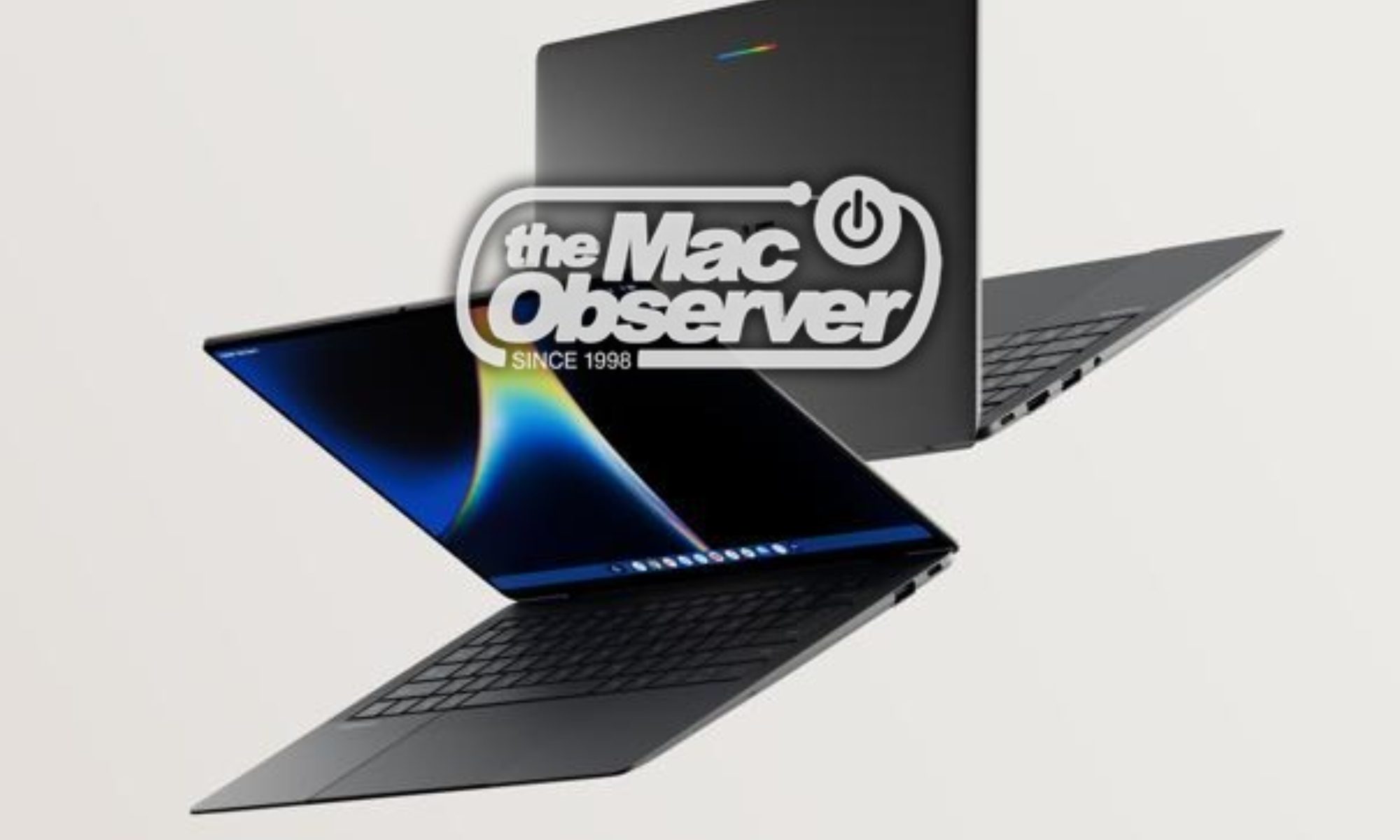
ASUS’ upcoming Googlebook has appeared in a new set of images, offering a closer look at the laptop’s design, keyboard and internal cooling system. The images, obtained exclusively by The Mac Observer, reveal a dark grey chassis, a large touchpad, a dedicated Google-branded G key, and a multicolour light bar on the lid.

The laptop is part of Google’s new premium Googlebook category, which aims to combine elements of ChromeOS and Android. However, ASUS has not yet confirmed the device’s final name, specifications, pricing or release date.

Glowing lid and dedicated Google key take centre stage

The leaked images show a conventional clamshell laptop with slim display bezels and a raised section around the webcam. The lid features an ASUS logo positioned beneath a narrow, multicolour light bar, which Google has previously referred to as the “glowbar.” The feature is expected to become a recognisable design element across the Googlebook family.

Inside, the laptop includes a wide rectangular touchpad, a keyboard without a number pad, and grilles on either side of the keyboard. A dedicated Google G key sits on the bottom row, immediately to the left of the Alt key. The images don’t show what the key does.

A full-size USB-A port is visible on the right edge, although the complete port selection and specifications remain unconfirmed.

Advertisement

The internal images also show a cooling fan beneath the right side of the keyboard, connected to a heat pipe extending towards the centre of the laptop. This suggests an actively cooled design, although the processor remains unknown.

Googlebook focuses on Gemini and Android integration

Google announced Googlebook in May as a new premium laptop category, with ASUS among its hardware partners alongside Acer, Dell, HP and Lenovo. The platform is designed around Gemini and includes features intended to connect laptops more closely with Android smartphones.

Google’s Magic Pointer allows users to select content on the screen and ask Gemini for assistance. Other features include Create My Widget, which generates custom widgets through prompts, and Cast My Apps, which lets users open Android phone apps on the laptop without reinstalling them. Quick Access also brings phone files into the laptop’s file browser. These smartphone features require Android 17 or later.

Google’s website says Googlebook preorders begin on September 21, but it remains unclear whether ASUS’ model will be available immediately. Details including its processor, memory, storage, display, battery capacity and price are still pending.

Advertisement

Source link

Continue Reading

Tech

World model companies are keeping a lot of secrets

Published

on

This week, I moderated a panel on world models at the All In conference (no relation to the podcast), and it gave me a chance to dig into one of the most mysterious corners of the AI world. The big players in the space are Yann LeCun’s AMI Labs and Fei-Fei Li’s World Labs — and while both have accumulated a lot of buzz and funding, they also rank pretty low on the trying-to-make-money scale.

At their core, world models are about automating spatial intelligence, so the field could head in lots of exciting and lucrative directions, from robotics to interactive video to more complex self-driving systems. 

But when I started to press on where we would actually see the tech commercialized, things got foggy. The closest thing I found to an authority was Michael Rabbat, a co-founder of AMI Labs and the company’s VP of World Models, who joined me on the panel. But when I pressed him on exactly what the company was working on, he was cagey. “We’ll talk about it when we’re ready to talk about it.” Over email, he clarified, “We’re still in a research and building phase, so we’re not talking publicly about any product plans or timeline.”

To be fair, AMI is less than a year old, so it’s fair enough to keep quiet. But this sort of caginess extends to the whole world-modeling space. World Labs’ Marble is probably the most fully developed product in the space, and its demos range from straightforward media creation, building explorable environments for video games, or CGI effects. There are robotics use cases too, but the whole platform seems more designed to demonstrate capabilities. 

Advertisement

That secrecy even extends to these companies’ suppliers. On the sidelines of the same conference, I spoke to Alex de Vigan, CEO of Physicl — a data supplier for the burgeoning world model business. He says he knows Physicl’s data has been useful for whatever they’re building, but he’s still in the dark about what exactly that is. “I wish they would tell us more. We could build more useful data if we knew what they were working on,” de Vigan told me.

Part of the mystery comes from how versatile world models are as an idea. The simplest version is a navigable map of the world, similar to the AI models that power self-driving cars. But the same modeling approach that helps a Waymo weave through traffic could also help a humanoid robot carry boxes, or turn a few minutes of video footage into an explorable environment. AMI has already dipped its toe in manufacturing, biomedicine, robotics, and even AI software for doctors through its Nabia partnership. Surely it won’t pursue all of those — but maybe one or two of them are standing out?

No one doubts that there are lots of viable businesses to be built on world model tech — and as long as it’s easy to fundraise, there’s no particular pressure to focus on one. In fact, there’s good reason not to. If AMI announced tomorrow that they had built a humanoid OpenClaw or a next-generation Hollywood rendering system, a lot of other labs would suddenly be very interested in the space. Soon, the lab would face potential competition from the other world model companies, the neolabs, and even OpenAI and Anthropic. 

In some ways, it’s the flip side of all that easy fundraising. Your competitors can fundraise, too — and the same money that lets you build under the radar is also funding lots of potential rivals once the path to market becomes clear. But even if that competition is inevitable, it’s best if you delay it for as long as possible, which means keeping quiet about exactly what you’re building.

Advertisement

Cixin Liu fans will recognize this as a dark forest scenario: If you don’t know who else is in the woods, it’s best not to attract attention.

This post was first published on September 18, 2026.

When you purchase through links in our articles, we may earn a small commission. This doesn’t affect our editorial independence.

Source link

Advertisement
Continue Reading

Trending

Copyright © 2025