
Crypto World
Avalanche price eyes 90% rally as tokenization demand lifts AVAX – CoinJournal



Key takeaways
- AVAX surged nearly 50% in one week, reaching an eight-month high of $10.82 on Sunday.
- Institutional tokenization developments involving ICE, New York Life Investment Management, Aave and Janus Henderson have boosted sentiment.
- Avalanche’s Helicon upgrade is scheduled for Sept. 22 and will reduce the minimum staking period from 14 days to 48 hours.
Avalanche’s AVAX token has climbed nearly 50% over the past week, reaching an eight-month high of $10.82 on Sunday as institutional tokenization developments renewed demand for the cryptocurrency.
One of the rally’s leading catalysts involves Intercontinental Exchange, the parent company of the New York Stock Exchange. ICE has reportedly spent about a year testing Avalanche as it explores infrastructure for round-the-clock trading of tokenized U.S. stocks and exchange-traded funds.
ICE has not selected Avalanche or announced a commercial partnership. However, Ava Labs President Charley Cooper said the company remains actively engaged with the network.
The development has strengthened expectations that Avalanche could play a role in bringing traditional financial assets onchain.
New York Life plans tokenized fund on Avalanche
New York Life Investment Management provided another institutional catalyst by announcing plans to launch its first tokenized fund on Avalanche through Centrifuge.
The offering will bring the firm’s U.S. High Yield Corporate Bond Strategy onchain, giving eligible investors access to exposure tied to high-yield corporate debt.
Other financial companies are also expanding their involvement with Avalanche. Aave is developing an institutional real-world asset lending market on the network, while Paxos has added support for AVAX and USDC.
Asset manager Janus Henderson has also joined Avalanche as a validator, further strengthening the network’s institutional credentials.
Together, these developments reinforce Avalanche’s positioning as a blockchain for tokenized funds, credit products and other real-world assets.
Avalanche’s upcoming Helicon upgrade provides an additional potential catalyst for AVAX.
Scheduled for Sept. 22, the upgrade will reduce the minimum staking lockup period from 14 days to 48 hours. The change could make staking more flexible by allowing participants to commit their tokens for substantially shorter periods.
Helicon will also modify validator requirements and reward structures. Lowering the time commitment may encourage more users to participate in network validation, although the full impact will depend on how validators respond to the revised economics.
The timing of the upgrade, alongside growing institutional interest, has added momentum to AVAX’s recovery.
Falling wedge points to $19–$20 target
AVAX’s weekly chart is showing a potential long-term recovery setup after the price rebounded from the lower boundary of a large falling wedge that has developed since its 2021 peak.
Falling wedges are generally viewed as bullish reversal patterns when the price rebounds from the lower trendline and eventually breaks above descending resistance.
The latest recovery started around the $5.80–$6.50 region, a historical support zone that has repeatedly attracted buyers. AVAX subsequently climbed above its 20-week Exponential Moving Average near $7.97, strengthening the case for a broader recovery within the wedge.
If the rebound continues, the next major upside target lies between $19 and $20. The wedge’s descending upper trendline is converging in this area with the 0.236 Fibonacci retracement level near $19.86.
A move from approximately $10.50 to that resistance zone would produce an estimated gain of 85%–90%.
Before AVAX can approach $19, it must overcome resistance around its 50-week EMA. A rejection from this moving average could slow the recovery or send the token back toward lower support levels.

The broader bullish setup would weaken if AVAX loses the wedge’s lower trendline and falls decisively below $5.80. That level currently serves as the primary invalidation point for the recovery thesis.
AVAX’s outlook therefore remains constructive while it holds above the reclaimed 20-week EMA and maintains the wedge’s lower support.
However, the projected move toward $19–$20 remains conditional on the token clearing intermediate resistance and sustaining institutional-driven demand.


Hyperliquid has generated $429.04 million in revenue from Jan. 1 through Sept. 15, placing the perpetual futures platform first in CoinGecko’s adjusted ranking of crypto revenue generators for 2026.
Summary
- Hyperliquid generated $429.04 million through September 15, leading CoinGecko’s adjusted 2026 crypto revenue ranking overall.
- Hyperliquid captured 12.62% of the $3.40 billion revenue pool used for CoinGecko’s project comparison dataset.
- Pump.fun ranked second with $322.21 million, leaving Hyperliquid ahead by more than $106 million overall.
- CoinGecko excluded Tether, Circle and Grayscale from rankings to improve comparisons among crypto-native revenue models.
- Hyperliquid routes trading fees toward community mechanisms, including automated HYPE purchases through its Assistance Fund.
CoinGecko’s Sept. 17 study calculated Hyperliquid’s share at 12.62% of the $3.40 billion comparison pool. Pump.fun followed with $322.21 million, while Axiom Pro ranked third among the projects included in the final table.
The ranking uses data through Sept. 15 and should be read as a fixed year-to-date snapshot. CoinGecko excluded Tether and Circle because their scale would overwhelm the comparison, while Grayscale was removed because its $154.14 million came from asset-management sponsor fees instead of a usage-based crypto protocol model.
Hyperliquid leads 2026 crypto revenue ranking
Hyperliquid finished more than $106 million ahead of Pump.fun at the Sept. 15 cutoff. CoinGecko said the two projects together generated $751.25 million, equal to 22.10% of the revenue pool used in the study.
Pump.fun’s $322.21 million came mainly from token creation and trading fees tied to its Solana memecoin launchpad. Axiom Pro followed at $132.09 million, Sky posted $129.87 million and GMGN generated $126.03 million.
Polymarket ranked sixth with $115.48 million. World Liberty Financial followed at $95.37 million, while Paxos recorded $87.93 million. edgeX generated $84.37 million and Titan Builder completed the top 10 at $83.47 million.
CoinGecko classified the projects across several business models, including perpetual futures, trading terminals, prediction markets, stablecoins, real-world assets and MEV infrastructure. The researcher described its sector labels as a best-effort classification instead of a formal industry taxonomy.
Perpetual trading feeds Hyperliquid’s revenue engine
Hyperliquid earns fees from perpetual futures and spot activity on its exchange infrastructure. Its official fee documentation uses volume-based maker and taker tiers, with separate schedules for perpetual and spot markets.
Higher-volume traders receive lower fees, while users staking HYPE can qualify for further discounts. Hyperliquid says its fee structure does not reserve the proceeds primarily for a company or insider group, with funds instead directed toward HLP, the Assistance Fund and eligible market deployers.
The Assistance Fund automatically converts eligible trading fees into HYPE through Hyperliquid’s L1 execution. Hyperliquid’s current documentation says HYPE acquired by the fund is burned, permanently removing those tokens from total and circulating supply.
Hyperliquid separately states that its platform is processing billions of dollars in daily trading volume and that more than $1 billion in annualized fees are being directed toward programmatic HYPE purchases. Fees and CoinGecko’s revenue figure are not identical accounting measures, so the two numbers should not be treated interchangeably.
As crypto.news previously reported, Hyperliquid’s Assistance Fund has become a central part of HYPE’s token structure because trading activity creates recurring purchases of the token. Earlier reporting placed cumulative fund spending above $1.3 billion, though that figure covers buybacks since launch and is separate from CoinGecko’s 2026 revenue ranking.
Pump.fun and trading terminals fill the next positions
CoinGecko’s ranking shows that revenue has not been concentrated in a single crypto sector. Pump.fun represents token launchpads, while Axiom Pro and GMGN are trading terminals that make on-chain markets easier to access.
Axiom integrates Hyperliquid for perpetual futures trading, creating some overlap between the activity surrounding the two projects even though CoinGecko records them as separate revenue-generating businesses. GMGN centers more heavily on Solana memecoin trading, linking its activity to the same trading segment that supports Pump.fun.
Shorter reporting periods can produce different leaders. In August, Pump.fun briefly moved ahead of Hyperliquid on a 30-day revenue measure after generating more than $10 million of protocol fees during the week of Aug. 3-9.
CoinGecko’s longer Jan. 1-Sept. 15 measurement produced a different result, with Hyperliquid retaining the full-year lead despite shorter periods in which competitors generated more revenue.
The top 15 projects accounted for 56.02% of the $3.40 billion pool used for the ranking. Beyond the top 10, Collector Crypt recorded $72.82 million, Phantom $60.05 million, Aave $56.81 million, fomo $54.66 million and Aerodrome $54.31 million.
CoinGecko exclusions change how the table should be read
CoinGecko deliberately excluded Tether and Circle from the top-project ranking because both stablecoin issuers generate revenue at a scale the researcher said would obscure differences between the remaining businesses. Their omission does not mean CoinGecko regarded their revenue as invalid.
Grayscale would have ranked third at $154.14 million, ahead of Axiom Pro, but CoinGecko excluded the asset manager because its revenue is derived from AUM-based sponsor fees. Aerodrome, which would otherwise have ranked 16th, consequently entered the displayed top 15.
CoinGecko uses on-chain revenue as its main inclusion criterion but acknowledged that not every project in the list earns money directly from blockchain transaction fees. Paxos and World Liberty Financial, for example, derive substantial revenue from interest earned on reserves, according to the study.
Monthly crypto revenue has remained below last year’s average. Across all projects tracked in CoinGecko’s second dataset, which does include Tether and Circle, monthly revenue averaged $1.08 billion from January through August 2026. The figure was 11.68% below the $1.22 billion monthly average recorded during 2025.
September was left out of the monthly-average comparison because CoinGecko had only 15 days of data when the study was compiled. Its revenue rankings still include activity through Sept. 15, meaning later September revenue will not appear in the published $429.04 million Hyperliquid figure.
HYPE trades near record levels after revenue growth
HYPE has remained close to record territory while Hyperliquid’s fee activity stays elevated. CoinGecko data on Sept. 21 placed HYPE around $94.02, up approximately 2.7% over 24 hours and 18.1% during the previous seven days, with a market capitalization close to $20.9 billion.
Historical CoinGecko data show HYPE closed at $76.92 on Sept. 15 before rising to $85.06 on Sept. 17 and $92.54 on Sept. 18. The token closed Sept. 20 at $93.64, while daily trading volume stood above $1 billion.
Crypto.news reported that Hyperliquid and Pump.fun accounted for nearly 90% of tracked crypto token buybacks during 2026. The report distinguished annual buybacks from Hyperliquid’s cumulative Assistance Fund purchases, which span multiple years.
Hyperliquid’s own documentation now lists maker rebates reaching negative 0.003% for qualifying high-volume market makers, while its highest published staking tier provides a 40% trading-fee discount to accounts linked with more than 500,000 HYPE staked.
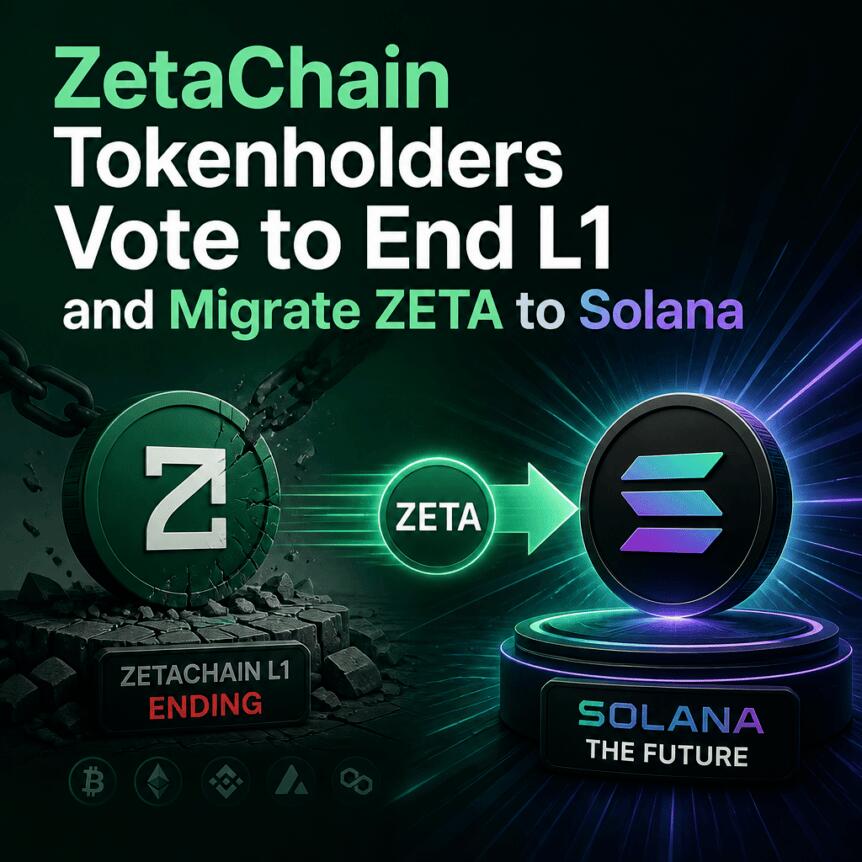
ZetaChain tokenholders have voted to end the project’s layer-1 blockchain and migrate its native ZETA token to Solana. The governance decision, approved via a formal proposal on Sunday, clears the path for ZETA to be represented as a Solana token through a 1:1 conversion—while network operations and staking are expected to continue until a later, separate shutdown and migration plan is finalized.
Governance proposal 68 passed with 99.4% support and 58% participation, comfortably above the network’s 40% quorum requirement. Importantly, the proposal does not immediately trigger a shutdown or token migration timetable; ZetaChain said a second proposal will be submitted to outline the withdrawal window for assets tied to other blockchains, snapshot timing, shutdown scheduling, and the mechanics and duration of the token claim and exchange period.
Key takeaways
- Proposal 68 approved: 99.4% support with 58% participation, exceeding the 40% quorum threshold.
- Token migration approach: ZETA is set to become an SPL token on Solana on a 1:1 basis, keeping the same ticker and total supply.
- No immediate shutdown: ZetaChain indicated validators will keep operating and staking rewards will continue during the transition.
- Next step is a second proposal: details on withdrawal windows, snapshot height, shutdown timing, and conversion/claim periods will be defined later.
What ZetaChain’s governance vote actually changes
Under the approved plan, ZETA will be converted into a Solana Program Library (SPL) token while preserving a 1:1 ratio. The proposal states that the token’s ticker and total supply will remain the same—an operational detail that matters for holders because it clarifies that the change is intended to be a representation/migration rather than a token split or supply adjustment.
However, governance approval is not the same as execution. ZetaChain emphasized that passing proposal 68 does not automatically set a shutdown date. Instead, core contributors must bring forward a subsequent proposal covering the practical steps holders will care about most: how and when assets connected to other chains can be withdrawn, the snapshot block height used for migration calculations, the shutdown timetable, and the process and timeframe for token claims or exchange conversions.
In the interim, validators are expected to keep running. The project also said staking rewards will continue through the transition phase, suggesting the token migration process is being staged rather than rushed—an important distinction for participants who would otherwise be forced to exit staking positions abruptly.
Why ZetaChain wants to shift away from its layer-1
ZetaChain linked its move away from maintaining its own Cosmos SDK-based layer-1 to a strategic repositioning. The project said its standalone chain no longer supports its focus on Anuma, a private-focused artificial intelligence application.
In ZetaChain’s framing, moving to Solana is meant to let the team redirect engineering and operational effort away from base-layer blockchain maintenance and toward Anuma and its “Private Memory Layer,” which the project says helps users carry encrypted context across AI models.
For investors and builders, the key question is not only whether the migration is technically feasible, but whether the funding and talent concentration can deliver measurable progress on the AI-related roadmap. On that front, ZetaChain’s approach is effectively a resource reallocation: the governance vote signals that maintaining a dedicated interoperability layer-1 is being deprioritized in favor of an execution environment closer to the rest of the Solana ecosystem.
A broader pattern of standalone chain wind-downs
ZetaChain’s decision fits a wider trend in crypto: projects that previously operated standalone chains are increasingly opting to shut them down or migrate tokens to other networks. The rationale varies—from security events to cost and strategic focus—but the end result is similar: ecosystems consolidate around fewer chains, while token representations move to more established venues.
Two other examples cited alongside ZetaChain include BounceBit and Harmony. BounceBit previously announced it would retire its standalone blockchain after an authorization flaw was exploited to steal about $3 million in BB tokens. The project chose a migration of its token to BNB Smart Chain at a 1:1 ratio rather than restarting its layer-1—an approach that mirrors ZetaChain’s “representation stays the same” principle.
Harmony also proposed winding down its layer-1 and migrating ONE to Ethereum as an ERC-20. Earlier reporting noted the proposal came after an exploit created unauthorized ONE tokens and led Harmony to plan a rollback of more than 109,000 transactions. In that case, the governance pivot appears tied both to recovery from a security incident and to a broader shift toward an AI video initiative.
While every project’s situation differs, these cases highlight how token migration plans can become governance-led responses to operational and risk realities—especially when maintaining a dedicated chain becomes harder to justify.
Security history adds urgency to migration planning
ZetaChain’s migration plan arrives against a backdrop of security-related issues. The project was previously affected by a $334,000 exploit targeting its cross-chain gateway contract, according to the referenced earlier coverage. The incident reportedly drained funds from ZetaChain-controlled wallets across multiple networks including Ethereum, Arbitrum, Base and BNB Smart Chain.
In response to that broader security discussion, ZetaChain also acknowledged it had dismissed an earlier bug bounty report about a vulnerability, stating it treated the behavior as intended. That decision later prompted a review of its security processes.
None of this history necessarily determines whether a Solana migration will be successful, but it raises the stakes for how ZetaChain designs its transition. The second governance proposal—covering snapshot height, the token claim period, and the exchange conversion window—will likely be where market participants focus on clarity and safeguards. For holders, the worst outcomes in a migration tend to be uncertainty: unclear eligibility rules, poorly timed snapshots, or token claim/exchange mechanics that leave participants unable to complete conversions.
With validators expected to keep operating and staking rewards continuing for now, ZetaChain appears to be attempting to balance continuity with an orderly wind-down. Still, the exact operational details—when withdrawals open, when the chain stops, and how claims are handled—remain unresolved until the next proposal is submitted.
Going forward, tokenholders and observers should watch for the forthcoming governance proposal that lays out the withdrawal window, snapshot block height, shutdown timeline, and conversion/claim mechanics. Those specifics will determine whether the transition preserves holder outcomes cleanly or introduces friction at the moment people need certainty most.
Bitcoin (BTC) climbed back above $81,000 on Monday, adding 1.29% after a turbulent week previously. The rebound came as markets looked ahead to this week’s Trump-Xi summit in Washington.
Bitcoin managed to deal with the failure of the CLARITY Act, as well as A Federal Reserve rate hike, which added pressure Wednesday, its first increase since 2023. The coin climbed to near $82,000 after a week of matching volatile ETF inflows too.
What This Week Holds for Bitcoin ETF Inflows
Last week’s spot Bitcoin ETFs barely stayed positive. Ether funds broke a four-week inflow streak. The CLARITY Act vote, a stalled Senate bill on crypto token rules, and a Fed rate hike both rattled markets.

Even at the weekend, when Bitcoin climbed to $80,000, there was a dip traced to Houthi strikes on Riyadh, which spooked markets before oil, bonds, and equities reopened. Bitcoin recovered by Monday, rising 1.29% as Asian equities advanced and oil slipped on hopes for Iran diplomacy.
Traders now face a packed week. A Trump-Xi summit lands Wednesday, and Iran’s response to Saudi and Chinese pressure remains unresolved. The Fed has also signaled at least one more rate move this year.
Higher Price and Lots of Catalysts
Any of the above catalysts could sway sentiment enough to move ETF flows again, especially with the price currently above $80,000.
Bitcoin funds needed a Friday rally just to stay positive last week, leaving little room for another setback.
Whether this week’s inflows can build on that momentum remains the open question.
A fresh geopolitical shock could easily reverse it as BTC pushes toward $82,000.
The post Bitcoin Climbs Toward $82,000: Will ETF Inflows Follow This Week? appeared first on BeInCrypto.
The crypto market will welcome tokens worth more than $900 million in the fourth week of September 2026. Major projects, including Plasma (XPL), Humanity (H), and SoSoValue (SOSO), will release significant new token supplies.
These unlocks could introduce market volatility and influence short-term price movements. So, here’s a breakdown of what to watch.
1. Plasma (XPL)
- Unlock Date: September 25
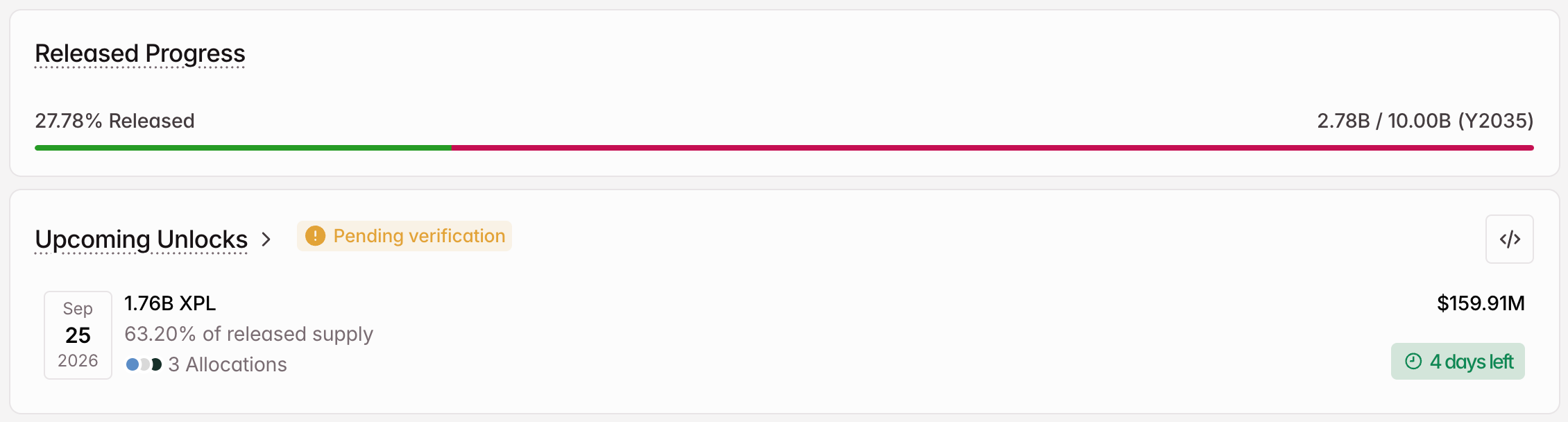
- Number of Tokens to be Unlocked: 1.76 billion XPL
- Released Supply: 2.78 billion XPL
- Total supply: 10 billion XPL
Plasma is a Layer 1 blockchain platform built to enhance the efficiency and scalability of stablecoin transactions. It enables zero-fee USDT transfers, supports custom gas tokens, enables confidential payments, and delivers the throughput required for global-scale adoption.
Plasma will release 1.76 billion crypto tokens on September 25. The XPL stack is worth $159.91 million. Moreover, the tokens account for 63.2% of the total supply released.

Investors and the team will each receive 833.33 million altcoins. In addition, the team will direct 88.89 million XPL to the ecosystem and growth.
2. Humanity (H)
- Unlock Date: September 25
- Number of Tokens to be Unlocked: 266.47 million H
- Released Supply: 3.63 billion H
- Total supply: 10 billion H
Humanity (H) is a decentralized identity protocol that utilizes biometric palm recognition, zero-knowledge proofs, and blockchain to verify the authenticity of real human users without exposing their personal data. It features a native Proof of Humanity (PoH) consensus mechanism.
On September 25, the protocol will unlock 266.47 million tokens. The tokens are worth $19.3 million and also account for 7.34% of the released supply.

The team will split the released supply six ways. Early contributors will take the largest share at 79.17 million H, while investors will receive 55.56 million.
Meanwhile, the ecosystem fund will claim 50 million H, and Humanity will direct 42.86 million altcoins toward identity verification rewards. The Human Institute strategic reserve will get 26.39 million H. Lastly, the foundation operations treasury will round out the distribution with 12.50 million.
3. SoSoValue (SOSO)
- Unlock Date: September 24
- Number of Tokens to be Unlocked: 23.46 million SOSO
- Released Supply: 393.12 million SOSO
- Total supply: 1 billion SOSO
SoSoValue is a crypto data and research platform covering ETF flows, market indicators, funding rounds, and project analytics, as well as SSI, its on-chain index product. SOSO, its ERC-20 token, is used for governance and access to SSI.
The platform will unlock 23.46 million SOSO on September 24. The tranche accounts for 5.97% of the released supply. The tokens are worth $6.97 million.

Core contributors and investors will each take an equal share of 9.17 million SOSO, together accounting for the bulk of the unlock.
Moreover, the ecosystem and airdrop allocation will receive 2.58 million SOSO, while the foundation will claim 1.58 million. Partners will take the smallest cut, at 972,220 SOSO.
In addition to these, other prominent unlocks investors can look out for in the fourth week of September include STBL (STBL), River (RIVER), Space ID (ID), and more, which will contribute to the total market-wide releases.
The post 3 Token Unlocks to Watch in the Fourth Week of September 2026 appeared first on BeInCrypto.

XRP price trades at $1.44, up 4% over the past 24 hours, and the prediction about it eventually flipping Ethereum’s market cap is getting louder. A $3,300 price target floated in a recent regulatory petition sounds absurd on first read. It might not be. There’s a specific mechanism behind the number.
The target originates from Boyd Roberts’ “Rulemaking Petition 4-867,” which argues XRP could be recognized as eligible collateral within institutional finance. Not just traded, but structurally embedded in sovereign liquidity systems.
Ripple Prime already processes over $3 trillion annually, and the SEC’s classification of XRP as a digital commodity has added weight to the institutional case. David Schwartz has gone as far as suggesting XRP’s market cap could eventually eclipse Bitcoin’s as adoption spreads.
Ethereum, meanwhile, sits at above $2,600, still grinding toward its own $3,000 psychological marker while carrying the weight of last cycle’s $4,490 high as a reminder of how far it’s fallen short. Both assets are testing trader patience in different ways, one on collateral narrative, the other on recovery math.
Discover: The Best Token Presales
XRP Price Prediction: Can Ripple Hit $3 This Week?
XRP’s near-term chart tells a more modest story than the $3,300 headline target. Price is consolidating between $1.40 support and $1.44–$1.45 resistance, based on recent trading ranges. The 7-day gain sits near 3.8%, a steady grind rather than a breakout.
A clean break above $1.45 on rising volume opens a path toward $1.60–$1.70, with regulatory clarity from the CLARITY Act acting as the catalyst that actually matters here. It could have a continued sideways chop in the $1.40–$1.45 band while institutions digest collateral-status developments.

But it could have a movement that holders don’t want to see. Because a drop below $1.40 support invalidates the near-term structure and points back toward $1.30.
None of the retrieved data attaches a verified $3,000 timeline to any named analyst, so treat the loftier targets as thesis, not forecast. Traders watching for confirmation should track the RSI trend against historical support zones before committing size.
Trade XRP on Bybit and Get a Chance to Win Our $1,000 USDT Airdrop
Maxi Doge Targets Early Mover Upside as XRP Tests Key Levels
XRP holders riding this 3.8% weekly move have reason to feel validated. But here’s the uncomfortable math: at a $90 billion market cap, XRP needs enormous capital inflows to deliver the kind of multiples early-stage tokens can produce off a fraction of that size.
This is the pivot point pulling traders toward presale plays while majors like XRP and Ethereum slog through consolidation.
Enter Maxi Doge ($MAXI), an Ethereum-based meme token built around a 240-lb canine mascot channeling “1000x leverage” trading culture. Think gym-bro humor meets degenerate trading floor.
The presale has raised $4.8 million at a current price of $0.000284, with a huge 65% APY staking live for early participants. Standout features include holder-only trading competitions with leaderboard rewards and a dedicated Maxi Fund treasury for liquidity and partnerships.
Research Maxi Doge directly before the presale window ends.
Earn $50 and Enter $300K Prize Draw on EdgeX
The post XRP Price Prediction: XRP Could Flip Ethereum as It Targets $3,000 appeared first on Cryptonews.

The Bank of Korea has launched its first 24-hour won settlement network pilot, allowing foreign investors to settle Korean currency transactions outside the country’s conventional banking hours.
Summary
- Four Korean banks joined the pilot, while foreign banks are scheduled to participate from January.
- The network runs 24 hours on business days, closing only during weekends and public holidays.
- Foreign investors can settle won through RFI-K accounts without opening accounts at Korean financial institutions.
- South Korea processed the pilot’s first transaction worth roughly 1.4 billion won on Monday morning.
- Project Agorá and Project Hangang continue testing tokenized reserves, deposits, and cross-border settlement infrastructure separately.
The Bank of Korea said in its September 21 announcement that the Bank of Korea Won International Wire Network began trial operations on Monday as part of South Korea’s plan to improve offshore access to the won. The pilot started at 9 a.m. with KB Kookmin Bank, Woori Bank, Hana Bank and Shinhan Bank participating.
Full operation is scheduled for January 2027, when foreign banks are expected to join the network. The system will operate continuously from 9 a.m. on one business day until 9 a.m. the next, while weekends and public holidays remain excluded.
Bank of Korea network lets foreigners settle won offshore
Foreign investors using the new system can settle won transactions through accounts held with Registered Foreign Institutions for KRW Business, known as RFI-Ks. They do not need to open a separate account directly with a domestic Korean financial institution to use the settlement network.
Revised foreign-exchange rules published days before the pilot allow registered foreign institutions to open omnibus accounts at Korean foreign-exchange banks and process won settlement through the Bank of Korea network. The Finance Ministry said the changes form part of the government’s plan to make offshore won transactions less dependent on time and location.
Under the model, an overseas investor can hold or transact won through a registered institution in its home market while the underlying settlement is completed through the central-bank infrastructure. The Korean authorities introduced RFI-K access as part of changes designed to make the domestic foreign-exchange market more accessible to international participants.
The BOK said “the network is expected to improve foreigners’ access to won settlement infrastructure, eventually enhancing the currency’s international standing.” The statement represents the central bank’s policy expectation for the system, not a measured outcome from the pilot.
Four banks begin pilot with 1.4 billion won test
KB Kookmin, Woori, Hana and Shinhan are the first banks participating in the trial phase. South Korea plans to bring foreign financial institutions into the network after the January launch, following roughly three months of testing.
The first reported test transaction took place at around 9:30 a.m. Monday between two participating domestic institutions. SBS reported that the payment was worth approximately 1.4 billion won, equivalent to roughly $1 million at current exchange rates.
The BOK described the platform as its first settlement network designed to operate around the clock on business days. Existing Bank of Korea payment infrastructure has traditionally followed domestic operating hours, while the new service is structured around the working hours of overseas investors.
During the pilot, the central bank plans to monitor the system while making operational and technical changes before the January rollout. The BOK said it intends to improve the network, expand participating institutions and maintain continuous monitoring as full operation approaches.
January launch fits Korea’s won internationalization plan
The settlement system is one part of South Korea’s larger Won Internationalization Roadmap, published by the Finance Ministry with the Bank of Korea and other agencies in July. The roadmap calls for round-the-clock foreign-exchange access, offshore won accounts, easier capital transactions and settlement infrastructure available outside Korea.
South Korea had already moved its domestic foreign-exchange market toward 24-hour trading before the settlement pilot started. The new network addresses the payment side of that policy by allowing offshore participants to complete transactions during their own local business hours instead of waiting for Korean banks to reopen.
The roadmap permits foreigners to conduct won transactions through overseas institutions registered with Korean authorities. Government documents describe examples in which investors could use won accounts at overseas branches of global banks for Korean bond investments, remittances and other financial services.
The authorities are pairing easier access with liquidity and monitoring measures. The roadmap says domestic banks can provide temporary won funding when overseas institutions face shortages, while the government and central bank may provide further liquidity when necessary. Regulators plan to monitor offshore won conditions as international use expands.
The BOK had outlined the network’s September pilot schedule in July, when it confirmed the four participating banks and said full 24-hour operation would begin in January. At the time, the central bank said the project could improve access to Korean settlement infrastructure and support South Korea’s efforts to attract more international investment.
Project Agorá and Hangang test tokenized settlement separately
The new international wire network does not use the same structure as the Bank of Korea’s blockchain-based digital-money projects. The BOK has been developing separate tokenized settlement infrastructure through Project Hangang and the Bank for International Settlements-led Project Agorá.
In July, the Bank of Korea completed live cross-border payment tests under Project Agorá using tokenized central-bank reserves across multiple currencies. As crypto.news previously reported, South Korean banks tested settlement workflows that included a 20 million won transfer between NongHyup Bank and Shinhan Bank using tokenized reserve funds.
The trial connected Project Hangang with the Agorá environment to test how tokenized central-bank money and commercial-bank deposits could interact in cross-border payments. The BOK said further test scenarios would follow as Project Agorá expanded its real-value transaction work.
Project Hangang has developed along a separate domestic path. As crypto.news reported in March, the second phase expanded participation from seven banks to nine and introduced deposit-token features including peer-to-peer transfers, biometric approvals and government subsidy payments.
Government agencies later began a 9.6 billion won program to connect deposit tokens with existing payment infrastructure. In related crypto.news coverage, the project brought together nine banks, eight payment companies and two large merchants to test how deposit tokens could work with existing retail payment systems.
The Bank of Korea’s latest payment systems report, published Sept. 17, said the institution had extended BOK-Wire+ operating hours, built the new international won network and adopted ISO 20022 as part of efforts to strengthen cross-border connectivity. The report said the central bank was simultaneously studying virtual assets, won-based stablecoins and tokenized settlement systems.
Project Hangang remains based on a wholesale central-bank digital currency used beneath commercial-bank deposit tokens, not a retail CBDC issued directly to consumers. The second phase has expanded to nine participating banks while testing transfers, payments and government-linked use cases.

ZetaChain tokenholders have approved a plan to wind down the project’s layer-1 blockchain and migrate its native ZETA token to Solana.
Governance proposal 68 passed Sunday with 99.4% support and 58% participation, exceeding the network’s 40% quorum requirement. Under the proposal, ZETA will become an SPL token on Solana through a 1:1 conversion, with the same ticker and total supply.
According to the proposal, the vote does not immediately trigger ZetaChain’s shutdown or migration. Core contributors will submit a second proposal detailing the withdrawal window for assets linked to other blockchains, snapshot block height, shutdown timetable, token claim process and exchange conversion period. Validators will continue operating and staking rewards will continue during the transition.
ZetaChain said running its own Cosmos SDK-based layer 1 no longer supports its focus on Anuma, its private-focused artificial intelligence application. The project said moving to Solana would allow it to redirect resources from blockchain maintenance to Anuma and its Private Memory Layer, which lets users carry encrypted context across AI models.
ZetaChain was founded in 2021 as an interoperability-focused project designed to connect assets and data across different blockchains. In 2023, it raised $27 million from investors including Blockchain.com, Jane Street Capital, Human Capital and Sky9 Capital to develop its layer-1 network.
Crypto projects wind down standalone chains
Other projects, including BounceBit and Harmony, have also announced plans to shut down their standalone blockchains.
In August, BounceBit opted to retire its standalone blockchain after an authorization flaw was exploited to steal about $3 million in BB tokens. The project migrated its token to BNB Smart Chain at a 1:1 ratio instead of restarting its layer 1.
On Sept. 6, Harmony proposed shutting down its layer-1 and migrating its native ONE token to Ethereum as an ERC-20, as part of a proposed pivot to an AI video initiative. The proposal came weeks after an exploit created unauthorized ONE tokens and led Harmony to plan a rollback of more than 109,000 transactions.
Related: Solana sees record 263K tokens issued in a single day
ZetaChain also suffered a $334,000 exploit in April targeting its cross-chain gateway contract, which drained funds from ZetaChain-controlled wallets across Ethereum, Arbitrum, Base and BNB Smart Chain.
The project later acknowledged that it had dismissed an earlier bug bounty report about the vulnerability as intended behavior, prompting a review of its security processes.
Magazine: Who needs CLARITY anyway? ARB could see 70X increase: Hodler’s Digest
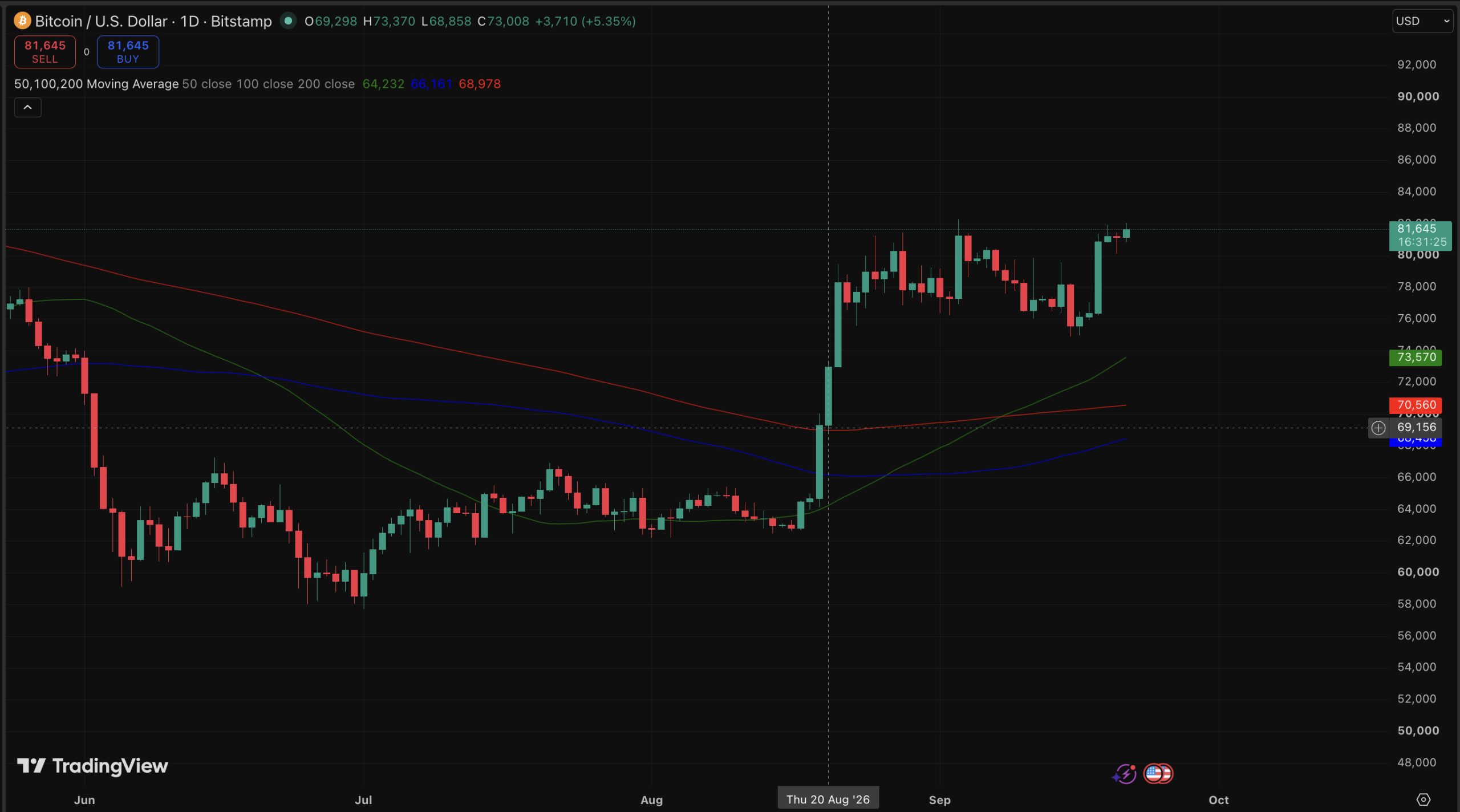
Bitcoin is trading at $81,600, up by a huge 6% since the start of last week, and the number that matters for its price prediction just flipped bullish for the first time in nearly a year. After 45 straight weeks of failing to close above its 50-week moving average, BTC finally flipped it.
Bitcoin closed the last week above the 50-day MA for the first time since November 2025, following a 29% rebound over 35 days. Galaxy Research head Alex Thorn called the close an “important confirmation” that the bear phase may have run its course. The weekly close is roughly 3% above the moving average, sitting at $78,800, and nearly 24% above the 200-week MA at $65,500.

This technical confirmation has historically lined up with prior cycle bottoms. Whether this one holds depends on what happens at the resistance shelf just overhead, a level Bitcoin has already tested and failed to clear once this week.
Trade Bitcoin on Bybit and Get a Chance to Win Our $1,000 USDT Airdrop
Bitcoin Price Prediction: Can BTC Hold the 50-Day MA and Push Toward $85,000?
Bitcoin’s current $81,600 print sits comfortably above both the 50 and 200-day moving averages, a structural setup technicians typically flag as early-bull-market territory rather than dead-cat bounce. Our pivot data shows layered resistance at $82,900, then $83,430–$84,775, with a stretch target near $88,162 if momentum extends.
Support has clustered around $78,845 and $77,895, with a firmer floor near $76,000–$76,700 that’s already been tested once this month. A weekly close above $82,956 confirms the breakout and opens the path toward $88,000+, consistent with Elliott Wave counts circulating in recent technical analysis.
— Alex Thorn (@intangiblecoins) September 21, 2026
 BTC CLOSES WEEK ABOVE 50-WEEK MOVING AVERAGE FOR FIRST TIME IN 45 WEEKS
regaining the 50w MA has historically served as strong confirmation that bear market lows are “in”
bitcoin is up 29% in 35 days pic.twitter.com/HzKVUrxMVz
The most likely scenario for now is to see BTC grind between $78,800 and $83,000 while the market digests the moving-average flip. However, A weekly close back below the 50-day MA at $78,800 would invalidate the signal and drag price toward the $76,000 line in the sand. Traders watching this setup should track the weekly close, not intraday noise.
Earn $50 and Enter $300K Prize Draw on EdgeX
Bitcoin Hyper Targets Early Mover Upside as Bitcoin Tests Key Levels
A 45-week-overdue moving average flip is exactly the kind of headline that gets long-term holders nodding along, but at an $81,000 handle, Bitcoin’s percentage upside from here is a different animal than it was at $16,000. Doubling from here means a $1.6 trillion market cap addition.
That math is why traders chasing asymmetric returns are increasingly looking one layer down, toward infrastructure being built directly on top of Bitcoin’s network.
Strong chart. Stronger Hyper.
https://t.co/VNG0P4GuDo pic.twitter.com/qAXJFTVW2X
— Bitcoin Hyper (@BTC_Hyper2) September 21, 2026

Bitcoin Hyper ($HYPER) is positioning itself as the first Bitcoin Layer 2 with full SVM integration. Hyper is running smart contracts at speeds it claims outpace Solana itself, while settling back to Bitcoin’s base chain for security. The presale has raised $33 million at a current token price of just $0.0136865, with staking rewards offered at a high 30% APY.
Its Decentralized Canonical Bridge aims to solve BTC’s two biggest structural gaps: near-zero programmability and sluggish, expensive transaction throughput.
Research Bitcoin Hyper directly before deciding.
Discover: The Best Token Presales
The post Bitcoin Price Prediction: Has the BTC Bear Market Ended After 45 Weeks? appeared first on Cryptonews.
Bitcoin has traded just above $81,000 on Monday, extending its recovery from last week’s drop below $76,000 as regulatory developments, renewed ETF demand and upcoming U.S. macro events shape the next test for the market.
Summary
- Bitcoin held above $81,000 after recovering from below $76,000 during last week’s volatile trading sessions.
- Spot Bitcoin ETFs reversed heavy midweek withdrawals with $592.5 million of combined inflows Thursday and Friday.
- Bitcoin’s RSI remains below overbought territory while MACD continues showing positive short-term momentum after recovery.
- U.S. flash PMI data and Federal Reserve speeches will shape rate expectations throughout the coming week.
- Trump and Xi are scheduled to meet Thursday as investors monitor trade, technology, and tariff discussions.
Market data showed BTC rising less than 1% over 24 hours during Asian trading on Sept. 21. The price has held above $80,000 after reclaiming the level late last week, when buyers returned following two sessions of heavy selling.
The recovery began as the U.S. Securities and Exchange Commission opened a regulatory route for qualifying tokenized U.S. stocks on Sept. 17. The SEC decision did not directly attribute any move in Bitcoin to the announcement, though the exemption coincided with improving sentiment across digital assets. The SEC said eligible tokenized securities venues can operate under temporary conditional relief while the agency considers longer-term rules.
Bitcoin rebounds as regulatory sentiment improves
Bitcoin fell below $76,000 during the middle of last week before recovering above $77,000 on Sept. 17 and then breaking through $80,000 around Sept. 18.
The SEC’s Innovation Exemption arrived during that rebound. The framework gives qualifying venues five years of conditional relief to trade certain tokenized National Market System stocks through permissioned automated market makers and liquidity pools. Token holders must receive the same legal and economic rights as owners of the underlying traditional shares.
Issuers retain the ability to object to unaffiliated platforms tokenizing their securities, while smart contracts used by qualifying venues must remain publicly auditable.
As crypto.news reported, the SEC order establishes a five-year pathway while maintaining limits on qualifying securities, venue operations and trading activity.
Bitcoin’s latest move has followed that regulatory development, though price action has remained below the resistance area that stopped the market around $82,000 during the weekend.
Bitcoin ETF demand returned after $746M of withdrawals
Institutional fund flows produced another major swing for Bitcoin last week.
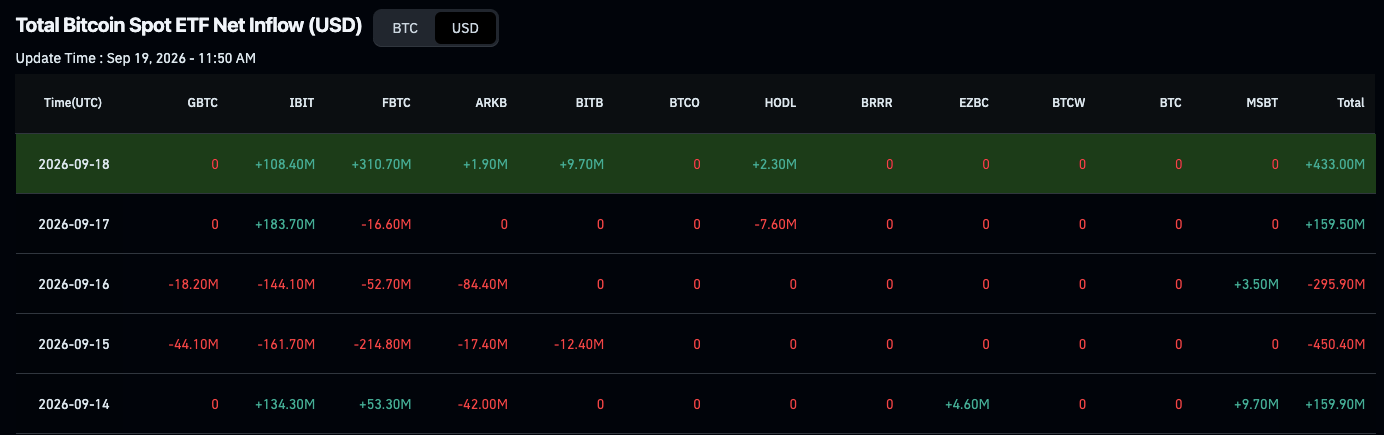
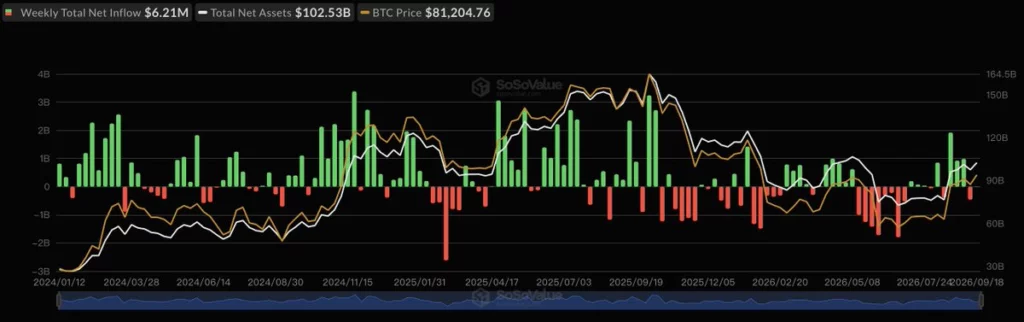
U.S. spot Bitcoin ETFs recorded approximately $159.9 million in net inflows on Sept. 14 before investors withdrew $450.4 million on Sept. 15 and another $295.9 million the following day.
Combined withdrawals across Sept. 15 and Sept. 16 reached roughly $746.3 million, coinciding with Bitcoin’s decline toward the mid-$75,000 area.
Demand returned later in the week. Spot Bitcoin ETFs attracted $159.5 million on Sept. 17 before inflows accelerated to around $433 million on Sept. 18.
Fidelity’s FBTC led Friday’s rebound with $310.7 million, while BlackRock’s IBIT added $108.4 million. Across the full five trading sessions, the funds finished with approximately $6.2 million in net inflows.
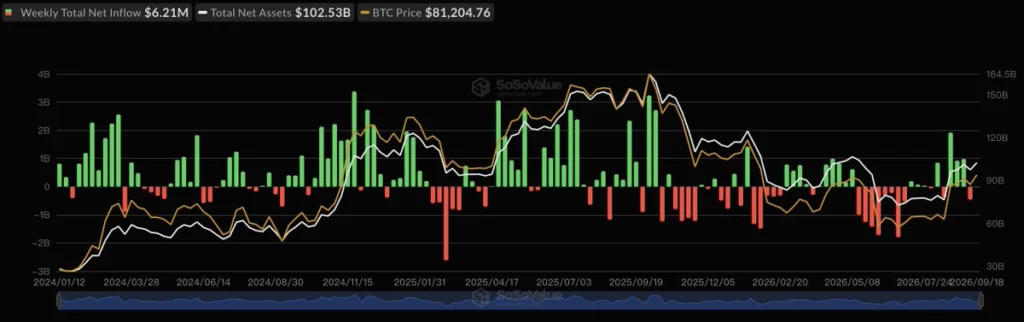
Crypto.news reported that Bitcoin ETFs ended the week slightly positive while U.S. spot Ether funds recorded approximately $140.6 million of net withdrawals.
The timing of the flows closely tracked Bitcoin’s volatile week, though ETF subscriptions and redemptions alone do not establish the cause of individual price moves.
Bitcoin momentum stays positive below overbought territory
Bitcoin’s current technical indicators show improving momentum without an overbought reading.
The 14-period Relative Strength Index stands at 59.96, above its moving average of 57.35. The RSI remains below the 70 level, commonly used to identify overbought conditions.
The reading places Bitcoin in neutral-to-bullish territory after the rebound from below $76,000. RSI holding above its own moving average shows momentum has strengthened during the recovery.
MACD gives a similar signal. The MACD line sits near 193.33, while the signal line stands at approximately 143.26, producing a positive histogram close to 50.07.
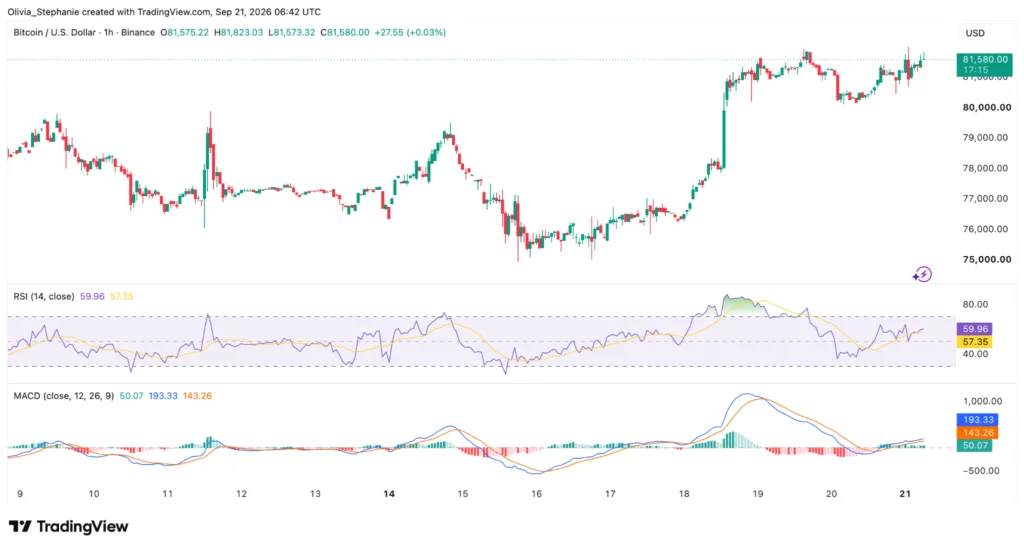
A positive MACD histogram indicates short-term upward momentum remains intact, although BTC still faces resistance before the rally can extend materially.
Bitcoin is now approaching the $81,700-$82,000 resistance zone, where selling pressure appeared during the weekend. A sustained move above the area would place the market beyond its latest local rejection.
On the downside, $80,000 remains the first level to watch. Losing that psychological threshold could bring the $79,000 area back into play, while a deeper reversal would put the recent breakout structure under pressure.
Fed speakers and PMI data could move Bitcoin this week
Monetary policy remains one of Bitcoin’s main macro variables after the Federal Reserve raised its benchmark interest-rate range by 25 basis points to 3.75%-4.00% on Sept. 16.
The Federal Open Market Committee approved the increase unanimously. In its policy statement, the Fed said economic activity continued expanding at a solid pace while inflation remained elevated.
There is no rate decision scheduled this week, but several Fed officials are due to speak. Investors will monitor their comments for clues about whether September’s increase was an isolated move or part of a longer tightening sequence.
Federal Reserve projections released with the September meeting indicated policymakers still see room for another increase during 2026, though future decisions remain dependent on incoming economic data.
Wednesday brings an important data point.
S&P Global is scheduled to publish preliminary September U.S. manufacturing, services and composite purchasing managers’ indexes at 9:45 a.m. ET on Sept. 23.
August’s flash report showed manufacturing at 53.9 and services at 56.5, both above the 50 level separating expansion from contraction.
Stronger September numbers could support expectations that the U.S. economy can tolerate tighter monetary policy. Weaker readings could revive debate about how far the Fed can continue raising rates.
Trump-Xi meeting adds another market catalyst
Thursday will turn attention toward U.S.-China relations as President Donald Trump and Chinese President Xi Jinping are scheduled to meet.
Reuters reported that trade, tariffs, investment, export controls and technology restrictions are expected to feature in the discussions. Markets will be watching for either an extension of the current trade truce or renewed friction between the two governments.
The existing tariff arrangement is due to expire in November, making Thursday’s meeting relevant for equities, currencies and other risk assets that have reacted to changes in U.S.-China trade policy.
Ahead of the talks, Reuters reported that the Chinese yuan strengthened to its highest level against the dollar in more than three years, while the U.S. dollar index traded around 100.23.
Crypto markets were broadly higher alongside Bitcoin on Monday. NEAR led major tokens with a roughly 23% gain to above $4, supported by increased activity through NEAR Intents and rising ZEC swap traffic. ZEC gained around 3% to above $1,500, while BNB, Ether and HYPE advanced close to 2%. XRP, DOGE, SOL and TRX posted gains of roughly 1% or less.
Disclosure: This article does not represent investment advice. The content and materials featured on this page are for educational purposes only.

The Bank of Russia has proposed capping banks’ total risk from cryptocurrencies and foreign digital instruments at 1% of their capital as it sets prudential limits for lenders entering the country’s newly regulated crypto market.
Summary
- Bank of Russia has proposed limiting banks’ total risk from cryptocurrencies and foreign digital instruments to 1% of their capital.
- The proposed rules cover direct crypto holdings, derivatives and other linked instruments, while allowing certain lower risk positions to be offset.
- Crypto exposure and certain client positions would carry a 1,250% risk weight, while some excluded client positions would receive a 50% risk weight.
- Banks are expected to begin reporting covered turnover and the new N31 and N32 risk ratios from January 2027.
According to the Bank of Russia, the draft regulation would introduce two maximum risk ratios, N31 for individual credit institutions and N32 for banking groups on a consolidated basis. Both would be limited to 1% of the institution or group’s own funds.
The rules would cover more than direct cryptocurrency holdings. Loans, derivatives, bonds, repo transactions, guarantees, credit lines and other financial instruments whose payments or value depend on cryptocurrencies or foreign digital instruments can fall within the calculation.
Banks would have to remain within the 1% ceiling on every operating day, while a breach on any such day would count as noncompliance. The draft gives the central bank authority to take measures against an institution if breaches occur on six or more operating days within any 30 consecutive operating days.
Bank of Russia crypto rules separate assets by risk
The proposed framework divides crypto related transactions into two groups based partly on sanctions and physical liquidity risks, determining how banks can account for long and short positions.
Group 1 includes certain exchange traded cash settled derivatives, qualifying over the counter derivatives and instruments involving counterparties that meet specified credit standards. Some transactions with cryptocurrency miners can qualify under conditions tied to their income from digital asset sales.
Deliverable derivatives and some loans, credit lines, guarantees, repo transactions and bonds can fall into the lower risk group when settlement is available in rubles or currencies of countries Russia does not classify as unfriendly.
For qualifying assets with lower freezing and physical liquidity risks, banks would be permitted to offset opposing long and short positions when calculating exposure. The draft applies discounts when maturities differ, starting at 5% and rising with the gap between the positions. A maturity mismatch of 37 months or more carries an 85% coefficient.
Group 2 captures direct investments in cryptocurrencies and foreign digital instruments, loans settled exclusively with such assets, certain repo transactions and derivatives that do not qualify for Group 1. Other crypto related transactions not included in the first category would fall into Group 2 as well.
The central bank would calculate Group 2 exposure using the larger of a bank’s long or short position in each asset, preventing institutions from fully offsetting the two sides for purposes of the risk limit.
Banks face a 1,250% crypto risk weight
Capital treatment under the proposal would impose a 1,250% risk weight on a bank’s aggregate crypto exposure and certain client positions for which the institution assumes responsibility.
The Bank of Russia said client assets for which a digital depository is responsible for losses arising from seizure or restrictions linked to sanctions risk would be included in the relevant risk calculation. Client positions where the bank does not bear that responsibility would be excluded from the N31 and N32 limits and instead receive a 50% risk weight for capital adequacy purposes.
Cryptocurrencies and foreign digital instruments could not be counted as collateral when banks calculate provisions for possible losses. Derivatives tied to crypto or foreign digital instruments would carry a 36% risk factor under the proposed framework.
The regulator plans to introduce reporting for turnover in the covered instruments and the N31 and N32 ratios from January 2027, with detailed reporting forms still under development. The regulation is expected to be officially published in the fourth quarter of 2026 and would take effect 10 days after publication.
Russia sets bank limits after regulated crypto market opens
The prudential proposal arrives weeks after Russia’s regulated cryptocurrency framework took effect on Sept. 1, bringing trading, custody and cross border crypto transactions under a formal system overseen by the Bank of Russia.
As crypto.news previously reported, nonqualified investors can purchase eligible liquid cryptocurrencies worth up to 300,000 rubles per year through each intermediary after passing a suitability test. Qualified investors can trade without the same purchase ceiling, although testing requirements still apply.
The Bank of Russia had already started preparing operating requirements for the institutions expected to serve the market. Draft rules published in July set out requirements for crypto exchanges and depositories, including registration and capital provisions for companies handling digital assets.
Russian banks have meanwhile been preparing their own infrastructure. Sberbank has set a Dec. 1 target to launch crypto trading infrastructure covering trading, custody, settlement and digital depository services for eligible customers.
Alfa Bank has been testing cryptocurrency trading through its Alfa Investments brokerage application with a limited group of qualified investors. The lender has said a larger rollout depends on the completion of the regulatory framework and has plans to establish its own digital depository.
Regulatory scrutiny has continued alongside the market rollout. On Sept. 15, the Bank of Russia identified cryptocurrencies and stablecoins as a financial market risk, citing concerns that digital assets could be used as substitutes for the ruble and reiterating the possibility of complete investment losses. The regulator’s risk assessment came as Russia continued implementing rules for licensed crypto operators and digital asset custody.

Amazon blocks Meta’s Muse AI assistant in new standoff over agentic shopping

Financial Audit Husband RUINED Her Life

Emmerdale Halloween horror confirmed for Kim as seismic twist unfolds | Soaps




-

 Fashion3 days ago
Weekend Open Thread: Talbots – Corporette.com
-

 Tech9 hours ago
Researchers escape OpenAI Codex sandbox to run commands on host
-

 Crypto World6 days ago
Revolut Attackers Warn of Ongoing Daily Customer Data Leaks
-

 Crypto World2 days ago
Circle launches Arc Studio AI agent for building onchain apps
-
 NewsBeat2 days ago
Trump says US has reached an agreement to take permanent control of Greenland’s security
-

 Crypto World6 days ago
Kraken Lets xStocks Holders Earn Yield Through DeFi
-

 Crypto World5 days ago
Robinhood engineers charged over $50K crypto scheme
-

 Crypto World2 days ago
Bitcoin price breaks channel as RSI climbs to 63
-

 Crypto World5 days ago
What Is the Status of the U.S.-Iran Peace Talks? Here's What Both Sides Are Saying
-

 Crypto World4 days ago
US Charges Robinhood Engineers Over Crypto Listing Trades
-

 Crypto World7 days ago
Elon Musk Drops a Bombshell: Grok 5 Could Be the AGI Breakthrough
-
 NewsBeat7 days ago
‘Sick conspiracy’: Trump says only guardrails AI needs is ‘a strong and smart (High IQ!) president’ in all-caps rant
-
Business7 days ago
SK Hynix ADRs Fall More Than 6% as Memory Rally Breaks on Fears of Slower AI Spending
-

 Crypto World6 days ago
NVIDIA Analysis: Attempted Rising Wedge Breakout Amid Pressure on the AI Sector
-

 Tech5 days ago
Webb’s IC 348 Mosaic Includes Two-Jupiter Dwarfs, Twin Jets, and a Nursery Still Making Worlds
-
Crypto World6 days ago
Can Circle’s Arc Repeat Robinhood Chain’s Meme Coin Boom?
-

 Crypto World3 days ago
Silver prices recover quickly, hitting weekly high today
-

 Crypto World6 days ago
DOJ Seeks to Seize $61M in Iran Oil Funds From Binance Accounts It Vouched For
-

 Crypto World2 days ago
World Money launches in 150+ countries with Stripe
-
 NewsBeat3 days ago
US was ‘on brink of war’ with China over false AI report of nukes moving in Middle East
You must be logged in to post a comment Login