
Business
Can You Get Invoice Factoring With Poor Business Credit?


For a business waiting 30, 60 or more days for customers to pay, that distinction matters. Previous missed payments or a difficult trading period may still be reviewed, but providers can also look at the strength of the business, its debtor book and the likelihood that outstanding invoices will be paid.
First identify where the cash flow gap comes from
Not every invoice-related cash-flow problem calls for the same type of finance. A business waiting for customers to settle completed work faces a different problem from one that needs to pay a supplier before receiving money from its own customers.
Before choosing invoice factoring or another invoice-based funding route, a business should identify which side of the payment cycle is creating the pressure. Factoring releases cash against unpaid customer invoices, while supplier invoice funding addresses bills the business itself needs to pay before enough customer cash has arrived.
Making that distinction first prevents a business from assessing a finance product that does not match the underlying problem.
Poor credit does not tell the whole story
Invoice factoring companies set their own eligibility criteria, so a weak credit history does not produce the same outcome in every application. Providers still carry out checks, but invoice finance also involves assessing the underlying business and the invoices being funded.
The quality of the debtor book matters because the facility depends on customers paying valid invoices. A business with established B2B customers, accurate records and customers that usually pay on time presents a different case from one dealing with disputed invoices or recurring late payments.
Recent accounts and trading information can also help explain an older credit problem. A missed payment during a temporary disruption may be viewed differently from continuing difficulty meeting current commitments.
None of this guarantees approval. It simply means the business credit history is one part of a wider assessment.
The invoices themselves need to stand up to scrutiny
Factoring works around money already owed to the business, so providers need confidence that those receivables are genuine and likely to be paid.
Accurate invoices, clear payment terms and an organised sales ledger make the position easier to assess. Providers may also look at how concentrated the debtor book is. Heavy dependence on one customer creates a different risk from a ledger spread across several established businesses.
Payment disputes matter as well. An invoice that is technically outstanding but subject to a disagreement over delivery or service quality is not equivalent to an undisputed invoice simply waiting for its payment date.
For the business owner, this means poor credit should not be considered in isolation. The condition of the receivables matters because those invoices sit at the centre of the facility.
Check whether factoring solves the actual problem
Access to funding is only one part of the decision. Factoring changes when the business receives cash and, in many arrangements, who manages collection from customers. It also comes with fees and contractual responsibilities.
A company with healthy sales but long customer payment terms or recurring late payments may have a clear reason to examine business invoice finance. A business that is consistently unprofitable has a different problem. Receiving cash earlier does not correct weak margins or operating costs that remain above income.
The same applies when poor credit reflects an issue that is still continuing. If current commitments already exceed what normal trading can support, another funding arrangement may shift the timing of the pressure without removing it.
Poor business credit does not automatically rule out invoice factoring, but approval and terms depend on the wider financial picture. The quality of the debtor book, current trading position, cost of the facility and reason for the cash-flow gap all matter when deciding whether factoring is a workable fit.

Business
Sensex jumps 550 points, Nifty nears 23,400 as oil prices cool down despite Middle East tensions. What lies ahead?

Sensex gained 550 points to 74,850, and Nifty gained 78 points to trade near 23,422 on Monday, as seen at around 12.02 am. Broader markets, however, slipped into the red, with Nifty Midcap 100 and Nifty Smallcap 100 indices falling up to 0.4%.
UltraTech Cement, Sun Pharma, HCL Tech, Asian Paints and IndiGo shares rose 2-3% to lead gains on Sensex, while shares of Power Grid, Bharti Airtel and Infosys fell more than 1% each. Among the sectors, Nifty FMCG and Nifty Pharma rose over 1% each, while Nifty IT dropped 0.6%. The overall market breadth remained flat, with NSE seeing 1,600 advances and 1,641 declines, while 107 stocks remained unchanged.
Also read | Lenskart shares drop 3% after 3 crore shares change hands in block deal; Platinum Jasmine likely seller
What lies ahead for Dalal Street?
Global geopolitical risks are increasing, V K Vijayakumar, Chief Investment Strategist at Geojit Investments, noted. He added that the conflicts in the Middle East and the Russia-Ukraine war are escalating. However, Brent crude has declined to below $102 per barrel, due to increasing oil flow through the Strait of Hormuz.

The US 10-year bond yields are hovering around 5%, posing a threat to equity markets. But equity markets are holding their ground, taking cues from the robust growth in developed economies and expectations of good corporate earnings, Vijayakumar said, adding that in India, too, this pattern is playing out.
“GDP growth of 7% and Nifty earnings growth of 12 to 14% are achievable in FY27. The broader market earnings growth will be much better. These expectations are already in the price since the mid-and small-cap valuations are at a significant premium to large-caps. A sectoral pivot to large-caps is likely. But this will happen only when the Iran-US conflict is resolved, and crude and bond yields decline. Investors should wait for this pivot and, meanwhile, accumulate high-quality large-caps available at attractive valuations,” according to the analyst.Also read | Tata Chemicals, Tata Investment Corp shares fall up to 3% as boardroom battle likely to reach court
Technical view on Nifty
With Nifty having reached within touching distance of the 23,400 objective, a consolidation is expected, said Anand James, Chief Market Strategist at Geojit Investments. He, however, said that the favoured view expects this phase to be short-lived and a rise to 23,560 and beyond may be expected if dips are contained above 23,280/260.
“Meanwhile, we will wait for a break past 23,116 to reconsider prospects of 22,600-21,800,” the analyst noted.
Disclaimer: This article has been written by Debaroti Adhikary, who is not a SEBI-registered Research Analyst or an Investment Adviser. Debaroti Adhikary and his/her ‘relative(s)’ (as defined under Section 2(77) of the Companies Act, 2013) do not hold any financial interest in the companies mentioned in this article as of the date of publication. The views/recommendations mentioned in this article, wherever applicable, are those of the respective SEBI-registered Research Analyst/brokerage and have been reproduced/reported with due attribution. They should not be construed as the views or recommendations of The Economic Times Digital or the journalist. Readers are advised to consider the original research report and make their investment decisions based on their own assessment. Brokerage disclaimers here.

Columbia Emerging Markets Fund Q2 2026 Commentary

Novo Nordisk shares fall 6% as company sets 2030 growth targets

Elevra Lithium: Reclaiming Its Margins Before Expanding Its Mine

DAX stalls at 25,697 below key resistance wall: Live levels

Why is Craneware stock plummeting today?

Check out what’s clicking on FoxBusiness.com.
Volkswagen Group of America is recalling more than 208,000 vehicles in the U.S. over a steering rack mounting bolt that can corrode and break, potentially causing a loss of steering control.
The recall affects a total of 208,724 SUVs, including certain 2018 Tiguan, 2018-2019 Atlas and 2019-2021 Audi Q3 vehicles, the National Highway Traffic Safety Administration (NHTSA) announced.
The affected Tiguan vehicles were manufactured from March 22, 2017, through June 18, 2018, the affected Atlas vehicles were manufactured from Nov. 30, 2016, through Sept. 22, 2018, and the affected Audi Q3 vehicles were manufactured from May 21, 2019, through July 16, 2021.
FORD RECALLS MORE THAN 223,000 VEHICLES OVER FUEL TANK ISSUE

Volkswagen is recalling more than 208,000 vehicles in the U.S. over a steering rack mounting bolt that may corrode and break that could break and cause a loss of steering control. (Getty Images / Getty Images)
The recalled vehicles were manufactured with a specific steering rack, so vehicles with a different steering rack are unaffected by the recall.
According to the notice, the right-side mounting bolt on the steering rack can corrode after moisture enters the surrounding area. If the bolt head fractures, the steering rack could remain attached to the vehicle’s subframe at only one mounting point.
CHRYSLER RECALLS NEARLY 75K SUVS OVER PARTS THAT COULD DETACH WHILE DRIVING

The recall affects a total of 208,724 SUVs, including certain 2018 Tiguan, 2018-2019 Atlas and 2019-2021 Audi Q3 vehicles. (Getty Images / Getty Images)
According to NHTSA, continued loading could cause the steering rack housing to fracture, potentially leading to a loss of steering capability, potentially leading to a loss of steering capability.
“A broken steering rack housing can result in a loss of steering control, increasing the risk of a crash,” the NHTSA said in its notice.
Volkswagen and Audi said they are not aware of any crashes, fires, injuries or deaths linked to the defect.

Volkswagen and Audi said they are not aware of any crashes, fires, injuries or deaths linked to the defect. (Getty Images / Getty Images)
CLICK HERE TO GET FOX BUSINESS ON THE GO
Dealers will replace the right steering rack mounting bolt with a bolt featuring a highly corrosion-resistant polymer coating at no cost. The new bolt is designed to offer greater protection against corrosion.
Owner notification letters are expected to be mailed out on Nov. 10.

Shake Shack: The Activist Catalyst Adds To This Turnaround Story

Adding a new customer is a routine business decision for trucking companies — one that may also introduce changes in how the operation is structured.
There may be changes in the type of cargo carried, locations served, route types, mileage, and contractual insurance requirements. Even when fleet size remains unchanged, those changes may affect how coverage placement reflects the operation.
Reviewing whether existing coverage reflects current operations may be a useful step.
How a New Customer May Change Trucking Operations
Adding a new customer does not automatically trigger coverage changes. What matters is what changes in the operation as a result of that relationship.
If the new customer uses similar cargo, equipment, and routes, operational changes may be minimal. When a new customer introduces new states, different cargo types, or specialized equipment, there may be coverage considerations worth reviewing.
Relevant operational factors include:
- Type of freight
- Operating territory
- Expected mileage
- Equipment requirements
- Loading and unloading facilities
- Contractual insurance requirements
These factors help describe how a new customer relationship connects to the broader trucking operation.
Changes in Routes and Coverage Considerations
Adding a new customer may extend the operating territory.
Routes may appear in states or regions outside the company’s primary operating area. Operating in unfamiliar traffic and road conditions may introduce different exposure patterns.
While this does not point to any specific coverage outcome, operating territory is a relevant factor in the information used for coverage placement — and a change in territory may be worth reviewing in that context.
How Different Cargo May Affect Coverage Considerations
A new customer may bring a different type of cargo.
Motor truck cargo insurance addresses damage to freight in the motor carrier’s care, subject to the terms and limitations of the applicable policy.
A transition to higher-value, temperature-sensitive, or specialized cargo may be worth reviewing against existing cargo coverage terms. Refrigerated cargo, for example, introduces operational factors — temperature monitoring, reefer equipment maintenance, and breakdown exposure — that differ from standard dry freight operations.
How Equipment Requirements May Connect to Coverage
A customer may require specialized equipment — refrigerated trailers, flatbeds, or other configurations.
Physical damage coverage protects against damage to insured vehicles from accident, fire, theft, vandalism, and similar causes. Adding or changing equipment may be worth reviewing against existing physical damage coverage.
Where specialized equipment is used under a trailer interchange agreement, Trailer Interchange coverage may be relevant depending on the terms of that agreement.
For transportation businesses navigating those shifts, working with an independent agency specializing in commercial trucking insurance (such as GIA Group, LLC) may help identify how new routes, cargo types, equipment, and contractual requirements factor into coverage placement, and connect the operation to insurance carriers specialized in commercial trucking.
Why Contractual Requirements Are Worth Comparing Against Current Coverage
Customer contracts may include a range of insurance requirements:
- Liability limits
- Cargo limits
- Certificates of insurance
- Additional insured status
- Specific endorsements
Existing coverage does not automatically satisfy all contractual requirements. Comparing those requirements against current coverage before starting operations may help identify potential gaps.
Why Adding a Customer Does Not Automatically Mean Premium Changes
Adding a new customer does not automatically produce a specific premium change.
Premiums are influenced by many factors — vehicles, mileage, operating territory, cargo, claims history, and drivers among them. A new account may shift some of those factors, but the overall effect depends on the full operational picture and market conditions at the time of review.
When Customer Changes May Warrant a Coverage Review
A coverage review may be useful when a new customer introduces material operational changes such as:
- Entering a new operating region
- Significantly increasing mileage
- Carrying a different type of cargo
- Adding specialized equipment
- Introducing new contractual insurance requirements
- Changing loading and unloading arrangements
Reviewing these changes alongside existing coverage information may help clarify whether coverage continues to reflect current operations.
Why Keeping Coverage Information Current Matters
Trucking operations may evolve as customer relationships develop. Routes, cargo requirements, equipment, and mileage may all shift during the policy period.
Maintaining current operational records may support a clearer picture of how coverage aligns with actual business activity.
Conclusion
A new customer may mean more than additional freight — it may also bring different cargo types, extended routes, increased mileage, specialized equipment requirements, and new contractual obligations.
Reviewing those changes alongside existing commercial trucking coverage may help clarify whether coverage continues to reflect how the operation actually functions.

Silver consolidates at $66.40 in breakout coil: Live levels

GMB’s Kate Garraway floored after co-star’s secret wedding ‘goodness me’
Sensex jumps 550 points, Nifty nears 23,400 as oil prices cool down despite Middle East tensions. What lies ahead?

Ethereum Price Prediction: Can ETH Break $3,000 This Month? Here’s Why It Could




-

 Fashion3 days ago
Weekend Open Thread: Talbots – Corporette.com
-

 Tech10 hours ago
Researchers escape OpenAI Codex sandbox to run commands on host
-

 Crypto World6 days ago
Revolut Attackers Warn of Ongoing Daily Customer Data Leaks
-

 Crypto World2 days ago
Circle launches Arc Studio AI agent for building onchain apps
-
 NewsBeat2 days ago
Trump says US has reached an agreement to take permanent control of Greenland’s security
-

 Crypto World6 days ago
Kraken Lets xStocks Holders Earn Yield Through DeFi
-

 Crypto World6 days ago
Robinhood engineers charged over $50K crypto scheme
-

 Crypto World2 days ago
Bitcoin price breaks channel as RSI climbs to 63
-

 Crypto World5 days ago
What Is the Status of the U.S.-Iran Peace Talks? Here's What Both Sides Are Saying
-

 Crypto World4 days ago
US Charges Robinhood Engineers Over Crypto Listing Trades
-

 Crypto World7 days ago
Elon Musk Drops a Bombshell: Grok 5 Could Be the AGI Breakthrough
-
 NewsBeat7 days ago
‘Sick conspiracy’: Trump says only guardrails AI needs is ‘a strong and smart (High IQ!) president’ in all-caps rant
-
Business7 days ago
SK Hynix ADRs Fall More Than 6% as Memory Rally Breaks on Fears of Slower AI Spending
-
 Crypto World6 days ago
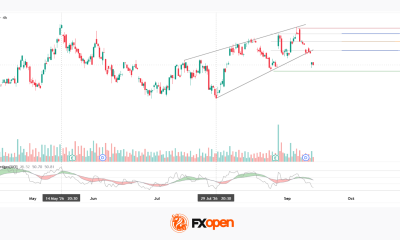
NVIDIA Analysis: Attempted Rising Wedge Breakout Amid Pressure on the AI Sector
-

 Tech5 days ago
Webb’s IC 348 Mosaic Includes Two-Jupiter Dwarfs, Twin Jets, and a Nursery Still Making Worlds
-
Crypto World6 days ago
Can Circle’s Arc Repeat Robinhood Chain’s Meme Coin Boom?
-

 Crypto World3 days ago
Silver prices recover quickly, hitting weekly high today
-

 Crypto World6 days ago
DOJ Seeks to Seize $61M in Iran Oil Funds From Binance Accounts It Vouched For
-

 Crypto World2 days ago
World Money launches in 150+ countries with Stripe
-
 NewsBeat3 days ago
US was ‘on brink of war’ with China over false AI report of nukes moving in Middle East
You must be logged in to post a comment Login