
Crypto World
MultiversX hit by Upbit warning after mainnet exploit


MultiversX has come under formal trading review at Upbit after the South Korean exchange flagged EGLD on Sept. 21 following a mainnet security incident that forced the network to stop progressing.
Summary
- Upbit designated EGLD for trading caution after MultiversX confirmed a VM-level atomicity exploit attempt Saturday.
- EGLD deposits and withdrawals remain suspended, with Upbit planning to reopen withdrawals before deposits later.
- MultiversX paused network progression after invalid state changes and prepared a fix for shadow-fork testing.
- Upbit will review EGLD through October 19-23 before deciding whether trading support should continue thereafter.
- Kraken placed EGLD trading pairs in cancel-only mode while deposits and withdrawals remained paused there.
Upbit’s official notice designated EGLD/KRW, EGLD/BTC and EGLD/USDT as trading caution markets after the exchange said an unresolved security incident involving the blockchain could have caused, or could potentially cause, user losses.
Upbit had already suspended EGLD deposits and withdrawals at 5:47 p.m. KST on Sept. 19. When transfers eventually resume, the exchange said withdrawals will return first. Deposit support will require a separate announcement after the trading caution review begins.
MultiversX exploit triggered the Upbit warning
The warning follows a confirmed attempt to exploit a virtual-machine-level atomicity issue on the MultiversX mainnet.
MultiversX initially disclosed on Sept. 19 that it was investigating a potential mainnet issue and prioritizing user safety and stable network operation. As crypto.news previously reported, the project’s first statement did not classify the event as an exploit or disclose any confirmed financial loss.
A later project update said an actor had “attempted to exploit a VM-level atomicity issue.” The attempt produced invalid state changes, prompting developers to stop network progression while engineers worked on a repair.
The team prepared a software fix for testing through a shadow fork, allowing developers to reproduce mainnet conditions without immediately applying changes to the live network.
MultiversX said deployment would proceed “subject to successful testing” and would require coordination with validators, exchanges and infrastructure providers. No firm restart deadline appeared in the public updates reviewed.
Security tracker SlowMist separately recorded the incident as an attempted VM-level atomicity exploit involving invalid on-chain state changes. Its public database did not list a confirmed loss amount.
EGLD withdrawals remain blocked across exchanges
Upbit’s action came as several exchanges restricted MultiversX transfers following the network disruption.
Bithumb suspended EGLD deposits and withdrawals on Sept. 19 after MultiversX block production stopped. The exchange said transfer services would remain unavailable until it confirmed network stability.
Bithumb had restored EGLD deposits and withdrawals only three days earlier following a scheduled network upgrade, according to its Sept. 16 service notice.
Kraken took a different approach. Its public status page placed EGLD trading pairs into cancel-only mode, allowing users to cancel existing orders while preventing new trades. Deposits and withdrawals remained unavailable.
Coinbase separately reported delayed EGLD sends and receives beginning Sept. 19 because of a MultiversX network issue. Buying, selling and fiat services were not affected by the transfer disruption.
MultiversX told users not to submit or rebroadcast transactions and advised against moving EGLD or ESDT tokens through exchange deposit and withdrawal routes or cross-chain bridges until the project issues an all-clear.
Upbit can extend the warning or end EGLD trading
The Upbit designation does not immediately remove EGLD from the exchange.
Under its digital asset trading-support termination policy, Upbit will review whether the reasons behind the caution notice have been fully resolved before deciding whether to lift the warning, extend the review or end trading support.
The current review period runs from Sept. 21 through the fourth week of October, with Upbit identifying Oct. 19-23 as the expected decision window.
The exchange said the review can be extended if further investigation is required. A failure to fully resolve the underlying security concerns could lead to termination of EGLD trading support.
Deposits made after publication of the caution notice cannot be credited normally and fall under Upbit’s return process. Since transfer services were already suspended, users remain unable to use standard EGLD deposits or withdrawals.
Upbit cited Article 17(1)(e) of South Korea’s Virtual Asset User Protection Act Enforcement Decree when explaining the designation.
The exchange said its decision considered whether a security incident affecting a wallet, distributed ledger or other infrastructure used to issue, transfer or store virtual assets remained unexplained or unresolved.
EGLD weakened as network restrictions spread
EGLD declined while the network issue and exchange restrictions developed.
CoinGecko historical data show EGLD closing at $4.14 on Sept. 18, before falling to $3.87 on Sept. 19 and $3.78 on Sept. 20. The move represented a decline of roughly 8.7% from the Sept. 18 close.
Trading activity increased during the disruption. CoinGecko recorded approximately $10.18 million in EGLD volume on Sept. 20, compared with roughly $3.35 million on Sept. 18.
The timing places the price decline alongside the security incident and exchange restrictions, though the market data alone do not establish that the exploit attempt caused every part of the move.
The episode came shortly after MultiversX activated its Supernova mainnet upgrade, which reduced targeted block time from six seconds to 600 milliseconds and shortened cross-shard settlement.
No MultiversX statement reviewed has connected the VM-level atomicity exploit attempt to Supernova, so the upgrade and security incident should not be treated as causally linked without further technical evidence.
MultiversX plans recovery before releasing full report
MultiversX said engineers were evaluating a targeted recovery procedure designed to preserve finalized legitimate transaction history while correcting invalid state changes linked to the incident.
The project has not yet published the exact recovery method or identified which transactions, smart contracts or account states require correction.
Its official status page has shown several services, including the Public API, xPortal, Explorer, Wallet, Bridge and xExchange, as experiencing degraded performance during the incident response.
Gateway and Index services were listed as operational in the same status update. MultiversX said a full technical incident report would be published after investigators finish the response and finalize their findings. Upbit, Kraken and other exchanges are meanwhile keeping EGLD transfer restrictions in place pending further network recovery updates.

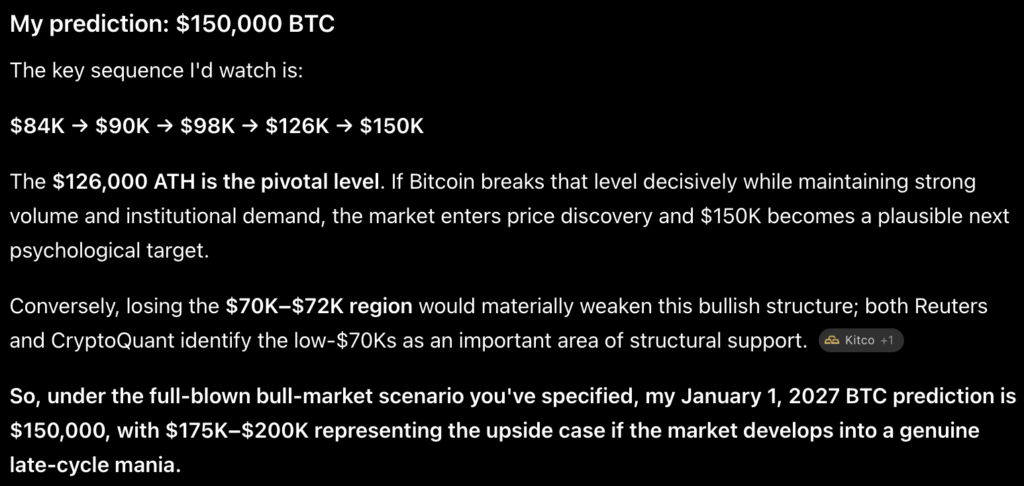
Elon Musk’s Grok AI predicts that in a full-blown bull market, Bitcoin could hit $150,000 before January 1, 2027. The bullish range is listed at $135,000–$175,000, with a genuine late-cycle blow-off potentially pushing Bitcoin toward $200,000+.
At roughly $82,000, $150,000 would be about an +80% move. The interesting thing about Bitcoin’s current setup is that it has already corrected substantially from its previous cycle high. BTC reached approximately $126,200 on October 6, 2025, before falling sharply during 2026. As of right now, it has recovered into the $80,000s.

Bitcoin has already shown it can produce enormous gains during strong cycles. According to historical annual data, BTC gained about 154% in 2023 and 110% in 2024.
A move from ~$82,000 to $150,000 is “only” around 80%, substantial, but nowhere near the percentage gains seen during earlier Bitcoin bull phases.
Grok AI Predicts Bitcoin to $150,000, Does the Technical Analysis Back it Up?
Bitcoin recently broke out of a sequence of lower highs that developed from May onward and reclaimed several key moving averages.
Reuters’ technical analysis identified the $71,781 area as important support, with $82,793 representing a major resistance level. Above that, the next technical objectives were around $90,000 and $97,867.
CryptoQuant has identified a similar progression. It sees $81,700 as particularly important because it matches Bitcoin’s 365-day moving average. Resistance levels above are around $84,600 and $88,700.
The first major test is therefore the $82K–$84K region. Bitcoin has now pushed through that area, which is important because a sustained breakout would remove one of the largest technical obstacles between the current price and the $100,000 level.
The next major milestone is approximately $98,000. Above that, the market is approaching the $126,200 all-time high, and this is where things get interesting.
Once BTC decisively breaks $126,000, it enters genuine price discovery. Very little historical resistance sits above that level. At that point, psychological targets such as $130K, $140K, and $150K can become magnets for momentum traders and institutional flows.
Never Miss a Swing Again: Use AI Copy Trading Bots From CryptoHopper
Historical Price Action Supports the Bull Case

Bitcoin’s previous cycles provide some context for what could happen if liquidity returns aggressively. In 2020, BTC rose from a March crash low of roughly $5,000 to nearly $29,000 by year-end. It then rose to about $69,000 in 2021.
The 2022 bear market subsequently took BTC down to around $15,700 before the next cycle began.
The recovery was substantial:
2022 low: ~$15,700
2023 high: ~$44,200
2024 high: ~$106,100
2025 high: ~$126,200
2026 low: ~$58,300
Historical annual data show just how dramatically Bitcoin can move when the cycle turns bullish. Another potentially encouraging technical development: Bitcoin recently produced a 50-day/200-day golden cross, the first such signal since May 2025.
That’s not a guarantee of another bull run, but in the scenario we’re assuming, it provides additional technical support for the thesis. If a full-blown bull market develops, a roughly 80% move from the current level is well within Bitcoin’s historical volatility.
There’s also an interesting external benchmark: Bernstein analysts currently expect Bitcoin to reach $150,000 by mid-2027, while their accelerated bull case projects about $200,000 around that time.
Make Your Prediction Count With $25 For Free on Kalshi
Bitcoin Hyper Targets Early Mover Upside as Bitcoin Tests Key Levels
A near +5% daily pop is fine if the position is already sized. For anyone watching from the sidelines, chasing BTC into resistance near $84,500 with the Grok AI predicts thesis still unconfirmed as active news is a thin trade.
The upside math at a $1.5 trillion-plus market cap simply moves more slowly than early-stage infrastructure plays, which is where attention is rotating.
Bitcoin Hyper ($HYPER) is positioning itself as the first Bitcoin Layer 2 with full SVM integration. It boasts smart contract execution built for speed that outpaces Solana itself, while settling back to Bitcoin’s base-layer security.
As of today, the presale has raised $33.1M at a current token price of just $0.0136864, with staking rewards live at launch at a huge 35% APY.
The pitch: solve Bitcoin’s slow transactions, high fees, and lack of programmability without abandoning what makes BTC trusted in the first place. A Decentralized Canonical Bridge handles BTC transfers natively.
Gain Access to New Bitcoin Layer 2 Early Here
Discover: The Best Token Presales
The post Grok AI Predicts Bitcoin to Hit $150,000 in Q4 appeared first on Cryptonews.

Eugene Investment & Securities has signed an agreement with blockchain company BEATOZ to test stablecoin settlement for tokenized securities subscriptions, targeting an onchain process that covers subscription, payment and settlement.
Summary
- Eugene Investment and BEATOZ will test stablecoins for settling tokenized securities subscription payments onchain.
- The proof of concept will examine whether subscription, payment and settlement can operate within a single blockchain based system.
- Eugene built its tokenized securities platform in 2024 and is participating in Hana Financial Group’s won stablecoin consortium.
- South Korea is preparing to introduce its regulated tokenized securities framework from February 2027.
According to Eugene Investment & Securities, the memorandum of understanding signed on Sept. 21 will initially focus on a proof of concept that applies stablecoins to subscription payments for tokenized securities. The firms will examine whether the payment leg can be moved onto blockchain infrastructure alongside securities records.
Current tokenized securities systems can record ownership and changes in investor rights onchain, while subscription funds continue to move through conventional bank accounts. Eugene and BEATOZ plan to test a structure in which stablecoins handle the payment side so that subscription, payment and settlement can operate through a single blockchain based flow.
Stablecoin settlement could bring payments onchain
Under the agreement, Eugene will contribute its securities operations experience and existing tokenized securities infrastructure, while BEATOZ will provide its hybrid blockchain technology. The companies will jointly review where stablecoins could be used across securities operations before deciding on potential infrastructure connections and subsequent cooperation based on the PoC results.
Eun Seok hoon, head of Eugene Investment & Securities’ AX innovation division, described the agreement as a “first step” toward infrastructure connecting tokenized securities and stablecoins.
“We will use our existing tokenized securities issuance platform to find concrete ways to apply it,” Eun said.
Eugene already has infrastructure that can be used for the trial. The brokerage built its tokenized securities platform in 2024 and participated in a tokenized securities pilot operated by the Korea Securities Depository in 2025. It is currently part of Hana Financial Group’s consortium working on a Korean won denominated stablecoin.
The trial comes as South Korea prepares to formally incorporate tokenized securities into its regulated capital markets system. Crypto.news previously reported that the country has laid out a three stage tokenization plan, with the first phase scheduled to begin when amendments to the Electronic Registration Act take effect on Feb. 4, 2027.
Selected privately pooled money market funds and institutional bonds are expected to become eligible for tokenization during the first phase, along with unlisted stocks issued through trust structures and publicly offered fractional investment securities. A later phase is expected to extend tokenization to publicly offered securities before the final stage introduces onchain payment infrastructure linked to stablecoins.
Existing licensed financial companies will be permitted to handle tokenized securities within the scope of their licenses. Qualifying issuers will be able to manage their own securities accounts, while distributed ledgers will serve as legally recognized records under the amended framework.
South Korea is building tokenized securities infrastructure
Technical work has been moving alongside the regulatory changes. Samsung SDS won a contract earlier this year to build the Korea Securities Depository platform that is expected to support tokenized securities when the new framework takes effect.
The system is expected to connect blockchain based distributed ledger records with KSD’s existing electronic securities account infrastructure. Planned functions include tokenized securities issuance, circulation checks, rights management and real time monitoring of issuance and circulation volumes. Samsung SDS previously conducted functional analysis for KSD in 2024 and built a test platform in 2025.
Private securities companies have been preparing their own systems ahead of the regulatory rollout. Hanwha Investment & Securities has completed a tokenized securities platform supporting Avalanche and Hyperledger Besu after beginning development with FairSquare Lab in 2025.
KSD’s infrastructure is being designed to connect with Avalanche, Hyperledger Besu and Hyperledger Fabric, giving participating securities companies multiple distributed ledger options as they prepare their systems for the incoming framework.
Institutional experiments are extending beyond the underlying securities records into the payment side of tokenized assets. South Korea has expanded deposit token trials to nine banks, with the tokens being examined for government payments, AI agent transactions and settlement of tokenized assets.
Financial firms test different tokenization models
Other South Korean financial companies are running separate trials before the 2027 framework takes effect. Shinhan Asset Management and Plume signed an agreement in August to test a won denominated tokenized fund backed by one of Shinhan’s ultra short term bond funds.
The proof of concept is being conducted offshore and excludes South Korean residents. No tokens will be issued or distributed as part of the test. Shinhan and Plume are examining investor whitelisting, know your customer checks, anti money laundering procedures and other onchain operating requirements.
BNK Investment & Securities has taken another route through a partnership with EverTreasure covering investment products backed by cultural content. BNK is responsible for arranging and distributing potential tokenized securities, recruiting investors and advising on regulatory requirements, while EverTreasure will identify underlying assets and connect blockchain technology to the products.
BNK is among the securities companies participating in Koscom’s joint tokenized securities issuance platform project. The companies plan to conduct due diligence on underlying assets and product structures before any potential offerings are made available to investors.
Eugene and BEATOZ have not disclosed a timetable for completing their stablecoin settlement PoC. The companies said the results will determine potential infrastructure integration and subsequent cooperation, while their initial work will focus on testing stablecoins for subscription payments and examining their possible use across other securities operations.
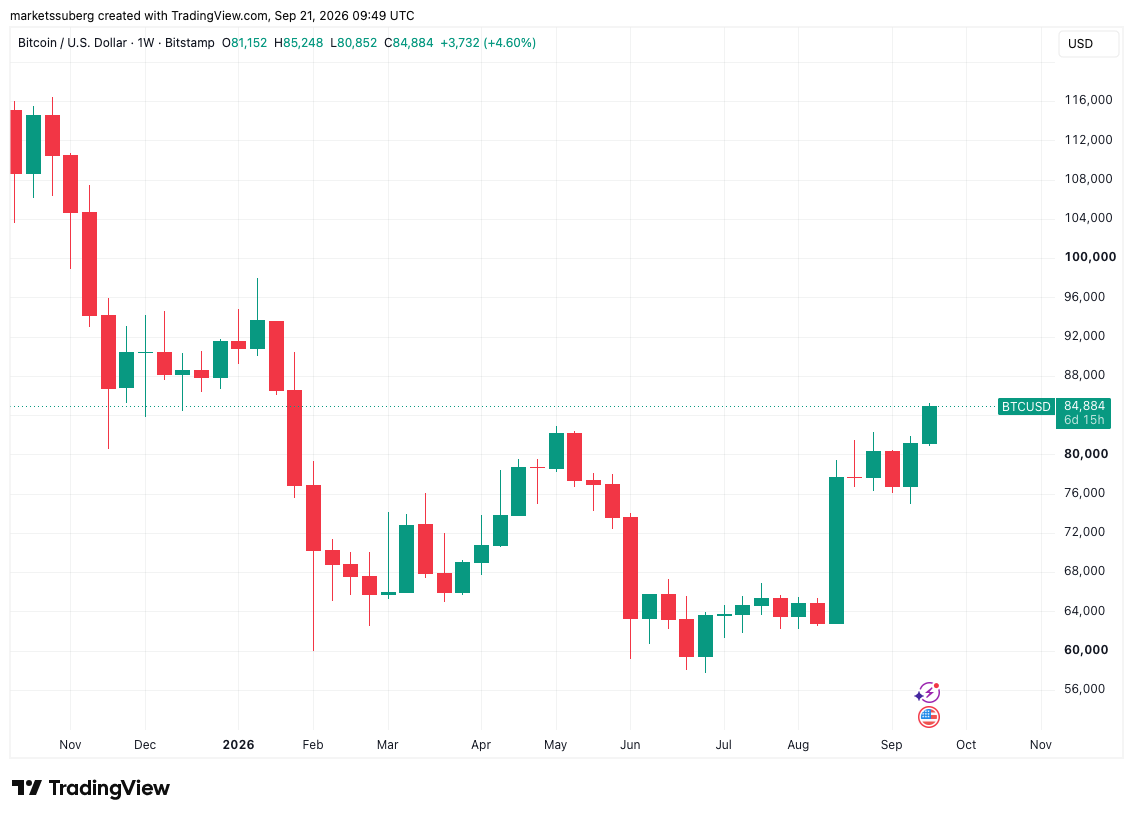
Bitcoin (BTC) starts a new week at its highest levels in nearly eight months as bulls propel the market to $85,000.
Key points:
- Bitcoin hit $85,248 on Monday, marking its highest levels since Jan. 29.
- BTC price action is approaching the breakeven point for US spot Bitcoin ETF investors near $86,000.
- Markets eyed oil prices below $94 per barrel and bond yields amid talk of US-Iran war diplomacy.
Bitcoin passes $85,000 after weekly close
Bitcoin is facing a key breakout at the time of writing as it hits $85,000 and sets new 33-week highs. Data from TradingView shows BTC/USD advancing after setting a weekly close of $81,120 on Sunday, its highest since the week of May 4.
BTC/USD one-week chart. Source: Cointelegraph/TradingView
Crypto short liquidations spiked as a result, with CoinGlass putting the cross-crypto 24-hour total at over $600 million.
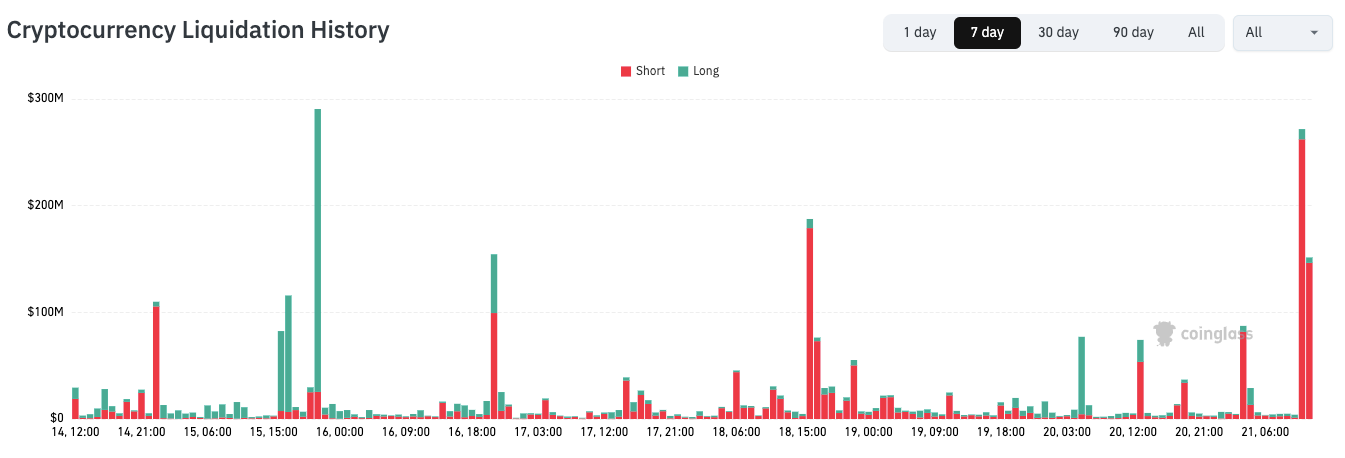
Crypto liquidation history (screenshot). Source: CoinGlass
The latest move higher has implications for the views of many market participants on whether price will hold above the prior local high of $82,950 from May. Last week, trader and analyst Rekt Capital described Bitcoin as facing a “moment of truth” as it coiled up below this level.
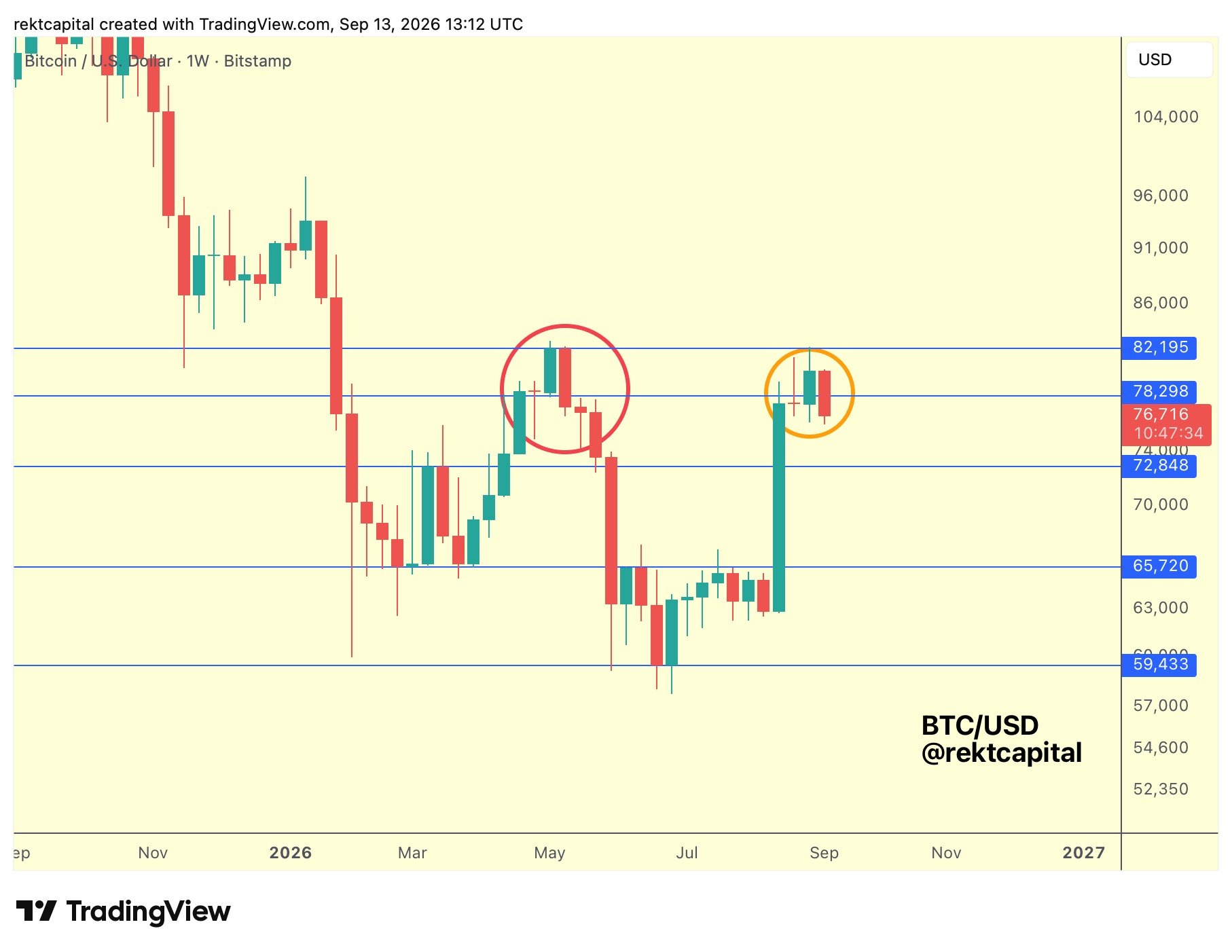
BTC/USD one-week chart. Source: Rekt Capital on X.com
Rekt Capital warned that a bearish divergence was playing out on the relative strength index (RSI) indicator on daily time frames, where lower highs for the indicator came with higher highs for price. He stated that this indicates a lack of underlying momentum to support the highs, increasing the risk of a sudden reversal.
With the return to $84,000, the daily RSI is approaching “overbought” territory at 70 at the time of writing. Bitcoin has reclaimed its 50-week exponential moving average (EMA) at $77,769, previously marked as a key prerequisite for upside continuation.
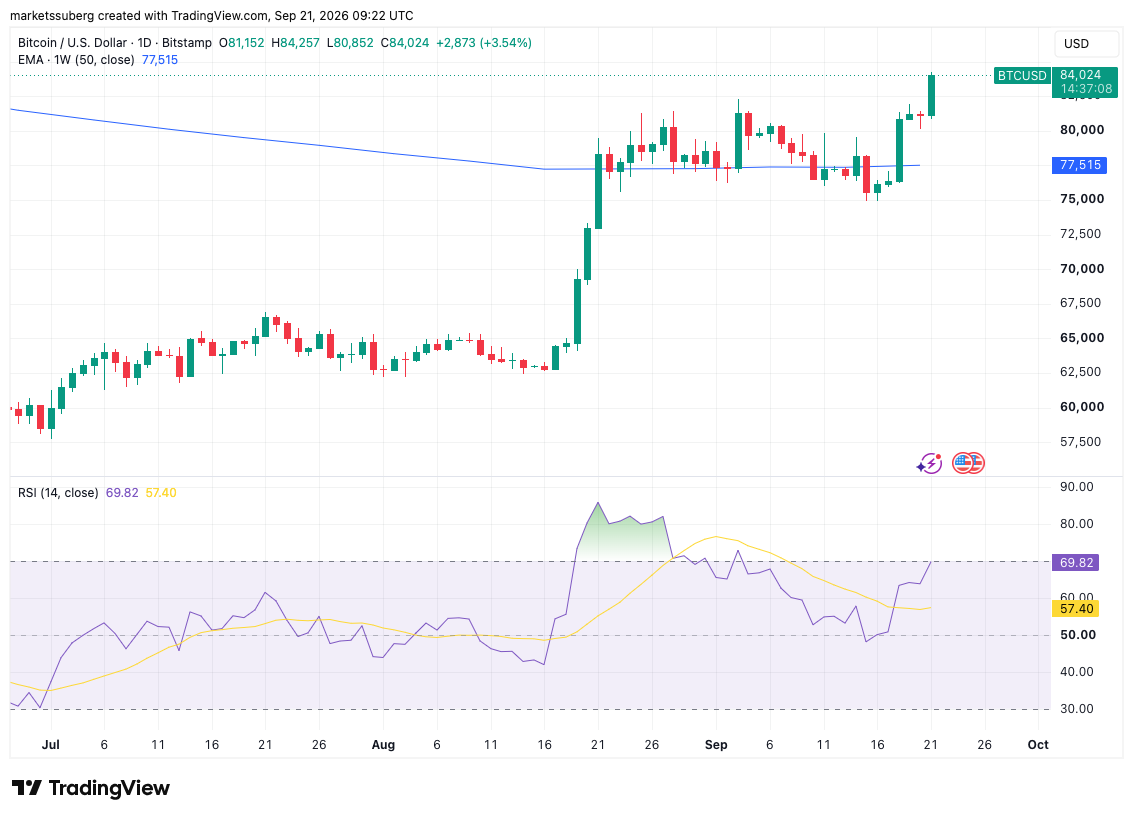
BTC/USD one-day chart with 50-week EMA; RSI data. Source: Cointelegraph/TradingView
Bitcoin ETF investors near breakeven point
Various investor cohorts also returned to aggregate profit, including Bitcoin corporate treasuries, holdings of which have a cost basis of around $80,500. Now, price is approaching its cost basis for investors in US spot Bitcoin exchange-traded funds (ETFs). Per data by onchain analytics platform Glassnode, this cost basis currently sits at $85,638.
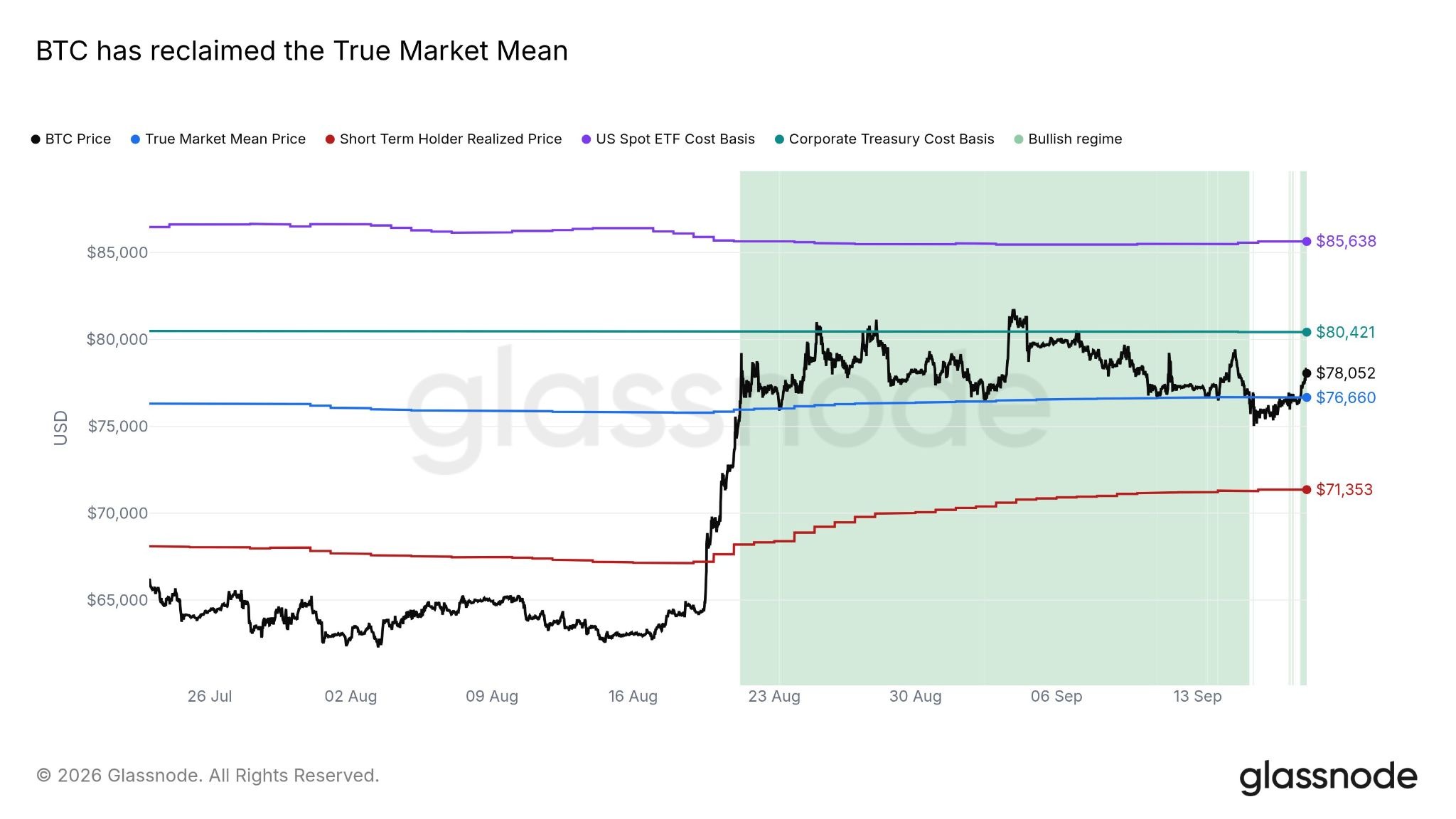
Bitcoin cost-basis data. Source: Glassnode on X.com
Bitcoin exchange-traded products saw a strong finish to the week, as investors added BTC exposure during a rally to $81,000. US ETFs saw net inflows of $435 million on Friday, their largest daily tally since Sept. 3, per data from UK-based investment company Farside Investors.
Despite the CLARITY Act failing to advance in the Senate last week, Thursday saw two US regulators — the Securities and Exchange Commission (SEC) and Commodity Futures Trading Commission (CFTC) — move ahead with crypto-related policies. This provided a boost to crypto stocks and appeared to lift the mood among investors, with $159 million in net crypto ETF inflows on the day.
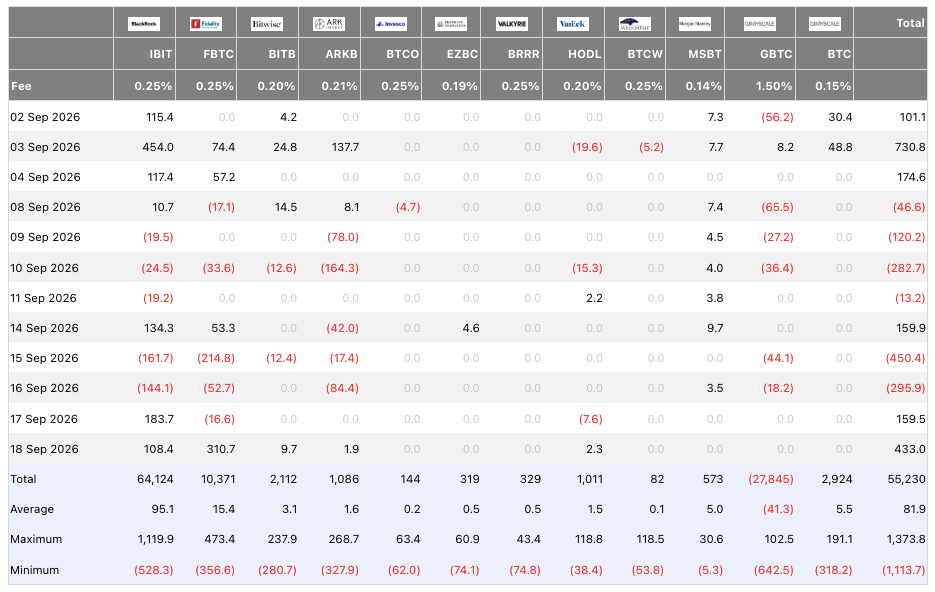
US spot Bitcoin ETF netflows (screenshot). Source: Fidelity Investments
In a departure from the norm, the largest Bitcoin ETF, BlackRock’s iShares Bitcoin Trust (IBIT), did not account for the lion’s share of inflows. Instead, most investors piled into Fidelity Investments’ Wise Origin Bitcoin Fund (FBTC), which accounted for $310 million of the total. In their analysis of recent market developments, the onchain analytics platform CryptoQuant discussed this change in ETF netflow composition.
“The key change is therefore not simply positive ETF activity, but a clear redistribution of flow leadership: IBIT went from dominating FBTC by nearly six times on September 3 to FBTC recording almost three times IBIT’s holdings netflow on September 18,” CryptoQuant stated in a blog post.
Oil falls as Trump hints at Iran dialogue
A comparatively quiet week for US macro data prints is shifting the focus firmly onto oil as inflation expectations for the remainder of 2026 are adjusting higher.
After spiking above $100 per barrel last week, WTI crude oil traded below $94 on Monday amid hopes of fresh diplomatic efforts to resolve the situation in the Middle East.
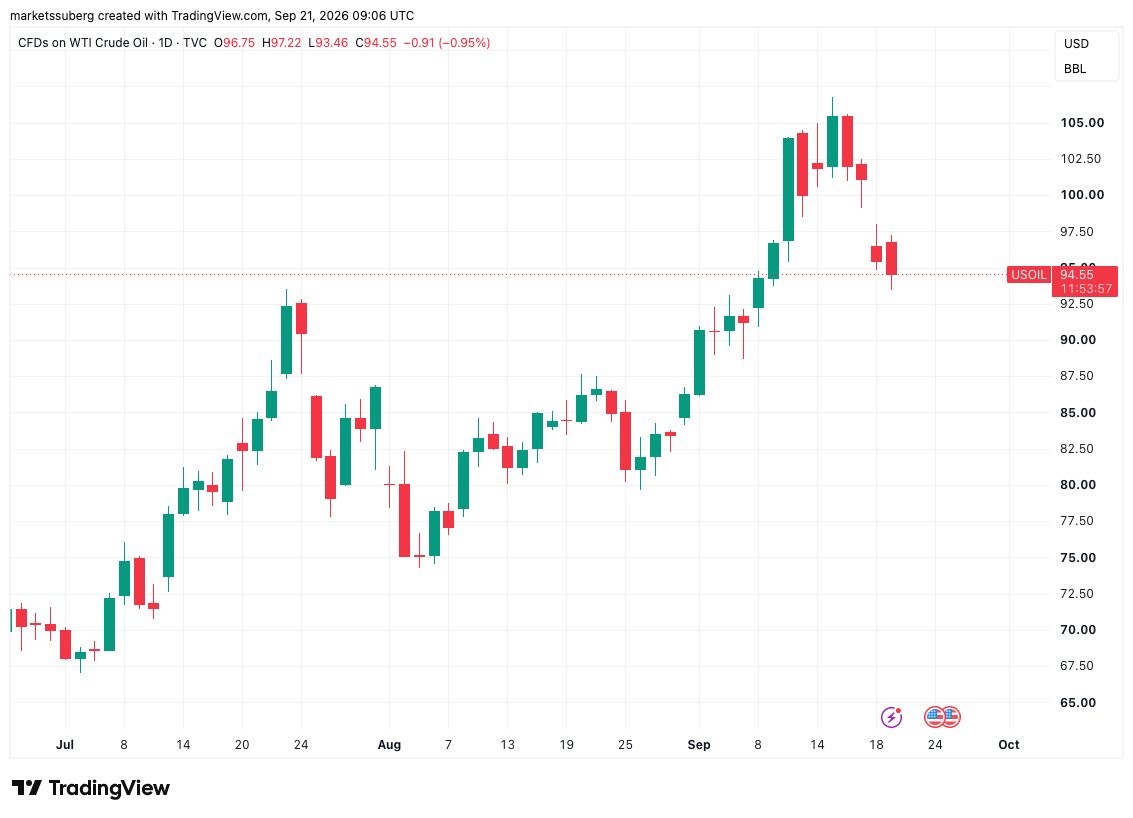
CFDs on WTI crude oil one-day chart. Source: Cointelegraph/TradingView
On Sunday, Majed Al-Ansari, a spokesperson for Qatar’s Foreign Ministry said that attempts to restart talks between the US and Iran had been ongoing “for the past couple of weeks.”
“A lot of ideas have been thrown back and forth,” he told Bloomberg.
“This is just one iteration of these documents going back and forth, and we’re trying to bridge the gap and find the right moment to move forward.”
In a telephone call with Fox News on Sunday, US president Donald Trump reportedly described his options in the Iran conflict as “wiping Iran out, letting them rot economically, or making a deal.” Trump added that he would “probably be open” to meeting with Iranian president Masoud Pezeshkian at the United Nations General Assembly this week.
Markets see two more Fed rate hikes in 2026
As Cointelegraph reported, the shutdown of several oil-shipping routes has already had knock-on effects for fuel prices worldwide. Even as central banks are tightening policy by hiking interest rates, the full impact of the supply shock is yet to be felt. Last week, Saudi Arabia warned the EU that its refineries would not be receiving shipments in October.
The latest data from the CME Group’s FedWatch Tool shows that markets now expect the US Federal Reserve to raise its benchmark rate by another 0.25% at its October meeting. The odds of this outcome sit at 53% as of Monday. The CME also shows a near 40% chance of a third 0.25% hike before the end of the year.
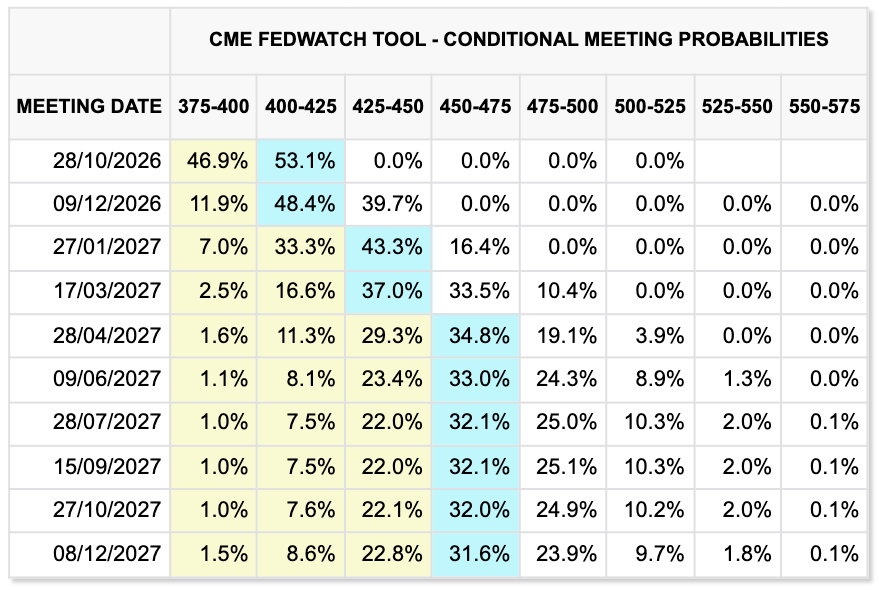
Fed target-rate probabilities (screenshot). Source: CME Group
On Tuesday, Federal Reserve Bank of Richmond President Thomas Barkin will speak to the CFA Society Baltimore in an appearance that could shed further light on the Fed’s current inclination on future policy. Barkin is due to provide “insights on the current economic landscape, the latest monetary policy developments, and his outlook for the U.S. economy.”
Analysis sees stocks holding gains as yields cool
US bond yields continued to come down from multidecade highs on Monday as borrowing costs fell with oil’s retreat.
Related: Here’s what happened in crypto today
The US 30-year yield traded at 5.301% on Monday, having cooled from its highs of 5.425% seen on Sept. 11, with these marking its highest levels since June 2004.
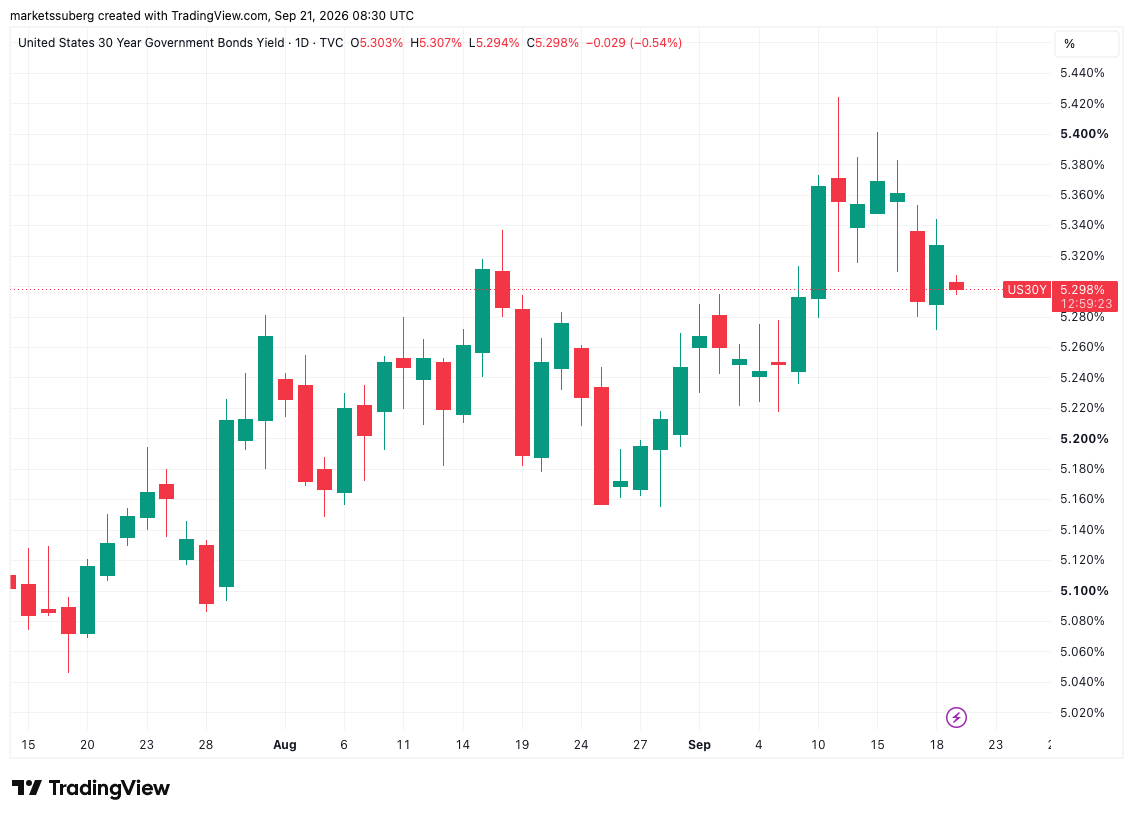
US 30-year bond yield one-day chart. Source: Cointelegraph/TradingView
After reacting positively to the announcement of US bond-market interventions in August, Bitcoin market participants continue to monitor any events surrounding yields. In a report for CME on Sept. 16, Jim Iuorio, CEO of JI Financial Strategies, argued that interventions may represent a liquidity tailwind for Bitcoin and crypto markets.
“Perhaps markets viewed these actions as being dollar-negative, pushing money back into dollar hedges like gold and Bitcoin,” he said.
In its latest analysis, Mosaic Asset Company saw the potential for stocks to preserve their own strength amid tightening macro conditions.
“While investors are wondering what the Fed’s rate hiking cycle means for the S&P 500, evidence of strong economic growth should help keep the earnings outlook in tact. As long as the Fed is hiking at a measured pace that doesn’t call into question the growth outlook, the rally in equities can persist,” it summarized at the weekend.

Hyperliquid has added trailing stop orders to its perpetual futures markets, giving traders a way to move their trigger price automatically as a position moves in their favor.
Summary
- Hyperliquid has introduced trailing stops for perpetual markets, with trigger prices moving automatically as positions move in traders’ favor.
- Long positions track the highest mark price after activation, while short positions follow the lowest before triggering on a selected retracement.
- Traders can set an activation price or begin tracking immediately, with triggered stops executing as market orders.
According to Hyperliquid, the new order type tracks the mark price after activation and triggers a market order when the price pulls back from its best level by a distance or percentage selected by the trader.
For a long position, the trailing stop follows the highest mark price reached after tracking begins. For a short position, it follows the lowest mark price. Traders can set an activation price to determine when tracking starts or leave the field empty to begin tracking immediately from the current mark price.
The feature expands Hyperliquid’s existing set of conditional order tools as activity across its perpetual futures platform continues to grow.
Hyperliquid trailing stops follow the mark price
Unlike a fixed stop price, Hyperliquid’s trailing stop adjusts when the market moves in favor of an open position.
For example, a trailing stop attached to a long position will follow the highest mark price reached after activation. If the mark price continues rising, the trigger moves with it. Once the market retreats by the distance or percentage chosen by the trader, the order is triggered.
Short positions work in the opposite direction. The trigger follows the lowest mark price reached since activation and executes once the price rebounds by the configured amount.
Hyperliquid said traders can choose between a fixed distance and a percentage when setting the retracement threshold. An optional activation price lets the user delay tracking until the market reaches a specified level. Without an activation price, the current mark price becomes the starting point.
Once the retracement condition is met, the trailing stop triggers a market order for the selected quantity. Hyperliquid’s existing take profit and stop loss system similarly uses the mark price to determine when conditional orders are triggered, according to the platform’s documentation.
Existing market TP and SL orders carry a 10% slippage tolerance, while limit versions allow traders to specify a limit price to control potential slippage. Hyperliquid warns in its support documentation that the trigger price and actual execution price can differ because the mark price triggers the order before it is filled against available liquidity.
The platform already supports market, limit, stop market, stop limit, take market, take limit, scale and TWAP orders. Its TWAP system breaks larger orders into smaller transactions sent at 30 second intervals, with each suborder subject to a maximum slippage setting.
Perpetual markets have expanded through HIP 3
The trading update follows several changes to Hyperliquid’s perpetual futures infrastructure over the past few months.
In September, Hyperliquid introduced a preliminary testnet upgrade that allows independent HIP 3 deployers to operate permissioned perpetual markets using onchain allowlists. Deployers can manage access themselves or assign the task to sub deployers, while the permissioning system remains optional for HIP 3 markets.
HIP 3 allows outside teams to deploy and operate perpetual markets using Hyperliquid’s infrastructure. The framework has increasingly been used to extend the types of assets and market structures available through the network.
Crypto.news previously reported that Kraken parent Payward has outlined plans to bring regulated Hyperliquid perpetuals to eligible U.S. clients through Bitnomial, subject to regulatory approval.
Under the proposed structure, CFTC regulated Bitnomial would deploy, administer, clear and settle the HIP 3 contracts. NinjaTrader Clearing would carry customer accounts, with access limited to users approved by the participating entities.
The plan followed earlier discussions involving Hyperliquid Labs and Payward over a structure that could make selected perpetual contracts available to U.S. traders without providing direct access to Hyperliquid’s decentralized trading platform.
Hyperliquid Policy Center and trade[XYZ] have pursued a separate regulatory path for commodity linked contracts. In August, the groups asked the Commodity Futures Trading Commission to permit regulated energy perpetuals tied to WTI crude, Brent crude and Henry Hub natural gas.
Their filing said trade[XYZ] had operated perpetual markets on Hyperliquid since October 2025, with cumulative volume exceeding $500 billion. The proposed framework included stablecoin margin, leverage limits and regulated onchain trading infrastructure.
Hyperliquid trading activity remains elevated
Hyperliquid’s derivatives business has continued to generate substantial trading activity as new products and integrations have reached users.
Coinbase brought more than 290 perpetual markets to its Base App through Hyperliquid in August. Eligible users can trade contracts linked to cryptocurrencies, stocks and commodities while remaining inside their existing wallets, with leverage reaching as high as 50 times on supported markets.
Users in the United States, United Kingdom and Canada were excluded from the product when the integration was announced.
Hyperliquid’s revenue has grown alongside trading activity. CoinGecko data published on Sept. 21 showed the platform generated $429.04 million in revenue between Jan. 1 and Sept. 15, accounting for 12.62% of the $3.40 billion revenue pool in the research firm’s adjusted comparison of crypto projects.
The platform’s fee structure directs part of trading revenue toward its Assistance Fund, which purchases HYPE on the open market. Hyperliquid’s documentation lists maker rebates reaching negative 0.003% for qualifying high volume market makers, while accounts linked to more than 500,000 HYPE in staking can receive a 40% trading fee discount.
HYPE has traded near record levels during the expansion. CoinGecko data on Sept. 21 placed the token near $94 after it reached a record $92.56 on Sept. 18 and subsequently moved higher.
The Sept. 18 move coincided with Hyperliquid introducing manual borrowing that lets users supply HYPE or Bitcoin as collateral and borrow USDC or USDT. HYPE carries a 65% loan to value ratio under the system, compared with 50% for Bitcoin.

X is suing two men for allegedly building a network of fake bitcoin news accounts to farm payouts from X’s own creator fund.
The lawsuit names Vivek Kumar Sen and Zmyang Sherpa as the alleged masterminds behind the scheme, with law firm Lewis Silkin LLP representing the platform. At stake is at least 207,000 pounds ($277,000) in disputed creator-fund payouts. Costs for further damages from investigations and remediation are still unquantified.
The lawsuit named nine accounts as part of the alleged network: @Vivek4real_, @Bitcoin_Teddy, @saylordocs, @TrendingBitcoin, @Kalshibacktest, @PolyBackTest, @BTC_Vibes, @MrSuperBitcoin and @Laserlump. These accounts circulated fake “breaking” news headlines that often matched word for word and appeared on X just seconds apart.
Most of these posts made unsubstantiated, unverified claims involving big players in finance to draw mass attention, such as claiming Goldman Sachs’ CEO was pushing a crypto bill or saying Citibank had bought $12.6 million in bitcoin.
The lawsuit further alleges that defendants operated accounts that repeatedly liked, replied to, and reposted these posts to create a facade of false engagement.

Given this contraction in public climate conversations, we wanted to learn from those who are still doing climate communication. What’s working, and how can we amplify it? Here’s what we found.
The first and most important lesson is that talking about climate change means talking about everyday life. When we asked climate newsletter writers, podcast hosts, people who regularly post on social media, and those building climate content for non-profits, their response was clear. Their first priority is to connect the climate crisis to other concerns people face: our jobs, our health, the places we love. They don’t set up climate change as a rival to those worries. Instead, they understand that climate change is already shaping the things people worry about. When we connect the dots between what we love and how climate change threatens it, it becomes obvious that nearly all of us have our own reasons to care and act.

Apple posted a U.S.-based Apple Pay Financial Product Strategy Lead role, listing a base-pay range of $149,700 to $280,000 and listing familiarity with stablecoins, tokenized deposits, and crypto technology among its desired skills. Google, meanwhile, is recruiting an Industry Principal Architect, Web3, in Hong Kong to support institutional digital-asset projects across Asia-Pacific.
— Coin Bureau (@coinbureau) September 21, 2026
 JUST IN: Apple hints at adding stablecoin support, potentially allowing CRYPTO payments via Apple Pay.
Apple posted a job listing requiring stablecoin expertise for payment roles, offering up to $280,000.
This follows Samsung’s plans to introduce the same feature to Samsung… pic.twitter.com/S6Vz7yyW9L
The Apple Card and Apple Cash team focuses on consumer credit cards, peer-to-peer transfers, stored value, and other consumer financial products. The hire will help develop long-term strategy, assess growth opportunities, build business cases, and evaluate products and partnerships across Wallets, Payments, and Commerce.
Google’s posting is focused on infrastructure and customer engagement. The Hong Kong-based architect is expected to bring production-grade Web3 systems experience and work with Google Cloud’s strategic Web3 engagements across Asia-Pacific. The role involves advising blockchain foundations, institutional exchanges, digital-asset custodians, and financial institutions on technical decisions.
Also on Google, preferred experience includes real-world-asset tokenization, stablecoin rails, tokenized deposits, and digital-asset custody, as well as multi-party computation, hardware security modules, transaction-signing architecture, and confidential computing.
The role also covers blockchain node infrastructure, indexing layers, validator networks, and key management. Google says the architect will act as a bridge between customers and its product and engineering organizations, with common architectural issues helping inform reusable reference architectures and the company’s Web3 product roadmap.
Earn $50 and Enter $300K Prize Draw on EdgeX
Apple Pay Crypto Stablecoins Payment Coming?
Google Cloud already provides infrastructure aimed at tokenized payments and blockchains. Its Universal Ledger is intended for financial institutions developing tokenized assets and digital representations of commercial bank money, while its Agent Payments Protocol is built for stablecoins and cryptocurrencies.
This existing product footprint places the Hong Kong role within Google’s enterprise infrastructure work rather than establishing plans for a Google-issued token.

Trade Crypto on Bybit and Get a Chance to Win Our $1,000 USDT Airdrop
Hong Kong’s regulatory setting provides additional context for the location. The Stablecoins Ordinance came into force in August 2025 and requires issuers of fiat-pegged stablecoins to be licensed in Hong Kong. Google’s role includes advising customers on security, risk, and compliance under regional regulations, including those of the Hong Kong Monetary Authority and the SFC.
Apple Pay listing does not set out a crypto or stablecoin product. Its existing financial products are supported by traditional payment rails, while the job advertisement presents digital-asset experience as part of a wider financial-product strategy.
Taken together, the postings show Apple and Google seeking expertise in stablecoins, tokenized deposits, and blockchain-related infrastructure. Neither company has announced plans to issue a stablecoin yet. But it could be coming.
Discover: The Best Token Presales
The post Apple Pay Crypto Hiring Fuels New Stablecoin Speculation appeared first on Cryptonews.
Crypto World
Bitcoin Tops $84,000 for the First Time Since January, Liquidating $262 Million in Shorts
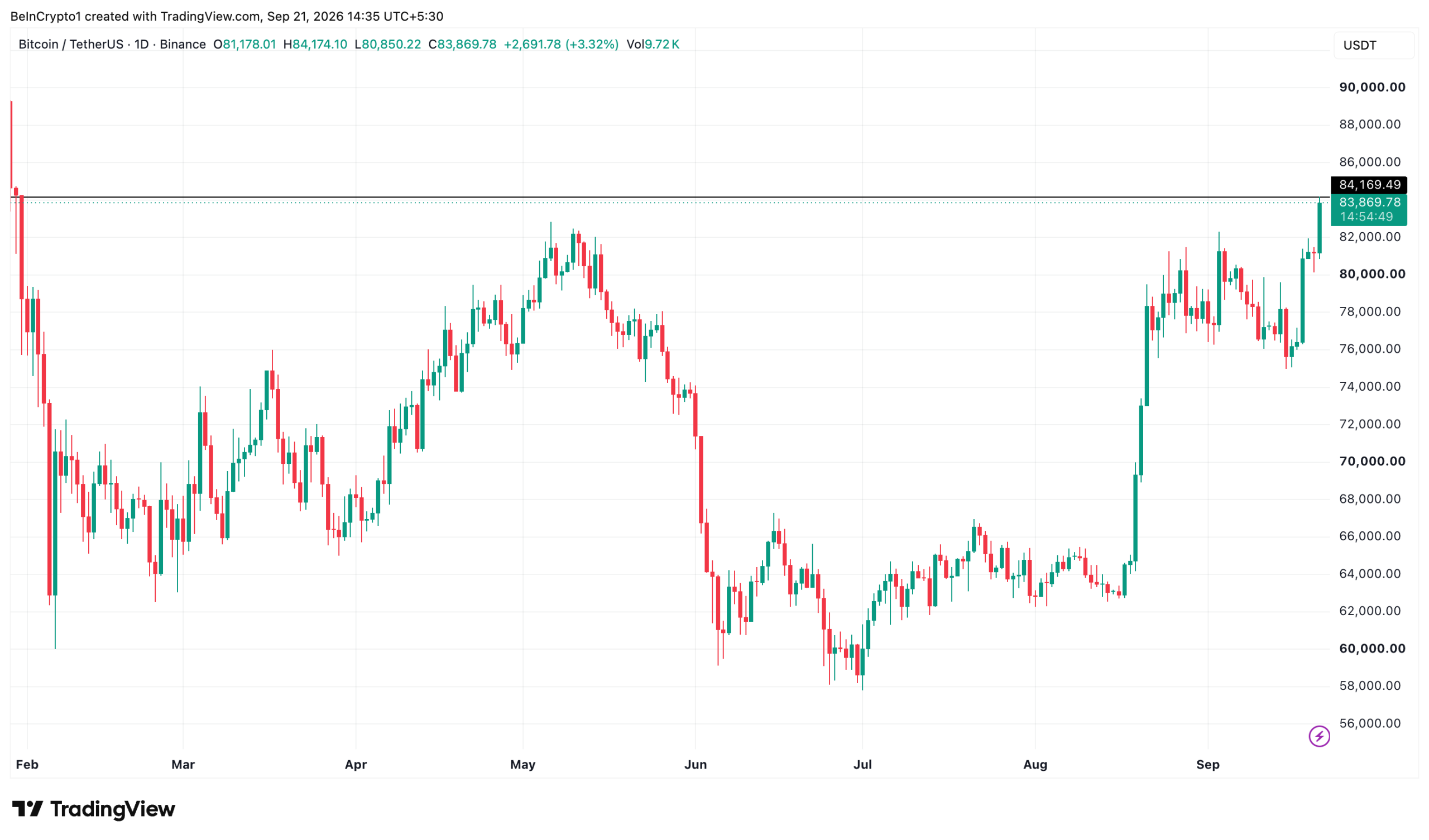
Bitcoin (BTC) briefly crossed $84,000 on September 21, its first trip to that level since January 31. The move liquidated $262.30 million of short positions in a single hour, according to CoinGlass.
The asset changed hands at $83,869 at the time of writing, a gain of 3.18% on the day.
Follow us on X to get the latest news as it happens

Bitcoin Rallies to Eight-Month High, Wiping Out Shorts
CoinGlass recorded $271.83 million of total liquidations across the crypto market in the hour. Long positions accounted for only $9.53 million of that.
Bitcoin carried $218.55 million of the hourly figure. Ethereum (ETH) followed with $26.47 million, while Solana (SOL) added $8.92 million.
The pressure held over longer windows. Liquidations reached $433.67 million over 12 hours and $599.15 million over 24 hours, hitting 127,304 traders. The largest single order was a Binance Bitcoin perpetual worth $11.29 million.

The rally reached the wider market. XRP rose 7.04% over 24 hours, and Solana gained 6.67%, while Zcash (ZEC) led the top 10 with a 33.50% weekly gain.
The milestone came after Bitcoin recorded its first weekly close above a 50-week moving average in 45 weeks. The asset ended the week of September 20 at $81,159, around 3% above the average near $78,786.
Alex Thorn, head of firmwide research at Galaxy, reads the close as a key signal that the bear market low is in.
Subscribe to our YouTube channel to watch leaders and journalists provide expert insights
The post Bitcoin Tops $84,000 for the First Time Since January, Liquidating $262 Million in Shorts appeared first on BeInCrypto.
Crypto World
Bitcoin (BTC) Skyrockets to 8-Month High Above $84K as Altcoins Mark Big Gains: Market Watch
Despite last week’s developments and the escalating tension in the Middle East, as well as on the Russia-Ukraine front, bitcoin’s price rebounded from the dip to $80,000 and surged past $84,000 earlier today for the first time since the end of January.
The altcoins are in the green as well, with ETH touching $2,700 earlier today and XRP bouncing to $1.45. XMR, NEAR, and AVAX have posted the most gains among the larger caps.
BTC Sees New 8-Month High
The previous week didn’t go well for the primary cryptocurrency, at least on a macro level. On Tuesday, the US Senate voted against advancing the key CLARITY Act. A day later, the US Federal Reserve hiked interest rates for the first time since July 2023.
BTC reacted to both developments with expected volatility, dipping to a multi-week low of $75,000. However, it rebounded swiftly by Friday when it surged past $80,000. It kept climbing on Saturday and neared $82,000. However, it was halted there as the tension in the Middle East escalated while Ukraine and Russia carried out more violent attacks against each other.
Monday, though, has been entirely the opposite so far. BTC bounced off the $80,000 support after it had reclaimed the 50-week MA, and rocketed to just over $84,000 minutes ago to mark an eight-month high.
It remains above $83,000 as of now, with its market cap surging to $1.670 trillion on CMC. Its dominance over the alts remains inches below 59%.

Alts Back in Green
Ethereum has rocketed to a multi-week peak of its own at just over $2,700. Ripple’s XRP rebounded from the $1.40 support and now sits well above the next key level at $1.45. SOL has climbed to $115, while BNB is up to $780. Even more impressive gains are evident from the likes of DOGE, ADA, XLM, BCH, and LINK.
XMR, AVAX, TAO, NEAR, SUI, BTW, and MORPHO have stolen the show from the larger-cap alts, posting double-digit gains.
The cumulative market cap of all crypto assets has added $70 billion in a day and is up to $2.810 trillion on CMC.

The post Bitcoin (BTC) Skyrockets to 8-Month High Above $84K as Altcoins Mark Big Gains: Market Watch appeared first on CryptoPotato.
Elon Musk-owned social media platform X has sued the alleged operators of a network of Bitcoin-focused accounts, seeking to recover at least $278,000 in creator payouts it says they obtained by manipulating engagement.
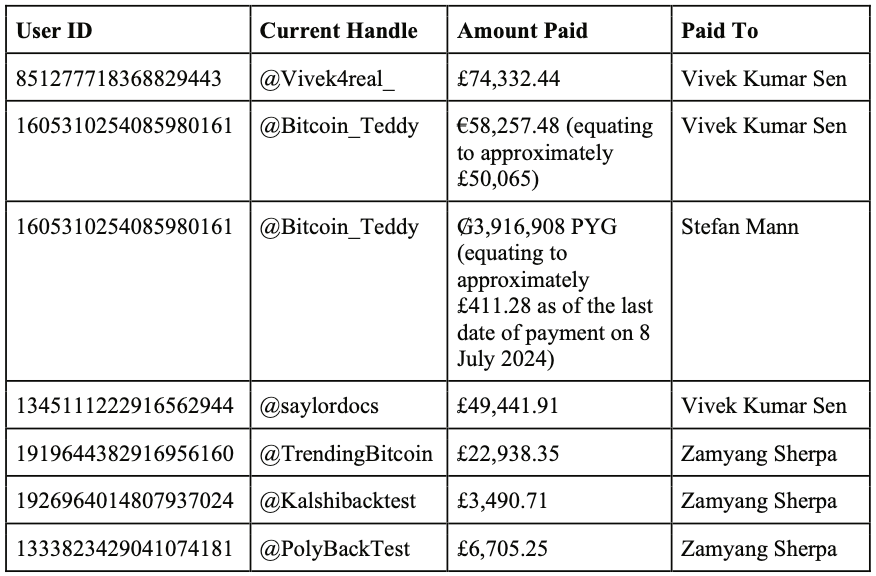
X filed a lawsuit in the High Court of England and Wales on Thursday against Vivek Kumar Sen, Zamyang Sherpa and unidentified account operators, alleging they fraudulently obtained at least 207,384 British pounds ($278,000) from its creator revenue-sharing program. The court filing is available on X’s Transparency Center.
The company claims the defendants coordinated multiple accounts to boost engagement by reposting and liking one another’s content and publishing identical or substantially similar posts, creating what the company described as a “false appearance of genuine, human communication and interaction.”
X suspended the accounts on Aug. 18 over what it called creator revenue-sharing fraud and platform manipulation.
X links six accounts to two defendants
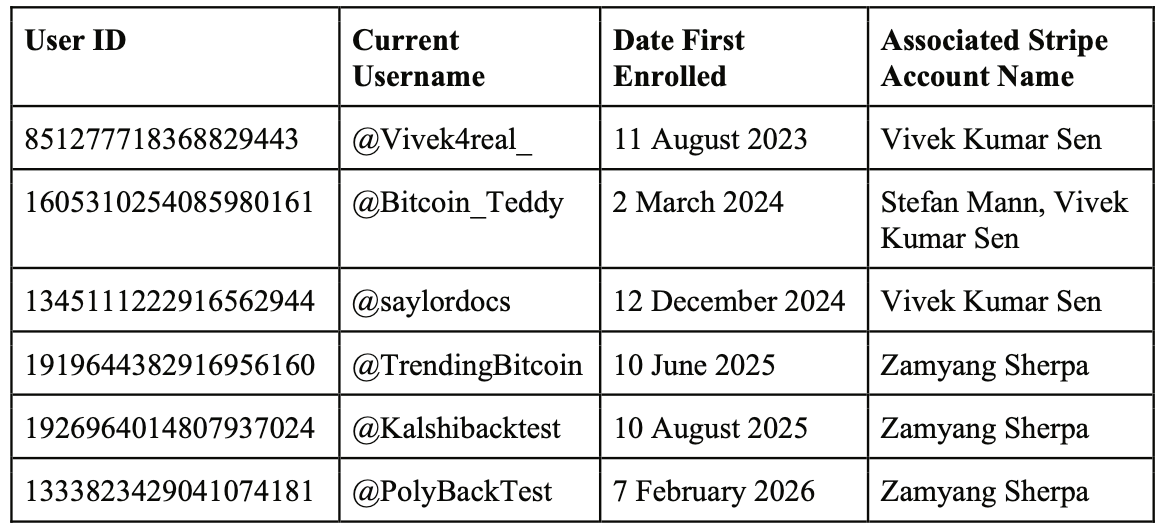
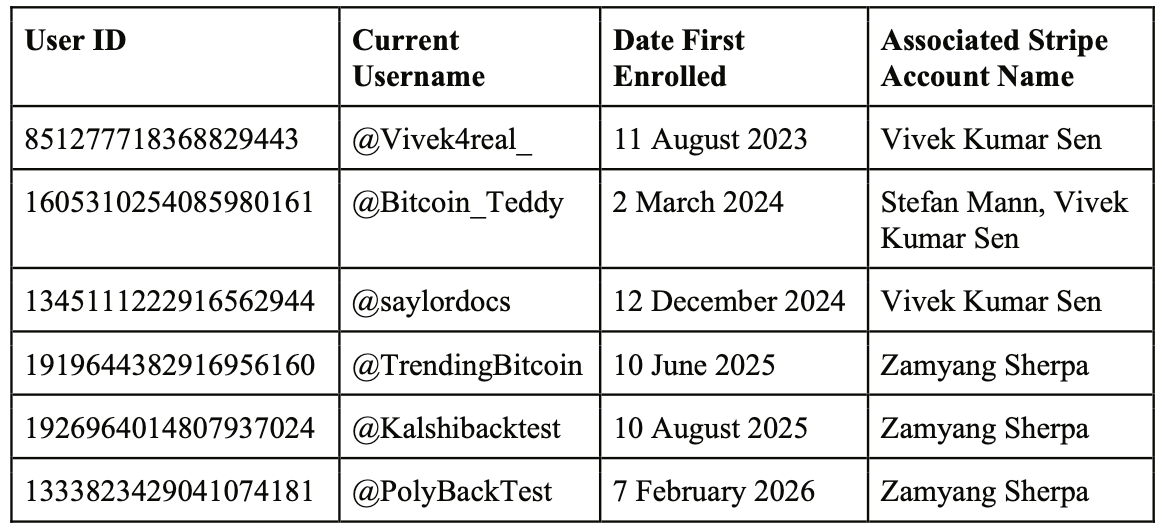
The lawsuit identifies six accounts enrolled in X’s revenue-sharing program: @Vivek4real_, @Bitcoin_Teddy, @saylordocs, @TrendingBitcoin, @Kalshibacktest and @PolyBackTest.
The filing links Stripe accounts associated with the first three profiles to Sen and those associated with the other three to Sherpa. The accounts joined the program between August 2023 and February 2026.
The network allegedly extended beyond those six accounts. X named @BTC_Vibes, @MrSuperBitcoin and @Laserlump, claiming they repeatedly liked, replied to and reposted content from the defendants’ accounts to manufacture engagement.
How the alleged scheme generated money
Under X’s former creator revenue-sharing program, eligible creators received a share of the platform’s revenue based on the engagement their posts generated from other users.
The filing cites an Aug. 5 example in which @Vivek4real_ and @TrendingBitcoin allegedly published substantially similar posts within 11 seconds of each other.
X retired the revenue-sharing program on Sept. 7 and began rolling out access to its replacement, Original Content Rewards, the following day.
Related: Cardano’s IOG warns users to avoid YouTube channel amid apparent hijack
In addition to the alleged fraudulent payouts, X says it expects at least 75,000 British pounds ($100,000) in investigation and remediation costs, bringing its claimed and projected losses to at least 282,384 pounds before interest and legal costs.
Cointelegraph sought comment through an email address linked to Sen in the filing but had not received a response by publication. Sherpa could not be reached for comment.
Magazine: Who needs CLARITY anyway? ARB could see 70X increase: Hodler’s Digest

Black marble monument appears near ‘traveller king’s’ giant headstone | News UK

Arts & Business Cymru reveals its new chief executive

Grok AI Predicts Bitcoin to Hit $150,000 in Q4




-

 Fashion3 days ago
Weekend Open Thread: Talbots – Corporette.com
-

 Tech12 hours ago
Researchers escape OpenAI Codex sandbox to run commands on host
-

 Crypto World6 days ago
Revolut Attackers Warn of Ongoing Daily Customer Data Leaks
-

 Crypto World2 days ago
Circle launches Arc Studio AI agent for building onchain apps
-
 NewsBeat3 days ago
Trump says US has reached an agreement to take permanent control of Greenland’s security
-

 Crypto World6 days ago
Kraken Lets xStocks Holders Earn Yield Through DeFi
-

 Crypto World6 days ago
Robinhood engineers charged over $50K crypto scheme
-

 Crypto World2 days ago
Bitcoin price breaks channel as RSI climbs to 63
-

 Crypto World5 days ago
What Is the Status of the U.S.-Iran Peace Talks? Here's What Both Sides Are Saying
-

 Crypto World4 days ago
US Charges Robinhood Engineers Over Crypto Listing Trades
-

 Crypto World7 days ago
Elon Musk Drops a Bombshell: Grok 5 Could Be the AGI Breakthrough
-
Business7 days ago
SK Hynix ADRs Fall More Than 6% as Memory Rally Breaks on Fears of Slower AI Spending
-
 NewsBeat7 days ago
‘Sick conspiracy’: Trump says only guardrails AI needs is ‘a strong and smart (High IQ!) president’ in all-caps rant
-
 Crypto World6 days ago
NVIDIA Analysis: Attempted Rising Wedge Breakout Amid Pressure on the AI Sector
-

 Tech5 days ago
Webb’s IC 348 Mosaic Includes Two-Jupiter Dwarfs, Twin Jets, and a Nursery Still Making Worlds
-
Crypto World6 days ago
Can Circle’s Arc Repeat Robinhood Chain’s Meme Coin Boom?
-

 Crypto World3 days ago
Silver prices recover quickly, hitting weekly high today
-

 Crypto World2 days ago
World Money launches in 150+ countries with Stripe
-
 NewsBeat3 days ago
US was ‘on brink of war’ with China over false AI report of nukes moving in Middle East
-

 Crypto World6 days ago
DOJ Seeks to Seize $61M in Iran Oil Funds From Binance Accounts It Vouched For
You must be logged in to post a comment Login