
Crypto World
‘The Frog is Waking Up!’ PEPE Explodes 50% in a Week as Golden Cross Forms

The frog-themed meme coin PEPE has emerged as one of the top-performing cryptocurrencies over the past week, with its price rising by roughly 50% to a nine-month high of $0.0000049.
The token has already demonstrated its ability to deliver triple and even quadruple gains in the past, and many analysts now believe another move of that scale could be on the horizon.
‘The Frog is Waking Up’
X user Giannis Andreou noted that PEPE’s weekly chart is holding a higher low above its 2023 base, meaning the test now comes at $0.0000048-$0.0000055.
The analyst claimed the weekly candle “is still open,” arguing that a close above the upper boundary, followed by a successful retest, could strengthen the case for $0.0000065-$0.0000075.
“Clear that, and $0.000009-$0.0000105 becomes the next zone to watch. The bigger recovery scenario reaches $0.000013–$0.000016,” he added.
At the same time, the analyst warned that a rejection may lead to a drop to the $0.0000023-$0.0000032 range.
For his part, Crypto With Gopal argued that the meme coin’s price is testing the lower trendline after a rejection near $0.0000054, showing momentum is tightening. He believes that the setup remains bullish, but buyers must defend support and reclaim the upper resistance to initiate a further upswing.
X user Plazma also chipped in, estimating that PEPE had formed a golden cross on the 50-day/200-day moving average: a setup usually considered highly positive for the price.
The Dangerous Game With Meme Coins
PEPE’s price increase is impressive and could go even higher, but traders and investors who want to hop on the bandwagon should keep in mind that tokens like this are highly volatile and often driven more by hype and speculation than fundamentals. Recently, X user Crypto Bitlord warned people to stay away from memes, claiming 99% of them are scams.
“It’s hard for me to recommend anyone play that game because the statistics are against you,” he added.
PEPE has been on the market for more than three years and has built a solid community base, but no one can say for sure whether the project has a bright future or is a time-ticking bomb.
Meanwhile, CoinGlass data shows that over the past few days, investors have moved PEPE tokens from self-custody to centralized exchanges. That reinforces the bearish scenario since it increases immediate selling pressure.

- PEPE Exchange Netflow, Source: CoinGlass
The post ‘The Frog is Waking Up!’ PEPE Explodes 50% in a Week as Golden Cross Forms appeared first on CryptoPotato.


An XRP Ledger account could soon let another account make payments or approve customers on its behalf without handing over the keys that control everything else.
The feature, called PermissionDelegationV1_1, entered a 14-day activation countdown on Sept. 21 after 29 of the network’s 35 trusted validators backed it. It could go live on Oct. 5 at 11:18 UTC if support remains at or above 80% throughout the period, according to the live amendment dashboard.
At least 28 validators must continue supporting it. Any drop below that level resets the clock.
The upgrade lets an account divide its authority by job. A stablecoin issuer could allow an internet-connected compliance system to approve customer accounts to hold its token while keeping the keys with full control offline.
A separate operations account could receive permission to make payments without gaining the power to change those keys or grant authority to somebody else. Each delegate can receive as many as 10 permissions, which the main account can later change or revoke, according to XRPL documentation.
PermissionDelegationV1_1 is the network’s second attempt at introducing the feature.


US spot Bitcoin ETFs recorded more than $1.7 billion in net inflows over two days as Bitcoin rose above investors’ estimated average cost basis.
Solana has moved its Alpenglow consensus upgrade toward public testnet deployment as developers prepare to test a design intended to cut transaction finality from roughly 13 seconds to around 150 milliseconds.
Summary
- Solana’s Alpenglow upgrade is moving to public testnet with a target of cutting transaction finality from roughly 13 seconds to around 150 milliseconds.
- Alpenglow replaces TowerBFT with Votor, allowing validators to reach agreement through one or two direct voting rounds.
- Agave 4.3 is required for the test, while Firedancer and Frankendancer do not yet support Alpenglow.
- Sept. 28 is listed for tentative Agave 4.3 feature activation on mainnet, but it is not a confirmed Alpenglow launch date.
According to github, the testnet stage will let developers test the migration across Solana’s established testing environment before the consensus system can be considered for the main network.
Finality refers to the point when a transaction becomes irreversible under the network’s consensus rules. Exchanges typically wait for finality before crediting deposits, while blockchain bridges use it before releasing assets on another network.
Solana currently relies on TowerBFT for consensus, with validators recording votes onchain and accumulating enough votes across 32 slots before a block reaches finality. Alpenglow replaces that process with a protocol called Votor, which lets validators exchange votes directly.
Under the new design, validators can reach agreement after one or two voting rounds. The change removes the longer sequence of onchain consensus votes required under TowerBFT while leaving transaction execution largely unchanged for applications and users.
Solana Alpenglow moves into public testnet
Alpenglow has already spent more than four months operating on a smaller community cluster created specifically to test the consensus system. Moving the upgrade into Solana’s established public testnet exposes it to a larger group of validators, infrastructure providers and services already connected to the network.
The public testnet uses tokens without monetary value, allowing developers to restart the network, test migration procedures and investigate problems without putting mainnet funds at risk.
Anza first moved Alpenglow into community validator testing in May, describing the upgrade as the largest consensus change in Solana’s history. As crypto.news previously reported, the community cluster allowed validator operators to test the new consensus design before deployment across Solana’s existing test infrastructure.
Votor is designed to reach finality through one of two voting paths depending on validator participation. Earlier specifications indicated that a block could settle after one round when enough stake participates, while a second round provides another route to finality under lower participation.
The expected result is a sharp reduction from Solana’s existing finality time. Anza has estimated median finality at around 150 milliseconds, with earlier simulations putting it as low as 100 milliseconds under favorable conditions.
Developers have not changed how applications execute transactions as part of the upgrade. Wallet users will continue sending transactions through the same interfaces, while the main changes take place in how validators communicate and agree on the permanent state of the blockchain.
Agave 4.3 carries the Alpenglow code
Validators participating in the Alpenglow test need to run Agave 4.3, the latest branch of the main validator software maintained by Anza.
Anza recommended Agave 4.3 for general adoption among mainnet validators on Sept. 21. The rollout had previously moved through controlled stages, first asking operators responsible for 10% of mainnet stake to upgrade before expanding the recommendation to 25%.
Alpenglow development has been tied to Agave releases for months. In August, the 150 millisecond finality target was expected to arrive through Agave 4.3 after the underlying Alpenglow code had already been included for testing in the previous software branch.
The Sept. 28 date listed in Anza’s Agave 4.3 schedule refers to the tentative resumption of mainnet feature activation. Anza states that its release dates are subject to change, while its feature gate tracker still listed the Alpenglow testnet activation as pending early Wednesday.
Sept. 28 therefore does not represent a confirmed date for Alpenglow to begin operating on Solana mainnet.
The distinction comes as several Solana performance upgrades have been moving through separate activation schedules. Transaction finality, slot production and transaction capacity are controlled by different network changes even though each can affect how quickly applications interact with Solana.
Solana has already reduced slot times to 250ms
Solana recently cut its target slot time from 300 milliseconds to 250 milliseconds under SIMD-0525, bringing the network to a target of four slots per second.
The 250 millisecond slot upgrade reduced each validator’s four slot leader window from 1.2 seconds to one second. Network processing limits were adjusted alongside the shorter slots, meaning the change did not raise overall processing capacity by the same proportion.
A final stage under SIMD-0525 targets 200 millisecond slots, which would bring the network to five targeted slots per second. Developers have not set a confirmed mainnet activation date for that stage.
Slot time and finality measure different parts of the network. Slot time determines how frequently Solana can produce new slots, while Alpenglow changes how validators reach agreement that a block is irreversible.
Solana began the current sequence of slot reductions in August, when its target fell to 350 milliseconds from the 400 millisecond setting used since the network launched. SIMD-0525 laid out successive targets of 350, 300, 250 and eventually 200 milliseconds.
Alpenglow follows a separate path through SIMD-0326 and replaces TowerBFT with Votor instead of modifying the duration of individual slots.
Firedancer remains outside the first Alpenglow test
Firedancer and Frankendancer, validator clients developed by Jump Crypto, do not currently support the Alpenglow test, leaving the initial migration dependent on Agave.
Client diversity gives Solana validators different software implementations for participating in the same network. If separate clients are available, a software fault affecting one implementation does not necessarily affect every validator.
Firedancer began producing mainnet blocks earlier this year after years of development by Jump Crypto. The team initially recommended a gradual rollout while security audits continued, with the independently built client intended to reduce reliance on Solana’s existing validator implementations.
Frankendancer serves as a hybrid implementation that combines components from Firedancer with existing Solana software. Neither implementation is listed as supporting the pending SIMD-0326 Alpenglow feature on Anza’s current feature gate tracker.
Agave 4.3 is therefore the supported client for the first public testnet migration. Anza’s tracker lists Alpenglow as a pending testnet activation under SIMD-0326, while support fields for Firedancer and Frankendancer remain marked as unavailable.

Bitpace has integrated Fireblocks into its payment infrastructure to support cross-border stablecoin settlements across a platform that handles more than 75 cryptocurrencies and 40 fiat currencies.
Summary
- Bitpace integrated Fireblocks to strengthen cross-border stablecoin settlement, transaction controls, custody, and treasury operations globally.
- Fireblocks says stablecoins represented 69% of digital asset transaction volume across its platform during Q2.
- Bitpace supports settlements in more than 75 cryptocurrencies and 40 fiat currencies for businesses worldwide.
- Fireblocks processes over $200 billion monthly in stablecoin volume across payment providers, fintechs, and banks.
- Bitpace plans to use Fireblocks for higher volumes and expansion into additional jurisdictions next year.
Bitpace said on Sept. 22 that Fireblocks has been connected directly to its core platform, giving corporate customers additional transaction controls, digital-asset security tools and custody infrastructure for international payments.
The companies did not disclose the value of transactions expected to pass through the integration, implementation costs or a list of blockchain networks enabled specifically for Bitpace clients. Bitpace said the infrastructure will be used for stablecoin transfers, multi-currency treasury activity and payment settlement across international markets.
Bitpace integrates Fireblocks into stablecoin settlement
Through the deployment, Bitpace customers can route and settle stablecoin transfers using Fireblocks infrastructure without Bitpace building a separate security and transaction-management layer for each payment flow.
Bitpace CEO Anil Oncu described the integration as providing “speed and security” alongside operational flexibility for its global clients. His comments describe the company’s intended operational benefits; the announcement does not provide independent performance data comparing settlement speeds before and after Fireblocks was deployed.
Fireblocks provides institutional wallet infrastructure, policy controls, transaction approvals and connectivity between digital-asset firms, liquidity providers and payment companies. Its Network product lets participants connect with payment providers, banks, stablecoin issuers and on/off-ramp companies through one infrastructure layer.
Richard Astle, Fireblocks’ vice president and head of network, said “transaction security and network reach” allow payment companies to handle rising transaction volumes. The partnership announcement does not state whether Bitpace will use every Fireblocks product or identify which custody configuration applies to individual customers.
Bitpace’s existing services are focused on businesses rather than retail customers. Its current terms state that its products are provided to wholesale customers, companies and merchants, with services varying by jurisdiction.
Fireblocks brings $200B monthly stablecoin network
The Bitpace integration connects the payments company to infrastructure Fireblocks says processes more than $200 billion in stablecoin volume each month through payment providers, fintech companies and banks. Those figures describe Fireblocks’ entire network and should not be treated as Bitpace transaction volume.
Fireblocks separately reported that stablecoins represented 69% of all digital-asset transaction volume on its platform during the second quarter of 2026. USDC became its largest stablecoin by platform volume earlier this year, according to the company.
Its institutional footprint extends beyond payments companies. Fireblocks says more than 2,500 organizations use its infrastructure globally, including over 100 banks, while its technology supports operations across more than 200 blockchains. The figures come from Fireblocks’ own platform materials.
Several stablecoin projects have joined the network during 2026. As previously reported, Circle integrated USDC Gateway and Circle Payments Network with Fireblocks, allowing institutional customers to manage USDC balances across supported chains and route stablecoin payments toward local fiat payouts. The July rollout placed Circle’s settlement services inside Fireblocks’ existing policy, approval and audit controls.
One day before the Bitpace announcement, Fireblocks disclosed another agreement in Asia. In related coverage, Kakao Pay and KakaoBank agreed to test stablecoin infrastructure with Fireblocks through proof-of-concept programs in South Korea. No commercial stablecoin or production date was announced under that agreement.
Bitpace had expanded stablecoin support before Fireblocks deal
Stablecoin settlement was already part of Bitpace’s payment product before the Fireblocks integration.
In August, Bitpace announced support for Global Dollar, or USDG, adding the stablecoin as another option for international invoice processing and cross-border settlement. The company said the product was intended for merchants, payment providers, brokers and real-estate businesses.
Its current payment platform supports settlement in more than 75 cryptocurrencies and 40 fiat currencies, according to the Sept. 22 release. Supported assets include major cryptocurrencies alongside stablecoins, while settlement availability depends on the customer’s location and Bitpace entity providing the service.
Bitpace has separately built compliance and security systems around the payment operation. In June, the company said it obtained ISO/IEC 27001 certification covering development, maintenance and delivery of its payment-processing services. ISO 27001 sets requirements for information-security management systems, although the certification does not by itself guarantee that a company cannot experience a security incident.
Its Canadian website operator, Q500 Canada Inc., is registered with Canada’s Financial Transactions and Reports Analysis Centre as a money services business, according to Bitpace’s terms. FINTRAC separately states that MSB registration confirms fulfillment of registration requirements and should not be interpreted as regulatory endorsement or licensing by the agency.
Bitpace lists another operating company, Q500 MEA Limited, for certain international services and says its offerings may be unavailable in some jurisdictions. Customers are assigned terms based on the legal entity handling their relationship.
Bitpace plans more jurisdictions and higher transaction capacity
Bitpace plans to use the Fireblocks deployment as it expands payment processing over the coming year.
The company said the new infrastructure is intended to support higher transaction volumes and entry into additional jurisdictions, but it did not name the countries, provide a deployment calendar or give volume targets. Any expansion will therefore depend on future commercial launches and the applicable local requirements.
Fireblocks has been expanding its payment infrastructure at the same time. Its current payments service connects more than 40 providers across over 100 countries and 60 fiat currencies, according to company data. Fireblocks says payment companies can access stablecoin issuers, liquidity firms and local payment rails through one integration.
The company introduced Fireblocks Flow in June for payment service providers and fintechs that want customers to pay from external wallets while merchants settle in selected stablecoins. An August update said companies running Flow in production could accept funds from wallets or exchanges and convert incoming digital assets into the stablecoin they are prepared to hold.
For Bitpace, the Sept. 22 announcement does not introduce a new stablecoin, consumer product or token. It changes the infrastructure supporting the company’s existing business-payment services, with Fireblocks providing part of the security, custody and transaction-management stack used for stablecoin settlement.
Bitpace has not given a date for its first new jurisdiction following the integration. Its published plan covers the coming year and states that payment-processing capacity will be expanded as the company scales its business services.

Russia has warned that investors may have to absorb losses when foreign stablecoin issuers freeze assets outside a Russian depository’s control, as officials estimate residents hold 3.7 trillion rubles, or roughly $44 billion, in crypto and related products.
Summary
- Russia estimates roughly 20 million crypto users collectively hold 3.7 trillion rubles in digital assets.
- Daily Russian crypto transactions total about 50 billion rubles, according to Deputy Finance Minister Chebeskov.
- Investors may bear losses when foreign stablecoin issuers freeze assets beyond direct Russian depositories’ control.
- Russian tax residents must report qualifying crypto activity conducted outside domestic regulated infrastructure beginning 2027.
- Nonqualified investors face a 300,000-ruble annual purchase cap through each intermediary after mandatory testing requirements.
TASS reported that Deputy Finance Minister Ivan Chebeskov put Russia’s crypto user base at around 20 million and daily transaction volume at approximately 50 billion rubles during an interview published Sept. 22. He said the holdings estimate includes direct cryptocurrency ownership and some financial products linked to digital assets.
The figures are expert estimates used by the Finance Ministry, not a complete government count of every wallet or transaction. Officials expect the new regulated framework to provide more precise data as activity moves through licensed exchanges, brokers and digital depositories.
Foreign stablecoin freezes can leave investors with losses
Chebeskov said foreign-issued stablecoins create a risk that Russian infrastructure cannot always control.
“The risk of assets being blocked by a foreign issuer does exist,” he said, using USDT and USDC as examples. Under the framework described by the deputy minister, a Russian digital depository remains responsible for failures in its own accounting, custody and transfer duties, including unauthorized disposal of customer assets.
Federal Law No. 282-FZ draws a separate line for actions carried out by foreign entities. Article 20 permits contracts, including exchange rules, to state that market operators, platform operators and clearing organizations are not liable for customer losses caused by foreign-law persons that seize digital assets or restrict transactions.
Chebeskov said a freeze imposed by a foreign issuer for reasons outside the Russian depository’s control would therefore not automatically require the depository to reimburse the customer.
The issue has already appeared in Russia’s crypto market. Tether said in March 2025 that it helped the U.S. Secret Service freeze $23 million in USDT connected to transactions involving sanctioned Russian exchange Garantex. U.S. authorities later said a coordinated enforcement operation froze more than $26 million in cryptocurrency controlled by the exchange.
As previously reported, Tether’s freeze forced Garantex to suspend operations after billions of rubles in USDT became inaccessible. The incident provides a documented example of the issuer-level control Russian officials now want investors to understand before buying foreign stablecoins.
Circle’s terms similarly state that the issuer can block USDC addresses linked to prohibited activity and may freeze tokens when required by a valid government order.
Russia puts its crypto market at 3.7 trillion rubles
Chebeskov said experts estimate about 20 million people in Russia currently use cryptocurrency.
Their combined investment exposure stands near 3.7 trillion rubles, according to the Finance Ministry estimate. The amount covers cryptocurrency held directly alongside certain crypto-linked financial products, meaning it should not be treated as a pure on-chain wallet-balance total.
Daily crypto activity is estimated at roughly 50 billion rubles. Chebeskov said regulators are not setting a fixed target for how much of that activity must migrate into licensed channels by July 2027. Their immediate focus is creating a market where intermediaries, responsibilities and investor protections can be identified.
Russia’s main cryptocurrency law took effect on Sept. 1. The Bank of Russia said both qualified and nonqualified investors may trade crypto through regulated intermediaries under the new framework. Domestic use of cryptocurrency as payment for goods and services remains prohibited.
As previously reported, Russia opened regulated cryptocurrency trading under Federal Law 282-FZ on Sept. 1, bringing exchanges, brokers, custody providers and cross-border settlement activity into a formal supervisory structure.
For nonqualified investors, the law permits purchases of eligible liquid cryptocurrencies after testing, capped at 300,000 rubles per year through each intermediary. Qualified investors must pass testing as well but do not face the same purchase ceiling.
Foreign crypto activity will trigger tax reporting
Russia’s new rules preserve the ability of residents to use cryptocurrency infrastructure outside the domestic regulated system, but reporting requirements are being added.
Amendments to Russia’s currency-control law state that residents can use addresses not administered by Russian digital depositories. Starting May 2, 2027, covered residents must submit reports to tax authorities on crypto operations involving such addresses, subject to procedures set by the government in coordination with the Bank of Russia.
Chebeskov said Russian tax residents will need to disclose qualifying transactions conducted outside the regulated domestic perimeter to the Federal Tax Service. The reporting framework covers transactions using addresses that Russian digital depositories do not administer.
The rule does not ban self-custody. Federal legislation explicitly permits residents to open non-depository-administered addresses without restriction. Reporting obligations apply to relevant transactions and differ for some residents who spend more than 183 days outside Russia.
The Bank of Russia has meanwhile begun publishing the secondary regulations needed to operate the market. It outlined rules covering organized crypto trading, digital accounts and depositories in July, with required depository capital ranging from 50 million to 250 million rubles depending on the services provided.
Independent cryptocurrency exchanges face a lower threshold. The central bank’s current admission rules set minimum own funds at 15 million rubles for organizations exchanging digital currencies.
Market participants receive a transition period running through July 1, 2027, to obtain the required approvals and bring their operations into line with the framework.
Russian stablecoin model remains under discussion
The Finance Ministry and Bank of Russia are separately studying whether Russia should develop a domestic stablecoin structure.
Chebeskov said it is “too early to talk about a specific model or a final bill.” Officials are examining how such an asset might operate, which transactions it could support and whether there is enough demand to justify a separate framework.
Russian policymakers have discussed local stablecoin alternatives before. Following the Garantex freeze in 2025, Finance Ministry official Osman Kabaloev said the episode had prompted officials to consider instruments similar to USDT but potentially linked to other currencies. As crypto.news previously reported, Russia’s Finance Ministry raised the possibility of a domestic stablecoin after the Tether freeze.
The current law already applies Russian crypto-market requirements to foreign stablecoins. The Bank of Russia confirmed that rules governing cryptocurrencies apply to foreign stablecoins as part of the regulated trading regime.
Enforcement provisions are still developing. Article 21 of Federal Law 282-FZ, scheduled to take effect July 1, 2027, requires banks to restrict payments to entities suspected of illegally organizing cryptocurrency circulation outside the authorized framework.
A separate government bill would create criminal liability for unlicensed digital-currency market operations that cause large losses or generate large illicit income. The State Duma has passed the proposal in first reading, but it has not become law. The draft provides prison terms of up to seven years for aggravated cases and proposes a July 1, 2027 effective date if enacted.

What actually works is, not surprisingly, the buddy-comedy stuff—the sillier, the better. Matthew and Woody squished into a rideshare with too many rowdy, young fans? A treat. Woody and Matthew donning ridiculous Sunset Strip rocker disguises, complete with facial prosthetics, to play an acoustic set at a coffee shop? Classic. Showrunner Lee Eisenberg (Stick, The Office), who created Brothers alongside McConaughey, Harrelson, and Schitt’s Creek alum David West Read, understands his leads’ personae, and they’re more than game to laugh at themselves. The series opens by showing us the versions that live in the public imagination; Woody enters smoking a joint and holding a surfboard, while Matthew roams the sun-dappled fields of Texas, sipping whisky in a cowboy hat as he recites an excerpt from his megahit memoir Greenlights in voiceover. He plays the charismatic, image-conscious, golden-boy straight man to Woody’s free-thinking hippie, a guy who doesn’t let fame stop him being as weird as he wants to be.
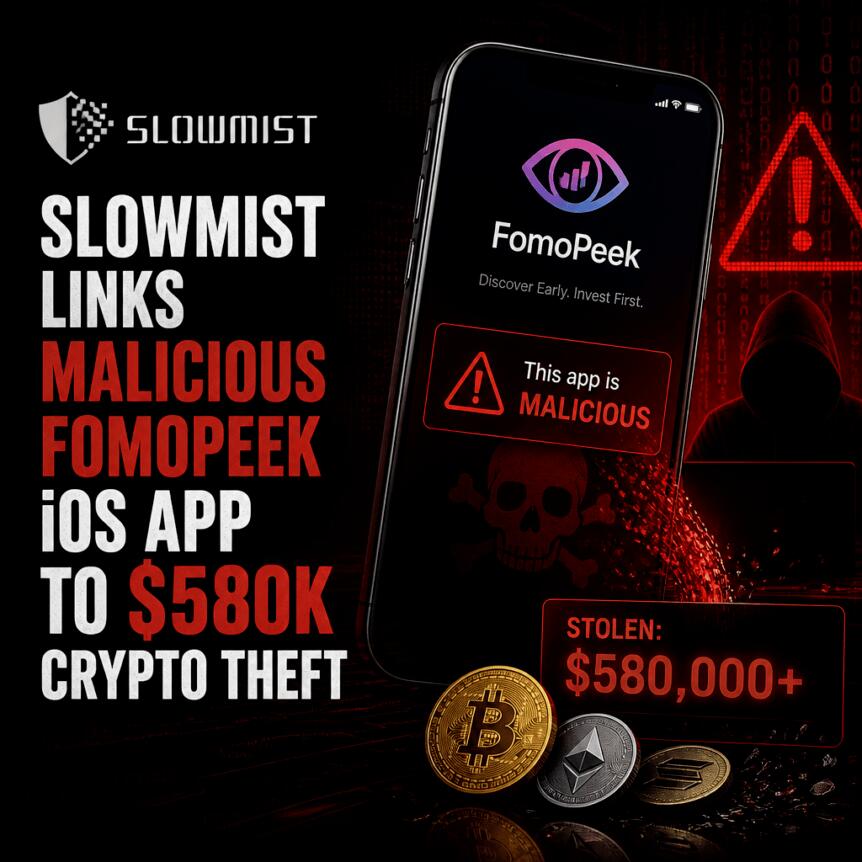
Security researchers have traced nearly $580,000 in stolen crypto to a malicious iOS application distributed through Apple’s App Store. According to an investigation by blockchain security firm SlowMist, the app—named FomoPeek—contained kernel exploitation capabilities designed to break out of Apple’s sandbox and reach sensitive wallet-related data.
SlowMist says the incident involved multiple attack modules that could elevate privileges and steal data stored by other apps, including items accessible via iOS Keychain mechanisms. The firm also tied onchain activity to a primary hacker address that received 579,984 USDT, with funds later routed across several services and networks.
Key takeaways
- SlowMist links the FomoPeek iOS app to about 579,984 USDT in stolen funds, based on onchain analysis.
- The malicious components were distributed in specific app versions released on Sept. 9 and Sept. 12, and removed in version 1.3 released Sept. 17.
- The exploit framework targeted iOS versions broadly (12.0 to 18.7.2 and 26.0 to 26.1) and included multiple methods for sandbox escape.
- SlowMist’s tracing indicates cross-network movement, followed by consolidation and transfers through intermediaries such as FixedFloat, KuCoin, and cce.cash.
What researchers say the app did
In its threat-intelligence analysis, SlowMist reports that FomoPeek introduced two malicious modules capable of exploiting iOS vulnerabilities. The firm describes how these components could help the app escape Apple’s sandbox environment, then gain elevated privileges to access sensitive data and files associated with other apps.
The report specifically highlights the ability to reach data stored in the Keychain, a common target for attackers looking to obtain credentials, tokens, or other secrets used by mobile applications. Once those privileges are gained, the scope of theft can broaden quickly—especially for users who already have crypto wallet software or related services installed on the same device.
Version timeline and what changed
SlowMist’s investigation provides a narrow window for when the harmful code was present. The firm says the affected FomoPeek versions were released on Sept. 9 and Sept. 12. It then points to a mitigation step: version 1.3**, released on Sept. 17, that removed the malicious components.
The detail matters for users and defenders because it implies the threat was not continuous across the entire app’s lifecycle. Instead, it appears tied to particular builds—meaning that devices running older versions would be at the highest risk, while later versions may have reduced exposure.
SlowMist also states that its work began after it received reports from users who said they experienced crypto theft and confirmed they had installed FomoPeek builds that fell within the affected period. The firm conducted the technical work together with the OKX security team.
Onchain trail: 579,984 USDT and cross-platform routing
To connect the iOS compromise to real-world losses, SlowMist performed onchain analysis. The firm says it identified a primary hacker address associated with the incident that received approximately 579,984 USDT.
SlowMist reports that this address became active on Sept. 15 and that the stolen funds were handled across multiple blockchain networks before being consolidated. From there, the flow continued through additional hops and addresses designed to obscure the trail.
In the report, SlowMist notes that portions of the funds were directed toward services including FixedFloat, KuCoin, and cce.cash. Other funds were dispersed across further addresses that the firm continued to trace.
While onchain movement cannot prove the full mechanics of the compromise by itself, it does provide a measurable link between the suspected attacker infrastructure and the ultimate transfer behavior. It also helps explain why such incidents often become multi-stage: initial theft on-device can be followed by rapid conversion, relocation, and consolidation efforts across chains and counterparties.
Targets, scope, and the exploit framework
SlowMist says the exploit framework used by FomoPeek included eight attack methods and claimed support for a wide range of iOS versions—specifically 12.0 to 18.7.2 and also 26.0 to 26.1.
That breadth is notable because iOS versions are not uniform, and exploit reliability can vary widely depending on device and patch level. A broader claimed range can indicate an attempt at wide applicability, which increases potential impact beyond a single narrow segment of users.
Still, the report’s most practical takeaway for users is not the list of supported versions—it’s the version-specific presence of the malicious code. If the harmful components were truly removed in version 1.3 on Sept. 17, that suggests updated installs could have helped limit damage going forward.
Cointelegraph attempted to request comments from Apple, SlowMist, and OKX, but did not receive responses before publication.
Readers should watch closely for follow-up disclosures from the security community and, most importantly, verify whether they have installed FomoPeek and which app version is currently on their devices. If a user still has any affected build installed, removing the application and updating to a later version would be a sensible immediate step, alongside reviewing wallet activity for any unusual transfers.
U.S. Treasury Secretary Scott Bessent has emerged as a leading candidate to become President Donald Trump’s next artificial intelligence czar as the administration prepares to establish a new “AI Force.”
Summary
- Scott Bessent is reportedly among the leading candidates for Trump’s next AI czar role, though the White House has not confirmed an appointment.
- Trump announced plans for a new AI Force on Sept. 19 but has yet to disclose its structure, authority or membership.
- Michael Kratsios, Scott Kupor and Sean Cairncross are among the other officials reportedly being considered for the position.
- Bessent has taken a growing role in AI policy discussions, including talks with China over possible communication channels for AI related security incidents.
Semafor reported on Sept. 22 that Bessent is among the officials being considered for the position, citing three people familiar with the matter. White House Office of Science and Technology Policy Director Michael Kratsios, Office of Personnel Management Director Scott Kupor and National Cyber Director Sean Cairncross are among the other names under consideration.
No appointment has been finalized. White House spokesperson Kush Desai pushed back against reports about the personnel deliberations, telling Semafor that “any reporting about personnel decisions that have not been officially announced by the administration should be regarded as baseless speculation.”
Trump announced on Sept. 19 that he planned to appoint a new AI czar and create an “AI Force,” but provided few details about its structure, authority or membership. Reuters reported that the announcement came as Washington faced renewed debate over AI safety and the pace of development, while Trump continued to favor using existing legal frameworks to address misuse instead of imposing new restrictions on the industry.
Bessent has taken a bigger AI policy role
Bessent has become more involved in the administration’s AI discussions this year, extending his work beyond Treasury’s traditional financial and economic policy responsibilities.
During meetings held around the United Nations General Assembly this week, Bessent spoke with Chinese Vice Premier He Lifeng about establishing a formal U.S. China dialogue on artificial intelligence. Their discussions included a possible notification system that could allow the two governments to communicate when AI incidents pose national security risks.
Bessent said in a CNBC interview earlier this week that appointing an AI czar could help put “context, shape and contours” around questions raised by artificial intelligence. He maintained that humans ultimately remain responsible for decisions involving AI systems.
His involvement grew after financial institutions raised concerns that advanced AI systems could expose weaknesses in their operations, according to Semafor. Bessent subsequently became a more active participant in discussions surrounding AI policy inside the administration.
The Treasury secretary already holds a prominent position in Trump’s technology and digital asset agenda. Bessent has repeatedly represented the administration on cryptocurrency regulation, including its push for congressional market structure legislation and its policy toward the U.S. Strategic Bitcoin Reserve.
In May, Bessent urged lawmakers to advance the CLARITY Act while reaffirming that the Trump administration opposed the creation of a U.S. central bank digital currency. He argued that clearer rules were needed to bring more digital asset activity into the United States.
A few days later, crypto.news previously reported that Bessent backed expanding the reserve while appearing before the Senate Finance Committee. He told lawmakers that the administration remained committed to developing the Strategic Bitcoin Reserve and wanted durable rules governing the initiative.
Trump is replacing the role once held by Sacks
Trump previously assigned AI and cryptocurrency policy to venture capitalist David Sacks, who became the White House AI and crypto czar after Trump announced his appointment in December 2024.
Sacks ended his czar term in March after reaching the 130 day service limit applying to his position as a special government employee. He continued working with the administration through the President’s Council of Advisors on Science and Technology, where he serves as a co chair.
Trump’s Sept. 19 announcement therefore sets up the first formal replacement for the AI czar position since Sacks left the government role. Reuters reported that Sacks continues advising Trump despite no longer serving as a special government employee.
Sacks has remained a prominent voice in the administration’s AI debate, particularly around regulation and competition with China. In July, he warned about Chinese AI after Moonshot AI’s Kimi K3 reached first place on the Frontend Code Arena. Sacks argued that restrictive U.S. rules could weaken American developers as Chinese models improved across several benchmarks.
Trump has used a similar competition argument when discussing both cryptocurrency and artificial intelligence. During his July push for the CLARITY Act, he framed the legislation around competition with China and presented technological leadership in crypto and AI as part of the same U.S. policy challenge.
White House has resisted strict AI rules
Any new AI czar would enter the role while the administration continues to favor a relatively light federal regulatory approach toward artificial intelligence.
The White House’s National AI Policy Framework released earlier this year favored voluntary agreements with technology companies over prescriptive federal requirements and called for Congress to preempt state AI laws considered excessively burdensome to innovation. The administration’s AI framework placed technology development and U.S. competitiveness among its main priorities.
Trump has continued resisting calls to slow AI development even as executives and researchers raise concerns over increasingly capable models. His Sept. 19 announcement did not explain whether the planned AI Force would have regulatory authority or how it would interact with existing federal agencies.
At the same time, Washington and Beijing have started discussing possible cooperation on some AI risks. Semafor reported that Bessent and He explored a notification mechanism for incidents with national security implications as part of discussions about establishing a formal bilateral AI channel.
OpenAI head of national security policy Sasha Baker said at a Sept. 22 Semafor event that an AI crisis communication line between the United States and China could provide a “starting place” for cooperation. Baker said both countries host leading AI laboratories, while other countries have an interest in decisions surrounding advanced AI systems.
Several officials remain in consideration
Bessent is not the only administration official being discussed for the czar position, and Trump has not publicly identified a preferred candidate.
Kratsios already oversees technology policy as director of the White House Office of Science and Technology Policy. Kupor entered government after previously serving as a managing partner at venture capital firm Andreessen Horowitz, while Cairncross serves as National Cyber Director.
Semafor reported that Bessent and Cairncross previously disagreed over Anthropic’s Mythos model in May, pointing to differences within the administration over how officials should approach individual AI systems and companies.
Holding the Treasury post would not necessarily prevent Bessent from taking the additional assignment. Semafor noted that Interior Secretary Doug Burgum has retained his Cabinet position while simultaneously serving in an administration coordinating role on energy policy.
Trump’s decision remains pending, and the White House has not confirmed Bessent, Kratsios, Kupor, Cairncross or any other official as the next AI czar.
BeInCrypto examined how LBank compares with rival exchanges on trading depth, access to emerging tokens and tokenized products.
- Major trading pairs: LBank ranked first in five of six major USDT order-book tests against Binance, OKX, Gate, Bitget, MEXC and Bybit. Its displayed depth exceeded the six-peer median on every pair, although this does not guarantee execution quality.
- Early token access: LBank scheduled PONS trading 54 days and seven hours before Bitget. Selected tokens also recorded sharp price gains, but the sample does not prove typical customer returns or worldwide first listings.
- Robinhood-linked products: LBank led 9 of 22 selected tokenized-product depth comparisons. Its HOODON book held 4.42 times the competitor exchange’s displayed depth, while HOODX held 2.23 times as much. These are two separate products linked to Robinhood.
- Security evidence: LBank supplied an ISO/IEC 27001:2022 certificate and documented relationships with Elliptic and CertiK. These show defined security and compliance arrangements, but they do not independently confirm completed testing, guarantee protection from breaches, or establish customer-asset coverage.
Choosing an exchange involves two practical questions: can you trade the asset you want, and how much will the trade cost? LBank’s emphasis on early listings and tokenized products makes both worth examining alongside its established crypto markets.
Our comparisons cover spot markets, where users trade tokens themselves rather than leveraged contracts. An order book lists offers to buy and sell; its midpoint lies halfway between the best buying and selling prices.
We measure displayed depth by adding orders within 2% of that midpoint. More depth can help absorb trades, but a buyer needs available sell orders and a seller needs buy orders.
LBank Led Five of Six Major Pair Tests
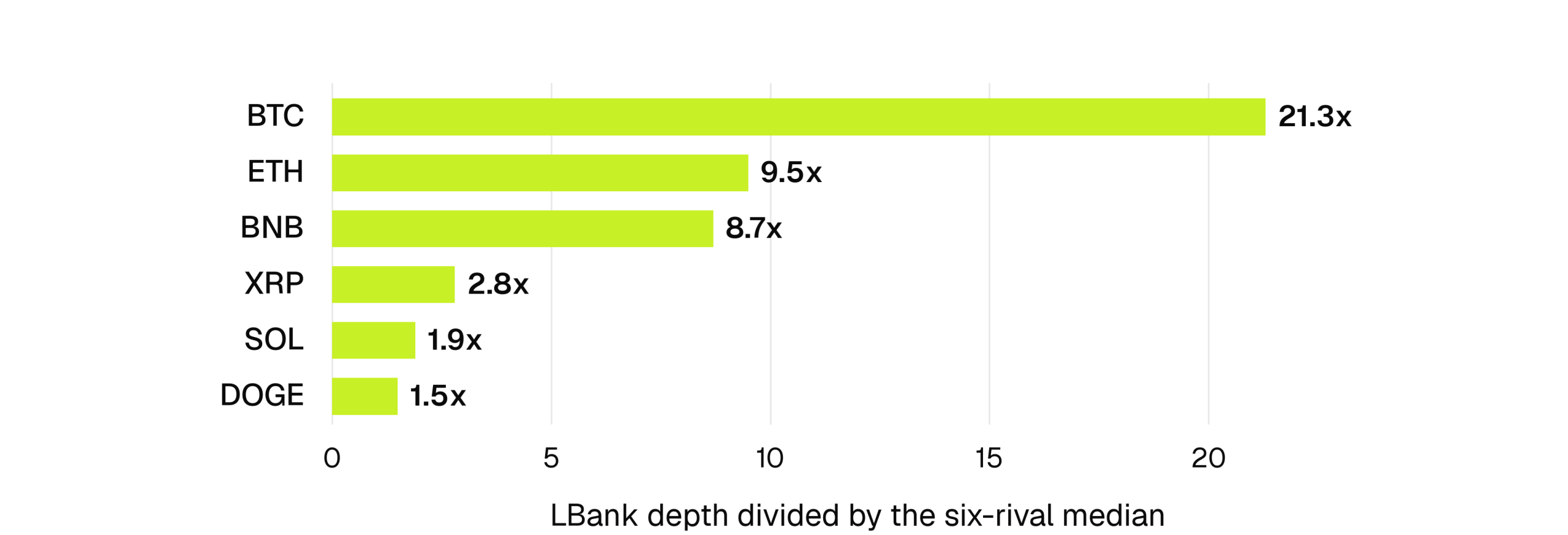
Our 29 August comparison covered Bitcoin, Ethereum, Solana, XRP, BNB and Dogecoin, each traded against USDT, a stablecoin designed to track the US dollar. We compared LBank with Binance, OKX, Gate, Bitget, MEXC and Bybit.
Across three snapshots, LBank ranked first in five pairs and second in Dogecoin. Its displayed depth exceeded the median, or middle value, of the six rivals on every pair.
Table 1 Major pair comparison
USDT pair
LBank depth
Strongest rival
Rival depth
Rank
BTC
$52.16m
Bitget
$11.79m
1 of 7
ETH
$25.24m
Bitget
$8.15m
1 of 7
SOL
$11.10m
Bitget
$10.98m
1 of 7
XRP
$4.92m
Bitget
$4.36m
1 of 7
BNB
$11.23m
Bitget
$4.15m
1 of 7
DOGE
$4.47m
MEXC
$4.51m
2 of 7
Source: Public order books from LBank, Binance, OKX, Gate, Bitget, MEXC and Bybit. Three snapshots, 29 August 2026; first 100 price levels per side; combined depth within 2%. Dollar amounts are approximate USDT values.

Bitcoin showed the clearest advantage: $52.16 million against Bitget’s $11.79 million, the strongest competing book. Solana was much closer, at $11.10 million against $10.98 million.
The test capped each side at 100 price levels, which can exclude different amounts of depth on different exchanges. Orders can also disappear before a trade executes. These results therefore describe the sampled books, rather than full market capacity or guaranteed execution prices.
| What this means: LBank showed competitive capacity in its core markets, particularly Bitcoin and Ethereum. That gives traders and trading partners a reason to compare its quotes for major assets, while testing the relevant side of the book at their intended order size. |
Early Listings Gave Access to Tokens With Large Gains
LBank nominated NIULAI, PONS, Artificial Inu and The Index for a closer look. CoinGecko’s 8 September capture showed large monthly gains in three, while NIULAI fell over the available seven-day window.
Table 2: Price changes in the four nominated tokens
Asset
7 days
30 days
PONS
+49.47%
+2,226.07%
Artificial Inu
+50.12%
+7,921.56%
The Index
+23.03%
+212.59%
NIULAI
-2.37%
Unavailable
Source: CoinGecko captures, 8 September 2026: PONS, Artificial Inu, The Index and NIULAI. NIULAI’s 30-day change was unavailable. Selection: LBank, not a representative sample of its listings.
These are changes in token prices, not returns earned by every LBank customer. Entry time, exit price and trading costs determine individual results. Artificial Inu appears as AI on CoinGecko and AI1 on LBank; we matched asset identities rather than relying on symbols alone.
The listing history does support a specific access advantage. LBank scheduled PONS trading for 15 July at 07:00 UTC; Bitget scheduled it for 7 September at 14:00 UTC. LBank’s launch was 54 days and seven hours earlier.
What this means: LBank offered access to PONS well before that particular rival, giving users an earlier opportunity to trade it. The evidence does not establish a worldwide first listing, typical customer profits or consistently successful token selection.
Small Token Books Limited Larger Purchases
The next question is whether traders could transact at the prices they saw. Three direct order-book captures per comparison on 8 September found much less nearby depth for several nominated tokens.
Table 3 Nearby depth in the same smaller tokens
Asset
LBank depth
Matched rival
Rival depth
NIULAI
$82
Gate
$17,011
PONS
$288
Gate
$113,214
Artificial Inu
$5,792
Gate
$2,660
The Index
$9
MEXC
$1,194
Source: BeInCrypto direct exchange captures, 8 September 2026. Median combined buy and sell depth within 2%; approximate dollars from USDT values. AI1 uses the later matched LBank and Gate capture; Gate names the same token AINVDA.
PONS illustrates the difference between an attractive quote and enough orders behind it. LBank’s spread, the gap between its best buying and selling prices, was only 0.011%, narrower than Gate’s 0.081%. Yet a simulated $1,000 purchase on the captured LBank book paid an average 2.23% above the midpoint, against 0.06% on Gate.

Source: Median simulated buying premium across three captures per comparison. Rivals: Gate for NIULAI, PONS and Artificial Inu; MEXC for The Index. No trades were placed. Calculations use displayed sell orders and exclude fees, delays, cancellations and new orders.
Artificial Inu needs a further distinction. LBank had more combined depth than Gate in the matched capture, but only about $96 consisted of sell orders, against Gate’s $1,396. Most of LBank’s depth was buying interest, offering little help to someone buying the token.
Its combined depth had also risen sharply between capture rounds. That change shows why a single snapshot cannot establish persistent liquidity.
What this means: Early access did not consistently translate into capacity for larger purchases. The simulations show why retail users need to inspect sell orders before buying; for listing partners, the weakness is the amount and balance of available liquidity, not simply the number of tokens offered.
bStocks Accounted for Most Tokenized Trading in the Sample
LBank offers tokenized products across bStocks, Ondo and xStocks. Our 8 September CoinGecko screen covered 22 selected products across those three families.
Tokenized products provide exposure linked to an underlying asset through a digital token. Two tokens referencing the same company can have different issuers and terms, so we compared the exact product and USDT spot pair across exchanges.
Table 4: Reported activity across the selected tokenized basket
Product family
Products
24h volume
Basket share
bStocks
8
$14.39m
63.91%
Ondo
6
$4.43m
19.67%
xStocks
8
$3.70m
16.42%
Total
22
$22.51m
100%
Source: CoinGecko ticker captures, 8 September 2026; selected LBank basket. Totals use unrounded figures. Share means share of this basket’s reported volume, not global market share. Ticker data and depth fields.
The basket covered eight reference names: Apple, Amazon, Circle, Nvidia, Robinhood, Tesla, SK Hynix and SpaceX. Including SK Hynix and SpaceX-linked products takes the comparison beyond ordinary US-listed shares. This is a selected product sample, not a measure of the whole US stock market.
xStocks represented just 16.42% of the basket’s $22.51 million in reported daily trading. The broader total reflects added product coverage, not evidence of a sudden increase in activity.
We also checked six overlapping xStocks pairs against completed one-minute trading records over nearly aligned 24-hour windows. CoinGecko showed $2.61 million; the reconstruction gave $2.64 million, 1.08% higher. Valuing the reconstructed quantities at CoinGecko’s latest prices narrowed the gap to 0.07%, suggesting pricing explains most of the difference.
Both calculations ultimately use exchange-reported activity. Agreement supports consistency between the two methods, but does not independently audit the trades.
What this means: bStocks contributed almost two-thirds of this sample’s reported activity, so an xStocks-only view would miss much of the trading covered here. Traders and partners should assess each product’s liquidity and terms separately.
Robinhood Products Had the Largest Depth Advantages
LBank led nine of the 22 exact-product depth comparisons. Its two largest leads over the strongest available rivals were HOODON and HOODX, two different products linked to Robinhood shares.

Source: CoinGecko, 8 September 2026. Combined upward and downward 2% depth; Gate was the strongest valid matched rival in both cases. Four valid venues, including LBank, returned for each product.
HOODON held $1,096,872 on LBank against Gate’s $248,125, a 4.42-fold difference. HOODX held $564,324 against $252,804, or 2.23 times as much. Both reference Robinhood, so these are two product strengths tied to one company.
Table 5: Other product comparisons show where the result changes
Product
Family
LBank depth
Strongest rival
Rival depth
HOODB
bStocks
$613,791
Binance
$499,816
TSLAB
bStocks
$548,588
Binance
$927,889
NVDAX
xStocks
$881,259
Gate
$597,711
NVDAON
Ondo
$312,474
MEXC
$885,850
Source: Selected examples from the 22-product CoinGecko capture, 8 September 2026. Each row compares the same token against USDT. Product sources: HOODB, TSLAB, NVDAX, NVDAON.
Results also varied across issuers. LBank led 9 of the 22 tokenized-product depth comparisons in the September 8 snapshot: four of eight bStocks products, four of seven xStocks products and one of seven Ondo products.
The table below lists every product where LBank led. Each comparison matches the same token and USDT trading pair against the strongest qualifying rival. Depth measures the combined value of buy and sell orders within 2% of the market midpoint.

Robinhood stood out across all three product families, accounting for three of LBank’s nine leads. HOODON held 4.42 times Gate’s displayed depth, while HOODX held 2.23 times as much—the two largest percentage advantages in the sample. HOODB also exceeded Binance’s depth by 22.8%.
The other leads ranged from 1.8% for Nvidia’s bStocks product to 47.4% for Nvidia’s xStocks product. The narrow advantages in NVDAB and CRCLX could reverse with relatively small changes in displayed orders.
These rankings cover valid returned matches in an 18-exchange screen. Missing markets were not counted as zero, and the number of qualifying rivals differed by product.
What this means: LBank’s strongest result was the consistency of its Robinhood lead across three separate tokenized products. Its other wins give traders and partners a wider set of markets to consider. These books showed more combined buying and selling interest near the market price than their strongest qualifying rivals, although actual execution still depends on order size, the side of the book and whether those orders remain available.
LBank Documents Security Controls and Partnerships
LBank supplied evidence of security controls and external partnerships that deserves consideration alongside trading performance. The sources establish different things, from a certificate’s stated scope to announced testing arrangements.
Table 6: What the security evidence supports
Evidence
Documented scope
Limit of the evidence
ISO/IEC 27001:2022
LBK EXCHANGE FZE; platform, infrastructure, applications and AWS security management. Stated validity 13 Feb 2026 to 12 Feb 2029, subject to periodic audits.
Names Prescient Security LLC as issuer. Issuer confirmation remained incomplete in this review.
Elliptic
Provider confirms transaction and wallet screening and fund tracing.
Partnership announcement; no measured control outcomes.
CertiK
LBank announces simulated attack testing and rewards for finding vulnerabilities, 10 Aug 2026.
Announcement does not establish completed tests or fixes.
Source: Certificate supplied by LBank and reviewed 1 September 2026; Elliptic announcement; LBank CertiK announcement. Elliptic’s page is dated 12 March 2025.
LBank also told BeInCrypto that SlowMist joined its security initiative. This review did not independently confirm that participation or its scope.
Access depends on jurisdiction as well as technical controls. Historical notices from Japan’s FSA on 14 June 2024, Spain’s CNMV on 9 September 2024 and India’s FIU on 1 October 2025 addressed registration or compliance. Those records alone do not determine today’s legal status.
| What this means: The documentation gives users and partners specific controls to investigate. It does not measure how reliably every control operates, guarantee protection from breaches or replace checking the legal entity and permissions relevant to a user’s country. |
What the Research Can Establish
Table 7: Research scope and dates
Test
Capture date
Basis
Major pairs
29 Aug 2026
Seven exchanges; three snapshots; first 100 levels per side.
Nominated tokens
8 Sep 2026
CoinGecko prices; listing notices; three direct books per comparison.
Tokenized products
8 Sep 2026
22 products; 18-venue screen; exact USDT spot matches; stale or anomalous rows excluded.
Volume check
8 Sep 2026
Six xStocks pairs; 1,440 completed one-minute records per pair; nearly aligned windows.
The observations describe two dated research windows, not live rankings or a controlled before-and-after comparison. Reported turnover is not independently audited. The nominated tokens and selected tokenized basket cannot establish exchange-wide market share or typical investment returns.
Public wallet trackers cover different address sets, and no complete current reserve package was supplied in the reviewed material. This study therefore cannot establish whether assets cover everything owed to customers; that does not demonstrate a shortfall. Verification requires dated assets and liabilities, a way for customers to check inclusion, and a defined independent review.
What this means: The findings support comparisons of specific markets and documented arrangements. They cannot establish the exchange’s overall financial condition or guarantee what a future trade will cost.
LBank Makes a Stronger Case for Some Trades Than Others
Table 8: Where the evidence is strongest
Use case
Finding
Condition
Major crypto trades
Led five of six sampled books
Depth must persist until execution.
New token access
PONS available earlier than Bitget
Large gains did not ensure deep sell books.
Tokenized products
Led nine of 22 comparisons
Choose the exact issuer and pair.
LBank’s strongest evidence concerns its major crypto markets and selected tokenized products. The sampled Bitcoin and Ethereum books compared favourably with large rivals, and the Robinhood-linked products showed substantial depth advantages. Its earlier PONS listing adds a separate benefit for traders seeking new assets.
The smaller-token tests qualify that case. Access to a rising asset can coexist with a thin sell book, making a larger purchase more expensive than the headline quote suggests. LBank has demonstrated reasons to consider individual markets; this research does not establish consistent leadership across its full catalogue.
For a retail trader, the practical conclusion is to compare the exact token, the relevant side of its book and the intended order size before choosing a venue. For partners, the strongest next test is whether LBank sustains the observed depth and delivers comparable execution over time.
Sources
- LBank public API documentation
- Binance official spot API documentation
- OKX market data API documentation
- Gate API documentation
- Bitget order-book API documentation
- MEXC spot API documentation
- Bybit order-book API documentation
- Dune xStocks query 6512755
- DefiLlama LBank profile
- Arkham LBank entity profile
- Japan Financial Services Agency warning
- Spain CNMV warning
- India Financial Intelligence Unit notice
The post LBank Market Depth: How It Compares With Six Major Crypto Exchanges appeared first on BeInCrypto.
The U.S. Commodity Futures Trading Commission has warned federally regulated prediction markets that contracts settling on what named people say, attend or do may face a presumption of being readily susceptible to manipulation.
Summary
- CFTC staff says mention markets carry heightened manipulation risks because outcomes depend on individual conduct.
- Designated contract markets must show strong safeguards before listing mention contracts under existing federal rules.
- Gabriel Perez disgorged $107,539 after using nonpublic presidential speech information to trade event contracts profitably.
- George Santos paid $35,000 after the CFTC found manipulative trading tied to his attendance contract.
- Kalshi still lists Trump speech markets, while mention contracts remain excluded from proposed margining plans.
The CFTC’s Division of Market Oversight issued the staff advisory on Sept. 22, covering contracts based on specific words or phrases, event attendance, public appearances and interactions between individuals. The guidance applies directly to designated contract markets and describes only limited circumstances in which such products may satisfy existing federal market-integrity requirements.
Unlike a new Commission rule, the advisory is informational and expressly says it creates no new legal obligations. Exchanges remain responsible for complying with the Commodity Exchange Act, including Core Principle 3, which requires designated contract markets to list only derivatives that are not readily susceptible to manipulation.
CFTC says mention markets can be presumed manipulable
Mention markets differ from contracts based on election results, economic releases or regulated sporting outcomes because settlement can depend on conduct controlled by one named person or a small group, according to the advisory. The regulator cited examples involving speeches, earnings calls, social-media posts, event appearances, photographs and personal interactions.
CFTC staff said a person controlling an outcome could deliberately trigger it, prevent it from occurring or know the result before traders outside that person’s circle. A podcast host, for example, could say a word tied to a contract payout, while people with access to scripts, prepared remarks or guest lists might possess material nonpublic information before settlement.
For that reason, the Division of Market Oversight said it may view mention markets as “presumptively readily susceptible to manipulation.” The phrase represents staff’s regulatory view under Core Principle 3 and does not mean every contract in the category is automatically prohibited.
A designated market could rebut that presumption in limited cases by showing that its contract design and controls sufficiently reduce manipulation risks. Staff identified independent verification and substantial public scrutiny as central considerations when evaluating those products.
The advisory asks exchanges to examine whether the person controlling settlement faces legal, professional, fiduciary, confidentiality, contractual or organizational duties that discourage deliberate interference. Exchanges should separately consider whether outside traders could influence the individual through payments, social pressure, inducements or other forms of interference.
Public settings receive particular attention. CFTC staff said formal events involving public figures may provide stronger independent verification, while conduct occurring privately or involving non-public people can be harder to verify and monitor. Even a public speech may present concerns when a contract turns on an incidental word with little connection to the substance of the event.
Recent cases show how insiders can control outcomes
The advisory follows two CFTC enforcement cases involving traders whose own access or conduct affected event-contract outcomes.
On Aug. 28, the regulator ordered former White House teleprompter operator Gabriel Perez to disgorge $107,539.02 and pay a $65,000 civil penalty after finding that he used advance access to President Donald Trump’s speeches to trade presidential mention contracts. Perez received a three-year trading ban.
Between December 2025 and February 2026, Perez had access to presidential speeches before delivery because of his federal employment, according to the CFTC order. The Commission found he misappropriated that information and generated more than $107,500 in trading profits. The CFTC credited KalshiEX for assisting the investigation.
As previously reported, the White House speech betting case involving advance access to Trump’s remarks ended with Perez agreeing to more than $172,000 in disgorgement and penalties after the regulator completed its investigation.
A separate July case involved former Rep. George Santos. The CFTC found that Santos traded contracts on whether he would attend the 2026 State of the Union while making public statements about his own attendance plans.
The regulator said contract prices moved in directions favorable to Santos after several of his social-media statements. Its settlement required him to disgorge $17,569.98, pay a $17,500 civil penalty and accept a three-year trading ban.
Kalshi later imposed its own permanent suspension. Kalshi’s lifetime ban on Santos over the State of the Union market followed the federal enforcement action and covered his access to the exchange directly or indirectly.
Kalshi keeps some mention markets live under tighter scrutiny
The new guidance does not amount to an industrywide ban on mention contracts.
As of Sept. 23, Kalshi still displayed markets tied to what Trump would say during United Nations meetings, including contracts covering terms such as AI, NATO and ceasefire. Another contract covering Trump’s United Nations General Assembly speech had recorded nearly $194,000 in volume in the available snapshot.
CFTC filing records show Kalshi previously self-certified amendments covering contracts asking whether a specific word would be said by a person, including a separate template tied to Trump. Those amendments were recorded as certified in June.
The Sept. 22 advisory means future Part 40 submissions involving such products are expected to contain more detailed, contract-specific manipulation analysis. Staff encouraged platforms to identify potential controllers and known insiders, then calibrate position limits, reporting requirements, recordkeeping and surveillance controls around those risks.
Staff said independent obligations placed on the person controlling an outcome do not replace the exchange’s own market-surveillance duties. Exchanges seeking to list a mention contract are expected to explain how their rules can detect manipulation, attempted manipulation and misuse of nonpublic information.
Kalshi has already reduced its exposure to some parts of the category. CFTC review of mention markets prompted Kalshi to pull sports mention contracts in August while political and corporate versions remained available.
A separate development arrived on the same day as the new CFTC advisory. Kalshi Klear requested approval for a margin framework covering selected event contracts, but mention and culture markets were excluded from the proposed eligible group, according to its filing coverage.
Prediction-market rulemaking remains unfinished
The mention-market advisory sits alongside a separate CFTC rulemaking process covering event contracts more generally.
The Commission proposed amendments to Regulation 40.11 in June that would create a formal process for assessing contracts involving areas Congress specifically identified, including gaming, terrorism, assassination, war and activities unlawful under federal or state law. The proposal includes a 90-day review process and contract-specific public-interest factors.
CFTC data said trading volume on federally registered prediction markets surpassed $25 billion during 2025. The regulator described event contracts as a growing part of derivatives markets while noting that the figure remained small beside the roughly $31 trillion notional value of the overall futures market it regulates.
The Commission has not published a final version of the June prediction-market proposal as of Sept. 23. Its current 2026 final-rule list does not show a completed Regulation 40.11 rulemaking, leaving the Sept. 22 staff advisory operating under existing Core Principle 3 and Part 40 requirements.
The federal framework is developing while courts consider separate disputes over state gambling authority. On Aug. 28, the Ninth Circuit ruled that Kalshi had not shown Nevada’s regulation of its sports event contracts was likely displaced by the Commodity Exchange Act, allowing Nevada’s sports-related enforcement to continue while other issues returned to the lower court.
As previously reported, the Ninth Circuit’s Nevada ruling on Kalshi’s sports prediction contracts did not invalidate the CFTC’s prediction-market rules or decide how every category of event contract must be treated.
Polymarket’s U.S. operation is part of the federally registered market structure through QCEX. CFTC records show amendments to the Polymarket U.S. rulebook were certified in April, while QCEX has continued filing event products with the regulator during 2026.
For mention markets specifically, the next compliance step falls on designated contract markets when they submit new products or amendments under Part 40. The Sept. 22 advisory says staff expects each filing to provide a detailed evaluation of the manipulation factors and describe the controls intended to address them.
XRP Ledger retries upgrade that lets banks split payment and compliance duties

Fantasy football Week 3 TE preview: Colston Loveland and Kyle Pitts are holds, not starts

F5 patches BIG-IP APM zero-day flaw exploited in RCE attacks




-

 Fashion5 days ago
Weekend Open Thread: Talbots – Corporette.com
-

 Tech2 days ago
Researchers escape OpenAI Codex sandbox to run commands on host
-

 Crypto World4 days ago
Circle launches Arc Studio AI agent for building onchain apps
-
 NewsBeat4 days ago
Trump says US has reached an agreement to take permanent control of Greenland’s security
-

 Crypto World2 days ago
Who Needs CLARITY Anyway? ARB Could See 70X Increase: Hodler’s Digest
-

 Crypto World4 days ago
Bitcoin price breaks channel as RSI climbs to 63
-

 Crypto World4 days ago
Trading Bitcoin on Robinhood? Why 2% Spread Has Traders Worried
-

 Crypto World6 days ago
US Charges Robinhood Engineers Over Crypto Listing Trades
-

 Crypto World5 days ago
Mortgage and refinance interest rates today, Thursday, September 17, 2026
-

 Crypto World4 days ago
World Money launches in 150+ countries with Stripe
-

 Business2 days ago
Analog Devices (ADI) Bets $1.35 Billion on Chips that Let Machines Think for Themselves
-

 Crypto World5 days ago
Silver prices recover quickly, hitting weekly high today
-

 Crypto World2 days ago
Coinbase, Robinhood, Circle Seen as Tokenized-Stock Winners
-

 Tech5 days ago
GPT-6 Astra Reached the Nether in Minecraft, Lost Its Stash to a Creeper, and Farmed Potatoes for Hours
-
 NewsBeat4 days ago
US was ‘on brink of war’ with China over false AI report of nukes moving in Middle East
-

 Crypto World2 days ago
Bitcoin price holds above $81K as key catalysts line up
-

 Entertainment6 days ago
Grey’s Anatomy Showrunner Teases Changes After Cast Exits
-

 Tech3 days ago
Trump suggests rebranding AI with a new name, says he’s also creating an AI Force
-

 Crypto World4 days ago
CFTC sends crypto market structure rulemaking to White House
-
 Crypto World1 day ago
Meta Jumps 11% As Muse Shines and Investors Show an Appetite for Advancing AI
You must be logged in to post a comment Login