
Business
Fed Hike: Selling These 2 Winners, And Replacing With These 2 High Yield Stocks



We’re a father-and-son team dedicated to helping individual investors achieve financial independence through strategic dividend investing. With years of combined experience and a deep understanding of the markets, we’ve developed a straightforward yet powerful method that empowers investors like you to take control of your financial future, create a massive dividend snowball, and retire happy and free. At The Dividend Freedom Tribe, we don’t serve institutional clients or cater to Wall Street’s elite. Instead, we focus on everyday investors who want to build sustainable wealth and income with a strategy that works in real-world conditions. Our motto is simple: “Buy Low, Sell High, Get Paid to Wait.” It’s a time-tested approach that’s helped our members generate reliable income, even in volatile markets. When you join The Dividend Freedom Tribe, you gain access to a comprehensive suite of tools designed to give you an edge. Our three model portfolios are built for different investing styles, whether you’re seeking high yield, high growth, or a balanced approach. All 3 have beaten the market since inception. You’ll also receive exclusive, in-depth analysis of a universe of 100 hand picked dividend stocks, weekly buy/watch/sell lists to help you make informed decisions, and our proprietary DFT Charts. But it’s not just about the numbers. As a member, you’ll be part of a vibrant, supportive community of dividend investors who share your goals and are eager to help each other succeed. We believe in transparency, engagement, and creating a space where everyone can learn and grow. Whether you’re just starting your investing journey or you’re a seasoned pro, we’re here to provide the insights and support you need to turn your retirement dreams into reality. Join us today and discover how our proven strategy can help you achieve financial freedom.Click here to get startedPS: If you’re not yet ready to get started, join our free tier and follow us on SeekingAlpha.
Analyst’s Disclosure: I/we have a beneficial long position in the shares of PBR, ITUB either through stock ownership, options, or other derivatives. I wrote this article myself, and it expresses my own opinions. I am not receiving compensation for it (other than from Seeking Alpha). I have no business relationship with any company whose stock is mentioned in this article.
Seeking Alpha’s Disclosure: Past performance is no guarantee of future results. No recommendation or advice is being given as to whether any investment is suitable for a particular investor. Any views or opinions expressed above may not reflect those of Seeking Alpha as a whole. Seeking Alpha is not a licensed securities dealer, broker or US investment adviser or investment bank. Our analysts are third party authors that include both professional investors and individual investors who may not be licensed or certified by any institute or regulatory body.


For expats, investing while living in Singapore can provide opportunities to build long-term financial security, but it also comes with considerations that may differ from those faced by local investors.
Singapore Expat Advisory can help international residents better understand the financial considerations involved in living and investing in Singapore. From choosing suitable investment strategies to considering international assets and future relocation plans, having a clear understanding of your financial position can make investment decisions more structured and informed.
Start With Your Financial Goals
Before choosing an investment, it is important to understand what you are trying to achieve. Your investment strategy should ideally reflect your financial objectives, timeline, and personal circumstances.
Are you investing to prepare for retirement, build long-term wealth, generate additional income, purchase property, or create a financial cushion for the future?
The answer can influence the types of investments you consider. Someone saving for a goal in two or three years may have different priorities from someone investing for retirement several decades away.
Defining your objectives first can help you avoid choosing investments simply because they are popular or have recently performed well.
Consider Currency Exposure
Currency is another factor that international investors should not overlook.
An expat working in Singapore may receive income in Singapore dollars while maintaining savings or investments in US dollars, British pounds, euros, Australian dollars, or another currency.
Exchange-rate movements can affect the value of those assets when measured in another currency. This becomes particularly relevant if you expect to return to your home country or relocate elsewhere in the future.
Think about where your future expenses are likely to occur and which currencies you may ultimately need. This can help you understand whether your existing financial position leaves you heavily exposed to a particular currency.
Diversification Matters
Diversification is a fundamental consideration when building an investment portfolio. Rather than concentrating your money in one company, industry, country, or asset class, diversification can spread exposure across different investments.
For expats, geographical diversification may be especially relevant. Living in Singapore does not necessarily mean that all of your investments need to be concentrated in Singapore-based assets.
Depending on your circumstances, a portfolio could potentially include a combination of equities, bonds, cash, property, and other investments across different markets.
However, diversification does not eliminate risk. International investments can introduce additional considerations, including currency fluctuations, market volatility, regulatory differences, and investment costs.
Think About Your Retirement Plans
Retirement planning can become more complicated when your career spans several countries.
An expat might have accumulated pension benefits in their home country, established investments in Singapore, and potentially expect to retire somewhere completely different.
Consider where you expect to live during retirement and what currencies you are likely to need. It can also be useful to review existing pensions, investment accounts, and other assets before deciding where additional savings should be directed.
Your retirement strategy should account for your entire financial picture rather than focusing on a single investment account.
Look Beyond Individual Investments
For people with more complex financial circumstances, wealth management for expats in Singapore can involve considerably more than selecting individual stocks or funds.
A broader financial strategy may incorporate investment management, retirement planning, insurance, tax considerations, estate planning, cash management, and assets held in different countries.
This can be particularly relevant for senior professionals, entrepreneurs, business owners, and families who have accumulated significant financial interests internationally.
The goal is to understand how different financial decisions work together rather than treating each investment as an isolated decision.
Investment Fees
Investment performance is only one part of the equation. Fees and other costs can also affect long-term results.
Depending on the investment product, investors may encounter management fees, platform charges, transaction costs, advisory fees, or currency conversion expenses.
While an individual fee may appear relatively small, recurring costs can have a noticeable effect over a long investment period.
Before investing, make sure you understand how much you are paying, what services are included, and whether there are additional charges associated with buying, selling, transferring, or managing the investment.
Maintain an Emergency Fund
Investing does not mean putting every available dollar into the market.
Having accessible savings for unexpected expenses can be particularly important for expats. Employment changes, relocation costs, family emergencies, medical expenses, or unexpected travel can create financial pressure.
An emergency fund can provide liquidity without requiring you to sell long-term investments at an inconvenient time.
The appropriate amount will vary depending on your income, expenses, family circumstances, employment situation, and overall financial position.
Consider Your Future Relocation Plans
One of the biggest differences between local and international financial planning is uncertainty about where you will live in the future.
An expat may stay in Singapore for several years before moving to another country. Others may eventually apply for permanent residency or decide to make Singapore their long-term home.
Your expected future location can influence how you think about investments, currencies, taxes, retirement arrangements, and financial accounts.
If relocation is a realistic possibility, consider whether your investments can continue to be managed efficiently if you move to another jurisdiction.
Review Your Investment Strategy Regularly
Your financial circumstances can change significantly over time.
A promotion may increase your income. You may purchase property, start a business, have children, inherit assets, or decide to relocate. Changes like these can affect your investment priorities.
For this reason, reviewing your financial strategy periodically can be useful. An approach that was appropriate when you first arrived in Singapore may not necessarily reflect your current objectives several years later.
Regular reviews can help you identify whether your investments, savings, insurance, and retirement plans remain aligned with your long-term goals.
Final Thoughts
Investing in Singapore as an expat can offer access to a sophisticated financial environment, but making investment decisions requires more than simply identifying attractive opportunities.
Your financial goals, residency status, tax position, currency exposure, investment horizon, retirement plans, diversification, liquidity needs, and future relocation plans can all influence your overall strategy.
For expats with straightforward financial circumstances, some decisions may be relatively simple. For those with assets, income, pensions, or financial commitments across multiple countries, professional guidance can help provide a clearer view of the available options.
Ultimately, the most useful starting point is understanding your own financial objectives and building an investment approach around them. Rather than following investment trends or making decisions based solely on short-term market movements, a structured long-term approach can help you make more informed financial decisions while living and working in Singapore.
Business
Hints and Answer for September 27, 2026 as Puzzle 1926 Sets Sail With a Tricky Nautical Word

Wordle players faced puzzle number 1,926 on Sunday, a five-letter word tied to sailing that multiple puzzle trackers described as one of the more difficult answers of the past week, catching even experienced solvers off guard.
For those still working through the puzzle, several hints circulated Sunday to help point solvers toward the answer without giving it away outright. The word refers to a type of small boat designed for sailing, typically featuring a single mast, and is commonly associated with recreational sailing and coastal waters. The word describes a particular kind of sailing vessel specifically, rather than referring to boats more generally. Structurally, the word functions as a noun, contains two vowels and three consonants, includes one repeated letter, and begins with the letter S.
SPOILER WARNING: Today’s Wordle answer follows below. Stop reading now if you’d rather solve the puzzle without assistance.
The answer to Wordle #1,926 for September 27 is SLOOP, a noun referring to a single-masted sailing boat commonly used for recreational sailing along coastal waters.
Puzzle trackers covering Sunday’s word were largely unified in describing it as genuinely difficult, a departure from some of the more familiar, everyday vocabulary that has defined several recent Wordle answers. One puzzle writer described the day’s puzzle candidly as “a really nasty puzzle,” admitting to only completing it in four guesses thanks to a fortunate early elimination of letters, while noting unfamiliarity with the word itself, going so far as to say that even a search engine initially assumed a typo for the more common word “slop” when checking the answer afterward. According to data from The New York Times’ companion tool, Wordlebot, the average player completed Sunday’s puzzle in exactly four guesses in both standard and hard mode, a solid pace for a puzzle several solvers found unusually tricky given the relative obscurity of “sloop” as an everyday word.
Strategy guides accompanying Sunday’s puzzle recommended a range of strong opening words to maximize early information given the puzzle’s difficulty, including CRANE, ADIEU, STARE, ROAST and ORATE, all frequently cited among the most statistically effective starting guesses for narrowing down Wordle’s five-letter solution space. Guides also reiterated standard advice not to rule out the possibility of repeated letters too quickly, citing past Wordle answers such as SHEEP and BLOOM as reminders that duplicate letters remain a regular feature of the puzzle’s solution pool, a detail directly relevant to Sunday’s answer given its own repeated letter.
Wordle, created by software engineer Josh Wardle in 2021 before being acquired by The New York Times, continues to release a new five-letter target word to players worldwide at midnight local time each day, giving solvers six total guesses to identify the correct word. The game’s familiar color-coded feedback system, green for a letter in the correct position, yellow for a correct letter placed in the wrong spot, and gray for a letter absent from the word entirely, continues to guide players toward the solution with each subsequent attempt. Because the puzzle refreshes at midnight in each player’s own local time zone, solvers across different regions of the world begin their attempt at each day’s puzzle at staggered points relative to players elsewhere, even though every solver worldwide is working toward the same single answer.
Puzzle number 1,926 followed Saturday’s answer, ELEGY, which itself began with the letter E and similarly featured one repeated letter and just one of the five most commonly used letters in the English language, continuing a stretch of recent Wordle answers that puzzle trackers have noted skew toward less common, more specific vocabulary rather than everyday high-frequency words. Players tracking their personal statistics through Wordle’s built-in results screen, or through Wordlebot itself, can compare how efficiently they solved Sunday’s puzzle relative to the broader player base and their own historical performance on similarly difficult words.
For solvers looking for an added challenge, Wordle continues to offer a “Hard Mode” setting, which requires players to reuse any previously revealed correct or partially correct letters in all subsequent guesses, removing the option to test entirely new, unrelated letter combinations once useful information has already been uncovered. That setting can be toggled from the game’s settings menu before starting a new puzzle each day.
With Sunday’s word now revealed, players who came up short on the day’s unusually tricky puzzle, or those simply looking to extend an active streak, will have a fresh five-letter word and a new set of six guesses to work with when Monday’s edition of Wordle resets at midnight local time.

Puzzle number 1,204 of The New York Times’ Connections game closed out the weekend Sunday with a grid mixing sculpture materials, restaurant seating options, telecom vocabulary and a wordplay category built around the endings of Chinese dynasty names, a combination puzzle guides described as playful but carrying more hidden traps than it first appeared.
Connections presents players with 16 words that must be sorted into four hidden groups of four, with each group sharing a common category. The puzzle rates each group’s difficulty using a color system: yellow for the most straightforward connection, green for slightly trickier, blue for more difficult, and purple, typically the most wordplay-heavy or misleading group, as the hardest.
For those still working through Sunday’s puzzle, here are hints for each category, organized loosely from easiest to hardest, without giving away the specific words involved.
One category groups together materials commonly used to create sculptures, the kind of vocabulary an art student or gallery visitor would recognize immediately. A second category brings together different types of seating options a host or server might offer at a restaurant, ranging from a communal booth to a simple stool. A third category groups together words associated with telecommunications, the kind of terminology used to describe a phone service provider or wireless network. The fourth and trickiest category takes ordinary-looking words and phrases and reveals a hidden connection at the end of each one, tied to the names of historical Chinese dynasties.
SPOILER WARNING: The full solution to Sunday’s Connections puzzle follows below. Stop reading now if you’d rather work through the categories on your own.
Sunday’s puzzle resolved into the following four groups. The yellow category, Sculpture Media, consisted of BRONZE, CLAY, MARBLE and PLASTER, four materials commonly used by sculptors to create three-dimensional artwork. The green category, Restaurant Seating Options, grouped BANQUETTE, BOOTH, CHAIR and STOOL, four types of seating a diner might encounter at a restaurant. The blue category, Telecom, brought together CARRIER, NETWORK, OPERATOR and PROVIDER, four terms associated with telecommunications and phone or internet service. The purple category, Ending in Chinese Dynasties, consisted of BBQING, HOMING, LOHAN and WU-TANG, four words and names that each conceal the name of a historical Chinese dynasty at their end, including the Qing, Ming, Han and Tang dynasties.
Puzzle guides covering Sunday’s grid described it as deceptively gentle at first glance, with one reviewer noting there were surprisingly few obvious red herrings planted among the 16 words, a departure from the misdirection Connections puzzles often build into their harder categories. That same reviewer admitted to briefly wondering whether actor Lindsay Lohan had any thematic connection to the hip-hop group Wu-Tang Clan before recognizing the actual hidden-dynasty wordplay linking the two names together in the purple category. Forbes contributor Erik Kain rated Sunday’s puzzle a 1 out of 5 on the Connections Bot difficulty scale, one of the easier ratings a puzzle can receive, even while acknowledging the purple category’s wordplay took him a moment longer to piece together than the other three groups.
Connections has grown into one of the Times’ most consistently played daily puzzles since its official launch in 2023, expanding the newspaper’s games portfolio well beyond its traditional crossword offerings. Puzzle guides recommend a general strategy of scanning the full grid first for any words that seem to share an obvious connection, then working through the remaining words methodically to identify less immediately apparent categories, an approach that worked well for Sunday’s grid given how distinctly separate its four categories were from one another in subject matter.
Sunday’s puzzle release also coincided with the broader expansion of the New York Times’ word game portfolio, which now includes Connections: Sports Edition, a companion puzzle produced in partnership with The Athletic that challenges players to find hidden links between sports-related terms, following the same core format as the original Connections game but built around athletic themes instead.
Players attempting Sunday’s puzzle are permitted up to four incorrect guesses before the game ends, with each group color-coded upon a correct guess to indicate which of the four difficulty tiers it belongs to. Players looking to track their performance on Sunday’s puzzle, or compare notes with friends, can share their results through Connections’ built-in results screen, which uses colored emoji squares to display a player’s guessing sequence without revealing the actual category words, a sharable format that has become a familiar sight across social media in the years since the game’s launch.
With Sunday’s puzzle now solved, players will have a fresh set of 16 words and four new hidden categories to work through when Monday’s edition of Connections goes live at midnight local time, continuing the daily puzzle’s steady run as one of the Times’ most widely shared games alongside Wordle, Strands and the Mini Crossword.

OpenAI pauses training a second time as rogue agents hit U.S. government websites
Puzzle number 1,203 of The New York Times’ Connections game challenged solvers Saturday with a grid mixing breath-freshening products, laundry care terms, features found in wood, and a set of old-fashioned expressions all built around the word “cool,” giving the day’s puzzle an unexpectedly nostalgic wordplay twist in its toughest category.
Connections presents players with 16 words that must be sorted into four hidden groups of four, with each group sharing a common category. The puzzle rates each group’s difficulty using a color system: yellow for the most straightforward connection, green for slightly trickier, blue for more difficult, and purple, typically the most wordplay-heavy or misleading group, as the hardest.
For those still working through Saturday’s puzzle, here are hints for each category, organized from easiest to hardest, without giving away the specific words involved.
The yellow category groups together products people use to freshen their breath after eating or drinking something strong. The green category brings together specific actions typically performed on a dress shirt during a trip to the laundry or dry cleaner. The blue category, trickier by design, connects distinct physical features or characteristics found in wood, the kind of terminology a woodworker or carpenter would recognize immediately. The purple category, the puzzle’s hardest by far, groups together words that can each follow the word “cool” to form somewhat dated expressions or phrases, several of which puzzle solvers themselves noted are rarely used in genuine everyday conversation anymore.
SPOILER WARNING: The full solution to Saturday’s Connections puzzle follows below. Stop reading now if you’d rather work through the categories on your own.
Saturday’s puzzle resolved into the following four groups. The yellow category, Breath Fresheners, consisted of GUM, MINT, MOUTHWASH and SPRAY, four common products used to combat bad breath. The green category, Things Done to a Dress Shirt at the Laundry, grouped FOLD, PRESS, STARCH and WASH, four processes a shirt might go through during a standard laundry or dry-cleaning visit. The blue category, Features of Wood, brought together BURL, GRAIN, KNOTS and RINGS, four terms describing distinct physical characteristics of wood, including burl, a deformed growth pattern in the wood grain that some solvers said they had never encountered before. The purple category, “Cool” Things in Expressions, consisted of BEANS, CAT, CUCUMBER and CUSTOMER, each of which can follow the word “cool” to form phrases such as “cool as a cucumber” or “cool customer,” though several solvers noted these expressions have largely fallen out of common modern usage.
Puzzle guides covering Saturday’s grid noted that the puzzle proved trickier than its initial yellow and green categories suggested, with the overlap between wood-related terminology and the more obscure “burl” tripping up solvers who were unfamiliar with the term. One puzzle blogger recounted initially solving the yellow category more broadly as “things that go in your mouth” before narrowing it specifically to breath-related products, and similarly identified the green category first as general laundry terms before recognizing its more specific focus on dress shirts. That same blogger described the purple category as conceptually strange, noting that expressions like “cool cat” are rarely heard in genuine conversation today despite remaining broadly recognizable through film and other media references.
Connections has grown into one of the Times’ most consistently played daily puzzles since its official launch in 2023, ranking as the second-most popular NYT Games offering behind only the flagship crossword itself. The daily puzzle challenges players to identify links between groups of four words that may represent straightforward shared categories or more elaborate wordplay, with difficulty increasing as players move from the yellow tier toward the purple tier.
Players attempting Saturday’s puzzle are permitted up to four incorrect guesses before the game ends, with each group color-coded upon a correct guess to indicate which of the four difficulty tiers it belongs to. Standard strategy for tackling the puzzle involves scanning the full grid first for any words that seem to have an obvious connection, then working through the remaining words methodically to identify the less immediately apparent categories, an approach that worked well for Saturday’s more literal yellow and green groups but required more careful thought once solvers reached the wood-related and expression-based categories.
Players looking to track their performance on Saturday’s puzzle, or compare notes with friends, can share their results through Connections’ built-in results screen, which uses colored emoji squares to display a player’s guessing sequence without revealing the actual category words, a sharable format that has become a familiar sight across social media in the years since the game’s launch.
With Saturday’s puzzle now solved, players will have a fresh set of 16 words and four new hidden categories to work through when Sunday’s edition of Connections goes live at midnight local time, continuing the daily puzzle’s steady run as one of the Times’ most widely shared games alongside Wordle, Strands and the Mini Crossword.


I am an independent trader and analyst specializing in the micro-cap market. My strategy combines technical analysis with the CAN SLIM method, developed by William O’Neil, to identify high-growth, underanalyzed companies. I focus on financial trends, profit growth, and institutional capital accumulation to uncover stocks with significant upside potential. In addition to equities, I have experience in Forex trading, which has helped me better understand price movements, market volatility, and sentiment-driven trends. My research approach integrates both fundamental and technical analysis, allowing me to identify strong growth stocks before they gain widespread attention. Key indicators I prioritize include relative strength, trading volume shifts, and accelerating profit growth—all of which help pinpoint stocks with the highest potential. Writing for Seeking Alpha is an integral part of my investment process, enabling me to refine my strategies, test investment theses, and engage with the investor community. In my articles, I aim to deliver in-depth company analyses, focusing on stocks with strong growth trends, improving fundamentals, and technical setups that signal potential breakouts. Through structured research, I strive to enhance market understanding and provide actionable investment insights.
Analyst’s Disclosure: I/we have no stock, option or similar derivative position in any of the companies mentioned, and no plans to initiate any such positions within the next 72 hours. I wrote this article myself, and it expresses my own opinions. I am not receiving compensation for it (other than from Seeking Alpha). I have no business relationship with any company whose stock is mentioned in this article.
Seeking Alpha’s Disclosure: Past performance is no guarantee of future results. No recommendation or advice is being given as to whether any investment is suitable for a particular investor. Any views or opinions expressed above may not reflect those of Seeking Alpha as a whole. Seeking Alpha is not a licensed securities dealer, broker or US investment adviser or investment bank. Our analysts are third party authors that include both professional investors and individual investors who may not be licensed or certified by any institute or regulatory body.

Republicans pour money into dozens of US House races previously considered ’safe’

AptarGroup's Bottom Line Pressures Are Preventing An Upgrade

Feeding The AI Beast: The Williams Companies' Path To Maintain Superior Dividend Growth
Business
Stephen Curry Agrees to Two-Year, $116 Million Extension With Warriors, Becoming NBA’s All-Time Top Earner

SAN FRANCISCO — Golden State Warriors star Stephen Curry has agreed to a two-year, $116 million contract extension, tying the franchise legend to the only organization he has ever played for through his 20th NBA season, league sources told ESPN’s Shams Charania on Friday.
The deal includes a player option for the final season, covering 2028-29, according to those sources. The extension pushes Curry’s career on-court earnings to $652 million, making him the first player in NBA history to surpass $600 million in career salary.
Curry had been eligible since August 29 to sign an extension worth up to two years and $136.7 million, the full maximum available to him under the league’s salary cap rules. The Warriors presented Curry with several contract options in recent weeks, including the possibility of waiting to sign, but Curry ultimately chose a modest pay cut and long-term security over either the full maximum contract or the uncertainty of delaying his decision for additional flexibility or information, according to team sources.
Under the new deal, Curry’s salary will decline from his current $62.6 million to $55.7 million for the 2027-28 season, followed by a player option worth $60.2 million for 2028-29. That structure is expected to provide the Warriors with approximately $10 million in additional projected salary cap space next summer, positioning the team to be a more significant participant in free agency or the trade market over the coming year.
Golden State’s broader salary cap picture is shaped by several other expiring contracts alongside Curry’s new deal. Both Jimmy Butler III, on a contract worth $56.8 million, and Draymond Green, at $27.6 million, have deals expiring next summer. Veteran center Kristaps Porzingis has only $3 million of his $20 million salary guaranteed for next season. According to ESPN’s Bobby Marks, those combined factors could leave the Warriors with somewhere between $38 million and a projected $55 million in cap space, depending on how the team handles Brandin Podziemski’s own extension eligibility; Podziemski, who has not yet signed an extension, carries a $17 million cap hold heading into next summer.
Curry took nearly a month to weigh his options, deciding among signing for his full maximum salary, accepting a modest pay cut, or waiting before committing to a new deal. Speaking to ESPN earlier this week, before finalizing his decision, Curry described the complexity of weighing those competing considerations. “We’re in a very interesting situation,” Curry said. “All the different salary cap conditions of whether I sign for a max or less or whatever it is, I want to be on a competitive team. I want to have an opportunity to have some flexibility because we haven’t had that in years past, the recent past. … This team should have flexibility to make necessary moves if things happen. Those are always just the considerations.”
Curry elaborated further on the broader context shaping his decision, pointing to both his own career stage and the team’s competitive urgency. “For me, information and patience is key,” he said. “It’s just a very unique situation all the way around based on where we’ve been the last four years, where I’m at in my career, what our team looks like this year and the absolute desperation to win. Trying to balance all that.”
Curry, who has said he wanted “no drama” surrounding his contract negotiations heading into training camp, ultimately settled on the pay cut and security just three days before the Warriors’ first practice of the season, resolving any lingering uncertainty about his future with the franchise before camp began.
The 39-year-old guard missed 39 games last season due to a persistent right knee issue, but said he feels physically ready heading into the new campaign. “The idea of getting back to work is exciting,” Curry said. “I feel like I’ve taken advantage of the offseason. I feel like there’s no hesitation about where I’m at physically going in. … But I’m excited about getting back to work.”
Curry’s decision to accept a reduced salary in exchange for greater roster flexibility reflects a broader pattern seen among some of the league’s most accomplished veteran stars in recent seasons, as players increasingly weigh the value of maximizing team competitiveness against securing the largest possible individual contract, particularly late in their careers when opportunities to win championships may be more limited.
With Curry’s extension now in place and the Warriors entering the season with a clearer picture of their salary cap situation for the coming years, the team is positioned to pursue additional roster upgrades over the next 12 months, even as questions remain about how Golden State will ultimately address the expiring contracts held by Butler, Green and Porzingis, and how Podziemski’s own extension situation will factor into the team’s broader financial planning.

World’s first Minecraft themed-hotel is coming to London in 2027 – here’s everything we know

What Should You Consider First?

Knicks’ Karl-Anthony Towns Pokes Fun at NBA Finals Fouls on SNL





-

 Fashion2 days ago
Weekend Open Thread: J.McLaughlin – Corporette.com
-

 Crypto World5 days ago
Goldman Sachs and Deutsche Bank Agree: The S&P 500 Rally Isn't Over
-

 Tech7 days ago
Researchers escape OpenAI Codex sandbox to run commands on host
-

 Fashion3 days ago
8 iPhone Accessories That Add Personality
-

 Crypto World7 days ago
Who Needs CLARITY Anyway? ARB Could See 70X Increase: Hodler’s Digest
-

 Entertainment4 days ago
These 17 Fall Amazon Dresses Seriously Look Like Anthropologie
-

 Business7 days ago
Analog Devices (ADI) Bets $1.35 Billion on Chips that Let Machines Think for Themselves
-

 Crypto World6 days ago
Coinbase, Robinhood, Circle Seen as Tokenized-Stock Winners
-

 Crypto World4 days ago
This Bearish Netflix Stock Trade Can Cash In On Video Streaming Giant’s Woes
-

 Crypto World5 days ago
Trump-Xi Polymarket Odds for Handshake Hit 50%
-

 Tech6 days ago
Google’s $899 Googlebook is a bet that you’ll buy a new laptop for Gemini
-

 Tech4 days ago
Reolink’s solar 4K security camera falls to its lowest price in months
-

 Crypto World4 days ago
Crude Oil Prices Pressured by Diplomatic Hopes in the Middle East
-
 Crypto World4 days ago
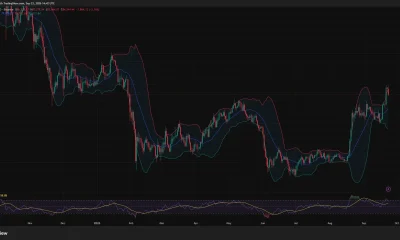
Bitcoin price tests $83,600 Supertrend support after $87K rejection
-
 Business4 days ago
Oil Price Today (September 23): Crude oil below $100 on hopes of US-Iran talks. What did Trump say?
-

 Crypto World4 days ago
Bitcoin Threatens Sub-$84,000 Breakdown as Long Liquidations Spike
-
 Crypto World5 days ago
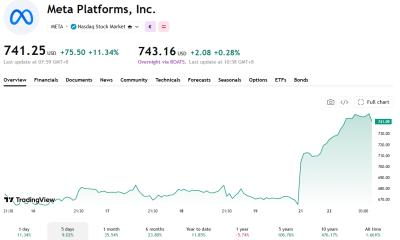
Meta Jumps 11% As Muse Shines and Investors Show an Appetite for Advancing AI
-

 Crypto World4 days ago
Did Jim Cramer Just Give GameStop Stock the Kiss of Death When He Said the Turnaround Is Working?
-

 Crypto World6 days ago
Bitcoin price holds above $81K as key catalysts line up
-

 Crypto World7 days ago
ARB Price Signals Spur Speculation of 70x Upside in Hodler Digest
You must be logged in to post a comment Login