Considering how important it is for everything from navigation to keeping clocks in sync, satellite navigation systems are surprisingly vulnerable to a variety of attacks, ranging from simple jamming to more sophisticated spoofing attacks. This may be changing, though, as Galileo, Europe’s GNSS, recently demonstrated its first cryptographically-secured position fix under spoofing conditions.
Most GNSS systems, including GPS, have no verification measures to keep an adversary from transmitting a false signal at a higher power and hijacking a receiver; since GNSS signals are extremely weak by the time they reach the ground, this presents no great difficulty to a moderately well-equipped attacker.
Galileo’s Signal Authentication System (SAS) aims to fix this. The Galileo ground station pre-selects signal spreading codes, which it then encrypts with a regularly-changing secret key and publishes. A receiver which anticipates needing a verified signal can then download these encrypted codes ahead of time and store them. Galileo satellites then transmit on the E6-C pilot signal, and the receiver records the signal. After transmitting a message block, it then transmits the decryption key on a separate signal, which the receiver uses to recover the spreading codes. The receiver then correlates these spreading codes with the recorded signal to find the satellite’s pseudorange.
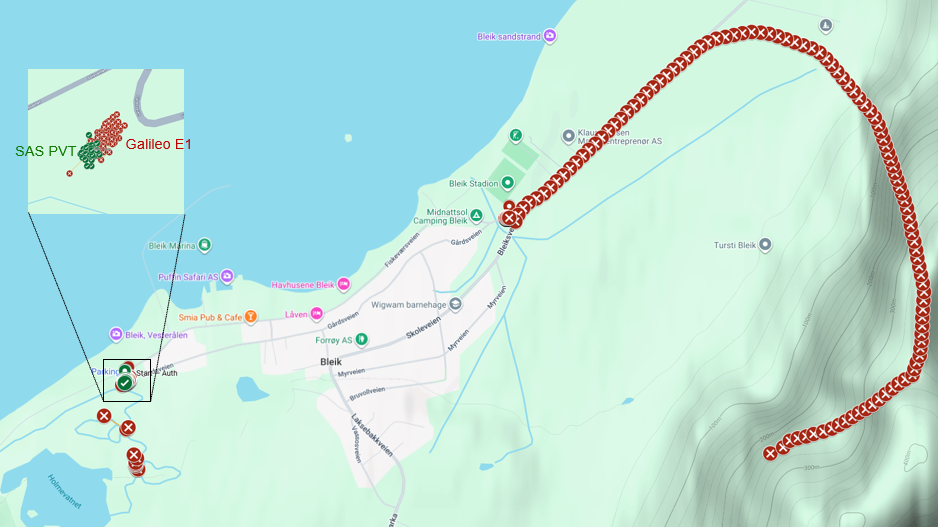
It’s a rather complicated system, but it works: earlier this month in Andøya, Norway, the annual Jammertest GNSS testing event took place. For one week, a wide range of organizations tested the resilience of their GNSS systems against various attacks, including jamming, delayed retransmission, and spoofing. Using five Galileo satellites, the European Space Agency was able to obtain a stable lock on their receiver even during spoofing.
Advertisement
In principle, this method could be extended to other GNSS systems. There’s certainly motivation to do so; very large-scale attacks have been demonstrated recently.
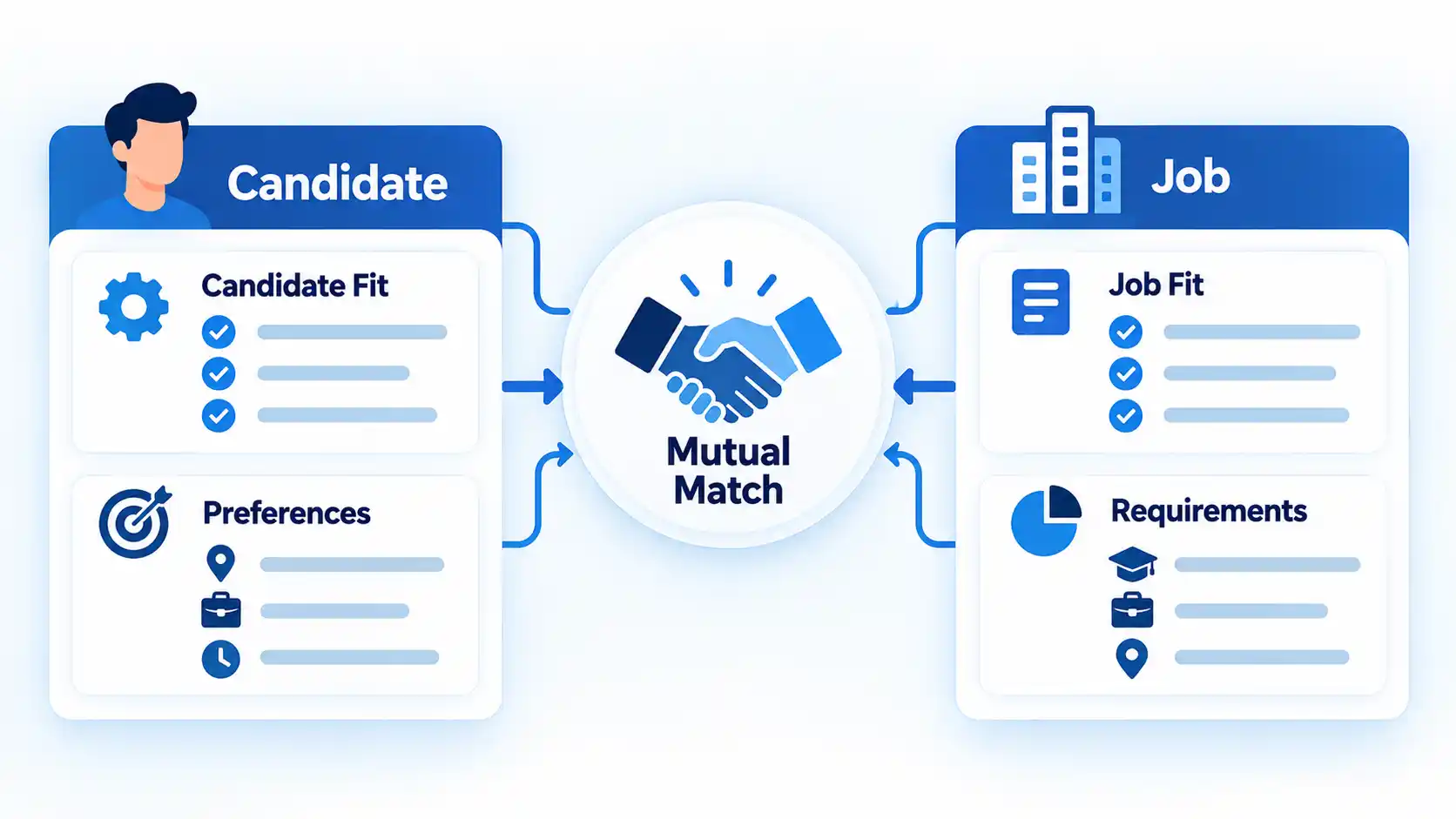
AI job matching turns information about a candidate and a job into signals, narrows the available pool, scores plausible matches, and ranks the results. More advanced systems can also use semantic similarity, behavior, and feedback, but a high-ranked match is still an estimate of relevance rather than proof that a person and job are objectively compatible.
There is no single algorithm that every job platform uses. Different systems can use different data, models, filters, ranking objectives, and feedback signals. The useful way to understand AI job matching is therefore as a common pipeline rather than as one universal formula.
AI Job Matching Is a Ranking Problem, Not a Mind Reader
AI job matching does not understand a person’s career in the same way a human recruiter or career adviser might. Instead, software converts available information about people and vacancies into data it can compare.
A signal is a piece of information a system can use when estimating how relevant a candidate and job appear to each other. Signals can come directly from profile fields, job postings, resumes, search preferences, or interactions with the platform.
Advertisement
Consider a nurse searching for a remote role. The candidate side might contain a nursing qualification, years of experience, location, preferred work arrangement, and listed skills. A vacancy might contain a title, required license, location rules, schedule, experience requirements, and employment type. A matching system can compare some of those details and use the result to narrow or order vacancies.
One important limitation appears before any sophisticated ranking occurs: both sides can be incomplete. A candidate may omit a relevant skill or certification, while a job description may leave an important requirement unstated. Missing information therefore does not necessarily mean the candidate lacks a qualification or that the job lacks a characteristic.
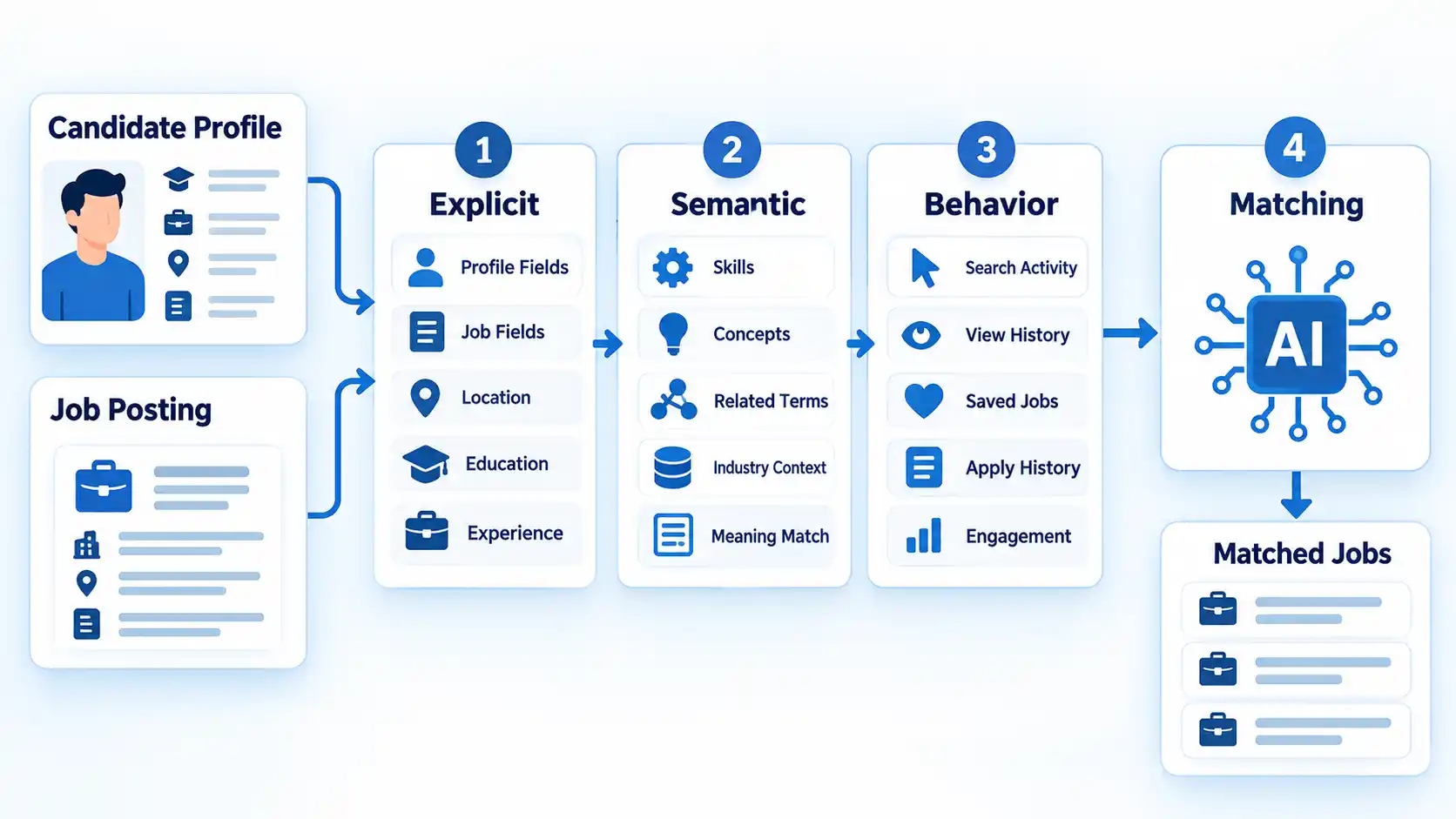
Step 1: Turn Profiles and Job Posts Into Matching Signals
The first technical challenge is converting messy information into signals the system can actually compare. These signals fall into several broad categories, although individual platforms can define and combine them differently.
Advertisement
Explicit signals
Explicit signals are information that a user, recruiter, employer, or platform records directly. Examples include job title, location, employment type, degree, certification, salary preference, years of experience, and whether a person wants remote, hybrid, or on-site work.
LinkedIn’s current job-recommendation documentation says recommendations can use preferences including job titles, locations, location types, and employment types. It also says profile-based recommendations can consider information from a member’s headline, About section, experience, education, and location preferences.
Explicit information is useful because its meaning can be relatively clear. If a person selects remote work, the platform does not need to infer that preference from unrelated behavior. The limitation is that explicitly entered information can be incomplete, outdated, inconsistent, or too broad.
Inferred and semantic signals
Platforms can also derive signals from unstructured text. A skill, occupation, or concept may appear in a resume, profile summary, work history, or job description without being stored as a neatly selected field.
Advertisement
Semantic matching means comparing meaning or related concepts rather than depending only on identical text. For example, “SaaS” and “Software as a service” can describe the same concept even though the wording differs.
LinkedIn’s current Skills filter distinguishes explicit skills from implicit skills extracted or inferred from profile content. It also gives a concrete example in which a search for “SaaS” can return members whose profiles use “Software as a service” instead.
Semantic inference can expand useful matches, but it creates another failure mode: an inferred skill or concept can be wrong. Mentioning a technology in a project description does not always mean the person is proficient in it, and similar terminology can have different meanings in different industries.
Behavioral signals
Interactions can become signals too. Saving a vacancy or candidate, hiding a recommendation, messaging someone, applying for a job, or repeatedly searching for a particular role can provide evidence about likely interest or responsiveness.
Advertisement
LinkedIn’s Recommended Matches says recruiter actions such as saving, hiding, and messaging candidates are used as real-time hiring signals. It also describes job-posting signals such as titles, locations, and skills and member-side signals such as being open to work.
Behavior is useful but ambiguous. A user may ignore a job because it is irrelevant, because important information is missing, because they have already seen it, or simply because they never noticed it. Treating every interaction as a perfect description of preference can therefore teach a system the wrong lesson.
The table below separates the main signal categories from what they can reasonably tell a matching system. Every signal is a proxy for something the platform wants to estimate rather than a complete description of the person or job.
Common signal categories in AI job matching and their main limitations
Directly stated requirements, qualifications, or preferences
Information may be missing, outdated, broad, or entered inconsistently
Inferred or semantic signals
Skills or concepts extracted from profile, resume, or job-post text
Potential similarity even when the same exact words are not used
An inference can misread context or overstate experience
Behavioral signals
Clicks, saves, hides, searches, applications, or messages
Possible interest, disinterest, or responsiveness
An action may have several explanations and may not reflect true preference
Outcome or feedback signals
Employer response, interview progression, hire, or another observed outcome
Whether previous matches led to later-stage outcomes
Historical outcomes can reflect earlier human decisions, unequal exposure, or other biases
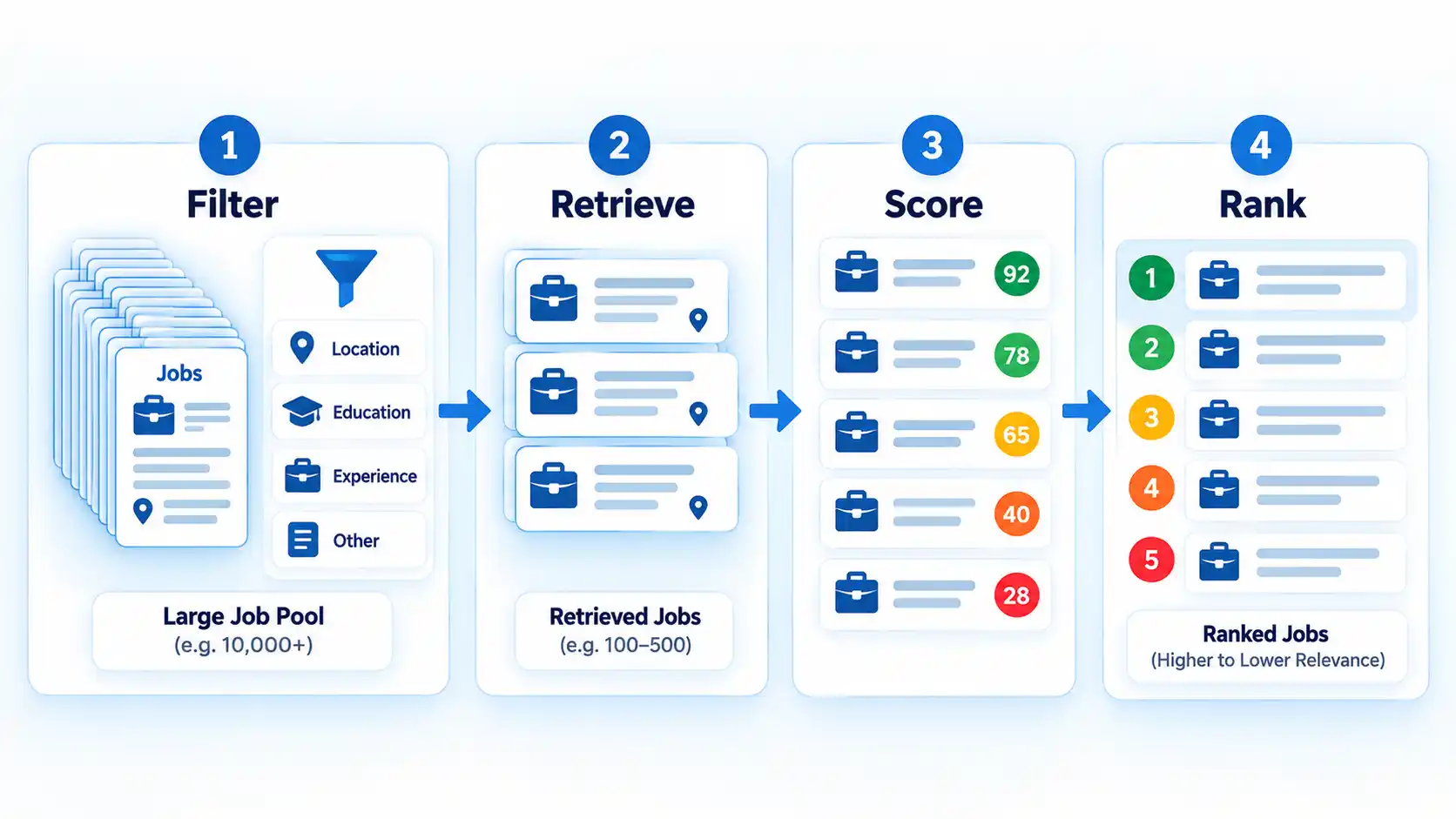
Step 2: Apply Constraints and Retrieve Plausible Matches
After signals exist, a platform does not necessarily run its most detailed scoring process against every possible person-job pair. Large marketplaces can contain enormous numbers of profiles and vacancies, so matching can begin by reducing the search space.
Advertisement
A hard constraint is a condition treated as required for a particular search or matching operation. Depending on the system and user-selected filters, examples can include a location requirement, employment type, occupational credential, or another must-have condition.
Retrieval is the stage that finds a manageable set of plausible candidates or jobs before more detailed ranking. It answers a broad question such as “Which possibilities are worth evaluating further?” rather than “Which one should appear first?”
LinkedIn’s current recruiter documentation describes this separation directly: candidates matching requested keywords and facets are selected and then ranked using other factors. Its current AI Search documentation also says natural-language requests can be translated into structured filters such as location, skills, and job titles.
This distinction creates an important failure point. If a strict filter removes someone during retrieval, the later ranking system may never evaluate that person. A qualified candidate can therefore disappear because a requirement was entered too narrowly, a profile field is missing, a job title is unusual, or an equivalent qualification is represented differently.
Advertisement
Retrieval quality matters as much as ranking quality. A ranking model cannot promote a relevant result that was never retrieved.
Step 3: Score and Rank the Remaining Matches
Once the system has a smaller set of plausible matches, it must decide which results deserve the most prominent positions.
A relevance score is a model-produced value used to compare matches under the system’s chosen objective. Its exact meaning depends on the product. A score might reflect similarity, predicted responsiveness, expected usefulness, or a combination of signals.
It should not automatically be interpreted as a probability of being hired.
Advertisement
Current LinkedIn Recruiter documentation provides a concrete example of multi-signal ranking. It says candidates can be ranked using factors including similarity between their work experience or skills and the search criteria, together with the likelihood that an interested candidate will respond. LinkedIn says those factors are weighted using machine-learning models.
A simplified matching system might face a trade-off like this:
Candidate A has very strong skills similarity but does not satisfy the preferred location.
Candidate B has slightly weaker skills similarity but matches the location and employment preferences closely.
Candidate C satisfies the stated search criteria but appears less likely to respond.
These are illustrative examples, not LinkedIn’s published scoring formula. The final order depends on the objectives and weights used by a particular system. Commercial platforms usually do not disclose a fixed percentage for every signal, so it would be misleading to assign arbitrary weights to skills, location, experience, or activity.
Some recommendation architectures use more than one ranking pass. Reranking means taking an already retrieved or initially ordered set and applying another model or scoring stage to refine the order.
A 2026 job-recommendation study, for example, combined metadata filtering, TF-IDF lexical retrieval, Sentence-BERT semantic retrieval, and optional cross-encoder reranking. The research demonstrates one possible hybrid architecture; it does not establish that LinkedIn, Indeed, Lensa, or every commercial job platform uses Sentence-BERT, cross-encoders, or the same model sequence.
Advertisement
Why Keyword Matching and Semantic Matching Produce Different Results
Keyword matching and semantic matching solve related but different problems.
Lexical or keyword matching looks for words, phrases, or standardized terms. It works well when a candidate and job use the same vocabulary. If both contain “project manager,” the connection is straightforward.
The weakness appears when equivalent ideas use different language. A job might request “Software as a service” experience while a candidate writes “SaaS.” A narrow exact-text approach could miss that relationship.
Semantic matching attempts to capture related meaning so concepts can still appear similar without identical wording. This can help retrieve profiles or vacancies that strict text matching might miss.
Advertisement
The two approaches do not have to compete. The 2026 research system cited above combined lexical and semantic retrieval rather than replacing one with the other. Structured filters can preserve precise constraints while semantic retrieval can broaden matching across terminology differences.
Semantic matching also has limits. Two phrases can appear related to a model while carrying different practical meanings. “Machine learning research” and “machine learning operations,” for example, overlap in vocabulary and domain but can require substantially different experience. Better semantic recall therefore does not automatically mean better job fit.
Job Matching Can Be a Two-Sided Recommendation Problem
Job recommendation differs from many ordinary recommendation systems because a useful match may depend on both sides of the marketplace. It is not enough for a job seeker to like a vacancy if the role has requirements the person does not meet, and an employer’s preferred candidate may have no interest in the location, schedule, salary, or role.
Researchers often describe this as a reciprocal recommendation problem because relevance can operate in both directions. A review of job recommender-system research identifies reciprocity as an important feature of the domain and also highlights data availability, temporal effects, fairness, and generalizability as evaluation challenges.
Advertisement
Consider two candidates for the same vacancy. Candidate A strongly prefers the job but lacks a mandatory professional license. Candidate B has the license and relevant experience but wants a fully remote role while the vacancy requires daily on-site work. A single similarity measure does not capture both sides of those constraints and preferences.
Indeed’s public explanation of its own matching system similarly describes a two-sided marketplace and a process of understanding people and jobs, narrowing and ranking possible matches, and learning from subsequent outcomes.
This does not mean every platform optimizes the same objective. A system might optimize for a useful recommendation, an application, a response, an interview, a hire, or another measurable outcome. Unless a platform documents its objective, the safest interpretation of a ranking is that the system estimates relevance or expected usefulness according to its own design.
Feedback Can Improve Rankings, but It Can Also Reinforce Mistakes
Matching systems can use what happens after recommendations are shown as additional information. A feedback loop occurs when earlier recommendations generate behavior that later influences future recommendations.
Advertisement
Possible feedback signals include clicking or saving a vacancy, hiding a recommendation, applying, replying to a recruiter, progressing to an interview, or being hired when the platform can observe that outcome.
Indeed says its system uses outcomes including applications, employer interview progression, ignored jobs, and successful hires as feedback for later matching. LinkedIn separately documents recruiter actions such as saving, hiding, and messaging candidates as signals in Recommended Matches.
This can make a system more responsive, but feedback is not neutral ground truth. Suppose a platform initially shows a software engineer mostly fintech jobs. If the person can interact only with the jobs the system exposes, later behavior may appear to confirm a strong fintech preference even if healthcare or education-technology roles were rarely presented.
This illustrates a filter-bubble risk. A 2025 LinkedIn research paper on large-scale job matching explicitly identifies cold start, filter bubbles, and bias as practical challenges in its research context. The paper describes a particular signal-integration system rather than establishing that every production job recommender experiences these problems to the same degree.
Advertisement
Cold start is the related problem that appears when the system has little historical information about a new user, new vacancy, or new type of role. In that situation, profile content, job metadata, skills, titles, or other non-behavioral signals can become especially important.
The Main Limitations of AI Job Matching
AI can make large job markets easier to search, but every stage of the pipeline introduces assumptions and possible errors. These are parallel failure modes, not a ranking of which problem is worst.
Incomplete candidate profiles: a system cannot reliably use qualifications that are missing, outdated, or represented ambiguously.
Weak job descriptions: vague titles, inflated requirements, missing conditions, or unclear working arrangements reduce the quality of the information being matched.
Cold start: a new candidate, employer, vacancy, or occupation may have little interaction history from which to learn.
Incorrect inference: semantic models can infer a skill, occupation, seniority level, or relationship that does not accurately describe the candidate or job.
Feedback loops: future recommendations can become too dependent on what the system previously chose to expose.
Optimizing the wrong outcome: more clicks or applications do not necessarily mean better jobs, stronger fit, better conditions, or successful hires.
Ranking and exposure effects: higher positions receive more opportunity for attention, so ranking affects what users can see and act on.
Bias and proxy variables: harmful patterns can enter through data, labels, system design, human processes, or variables correlated with sensitive characteristics.
Changing labor-market patterns: occupations, terminology, skills, qualifications, and hiring behavior evolve, so relationships learned from older data may become less useful.
Opaque scoring: users may see an ordered list or match label without knowing which signals dominated the result.
Bias deserves especially careful treatment. NIST’s current harmful-bias research page explains that bias can arise from more than training data and that AI systems can perpetuate or amplify harmful patterns. Removing one obvious sensitive field is therefore not enough to establish that a system is fair.
Ranking creates another issue: exposure. A result shown near the top has more opportunity to receive attention than one placed much lower. NIST’s TREC Fair Ranking work explicitly studies systems that balance result quality with fair exposure. That benchmark is not specific to employment, so it is used here only to illustrate the broader ranking principle that ordering affects who or what receives attention.
These concerns become more consequential when automation moves from recommending opportunities toward evaluating applicants. Job recommendation should therefore be separated from AI resume screening, where employer-side systems may evaluate or narrow applicant pools rather than simply recommend vacancies.
Advertisement
What a Match Score Does and Does Not Tell You
A high-ranked job or candidate generally means the system estimates that result to be more relevant under its available signals, filters, data, and optimization objective than at least some of the alternatives it considered.
That is useful, but it is narrower than many people assume. A high match score does not automatically prove that:
the applicant satisfies every meaningful qualification;
the employer will respond or offer an interview;
the person will enjoy the role or workplace;
the employer offers good conditions;
the recommendation is free from bias;
the score represents a probability of being hired; or
the top-ranked vacancy is objectively the best opportunity available.
Real platforms show how these general ideas become product features. Lensa’s AI-assisted job matching, for example, provides a platform-specific case of AI-assisted job discovery and matching, while LinkedIn and Indeed document different combinations of preferences, profile information, search filters, behavioral signals, and ranked recommendations.
The safest way to use a match is as a search aid rather than a verdict. A ranking can reduce the number of possibilities you need to inspect, but broader job search strategies such as checking the employer, tailoring an application, reviewing requirements, and preparing for interviews still happen outside the matching score.
AI job matching is therefore most useful when its output is treated as an informed shortlist. The system can estimate relevance from the information it has, but the candidate and employer still provide context, verification, judgment, and decisions that a ranking cannot fully represent.
Cloudflare has fixed a vulnerability in Containers and Sandboxes that allowed customers with a Workers Paid account to recover residual data from other customers’ containers on the same physical host.
Cloudflare Containers is a service available on the Workers Paid plan that lets developers run containerized applications on Cloudflare’s infrastructure, alongside Cloudflare Workers.
Developers and companies building applications on Cloudflare typically use it, including those running backend services, processing jobs, and code execution environments.
The flaw was reported through HackerOne on September 4 by Oren Yomtov, a security researcher at technology company Accomplish.
Advertisement
Exploiting it would let an attacker read other customers’ files, including directory listings, SQLite databases, Chromium profiles, .env files, and credential files.
According to Cloudflare’s disclosure, the issue was in a shared storage pool configured to skip zeroing reused 64 KiB blocks.
“When the thin volume backing a container’s root disk was deleted, its physical blocks were returned to a pool that served workloads belonging to multiple customer accounts,” Cloudflare explains.
By writing only 4 KiB to an unused region of a new container’s disk, the researchers could cause a reused 64 KiB physical block to be allocated. Without the zeroing operation, only the 4 KiB write would overwrite the block, leaving in a readable state the remaining 60 KiB that may contain data from a previous customer.
Advertisement
They found residual material on 18 of 24 container placements and across 20 of 22 underlying nodes tested, including directory structures, database pages, and structurally complete SQLite databases.
“The vulnerability would potentially have allowed for a customer with a Workers Paid account to recover residual data from storage blocks previously used by other customers’ Containers on the same underlying host,” Cloudflare says.
“A successful exploitation would have crossed the tenant-isolation boundary and could disclose filesystem metadata, directory structures, database pages, and application data.”
An attacker would not have control over the victim or host, nor would they be able to read an actively attached disk.
Advertisement
Risk evaluation and real exposure
Cloudflare says the researchers only used scripts that performed checks and returned aggregate counts, not actual disk contents, so no real customer data was exposed in this evaluation.
The researchers also did not demonstrate any way to change another customer’s data or disrupt their workloads on Cloudflare’s service.
Cloudflare removed the setting that caused the skipped block zeroing, retired existing container disks, and cleared cached snapshots that may contain old mappings, finishing all mitigation actions by September 19, 2026.
After examining logs, telemetry, and historical data, the company found no evidence that customer data was exposed via the method described by Accomplish.
Advertisement
Cloudflare applied the fixes to its infrastructure automatically, and customers need to take no action to address the risk.
Join Mikko Hyppönen and security leaders from the NFL, CHANEL, and Atlassian for a two-hour digital summit on what AI-speed attacks change, what defenders should stop doing, and how to validate, decide, fix, and re-validate at machine speed.
The new form factor offers convenience at a premium.
Ra2studio/Getty Images
Book-style foldable phones feature enough screen real estate to rival compact tablets, and at this point, it’s reasonable to wonder if the former should replace the latter. For instance, the latest iPad Mini features an 8.3-inch screen, only 0.3 inches larger than the Pixel 11 Pro Fold and Galaxy Z Fold 8 Ultra. At 7.6 inches, the iPhone Duo is slightly smaller, but the difference is minor. Most people aren’t carrying a compact tablet around, but if an 8-inch device folds down to a typical smartphone size, that’s different.
In fact, that convenience is the strongest argument in favor of replacing your tablet. You can use all of the features you normally use on a smartphone and unfold the screen when you prefer a tablet experience. A foldable also simplifies mobile data because most tablets need a second cell plan if you’re moving around and need full access to its features. If you don’t have a second plan, you may have to pay extra for a hotspot on your phone.
The foldable consolidates those uses into a single device and slides into your back pocket when you’re done. It’s not perfect, and it’s not a universal replacement, but it’s more than enough to replace a casual tablet, especially on the go.
Advertisement
Tablets still win for long sessions and serious work
It’s a different story if your tablet is a major part of your daily work. A foldable is great for two, maybe three-app multitasking and portable entertainment, but it can’t match the comfort and larger workspace a tablet typically brings to the table. This is especially true with tablets designed for video editing, graphic design or work that benefits from a larger canvas.
Granted, foldable phones can connect with most of the same peripherals a tablet can, which makes them fairly capable travel tools for basic work. But that’s not the same as being a true workhorse. Using your phone as your full-time work machine puts a lot more strain on the battery, which is a huge compromise because it’s also your main device for everyday use.
Advertisement
The price difference is also worth considering, because foldables aren’t very budget friendly. The Pixel 11 Pro Fold and Galaxy Z Fold 8 start at premium prices, so combining your phone and tablet into one product can still cost more than purchasing separate devices, depending on what you need from each.
What are the disadvantages of a foldable phone?
agustin.photo/Shutterstock
Foldable phones still come with more compromises than either a standard smartphone or a dedicated tablet. The biggest reason is the hardware. Much has been said about hinges and folding displays, but ultimately, they just add complexity and cost, along with another element of wear and tear.
The design introduces a few trade-offs in day-to-day use. It offers more screen real estate, but that also means a bulkier, heavier device, with an inner display crease that’s visible under certain lighting conditions. To be fair, foldable phones are becoming thinner and lighter, though they still have a way to go.
Advertisement
There are occasional software compromises as well. Android handles large screens and split-screen multitasking better than it used to, but occasionally an app uses the unfolded screen less than gracefully. Some apps simply stretch a vertical layout across a wider panel, and the result is… interesting.
Foldable phones are a premium convenience, but not quite full-blown replacements for every phone and tablet. They can absorb the job of a casual compact tablet, but there are a few compromises along the way. For those who aren’t looking for any new compromises just yet and need a mobile workhorse, sticking with a dedicated tablet is still the best bet.
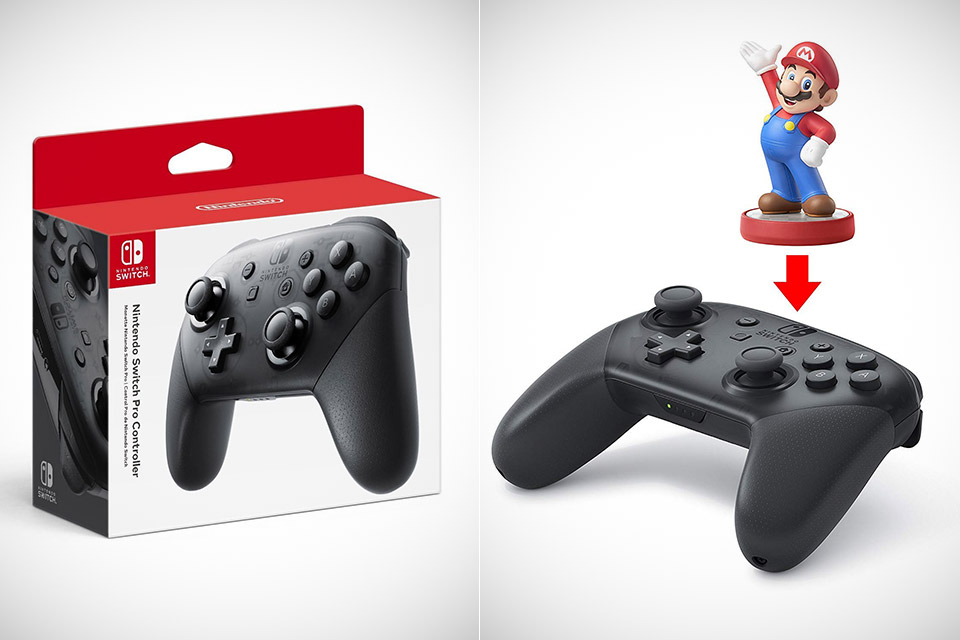
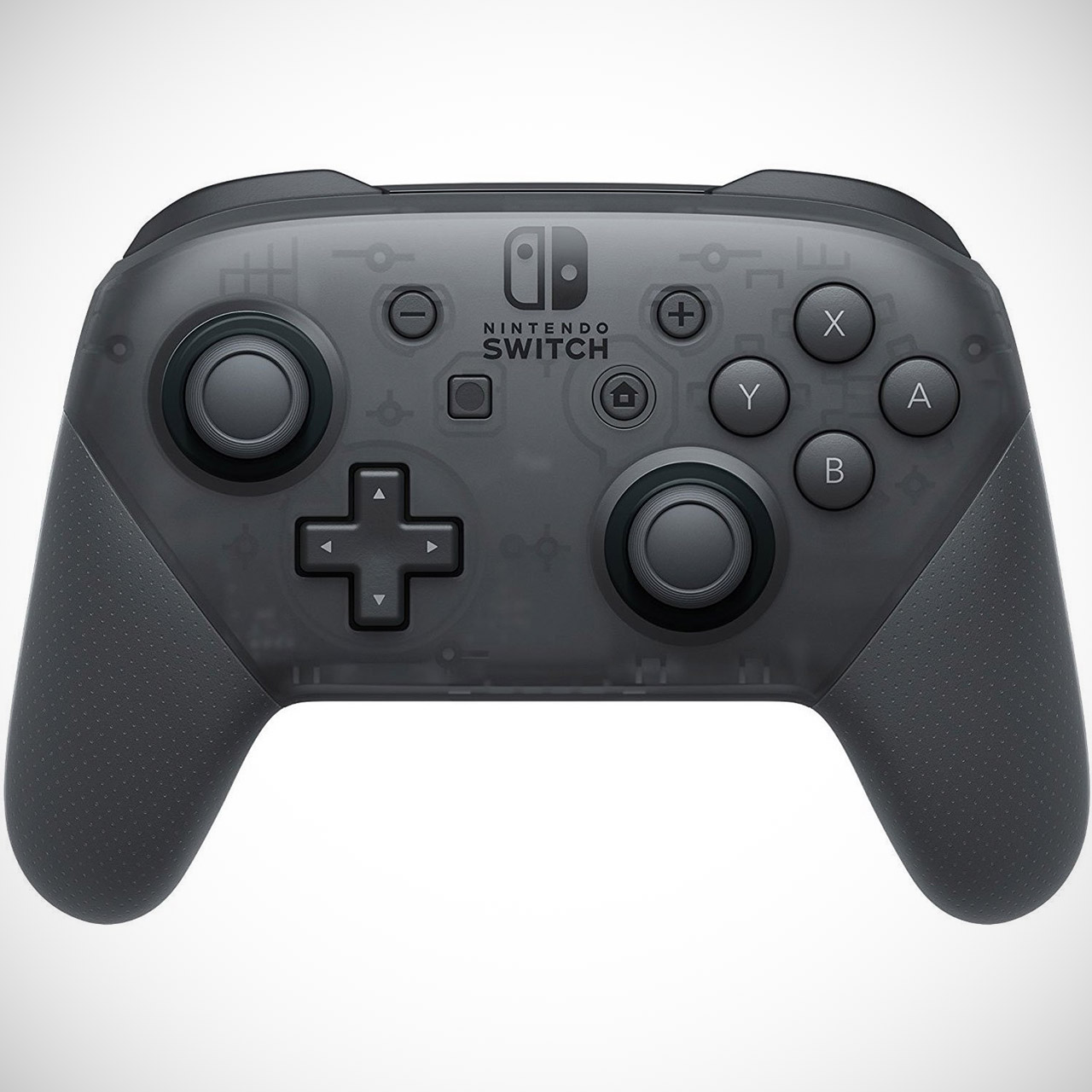
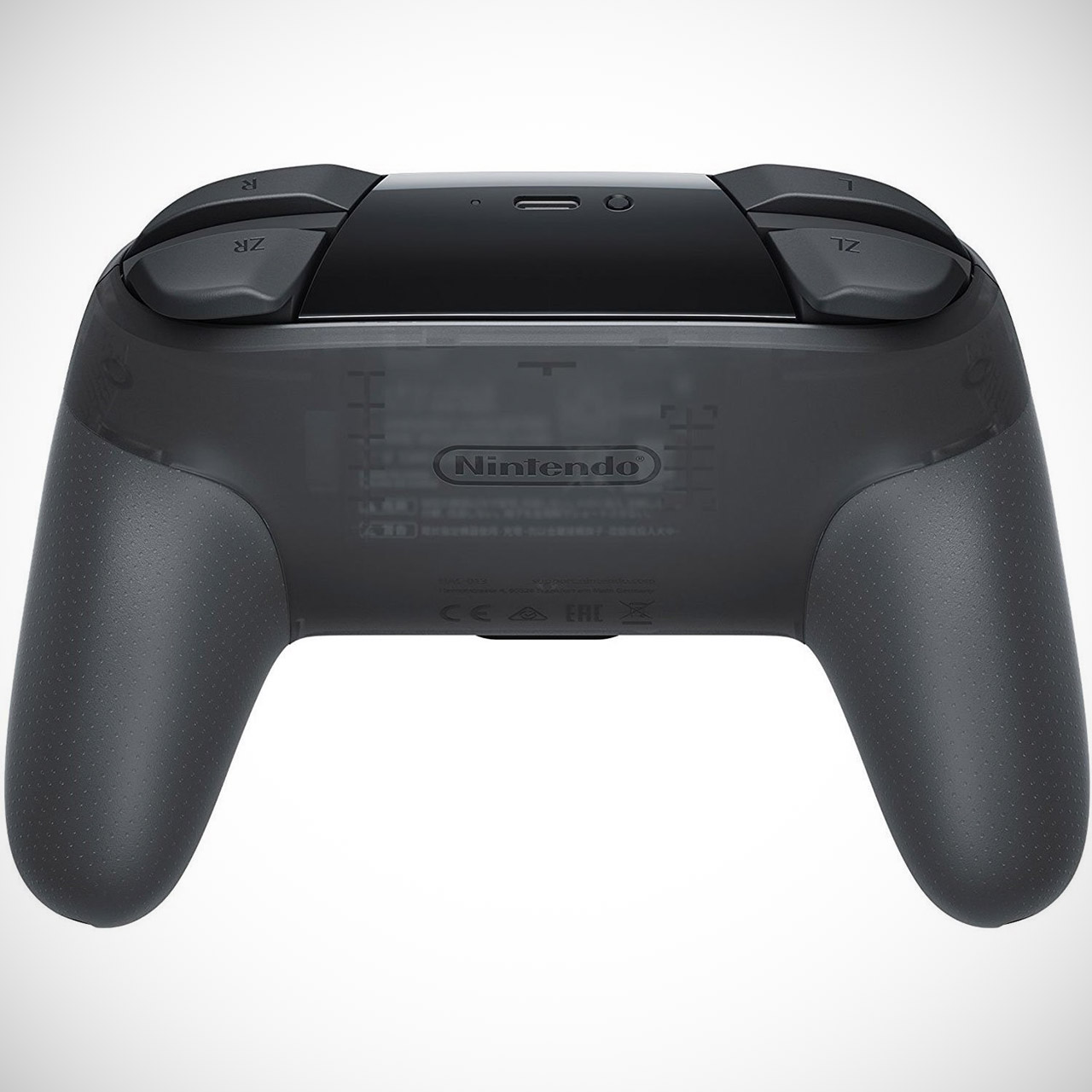
Nintendo shipped the Switch Pro, priced at $55.97 (was $80), a while back, the same day the original Switch arrived, and the shape has barely needed defending since. You get a one-piece gamepad measuring 106 millimeters tall, 152 millimeters wide, and 60 millimeters thick, weighing about 246 grams. Offset analog sticks sit in the familiar Xbox arrangement, with a plus-shaped direction pad under the left stick and the four face buttons above the right. Both sticks click. Capture, Home, Plus, and Minus land where muscle memory already lives. Plastic feels dense without turning heavy, and the grips stay comfortable through long docked sessions that split Joy-Cons never quite manage.
Nintendo estimates forty hours from its 1300mAh cell, and most people seem to take it at face value. It takes roughly 6 hours to charge it using a USB-C port and the accompanying USB-C cable, which also works with a dock if you prefer to play wired. With the accompanying USB-A adaptor, you have a great deal of freedom. Pairing continues to use the little Sync button on the top edge, as it has for quite some time. Meanwhile, the player lights have been located on the bottom edge. Several of these controllers can be connected to a single console at once.
Take your game sessions up a notch with the Nintendo Switch Pro Controller
Handheld Nintendo Switch gaming at a great price
Comes with charging cable (USB C to USB A)
The HD rumble in these handles continues to impress in the games that actually use it, as game designers appear to prefer showing off rains, footsteps, as well as engine noise as textures rather than a generic rumble. Motion sensing is important in games like Splatoon; it is also used in Zelda for bow aiming, and there are numerous other games that make use of it. Simply tap an amiibo near the Nintendo logo, and the NFC reader will take care of the rest. The fact that so many third-party controllers still fall short of this experience, even if their sticks appear to be fantastic on paper, speaks volumes about Nintendo’s design.
Advertisement
Of course, compatibility is the key to this controller’s lasting appeal. It works with the original Switch, the OLED, the Lite, and even the upcoming Switch 2, both wirelessly and via dock cable. The entire range of first-party Nintendo features are then carried over, including amiibo reading, gyro aiming, and the gorgeous HD Rumble. One minor exception remains: on a sleeping Switch 2, you cannot wake it up using the home button on this controller; instead, hit the main console button to get it starting. Steam Input on PC and official iOS 16 and later support from Nintendo itself will push the potential of this technology much further.
The analog sticks employ Alps potentiometers, which are similar to those seen in older controllers, so if you use this device regularly, you may notice some drift after a few years. The triggers are digital instead than analog. This one lacks a headphone jack, back paddles, and secret extra buttons; if those are important to you, you should look elsewhere. For the rest of us, the layout, battery life, and first-party features continue to make this an excellent pick for docked gaming with any switch model.
Paul Lagier builds spare, printable objects on YouTube, and Shiptracker began as a present. His girlfriend already followed cargo ships, tankers, and ferries on websites, reading destinations, speeds, and origins the way other people refresh a weather app. He wanted that ritual to live on a desk without a phone in hand, so he boxed a Raspberry Pi Zero W, a 7.5-inch Waveshare e-paper panel, and two rotary encoders into a pale 3D-printed shell that draws almost no power between screen updates.
Commercial trackers practically map almost every ship on the planet. You’d think MarineTraffic and other similar websites would provide an API you could use for your own small project, but they don’t, and scraping their pages is not an option. Finland managed to tackle their data challenge in a clever way. Fintraffic’s Digitraffic service simply broadcasts AIS locations and a plethora of other vessel metadata for free, at least for the Gulf of Finland, which extends between Finland, Estonia, and Russia. Norway and Singapore had similar feeds, but Finland’s stream was enough to generate a map with real ships on it.
A1 mini + LED Lamp Kit for Creative Light Projects: Bring your ideas to life with the included LED Lamp Kit. Simply print compatible lamp models and…
The Perfect 3D Printer for Beginners: A1 mini 3D Printer is designed to make 3D printing easy from day one with automatic calibration, simple setup…
Experience the Bambu Lab Ecosystem: Access MakerWorld’s huge library of ready-to-print models, manage prints through the Bambu Handy app, and enjoy…
Now, the map is being drawn using a Waveshare 7.5-inch E-Paper HAT V2. Having multiple shades of gray makes the coastline and ship markers readable, and the greatest thing is that the screen only needs energy when the image changes, making it very power efficient. Uploading partial black-and-white updates isn’t too difficult, but partial grayscale updates take longer. That provided Paul a reason to reconsider his design later. Paul had planned to use a Pi Zero 2 W, but it proved to be too expensive, so he purchased a used Zero W with the header pins already soldered on because it was a much cheaper alternative. That older board can still connect via Wi-Fi and run current software until 2026. However, it still utilizes the largely obsolete micro-USB power port, so he had to wire a USB-C breakout directly to the power pins and order a 5-volt 3-amp supply just to be safe.
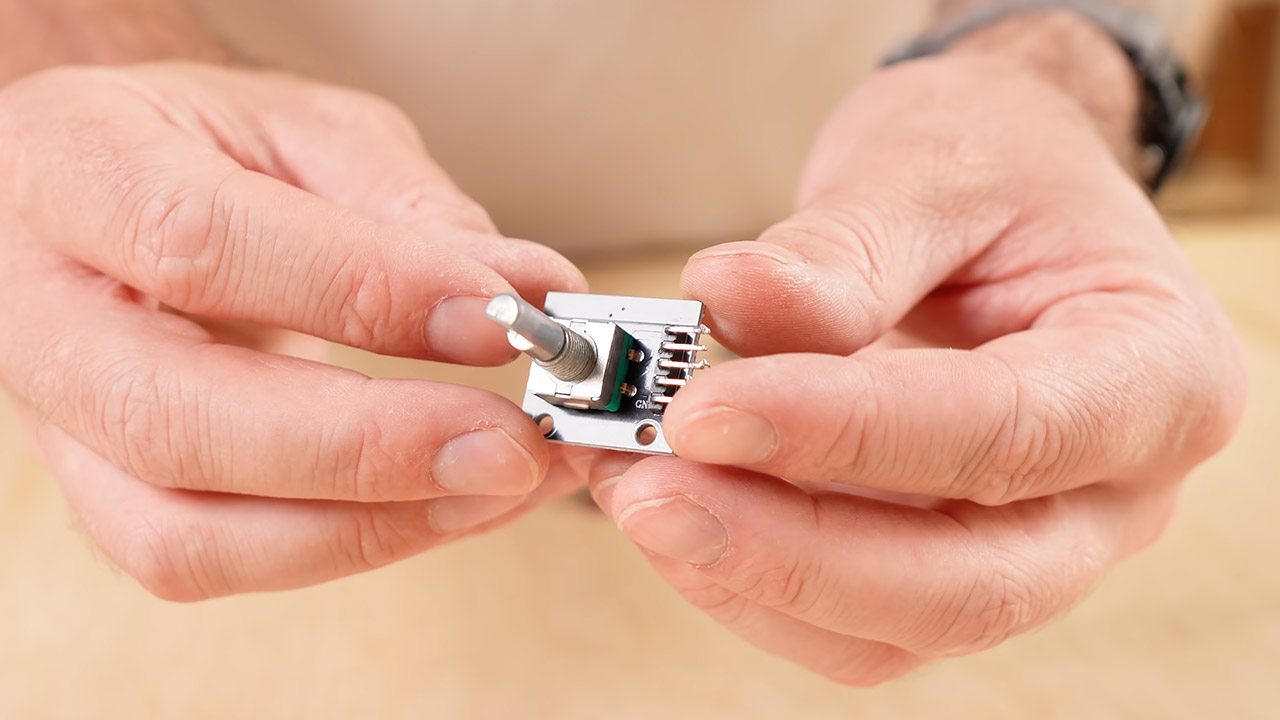
Instead of a touchscreen, two buttons do the trick, each having an encoder that spins both directions and has a pleasing click. One knob scrolls among lists and views, while the other allows you to read details about a specific ship, such as its destination, projected arrival time, speed, length, and beam. There are two options: recommended mode displays the larger or more interesting vessels, and full list allows you to scroll through every ship that is currently reporting in. You can even mark one as a favorite with a single button press. After sitting inactive for a while, the interface will switch to watch mode, a calmer layout that only shows one ship, allowing you to have it on in the background without requiring continual attention.
Having images of each ship seemed like a fantastic idea at first, but it turned out that it wasn’t an option in the end. These full-screen grayscale refreshes simply took too long. Instead, Paul simply removed the photos and added a QR code to the detail view instead. If you scan the QR code, you can easily see a snapshot as well as all of the extra records on your phone. If you prefer a written summary of the ship, an AI-generated synopsis is included in the same package. Menus are accessible in both English and German.
He worked on the enclosure using Shapr3D. The front is recessed to fit the display, but a separate back plate just holds the Pi on four screws, preventing any pressure from being applied to the glass. He also used foam tape to keep the display from sliding about. He made a several prototypes in Panchroma Muted White PLA until the holes lined up correctly, then added a bottom cover and matching knobs. You may obtain the 3mf files for the housing, cover, mounting plate, and knobs, as well as an illustrated wiring guide, directly from the shop. [Source]
There aren’t many episodes left of Ted Lasso season 4. In fact, only two more, including this week’s chapter, remain, so there’s not much time left for it to find a match-winning goal.
AFC Richmond Women will have to do so without their star striker Gemma following the potentially serious knee injury she suffered in last week’s entry. Who, if anyone, will step up and try to get the team promoted? We’ll have to wait for this week’s installment to arrive, so read on to find out when it will.
What is the launch time for Ted Lasso season 4 episode 9?
What’s got Keeley and Rebecca looking like this? (Image credit: Apple TV)
Ted Lasso season 4’s penultimate episode should come out in the US and Canada at 6pm PT / 9pm ET on Tuesday, September 29.
Advertisement
Latest Videos FromTechRadar
Publicly, Apple has always stressed that new episodes of its first-party shows premiere every Wednesday at 12am PT in North America. However, every episode of the hit soccer comedy-drama’s latest season has arrived on Tuesday evenings at the times listed above. Barring an unexpected launch date and time change, I’m confident season 4 episode 9 will do likewise.
As for the rest of the world, this week’s entry will air on Apple TV, aka one of the world’s best streaming services, on Wednesday, September 30. Read on to see what time it’ll be released near you:
Advertisement
US — Tuesday, September 29 at 6pm PT / 9pm ET
Canada — Tuesday, September 29 at 6pm PT / 9pm ET
UK — Wednesday, September 30 at 2am BST
India — Wednesday, September 30 at 6:30am IST
Singapore — Wednesday, September 30 at 9am SGT
Australia — Wednesday, September 30 at 11am AEST
New Zealand — Wednesday, September 30 at 1pm NZST
When is the final episode of Ted Lasso season 4 set to come out?
Is Alice cooking up a new, Gemma-less tactic for Richmond Women? (Image credit: Apple TV)
The 10th and final episode of the Apple TV show’s fourth season will kick off on Tuesday, October 6, in North and South America. Meanwhile, viewers on other continents will have to wait until Wednesday, October 7 to catch the series’ latest finale.
Advertisement
What’ll happen in it? Its story will be dictated by what goes down in its predecessor — i.e. season 4 episode 9. So, be sure to tune in to Ted Lasso‘s next chapter to see what it’ll set up ahead of this season’s last hurrah.
Sign up for breaking news, reviews, opinion, top tech deals, and more.
Hyundai rolled the Staria Camper Concept onto the CMT floor in Stuttgart in mid January 2026, only days after the Staria Electric made its Brussels debut. Visitors walked around a finished looking van with a body colored pop up roof, a galley, a shower, and a solar panel built into the lid. Officials called it a study aimed at European campers who want one vehicle for the week and the weekend. Nine months later it remains a concept. Hyundai is still collecting feedback and seeking approval before any factory build, with Europe first in line if the project moves. A recent report also raised the chance of a wider sale later.
The production version of this camper van will use the same hardware as the Staria Electric. This means it will employ an 84 kWh battery, the same 800 volt system as the Ioniq 5, Ioniq 6, and Ioniq 9, and a single 160kW front motor capable of 218PS. Official documentation estimate that the WLTP range is roughly 400km (249 miles) before the increased weight of the camper reduces that amount. The base van received a certified 430km rating in some regions, therefore we’re using the camper figure as a cautious starting point. Fast charging from 10 to 80 percent takes roughly 20 minutes on a good DC station. We might also expect 2,000 kg of braked towing capacity. To manage the extra load, they strengthened the suspension at both ends and added additional sound deadening to keep the highway runs quiet.
[Power 11 Devices] – With a 1024Wh capacity, Elite 100 V2 Solar Generator delivers 1800W AC output (2700W Lifting Power) and 11 ports, ideal for…
[35% Smaller] – Elite 100 V2 weighs 25 lbs and is compact at 17L. The concealed handle makes it easy to carry with one hand, whether working from…
[45-Minute Rapid Charging] – Powered by advanced 1200W TurboBoost AC fast-charging tech, this solar generator reaches 80% charge in roughly…
When you park, simply push a button to lift the fully integrated pop-up roof, which is finished in the same material as the rest of the body. Hyundai designed the lid to make the van as aerodynamic as possible in the air and to reduce wind noise when driving. Once lifted, it provides a great view of the cabin and makes the kitchen much easier to operate. A 520-watt lightweight composite solar panel is installed on the roof. According to Hyundai, this device can recharge up to 2.6kWh a day in just five hours of bright sunlight. That trickle can either charge the traction battery or power the living systems, saving you time searching for a camping hookup.
Front captain seats rotate 180 degrees, allowing two individuals to sit facing the rear lounge. With the stroke of a button, the rear seats fold flat to form a bed for two. Some coverage of the show cars revealed other sleeping choices, including floor rails allow you to take seats or bedding out for bikes and gear. In addition, there is a folding camping screen in the galley that stretches from the roof to the seats and rear windows. That glass is smart glass; you can electrically modify how clear or shaded it is from the screen, and it is meant to provide better UV, heat, and noise control than traditional windows. A foldable table may be used inside the van or dragged out the back for outdoor dining, and the display cars had a Fiamma awning on the passenger side and a shore power connection.
Living kit is simple and electric; think of it as no-frills but functional. A 36-liter fridge fits comfortably in the van’s galley. The portable shower gets its power from the battery, which is a very cool function. The climate control in the cabin can be powered by the battery pack or, if you have a roof panel, you can also charge it from there. Staria Electric vans already feature vehicle to load connectors that allow you to operate small appliances from the traction battery, which is very convenient. None of this is a full-on motorhome kitchen; rather, it is a tiny conversion that drives like a standard tall family van most of the time.
In reality, South Korea has already sold a Staria Lounge Camper with identical living quarters, but those home market vans are powered by combustion or hybrid engines and start in the low fifties, depending on specification. Europe might get an electric only version of the camper van if Hyundai decides to go for it though. Back in January, there was some conjecture that it will be ready in late 2026 or possibly 2027, and if a specialist converter like Westfalia gets involved, it is likely to cost around the mid-fifties in pounds if you wind up in the center of the price range. [Source]
The Microsoft co-founder said that the more present danger is bad actors with access to AI tools.
Chip Somodevilla/Getty Images
After several CEOs of leading AI companies have agreed on slowing down the pace of AI development, Bill Gates has offered supporting sentiments and called for more regulation and safeguards. In an interview with NBC News‘ Meet the Press, the Microsoft co-founder said that “it’s completely irresponsible not to require every AI to have these safeguards and monitoring capabilities.” To that end, Anthropic recently tapped Accenture to act as a third-party evaluator for its latest AI models.
As for other approaches to deal with AI’s rapid rate of evolution, California’s governor, Gavin Newsom, proposed a “kill switch” as part of a larger solution. When asked about the kill switch approach to curb AI, Gates said that, “I would never want to say that I’m against a kill switch,” but added that this approach wouldn’t address a more imminent danger. Instead, Gates said the more pressing concern is when bad actors tap into the power of AI to aid with bioterrorism or mass financial fraud incidents.
“The most dangerous thing we’re facing right now is people with bad intent using AI,” Gates said during the interview. “There’s never been a weapon as powerful as the combination of people with ill intent using the latest AI tools.”
Advertisement
When it comes to legislation, Gates supported law enforcement and politicians getting into the conversation of what safeguards and monitoring should be incorporated into AI companies. The former Microsoft exec said that this approach would add some overhead to the industry, but it wouldn’t be cause a “dramatic slowing of what they’re doing.”
Ace Combat 8: Wings of Theve is earning strong reviews for its thrilling aerial combat, cinematic presentation, and excellent soundtrack. Critics call it one of the series’ best entries. Multiplayer adds 100-player lobbies, but the single-player campaign remains the star.
Tesla announced its electric semi-truck back in 2017, but deliveries to its first customers are just about to start nearly a decade later in September 2026. On September 24th, Tesla held a launch event for the Semi at its manufacturing plant in Nevada, where it plans to build 50,000 Semis a year. It may seem like a lofty goal, but Tesla CEO Elon Musk said in a pre-recorded video message that there is already a big waiting list for the Semi. At $290,000 for a Long Range Semi, it’s predicted that Tesla will deliver 15,000 in 2026 at most.
One of those early customers includes Zero-Emission Truck Shipper-Carrier Alliance Leading Electrification (ZET SCALE), a shipper alliance with brands like Microsoft and PepsiCo that reportedly ordered 2,500 of the electric semis — the largest electric Class 8 order ever made in the U.S. Tesla’s announcement made it sound as if it was providing all 2,500 of the trucks, but it’s just the primary supplier along with other brands. The fleet of 2,500 electric trucks will be deployed in Los Angeles, Houston, Dallas, New York, Atlanta, and other freight hubs over the next few years.
Advertisement
Said Dan Priestley, Director for the Tesla Semi Program: “We are proud to have been the primary selection in this RFP and look forward to giving shippers and carriers a new competitive edge.”
Advertisement
Tesla Semi faces delays and big claims ahead of launch
The Semi has a pretty typical history, as far as Tesla goes. Musk announced the vehicle in 2017 and had lofty goals of launching it in 2019, claiming it would be cheap to operate, carry a full load, and reach 500 miles on a single charge. At the time, experts responded that this was nearly impossible to pull off due to technology limitations. Tesla continued to miss various launch dates, eventually shipping some early examples to PepsiCo in 2022. Next year’s launch date was also missed, although brands like Walmart, Costco, and the NFL were given one Semi to test. Those have now been used for over 5 million miles.
If that timeline sounds familiar, it’s likely because the second-generation Roadster was announced in 2017, delayed multiple times, and is finally getting a reveal October 2026. The Cybercab was revealed in 2024, Musk claimed 2 million would be produced a year, and as of 2026, there are only 69 active Cybercabs besting tested in a few cities.
“This is going to be a revolutionary truck that’s capable of carrying the heaviest loads over very far distances,” Musk stated ahead of the launch event. He also added that it will be the “funnest truck to drive” due to its fast acceleration, which echoes previous statements, noting it will get Full Self-Driving in the future. There will be a Standard Range Semi that has 350 miles and a Long Range that gets 500 miles.








































































You must be logged in to post a comment Login