Connect with us

NewsBeat

Trump announces global tariff after Supreme Court rebuke | World News

Published

on

Trump announces global tariff after Supreme Court rebuke | World News

Donald Trump has announced a global tariff after the US Supreme Court ruled that his previously imposed duties are illegal.

The new 10% import duty will apply to all countries and be effective “almost immediately”, the US president said in a post on his Truth Social platform.

The White House announced the levy would take effect on 24 February, although it could face legal challenges.

The law Mr Trump has used to impose the tariff caps it at 150 days, but he brushed off a question about the limit by saying “we have a right to do pretty much what we want to do”.

Advertisement

Advertisement

Supreme Court rules against Trump’s tariffs

It comes after six of the Supreme Court‘s nine judges voted to overturn Mr Trump’s signature economic policy, handing him a significant loss.

The judgment was in response to an application brought by businesses affected ‌by the tariffs from 12 mostly Democrat-run states.

The applicants challenged the way the US president imposed the sweeping country-specific taxes.

Advertisement

Traditionally, tax-raising measures like tariffs are taken through Congress but the president wished to bypass that process.

But the majority judgment found the US Constitution “very clearly” gives Congress that power.

“The framers did not vest any part of the taxing power in the executive branch,” US Chief Justice John Roberts wrote.

The case is the first challenge to a major part of Mr Trump’s agenda to be ruled on by the Supreme Court.

Advertisement

Advertisement

Foreign countries ‘are dancing in the streets’

Trump ‘ashamed’ of judges who ruled against him

Responding to the decision, Mr Trump described it as a “disgrace”.

He said he was “ashamed” of the six Supreme Court judges who ruled against him for not “having the courage to do what’s right” for the US, describing them as “fools and lapdogs” who are “very unpatriotic and disloyal to our Constitution”.

Advertisement

Three of the six judges who ruled his tariffs illegal are Republicans. They include Neil Gorsuch and Amy Coney Barrett, who were appointed during Mr Trump’s first term in office.

Mr Trump thanked the three justices who voted in his favour, before claiming that foreign countries “who have been ripping us off for years” were now “dancing in the streets”.

Read more: Trump’s trade war is not over


Trump hits out at court over tariffs ruling

Advertisement

Mr Trump’s administration had argued that a 1977 law allowing the president to regulate importation during emergencies also allowed him to set tariffs.

Other presidents have used the law to impose sanctions before, but Mr Trump was the first president to invoke it for import taxes.

Following the Supreme Court ruling, he said: “Today I will sign an order to impose a 10% global tariff under section 122 over and above our normal tariffs already being charged.”

Section 122 of the 1974 Trade Act allows the president to institute a “temporary import surcharge” of up to 15% for a maximum of 150 days if he finds there are “large and serious” balance-of-payments deficits to prevent an “imminent” and “significant” depreciation of the US dollar in foreign exchange markets.

Advertisement

What has been the British response?

The UK government said it expected its “privileged trading position” with the US to continue.

A spokesperson said Britain would work with the US to understand “how the ruling will affect tariffs for the UK and the rest of the world”.

The British Chambers of Commerce (BCC) said the decision did little to “clear the murky waters for business”.

Advertisement

William Bain, head of trade policy at the BCC, said Mr Trump could use other legislation to reimpose tariffs – which is exactly what he’s planning.

What are tariffs?

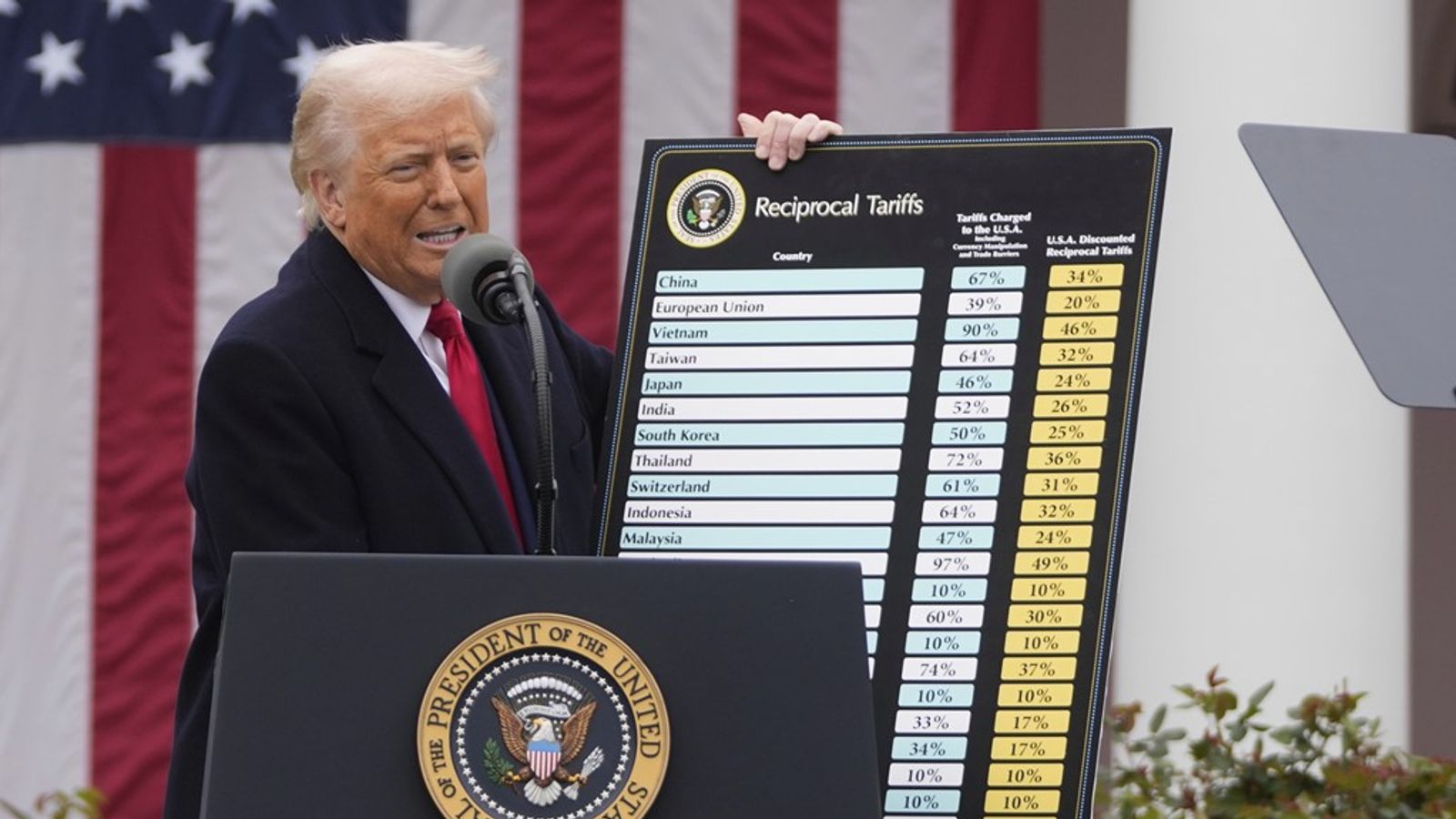
From 2 April last year, a day described by Mr Trump as “Liberation Day”, countries across the world were hit with taxes on their exports.

The tariffs were brought in via executive order from Mr Trump, who invoked ‍the International Emergency Economic Powers Act to do so.

Advertisement

The Act is a 1977 law intended to be used during national emergencies, which Mr Trump invoked, saying the country was in a national emergency because of US trade deficits.

It was also this law that was used to apply levies on Canadian, Chinese and Mexican goods and services entering the US, although Mr Trump’s national emergency rationale was the trafficking of the drug fentanyl into the US.

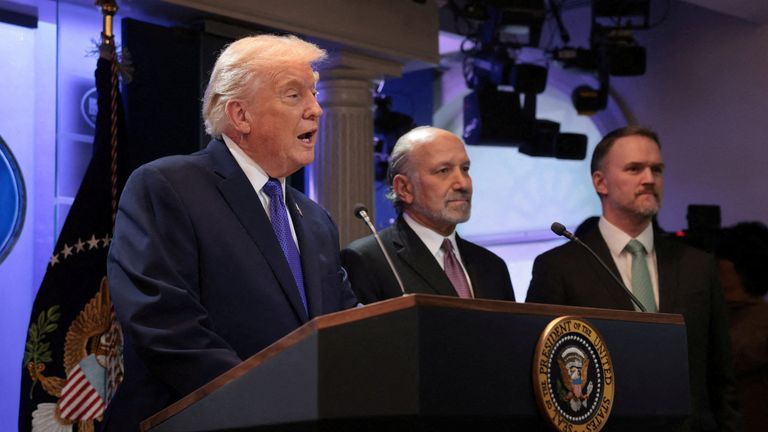
Donald Trump responding to the Supreme Court's decision. Pic: Reuters
Image:
Donald Trump responding to the Supreme Court’s decision. Pic: Reuters

What does it mean for the economy?

What happens next, and whether roughly $175bn in import taxes will be refunded, remains to be seen.

The decision immediately lowers the effective tariff rate sharply, from 12.8% to 8.3%, according to Michael Pearce, the chief US economist at Oxford Economics.

Advertisement

Many companies, including wholesale chain Costco, have already gone to court seeking tariff refunds.

Read more from Sky News:
Trump: Release files on ‘alien and extraterrestrial life’
Board of Peace pledges billions of dollars to Gaza

Advertisement

Justice Kavanaugh wrote in the dissent: “The court says nothing today about whether, and if so how, the government should go about returning the billions of dollars that it has collected from importers.

“But that process is likely to be a ‘mess’, as was acknowledged at oral argument.”

That uncertainty is likely to remain, potentially eliminating any economic benefit from tariff removal.

Advertisement

Source link

Continue Reading
Click to comment

Leave a Reply

Your email address will not be published. Required fields are marked *

NewsBeat

What is ALS, also known as Lou Gehrig’s disease?

Published

on

What is ALS, also known as Lou Gehrig's disease?

Eric Dane, known for his roles on “Grey’s Anatomy” and “Euphoria,” died this week from amyotrophic lateral sclerosis at age 53.

The fatal nervous system disease, also known as Lou Gehrig’s disease, killed Dane less than a year after he announced his diagnosis.

According to the Centers for Disease Control and Prevention, ALS is rare. In 2022, there were nearly 33,000 estimated cases, say researchers, who project that cases will rise to more than 36,000 by 2030.

The disease is slightly more common in men than in women and tends to strike in midlife, between the ages of 40 and 60.

Advertisement

Here’s what to know.

What is ALS?

It affects nerve cells in the brain and spinal cord, causing loss of muscle control and getting worse over time.

ALS causes nerve cells in the upper and lower parts of the body to stop working and die. Nerves no longer trigger specific muscles, eventually leading to paralysis. People with ALS may develop problems with mobility, speaking, swallowing and breathing.

The exact cause of the disease is unknown, and Mayo Clinic experts said a small number of cases are inherited.

Advertisement

It’s called Lou Gehrig’s disease after the Hall of Fame New York Yankees player. Gehrig was diagnosed with ALS in 1939 on his 36th birthday, died in 1941 and was the face of ALS for decades.

What are some signs of ALS?

Experts say the first symptoms are often subtle. The disease may begin with muscle twitching and weakness in an arm or leg.

Over time, muscles stop acting and reacting correctly, said experts at University of California San Francisco Health. People may lose strength and coordination in their arms and legs; feet and ankles may become weak; and muscles in the arms, shoulders and tongue may cramp or twitch. Swallowing and speaking may become difficult and fatigue may set in.

The ability to think, see, hear, smell, taste and touch are usually not affected, UCSF experts said.

Advertisement

Eventually, muscles used for breathing may become paralyzed. Patients may be unable to swallow and inhale food or saliva. Most people with ALS die of respiratory failure.

How is ALS diagnosed and treated?

The disease is difficult to diagnose because there’s no test or procedure to confirm it. Generally, doctors will perform a physical exam, lab tests and imaging of the brain and spinal cord.

A doctor may interpret certain things as signs of ALS, including an unusual flexing of the toes, diminished fine motor coordination, painful muscle cramps, twitching and spasticity, a type of stiffness causing jerky movements.

There’s no known cure for ALS, but the drug riluzole has been approved for treatment. According to the Mayo Clinic, it may extend survival in the early stages of the disease or extend the time until a breathing tube is needed.

Advertisement

Another much-debated drug, Relyvrio, was pulled from the U.S. market by Amylyx Pharmaceuticals in 2024. Its development had been financed, in part, by the ALS Association, the major beneficiary of the 2014 “ ice bucket challenge ” viral phenomenon.

Other medications are sometimes prescribed to help control symptoms.

Choking is common as ALS progresses, so patients may need feeding tubes. People may also use braces, wheelchairs, speech synthesizers or computer-based communication systems.

After the onset of the disease, experts say patients may survive from two years to a decade. Most people live from two to five years after symptoms develop, and about a fifth live more than five years after they are diagnosed.

Advertisement

___

The Associated Press Health and Science Department receives support from the Howard Hughes Medical Institute’s Department of Science Education and the Robert Wood Johnson Foundation. The AP is solely responsible for all content.

Advertisement

Source link

Continue Reading

NewsBeat

What happens next after the Supreme Court slapped down Trump’s tariffs

Published

on

What happens next after the Supreme Court slapped down Trump's tariffs

WASHINGTON (AP) — There’s little that Donald Trump has cherished more in his second term than tariffs, a symbol of his imperious approach to the presidency. He has raised and lowered them at will, rewriting the rules of global commerce and daring anyone to stop him.

Now that may be over, the victim of a stunning rebuke from the Supreme Court on Friday. After more than a year of expanding his power, Trump had run into a rare limit.

It was a loss that Trump couldn’t quite accept, and the president claimed he would use other laws to impose alternative tariffs. He even said that the end of this particular legal battle would bring “great certainty” to the economy.

But if anything, Friday opened a new chapter in Trump’s ongoing tariffs drama and raised urgent questions about his ability to make good on his promises of an economic revival. The ruling will most likely prolong chaos over international trade through the midterm elections, with much unknown about Trump’s next steps and whether roughly $175 billion in import taxes that the Supreme Court struck down will be refunded.

Advertisement

The president chose, as he often does, to scorn the patriotism of those who disagree with him.

He said the ruling was “deeply disappointing” and “ridiculous,” adding that he was “absolutely ashamed” of the six Supreme Court justices who ruled against him “for not having the courage to do what’s right for our country.”

Trump described the justices as “fools and lapdogs” who are “very unpatriotic and disloyal to our Constitution.”

The president said on social media Friday night that he had signed an executive order enabling him to bypass Congress and impose a 10% tax on imports from around the world. The government would begin national security investigations in order to charge new tariffs on specific products as well. The 10% tariffs are legally capped at 150 days, but Trump brushed off a question about the limit by saying “we have a right to do pretty much what we want to do.”

Advertisement

All of that means Trump’s tariff timelines are likely to collide with the midterm elections for control of the House and Senate.

Tariffs have been politically unpopular

Trump learned of the Supreme Court’s decision during a private meeting with governors in the morning when he was handed a note, according to two people with knowledge of the president’s reaction who spoke on the condition of anonymity. They said he called it “a disgrace.”

Another person, who was briefed on the conversation, disclosed that Trump said he has “to do something about these courts.”

The meeting with the governors ended shortly thereafter.

Advertisement

Looming over Trump’s legal debacle has been voters’ frustration with the tariffs, which have been linked to higher prices and a slowdown in hiring.

The president has consistently misrepresented his tariffs, claiming despite evidence to the contrary that foreign governments would pay them and that the revenues would be sufficient to pay down the national debt and give taxpayers a dividend check.

After Trump announced worldwide tariffs last April, an AP-NORC poll found that 76% of Americans said the policies would increase the cost of consumer goods — a worrisome sign for a president elected on the promise of addressing years of inflation.

Another poll, conducted in January, said about 6 in 10 Americans said Trump had gone too far in imposing new tariffs on other countries.

Advertisement

Trump used tariffs to reshape Republican trade agenda

Trump’s aggressive use of tariffs had left many Republican lawmakers uneasy, publicly and privately, forcing them to defend what were essentially tax increases on the American public and businesses.

At various points during Trump’s second term, at least seven senators from the president’s party have voiced their concerns. Earlier this month, six House Republicans joined with Democrats to vote for a resolution against Trump’s tariffs on Canada.

Indeed, free trade had long been a central plank of the Republican Party before Trump’s rise to power.

Kentucky Sen. Mitch McConnell described Trump’s assertion that he can bypass Congress to implement tariffs as “illegal” in a statement praising the Supreme Court’s decision.

Advertisement

“Congress’ role in trade policy, as I have warned repeatedly, is not an inconvenience to avoid,” the former top Senate Republican said. “If the executive would like to enact trade policies that impact American producers and consumers, its path forward is crystal clear: convince their representatives under Article 1” of the Constitution.

Former Vice President Mike Pence, who served during Trump’s first term, cheered the ruling.

“American families and American businesses pay American tariffs — not foreign countries,” Pence wrote on social media. “With this decision, American families and businesses can breathe a sigh of relief.”

Democrats were quick to seize on the Supreme Court ruling to say Trump broke the law and middle-class families suffered as a result.

Advertisement

Rep. Suzan DelBene, D-Wash., said Trump “is not a king” and his “tariffs were always illegal.”

“Republicans in Congress could have easily ended this economic crisis by standing up for their communities,” said DelBene, chair of the Democratic Congressional Campaign Committee. “Instead, they chose to bend the knee to Trump while families, small businesses and farmers suffered from higher prices.”

Tariffs were central to Trump’s economic pitch

Trump has claimed that his tariffs were the difference between national prosperity and deep poverty, a pitch he made Thursday to voters in the swing state of Georgia.

The president used the word “tariff” 28 times in his speech at a Georgia steel company, Coosa Steel, which credited the import taxes as making its products more competitive with goods from China.

Advertisement

“Without tariffs, this country would be in such trouble right now,” Trump insisted.

Trump also complained that he had to justify his use of tariffs to the Supreme Court.

“I have to wait for this decision. I’ve been waiting forever, forever, and the language is clear that I have the right to do it as president,” he said. “I have the right to put tariffs on for national security purposes, countries that have been ripping us off for years.”

By a 6-3 vote, the high court said no.

Advertisement

___

Associated Press writer Steven Sloan contributed to this report.

Advertisement

Source link

Continue Reading

NewsBeat

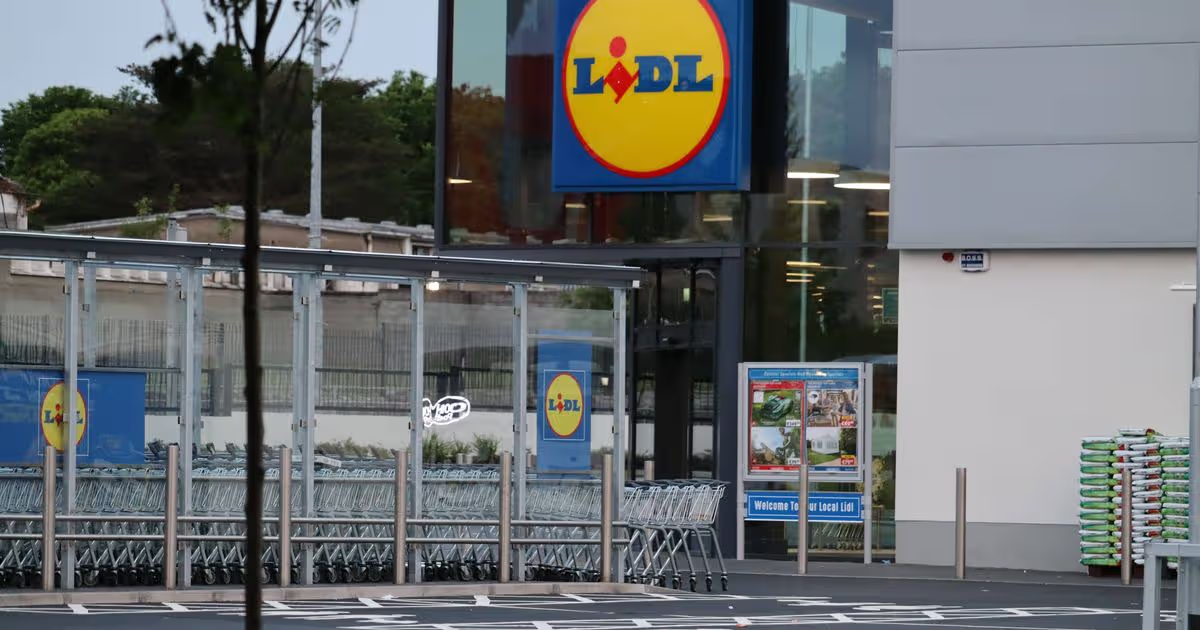
I never buy 1 simple item from Sainsbury’s anymore as it’s cheaper and tastier from Lidl

Published

on

Manchester Evening News

I made the switch from Sainsbury’s to Lidl for one simple food item after comparing taste, freshness and price.

Whilst I conduct most of my shopping at Sainsbury’s for convenience, there are certain food items I favour collecting from other supermarkets. Marks and Spencer is always my destination for chicken breasts, Caesar sauce and salad.

Regarding fruit and vegetables, Sainsbury’s generally stocks good-quality produce at a fair price.

Advertisement

However, after purchasing multiple packs of one essential fruit from Sainsbury’s and Lidl, the latter proved tastier and even stayed fresh several days beyond the best-before date. The fruit in question is pomegranate seeds, the pre-packaged variety.

Fruit plays a vital role in my weekly grocery shopping, and it’s essential to select good-quality fruit, as it can deteriorate quite rapidly.

Whilst there are numerous different storage tips to help keep fruit fresh for an extended period, you’re better off purchasing it as fresh as possible.

Advertisement

I didn’t anticipate such excellent quality from budget supermarket Lidl, as previously I’ve discovered fruits like blackberries and raspberries have been mouldy in the store.

The packaged pomegranate seeds from Lidl are sweet, juicy and full of flavour, more so than Sainsbury’s.

Ensure our latest lifestyle and travel stories always appear at the top of your Google Search by making us a Preferred Source. Click here to activate or add us as your Preferred Source in your Google search settings.

I also find that the pomegranate from Lidl tastes good a couple of days after the best-before date stated on the packaging.

As well as the quality and taste, pomegranate seeds are more affordable at Lidl than they are at Sainsbury’s. At Sainsbury’s, they retail for £1.50 for an 80g pot and £2.65 for a 240g pot.

Lidl only stock a 200g pot of pomegranate seeds, and they retail for just £1.39.

Source link

Advertisement
Continue Reading

NewsBeat

I’ve ditched Sainsbury’s for Lidl when buying 1 simple item – it’s cheaper and tastier

Published

on

Daily Mirror

As a regular Sainsbury’s shopper, I switched to Lidl for one simple item that’s sweeter, juicier and better value for money.

Whilst Sainsbury’s is my usual port of call for the weekly shop, there are certain food items I make a beeline for elsewhere. For chicken breasts, Caesar dressing and salad, it’s got to be Marks and Spencer.

Advertisement

When it comes to fruit and veg, Sainsbury’s generally offers decent quality at a fair price.

However, after comparing packs of one particular fruit from both Sainsbury’s and Lidl, the latter came out on top for taste and freshness, even several days past its best-before date.

The fruit in question? Pre-packaged pomegranate seeds. Fruit is a staple of my weekly grocery haul, and it’s crucial to choose high-quality produce as it can go off rather quickly.

There are plenty of tricks for prolonging the life of your fruit, but you’re always better off buying as fresh as possible.

I was pleasantly surprised by the quality on offer at budget supermarket Lidl, especially given previous experiences with mouldy blackberries and raspberries on their shelves.

The pre-packaged pomegranate seeds from Lidl are sweet, juicy and packed with flavour, far surpassing those from Sainsbury’s.

Ensure our latest stories always appear at the top of your Google Search by making us a Preferred Source. Click here to activate or add us as your Preferred Source in your Google search settings.

Advertisement

What’s more, I’ve found that Lidl’s pomegranate still tastes great a couple of days beyond the best-before date printed on the pack.

Not only do they win on quality and taste, but Lidl’s pomegranate seeds also come in cheaper than Sainsbury’s. Whilst Sainsbury’s charges £1.50 for an 80g pot and £2.65 for a 240g pot.

Lidl sells a 200g pot of pomegranate seeds for just £1.39.

Advertisement

Source link

Continue Reading

NewsBeat

New MAFS UK 2026 reunion date and start time confirmed

Published

on

New MAFS UK 2026 reunion date and start time confirmed

And it will take place in a matter of days.

Excited? Well, after this latest season, we definitely are.

Revealing what fans can expect, a show insider revealed to The Sun: “Last year’s Married at First Sight U.K. may be over, but there’s still unfinished business between the experiment’s couples.

Advertisement

“In this dramatic, emotional reunion special, familiar faces return for a dinner party at which some celebrate romance, while others are forced to face old tensions.

“One husband confronts his ex-wife over a shocking revelation, while a former bride finds herself at the eye of the storm, as she’s pulled into the centre of another couple’s conflict, sparking a fiery showdown.

“Secrets spill and alliances shift in a night that proves truth always finds its way to the table.”

When is the MAFS UK 2026 reunion?

The series last aired in October last year.

This special episode will take place on March 1 at 9pm, per reports.

Advertisement

Like the main series, the one-off episode will be available to watch on E4 and the Channel 4 website.


Recommended reading:

Married at First Sight expert Mel Schilling leaves show

Line of Duty revisits storyline that caused ‘genuine anger’ for viewers in new series

Advertisement

When Britain’s Got Talent returns with first auditions as new judge joins the panel


It’s set to have a runtime of 90 minutes.

Sarah and Dean, Divarni and Julia-Ruth, Maeve and Joe, Steven and Nelly, Anita and Paul, Rebecca and Bailey, Ashley and Grace, Keye and Davide, Abi and John, Leisha and Reiss, April and Leo, and Leigh and Leah all tied the knot, to varying degrees of success.

All of them, each receiving advice – and not particularly listening to – from experts Mel Schilling, Charlene Douglas and Paul C Brunson.

Advertisement

Many fans are keen to know whether these contestants make it to Final Vows and are still in a relationship. Well, you’ll just have to wait.

Source link

Advertisement
Continue Reading

NewsBeat

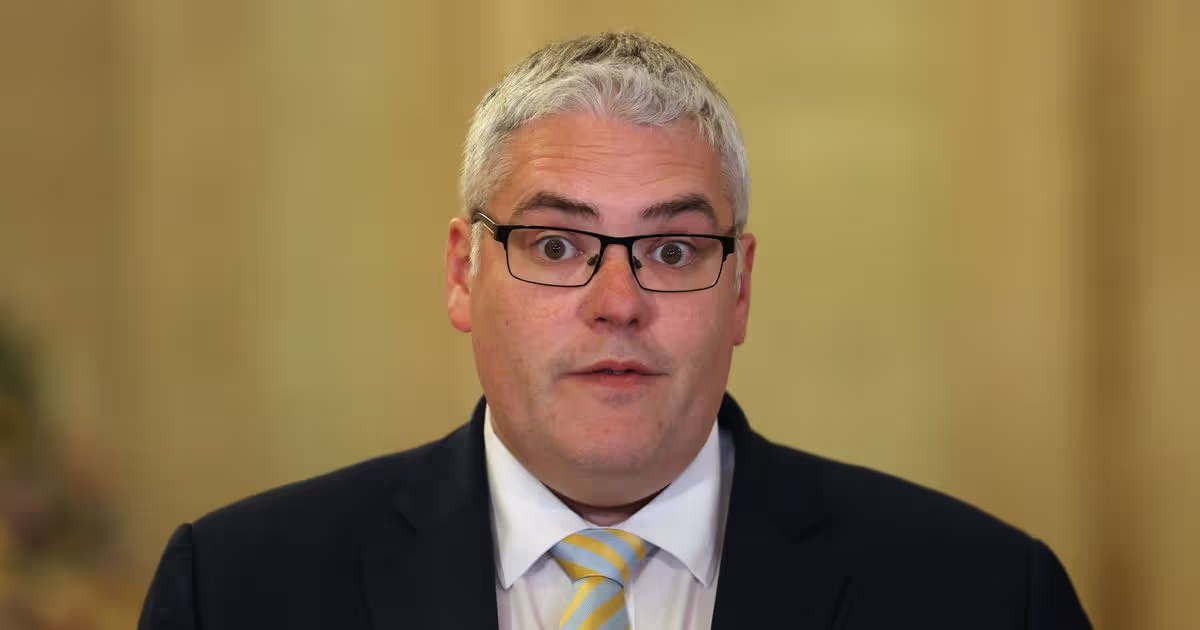
Return to 50:50 police recruitment would be a mistake says DUP leader Gavin Robinson

Published

on

Belfast Live

Police said more than 4,000 people had applied for their latest student officer recruitment campaign, with 65.6% from a Protestant background, 26.7% from a Catholic background and 7.7% undetermined

Any return to 50:50 recruitment to the police force in Northern Ireland would be a “mistake”, DUP leader Gavin Robinson has said.

Advertisement

In his weekly email to party members, Mr Robinson also said there had been an “absence of sustained and wholehearted leadership” from republicans to challenge barriers to Catholics joining the PSNI.

New PSNI recruitment figures this week showed that the percentage of new Catholic applicants to join the force was at its lowest in more than a decade.

Police said more than 4,000 people had applied for their latest student officer recruitment campaign, with 65.6% from a Protestant background, 26.7% from a Catholic background and 7.7% undetermined.

That prompted fresh concerns about representation within the force.

Advertisement

Between 2001 and 2011, there was a 50:50 recruitment initiative which meant there was one Catholic recruit for every one person from a Protestant or other background.

Mr Robinson said there had been a “predictable” call for the return of 50:50 since the latest recruitment figures were released.

He said: “That would be a mistake. It would reintroduce discrimination and undermine merit. Representation cannot be built by excluding capable applicants from other backgrounds.”

Advertisement

Mr Robinson said Catholic applicants should be praised.

He added: “They strengthen policing, and they strengthen our society. Those republicans who wish to see more Catholics join the police must also be prepared to face the legacy of decades spent distancing themselves from policing.

“You cannot question the legitimacy of the police for a generation and then express surprise when recruitment reflects that history.

“Until that contradiction is confronted, claims of support will continue to be met with scepticism.”

Advertisement

Mr Robinson said “chill factors still existed for Catholic applicants to the police in Northern Ireland”.

He added: “Pretending otherwise helps no-one. But acknowledging that reality cannot be where the discussion stops. For too long, there has been an absence of sustained and wholehearted leadership within republicanism to challenge those barriers directly.

“It was an appalling abdication of leadership that it was 20 years after the PSNI was formed before Sinn Fein ’s leadership attended a passing-out parade or a recruitment event. The time for tokenism is over. Leadership on policing requires consistency and visibility.”

Sinn Fein MLA and Policing Board member Linda Dillon said it is “imperative” that the PSNI is representative of society.

Advertisement

She said: “For this reason the PSNI need to listen to young people from a Catholic, nationalist, republican background to identify the barriers preventing them from joining them.

“Sinn Fein opposed the decision to withdraw 50:50 recruitment, its removal has negatively impacted on the recruitment and retention of officers, specifically from the Catholic/nationalist community.

“The political mishandling by the British government in failing to implement legacy arrangements under the Stormont House Agreement has also had a negative effect.

“The PSNI must strive to deliver a modern and representative policing structure, across all levels of the police service, including specialist units, that is as diverse as the community it serves and commands maximum public confidence.”

Advertisement

To ensure you don’t miss out on all the latest from Belfast Live, be sure to make us your preferred source on Google.

Source link

Continue Reading

NewsBeat

Sickening moment thug dad and son batter hero cop in the street

Published

on

Daily Mirror

PC Ryan Davis suffered horrific injuries after Richard Quinn, 49, and his son Alex, 20, repeatedly stamped on him. CCTV shows the Quinns’ attacking another man in the centre of Hereford

A thug father and son battered a police officer as he tried to stop them attacking another man.

Advertisement

PC Ryan Davis suffered horrific injuries after Richard Quinn, 49, and his son Alex, 20, repeatedly stamped on him. CCTV shows the Quinns’ attacking another man in the centre of Hereford on March 29, 2024.

PC Davis, who was in plain clothes, was on patrol in the city to protect women and girls from assaults. Footage shows him stepping in to stop a man being repeatedly punched after the Quinns’ attacked him on Union Street.

The Quinns’ quickly turned their attention to PC Davis and repeatedly stamped on him before strangling him on the ground.

Advertisement

PC Davis suffered a dislocated and broken ankle, broken lower leg, multiple fractures and face lacerations including damage to an eye. PC Davis’ colleagues were also attacked by Richard Quinn’s wife Carolynn, who was also with her husband and son. She was convicted of two counts of assault of an emergency worker.

Richard Quinn, 49, of Hereford, was convicted of assault causing grievous bodily harm against PC Davis and a separate assault.He was jailed for four years and three months at Hereford Crown Court on Friday (20/2).

Alex Quinn, 20, of the same address, was sentenced to three years and ten months at a young offenders’ institute for the same offences. After the sentencing hearing, PC Davis revealed the trauma he is still suffering today as a result of the attack.

Advertisement

The 34-year-old officer said: “While I am pleased that justice has been handed out today, I have already been serving my sentence, having spent the past 21 months recovering from this cowardly and brutal attack – and there is still more recovery time for me to get through as I slowly rebuild my life.

“This horrific attack changed who I am. I have struggled with PTSD ever since.

Their actions have put me through so much physical and mental pain, and I really don’t recognise the person I was before it happened. “It left me fearful to go out and I have suffered recurrent flashbacks to the events of that night.

Advertisement

“I feel I have been left to suffer by perpetrators who have shown no remorse.

“Nobody should go out to work and expect to experience anything like this, but I would like to thank my colleagues and West Mercia Police and the Federation for their help and support along the way.”

Source link

Advertisement
Continue Reading

NewsBeat

Iran women defying norms in Oscar-tipped film

Published

on

Iran women defying norms in Oscar-tipped film

She later decided to research female entrepreneurs and activists in the country, and “came across this really amazing, tenacious individual who lives in the north-west of Iran, who rides a motorcycle, as the only female motorcycle rider in the region, and she’s delivered 400 kids as a midwife”.

Source link

Continue Reading

NewsBeat

Former boss of Poulton restaurant torched venue in revenge

Published

on

Former boss of Poulton restaurant torched venue in revenge

Fakhrul Islam torched the Seventy One Indian in Breck Road, Poulton, in the early hours of December 8, 2024, causing extensive damage to the business and causing it to close its doors until this week.

Fakhrul Islam (Image: Lancashire Police)

While the restaurant was closed and empty at the time, staff members from the restaurant and another family who lived above had to be helped by quick-thinking staff from the nearby Cube nightclub, who heard the alarms go off, spotted the flames and raced to the rescue.

READ MORE: Emergency services called out to vehicle fire in Burnley

READ MORE: Three members of drugs gang who ‘peddled misery’ across towns are jailed

Advertisement

READ MORE: Teen to be sentenced for role in series of vehicle thefts and burglaries

Islam, who wore a blonde wig to try to disguise himself, was tracked down following an investigation which tracked his movements on the night through CCTV and vehicle movements.

Seventy One, Breck Road, Poulton (Image: Lancashire Police)

Despite him initially denying the offence, claiming he was driving around as part of his work as a taxi driver, Islam pleaded guilty to arson in the face of the evidence compiled.

The 37-year-old, of Hemingway, Blackpool, was sentenced at Preston Crown Court earlier this week to seven years and six months in prison.

Advertisement

During sentencing, the Judge described the incident as a revenge attack motivated by ill feelings between Islam and the restaurant’s new owners.

Seventy One, Breck Road, Poulton (Image: Lancashire Police)

DC Alexa Taylor, of Blackpool CID, said: “I welcome this sentence, which reflects the gravity and reckless disregard for life that Islam showed that morning when he carried out this arson attack.

“I would also like to thank and acknowledge the heroic actions of the staff members from the Cube whose selfless and courageous intervention undoubtedly saved many lives during this incident.”

Advertisement

Source link

Continue Reading

NewsBeat

World’s longest direct train journey where passengers are in their seats for almost 7 days

Published

on

Daily Mirror

One train journey takes a staggering 167 hours to complete, with the railway spanning eight time zones to make it the longest in the world

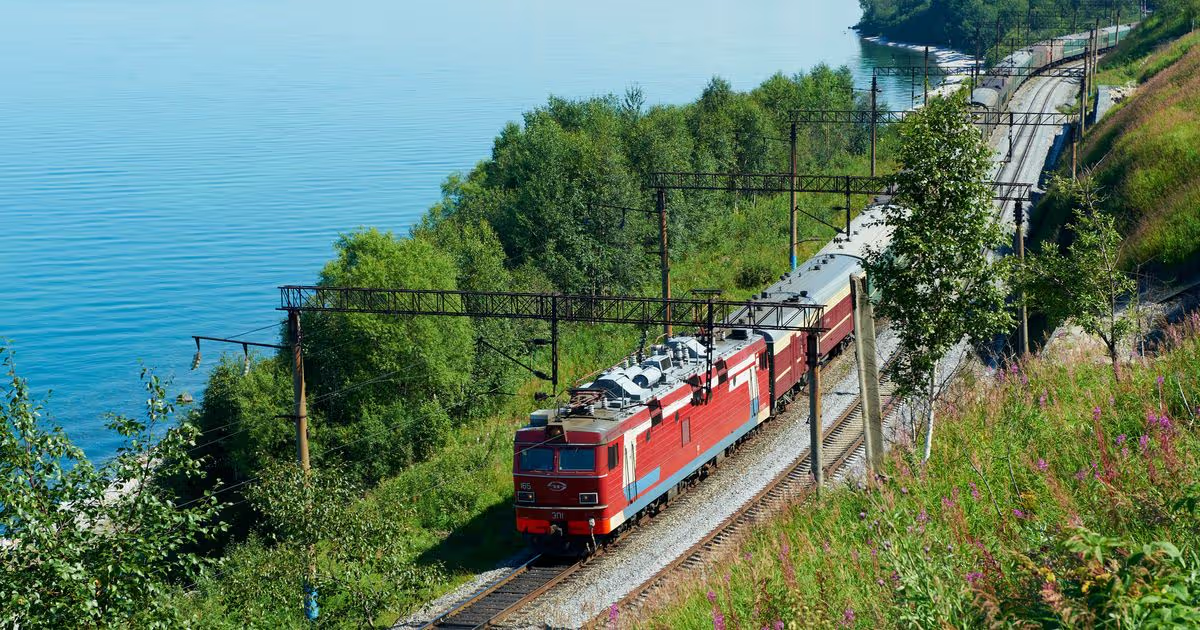
The longest direct train journey in the world stretches a staggering 5,771 miles and takes almost a week to complete. Passengers on board the train undertake a mammoth journey through eight time zones.

Advertisement

The Trans-Siberian Railroad claims the title of the longest single rail system in the world. It connects east and west Russia, running from Moscow to Vladivostok.

To travel the length of the railway, it takes approximately 167 hours and requires no passenger changes. Heading east from Moscow, the train crosses the country to the Pacific Ocean.

There are even non-stop train options, so all passengers remain on board throughout the seven days. If you prefer to get off and explore the local surroundings, passengers can opt for the stopping service.

However, this takes between 14 and 20 days to complete. The Trans-Siberian railway runs through cities such as Moscow, Yaroslavl, Chelyabinsk, Omsk, Novosibirsk, Krasnoyarsk, Irkutsk, Ulan-Ude, Chita, Khabarovsk, and Vladivostok.

Advertisement

There’s also the Trans-Manchurian line, which runs through northern China to Beijing, and the Trans-Mongolian, which heads to Beijing but passes through Ulan Bator.

A famous train on the Trans-Siberian railway is Rossiya (the Russia), which has second-class sleepers, third-class open-plan sleeper bunks, and a restaurant car.

Passengers can pay for four tickets to ensure sole occupancy of a four-berth compartment, even if they’re the only ones travelling. The bunks convert to seats during the day, with toilets and washrooms at the ends of the corridors.

Advertisement

Many tourists who travelled the route chose not to start or end their journey in Russia. Tourists once began in London and made their way to Moscow before boarding the Trans-Siberian Railroad.

Once in Vladivostok, tourists could then head to Korea, Japan, or China without taking a plane. National Geographic also ran tours along the route, offering tourists the chance to travel on “one of the world’s most legendary railways.”

They described the journey: “Set out on an epic train journey across one-third of the world, travelling from Vladivostok, Russia to the heart of Moscow along the legendary Trans-Siberian Railway.

“From the Mongolian steppe to Lake Baikal’s remote shores to the snow-capped Ural Mountains, trace the history of tsars, exiles, and Mongols in the comfort of our luxury train, the Golden Eagle Trans-Siberian Express. Encounter remote cultures and the unique architecture of Siberia’s wooden cottages and Moscow’s onion domes.”

Advertisement

Tours like these have been halted, yet the train is reportedly still being used by Russians. The UK Government warn against all travel to Russia.

Official advice from the Foreign, Commonwealth & Development Office says: “FCDO advises against all travel to Russia due to the risks and threats from its continuing invasion of Ukraine, including security incidents, such as drone attacks, and Russian air defence activity, lack of flights to return to the UK and limited ability for the UK government to provide support.”

Source link

Advertisement
Continue Reading

Trending

Copyright © 2025