NewsBeat
Trump announces global tariff after Supreme Court rebuke | World News

Donald Trump has announced a global tariff after the US Supreme Court ruled that his previously imposed duties are illegal.
The new 10% import duty will apply to all countries and be effective “almost immediately”, the US president said in a post on his Truth Social platform.
The White House announced the levy would take effect on 24 February, although it could face legal challenges.
The law Mr Trump has used to impose the tariff caps it at 150 days, but he brushed off a question about the limit by saying “we have a right to do pretty much what we want to do”.
It comes after six of the Supreme Court‘s nine judges voted to overturn Mr Trump’s signature economic policy, handing him a significant loss.
The judgment was in response to an application brought by businesses affected by the tariffs from 12 mostly Democrat-run states.
The applicants challenged the way the US president imposed the sweeping country-specific taxes.
Traditionally, tax-raising measures like tariffs are taken through Congress but the president wished to bypass that process.
But the majority judgment found the US Constitution “very clearly” gives Congress that power.
“The framers did not vest any part of the taxing power in the executive branch,” US Chief Justice John Roberts wrote.
The case is the first challenge to a major part of Mr Trump’s agenda to be ruled on by the Supreme Court.
Trump ‘ashamed’ of judges who ruled against him
Responding to the decision, Mr Trump described it as a “disgrace”.
He said he was “ashamed” of the six Supreme Court judges who ruled against him for not “having the courage to do what’s right” for the US, describing them as “fools and lapdogs” who are “very unpatriotic and disloyal to our Constitution”.
Three of the six judges who ruled his tariffs illegal are Republicans. They include Neil Gorsuch and Amy Coney Barrett, who were appointed during Mr Trump’s first term in office.
Mr Trump thanked the three justices who voted in his favour, before claiming that foreign countries “who have been ripping us off for years” were now “dancing in the streets”.
Read more: Trump’s trade war is not over
Mr Trump’s administration had argued that a 1977 law allowing the president to regulate importation during emergencies also allowed him to set tariffs.
Other presidents have used the law to impose sanctions before, but Mr Trump was the first president to invoke it for import taxes.
Following the Supreme Court ruling, he said: “Today I will sign an order to impose a 10% global tariff under section 122 over and above our normal tariffs already being charged.”
Section 122 of the 1974 Trade Act allows the president to institute a “temporary import surcharge” of up to 15% for a maximum of 150 days if he finds there are “large and serious” balance-of-payments deficits to prevent an “imminent” and “significant” depreciation of the US dollar in foreign exchange markets.
What has been the British response?
The UK government said it expected its “privileged trading position” with the US to continue.
A spokesperson said Britain would work with the US to understand “how the ruling will affect tariffs for the UK and the rest of the world”.
The British Chambers of Commerce (BCC) said the decision did little to “clear the murky waters for business”.
William Bain, head of trade policy at the BCC, said Mr Trump could use other legislation to reimpose tariffs – which is exactly what he’s planning.
What are tariffs?
From 2 April last year, a day described by Mr Trump as “Liberation Day”, countries across the world were hit with taxes on their exports.
The tariffs were brought in via executive order from Mr Trump, who invoked the International Emergency Economic Powers Act to do so.
The Act is a 1977 law intended to be used during national emergencies, which Mr Trump invoked, saying the country was in a national emergency because of US trade deficits.
It was also this law that was used to apply levies on Canadian, Chinese and Mexican goods and services entering the US, although Mr Trump’s national emergency rationale was the trafficking of the drug fentanyl into the US.

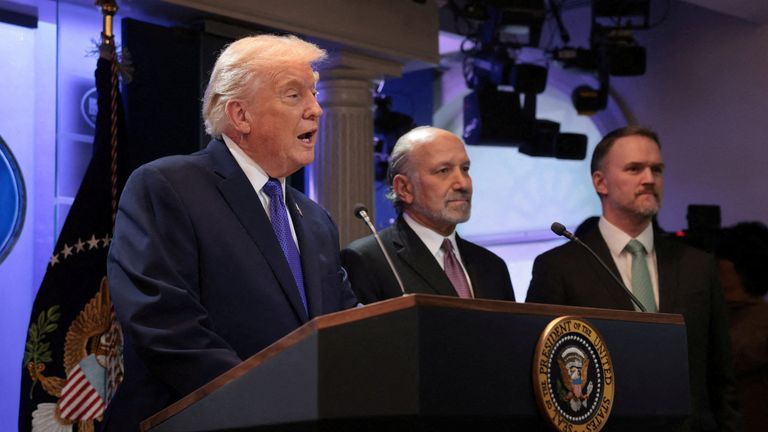
Donald Trump responding to the Supreme Court’s decision. Pic: Reuters
What does it mean for the economy?
What happens next, and whether roughly $175bn in import taxes will be refunded, remains to be seen.
The decision immediately lowers the effective tariff rate sharply, from 12.8% to 8.3%, according to Michael Pearce, the chief US economist at Oxford Economics.
Many companies, including wholesale chain Costco, have already gone to court seeking tariff refunds.
Read more from Sky News:
Trump: Release files on ‘alien and extraterrestrial life’
Board of Peace pledges billions of dollars to Gaza
Justice Kavanaugh wrote in the dissent: “The court says nothing today about whether, and if so how, the government should go about returning the billions of dollars that it has collected from importers.
“But that process is likely to be a ‘mess’, as was acknowledged at oral argument.”
That uncertainty is likely to remain, potentially eliminating any economic benefit from tariff removal.