
Tech & AI
Michelotto Gruppo 4 Tributo Crafts a Lightweight V8 Manual Tribute to the Rally 308



Padua’s Palazzo Moroni hosted the reveal of the Michelotto Gruppo 4 Tributo on October 10, 2026, fifty years after the Ferrari 308 received its Group 4 homologation. AC Motorsport, started by Padua entrepreneur Francesco Calzavara following his years at Michelotto, promoted the effort while Michelotto Group carried out the design, development, and construction.
Giuliano Michelotto established his workshop in 1969 and worked on almost 700 competition cars, winning an astounding 1,495 races, including 44 world championships. Ferrari later approached Michelotto’s business to acquire the Pininfarina-designed 308 GTB for Group 4 rallying. This essentially involved grafting on tubular frame sections, some seriously advanced composite bodywork, and a seriously tweaked 2 valve V8, and the results were nothing short of stunning: a 1981 Tour de France Automobile win with Jean-Claude Andruet and a close second place at the 1982 Tour de Corse, Ferrari’s only ever top level World Rally Championship podium finish.
Sale

LEGO Technic Ferrari FXX K Toy Car – Building Toy for Girls & Boys, Ages 10+ – Cool Birthday Gift for…
- LEGO FERRARI MODEL CAR KIT – Builders ages 10+ can create the legendary Technic Ferrari FXX K with authentic details and working mechanical features
- AUTHENTIC RACE CAR DETAILS – This supercar building set features working butterfly doors, opening hood, and an engine cover that reveals the…
- CAR MODEL KIT – Young engineers explore real automotive concepts with this educational learning toy as they build the working differential and watch…


Under the hood is a transversal 3.4-liter naturally aspirated 90-degree V8, producing 380 horsepower at 8,250 rpm and 363 Nm of torque on 98 RON fuel. The aluminum block and heads, four camshafts driving two valves per cylinder (which provides more torque on mixed surfaces than a four valve system), and electronic injection all add up to a very powerful package. The power is sent to the rear wheels via a five-speed manual with a gated shifter, dog-ring engagement, and an impressive eight different gear ratios to choose from, so whether you’re tackling tight roads or quicker circuits, you can get the car set up to fit.
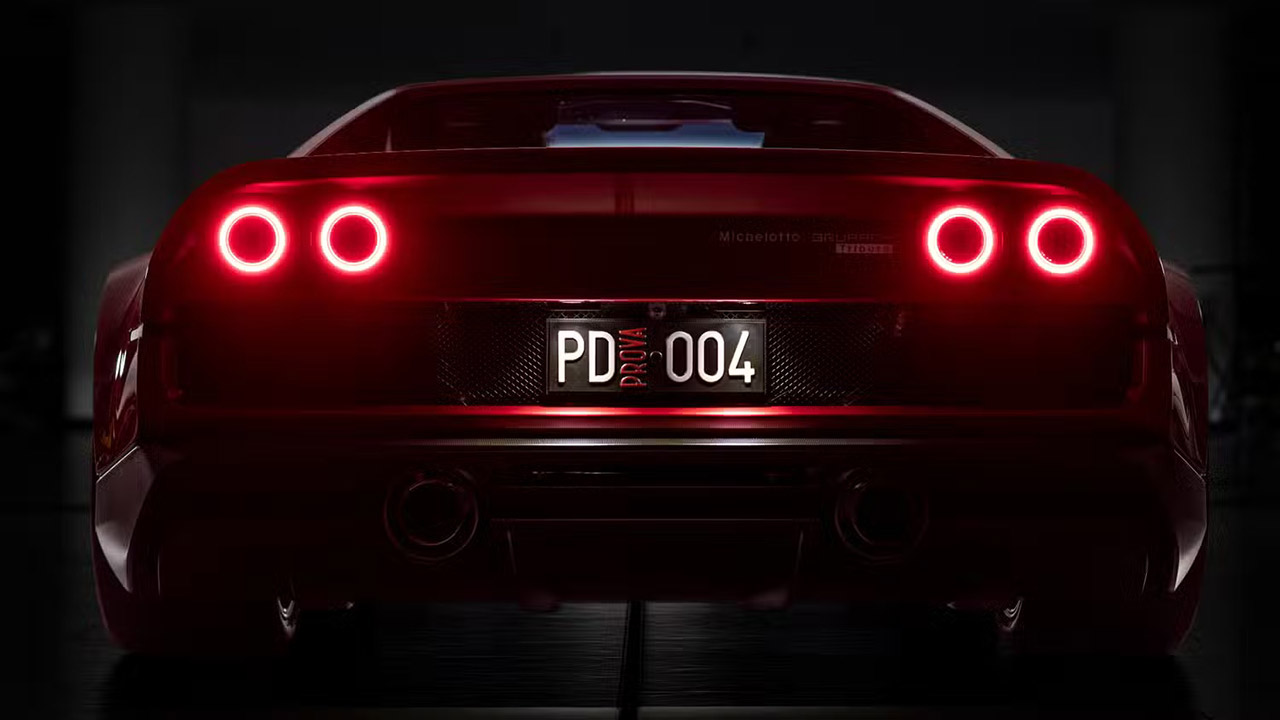

The tubular frame is comprised of elliptical tubes that hold composite body panels and an integrated roll bar. This all adds up to a relatively light 950 kilos (with fluids but no gasoline), giving you a power-to-weight ratio of around 2.5 kilograms per horsepower. That’s rather similar to the original 308 footprint, however it should be noted that this is a two-seater berlinetta.


So, how is the ride? The car comes with double wishbones machined from solid, adjustable dampers, and stabilizer bars, which allow you to configure the entire chassis to your liking. Four piston calipers clamp down on the front and rear ventilated disks (which measure 345 and 328 millimeters, respectively), and the brake balance may be adjusted from the cockpit. You’ll be seated on eighteen-inch wheels with Pirelli P Zero Trofeo RS tires.


The composite bodywork is based on the classic wedge shape, but with a much more modern twist. You get a low nose, pop-up headlights, various vents and gills on the hood and fenders, flared arches, a seriously enormous rear clamshell, four circular taillights, and, of course, dual exhausts. On the inside? To keep things basic, you get composite-shell seats wrapped in Alcantara, a three-spoke wheel, and a gated shifter, all linked with a digital display and a plethora of physical switches.


Michelotto expects to build fewer than fifty of them, primarily in Padua, and hopes to confirm the final number by the end of 2027. What about price? They’re keeping that under wraps for now, but comparable restomod projects would suggest it’ll cost at least 450,000 euros. As for road registration (street legality), that is still up in the air, but the car clearly continues the work of the workshop that first took the 308 and transformed it into a true rally winner.
[Source]


Revival Rugs is turning 9 this month, and evidently, the birthday girl is feeling generous. The rug retailer is taking 20 percent off everything sitewide (exclusions may apply, as always). But don’t dillydally—the party ends Sunday, October 25.
Sure, Black Friday is around the corner, and there will be deals aplenty. But will they be sitewide and stackable? Revival’s 20 percent stacks, meaning it also applies to marked-down and clearance items. Will the rug you’ve been eyeing for months still be available in November? Are you willing to risk it? I wouldn’t.
Why We Love Revival Rugs
Revival is a retailer we love here at WIRED, mainly because of its lovely selection of hand-knotted and handwoven wool rugs at reasonable prices. The company imports rugs from Turkey, Morocco, and India, and also works with its own supplier in Oakland, California. Revival also offers a variety of washable rugs, à la Ruggable (which, by the way, is having its own October Hosting Sale). Not every Revival rug is machine washable, but many are easy to maintain with spot cleaning and a low-suction vacuum.
WIRED reviewer Nena Farrell has the Bronto Hand-Tufted Rug in her toddler’s bedroom, and they are both fans. Farrell appreciates how soft it is and how it makes the room feel playful without looking tacky. Meanwhile, her son is mostly here for the giant dinosaur, which, honestly, is fair. WIRED operations coordinator Molly Higgins has the Garland Washable Area Rug in her living room, where its Turkish-inspired folk-art pattern adds plenty of color and disguises everyday stains. WIRED commerce director Cooper Fleishman just bought a vibrant marmalade wool rug for his new office from the Birthday Sale; sadly, it’s sold out, but this tonal design is a close cousin.
As with any sale, there are a few exclusions. Swatches and gift cards aren’t included, and be sure to read the terms and conditions for more information.

Getting initial customers as a startup can be one of the most grueling challenges in business. Even when companies manage to snag some early interest, there’s no guarantee those customers will stick around.
At TechCrunch Disrupt last week, Elia Wallen, founder and CEO of travel startup Engine, Gamma founder and CEO Grant Lee, and Crystal Huang, general partner at Google Ventures, shared tips on how to attract and retain customers.
In the current era — when young AI companies like Cluely and Instinct are building big audiences not just through their products but also through their founders’ colorful online presences — social media can seem like a magic bullet for reaching early customers. But founders who want heighten their business strategy with modern marketing, have to be strategic, according to Lee.
Gamma, which sells AI-powered presentation software, managed to scale its business exponentially with a social media strategy that deployed influencers through its Ambassadors (or “Gambassador”) program. The company adopted the plan before influencer-based marketing was a tried-and-true strategy for smaller companies, eventually reaching a multi-billion dollar valuation.
But simply giving influencers a platform and telling them to promote your brand online doesn’t automatically translate to sales, said Lee. There’s more to it than that.
“If you have a product that can serve many different segments or use cases, then you want to basically have creators that can target each one of those,” Lee said. “If you have folks that are in consulting versus people that do all their marketing and create all the decks for their CMO, there’s all these different segments you might want to go after.”
Lee said sometimes founders seem to treat creator marketing or influencer marketing as a sort of set it and forget it thing.
“I think you’re better served by really spending a lot of time with these creators, because if they’re not able to understand how to articulate the value of your product, it doesn’t matter how much money you spend, it’s just going to fall flat,” Lee added.
The effectiveness of social media depends largely on the type of business. Other ways of reaching customers can be just (if not more) effective.
Wallen would know. His company Engine, which manages lodging and travel bookings for midsize businesses, bootstrapped its way to $150 million in bookings before taking on any outside funding. They also had no visible social media strategy at all. For Wallen, traditional sales tactics can be far more useful than a positive TikTok video.
“We did events and we smiled and dialed,” said Wallen. “We still have a lot of people picking up the phone. A lot of people who didn’t grow up with that or don’t understand it think that it’s outdated or it doesn’t work but it does. It’s a hard thing. There are a lot of companies that just refuse to do it or don’t know how to do it well. But they’re missing out on a very big offline client base.” He added: “The phone still works.”
Wallen also shared an in-person tactic that his company deployed during its scrappy early days: hiring a magician named David to perform tricks for prospective clients at events and encourage them to visit the Engine’s booth. In short, old-fashioned personal engagement can work just as well, if not better, than the latest social media tricks.
Huang, who has managed droves of startups and shepherded them to success, said that once you have a customer, a lot of value can be derived from looking at how they use the product.
“Can you look into usage data and figure out if it’s recurring, if it’s increasing, if they are referring their friends?” Huang said. “It can come across in early usage and retention information as well. And then also, do you see some super fans, right, who even want to work at the company, promote the company, be attached to the brand?” She added: “You need to have ways to create evangelists who are really passionate about the product.”
When you purchase through links in our articles, we may earn a small commission. This doesn’t affect our editorial independence.

The Call of Duty series needed a win this year. Last year’s Black Ops 7 was a clown car of bad decisions, featuring an always-online campaign mode with ridiculous zombie bosses and open-world Warzone. Worse still, the multiplayer mode (the only reason that many people buy the game) was entirely forgettable. Developer Treyarch was tasked with putting out Call of Duty games two years in a row — that crunch was a recipe for disaster.
On the other hand, that means Modern Warfare developer Infinity Ward had plenty of time to cook up the fourth and final entry in its own series. Thankfully, the studio used that extra runway to its advantage. Modern Warfare 4 may not have returned Call of Duty to the highest highs of the original trilogy that ended in 2009 (and which Infinity Ward rebooted over the last decade), but this is a leap in the right direction for a series that has become increasingly sloppy in recent years.
Players will find plenty of cinematic action in the single-player campaign, and the multiplayer mode has slowed down just a touch, which I think the game largely benefits from.
More importantly, Modern Warfare Zombies has been completely dropped in favor of DMZ, an accessible player-versus-player-versus-AI extraction shooter experience. The experimental swing feels like a lifeline for the series, and DMZ is the standout mode for the game.
The campaign identity crisis is (mostly) resolved
Modern Warfare 4 is a tighter game than Infinity Ward’s previous project, and it’s leagues better than Black Ops 7.
At the same time, it has a complicated campaign to crack open (and not because the plot is hard to follow). Players flit back and forth between the perspective of Captain John Price, longtime protagonist of the series, and South Korean soldier Park Hyun-Jun, a newcomer whose squad is fighting for his homeland. A battle rages against a united coalition of Russian and North Korean ultranationalists, who are blazing a path into other territories.
Russian bad actors have been the primary antagonists of every Modern Warfare game, and it’s actually really cool to see South Korea’s positive representation in a Call of Duty title. But the propaganda is laid on thick — Russia and North Korea are presented as sneering colonialist powers, while the Western world’s soldiers are a shield on every front.
Americans spearhead the fight against imperialism; forget about the Strait of Hormuz and gun down these unambiguously bad guys. The whole plot hinges on a somehow less-subtle Red Dawn-type of scenario, and the gung-ho military politics are absolutely nauseating this time around. Sure, Price is framed as morally gray — he’s working with a cartel to achieve his goals, and there’s boring melodrama where he comes to blows with his former allies — but he’s vindicated in the end because he is the type of Call of Duty leader that prevents global conflict.

Modern Warfare 4 also features an obligatory shockingly graphic mission, which is something of a tradition for the series. In it, you play as a North Korean soldier rounding up and executing the occupants of a small village for hiding a defector. During my playthrough, I earned an achievement for successfully interrogating a villager without beating them down. The whole affair is gratuitous, gross and gamified in a problematic way, exacerbated by the bizarre decision to continue making this kind of mission a mainstay in each game.
It’s a shame that the story is so trite and icky because the tentpole action is really good. The best mission takes place early in the campaign, when Price infiltrates a New York nightclub to search for a Russian oligarch. Bright lights and pulsing music contrast with brutal fistfights and gunplay — it’s like playing through the climax of a John Wick film. From there, the highlights keep coming: There’s a fight in a train yard where the cover moves on rails, a chase scene across Mumbai rooftops, a high-stakes nighttime penthouse raid and a full-out assault on a dictator’s compound.
But the worst mission in the campaign repeats the mistakes of other modern Call of Duty games. When the player’s squad initially counterattacks North Korean airspace, they’re shot down and have to survive behind enemy lines with scavenged gear. It’s an interesting setup that is completely wasted on a Warzone-like, open-world mission with a checklist of more than 50 optional collectibles to seek out.
The few puzzles that exist are mind-numbingly easy — despite my best efforts, I checked out after completing around half of the activities. I focused on the main objective to end the mission as soon as possible, which is just about the worst feeling to have while playing a game.
I don’t know if there’s an edict from up top to put one of these open-world missions in each new game to funnel players into Warzone, but they don’t work at all and are the worst part of any campaign.
Still, the folks that play the campaign will probably have a good time here. Players can explore tons of cool locales, and the enemies are surprisingly difficult this time around. Still, if you care about the loose narrative implications of a Call of Duty campaign, it’s tough to wash the bad taste out of your mouth.

DMZ is better than Warzone and a welcome reprieve from Zombies
DMZ, a fairly accessible extraction shooter game mode, returns with new content for the first time since its “beta” ended in 2023. Players have been mourning what could have been for years, but it seems like the developers at Infinity Ward have been tinkering with it in the background for quite some time.
And their hard work has paid off because I’m confident that DMZ is the standout mode for Modern Warfare 4.
This extraction shooter is perhaps simpler than even ARC Raiders, but that’s part of the appeal. Players drop into North Korea to loot, fight each other and take down key targets throughout the map.
Everything is streamlined and easy to understand, including the loot. During play, you will come across several types of scrap, an assortment of healing items and tons of weapons, so you don’t have to think too hard about what to grab. Just move, shoot and pull out high-value items, then run the loop again.
The enemy AI is surprisingly aggressive and fun to battle against, especially when you run into an overwhelming number of troops. Armored vehicles and helicopters will try to smear you into the dirt. It’s an adrenaline rush, and as far as I’m concerned, Infinity Ward nailed the really important part of DMZ. It’s tough to get the player-versus-AI balance right, but these enemies feel like a real threat.
Other players might also come for your loot, which is what sometimes puts folks off of the extraction genre altogether. But DMZ’s in-depth bounty system provides a foil to player-versus-player gameplay.
Folks who hunt down other players rack up a bounty and appear on the map, so pacifists have a better chance to steer clear while bounty hunters stalk them down. It’s a pretty genius compromise that encourages the player-versus-player enjoyers to butt heads while the player-versus-environment crowd hides away because the tension of a potential run-in with aggressors is never truly alleviated.
I’m concerned that the pared-down simplicity of the gameplay loop could hurt DMZ’s long-term success, but Infinity Ward seems committed to adding new world bosses. That could really shake up how matches play out, even if there’s nothing as over-the-top as Marathon’s Cryo Archive boss.
DMZ isn’t perfect, but I see the groundwork laid for one of the better extraction shooters I’ve played. Depending on how the development team builds on this game mode, I can see it becoming something special (and maybe even a Call of Duty mainstay for years to come).

Multiplayer remains quick, but it’s heavier and grounded
Call me an oldhead, I don’t care: Black Ops 7’s omnimovement system, which allowed players to run, jump and slide around while looking in any direction, was disastrous for Call of Duty game balance.
Treyarch’s update to the formula might work for massive Warzone maps where there’s plenty of open space and a higher time-to-kill for other players, but the smaller multiplayer maps become impossible to breathe on. Call of Duty is, first and foremost, an arcade shooter, but the multiplayer formula still works best when there’s time to recoup and recover, make tactical flanks and call in your scorestreaks.
Infinity Ward’s Modern Warfare 4 removes the omnimovement system, but it still allows players to sprint, slide and dolphin dive around at appreciably high speeds. The new mantling mechanic adds some traversal options, but everyone feels a little heavier.
The slightly slower six-versus-six matches feel great, and the larger modes are a bit less chaotic. The Modern Warfare games have always skewed closer to classic boots-on-the-ground Call of Duty, and the latest entry doesn’t disappoint in that regard.
Still, the fatal flaws of the modern Call of Duty formula have gone untouched. There remain more than 70 attachments for many weapons. Many modes have maps cut out of larger Warzone areas. The seemingly mandatory 24/7 Shipment playlist is being added soon to prey upon your nostalgia. Progression needs to synergize across a complete Modern Warfare 4 product, so unnecessary bloat exists everywhere you look.
This is a solid modern Call of Duty game, but the overall quality is still a far cry from the series’ heyday. In a post-Warzone world, this is about as good as it gets — but if that formula doesn’t work for you, it might be worth steering clear of Modern Warfare 4.


We buy fitness bands and activity trackers to keep tabs on our exercise, but it is easy to forget to start tracking or switch modes when moving between different activities. For Fitbit and Pixel Watch users, that could soon become a lot less annoying, as Google is rolling out a major upgrade to automatic activity tracking that can recognize more than 100 types of exercise, up from just 10 before.
Google first showed off the improved tracking earlier this month alongside the Fitbit Edge. It is now coming to Fitbit Air and the Pixel Watch 3, 4, and 5, and Google claims the added context behind the system makes workout detection nearly twice as accurate while cutting missed activities by more than half. Fitbit Edge will support it too.

It looks at more than just your movement
Google Health can consider your usual exercise routines, activity history, previous manual corrections, and, if you allow it, your location when figuring out what you are doing. The expanded list includes strength training, swimming, racket and team sports, cardio machines, golf, and high-intensity workouts. Sessions that meet your minimum duration, set to 15 minutes by default, and maintain an elevated heart rate can be logged automatically. A summary should arrive in Google Health within about 30 minutes. Correcting a wrongly detected activity also helps the system learn your patterns for future sessions.

According to 9to5Google, the feature is arriving through Google Health 5.11, which is already widely available on iOS and still rolling out on Android. Users receiving the upgrade are also seeing a new setup screen for expanded activity detection.
Fitbit Air is getting another health upgrade
Google is also bringing Health Guardian to Fitbit Air later this month for Google Health Premium subscribers. It can track blood pressure and insulin resistance trends and provide a report at the beginning of each month for users who meet the required wear time. Google Health Coach can then use those patterns to adjust fitness and wellness guidance.
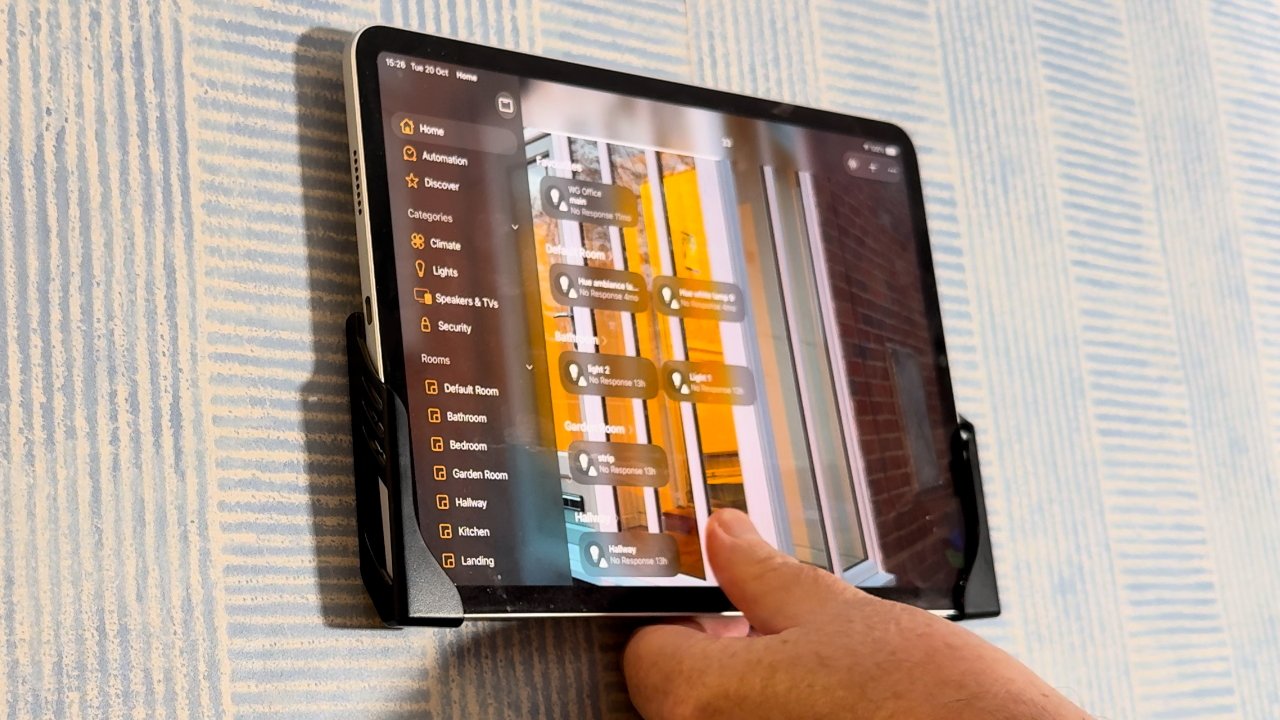
What HomeView does, it does very well, yet there are compromises and so many use cases where an old iPad would do much better. Here’s what you can do to get most of the HomeView experience.

With just two mounting brackets, I can have my iPad Pro on the wall and also readily take it out again when I need.
Apple got it exactly right when it determined that a device that would control your smart home could also be a simple focal point in the kitchen or the den. But Apple is wrong thinking that a static 6-inch square screen is enough for this.
That’s especially obvious to me since I already cook using my 13-inch iPad Pro to display recipes. It’s true that this is far too powerful an iPad to just have sitting there on the counter, but it is exceptionally good at the job.
Continue Reading on AppleInsider | Discuss on our Forums


eMudhra, the certificate authority that issued eight intermediate TLS credentials so weak that anyone could mint certificates for any website or mail server—one had a private encryption key of just 4—said it’s getting out of the business.
V. Srinivasan, chairman of India-based eMudhra Limited, cited increasing costs and complexities of compliance requirements—paired with the business generating just 1 percent of its revenue. He also said that the emergence of organizations providing TLS certificates free of charge further reduced returns on investment when compared to other products and services the company offers.
Don’t let the door hit you on the butt
“However, the level of social media amplification around this incident has brought scrutiny that is out of proportion to SSL/TLS’s place in our business,” the company continued in a Thursday post. “In view of this, after detailed deliberations our board has concluded that withdrawing from global SSL/TLS is the right decision for eMudhra and its shareholders.”
The announcement came two days after researchers revealed eMudhra had issued eight certificates with private keys so defective they were trivial to discover. Anyone who took the time—which was measured in milliseconds—could crack them and then use them to generate TLS certificates that would be trusted by all major browsers, as well as an untold number of email servers, IoT devices, Docker containers, forgotten Linux machines, and unmaintained CLI tools that ship their own copy of the roots.
Whereas NIST P-384 elliptic curve cryptography private keys—used in the type of certificates eMudhra issued—are supposed to contain roughly 384 bits of entropy, the eight compromised certificates had key sizes ranging from 3 to 8 bits. Stated differently, whereas there are supposed to be 2384—a number with 116 digits—different key possibilities, the strongest of the defective keys had a maximum of just 256. The private keys were 4, 56, 66, 115, 155, 156, 230, 237.
Why Buy a Soundbar in 2026?
While TV makers have made progress in the past few years in improving the sound of built-in speakers, the physics involved present a challenge. Slim TVs lack the cabinet volume needed for low bass reproduction and the TV screen itself limits the placement and size of internal speakers. Soundbars offer a compelling solution as they can concentrate on providing better sound, while also allowing expansion to discrete multi-channel immersive sound, with no speaker wires or separate A/V receiver required.
But there is a trade-off: getting rid of speaker wires and a separate A/V receiver means that each speaker needs its own power cable, and the width of the front soundstage is still limited (in most cases) by the dimensions of the soundbar itself. It also means that the height effects, critical to immersive sound formats like Dolby Atmos, Eclipsa Audio and DTS:X, are served either by virtualization (simulated height) or by up-firing drivers which bounce sound off the ceiling. While both of these solutions can work reasonably well in the right room, they don’t compare with the discrete height speakers of a traditional wired, component based surround system.
Alternative solutions have emerged that allow customers to get a wider front soundstage by placing speakers on either side of the TV, while still maintaining the set-up simplicity of a wireless system. Sony’s BRAVIA Theater Trio and Quad are examples of this, as are LG’s Sound Suite and TCL’s Z100 wireless speakers, both of which use Dolby Atmos FlexConnect technology to allow customers to choose anywhere from one to five speakers for their room, with a wireless connection from the TV and built-in calibration software to optimize the sound.
But the appeal of a simple one-piece or two-piece soundbar system is hard to deny. Plug in a single HDMI cable from the TV to the bar and provide power to each speaker and you’ll instantly improve the sound of anything you watch on TV. Good soundbars also integrate with music streaming services so you can enjoy high quality sound from music, podcasts or audiobooks when the TV is off.
In 2026, we’ve seen and tested updated soundbar models from Sony, Samsung, Sonos, Bose, Nakamichi and Bluesound. High-end speaker maker Focal also introduced its first soundbar-like product (but don’t call it a soundbar). The Focal Mu-so Hekla wireless speaker can create convincing surround sound with solid bass from a single one-piece speaker that sits on a shelf or credenza below your TV. Our review of that product will be coming soon. This year LG introduced its first soundbar with Dolby Atmos FlexConnect built in (the H7), which is capable of adding up to five additional wireless speakers (including two subwoofers), for maximum immersive surround. But that model is not eligible for an award as we haven’t reviewed it yet.
Methodology
All of the soundbars and soundbar systems selected as “eCoustics Editor’s Choice” for 2026 were reviewed hands-on by our experienced staff of tech journalists. We tested all soundbars standalone, and with optional subwoofers and rear speakers, when possible. We used a wide sampling of content including movies, TV shows and music in both stereo and spatial audio formats like Dolby Atmos. In addition to sound quality (which is paramount), other factors including ease of use and set-up, ergonomic design and usability and aesthetic design were considered. Without further ado, here are our picks for best soundbars of 2026.
Sonos Beam Ultra
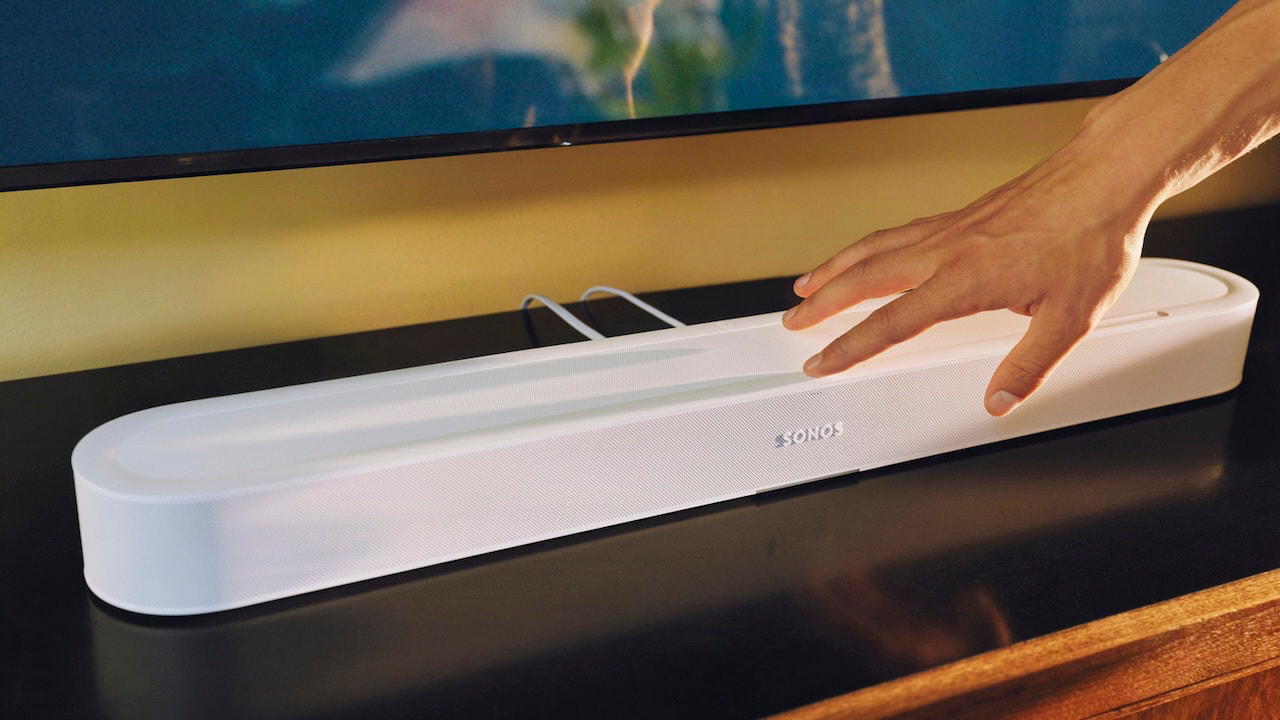
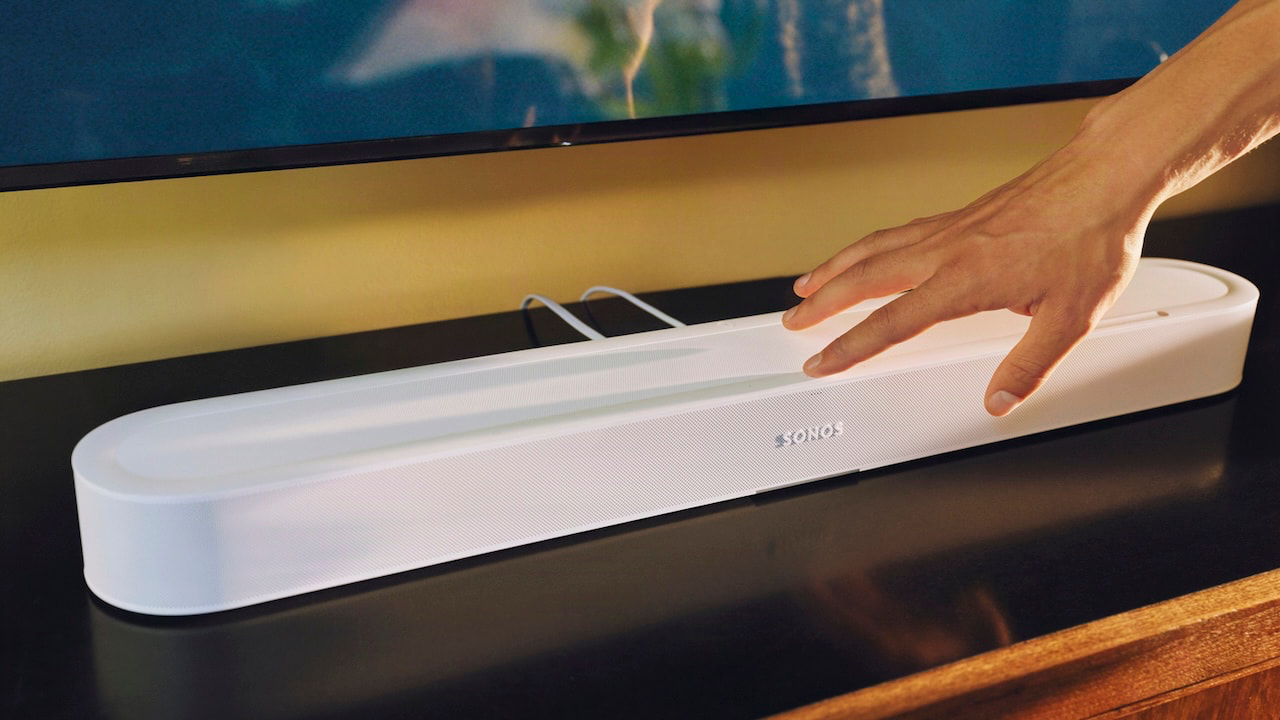
The Sonos Beam Ultra ($699.99) is the newest Sonos soundbar for 2026, available in white or black finishes. At just under 30-inches wide it delivers better immersion and more mid-bass punch than you’d expect for its size thanks to more power and more speaker drivers than its predecessor (the Sonos Beam), including two new up-firing reflective height channel speakers. And, for the first time, Sonos allows its portable wireless speakers, including the Play and Move 2, to be used as surround speakers. This means you don’t actually need power cords in the back of your room to get discrete rear sound effects. You will need to recharge these speakers occasionally though, as their built-in batteries don’t last forever. But while they’re not in use as surround speakers, you can take them to the backyard or the beach for music on the go.
The Beam Ultra can also work with the Sonos Ace Ultra headphones to swap sound from speaker to headphones with the touch of a single button, while still maintaining a spatial Dolby Atmos immersive soundstage, complete with head tracking.
Why We Picked It: The Sonos Beam Ultra provides high quality surround sound in a compact, fairly affordable package, works seamlessly within the robust Sonos ecosystem and app and can be upgraded to true discrete multi-channel surround with solid bass if you add an optional subwoofer and rear speakers.
Where to Buy:
Samsung HW-Q990H Soundbar System

At $1,999 MSRP, the 4-piece Samsung HW-Q990H is the company’s flagship soundbar system for 2026. Unlike unlike some competitive models, the HW-Q990H comes with everything you need in the box: the soundbar, a pair of rear channel speakers (with up-firing drivers) and a surprisingly capable compact dual 8-inch subwoofer. The nearly 49-inch wide soundbar can process up to 11.1.4 channels of immersive audio, routing sound to each of the 23 separate speaker drivers. In real world testing, we found that the Q990H was the best soundbar we’ve tested at creating an immersive dome of sound with seamless motion and few audible dead spots around the room.
We love that it supports not only Dolby Atmos and DTS:X immersive surround, but also the new Eclipsa Audio format which is beginning to gain traction on YouTube. Also, with three HDMI ports (compared to competitive products with only one or two HDMI ports), the Q990H offers maximum flexibility and can work well even with older TVs or TVs with limited audio passthrough options. It performs well with both movies and music and its compact design won’t draw too much attention to itself.
Why we picked it: At a street price of around $1,500, the HW-Q990H system offers a simple, yet great-sounding upgrade to any TV or projector, and its comprehensive format support ensures future compatibility.
Where to Buy: $1,999 $1,499 at Amazon | Best Buy | Crutchfield
Bose Lifestyle Ultra

The Bose Lifestyle Ultra soundbar ($1,099) works well as a standalone soundbar, but its performance ascends to the next level with the addition of a sub and rear speakers. At a system price of $2,596, the four-piece Bose Lifestyle Ultra system includes a 43.5-inch soundbar, wireless Lifestyle Ultra Subwoofer, and two Lifestyle Ultra Speakers serving as rear surround and height channels, creating a 7.1.4-channel Dolby Atmos configuration. The system supports HDMI eARC, Apple AirPlay 2, Google Cast, Spotify Connect, Wi-Fi, and Bluetooth, along with Bose’s CustomTune room calibration and adjustable SpeechClarity dialogue enhancement.
Why We Picked It: Our testing revealed excellent dialogue clarity, convincing Dolby Atmos height and surround effects, and significantly greater cinematic impact with the subwoofer and rear speakers engaged. The premium design, generally straightforward setup, and strong performance in real-world living spaces make it an excellent choice for buyers who want immersive home theater without an AVR and speaker cables. The occasional app hiccup and lack of DTS support are worth considering, but the complete system delivers an engaging movie and television experience.
Where to Buy:
Canvas HiFi All-in-One Soundbar

On paper, Canvas HiFi ($4,999) is a soundbar with an integrated TV stand and mounting system. In reality, that description sells it short—by a long shot. Its Danish build quality is exceptional, and its sonic performance outclasses every standalone soundbar we’ve heard. Thanks to BACCH 3D technology, the soundstage is so expansive and convincing that you’ll swear there are extra speakers hiding somewhere in the room. There aren’t.
Despite all that scale and theatricality, dialog remains locked dead-center and crystal clear, and the system somehow delivers genuinely chest-punching bass down to 30Hz—without the help of a subwoofer. Great for movies. Great for music. One box. No compromises.
The Canvas HiFi has multiple size and finish options and is optimized for TVs 55 to 85 inches. The company makes a version called the “HiFi Frame” specifically for Samsung’s “The Frame” and “The Frame Pro” TVs, for seamless integration with those models. Also, a larger version (Canvas L), optimized for TVs 65 inches to 115 inches was introduced at the Vienna HiFi show and is expected to begin shipping later this year.
Why We Picked It: The Canvas HiFi’s unique combination of elegant design and rich expansive sound offers an ideal solution for design-conscious movie and music lovers who appreciate great sound but also desire visual simplicity.
Where to Buy: $4,999 at Canvas
Sonos Arc Ultra

Sonos made its name as a pioneer of whole home wireless audio systems. Rather than requiring a custom installer or routing miles of speaker wire all over your home, Sonos offered a simple networked solution allowing music lovers to play their music out loud anywhere in their home via a simple mobile app and wireless ecosystem. 13 years ago, the company launched its first soundbar, and in late 2024, they released their latest flagship soundbar, the Arc Ultra ($1,099).
The Arc Ultra builds on what made its predecessors great, with simple design, high quality sound and the ability to expand into a fully immersive multi-channel wireless surround system. Its main strength is simplicity and integration within the Sonos environment, but it’s no slouch in the sound quality department and does a great job adding impact and drama to movies and TV shows. But it was designed for music first, and it shows when you play back your favorite tunes from your streaming service of choice, either in stereo or immersive Dolby Atmos surround.
The Arc Ultra does well as a standalone soundbar, with good spaciousness and solid bass, but really shines if you add a pair of ERA 300 rear speakers and one (or two) subwoofers. Get ready for a little sticker shock, though: a fully loaded system with Arc Ultra, 2 ERA 300s and 2 Subs will set you back around $3,700, and at that price, you could opt for a pretty nice component-based system, albeit with more effort involved.
Why We Picked It: Sonos offers a robust app and ecosystem for music and movie lovers who want to listen to their content out loud anywhere in the home (and even outside it). The Arc Ultra is one of few soundbars that can hold its own, without any additional speakers, though it comes alive with the addition of optional surround speakers and subwoofer.
Where to Buy:
Theory Audio Design Soundbar System
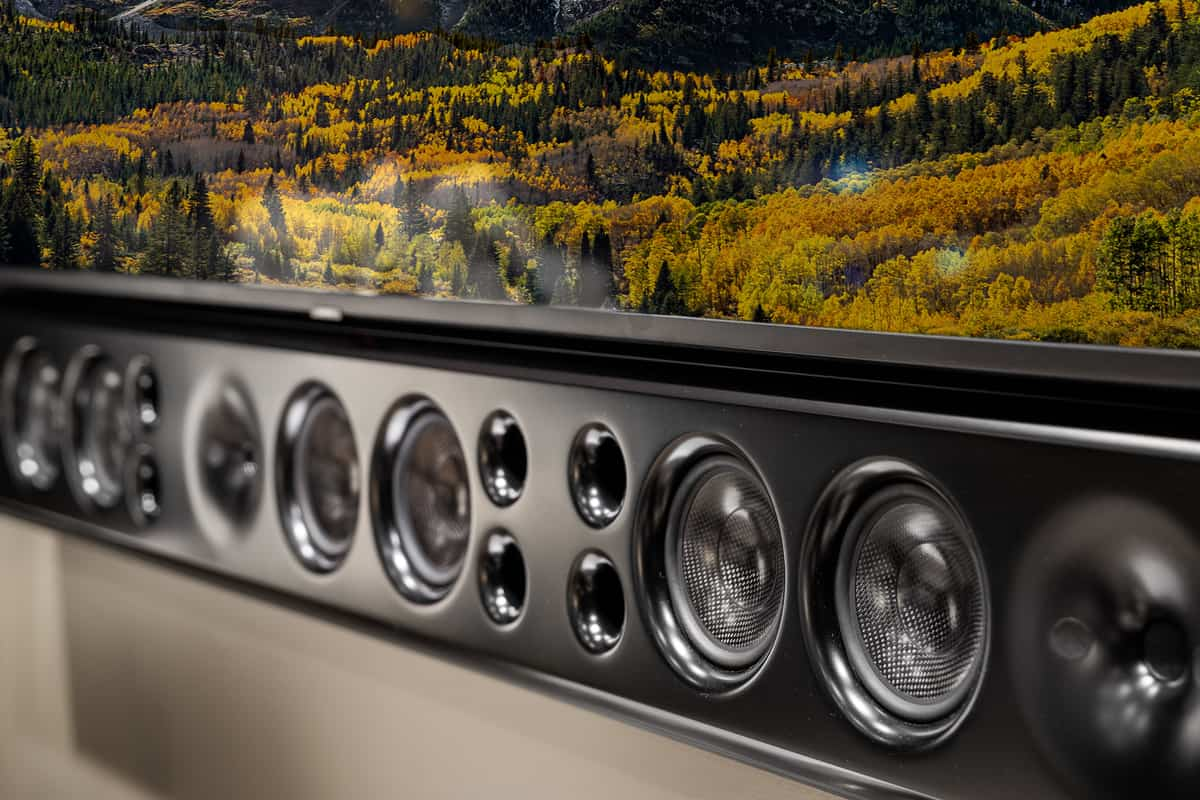
The Theory Audio Design 5.2.2 is a professionally installed home theater system built around a three-channel soundbar, dedicated surround and height speakers, dual subwoofers, and Theory’s amplified loudspeaker controllers with integrated DSP and bass management. The system is modular, allowing installers to tailor the speaker configuration and amplification to the room, although a separate AV processor is required for Dolby Atmos and DTS:X decoding. Unlike conventional wireless soundbar packages, Theory prioritizes neutral tonal balance, excellent dialogue intelligibility, precise imaging, and dynamic range without sacrificing detail or control.
Why We Picked It: In more than two decades of reviewing home theater equipment, few systems have delivered the sense of scale and emotional involvement that the Theory 5.2.2 achieved. Explosions had genuine physical impact without overwhelming the rest of the soundtrack, while quieter scenes revealed subtle ambient details that made films and television dramas feel more believable. It wasn’t simply about playing louder; Theory demonstrated how convincing cinematic sound can fundamentally change the viewing experience.
Priced from $10,398 for a 5.1 system at Theory Professional
The Bottom Line
No longer just a poor man’s cheap fix to bad TV sound, sound bars and similar products have expanded to provide comprehensive sonic solutions for virtually any budget and lifestyle. Where you’re looking for something simple and easy to set-up or something more robust and expandable, there is likely a soundbar system out there that will serve your audio needs.
Related Reading

Apple’s flagship Champs-Elysees store will remain closed Saturday as the company suspends retail operations across Paris ahead of planned protests.

Apple Champs-Elysees | Image credit: Apple
Apple will close seven French stores on Saturday, October 24, as Paris prepares for further protests following last weekend’s violence. The closures include all three Apple stores within the French capital, while shopping center locations around Paris are expected to remain open.
The Paris closures affect Apple Champs-Elysees, Apple Opera, and Apple Marche Saint-Germain. All three stores will reopen Sunday with limited hours, from noon until 6 p.m.
Continue Reading on AppleInsider | Discuss on our Forums

Thousand-outlet Chinese chains are opening up shop fast in Singapore
Luckin Coffee opened its 100th Singapore store in Sept, just three years after entering the market with two. When you step into a mall, a Mixue or Chagee seems to be just a few shopfronts away. A mala or hotpot restaurant might occupy a space where a familiar local name used to be.
It’s easy to see why the “Chinese takeover” narrative has taken hold, and why Chinese brands are being blamed for rising rents and the closure of local eateries.
But what do the numbers actually tell us? And what can’t they?
Chinese-owned businesses make up only 3% of Singapore’s retail sector

In a written parliamentary reply in Jan, Deputy Prime Minister and Trade and Industry Minister Gan Kim Yong gave an official breakdown of retail businesses by ownership.
Of the 45,631 registered retail entities as of Jan 8, 2026, 40,931 (89.7%) were Singapore-owned. Businesses owned by China, including Hong Kong, came second at 1,390 entities, or 3%, just ahead of Malaysia (432) and India (427), which each accounted for 0.9%. Ownership is decided by whoever holds more than half of a company’s shares.
In a separate reply in Jul, MTI said locally owned enterprises still make up about 90% of the F&B and retail sectors.
There’s a catch, though. These figures count registered entities, not outlets, and one company can run dozens of stores.
Luckin, for example, had 103 stores in Singapore as of Sep. NUS real estate professor Sing Tien Foo made the same point to Lianhe Zaobao: chains use their scale to open many outlets, so their presence in shopping centres is far bigger than their share of entities suggests.
Which is why the more useful question is what’s actually inside the malls.
Inside the malls, Chinese brands’ share has doubled

Official data on mall tenants is harder to come by. MTI said in a Feb parliamentary reply that it does not collect information on tenant profiles in privately owned or REIT-owned malls, as tenant mixes are commercial decisions made by landlords and tenants.
So there is no official mall-level figure, and the best numbers come from journalists who counted for themselves.
The most thorough is Mothership’s analysis published in late Sep. It shortlisted 26 malls, from ION Orchard and Plaza Singapura to Jurong Point and Hougang Mall, and compared each one’s 2023 directory with its 2026 directory, noting where every tenant brand came from.
Across all 26 malls, Chinese brands held 254 tenancies in 2026, or 4.97% of the total, up from 122 (2.46%) in 2023. That is a doubling in three years, and all but one of the malls (Compass One) saw an increase. The writer said they had expected a figure closer to 15%.
Singapore brands, though, were not the ones giving way. Their share held steady at about 66% in 2026, with the count rising from 3,260 to 3,366.
In addition, the Chinese retail share seems orchestrated, with a sizable decline coming from other foreign brands: American tenancies fell by 22%, Hong Kong by 35%, Australian by 15%, and Taiwanese by 6%. Nonetheless, these American (6.36%) and Japanese (5.97%) brands still hold a larger share of mall tenancies than Chinese brands today.
Eatbook’s smaller count lands in a similar place. It sampled three high-footfall malls in each of Singapore’s five regions in May, counting only F&B chains that originated from mainland China, and found they averaged 5.6% of outlets.
Some malls sit far above that, like Grantral Mall @ Clementi, where seven of the 12 F&B listings on Google Maps appeared to serve mainland Chinese food, though some seem to be locally founded.
However, it’s crucial to note that tenancies are not the same as floor space.
As Mothership points out, a large Haidilao flagship, like its JCube outlet spanning six units, can create a bigger impression than a small-format stall.
The growth feels bigger than it actually is

Chinese brands may still make up a small slice of Singapore’s retail scene, but their rapid expansion is hard to miss.
Across Singapore, some 85 Chinese F&B brands were running around 405 outlets as of Aug 2025, more than double the 32 brands and 184 outlets a year earlier.
Chains that have grown fastest. Mixue went from 10 outlets in 2023 to 38 outlets today. Luckin Coffee, meanwhile, entered Singapore’s mature and highly competitive coffee market relatively late, but expanded from 31 outlets in 2025 to 103 by Oct 2026, attracting nearly two million app members locally.
And since returning to Singapore in August 2024, Chinese tea chain Chagee has also grown to 46 outlets as of Aug 2026.
Such fast growth from a small base is exactly what makes the Chinese retail trend feel like an invasion. New openings draw queues and social media attention, and these tend to land in high-footfall spots. The South China Morning Post reported that observers warn public perception of the retail scene can be skewed for this reason, since chains like Chagee and Luckin sit where the crowds are.
Mothership offers three reasons the share feels bigger than it is.
Many Chinese brands have distinctive names, Mandarin signage and typography, so their origin is obvious, whereas McDonald’s or Starbucks read as generically global. Some arrive with large flagship spaces, and some of the same chains tend to repeat across mall after mall.
Singapore has seen similar waves before. Ernest Tan, a lecturer at Singapore Polytechnic’s School of Business, told Channel NewAsia (CNA) that a wave of Japanese restaurants arrived about 20 years ago, followed by Korean ones. He expected Chinese openings to eventually plateau, and perhaps even decline.
What about rents?

One of the biggest concerns behind the “Chinese takeover” narrative is that these brands are outbidding local businesses for retail space, driving up rents and squeezing homegrown operators out.
Andy Hoon, chairman of the local business group Bosses Network, told CNA that when a local tenant offers S$36 to S$38 per sq ft in a market where S$30 to S$40 is expected, a Chinese brand might offer S$45. Knight Frank’s head of retail Ethan Hsu said large-scale Chinese investment has contributed to rising rents in high-traffic locations.
But the same CNA coverage also reported that Chinese brands denied paying higher rents, and that analysts described what was happening as market dynamics.
We looked at why some of these brands can afford to do this in an earlier piece: large chains such as Luckin Coffee may have greater financial resources to support their overseas expansion, giving them an advantage over smaller operators.
Moreover, the market-wide data doesn’t show a rent spike either. Savills’ basket of prime suburban malls was unchanged at S$14.90 per sq ft a month in Q2 2026, while Orchard Road malls inched up 0.3% to S$23.70. CBRE data cited by EdgeProp put islandwide prime rents up 0.4% quarter-on-quarter in Q2, and 0.9% for the first half.
At the same time, islandwide private retail vacancy rose from 6.4% to 7.0% in Q2, according to URA data, as store closures opened up more space in the market.
These figures do not rule out Chinese brands bidding up rents in particular malls or high-footfall locations. But they offer little evidence of a widespread rental surge driven by Chinese chains. The picture is more complicated than a simple story of foreign brands outbidding local businesses across the board.
The squeeze is mostly about costs

However, what the data does show clearly is how hard it is to run an F&B business here. A total of 3,047 F&B businesses shut down in 2024, the highest figure since 2005, according to Knight Frank.
The closures have not been limited to small local players, either. Local restaurant group Crystal Jade is now down to nine restaurants after another round of closures.
That timing is part of why the two trends get conflated. Chinese brands are expanding in the same stretch that local F&B is struggling, so one looks like the cause of the other.
In reality, high rent and manpower costs are hurting nearly everyone, and the brands that cope best are those with scale.
Luckin Coffee and Mixue, for instance, control much of their own supply chain, which lets them absorb cost pressures that a single-outlet operator can’t.
But it’s important to note that not all Chinese brands are immune to Singapore’s brutal F&B pressures. Haidilao closed its Clarke Quay flagship in Aug 2025, after earlier shutdowns at Downtown East and Bedok Mall, citing labour costs, locations and rental pressures.
So are Chinese brands taking over?
Not by the numbers we currently have. They own about 3% of registered retail businesses and hold just under 5% of tenancies across 26 malls, behind American and Japanese brands, while Singapore brands hold about two-thirds.
Nonetheless, the shift to a stronger Chinese presence in our retail scene is very much obvious.
Their mall share has doubled in three years, many backed by deep-pocketed parent companies, and they cluster where shoppers look first. That is why it feels like there’s a Chinese takeover even when there might not be one.
- Read other articles we’ve written on Singaporean businesses here.
Featured Image Credit: Molly Tea, Strike Gundam via Google Reviews, Sentosa, Entree Kibbles
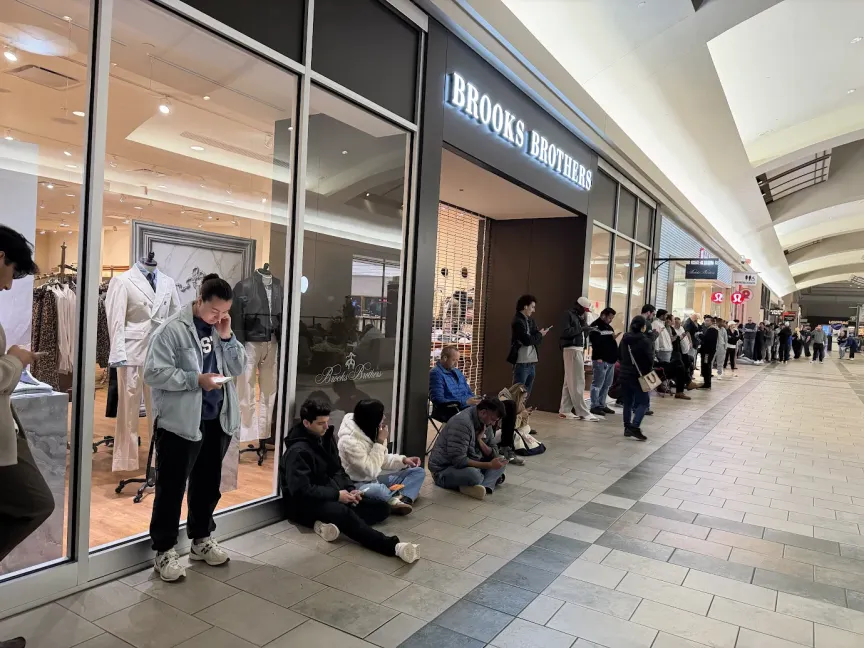
Apple’s causing a commotion with its new iPhone Duo.
The tech giant’s first foldable phone hit shelves Friday, and lines were forming (and selling out) well before Apple stores even opened. Many preordered the phone, but that didn’t stop people from trying their luck to buy one without an order number. CNET editors and reporters were on the ground to bring you all of the uproar, so you can save yourself the trip if you were trying to buy one over the weekend.
At Apple’s flagship 5th Avenue location in New York, the line started forming on Wednesday by 9 a.m. ET — two days before the launch. Over 50 people were waiting in line by Thursday at 7 p.m. ET, sometimes with buckets serving as placeholders. In the first minutes after the store opened, there was no word that the iPhone Duo had sold out yet, but other stores were sold out before their doors opened.

At the Oxmoor Center in Louisville, Kentucky, the Apple store opened at 8 a.m. EDT, and CNET’s Faith Chihil saw a line of more than 40 people three hours earlier. At about 7:27 a.m. ET, Apple store employees started taking orders for the phone. But the 256GB iPhone Duo was already sold out.


CNET Editor in Chief David Katzmaier reported that the first person was in line at Walt Whitman Shops in Huntington, New York, on Thursday at 10 a.m. ET, and was able to preorder the phone. Apple store employees started taking orders to pick up the phone at 7 a.m. ET. But by 7:30 a.m. ET, the rest of the line was dismissed after an announcement that the store had sold out before doors opened.
CNET’s Patrick Holland reported from Apple’s Union Square store in San Francisco. The first people started forming a line at 9:30 p.m. ET on Thursday. As of 11 a.m. ET, lines were down the block and around the building. There were also some sightings of people reselling the iPhone Duo just moments after waiting in line to buy one.

Meanwhile, at the Apple store at University Village in Seattle, about 180 people were waiting in line who didn’t preorder the iPhone Duo. It sold out within 15 minutes of the store opening.
While many may have expected new Apple CEO John Ternus to be at the New York flagship store, he debuted the iPhone Duo launch at the Apple store in Austin, Texas. He might have been there because of this weekend’s Formula 1 race in the city — streaming on Apple TV.
iPhone Duo buyers had ‘one more thing’ waiting at pickup
Apple is full of surprises. In line with the company’s “one more thing” tagline, those who preordered the iPhone Duo had a surprise awaiting them at unboxing.
Apple’s usual “Hello” welcome screen included their name when they first turned on the phone. It’s clearly a special detail the company thought of before today, and it’s the first time it has customized its usual welcome screen for customers.

The iPhone Duo, Apple’s long-awaited first foldable iPhone, debuted earlier this month alongside the iPhone 18 Pro Max. It features split-screen capabilities, a photo preview display, Touch ID instead of Face ID and Apple Pencil support. The iPhone Duo’s preorders opened on Oct. 16, but quickly turned into a backlog that stretches into early next year. Pricing starts at $1,999.
“Details like the matte inner display, under-display inner camera and smooth transitions between screens give the Duo a premium feel that helps to justify its high price tag, at least to some extent,” CNET’s Abrar Al-Heeti said in her review of the iPhone Duo.
The Duo, Al-Heeti said, “is a foldable experience that feels cohesive, intuitive and genuinely useful, which could help win over more people to foldables in general. But I think that broader appeal is still a ways off.”
We don’t know how many iPhone Duos are available at each store or when Apple will restock its physical locations. But there’s a limit of two iPhone Duos per person, per day, which marks the first time in a long time that Apple’s put a cap on how many you can buy.
If you’re set on getting the phone, try ordering on Apple’s website and picking it up at a nearby store to get the phone sooner, but you’ll need to check availability on Oct. 24. It could be sooner than its estimated shipping times that say the phone won’t arrive until Jan. 29 in some areas.


Revival Rugs Birthday Sale: 20 Percent Off Sitewide Through Sunday

VIVIANCHAN Was A Lesson In Light & Layers At The Bomb Fashion Show LA

Michelotto Gruppo 4 Tributo Crafts a Lightweight V8 Manual Tribute to the Rally 308


-

 Fashion6 days ago
Weekend Open Thread: Kut from the Kloth
-

 Tech & AI7 days ago
Double Fine’s First Post-Xbox Title, First-Person Soulslikes And Other New Indie Games Worth Checking Out
-

 Tech & AI7 days ago
Hackers breach Microsoft 365 tenants via ConnectWise supply-chain attack
-

 Tech & AI6 days ago
Replit is no longer working with Anthropic, CEO says
-

 Entertainment6 days ago
Britney Spears Praises Janet Jackson In Heartfelt Message
-

 Tech & AI7 days ago
NeodraDynamics Neo1 Rises Thirteen Feet High to Carry Half Ton Loads at Work
-

 Business & Hustles7 days ago
25 Videos You Can Film This Week
-

 Tech & AI6 days ago
Turning A Wi-Fi Adapter Into An SDR
-

 Tech & AI4 days ago
Seattle ag-tech startup Carbon Robotics reduces workforce, citing economic conditions
-

 Tech & AI6 days ago
Intel Nova Lake processors could ditch three-digit names for Core Ultra 4000 branding
-

 Tech & AI7 days ago
Making One Fender From Another
-

 Tech & AI7 days ago
Does More RAM Make a Laptop Faster? Check Before Buying
-

 Crypto7 days ago
Bitcoin Faces Quantum Computing Threat: 30% at Risk
-

 Tech & AI6 days ago
Amazon’s new Bee AI devices have a bystander problem, says former AWS security engineer
-

 Entertainment5 days ago
David Pollack Reveals ‘Stunning’ Update About Wife’s Brain Cancer
-

 Tech & AI6 days ago
T+A Solitaire T Pro Adds Dolby Atmos and aptX Lossless But Is It Worth the Premium?
-

 Tech & AI6 days ago
How to watch Fiji vs Cook Islands for FREE: Live stream RLWC 2026
-

 Fashion5 days ago
What I Reach For Every Fall
-

 Tech & AI7 days ago
OPPO Find X10, Find X10 Pro Max India Prices Leaked Ahead of Launch
-

 Fashion6 days ago
Hailey Bieber Brings Ballet Style to Adanola
You must be logged in to post a comment Login