
Crypto
Ethereum Glamsterdam Upgrade Delayed Over Smart Contract Security Risks


Ethereum developers have postponed the Glamsterdam upgrade on the Hoodi testnet after researchers identified potential security risks involving existing smart contracts, leaving the network’s next major development milestone without a confirmed activation date. The decision comes as ETH trades under $2,400, with the token losing around 0.5%.
The Ethereum Foundation announced the delay last night, canceling the Hoodi activation scheduled for October 26. Developers want more time to investigate how proposed gas-accounting changes could interact with contracts already deployed on Ethereum mainnet. No replacement date has been announced for the testnet upgrade, and the mainnet schedule remains undecided.
Ethereum postpones the Glamsterdam upgrade and cancels Monday's Hoodi testnet activation after security developers flagged risks to existing contracts. — lenny
Just another reminder that protocol upgrades can be fragile.
 (@blockchainlenny) October 23, 2026
Ethereum Holds Near $2,400 as Glamsterdam Delayed

ETH price is fluctuating between $2,370 and $2,415. The token is approaching the upper end of its daily range, putting the $2,400 level in focus as traders assess whether the latest gains can hold.
A sustained move above $2,415 could open the door to further upside, while a drop below $2,370 would signal renewed selling pressure and put lower price levels in focus. For now, ETH’s short-term direction will depend on whether buyers can maintain momentum and how the broader crypto market performs.
The Ethereum Glamsterdam delay adds another factor for traders to watch, particularly if uncertainty around the upgrade timeline persists. However, the postponement alone does not establish a bearish outlook for ETH. Attention will remain on price momentum, market demand, and further updates from Ethereum developers as the next testing milestone approaches.
Discover: The Best Token Presales
Delay Leaves December Timeline Uncertain
The postponement also raises questions about the broader Ethereum Glamsterdam rollout timeline. Developers had discussed potential December activation dates for mainnet, but the schedule had not been finalized. With the Hoodi test now delayed, those possible dates should not be treated as confirmed launch targets.
Hoodi testing is an important step in checking how the upgrade behaves before developers decide when to deploy it on mainnet. The canceled activation also removes a planned increase in Hoodi’s gas limit to 200 million, which had been scheduled alongside the upgrade.
The Ethereum Foundation has not announced a replacement Hoodi date. Developers must first investigate the reported compatibility issues and determine what changes, if any, are needed before the next activation can proceed.
For ETH traders, the uncertainty creates a new development milestone to follow rather than a confirmed change to the network’s mainnet operations. A prolonged delay could keep attention on the upgrade’s readiness, while a revised testing schedule would provide a clearer timeline for the next phase.
Smart Contract Security Concerns Trigger Ethereum Glamsterdam Delay

The immediate issue involves EIP-8037, a proposal that changes how Ethereum accounts for gas costs associated with creating blockchain state. Researchers have raised concerns about how the proposed changes could interact with existing smart contracts, particularly those that rely on specific gas limits when handling failed operations.
Security firm ChainSecurity identified scenarios in which the proposed gas changes could leave contracts with different amounts of gas than expected. That could affect how certain applications handle errors, potentially causing operations to fail or behave differently from their original design.
The findings matter because deployed smart contracts may continue operating under assumptions established before the upgrade. Changes to gas accounting can therefore create compatibility problems even when developers are not deliberately changing an application’s underlying logic.
Ethereum’s decision to postpone the Hoodi activation gives developers additional time to investigate those interactions before proceeding. The delay is specific to the Hoodi testnet and does not mean the Glamsterdam upgrade has been canceled.
Glamsterdam remains part of Ethereum’s development roadmap, with proposed improvements including enshrined proposer-builder separation and block-level access lists. For now, the immediate focus is on resolving the security concerns, rescheduling Hoodi testing, and establishing a clearer path toward mainnet activation.
Discover: Best Crypto IPOs This Q4
The post Ethereum Glamsterdam Upgrade Delayed Over Smart Contract Security Risks appeared first on Cryptonews.


U.S. spot Bitcoin funds have swung from $524.8 million in net inflows on October 21 to $635.6 million in outflows on October 22, followed by another $137.9 million in withdrawals on October 23.
Summary
- U.S. spot Bitcoin ETFs took in $524.8 million on October 21 and lost $635.6 million the next session, according to Farside.
- Another $137.9 million left the funds on October 23, based on Farside’s latest displayed fund entries.
- The October 19 to 23 total remained positive at $301.2 million despite two consecutive withdrawal days.
- BlackRock’s IBIT and Fidelity’s FBTC accounted for $471.6 million of the October 22 outflow.
- The SEC has permitted in-kind Bitcoin redemptions since July 2025, so an ETF withdrawal need not trigger an immediate fund sale.
Farside Investors’ fund-by-fund table shows the turn across BlackRock, Fidelity, Ark Invest and other issuers, but it cannot identify the buyer who took the other side of a Bitcoin sale.
An investor can sell an ETF share to another investor without a coin changing hands. A market maker can carry shares for a time, or an authorized participant can redeem a block of them for cash or Bitcoin. Only some of those routes require an immediate sale in the underlying market. The daily flow total combines the result at the fund level and leaves the trading path mostly out of view.
Bitcoin traded around $80,000 to $82,000 as the withdrawals arrived. The fund withdrawals coincided with a lower Bitcoin price. Neither figure shows whether $773.5 million worth of coins was sold on public exchanges over those two days. The issuers’ redemption procedures, the timing of hedges and the identities of eventual Bitcoin buyers determine how much pressure reached spot trading.
Two days erased most of a three-day inflow run
Farside recorded $526.7 million entering U.S. spot Bitcoin products on October 19, $23.2 million on October 20 and $524.8 million on October 21. Over three sessions, the funds added $1,074.7 million. Outflows of $635.6 million on October 22 and $137.9 million on October 23 removed $773.5 million, or about 72% of the previous three sessions’ gains. Subtracting the two amounts leaves a $301.2 million net inflow for the five sessions. The arithmetic uses Farside’s rounded daily dollar totals; the October 23 row still displays a dash for one issuer and can be revised.
The change between Wednesday’s $524.8 million inflow and Thursday’s $635.6 million withdrawal was a $1,160.4 million swing in the daily net flow. It was not a $1.16 billion redemption. SoSoValue put October 22 outflows at $635.49 million and October 21 inflows at about $528.4 million in crypto.news coverage of the price decline. Farside’s figures differ slightly, so the five-session calculation here uses Farside throughout.
BlackRock’s IBIT posted a $254.1 million outflow on October 22 and Fidelity’s FBTC lost $217.5 million, Farside’s table shows. Their combined $471.6 million made up about 74% of the day’s net withdrawal. Ark Invest and 21Shares’ ARKB lost $109.4 million, Bitwise’s BITB lost $27.4 million and Grayscale’s GBTC lost $29.5 million. Morgan Stanley’s MSBT had a $2.3 million inflow. A net figure can therefore conceal simultaneous inflows at one fund and redemptions elsewhere.
IBIT lost another $110.3 million on October 23, while FBTC lost $31.8 million. Morgan Stanley’s fund added $4.2 million. A negative daily total tells readers which fund shares were removed after creations and redemptions were netted; it says nothing on its own about the identity or motive of an investor selling shares in the open market. Institutional portfolios, retail accounts, arbitrage desks and market makers can all trade the same shares.
Bitcoin failed to hold a move toward $85,000 during the three-day run of ETF inflows. Lookonchain and Farside then published different daily tallies for the period. Lookonchain’s graphic labeled its figures October 22 without identifying a completed U.S. session, while Farside’s October 21 row listed $524.8 million. The two figures refer to differently labeled reporting snapshots.
An ETF share can change hands without a Bitcoin trade
An ordinary investor sells ETF shares through a broker. A buyer acquires those shares on the stock exchange, and the fund’s Bitcoin balance does not change simply because the trade occurred. The secondary market can process heavy selling if another investor, a dealer or a market maker is willing to hold the shares at an acceptable price.
The next question is what the buyer does with them. A market maker may sell its inventory to someone else, hedge Bitcoin price exposure with derivatives or assemble enough shares to redeem a basket. Authorized participants, the financial firms that deal directly with the trust, can submit those baskets and receive the specified redemption proceeds. Several participants may serve a fund, and a single participant can act for multiple clients. The route from an investor’s sell order to a redemption is therefore neither automatic nor visible in a daily ETF flow table.
BlackRock’s IBIT prospectus filed with the SEC says only authorized participants can redeem baskets. Its trust can make redemptions using partial cash, all cash or, at the sponsor’s discretion, Bitcoin in kind. The document says the choice can depend on participant capabilities and preferences as well as tax considerations. A shareholder who is not an authorized participant cannot demand Bitcoin from the trust directly.
A $100 million IBIT share sale to another investor would raise trading volume without changing the trust’s Bitcoin holdings. No basket needs to be redeemed in that exchange transaction. Shares outstanding can fall if an authorized participant later gathers a basket and returns it to the trust for redemption proceeds. Even then, the proceeds may be Bitcoin or cash, and the counterparty’s next trade is not disclosed by the daily flow number.
Existing ETF shares represent a claim on a trust that already holds Bitcoin. A trade in those shares does not require the trust to buy another coin. Creations and redemptions change the number of shares and the corresponding assets. Secondary trading transfers exposure between owners. Confusing these layers turns an observation about who held the security at the close into an unsupported claim about a simultaneous order in a crypto exchange’s spot book.
The redemption route determines where selling occurs
Cash redemptions and in-kind redemptions can produce different immediate trades. With an all-cash redemption, a trust needs cash to pay the authorized participant and may instruct an execution agent to sell Bitcoin. The execution, its venue and its timing are separate from the public tally of share redemptions. With an in-kind redemption, the trust can transfer Bitcoin to the authorized participant or its designated agent. The trust’s wallet balance falls, but the recipient decides whether to hold, sell, hedge or deliver the coins to another customer.
The Securities and Exchange Commission approved in-kind creations and redemptions for spot crypto exchange-traded products in July 2025. Its decision ended the cash-only requirement imposed when spot Bitcoin products first launched in January 2024. The commission described in-kind processing as a way to reduce costs and improve efficiency. Permission to use it does not establish that every fund, on every day, used that route.
Commissioner Mark Uyeda said the former cash-only structure could force issuers to sell Bitcoin to raise redemption cash. In-kind settlement removes that specific forced sale at the trust, though a recipient of the Bitcoin remains free to sell later. Daily flow dashboards do not report how many of the October 22 redemptions were paid in cash, partial cash or Bitcoin.
BlackRock’s prospectus sets an in-kind redemption order cutoff at 2 p.m. Eastern on the trade date. Its other cash and partial-cash orders follow their stated deadlines, and proceeds are generally expected on the next business day after an accepted redemption request. Market makers may begin managing exposure before a basket is submitted or settle positions later. Matching every October 22 withdrawal dollar to a Bitcoin sale during the same New York trading session would ignore those timing differences.
Some funds have revised their procedures since the SEC’s 2025 decision. An in-kind transfer can separate a fund outflow from a same-day Bitcoin sale by the trust. Each fund’s prospectus describes the options it offers, but public daily flow figures do not say which option it used for a particular October 22 basket.
Who could take the other side?
Every executed Bitcoin sale has a buyer, but a public flow number does not label that buyer. If a trust sells coins for a cash redemption, the direct counterparty may be a trading firm, an exchange customer or a dealer filling an institutional order. A dealer can subsequently sell the position to several customers. If the trust delivers Bitcoin in kind, the authorized participant receives the coins first and can keep them as inventory, use them to cover a hedge, pass them to another client or sell them. The eventual buyers may not transact at the same hour as the ETF redemption.
Price is part of how those counterparties meet. At a quoted price, bids may be insufficient for a seller’s desired size; the next available bids sit lower. A trade clears when a buyer accepts the offered amount and the seller accepts the price. A $635.6 million fund outflow does not tell us how many coins, if any, were offered through public order books, or how deep those books were at each moment. It cannot by itself assign the whole Bitcoin price move to one class of seller.
Glassnode’s October 21 market study described buying around $80,000 to $81,500 after an October 15 dip. Its analysts placed the estimated cost basis of U.S. spot ETF holdings and corporate treasury holdings in that region, with potential selling and liquidation clusters between about $85,000 and $87,500. A cost basis is an average calculated for a cohort, not a standing bid from every member of the cohort. The research showed where buyers had previously appeared; it did not identify who bought the October 22 or 23 redemptions.
The same study cited an October 19 ETF inflow of $653 million on thin volume, a different number from Farside’s $526.7 million for that day’s fund table. The discrepancy appears in published datasets and should not be smoothed away. Provider coverage, preliminary timestamps or methodology may differ; neither source offers transaction-level identities for the buyers on the other side. The five-session calculation in this article consistently uses Farside.
Direct spot demand can come from private clients, exchange users, corporate treasuries or trading firms arbitraging prices across venues. Their motives cannot be reconstructed from the aggregate ETF totals. The ledger shows transfers between addresses, yet exchange and custodian wallets often pool many customers’ coins. An address receiving Bitcoin is not necessarily a newly bullish investor, and an exchange inflow is not automatically a market sell order.
The case for treating outflows as real selling pressure
Redemptions do remove shares and assets from a fund, and the process can still create selling pressure. Someone who takes Bitcoin in kind might sell it to raise dollars, while a fund paying cash might sell the coins itself. Market makers buying ETF shares from departing investors may hedge by selling Bitcoin futures or spot. Selling and hedging can press on price even when the trades do not line up neatly with a single daily fund-flow print.
Bitcoin’s decline and ETF withdrawals occurred together during October 22 and 23. Bitfinex analysts had warned of liquidation risk as futures open interest grew despite falling prices. The October 23 price report put BTC near $81,450 after a retreat from the $84,000 to $85,000 area and recorded more than $400 million in broader crypto liquidations from CoinGlass. Liquidations can add forced sales or buybacks independently of fund redemptions. Weak technology stocks and other risk assets were moving at the same time, according to contemporary market coverage. The available data do not show how much of Bitcoin’s drop came from ETF redemptions.
Farside recorded $773.5 million in net withdrawals over two sessions. Dealers or other investors had to take on the shares or the resulting Bitcoin inventory as the funds shrank. Demand for fund shares weakened, although the public figures do not show how much Bitcoin funds or market makers sold in response.
An authorized participant can sometimes warehouse coins while seeking another counterparty, but inventory has a cost and risk. A rapidly moving Bitcoin price makes that risk larger. If spreads widen or dealers step back, a sale that might have been absorbed quietly in a calmer market can move through available bids more visibly. The size and capacity of those intermediaries on October 22 are not reported in the fund flow table. Price movement is consistent with pressure, though it does not reveal the identity of its source.
Glassnode recorded buyers near $80,000 after the October 15 dip. Their orders on that day say little about how much they would buy during another selloff. Macro news, liquidations and further redemptions can change the price buyers are willing to pay. The estimated ETF cost basis around that level offers no guarantee that it will hold.
The fund totals hide a mixed week
Thursday’s $635.6 million withdrawal was bigger than Wednesday’s $524.8 million gain, but the preceding Monday added $526.7 million. Friday’s $137.9 million loss then reduced, without erasing, the weekly net inflow. The last two sessions therefore show net withdrawals, while the five-session total shows a net inflow. The choice of window changes the description of ETF demand without telling us how much Bitcoin traded outside the funds.
Farside lists a cumulative $57.251 billion in net inflows to the covered funds in its October 23 table. This historical total is not their current Bitcoin holdings or the amount investors would receive if every share were sold. Asset values move with BTC’s price, and Grayscale’s GBTC alone carries roughly $28 billion in cumulative net outflows in the provider’s series. Cumulative dollars flowing into and out of shares answer a different question from coins held at the custodian or current market value of the shares.
The issuer breakdown complicates any claim that all institutions sold in unison. On Thursday, IBIT and FBTC dominated withdrawals while MSBT gained $2.3 million. On Friday, MSBT gained $4.2 million as the larger funds remained negative. Simultaneous directions can reflect different clients, mandates, fees or execution choices; the table cannot say which explanation applies. It shows enough to rule out a single, uniform trade across all funds.
An ETF share’s discount or premium to its net asset value can signal whether the exchange price and underlying holdings have moved apart. Authorized participants may be motivated to create or redeem baskets when the gap covers their costs, helping align the two markets. A small discount alone does not prove a completed redemption, and a large one may persist if trading or settlement becomes difficult. Issuer price and NAV disclosures are useful alongside fund flows, but they are still not a tape of the authorized participant’s Bitcoin trades.
The 2025 SEC approval gave market participants another way to close those gaps. BlackRock’s current prospectus nonetheless leaves the redemption form to the sponsor’s discretion, and authorized participants have no obligation to submit orders. The daily fund table records the outcome but does not disclose each basket’s settlement method or the authorized participant’s trades.
What price and on-chain data can establish
Market data offer fragments of the answer. Exchange trade records identify the time, price and size of transactions, and some venues report whether aggressive buyers or sellers crossed the spread. Order books show posted bids and offers that can disappear or change before they execute. Neither dataset labels a Bitcoin trade as an IBIT redemption or tells readers whether a market maker is closing an earlier hedge.
On-chain transfers can show coins leaving a known custodian address, subject to the quality of address identification and the custodial settlement timetable. A wallet transfer between a custodian and an authorized participant may represent an in-kind redemption, an internal reorganization or another operational movement. Transfers through omnibus addresses require particular care. Without transaction-level confirmation from the fund or a participant, a matching dollar amount and timestamp are suggestive but not proof.
The ETF’s own holdings, shares outstanding and NAV can provide a more reliable fund-level cross-check. A decline in shares outstanding accompanied by lower Bitcoin holdings is consistent with a net redemption. Comparing consecutive reports needs adjustment for the fund’s fee accrual, pricing timestamp and any other assets or liabilities. The count of coins moved is more informative about trust inventory than a chart of share trading volume, but it still stops short of identifying whoever ultimately bought the coins.
Glassnode’s October study adds the holders’ estimated cost basis, the distribution of on-chain coin ages and areas where leveraged positions may be forced out. Such models describe investor positioning, not individual identities. Its observation that bids refilled near the October 15 low is evidence of buying at that point. It does not prove that those same buyers remained there when October 22’s ETF outflow was announced.
At a hypothetical fixed Bitcoin price of $81,000, Farside’s $773.5 million two-day outflow is equivalent to about 9,549 BTC. The calculation divides $773.5 million by $81,000 and measures scale only. Fund share valuations, fees, cash balances and redemption methods vary, so 9,549 BTC is not an observed count of coins sold.
A buyer’s identity remains private even when the flow is public
Public disclosures can show that Bitcoin left a trust; they generally cannot reveal the names behind every share order and subsequent coin trade. Broker records identify customers to their intermediaries, but those records do not appear in Farside’s aggregate table. Market makers can offset positions across several venues or derivatives contracts. A dealer who receives coins in a redemption may already have a customer order for them, avoiding any visible exchange sale at the point of delivery.
The publicly available October 22 and 23 fund data do not name the buyers. Another investor or a dealer may have bought the ETF shares. If a basket was redeemed, an authorized participant could have received Bitcoin and either held it or sold it to a client or on an exchange. Naming a final buyer would require transaction records or a disclosed trade, neither of which is available in the fund table.
Holding an ETF share and buying a coin are different forms of exposure. One person buying shares from a seller can keep the fund’s Bitcoin where it is. Another can receive Bitcoin in kind from the trust and transfer it without touching a public exchange. Direct buyers at a lower price can absorb a later spot sale. Each route can contribute to the same observed combination of ETF outflows and a falling Bitcoin price, which is why a price chart cannot reconstruct the transaction chain by itself.
Farside’s table will show whether net redemptions continue after the next trading close, subject to corrections. Fund holdings and share counts can show which trusts shed assets. Exchange volume, spreads and the direction of active trades can show how Bitcoin markets responded. Keeping those readings separate preserves the distinction between money leaving an investment product and coins changing owners in the market underneath it.
What to watch
- The next completed fund rows: Check Farside’s issuer entries and any revisions to October 23 before treating the $301.2 million five-session net inflow as final.
- Shares and holdings: Compare each issuer’s shares outstanding, Bitcoin holdings and NAV at consistent timestamps to see whether redemptions changed trust inventory.
- Redemption disclosures: Check current prospectuses and any issuer updates for the cash, partial cash or in-kind methods used; permission to redeem in kind does not establish daily usage.
- Spot liquidity: Watch executed volume and bid depth near $80,000 to $81,500, the area where Glassnode recorded buying on October 15, without treating it as a guaranteed floor.
- Price versus fund demand: Compare completed ETF flows with Bitcoin’s trading range and liquidation data, while keeping other market drivers in view.
FAQ
Did Bitcoin ETFs sell $635.6 million of Bitcoin on October 22?
Farside reported $635.6 million in net fund outflows, not an audited total of Bitcoin sold on exchanges. Cash and in-kind redemptions can send the resulting inventory through different hands and on different schedules.
How much left Bitcoin ETFs over October 22 and 23?
Farside’s displayed totals were $635.6 million and $137.9 million, respectively, or $773.5 million combined. One October 23 issuer entry was displayed as a dash when the figures were reviewed, so the later day’s total could change.
Were Bitcoin ETF flows negative for the whole week?
Using Farside’s October 19 to 23 entries, the three inflow days totaled $1,074.7 million and the two outflow days $773.5 million. The difference was a $301.2 million net inflow across five sessions, subject to any revised fund entries.
Who buys an ETF share when an investor sells it?
Another investor or a market intermediary takes the other side of the stock exchange trade. Only authorized participants can later create or redeem shares directly with a trust in baskets.
What is an in-kind Bitcoin redemption?
An authorized participant returns a basket of ETF shares and receives Bitcoin, subject to a fund’s procedures. The SEC permitted that structure for spot crypto products in July 2025; the participant’s later decision to hold or sell the coins is separate.
Can ETF outflows push Bitcoin’s price down?
They can contribute to selling or hedging pressure when funds or intermediaries dispose of Bitcoin exposure. A daily outflow total alone cannot measure that pressure or separate it from other selling, including derivatives liquidations.
Does the $80,000 cost basis guarantee support?
No. Glassnode estimated that ETF and treasury holders’ average costs sat around the $80,000 to $81,500 area and observed bids after an October 15 dip. An average historical cost and a past episode of buying do not guarantee future demand.
Can public data identify who bought the redeemed Bitcoin?
Public ETF tables, issuer disclosures and on-chain records can narrow the route and measure changes in fund holdings, but they do not generally name the final buyer. A direct answer requires transaction-level information from the relevant fund or intermediary. This is educational analysis, not investment advice.
Disclaimer: This article is for information and educational purposes only and does not constitute financial or investment advice. Figures reflect regulatory filings and reporting available at the time of writing and change with each disclosure. Nothing here is a recommendation to buy, sell, or hold any security or asset. Always do your own research. Information is accurate as of October 25, 2026.
The AI boom is creating huge demand for training data and the expensive computers that power it. Grayscale has identified three cryptocurrencies targeting these growing needs. Their prices, however, tell very different stories.
In an October 23 research note, Grayscale Head of Research Zach Pandl highlighted DATA Network (DATA), USD.AI (CHIP), and Pearl (PEARL).
Each addresses a different part of AI infrastructure, from supplying training data to financing computer chips and earning revenue from computing power.
1. DATA Network (DATA): Selling the Data AI Needs
AI models learn from images, videos, and voice recordings. DATA aims to collect this material with permission, license it to AI developers, and reward contributors.
On October 12, the Sui Foundation announced a $30 million investment in the network. DATA also plans to migrate to Sui, transferring existing tokens one-for-one.
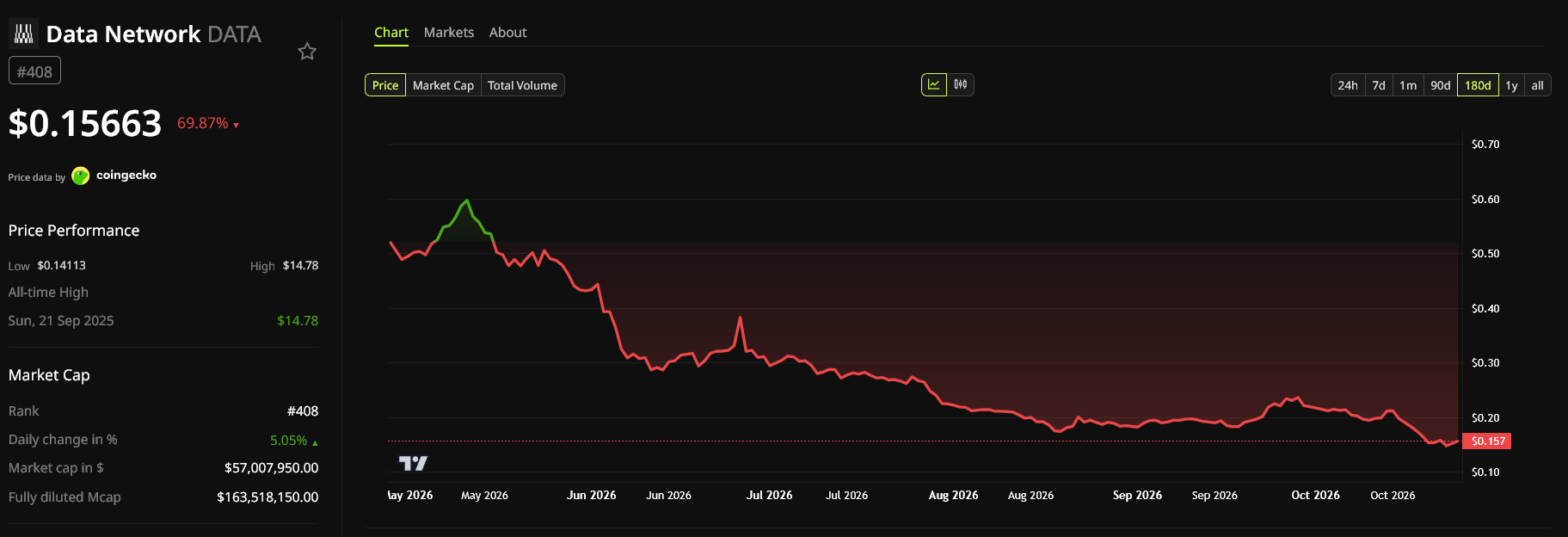
Yet investors have seen little relief. DATA has fallen 42.07% over 90 days to $0.15243, including a 34.65% decline over the past month.

2. USD.AI (CHIP): Financing Expensive AI Chips
AI requires powerful graphics processors, or GPUs. USD.AI helps computing companies borrow money against this hardware and its future income, using blockchain-based lending pools.
In August, Bullish announced a $100 million financing facility supporting USD.AI’s GPU loans.
CHIP has gained 47.98% over 90 days to $0.04386, although it remains roughly 69% below its April peak.
3. Pearl (PEARL): Making GPUs Earn Twice
Pearl proposes using the same computing capacity for AI workloads and blockchain mining. Providers could earn AI revenue while collecting tokens for securing the network.
PEARL is the standout performer, surging 528.24% in 90 days to $2.00. However, it has retreated about 19% from its October 21 record of $2.46.
Supply also poses a risk. Around 1.2 million new tokens are estimated to enter circulation daily, while its $4.2 billion fully diluted valuation far exceeds its $713 million market cap.

Grayscale sees potential in all three projects, although their success remains uncertain.
“Their long-term relevance will depend on adoption and competitive economics. We are keeping an eye on them,” Pandl said.
The post Grayscale Names 3 Cryptocurrencies That Could Benefit From AI Growth appeared first on BeInCrypto.

The US Internal Revenue Service (IRS) is preparing to overhaul its voluntary disclosure program, with plans to reduce penalties and accelerate the resolution of tax violations, including those involving cryptocurrencies, according to a Friday report by Forbes.
IRS Criminal Investigation Chief Jarod Koopman said the agency aims to introduce the revised program before December, with a target of resolving cases within 120 days of taxpayers completing the required submission process.
The overhaul would reportedly not establish a separate disclosure process for digital assets. Koopman told attendees at the UCLA Extension Tax Controversy Conference that the IRS would handle digital assets through the same voluntary disclosure procedures used for other forms of tax noncompliance.
The IRS official also indicated that penalties under the revised program would be substantially lower than those currently imposed, although he did not provide specific figures. The agency is considering allowing taxpayers to settle outstanding liabilities through installment plans or offers in compromise.
The proposed changes would mark a shift from the existing process, which can take a year or longer to complete, according to Forbes. The IRS’s current voluntary disclosure program is intended for taxpayers whose willful failure to comply with tax laws could expose them to criminal prosecution, rather than those who made unintentional reporting errors.
Meanwhile, lawmakers are considering a separate voluntary disclosure program aimed at crypto taxpayers, including those who made unintentional reporting errors. Section 502 of the proposed Digital Asset Tax Certainty Act would establish a process for correcting past violations with defined penalties, unlike the IRS’s existing program, which primarily addresses willful tax noncompliance. The bill cleared the House Ways and Means Committee in September.
American Express (AmEx) said today that it will fire about 5% of its workers as part of a $336 million restructuring.
Despite these massive layoffs, its Q3 earnings report barely nudged its 2026 full year adjusted profit forecast up by a midpoint of 15 cents per share — less than 1% above analysts’ prior midpoint consensus.
AmEx lifted the floor of its adjusted profit range from $17.30 to $17.60 per share while leaving the $17.90 top end of its range unchanged.
Raising that floor moved the midpoint within its new profit forecast from $17.60 to $17.75, a gain of 0.85%.
Analysts expected $17.63 anyway, so AmEx’s new forecast exceeds consensus by a paltry 12 cents.
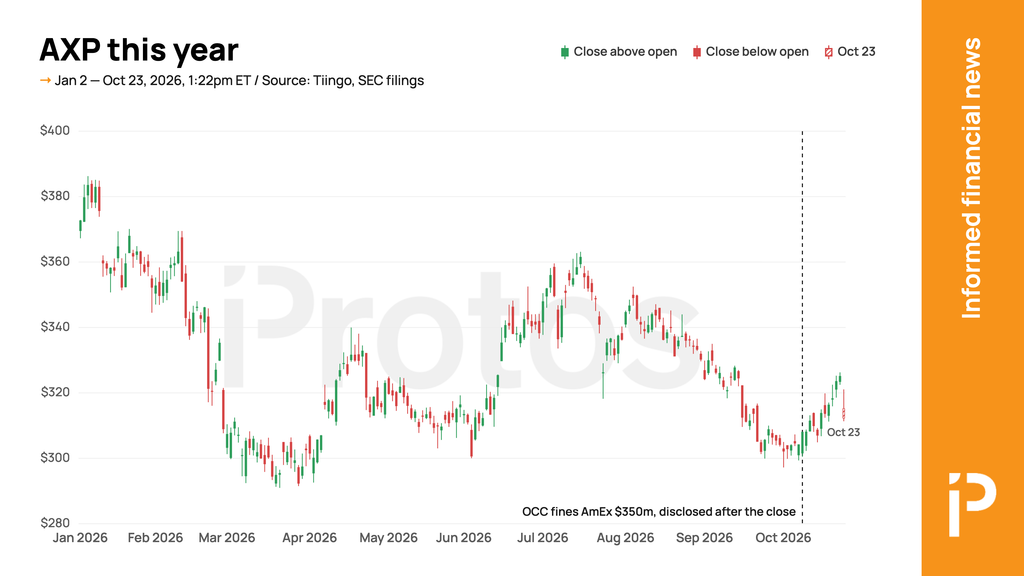
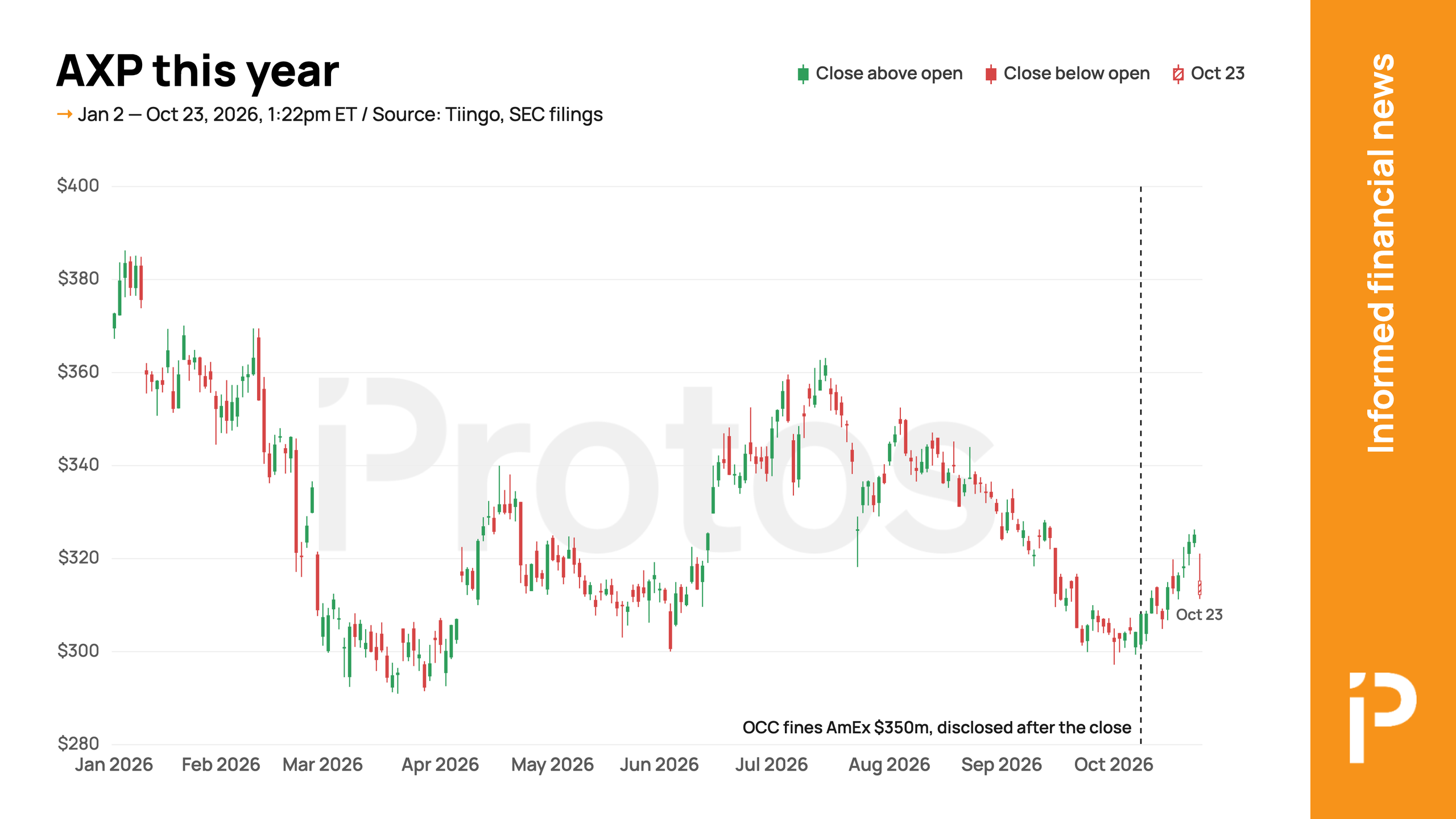
Separately, the credit card company is also dealing with a $350 million penalty for missing $13 billion of suspected money laundering activity.
Disappointed, investors sold down the stock price for AmEx 3.7% by noon in New York trading. Year-to-date, the stock has lost 15% of its value.
AmEx layoffs up 5%, profit forecast up 1%
A one-time cash windfall will help the company to fund separation agreements for layoffs. Specifically, AmEx has booked a nearly $1 billion pretax gain on selling its stake in Global Business Travel, more than offsetting its $336 million restructuring charge.
During the earnings call, CEO Stephen Squeri boasted that the company is “dropping two thirds of the gain to the bottom line.”
CFO Christophe Le Caillec told CNBC the cuts make AmEx “leaner, more agile, and also to prepare for AI.” The plan is to “reduce layers and increase spans of controls.”
Fewer managers will oversee more staff, so AmEx can “automate and take advantage of AI,” the executive claims.
Read more: Bank of America hit with $1.2B fine after missing ‘Chinese money laundering’
On October 8, 15 days before the layoff announcement, the US Office of the Comptroller of the Currency (OCC) found “inadequate resources, including staff without sufficient expertise” in AmEx’s anti-money laundering program.
Comptroller Jonathan Gould chastised AmEx, saying banks must “devote sufficient resources to ensure compliance with laws and regulations designed to detect and prevent money laundering.”
Nothing in AmEx’s disclosures indicates how many layoffs, if any, will occur within its compliance departments.
Squeri claimed that the OCC fine “does not impact our full-year 2026 guidance.”
Got a tip? Send us an email securely via Protos Leaks. For more informed news and investigations, follow us on X, Bluesky, and Google News, or subscribe to our YouTubechannel.

Cointelegraph is committed to providing independent, high-quality journalism across the crypto, blockchain, AI, and fintech industries.
All news, reviews, and analyses are produced with full journalistic independence and integrity. For more details on our standards and processes, please read our Editorial Policy.

Binance founder Changpeng Zhao has warned that artificial intelligence can harm Bitcoin users through leaked personal data and social engineering without breaking the cryptocurrency’s cryptography, according to posts from CoinMarketCap and Bitcoin Archive.
Summary
- CZ warned that leaked personal data can enable AI phishing without breaking Bitcoin’s cryptography.
- OWASP’s guidance compares specific algorithms and key sizes, leaving the bank-encryption claim unverified.
- Coinbase’s 2025 breach exposed customer information without compromising private keys or login credentials.
- Zscaler documented fake Ledger verification pages designed to steal wallet recovery phrases.
CoinMarketCap described Zhao’s warning as a concern about more advanced phishing enabled by exposed information, while Bitcoin Archive attributed to him a claim that banks rely on weaker encryption than Bitcoin. Neither post in the screenshot provides the algorithms, key lengths, or bank systems needed to check that comparison.
FBI guidance documents AI-assisted financial deception
The FBI’s December 2024 warning describes criminals using generative AI to make fraud more convincing and reach potential victims with less effort. Its examples include fake cryptocurrency investment websites, fabricated social media profiles, and chatbots that direct visitors toward malicious links.
Criminals can use generated text and translations to remove spelling and grammar mistakes that might otherwise expose a scam, the agency said. Its guidance describes synthetic images used for false identities and fraudulent identification documents, alongside video calls impersonating executives or other authority figures.
The FBI warned that cloned audio can imitate relatives seeking emergency payments or be used to impersonate bank customers. Such examples concern deception and identity abuse; the advisory does not report AI breaking Bitcoin’s cryptographic protections.
For households, the agency recommends agreeing on a private word or phrase to check a relative’s identity. It advises limiting publicly available personal images and voice recordings that criminals could use to create convincing impersonations.
Bitcoin security claims require a specific comparison
OWASP’s Application Security Verification Standard lists cryptographic strength by algorithm and key size, using a comparison table drawn from guidance issued by the US National Institute of Standards and Technology. The table places AES-128, 3,072-bit RSA and elliptic-curve cryptography using keys of 256 to 383 bits in the same 128-bit security category.
OWASP’s framework does not rank banks and Bitcoin as two uniform systems. Its guidance calls for organizations to identify and document their cryptographic assets, including algorithms, keys, and certificates, and assess them as cryptographic research and requirements change.
The bank comparison attributed to Zhao remains an assertion without that system-level evidence. The two posts do not identify a bank, describe a cryptographic weakness, or document an AI attack that recovered a Bitcoin private key.
Quantum computing presents a separate technical question in NIST’s published guidance. In August 2024, the agency finalized three post-quantum standards intended to protect electronic information against attacks from sufficiently capable quantum computers. Its announcement describes machines that operate differently from conventional computers and could defeat widely used cryptographic methods.
NIST said the standards cover general encryption and digital signatures, with applications ranging from confidential communications to online commerce. The agency encouraged administrators to begin integrating the standards because deployment takes time.
Coinbase disclosed how stolen records supported impersonation
A US exchange has documented a customer-data attack with a similar mechanism. In May 2025, Coinbase said criminals bribed overseas support personnel to obtain information they could use while pretending to represent the company, as crypto.news previously reported in its account of the customer data breach.
Coinbase’s own disclosure listed contact details, government identification images, masked financial identifiers and account information among the stolen records. The company said the attackers did not obtain private keys or login credentials, and the stolen access did not itself allow them to move customer funds.
The exchange rejected a ransom demand and announced a matching $20 million bounty for information leading to the attackers’ arrest and conviction. Its disclosure described safeguards including extra identity checks on large withdrawals and scam warnings for flagged accounts.
Coinbase said its voluntary reimbursement covered retail customers who sent funds to the scammer as a direct result of the incident before the announcement, subject to review. The disclosure did not establish that AI was used in those attacks.
Ledger phishing pages sought wallet recovery phrases
Hardware-wallet users have faced impersonation through search advertising. A Sep. 25 investigation by Zscaler, covered in an Oct. 11 article about fake Ledger websites, described fraudulent Google advertisements leading users toward a counterfeit wallet interface.
Zscaler documented a campaign it analyzed in August, with redirects passing through Google Cloud Storage and Vercel before displaying a phishing page hosted through Google Sites. Researchers observed redirect addresses changing every 15 to 20 minutes.
The fake verification process asked visitors for their recovery phrases, which attackers could use to access wallets without possessing the physical devices, the researchers said. Zscaler’s account described credential theft and did not establish AI involvement in the campaign.
Ledger’s own campaign warnings describe physical letters that ask recipients to scan a QR code or visit a website before entering their 24 recovery words. The company says anyone holding that phrase can access the accounts created from it, and warns users never to enter it into a computer.
The wallet maker’s guidance says it does not send emails asking customers to update device firmware, enable two-factor authentication, or take similar steps. Its warning page includes examples of fraudulent letters and emails used to solicit recovery information.


Key takeaways
- BTC traded around $81,593, above its 50-day EMA at $80,878.
- Bitcoin’s RSI near 47 and slightly negative MACD suggest recovery momentum remains weak.
- BTC faces resistance at $85,000, with deeper support at $77,528 and $76,186.
Crypto prices stabilize after support tests
Bitcoin, Ethereum and XRP edged higher on Friday after the previous session’s correction brought all three assets toward important technical support levels.
Bitcoin held just near its 50-day Exponential Moving Average, Ethereum found support around its 100-day EMA, and XRP maintained its horizontal floor near $1.300.
The modest rebound suggests buyers remain active around these levels. However, the recovery remains dependent on support holding, with decisive daily closes below those areas potentially opening the door to a deeper correction.
Bitcoin holds its 50-Day EMA
Bitcoin traded just below $81,856 on Friday, remaining above its 50-day EMA at $80,878.
Holding that average preserves a constructive technical backdrop despite the recent consolidation. The 100-day EMA at $77,528 and the 200-day EMA at $76,186 also remain below the current price, providing additional support for the broader trend.
Momentum indicators offer less convincing evidence of an immediate rally. The Relative Strength Index sits near 46, slightly below the neutral 50 threshold, suggesting buyers have yet to establish clear control. Meanwhile, the Moving Average Convergence Divergence remains marginally negative.
Together, those readings indicate stabilization rather than a confirmed bullish reversal. The first major upside barrier is the horizontal resistance near $85,000, where previous selling could limit recovery attempts.

A sustained move toward that level would test whether buyers can build on Friday’s rebound. Stronger momentum would be needed to turn the current support defense into a more durable advance.
Until then, Bitcoin remains vulnerable to further consolidation as buying interest below price competes with overhead supply.
On the downside, the 50-day EMA at $80,878 remains the immediate level to watch. A decisive daily close below it would weaken the recovery setup and bring the 100-day EMA at $77,528 into focus. Further selling could expose the 200-day EMA at $76,186.

Bitcoin Ordinals and Runes supporters have renewed calls for native trading on OpenSea after Leonidas shared a comment attributed to a company marketer saying community feedback helps shape its product roadmap.
Summary
- Leonidas has asked OpenSea to add native support for Bitcoin Ordinals and Runes.
- A shared interface image features Runestone, Bitcoin Puppets and NodeMonkes among Bitcoin collections.
- OpenSea’s published blockchain compatibility guide does not list Bitcoin among its supported networks.
- The campaign follows earlier announcements to close Bitcoin services at Magic Eden and Ord.io.
Leonidas, in posts dated Oct. 21 and Oct. 22, urged collectors to make their interest known and directly asked OpenSea to support both asset types. His posts included an image of Bitcoin collections displayed in an OpenSea interface and a separate promotional graphic imagining trading support.
“Please add support for Ordinals and Runes.”
The request establishes a public campaign for integration. Neither screenshot contains an official OpenSea announcement confirming native Bitcoin trading, an approved integration, or a release date.
OpenSea supporters press for a Bitcoin integration
In his Oct. 21 post, Leonidas reproduced a statement attributed to an OpenSea marketer encouraging people who want Ordinals to keep asking for them. The quoted statement said community feedback “very much directly informs our product roadmap.”
The screenshot does not include the original recording or the full conversation surrounding the remark. Its wording describes how feedback informs product decisions without promising that Bitcoin support has been scheduled.
Alongside the statement, Leonidas shared an interface showing Runestone in a featured position. Bitcoin Puppets and NodeMonkes appeared under a section labeled “Trending Ordinals Collections,” alongside Bitcoin Wizards and Taproot Wizards.
The image displays collection prices in BTC and includes activity figures, but it does not show a completed purchase or a Bitcoin transaction. Collection visibility in that screenshot therefore remains separate from evidence of an available trading service.
A second post, dated Oct. 22, paired the direct request with an OpenSea-branded graphic reading “Ordinals and Runes trading is live!” Because Leonidas published the image while asking for support, the graphic cannot be treated as a company launch notice.
OpenSea’s blockchain compatibility guide lists networks including Ethereum, Solana, Polygon and Arbitrum, without listing Bitcoin. Its older Ordinals explainer, published in April 2023, explicitly says users cannot buy Bitcoin Ordinals through OpenSea; that page is historical documentation, not a fresh roadmap statement.
OpenSea’s mobile launch includes trading and discovery
OpenSea’s Oct. 20 mobile announcement describes an app available to everyone on iOS and Android, with token and collectible trading across more than 25 blockchains. The company says users can combine holdings from multiple wallets and synchronize their accounts with its web platform.
The launch description distinguishes trading from discovery features. OpenSea says its social feed displays activity from people a user follows regardless of the app or chain where their trades occurred, while a separate feature shows trending activity by chain.
For the mobile product, the company lists a 0.5% fee on token trades and a 1% fee on collectible purchases, with network fees potentially charged separately. The announcement does not identify a Bitcoin-specific trading rollout.
The company’s earlier OS2 announcement, issued in Miami in May 2025, introduced full token trading across 19 chains, including Solana fungible tokens. OpenSea identified Miami as its headquarters and said further chain integrations were part of its development plans, without naming a Bitcoin launch date.
Bitcoin marketplace operators have announced service closures
The appeal follows several earlier announcements affecting Bitcoin asset services. In February, crypto.news previously reported Magic Eden’s planned Bitcoin marketplace exit, alongside the closure of its EVM marketplaces and multichain wallet. That announcement retained support for its Solana business.
Magic Eden had launched Ordinals trading in March 2023. At launch, the marketplace supported secondary sales and said it was investigating tools for creators to inscribe assets, while royalty support remained unavailable.
A separate May announcement set June 1 as the shutdown date for Ord.io and Zap. Leonidas attributed the decision to exhausted funding, while the associated trading app said it had not reached the user growth needed to continue operating.
Other operators announced new services during the same period. Unspendable Labs said on March 30 that Horizon Market had added Ordinal inscriptions alongside Counterparty assets and Bitcoin Stamps. Its announcement described inscription creation, listings, and purchases settling directly on Bitcoin, without an intermediary holding the assets.
Ordinals and Runes use different Bitcoin asset structures
The Ordinal Theory Handbook describes inscriptions as content attached to individual satoshis, creating Bitcoin-native digital artifacts without requiring a sidechain or separate token. Those assets can be held in Bitcoin transaction outputs and transferred through Bitcoin transactions.
Runes represent interchangeable units, unlike unique inscriptions. The handbook says Bitcoin transactions can create, mint, and transfer them, with protocol messages called runestones stored in transaction outputs. A transaction can contain at most one runestone, and an individual output can hold balances of multiple runes.

News outlets including the New York Times and POLITICO, citing anonymous sources with knowledge of the situation, have reported that Means was becoming increasingly frustrated because he felt that there was little movement on issues central to the MAHA agenda—for instance, on the issue of defining and regulating ultraprocessed foods.
Means, who was pivotal in coordinating an alliance between Kennedy and Trump during the 2024 election cycle, has championed the Administration’s food-policy agenda, including efforts to persuade manufacturers to stop using artificial food dyes in their products and to restrict the purchase of soda with Supplemental Nutrition Assistance Program (SNAP) benefits in some states.
In his social media post, Means heralded those actions, as well as his efforts to reform dietary guidelines and his push for research into psychedelic medications.
“It was an honor to advocate for MAHA moms in the administration,” Means said.

In a milestone decision for European cryptocurrency regulation, the European Banking Authority (EBA) has classified USDC as the European Union’s first significant e-money token under the Markets in Crypto-Assets (MiCA) regulation framework.
What the EBA’s Significance Classification Means
According to the EBA, 45 e-money tokens have been notified under MiCA to date, but USDC is the very first to meet the criteria for “significant” designation. USDC is issued within the European Union by Circle Internet Financial Europe SAS.
Beginning November 12, USDC will transition to a dual-supervision model for significant e-money tokens under MiCA rules:
- European Banking Authority (EBA): Direct supervision covering essential structural areas including own funds requirements, reserve assets management, liquidity standards, as well as recovery and redemption planning.
- Autorité de Contrôle Prudentiel et de Resoluton (ACPR): France’s national regulator will retain responsibility for local governance, outsourcing, qualifying holdings, managing conflicts of interest, and executive fitness assessments.
Heightened Supervision vs Non-Compliance
Unlike previous regulatory guidance regarding non-compliant stablecoins, the EBA’s decision does not designate USDC as non-compliant or restricted. Instead, it subject USDC to enhanced, direct European oversight due to its substantial scale and systemic importance across digital asset markets.
Key Implications for UK and European Traders
For cryptocurrency exchanges, custodians, liquidity providers, and retail investors using USDC, this supervisory shift establishes a structured regulatory precedent under MiCA:
- Formalised supervisory coordination between national and EU-level regulators.
- More detailed operational requirements regarding reserve management, redemption protocols, and liquidity arrangements.
- Increased regulatory scrutiny for other stablecoin issuers approaching significant volume thresholds in European markets.
This development comes alongside wider European regulatory developments and ongoing implementation of cryptocurrency framework standards. Readers following institutional regulatory updates can also review our previous coverage on UK FCA crypto authorisation deadlines and UK banking access restrictions for additional context on evolving crypto compliance rules.

NC State Feather Star Robot Swims in Three Dimensions Using Only Two Actuators

Frugal Friday’s Workwear Report: Midi Slip Skirt

The next MacBook Air could arrive early next year, but OLED will have to wait


-

 Fashion2 days ago
Weekend Open Thread: Anine Bing
-

 Tech & AI6 days ago
Seattle ag-tech startup Carbon Robotics reduces workforce, citing economic conditions
-

 Entertainment7 days ago
David Pollack Reveals ‘Stunning’ Update About Wife’s Brain Cancer
-

 Tech & AI5 days ago
DeepSeek updates V4.1-Flash model to improve performance
-

 Fashion6 days ago
What I Reach For Every Fall
-

 Tech & AI6 days ago
Amazon challenges Nvidia’s software advantage with new tool for its own AI chips
-

 Fashion5 days ago
Tuesday’s Workwear Report: Margeaux Blazer in Four-Season Stretch
-

 Tech & AI6 days ago
Driving On The Moon At A Blistering 11.6 MPH
-
 Crypto6 days ago
Software’s new consolidator gets big vote of confidence from Berkshire
-

 Tech & AI6 days ago
The Logitech G Pro X2 Rapid brings incredible esports performance to an approachable, compact gaming keyboard that’s simply a joy to use
-

 Fashion6 days ago
Winter Fashion Trends Set to Dominate This Season
-

 Tech & AI5 days ago
Stolen UpdraftCentral keys used to backdoor WordPress sites
-

 Crypto4 days ago
UK Banks Restricting Crypto Transfers: Complaints Rise
-

 Tech & AI6 days ago
Apple updates guidelines to ban nudify apps masquerading as regular apps to pass review
-

 Business & Hustles6 days ago
A Stronger Start With Personalized Early Development Support
-

 Sports6 days ago
GLP-1s and AI among talking points at W3Fit
-
Sports6 days ago
Does Defense Win Championships? The Vikings May Find Out
-

 Crypto6 days ago
Best stablecoin yield in 2026: 6 ways to earn on USDT and USDC, ranked by where the money comes from
-

 Tech & AI6 days ago
AI agents like Muse and Instinct can do your tedious tasks. But should they?
-

 Crypto5 days ago
CME Bitcoin Cash & Uniswap Futures for UK Traders
You must be logged in to post a comment Login