
Crypto
IRS Targets 120-Day Tax Disclosure Process: Forbes


The US Internal Revenue Service (IRS) is preparing to overhaul its voluntary disclosure program, with plans to reduce penalties and accelerate the resolution of tax violations, including those involving cryptocurrencies, according to a Friday report by Forbes.
IRS Criminal Investigation Chief Jarod Koopman said the agency aims to introduce the revised program before December, with a target of resolving cases within 120 days of taxpayers completing the required submission process.
The overhaul would reportedly not establish a separate disclosure process for digital assets. Koopman told attendees at the UCLA Extension Tax Controversy Conference that the IRS would handle digital assets through the same voluntary disclosure procedures used for other forms of tax noncompliance.
The IRS official also indicated that penalties under the revised program would be substantially lower than those currently imposed, although he did not provide specific figures. The agency is considering allowing taxpayers to settle outstanding liabilities through installment plans or offers in compromise.
The proposed changes would mark a shift from the existing process, which can take a year or longer to complete, according to Forbes. The IRS’s current voluntary disclosure program is intended for taxpayers whose willful failure to comply with tax laws could expose them to criminal prosecution, rather than those who made unintentional reporting errors.
Meanwhile, lawmakers are considering a separate voluntary disclosure program aimed at crypto taxpayers, including those who made unintentional reporting errors. Section 502 of the proposed Digital Asset Tax Certainty Act would establish a process for correcting past violations with defined penalties, unlike the IRS’s existing program, which primarily addresses willful tax noncompliance. The bill cleared the House Ways and Means Committee in September.

American Express (AmEx) said today that it will fire about 5% of its workers as part of a $336 million restructuring.
Despite these massive layoffs, its Q3 earnings report barely nudged its 2026 full year adjusted profit forecast up by a midpoint of 15 cents per share — less than 1% above analysts’ prior midpoint consensus.
AmEx lifted the floor of its adjusted profit range from $17.30 to $17.60 per share while leaving the $17.90 top end of its range unchanged.
Raising that floor moved the midpoint within its new profit forecast from $17.60 to $17.75, a gain of 0.85%.
Analysts expected $17.63 anyway, so AmEx’s new forecast exceeds consensus by a paltry 12 cents.
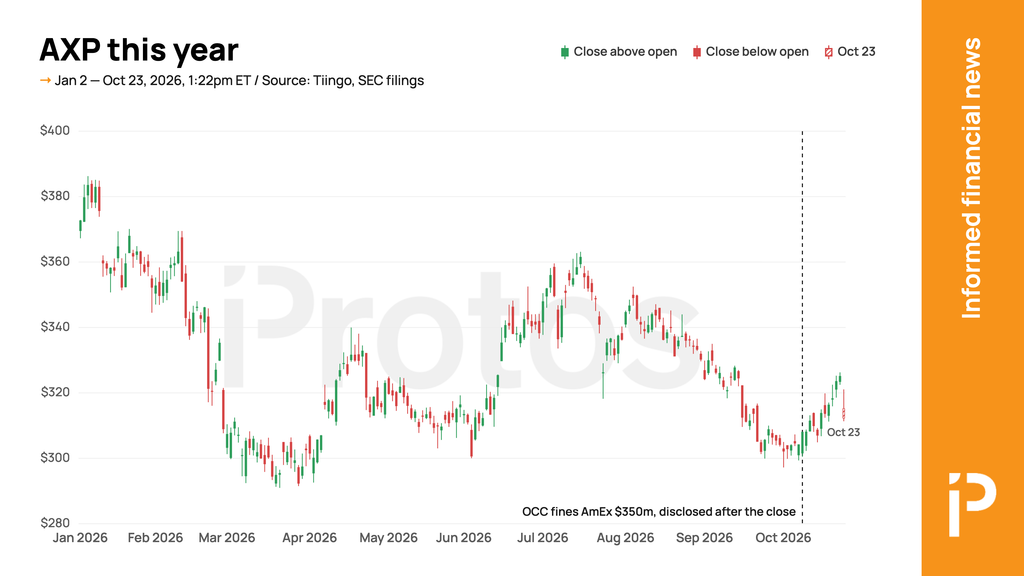
Separately, the credit card company is also dealing with a $350 million penalty for missing $13 billion of suspected money laundering activity.
Disappointed, investors sold down the stock price for AmEx 3.7% by noon in New York trading. Year-to-date, the stock has lost 15% of its value.
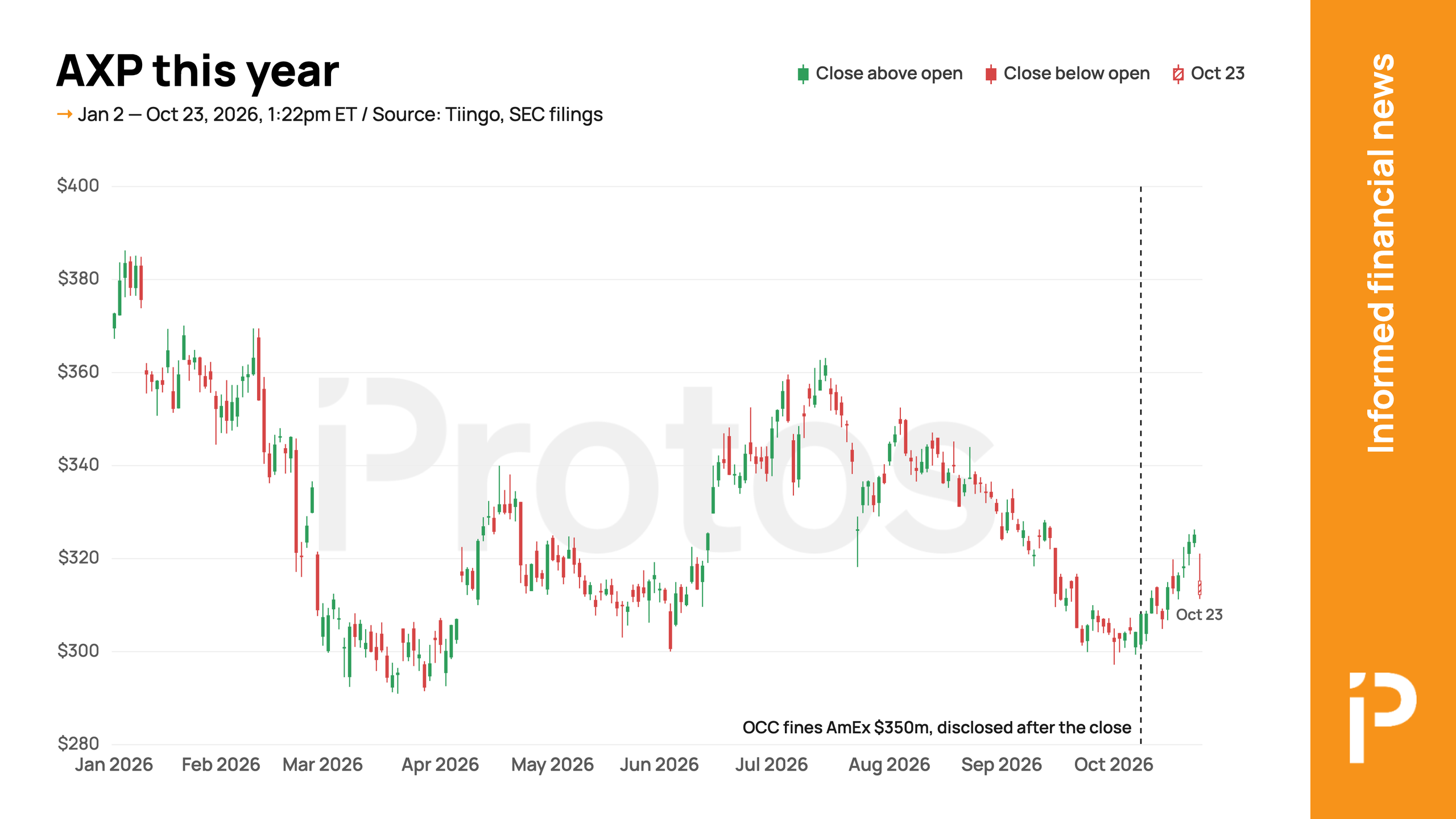
AmEx layoffs up 5%, profit forecast up 1%
A one-time cash windfall will help the company to fund separation agreements for layoffs. Specifically, AmEx has booked a nearly $1 billion pretax gain on selling its stake in Global Business Travel, more than offsetting its $336 million restructuring charge.
During the earnings call, CEO Stephen Squeri boasted that the company is “dropping two thirds of the gain to the bottom line.”
CFO Christophe Le Caillec told CNBC the cuts make AmEx “leaner, more agile, and also to prepare for AI.” The plan is to “reduce layers and increase spans of controls.”
Fewer managers will oversee more staff, so AmEx can “automate and take advantage of AI,” the executive claims.
Read more: Bank of America hit with $1.2B fine after missing ‘Chinese money laundering’
On October 8, 15 days before the layoff announcement, the US Office of the Comptroller of the Currency (OCC) found “inadequate resources, including staff without sufficient expertise” in AmEx’s anti-money laundering program.
Comptroller Jonathan Gould chastised AmEx, saying banks must “devote sufficient resources to ensure compliance with laws and regulations designed to detect and prevent money laundering.”
Nothing in AmEx’s disclosures indicates how many layoffs, if any, will occur within its compliance departments.
Squeri claimed that the OCC fine “does not impact our full-year 2026 guidance.”
Got a tip? Send us an email securely via Protos Leaks. For more informed news and investigations, follow us on X, Bluesky, and Google News, or subscribe to our YouTubechannel.

Cointelegraph is committed to providing independent, high-quality journalism across the crypto, blockchain, AI, and fintech industries.
All news, reviews, and analyses are produced with full journalistic independence and integrity. For more details on our standards and processes, please read our Editorial Policy.

Binance founder Changpeng Zhao has warned that artificial intelligence can harm Bitcoin users through leaked personal data and social engineering without breaking the cryptocurrency’s cryptography, according to posts from CoinMarketCap and Bitcoin Archive.
Summary
- CZ warned that leaked personal data can enable AI phishing without breaking Bitcoin’s cryptography.
- OWASP’s guidance compares specific algorithms and key sizes, leaving the bank-encryption claim unverified.
- Coinbase’s 2025 breach exposed customer information without compromising private keys or login credentials.
- Zscaler documented fake Ledger verification pages designed to steal wallet recovery phrases.
CoinMarketCap described Zhao’s warning as a concern about more advanced phishing enabled by exposed information, while Bitcoin Archive attributed to him a claim that banks rely on weaker encryption than Bitcoin. Neither post in the screenshot provides the algorithms, key lengths, or bank systems needed to check that comparison.
FBI guidance documents AI-assisted financial deception
The FBI’s December 2024 warning describes criminals using generative AI to make fraud more convincing and reach potential victims with less effort. Its examples include fake cryptocurrency investment websites, fabricated social media profiles, and chatbots that direct visitors toward malicious links.
Criminals can use generated text and translations to remove spelling and grammar mistakes that might otherwise expose a scam, the agency said. Its guidance describes synthetic images used for false identities and fraudulent identification documents, alongside video calls impersonating executives or other authority figures.
The FBI warned that cloned audio can imitate relatives seeking emergency payments or be used to impersonate bank customers. Such examples concern deception and identity abuse; the advisory does not report AI breaking Bitcoin’s cryptographic protections.
For households, the agency recommends agreeing on a private word or phrase to check a relative’s identity. It advises limiting publicly available personal images and voice recordings that criminals could use to create convincing impersonations.
Bitcoin security claims require a specific comparison
OWASP’s Application Security Verification Standard lists cryptographic strength by algorithm and key size, using a comparison table drawn from guidance issued by the US National Institute of Standards and Technology. The table places AES-128, 3,072-bit RSA and elliptic-curve cryptography using keys of 256 to 383 bits in the same 128-bit security category.
OWASP’s framework does not rank banks and Bitcoin as two uniform systems. Its guidance calls for organizations to identify and document their cryptographic assets, including algorithms, keys, and certificates, and assess them as cryptographic research and requirements change.
The bank comparison attributed to Zhao remains an assertion without that system-level evidence. The two posts do not identify a bank, describe a cryptographic weakness, or document an AI attack that recovered a Bitcoin private key.
Quantum computing presents a separate technical question in NIST’s published guidance. In August 2024, the agency finalized three post-quantum standards intended to protect electronic information against attacks from sufficiently capable quantum computers. Its announcement describes machines that operate differently from conventional computers and could defeat widely used cryptographic methods.
NIST said the standards cover general encryption and digital signatures, with applications ranging from confidential communications to online commerce. The agency encouraged administrators to begin integrating the standards because deployment takes time.
Coinbase disclosed how stolen records supported impersonation
A US exchange has documented a customer-data attack with a similar mechanism. In May 2025, Coinbase said criminals bribed overseas support personnel to obtain information they could use while pretending to represent the company, as crypto.news previously reported in its account of the customer data breach.
Coinbase’s own disclosure listed contact details, government identification images, masked financial identifiers and account information among the stolen records. The company said the attackers did not obtain private keys or login credentials, and the stolen access did not itself allow them to move customer funds.
The exchange rejected a ransom demand and announced a matching $20 million bounty for information leading to the attackers’ arrest and conviction. Its disclosure described safeguards including extra identity checks on large withdrawals and scam warnings for flagged accounts.
Coinbase said its voluntary reimbursement covered retail customers who sent funds to the scammer as a direct result of the incident before the announcement, subject to review. The disclosure did not establish that AI was used in those attacks.
Ledger phishing pages sought wallet recovery phrases
Hardware-wallet users have faced impersonation through search advertising. A Sep. 25 investigation by Zscaler, covered in an Oct. 11 article about fake Ledger websites, described fraudulent Google advertisements leading users toward a counterfeit wallet interface.
Zscaler documented a campaign it analyzed in August, with redirects passing through Google Cloud Storage and Vercel before displaying a phishing page hosted through Google Sites. Researchers observed redirect addresses changing every 15 to 20 minutes.
The fake verification process asked visitors for their recovery phrases, which attackers could use to access wallets without possessing the physical devices, the researchers said. Zscaler’s account described credential theft and did not establish AI involvement in the campaign.
Ledger’s own campaign warnings describe physical letters that ask recipients to scan a QR code or visit a website before entering their 24 recovery words. The company says anyone holding that phrase can access the accounts created from it, and warns users never to enter it into a computer.
The wallet maker’s guidance says it does not send emails asking customers to update device firmware, enable two-factor authentication, or take similar steps. Its warning page includes examples of fraudulent letters and emails used to solicit recovery information.


Key takeaways
- BTC traded around $81,593, above its 50-day EMA at $80,878.
- Bitcoin’s RSI near 47 and slightly negative MACD suggest recovery momentum remains weak.
- BTC faces resistance at $85,000, with deeper support at $77,528 and $76,186.
Crypto prices stabilize after support tests
Bitcoin, Ethereum and XRP edged higher on Friday after the previous session’s correction brought all three assets toward important technical support levels.
Bitcoin held just near its 50-day Exponential Moving Average, Ethereum found support around its 100-day EMA, and XRP maintained its horizontal floor near $1.300.
The modest rebound suggests buyers remain active around these levels. However, the recovery remains dependent on support holding, with decisive daily closes below those areas potentially opening the door to a deeper correction.
Bitcoin holds its 50-Day EMA
Bitcoin traded just below $81,856 on Friday, remaining above its 50-day EMA at $80,878.
Holding that average preserves a constructive technical backdrop despite the recent consolidation. The 100-day EMA at $77,528 and the 200-day EMA at $76,186 also remain below the current price, providing additional support for the broader trend.
Momentum indicators offer less convincing evidence of an immediate rally. The Relative Strength Index sits near 46, slightly below the neutral 50 threshold, suggesting buyers have yet to establish clear control. Meanwhile, the Moving Average Convergence Divergence remains marginally negative.
Together, those readings indicate stabilization rather than a confirmed bullish reversal. The first major upside barrier is the horizontal resistance near $85,000, where previous selling could limit recovery attempts.

A sustained move toward that level would test whether buyers can build on Friday’s rebound. Stronger momentum would be needed to turn the current support defense into a more durable advance.
Until then, Bitcoin remains vulnerable to further consolidation as buying interest below price competes with overhead supply.
On the downside, the 50-day EMA at $80,878 remains the immediate level to watch. A decisive daily close below it would weaken the recovery setup and bring the 100-day EMA at $77,528 into focus. Further selling could expose the 200-day EMA at $76,186.

Bitcoin Ordinals and Runes supporters have renewed calls for native trading on OpenSea after Leonidas shared a comment attributed to a company marketer saying community feedback helps shape its product roadmap.
Summary
- Leonidas has asked OpenSea to add native support for Bitcoin Ordinals and Runes.
- A shared interface image features Runestone, Bitcoin Puppets and NodeMonkes among Bitcoin collections.
- OpenSea’s published blockchain compatibility guide does not list Bitcoin among its supported networks.
- The campaign follows earlier announcements to close Bitcoin services at Magic Eden and Ord.io.
Leonidas, in posts dated Oct. 21 and Oct. 22, urged collectors to make their interest known and directly asked OpenSea to support both asset types. His posts included an image of Bitcoin collections displayed in an OpenSea interface and a separate promotional graphic imagining trading support.
“Please add support for Ordinals and Runes.”
The request establishes a public campaign for integration. Neither screenshot contains an official OpenSea announcement confirming native Bitcoin trading, an approved integration, or a release date.
OpenSea supporters press for a Bitcoin integration
In his Oct. 21 post, Leonidas reproduced a statement attributed to an OpenSea marketer encouraging people who want Ordinals to keep asking for them. The quoted statement said community feedback “very much directly informs our product roadmap.”
The screenshot does not include the original recording or the full conversation surrounding the remark. Its wording describes how feedback informs product decisions without promising that Bitcoin support has been scheduled.
Alongside the statement, Leonidas shared an interface showing Runestone in a featured position. Bitcoin Puppets and NodeMonkes appeared under a section labeled “Trending Ordinals Collections,” alongside Bitcoin Wizards and Taproot Wizards.
The image displays collection prices in BTC and includes activity figures, but it does not show a completed purchase or a Bitcoin transaction. Collection visibility in that screenshot therefore remains separate from evidence of an available trading service.
A second post, dated Oct. 22, paired the direct request with an OpenSea-branded graphic reading “Ordinals and Runes trading is live!” Because Leonidas published the image while asking for support, the graphic cannot be treated as a company launch notice.
OpenSea’s blockchain compatibility guide lists networks including Ethereum, Solana, Polygon and Arbitrum, without listing Bitcoin. Its older Ordinals explainer, published in April 2023, explicitly says users cannot buy Bitcoin Ordinals through OpenSea; that page is historical documentation, not a fresh roadmap statement.
OpenSea’s mobile launch includes trading and discovery
OpenSea’s Oct. 20 mobile announcement describes an app available to everyone on iOS and Android, with token and collectible trading across more than 25 blockchains. The company says users can combine holdings from multiple wallets and synchronize their accounts with its web platform.
The launch description distinguishes trading from discovery features. OpenSea says its social feed displays activity from people a user follows regardless of the app or chain where their trades occurred, while a separate feature shows trending activity by chain.
For the mobile product, the company lists a 0.5% fee on token trades and a 1% fee on collectible purchases, with network fees potentially charged separately. The announcement does not identify a Bitcoin-specific trading rollout.
The company’s earlier OS2 announcement, issued in Miami in May 2025, introduced full token trading across 19 chains, including Solana fungible tokens. OpenSea identified Miami as its headquarters and said further chain integrations were part of its development plans, without naming a Bitcoin launch date.
Bitcoin marketplace operators have announced service closures
The appeal follows several earlier announcements affecting Bitcoin asset services. In February, crypto.news previously reported Magic Eden’s planned Bitcoin marketplace exit, alongside the closure of its EVM marketplaces and multichain wallet. That announcement retained support for its Solana business.
Magic Eden had launched Ordinals trading in March 2023. At launch, the marketplace supported secondary sales and said it was investigating tools for creators to inscribe assets, while royalty support remained unavailable.
A separate May announcement set June 1 as the shutdown date for Ord.io and Zap. Leonidas attributed the decision to exhausted funding, while the associated trading app said it had not reached the user growth needed to continue operating.
Other operators announced new services during the same period. Unspendable Labs said on March 30 that Horizon Market had added Ordinal inscriptions alongside Counterparty assets and Bitcoin Stamps. Its announcement described inscription creation, listings, and purchases settling directly on Bitcoin, without an intermediary holding the assets.
Ordinals and Runes use different Bitcoin asset structures
The Ordinal Theory Handbook describes inscriptions as content attached to individual satoshis, creating Bitcoin-native digital artifacts without requiring a sidechain or separate token. Those assets can be held in Bitcoin transaction outputs and transferred through Bitcoin transactions.
Runes represent interchangeable units, unlike unique inscriptions. The handbook says Bitcoin transactions can create, mint, and transfer them, with protocol messages called runestones stored in transaction outputs. A transaction can contain at most one runestone, and an individual output can hold balances of multiple runes.

News outlets including the New York Times and POLITICO, citing anonymous sources with knowledge of the situation, have reported that Means was becoming increasingly frustrated because he felt that there was little movement on issues central to the MAHA agenda—for instance, on the issue of defining and regulating ultraprocessed foods.
Means, who was pivotal in coordinating an alliance between Kennedy and Trump during the 2024 election cycle, has championed the Administration’s food-policy agenda, including efforts to persuade manufacturers to stop using artificial food dyes in their products and to restrict the purchase of soda with Supplemental Nutrition Assistance Program (SNAP) benefits in some states.
In his social media post, Means heralded those actions, as well as his efforts to reform dietary guidelines and his push for research into psychedelic medications.
“It was an honor to advocate for MAHA moms in the administration,” Means said.

In a milestone decision for European cryptocurrency regulation, the European Banking Authority (EBA) has classified USDC as the European Union’s first significant e-money token under the Markets in Crypto-Assets (MiCA) regulation framework.
What the EBA’s Significance Classification Means
According to the EBA, 45 e-money tokens have been notified under MiCA to date, but USDC is the very first to meet the criteria for “significant” designation. USDC is issued within the European Union by Circle Internet Financial Europe SAS.
Beginning November 12, USDC will transition to a dual-supervision model for significant e-money tokens under MiCA rules:
- European Banking Authority (EBA): Direct supervision covering essential structural areas including own funds requirements, reserve assets management, liquidity standards, as well as recovery and redemption planning.
- Autorité de Contrôle Prudentiel et de Resoluton (ACPR): France’s national regulator will retain responsibility for local governance, outsourcing, qualifying holdings, managing conflicts of interest, and executive fitness assessments.
Heightened Supervision vs Non-Compliance
Unlike previous regulatory guidance regarding non-compliant stablecoins, the EBA’s decision does not designate USDC as non-compliant or restricted. Instead, it subject USDC to enhanced, direct European oversight due to its substantial scale and systemic importance across digital asset markets.
Key Implications for UK and European Traders
For cryptocurrency exchanges, custodians, liquidity providers, and retail investors using USDC, this supervisory shift establishes a structured regulatory precedent under MiCA:
- Formalised supervisory coordination between national and EU-level regulators.
- More detailed operational requirements regarding reserve management, redemption protocols, and liquidity arrangements.
- Increased regulatory scrutiny for other stablecoin issuers approaching significant volume thresholds in European markets.
This development comes alongside wider European regulatory developments and ongoing implementation of cryptocurrency framework standards. Readers following institutional regulatory updates can also review our previous coverage on UK FCA crypto authorisation deadlines and UK banking access restrictions for additional context on evolving crypto compliance rules.

Alpenglow actually makes those transactions faster, giving apps a way to show users their money has arrived with stronger assurance that the payment will hold. Such a benefit is especially useful when a service needs to release funds or goods immediately after receiving payment.
An exchange could credit a deposit sooner, letting a customer trade with the funds. A shop accepting a stablecoin payment could confirm it without keeping the customer at the counter waiting for settlement.
How quickly that reaches a user’s screen also depends on the service handling the payment. Anza, the company behind Solana’s Agave software, told CoinDesk in a release that some computers receive finality information later than the validators voting directly.
The 150-millisecond figure remains a target under normal network conditions, rather than a guaranteed time for every payment.
Users can continue sending funds through their existing wallets. Transaction fees and the way applications run remain unchanged.
The speed comes from changing how validators, the computers checking transactions and agreeing on the network’s records, communicate.
Meanwhile, there is also a change readers may notice on network dashboards. Validator votes no longer appear as blockchain transactions, so services that counted them will report lower transaction totals.

President Donald Trump planned to put special focus on his administration’s efforts against overseas crypto-fueled criminal operations at a Wednesday event on cybercrime, according to a White House official.
Crypto-related scams have stolen tens of billions from U.S. citizens, and Trump was set to highlight how much his administration is targeting and disrupting the transnational organizations behind it. Multinational criminal cartels have set up elaborate scam centers designed to steal money through relationship scams, phishing campaigns, ransomware attacks and other fraudulent means, and the official said that the U.S. strategies to seize funds and shut down the operations will be discussed.
The administration says its law enforcement agencies have halted about $833 million in crypto connected to the overseas scams, and 503 fraudulent crypto websites have been seized under the watch of the Homeland Security Task Force. It’s also informed almost 9,000 U.S. citizens that they’re being victimized, the official said.
In November, the Department of the Treasury announced it had formed a multi-agency Scam Center Strike Force that pursued so-called “pig butchering” that was coordinated by widespread and well-funded organized-crime operations in places such as Burma, Cambodia, Laos and the Philippines.

\n\n
According to an October 2026 report by Stand with Crypto UK shared with crypto.news, 9,803 individuals submitted 10,092 complaints over a 90-day period between May and August after facing difficulties transferring money to crypto platforms.
\n\n
The complaints span all 650 UK parliamentary constituencies, highlighting how widespread the issue has become for retail crypto investors and traders.
\n\n
Which Banks Are Restricting Crypto?
\n\n
Lloyds Banking Group received the most complaints at 2,297, including those involving Halifax and Bank of Scotland customers, followed by Barclays with 1,569 and NatWest Group (including Royal Bank of Scotland) with 1,278. HSBC UK was the fourth bank to receive more than 1,000 complaints during the period.
\n\n
\n\n
What Restrictions Are Actually in Place?
\n\n
\n\n
\n\n
\n\n
\n\n
What Stand with Crypto UK Is Asking For
\n\n
\n\n
\n\n
Why This Matters for UK Traders
\n\n
The dispute comes as the FCA has opened its crypto authorization process ahead of a new regulatory framework. The FCA opened applications for the new crypto regulatory framework on September 30, 2026, and firms have until February 28, 2027, to apply if they want to qualify for transitional arrangements.
\n\n
However, the new rules do not require retail banks to process payments to cryptocurrency exchanges, meaning customers could continue facing restrictions depending on their bank’s policies even after the new framework takes effect.
\n\n
If you bank with one of these providers, keep records of any blocked transactions and contact your bank’s customer service for clarity on their specific policies before attempting transfers to crypto platforms.
How Long Does Refrigerant Last In A Mini Split?

Breaking the Color Rules – Julia Berolzheimer

ETH Zurich ANYmal Robot Solves Giant Rubik’s Cube Using Only Its Feet


-

 Fashion7 days ago
Weekend Open Thread: Kut from the Kloth
-

 Entertainment6 days ago
Britney Spears Praises Janet Jackson In Heartfelt Message
-
 Tech & AI6 days ago
Turning A Wi-Fi Adapter Into An SDR
-

 Tech & AI5 days ago
Seattle ag-tech startup Carbon Robotics reduces workforce, citing economic conditions
-

 Tech & AI7 days ago
Intel Nova Lake processors could ditch three-digit names for Core Ultra 4000 branding
-

 Fashion18 hours ago
Weekend Open Thread: Anine Bing
-

 Tech & AI6 days ago
Amazon’s new Bee AI devices have a bystander problem, says former AWS security engineer
-

 Tech & AI7 days ago
T+A Solitaire T Pro Adds Dolby Atmos and aptX Lossless But Is It Worth the Premium?
-

 Entertainment6 days ago
David Pollack Reveals ‘Stunning’ Update About Wife’s Brain Cancer
-

 Tech & AI7 days ago
AI nudify apps targeted in App Review Guidelines update
-

 Tech & AI7 days ago
How to watch Fiji vs Cook Islands for FREE: Live stream RLWC 2026
-

 Fashion5 days ago
What I Reach For Every Fall
-

 Tech & AI5 days ago
Amazon challenges Nvidia’s software advantage with new tool for its own AI chips
-

 Fashion7 days ago
Hailey Bieber Brings Ballet Style to Adanola
-

 Fashion4 days ago
Tuesday’s Workwear Report: Margeaux Blazer in Four-Season Stretch
-
 Crypto7 days ago
KOSPI erases an entire year’s worth of South Korean GDP
-

 Tech & AI6 days ago
There’s more to headphones than music. Doctors say they can reduce health troubles post-surgery
-

 Tech & AI5 days ago
DeepSeek updates V4.1-Flash model to improve performance
-

 Tech & AI6 days ago
List of 6 semiconductor chips designed by Malaysia
-

 Fashion6 days ago
Amazon Sundays: Color, in Small Doses
You must be logged in to post a comment Login