

Crypto World
Crypto Funds Lose $288M as ETPs Extend Outflows to Five Weeks

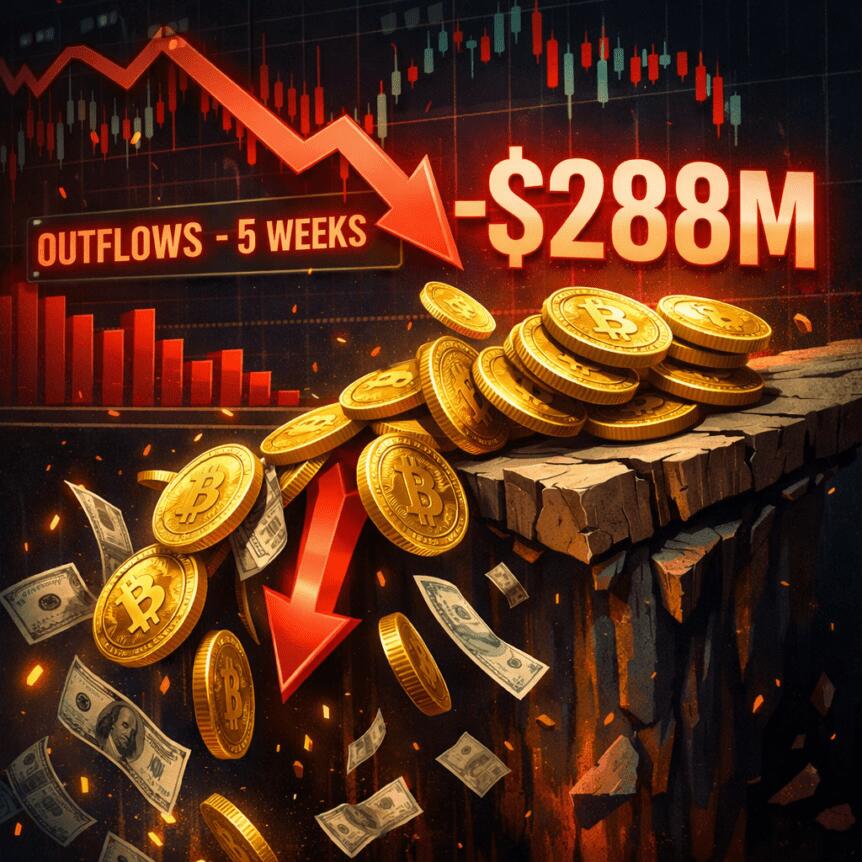
Crypto investment products continued to retreat last week, with outflows totaling $288 million, extending a five-week run of withdrawals that ranks as the longest streak since US spot Bitcoin ETFs began trading in 2024. The latest figure pushes year-to-date redemptions toward the $4 billion mark, although total outflows remain below the $6 billion pulled during the same period a year earlier. Across the broader crypto ETP landscape, trading activity cooled to $17 billion for the week—the quietest pace since mid-2025—underscoring subdued investor appetite amid lingering risk sentiment and regulatory headlines. Bitcoin led the exodus, while bearish bets persisted in short-BTC products. CoinShares also announced a price cut for Europe’s largest physically backed Bitcoin ETP, a move designed to enhance competitiveness, as detailed in the firm’s report and accompanying filing.
Key takeaways
- Last week’s crypto ETP outflows totaled $288 million, extending a five-week streak and lifting year-to-date withdrawals toward $4 billion.
- Bitcoin funds accounted for the lion’s share, with about $215 million pulled, while short-BITCOIN products drew inflows of $5.5 million—the strongest inflow among crypto assets.
- Ether funds declined by approximately $36.5 million, contributing to year-to-date losses near half a billion dollars; XRP and Solana saw modest inflows of around $3.5 million and $3.3 million.
- CoinShares reduced the management fee on the flagship BITC ETF to 0.15% effective immediately, a deliberate move to improve competitiveness for Europe’s largest physically backed Bitcoin ETP.
- US spot Bitcoin ETFs showed signs of renewed activity on a Friday, with volumes rising to about $3.7 billion, even as the week still closed in the red with roughly $316 million in net outflows.
Tickers mentioned: $BTC, $ETH, $XRP, $SOL, $BITC
Sentiment: Bearish
Market context: The ongoing withdrawal cycle in crypto ETPs appears to reflect cautious risk sentiment and selective participation around ETF products, even as some structural improvements—such as lower fees—seek to restore competitiveness. The broader environment includes macro headwinds and evolving regulatory scrutiny that influence investor appetite for crypto-linked products and the speed at which new products attract inflows.
Why it matters
The persistence of outflows in crypto investment products matters because it signals a cautious stance among professional and retail investors toward crypto-linked vehicles, despite constructive developments in the market, such as the introduction of lower-cost products. The outflows are not isolated to one asset class; they span Bitcoin ETPs, Ethereum funds, and smaller-cap crypto listings, illustrating a broad risk-off mood rather than a targeted bet against a single token.
Bitcoin remains the central driver of fund flows. With about $215 million leaving Bitcoin ETPs last week, the asset’s price dynamics continue to influence the mood of the broader ETP segment. Conversely, traders seeking to hedge or express bearish views with limited downside exposure pulled into short-BTC products, which attracted the largest inflow in the crypto-ETP space at $5.5 million. This pattern underscores the persistence of a bear tilt in certain pockets of the market, even as some participants diversify into other assets such as XRP and Solana, which posted modest inflows.
From a product perspective, CoinShares’ move to cut the BITC management fee to 0.15%—a permanent adjustment rather than a promotional incentive—highlights an ongoing alignment between pricing and accessibility. The objective is to attract more long-term holders to Europe’s leading physically backed Bitcoin ETP, potentially stabilizing flows if inflows follow the fee reduction. This is notable because BITC launched in January 2021 with a base fee of 0.98%, so the new rate represents a meaningful re-pricing in a segment that has faced stiff competition and fee pressure.
On the ETF front, spot Bitcoin ETF activity in the United States showed a surprising uptick on what was otherwise a downbeat week. SoSoValue data indicated daily volumes rising to about $3.7 billion, marking a notable shift after several weeks of thinning liquidity. While the week still closed with red ink—$315.9 million in net outflows—the move hints at renewed interest that could foreshadow a more active period if macro conditions remain supportive and if ETF providers continue to refine product features and liquidity channels.
The year-to-date picture remains challenging for Bitcoin ETPs, with net outflows around $1.3 billion in BTC ETPs alone, reflecting the broader struggle to sustain momentum in a market characterized by episodic volatility and regulatory crosswinds. The performance of Ether and other major assets further illustrates that traders are weighing different risk-return profiles, with ETH showing material outflows and XRP/SOL posting smaller inflows as market participants reallocate capital across a wider array of tokens and related products.
In a note accompanying the earnings move, CoinShares’ chief executive Jean-Marie Mognetti framed the pricing shift as a signal of structural change rather than a temporary promotion. The firm’s decision to reduce the BITC fee to 0.15% is intended to reflect an ongoing commitment to accessible pricing, ensuring that investment products remain competitive as demand evolves. Such moves can influence sentiments among institutional and sophisticated retail buyers who closely monitor fee levels when assessing exposure to crypto assets through ETPs.
What to watch next
- Monitor CoinShares’ next weekly flow update for any reversal or continuation of the outflow trend, including asset-specific moves in BTC, ETH, XRP, and SOL.
- Track whether BITC’s lower management fee translates into meaningful inflows in the coming weeks and whether similar pricing adjustments spread to other Europe-based crypto ETPs.
- Watch US spot Bitcoin ETF volumes in the next trading sessions, as a fresh wave of demand could alter the week-to-week flow balance.
- Observe whether BTC ETPs maintain their year-to-date outflow pace or show signs of stabilization amid price movements and investor sentiment shifts.
Sources & verification
- CoinShares weekly report (Volume 274) detailing digital asset fund flows and asset-level movements.
- CoinShares press release announcing the 0.15% management fee on BITC, Europe’s largest physically backed Bitcoin ETP.
- SoSoValue data on US spot Bitcoin ETF daily volumes and weekly flow dynamics.
- Cointelegraph coverage of spot Bitcoin ETF activity and the broader fund-flow landscape, including references to five weeks of net outflows.
Crypto flows, fee changes, and the evolving ETF landscape
Last week’s market activity underscored a cautious but evolving ETF environment. Bitcoin (CRYPTO: BTC) funds led the charge in outflows, underscoring the sensitivity of BTC-linked products to shifting risk appetite. Investment vehicles covering Ethereum (CRYPTO: ETH) also posted declines, while XRP (CRYPTO: XRP) and Solana (CRYPTO: SOL) saw smaller, more mixed moves that suggest a rebalancing among investors seeking diversified exposure. The divergence between BTC and altcoin flows, particularly with Bitcoin ETPs contributing substantially to the overall negative tone, highlights how the crypto-asset landscape remains tethered to macro and regulatory cues as much as to token-specific developments. The industry continues to test pricing dynamics and liquidity provisioning, with BITC (EXCHANGE: BITC) now operating at a reduced fee that could reshape competitive dynamics across European-listed crypto products.
On the volume front, Friday’s data from US spot Bitcoin ETFs showed resilience after a stretch of subdued activity, with daily volumes hitting the $3.7 billion mark. While the week finished with a net outflow, the uptick in volumes points to a potential reawakening of interest in physically backed exposures, particularly as investors reassess risk and reward amid volatility in price action and policy signals. The tweet- and data-backed signals surrounding ETF volumes are relevant for traders watching liquidity conditions, as increased activity can improve execution quality and narrow bid-ask spreads for large trades.
From a product design perspective, the BITC fee reduction is a meaningful, real-world adjustment. Lower fees can improve net returns for long-term holders and may help attract new participants who previously found European crypto ETPs comparatively expensive. The price cut—announced by CoinShares and described in public filings—reflects a broader industry trend toward more competitive cost structures as firms chase incremental inflows in a crowded European and global marketplace. While fee reductions do not guarantee immediate inflows, they set a framework in which investors may re-evaluate exposure levels and allocation across a spectrum of assets, including Bitcoin, Ether, XRP, and Solana, as observed in the latest weekly flows.
In sum, the current footpath for crypto ETPs remains mixed: persistent outflows in Bitcoin-focused products contrast with selective inflows in some altcoin-linked funds, while structural changes such as BITC’s fee cut add a new variable to consider for future allocations. The next few weeks will be telling as ETF providers—alongside market participants—assess whether price dynamics, regulatory updates, and ongoing product improvements translate into a more stable or even improving flow environment.

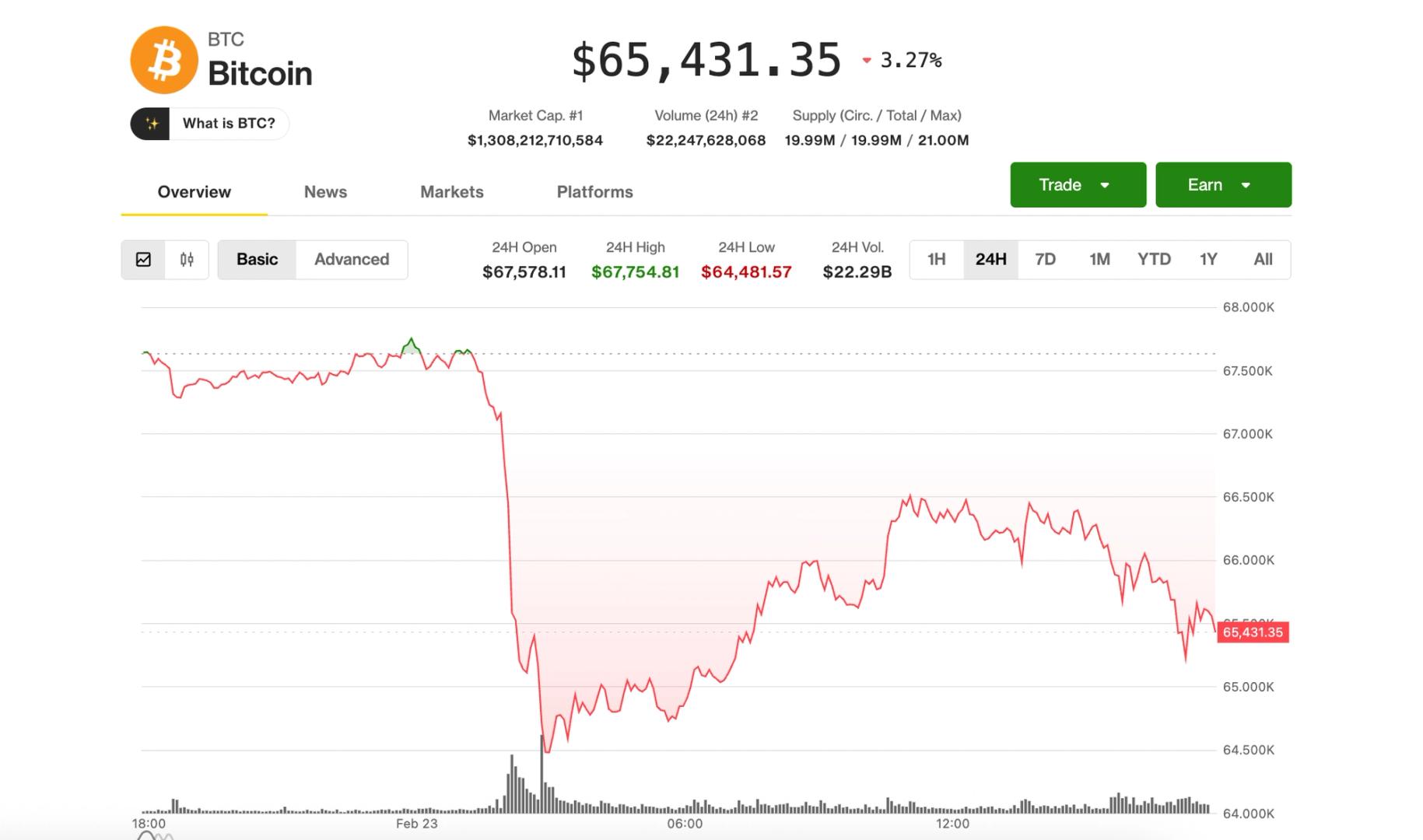
Bitcoin’s very modest rebound from its steep overnight selloff quickly fizzled out during U.S. morning trading on Monday as broader risk markets turned sharply lower.
Trading at $65,400 near the noon hour on the east coast, bitcoin was down 35% over the past 24 hours.
The action occurred as U.S. equities tumbled. The S&P 500 and the tech-heavy Nasdaq 100 were each lower by more than 1%, led by renewed weakness in software stocks and private-equity names.
The iShares Expanded Tech-Software ETF (IGV) sank another 5% to a fresh 52-week low and is now down nearly 35% since October amid concerns that generative AI tools could disrupt traditional software business models. Whether true or not, current market thinking is that crypto is just software, and price movements of bitcoin and IGV of late have been nearly perfectly correlated.
Adding to that bearish theme are continuing worries that AI could be leading markets to the cusp of a major negative credit event similar to that of 2008’s global financial crisis. This is currently reflected in private equity share prices. These companies have heavy exposure to the afore-mentioned software sector. Blow Owl Capital (OWL) — which last week sold assets in an attempt to mollify liquidity-seeking investors — is lower by another 3.5% Monday and 32% year-to-date. BlackStone (BX), Ares Management (ARES), and Apollo Global Management (APO) all added to their sizable recent losses, falling between 6% and 8%.
Crypto often trades as a high-beta proxy for tech and broader liquidity conditions, and Monday’s weakness reflected that dynamic. While BTC has so far held above the worst of its early February lows, it still trades in a tight range between $60,000 and $70,000 as risk appetite remains fragile.
Added to all of this is uncertainty about global tariffs after the Supreme Court clamped down on President Trump’s previous use of sweeping levies, Joel Kruger, market strategist at LMAX Group, said in a note.
“This sparked a classic risk-off environment,” Kruger said. “Investors pulled back from speculative assets like crypto, with bitcoin behaving more like a high-beta risk play than ‘digital gold.’”
Ali Martinez points to a rare three-day signal that historically appeared just before Bitcoin’s final bear-market plunges.
A key technical signal that has foreshadowed the final capitulation phase of previous Bitcoin (BTC) bear markets is flashing again.
According to chartist Ali Martinez, a “death cross” on the three-day chart could be confirmed in late February, potentially sending BTC to $40,000 or even $30,000.
The Death Cross Pattern and What History Shows
Martinez pointed to the three-day chart as a crucial timeframe for understanding Bitcoin’s macro structure, noting that the interaction between the 50 and 200 simple moving averages on this chart has reliably signaled the last major downside move since 2014.
“The death cross between these two moving averages on the 3-day chart has consistently preceded the final leg down of a bear market,” the trader wrote.
Following the 2013 top, Bitcoin dropped more than 72% before the death cross printed in December 2014, after which it fell another 52%. After the 2017 peak, the death cross appeared in November 2018, coming just before a final 50% decline. The signal emerged again in May 2022, following the 2021 top, which led to an additional 45% drop.
Bitcoin registered a new all-time high (ATH) in October 2025 when it went above $126,000, but the current price, which had recovered to just over $66,000 at the time of writing after earlier shedding about $4,000 in only a matter of hours, is nearly 48% below that ATH.
With a potential death cross projected for late February, Martinez warns that if history repeats even partially, a further 30% decline would place Bitcoin near $40,000, while a 50% drop could take it to $30,000.
However, the market watcher was quick to note that there were no guarantees the price drops would happen, even though the current structure matches up with historical setups that led to the last major downside moves before macro bottoms formed.
You may also like:
Market Reaction and On-Chain Divergence
Bitcoin is currently down about 2.5% in the last 24 hours and more than 4% over the past week. It has also lost nearly 27% of its value in the past month, a drop exacerbated by U.S. President Donald Trump’s recent announcement of a 10% (later upgraded to 15%) temporary global tariff after the country’s Supreme Court struck down many of the previous tariffs the Trump administration had imposed under a 1977 emergency law.
As seen during past tariff-related volatility, the impact on Bitcoin wasn’t immediate but arrived once legacy futures markets opened. It also sparked a coordinated bearish impulse in the futures market, with data from analyst Axel Adler Jr. showing that taker sell volume spiked to $2.3 billion in a single hour, accompanied by forced long liquidations of approximately 1,247 BTC worth more than $81 million.
Santiment data confirmed the liquidation cascade, noting open interest dropped to $19.5 billion, which is less than half its January peak, leading to skyrocketing negative sentiment, and the Bitcoin market entering “FUD mode.”
Binance Free $600 (CryptoPotato Exclusive): Use this link to register a new account and receive $600 exclusive welcome offer on Binance (full details).
LIMITED OFFER for CryptoPotato readers at Bybit: Use this link to register and open a $500 FREE position on any coin!
Even though bitcoin (BTC) is, historically speaking, one of the best performing assets of all time, on most days its performance isn’t actually all that impressive. In fact, almost all of its long term returns are crammed into a small number of trading sessions.
The rest of the time, it chops around.
For example, on November 17-18, 2013, BTC rallied 50%. Take these two days out of the equation and every early Bitcoiner’s return would be halved.
Elsewhere, on July 20, 2017, BTC rallied 27% and in December of that same year, it surged 40%.
To have made the most of the rally that’s exceeded one million percent between 2009 and July 2012, investors needed to be holding during rare bull runs.
Read more: Bitcoin Core promotes first Trusted Keys maintainer in three years
Visualizing the uneven returns of bitcoin
There are various ways to visualize the irregular days that generate the vast majority of BTC investment returns.
The most appropriate method might be a giant calendar highlighting the tiny number of days responsible for the majority of BTC returns.
Similarly, the same calendar could highlight the fewest days that would have zeroed out the lifetime return of BTC if an investor hadn’t held on during those days.
That number is shockingly small: less than 100 of the 5,000 days since July 2012.
Whereas a vast and mostly blank calendar certainly conveys the message about clustered outperformance amid normally unremarkable behavior, perhaps the most visually compelling way to track this data is to show the price change by periods of significant rallies.
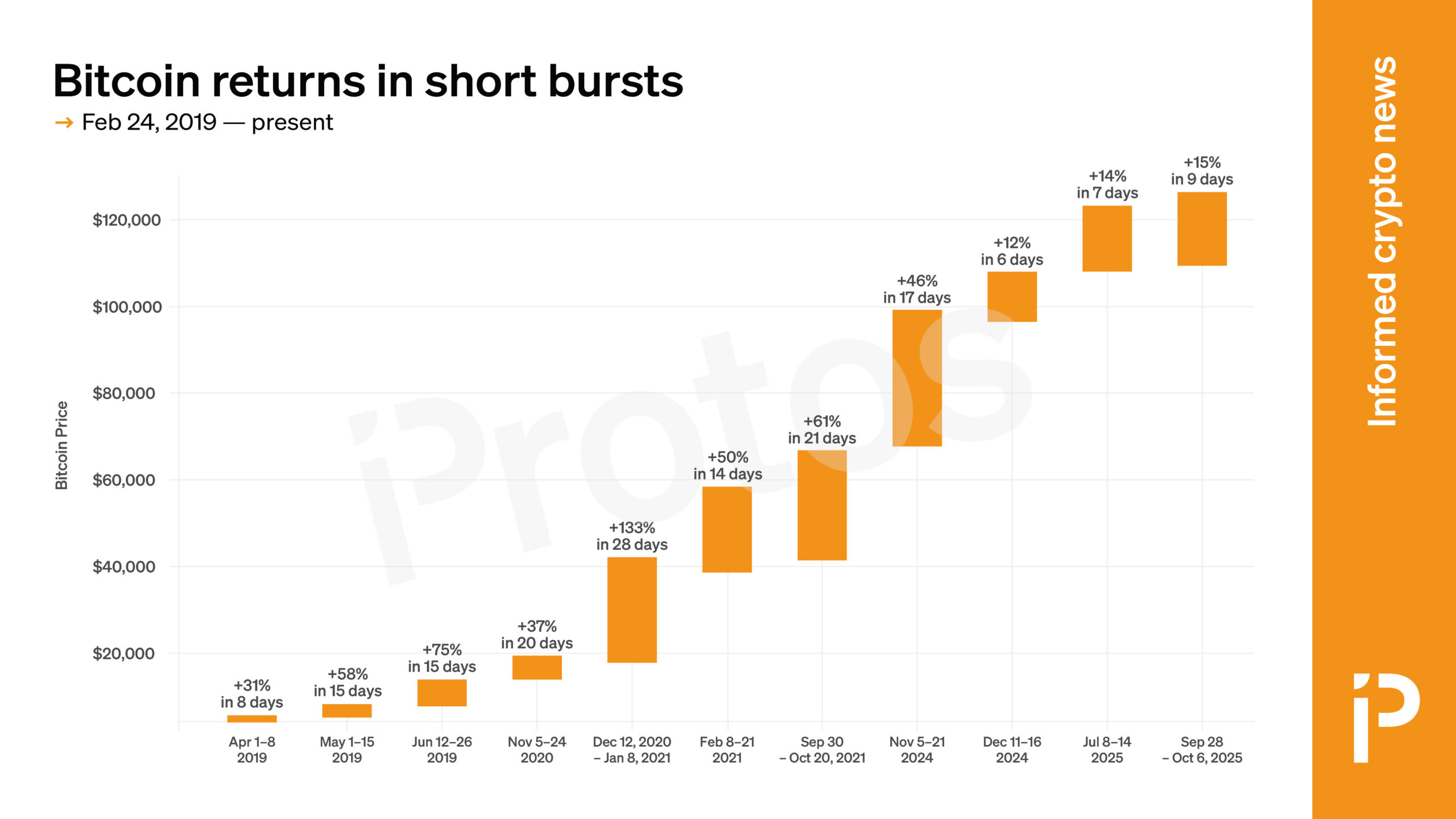
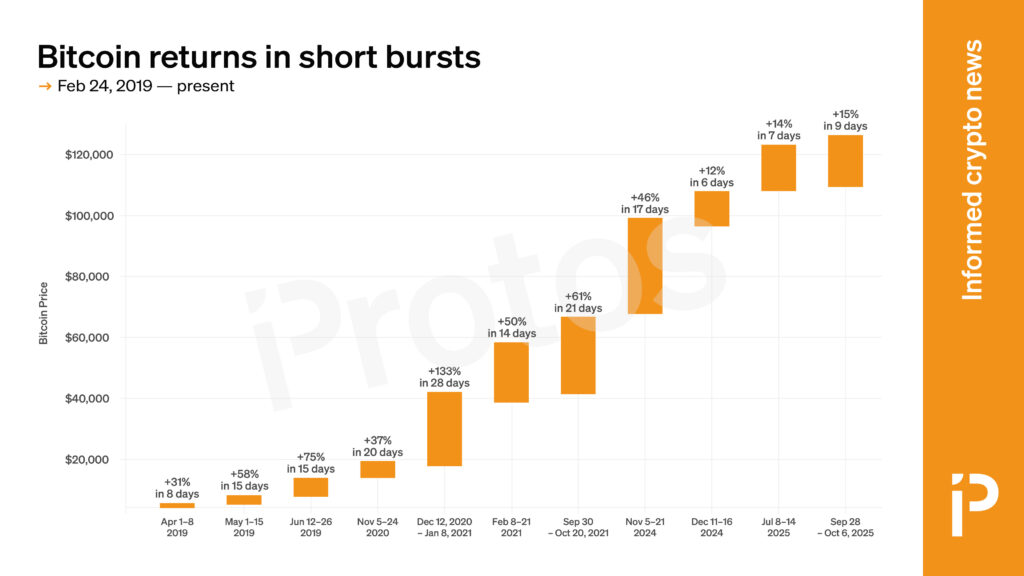
From a starting point exactly seven years ago, there have been 11 significant BTC rallies that achieved new highs. The above chart illustrates these periods.
- April 1-8, 2019: $4,095 to $5,347, a 31% gain in eight days
- May 1-15, 2019: $5,268 to $8,300, a 58% gain in 15 days
- June 12-26, 2019: $7,916 to $13,880, a 75% gain in 15 days
- November 5-24, 2020: $14,168 to $19,442, a 37% gain in 20 days
- December 12, 2020-January 8, 2021: $18,031 to $42,000, a 133% gain in 28 days
- February 8-21, 2021: $38,870 to $58,354, a 50% gain in 14 days
- September 30-October 20, 2021: $41,538 to $67,017, a 61% gain in 21 days
- November 5-21, 2024: $67,817 to $99,121, a 46% gain in 17 days
- December 11-16, 2024: $96,658 to $107,821, a 12% gain in six days
- July 8-14, 2025: $108,286 to $123,236, a 14% gain in seven days
- September 28-October 6, 2025: $109,679 to $126,272, a 15% gain in nine days
Eleven periods outperformed BTC
As a simple, non-cumulative sum, these rallies are worth 532% or one-third of the 1,540% BTC rally from $4,100 seven years ago to its $67,200 price as of writing.
On a compounded basis, those 11 trading periods are worth 5,800% or nearly quadruple the actual seven-year gain in BTC.
Yes, had an investor only held during those periods and reinvested fully each time, they’d have substantially outperformed BTC.
Of course, no investor can magically time the market perfectly. Nonetheless, this exercise shows how important the returns of a very short number of days are to the overall returns of one of the world’s all-time best-performing assets.
Got a tip? Send us an email securely via Protos Leaks. For more informed news, follow us on X, Bluesky, and Google News, or subscribe to our YouTube channel.
Officials advising Donald Trump’s “Board of Peace” are exploring a US dollar-backed stablecoin for Gaza, according to reports from the Financial Times. The proposal remains in early stages.
However, it signals a potential shift toward using crypto as core infrastructure in Gaza’s post-war economic reconstruction.
Turning Gaza Into a Crypto Project?
According to the Financial Times, the stablecoin would be pegged to the US dollar and used to facilitate digital payments, not replace Gaza with a sovereign currency.
Governance would involve the Board of Peace and Gaza’s interim technocratic administration.
The discussions come as Gaza’s banking system remains severely impaired. Cash access has been restricted since 2023 due to ATM destruction and limits on physical currency deliveries.
As a result, digital payments have become more common, though connectivity and financial infrastructure remain fragile.
Board of Peace Takes Central Role in Gaza Transition
The Board of Peace sits at the center of Trump’s broader 20-point plan for Gaza. Trump chairs the body. Its members include senior US officials such as Secretary of State Marco Rubio and envoy Steve Witkoff, alongside international figures like former UK Prime Minister Tony Blair and World Bank President Ajay Banga.
The board oversees Gaza’s transitional governance, reconstruction planning, and economic recovery. It also coordinates with a Palestinian technocratic committee tasked with restoring services and managing daily administration.
Meanwhile, an international stabilization force is expected to handle security and policing during the transition period.
Within this framework, the stablecoin proposal reflects a broader effort to rebuild Gaza’s financial system without relying on traditional banking infrastructure.
Promise of Financial Access, But Ethical Risks of Control
In theory, a stablecoin could help restore economic activity. Digital dollars could enable aid delivery, salaries, and daily transactions even without functioning banks. This could potentially improve transparency and reduce corruption in aid distribution.
However, the plan raises serious ethical and political concerns. A digitally controlled currency governed by an international body could give external actors unprecedented influence over Gaza’s financial system. Every transaction could be tracked.
Access could potentially be restricted or revoked.
Moreover, introducing a separate payment system risks further separating Gaza economically from the West Bank. Infrastructure limits, including Gaza’s reliance on slow 2G networks, could also hinder adoption.
For now, the stablecoin remains only a proposal.
However, if implemented, it would represent one of the first attempts to rebuild a post-conflict economy using digital dollar infrastructure — a move that could reshape both Gaza’s future and the global role of stablecoins.

TLDR
- Novo Nordisk stock fell 15% after CagriSema failed to prove non-inferiority to Eli Lilly’s tirzepatide in an 84-week trial.
- CagriSema delivered 23% weight loss vs. 25.5% for tirzepatide — missing its primary endpoint.
- The stock hit its lowest level since June 2021, down nearly 50% over the past year.
- Novo’s CEO remains confident in CagriSema, citing its potential as the first GLP-1/amylin combo drug on the market.
- Eli Lilly stock rose 3.1% in premarket trading on the news.
Novo Nordisk took another hit on Monday. The stock fell as much as 15% after the company revealed its next-generation weight loss drug, CagriSema, failed to prove it was just as good as Eli Lilly’s tirzepatide in a head-to-head trial.
The result sent NVO to its lowest price since June 2021.
In the late-stage trial, patients on CagriSema lost 23% of their body weight over 84 weeks. Those on tirzepatide — the active ingredient in Lilly’s Mounjaro and Zepbound — lost 25.5%.
That gap meant CagriSema missed its primary endpoint: showing non-inferiority to tirzepatide.
The trial was open-label, meaning participants knew which drug they were taking. Novo’s Chief Scientific Officer Martin Holst Lange said this design can introduce bias toward a well-known product when tested against an experimental one.
Lange said he was “surprised” by tirzepatide’s 25.5% result, pointing out that Lilly’s own studies have shown the drug producing around 20.2% weight loss over 72 weeks.
CEO Stays Optimistic
Despite the miss, CEO Mike Doustdar pushed back on the negativity. “We strongly believe that CagriSema has, right now, the best weight efficacy than any product currently in the market,” he said.
Novo filed CagriSema with the FDA late last year, and a decision is expected by late 2026. Doustdar said he expects it to reach the market early next year with the best weight-loss label available.
The company is also exploring additional trials, including higher-dose combinations, to maximize the drug’s potential.
CagriSema combines semaglutide — the ingredient in Ozempic and Wegovy — with cagrilintide, an experimental hormone that affects appetite. Novo has positioned it as the first GLP-1/amylin combination treatment for obesity.
A Rough Run for Novo
This is not an isolated setback. When Novo first released CagriSema late-stage data in December 2024, the stock dropped 21% and wiped out nearly $100 billion in market value.
Over the past year, NVO has lost close to 50% of its value.
Earlier this month, Novo forecast a sales and profit decline of between 5% and 13% for 2026. The company is dealing with rising competition, lower U.S. prices, and upcoming patent expirations on Wegovy and Ozempic in some markets.
Jefferies analyst Michael Leuchten noted that CagriSema’s commercial positioning is “increasingly unclear” following Monday’s results. He estimated the drug could account for 15% to 25% of Novo’s revenue by 2030 and said the situation highlights “the pressing need for M&A,” forecasting Novo could spend up to $35 billion on acquisitions this year.
Meanwhile, Eli Lilly’s stock rose 3.1% in premarket trading Monday.
Novo’s Copenhagen-listed stock was last seen down 14% at 259 Danish kroner.

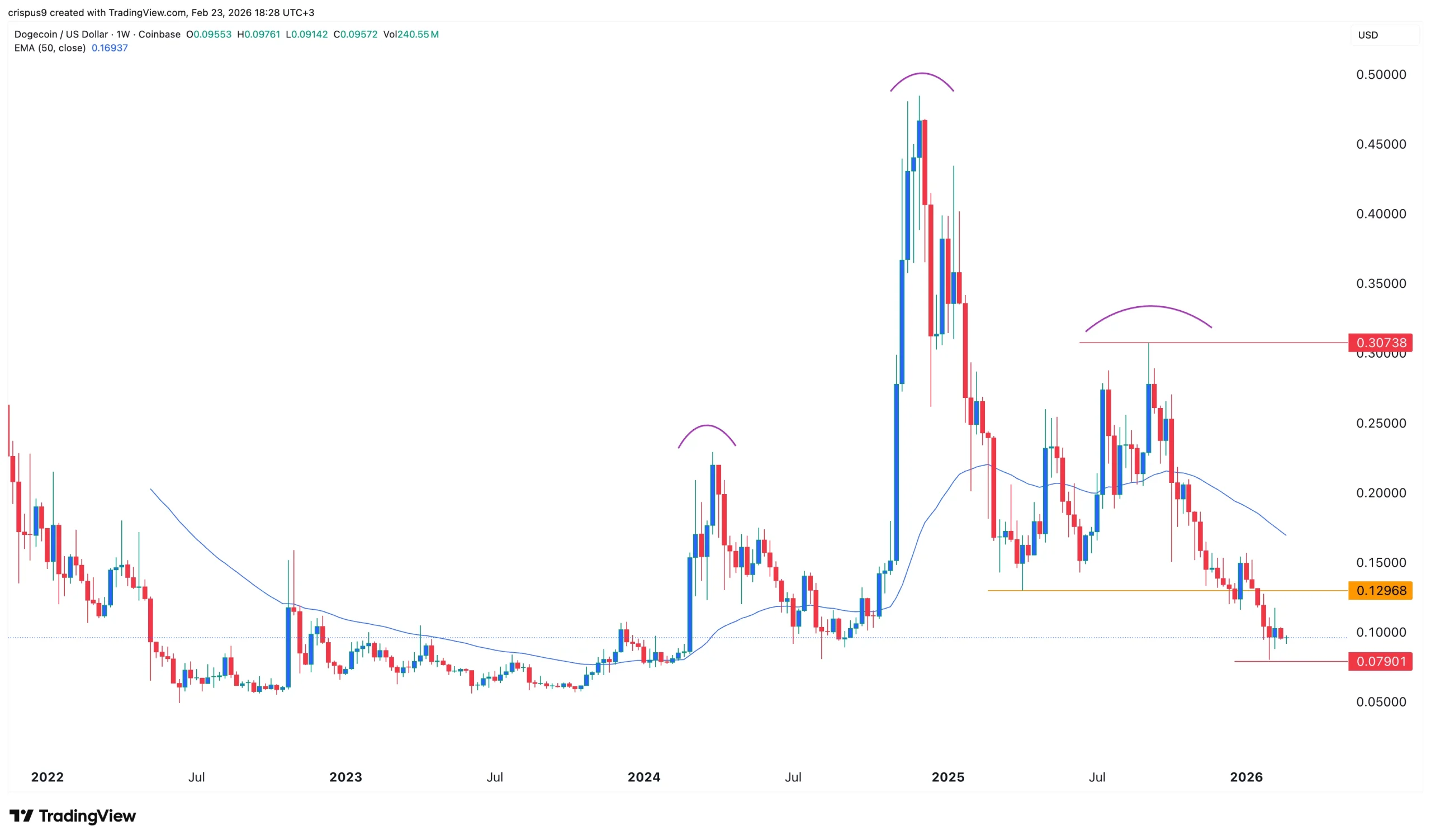
Dogecoin price is stuck in a technical bear market, a trend that may continue as key metrics like exchange-traded fund inflows and futures open interest slip.
Summary
- Dogecoin price has formed a large head-and-shoulders pattern.
- Data shows that spot DOGE ETFs have had no inflows in weeks.
- Dogecoin’s futures open interest has continued falling.
Dogecoin (DOGE) token was trading at $0.09610, down by 80% from its highest level in November 2024. It is hovering near its lowest level since September 2024.
DOGE, the biggest meme coin in the crypto industry, has dropped, mirroring the performance of Bitcoin (BTC) and other altcoins. It has also mirrored the performance of other meme coins like Shiba Inu and Bonk.
Third-party data shows that Dogecoin’s demand has waned in the past few months. A good example of this is in Wall Street, where DOGE ETFs by companies like Grayscale, 21Shares, and BitWise have not attracted any inflows since February 3.
Their cumulative inflows this month is just $252k, with their assets being $9 million. In contrast, spot XRP ETFs have over $1 billion in assets, while Solana have $775 million.
More data shows that the futures open interest has tumbled in the past few months. It has dropped to $1 billion, down from $5.2 billion in September last year. Falling open interest is a sign that demand from the highly active traders has continued falling.
The open interest has been in a downtrend after the major liquidation event that happened in October last year. In most cases, falling interest during a downtrend is a sign that demand is waning.
Dogecoin price prediction: technical analysis
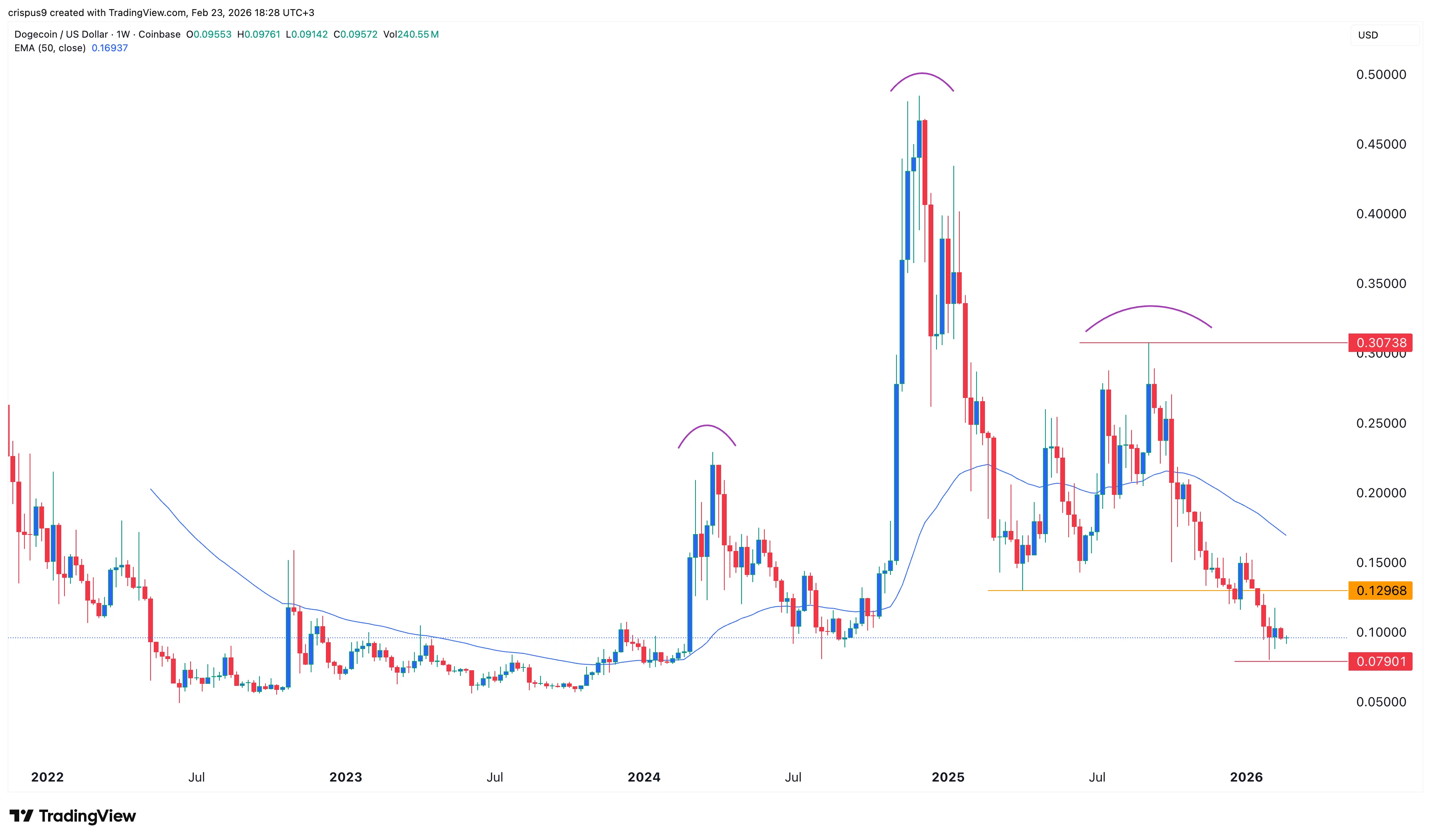
The weekly chart shows that the DOGE price has slumped in the past few months. It dropped below the important support level at $0.10, confirming a bearish outlook.
Most notably, the coin has formed a multi-year head-and-shoulders pattern. The head is at $0.4820, while the right shoulder is at $0.3073, and the left one is at $0.2290.
Dogecoin has remained below the 50-week and 100-week Exponential Moving Averages. It has dropped below the key support level at $0.1296, its lowest level in April last year.
Therefore, the coin will likely continue falling as sellers target the key support level at $0.050. The bearish outlook will become invalid if it moves above the key resistance at $0.1300 will invalidate the bearish outlook.

Crypto.com announced on Monday that it has secured conditional approval for a national bank trust charter from the U.S. Office of the Comptroller of the Currency (OCC). If the company clears final regulatory hurdles, it would operate as a federally regulated custodian with OCC oversight, enabling custody services for digital asset treasuries, exchange-traded funds, and other tokenized products across the United States. The application, which Crypto.com filed in October, signals a push toward regulated, institution-facing custody solutions as regulators weigh how crypto firms fit within traditional banking structures. The development comes amid a broader policy shift in Washington as regulators assess the path for crypto custody, stablecoins, and related financial services.
Key takeaways
- Crypto.com has won conditional approval from the OCC for a national bank trust charter, positioning it to offer nationwide custody under federal supervision.
- The OCC’s action comes two months after it conditionally approved five other national bank charters for Circle, Ripple, BitGo, Fidelity Digital Assets, and Paxos, signaling a growing regulatory pathway for crypto firms seeking bank-like status.
- Coinbase also applied for a national trust charter in October, stating it would not pursue a banking charter if approved.
- The American Bankers Association has urged the OCC to slow the pace of charter approvals for digital-asset firms until the GENIUS Act’s framework is fully implemented, arguing for robust safety and soundness standards.
- Nationally chartered trust companies could, in practice, be exempt from many state licensing requirements, a shift that could alter how crypto custodians operate across state lines.
Sentiment: Neutral
Market context: The OCC’s charter activity reflects a broader effort by U.S. regulators to define a federal framework for crypto custody and related services. As institutions seek regulated access to digital assets, the agency’s willingness to grant national trust charters signals a pathway for crypto firms to operate with bank-style oversight, while lawmakers debate stablecoins and payment infrastructure within the GENIUS Act and other regulatory constructs.
Why it matters
For Crypto.com, the conditional approval marks a consequential milestone in the company’s strategy to scale regulated custody services beyond traditional exchange models. A federally chartered custodian would offer clients a familiar, bank-like framework backed by OCC oversight, potentially increasing institutional comfort with safekeeping digital assets and related products. The ability to custody digital asset treasuries and exchange-traded funds at scale could reduce fragmentation in the market, offering a single, regulated point of custody for a broad array of tokenized assets. As regulated entities, these custodians may also gain access to mainstream banking services and payments rails that have historically remained out of reach for many crypto firms.
The OCC’s broader pattern — approving multiple national bank charters for crypto-focused firms — suggests a deliberate policy tilt toward integrating digital asset services into the U.S. banking system. This trend aligns with a growing cadre of firms pursuing trust-charter status as a route to credibility and growth within a tightly regulated financial ecosystem. At the same time, it invites ongoing questions about safety, risk management, and consumer protection in a rapidly evolving space. The ABA’s warning underscores the tension between innovation and prudence, highlighting the need for a clear regulatory timetable and robust standards before large-scale approvals are granted.
World Liberty Financial, another crypto-related firm pursuing a national bank charter with ties to the USD1 stablecoin project backed by high-profile political figures, illustrates the intense regulatory scrutiny surrounding these applications. The bank-charter process for World Liberty has drawn attention from lawmakers and regulators who are weighing the implications of native, in-house issuance and custody capabilities for digital-asset stablecoins. The OCC chair and senior staff have signaled a commitment to apolitical, nonpartisan review, even as political signals and stakeholder perspectives continue to shape the conversation.
In parallel, the regulatory dialogue continues to unfold around whether national charters should supersede or complement state-by-state licensing regimes. Legal experts have noted that a nationally chartered trust company could be exempt from much of the licensing friction tied to state rules, potentially streamlining cross-border or cross-state custody arrangements. This possibility adds a layer of strategic importance for issuers and asset managers contemplating multi-jurisdictional operations in the United States.
The ongoing debate also touches on the role of policy in facilitating or constraining innovation. While a federally chartered path can provide clarity and resilience for large-scale custody, regulators must balance that clarity with rigorous safety standards to protect customers and the financial system. As OCC reviews advance, market participants will be watching how quickly final approvals are issued, how the agency applies safety-and-soundness criteria to crypto-adjacent activities, and how the evolving framework interacts with broader legislative developments in the GENIUS Act era.
For more context on the specific filings and related regulatory developments, see the official crypto-company notices and industry coverage linked in this article, including Crypto.com’s conditional approval announcement, historical OCC actions on national bank charters, and related coverage of industry stakeholders urging caution or applauding progress.
What to watch next
- Final OCC approval for Crypto.com’s national bank trust charter and any conditions attached to it.
- Public decisions on the other recently approved national charters (Circle, Ripple, BitGo, Fidelity Digital Assets, Paxos) and any new applicants.
- Timeline and milestones for GENIUS Act implementation and how it might affect future charter reviews.
- Progress on World Liberty Financial’s charter bid and regulatory feedback from lawmakers and regulators.
- Coinbase’s regulatory status and any statements from the OCC on potential bank-charter interpretations for crypto companies.
Sources & verification
- Crypto.com press release confirming conditional OCC charter approval for a national trust charter: https://crypto.com/eea/company-news/cryptocom-receives-conditional-approval-from-occ-for-national-trust-bank-charter
- History of OCC conditional approvals for Circle, Ripple, BitGo, Fidelity Digital Assets, Paxos: https://cointelegraph.com/news/bitgo-circle-fidelity-bitgo-ripple-occ-approval-bank-conversion
- Coinbase application for a national trust charter: https://cointelegraph.com/news/crypto-exchange-coinbase-national-trust-charter-license
- ABA letter urging delay and safety standards: https://cointelegraph.com/news/bankers-push-occ-slow-crypto-trust-bank-charters
- World Liberty Financial’s charter bid and related coverage: https://cointelegraph.com/news/world-liberty-files-banking-charter-expand-usd1
Crypto.com gains conditional OCC national trust charter, signaling a broader shift in US crypto custody
Crypto.com has moved a step closer to a federally regulated custody framework, announcing conditional approval from the OCC for a national bank trust charter. If final approval is granted, the company would serve as a custodian across the United States, operating under OCC oversight. The company filed its application in October, aiming to provide custody services for digital asset treasuries, exchange-traded funds, and other tokenized products for institutional clients. This milestone comes amid a wave of regulatory activity as policymakers weigh how to integrate crypto-securities and digital assets into traditional banking systems. The OCC’s decision aligns with a broader push that has seen Circle, Ripple, BitGo, Fidelity Digital Assets, and Paxos receive conditional approvals in the preceding months, illustrating a concerted effort to establish a regulated pathway for crypto custodians. Crypto.com CEO Kris Marszalek framed the milestone as a testament to the company’s compliance culture and its commitment to delivering trusted, secure services that meet institutional expectations, a sentiment echoed in the broader industry narrative about formalizing crypto custody under a bank charter regime. Source: Crypto.com The development arrives alongside ongoing regulatory discussions about the balance between innovation and consumer protection in the crypto space, including questions about how national charters interact with state-level licensing regimes and whether a federally chartered custodian might enjoy exemptions from certain state requirements. Recent industry-background coverage highlights that the OCC’s approvals signal a growing appetite among federal regulators to incorporate crypto custody into the mainstream banking framework, a trend that could shape how institutions access custody services, secure settlement rails, and manage risk across digital asset portfolios. The broader policy environment—encompassing the GENIUS Act and related discussions—will influence how quickly such charters are granted and how strict the accompanying safety standards will be. For now, Crypto.com’s milestone stands as a signal that regulated custody is moving from concept to practice, and that the regulatory path for digital asset custodians is becoming more defined, even as scrutiny and debates continue across Washington.


- Toncoin price is up 4% as key metrics like volume and TVL rise.
- A breakout above the $1.50 zone could result in upside momentum.
- If broader sentiment doesn’t invalidate the outlook, the next target could be above $2.
Toncoin (TON) is demonstrating resilience as a challenging crypto market sees several altcoins slump to new lows.
The token trades around $1.37 with a modest 4% gain in 24 hours, and it’s seeing a notable surge in trading volume.
The total value locked is also up and highlights a potential strength that could embolden bulls and allow them to target the $2.00 mark.
Toncoin’s bullish outlook, however, could be tempered by the broader sentiment across major cryptocurrencies.
Bitcoin, which trades around $65,800 as bulls struggle with macro headwinds, highlights the bearish dangers.
Toncoin gains amid volume spike
Toncoin’s intraday gains to $1.37 buck the trend that saw BTC dip to under $65k before posting a slight recovery.
Other coins, including Ethereum, BNB and XRP, have notched downward moves amid growing negative sentiment in an increasingly risk-averse environment.
The 25% spike in daily trading volume to $80 million reflects the cryptocurrency’s likely upward strength.
Buyers have also bumped up open interest in TON, currently at $182 million.
While long positions account for nearly 70% of the “rekt” value in the past 24 hours, data shows more shorts have been liquidated in the past 12 hours.
Additionally, TON’s Total Value Locked (TVL) in DeFi protocols has climbed to $165 million.
The global defi TVL stood at $204 billion at the time of writing, but was less than 0.7% up in the past 24 hours.
In comparison, TON had its TVL up by nearly 2% to signal increased interest in protocols on The Open Network.
Meanwhile, the stablecoin market cap on TON has also risen to $941 million, with USDT dominance at 79%.
These metrics suggest capital rotation into TON, rather than gains being driven by broad speculation.
TON price prediction: Is $2 next?
Toncoin approaches a pivotal technical juncture on the daily chart. Gains to intraday highs have bulls testing resistance from a descending trendline that has capped upside since late 2025.

A successful breakout could allow bulls to target the 50-day EMA. This hurdle currently sits near $1.48, a level aligning with recent consolidation zones and a key resistance line since Dec. 2024.
If the supply zone paves the way amid overall bullish sentiment, momentum could drive TON toward the 200-day EMA around $2.0.
This outlook might strengthen if neutral RSI readings near 43 flip higher and the daily MACD invalidates the bearish hint.
However, Bitcoin’s ongoing selloff pressure amid deleveraging and ETF outflows might pose a downward risk for the token.
Currently, macroeconomic headwinds have dragged BTC back to the $65k area.
A similar outlook for TON could bring the $1.12 support level into view.
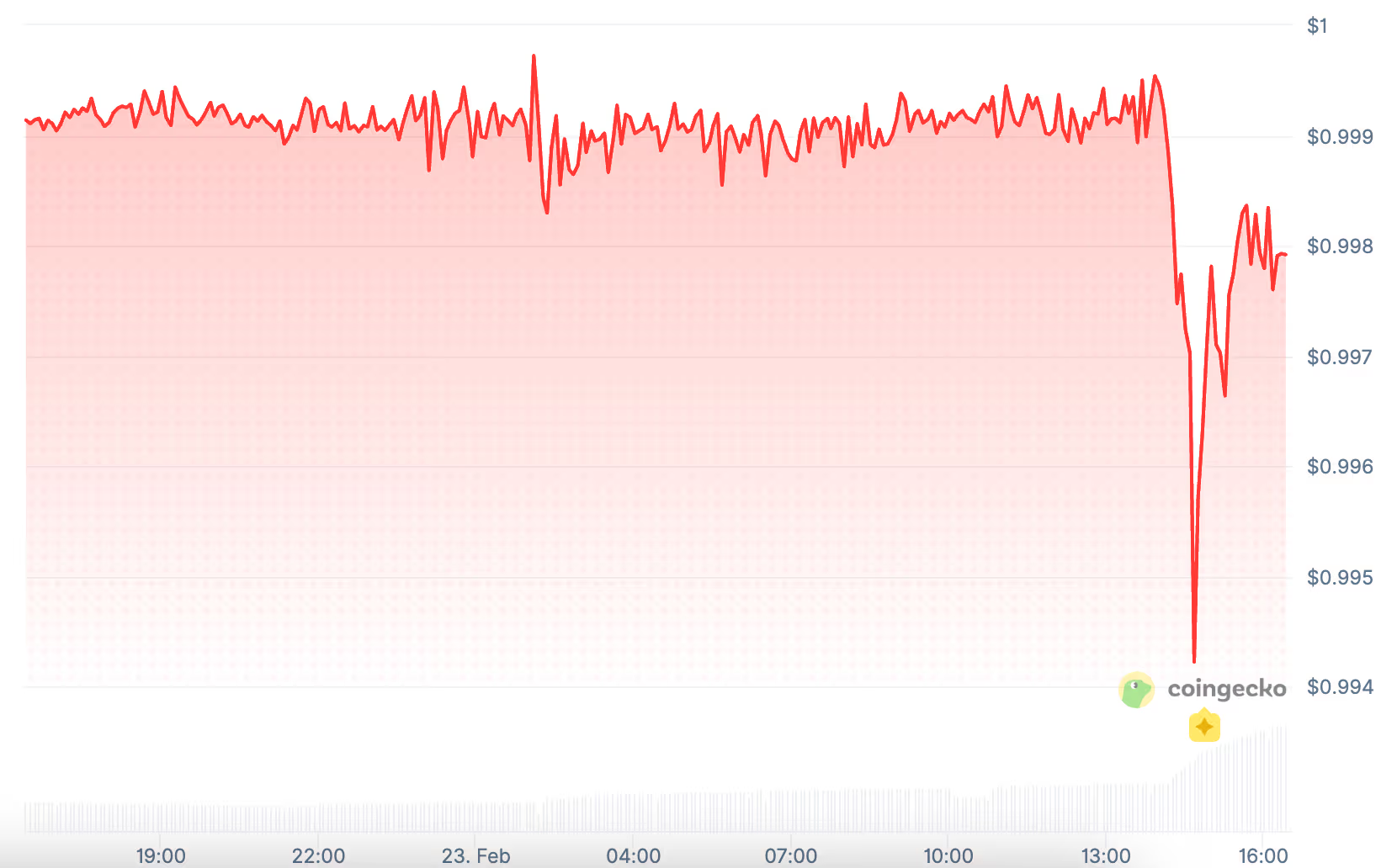
USD1, the U.S. dollar stablecoin of World Liberty Financial — a crypto protocol with close links to President Donald Trump’s family — slipped from its $1 peg on Monday amid what the project’s developers described as a “coordinated attack” against the protocol.
The token fell to as low as $0.994 during the day, some 0.6% from its intended $1 anchor, CoinGecko data shows.
In a Monday X post, the team behind USD1 said multiple cofounder accounts were hacked, influencers were paid to sow doubt, and short positions were opened against the protocol’s native token, WLFI, in what they framed as a deliberate effort to stir panic and profit from it.
“It didn’t work,” the post said, saying that a redemption mechanism that allows USD1 holders to exchange their tokens for an equal amount of U.S. dollars as the reason the peg held firm.
However, the token still traded at $0.998, some 0.2% below its intended $1 price anchor, CoinGecko shows, which gathers price data from exchange pairs.

USD1, issued in partnership with crypto custodian BitGo (BITG) is among the largest dollar-backed stablecoins. Its value is backed 1:1 by short-term U.S. government treasuries, U.S. dollar deposits and other cash equivalents and reports monthly attestations of its reserve signed by consulting firm Crowe, according to BitGo. The token currently has a $5 billion market capitalization, but it still trails major players like Tether’s USDT and Circle’s (USDC).
Read more: Goldman Sachs, Franklin Templeton, and Nicki Minaj: Inside Trump’s surreal Mar-a-Lago crypto summit
UPDATE (Feb. 23, 16:00 UTC): Adds details about USD1’s backing.
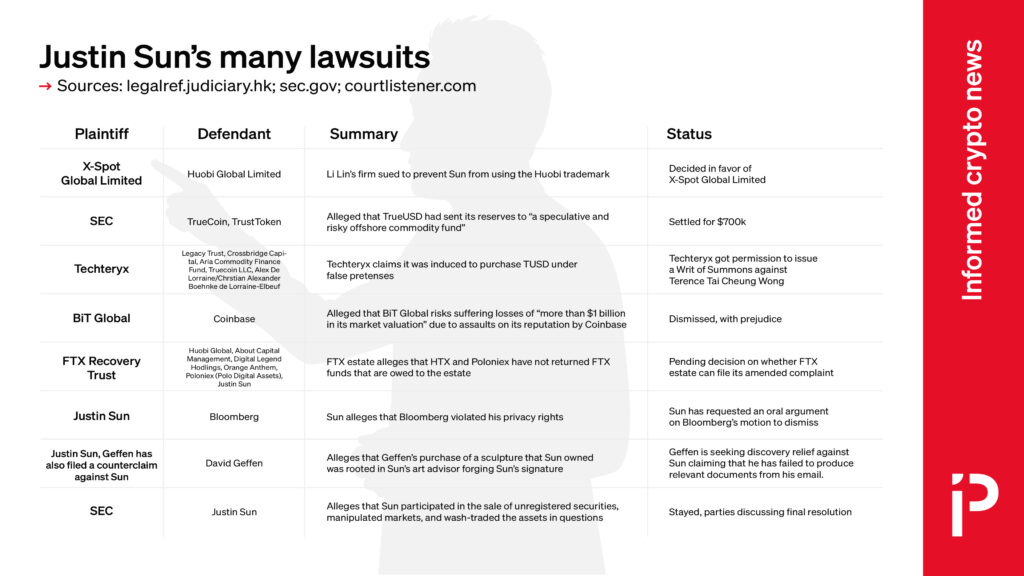
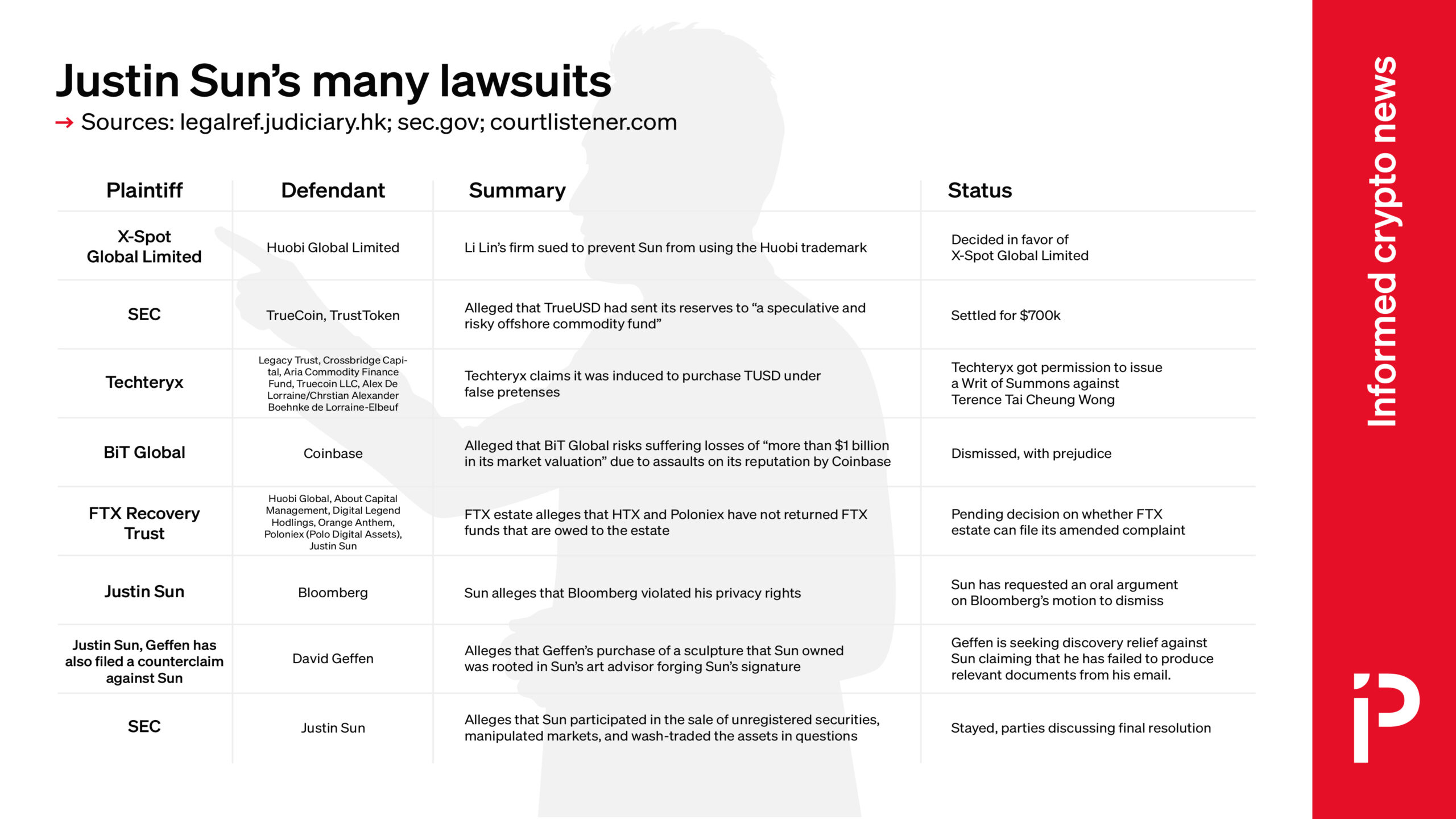
Justin Sun and his numerous cryptocurrency projects feature as both a plaintiff and a defendant in a variety of different lawsuits.
In fact, there are so many that keeping track can almost feel like a full time job. So, for those interested in that sort of thing, Protos has attempted to cut through the clutter and pulled together the suits involving Sun and his firms that we believe are most important.
Justin Sun’s fight with Huobi’s founder
Sun has been engaged in a series of disputes with Huobi founder Li Lin.
Initially, Sun accused Li’s brother, Li Wei, of taking advantage of the Huobi Token, specifically claiming that Li Wei had “received millions of HT tokens for free.”
This tweet was subsequently deleted.
Read more: Justin Sun fights a lot of lawsuits on behalf of companies he doesn’t own
The focus of this dispute then shifted to Sun’s use of the “Huobi” name.
Eventually, the High Court of Hong Kong determined that the requested injunction from Li’s firm would be granted, limiting Sun’s ability to use the Huobi name in Hong Kong.
More recently, Sun accused Li of concealing a $30 million hole in Huobi’s books when it was sold to About Capital Management.
Sun has since deleted the tweet where he made this accusation.
TrueUSD and the missing reserves
Techteryx, the Sun-affiliated firm that operates TrueUSD, has been engaged in a dispute with First Digital over the reserves of TrueUSD and how they were managed and invested.
TrueUSD had allowed First Digital to manage substantial portions of the reserves, and these investments were directed into a series of speculative and illiquid investments.
The portion of TrueUSD’s reserves invested into these assets became inaccessible when the fund they were invested in refused redemption.
Read more: What’s up with TrueUSD and the rest of TrustToken’s stablecoins?
Many of these claims about the reserves were echoed in the SEC lawsuit against TrueUSD (already settled).
Additionally, an attestation for TrueUSD from Moore Hong Kong, including notes from Techteryx executive Jennifer Jiang retrieved on February 19, reads, “The Hong Kong depository institution has invested all or substantially all of the collateral in other instruments to generate yield, which cannot be readily convertible to cash, and are subject to ongoing legal proceedings.”
Several of the defendants in this case maintain that this issue should be handled according to an arbitration agreement and not in court.
Read more: FTX knew Justin Sun tried to acquire TrueUSD
Reporting and legal filings related to this case have also revealed that Sun had to extend a large line of credit to TrueUSD because of the insolvency resulting from this reserve mismanagement.
Sun has also publicly claimed that First Digital’s role in the management of these reserves suggest “obvious loopholes in the trust industry in Hong Kong.”
First Digital Trust also publicly responded to Sun’s accusations, claiming that a substantial portion of the redemption issue for TUSD’s reserves was rooted in “AML/KYC concerns regarding the buy-out deal between TrueCoin and Techteryx and the identification of the ultimate beneficial owner of Techteryx.”
This would seem to be an allusion to Sun, though Techteryx and TrueUSD have, for some reason, continued to maintain that Sun isn’t the ultimate beneficial owner.
Older TrueUSD-related firms, specifically Archblock, TrueCoin, and TrustToken, have also recently been targeted in a lawsuit by the Celsius estate.
BiT Global’s lawsuit against Coinbase
Coinbase and Sun have been involved in lawsuits over tokenized bitcoin (BTC).
Sun is an advisor to Wrapped Bitcoin (WBTC) and has ties to BiT Global.
After Sun became involved with WBTC, Coinbase chose to delist the token.
Read more: Coinbase takes aim at Justin Sun in WBTC lawsuit response
BiT Global hoped that Coinbase would pay damages and would also be forced to relist WBTC.
Coinbase responded by pointing out it believed there was an “unacceptable risk that control of WBTC would fall into the hands of Justin Sun.”
It additionally noted that BiT Global wasn’t willing to answer questions “about who ultimately owned and controlled BiT.”
BiT Global’s lawsuit was dismissed with prejudice.
FTX’s lawsuit against Justin Sun
The FTX estate is seeking an opportunity to file an amended complaint against HTX, Poloniex, Sun, and other Sun-affiliated entities like About Capital Management.
The proposed amended complaint alleges that both Poloniex and HTX still retain millions in FTX estate assets that they’ve been unwilling to hand over.
Specifically, it alleges that Alameda Research had assets “then-valued at approximately $27.5 million” between the two Sun-owned exchanges, and “both Huobi and Poloniex had locked the Alameda accounts, rendering the debtors unable to recover their assets.”
The suit additionally verified some of the opaque structures that Alameda Research preferred, noting that the Poloniex account wasn’t associated with Alameda Research in general but was opened in Sam Bankman-Fried’s name.
Similarly, the Huobi account was also opened up under the name of an Alameda Research employee.
The amended complaint also complains that Sun’s “liquidity arrangement” with FTX as it collapsed “affirmatively facilitated a breakdown of creditor equality by providing preferential treatment unavailable to others who didn’t have tokens associated with Sun.”
This arrangement ended up “effectively reallocating estate value away from the general creditor body and towards Sun and his enterprises” as it “was designed to — and did — artificially inflate the prices of Sun-affiliated tokens by inducing a surge in demand on FTX.”
Several of the entities defending against this have filed responses opposing the ability for the estate to file this amended complaint, often claiming that the suit had done an inadequate job of proving these Sun-affiliated entities were Sun’s alter egos.
Justin Sun’s lawsuit against Bloomberg
Sun has filed a suit against Bloomberg following his participation in and inclusion on the Bloomberg Billionaire Index.
Sun had shared a variety of documents with Bloomberg, including a list of crypto addresses and evidence that he owned HTX, so that he could be included on the index.
Sun subsequently tried to insist in a group chat with Bloomberg reporters that “all information shared within the group is strictly confidential and for verification purposes only.
He also demanded that, “Once the verification is complete, the data must be deleted,” and also stipulated that the data shared should be used “solely for verification and may not be used for any other purpose (including reporting).”
Read more: ‘Someone’ is taking advantage of HTX’s reserves
Bloomberg, notably, did not agree to these terms.
Subsequently, the outlet was able to publish reporting on Sun that revealed that he owned the majority of TRX tokens and the HTX exchange.
Most recently Sun’s representatives have requested an oral argument over Bloomberg’s motion to dismiss.
This suit against Bloomberg is only one example of Sun pursuing journalistic outlets; he also reportedly complained to Bullish, CoinDesk’s owner, to get an article about his purchase of a multi-million dollar banana removed.
Justin Sun’s lawsuit against David Geffen
Sun has also filed a suit against music mogul David Geffen.
It alleges that Geffen’s purchase of a sculpture that Sun owned hinged upon Sun’s former art advisor forging Sun’s signature.
Geffen’s representatives have described the suit as “seller’s remorse.”
Geffen has also filed a counterclaim against Sun that alleges that Sun filed this lawsuit because his team had “failed to find a buyer” for paintings that were part of the deal with Geffen.
Geffen’s counterclaims allege that following this failure, “Sun and Xiong contrived this fraudulent lawsuit, hoping to pressure Geffen into rescinding the deal or paying Sun.”
The SEC lawsuit against Justin Sun
The SEC has also sued Sun, alleging that he sold unregistered securities, wash-traded, and participated in market manipulation.
Allegedly, Sun and Sun-affiliated entities engaged in a scheme to wash-trade TRX tokens on a US-based platform, specifically Bittrex.
Additionally, the amended complaint details how Sun was frequently spending time in the United States while he was directing these activities, helping the SEC establish jurisdiction.
Read more: SEC sues Justin Sun over TRX, BTT, market manipulation
Recently, Sun has become one of the largest financial supporters of United States President, Donald Trump.
Sun was the largest individual purchaser of the $TRUMP memecoin and also the largest individual purchaser of the WLFI token issued by Trump-founded World Liberty Financial.
World Liberty also named Sun as an advisor to the project.
Subsequently, the SEC requested a stay in the case, leading to frequent accusations of Sun-Trump corruption centered around their extensive financial relationship.
Got a tip? Send us an email securely via Protos Leaks. For more informed news, follow us on X, Bluesky, and Google News, or subscribe to our YouTube channel.

BTC slips toward $65,000 amid U.S. stock rout

No. 6 Iowa State faces struggling Utah amid gauntlet of ranked foes

Is It Snowing Where You Are? I Hope You Have a Roof Rake


-

 Crypto World6 days ago
Can XRP Price Successfully Register a 33% Breakout Past $2?
-

 Video4 days ago
XRP News: XRP Just Entered a New Phase (Almost Nobody Noticed)
-

 Fashion3 days ago
Weekend Open Thread: Boden – Corporette.com
-

 Sports7 days ago
GB's semi-final hopes hang by thread after loss to Switzerland
-

 Politics1 day ago
Baftas 2026: Awards Nominations, Presenters And Performers
-
 Tech7 days ago
The Music Industry Enters Its Less-Is-More Era
-

 Business6 days ago
Infosys Limited (INFY) Discusses Tech Transitions and the Unique Aspects of the AI Era Transcript
-

 Entertainment5 days ago
Kunal Nayyar’s Secret Acts Of Kindness Sparks Online Discussion
-

 Video6 days ago
Financial Statement Analysis | Complete Chapter Revision in 10 Minutes | Class 12 Board exam 2026
-

 Tech5 days ago
Retro Rover: LT6502 Laptop Packs 8-Bit Power On The Go
-
 Sports5 days ago
Clearing the boundary, crossing into history: J&K end 67-year wait, enter maiden Ranji Trophy final | Cricket News
-

 Business1 day ago
Mattel’s American Girl brand turns 40, dolls enter a new era
-

 Business1 day ago
Law enforcement kills armed man seeking to enter Trump’s Mar-a-Lago resort, officials say
-

 Entertainment5 days ago
Dolores Catania Blasts Rob Rausch For Turning On ‘Housewives’ On ‘Traitors’
-

 Business5 days ago
Tesla avoids California suspension after ending ‘autopilot’ marketing
-
 NewsBeat7 hours ago
‘Hourly’ method from gastroenterologist ‘helps reduce air travel bloating’
-

 Politics6 days ago
Eurovision Announces UK Act For 2026 Song Contest
-

 Tech24 hours ago
Anthropic-Backed Group Enters NY-12 AI PAC Fight
-

 NewsBeat23 hours ago
Armed man killed after entering secure perimeter of Mar-a-Lago, Secret Service says
-

 Crypto World5 days ago
WLFI Crypto Surges Toward $0.12 as Whale Buys $2.75M Before Trump-Linked Forum