Calocane, who had been diagnosed with paranoid schizophrenia, killed University of Nottingham students Barnaby Webber and Grace O’Malley-Kumar, both 19, and caretaker Ian Coates, 65, and attempted to kill three more people in Nottingham in June 2023.
A series of reports into the incident by the NHS so far have highlighted failings in Nottinghamshire Healthcare Foundation Trust’s management of Calocane, including failures to appropriately assess the risk he posed to himself and others. A public inquiry will now scrutinise prosecutors, police and medical professionals.
During the first day of the hearings on Monday, the inquiry heard that Calocane first had a serious violent episode on 24 May 2020. But mental health professionals ruled Calocane was safe to be treated in the community rather than being admitted.
Advertisement
Ian Coates, Barnaby Webber and Grace O’Malley-Kumar were fatally stabbed by Calocane (PA)
Counsel to the inquiry Rachel Langdale told the hearing that, during the incident, Calocane, who is referred to as “VC” in proceedings, was found “repeatedly kicking and punching a door” in an attempt to get into a neighbour’s flat.
He was assessed by a mental health professional and found to be suffering from a psychosis mental health episode and “was noted to be presenting with mental health issues, hearing voices, appeared vacant, and had not slept for five days”.
At a follow-up mental health act assessment, Dr Gandhi, along with an approved mental health practitioner, Ben Williams, and a mental health nurse Anna Palmer, agreed he would be offered treatment with antipsychotic medication in the community rather than as an inpatient admission.
Advertisement
According to the statement, Dr Gandhi said he was leaning towards detaining Calocane “given it was the first presentation of psychosis, and a lack of information on risk history”. But he said that the team of professionals also “considered the research evidence that shows overrepresentation of young Black males in detention”.
Dr Gandhi said it is part of his role in assessments to be aware of research, evidence and data including health inequalities but that it would not have affected the decision to admit or treat Calocane in the community.
The inquiry will look at how appropriate that mental health act assessment was.
KC Langdale’s statement later quotes Royal College of Psychiatrist’s evidence stating there is “there is no evidence that psychiatrists are not admitting patients because they are black. The rates of admission are the same as at the time of the publication of the independent review and recent evidence shows that detentions are going up.”
Advertisement
She added that in the specific case of Calocane the inquiry may want to consider whether race was a factor however said the evidence so far received does not suggest it was and that it he was admitted on four on four occasions.
Shortly after being released, Calocane was arrested after attempting to get into another neighbour’s flat and causing the the woman to become so scared she jumped out of her first floor window, causing serious damage to her spine.
Following his arrest, Ms Palmer spoke with his mother, Celeste Calocane, who “noted that she would prefer that her son goes into hospital for treatment, as he’s a risk to others in his current mental state”, the inquiry heard.
Ms Langdale added that the chair of the inquiry Deborah Taylor may ask why Calocane was released at that stage and whether release straight into the community was appropriate.
Advertisement
It was not until the next day, during a further mental health act assessment, that he was recommended for section.
The inquiry will also probe why services deemed, prior to discharging him, that there had been “no incidents of violence” from Calocane despite the episodes in May 2020, as well as a prior incident in which he “had entered a neighbour’s flat to confront those who believed were trying to spy on him and torment his mind”.
Ms Langdale’s opneing statement further revealed in Christmas 2022, Calocane sent his parents files over christmas which included, a document explaining he “had been hearing voices in his head all the time, but this wasn’t the result of mental ill-health”, but it was explained by “mind control technology”, the inquiry heard.
After the attacks on June 13, analysis of Calocane’s phone was undertaken, which show he researched “mind control technology” and watched videos including of a shooting. He also viewed documents with some content relating to the law and police powers, Ms Langdale said.
Advertisement
He largely kept a low profile during his fourth hospital admission in early 2022, spending most of his time on his phone.
Ms Langdale said the inquiry will “explore with treating clinicians whether they ever asked VC what he was viewing on his phone, if not, why not, and whether patients routinely have unfettered access to their phone”.
His risk assessment was updated for the final time prior to the attacks on February 28 2022 – which noted “that given the history of violence and aggression, there should not be home visits, and if a home visit was required it should be a joint visit; no lone working”.
Ms Langdale added: “We will ask why this assessment of the risks to the community medical team did notapply equally to other students and the wider public.”
Advertisement
In September 2022 Calocane was discharged from the early intervention in psychosis team which were responsible for his care in the community at the time. He was discharged back to his GP as the team could not make contact with him despite attempts to.
The inquiry will consider whether discharging him to his GP for non-attendance to appointments should have been a signal of his deteriorating mental health.
In the months leading up to the killings in June 2023 Calocane’s GP sent text messages asking him to arrange an appointment, however he was not seen and was not provided with any medication.
“The Inquiry will consider the role of primary care services following discharge of non-engaging patients, especially where the non-engagement may be an indication of deteriorating mental health and increased risk,” the statement said.
Advertisement
Ms Langdale also said there appears to be a “lacuna” in terms on monitoring patients’ medication as Calocane’s GP claimed this was the responsibility of the trust.
“It does not appear the GP practice took any steps to manage VC’s prescriptions or make any efforts to ensure he received any. VC was essentially in the community disengaged from any health service and unmedicated”, the inquiry heard.
Calocane was sentenced to an indefinite hospital order in January 2024 after admitting manslaughter by diminished responsibility and attempted murder – something which has been widely criticised by the victims’ families.
All four people in the property were able to make it out of the house safely
A house fire that “destroyed” a bedroom and caused “serious damage” to the upstairs of the property is believed to have been started by a candle. Firefighters from Cambridgeshire Fire and Rescue were called to the scene of a house fire in March.
Advertisement
When they arrived at the property, they found a bedroom fully engulfed in fire. Crews from March, Wisbech, and Chatteris helped to contain the fire.
The crews stopped the fire from spreading further and were able to extinguish it. There were four people in the property at the time of the fire but they were all able to make it out of the house before the crews arrived.
Station Commander Clive Allen said: “The fire is believed to have been caused by a curtain blowing onto a lit candle. We would like to remind people to always remain vigilant when lighting candles. Our advice for the safe use of candles is to never leave them unattended and keep them in a draught-free area away from curtains, furniture and other flammable surfaces. Alternatively, you could use LED candles as a safer option.
“Thankfully the occupants had working smoke alarms on each floor of the house which is exactly what we would advise people to warn you of a fire in your home. We also recommend you test all smoke alarms in your home once a month to ensure they are working properly. If you need a reminder to test your alarm, you can sign up to get an email from us every month to give you that nudge.”
Advertisement
To get more news and top stories delivered directly to your phone, join our new WhatsApp community.Click this linkto receive your daily dose of CambridgeshireLive content.
We also treat our community members to special offers, promotions, and adverts from us and our partners. If you don’t like our community, you can check out any time you like. If you’re curious, you can read ourPrivacy Notice.
The new service will be available 24/7 across Asda stores
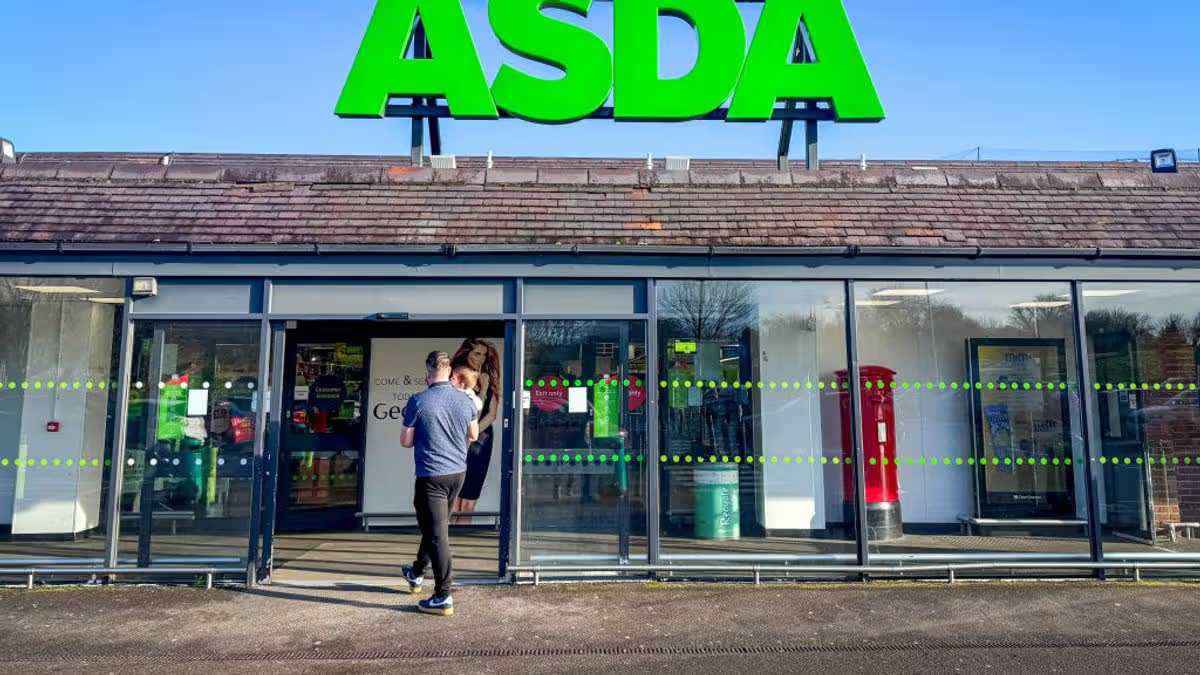
Asda has launched a new service across 700 of its stores which is designed to “make life easier” for customers. The supermarket has announced it will be installing self‑service laundry machines across its stores, meaning Asda customers will now be able to do a wash while they are shopping.
Advertisement
The new laundry units will be installed at a range of Asda Supercentres, Superstores, supermarkets and Express sites from May, and will look to give customers a quick, convenient and great‑value way to wash and dry their clothes while they shop.
The units will offer 9kg and 20kg drum capacities as well as energy-efficient cycles and high-speed drying. The machines will also be available to be used by shoppers 24/7.
Get MEN Premium now for just £1 HERE – or get involved in our WhatsApp group by clicking HERE. And don’t miss out on our brilliant selection of newsletters HERE.
Joseph Sutton, Vice President Asda Express, foodservice and fuel, said: “We’re always looking for new ways to make life easier for the customers who shop with us, particularly by strengthening the breadth of services that meet their needs under one roof.
Advertisement
“This large‑scale rollout of Wash.ME units gives customers a quick, convenient and great‑value way to tackle their laundry while they shop. We’re pleased to be working with ME Group on this significant partnership and look forward to seeing the benefits it brings to customers across the UK.”
Commenting on the new partnership with Asda, Vladimir Crasneanscki, Deputy Chief Executive Officer of ME Group, added: “Asda is a perfect company to partner with, their retail and petrol stations are excellent locations for our services and their innovative and fast paced approach will enable us to deploy our units rapidly. We are delighted to announce this partnership; this is the largest single client deal in the history of our laundry division and demonstrates the growing demand for our services.
“The rapid expansion of our Wash.ME laundry services is a key strategic priority for the Group, driven by strong consumer demand. In 2025, we announced a record number of Wash.ME machine installations of 1,326 across our geographies, and we have clear ambitions to continue building on this progress. This partnership is indicative of our intention to further cement our UK market-leading position in the unattended laundry segment.”
ITV viewers have begged bosses to bring back the hit show two years after the show went off air
Monde Mwitumwa TV and Celebrity Reporter
13:20, 10 Apr 2026
ITV audiences have pleaded with bosses to bring back what they say is ‘the best thing on TV’ following a two-year absence.
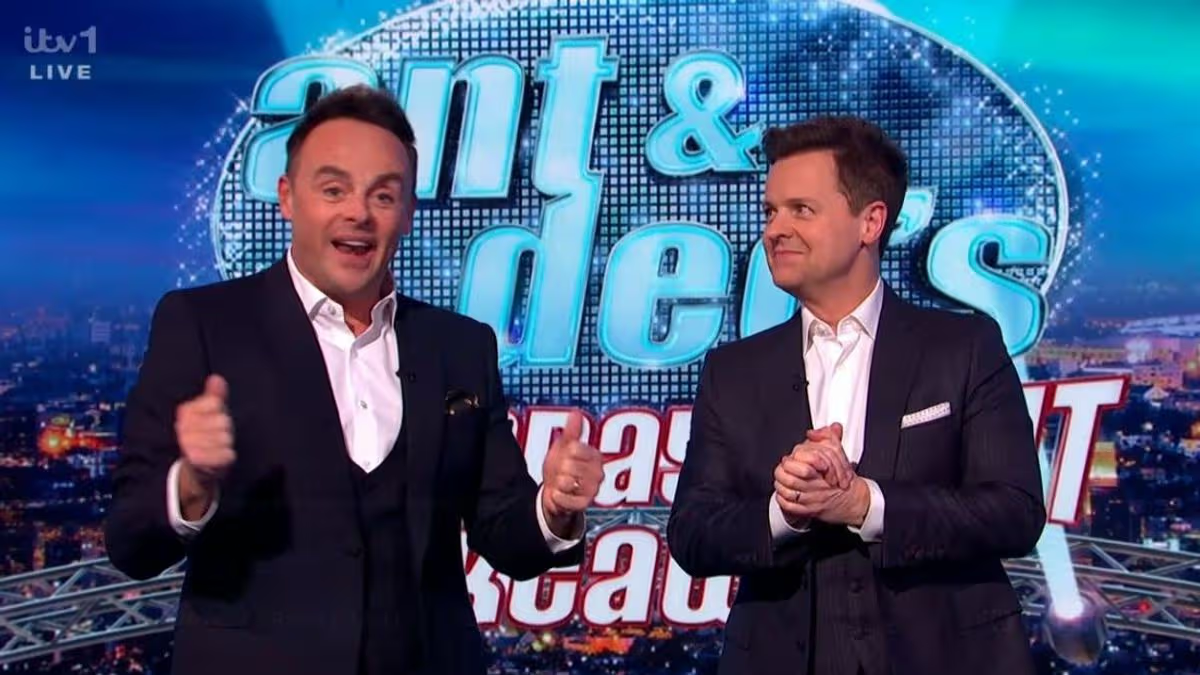
The broadcaster sparked excitement among fans after posting a video to its official Instagram page featuring Ant McPartlin and Declan Donnelly presenting their first and final instalment of their popular programme Saturday Night Takeaway.
Advertisement
Saturday Night Takeaway initially debuted in 2002, with the programme taking a hiatus in 2009, before making its comeback four years afterwards in 2013.
Throughout its run, it has garnered numerous honours, including Bafta and National Television Awards (NTA) recognition, reports the Mirror.
Following six years on TV, Ant and Dec revealed they would be stepping away from the programme – describing it as the “perfect time to pause for a little while and catch our breath”.
During that period, they concluded their final series on a triumphant note, featuring numerous adrenaline-fuelled challenges, amusing hidden camera pranks, fresh studio entertainment, and spontaneous surprises.
The presenting pair did not specify when or whether it would ever make a return. Now two years since it vanished from our screens, television enthusiasts have urged ITV to contemplate a revival following their social media upload.
Expressing their response in the comments area, one supporter stated: “Bring it back soon.” Another declared: “Bring Saturday night takeaway back next year! @itv.”
Advertisement
A third remarked: “We need this back ASAP.” Meanwhile one asserted: “Probably was the best thing on TV at the time.” Another speculated: “This makes me think it’s coming back.” One agreed: “I think it’s coming back.” One said: “I wish they would bring it back, it’s a great show.”
One fan insisted: “Bring Saturday night takeaway back next year!” Another joked: “My children and I mourn this show..bring…it….back.” Meanwhile one added: “Need this back.. best thing on TV.”
In a previous interview with Fault magazine, Ant addressed the reasoning behind the programme’s hiatus. He said: “Part of the reason we’re pausing Takeaway is we need a break ourselves, and we need to spend some time with our family. We’ve both got children that we need to spend time with for a little bit.”
Advertisement
He continued: “We need time to think and, and time to step back and look at the bigger picture and just see where we are now. Like I say, we’re turning 49, and what do we want to do next? What’s the next phase of our career?”
The television personality went on: “And we’ve got lots of ideas and lots of offers on the table, lots of options of things we can do. But it’s working on what we do next and where the next chapter begins.
“So that’s what we’re gonna do when Saturday Night Takeaway is out of the way. We’ll sit down, take a bit of time, and re-evaluate everything.”
British voters’ trust in the United States has plummeted in the wake of Donald Trump’s decision to wage war in Iran, a new poll has revealed.
The Public First research for Politico found that more than half (53%) of the UK public now view America as a negative force globally, up from 35% in December.
At the same time, the proportion of voters who think the States plays a positive role in the world has slumped from 41% to 29%.
The poll of 2,000 people was carried out between April 3 and 7, around five weeks into the US and Israel’s bombing campaign in Iran.
Advertisement
During the conflict, Trump has repeatedly attacked America’s allies – and the UK in particular – for not helping the war effort.
The poll also found that just 27% of British voters believe the US supports its allies around the world, down from 40% in December.
And the number who think America can be relied upon in a crisis has also fallen, from 44% to 32%.
Seb Wride, Public First’s head of polling, said: “In just 5 months, the UK public has entirely lost faith in their main ally — right at the moment that the world seems historically unstable.”
Advertisement
Relations between the US president and Keir Starmer have also reached an all-time low as a result of the war.
Trump has repeatedly attacked the prime minister over his decision to limit Britain’s involvement in the conflict.
Subscribe to Commons People, the podcast that makes politics easy. Every week, Kevin Schofield and Kate Nicholson unpack the week’s biggest stories to keep you informed. Join us for straightforward analysis of what’s going on at Westminster.
And now, Gemma has debuted her growing bump as they prepare to expand their brood.
Taking to social media, the reality star posed in a mirror selfie, wearing a crop top and adding the caption ‘Incoming’. She then shared a smiley selfie with Jesse, writing: ‘Made by these muppets’.
Made in Chelsea star Gemma, 40, debuted her bump in a mirror selfie (Picture: Gemma Gregory/Instagram)
She followed the announcement up with a smiley selfie alongside Jesse, 49 (Picture: Gemma Gregory/Instagram)
Jesse is already a dad to son Rex, 12, and daughter Honey, nine, from his marriage to Fearne. He also has two children with his first wife, Tilly Wood, to whom he was married from 2003 to 2011.
Meanwhile, Gemma, who joined E4’s Made in Chelsea in 2012 and is also the daughter of actor Paul Gregory, gave birth to her son, Benji, in 2014.
Their baby news comes just months after Jesse appeared in court after being caught driving 27mph in a 20mph zone, facing a possible ban.
Advertisement
Speaking of his financial situation in January, the guitarist told Lavender Hill Magistrates Court that he had been struggling to find work.
Representing himself, he said: ‘I was due to be employed in 2024, but it got delayed.
‘At the moment, I’m living off my savings, and I am looking to get employment.’
Jesse was married to Fearne Cotton for 10 years (Picture: Alan Chapman/Dave Benett/Getty Images)
He and girlfriend Gemma went public with their romance four months after his divorce was announced (Picture: Gemma Gregory/Instagram)
As reported by the Daily Mail at the time, he added that his recorded income on last year’s tax returns was around £14,000.
This followed him standing down as the director of Reef Band LLP last October, with the last accounts showing the company to be in the red. Jesse also resigned as a director of Tribe Festivals in 2022.
Advertisement
He apologised for his speeding offence and pleaded guilty, resulting in a six-month ban and three additional penalty points.
Because of his plea, he managed to get his fine reduced from £134 to £89. He was further ordered to pay £36 and £130 in contribution to court costs.
Jesse has not spoken publicly about his divorce since Fearne broke the news. She wrote online at the time: ‘It is with a heavy heart that I let you all know that Jesse and I are ending our marriage.
‘Our priority has been and always will be our children.’
Advertisement
Fearne is now prioritising her own happiness, having also moved on romantically (Picture: Fearne Cotton/Instagram)
She and Jesse continue co-parenting son Rex, 12, and daughter Honey, nine (Picture: Fearne Cotton/Instagram)
Musician Jesse insisted the split was ‘amicable’ (Picture: Fearne Cotton/Instagram)
Jesse did, however, make a brief mention of where things currently stand when he appeared on Lorraine last March, saying: ‘It’s all very amicable and the kids are doing great. I am in a very good place.’
Fearne also moved on, going public with television director Elliot Hegarty (who is 10 years her senior) earlier last year, which Jo Wood, Ronnie’s ex-wife, who helped to raise Jesse, said ‘shocked’ her.
‘I didn’t expect Fearne to have a new boyfriend. And Jesse was devastated,’ she said in 2025.
‘But sometimes in life, you have to go through these things. It may be daunting at first, but every cloud has a silver lining. Nothing lasts forever. I hope Fearne will be very happy.
‘I’m sure Jesse’s going to be very happy. These things work out. Their time was up – they had to move on.’
‘One of the most important things is the people around you – and that is the most important thing in life,’ she told Closer in August.
‘We need good people around us, but we have got to do the work. It is bloody hard.
‘When you start liking yourself and loving yourself, you want to feel better as you know you deserve it.’
Advertisement
Got a story?
If you’ve got a celebrity story, video or pictures get in touch with the Metro.co.uk entertainment team by emailing us celebtips@metro.co.uk, calling 020 3615 2145 or by visiting our Submit Stuff page – we’d love to hear from you.
The 15-cap wing has endured some injuries in recent seasons, but featured in Wales’ Six Nations campaign
Wales international Mason Grady has become the latest player to sign a new contract with Cardiff.
Advertisement
The likes of Alex Mann, James Botham and Evan Lloyd have all penned new deals in recent weeks – with wing Josh Adams announcing he would be staying at the Arms Park on Thursday.
Homegrown talent Grady is now the latest to commit his future to the Blue and Blacks, having signed a multi-season contract to stay in the Welsh capital.
The 24-year-old has struggled with injuries at times in recent seasons, but has been in good form recently for Cardiff.
“I’m really happy to sign this long-term contract with Cardiff and I’m excited for what the future holds,” said Grady after signing his new deal.
Advertisement
“This is the club I grew up supporting, I can remember fondly coming here as a kid and I have come through the pathway. I have a lot of good friends here and I believe we have huge potential.
“On a personal level, I feel this is the best environment for me to continue my development. I’ve had some set-backs with injuries but feel like I’m getting back to my best and it’s about consistently improving and putting my game on the pitch.
“To come to the Arms Park every day is such a privilege, which I am very grateful for. We have a squad packed with talent, whether experienced players to learn from or exciting youngsters, and we are all competing and driving each other on.
“We are heading in the right direction and are determined to keep doing that. I’m really looking forward to playing my part in the next few years and hope we can do the amazing supporters at the Arms Park proud.”
Grady had previously signed a one-year deal last year with the club, having turned down offers in England to stay in Wales.
Due to his imposing size, standing at 6ft 4ins and weighing 111kg, there’s been a lot of excitement surrounding Grady – who can play either wing or centre – for a number of years now.
Having made his debut for Cardiff during the 2020/21 season, he has now played 59 times for the Arms Park club.
Advertisement
He has also played 15 times for Wales, scoring his second Test try against France in this year’s Six Nations.
“We are very happy to keep Mason at the Arms Park,” said Cardiff coach Corniel van Zyl. “He is a local boy, who has come through the ranks and cares deeply about the club.
“He’s obviously had a few setbacks with injuries recently but he has come back from them well. There was a bit of expectation on him at the beginning, but he settled back nicely and has found some good form in recent weeks.
“His game is definitely growing, he is highly motivated to continue improving and we are excited to see where he can go.
Advertisement
“With his size, pace and power, he has an athletic ability and attributes that are rare in Wales, while his basics are improving every day.
“So we are delighted he has decided to continue his journey in a Cardiff jersey and we look forward to helping him push onto the next level.”
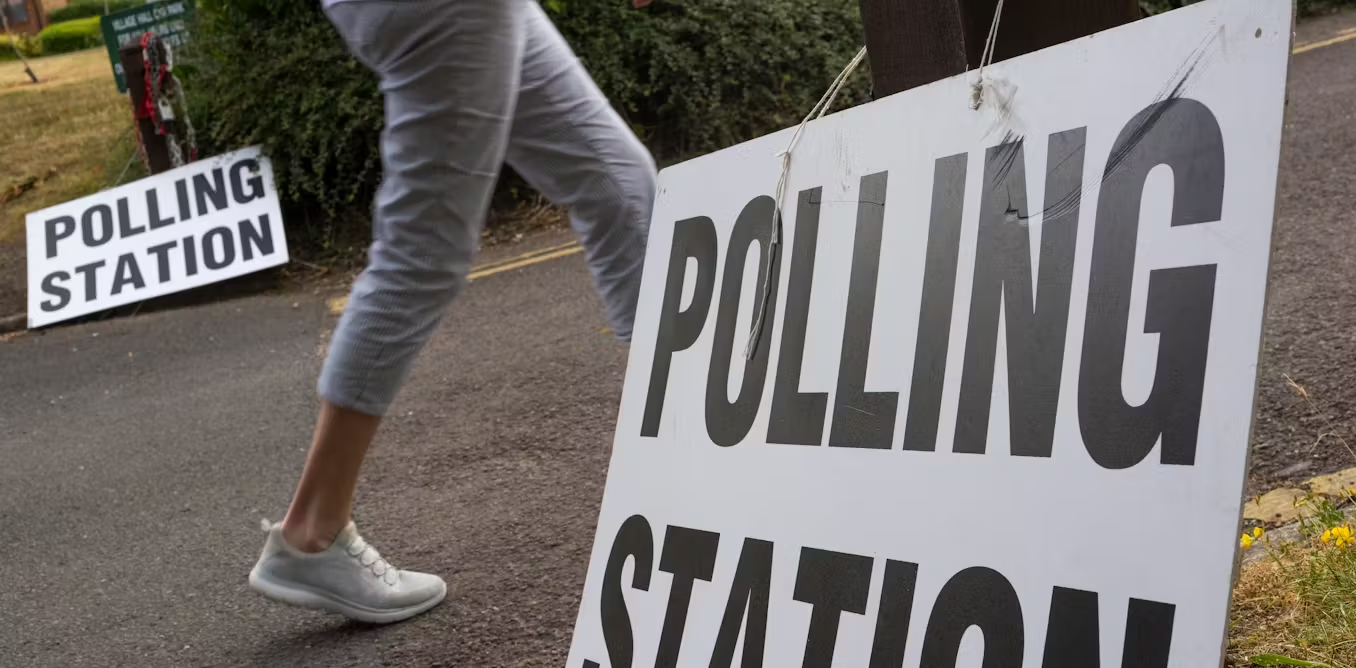
On May 7 2026, voters in England, Scotland and Wales will head to the polls. Parliamentary elections are taking place in the devolved Welsh Senedd Cymru and Scottish Parliament, and local elections for over 4,850 councillor roles could have huge implications for local governments throughout England. With all to play for, we asked five experts to tell us what they will be keeping their eye on.
Can Reform compete across the UK?
Jonathan Tonge, Professor of Politics, University of Liverpool
The 2026 elections will reveal whether Reform UK will peak as an English nationalist party, or if they can compete as a genuine nationwide force. Last year’s local elections confirmed that Reform can seriously harm the Conservatives. This year, contests are across councils held mainly by Labour, making the English elections about Reform’s threat to Keir Starmer’s party.
Nigel Farage’s party, which currently has eight MPs, has led opinion polls in England since May 2025, when it won the highest vote in English local elections. Reform took control of ten councils (from a starting point of zero), and gained nearly 700 new councillors. Of these, eight were county council gains from the Conservatives, with another taken from a Liberal Democrat-led coalition. The tenth gain was from Labour in the only metropolitan borough contested, Doncaster.
Advertisement
Reform’s likely gains in English councils aren’t guaranteed elsewhere in the UK however. The party’s polling in Scotland is around ten percentage points behind what it is in England. It may be that Reform is battling Labour for second place, while the Scottish National Party (SNP) continues to dominate.
Alex Nurse, Reader in Urban Planning, University of Liverpool
Advertisement
Local elections are often concerned with local issues – think potholes and bin collections. Councils are also obliged by law to spend a lot of their time and budget on initiatives like adult social care, but these issues are often lost in the broad brush strokes of election campaigns.
It will be interesting to see how the ascendant Greens and Reform present their vision for local government, and what compromises they make to win over local voters. In the recent Gorton and Denton byelection, Green candidate Hannah Spencer made scarce mention of the environment and instead focused heavily on the cost of living and the broader social contract. Similarly, Reform’s promise to mimic the US Department of Government Efficiency (Doge) following the 2025 elections came up short after its newly elected councillors found local authorities already cut to the bone from years of austerity.
I’ll also be watching to see how the fragmented opinion polls translate into council seats. While we might be expecting a wipeout for Labour and the Conservatives, it remains to be seen how many councils the other parties will win wholesale, and where there will be situations of no overall control, requiring tricky coalition building. This might involve attempts to form a coalition of like-minded councillors, as seen in Bristol. However, the reality is often that parties attempt to go it alone, by entering minority government and living vote by vote, as seen in places like Sheffield or Wirral.
Murray Leith, Professor of Political Science and Director of the Centre for Migration, Diaspora, Citizenship and Identity, University of the West of Scotland
The SNP has long predicated its sense of national identity on a civic and inclusive
Scottishness. Its message throughout the past 19 years has been that anyone who believes in Scotland can be Scottish. While other parliamentary parties have challenged and attacked myriad SNP platforms and policies in the last two decades, none disagree with this political elite consensus.
However, this agreement has not been as duly accepted by people in Scotland who
are less accepting of incomers and migrants (from the rest of the UK and beyond) claiming Scottish identity. Scotland has shifted from an emigrant nation to an immigrant nation in recent years. Without immigration, Scotland’s population would have shrunk. While migration policy remains reserved to Westminster, it looms large in the minds of voters – so much so, that the SNP has made devolving immigration power to Scotland one of its 14 key manifesto pledges.
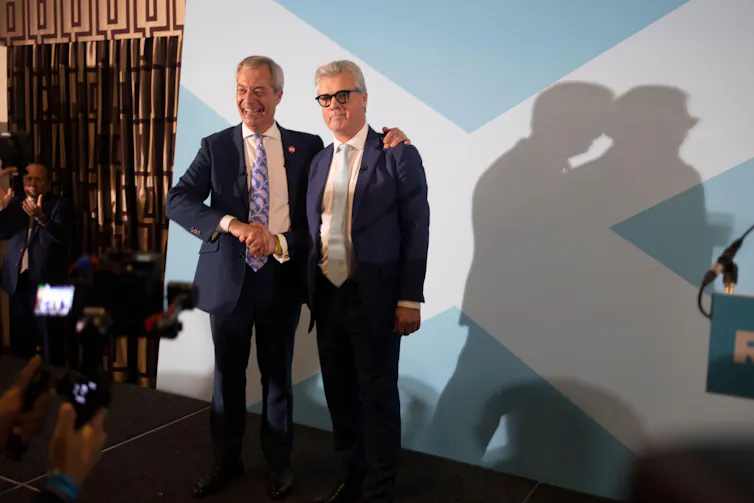
Reform UK is openly challenging this inclusive and welcoming political consensus. In his first speech, Malcolm Offord, Reform’s Scottish leader spoke of strangers and uncontrolled immigration destabilising communities. Given recent polling and the possibility that Reform may be the official opposition in the next Scottish parliament, the SNP may soon be facing an opposition that proposes a less inclusive vision of Scottishness.
Advertisement
Reform UK’s Malcolm Offord has campaigned on prioritising Scottish people over ‘strangers’. jeremy sutton-hibbert/Alamy
A potentially huge turnover on councils
Hannah Bunting, Senior Lecturer in Quantitative British Politics and Co-director of The Elections Centre, University of Exeter
In the English local elections, I’m keeping an eye out for how many incumbents lose their seats. We know that voters are disillusioned with the two main parties and looking for alternatives. Last year in the 2025 locals, and in many council byelections since, less than 40% of Labour and Conservative incumbents were re-elected. According to our data at The Elections Centre, this figure hasn’t dropped below 70% since 1973.
There are also many more vacancies this year compared to 2025, with Labour defending half of the nearly 5,000 up for grabs, and the Conservatives defending another quarter of them. If this rate of losses continues, we are going to see thousands of new councillors elected, with huge implications for local governments.
Two Labour strongholds, Sunderland and Barnsley, are currently polling in favour of Reform, as is Walsall, which has been held by the Conservatives since 2004. The Greens are making headway in the inner boroughs of London, and councils with “no overall control” may be more common than ever in the capital after these contests. Labour has the furthest to fall, and all eyes will be on how many gains Reform and the Greens make, alongside how many areas turn to the Liberal Democrats as an alternative.
Anwen Elias, Reader in Politics, Aberystwyth University
Changes to the way Welsh voters elect the Senedd – a proportional system where one vote is cast for a political party’s list of candidates across 16 new constituencies – will require parties to campaign very differently compared to previous elections. The extent to which they can adapt will affect how they perform.
Under the previous electoral system, most Senedd members (40 out of 60) were elected under first-past-the-post, with the rest elected through proportional regional lists. There was an incentive to focus attention and resources on key seats where a political party had the best chances of winning. Under the new system parties will need to gain support from across Wales if they want to ensure a strong presence in the Senedd.
This requires a different kind of campaign strategy and organisation, which is likely to be especially challenging for parties with fewer resources. Within constituencies – some of which are huge – political parties will have to mobilise activists in areas where historically they might not have had a much presence or electoral support. Parties with the available resources for a coordinated national campaign and a strong media, and social media, presence will have a clear advantage under this new system.
An unexpected Netflix star appears in the new Malcolm in the Middle spin-off
Where the cast of Malcolm in the Middle are now
Malcolm in the Middle fans have been distracted by the unexpected cameo of one huge Netflix star in the revival series.
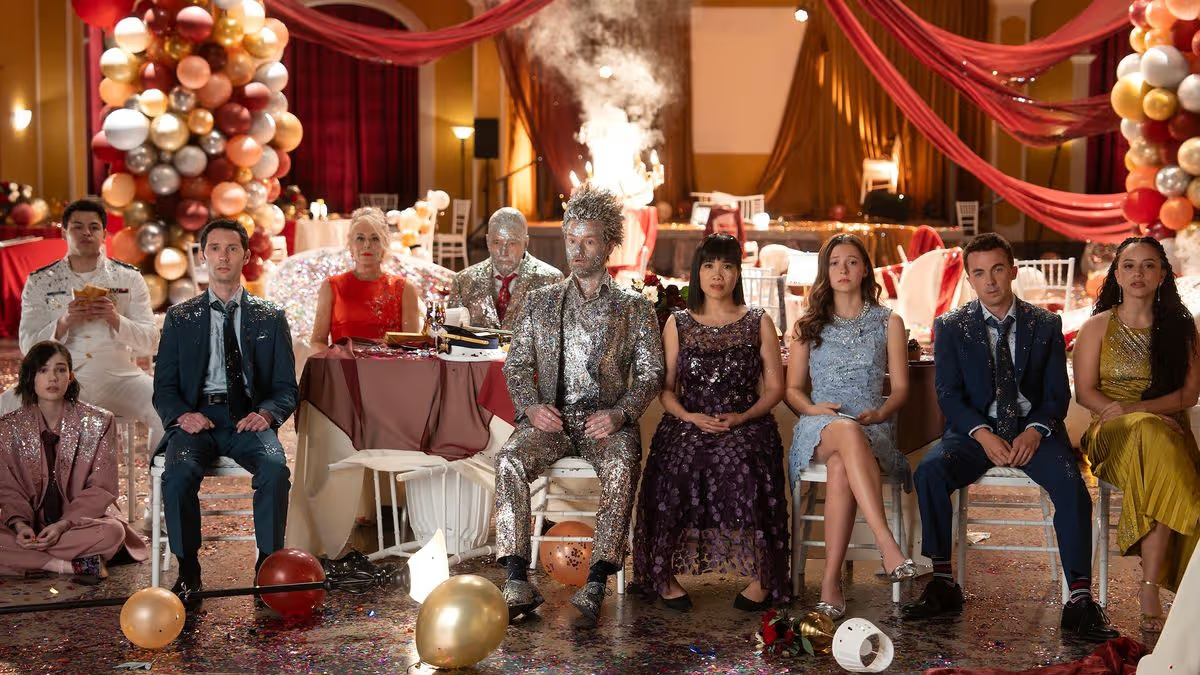
The beloved sitcom has finally returned after the original series wrapped up 20 years ago back in 2006. Subtitled Life’s Still Unfair, the four-part limited special reunites fans with what is considered as television’s most chaotic family.
*Warning – this article contains major spoilers for Malcolm in the Middle: Life’s Not Unfair, specifically, episode 4*
According to its synopsis, Malcolm has been keeping himself and his daughter at arm’s length from his family for over a decade. Yet he finds himself pulled back into their chaotic world when his parents, Hal and Lois, insist that everyone must attend their forthcoming 40th wedding anniversary celebration.
Advertisement
Frankie Muniz returns once again to play Malcolm, the role that made him a child star, while he is also joined by Justin Berfield and Christopher Masterson who are also returning as two of his brothers, Reece and Francis respectively.
Bryan Cranston, who went on to star in hit drama Breaking Bad once the show ended also makes a welcome return as Hal, with Jane Kaczmarek returning by his side as strict matriarch Lois.
All four episodes of the special are streaming now on Disney+ as of today (April 10) and fans have already starting to binge watch it as quickly as they can. While they are loving seeing familiar faces back on their screens, they also admit to feeling emotional at seeing the show make its return.
The short series is also absolutely packed with guest appearances. That includes several characters that appeared in the original series such as Malcolm’s best friend Stevie Kenarban and Lois’ former Lucky Aide coworker Craig Feldspar.
However there is one guest star making a small cameo of a brand new character in the revival series that no fan expected. Viewers have now discovered that Finn Wolfhard, star of Netflix hit Stranger Things, makes a brief appearance.
Get Disney+ for £5.99
Advertisement
This article contains affiliate links, we will receive a commission on any sales we generate from it. Learn more
A Disney+ subscription now starts at £5.99 and includes new series like Malcolm in the Middle: Life’s Still Unfair, plus countless titles from Marvel, Star Wars, Pixar and more.
The 23-year-old Canadian actor and musician is most famously known for having played the role of Mike Wheeler in the 80s inspired series across its entire run. It was not known before its release, but is now confirmed he plays out a stressed out party planner trying to help Lois organise her 40th wedding anniversary.
Fans were quick to spot the Netflix star as one posted on social media saying: “Finn is in the new Malcolm in the Middle? Jump scare in the best way! WTF! Why is he in the reunion special of my comfort show?”
Advertisement
Another added: “My sister had the Malcolm in the Middle revival on the TV this morning and I had to do a double take like “IS THAT FINN WOLFHARD???” Whoever his agent is…give them a raise immediately”
Apparently, his appearance came about through a little bit of luck. Speaking to Deadline, series creator Linwood Boomer explained exactly how it happened.
He said: “His agent called us and said, ‘Can Finn visit the set? He loves the show, he’s such a big fan of the show’, and we’re like, ‘S*** yeah! Well, there’s a part we haven’t cast yet. Does he wanna do that? I mean, it’s a small part.’ And he said, ‘F*** yeah, he wants to do it.’ And we were like, ‘F*** yeah, we want you to come, that’d be awesome.’”
Advertisement
Malcolm in the Middle: Life’s Still Unfair is streaming on Disney Plus
However, it was always expected that Fury would return, likely for a huge money-spinning showdown with long-time rival Anthony Joshua, and he repeatedly hinted as much before officially announcing his comeback in January, with an April date against Makhmudov confirmed.
Makhmudov, 36, is a Russian heavyweight based in Canada who has a professional record of 21-2 with 19 knockouts. He last fought in Sheffield in October, when he beat David Allen by unanimous decision.
Both of those defeats have come in his last five bouts, with Makhmudov stopped by now interim WBC champion Agit Kabayel in the fourth round in Riyadh in 2023 on the ‘Day of Reckoning’ card ahead of Deontay Wilder vs Joseph Parker and Joshua vs Otto Wallin, losing his WBC-NABF and WBA Inter-Continental titles.
Arslanbek Makhmudov picked Tyson Fury up at their final press conference
Advertisement
AFP via Getty Images
After bouncing back with an early knockout of Miljan Rovcanin, he was then upset by Italy’s Guido Vianello in the summer of 2024 in a rematch of their World Series of Boxing clash after gruesome swelling around his left eye forced the ringside doctor to wave off the bout at the start of round eight.
Makhmudov responded with a first-round knockout of Jamaican Ricardo Brown in Quebec City, before travelling to the UK to defeat Allen.
Fury’s comeback comes amid yet more speculation that a fight with Joshua has been agreed, with renewed suggestions that it could take place in Dublin in the autumn.
Advertisement
Joshua last fought by knocking out Jake Paul in Miami in December, though his boxing future looked uncertain after he subsequently sustained minor injuries in a car accident in Nigeria in which two of his close friends and team members died.
Eddie Hearn has said that they have been “very focused” on making the Fury fight, but also did not rule out Joshua – who was in attendance at the O2 Arena – potentially facing another long-time rival in Deontay Wilder, who called him out in person after defeating Derek Chisora in a thrilling contest by split decision last weekend.
Joshua is also expected to be ringside for Fury vs Makhmudov.
Fury vs Makhmudov fight date and venue
Advertisement
Fury vs Makhmudov takes place on Saturday April 11, 2026 at the Tottenham Hotspur Stadium in London, England.
Fury vs Makhmudov fight time and ring walks
Saturday night’s main card is due to begin at 7pm BST, which is 2pm ET and 11am PT in the United States.
Fury and Makhmudov are expected to make their ring walks after 10pm BST, 5pm ET and 2pm PT. The fight should be underway at approximately 10:30pm BST (5:30pm ET, 2:30pm PT), but those timings are subject to change.
Advertisement
How to watch Fury vs Makhmudov
TV channel and live stream: Fury vs Makhmudov is being shown live and exclusive around the world on Netflix, included in regular subscriptions at no extra cost. A subscription to Netflix currently costs from £5.99 a month in the UK.
Live blog: You won’t miss anything on fight night with Standard Sport’s live blog.
Fury vs Makhmudov undercard
Advertisement
Jeamie ‘TKV’ Tshikeva defends the British heavyweight title won against Frazer Clarke for the first time as he battles Richard Riakporhe, while Clarke is on the comeback trail against Justis Huni.
Former British and Commonwealth middleweight champion Felix Cash is also on the bill, taking on Liam O’Hare.
Connor Benn heads the undercard
Nick Potts/PA Wire
Tyson Fury vs Arslanbek Makhmudov
Advertisement
Conor Benn vs Regis Prograis
Jeamie ‘TKV’ Tshikeva vs Richard Riakporhe
Frazer Clarke vs Justis Huni
Felix Cash vs Liam O’Hare
Advertisement
Simon Zachenhuber vs Pawel August
Breyon Gorham vs Eduardo Costa
Mikie Tallon vs Leandro Blanc
Hector Lozano vs Sultan Almohammed
Advertisement
Francis Gorman vs Ryan Labourn
Fury vs Makhmudov prediction
There will no doubt be an awful lot of ring rust to shake off for Fury, who has not fought for 16 months and spent the entirety of 2025 outside the ring.
You would certainly not expect the self-proclaimed ‘Gypsy King’ to be at anywhere close to his best after such an extended absence, though as usual has promised a “brutal knockout” to announce his latest return and first fight in the UK since stopping Chisora at Tottenham in 2022.
Advertisement
Makhmudov is tough, aggressive and a hard-hitter who only gives up a couple of inches in height to Fury and who will view this as a massive opportunity to make a statement on the very biggest stage.
Tyson Fury will hope to inflict a third career defeat on Arslanbek Makhmudov
Getty Images for Netflix
However, defeats by Kabayel and Vianello have also exposed his vulnerabilities and he will have been disappointed not to have stopped Allen.
The far more dynamic Fury is a whole new level of challenge that he has never faced before and will surely not be able to handle.
Advertisement
Fury vs Makhmudov latest odds
Fury to win on points or by decision: 7/2
Fury to win by knockout, technical knockout or disqualification: 1/2
Makhmudov to win on points or by decision: 13/1
Advertisement
Makhmudov to win by knockout, technical knockout or disqualification: 6/1
BEIJING (AP) — Taiwan’s opposition leader met Friday with Chinese President Xi Jinping at Beijing’s Great Hall of the People, the first such encounter in over a decade, with both sides affirming the need for maintaining peace around the self-ruled island that China claims as its territory.
Both Xi and Cheng Li-wun, the head of the Beijing-friendly Kuomingtang Party, reiterated they wanted to move toward a peaceful reunification of Taiwan and the mainland, though it remains unclear how they would achieve it. China hasn’t ruled out the use of force and has stepped up its military exercises around Taiwan, sending warships and fighter jets closer toward the island and steadily poaching Taiwan’s few remaining diplomatic allies.
Xi welcomed Cheng and her party’s representatives in the Great Hall of the People, where he usually meets world leaders, to a round of applause from both sides. “The larger trend of compatriots on both sides of the strait walking nearer, closer, and together will not change. This is a historical necessity. We have full confidence in this,” he said.
“Although people on both sides of the Taiwan Strait live under different systems, we will respect each other and move towards each other,” Cheng said, adding: “We will seek systemic solutions to prevent and avoid war.”
Advertisement
She arrived in Beijing on Tuesday after visiting Shanghai and Nanjing.
Cheng has previously described herself as a promoter of peace between Taiwan and China. She has opposed large increases in Taiwan’s defense spending and her party continues to block President Lai Ching-te’s special defense budget for arms purchases, including building an air defense system with interception capabilities called the Taiwan Dome.
Taiwan has been governed separately from China since 1949, when a civil war brought the Communist Party to power in Beijing. Defeated Kuomingtang forces fled to Taiwan, where they set up their own government.
Taiwanese President Lai Ching-te did not directly address Cheng’s China visit, but issued a statement Friday morning urging for the KMT to approve his special defense budget. He said that “history tells us that compromising with authoritarian regimes only comes at the cost of sovereignty and democracy, and will not bring freedom or peace.”
Advertisement
Cheng had said she would push for a “framework for peace” between China and Taiwan, but did not offer any specifics when asked by reporters in Beijing after her meeting with Xi. She said she raised the issue of increasing Taiwan’s international profile, such as participation in the Regional Comprehensive Economic Partnership free trade agreement, and that Xi responded “positively.”
Cheng said both parties will work to make sure “the Taiwan Strait will no longer be a flash point with the possibility of conflict, and will not become a chess piece played by the outside world.”
“Her speech is not like that of a Taiwanese politician,” said Weihao Huang, a professor of political science at National Sun Yat-sen University in Taiwan, saying she didn’t mention the public. “You can’t see the public’s mindset from her words. It’s either her words are being restricted by China or that she was willing for China to restrict it.”
Both Xi and Cheng said they would uphold the 1992 Consensus and opposed Taiwan’s independence.
Advertisement
The 1992 Consensus is a tacit agreement, never formally enshrined as a document, that Taiwan and China all belong to one China. However, while the KMT said the 1992 Consensus means they belong to “One China” with separate interpretations of what China means, the Communist Party has never acknowledged that.
“This visit is more significant to Xi than to Cheng,” said Ma Chun-wei, an expert in China-Taiwan relations at Taiwan’s Tamkang University. ”At the local level, the KMT’s grassroots members didn’t really want Cheng to visit China at this time” ahead of local elections later this year.
But for Xi, this visit is a chance to have a grip on China-Taiwan relations with Cheng, Ma said, as there’s been no official contact between the governments since the Democratic Progressive Party came into power. Further, Xi can tell the U.S. to not interfere as “he has a channel and the ability to deal with the Taiwan issue.”






















































You must be logged in to post a comment Login