

Crypto World
Ripple USD Stablecoin Nears $2B Market Cap Milestone


TLDR
- Ripple USD has reached a market capitalization of $1.56 billion with 1.55 billion tokens in circulation.
- RLUSD is now less than $500 million away from achieving the $2 billion market cap milestone.
- Ripple minted $40 million worth of RLUSD on Ethereum earlier this week.
- Daily trading volumes for RLUSD have remained above $43 million, with several sessions exceeding $100 million.
- RLUSD has maintained its $1 peg despite broader weakness in the crypto market.
Ripple’s USD (RLUSD)-backed stablecoin approaches a new supply milestone as market capitalization reaches $1.56 billion. Circulating supply stands at 1.55 billion tokens, according to CoinMarketCap data. The token now sits less than $500 million away from the $2 billion level.
Ripple USD Supply Growth Nears $2 Billion Mark
Ripple USD recorded a $40 million mint on Ethereum earlier this week. The mint increased total supply while daily trading volume stayed above $43 million.
Data shows RLUSD has maintained volumes above $100 million on several recent sessions. At the same time, the token has held its $1 peg during broader crypto market weakness.
Ripple has expanded RLUSD distribution through regulated financial channels. The company continues to position the stablecoin within traditional finance infrastructure.
Deutsche Bank integrated Ripple technology for cross-border payments this week. The integration supports Ripple’s broader push into regulated payment systems.
Société Générale also expanded its MiCA-compliant euro stablecoin onto the XRP Ledger. This move connects European regulated assets with Ripple’s blockchain network.
Ripple has outlined plans for a Japan rollout with SBI Holdings. Market participants track this expansion as part of RLUSD’s international growth.
The company also continues its pursuit of a U.S. National Trust Charter. Regulatory approval would support further institutional adoption of Ripple USD.
Institutional Strategy Supports RLUSD Expansion
Ripple has spent nearly $3 billion on acquisitions tied to financial infrastructure. Executives describe the strategy as focused on compliance and institutional utility.
The company has referred to its approach as “boring is better” in prior statements. This positioning emphasizes oversight and integration over speculative growth.
RLUSD differs from XRP because its growth depends on circulating supply. Each new token enters circulation through minting tied to demand.
Supply growth reflects usage across payment and settlement channels. Ripple links this expansion to partnerships with regulated financial entities.
Recent market conditions have pressured many crypto assets. However, RLUSD has remained stable and preserved its dollar peg.
Trading activity has continued even during periods of broader asset declines. Volume data supports consistent liquidity across major exchanges.
If current minting trends continue, RLUSD could cross $2 billion by early Q2 2026. The projection follows current supply growth patterns and institutional integrations.

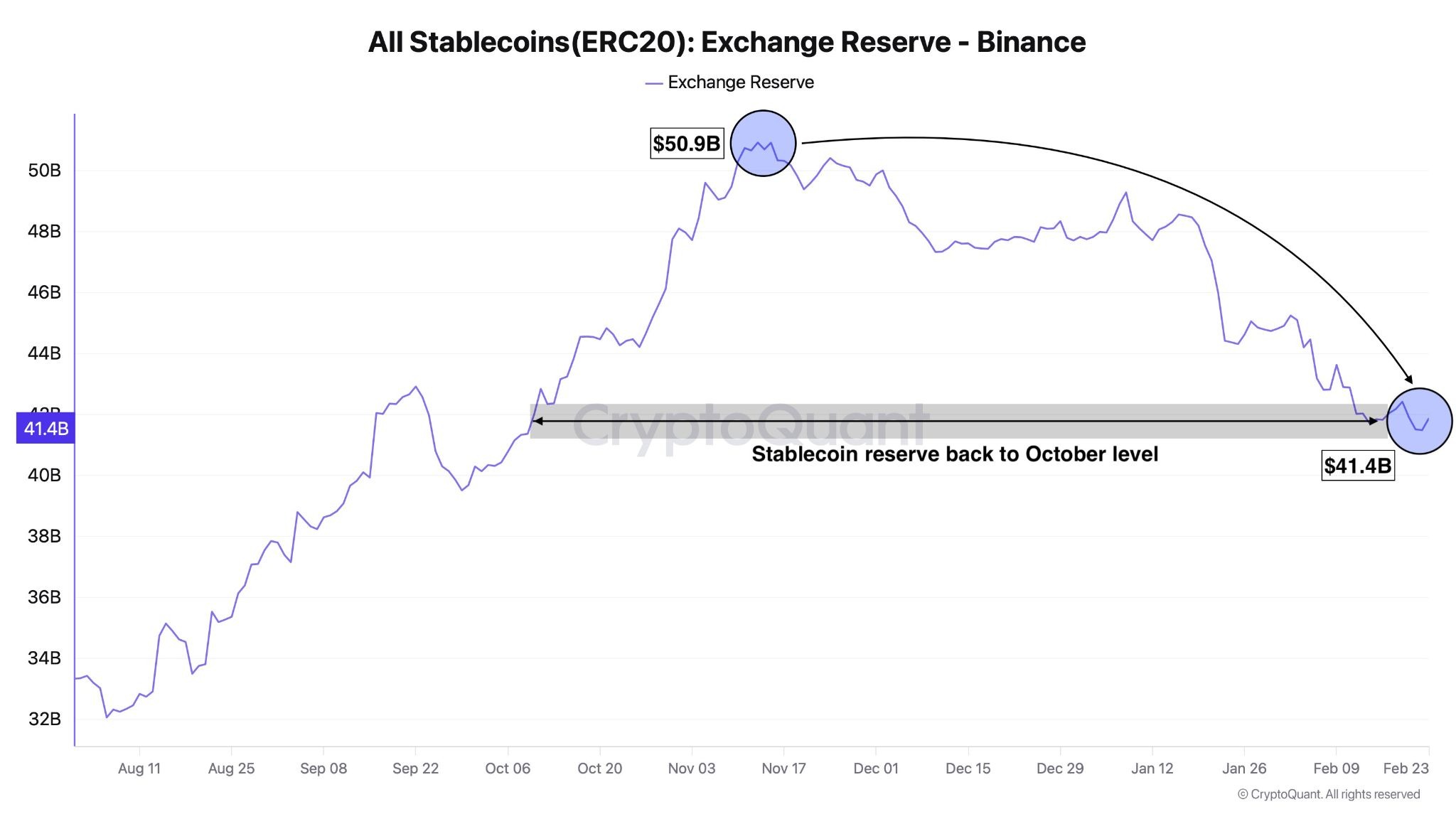
Stablecoin reserves on the world’s largest crypto exchange, Binance, have fallen back to levels not seen since October amid a crypto liquidity drought, according to CryptoQuant.
The stablecoin reserves are down 18.6% since November, dropping around $10 billion from $50.9 billion to current levels of $41.4 billion, said CryptoQuant analyst Darkfost on Monday.
Stablecoin reserves on exchanges “typically adjust based on investor demand,” and crypto “liquidity dynamics can be proxied through stablecoin flows,” the analyst noted.
Despite the decline, Binance still accounts for roughly 64% of total stablecoin reserves across all exchanges.
However, when a platform of this scale begins to reflect such a shift in investor behavior, “it becomes a signal worth monitoring,” they cautioned.
“For the market to stabilize, a renewed inflow of stablecoins will likely be required to reverse the current liquidity trend.”

Crypto liquidity drought continues
A contraction in exchange stablecoin reserves generally means that investors are removing liquidity from crypto markets by converting back to fiat rather than leaving stablecoins on the sidelines for re-entry.
“One of the key headwinds currently weighing on the space is the lack of incoming liquidity,” commented Darkfost, who cautioned that “from a broader cross-market liquidity perspective, conditions are unlikely to improve in the near term.”
Related: Bitcoin’s tech stock divergence is a ‘fire alarm’ for fiat: Arthur Hayes
The total stablecoin market capitalization has plateaued at just over $300 billion since October, according to DeFiLlama. This has followed two years of solid gains that saw 150% increases in stablecoin circulation.
The last time the stablecoin market cap saw significant declines was in mid-2022 during the bear market that followed the Terra/Luna collapse, and they did not recover until November 2023, 18 months later.

Fed rate reduction in March unlikely
Liquidity is also highly influenced by US interest rates, and policymakers do not appear to be ready for another reduction.
Federal Reserve Governor Christopher Waller said on Monday he was open to leaving rates on hold at the March meeting if upcoming February labor market data indicates “pivoting to a more solid footing,” reported Reuters.
CME futures markets currently predict a 95.5% probability of rates remaining unchanged in March, further adding to crypto market liquidity woes.
Magazine: Bitcoin may take 7 years to upgrade to post-quantum: BIP-360 co-author


High-frequency trading powerhouse Jane Street is accused of insider trading that accelerated the downfall of crypto project Terraform Labs in 2022, which destroyed billions in investor wealth.
Todd Snyder, the administrator winding down Do Kwon’s Terraform Labs, has sued Jane Street, seeking damages from its co-founder Robert Granieri, and employees Bryce Pratt and Michael Huang, according to a report by Wall Street Journal.
Snyder has accused the trading firm of using material nonpublic information from Terraform insiders to front-run trading that sped up Terraform’s demise. That means trading on private, price-swinging facts before they’re public and then jumping ahead of big orders to pocket profits first.
“Jane Street abused market relationships to rig the market in its favor during one of the most consequential events in crypto history,” Snyder said in a statement.
“On behalf of injured parties, we will pursue all avenues supported by the facts and the law against those who exploited their position and reaped substantial profits at the expense of Terraform Labs’ creditors.
Terraform Labs was a Singapore-based blockchain company founded in 2018 by Do Kwon and Daniel Shin, best known for creating the Terra blockchain, it’s native token luna and the algorithmic stablecoin TerraUSD (UST). The company filed for bankruptcy in January 2024, with a wind down trust taking control later that year. Do Kwon was sentenced 15-year prison after pleading guilty to two criminal counts in August.
The stablecoin lost its 1:1 USD peg in May 2022 and within days the luna token also crashed to zero. The result: An astonishing $40 billion in market cap evaporated in just one week, leading to massive wealth destruction worldwide. It also led to collapse of other crypto companies who had an exposure to the project.
It all started on May 7 with Terraform quietly withdrawing 150 million TerraUSD from decentralized stablecoin-focused trading platform Curve3pool. The lawsuit alleges that within 10 minutes, before Terraform informed anything to the public, a wallet linked to Jane Street also withdrew 85 million TerraUSD from the same pool. This supposedly triggered the market panic.
Kwon clarified on the following day that the 150 million withdrawals was mean to move coins to a new liquidity pool for stablecoins, but it was too late.
Then, On May 9, with TerraUSD starting to slip, Jane Street’s Pratt fired off a group chat to Kwon and team, floating offers to buy bitcoin or Luna. Kwon shot back that Jump’s co-founder Bill DiSomma should have clued them in earlier about Terraform’s fundraising push.
Jan Street has called the lawsuit an attempt to extract money from the trading firm while vowing to defend vigorously against “baseless, opportunistic claims.”
“This desperate suit is a transparent attempt to extract money when it is well-established that the losses suffered by Terra and Luna holders were the result of a multibillion-dollar fraud perpetrated by the management of Terraform Labs,” said a spokesman for Jane Street.”
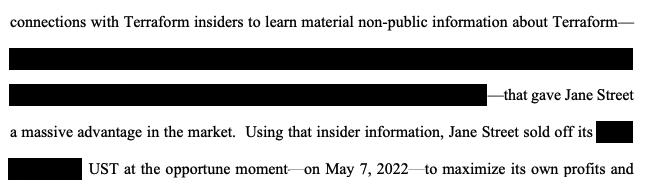
The court-appointed administrator overseeing the bankruptcy of crypto company Terraform Labs has sued trading firm Jane Street, accusing it of insider trading that worsened the collapse of the multibillion-dollar Terra ecosystem.
On Monday, Todd Snyder, Terraform’s court-appointed administrator, sued Jane Street, its co-founder Robert Granieri, and employees Bryce Pratt and Michael Huang in a Manhattan federal court, accusing them of “misappropriating confidential information and manipulating market prices.”
The heavily redacted complaint claimed Jane Street used connections with “Terraform insiders to learn material non-public information” about the company and used the information to sell tokens tied to the Terra blockchain that worsened its collapse.

Jane Street told Cointelegraph it will defend itself over the “baseless, opportunistic claims.”
“This desperate suit is a transparent attempt to extract money when it is well-established that the losses suffered by Terra and Luna holders were the result of a multi-billion dollar fraud perpetrated by the management of Terraform Labs,” the firm said.
Terraform collapsed in May 2022 after its token, TerraUSD, an algorithmic stablecoin, lost its peg to the US dollar, leading to a death spiral that also saw the Terra token collapse and wipe out $40 billion.
Terraform filed for bankruptcy in the US in 2024, and its co-founder, Do Kwon, was later arrested and pleaded guilty in the US to two fraud charges. He was sentenced to 15 years in prison in December.
Jane Street sold hours before collapse, suit claims
Snyder’s lawsuit claimed Jane Street got information that allowed it to sell off “hundreds of millions of dollars in potential exposure at precisely the right time, mere hours before the Terraform ecosystem collapsed.”
According to the suit, Jane Street onboarded Terraform for trading in 2018, but its trading of Terra tokens “did not take off” until 2022, after Pratt, a former Terraform intern, reestablished communication with his old teammates.
Pratt also set up communications with Terraform’s business development lead, which Jane Street used as “a back-channel source for material non-public information about Terraform,” Snyder claimed.
Related: Jump Trading hit with $4B lawsuit tied to $50B Terra crash
The lawsuit said that on May 7, 2022, Terraform withdrew 150 million TerraUSD tokens from a liquidity pool for trading stablecoins without publicly announcing the move.
Within 10 minutes of Terraform’s withdrawal, Snyder claimed Jane Street sold 85 million TerraUSD into the same liquidity pool, which was its largest-ever single swap that kicked off a fire sale of the token that “ultimately led to the collapse of the Terra ecosystem.”
The lawsuit alleged that Jane Street continued to use sensitive information to inform trades of the TerraUSD stablecoin as it was collapsing to garner more profits, with Pratt setting up a group chat with Kwon.
Snyder is seeking damages from Jane Street, along with disgorgement and interest, at a jury trial.
Magazine: How crypto laws changed in 2025 — and how they’ll change in 2026


Benchmark cut Metaplanet’s target after BTC-driven losses despite stronger BTC income.
Summary
- Benchmark trimmed its Metaplanet target from ¥2,400 to ¥1,100 while reiterating a buy view.
- Metaplanet booked a sizeable net loss on late‑2025 BTC price declines despite higher BTC income revenues.
- Shares trade near post‑April 2024 BTC‑treasury lows as large holders sit on deep unrealized BTC losses.
Benchmark has reduced its price target for Tokyo-listed Bitcoin treasury company Metaplanet while maintaining a “buy” rating, according to a recent analyst report citing mixed performance indicators from the firm’s earnings and bitcoin-focused strategy.
Metaplanet shares, which trade on U.S. over-the-counter markets, are trading near their lowest levels since the company began purchasing bitcoin in April 2024, according to market data.
The company reported a net loss for the fiscal year ended December 31, driven primarily by non-cash valuation losses on its bitcoin holdings following price declines in late 2025, according to the company’s financial statements. Revenue and operating profit showed improvement due to bitcoin-related financial services, the report stated.
Benchmark highlighted Metaplanet’s Bitcoin (BTC) Income Generation business, which generates revenue through options and yield strategies tied to bitcoin. The business model allows for potential dividends on new perpetual preferred shares without requiring the sale of core bitcoin holdings, according to the analyst report.
Metaplanet holds tens of thousands of bitcoin purchased at a high average price, resulting in a substantial unrealized loss, according to company disclosures.
Analysts stated that investor demand for preferred shares will determine the company’s ability to expand its bitcoin treasury while managing dilution risk. Large holders face substantial losses, reflecting the sector-wide impact of bitcoin volatility on corporate treasuries, the report noted.
Benchmark stated that upside potential remains if Metaplanet successfully scales both its bitcoin holdings and income-generating operations, but cautioned that price volatility and shareholder dilution represent significant concerns for investors.


Veteran crypto advocate Erik Voorhees, an early supporter of Bitcoin and founder of ShapeShift, has repurchased a significant amount of Ethereum after selling a large stake roughly one year ago, according to on-chain data shared by analytics account Lookonchain.
Summary
- Erik Voorhees repurchased 9,911 ETH for $20.38 million at an average price of $2,057, according to on-chain data shared by Lookonchain.
- Roughly a year earlier, he sold 11,616 ETH for $33.94 million at around $2,922, effectively buying back at about a 30% lower price.
- The move follows his recent diversification into tokenized gold, signaling a broader strategy of tactical timing and portfolio hedging.
Erik Voorhees buys back $20M in Ethereum after last year’s sale
In a widely circulated tweet, Lookonchain reported that Voorhees spent 20.38 million USDC to acquire 9,911 Ethereum (ETH) at an average price of about $2,057.
About a year earlier, he had sold 11,616 ETH for roughly $33.94 million when the price was near $2,922.
The move suggests tactical timing. His prior sale at nearly $2,922 per ETH brought in about $33.94 million, while the recent repurchase cost $20.38 million, allowing him to reaccumulate a large position at a roughly 30% lower price.
The transaction also marks a notable return to Ethereum for Voorhees, who has built his reputation as one of crypto’s long-standing figures. Active in the space since at least 2011, he became a vocal Bitcoin proponent, championing BTC as “digital gold” and helping shape early crypto adoption.
Voorhees has also drawn attention recently for diversifying into other assets outside Bitcoin and ETH, including millions worth of tokenized gold. On-chain data shows he spent around $6.8 million in USDC to buy 1,382 ounces of PAXG, a gold-backed token, underscoring a broader strategy of hedging against market volatility with traditional safe-haven assets.
The ETH buyback could reflect renewed confidence in Ethereum despite price volatility and macro uncertainty. Buying near $2,057 at a lower entry point than his prior sale signals long-term accumulation rather than short-term trading.
Voorhees’ actions highlight a continuing theme among experienced crypto investors: balancing digital asset exposure with strategic diversification amid shifting market conditions.
Bitcoin dipped below $63,000 during Asian trading hours, extending overnight weakness amid President Donald Trump’s tariffs and AI jitters that have soured investor sentiment.
The leading cryptocurrency by market value is already down nearly 7% for the week, trading at levels last seen on Feb. 6 when prices nearly dropped to $60,000, CoinDesk data shows.
“Similar to equities, Bitcoin has had a sharp pullback today, driven largely by renewed tariff-related uncertainty, similar to the events of April 2025. Furthermore, ratcheting geopolitical tensions could likely prove bearish for BTC in the short-term,” Matt Howells-Barby, vice president at Kraken, Pro Trader, and host of Trading Spaces, told CoinDesk in an email.
He added that the $60,000 level is a key support that bulls are watching closely. “If that level fails to hold, we could potentially see a move into the mid-to-low $50K range,” he noted.
The U.S. stocks fell Monday after Trump said he would place temporary 15% tariffs on imports from other countries, up from the 10% rate announced Friday following the Supreme Court’s decision to struck down his tariffs strategy. Meanwhile, investors continued to sell shares in companies that stand to lose the AI revolution.
History favors a deeper sell-off in BTC
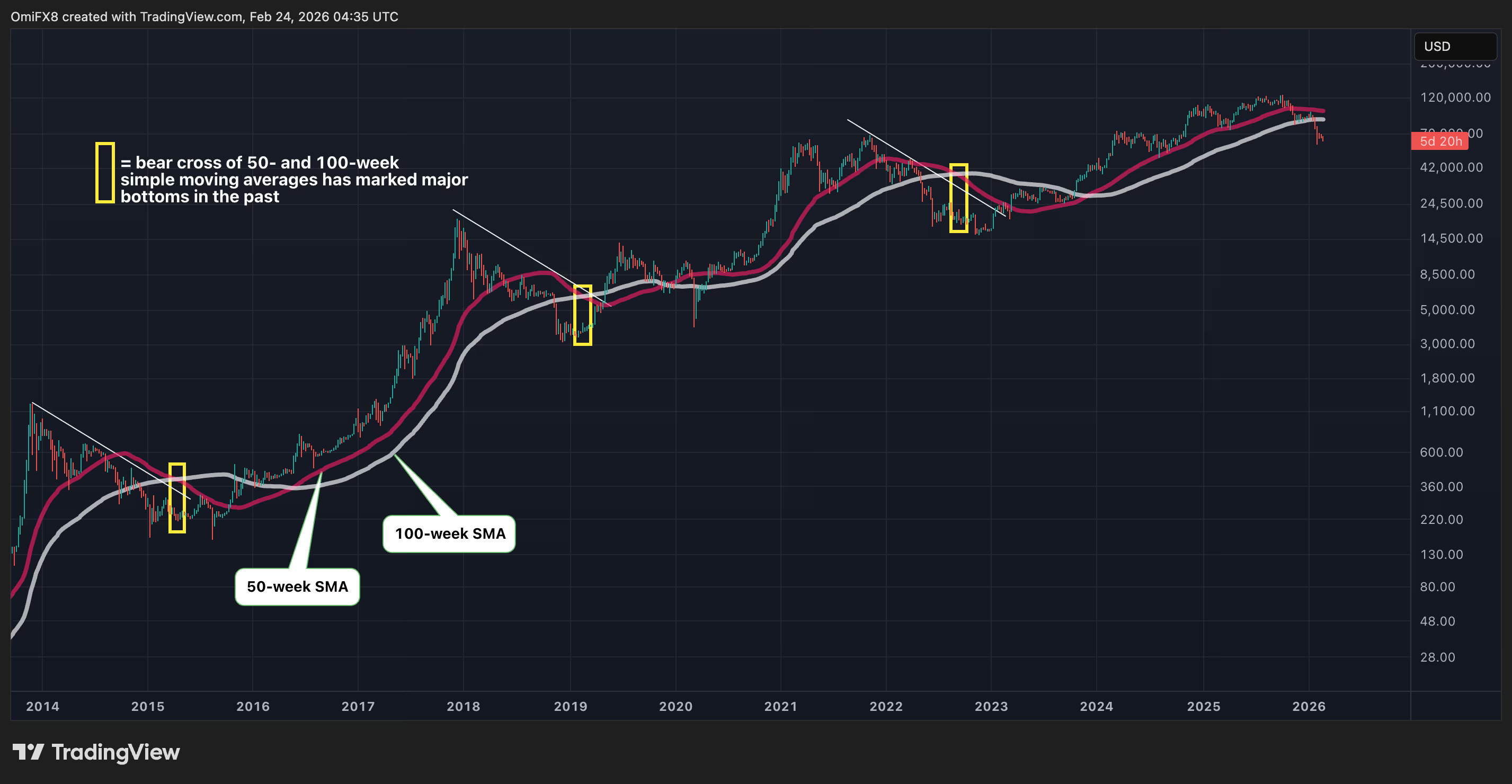
History shows BTC rarely bottoms until the 50-week average price crosses below the 100-week average price. This so-called bear cross has marked the end of every major bear market, including those in 2022 and 2018.
We’re nowhere near that signal today, as the 50-week average price remains well above the 100-week.
So, if past data is a guide, the market could slide further, potentially to $50,000 or lower, as several experts told CoinDesk at Consensus Hong Kong before the averages cross bearish and capitulation sets in.

The pattern may seem counterintuitive: The 50-week average dropping below the 100-week signal further weakens momentum.
But it fits the moving averages’ lagging nature perfectly: crossovers confirm what’s already happened – not predict what’s next – so long-term ones have tended to market bear market bottoms in bitcoin.
That said, as with any indicator, the past record offers no assurance of future results.

The Federal Reserve is moving to enshrine a rule that would remove reputational risk as a driver of banking supervision, a shift crypto advocates say could blunt a pattern of debanking in recent years. The central bank began codifying the change last June, directing its supervisors to stop pressuring banks to sever client ties over reputation concerns and instead assess banking relationships primarily through financial risk management. Now, in a formal rulemaking proposal published on Monday, the Fed is inviting public comment on turning that approach into law, with a 60-day window to hear from stakeholders. The initiative arrives amid ongoing debates about the boundaries of political and ideological considerations in financial services and bears directly on how crypto firms access banking pathways that were once routine.
The Fed’s upward move comes with explicit acknowledgment of the concerns raised by lawmakers and industry observers about how reputation risk has been wielded in ways that affect crypto and other disfavored sectors. In the accompanying release, vice chair for supervision Michelle Bowman framed the issue in stark terms: “We have heard troubling cases of debanking — where supervisors use concerns about reputation risk to pressure financial institutions to debank customers because of their political views, religious beliefs, or involvement in disfavored but lawful businesses.” She stressed that discrimination on these bases runs counter to federal policy and has no place in the Fed’s supervisory framework. The push to formalize this standard reflects a desire to shield legitimate business activity from ad hoc revocation of banking access under the guise of reputation risk.
As the digital asset ecosystem pushes for clearer rules and a more stable banking landscape, political observers weighed in as well. In a post on X, Senator Cynthia Lummis lauded the Fed’s move, arguing that it should not be the regulator’s role to adjudicate who can participate in the crypto economy. She framed the reform as a breaking point that could help “permanently remove ‘reputation risk’ from Fed policy and put Operation Chokepoint 2.0 to rest so America can become the digital asset capital of the world.” The sentiment was echoed by Galaxy Digital’s head of firmwide research, Alex Thorn, who lauded the development as part of the industry’s ongoing push to roll back what supporters call choke points in traditional finance. Thorn signaled via X that the rollback continues, underscoring the ongoing tension between crypto firms seeking direct access to banking services and legacy financial institutions wary of reputational exposure.
Operation Chokepoint 2.0 is a label used within crypto circles to describe what some perceived as a coordinated effort by the Biden administration and the banking sector to restrict crypto firms’ access to essential banking services. The discourse around this concept has included references to previous policy debates and actions that crypto insiders argued were designed to curb the industry’s growth by pressuring banks to sever ties. The Fed’s latest move—aimed at removing reputation-based triggers from supervisory decisions—has been positioned by supporters as a corrective step toward neutral, risk-based decisions that prioritize financial metrics over political or ideological considerations. The discourse surrounding debanking isn’t new: disclosures and investigations have connected the policy debate to broader questions about regulatory overreach, financial privacy, and the U.S.’s stance toward crypto innovation.
The policy questions extend beyond banking practices into the political discourse around regulation. The administration has signaled an intent to curb debanking in the United States, with discussions touching on how regulators should approach crypto-related clients. The public record features a mix of official statements and industry commentary about the proper balance between safeguarding the financial system and enabling a vibrant digital asset sector. The thread linking this initiative to broader regulatory reform remains a focal point for crypto firms seeking greater clarity and predictability in how banks evaluate risk and structure services for digital assets.
In parallel, proponents of the reform have pointed to links between reputational considerations and broader regulatory strategies aimed at safeguarding consumers while not constraining legitimate innovation. The Fed’s invitation for public comment signals a willingness to test the proposed framework against diverse viewpoints before any final rule is enshrined. If adopted, the rule could set a precedent for how U.S. supervisory agencies weigh risk and approach non-financial considerations in decisions that affect access to fundamental banking services for crypto businesses and other sectors that have faced similar pressures.
Beyond the policy debate, the legal and practical implications loom large. Some observers have highlighted how banks may recalibrate due to the clarity this rule would provide or because it reduces discretionary leverage tied to reputational risk. Others warn that a formalized standard would still require careful definition to avoid unintended consequences, such as banks underreacting to financial risk signals or inadvertently channeling risk through opaque channels. In the end, the rule’s success hinges on how well the Fed can translate a principle into a measurable framework that stands up to scrutiny and serves as a reliable reference for bankers, crypto firms, and regulators alike. The Fed’s consultation period will be a key barometer of how broad support is for codifying this approach and what refinements may be necessary to address edge cases and evolving digital-asset landscapes.
The evolving narrative around debanking and regulatory clarity has also intersected with political dimensions, including ongoing disputes over how bank accounts are treated during periods of political or ideological contention. While the Fed’s move is framed as a technical adjustment to supervisory practice, the broader implications touch on the dynamics of financial inclusion, national competitiveness in the crypto space, and the boundaries of regulatory intervention in private-sector decisions. As negotiators and policymakers weigh the future of digital asset markets, this rulemaking could become a touchstone for how the United States balances the need to manage risk with the desire to foster innovation and maintain the country’s pull in the global crypto economy. The public comment period will determine not only the technical shape of the rule but also the degree to which the policy resonates across industry, advocacy groups, and financial institutions that must implement it in the months ahead.
Key takeaways
- The Fed is seeking to codify the removal of reputation risk as a factor in banking supervision, a move crypto advocates view as reducing punitive pressure on banks over political or ideological considerations.
- A 60-day public-comment window accompanies the proposal, signaling an invitation for industry, lawmakers, and the public to weigh in on the formal rule.
- The initiative follows a June policy shift in which the Fed directed supervisors to base decisions on financial risk management rather than reputational concerns.
- Supporters, including lawmakers and industry figures, frame the reform as a step toward restoring access to banking for crypto firms and ending what critics call “Chokepoint 2.0.”
- Opponents may push for careful definitions of “reputation risk” to avoid unintended loopholes or gaps in enforcement that could leave some customers exposed to informal criteria.
Market context: The policy sits within a broader regulatory environment where liquidity, risk sentiment, and clarity around digital assets influence the willingness of traditional banks to service crypto clients. As policymakers push for explicit standards, market participants look for predictable frameworks that reduce opacity in a space historically marked by sudden access changes and reputational triggers.
Why it matters
For crypto companies, the Fed’s potential rule offers a clearer path to banking access that is less contingent on perceived reputational concerns. In a sector where financial infrastructure—payments, settlement, and treasury services—can determine a project’s viability, a formal standard buffers firms against abrupt disconnections from banking rails. The change could also incentivize banks to adopt uniform risk-based criteria, improving consistency across institutions and reducing the likelihood that decisions are swayed by external factors unrelated to financial health.
From a policy perspective, the move indicates an intent to articulate a more transparent governance framework for supervisory actions. If successfully enacted, the rule could help normalize the treatment of crypto firms within mainstream financial services and strengthen the U.S. position as a hub for digital asset innovation. Support from lawmakers who view debanking as a civil-rights or anti-competitive concern further underscores the political resonance of the issue, elevating the debate beyond technocratic risk management into a broader discussion about access to finance and national competitiveness.
Nevertheless, the discussion remains nuanced. Advocates stress the need for precise definitions to avoid softening risk controls or eroding the ability of regulators to intervene when broader financial crime or consumer protection concerns arise. The rule will likely require ongoing refinement to address newly emergent business models and evolving threats, including opaque financial arrangements or non-traditional counterparties that still carry risk. The Fed’s engagement with industry stakeholders, as evidenced by the 60-day comment period, will be a critical litmus test for how quickly and effectively a clearer, more stable regime can take shape.
What to watch next
- Public comments: The 60-day window opens with the formal proposal and should yield a spectrum of views from banks, crypto firms, consumer groups, and policymakers.
- Final rule release: The Fed will publish the final text, outlining definitions, enforcement mechanisms, and transition timelines for banks to align with the new standard.
- Banking industry response: Expect filings, memos, and industry white papers detailing how lenders foresee applying the rule in practice and where they foresee friction or ambiguities.
- Regulatory coordination: Observers will look for alignment with other regulators’ approaches to reputational risk and how the rule interacts with anti-money-laundering and sanctions regimes.
Sources & verification
- Federal Reserve press release: June 23, 2025, announcing changes to supervision focused away from reputation risk
- Federal Reserve press release: February 23, 2026, inviting public comment on turning the approach into law
- Senator Cynthia Lummis (X) post praising the move: https://x.com/senlummis/status/2026060712305365065
- Galaxy Digital Alex Thorn (X) post commenting on the rollback: https://x.com/intangiblecoins/status/2026069012124164150
- Cointelegraph article: Operation Chokepoint crypto banking restrictions
Market reaction and key details
The Fed’s initiative to codify reputation-risk exclusion from supervisory judgment underscores a broader shift toward risk-based banking decisions that foreground financial metrics over reputational considerations. The formal rulemaking process, including a 60-day comment window, invites a wide spectrum of perspectives, ensuring that the final framework balances financial stability with the industry’s push for more straightforward access to banking services. Industry observers note that the policy’s success will hinge on how clearly the Fed defines “reputation risk” and how it handles edge cases where reputational concerns intersect with legitimate risk signals. The conversation also weaves in the historical debate around “Operation Chokepoint 2.0,” a label used by crypto insiders to describe perceived regulatory and banking pressures on crypto firms, which the current proposals seek to reverse or at least diminish in influence over supervisory outcomes. The official narrative aligns with a broader push to position the United States as a competitive, innovation-friendly environment for digital assets while maintaining guardrails that deter illicit activity.
The momentum behind the policy has drawn attention from lawmakers and industry figures who argue it could restore a more predictable banking environment for crypto companies. The ongoing public debate touches on questions of how much regulatory discretion should be exercised based on non-financial considerations and how transparent the decision-making process should be for banks that service digital-asset businesses. With the 60-day window now open, observers will be watching not only for the rule’s final form but also for the evidence of consensus around where the balance should lie between risk control and access to essential banking services.
Ultimately, the Fed’s proposed rule is part of a larger narrative about how the United States intends to steward innovation in the digital asset space while preserving the integrity of the financial system. If the rule stands up to scrutiny and gains broad support, it could reduce the volatility that arises when firms lose access to banking for reasons tied more to reputation than to tangible financial risk. For participants across the industry—from fintech startups to established crypto exchanges—the development represents a potential turning point in the governance of banking relationships and the speed at which the U.S. can keep pace with global peers in the digital economy.

A new report by Citrini Research has been partially blamed for a software and payments stock sell-off on Monday, where it outlined extreme scenarios in which AI could severely disrupt the economy, from wiping out a sizable share of the workforce and slashing consumer spending to threatening the $13 trillion US mortgage market.
Citrini was little-known up until Monday, when its “Global Intelligence Crisis” report amassed over 22 million views on X alone and discussed how AI agents could drive corporate profits so high that human labor could become increasingly redundant and trigger a recession.
The report lays out a chilling June 2028 scenario, in which the Standard & Poor’s 500 is down 38% from its all-time high, unemployment is over 10%, private credit is unraveling and prime mortgages are cracking — all while AI didn’t disappoint, exceeding every expectation.

Citrini said the term “Ghost GDP” could emerge, describing it as output that shows up in the national accounts but never circulates through the “real economy.”
“A single GPU cluster in North Dakota is generating output previously attributed to 10,000 Manhattan office workers,” Citrini theorized in a potential June 2028 scenario.
The result: a massive white-collar layoff, far less consumer spending and a recession, Citrini said.
The macroeconomic uncertainty from AI and other issues, such as US President Donald Trump’s tariffs, has not been taken well in the crypto market over the past few months, with Bitcoin (BTC) falling nearly 50% from its $126,080 all-time high in early October, while safe havens like gold continue to rise.
AI, credit card stocks tank
Computing and AI company IBM saw its largest single-day drop in 25 years on Monday, tumbling 13.1% to $223.35, while Microsoft, Oracle and Accenture fell 3.21%, 4.57% and 6.58%, Google Finance data shows.
Credit card platforms Visa, Mastercard and American Express also fell 4.5%, 5.77% and 7.2% as Citrini said private credit and software-backed loans would face cascading defaults.
Investor anxiety was compounded by warnings from renowned risk theorist Nassim Taleb, who said AI could make some software companies bankrupt, while Anthropic said its Claude Code tool can be used to modernize software written in the COBOL language, which handles large transactions for many governments, banks and airlines.
Related: How SocialFi, memecoins and AI pushed Base to the top of the L2 ladder
Anthropic’s findings appeared to affect IBM’s share price directly, as COBOL is mostly run on IBM’s systems.

Citrini said the rise in agentic AI tools like Anthropic’s Claude Code or OpenAI’s Codex will drive the broad economic shift, reducing the need for human labor and forcing companies to reinvest savings into ever-more capable AI, essentially creating a feedback loop that accelerates workforce displacement and consumer spending decline.
Tech entrepreneurs say AI agents aren’t worth the costs yet
However, three multimillionaire tech investors recently said the high costs of deploying AI agents still don’t justify replacing many humans, who can perform tasks just as well, more cheaply.
Tech investor Jason Calacanis said he is spending $300 per day to run a single AI agent despite it only operating at 10% to 20% of full capacity, while Social Capital CEO Chamath Palihapitiya noted the same problem and said his AI agents need to be at least twice as productive as employees to justify the costs.
Billionaire investor Mark Cuban said the economic-constraint argument of AI agents raised by Calacanis and Palihapitiya was the smartest counterargument that he had seen to AI replacing humans.
Magazine: IronClaw rivals OpenClaw, Olas launches bots for Polymarket — AI Eye


XRP, Solana, and Chainlink recorded small inflows, but these were insufficient to offset broader, persistent altcoin outflows.
Investor appetite for digital asset funds remains muted after $288 million in weekly outflows. This is the fifth week in a row of redemptions, which propelled aggregate withdrawals to $4 billion, still trailing the $6 billion logged last year.
Market participation has thinned significantly, as ETP trading slid to $17 billion, the weakest level since July 2025, amidst signs of disengagement among institutions and retail allocators alike globally this quarter.
Short Bets Quietly Surge
According to the latest edition of CoinShares’ Digital Asset Fund Flows Weekly Report, Bitcoin remains the primary drag on market sentiment, shedding $215 million. In addition, bearish positioning intensified as short-bitcoin funds absorbed $5.5 million, which is the highest inflow among individual assets. Ethereum also experienced notable withdrawals of $36.5 million, joined by continued selling in multi-asset products and Tron, which lost $32.5 million and $18.9 million, respectively.
While XRP, Solana, and Chainlink attracted limited inflows ranging between $1.2 million and $3.5 million, these gains did little to offset persistent net outflows across altcoins.
The US dominated weekly flows on the downside as it contributed $347 million in outflows, while investors outside the country treated recent price declines as an entry point. Inflows were led by Switzerland, Canada, and Germany at $19.5 million, $16.8 million, and $16.2 million, respectively. Smaller allocations of of $3 million, $2.7 million, and $1 million also flowed into Brazil, Australia, and the Netherlands, respectively.
Bitcoin Stuck in a Macro Storm
Bitcoin slipped below $65,000 during Monday’s early Asia trading, which ended up triggering roughly $230 million in long liquidations as markets grapple with a convergence of geopolitical and macro risks. The move followed Donald Trump’s decision to raise a proposed global tariff to 15%, announced shortly after the Supreme Court of the United States struck down his “Liberation Day” tariffs.
This was enough to compound policy uncertainty amid already thinning risk appetite and renewed concerns around a potential US-Iran conflict. QCP Capital stated that the focus is not on whether Bitcoin has failed, but how long this storm persists.
You may also like:
With BTC on pace for a fifth red monthly close, historically a late-stage signal, all eyes are now on upcoming catalysts, including progress on the Clarity Act and US-Iran talks. But QCP added that a reclaim of $74,000 remains critical for a durable recovery.
Binance Free $600 (CryptoPotato Exclusive): Use this link to register a new account and receive $600 exclusive welcome offer on Binance (full details).
LIMITED OFFER for CryptoPotato readers at Bybit: Use this link to register and open a $500 FREE position on any coin!


BTC is trading around $68,000, slightly up on the day but down over the week, and Robinhood’s crypto head says their users are using this environment to buy dips and diversify beyond just BTC and ETH.
Summary
- BTC trades near recent lows after multi-week decline amid persistent ETF outflows and extreme fear readings.
- Robinhood users increasingly rotate from just BTC, ETH into a broader basket of tokens during the downturn.
- Staking demand for ETH and SOL on Robinhood remains strong since its December launch, signaling active on-chain use, not passive holding.
Cryptocurrency investors are diversifying their holdings beyond Bitcoin and Ethereum during the current market decline, according to a Robinhood executive.
Johann Kerbrat, head of crypto at Robinhood, stated in a recent interview that many platform users view the ongoing market downturn as an opportunity to purchase digital assets at lower prices. However, trading activity has expanded beyond the largest cryptocurrencies, Kerbrat said.
“Customers see the current market as a buying opportunity. However, they are expanding their transactions beyond the two or three most popular cryptocurrencies to include a wider range of assets,” Kerbrat stated.
The executive reported that clients are actively using their tokens rather than simply holding them on the platform. Interest in staking has remained strong since Robinhood launched the feature in December, according to Kerbrat.
The shift in investor behavior comes as overall market sentiment remains at extreme levels of fear, according to market indicators. U.S. spot Bitcoin exchange-traded funds have experienced net outflows for several weeks, data shows.
Despite the negative market conditions, interest in decentralized finance use cases is increasing, Kerbrat noted.
Bitcoin and altcoin prices have continued to decline in recent weeks, extending losses across the cryptocurrency market.

Mexico may pay a steep price for the killing of Jalisco cartel leader El Mencho

What’s Next for Thailand as Trump Ups Global Tariff to 15%

Falling Binance Stablecoin Reserves Signal Liquidity Crunch


-

 Crypto World7 days ago
Can XRP Price Successfully Register a 33% Breakout Past $2?
-

 Video4 days ago
XRP News: XRP Just Entered a New Phase (Almost Nobody Noticed)
-

 Fashion3 days ago
Weekend Open Thread: Boden – Corporette.com
-

 Politics2 days ago
Baftas 2026: Awards Nominations, Presenters And Performers
-

 Sports10 hours ago
Women’s college basketball rankings: Iowa reenters top 10, Auriemma makes history
-

 Politics12 hours ago
Nick Reiner Enters Plea In Deaths Of Parents Rob And Michele
-

 Business6 days ago
Infosys Limited (INFY) Discusses Tech Transitions and the Unique Aspects of the AI Era Transcript
-

 Entertainment6 days ago
Kunal Nayyar’s Secret Acts Of Kindness Sparks Online Discussion
-

 Video7 days ago
Financial Statement Analysis | Complete Chapter Revision in 10 Minutes | Class 12 Board exam 2026
-

 Tech6 days ago
Retro Rover: LT6502 Laptop Packs 8-Bit Power On The Go
-
 Sports5 days ago
Clearing the boundary, crossing into history: J&K end 67-year wait, enter maiden Ranji Trophy final | Cricket News
-

 Business2 days ago
Mattel’s American Girl brand turns 40, dolls enter a new era
-

 Business2 days ago
Law enforcement kills armed man seeking to enter Trump’s Mar-a-Lago resort, officials say
-

 Entertainment5 days ago
Dolores Catania Blasts Rob Rausch For Turning On ‘Housewives’ On ‘Traitors’
-
 NewsBeat19 hours ago
‘Hourly’ method from gastroenterologist ‘helps reduce air travel bloating’
-

 Business6 days ago
Tesla avoids California suspension after ending ‘autopilot’ marketing
-

 Politics7 days ago
Eurovision Announces UK Act For 2026 Song Contest
-

 Tech1 day ago
Anthropic-Backed Group Enters NY-12 AI PAC Fight
-

 NewsBeat1 day ago
Armed man killed after entering secure perimeter of Mar-a-Lago, Secret Service says
-

 Politics2 days ago
Maine has a long track record of electing moderates. Enter Graham Platner.