

Crypto World
Bitcoin Selling Pressure Nears Exhaustion, Analyst Says


Bitcoin has found itself at a crossroads after a sustained period of selling pressure, with observers noting that the selling might be losing steam. Over the past three weeks, the flagship cryptocurrency has traded in a relatively narrow band between $60,000 and $70,000, with a brief dip below $67,000 during late-session trading on Thursday. Several analysts argue the market is transitioning from a pullback phase into a period of sideways consolidation rather than an immediate rebound. The coming weeks could reveal whether buyers regain control or if the market continues to digest recent liquidity shocks, leaving traders with a watchful stance as macro dynamics and liquidity conditions evolve.
Key takeaways
- Investor selling pressure appears to have exhausted itself, according to analyst Willy Woo, potentially opening a window for a month of sideways price action and a possible rebound that may still face resistance near the mid-$70,000s.
- Bitcoin has traded in a $60,000–$70,000 range for roughly three weeks, dipping briefly under $67,000 in late trading on Thursday, underscoring a broad consolidation phase.
- Analysts project the fourth quarter could mark a turning point away from the current bear trend, with momentum potentially reasserting in Q1 or Q2 2027 if macro conditions cooperate.
- Liquidity remains a limiting factor; both spot and futures markets show deterioration, making a rapid upside breakout less likely in the near term.
- RSI and on-chain observations point to exhaustion of selling pressure, with some strategists suggesting the bottoming process is underway even as markets stay range-bound for weeks to months.
Tickers mentioned: $BTC
Sentiment: Neutral
Price impact: Neutral. Easing selling pressure hints at a potential pause, but prices remain within a broad range without a clear breakout.
Trading idea (Not Financial Advice): Hold. The market shows signs of exhaustion but lacks a decisive catalyst for a sustained rally.
Market context: The narrative sits within a broader crypto environment characterized by cautious risk sentiment and liquidity constraints. While some observers note improving spot ETF inflows, the overarching backdrop remains orderly rather than exuberant, keeping upside catalysts on a tight leash until macro conditions brighten or liquidity improves decisively.
Why it matters
The dynamics surrounding Bitcoin’s price action matter for a wide range of market participants—from retail traders to institutional allocators and developers building on top of the ecosystem. If the bear-phase momentum truly abates and a longer period of consolidation sets in, risk appetite could gradually stabilize, providing a platform for price discovery to occur at a steadier pace. The idea of a bottoming process matters because it reframes expectations for liquidity cycles and the timing of potential demand shocks that historically accompany macro shifts or policy developments.
Several credible voices emphasize that the timing of a new up-leg will hinge on both micro-market signals—like on-chain activity, liquidity dynamics, and ETF inflows—and the broader macro environment. Analysts caution that even with an easing of selling pressure, a sharp rally may require a confluence of favorable conditions, including renewed enthusiasm for risk assets, improved liquidity conditions, and potentially new catalysts from regulatory clarity or product launches. The consensus leans toward a multi-quarter horizon where patience and risk management become paramount for participants trying to navigate a crypto market that has shown a stubborn penchant for extended consolidation after big drawdowns.
“They are mostly done selling, and we are in the process of bottoming. We will set new all-time highs in the future. This is a classic crypto winter, and there will be a classic crypto spring.”
Market observers also point to macro-driven risk factors as a key determinant of the near-term trajectory. A dovish tilt in global liquidity or a swift improvement in risk-on sentiment could lift prices from key support levels, but until that shift materializes, the market may remain hostage to the same cooling dynamics that have dominated for months. Some strategists stress that a sustained rally is unlikely without a meaningful reacceleration in demand and a corresponding uptick in liquidity across spot and derivatives markets.
Beyond price action, a separate line of inquiry focuses on the depth of the current retracement relative to historical cycles. A number of veteran observers view the recent sell-off as a function of tactical rotations—investors trimming exposure to Bitcoin to redeploy capital into AI-related ventures and other growth areas—rather than a fundamental shift in the asset’s long-term case. The four-year cycle narrative, in particular, remains a talking point among serious market watchers who argue that the period ahead could see a transitional phase before renewed bullish momentum takes hold in subsequent quarters.
What to watch next
- Monitor liquidity metrics in both spot and futures markets for signs of a sustained pickup or further deterioration.
- Track spot ETF inflows and any official regulatory or product developments that might unlock additional demand channels for Bitcoin.
- Observe price tests around the $62,000–$65,000 support zone and the potential for a test of the $70,000 barrier as catalysts emerge.
- Watch macro risk sentiment and potential shifts in risk assets that could spell a broader appetite for crypto exposure.
- Keep an eye on Q4 and early 2027 macro narratives, including potential catalysts identified by market observers for a shift in momentum.
SOURCES & verification
- Willy Woo’s observation on market exhaustion via his X post: https://x.com/willywoo/status/2027202273525592298
- Bitcoin price context and recent range behavior noted in market reporting: https://cointelegraph.com/bitcoin-price
- Bitrue research lead Andri Fauzan Adziima on RSI exhaustion and its implications for consolidation: https://cointelegraph.com/news/bitcoin-adoption-is-booming-even-if-its-price-isn-t-river
- Matt Hougan (Bitwise) comments on selling pressure and the four-year cycle in market action: https://x.com/Matt_Hougan/status/2027107215036059861
- CoinEx analyst Jeff Ko on ETF inflows and the likelihood of prolonged consolidation: https://cointelegraph.com/news/bitcoin-bounces-66k-rumors-swirl-jane-street-selling-algorithm
Bitcoin eyes a pause in capitulation as consolidation takes hold
Bitcoin (CRYPTO: BTC) has drifted in a sideways rhythm after a protracted run of selling, with market observers noting that the pace of declines has cooled enough to allow a broader pause. The asset’s price has hovered within a broad corridor from roughly $60,000 to $70,000 for several weeks, punctuated by a fleeting dip below the $67,000 mark during late-session trading. This combination of a paused sell-off and a lack of fresh demand has created an environment where price discovery proceeds in a largely horizontal fashion rather than a decisive move higher or lower.
Analysts have pointed to a convergence of factors that could underpin a more stable baseline for prices. One prominent view comes from Willy Woo, who suggested that the “bearish sell-down by investors seems to have exhausted,” providing the market with a chance to “consolidate sideways for maybe a month,” with a potential rebound toward the mid-$70,000s that would likely be rebuffed if momentum fails to strengthen. Woo’s assessment rests on a blend of on-chain indicators and market psychology, and it was echoed in a subsequent discussion about the broader liquidity backdrop facing the market. The current environment is characterized by limited liquidity in both spot and futures markets, which complicates the path to a sustained rally even as selling pressure wanes.
In other voices, Bitwise’s Matt Hougan argued that the recent depreciation of prices stems in part from a shift in investment priorities, as funds rotated into AI ventures or rebalanced across asset classes. He contended that the selling pressure may be close to exhausted, supported by a mix of four-year cycle dynamics and concerns about quantum computing, which have historically reframed risk appetite in crypto markets. Hougan’s commentary aligns with a chorus of analysts who view the current phase as a classic crypto winter, followed by the expectation of a crypto spring as sentiment improves and long-term holders slowly test new highs again.
Within the market’s current cadence, multiple observers have highlighted that the most convincing signal will be a tangible improvement in liquidity signals in both the spot and futures arenas. Some have noted that recent ETF inflows—specifically in the spot market—have offered a glimmer of support for buyers seeking a firmer footing, though they stop short of signaling a rapid, V-shaped recovery. Jeff Ko, chief analyst at CoinEx, cautioned that a sharp recovery remains unlikely after a steep drawdown, underscoring the probability of a prolonged consolidation phase as investors reassess risk and sentiment adapts to evolving macro conditions. A recurring theme across analyses is the potential for a prolonged period of sideways movement, as sentiment repairs itself gradually in a market that has endured a series of shocks and regulatory debates.
Looking ahead, several market participants anticipate a convergence toward a more constructive regime in early 2027, particularly if macro environments improve and liquidity flows normalize. The forecast rests on the premise that a significant portion of the selling pressure has run its course and that the market will begin to price in a new cycle of demand now tempered by a more robust risk-appetite backdrop. Yet, even with the groundwork for a potential uptick, the path to all-time highs remains uncertain, and the near term is likely to be defined by tests of support in the $62,000–$65,000 zone and resistance around $70,000. The next phase will hinge on whether external catalysts—ranging from macro stimuli to ETF-driven liquidity—arrive in a manner that can sustain gains beyond a shallow relief rally.

Crypto World
Meta Expands AI Chip Strategy with Google TPU Partnership Following Nvidia and AMD Deals

Key Highlights
- Meta Platforms has finalized a multi-year, billion-dollar agreement with Google to lease Tensor Processing Units (TPUs) for artificial intelligence development.
- The social media giant is negotiating to acquire Google TPUs directly for deployment in its proprietary data centers beginning next year.
- This partnership comes on the heels of Meta announcing separate long-term chip agreements with both Nvidia and AMD earlier this week.
- Meta’s agreement with Nvidia encompasses millions of Blackwell and Rubin GPU units, while its AMD contract totals approximately $100 billion across five years.
- Wall Street analysts maintain a Strong Buy rating on META stock, projecting an average target price of $864.62—representing potential upside of around 31.6%.
Meta Platforms has concluded a remarkably active week in the semiconductor industry, finalizing significant chip procurement agreements with three major players in AI computing: Nvidia, AMD, and most recently, Google.
The most recent arrangement involves Meta leasing Google’s Tensor Processing Units (TPUs), specialized chips designed for artificial intelligence workloads. According to The Information’s initial coverage, this multi-year commitment represents a financial commitment in the billions.
Beyond simply renting cloud capacity, Meta is reportedly discussing purchasing Google TPUs outright for installation within its own infrastructure, with deployment potentially beginning as early as next year.
Developed by Google’s parent corporation, Alphabet, TPUs represent a strategic alternative to Nvidia’s dominant GPU offerings. The chips have increasingly contributed to Google Cloud’s revenue stream, and securing Meta as a customer provides Alphabet with a prestigious reference account.
Alphabet has additionally established a joint venture with a major institutional investor (name undisclosed) focused on TPU leasing arrangements—indicating the tech giant’s commitment to expanding its chip business beyond internal applications.
Meta’s Massive Chip Investment Wave
Just days ago, Meta unveiled an AMD partnership covering 6 gigawatts of computational capacity. Industry analysts estimate this five-year deal at approximately $100 billion in total value.
Under the AMD terms, Meta will become the inaugural recipient of custom-designed MI450 GPUs alongside Venice CPU processors in late 2026. The agreement includes warrants allowing Meta to acquire up to 160 million AMD shares, creating aligned financial incentives between the partners.
The Nvidia partnership matches this scale of ambition. Meta intends to roll out millions of Nvidia’s next-generation Blackwell and Rubin GPU architectures, complemented by Grace and Vera central processing units, plus Spectrum-X networking infrastructure. Notably, this represents Nvidia’s first major standalone deployment of Grace CPUs with any client.
Collectively, these three partnerships demonstrate Meta’s aggressive capital deployment strategy aimed at narrowing the competitive gap in artificial intelligence capabilities.
Google Challenges Nvidia’s Market Position
For Google, securing Meta as a TPU client represents a significant milestone in its campaign to challenge Nvidia’s overwhelming market leadership in AI accelerators.
Nvidia shares declined more than 5% following the announcement, while AMD fell over 3%. Alphabet stock dropped approximately 1.76%. Meta, conversely, posted gains of 0.51%.
Previous reporting this week suggested Google has been actively pursuing strategies to broaden TPU adoption, with several startups already onboard. Nevertheless, the company has encountered manufacturing constraints and tepid interest from major cloud service providers.
Meta’s participation offers Google an opportunity to showcase TPU performance on enterprise-scale, computationally intensive AI applications.
Alphabet’s joint venture with an unnamed institutional partner aims to facilitate TPU leasing operations—a framework that could provide the capital necessary to expand production capacity in response to rising demand.
From an investment perspective, META currently carries a Strong Buy consensus rating on TipRanks, supported by 39 Buy recommendations against 4 Hold ratings. The consensus price target of $864.62 suggests approximately 31.6% appreciation potential from present trading levels.


TLDR
- Intel (INTC) declined approximately 3% on Thursday, closing at $45.46 with volume 41% below average
- Kevin O’Buckley, the SVP and general manager of Intel Foundry Services, departed to join Qualcomm as VP of global operations and supply chain
- The company revealed a partnership with AI chip startup SambaNova focused on the SN50 inference chip
- Wall Street consensus remains at “Hold/Reduce” with price targets ranging from $45.74 to $48.21
- Q4 earnings showed EPS of $0.15, surpassing expectations, though margins remain negative with cautious forward outlook
Shares of Intel (INTC) slipped nearly 3% during Thursday’s session, settling at $45.46 compared to the prior close of $46.88. Volume registered approximately 71 million shares, representing a 41% decline from typical daily levels.
The decline was primarily attributed to a significant personnel change: Kevin O’Buckley, who served as senior vice president and general manager of Intel Foundry Services, has exited the company.
O’Buckley is transitioning to Qualcomm, where he’ll assume the position of vice president of global operations and supply chain. The lateral move between two semiconductor powerhouses triggered immediate market reaction.
Intel acted swiftly to calm investor concerns. The chipmaker emphasized that Intel Foundry continues to be “one of Intel’s highest strategic priorities” and will operate under Naga Chandrasekaran’s leadership, who assumed the top foundry position last year.
The company publicly acknowledged O’Buckley’s contributions and extended best wishes. Official reasons behind his departure remain undisclosed.
Speculation suggests O’Buckley may have previously held a direct reporting relationship with CEO Lip-Bu Tan. Following Intel Foundry’s reorganization, his reporting structure shifted to Chandrasekaran. Whether this organizational change influenced his decision remains unclear.
Intel’s AI Inference Push
The week brought positive developments as well. Intel unveiled a partnership with AI chip startup SambaNova centered on the company’s latest SN50 inference chip. Intel is also contributing to SambaNova’s current funding round.
This collaboration positions Intel more competitively in the AI inference space, which industry analysts identify as a rapidly expanding, higher-margin segment. The partnership demonstrates Intel’s strategic efforts to establish stronger positioning in AI hardware beyond its core CPU operations.
Regarding financial performance, Intel delivered Q4 EPS of $0.15, exceeding the consensus forecast of $0.08. Revenue reached $13.67 billion, topping analyst projections of $13.37 billion. However, revenue declined 4.2% compared to the previous year.
The forward outlook presents challenges. Intel projected Q1 2026 EPS at zero, while analysts anticipate -$0.11 EPS for the complete fiscal year. The company continues facing negative net margins and negative return on equity.
Nvidia Eyes Intel’s Turf
Additional competitive dynamics are emerging. Nvidia, following its $5 billion Intel investment in December, is now advancing into the CPU sector — territory Intel has traditionally dominated.
As artificial intelligence firms transition from model training to deployment phases, CPU requirements are increasing. Nvidia aims to capture market share in this segment.
Analyst opinions show divergence. Tigress Financial maintains a Buy rating with a $66 price objective. Conversely, Wedbush holds a Neutral stance with a $30 target. UBS established a $51 target. MarketBeat’s consensus stands at “Reduce” with a $45.74 price target, while TipRanks reports an average of $48.21 based on recent analyst coverage.
Insider transactions show mixed signals. EVP David Zinsner acquired approximately $250,000 in stock during late January. EVP April Miller disposed of $981,000 worth of shares in early February.
Institutional ownership accounts for 64.53% of INTC shares. The stock’s 50-day moving average stands at $44.26, while the 200-day moving average registers at $37.07.
The consensus analyst price target of $48.21 suggests approximately 6.67% potential upside from current trading levels.
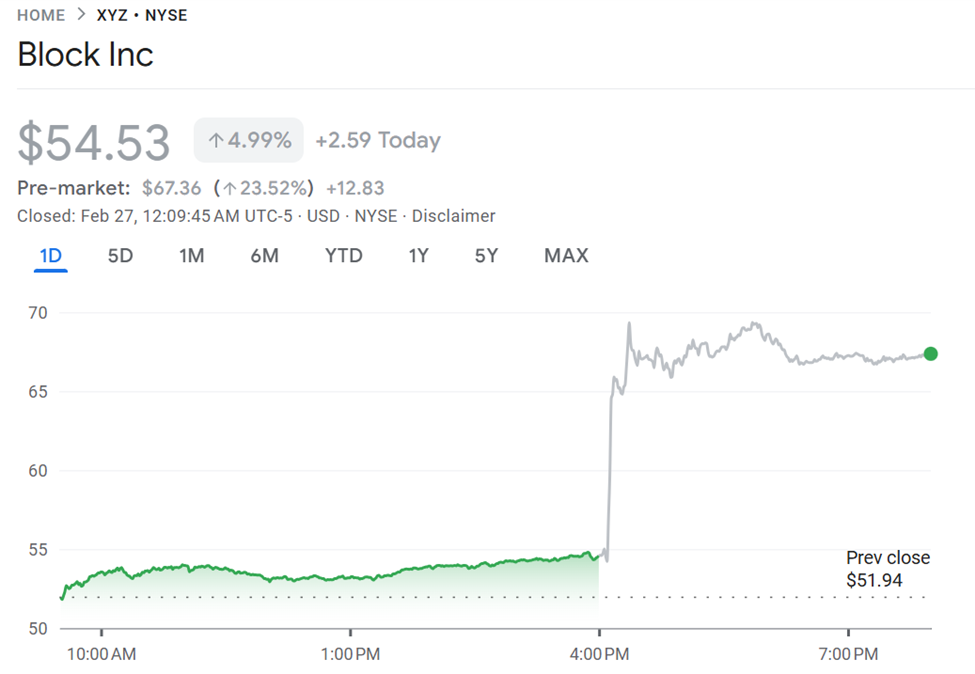
Reports reveal that Jack Dorsey’s September 2025 in-person company event cost a staggering $68.1 million, roughly equivalent to the annual payroll for 200 employees, only to be followed five months later by layoffs slashing 40% of Block’s workforce.
The sequence of events draws criticism, sparking a broader conversation about AI, corporate culture, and fiscal responsibility. The Twitter co-founder turned Block CEO remains in the headlines over corporate strategy in Silicon Valley.
Block’s $68 Million Party, 4,000 Layoffs, and the AI Excuse: Did Jack Dorsey Just Redraw Silicon Valley’s Playbook?
According to Dorsey, the choice was between a gradual reduction that could undermine morale and a decisive, single cut that would position Block to grow “on our own terms.”
He framed the layoffs as a forward-looking pivot toward AI and agentic workflows, claiming in a company-wide note: “100 people + AI = 1,000 people.” According to the Twitter co-founder, intelligence tools paired with smaller, flatter teams enable a new, accelerated model of operations.
Wall Street responded with immediate approval, with Block’s XYZ stock surging 20–23% within an hour, adding approximately $6 billion in market capitalization. This translates to roughly $1.5 million in enterprise value per eliminated role.
Block’s $68 Million Party Draws Criticism
Meanwhile, Jack Dorsey has sparked outrage and debate with a spectacle that many critics say redefines corporate norms.
In September 2025, the former Twitter CEO reportedly spent $68.1 million on a Block in-person event, an amount roughly equal to the annual payroll of 200 employees.
The three-day festival in downtown Oakland featured performances by Jay-Z, Anderson .Paak, T-Pain, and Soulja Boy, and brought 8,000 employees from around the globe.
The party, recorded in Block’s own earnings as a $68.1 million increase in general and administrative expenses, has drawn widespread criticism.
Social media users described it as “psycho” and “crazy,” with some pointing to the stark contrast between celebration and accountability, particularly in light of the layoffs that followed.
To some, the spectacle of the $68 million party followed by mass layoffs sends a troubling message about priorities and managerial judgment.
It highlights the dangers of pandemic-era overexpansion and executive indulgence, with some critics arguing that the layoffs were a correction of years of overhiring and mismanagement.
“Yes, we over-hired during COVID because I incorrectly built 2 separate company structures (Square & Cash App) rather than 1, which we corrected mid-2024. But this misses all the complexity we took on through lending, banking, and BNPL. And that we’re now targeting $2M+ gross profit per person, 4x our pre-COVID efficiency, which stayed flat at ~$500k from 2019 until 2024. We have and do run an efficient company… better than most,” Dorsey responded.
Meanwhile, others see the layoffs as AI-washing, a convenient cover for structural inefficiencies.
“Sam Altman previously stated that ‘some firms are attributing job cuts to AI, when in reality, those layoffs were already planned or would have occurred regardless.’ He describes this, along with other exaggerations of AI capabilities, as “AI washing”… a tactic aimed at masking business issues. Just saying,” noted Graham Stephan.
Notwithstanding, Coinbase’s first CTO, Balaji Srinivasan, suggests that it signals a broader shift in tech toward AI-driven productivity and smaller teams.
Block’s severance packages, including 20 weeks’ pay, six months of healthcare, equity, and $5,000 in transition support, were generous by tech standards.


Trescon marks 10 years, delivering 500+ government-backed events and scaling from Bengaluru to Dubai-led MEASA expansion.
Summary
- Founded in 2016 in Bengaluru, Trescon now runs 500+ events across 10+ countries, connecting 250k+ attendees and 3.5k+ investors.
- Dubai FinTech Summit under Dubai Future Finance Week has grown past 9,000 participants, cementing Trescon as a key DIFC partner.
- The firm is expanding from Dubai into Riyadh, Saudi, ASEAN and African markets with new AI, cybersecurity, STEM and deeptech platforms.
Trescon, a business events company, has marked its 10-year anniversary as a provider of government-backed business platforms in the Middle East and North Africa region, the company announced.
The company was founded in Bengaluru in 2016 by Mohammed Saleem, Mithun Shetty and Swarnavo Roy, according to company records. Trescon established its UAE office in 2021, designating Dubai as its regional headquarters.
The firm currently manages four events within Dubai Future Finance Week, organized by the Dubai International Financial Centre (DIFC): Dubai FinTech Summit, Future Sustainability Forum, Future Islamic Finance Forum, and Reg3 Forum, according to the company.
The Dubai FinTech Summit has grown to more than 9,000 participants, according to event data. Trescon has also provided services for government initiatives including the World Police Summit organized by Dubai Police and Dubai Future Forum organized by Dubai Future Foundation.
Over the past decade, the company has delivered more than 500 events globally across 10-plus countries, attracted over 250,000 attendees, generated more than 1 million business connections, and engaged over 3,500 investors, according to company figures.
The company’s leadership team includes Madhukar Dudda, Ummer Shameem, Sanjiv Singh, Anil Kumar, Edward Maben, Christine Davidson, Vimal Bhat and Naveen Bharadwaj, who oversee more than 250 professionals across international offices, according to the company.
“With government-entrusted flagship platforms, delivery must be flawless. At this level, the organiser’s credibility and the government’s reputation are inseparable,” Mohammed Saleem stated.
The company has expanded operations to Riyadh and is pursuing growth in Saudi Arabia, Indonesia, Malaysia, and African markets including Mauritius, according to the announcement. Trescon is developing platforms focused on artificial intelligence, cybersecurity, STEM and deeptech sectors.
“As we enter our second decade, we are scaling that framework across high-growth economies aligned with future technologies, sustainability and capacity building,” Naveen Bharadwaj stated.
Trescon operates with six business divisions across seven global offices. The company’s portfolio includes managed events under Dubai Future Finance Week, alongside event brands including World AI Show, HODL, DATE, CARE for Sustainability and the World FinTech Show, according to company information.
The company focuses on mid-to-large scale leadership platforms, typically hosting 3,000 to 10,000 senior stakeholders, according to its business model description.
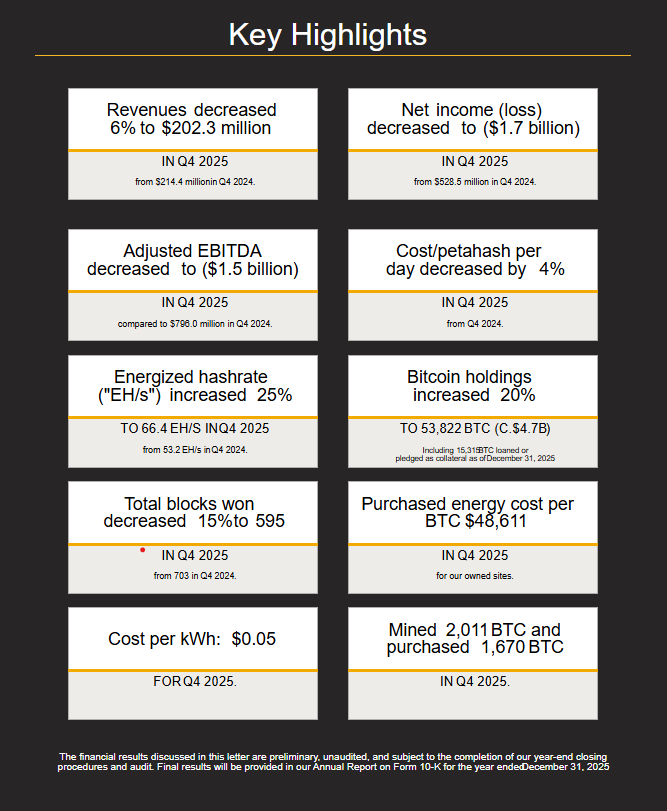
MARA Holdings (MARA) reported a fourth quarter 2025 net loss of $1.71 billion, or $4.52 per diluted share, compared with net income of $528.3 million, or $1.24 per diluted share, in the same period a year earlier.
Its shareholder letter filed with the US Securities and Exchange Commission (SEC) said revenue in Q4 fell 6% to $202.3 million from $214.4 million in Q4 of 2024, as a lower average Bitcoin (BTC) price outweighed the impact of a higher hashrate.
For the full year 2025, Marathon booked a net loss of $1.31 billion, compared with net income of $541 million in 2024, even though its revenue rose to $907.1 million from $656.4 million a year earlier.

The company said that its Q4 net income was hit by a $1.50 billion negative change in the fair value of digital assets and digital assets receivable, reflecting the decline in Bitcoin’s price from around $114,300 on Sept. 30 to roughly $88,800 on Dec. 31, according to data from CoinGecko.
The company’s share price also took a beating, with MARA stock down 46% in the past six months.

On the production side, Marathon said that it mined 2,011 BTC in Q4 2025, down 6% from 2,144 BTC in the prior quarter and 2,492 BTC in the year-earlier period, and 8,799 BTC for the full year, compared with 9,430 BTC in 2024.
Related: Bitdeer sells all Bitcoin, Metaplanet rejects misconduct claims: Asia Express
The company said that it ended 2025 holding 53,822 BTC, including 15,315 BTC loaned or pledged as collateral, with its balance sheet BTC valued at about $4.7 billion at a quarter‑end spot price of $87,498 per coin.
Marathon’s AI and high‑performance compute push
Alongside the numbers, Marathon used its Q4 shareholder letter to outline a multi‑year shift “from a pure‑play Bitcoin miner into an energy and digital infrastructure company,” announcing a strategic joint venture with Starwood Digital Ventures to develop artificial intelligence (AI) and high‑performance compute (HPC) data centers at its power‑rich sites.
Marathon said that the Starwood partnership was designed to support more than 1 gigawatt of IT capacity in its initial phase, with a roadmap that could extend above 2.5 gigawatts over time, and giving Marathon the option to invest up to 50% in individual projects while continuing to mine where power remains attractive.
The company also highlighted its acquisition of a 64% stake in Exaion in February to target “sovereign‑grade” and enterprise AI deployments.
Miners diverge on strategy as drawdown bites
Marathon’s hybrid approach comes as other major miners continue to experiment with different playbooks in response to the latest Bitcoin drawdown.
Hut 8 reported a fourth‑quarter net loss of $279.7 million on Wednesday, as it leans into a $7 billion AI data center lease, while Trump‑backed American Bitcoin reported a $59.5 million Q4 2025 loss on Thursday, yet continues to double down on its mine-and-hoard BTC model.
Magazine: South Korea gets rich from crypto… North Korea gets weapons
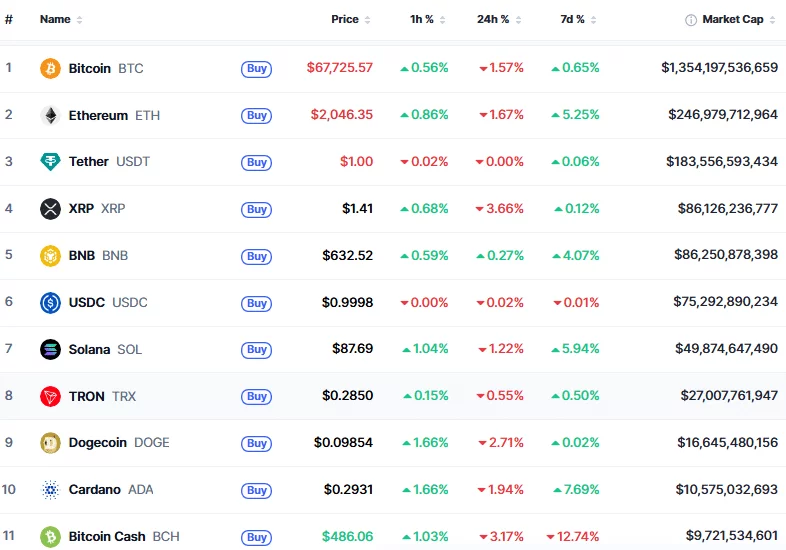
Cardano has made a defiant return to the crypto top 10, reclaiming its spot on CoinMarketCap after ADA price surged nearly 20% over the last 48 hours.
Summary
- Cardano (ADA) surged nearly 20% in 48 hours, reclaiming a top-10 spot on CoinMarketCap and flipping Bitcoin Cash in market capitalization, though ranking discrepancies remain across platforms.
- ADA is trading near $0.292, with RSI near 51 and the Awesome Oscillator turning positive, signaling strengthening bullish momentum as price tests psychological resistance at $0.30.
- Large holders have added over 819 million ADA in six months, while Grayscale raised Cardano’s weighting to 20.2% in its Smart Contract Platform Fund.
This rally allowed the “Ethereum-killer” to flip Bitcoin Cash in market capitalization, signaling a renewed appetite for the asset following months of lacklustre price action.
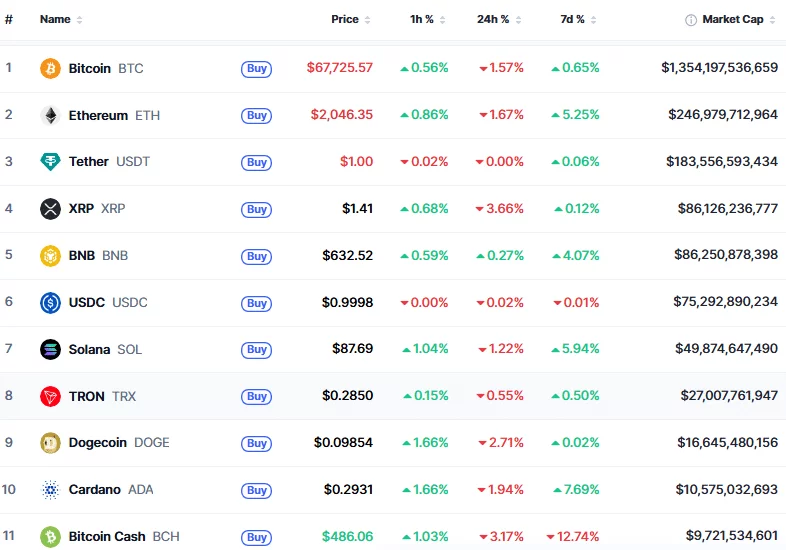
Interestingly, while CoinMarketCap places ADA at #10, the platform CoinGecko currently ranks it 12th. This discrepancy typically arises from how each platform calculates circulating supply and which “wrapped” or staked assets they include in their total market cap valuation.
Regardless of the minor ranking rift, the momentum behind Cardano is undeniable.
ADA price analysis: Bulls eye $0.30 resistance
The attached ADA/USDT daily chart reveals a significant shift in sentiment. After a period of consolidation throughout February, Cardano is currently trading at $0.2921, testing the upper bounds of its recent range.
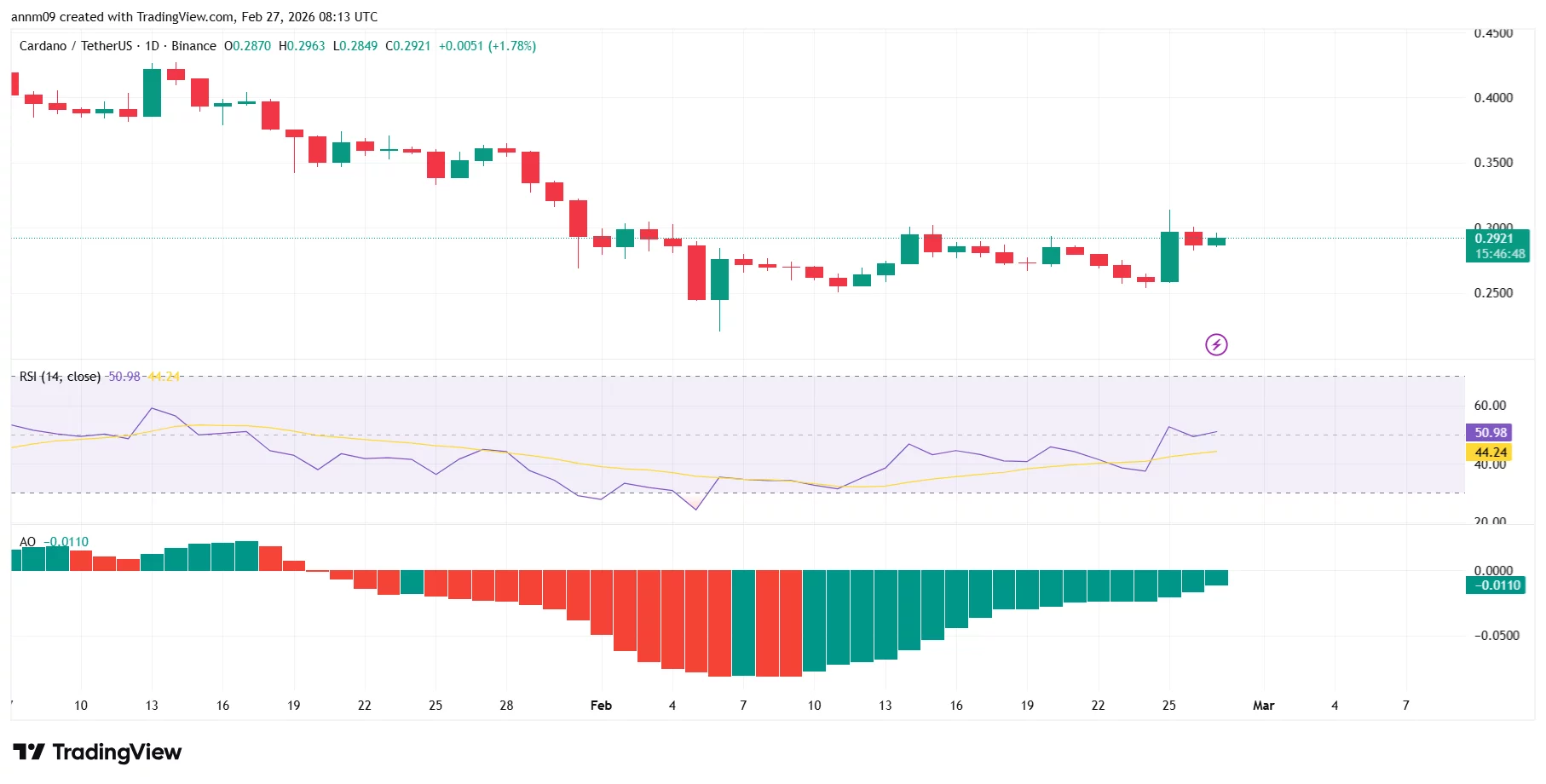
The Relative Strength Index (RSI) sits at 50.98, indicating a neutral-to-bullish momentum with plenty of “room to run” before reaching overbought territory.
Meanwhile, the Awesome Oscillator (AO) has printed its first few green bars above the zero line, suggesting that bullish momentum is finally overtaking the previous bearish trend.
The immediate resistance is a psychological barrier at $0.3000. A daily close above this level could clear the path for a move toward $0.34.
On the downside, solid support is established at the $0.25 level, where buyers aggressively stepped in during early February.
The verdict: Can ADA hold its position?
Whether Cardano holds its top 10 position depends on its ability to flip the $0.30 mark into support. With whale accumulation on the rise and technical indicators flashing green, ADA is well-positioned to maintain its comeback, provided the broader market remains stable.
Recent data from Santiment and other analytics providers suggests a clear divergence between large holders and retail traders.
Over the last six months, “sharks” and “whales” have aggressively increased their positions. Specifically, 819.4 million ADA has been accumulated by this group even as prices hit local lows near $0.26.
Meanwhile, institutional interest is also resurfacing. Grayscale recently increased Cardano’s weighting in its Smart Contract Platform Fund to 20.2%, making it the fund’s third-largest holding.
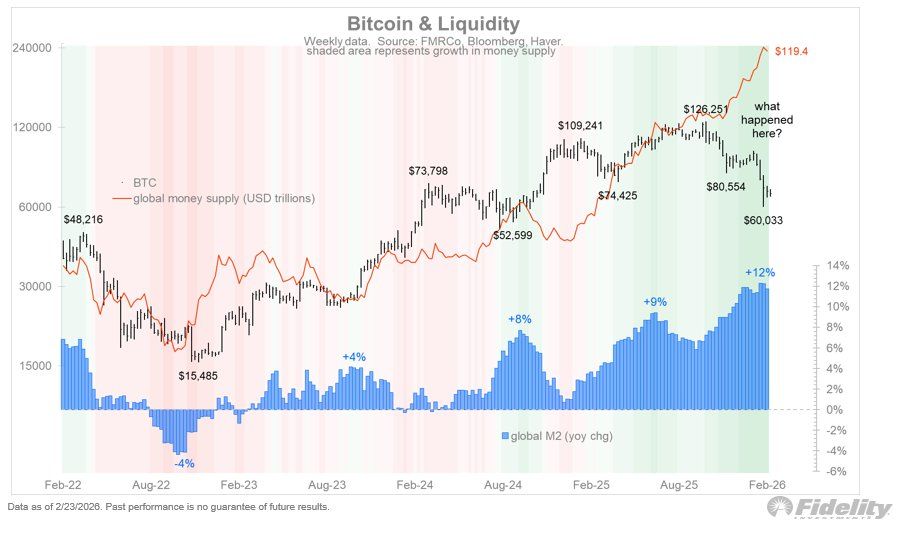
Global money supply surged to a fresh all-time high in December 2025, reinforcing a liquidity backdrop that has historically supported hard assets.
Gold has responded accordingly, maintaining its upward trajectory despite sharp but brief drawdowns. Nonetheless, Bitcoin, often described as “digital gold,” has delivered choppier price action.
Bitcoin’s Dual Identity Weighs on Price as Risk Appetite Fades
Global liquidity has continued to expand at a rapid pace. According to the Kobeissi Letter, global broad money supply rose to a record $144 trillion in December 2025. On a year-over-year basis, it increased by $13.6 trillion or 10.4%.
The December figure marked the third consecutive month of accelerating growth.
“Since the 2020 pandemic alone, money supply has surged +$44 trillion, or +44%. The fastest increase over this period was recorded in February 2021, at +18.7%. Global money creation has never moved this fast outside of a crisis,” the post read.
If global money supply is hitting an all-time high, the classic expectation would be: More liquidity → higher hard assets. Jurrien Timmer, Director of Global Macro at Fidelity, highlighted that gold is behaving according to that script while Bitcoin is not.
Timmer noted that despite volatility and a 21% drawdown earlier this month, gold has remained resilient. He said the metal has behaved as typically seen in a bull market, with sharp but short-lived pullbacks that quickly attract renewed buying interest.
“Gold may be the ultimate hard money asset and it has been following the global money supply in lockstep. Bitcoin is thought to be the same, but as the chart shows below, its price action vis-à-vis global liquidity has been a lot choppier than gold,” he said.
Follow us on X to get the latest news as it happens
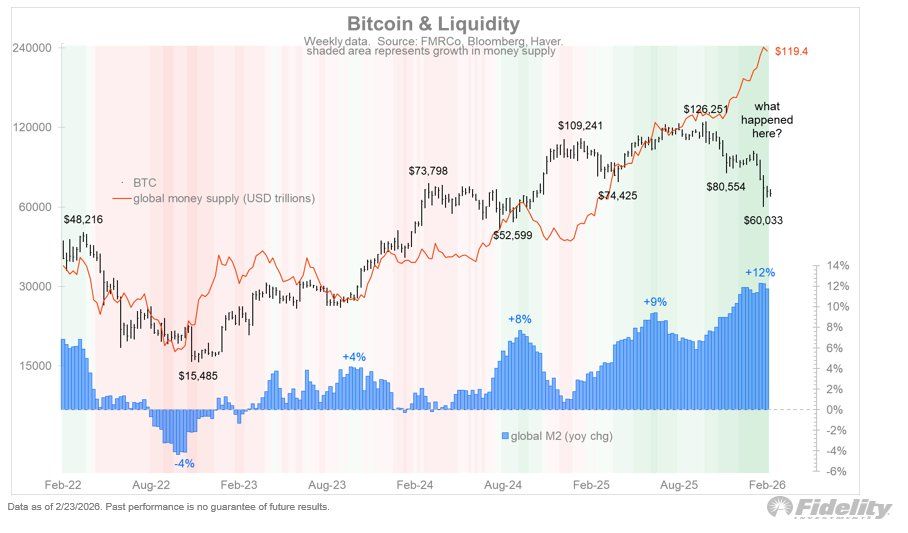
Timmer explained that the reason for the disconnect is simple. According to him, gold is only one thing, i.e, “hard money.” Bitcoin, meanwhile, occupies a dual identity: a potential hard currency on one hand, and a speculative asset on the other.
The Fidelity executive further added that when the rate of change in the software and SaaS index is added to money supply growth, it becomes clear that when the speculative component of the market turns negative, it can easily override the liquidity tailwind that would otherwise support BTC.
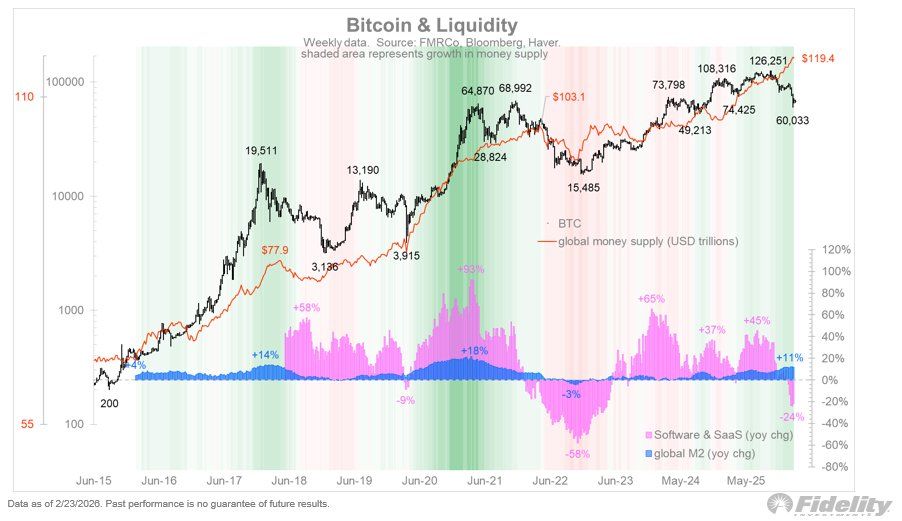
He noted that periods characterized by both expanding liquidity and strong speculative appetite have historically amplified bullish conditions. This often results in powerful bull markets. However, the dynamic works in reverse as well.
“Right now, we have ample liquidity growth but a bear market in speculation. The result: Bitcoin is languishing while gold and the money supply are rallying,” he remarked.
Subscribe to our YouTube channel to watch leaders and journalists provide expert insights
For now, the gap between gold and Bitcoin illustrates that rising liquidity alone does not guarantee crypto’s performance when speculative appetite is contracting. Whether Bitcoin will regain alignment with global liquidity likely depends on speculative interest returning to crypto markets, something that remains uncertain as February 2026 closes.
Key Highlights
- 180-day token lock required for WLFI governance participation
- Enhanced voting influence based on stake amount and lock time
- Annual 2% incentive for engaged governance voters
- Node tiers enable USD1 conversions and exclusive benefits
- USD1 stablecoin scales through banking license and multi-chain deployment
World Liberty Financial has unveiled a governance restructuring initiative that connects voting privileges to extended staking commitments. The framework establishes a six-month minimum lock requirement for previously unlocked WLFI tokens to gain governance access. This strategy seeks to enhance protocol commitment and stimulate broader engagement within the USD1 stablecoin ecosystem.
Governance Structure Redesigned Around Mandatory Lock Periods
World Liberty Financial has released details of a governance model requiring unlocked WLFI holders to commit tokens through staking before voting on protocol decisions. The framework mandates a 180-day lock duration and calculates voting influence according to both stake volume and time remaining in the lock period. Tokens already locked retain their governance capabilities without needing further action.
The system offers a baseline incentive of 2% annually for users who cast votes in a minimum of two governance proposals throughout their staking period. The WLFI treasury serves as the funding source for these incentives and supports continued community alignment. According to the project team, this design prioritizes influence among token holders demonstrating long-term commitment.
For the proposal to become active, it must achieve a quorum representing one billion eligible WLFI tokens. Following quorum achievement, passage requires simple majority support. Current market circulation exceeds 27 billion WLFI tokens.
Multi-Tier Staking Structure and USD1 Ecosystem Development
The governance plan establishes multiple tiers offering distinct advantages corresponding to staking volumes. Token holders committing at least 10 million WLFI achieve Node classification and unlock stablecoin conversion capabilities. These services facilitate direct 1:1 exchanges between USDT or USDC and USD1, alongside direct fiat withdrawal options.
Users staking above 50 million WLFI earn Super Node designation. This advanced tier provides partnership opportunities and potential economic benefits tied to protocol collaborations. The tiered approach is designed to encourage deeper participation and broaden WLFI’s institutional footprint.
The framework also integrates staking advantages with USD1 utilization throughout WLFI Markets. Token stakers receive benefits for USD1 deposits plus supplementary incentives facilitated through DeFi platform Dolomite. The development team anticipates this mechanism will generate consistent demand within the lending infrastructure.
Multi-Chain Stablecoin Growth and Regulatory Strategy
USD1 has been expanding its presence across numerous blockchain networks and platform integrations following its 2025 debut. The stablecoin’s backing consists of cash holdings and U.S. Treasury securities, managed by BitGo with monthly verification reports and multi-chain compatibility. Recent circulation growth accelerated following a significant arrangement involving Abu Dhabi’s MGX fund and Binance.
The initiative has also moved forward with its regulatory positioning through a banking license submission. WLTC Holdings submitted an application to create a national trust bank focused exclusively on stablecoin services. This institution would unify issuance, safekeeping, and conversion functions under single oversight.
WLFI has additionally authorized treasury funds to support USD1 integration across major platforms. The team subsequently introduced World Swap to enable international transfers using USD1 as the settlement mechanism. WLFI Markets continues experiencing increased activity, highlighting the stablecoin’s foundational importance throughout the expanding ecosystem.
TLDR
-
HEICO achieves best-ever first quarter earnings, yet shares decline in early trading.
-
Revenue jumps 14% to reach $1.18B with Flight Support segment leading the charge.
-
Flight Support profitability climbs to 24.5% driven by favorable mix and operational gains.
-
Electronic Technologies expands revenue but faces margin compression from product mix changes.
-
Leverage ratios increase following acquisition activity, though outlook remains optimistic.
Shares of Heico (HEI) experienced downward pressure despite the aerospace and defense supplier delivering its best quarterly earnings performance on record. The stock, which closed at $344.72, retreated to $324.59 during pre-market hours. This pullback came after the company unveiled results demonstrating substantial progress throughout its primary operating divisions.
Company Achieves Best-Ever Quarter With Double-Digit Sales Expansion
Heico’s first-quarter performance demonstrated impressive financial momentum with net income surging to $190.2 million. The company achieved diluted earnings of $1.35 per share, representing a year-over-year advancement. Consolidated net sales jumped 14% to $1.18 billion, showcasing robust demand dynamics.
The company’s operating income climbed to $259.9 million while maintaining healthy profitability levels. EBITDA grew 14% to hit $312 million, demonstrating effective operational leverage. Cash flow from operations declined to $178.6 million, primarily attributable to timing of employee compensation payouts.
Leverage indicators moved higher following a recent strategic acquisition that expanded balance sheet commitments. The net debt to EBITDA ratio climbed to 1.79x while total debt relative to net income also increased. Despite these metrics, leadership expressed strong optimism regarding fiscal 2026 trajectory.
Flight Support Division Powers Results With Organic Expansion
The Flight Support Group demonstrated exceptional performance with revenue climbing to $820 million for the period. Organic demand accelerated 12%, reflecting strength across the division’s diverse product portfolio. Recent acquisition contributions supplemented organic gains and bolstered overall segment results.
The division’s operating income surged 21% to $200.7 million during the quarter. Profitability expansion stemmed from reduced selling, general and administrative expense ratios combined with advantageous product mix dynamics. Elevated repair and overhaul activity further enhanced bottom-line results.
Operating margins within the segment reached 24.5%, surpassing the prior-year comparison. Enhanced operational execution drove the improvement alongside robust end-market demand conditions. The division sustained its positive trajectory and remained a key contributor to consolidated results.
Electronic Technologies Division Faces Margin Headwinds Despite Sales Growth
The Electronic Technologies Group reported net sales of $370.7 million, benefiting from strong demand across aerospace and electronic components markets. Organic revenue growth of 6% helped counterbalance softer performance in space-related product lines. Recent acquisitions contributed incremental revenue and diversified the business mix.
Operating income for the segment decreased to $73.2 million as profitability faced challenges from an unfavorable shift in product composition. Weakness in space-oriented offerings pressured gross margins during the period. Stronger aerospace demand partially mitigated these headwinds.
The division’s operating margin came in at 19.8%, reflecting the evolving product portfolio dynamics. Margin compression persisted as defense and space order patterns shifted throughout the quarter. Nevertheless, the segment’s revenue performance remained solid and aligned with management’s longer-term projections.
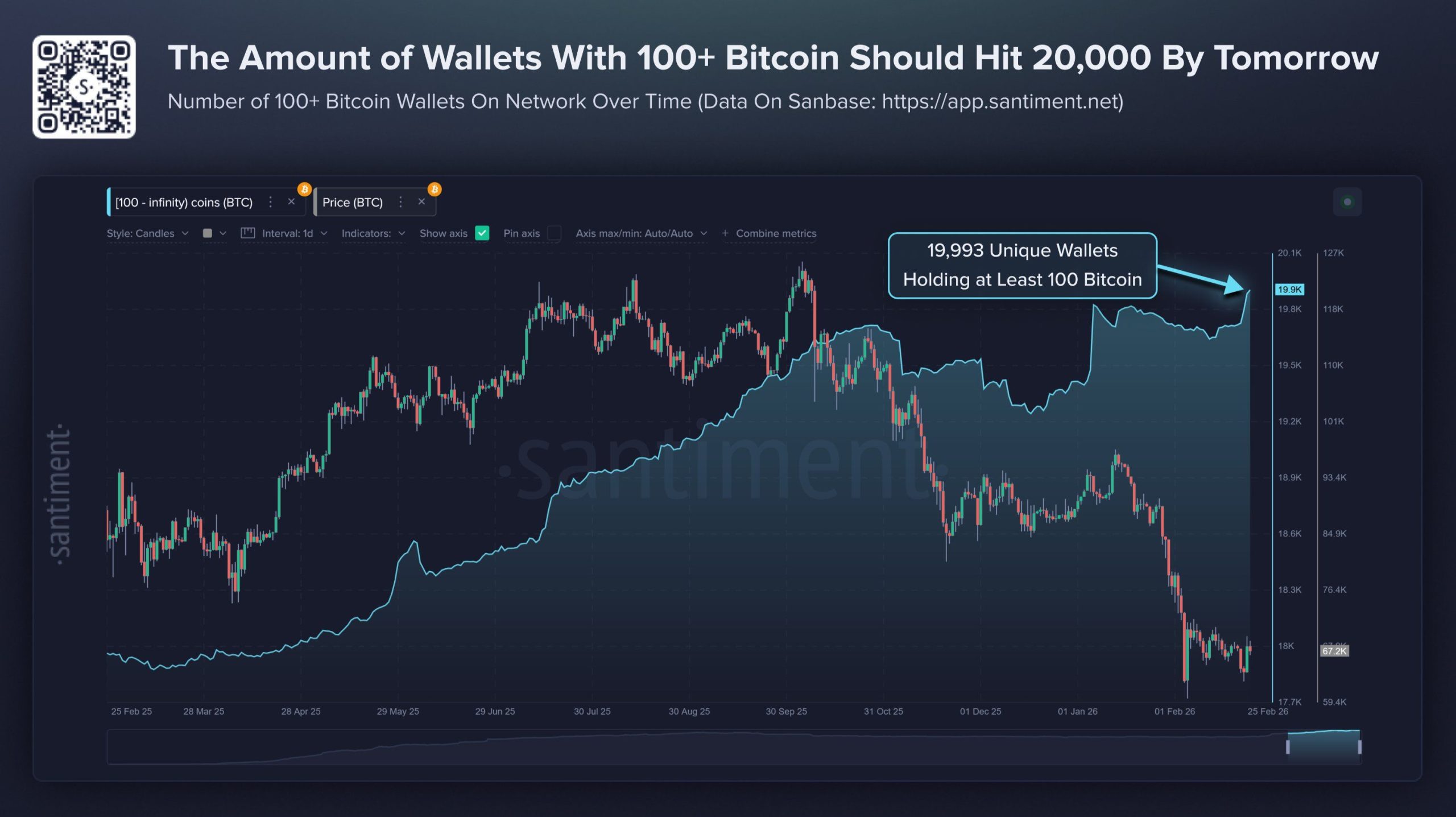
Bitcoin price has drifted lower in recent sessions, reflecting cautious sentiment across the crypto market. BTC continues to struggle beneath key resistance, limiting upside momentum.
Despite the slow decline, structural signals show accumulation beneath the surface. Whether that conviction translates into price recovery is yet to be seen.
Bitcoin Holders Near New Milestone
Santiment data shows Bitcoin is nearing a significant milestone. The network is about to surpass 20,000 wallets holding at least 100 BTC. At current prices, a 100 BTC wallet represents roughly $6.78 million in value.
Such wallets are typically controlled by high-net-worth individuals, institutional investors, funds, or long-term holders. Growth in this category during price pullbacks is often interpreted as a constructive signal. Accumulation during weakness reflects confidence in long-term fundamentals.
Want more token insights like this? Sign up for Editor Harsh Notariya’s Daily Crypto Newsletter here.
However, the overall percentage of supply held by key stakeholders has not materially increased. This suggests that distribution is occurring across more large holders rather than consolidating within a smaller elite group. While this reduces extreme concentration risk, it also limits aggressive price acceleration. Broader accumulation may stabilize price but not immediately trigger sharp rallies.
Bitcoin Holders Exhibit Mixed Sentiment
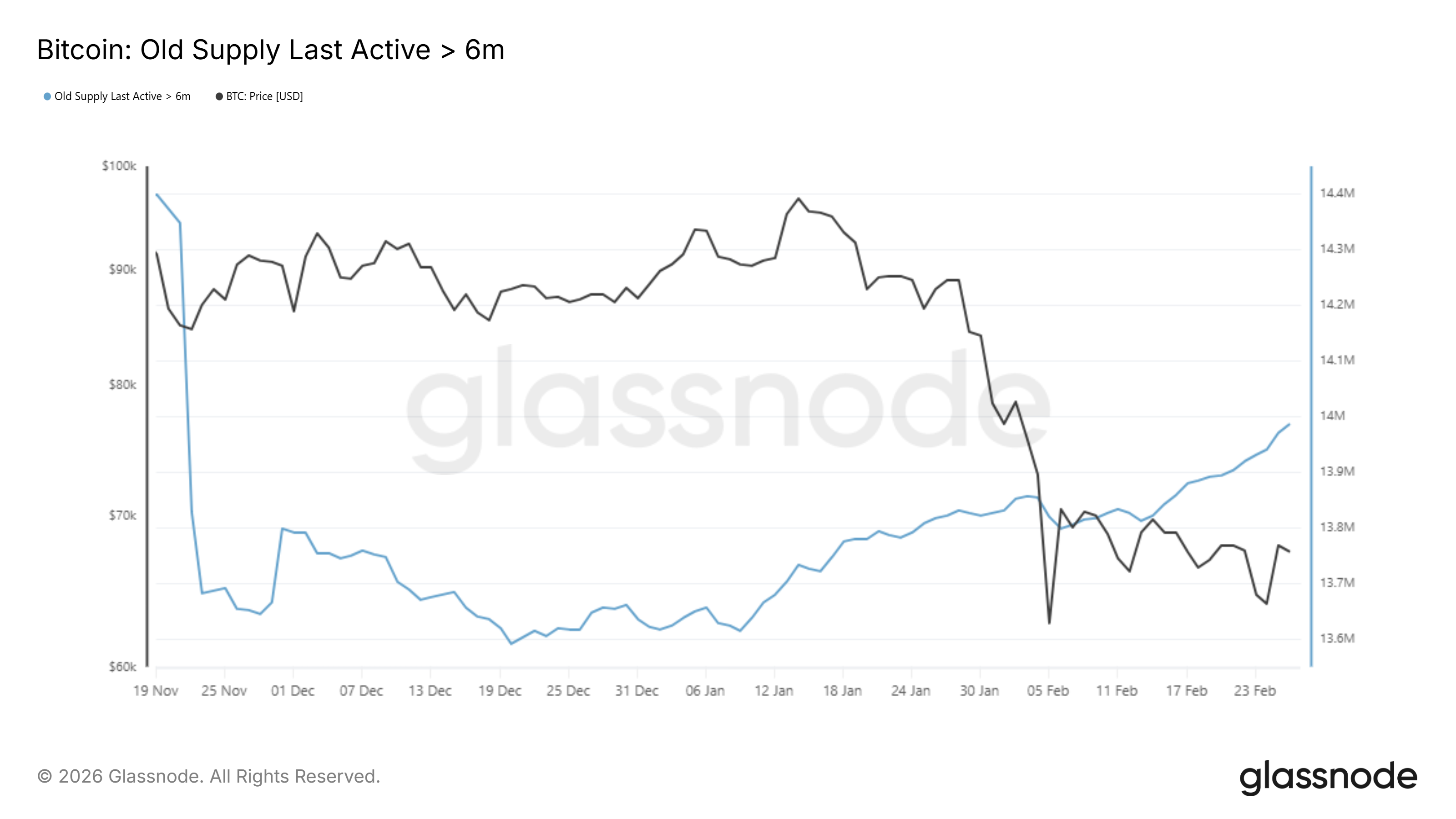
Old supply data adds another layer to the outlook. Old supply refers to Bitcoin that has not moved in at least six months. These coins are often associated with patient, long-term holders.
Over the past three weeks, old supply increased by 188,000 BTC, valued at more than $12.75 billion. Rising old supply indicates that mature hands are choosing to hold rather than distribute. Historically, this behavior has supported longer-term recovery phases when selling pressure diminishes.
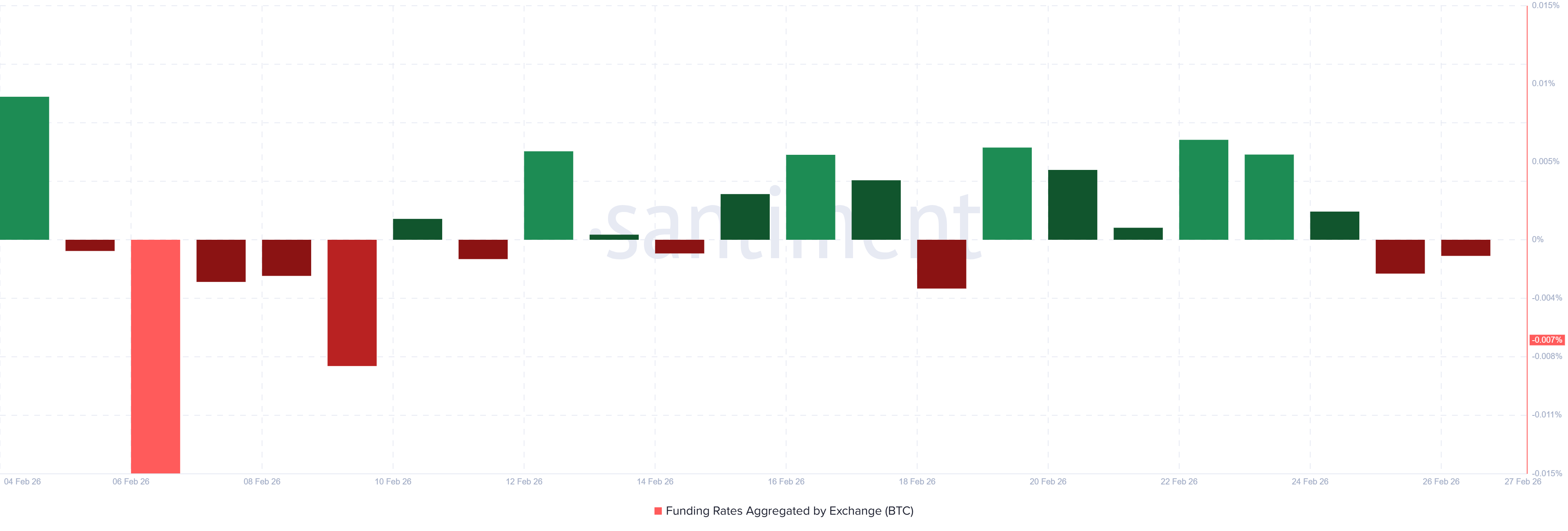
Derivatives data present a more cautious picture. Aggregate funding rates across Binance show that Bitcoin is currently being shorted. Negative funding rates signal that short positions are dominating longs.
Red funding bars over the last 24 hours indicate traders are positioning for potential downside. If short bias persists, BTC may face continued consolidation. Elevated short interest can cap near-term rallies unless a strong catalyst forces short covering.
BTC Price Is Under Slight Pressure
Bitcoin is trading at $67,867 at the time of writing, remaining below the $68,830 resistance level. The asset has formed a mild downtrend line over the past 20 days. A decisive move above $70,000 would shift momentum and signal renewed bullish strength.
Accumulation growth and expanding large wallet counts provide a supportive backdrop. If conviction strengthens and price responds, BTC could break above $70,000. Crossing $72,294 would mark a structural recovery phase and potentially attract renewed inflows.
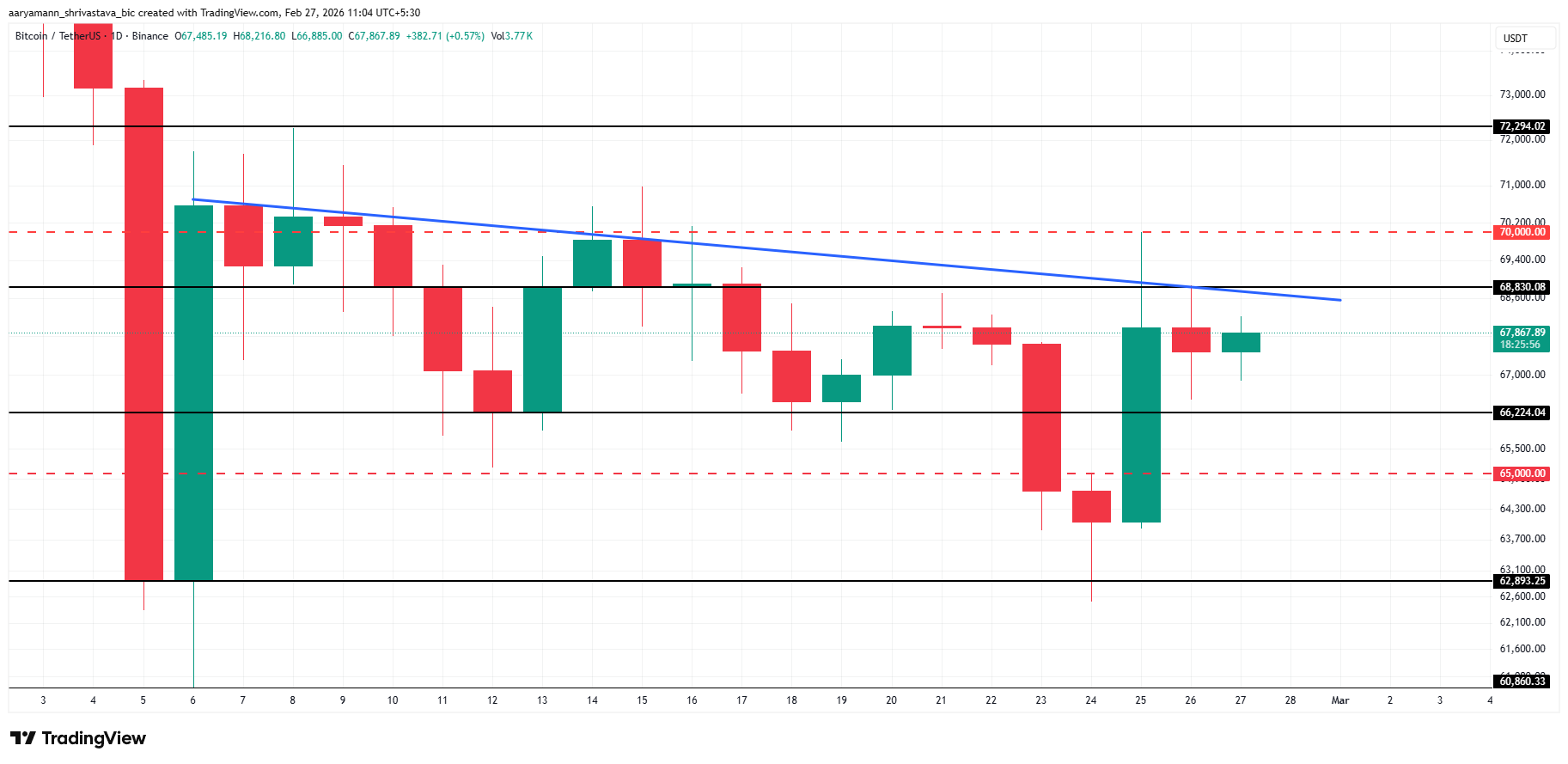
However, divergence between spot accumulation and derivatives skepticism may limit upside. Continued formation of lower highs would reinforce the downtrend line. In that scenario, Bitcoin could slide toward the $66,224 support. A sustained move below this level would invalidate the bullish outlook and extend consolidation pressure.
Meta Expands AI Chip Strategy with Google TPU Partnership Following Nvidia and AMD Deals

Amanda Bynes Continuing With Ozempic Journey, Wants to Lose 30 More Pounds

“Huge Blessings Await! God’s Financial Miracle Is Coming Your Way! | EP-70


-

 Politics5 days ago
Baftas 2026: Awards Nominations, Presenters And Performers
-

 Fashion7 days ago
Weekend Open Thread: Boden – Corporette.com
-

 Sports4 days ago
Women’s college basketball rankings: Iowa reenters top 10, Auriemma makes history
-

 Politics4 days ago
Nick Reiner Enters Plea In Deaths Of Parents Rob And Michele
-

 Business3 days ago
True Citrus debuts functional drink mix collection
-

 Politics9 hours ago
ITV enters Gaza with IDF amid ongoing genocide
-

 Crypto World3 days ago
XRP price enters “dead zone” as Binance leverage hits lows
-

 Business5 days ago
Mattel’s American Girl brand turns 40, dolls enter a new era
-

 Business5 days ago
Law enforcement kills armed man seeking to enter Trump’s Mar-a-Lago resort, officials say
-

 Tech3 days ago
Unsurprisingly, Apple's board gets what it wants in 2026 shareholder meeting
-

 NewsBeat1 day ago
Cuba says its forces have killed four on US-registered speedboat | World News
-
 NewsBeat1 day ago
Manchester Central Mosque issues statement as it imposes new measures ‘with immediate effect’ after armed men enter
-
 NewsBeat4 days ago
‘Hourly’ method from gastroenterologist ‘helps reduce air travel bloating’
-

 Tech5 days ago
Anthropic-Backed Group Enters NY-12 AI PAC Fight
-

 NewsBeat5 days ago
Armed man killed after entering secure perimeter of Mar-a-Lago, Secret Service says
-

 Politics5 days ago
Maine has a long track record of electing moderates. Enter Graham Platner.
-
 NewsBeat2 days ago
Police latest as search for missing woman enters day nine
-

 Business1 day ago
Discord Pushes Implementation of Global Age Checks to Second Half of 2026
-

 Crypto World2 days ago
Entering new markets without increasing payment costs
-

 Business12 hours ago
Only 4% of women globally reside in countries that offer almost complete legal equality