A security check on a fleet of new electric buses in Oslo late last year uncovered features that caused international alarm.
Advertisement
The 300 Yutong buses were sending data back to its manufacturers in China. The company insisted this flow was necessary to “optimise” their performance.
But Norway’s transport authorities moved to prevent access to data being sent to China. They also said they had mitigated any possibility of a ‘kill switch’ that could be activated by the manufacturer crippling the fleet from afar.
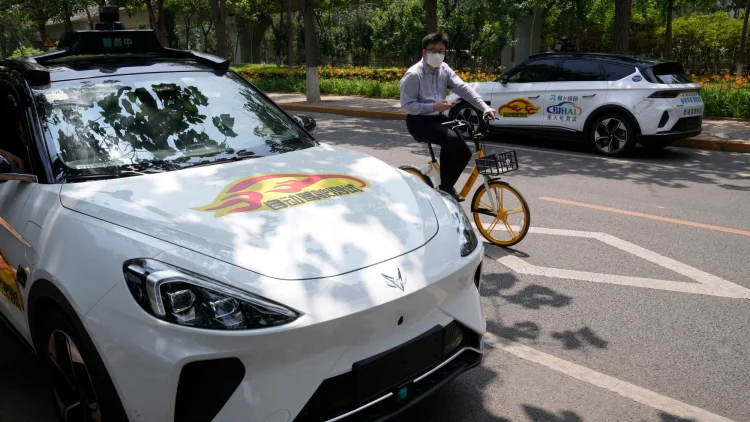
The incident brought into sharp relief the challenges the Chinese-dominated market in electric vehicles are posing western policymakers – made all the more acute with the advent of self-driving cars.
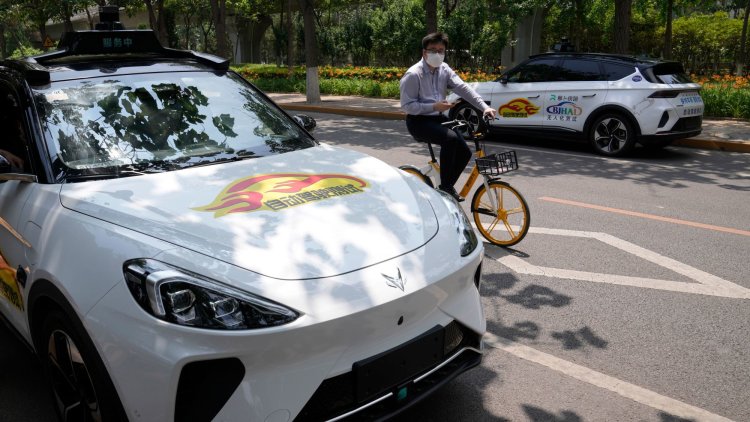
China dominates the global EV market, with its home-grown company BYD overtaking Tesla as the world’s largest electric carmaker last year. Amid reports that Chinese self-driving taxis could be trialled in the UK as soon as this year, MPs and peers from across the political spectrum are urging caution.
Advertisement
The BBC reported in December that Uber and Lyft had unveiled partnerships with Chinese tech giant Baidu to pilot these taxis in London, which Transport Secretary Heidi Alexander called a “vote of confidence in our plans for self-driving vehicles”.
But Alex Sobel, Labour MP for Leeds Central and Headingley, tells The House he is worried these partnerships – and others with Chinese firms – could open the door to major data vulnerabilities. Under Chinese law, companies operating within its national borders are required to hand over any data requested by the authorities in Beijing.
“I am concerned that people’s personal information potentially can be shared with the Chinese state and used for a variety of purposes, if you are particularly concerned for certain communities – for instance, from Hong Kong, from Tibet, Uyghurs, or Chinese who have a dissenting view from the Chinese government,” Sobel says.
Advertisement
Chinese activists defying their government don’t only face persecution at home. Beijing conducts an extensive campaign of transnational repression against dissidents and critics – such as posting bounties against high-profile Hong Kong democracy campaigners who fled to safety in the West.
“Transnational repression is becoming increasingly sophisticated,” Sobel says. “And I’m not just saying that about China or other countries as well, but other countries don’t have as much reach and penetration to the UK as China.”
Sobel adds that while he believes there should be a kill switch in any AI-powered devices as a failsafe mechanism, such switches should be in control of the country’s government in which the technology is operating.
“If the Chinese state decided, for whatever reason, they want to act in a hostile way towards the UK and kill all of these off at a point in time when there’s a deep penetration in the UK, obviously that would have a massive effect.”
Advertisement
North Durham Labour MP Luke Akehurst is another with concerns. He posed a written question to the Transport Secretary in January, asking her to assess the risk “that electric buses operating in the UK could be remotely rendered inoperable via their internet-connected systems by hostile state actors”.
Dr Alessandro Arduino, an affiliate lecturer at King’s College London, tells The House that robo-taxis and other self-driving vehicles offer a “revealing case study” in how new technology can sit on a fine line between fresh innovation and national security dangers.
He notes that these cars generate reams of data as they drive – from location information to citizen movement and urban layout. “Such data is invaluable not only for training artificial intelligence systems but also for forecasting and strategic analysis,” he says. “China’s own policy framework is explicit in treating data and AI as matters of state sovereignty and national security, and I do believe that context matters.”
Such a dramatic threat as a kill switch would not be the first order concern, he adds, saying that the most urgent consideration is whether operating companies can keep their data secure from malicious actors.
Advertisement
A Transport for London (TfL) spokesperson says: “Safety is our top priority, and we are interested in learning more about technologies that could potentially help deliver safety benefits for all road users.
“TfL recognises the challenge of legislating in response to changes in automated vehicle technology in a timely manner to ensure benefits are delivered and risks are mitigated.”
It is not the first time the use of Chinese tech in Britain’s infrastructure has faced fierce opposition over national security fears. In 2020, the government halted the use of Huawei equipment in Britain’s 5G network and ordered that existing tech be removed by the end of 2027.
But it comes at a time when Downing Street is seeking a reset in relations with China after a frosty few years. In January, the controversial Chinese new ‘mega-embassy’ in London was granted planning permission – despite repeated concerns over its proximity to crucial fibre-optic cables and potential for heightened espionage.
Keir Starmer has also now become the first British prime minister to visit Beijing in eight years, travelling along with a cohort of business leaders in a drive to reap the vaunted benefits of dealing with the world’s second-largest economy.
Advertisement
The Prime Minister’s visit saw the announcement of plans to allow British citizens visa-free travel to China and the lifting of sanctions on MPs who had blasted Beijing’s repression of Uyghur Muslims.
Former Conservative leader Iain Duncan Smith MP, a persistent China ‘hawk’, says he would like to see a pilot of self-driving taxis in the UK blocked if it uses Chinese technology. “They all basically data-harvest those who use them. It goes all the way down the line.”
Chinese companies such as Baidu have also long been criticised for their role in online censorship in the country, where the government maintains fiercely tight control over the information space.
Sam Goodman of China Strategic Risks Institute tells The House: “Given the integral role Baidu plays in internet censorship in China, and its legal requirement to share users’ data with China’s Ministry of State Security, it is hard to see how it can be trusted with the data security and personal safety of the British public.”
As AI technology, including that used in self-driving vehicles, continues to advance at breakneck pace, governments across the world have been left scrambling to find a policy answer on how best to regulate the sector and mitigate its risks without suffocating innovation.
Advertisement
Professor James Davenport of the University of Bath tells The House that lawmakers face grappling with both the novelty and broad range of AI technologies as they figure out effective regulation. “For example,” he explains, “the EU AI Act will impose the same requirements on self-driving taxis as on chatbots offering psychiatric advice. The alternative would be an enormous mass of detailed legislation and incredible turf wars.”
Liberal Democrat MP Wera Hobhouse, who was refused entry to Hong Kong last year, says the proposed pilot “fits a worrying pattern of the government growing far too cosy with Beijing”. Hobhouse is among the voices who believe the pilot should not go ahead until the government can categorically prove there would be no risk posed to national security or public safety.
She tells The House: “From approving a Chinese super-embassy in London to pushing ahead with closer economic ties despite repeated security warnings, the government are sending the wrong signal: that trade is being prioritised over security, human rights and the safety of those who have fled repression to build new lives in the UK.”
A government spokesperson tells The House: “Safety is central to our plans for automated-vehicle pilots. All proposed deployments will be subjected to rigorous safety and cyber-security assessments.”
Advertisement
Baidu did not respond to a request for comment. It has previously denied allegations of links to the Chinese state and military. An Uber spokesperson said: “No matter which country an AV partner is from, we only work with them if they can both meet Uber’s own high standards and fully comply with all applicable laws on safety, security, and privacy.” Lyft did not reply to requests for comment.
Hannah Spencer is campaigning to protect disabled children in school fires. Spencer shared on her Instagram that she is working with a young constituent to make schools safer for disabled children.
The new Green MP for Denton and Gorton shared the story of Lucas Vezza-O’Brien, a wheelchair user with cerebral palsy. Last year during a fire at his school Vezza-O’Brien was left behind as an assessment was made that the fire service and staff couldn’t get him out of the classroom.
Spencer said
He was left behind whilst alarms were ringing and the smell of smoke started to spread.
Being left behind during fires is reality for disabled people
This sounds like an absolutely terrifying and unimaginable situation, but for wheelchair users and other disabled people, it’s reality. In 2023, Dr Hannah Barham-Brown made headlines after she was left behind during a fire alarm at the Premier Inn she was staying in. Dr Barham-Brown had to be assisted out by friends, and if it had been a real fire she would’ve been left to die by the hotel staff.
Advertisement
We also learnt from Grenfell just how little housing associations and building companies give a fuck about protecting disabled people. 72 people died in the Grenfell tower block fire, many of whom were disabled and had their concerns ignored. Grenfell was an exercise in what happens when you neglect marginalised people and care more about taking their rents.
As Spencer shared, Vezza-O’Brien is campaigning to make sure that no other disabled school children face the ‘same horrendous experience’. The teenager has unpicked fire regulations for schools and started the #NoStudentLeftBehind campaign. His parliamentary petition got over 104,000 signatures. Spencer says she met with him as his MP and they will be attending a meeting with a government minister to ‘try and change the law’
Hannah Spencer is working for disabled people
Spencer and Vezza-O’Brien are both adamant in the stance that the schools or fire service ‘did nothing wrong’, but the law needs changing because there’s no requirement for schools to have evacuation chairs to get disabled people out in emergencies.
Spencer said
Advertisement
The law currently is too loose and vague. It needs changing. And thanks to Lucas, there’s now a lot of awareness and pressure building.
Of Vezza-O’Brien, Spencer said
It’s always very special to get to meet someone who clearly is a passionate activist – trying to challenge a complex legal and political system. But what I find most humbling here is that Lucas isn’t doing any of this for his own benefit, he’s doing it to make sure no other school pupil ever goes through the experience he had. He called his campaign #NoStudentLeftBehind and wants to stop this happening to anyone else.
Spencer said she is ‘honoured to play a very small part in this’ and hopes to help change the law so all pupils are safe in emergencies.
Though Spencer is just getting started as an MP, it’s clear she cares about disability rights. Something which we don’t see enough in Westminster. In her acceptance speech, Spencer was clear to state that she would serve all constituents, not just ‘taxpayers’ or ‘working people’.
She said
Advertisement
And I think that if you’re not able to work that you should still have a nice life. I think that absolutely everybody should get a nice life. And clearly, I’m not the only person who thinks that.
the disabled people who can’t access the world because of structural inequality that is completely fixable.
It’s refreshing to finally have a politician who cares about actually fighting for disabled people, and not just when it’s gaining headlines. Let’s hope this continues with the Green Party’s rise
Pope Leo has used his visit to Algiers to lay a tribute to Algerian rebels who died fighting for Algeria’s independence from France. The Pope, in full regalia, solemnly laid a wreath at the FLN (National Liberation Front) monument in the city:
The tribute is a pointed reminder to today’s neo-imperial powers of the will for freedom among oppressed and colonised people. It is one that is even more powerful from a Pope who is US-born – and one very much in line with the liberationist ideals of Leo’s predecessor Francis. More powerful still in the wake of Leo’s condemnation of US thief-in-chief Donald Trump for his arrogance, warmongering and delusions of divinity. And it is a welcome evolution in Leo’s political presence after a much less than auspicious start.
Commentator @thatkid1871 probably put it best:
After Francis died, I admit I did not predict that less than a year later we’d have a Chicago pope paying respect to FLN martyrs in full Roman regalia https://t.co/HiJU3JlMiJ
Nominations have closed for the local elections taking place on 7 May. And the sixth-biggest bloc of candidates – behind Labour, the Tories, Reform, the Lib Dems and the Greens – consists of those using one of the Trade Unionist and Socialist Coalition (TUSC) descriptions on their ballot paper.
TUSC has been in touch with details of its preparations for the elections:
There are 136 local authorities with scheduled contests this May. Councillors are up for election in around 3,000 wards or county council divisions. In total there are 289 candidates using a TUSC-registered description in the local elections across 64 councils.
They’re standing in one-in-five of the wards in those councils and just under one-in ten overall. And this includes candidates for the directly-elected mayors of Croydon, Lewisham and Tower Hamlets.
Advertisement
At the same time, there will be six constituency candidates using a TUSC description in the Scottish parliament elections, agreed by the autonomous Scottish Trade Unionist and Socialist Coalition.
And two constituencies in the Welsh senedd elections (out of 16) will see five candidates using a TUSC description. Each constituency sends six members to the senedd on a proportional system.
Most of the candidates appear on the ballot paper with the description Trade Unionist and Socialist Coalition next to their name. But some are using the Independent Trade Union and Socialist Candidate or Socialist and Trade Union Candidate descriptors.
Advertisement
Whatever the description, however, every candidate is committed to stand up to the establishment parties, who have all shown themselves to be indistinguishable when it comes to representing the interests of working class people.
For those with a TUSC candidate in their area the opportunity is there not just to protest on 7 May but to vote positively for socialist change.
There are other candidates contesting the establishment parties on 7 May who, while not appearing on the ballot paper with a trade unionist and socialist description, will have support from the coalition.
Advertisement
These include the 20 candidates standing under the Your Party name and others appearing on the ballot paper as ‘Independent’ who could be properly described as anti-cuts and anti-war candidates. TUSC is currently collating information on these and will publish as comprehensive a list as possible of alternative candidates before polling day.
On 15 April, social media was host to a great revelation – namely that swarms of bees had beset the tiny nation of Israel. Given Israel’s warmongering activities over the past few years, many have interpreted the great plague as God asking the Israelis to put a lid on it:
WATCH: Chaos in Israel as hundreds of thousands of bees swarm across the country!
Authorities are warning residents nationwide to shut their windows and stay off the streets!
In the Old Testament, swarms of bees are seen as a sign of divine wrath or looming danger. pic.twitter.com/dfjCPDGAW0
According to y-net Global, the swarm of bees is located in the southern Israeli city of Netivot. The swarm was localised to a shopping complex at the time, but footage has shown them settling on residents’ vehicles and balconies too.
Residents were advised not to approach the bees – under any circumstances. The guidance came as the swarm occupied streets and public spaces across the commercial area.
We should note that the above doesn’t apply if you’re part of the Israeli Occupation Forces (IOF). If you’re a soldier, please feel free to approach the bees as you like. These insects are here to support you, and they like it when you dance about and make as much noise as possible.
GB News also reported:
One social media user quoted a passage from the Bible, from Isaiah 7:18.
“And it shall come to pass in that day, that the Lord shall hiss for the fly that is in the uttermost part of the rivers of Egypt, and for the bee that is in the land of Assyria,” they quote.
The passage refers to God calling on foreign armies to invade Israel and judge Judah, one of Jacob’s sons.
Advertisement
It’s worth bearing in mind that Israel’s neighbours have shown no interest in invading the Zionist nation – something which cannot be said in reverse. Additionally, as Pope Leo recently said:
God does not bless any conflict. Anyone who is a disciple of Christ, the Prince of Peace, is never on the side of those who once wielded the sword and today drop bombs. Military action will not create space for freedom or times of #Peace, which comes only from the patient promotion of coexistence and dialogue among peoples.
The Isaiah passage above is from the Old Testament, whereas the Pope is talking that modern New Testament stuff.
It’s certainly the case that Israeli PM Benjamin Netanyahu is heavily inspired by the Old Testament. This is particularly notable when he brands his opponents “Amalek” – the Biblical enemies of the Israelites:
Advertisement
Netanyahu will NEVER accept peace. He sees Iran as the biblical Amalek that must be totally destroyed.The computer does not show this ending.
“We are ready to resume the fighting at any moment.” “Our finger is on the trigger.” pic.twitter.com/RzU7Toc8Xe
— Martin A. Armstrong (@ArmstrongEcon) April 8, 2026
Prime Minister Benjamin Netanyahu said that Israelis were united in their fight against Hamas, whom he described as an enemy of incomparable cruelty. “They are committed to completely eliminating this evil from the world,” Netanyahu said in Hebrew. He then added: “You must remember what Amalek has done to you, says our Holy Bible. And we do remember.”
There are more than 23,000 verses in the Old Testament. The ones Netanyahu turned to, as Israeli forces launched their ground invasion in Gaza, are among its most violent—and have a long history of being used by Jews on the far right to justify killing Palestinians.
As others quickly pointed out, God commands King Saul in the first Book of Samuel to kill every person in Amalek, a rival nation to ancient Israel. “This is what the Lord Almighty says,” the prophet Samuel tells Saul. “‘I will punish the Amalekites for what they did to Israel when they waylaid them as they came up from Egypt. Now go, attack the Amalekites and totally destroy all that belongs to them. Do not spare them; put to death men and women, children and infants, cattle and sheep, camels and donkeys.’”
You can see how this passage would justify genocide in the eyes of certain true-believers.
Unfortunately, some people use faith as cover for their own worst urges.
Advertisement
Buzzed
Footage online supposedly shows that the bees have swarmed a fighter plane:
Israeli military planes are experiencing serious issues, with many unable to fly, after the largest swarm of bees in recorded history descended on Israel pic.twitter.com/DHcAjOfesc
We can’t confirm that ‘many fighter planes are unable to fly’ or that the swarm is the ‘largest in recorded history’, but the Daily Express US is reporting the following:
The horde of winged insects, the largest ever recorded in the nation’s history, prevented a military plane from taking off when it overtook the engine.
A massive swarm was also seen hanging from the aircraft’s wing. Relevant teams are anticipated to respond to the situation.
One death machine out of action is still a result, so well done the bees.
The bees are doing more to stop Israel than the entire Democratic party.
The Rational National YouTube is among those who have collated videos of the bees:
Bee-lief
Of course, the swarms are almost certainly just a seasonal thing. It is interesting, though, that a nation which acts with Old Testament intent has now experienced something like an Old Testament plague.
Advertisement
If we believed in old school Biblical retribution, we’d possibly be worried right now.
It was exactly one year ago today that the Supreme Court delivered its judgment in the case of For Women Scotland Vs The Scottish Ministers, a judgment which has still not been implemented by the Scottish or UK governments, so it was quite bold of the SNP to choose it as the launch date for their manifesto.
The judgment is not referenced in the document and the phrases “women’s rights” and “single-sex” do not appear anywhere in it, although it does say “We are committed to upholding and protecting the human rights of trans people as far as possible within our powers and we will do all we can to ensure that trans people’s identities are recognised and respected”.
So, y’know, more of the same to come for the next five years.
A new animated film from Save the Children highlights how children’s lives are being torn apart by war, with life-long consequences, as the laws designed to keep them safe are repeatedly broken. British-Sudanese comedian Ola Labib narrates the 2-minute animation. It takes inspiration from the story of a family in Sudan living with the long-term effects of explosive weapons.
It follows two brothers, Ali, 13 and Nour, 10 [names changed to protect identities]. They were playing football outside their home in Khartoum when a bomb exploded nearby, changing their lives forever. Ali lost his leg instantly, while Nour suffered severe injuries that left him paralysed.
Launching on the third anniversary of the conflict in Sudan, Walk Twice exposes the rising impact of explosive weapons on children’s lives as bombs and drones increasingly strike schools, homes, and hospitals – places that should be protected under international humanitarian law.
The number of civilians harmed per attack rose from around 19 in 2023 to 26 in 2025 – a 37% increase. This reflects the growing use of wide-area explosive weapons in populated areas, where civilians gather. Most casualties occur in residential districts, markets and other dense urban spaces.
Labib said:
Stories like Ali’s are devastating - and as world leaders continue to flout international law, we risk seeing more children injured and suffering in this way.
Ali’s story really hit home for me. I lost my second cousin during the war in Sudan - he was around the same age as the brothers. Not everyone has that personal connection, but empathy shouldn’t depend on personal experience.
Any child lost or injured to war is one too many. This must never be something we just accept. It must never become normal. That’s why I’m joining Save the Children’s campaign that urges the UK government to fight for the right to childhood in Sudan.
Advertisement
A moving portrayal of displacement and loss, the film follows the desperate journey taken by Ali, Nour and their mother across large swathes of Sudan, seeking treatment amid collapsing health systems and ongoing insecurity.
Eventually they reach a displacement camp in Gedarif. And the film also captures the hope and quiet resilience of children affected by blast injuries. Following their upheaval, Save the Children provided the family with essential supplies, psychosocial support and mobility aids including an electric wheelchair for Ali.
Speaking about the difference Save the Children’s support has made, Ali said:
When Save the Children came and gave me this wheelchair, my self-confidence grew. It motivated me not to give up, and it made me think that the future is worth pursuing and that nothing is impossible.
A worldwide threat
While prompted by the anniversary of the conflict in Sudan, the film also highlights the growing threat to children in wars around the world, including Gaza and Ukraine.
Advertisement
A report by Save the Children reveals that explosive weapons are now killing children on a scale never seen before. More than 60% of child casualties in war zones now come from explosive weapons. Between 2020 and 2024, nearly 50,000 children became casualties of war.
Save the Children is urging the public to write to their MP and urge the UK government to do everything it can to protect children in Sudan. This should include urgently pressuring all warring parties and their international backers to end the violence, prioritise children’s safety and hold those who harm children accountable.
Alison Griffin of Save the Children said:
Every day we are watching the laws that were designed to protect children in conflict be openly ignored – not only by armed groups, but by governments that have a duty to protect them. No child should have to learn to walk twice. We cannot let this become the new normal.
Without urgent action from global leaders, including the UK government, we are on a dangerous path towards a world where conflict is a lawless free-for-all, and nothing is off limits.
Advertisement
Standing up for international law isn’t a choice. It’s an obligation.
Save the Children works in war zones around the world, providing life-saving care for injured children through pop-up hospitals. The charity also supports children’s long-term recovery, from safe spaces to play and learn to an innovative partnership with Imperial College London developing prosthetic limbs that can be remoulded as children grow.
In a surprise to exactly no one, Nigel Farage is topping a chart of scrounger MPs. Searching the Accountability Tracker on UKGovScan reveals some interesting things. Among them, the MPs with the highest ‘outside incomes’ are ex-PM Rishi Sunak and wannabe-next-PM Nigel Farage:
Farage is not a man of the people
First things first, it’s alarming that MPs have any outside income.
Being a Member of Parliament should be hard, gruelling work that takes a person’s full attention; it should also be considered an honour. If a politician feels like they have time to spend on side hustles, they’re not taking the job seriously.
Outside income also opens politicians up to outside influence.
Lord Alli? Is that the Lord Alli who gave @Keir_Starmer £16,000 'for his office' (cough), which he then spent on designer clothes? £16,000. For freebies? That Lord Alli?
We see that Starmer is in the Top 10 gifts list himself, despite his previous scandal. The value of his gifts is significantly below that of dame McDonagh, but how has he not learned his lesson yet?
Starmer’s ‘Gifts & Hospitality’ list contains 129 entries, and you’ll notice the value jumps to £356.7k with hospitality added:
When it comes to Farage, we can see he’s more than happy to take money from whoever’s offering it. We also know he’s a big fan of Donald Trump, whose regime has taken governmental corruption to whole new levels of dodgy:
Suspiciously timed trades betting on the future price of oil — concurrent with Trump's announcements on his moves in Iran — have caught the attention of market regulators at the Commodity Futures Trading Commission (CFTC).
Every year, global tourists and social media users share accounts of witnessing captive wild animals suffering in distressing conditions. Whether it’s seeing a barren concrete pen at a dilapidated roadside zoo or a video from a tiger cub cuddling experience on social media, it’s often difficult to know who to raise a concern with.
Global animal charity Wild Welfare has just launched its newly updated online Animal Welfare Concern Reporting Tool. This unique digital service allows anyone to take action when they witness potential animal welfare issues in-person or online.
The newly upgraded “Concern Navigator” provides a seamless central gateway for tourists or visitors to report uneasy or troubling experiences seen at zoos, aquariums, sanctuaries, or other animal related tourist attractions around the world.
These concerns may include physical issues, such as chained animals or maltreatment, as well as environmental failings like cramped, unsuitable enclosures.
Advertisement
It also helps to raise a red flag on ‘hidden’ suffering such as the over-handling of small mammals or reptiles, wild animals being used as photo props, or the psychological toll evidenced by stereotypic behaviours like pacing and repetitive head rolling.
Mainstream headlines are increasingly reflecting a shift in public perception and awareness of captive wildlife welfare, highlighted by recent high-profile stories such as the viral concerns for ‘Baby Punch’ the macaque at a Japanese zoo and the public campaigns about penguin welfare at a London aquarium.
Growing public concern for animal welfare
However, many people still feel powerless or unsure where to turn when they witness potential welfare issues or captive wild animals in distressing situations. Wild Welfare’s Animal Welfare Concern Reporting Tool acts as a free and easy triage service accessible to all online around the globe.
Wild Welfare’s online concern reporting service initially launched in 2018. Since then it has received over five hundred reports from concerned members of the public sharing experiences of potential captive wild animal abuse, inappropriate living conditions or poorly looked after wildlife.
Advertisement
Upon receiving a report, the newly re-launched tool can provide immediate feedback, advising and signposting users to relevant legislative bodies, local authorities, or associations best positioned to address the particular issue most effectively.
The website’s re-launch is the result of collaborative input from global leaders in animal science and zoo management including experts at Zoos Victoria in Australia. Data collected through the tool continues to help fuel ongoing research initiatives at Nottingham Trent University in the UK, allowing Wild Welfare to identify global trends in animal welfare concerns.
The project hopes to aid the further development of evidence-based welfare solutions, while raising public awareness of identifying what sub-standard animal welfare might look like.
Wild Welfare director Simon Marsh explained:
Advertisement
Wild Welfare’s philosophy is to work in collaboration with zoos, aquariums, and sanctuaries. Our initial concern reporting tool helped us to identify potential welfare issues and start addressing them by working with individual facilities, zoological associations, and governing authorities.
By reimagining and re-launching this free online tool, we are helping to provide a voice for the voiceless animals around the world suffering as a result of inappropriate tourist activities and living in unsuitable conditions.
We provide practical training and resources to address immediate welfare concerns and create institutional change, delivering long-term positive welfare outcomes for animals under human care.
Wild Welfare is encouraging anyone who witnesses poor animal welfare to use the tool and flag their concern. Each report contributes to a global database that is helping Wild Welfare and their partners to advocate for stronger welfare legislation and better global husbandry practices.
Maritime union RMT is taking further strike action at the Royal Fleet Auxiliary on Thursday 16 April. This is after the employer failed to table a new offer.
Despite repeated attempts by the union to reach a negotiated settlement, no improved offer has been made by Royal Fleet Auxiliary management.
During the 24 hour strike action, members will continue to maintain the safety of vessels at all times. This includes the management of moorings and gangways.
Advertisement
Seafarers can routinely work up to 12 hours a day. But there remains no clear or transparent formula setting out how to calculate pay against those hours.
RMT general secretary Eddie Dempsey said:
Our members in the Royal Fleet Auxiliary have shown patience and professionalism throughout this dispute, but they are being left with no other option than to take further strike action.
Despite repeated efforts by our union to secure a fair deal, the employer has failed to return with any improved offer.
The frustration amongst our members due to the inaction of the employer is high and will only fuel their determination to carry on their industrial campaign.
Advertisement
RFA seafarers play a vital role in supporting the Royal Navy, often in demanding and dangerous conditions and they should be rewarded properly.
The Ministry of Defence and the employer must now come forward with a serious proposal on pay and conditions, including ensuring full compliance with National Minimum Wage legislation.







 (@ThatKid1871)




 WATCH: Chaos in Israel as hundreds of thousands of bees swarm across the country!



















































You must be logged in to post a comment Login