

Crypto World
Ethereum Price Analysis: $220M Short Squeeze Drives ETH Rally Amid Rising Volatility

TLDR
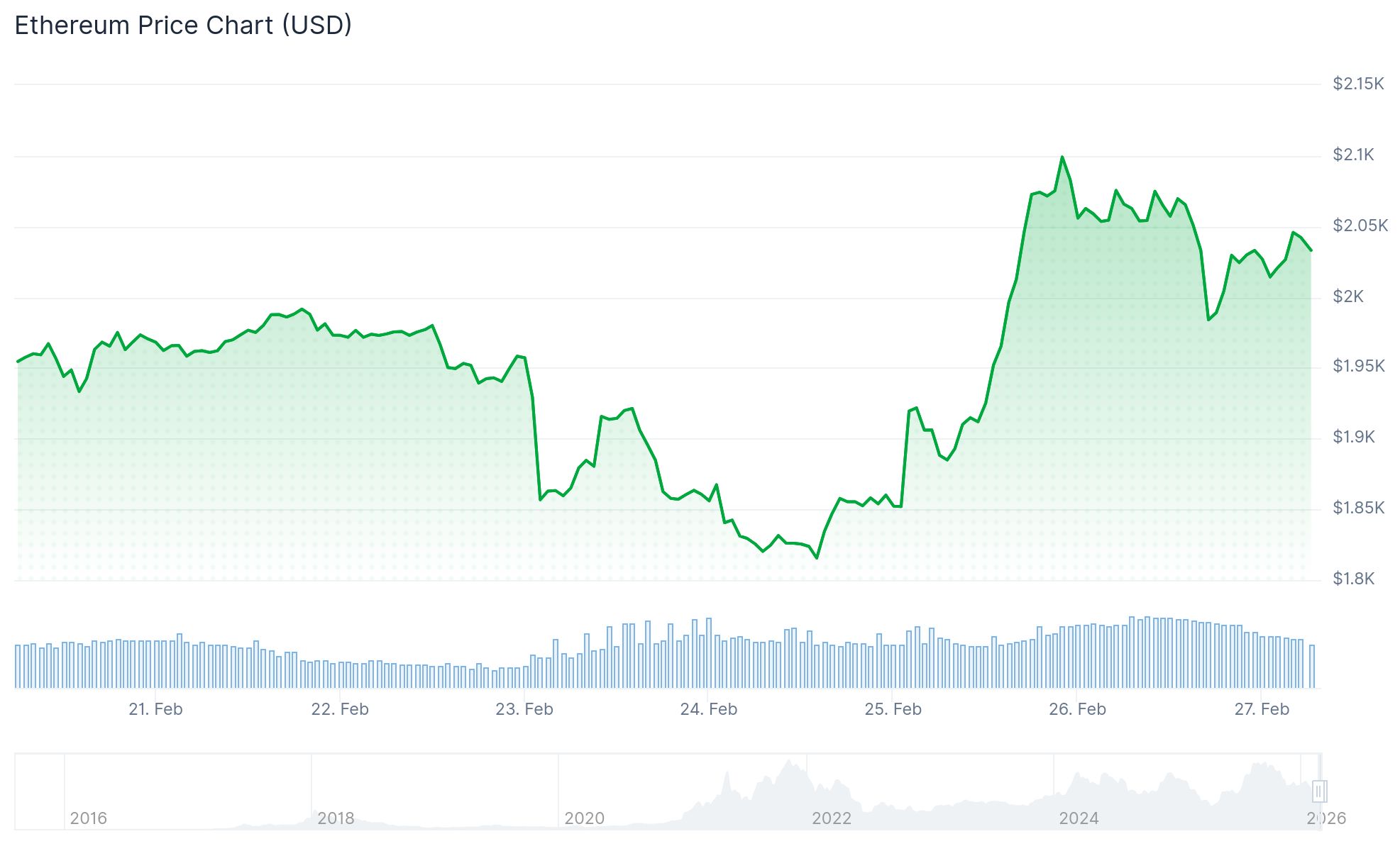
- Ethereum touched $2,150 this week before encountering resistance across several technical indicators
- The $2,100 level represents a critical threshold, matching the realized price for wallets containing 100,000+ ETH
- The 30-day realized volatility for ETH approaches 0.97, marking the highest point since March 2025
- Liquidations of short positions exceeded $220M across 48 hours, while funding rates shifted into positive territory
- ETF outflow pressure shows signs of weakening, although definitive accumulation trends remain absent
Ethereum surged to $2,150 during Thursday’s trading session before experiencing a retracement. The cryptocurrency continues navigating a narrow trading corridor, with $2,000 serving as crucial support and $2,100 emerging as the next significant barrier.
Closing above $2,100 on the daily timeframe carries particular significance as this price point corresponds to the realized price for addresses holding 100,000 ETH or greater. The realized price metric represents the average acquisition cost based on the last on-chain movement, providing insight into whether major stakeholders maintain profitable positions.
Historical data from 2020 onward reveals ETH has rarely traded beneath this whale cohort’s cost basis, with the most notable exception occurring throughout 2022’s bear cycle. Previous tests of this threshold have typically preceded price recoveries.
Futures and Funding Rates
The derivatives market witnessed short position liquidations exceeding $220 million during the previous 48-hour period, eliminating substantial leveraged positions. Binance funding rates, which plunged deeply negative in early May as bearish positions accumulated, have reversed course to reach positive 0.23%.
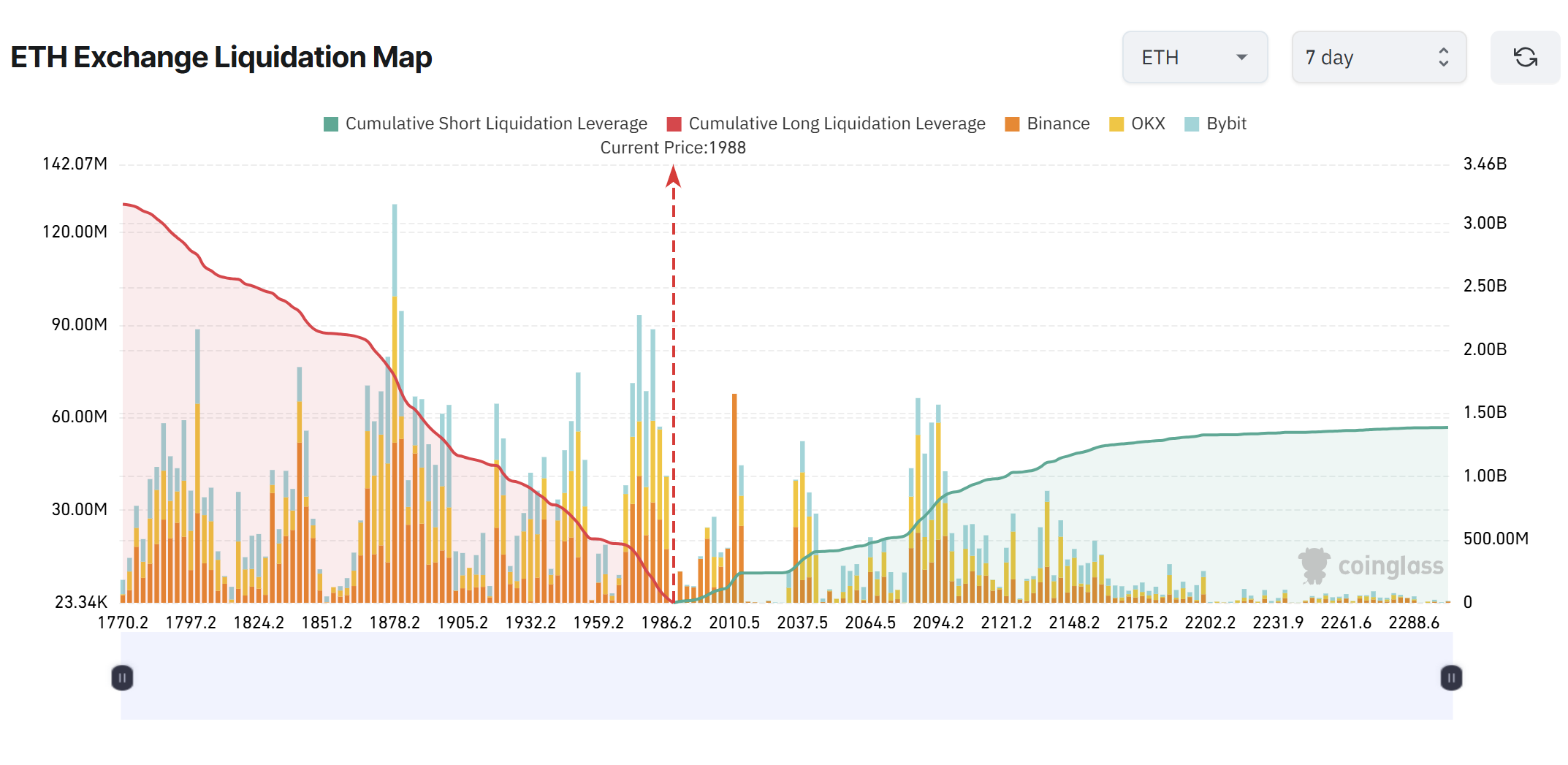
This reversal indicates that traders who opened shorts late in the cycle faced forced liquidations. Nevertheless, with funding rates now trading at elevated positive levels, the market structure favors long positions, creating potential vulnerability for a long squeeze toward $1,800 should upward momentum weaken.
Approximately $2.66 billion in long position liquidation exposure clusters around the $1,800 price zone, establishing a substantial liquidity pocket beneath current trading levels.
Volatility and ETF Flows
Ethereum’s 30-day realized volatility measured on Binance has climbed to approximately 0.97, representing the highest measurement recorded since March 2025. Heightened volatility during this phase may indicate market uncertainty and directional indecision rather than establishing a clear trend.
Price action continues trading beneath the 50-day, 100-day, and 200-day moving averages. Following the rejection near $4,800 in late 2025, each subsequent recovery attempt has established lower peaks, suggesting persistent distribution pressure.
Regarding ETF activity, selling pressure appears to be diminishing. Following substantial outflows throughout mid-2025, recent flow statistics indicate reduced movement in either direction. Institutional distribution seems to be decelerating, although convincing accumulation signals have yet to materialize.
Market analyst Leon Waidmann observed that retail participants with low conviction have predominantly exited their positions. Short interest continues declining, while highly leveraged long positions have been slow to establish meaningful presence.
Technical strategist IncomeSharks identified three overhead resistance zones, including multiple SuperTrend rejections and channel resistance positioned near $2,250. The analyst additionally highlighted April’s lows around $1,500 as a critical downside level should demand weaken once more.
At press time, ETH was changing hands at $2,034.


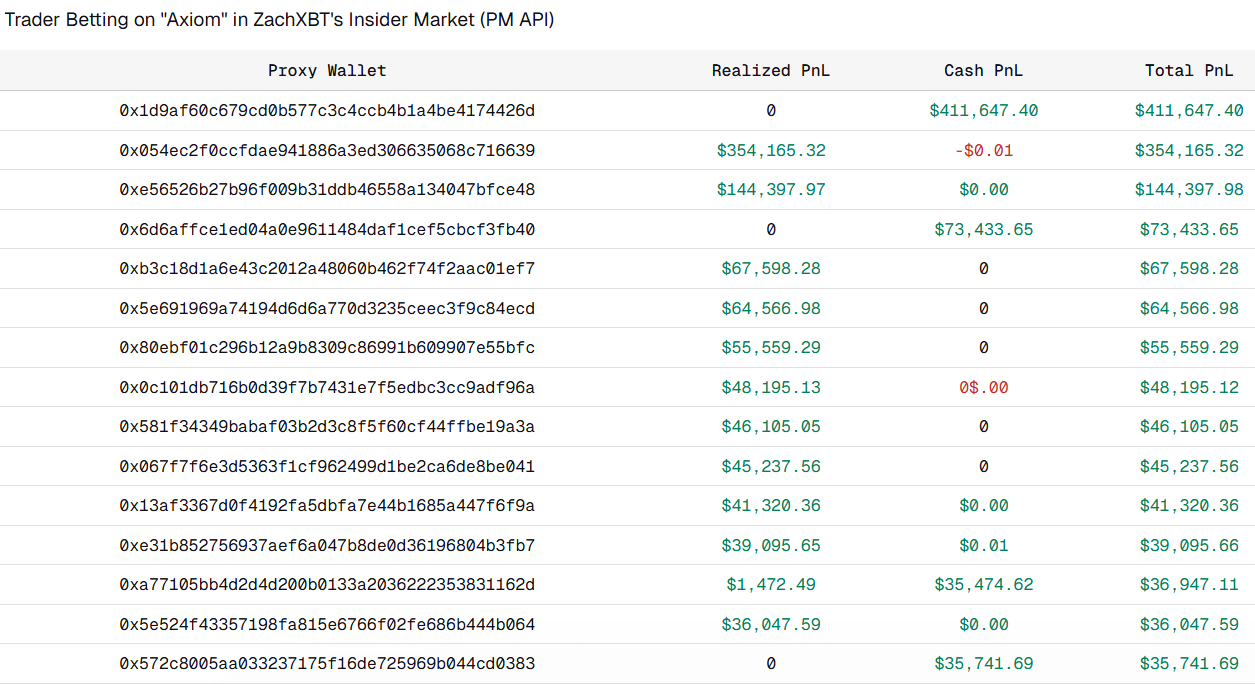
A small group of crypto wallets won more than $1.2 million betting on a Polymarket contract tied to an onchain investigation into decentralized finance (DeFi) trading platform Axiom, fueling fresh concerns that prediction markets can reward people with advance knowledge of market-moving disclosures.
The eight most profitable wallets on the market collectively made about $1.2 million, according to trading data compiled on Dune. The same dataset showed more than 50 wallets posting combined losses of roughly $1.23 million, while two wallets lost about $366,000.
Eight out of the top 10 wallets are likely insider addresses, judging by their onchain transaction patterns, according to onchain researcher Defioasis. “There are 3 addresses that achieved profits exceeding $100,000, all of which are insider addresses that traded only this single market,” said the researcher in a Friday X post.

ZachXBT released the much-anticipated investigation on Thursday, alleging that Axiom employee Broox Bauer and others had been responsible for insider trading activity since early 2025.

In an X response to the incident, Axiom said it was “shocked and disappointed” in the news and that it had removed access to the tools that were used in the alleged insider trading.
Related: Analysts reject Jane Street ‘10 a.m. dump’ claims, say Bitcoin isn’t easily manipulated
Prediction markets raise insider trading allegations
Insider trading concerns in prediction markets mounted in early January after a highly profitable bet on the removal of Venezuelan President Nicholas Maduro by the US raised eyebrows.
On Jan. 3, a Polymarket account placed a bet on a contract predicting that Maduro would be removed from office just hours before US forces captured him in a military operation, netting the user about $400,000 in profit.
US lawmakers have since proposed legislation aimed at restricting political prediction market trading by government officials, adding to the regulatory spotlight on the sector.
Related: Solo Bitcoin miner bags over $200K block reward using rented hashrate
Polymarket faces growing regulatory scrutiny on gambling concerns
Polymarket, the largest decentralized prediction market, has faced mounting regulatory pressure in several countries where authorities have argued that the platform offers unlicensed gambling.
Hungary and Portugal blocked access to the platform in January, citing concerns related to forbidden gambling activities.
A week earlier, Ukraine blocked Polymarket, classifying its activities as unlicensed gambling under national law.
Polymarket has also been restricted or blocked in several other countries over gambling concerns, including France, Belgium, Poland, Singapore and Switzerland.
Magazine: Inside a 30,000 phone bot farm stealing crypto airdrops from real users


Matt Hougan dismissed claims that Jane Street is orchestrating Bitcoin’s recent decline, calling the downturn “a classic crypto winter.”
Matt Hougan, chief investment officer at Bitwise, has pushed back on claims that trading firm Jane Street is behind Bitcoin’s recent slide, writing on X on February 26 that the downturn is “a classic crypto winter,” not a coordinated attack.
His comments come as lawsuits and viral threads revive old fears about market manipulation just as Bitcoin is trading over 46% below its all-time high.
Conspiracy Claims Collide With ETF Mechanics
Speculation intensified after reports emerged that Terraform Labs’ bankruptcy administrator had sued Jane Street in a Manhattan federal court, accusing the firm of using insider information before the May 2022 Terra-Luna collapse.
According to the complaint, Jane Street withdrew 85 million TerraUSD from Curve’s 3pool minutes after Terraform removed 150 million UST, a sequence the suit claims accelerated the $40 billion collapse. Jane Street has denied the allegations, calling the case a “desperate attempt” to recover losses and blaming Terraform’s management for the failure.
At the same time, some crypto analysts, including Bull Theory, alleged that Jane Street runs a “10 AM” sell algorithm to push Bitcoin lower and profit from derivatives.
Bull Theory also pointed to an interim order from India’s Securities and Exchange Board accusing Jane Street entities of expiry-day index manipulation between January 2023 and March 2025, alleging thousands of crores in unlawful gains. The case is ongoing, and the firm has appealed.
However, Hougan dismissed the narrative as misplaced. “The conspiracy theories are wild,” he wrote, arguing that Bitcoin is down because investors unwound long positions, reduced leverage, and rotated capital elsewhere.
You may also like:
The Bitwise CIO also amplified colleague André Dragosch’s analysis of intraday Bitcoin performance since the ETF launch in January 2024. Dragosch’s data countered the viral 10 AM slam narrative by showing pronounced weakness around midnight ET, pointing to non-U.S. trading hours as the actual vulnerability period.
Macro strategist Alex Krüger also echoed Hougan’s skepticism, calling the Jane Street theory “yet another viral and flawed conspiracy theory.” He noted that basis traders and authorized participants (APs) simply close gaps between ETFs, futures, and spot markets.
“Too many doomer narratives and conspiracy theories looking for villains circulating right now,” Krüger posted. “Historically, that’s the kind of sentiment you see at bottoms.”
Structural Questions Linger Beyond the Blame
The controversy has also revived debate about ETF plumbing. ProCap CIO Jeff Park wrote on February 25 that concerns are less about a single firm and more about how APs operate under regulatory exemptions that allow in-kind creations and redemptions.
In theory, APs can hedge ETF exposure with futures instead of buying spot Bitcoin directly, which critics argue could dull spot demand.
None of the lawsuits or regulatory filings so far establish coordinated misconduct in Bitcoin markets. Still, the overlap between large quantitative firms, derivatives strategies, and ETF mechanics has fueled suspicion during a downturn.
For Hougan, the explanation is simpler. Bitcoin’s four-year cycle, leverage resets, and shifting investor priorities are enough to explain the pullback.
“This is a classic crypto winter and there will be a classic crypto spring,” he wrote. “People want someone to blame — I get it — but the reality is far more boring than that.”
Binance Free $600 (CryptoPotato Exclusive): Use this link to register a new account and receive $600 exclusive welcome offer on Binance (full details).
LIMITED OFFER for CryptoPotato readers at Bybit: Use this link to register and open a $500 FREE position on any coin!


AllUnity, a joint venture between DWS, Galaxy, and Flow Traders, has expanded its stablecoin lineup with a new token pegged to the Swiss franc, which has emerged as a haven darling for major banks and analysts.
The BaFin-regulated e-money institute has unveiled CHFAU, which is backed 1:1 by Swiss franc reserves, in response to institutional demand for regulated digital CHF for payments, settlements, and treasury operations.
It debuts on the Ethereum blockchain as an ERC-20 token, with plans to expand to other networks later this year.
“In response to strong demand for a compliant digital Swiss Franc, we progressed from concept to launch in a matter of months, demonstrating the strength and scalability of AllUnity’s multicurrency platform,” Alexander Höptner, CEO of AllUnity, said in a press release shared with CoinDesk.
“This milestone is just the start of a broader transformation in how global liquidity moves,” said.
The debut is a sign of growing investor demand for stablecoins pegged to fiat currencies beyond the U.S. dollar. Last year, AllUnity debuted the EUR-stablecoin, while several other firms have issued tokens pegged to other fiat currencies such as JPY.
The debut signals surging demand for stablecoins pegged to fiat currencies beyond the dollar. Last year, AllUnity launched its EUR-pegged token, joining others that have issued JPY-tied alternatives. The stablecoin market has exploded since 2020, hitting $310 billion in combined value, with dollar-pegged tokens in pole position.
Safe haven CHF
Prospects for CHF-linked assets look bright as the currency is gaining notoriety as a better haven currency than the widely popular Japanese yen.
A safe haven currency is a stable, liquid currency that investors seek to hold during periods of economic uncertainty, political turmoil, or market volatility to protect their capital.
“If you’re a fiscal basket case, markets weaken your currency and push up government bond yields. Japan and Switzerland are polar opposites: Japan is a basket case, Switzerland is a massive safe haven,” Economist Robin Brooks said on X, echoing what Bannockburn Global Forex’s Chief Market Strategist Marc Chandler told CoinDesk last year.
Investment banking giant Morgan Stanley has compared the Swiss franc to gold, calling for a 17% appreciation against the U.S. dollar.
“CHF is an overlooked, under appreciated asset safe haven asset that looks set to appreciate more substantially and speedily than investors think and markets anticipate,” the bank said this week.
Goldman and Bank of America revealed a bias for franc over yen as haven currency in September last year.


Ethereum is preparing for a future where quantum computers could break much of today’s internet cryptography, as co-founder Vitalik Buterin outlined a step-by-step “quantum resistance roadmap” targeting the network’s most vulnerable components.
Summary
- Vitalik Buterin outlined a quantum resistance roadmap targeting Ethereum’s consensus signatures, data availability, wallet cryptography, and ZK proofs.
- The plan proposes replacing vulnerable BLS and ECDSA systems with hash-based or lattice-based quantum-resistant alternatives, supported by recursive STARK aggregation.
- While large-scale quantum attacks remain theoretical, Ethereum is proactively engineering long-term defenses to future-proof the network.
Ethereum braces for quantum future as Vitalik Buterin unveils sweeping resistance roadmap
In a detailed post, Buterin identified four key areas exposed to quantum attacks: consensus-layer BLS signatures, data availability mechanisms relying on KZG commitments, externally owned account (EOA) signatures using ECDSA, and application-layer zero-knowledge proofs such as Groth16.
Powerful quantum machines, if realized at scale, could theoretically crack ECDSA and similar elliptic curve systems using Shor’s algorithm, potentially allowing attackers to forge signatures and compromise wallets.
To address this, Ethereum’s roadmap proposes gradually replacing vulnerable cryptography with quantum-resistant alternatives. At the consensus layer, hash-based signatures and STARK-based aggregation could replace BLS signatures.
For EOAs, Buterin points to native account abstraction under EIP-8141, allowing wallets to adopt post-quantum signature schemes once efficient implementations are available.
The shift, however, comes with tradeoffs. Quantum-resistant signatures are significantly larger and more computationally expensive than current standards. Buterin suggests protocol-level recursive proof aggregation as a long-term fix, enabling multiple signatures or proofs to be compressed into a single STARK verification, potentially preventing massive increases in on-chain gas costs.
Ethereum’s data availability stack may also migrate from KZG commitments toward STARK-based constructions, though this would require substantial engineering work.
While large-scale quantum computers capable of breaking modern cryptography may still be years away, Ethereum’s proactive planning signals an effort to future-proof the network. The roadmap does not represent an immediate upgrade, but rather a phased transition designed to ensure Ethereum remains secure in a post-quantum world.


Where is XRP heading next? Here are some of the recent predictions and analyses.
Ripple’s cross-border token has often been the object of some wild price predictions, many of which might sound absurd at the time being. However, its infamous volatility has proved that it can produce massive gains (or drop violently) in the span of just weeks and months.
In this article, we will review some of the latest bull and bear cases, one of which was even called precision and not ‘hopium.’
XRP’s Bull Predictions
We will begin with the more ‘modest’ forecast coming from perma-XRP bull John Squire. In a recent post, he outlined some rumors that Ripple’s US national bank license is set for approval. Without providing any further details on the matter, he added that such a “major step for crypto adoption and institutional finance” can instantly send the underlying token to $5.
EGRAG CRYPTO, an analyst also known for their pro-XRP calls, relied on technical analysis to determine the asset’s next targets. They indicated that the long-term XRP chart shows a 814% surge during the first Elliott Wave, which transpired between 2015 and 2018. The subsequent corrective wave 2 took the asset south by over 70% to under $0.12 during the 2020-2022 bear market.
The analyst believes XRP is approaching the third wave, but it still needs to confirm it by reclaiming the wave 1 high of over $3.40 with a strong “weekly close and momentum expansion.” Until that happens, the asset is “still corrective.”
If it does, though, the sky would be the limit for the cross-border token, with EGRAG indicating a massive price target of somewhere between $15 and $31 during wave 3.
#XRP – Elliott Wave Reality Check (W3🟰$15-$31):
Let’s be precise. No hopium.
✔️ Wave 1⃣:
The ~814% expansion fits a textbook impulsive Wave 1. Strong momentum, clean channel respect.✔️ Wave 2⃣(Now):
The current pullback sits perfectly within normal Wave 2 retracements… pic.twitter.com/iK4eEV0zSR— EGRAG CRYPTO (@egragcrypto) February 26, 2026
You may also like:
Or, Below $1?
In the opposite corner stands Ali Martinez, who, instead of going with the hype and predicting some mind-blowing bull targets, outlined XRP’s most significant support levels in case another correction is to take place. The token has plunged by over 60% since its July 2025 all-time high, and currently struggles to remain above $1.40.
He noted that Ripple’s token could find some support “along the triangle’s hypotenuse between $0.90 and $0.60” if it loses the coveted $1.00 defense level. Recall that XRP dipped to $1.11 on February 6 when the entire market collapsed, but has remained above that line since then.
$XRP could find support along the triangle’s hypotenuse between $0.90 and $0.60. pic.twitter.com/F04KWLknux
— Ali Charts (@alicharts) February 26, 2026
Binance Free $600 (CryptoPotato Exclusive): Use this link to register a new account and receive $600 exclusive welcome offer on Binance (full details).
LIMITED OFFER for CryptoPotato readers at Bybit: Use this link to register and open a $500 FREE position on any coin!
Crypto World
U.S. spot BTC ETFs see $1.1 billion in 3-day inflows, set for biggest week since mid-January
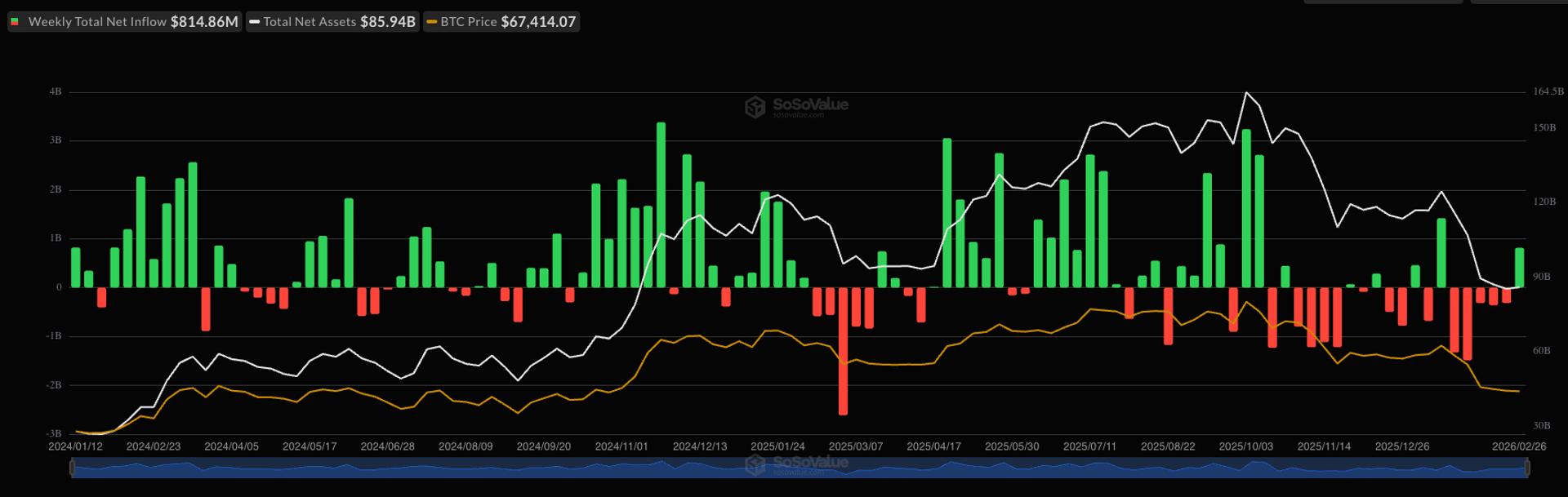
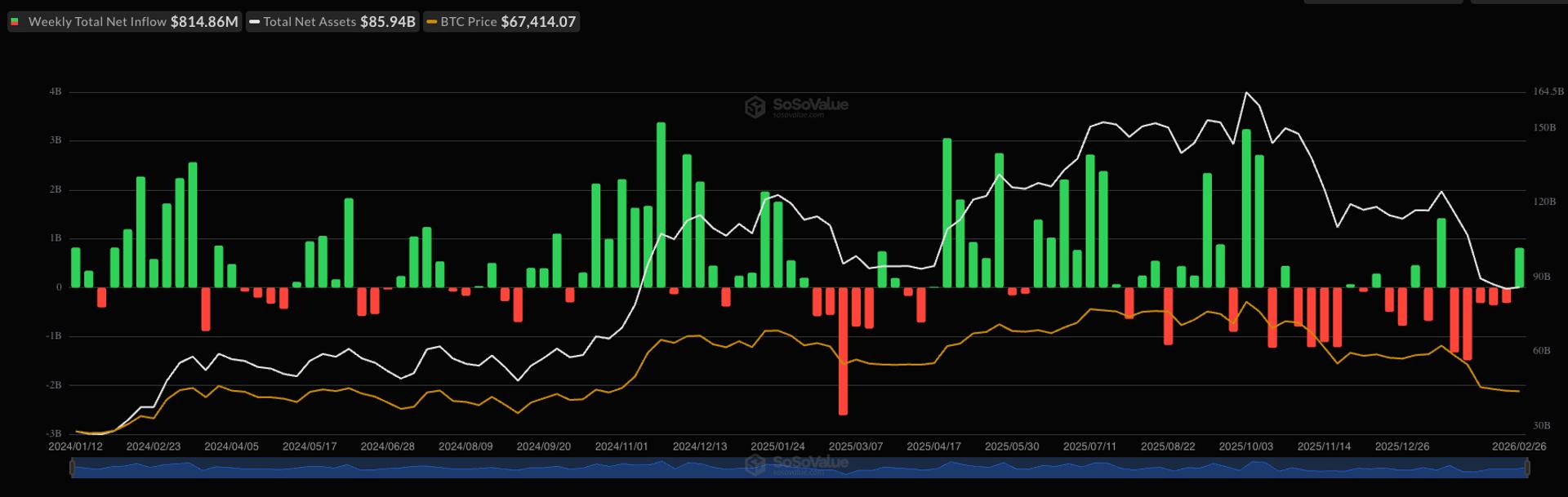
U.S. bitcoin exchange-traded funds (ETFs) are on track to snap a streak of five consecutive weeks of net outflows with their strongest performance since mid-January.
The funds recorded net inflows of $1.1 billion in three straight days, according to data from SoSoValue, leaving them roughly $815 million ahead after Monday’s net outflow is taken into account, the most since adding $1.4 billion in the week ended Jan. 16.
BlackRock’s iShares Bitcoin Trust (IBIT) accounted for more than half of the three-day flow, drawing in roughly $652 million. On Wednesday, Grayscale’s GBTC, which carries the highest fee among the funds, posted its largest single-day inflow since converting from a trust structure to an ETF.
The renewed inflows suggest U.S. demand is returning, an conclusion reinforced by the Coinbase Premium Index turning positive after 40 days in negative territory. The index tracks the price difference between bitcoin on Coinbase (COIN), which is accessible to firms in the world’s largest economy, and the broader global market. It is widely used as a gauge of U.S. institutional flows and sentiment.
Data from Checkonchain shows total bitcoin holdings across U.S. spot ETFs climbed to 1.29 million BTC, putting assets under management (AUM) less than 10% below their October peak.
This comes despite the spot price of bitcoin remaining 45% below its October record. The largest cryptocurrency has continued to consolidate around the mid $60,000 range this week.
Meanwhile, open interest on the Chicago Mercantile Exchange (CME) has continued to decline, falling to 107,780 BTC, according to Glassnode data. Because CME allows institutions to simultaneously take a long position in spot bitcoin and a short position in futures — a strategy known as a basis trade — the drop in futures can be seen as indicating the ETF inflows are outright long positions.

[PRESS RELEASE – Willemstad, Curaçao, February 27th, 2026]
Bookmaker & casino broker VOdds unveiled a new feature, Odds Scanner, a betting intelligence tool designed to compare bookmaker prices across multiple sports markets. The platform puts all the odds data in one place, so users don’t have to search for it manually, and so prices are easier to see. VOdds covers a wide range of sports, including football and other popular sports, and supports major events like the Premier League, Champions League, and World Cup. Vodds’ odds checker is an informational tool that focuses on speed, accuracy, and making it easy to compare markets.
Key Features of VOdds Scanner
According to the company, the VOdds scanner is made with precision, making complicated odds data in a simple, easy-to-read way. It is said that users can quickly find the right markets thanks to filters, sorting options, and easy-to-use navigation. In short words, the odds scanner is good for both new and experienced bettors, simply because it’s focused on the user.
Additionally, the VOdds scanner works in a lot of different sports betting markets, from football and basketball to less popular sports and other types of markets. This wide range of coverage lets people look at odds for different leagues, tournaments, and types of bets all in one place. The tool makes sure that data is always available, whether users are following big international events or smaller regional matches.
Odds Comparison
With the odds scanner by VOdds, users can compare prices for the same outcome from different bookmakers all in one place. This lets users find options with higher prices for the same event. For instance, VOdds might show different odds for a Premier League home win and highlight the best one that is available. This structured comparison strengthens the platform’s position as a best odds checker without any bias from advertising.
Real-Time Odds Collection
As a live odds checker, VOdds collects data from multiple bookmakers at the same time and updates prices in real time. This makes sure that people can get up-to-date market information during big events like the Champions League and the World Cup. Real-time updates lower the risk of using old prices and help Vodds users make smart decisions when using the odds checker.
Alerts and Trends
The VOdds platform keeps an eye on changes in odds and market trends. Users can set up alerts for big changes, like when odds drop, which could mean that the market is changing. These tools help users respond quickly and cut down on the need to constantly check the odds scanner by Vodds.
Sports Coverage
Undoubtedly, VOdds has a lot of sports markets, so bettors can see the odds for all the big global competitions in one place. The odds checker on the platform is set up so that the data is always shown in the same way for all sports. This makes it easy to move between markets without losing clarity or accuracy.
Football Odds Checker
VOdds’s football odds checker covers a lot of football, including both domestic leagues and international tournaments. Users can bet on the Premier League, Champions League, and World Cup, among other competitions, using the same odds checker framework. These markets include 1X2, handicaps, and totals.
Tennis Odds Checker
VOdds’s tennis odds checker covers the ATP and WTA tours, Grand Slams, and Challenger events. Vodds’ odds scanner lets users compare match winners, set handicaps, and game totals, and it sends updates in real time.
Basketball Odds Checker
VOdds also lets users bet on basketball games, like the NBA and EuroLeague. The odds checker app shows bet types like moneylines, spreads, and totals in a standard way, which makes it easier to compare them.
How to Start Using the Best Odds Checker by VOdds
Users first sign up for the VOdds platform and then use the odds checker by Vodds from the dashboard. Users can choose which events to see by sport, competition, and market type using filters. This process makes it easy for Vodds to get to the odds scanner.
“We wanted to make a tool that gives bettors clear access to real-time market data without making things too complicated,” Zak Richardson, VOdds spokesperson. The platform makes it easier for users to find good deals on major sporting events by bringing together all the prices from different bookmakers and updating them right away.
Benefits of Using Odds Scanner by VOdds
VOdds points out some important functional benefits, such as:
- Finding the Best Odds: Centralised comparison makes it easier to see the best prices for events like Champions League matches because users don’t have to check multiple bookmakers by hand.
- Making Strategies Work Better: Real-time updates help users quickly react to changes in the market and find arbitrage opportunities with Vodds’ odds scanner.
- Supporting Bigger Bets: Users can better judge markets before placing bigger bets when they can see liquidity and price stability.
How to Use the VOdds Odds Checker
According to VOdds, the main purpose of the VOdds Odds Checker is to compare bookmaker odds in real time so players always place bets at the most profitable price.
For example, users want to bet on Manchester City to win:
- Bookmaker A: 1.72
- Bookmaker B: 1.80
- Bookmaker C: 1.75
VOdds instantly highlights 1.80 as the best available price.
About VOdds
VOdds is a crypto gambling site where people can place bets with cryptocurrency and use a set of data-driven betting tools. VOdds wants to make sports betting more open, efficient, and available to people all over the world by combining digital asset payments with advanced analytics. By collecting and displaying bookmaker data in a clear, easy-to-use way, the platform helps bettors compare prices across different markets, which helps open up the market. VOdds helps users find value opportunities, compare odds in real time, and make better betting decisions while fully participating in the crypto betting ecosystem. It does this with its own odds checker tools.
For more information about the company, users can visit VOdds website or reach out to their contact info below.
Binance Free $600 (CryptoPotato Exclusive): Use this link to register a new account and receive $600 exclusive welcome offer on Binance (full details).
LIMITED OFFER for CryptoPotato readers at Bybit: Use this link to register and open a $500 FREE position on any coin!
Crypto World
Hedera price eyes bullish crossover as stablecoin activity fires up, will it break out?
Hedera price rallied over 8% this week amid a notable jump in the stablecoin supply held on the network.
Summary
- Hedera price rebounded 8% this week amid an uptick in network activity.
- HBAR price action is close to confirming a bullish crossover on the daily chart.
According to data from crypto.news, Hedera (HBAR) price rallied 8.7% over this week amid a broader crypto market rebound largely fueled by Bitcoin reclaiming key support levels and improved investor appetite for risk assets amid a surge in tech stocks.
The token’s rally also gained support from a jump in stablecoin supply held on the network. Data from DeFiLlama show that its stablecoin supply has surged nearly 17% over the past seven days, driven largely by USDC, which accounts for about 99.8% of the total supply.
A surge in stablecoin means more users are transacting, deploying capital, or seeking yield on the network. Such activities tend to support retail sentiment.
Demand from derivative traders also provided an impetus to HBAR’s rally. Notably, Hedera futures open interest has increased by 3% in the past 24 hours, while its weighted funding rate has also turned positive.
A positive funding rate means more traders are entering the market with bullish bets, which in turn is improving overall market sentiment.
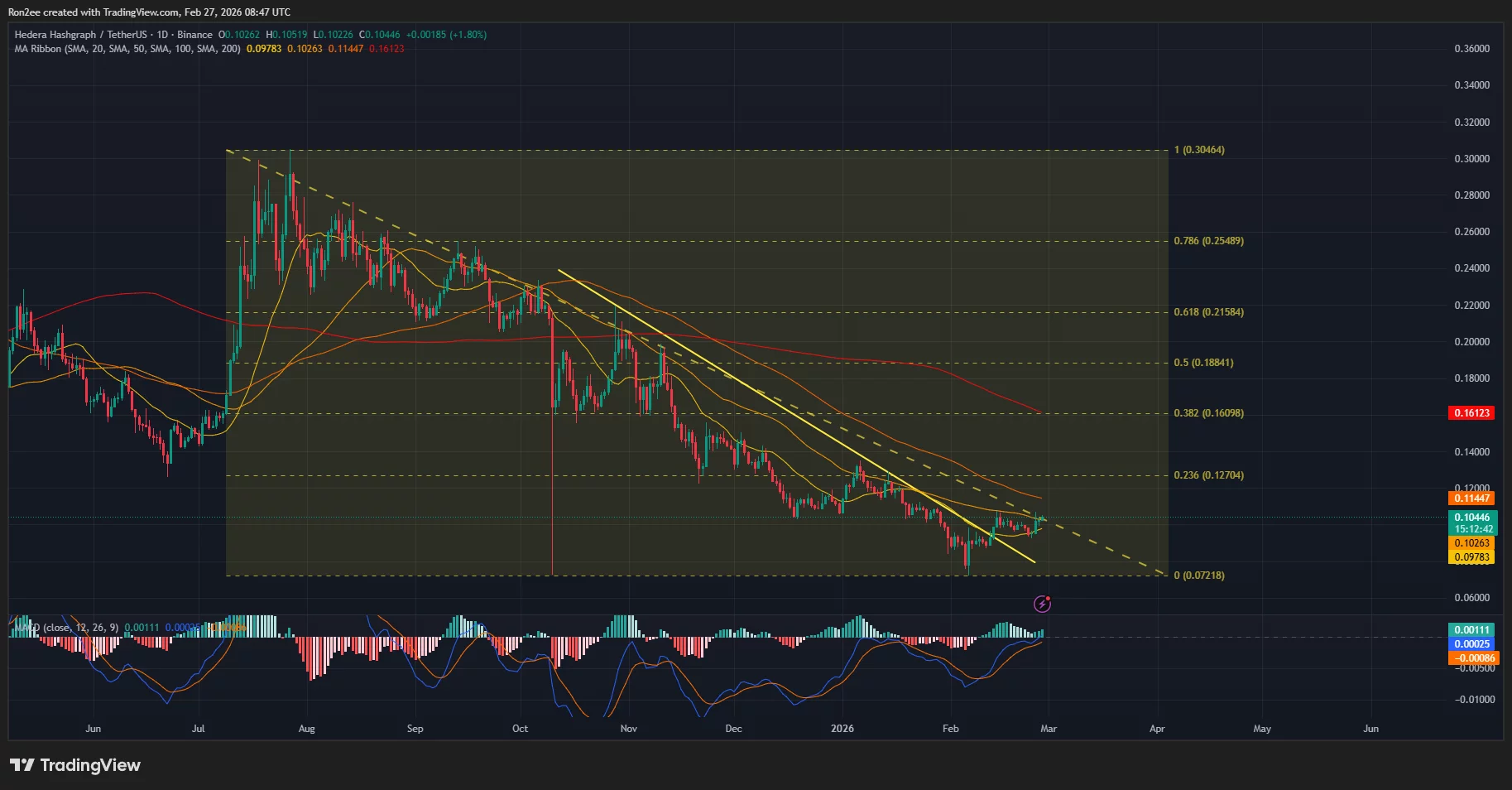
On the daily chart, Hedera price has broken above a descending trendline that had been acting as a dynamic resistance, capping price movement since late October last year. When an asset breaks out of such a descending trendline resistance, it is typically a sign of a trend reversal, with dominance shifting to the hands of bulls.
The 20-day SMA appears close to moving above the 50-day SMA, forming what traders term a short-term bullish crossover. When such crossovers are confirmed, cryptocurrencies have often sparked sharp rallies.
Adding to the bullish outlook, the MACD lines have also pointed upwards and are close to moving above the zero line.
Hence, the price outlook for Hedera appears to be bullish for now, with the token most likely to target $0.12 next, which aligns with the 23.6% Fibonacci retracement level.
On the contrary, if bears can push the price below the 20-day SMA of $0.097, Hedera could enter a downtrend.
However, the lackluster demand for Hedera spot ETFs could become a bottleneck for any upside move, especially since other assets like XRP and Solana ETFs have continued to outpace HBAR in both net daily inflows and total assets under management (AUM).
Disclosure: This article does not represent investment advice. The content and materials featured on this page are for educational purposes only.
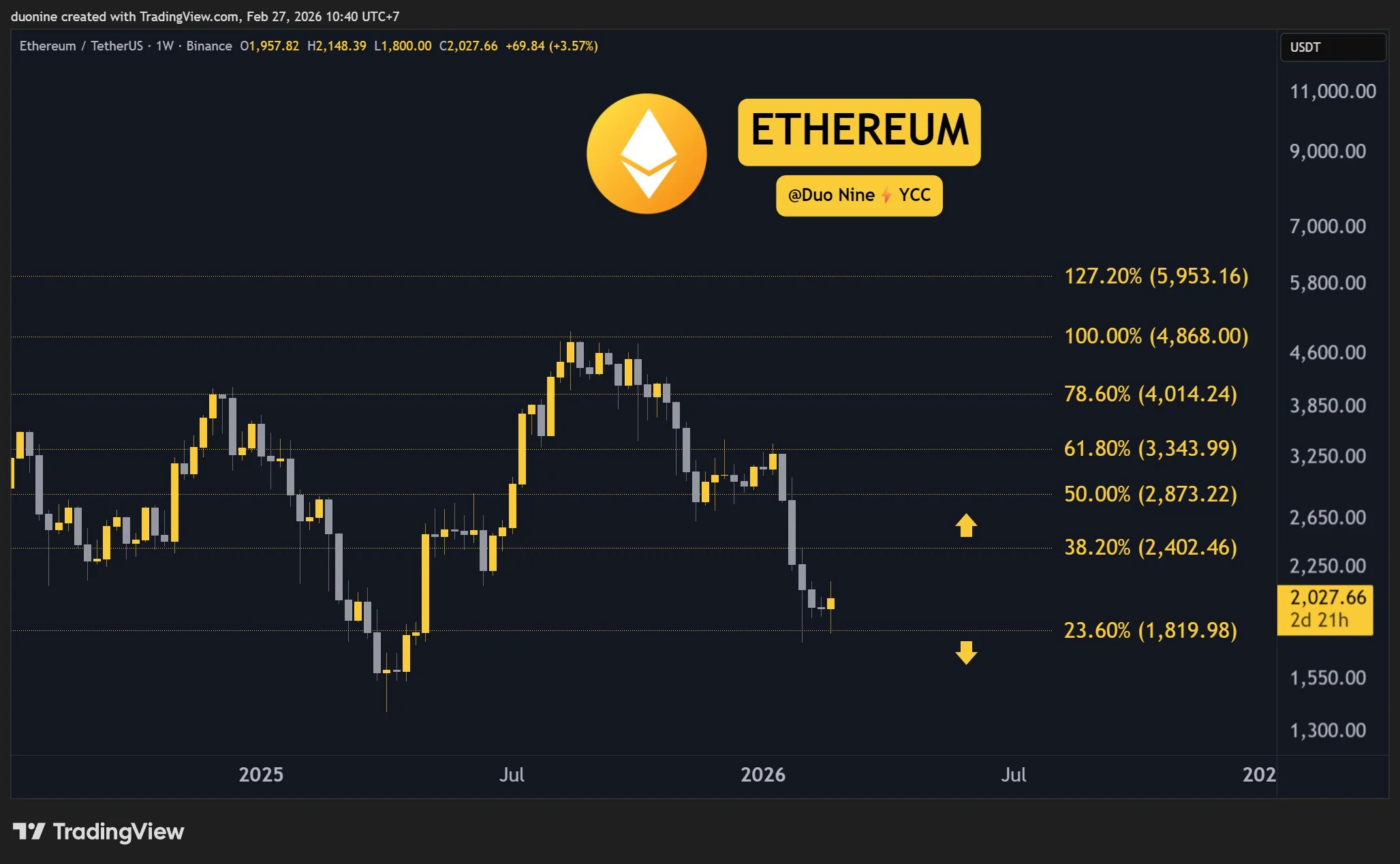
This Friday, we examine Ethereum, Ripple, Cardano, Binance Coin, and Hyperliquid in greater detail.
Ethereum (ETH)
After weeks of bearish price action, Ethereum has finally found support at the $1,800 level, where buyers have shown interest. This allowed ETH to close the week 5% higher, reaching $2,000, which is currently being contested.
If the bulls manage to hold the price above $2,000 and turn this level into a key support, then the cryptocurrency has a good shot at moving much higher and towards $2,400, which is the next resistance on the chart.
Looking ahead, ETH may be entering a relief rally that could take it as high as $2,800. Once there, sellers could step up the pressure again.

Ripple (XRP)
XRP has been flat over the past week and has not made any gains. Nevertheless, there are signs the price wants to move higher since sellers have failed to make lower lows.
This pause in price action could be interpreted as bullish because sellers have lost the initiative, which opens the door for buyers to return and push XRP to the next key level at $1.6. This becomes likely if the current support at $1.4 continues to hold.
Looking ahead, a bounce higher can be expected, but sellers could return at $1.6. Only if that level is broken can bulls hope to reclaim $2 or higher.

Cardano (ADA)
ADA had a good week, closing with a 7% gain. This is the first time in months that ADA is managing to look bullish after a prolonged correction. To consolidate the current gains, buyers will have to push this cryptocurrency above 30 cents, which acts as a resistance.
If 30 cents falls, then the next key target will be found at 36 cents, which is likely to be defended by sellers quite aggressively based on the past price action.
Looking ahead, Cardano may be forming a bottom here, which would be in line with the past. If so, this is an attractive area for buyers, especially since this downtrend lasted for over a year and a reversal is overdue.

Binance Coin (BNB)
Binance Coin closed the week 4% higher and found strong support around $600. It seems sellers ran out of steam and were unable to break lower and hold the price there. Because of this a bounce here is likely.
Should buyers become more active in the days to come, their first target is found at $690. If that level is reclaimed, then they will look at $900 next.
Looking ahead, BNB wants to recover some of the recent losses, and considering most altcoins are turning bullish, it would not be surprising to see this cryptocurrency also make steady gains in the coming days and weeks.

Hype (HYPE)
HYPE is flat on the weekly chart and is trying to return above $30. So far, buyers will need at least one more push to be successful, but sellers may be waiting for that move before they return.
With momentum building up behind bulls across the market, HYPE has a good shot at a breakout beyond $30, especially if the recent test of the $26 support is confirmed as a higher low.
Looking ahead, HYPE has a real chance to rally if the $30 is turned into support. Watch the price action in the next few days, as it will be decisive to where this cryptocurrency goes next.

Binance Free $600 (CryptoPotato Exclusive): Use this link to register a new account and receive $600 exclusive welcome offer on Binance (full details).
LIMITED OFFER for CryptoPotato readers at Bybit: Use this link to register and open a $500 FREE position on any coin!
Disclaimer: Information found on CryptoPotato is those of writers quoted. It does not represent the opinions of CryptoPotato on whether to buy, sell, or hold any investments. You are advised to conduct your own research before making any investment decisions. Use provided information at your own risk. See Disclaimer for more information.

In its latest quarterly update, MARA Holdings confronted a stark reality: even as its bitcoin mining fleet generated fewer coins, the company’s balance sheet was weighed down by falling crypto valuations and a strategic pivot away from pure mining. MARA reported a fourth-quarter 2025 net loss of $1.71 billion, or $4.52 per diluted share, compared with a year-earlier net income of $528.3 million. Revenue slipped 6% year over year to $202.3 million, as a softer Bitcoin (CRYPTO: BTC) price offset a higher hashrate. For the full year, the firm posted a net loss of $1.31 billion on revenue of $907.1 million, reversing 2024’s $541 million profit.
Key takeaways
- MARA’s Q4 2025 net loss was $1.71 billion and revenue was $202.3 million, with earnings pressured by the decline in BTC prices despite a higher mining hashrate.
- For the full year 2025, the company recorded a net loss of $1.31 billion on $907.1 million in revenue, reversing 2024’s profit as crypto prices remained volatile.
- A $1.5 billion negative adjustment to the fair value of digital assets and receivables contributed to the quarterly loss, reflecting BTC price declines from around $114,300 on Sept. 30 to $88,800 on Dec. 31 (per CoinGecko).
- MAR A’s BTC holdings at year-end totaled 53,822, with 15,315 pledged or loaned, and the balance-sheet BTC carried a roughly $4.7 billion value at quarter-end prices.
- The company unveiled a strategic pivot into AI and high-performance compute, including a joint venture with Starwood Digital Ventures to build data centers at power-rich sites, initially targeting more than 1 GW of IT capacity and potentially expanding to 2.5 GW.
- In February, MARA acquired a 64% stake in Exaion to pursue sovereign-grade and enterprise AI deployments as part of the broader diversification plan.
Tickers mentioned: $BTC, $MARA
Sentiment: Bearish
Price impact: Negative. MARA’s stock has fallen about 46% over the past six months as results and strategic pivots weigh on investor sentiment.
Trading idea (Not Financial Advice): Hold. While the transition toward AI/HPC is notable, near-term investors should watch project execution and BTC price stability before reassessing risk/reward.
Market context: The results come amid a broader crypto downturn where mining economics remain sensitive to BTC price swings, regulator signals, and capital allocation shifts among miners pursuing diversified revenue streams rather than pure hodling or mining.
Why it matters
The quarterly and annual figures underscore a pivotal moment for MARA as it moves beyond a pure-play bitcoin miner toward an energy and digital infrastructure company. The heavy accounting hit from the fair value of digital assets illustrates how price volatility can disproportionately affect mining-focused models, even when production levels hold steady or improve. By contrast, the balance sheet remains robust in crypto terms, with a substantial BTC stash that, on paper, still carries significant value given the ongoing, albeit uneven, interest in asset-backed mining operations.
Beyond the numbers, the strategic pivot is the centerpiece. MARA’s collaboration with Starwood Digital Ventures aims to unlock a significant AI/HPC footprint on existing energy-rich sites, a move that could open new revenue channels independent of BTC cycles. The plan envisions more than 1 gigawatt of IT capacity in the initial phase, with a roadmap to exceed 2.5 GW over time. Crucially, MARA retains the option to invest up to 50% in individual projects, while continuing to mine where power remains economical. This hybrid model reflects a broader industry trend: miners seeking to hedge against crypto price volatility by anchoring operations in data centers and AI workloads that can generate steady, long-term demand.
Additionally, the February acquisition of a 64% stake in Exaion signals a concrete push into AI deployments that could leverage MARA’s grid-scale energy footprint. Exaion’s focus on sovereign-grade and enterprise AI deployments aligns with the growing demand for specialized compute resources, particularly at the intersection of crypto mining infrastructure and high-performance compute networks. As more miners explore blended business models, MARA’s approach stands out for attempting to formalize AI-centric data center capacity alongside mining operations.
In comparison, peers are testing similar pivots with varying degrees of commitment. Some miners are leaning into large AI data-center leases, while others continue to emphasize a combined strategy of mining and hoarding BTC to preserve, and potentially grow, crypto exposure. The sector’s direction remains dependent on macro conditions, including BTC price trajectories, energy costs, and regulatory developments that could influence the economics of large-scale mining and data-center deployments alike.
The financials also hint at the balancing act between growth investments and shareholder value. If the Starwood joint venture and Exaion initiatives deliver on capacity and utilization, MARA could unlock a multi-year path toward diversified cash flows. Yet the immediate picture is clouded by historical volatility in the crypto markets and the challenge of turning large capex programs into near-term profits. Investors will be watching how the company manages capital deployment, debt, and any potential tranche financing to accelerate its AI/HPC push while supporting ongoing mining operations.
The company’s overall strategy, while ambitious, mirrors a broader move within the crypto hardware space toward building resilient, diversified platforms. As data centers become a more common anchor for crypto firms, MARA’s ability to translate capacity into meaningful revenue streams will be a key test for the model’s sustainability in a market where price signals for BTC remain bifurcated and often unpredictable.
What to watch next
- Progress updates on the Starwood Digital Ventures AI/HPC data-center partnership, including projected milestones for the initial >1 GW capacity and any expansions toward 2.5 GW.
- Operational and financial details on Exaion deployments and contracts, particularly any sovereign-grade AI projects and enterprise compute commitments.
- Bitcoin price movements and realized/batched mining yields as MARA advances its hybrid strategy, plus any changes to the company’s balance-sheet BTC position or collateral arrangements.
- Any capital-raising efforts, debt restructurings, or financing agreements tied to the new AI/HPC initiatives and data-center builds.
- Regulatory developments affecting crypto mining, energy use, and AI infrastructure deployments that could impact project economics or timelines.
Sources & verification
- MARA Holdings Q4 2025 shareholder letter filed with the SEC (SEC: q425shareholderletter.htm).
- Bitcoin price data used for the fair value discussion (CoinGecko: bitcoin).
- Company updates and stock performance coverage (Yahoo Finance: MARA).
- Exaion stake and AI/HPC deployments referenced in MARA communications (Cointelegraph article on Exaion stake).
Key figures and next steps
What the announcement changes
The fourth quarter reports reveal a company navigating a difficult macro environment for mining while actively pursuing a structural shift toward AI-enabled data centers. If successful, the Starwood JV and Exaion partnerships could provide MARA with nonmining revenue streams that weather BTC price cycles. The path forward will hinge on project execution, the pace of capacity buildup, and the ability to translate compute demand into sustained profitability.
Sources & verification
- SEC filing: q425shareholderletter.htm
- CoinGecko data: bitcoin
- Yahoo Finance: MARA
- Exaion stake coverage: Cointelegraph

Federal judge clears Trump White House ballroom construction project

Suspected Insider Wallets Net $1.2M Betting on ZachXBT’s Axiom Expose

The Traitors Season 4 Finalists Break Down That Savage Finale (Excl)


-

 Politics5 days ago
Baftas 2026: Awards Nominations, Presenters And Performers
-

 Fashion7 days ago
Weekend Open Thread: Boden – Corporette.com
-

 Sports4 days ago
Women’s college basketball rankings: Iowa reenters top 10, Auriemma makes history
-

 Politics4 days ago
Nick Reiner Enters Plea In Deaths Of Parents Rob And Michele
-

 Business3 days ago
True Citrus debuts functional drink mix collection
-

 Politics10 hours ago
ITV enters Gaza with IDF amid ongoing genocide
-

 Crypto World3 days ago
XRP price enters “dead zone” as Binance leverage hits lows
-

 Business5 days ago
Mattel’s American Girl brand turns 40, dolls enter a new era
-

 Business5 days ago
Law enforcement kills armed man seeking to enter Trump’s Mar-a-Lago resort, officials say
-

 Tech3 days ago
Unsurprisingly, Apple's board gets what it wants in 2026 shareholder meeting
-
 NewsBeat1 day ago
Manchester Central Mosque issues statement as it imposes new measures ‘with immediate effect’ after armed men enter
-

 NewsBeat1 day ago
Cuba says its forces have killed four on US-registered speedboat | World News
-
 NewsBeat4 days ago
‘Hourly’ method from gastroenterologist ‘helps reduce air travel bloating’
-

 Tech5 days ago
Anthropic-Backed Group Enters NY-12 AI PAC Fight
-

 NewsBeat5 days ago
Armed man killed after entering secure perimeter of Mar-a-Lago, Secret Service says
-

 Politics5 days ago
Maine has a long track record of electing moderates. Enter Graham Platner.
-
 NewsBeat3 days ago
Police latest as search for missing woman enters day nine
-

 Business1 day ago
Discord Pushes Implementation of Global Age Checks to Second Half of 2026
-

 Crypto World3 days ago
Entering new markets without increasing payment costs
-

 Business14 hours ago
Only 4% of women globally reside in countries that offer almost complete legal equality