
Crypto World
Gold Takes the Lead as Dollar Slides, BTC Recast as Companion

Bitcoin (BTC) has long been promoted by its most ardent supporters as a hedge against monetary debasement, but as the US dollar slides to multi-year lows, the market’s clearest flight to safety is emerging elsewhere: in gold.
Over the past year, investors have rediscovered the precious metal through both traditional channels and blockchain rails. Tokenized gold products like XAUt are gaining traction alongside spot prices, offering digital-native exposure to a centuries-old safe haven as inflation concerns and currency stress intensify.
Bitcoin is still very much in the picture, though increasingly as a secondary beneficiary. Actively managed exchange-traded funds (ETFs) are pairing BTC with gold as complementary defenses against fiat erosion, positioning Bitcoin less as a proven hedge and more as a higher-volatility companion to hard assets.
This week’s Crypto Biz traces that shift, from tokenized bullion and hybrid ETFs to Wall Street’s growing embrace of stablecoins and crypto banking charters. In periods of currency stress, gold still leads. Crypto is learning how to follow.
Tokenized gold surges as dollar hits four-year low
It’s not just traditional investors piling into gold. Digital asset investors are increasingly turning to tokenized versions of the precious metal as the US dollar weakens and concerns over currency debasement and inflation intensify.
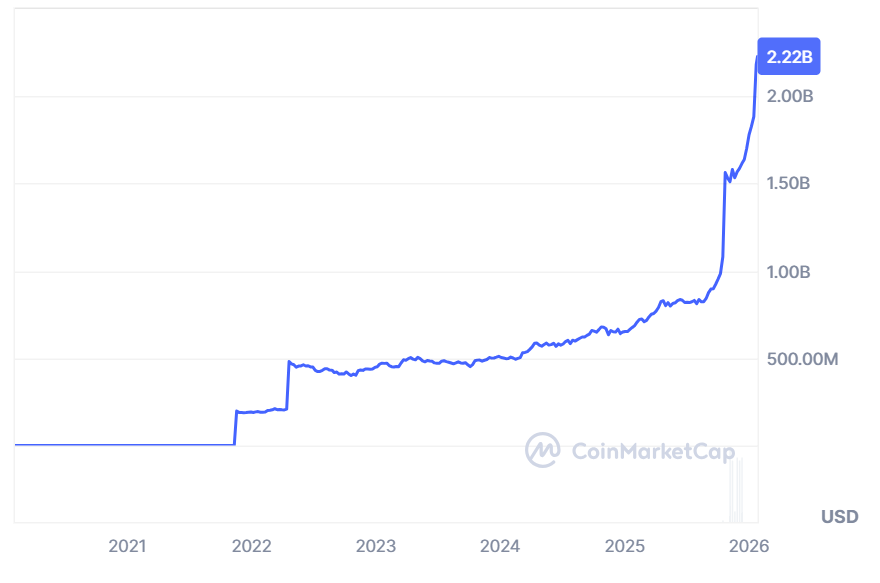
Tether said its gold-backed stablecoin, Tether Gold (XAUt), now accounts for more than half of the tokenized gold market, with a total market value of more than $2.2 billion. As of the end of the fourth quarter, 520,089 XAUt tokens were in circulation, each backed one-to-one by physical gold bullion, according to the company.
The surge in demand comes as gold prices climbed above $5,300 per troy ounce, up about 90% over the past year, while the US dollar continues to erode. Bloomberg’s spot US dollar index recently fell to its lowest level in four years.

Bitwise pairs Bitcoin and gold in actively managed ETF
Asset manager Bitwise has launched a new ETF designed to protect investors from currency debasement by pairing Bitcoin with gold and other precious metals.
The Bitwise Proficio Currency Debasement ETF debuted on the New York Stock Exchange under the ticker BPRO. The actively managed fund is designed to hedge against the declining purchasing power of the US dollar and other fiat currencies.
The portfolio includes exposure to Bitcoin, precious metals and mining stocks and is designed for wealth managers seeking Bitcoin exposure without directly allocating to a crypto-specific product.

Fidelity unveils US dollar stablecoin
Fidelity is gearing up to launch its own dollar-pegged stablecoin as it pushes deeper into the regulated digital finance space.
Called the Fidelity Digital Dollar (FIDD), the upcoming stablecoin is expected to align with the GENIUS Act’s federal standards for payments-focused digital dollars, including reserve backing and oversight requirements. Fidelity executives have pitched stablecoins as foundational for real-time settlement and 24/7 payment infrastructure, signaling a shift toward mainstream use beyond trading.
The initiative comes as traditional finance heavyweights explore blockchain rails and regulators craft clearer rules for US stablecoins, marking another step in institutional adoption of crypto-native settlement systems.

Nomura-backed digital asset company eyes US banking charter
Laser Digital, a Nomura-backed digital asset company, has reportedly applied for a US national bank trust charter with the Office of the Comptroller of the Currency, marking a major push to bring crypto services into the US-regulated banking framework.
If approved, the charter would let Laser Digital operate nationwide under a single federal license, bypassing state-by-state custody requirements, and offering spot trading for digital assets without taking customer deposits.
The move comes amid a broader surge in crypto charter applications in a more permissive US regulatory climate, with several digital asset companies eyeing federal trust bank status to deepen integration with traditional finance.
Crypto Biz is your weekly pulse on the business behind blockchain and crypto, delivered directly to your inbox every Thursday.


Binance co-founder Changpeng “CZ” Zhao shared a long-range optimism for crypto and blockchain, arguing they will become an invisible layer of everyday infrastructure by 2031. In a recent appearance on Scott Melker’s Wolf of All Streets podcast, Zhao said that while new use cases will continue to emerge, the technology should fade from the conversation as it becomes ubiquitous in daily life. “I’m hoping that we don’t talk about crypto as crypto in five years, just like we don’t talk about the internet anymore,” he said, adding that in five years he expects to be using crypto rather than discussing the technology itself.
Beyond his own timeline, Zhao tied the future of crypto to broader adoption trends, AI-driven acceleration, and national policy choices. The discussion touched on a cascade of forecasts from research firms and industry figures that paint a picture of a rapidly expanding ecosystem where stablecoins, tokenization, and AI-enabled tooling could reshape how finance and data markets operate.
Key takeaways
- Long-run vision: CZ envisions a future where crypto is ubiquitous and no longer discussed as a separate technology, much like the everyday use of the internet.
- Growing adoption and outsized market forecasts: DemandSage cites hundreds of millions of crypto users by the end of the decade, while ARK Invest and others project multi-trillion-dollar outcomes for digital assets in the 2030s.
- Stablecoins and tokenization on the path to scale: Chainalysis and Citi highlight potential surges in stablecoin volumes and cross-border/tokenized post-trade activity amid a broader shift in market infrastructure.
- AI as a catalyst for development: Zhao sees AI accelerating blockchain development and adoption, with crypto playing a key role in AI-enabled ecosystems.
- Policy and geography as competitive levers: Switzerland’s crypto-friendly stance and UAE’s AI-led adoption, alongside US leadership in AI infrastructure, frame a fragmented but converging global landscape.
The optimistic trajectory: 2030 and beyond
The interview sits within a chorus of expectations about crypto’s role in the global economy. DemandSage estimates that 559 million people worldwide will be using crypto in 2026, suggesting a broad base of participants that could fuel further institutional interest and product innovation. Meanwhile, Ark Invest has painted a bold future: a January report argues digital assets could grow into a $28 trillion market by 2030, underscoring a view that the asset class may reach a scale comparable to major financial sectors today.
Other voices add to the optimism. Reeve Collins, co-founder of Tether, has suggested a future where stablecoins become a standard medium of exchange and possibly even a foundation for most currencies by 2030. In parallel, Chainalysis has estimated that stablecoin volumes could reach as much as $1.5 quadrillion by 2035, illustrating a potential trajectory for on-chain liquidity and cross-border settlement. A Citi survey of banks and asset managers last September found that a significant share expect about one-tenth of the global post-trade market turnover to be settled in stablecoins and tokenized securities within five years, signaling a shift in how markets operate at scale.
For investors, these forecasts translate into upside potential across a spectrum of players—from wallet providers and exchanges to tokenization platforms and custodians. Yet they also raise questions about how quickly infrastructure, regulatory clarity, and off-chain data networks can keep pace with a demand signal that is already being built now.
AI as a speed supersonic for blockchain
Beyond macro adoption, Zhao highlighted AI as a key accelerant for blockchain development. He argued that the speed at which developers can write code and deploynew features will accelerate as AI agents become more integrated with crypto tooling. He has previously urged the crypto community to emphasize utility over token incentives, a stance he reiterated as AI-driven capabilities begin to reshape development cycles and product timelines.
The notion that AI could turbocharge blockchain aligns with broader industry observations. A March discussion around AI agent-enabled tokens touched on the tension between rapid innovation and meaningful utility. If AI-assisted approaches can lower friction in building decentralized applications and automating complex on-chain tasks, the resulting productivity gains could help scale networks and improve user experiences at a pace that outstrips traditional software development cycles.
Geopolitics, adoption climates, and who leads the pack
As adoption widens, the geographic and regulatory landscape remains diverse. Signzy ranked Switzerland as the most crypto-friendly country in a January evaluation, while Arkham highlighted Switzerland as a top innovating jurisdiction. The country’s regulatory posture and ecosystem maturity have been cited as favorable for early-stage and mature crypto projects alike, reinforcing the view that policy environments will matter as much as technology in determining which regions become crypto hubs.
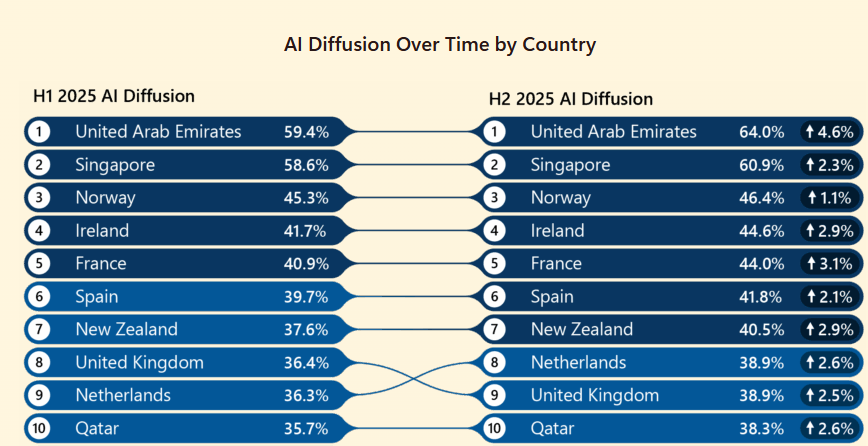
Separately, a Microsoft AI report placed the United States at the forefront of AI infrastructure and frontier model development. Yet the study also noted that usage and practical deployment can lag behind in some regions; it singled out the United Arab Emirates as a standout in actual AI usage, underscoring how digitized, resource-rich economies can leapfrog into higher productivity with AI-enabled capabilities. The broader takeaway: national strategy and industrial policy around AI and blockchain will significantly influence who wins in a fast-evolving tech stack.
Industry observers are watching how these dynamics intersect with crypto’s evolution. The United Arab Emirates’ leadership in AI deployment and Switzerland’s crypto-friendly climate illustrate two distinct but complementary paths toward broader adoption: one anchored in public-facing, consumer-ready digital economies and the other in a regulated, institutional-friendly environment that can attract liquidity and innovation. Investors and builders will be looking for policy clarity, interoperability standards, and scalable on-ramp/off-ramp options as barriers to entry continue to shrink in many markets.
As Zhao’s long horizon suggests, the next phase of crypto’s story may be less about headlines and more about the practical integration of crypto rails into everyday infrastructure. With demand signals pointing toward substantial growth and institutional interest likely to intensify, the outcomes will depend on how quickly ecosystems can deliver secure, compliant, and user-friendly experiences at scale.
What remains uncertain, and what readers should watch next, is how quickly policymakers harmonize global standards around stablecoins, tokenized assets, and on-chain data governance; how commercial and technical ecosystems onboard mainstream users; and how AI-enabled tooling will shape the pace and direction of development across different jurisdictions. The coming years will reveal whether the industry can translate these optimistic forecasts into durable, real-world infrastructure that supports real economic activity.

Key Highlights
- SpaceX recorded a deficit approaching $5 billion during 2025, per The Information’s reporting
- Annual sales exceeded $18.5 billion throughout the year
- The deficit encompasses xAI, the AI venture from Elon Musk that SpaceX purchased in February 2025
- The aerospace company submitted confidential IPO documents in March 2026
- SpaceX aims for a public market valuation exceeding $1.75 trillion
Elon Musk’s aerospace venture SpaceX recorded a deficit approaching $5 billion throughout 2025, based on reporting from The Information, which cited individuals with knowledge of the financial data. Reuters was unable to independently confirm these numbers, and SpaceX declined to provide commentary.
The aerospace firm generated sales surpassing $18.5 billion throughout 2025. This represents an increase compared to the $15 billion to $16 billion in sales documented during the previous year, a period when the company logged approximately $8 billion in earnings.
The transition from profitability to deficit marks a dramatic financial shift. During 2024, SpaceX maintained robust earnings performance. The 2025 financial picture presents a contrasting narrative.
A primary driver behind the deficit involves SpaceX’s purchase of xAI, Elon Musk’s artificial intelligence company. The transaction concluded in February 2025, and xAI’s financial performance is now consolidated within SpaceX’s comprehensive results.
xAI was established by Musk during 2023. The company develops the Grok AI conversational platform. Integrating a venture of this magnitude into SpaceX’s accounting would inevitably impact profitability metrics.
SpaceX currently ranks as the planet’s most prolific launch services provider. The firm operates both Falcon 9 and Falcon Heavy launch vehicles, while advancing development of the Starship platform designed for deep-space exploration.
The organization has articulated objectives to enable interplanetary transportation. Additionally, it has revealed intentions to construct and operate artificial intelligence computing facilities in orbital space.
IPO Plans Target Historic $1.75 Trillion Market Cap
SpaceX submitted confidential paperwork for a U.S. public market debut in March 2026. The company seeks a market capitalization surpassing $1.75 trillion should it move forward with the share offering.
This would position it among the most substantial initial public offerings ever recorded if the listing proceeds at that valuation level. No specific timeline for the public market debut has been announced.
Sales Expansion Continues Despite Financial Loss
Notwithstanding the net deficit, sales figures expanded on an annual basis. The $18.5 billion total for 2025 compares positively against the $15 billion to $16 billion documented during 2024.
This revenue expansion demonstrates the underlying business operations are growing. Starlink, SpaceX’s orbital internet connectivity platform, has served as a significant contributor to that revenue stream.
SpaceX maintains tens of millions of Starlink customers worldwide. The network functions throughout more than 100 nations and persistently expands its user base.
The firm’s launch services division maintains robust activity levels. SpaceX executes more orbital missions than any competing commercial entity or governmental space agency globally.
The 2025 deficit primarily stems from the xAI purchase rather than challenges within the core launch and satellite divisions. The Information’s analysis did not separate xAI’s specific impact on the aggregate loss calculation.
SpaceX submitted its IPO documentation under confidential filing procedures, indicating complete financial disclosures have not yet been released through an official public prospectus.

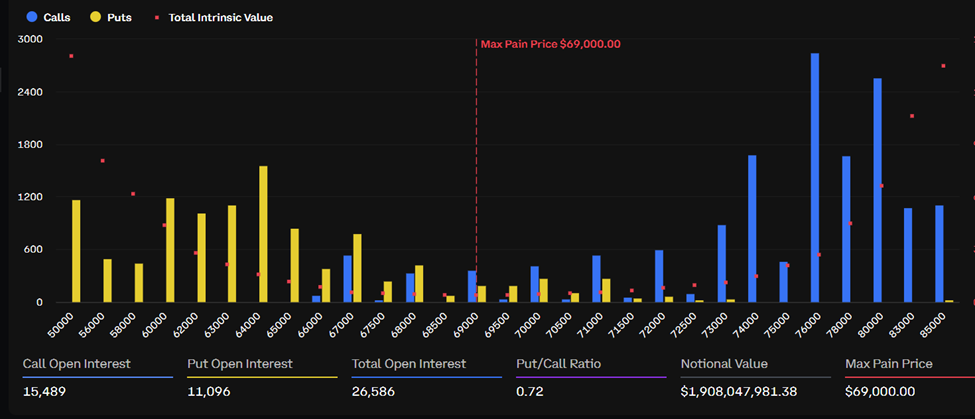
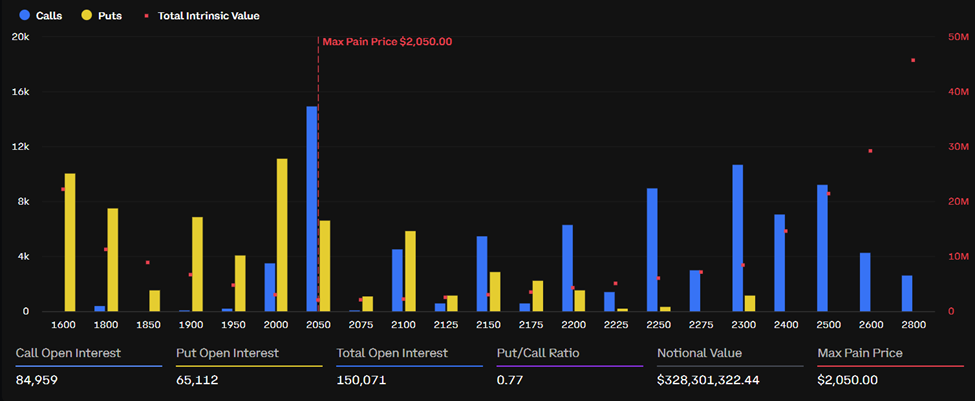
Around 26,700 Bitcoin (BTC) options contracts expire on Friday, April 10, carrying a notional value of roughly $1.9 billion. Another 151,500 Ethereum (ETH) contracts also settle today, worth approximately $332 million.
The combined expiry adds up to over $2.2 billion. However, the event is relatively small compared to the record $27 billion quarterly settlement in late 2025 and is unlikely to move spot prices on its own.
BTC Options Show Renewed Optimism Above $70,000
This week’s batch of BTC contracts has a put/call ratio of 0.71, indicating more bullish long positions than bearish shorts. Max pain sits around $69,000, according to Deribit, well below the current spot price near $71,759.
Open interest remains highest at the $80,000 strike on Deribit, with $1.6 billion in bullish bets now dominant.
Total BTC options open interest across all exchanges has pulled back to $34 billion following the end of the Q1 expiry cycle.
Traders responded to this week’s rebound by buying short-term call options and rolling put positions to higher strike prices. That repositioning reflects a more constructive outlook following BTC’s recovery above $70,000.
“Judging by key options indicators, the rebound above $70,000 has clearly boosted market sentiment, primarily by alleviating fears of a black swan-induced crash, rather than reflecting expectations of sustained price gains,” wrote analysts at Greeks.live.
ETH Derivatives Flash Rare Bullish Signal
On the Ethereum side, max pain sits at $2,050 with a put/call ratio of 0.77. Total ETH options open interest across exchanges stands near $6.6 billion.
Beyond the expiry itself, CryptoQuant analyst Darkfost flagged a recovery signal in ETH derivatives. The Taker Buy Sell Ratio on Binance has moved back into positive territory, with a monthly average around 1.016. The metric has held above 1 for several consecutive days.
This reading has not appeared since 2023. Binance accounts for over 37% of total ETH open interest, making it a key venue for reading futures positioning.
A ratio above 1 means aggressive buy orders outpace sells, signaling buyer dominance on perpetual contracts.
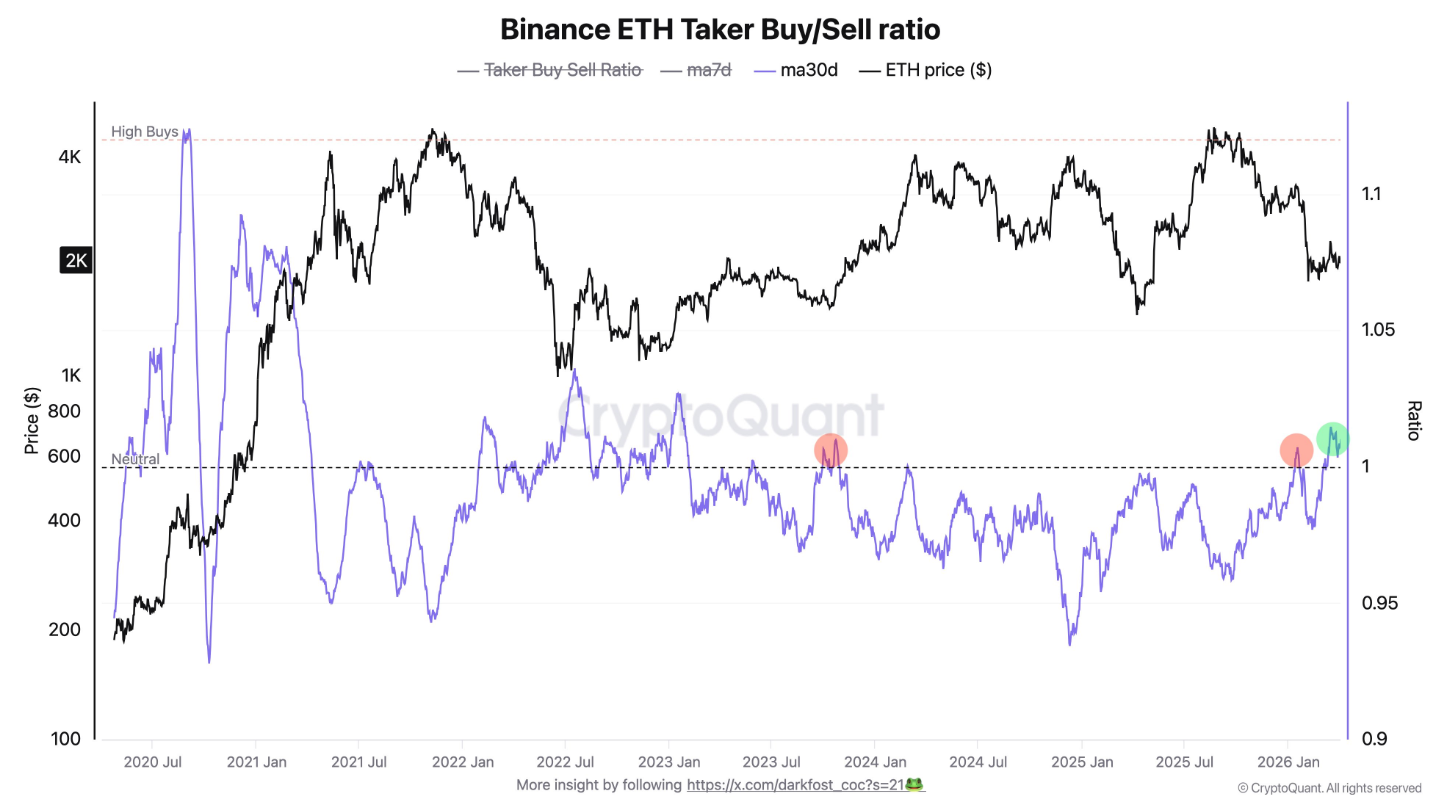
Importantly, the shift is happening gradually and without excessive spikes. That kind of steady buildup tends to be healthier in derivatives markets, which are often prone to rapid imbalances and liquidation cascades.
Combined with $90 billion added to total crypto market capitalization since Monday, the signal offers a cautiously constructive note heading into the weekend.
The post $2.2 Billion in Crypto Options Expire Today as a Hidden Ethereum Signal Resurfaces appeared first on BeInCrypto.


- XRP price has slipped after failing to hold the $1.38 resistance level.
- Momentum stays weak as volume and buying pressure remain low.
- Price is compressed between $1.32 support and $1.39 resistance.
XRP slipped back after briefly pushing toward $1.38, marking another failed attempt to break higher.
Notably, XRP has spent the past several days moving between roughly $1.32 and the upper resistance zone near $1.35–$1.39.
But each push higher has struggled to attract enough buying pressure to sustain a breakout, and as a result, the market remains stuck in a tight range, with neither bulls nor bears fully in control.
Weak momentum keeps upside in check
One of the biggest issues for XRP right now is the lack of momentum.
Even with the impressive gains, the strength behind those gains is limited. Indicators are hovering around neutral levels, showing that buyers are not stepping in aggressively.
Volume has also been inconsistent, and in some cases, it has even declined during upward moves. That is usually a warning sign that the rally may not last.
This weakness becomes even more noticeable when compared to the broader market.
Bitcoin has been leading recent gains, lifting many altcoins along with it and while XRP has followed this trend, it has not shown much independent strength of its own.
That matters because externally driven rallies tend to be fragile.
If Bitcoin slows down or pulls back, XRP could quickly lose support and fall back into its lower range.
Without a strong internal catalyst, it is difficult for XRP to break away from this pattern.
A market in compression, not in trend
While momentum remains weak, there is another side to the story that cannot be ignored.
XRP’s supply on exchanges appears to be tightening, suggesting that more holders are choosing to keep their tokens rather than sell.

At the same time, there is very little leverage in the market. Traders are not taking large speculative positions, which reduces the chances of sudden, exaggerated moves in either direction.
This combination creates what would be termed a compression phase, since the price is not moving much, volatility is shrinking, and participation is relatively low.
XRP breakout potential vs downside risk
The current setup leaves XRP at a crossroads. On one hand, the tightening supply and improving broader sentiment suggest that a breakout is possible.
On the other hand, the lack of momentum and weak participation make it difficult to trust any move higher without confirmation.
If XRP manages to hold above the $1.28–$1.31 support zone, another attempt at testing the $1.35–$1.39 resistance zone is likely.

And a decisive push above $1.39, supported by stronger trading activity, could shift sentiment and push the price towards the multi-month resistance at $1.43.
However, the downside risk is just as important. A break below the $1.32–$1.33 support zone could lead to a quicker drop, with analysts highlighting $1.28 as the next support level to watch.
If selling pressure increases further, deeper support near $1.13 could come into focus.
For now, the market is not trending but rather preparing for its next move.
The pullback from $1.38 highlights the lack of strength, but it also reinforces how tightly price is coiling, and the longer XRP remains in this range, the more meaningful the eventual breakout or breakdown is likely to be.
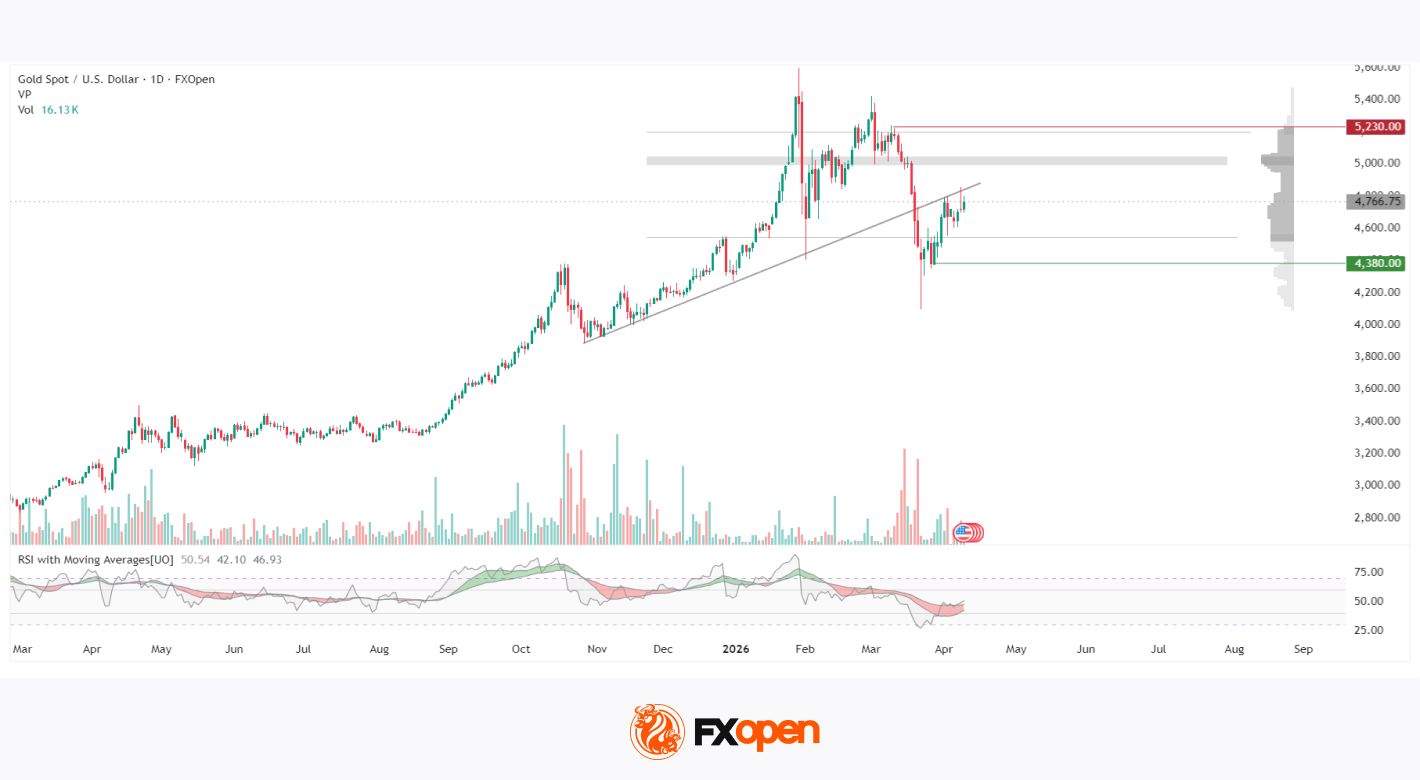
Geopolitical tensions in the Middle East had remained the primary macro driver for the gold market over recent weeks; however, on 8 April the situation shifted sharply as the United States and Iran agreed to a temporary two-week ceasefire, including the reopening of the Strait of Hormuz and a pause in military strikes. The easing of acute tensions triggered a sharp decline in oil prices and a return of risk appetite across global markets, weighing on demand for safe-haven assets. As a result, gold retreated from intraday highs near 4,850.
That said, the durability of the agreement remains uncertain. Reports of localised strikes in the region continue to keep market participants on edge, preventing a full dismissal of Iranian-related risks. Additional influence comes from macroeconomic data—particularly US inflation—whose interpretation in the context of Federal Reserve rate expectations continues to shape dollar dynamics. Structural support from central banks persists, with China continuing to increase its gold reserves, while Malaysia and South Korea have resumed purchases after an extended pause.
Technical Outlook
On the daily chart of XAU/USD, a clear two-phase structure is evident. An uptrend that began in March 2024 drove prices to a record high in the 5,595–5,600 range by late January 2026, followed by a sharp and impulsive decline. Notably, the peak in vertical volume occurred not at the price high, but during the subsequent sell-off in March 2026, indicating a climactic phase of selling rather than buying.
The low of that move was recorded near 4,100, from which price rebounded to current levels around 4,766. The horizontal volume profile reveals a dense cluster in the 4,990–5,050 zone, marking the point of control (POC) where trading activity has been most concentrated. This area acts as a natural resistance to further upside. The next significant level above lies at 5,230.
The ascending trend line originating from autumn 2025 was broken to the downside in March 2026 and no longer serves as support for buyers. It may now act as an additional resistance near the 5,000 level.
The lower boundary of the current range is located around 4,380. The RSI and moving averages stand at 50.54 / 42.10 / 46.93, with the RSI hovering near the neutral 50 level and remaining below both upward-sloping moving averages, signalling a lack of confirmed directional momentum.
Summary
Following the completion of an active corrective phase, gold has stabilised below the POC zone, while the RSI remains near neutral levels without a clear directional bias. The current trading range—4,380 on the downside and 5,230 on the upside—continues to define the market structure, as geopolitical developments and Federal Reserve rhetoric shape short-term price dynamics.
Start trading commodity CFDs with tight spreads (additional fees may apply). Open your trading account now or learn more about trading commodity CFDs with FXOpen.
This article represents the opinion of the Companies operating under the FXOpen brand only. It is not to be construed as an offer, solicitation, or recommendation with respect to products and services provided by the Companies operating under the FXOpen brand, nor is it to be considered financial advice.
Key Highlights
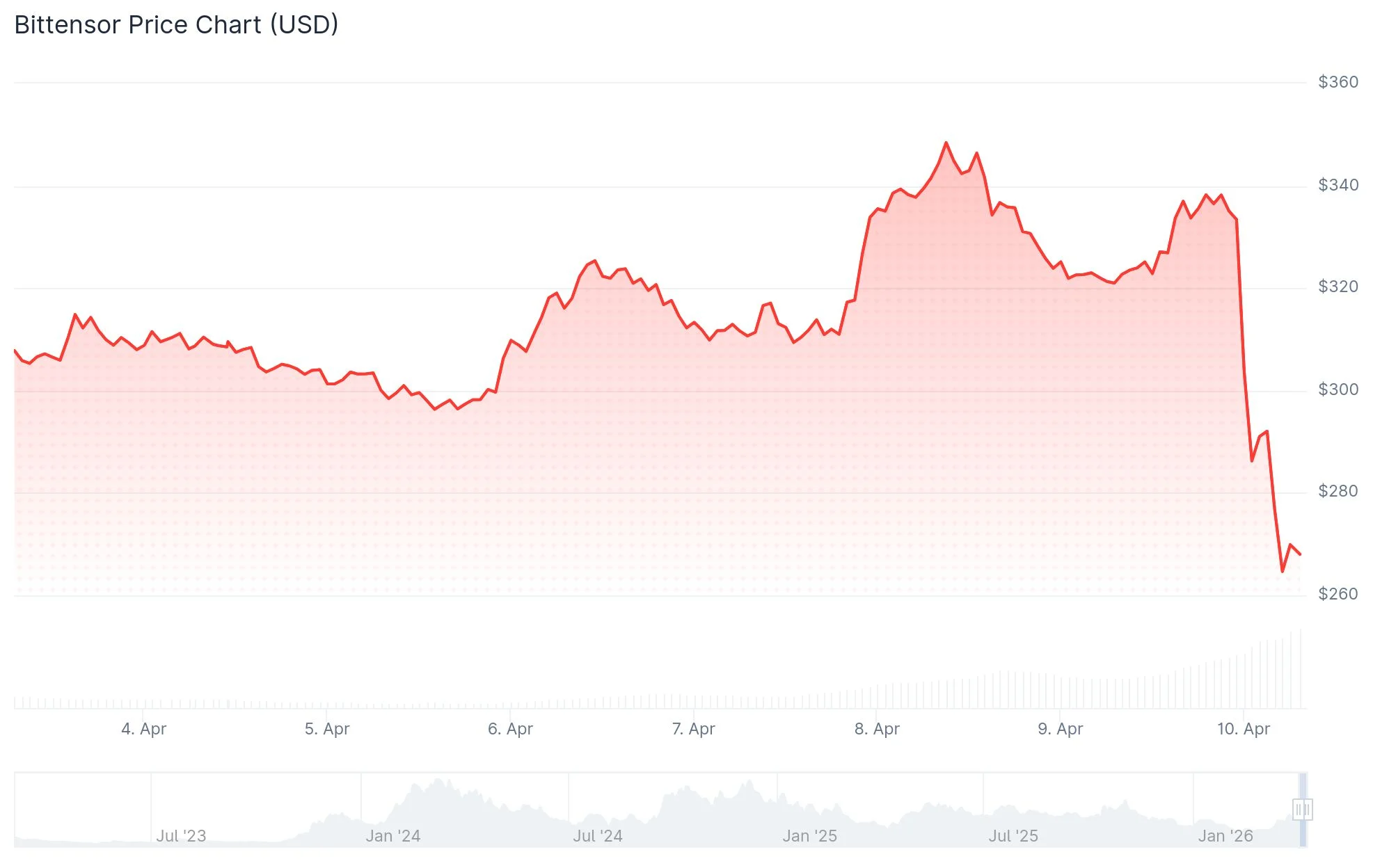
- Bittensor’s TAO token plummeted over 18% following Covenant AI’s departure announcement
- Sam Dare, Covenant AI’s founder, leveled accusations of centralized governance against Bittensor co-founder Jacob Steeves
- Claims include suspended emissions, revoked moderation privileges, and deprecated subnet infrastructure
- TAO currently hovers between $263 and $292, trading beneath its 200-day moving average with $250 as critical support
- Derivatives market shows nearly 1% decline in open interest to $392.59 million, with significant liquidations across major exchanges
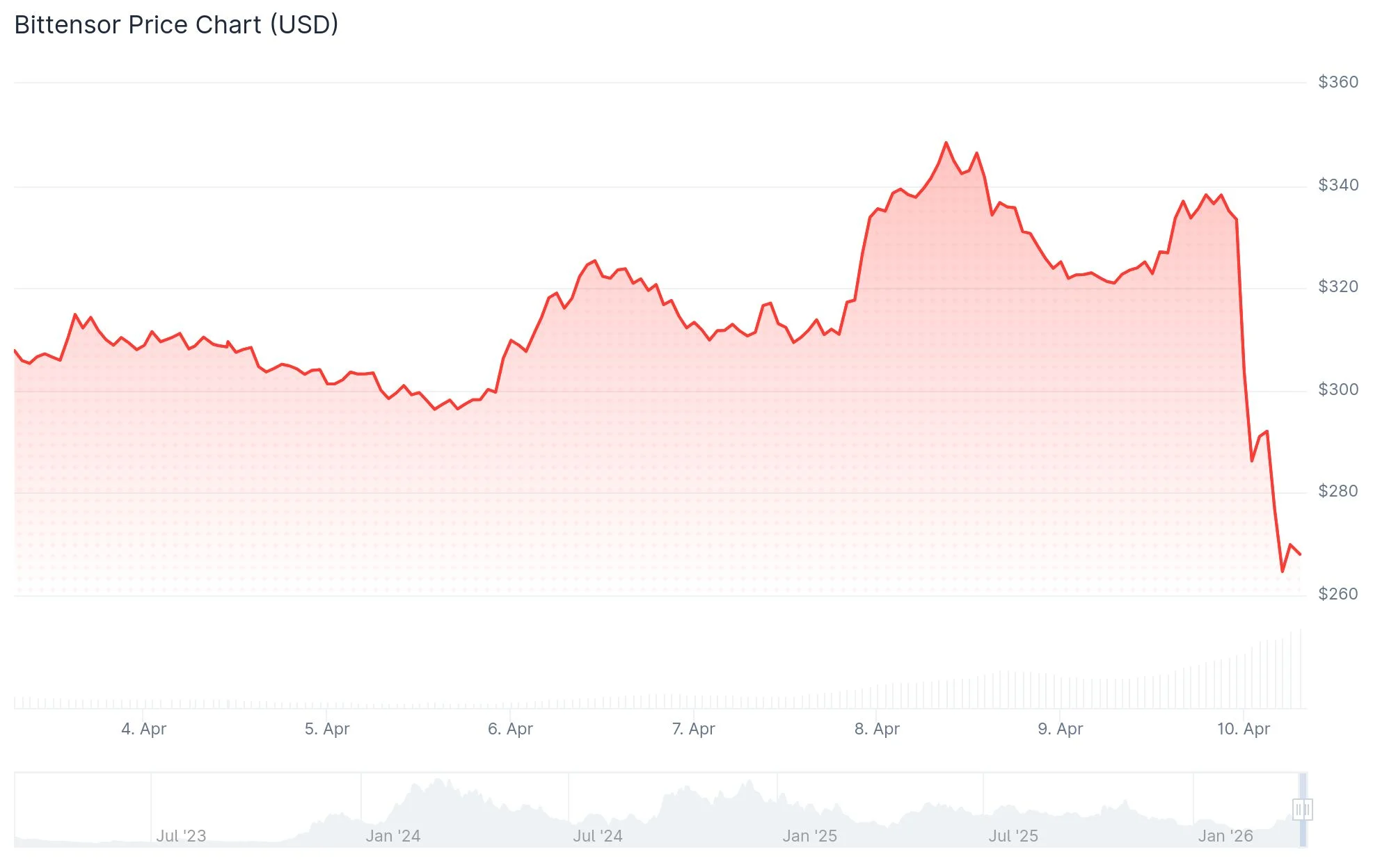
The Bittensor network experienced a significant blow on April 10, 2026, as its native TAO token shed more than 18% of its value within a single day. This dramatic downturn wiped out gains from a previous rally that had pushed prices up over 100%, with the catalyst being Covenant AI’s decision to withdraw from the ecosystem.
As one of the network’s most prominent participants, Covenant AI managed three distinct subnets: Templar (SN3), Basilica (SN39), and Grail (SN81). Their departure represents a substantial loss for the protocol’s operational infrastructure.
In a scathing public disclosure, Sam Dare, who founded Covenant AI, directly challenged the decentralization claims of Bittensor, specifically targeting co-founder Jacob Steeves for what Dare characterizes as autocratic network management.
“The network functions under a triumvirate framework—three people controlling the multisig for protocol upgrades. This is marketed as distributed governance to the community. That’s misleading. This is decentralization in name only,” Dare stated in his announcement.
According to Dare’s allegations, Steeves halted token emissions to Covenant’s operational subnets, removed their administrative access to community communication platforms, forcibly deprecated their subnet systems, and executed calculated token liquidations designed to create financial strain.
Steeves “wields ultimate authority over the triumvirate, opposes any substantive power-sharing arrangements, and implements protocol modifications at will, bypassing established procedures and collaborative decision-making,” Dare asserted.
Complete Liquidation of TAO Position
Following the announcement, Dare liquidated his entire position in the network. Blockchain analysis from taosats revealed he sold more than 37,000 TAO tokens from his personal wallet, creating immediate downward price pressure on the asset.
While severing ties with the [[LINK_START_2]]Bittensor[[LINK_END_2]] ecosystem, Covenant AI confirmed it would maintain its research division, proprietary models, and ongoing development efforts. The organization indicated forthcoming announcements regarding new initiatives. “Decentralized, permissionless artificial intelligence training isn’t exclusive to Bittensor. It represents a technological frontier our team remains committed to exploring,” the company stated.
At press time, TAO was fluctuating in the $263 to $292 range. Throughout the 24-hour period, the token reached a low of $262.51 and peaked at $341. Transaction volume surged by 156% during this timeframe.
Critical Price Levels Under Watch
Well-known market analyst Cheds Trading observed that TAO has broken below its 200-day moving average and is approaching the 50-day moving average positioned at $250. The Relative Strength Index (RSI) declined to 41, suggesting additional downward momentum could be imminent.
The Covenant-72B model developed by Covenant AI had previously served as a major catalyst for TAO’s bullish performance. When NVIDIA CEO Jensen Huang mentioned the model during an appearance on the All-In Podcast, the endorsement contributed to TAO’s subsequent 90% price surge.
Derivatives market data from CoinGlass indicated that Bittensor futures open interest contracted by nearly 1% to $392.59 million in just one hour. The most substantial selling activity occurred on OKX, Gate, Bitget, Hyperliquid, and LBank exchanges. At the time of analysis, neither Binance nor Bybit had reflected comparable adjustments.
Following Covenant AI’s withdrawal, TAO is currently priced around $263 with derivatives open interest standing at $392.59 million.


A new pricing mechanism for the x402 protocol will allow AI agents to pay for compute resources based on actual usage rather than fixed rates.
Summary
- Coinbase has introduced the “Upto” mechanism for the x402 protocol to enable usage-based payments for AI compute tasks.
- Coinbase Developer Platform confirmed the update replaces fixed-price models with a system where users only pay for actual resource consumption, like token counts or processing time.
According to a Thursday announcement on X by the Coinbase Developer Platform, the newly launched “Upto” scheme enables variable-cost services for tasks like data queries and large language model inference.
This update addresses a long-standing limitation in the protocol that prevented efficient payments for services where costs are not known upfront.
“Until now, x402 only supported exact, fixed-price payments. That works great for deterministic APIs. But it blocked an entire category of services where the cost depends on usage, such as token count, compute time, or query complexity,” the Coinbase Developer Platform stated.
The technical framework operates as an Ethereum Virtual Machine (EVM) implementation that supports all ERC20 tokens. To further streamline the process, the CDP Facilitator has been integrated to allow for transactions without gas fees.
Under this new arrangement, sellers set a maximum price while buyers authorize a spending limit for a specific task. Once the AI agent completes the request, the server calculates the precise cost and charges only for the resources consumed.
This prevents the previous issue where users frequently overpaid for simple tasks or underpaid for complex ones because the protocol could not adjust for fluctuating server-side demands.
Industry adoption of the x402 protocol has grown as companies prepare for the rise of agentic commerce, a sector that requires rapid, frictionless payments to handle high network demand.
While Coinbase originally developed the protocol, the company recently transferred ownership to the nonprofit Linux Foundation. Major technology players, including Google, Microsoft, and Amazon Web Services, now hold stakes in the protocol through the x402 Foundation.

Microsoft’s stock outlook for 2026–2030 remains broadly constructive, driven by continued growth in Azure, expanding AI monetisation through Copilot, and a $625 billion commercial backlog that provides unusual revenue visibility. The stock trades near $373 as of 8th April 2026, down roughly 33% from its July 2025 all-time high, with the forward P/E compressed to around 20x.
Base-case scenarios point to steady long-term appreciation as AI infrastructure spending begins converting into returns. However, the pace of any recovery depends on capex discipline, Copilot adoption rates, macro conditions and interest rate direction. Valuation sensitivity remains a key swing factor. Read on to learn more about key drivers and risks for MSFT stock price.
Analytical MSFT Stock Price Prediction: Quick Answer
MSFT trades near $373 as of 8th April 2026, down roughly 33% from its all-time high of $555.45 reached in July 2025. The 12-month analyst consensus averages approximately $582 across 34 analysts tracked by StockAnalysis, with targets ranging from $392 (Stifel) to $675 (Jefferies).
The stock trades at roughly 20x forward earnings on FY2027 Microsoft EPS forecast of ~$19.38, which assumes continued Azure momentum, gradual Copilot scaling and no further macro deterioration.
- Base view: Steady cloud and AI revenue growth supports a gradual recovery towards $500–$550 over 12 months.
- What must go right: Copilot adoption accelerates, capex-to-revenue conversion improves, and rate expectations stabilise.
- What could derail it: AI monetisation disappoints, capex keeps outpacing Microsoft revenue growth, or tariff and rate uncertainty deepens the selloff.
Recent Price History of MSFT
MSFT traded in a wide range over the past twelve months, falling from an all-time high of $555.45 in late July 2025 to around $357 by the end of March 2026. That represents a drawdown of over 35% from peak to trough. As of 8th April 2026, the stock is down approximately 23% year-to-date, on track for its worst annual performance in nearly two decades.
Several catalysts shaped the move. A strong AI narrative and accelerating Azure growth pushed MSFT above $500 through mid-2025, with the company briefly joining the $4 trillion market cap club in July and October 2025. The reversal began on 28th January 2026, when Q2 FY2026 earnings revealed $37.5 billion in quarterly capex. The stock fell 10% in a single session.
The sharp swings reflected two colliding forces. Through mid-2025, traders priced in AI as a margin expansion story. Once the true infrastructure cost emerged, the narrative flipped to a capital destruction story. Each earnings print and macro headline amplified moves in both directions as the market repriced how long the capex cycle would last.
What Could Drive Microsoft Stock Between 2026 and 2030?
The path for Microsoft stock price predictions through 2026-2030 hinges on a handful of measurable business drivers. Each connects directly to earnings power and how the market values the stock.
What Drives Microsoft Stock?
- Azure and cloud demand: The core earnings engine, currently growing 39% year-over-year.
- AI monetisation and Copilot uptake: 16 million paid seats, but attach rates and pricing power matter more than headlines.
- Capex, margins and cash-flow conversion: Spending pacing toward $145 billion annually, pressuring free cash flow.
- Valuation regime and interest rates: The forward P/E compressed from 33x to roughly 20x as rate expectations shifted.
Azure and Broader Cloud Demand
Intelligent Cloud delivered $32.9 billion in Q2 FY2026, up 29% year-over-year. Azure and other cloud services grew 39%, with AI workloads contributing an estimated 13 to 16 percentage points. Cloud now accounts for more than 60% of Microsoft’s total revenue and carries higher margins than legacy segments. The business remains capacity-constrained, with roughly $80 billion in unfulfilled Azure orders due to power and data centre limitations.
Microsoft AI Monetisation and Copilot Uptake
Microsoft 365 Copilot reached approximately 16 million paid seats by December 2025, up 160% year-over-year. At $30 per user per month, that implies a run rate of roughly $5.8 billion. But the M365 commercial installed base sits between 415 and 450 million, meaning penetration remains below 4%. A new premium E7 tier at $99 per month launches in May 2026. Enterprise renewal and usage rates climb from here matters.
Capex, Margins and Cash-Flow Conversion
Microsoft spent $37.5 billion on capex in Q2 FY2026 alone, up 66% year-over-year. Quarterly free cash flow fell to $5.9 billion. This spending funds the data centres and AI accelerators behind Azure and Copilot. Over time, it could produce strong returns if AI workloads scale. In the near term, it compresses free cash flow and raises the bar for what revenue growth needs to deliver.
Microsoft’s Valuation Regime and Interest Rates
MSFT’s forward P/E fell from roughly 33x in mid-2025 to around 20x by April 2026. The Fed holds rates at 3.50% to 3.75%, with only one further cut projected by year-end. Higher rates reduce the present value of future earnings, hitting growth stocks disproportionately. Even strong EPS growth may not lift the stock if the multiple keeps contracting.
Traders may track MSFT CFD price movements in FXOpen’s TickTrader platform.
Analytical Microsoft Stock Bull, Base and Bear Cases (12-Month / 2026 View)
In a base analytical Microsoft stock price prediction for 2026, Microsoft sustains mid-to-high-teens revenue growth, Copilot adoption scales steadily and the forward multiple stabilises near current levels. In a bull case, Azure reaccelerates above 40%, AI monetisation inflects meaningfully and rate expectations shift dovish, allowing the multiple to expand. In a bear case, capex continues to outpace revenue gains, Copilot uptake stalls and macro weakness compresses valuations further.
Price targets are based on publicly available 12-month analyst consensus data from StockAnalysis, accessed 8th April 2026 (34 analysts). Published values: average $582, high $675, low $392.
Other aggregators, including TipRanks and MarketBeat, show a broadly similar range, although exact figures vary due to differences in analyst coverage, sample windows, and update frequency.
Analytical Long-Term Outlook for Microsoft Stock (2027-2030)
It’s difficult for analysts to make accurate Microsoft stock forecasts four to five years out, especially when the company is mid-cycle on the largest infrastructure build in corporate history. A more practical approach is to identify what would need to happen for the stock to move materially higher or lower from current levels.
AI and Cloud Compounding
If Azure’s growth outlook remains positive, above 25% annually, and Copilot penetration climbs from below 4% towards 10–15% of the M365 installed base, the revenue mix shifts towards higher-margin recurring software. At that scale, the capex currently weighing on free cash flow starts to look like invested capital generating strong returns. Microsoft’s commercial backlog of $625 billion provides a foundation, but the conversion rate into recognised revenue is what matters.
Platform Expansion Beyond Current Products
Microsoft is positioning itself as a fully integrated AI-driven platform, rather than a collection of standalone products. This platform expansion is underpinned by investments in proprietary silicon (Maia 200 AI chip), cloud-scale AI infrastructure, and deeper integration across enterprise applications, enabling tighter control over both performance and cost structures. Core assets such as Microsoft Azure and Microsoft 365 are increasingly interconnected, supporting cross-product monetisation and higher client retention.
Valuation Context
MSFT has delivered strong profit growth over the past five years, averaging close to 19% per year. Even if this growth slows to around 12–15% annually through 2030, the current share price still leaves room for further gains, as profits alone could support higher valuations over time. In this case, stock performance would be driven mainly by continued business growth rather than investors paying a higher price for each dollar of earnings. However, if profit growth slows to single-digit levels, the stock may begin to behave more like a mature large-cap, with more limited upside and less investor enthusiasm.
How Trader Can Evaluate a Microsoft Stock Forecast
Traders typically break an MSFT analysis into a few core steps.
- Starting with Microsoft valuation and earnings: Traders check the trailing and forward Microsoft’s P/E ratio against five-year average and the broader S&P 500. A widening premium without an acceleration in EPS growth could alter risk/reward. At roughly 20x forward earnings, MSFT currently trades below its recent historical range of 28–33x.
- Tracking Azure and Copilot momentum: Azure’s quarterly growth rate and Copilot seat count are the two clearest signals of whether Microsoft’s AI investment is translating into revenue. Both figures appear in each quarterly earnings release.
- Watching the capex-to-free-cash-flow ratio: When capex consumed $37.5 billion in a single quarter against $35.8 billion in operating cash flow, the free cash flow margin collapsed. Monitoring whether this ratio improves or worsens quarter-over-quarter reveals how quickly infrastructure spending converts into returns.
- Factoring in macro and rate expectations: MSFT’s valuation is sensitive to interest rate direction. Fed policy shifts and inflation data move the multiple independently of company fundamentals, as the 2025–2026 drawdown demonstrated.
MSFT Risks: Factors That Could Limit Upside
There are risks that could negatively affect MSFT price.
- Slower Azure growth: If cloud demand softens or capacity constraints persist, the core earnings engine decelerates. Even a few percentage points of slower growth would pressure the multiple.
- Weak AI monetisation: Copilot penetration remains below 4%. If enterprises treat it as discretionary rather than a core workflow tool, renewal rates disappoint and the capex programme looks harder to justify.
- Competition from AWS and Google Cloud: Azure gained share through 2025, but Google Cloud is growing faster in percentage terms and neoclouds like CoreWeave are scaling rapidly in AI-specific workloads.
- Regulatory pressure: The EU’s Digital Markets Act investigations into Azure, the ongoing Teams antitrust case, and the UK CMA’s probe into Microsoft’s licensing practices could each constrain pricing power.
- Macro-driven multiple compression: At roughly 20x forward earnings, much of the valuation reset has already occurred. But if rates stay elevated or rise further, the multiple has room to compress again.
Final Thoughts
Microsoft enters the 2026–2030 period with a strong but complicated setup. Revenue growth is accelerating, the cloud and AI backlog provides unusual visibility, and the valuation has compressed to levels not seen in nearly a decade. But the capex cycle is unprecedented, AI monetisation remains early-stage, and the macro environment adds uncertainty around the pace of any recovery.
Contradictory market conditions can create an attractive trading environment. If you are looking to trade MSFT via CFDs without owning the underlying shares, you may consider opening an account with FXOpen.
FAQ
What Is the Microsoft Stock Price Prediction for 2026?
The 12-month analyst consensus averages roughly $582 across 34 analysts tracked by StockAnalysis, with targets ranging from $392 to $675. The wide spread in MSFT forecasts for 2026 reflects disagreement over whether AI capex translates into margin expansion or continued free cash flow pressure. The base case assumes steady Azure growth and gradual Copilot adoption at current valuation levels.
What Could Drive Microsoft Stock Higher by 2030?
Sustained Azure growth above 25%, Copilot penetration climbing from below 4% towards double digits, and a dovish shift in Fed policy could each support bullish Microsoft stock price prediction for 2030. If AI workloads scale with near-100% incremental margins and the forward multiple expands back toward 28–30x, the upside case strengthens significantly over a four-year horizon.
Will Microsoft Stock Reach $1000 by 2030?
It would require a market capitalisation of roughly $7.4 trillion. That implies EPS compounding at 15–18% annually to reach $28–33 by FY2030, combined with a 30–35x multiple. Such a bullish analytical Microsoft stock price prediction for 2030 is demanding but it can’t be ruled out if AI monetisation scales and cloud growth holds above 20%. Sustained margin expansion and continued buybacks would also need to contribute.
How Much Could Microsoft Stock Be Worth in 10 Years?
No reliable methodology exists for making 10-year Microsoft share price forecasts. Over the past decade, Microsoft has delivered strong profit growth of roughly 20–23% per year, and even if that pace slows significantly, earnings could still expand meaningfully over time. However, long-term outcomes depend on multiple uncertain factors, including valuation levels, interest rates, and competitive dynamics. As a result, any precise long-term price target should be treated as highly speculative rather than predictive.
How High Is MSFT Stock Expected to Go?
The highest published 12-month Microsoft stock outlook target is $675, from Jefferies. Beyond that, long-term scenario analyses from various sources place bull-case estimates in the $950–$1,150 range by 2030, assuming strong AI monetisation and moderate multiple expansion. Bear-case estimates cluster around $400–$500 if capex pressures persist and growth slows.
This article represents the opinion of the Companies operating under the FXOpen brand only. It is not to be construed as an offer, solicitation, or recommendation with respect to products and services provided by the Companies operating under the FXOpen brand, nor is it to be considered financial advice.
Binance co-founder Changpeng ‘CZ’ Zhao said he hopes that cryptocurrencies and blockchain will simply become an invisible part of daily infrastructure by 2031, much like the internet today.
Speaking on Scott Melker’s Wolf of All Streets podcast posted Thursday, Zhao said that while new use cases and advances will continue to emerge, he hopes talk of the technology will subside as it becomes part of everyday life.
“I’m hoping that we don’t talk about crypto as crypto in five years, just like we don’t talk about the internet anymore, we don’t talk about TCP/IP, we don’t talk about HTML, JavaScript, etc. We don’t talk about that stuff anymore. We just use it.”
“I think in five years, I’m hoping we’ll just use crypto,” he added. “There will be other use cases for the blockchain, for data storage, so there will be other cases, but I’m hoping in five years, we stopped talking about the technology, we are just using it and it will be used everywhere.”
Freedom of Money with CZ (AMA) https://t.co/ig5azu5ZcU
— The Wolf Of All Streets (@scottmelker) April 9, 2026
The optimistic vision for crypto in 2030
Global crypto adoption is steadily increasing. An estimated 559 million people worldwide use crypto in 2026, according to data and analytics firm DemandSage.
Industry insiders predicted last September that the sector may be just one market cycle away from full-scale mainstream adoption.
CZ isn’t alone in his lofty hopes for the future.
Cathie Wood’s ARK Invest predicted in a January report that by 2030, digital assets could grow into a $28 trillion market, while Tether co-founder Reeve Collins said last October he expects all currencies to become stablecoins in the same timeframe.
Meanwhile, blockchain analysis firm Chainalysis recently estimated that stablecoin volumes could hit $1.5 quadrillion by 2035, and a Citi survey of banks and asset managers last September found that most expect a tenth of the global post-trade market turnover to be handled through stablecoins and tokenized securities in less than five years.
AI could speed up blockchain development
Zhao added that blockchain technology could also get a boost in adoption and development thanks to AI.
“The speed of development, the speed of writing code is going to increase quite dramatically, and AI agents are going to use crypto a lot,” Zhao said, adding that “I’m hoping that blockchain, and I also kind of know blockchain will get there.”
In March, Zhao argued that AI agent developers should prioritize their intrinsic utility, not the launch of in-house native tokens to raise funds.
Countries that avoid AI and blockchain will fall behind
At the same time, Zhao said that countries that avoid blockchain technology and AI will be at a huge disadvantage in the future.
Related: CZ memoir revives feud with OKX founder Star Xu over contract forgery, Huobi arrest
“I think there’s really three big industries in my adult lifetime: the internet, blockchain and AI. Any country that misses one of them is going to be severely disadvantaged,” he added.
Customer onboarding platform Signzy ranked Switzerland as the most crypto-friendly country in its January blog. While Arkham flagged the country as one of the top innovating jurisdictions globally.
A January AI report from Microsoft, meanwhile, named the US as the leader in AI infrastructure and frontier model development, though it noted the country lags behind smaller, highly digitized economies like the United Arab Emirates in actual usage.

Magazine: Should users be allowed to bet on war and death in prediction markets?

Quick Overview
- Acquirers are reportedly interested in Gemini’s closed European and U.K. entities for their regulatory licenses
- Interest appears focused on specific business segments rather than a complete acquisition
- GEMI shares climbed approximately 9% following the CoinDesk coverage, finishing near $4.87
- Shares have plummeted more than 80% since the company’s $28 September 2025 IPO price
- The company’s COO, CFO, and CLO all exited in February, effective immediately
Shares of Gemini Space Station (GEMI) rallied nearly 9% on Thursday following a CoinDesk report indicating that potential acquirers are evaluating pieces of the Winklevoss brothers’ cryptocurrency exchange.
Gemini Space Station, Inc. Class A Common Stock, GEMI
The equity climbed from approximately $4.48 to finish the session around $4.87, touching an intraday peak of $5.18. Trading volume reached 5.5 million shares, significantly exceeding the typical 1.8 million average.
According to the report, this isn’t about a complete company acquisition. Sources familiar with the matter indicated to CoinDesk that interested parties are zeroing in on Gemini’s shuttered European and United Kingdom operations — particularly the regulatory permissions associated with those entities.
Last February, Gemini revealed plans to reduce its worldwide headcount by 25% while discontinuing services in the United Kingdom, European Union, and Australia. Management indicated the company would concentrate exclusively on its United States and Singapore markets moving forward.
These international operations possessed considerable regulatory worth. Within Europe, Gemini maintained a Markets in Crypto-Assets (MiCA) authorization, enabling the platform to service clients throughout the entire EU marketplace. In Britain, the exchange held registration with the Financial Conduct Authority (FCA) as an electronic money institution.
Obtaining such regulatory clearances independently can require multiple years. This shortcut represents the primary attraction for prospective purchasers.
Valuable Regulatory Credentials Attract Bidders
Under MiCA regulations, crypto authorizations don’t simply transfer during acquisitions. Regulatory bodies classify such transactions as a “change of control” and conduct fresh evaluations of incoming ownership — essentially treating them similarly to new applications. The FCA employs comparable procedures.
While the licenses themselves don’t transfer automatically, purchasing the already-registered corporate entity provides buyers with a substantial advantage versus starting the application process from the beginning.
Gemini has not issued any official statement regarding the CoinDesk coverage.
The February workforce reduction occurred simultaneously with the exit of three C-suite executives. COO Marshall Beard, CFO Dan Chen, and CLO Tyler Meade all departed immediately, according to regulatory filings. Beard additionally resigned from his board position. Management stated his departure wasn’t connected to any conflicts regarding company operations or strategic direction.
Steep Decline Following Public Debut
GEMI began trading publicly in September 2025 with an IPO price of $28 per share. On opening day, it surged above $37 and settled around $32, representing intraday appreciation exceeding 30%.
That initial enthusiasm proved short-lived. Shares have subsequently collapsed more than 80% from the debut price and were hovering near $4.36 prior to Thursday’s rally.
Short interest currently represents 15% of available shares, based on FactSet information.
The firm’s market capitalization presently stands at approximately $584 million. Its 52-week trading range extends from $3.91 to $45.89.
Gemini provides a comprehensive suite of services beyond basic trading capabilities. The platform offers institutional-grade custody solutions, staking services, yield-generating products, payment processing infrastructure, and a cryptocurrency rewards credit card.
Thursday’s price increase followed the publication of the CoinDesk article. Shares concluded trading up roughly 9%, although they continue trading substantially below the level where the company went public just seven months earlier.

At the Masters, the player/coach relationship is crucial. And different

Google Chrome adds infostealer protection against session cookie theft

Kris Marshall ‘hid under bed from landlord and couldn’t pay rent’ after losing job


-

 Fashion7 days ago
Weekend Open Thread: Spanx – Corporette.com
-

 Business4 days ago
Three Gulf funds agree to back Paramount’s $81 billion takeover of Warner, WSJ reports
-

 Sports5 days ago
India men’s 4x400m and mixed 4x100m relay teams register big progress | Other Sports News
-

 Business6 days ago
Expert Picks for Every Need
-

 Tech2 days ago
How Long Can You Drive With Expired Registration? What Florida Law Says
-

 Business5 days ago
No Jackpot Winner, Prize to Climb to $231 Million
-

 Fashion4 days ago
Massimo Dutti Offers Inspiration for Your Summer Mood Board
-

 Fashion3 days ago
Let’s Discuss: DEI in 2026
-
Politics7 days ago
Wings Over Scotland | The quality of mercy
-

 Crypto World2 days ago
Bitcoin recovers as US and Iran Agree a Ceasefire Deal
-

 Business5 days ago
Akebia Therapeutics, Inc. (AKBA) Discusses Pipeline Progress and Strategic Focus on Kidney Disease Treatments at R&D Day – Slideshow
-

 Crypto World20 hours ago
Canary Capital Files SEC Registration for PEPE ETF
-

 Fashion7 days ago
Frugal Friday’s Workwear Report: Hammered Metallic Button Sweater Vest
-

 Politics6 days ago
The UK should not pay a penny in slavery reparations
-

 Tech4 days ago
Haier is betting big that your next TV purchase will be one of these
-

 Fashion7 days ago
Tory Burch’s Spring 2026 Campaign Goes on a Getaway
-

 Fashion7 days ago
Weekly News Update, 4.3.26 – Corporette.com
-

 NewsBeat6 days ago
Kemi Badenoch talks ‘spring cleaning’ Reform defections
-

 Tech4 days ago
Samsung just gave up on its own Messages app
-
 Fashion7 days ago
Philip Jones Kids Jewellery collection – Genuine 925 sterling silver
You must be logged in to post a comment Login