Connect with us

Tech

OpenAI strikes a deal with the Defense Department to deploy its AI models

Published

on

OpenAI has reached an agreement with the Defense Department to deploy its models in the agency’s network, company chief Sam Altman has revealed on X. In his post, he said two of OpenAI’s most important safety principles are “prohibitions on domestic mass surveillance and human responsibility for the use of force, including for autonomous weapon systems.” Altman claimed the company put those principles in its agreement with the agency, which he called by the government’s preferred name of Department of War (DoW), and that it had agreed to honor them.

The agency has closed the deal with OpenAI, shortly after President Donald Trump ordered all government agencies to stop using Claude and any other Anthropic services. If you’ll recall, US Defense Secretary Pete Hegseth previously threatened to label Anthropic “supply chain risk” if it continues refusing to remove the guardrails on its AI, which are preventing the technology to be used for mass surveillance against Americans and in fully autonomous weapons.

It’s unclear why the government agreed to team up with OpenAI if its models also have the same guardrails, but Altman said it’s asking the government to offer the same terms to all the AI companies it works with. Jeremy Lewin, the Senior Official Under Secretary for Foreign Assistance, Humanitarian Affairs, and Religious Freedom, said on X that DoW “references certain existing legal authorities and includes certain mutually agreed upon safety mechanisms” in its contracts. Both OpenAI and xAI, which had also previously signed a deal to deploy Grok in the DoW’s classified systems, agreed to those terms. He said it was the same “compromise that Anthropic was offered, and rejected.”

Anthropic, which started working with the US government in 2024, refused to bow down to Hegseth. In its latest statement, published just hours before Altman announced OpenAI’s agreement, it repeated its stance. “No amount of intimidation or punishment from the Department of War will change our position on mass domestic surveillance or fully autonomous weapons,” Anthropic wrote. “We will challenge any supply chain risk designation in court.”

Advertisement

Altman added in his post on X that OpenAI will build technical safeguards to ensure the company’s models behave as they should, claiming that’s also what the DoW wanted. It’s sending engineers to work with the agency to “ensure [its models’] safety,” and it will only deploy on cloud networks. As The New York Times notes, OpenAI is not yet on Amazon cloud, which the government uses. But that could change soon, as company has also just announced forming a partnership with Amazon to run its models on Amazon Web Services (AWS) for enterprise customers.

Source link

Continue Reading
Click to comment

Leave a Reply

Your email address will not be published. Required fields are marked *

Tech

3D Print This MRI Safe Torque Wrench If You’re Rich

Published

on

MRI machines come with a variety of safety warnings. Perhaps most importantly, you have to be very careful not to take ferrous metal objects anywhere near them, since strong magnetic fields can send them flying, causing damage and injuries. To that end, you might find yourself in need of magnetically-safe tools when working on such machines. [Sam Schmitz] recently whipped up a nifty example of an MRI-safe torque wrench himself.

The torque wrench mechanism, which operates in one direction only.

It’s a 3D printed design which can be produced on a Formlabs Fuse 1+ as a single piece in nylon using a selective laser sintering process. The torque wrench works in a deceptively simple manner. As the handle is rotated, a flap  mates with the flat side of a fin on the shaft. This allows the shaft to turn. However, apply more than 0.6 Nm of torque, and the fin will eventually give in, snapping over the lip and stopping any further rotation that would over-tighten the fastener. [Sam] suggests these printed torque wrenches largely come out to the correct torque spec when printed, and can survive a thousand cycles or more while remaining in a usable spec.

The wrench does have one drawback though—it is apparently painfully loud to use. When the handle snaps past the detent, the “click” is quite piercing. [Sam] has measured the sound at up to 125 dB. Not exactly the best when it comes to ear safety!

If you work on MRI machines regularly, you already have the tooling to do your job. However, it’s neat to see that such a specialized tool can be easily and reliably 3D printed… with the slight drawback that you need a $60,000 SLS printer to do it. SLS isn’t readily available at the DIY level just yet, but it is slowly getting there. We’re waiting with bated breath.

Advertisement

Source link

Continue Reading

Tech

APT37 hackers use new malware to breach air-gapped networks

Published

on

APT37 hackers use new malware to breach air-gapped networks

North Korean hackers are deploying newly uncovered tools to move data between internet-connected and air-gapped systems, spread via removable drives, and conduct covert surveillance.

The malicious campaign has been named Ruby Jumper and is attributed to the state-backed group APT37, also known as ScarCruft, Ricochet Chollima, and InkySquid.

Air-gapped computers are disconnected from external networks, especially the public internet. Physical isolation is achieved at the hardware level by removing all connectivity (Wi-Fi, Bluetooth, Ethernet), while logical segregation relies on various software-defined controls, like VLANs and firewalls.

Wiz

In a physical air-gap environment, typical in critical infrastructure, military, and research sectors, data transfer is done through removable storage drives.

Researchers at cloud security company Zscaler analyzed the malware employed in APT37’s Ruby Jumper campaign and identified a toolkit of five malicious tools: RESTLEAF, SNAKEDROPPER, THUMBSBD, VIRUSTASK, and FOOTWINE.

Advertisement

Bridging the air gap

The infection chain begins when the victim opens a malicious Windows shortcut file (LNK), which deploys a PowerShell script that extracts payloads embedded in the LNK file. To divert attention, the script also launches a decoy document.

Although the researchers did not specify any victims, they note that the document is an Arabic translation of a North Korean newspaper article about the Palestine-Israel conflict.

The PowerShell script loads the first malware component, called RESTLEAF, an implant that communicates with APT37’s command-and-control (C2) infrastructure using Zoho WorkDrive.

RESTLEAF fetches encrypted shellcode from the C2 to download the next-stage payload, a Ruby-based loader named SNAKEDROPPER.

Advertisement

The attack continues with installing the Ruby 3.3.0 runtime environment – complete with the interpreter, standard libraries, and gem infrastructure – disguised as a legitimate USB-related utility named usbspeed.exe.

“SNAKEDROPPER is primed for execution by replacing the RubyGems default file operating_system.rb with a maliciously modified version that is automatically loaded when the Ruby interpreter starts,” via a scheduled task (rubyupdatecheck) that executes every five minutes, the researchers say.

The THUMBSBD backdoor is downloaded as a Ruby file named ascii.rb, as well as the VIRUSTASK malware as the bundler_index_client.rb file.

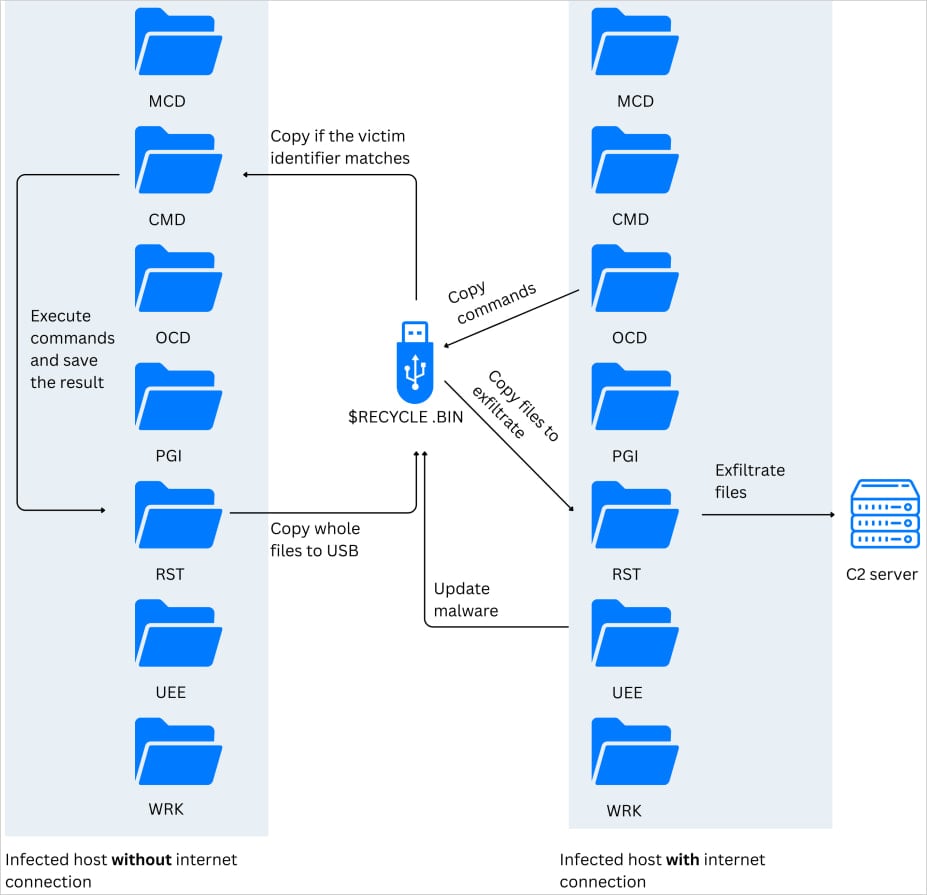
The role of THUMBSBD is to collect system information, stage command files, and prepare data for exfiltration. Its most crucial function is to create hidden directories on detected USB drives and copy files to them.

Advertisement

According to the researchers, the malware turns removable storage devices “into a bidirectional covert C2 relay.” This allows the threat actor to deliver commands to air-gapped systems as well as extract data from them.

ThumbSBD execution flow
Source: Zscaler

“By leveraging removable media as an intermediary transport layer, the malware bridges otherwise air-gapped network segments,” Zscaler researchers say.

VIRUSTASK’s role is to spread the infection to new air-gapped machines, weaponizing removable drives by hiding legitimate files and replacing them with malicious shortcuts that execute the embedded Ruby interpreter when opened.

The module will only trigger an infection process if the inserted removable media has at least 2GB of free space.

Overview of the attack chain
Overview of the Ruby Jumper attack chain
Source: Zscaler

Zscaler reports that THUMBSBD also delivers FOOTWINE, a Windows spyware backdoor disguised as an Android package file (APK) that supports keylogging, screenshot capture, audio and video recording, file manipulation, registry access, and remote shell commands.

Another piece of malware also observed in the APT37’s RubyJumper campaign is BLUELIGHT, a full-fledged backdoor previously associated with the North Korean threat group.

Advertisement

Zscaler has high confidence attributing the RubyJumper campaign to APT37 based on several indicators, including the use of the BLUELIGHT malware, initial vector relying on LNK files, two-stage shellcode delivery technique, and C2 infrastructure typically observed in attacks from this actor.

The researchers also note that the decoy document indicates that the target of the RubyJumper activity is interested in North Korean media narratives, which aligns with the victim profile of this threat group.

Modern IT infrastructure moves faster than manual workflows can handle.

In this new Tines guide, learn how your team can reduce hidden manual delays, improve reliability through automated response, and build and scale intelligent workflows on top of tools you already use.

Source link

Advertisement
Continue Reading

Tech

Amazon’s new Fire TV interface includes a redesigned mobile app

Published

on

Amazon is rolling out a massive, redesigned Fire TV experience, and the star of the show for many users is a transformed Fire TV mobile app.

This isn’t just a minor tweak; the update effectively turns your smartphone into a genuine second screen, making the entire process of discovering, managing, and launching content onto your TV significantly easier and faster.

The refreshed mobile application now sports a look and feel that aligns with the updated Fire TV interface. Gone are the days of clunky navigation; the app offers streamlined browsing for a quicker path to movies, TV shows, live sports, and other content. 

This means less time wasted scrolling and more time enjoying your favourite entertainment. Users can now manage their watchlists, initiate playback on their TV, and even save recommendations from friends while they are away from home. Talk about convenience.

Advertisement

With this new version, your phone evolves from a simple remote into a powerful companion device designed to drastically cut down on searching.

Advertisement

In a smart move, the app is fully integrated with Alexa+, Amazon’s new generative AI-powered assistant that is available in certain regions. This integration promises personalised recommendations that are actually useful and smarter overall navigation, essentially acting as a personal content curator in your pocket.

The new mobile app marks a strategic move Amazon made to position Fire TV as a truly connected ecosystem. Pairing the revamped Fire TV interface with this significantly more capable mobile app, Amazon is ensuring that the largest screen in your home works in perfect harmony with the one you carry around everywhere. 

Advertisement

This makes finding and watching content less of a chore and more of a fluid experience.

The rollout of this redesigned app has started in the UK, Germany, France, Italy, Spain, Japan, and India. Amazon has confirmed that availability will be expanding to more countries globally in the coming weeks, so users worldwide can look forward to getting their hands on this elevated Fire TV experience soon. 

Source link

Advertisement
Continue Reading

Tech

Trump orders federal agencies to drop Anthropic services amid Pentagon feud

Published

on

President Donald Trump has ordered all US government agencies to stop using Claude and other Anthropic services, escalating an already volatile feud between the Department of Defense and company over AI safeguards. Taking to Truth Social on Friday afternoon, the president said there would be a six-month phase out period for federal agencies, including the Defense Department, to migrate off of Anthropic’s products.

“The Leftwing nut jobs at Anthropic have made a DISASTROUS MISTAKE trying to STRONG-ARM the Department of War, and force them to obey their Terms of Service instead of our Constitution,” the president wrote. “Anthropic better get their act together, and be helpful during this phase out period, or I will use the Full Power of the Presidency to make them comply, with major civil and criminal consequences to follow.”

Before today, US Defense Secretary Pete Hegseth had threatened to label Anthropic a “supply chain risk” if it did not agree to withdraw safeguards that insist Claude not be used for mass surveillance against Americans or in fully autonomous weapons. In a post on X published after President Trump’s statement, Hegseth said he was “directing the Department of War to designate Anthropic a Supply-Chain Risk to National Security. Effective immediately, no contractor, supplier, or partner that does business with the United States military may conduct any commercial activity with Anthropic.”

Anthropic did not immediately respond to Engadget’s comment request. Earlier in the day, a spokesperson for the company said the contract Anthropic received after CEO Dario Amodei outlined Anthropic’s position made “virtually no progress” on preventing the outlined misuses.

Advertisement

“New language framed as a compromise was paired with legalese that would allow those safeguards to be disregarded at will. Despite DOW’s recent public statements, these narrow safeguards have been the crux of our negotiations for months,” the spokesperson said. “We remain ready to continue talks and committed to operational continuity for the Department and America’s warfighters.”

Advocacy groups like the Center for Democracy and Technology (CDT) quickly came out against the president’s threats. “This action sets a dangerous precedent. It chills private companies’ ability to engage frankly with the government about appropriate uses of their technology, which is especially important in national security settings that so often have reduced public visibility,” said CDT President and CEO Alexandra Givens, in a statement shared with Engadget. “These threats undermine the integrity of the innovation ecosystem, distort market incentives and normalize an expansive view of executive power that should worry Americans all across the political spectrum.”

For now, it appears the AI industry is united behind Anthropic. On Friday, hundreds of Google and OpenAI employees signed an open letter urging their companies to stand in “solidarity” with the lab. According to an internal memo seen by Axios, OpenAI CEO Sam Altman said the ChatGPT maker would draw the same red line as Anthropic.

In a blog post published late on Friday, Anthropic vowed to “challenge any supply chain risk designation in court,” and assured its customers that only work related to the Defense Department would be affected. The company’s full statement is available here, an excerpt is below:

Advertisement

Designating Anthropic as a supply chain risk would be an unprecedented action—one historically reserved for US adversaries, never before publicly applied to an American company. We are deeply saddened by these developments. As the first frontier AI company to deploy models in the US government’s classified networks, Anthropic has supported American warfighters since June 2024 and has every intention of continuing to do so.

We believe this designation would both be legally unsound and set a dangerous precedent for any American company that negotiates with the government.

No amount of intimidation or punishment from the Department of War will change our position on mass domestic surveillance or fully autonomous weapons. We will challenge any supply chain risk designation in court.

Update, February 27, 9PM ET: This story was updated twice after publish. First at 6PM ET to include a link to and quotes from Hegseth about the designation of Anthropic as a supply chain risk. Later, a quote from Anthropic was added, along with a link to the company’s blog post on the subject.

Source link

Advertisement
Continue Reading

Tech

How the Hartung Game Master Almost Found Its Place in Handheld History

Published

on

Hartung Game Master Handheld Console
In the early 1990s, handheld gaming was booming, and two absolute titans ruled the roost: Nintendo’s Game Boy and SEGA’s Game Gear. These two were extremely expensive, typically costing more than $100 each ($225 today), so only young gamers with deep pockets could get in on the action. Then the Hartung Game Master appeared unexpectedly from Germany.


Hartung, a company known (or infamous in some places) for producing low-cost LCD gadgets, introduced the Game Master in 1990 to mix things up a bit – undercutting the competition is the word, though that sounds a little too businesslike. So, yes, they went in cheap. In Europe, this was a huge business, with France being completely swamped with, among other brands, Videojet Game Master, Super Game, and Game Tronic. The UK had the Systema 2000 which came out late in 1991, £50 to be exact, which is to say roughly £30 less than the Game Boy. Then there was Spain, which got the Prodis PDJ-10, Italy got a Virella model, and Hong Kong got the Impel Game Master. One anomaly was that France’s Delplay Game Plus essentially copied the Game Boy’s design while abandoning the conventional cartridges concept.

Sale


YEQOO R36MAX Retro Handheld Game Console, 4.0 Inch IPS HD Screen Portable Retro Gaming Console, 1.5GHz…
  • 【Powerful Performance Meets Classic Gaming】Dive into seamless nostalgia with the R36MAX retro gaming console. Driven by a robust 1.5GHz 64-bit…
  • 【Instant Plug & Play with Vast Game Library】Unbox and play instantly! This retro handheld game console comes pre-loaded with a massive collection…
  • 【Vivid IPS Display & Ergonomic Contro】Immerse yourself in stunning clarity with the R36MAX’s 4.0-inch IPS HD screen (720*720 resolution). It…

In terms of size and shape, the standard model, measuring 170 by 97 by 33 millimeters, was essentially a Game Gear clone, with a wide body with the D-pad on the left and the A and B buttons on the right, as well as a confusing layout with the Select and Start buttons stuck awkwardly in the upper-left corner. The buttons felt like you were pressing these small spheres, and the D-pad was a touch weird, making for an uncomfortable grip after a time.

Advertisement

It’s powered by four AA batteries or a 6 volt DC converter, and the power switch was a nice addition, but only if you had a cartridge in, because the last two pins on each cart bypass the switch totally, bringing the device to life. No, when you take the game out, it immediately shuts off. Anyway, the volume and headphone controls were located on the bottom, along with a contrast dial and the power adapter plug. They also included a small pair of stereo headphones for the price, unlike the competition.

Hartung Game Master Handheld Console
Under the hood, there wasn’t much to be excited about. An NEC D78C11AGF microcontroller clocked at only 8MHz and paired with an absurdly meager 2.25 KB of RAM. As for the PCB, well, let’s just say it appeared to have been quickly made with a lack of soldering abilities, with bridges and globs of solder everywhere.

Hartung Game Master Handheld Console
Up front, however, the 61 by 64 monochrome LCD was the true hero, or perhaps the villain, depending on your perspective. It rendered in stark black and silvery white pixels, and there was no backlight, thus it was only useful in reasonably bright environments. Oh, and there was the issue of vertical smearing, which effectively divided the screen into two parts. Clean the zebra connectors as you might, the problem often lay with the glass itself rather than the connections. Tweaking the contrast helped a little, but you knew it would never be perfect.

Hartung Game Master Handheld Console
The cartridges just slid into its 40-pin slot, which was very similar to the Watara Supervision carts except for the exposed sides, and they had no cross compatibility with the other games. There were only 18 games shipped worldwide, and all of them were unlicensed clones stuffed in plastic pouches with the required folded up manual.

Source link

Advertisement
Continue Reading

Tech

Anthropic vs. The Pentagon: what enterprises should do

Published

on

The relationship between one of Silicon Valley’s most lucrative and powerful AI model makers, Anthropic, and the U.S. government reached a breaking point on Friday, February 27, 2026.

President Donald J. Trump and the White House posted on social media ordering all federal agencies to immediately cease using technology from Anthropic, the maker of the powerful Claude family of AI models, after reportedly months of renegotiating a less than two-year-old contract. Following the President’s lead, Secretary of War Pete Hegseth said he was directing the Department of War to designate Anthropic a “Supply-Chain Risk to National Security,” a blacklisting traditionally reserved for foreign adversaries like Huawei or Kaspersky Lab.

The move effectively terminates Anthropic’s $200 million military contract and sets a hard six-month deadline for the Department of War to scrub Claude from its systems.

But Anthropic’s business has been booming lately, with its Claude Code service alone taking off into a $2.5+ billion ARR division less than a year after launch, and it just announced a $30 billion Series G at $380 billion valuation earlier this month and has, more or less singlehandedly spurred massive stock dives in the SaaS sector by releasing plugins and skills for specific enterprise and verticalized industry functions including HR, design, engineering, operations, financial analysis, investment banking, equity research, private equity, and wealth management.

Advertisement

Ironically, SaaS companies across industries and sectors such as Salesforce, Spotify, Novo Nordisk, Thompson Reuters and more are reporting some of the biggest benefits in productivity and performance thanks to Anthropic’s top benchmark-scoring, highly capable and effective Claude AI models. It’s not a stretch to say Anthropic is among the most successful AI labs in the U.S. and globally.

So why is it now being considered a “Supply-Chain Risk to National Security?”

Why is the Pentagon designating Anthropic a ‘Supply-Chain Risk to National Security’ and why now?

The rupture stems from a fundamental dispute over “all lawful use.” The Pentagon demanded unrestricted access to Claude for any mission deemed legal, while Anthropic CEO Dario Amodei refused to budge on two specific “red lines”: the use of its models for mass surveillance of American citizens and fully autonomous lethal weaponry.

Hegseth characterized the refusal as “arrogance and betrayal,” while Amodei maintained that such guardrails are essential to prevent “unintended escalation or mission failure.”

Advertisement

The fallout is immediate; the Department of War has ordered all contractors and partners to stop conducting commercial activity with Anthropic effectively at once, though the Pentagon itself has a 180-day window to transition to “more patriotic” providers.

The vacuum left by Anthropic is already being filled by its primary rivals. OpenAI CEO Sam Altman just announced a deal with the Pentagon that includes two similar sounding “safety principles,” though whether they are the same type of contractual language is still not clear. Earlier in the day, OpenAI announced a staggering $110 billion investment round led by Amazon, Nvidia, and SoftBank.

Elon Musk’s xAI has also reportedly signed a deal to allow its Grok model to be used in highly classified systems, having agreed to the “all lawful use” standard that Anthropic rejected, but is said to rate poorly among government and military workers already using it.

Meanwhile, Anthropic has stated its intention to fight the designation in court and has encouraged its commercial customers to continue usage of its products and services with the exception of military work.

Advertisement

What it means for enterprises: the interoperability imperative

For enterprise technical decision-makers, the “Anthropic Ban” is a clarion call that transcends the specific politics of the Trump administration. Regardless of whether you agree with Anthropic’s ethical stance (as I do) or the Pentagon’s position, the core takeaway is the same: model interoperability is more important than ever.

If your entire agentic workflow or customer-facing stack is hard-coded to a single provider’s API, you aren’t going to be nimble or flexible enough to meet the demands of a marketplace where some potential customers, such as the U.S. military or government, want you to use or avoid specific models as conditions of your contracts with them.

The most prudent move right now isn’t necessarily to hit the “delete” button on Claude—which remains a best-in-class model for coding and nuanced reasoning—but to ensure you have a “warm standby.”

This means utilizing orchestration layers and standardized prompting formats that allow you to toggle between Claude, GPT-4o, and Gemini 1.5 Pro without massive performance degradation. If you can’t switch providers in a 24-hour sprint, your supply chain is brittle.

Advertisement

Diversify your AI supply

While the U.S. giants scramble for the Pentagon’s favor, the market is fragmenting in ways that offer surprising hedges.

Google Gemini saw its stock spike following the news, and OpenAI’s massive new cash infusion from Amazon (formerly a staunch Anthropic ally) signals a consolidation of power.

However, don’t overlook the “open” and international alternatives. U.S. firms like Airbnb have already made waves by pivoting to lower cost, Chinese open-source models like Alibaba’s Qwen for certain customer service functions, citing cost and flexibility.

While Chinese models carry their own set of arguably greater geopolitical risks, for some enterprises, they serve as a viable hedge against the current volatility of the U.S. domestic market.

Advertisement

More realistically for most, the move toward in-house hosting via domestic brews like OpenAI’s GPT-OSS series, IBM’s Granite, Meta’s Llama, Arcee’s Trinity models, AI2’s Olmo, Liquid AI’s smaller LFM2 models, or other high-performing open-source weights is the ultimate insurance policy. Third-party benchmarking tools like Artificial Analysis and Pinchbench can help enterprises decide which models meet their cost and performance criteria in the tasks and workloads they are being deployed.

By running models locally or in a private cloud and fine-tuning them on your proprietary data, you insulate your business from the “Terms of Service” wars and federal blacklists.

Even if a secondary model is slightly inferior in benchmark performance, having it ready to scale up prevents a total blackout if your primary provider is suddenly “besieged” by government reprisal. It’s just good business: you need to diversify your supply.

The new due diligence

As an enterprise leader, your due diligence checklist has just expanded thanks to a volatile federal vs. private sector fight.

Advertisement

The takeaway is clear: if you plan to maintain business with federal agencies, you must be able to certify to them that your products aren’t built on any single prohibited model provider — however sudden that designation may come down.

Ultimately, this is a lesson in strategic redundancy. The AI era was supposed to be about the democratization of intelligence, but it’s currently looking like a classic battle over defense procurement and executive power.

Secure your backup and diversified suppliers, build for portability, and don’t let your “agents” become collateral damage in the war between the government and any specific company.

Whether you’re motivated by ideological support for Anthropic or cold-blooded bottom-line protection, the path forward is the same: diversify, decouple, and be ready to swap in and out fast.

Advertisement

Model interoperability just became the new enterprise “must-have.”

Source link

Continue Reading

Tech

Steam Next Fest, a different flavor of The Witcher and other new indie games worth checking out

Published

on

Welcome to our latest roundup of what’s going on in the indie game space. It’s Steam Next Fest week, with literally thousands of demos for upcoming games for us to dive into. I’m trying to check out as many as I can before the event wraps up on Monday. However, I made a near-critical error in my planning: I opted to try the Raccoin demo first. I could and would have happily played that all week.

This is a coin-pushing roguelike deckbuilder that adopts the format of Balatro. To progress, you need to earn a certain number of points and the target increases each round. Every three rounds there’s a sort-of boss — a few coins that negatively impact your game until you can get rid of them. After every round, you’ll go to a shop to buy and sell special coins and other upgrades. As you might expect with this type of game, finding ways to boost the points you can score from each coin is how to win.

On my first successful run, I found a way to electrify the coins (which boosts their score) by charging them and use passive abilities and special coins to spread and amplify the effect. Then I was able to replicate a special coin that pulls all other nearby coins into a cyclone — having the water-based coins in there helped to spread the electrical effect between other coins. There were a few rounds in which I didn’t even have to do anything. The cyclones just dumped enough coins over the edge for me.

This was only the first way I’ve figured out how to break the game. Six hours in, I’m eager to find many more.

Advertisement

Raccoin — from Doraccoon and Balatro publisher Playstack — will hit Steam on March 31. The demo is currently still available.

I’ve had The Eternal Life of Goldman on my wishlist since we first learned about it a couple of years ago. I’m very glad that was one of the demos I’ve tried. This is an utterly gorgeous platform adventure with hand-drawn art. As Goldman, an elderly gentleman, you’ll swap parts of your cane on the fly so you can hook onto floating rings or pogo off springs.

The platforming is challenging enough that I had to focus to get through the demo, which lasts about 75-90 minutes. There’s almost always something going on in the background or foreground too. This game from Weappy Studio is shaping up to be quite something. I can’t wait to play the full thing when The Eternal Life of Goldman hits PC, Nintendo Switch, PS5 and Xbox Series X/S, hopefully later this year.

Of course I had to check out the Next Fest demo for Vampire Crawlers, which is also available on Xbox. The latest game from Poncle is a turn-based deckbuilder roguelite. Oh, and it’s also a Vampire Survivors spin-off. Instead of passively firing your weapons at surrounding enemies, you have a bit more control here.

Advertisement

It plays a bit like those first-person maze games from the ’90s. You’ll walk around each level with the help of a map that shows where enemies, chests and bosses are located. When you encounter enemies, you’ll play cards in a certain order to deal damage or boost your stats for that particular battle. You can play all your available cards in one go, but you might want to rearrange them first so that you, for instance, use a card that boosts your damage before firing any weapons. Each card has a mana point value — you can only play a full hand if you have enough mana. And yes, there are weapon evolutions.

Turn-based games usually aren’t my bag, but sometimes they just hit right. The Vampire Crawlers demo hits right. I can already tell I’m going to spend dozens of hours with the full game, which is coming to Steam, Xbox Series X/S, PS5, Nintendo Switch, iOS and Android this year.

I tried a few other demos so far, including one for John Carpenter’s Toxic Commando, a co-op shooter in the vein of Left 4 Dead. It’s a little rough around the edges right now, but it seems enjoyable enough.

There are a bunch of other Next Fest demos I’m hoping to try over the weekend, including precision platformer Croak, PvE pirate game Windrose, cyberpunk platformer Replaced, record store sim Wax Heads, match-three/tower-defense game Titanium Court and Dragon Care Tarot. I read that you can pet dragons in the latter, so I’m sold.

Advertisement

New releases

If you can’t get enough of The Witcher and are impatiently waiting for CD Projekt Red to unleash The Witcher IV, here’s one way to keep your thumbs busy in the meantime. Reigns: The Witcher is the latest installment of the Reigns series from Nerial and Devolver Digital for Steam, Android and iOS ($6).

You still play as Geralt of Rivia. However, this is a narrative-focused game in which you make choices by swiping. It’s something a little different for Witcher fans. It might just pull some long-time Reigns players into that fantasy universe for the first time too.

Bread and Fred is the cutest thing. The co-op platformer from SandCastles Studio has been available on PC (Steam, GOG and Epic Games Store) and Nintendo Switch for a while, and this week it landed on Xbox One, Xbox Series X/S, PS4 and PS5. It normally costs $15 and there’s a 20 percent launch discount on those consoles. You’ll need to be a PS Plus subscriber to get those savings on PlayStation, though.

You and a friend take control of a pair of adorable penguins that are tethered together. The aim is to ascend a mountain, sometimes by swinging each other to get to hard-to-reach places. But if you miss a jump, you can plummet back down and erase a chunk of your progress. There is a single-player mode in which one of the penguins is replaced by a rock. The pixel art aesthetic here is super charming.

Advertisement

Here’s another co-op game. This one is a side‑scrolling RPG brawler. After several months in early access/game preview, the full version of Stoic’s Towerborne arrived on Xbox Series X/S, Xbox on PC, Steam and PS5. It costs $25, though there’s a 20 percent launch discount on Xbox. It’s on Game Pass Ultimate and Premium as well.

After the 1.0 update, the game has a full campaign that you can play offline by yourself or online with friends. Stoic has added fresh biomes, enemies and bosses, and there are said to be hundreds of missions, side quests and bounties. I really dig the fluidity of the animations in the trailer, though the action is a bit hard to parse at first glance. Still, I’m curious enough to try out Towerborne.

I’ve been a little too occupied with other Next Fest demos (plus Overwatch challenges, I’ll admit it) to play Dice A Million yet, but this roguelike deckbuilder looks pretty interesting. The aim is to find the right combination of dice and rings (i.e. passive abilities) to roll a million points in one go. As with the likes of Balatro, it’s all about figuring out powerful synergies between dice and rings to break the game and rack up ridiculous scores. I did quite enjoy a line on the Steam page that reads, “Cutting edge next-gen graphics (not really, I drew all of them on paint).”

Dice A Million — from Countlessnights and publisher 2 Left Thumbs — is also available on Itch and Xbox on PC. It’s on Game Pass Ultimate and PC Game Pass. Otherwise, it costs $13, but there’s a 20 percent discount on Steam until March 11. There’s a demo available on Steam too.

Advertisement

Upcoming

Let’s start this section with a news roundup. Mouse: P.I. for Hire continues to look rad, but unfortunately we’ll have to wait a little longer to play it. Fumi Games and publisher PlaySide have delayed it by a few weeks until April 16 to polish the game up.

I do love voxel-based heist game Teardown, so I’m jazzed for the online multiplayer update. Tuxedo Labs revealed it will go live on Steam on March 12.

It will add a co-op campaign option (for up to 12 players!). There’ll be hundreds of other multiplayer modes created by the studio and the community, including prop hunt, battle royale and floor-is-lava modes. There’s going to be so much carnage. The PS5 and Xbox Series X/S versions of Teardown will get the multiplayer update later this year.

ConcernedApe (aka Eric Barrone) marked the 10-year anniversary of Stardew Valley by showing off some very early gameplay footage, some stories from his time of working on his all-time-great indie game and revealing the two additional characters that players will be able to marry when the 1.7 update goes live. Sandy’s cool, so it’ll be nice to have her as an option, but Clint? That guy sucks. Here’s hoping Barrone will finally focus more of his attention on Haunted Chocolatier once this Stardew update is done and dusted.

Advertisement

Also as part of the 10th anniversary celebrations, it was revealed this week that an orchestra will deliver a one-night-only performance of music from Stardew Valley at the Red Rocks Amphitheatre in Colorado on October 25. I missed my chance to see the Symphony of Seasons tour in person when it stopped near me, because I don’t always make the wisest decisions in life. At least we can now watch an official recording of a previous concert.

Minimap, a social platform for gamers, ran its first indie game showcase this week. Among the highlights:

  • Thrifty Business (Spellgarden Games), a cozy thrift-store management sim that’s coming to Steam this year. A demo’s available now.

  • Another look at Please, Watch The Artwork, an anomaly-spotting game — without jump scares or monsters — from Please, Touch The Artwork developer Thomas Waterzooi.

  • Lily’s World XD, a psychological horror game from SonderingEmily in which you’ll investigate a teenage girl’s laptop in the early 2000s. The trailer brings to mind screenlife films like Searching and Unfriended.

  • Coming-of-age adventure Ikuma – The Frozen Compass from Mooneye Studios. You’ll play as both cabin boy Sam and husky Ellie (or have a friend take control of one of them) as you try to make your way home from the Arctic. This should hit Steam later this year.

Tombwater was originally supposed to arrive in November, but Moth Atlas and publisher Midwest Games delayed it for further refinement. It’s now set to arrive on Steam on March 31.A Next Fest demo is available now.

This is a 2D Soulslike with a Western setting and 2D pixel art that’s inspired by Bloodborne and early Legend of Zelda games. You’ll face off against horrific eldritch creatures as you search for a missing friend. You’ll have seven playable classes to choose from and the ability to wield more than 50 firearms and melee weapons, and more than 20 spells. Tombwater is said to have around 20 hours of gameplay.

Advertisement

There’s no release date for Solarpunk as yet, but I found this trailer quite soothing. It offers a first look at co-op gameplay for this base-building and exploration game from the two-person team at Cyberwave and publisher rokaplay.

Up to four players will be able to explore floating islands, gather resources and build out a homestead together. As the title suggests, there’s a technology-driven element to Solarpunk. You can use renewable energy sources to power tools that can automate things like resource harvesting and watering plants. The airships you use to travel between islands look cool too.

Solarpunk is set to hit Steam later this year. A demo is available now.

Source link

Advertisement
Continue Reading

Tech

GTA 6 may feature unprecedented real-world realism, claims alleged ex-Rockstar Employee

Published

on

The hype around Grand Theft Auto 6 continues to build, and an alleged former Rockstar Games employee has added to the high expectations with a fresh rumor. The new set of potential features suggests that GTA 6 might raise the bar on realism in ways that go beyond graphics alone.

GTA 6 NPCs are the biggest leap forward

One of the biggest claims in the Reddit leak centers around NPC behavior and interaction. Building on the systems introduced in Red Dead Redemption 2, the upcoming game will allegedly expand NPC interaction in a major way. Players can now have basic interaction options like greeting, insulting, flirting, or more.

Another standout feature could be a custom text input system, allowing players to type their own dialogue, which the NPCs can respond to contextually. These NPCs will reportedly retain memory over time. Treating someone poorly may cause them to react differently when you see them again. The leaker describes a system that allows players to build relationships and deepen bonds or rivalries organically.

There are levels to the life of crime

Crime in GTA 6 is described as more layered and situational than before. Smaller targets like convenience stores are reportedly easier to rob, with slower police response and smaller payouts. But as soon as you hit some high-value targets, such as luxury stores and jewelry shops, the situation becomes more complex. These locations are covered with silent alarms and security cameras that bring faster police responses. So players must plan their actions rather than just rushing in.

Simulating everyday life

Environmental realism is another major focus of the leak, with areas like airports and supermarkets bustling with people and various kinds of minor interactions. GTA 6 is expected to build fully enterable interiors rather than decorative set pieces to expand the realism in these everyday spaces.

Advertisement

Phones also appear to be a part of the gameplay, packed with functional apps that let you text NPCs, manage contacts, and browse social media. According to the claim, phones play a key role in communication, planning crimes, and engaging with the open-world dynamically.

Take it for what it is

These details remain as unverified claims from an alleged former employee. So I’d recommend taking this with a grain of salt for now. But even if parts of this description hold true, GTA 6 could showcase a significant shift towards deeper immersion and realism. So until the global release, this leak can best be passed on as an insider perspective, rather than a promise.

Source link

Advertisement
Continue Reading

Tech

Whistleblower: ICE Has Slashed Its Training Program And Its Boss Is Lying To Congress About It

Published

on

from the not-sending-our-best,-making-them-worse dept

ICE can’t keep up with the baseline set by resident ghoul/White House advisor Stephen Miller. Miller has demanded 3,000 arrests per day, which he presented as the minimum he would be satisfied with.

To reach this goal, tons of talent from other federal law enforcement agencies have been added to the mix. The results have been less than impressive, to be entirely too kind to these kidnappers and murderers.

CBP and Border Patrol officers used to handling border crossing business are now roaming the streets of Midwestern cities looking for anyone who seems a bit too dark to be a native. In addition, nearly half of FBI agents have been placed on the “find the brown person” beat, along with volunteers/voluntolds from DEA, ATF, US Secret Service, Homeland Security Investigations, and anyone else with a badge they’re unwilling to display prominently when raiding local day care centers.

The GOP threw a whole lot of money at ICE with the “Big Beautiful Bill.” ICE is throwing a lot of money at potential hires, much to the chagrin of law enforcement agencies everywhere, as well as already-understaffed prisons and jails.

Advertisement

The expectations were lowered, along with the bar for entry. The promise of a $50,000 signing bonus has managed to attract the expected blend of MAGA faithful, retired cops, bigots (but I repeat myself…), and anyone who thinks they have what it takes to frog-walk five-year-olds to the nearest rented SUV.

Hiring a bunch of people is only half the battle. The next step is preparing them to do their jobs. Ridding the nation of migrants is Job #1 here in America at the moment. But it’s a job too important to be done well by fully trained ICE officers. Quantity over quality is the name of the game, as former ICE trainer Ryan Schwank — who only resigned last week — told Congress. Here’s the Washington Post with the details:

[S]chwank… told congressional Democrats at a hearing that the agency eliminated 240 hours of “vital classes” from a mandatory 580-hour training program, including instruction about the legal boundaries for the use of force, how to safely handle firearms, and the proper way to detain and arrest immigrants.

Seems like a pretty sweet deal for new hires. Not only do they get a hefty signing bonus, but they don’t have to go through 40% of the training. Giving people guns and the power to deprive others of their lives and liberties should mean giving them the best possible training you can in hopes of heading off… well… pretty much everything we’ve been seeing lately during Trump’s anti-blue state/city surges.

Certainly, the administration is already doing everything it can to undercut the credibility of its now-former employee. But it’s not going to work unless you’re an idiot who prefers nigh-incoherent MAGA invective to actual facts. You see, Schwank didn’t just bring himself to this hearing. He also brought receipts.

Advertisement

Ahead of the hearing, Schwank provided a joint panel of House and Senate Democrats copies of internal ICE documents that he said show the extent of the cuts. The documents indicated that the Federal Law Enforcement Training Centers in Glynco, Georgia, shortened its training program from 72 days to 42 days.

Except that’s not what Todd Lyons said to Congress when he was asked to testify following two murders committed by federal officers in Minneapolis, Minnesota. Lyons claimed nothing important had been cut. He also said this, which is directly contradicted by the documents Schwank gave to lawmakers:

In a statement Monday, the Department of Homeland Security said ICE recruits receive 56 days of training before beginning their assignments…

Lyons went on to say that an “average” of 28 days of additional “on the job training” occurs after that. But even if you might believe Lyons is stacking his apples against the apples in ICE’s internal documents to come up with 84 days of training, you’re miscounting apples the same way Lyons is. OJT is post-assignment. Even if you choose to believe Lyons more than the documents his own agency generated, officers are still being put on the street two weeks earlier than they used to be.

The lies persist, of course. The statement provided to the Post says something else entirely, which is also contradicted by the documents and statements made by Schwank.

“No training hours have been cut. Our officers receive extensive firearm training, are taught de-escalation tactics, and receive Fourth and Fifth Amendment comprehensive instruction,” said Lauren Bis, a spokeswoman for the department.

But training hours have been cut. And the rest of it is pure horseshit, especially the part about training new hires about the Fourth and Fifth Amendment. Schwank’s testimony noted that he was asked to review an internal memo signed by Lyons that claimed — untruthfully — that ICE officers can enter people’s homes using only a self-issued administrative warrant.

Advertisement

Other rights were similarly glossed over. In fact, some of them are ignored completely.

[Schwank] also said that a two-hour class on the rights of protesters was shortened into 10 minutes of discussion during a lecture on “the concept of seizure.”

Nice. That’s the way to do it. Goodbye, First Amendment. Instead, here’s 10 minutes of ICE’s interpretative dance: “The Fourth Amendment, And What It Doesn’t Mean To Us.”

Everyone knew that once the cattle call began, ICE would be swarmed with opportunists who saw a great way to combine their bigotry and violence tendencies with a career — however short-lived — in public service. A steady paycheck, and all the government asked was that you show up at least 40% of the time during training.

This horde (actual number unknown) is being pushed through the doors towards their on-the-job-training, armed with little more than their masks, their guns, and some very comprehensive incorrecting of their constitutional notions.

Advertisement

Of course, none of this will matter to the people running ICE. I’m pretty sure they love this press. They have no interest in heading up a finely-tuned precise instrument of immigration law enforcement. They’d rather have the untargeted terrorizing of entire neighborhoods and the unearned swagger of a paramilitary death squad that somehow can still be hooted, horn-honked, and whistled into submission by suburbanites. And maybe this isn’t even an intentional design decision. There’s a good chance no one up top is intelligent enough to recognize the self-destructiveness of their actions. For now, at least, we know what they know. And we know this is wrong.

Filed Under: dhs, ice, mass deportation, ryan schwank, todd lyons, trump administration

Source link

Advertisement
Continue Reading

Tech

Washington state gets federal sign-off for huge broadband buildout

Published

on

(Photo by Jason Richard on Unsplash)

Washington state has received a federal green light for its final plan under the Broadband Equity, Access, and Deployment (BEAD) program — the national push to extend high-speed internet to places that still don’t have adequate service.

The National Telecommunications and Information Administration signed off on the BEAD proposal, giving the Washington State Broadband Office authority to start contracting with internet service providers and begin construction.

The approved plan directs $736 million in federal BEAD funding and $112 million in state match toward connecting about 166,500 homes and small businesses across 238 project areas. Combined with private match funding and other contributions, the total investment tops $1 billion.

Of the locations being funded, 76% are completely unserved (no qualifying high-speed service) while the remaining 24% are underserved.

“This is a transformative moment for Washington,” WSBO Director Jordan Arnold said in a statement. “For rural and underserved communities, internet access is a lifeline to economic opportunity, education, health care, and the modern world.”

Advertisement

The buildout breaks down roughly as fixed wireless (38% of locations), fiber (35%), and low-earth orbit satellite (27%). Nine of the 238 project areas are on tribal lands.

The inclusion of low-earth-orbit satellite could be relevant for SpaceX’s Starlink and Amazon Leo, both of which have operations tied to satellite connectivity in Washington state. It’s not yet clear exactly how much each provider will receive, but both have emerged as major winners of BEAD funding nationally. They each also have substantial satellite manufacturing operations in the state. Update: SpaceX will receive $45.8 million and Amazon will receive $9.25 million.

With NTIA approval in hand, the WSBO will now formally announce awards, execute contracts with providers, and begin overseeing construction. All projects must be completed within four years, though the office said some could break ground this year.

Source link

Advertisement
Continue Reading

Trending

Copyright © 2025