

Crypto World
11 US Senators Urge Federal Probe Into Binance Sanctions Compliance

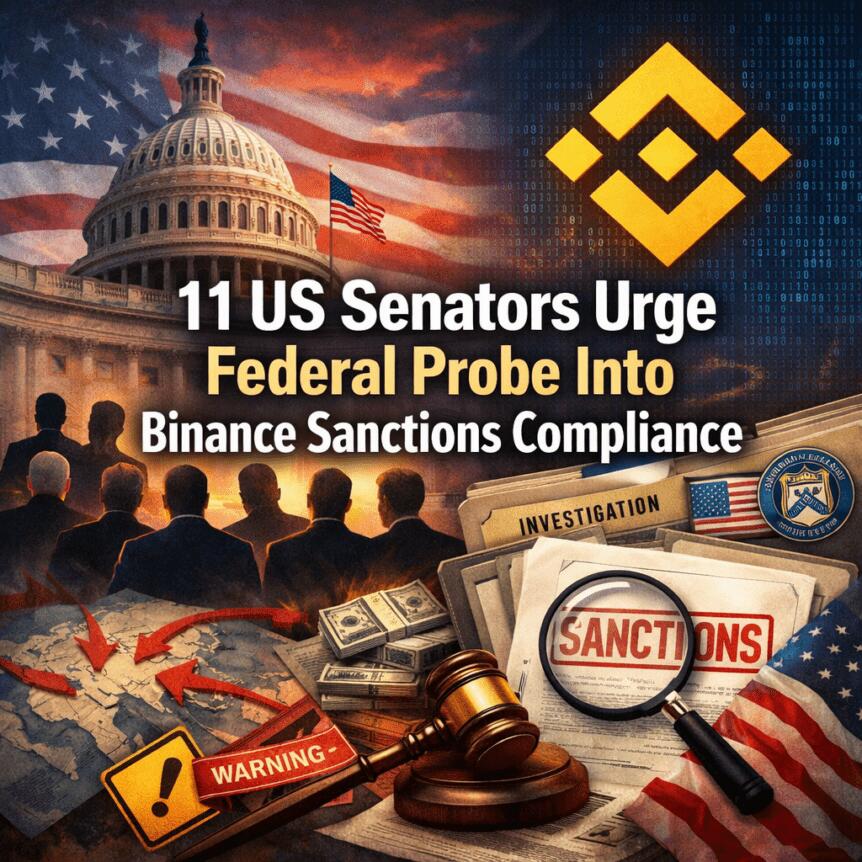
A bipartisan group of 11 United States senators has pressed federal authorities to scrutinize Binance’s compliance with sanctions and anti-money-laundering rules, citing escalating public scrutiny and a string of contentious reports. In a letter addressed to Treasury Secretary Scott Bessent and Attorney General Pamela Bondi, the lawmakers urged an expedited and thorough assessment of the exchange’s controls and its handling of prior settlement commitments reached in 2023. The missive highlights claims that roughly $1.7 billion in digital assets potentially flowed to Iranian entities tied to terrorism, and points to investigations into Iranian-based accounts and possible evasion of Russian sanctions. The document also notes claims that Binance’s internal responders who flagged suspicious activity faced dismissal, and that law-enforcement agencies have observed a downturn in cooperation from the firm on customer information requests.
Key takeaways
- Eleven U.S. senators asked multiple federal agencies to conduct a prompt, comprehensive review of Binance’s sanctions-and-AML controls and adherence to 2023 settlement terms.
- The letter references allegations of about $1.7 billion in digital-asset flows linked to Iranian entities tied to terrorism, including groups connected to the Houthis and the Islamic Revolutionary Guard Corps.
- Investigators reportedly identified more than 1,500 accounts accessed by users in Iran and possible activity aimed at evading Russian sanctions.
- According to the letter, some Binance staff who flagged suspicious transactions were dismissed, and law-enforcement agencies indicated Binance had become less cooperative in providing customer information.
- Senators warned that newer Binance products, such as payment cards in parts of the former Soviet Union and partnerships tied to stablecoin initiatives, could enable sanctions evasion.
Sentiment: Neutral
Market context: The escalation comes amid growing regulatory focus on exchange compliance and wider scrutiny of sanctions enforcement in crypto markets, with policymakers seeking clearer accountability for cross-border transactions and the robustness of AML controls during periods of heightened geopolitical risk.
Why it matters
The episode underscores the central role of major exchanges in economic sanctions enforcement and the delicate balance between fostering innovation and ensuring lawful conduct. As policymakers scrutinize Binance’s checks and balances, questions about transparency, information sharing with authorities, and the efficacy of enforcement mechanisms come to the fore. The stakes extend beyond one platform: they touch on the credibility of sanctions regimes in the digital asset era and the capacity of regulators to monitor rapidly evolving products, such as payments-linked services and stablecoin-related ventures, that could potentially be exploited for evading sanctions.
The discussions also spotlight the tension between operational secrecy in risk controls and the public interest in accountability. Binance has repeatedly faced questions about how it flags suspicious activity and how it collaborates with law enforcement. The senators’ letter maintains that a rigorous review is warranted not only to evaluate past settlements but to assess how future models—especially card-based products and cross-border partnerships—fit within the existing regulatory framework. In parallel, congressional inquiries have sought documents and internal records related to the exchange’s sanctions controls, signaling a broader push to obtain a clearer image of internal governance at a high-profile crypto venue.
What to watch next
- By March 13, agencies are asked to report on steps taken to examine Binance’s conduct, including the effectiveness of its sanctions controls.
- A congressional inquiry into Binance’s sanctions practices, led by Senator Blumenthal, is expected to yield new documents and testimony from the firm’s leadership.
- Regulators and prosecutors may press Binance for deeper disclosures around past settlements and the handling of suspicious activity reports.
- The exchange’s cooperation with investigators and its stance on Iranian-user activity will be tested as media coverage continues to surface conflicting narratives.
- Market participants will watch for regulatory signals that could shape the adoption and design of crypto-sanctions regimes, especially concerning new products and stablecoins tied to cross-border payments.
Sources & verification
- The letter from 11 senators to Treasury Secretary Scott Bessent and Attorney General Pamela Bondi requesting review of Binance’s sanctions controls: https://www.vanhollen.senate.gov/imo/media/doc/cvh_bessent_bondi_ltr_binance.pdf
- Binance denial of Iran-linked transaction allegations and assertion of cooperation with authorities, as reported to Cointelegraph: https://cointelegraph.com/news/binance-denies-iran-sanctions-report-fortune
- Senator Richard Blumenthal’s congressional inquiry into Binance, including a request for documents related to sanctions controls: https://cointelegraph.com/news/us-senator-probes-binance-iran-russia-sanctions
- Binance CEO’s response to coverage of Iran-related activity and criticisms of a Wall Street Journal report: https://cointelegraph.com/news/binance-ceo-legal-action-report-iranian-entities
Market reaction and key details
Regulators and lawmakers appear intent on mapping Binance’s risk controls against a backdrop of continued scrutiny of the broader crypto ecosystem. While Binance has touted its compliance efforts and stated that it does not permit Iranian users, public narratives surrounding these allegations continue to prompt questions about due diligence, cooperation with law enforcement, and the ability of large exchanges to detect and deter sanctioned activity. The dynamic highlights the ongoing tension between enterprise-level risk management and regulatory expectations as the crypto market seeks clarity on governance and accountability in a landscape that remains highly scrutinized by policymakers worldwide.
Why it matters
The episode reinforces the critical importance of robust sanctions-compliance infrastructures within major crypto platforms. As policymakers seek to close perceived gaps in enforcement and as new product lines expand cross-border capabilities, exchanges face intensified demands for auditable controls and transparent reporting. For users and investors, the developments illustrate the evolving regulatory environment that shapes how digital assets are traded, settled, and monitored for illicit activity. For builders and auditors, there is a clear signal that governance frameworks, risk controls, and cooperative compliance partnerships will be central to sustaining trust in a market that remains under close regulatory watch.
What to watch next
- Potential disclosures from Binance about internal governance, risk controls, and staff retention practices related to compliance investigations.
- Follow-up statements from the agencies expected to participate in the review and any public briefing on sanctions enforcement in crypto across the sector.
- Regulatory guidance or formal actions that could reshape product launches, especially in regions where new payment-card-type offerings are being rolled out.


TLDR:
- Bitcoin dropped to $63K within minutes of the Iran War breaking out, triggering over $515M in crypto liquidations.
- Gold surged past $5,200 as the Iran War intensified, with Bank of America forecasting a $6,000 per ounce target.
- The Strait of Hormuz carries 20% of global oil daily, and tankers are already halting movement amid the Iran War.
- Recession probability jumped from 25–30% to 40–50% as the Iran War threatens sustained disruption to global oil supply.
The Iran War has triggered an immediate financial shockwave across every major asset class. Open military conflict between the U.S., Israel, and Iran erupted on February 28, following explosions across Tehran, southern Lebanon, and near U.S. military bases.
President Trump declared “major combat operations” under Operation Epic Fury. Iran responded with missile strikes on Israeli and U.S. Gulf bases.
Investors across every market are now reassessing their positions as the situation continues to evolve hour by hour.
Stock Markets Face a Historic Test as War Escalates
The Iran War arrived at an already fragile moment for equities. The S&P 500 had turned negative for 2026 before the first strike even landed.
Bank of America held the most bearish S&P 500 outlook heading into the conflict, with a year-end target of just 7,100.
Historical data, however, offers a counterpoint worth noting. CFA Institute data shows U.S. large-cap stocks returned 11.9% annualized during wartime versus 10.0% during peacetime periods.
Across six major conflicts, the pattern has remained consistent — markets sell off before the war begins, then recover shortly after it starts.
The critical difference this time is oil. None of those previous wars directly threatened a supply corridor handling 20% of global crude.
If the Strait of Hormuz faces prolonged disruption, the historical “buy the war” playbook may not hold. Recession probability has already shifted from roughly 25–30% to an estimated 40–50%.
Bitcoin and Gold Split as Investors Seek Safety
Bitcoin dropped to approximately $63,000 within minutes of the Iran War breaking out, falling 3.8% almost immediately.
Over $515 million in crypto liquidations followed, erasing roughly $128 billion from total market capitalization. Ethereum fell 5.5%, with $149 million in ETH futures liquidations recorded by CoinGlass.
Gold, by contrast, surged past $5,200 and settled near $5,296 in the same window. Silver climbed 7.85% alongside it.
Gold had already gained 13.31% in January alone, reflecting a months-long trend driven by central bank buying and growing de-dollarization momentum.
The divergence between the two assets tells a clear short-term story. Bitcoin is trading like a risk-on asset, absorbing panic selling during weekend hours when no other liquid market is open.
Gold is functioning as the traditional safe haven. Bank of America expects gold to reach $6,000 per ounce over the next 12 months, and every current macro condition supports that trajectory.
Oil Prices and Economic Fallout Determine What Comes Next
The Iran War’s economic consequences hinge almost entirely on what happens at the Strait of Hormuz. Roughly 20 million barrels of oil pass through it daily, covering Qatar’s LNG, UAE crude, and most of Kuwait and Iraq’s exports.
Tanker traffic has already slowed, with Japanese shipping firm Nippon Yusen directing its full fleet away from the strait.
Brent crude closed the prior Friday at $72.48, while WTI jumped to $75.33, up 12% in a single session. Lombard Odier estimates a temporary spike to $100 per barrel is plausible under current conditions.
A sustained 20–30% oil price increase could depress global growth by 0.5–1.0% and push headline inflation higher by a similar margin.
The chain reaction from there runs through the entire economy. Higher oil raises costs across transportation, manufacturing, and consumer goods. Spending contracts, confidence falls, and growth slows.
The Federal Reserve, already stuck with rates at 3.5%–3.75% and inflation near 3%, has little room to respond. If Brent remains below $90, markets may stabilize. Above $100 sustained, the road through 2026 becomes considerably rougher.
Bitcoin’s future in an artificial intelligence-driven world may depend less on code and more on central banks.
In a new note, Greg Cipolaro, global head of research at financial services and infrastructure firm NYDIG, argued that artificial intelligence will affect bitcoin mainly through macroeconomic channels and its impact on the labor market.
The key variables are growth, employment, real interest rates and liquidity. Bitcoin, he writes, sits downstream of those forces.
If automation cuts jobs and wages, consumer demand could weaken and, in a severe case, falling incomes would strain debt payments and pressure asset prices.
Those fears appear to be well-grounded. Just this week, Jack Dorsey’s fintech firm Block unveiled its shrinking back toward its pre-pandemic size, cutting staff by about 40%. Dorsey cited AI-enabled efficiency for the job cuts, something that was theorized in Citrini’s research on the AI-doom that spooked the market this week.
In such a scenario, policymakers might respond with lower rates or fiscal spending to stabilize the economy. That wave of liquidity could support bitcoin, which has often tracked shifts in global money supply.
A different outcome would look less friendly for the cryptocurrency. If AI boosts productivity and economic growth without major job losses, real yields could rise, and central banks might keep policy tight.
Higher real rates have historically weighed on bitcoin by raising the opportunity cost of holding it and making risk assets less attractive.
Shift in demand
Anxiety around AI echoes past moments of upheaval in Human society.
The steam engine displaced manual labor in factories and on farms. Electrification then rewired entire industries. Later, computers and the internet automated clerical work and reshaped retail, media and finance.
Each wave triggered fears of permanent job loss. In the early 1900s, factory mechanization sparked labor unrest as machines replaced skilled craftsmen. In the 1980s and 1990s, personal computers cut typist pools and back-office staff. More recently, e-commerce helped hollow out brick-and-mortar retail roles.
Yet aggregate demand did not collapse. Productivity rose. New industries absorbed displaced workers, even if the transition proved uneven and painful. Nowadays, we have industries that were unthinkable before the dawn of the internet. Think cloud computing.
Cipolaro argued AI may follow a similar pattern. As a general-purpose technology, it requires firms to redesign workflows and invest in complementary tools. Over time, that process tends to expand productive capacity rather than shrink it.
“The implication is not that disruption will be painless, but that the equilibrium response to new technology has historically been integration, not obsolescence,” Cipolaro wrote. “Society’s response to AI will likely follow the same pattern.”
For bitcoin, that distinction matters. If AI ultimately lifts long-term growth, the structural backdrop could differ from the short-term shocks that often drive liquidity injections.
Meanwhile, adoption may also rise thanks to agentic payments, which would essentially see software pay other pieces of software without human involvement. One of Bitcoin’s earliest visions centered on machine-to-machine payments, and AI may be the necessary tool to make them a reality.
Still, incentives aren’t currently there for a widespread rollout. Credit cards bundle rewards and short-term credit, features that stablecoins do not yet match, Cipolaro noted.
Ultimately, while the rise of AI brings new challenges, what matters is the human response to the disruption it brings. If AI triggers a deflationary shock and forces the money printer to turn back on, or if it fuels a productivity boom that raises real yields, bitcoin will reflect that.


A tip to Homeland Security unraveled a multi-wallet laundering scheme, which ultimately resulted in a $61 million Tether confiscation.
US federal agents have seized more than $61 million worth of USDT. Investigators traced the seized funds to cryptocurrency addresses allegedly linked to the laundering of criminal proceeds obtained through “pig butchering” schemes.
According to the official press release, the funds were connected to scams in which victims were recruited and manipulated into transferring money under false pretenses.
Romance, Fake Profits, and $61M in USDT
Court filings state that criminal actors targeted victims by establishing trust and often posed as romantic partners. After gaining victims’ confidence, the scammers claimed to have specialized knowledge or techniques that could generate massive profits through cryptocurrency trading.
Victims were directed to fraudulent cryptocurrency trading platforms that closely resembled legitimate platforms in name and appearance. These fake platforms displayed fabricated investment portfolios and showed unusually high returns in order to encourage victims to invest increasing amounts of money.
When victims attempted to withdraw their funds, they were unable to do so and were frequently told they needed to pay additional “taxes” or “fees” to release their assets. According to authorities, these tactics were used to extract more money from victims.
Once funds were transferred to cryptocurrency wallets controlled by the scammers, the money was rapidly moved through multiple wallets to conceal its source, ownership, and control. In this case, Homeland Security Investigations (HSI) agents and analysts in Raleigh received a complaint through the HSI Tip Line and traced the victim’s funds through several cryptocurrency wallets involved in the alleged fraud and money laundering scheme.
Authorities also revealed that some of those wallets still held significant amounts of victims’ funds, making them subject to seizure and forfeiture.
You may also like:
Crackdowns
Tether has been involved in several financial crime investigations in coordination with international law enforcement agencies. The stablecoin issuer has assisted efforts to track, freeze, and support the seizure of illicit funds. On July 22, 2025, the US Department of Justice announced a civil forfeiture action against Buy Cash Money and Money Transfer Company that involved freezing and reissuing $1.6 million in USDT allegedly tied to Gaza-based terror financing.
In June 2025, Brazilian authorities recognized Tether’s assistance in blocking approximately $6.2 million, connected to a cross-border money-laundering scheme conducted through Klever Wallet. Also in June 2025, the Department of Justice and OKX enabled a civil forfeiture complaint seeking to seize roughly $225 million in USDT allegedly linked to pig butchering investment scams. In March 2025, the United States Secret Service froze $23 million in funds associated with transactions on the Russian-sanctioned exchange Garantex.
Binance Free $600 (CryptoPotato Exclusive): Use this link to register a new account and receive $600 exclusive welcome offer on Binance (full details).
LIMITED OFFER for CryptoPotato readers at Bybit: Use this link to register and open a $500 FREE position on any coin!
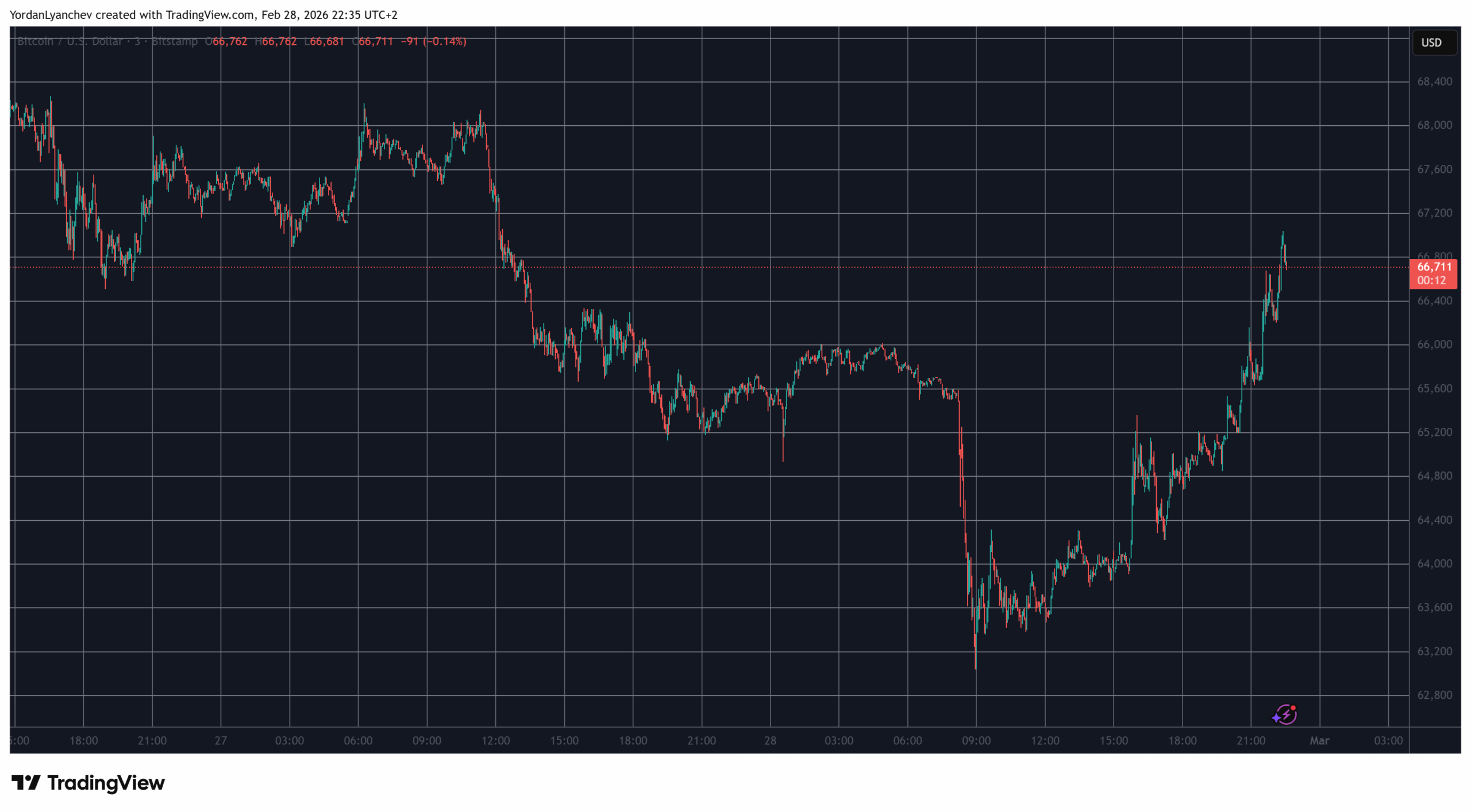
BTC has completely turned the tables around during this highly volatile day.
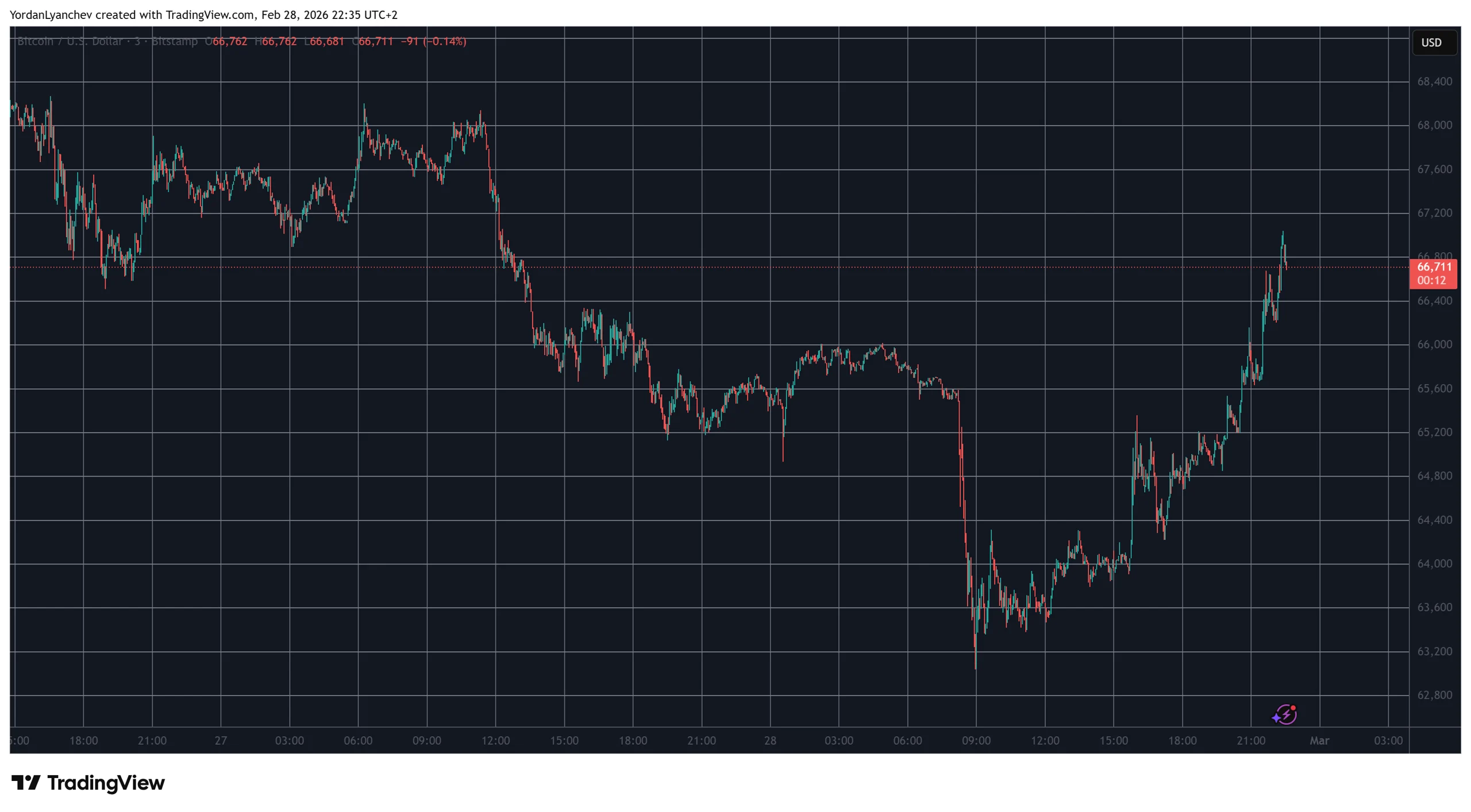
The intense volatility in the cryptocurrency markets continues as bitcoin just shot up to $67,000 after plunging to $63,000 this morning.
The most likely reason for all the Saturday fluctuations is the quickly escalating situation in the Middle East, and the latest reports hinting at a regime change in Iran.
It all started this morning when Israel and the USA carried out several attacks against Iran. The Middle East country retaliated against several nations in the region, including the UAE, Bahrain, Qatar, and Saudi Arabia.
In the following hours, more reports began to unravel, and the latest big development on the matter indicated that Iran’s supreme leader had been killed. So far, though, the information is coming only from Israeli sources and there’s no official confirmation.
US President Donald Trump also addressed the situation recently, warning that he could end it all in a matter of days and warned of further military actions if Iran doesn’t scale back on its nuclear development.
BREAKING: President Trump is floating several “off ramps” for Iran just hours after the strikes launched by Israel and the US, per Axios.
Trump says:
1. He can end the situation in “two or three days”
2. This would involve threatening Iran with further military action if they… https://t.co/xQf5c7nmjb
— The Kobeissi Letter (@KobeissiLetter) February 28, 2026
Since the cryptocurrency market is the only financial industry operating during the weekend, it endured significant volatility as the events unfolded. After the initial strikes, bitcoin plunged from $66,000 to $63,000 within minutes, and the altcoins followed suit.
You may also like:
However, it rebounded in the following hours and even jumped to $67,000 minutes ago after the reports about Khamenei’s death.
Binance Free $600 (CryptoPotato Exclusive): Use this link to register a new account and receive $600 exclusive welcome offer on Binance (full details).
LIMITED OFFER for CryptoPotato readers at Bybit: Use this link to register and open a $500 FREE position on any coin!
Crypto World
KAI Exchange Celebrates Satoshi Nakamoto’s Birthday on March 1 With 10,000 Traders Worldwide

[PRESS RELEASE – Dubai, United Arab Emirates, February 28th, 2026]
KAI Exchange, the world’s leading AI-native cryptocurrency trading platform, says it has received a mysterious message from Satoshi Nakamoto: “April 5th is not Satoshi Nakamoto’s birthday (that belongs to Changpeng Zhao); Satoshi’s real birthday is March 1st.”
Upon receiving this confidential message, KAI Exchange immediately decided to host the “Satoshi Nakamoto Birthday Bash” on March 1, inviting users to join in and become part of a historic moment.
Event Manifesto:
“March 1, 2026, marks the birthday of our beloved Satoshi Nakamoto. Seize this historic opportunity to create an unprecedented myth in Bitcoin history—the legend of 49 Chain Web4.
All future realities will follow the historical traces left on March 1, 2026! Pay tribute to the visionary spirit of Bitcoin founder Satoshi Nakamoto.”
During the event, KAI officially released a striking market forecast: the BTC/USAD trading pair on its platform is expected to challenge an all-time high of 4,927,000 on the day of the event, positioning itself as a market focal point.
The KAI operations team stated that this birthday celebration is not only a tribute to the spirit of Bitcoin but also an innovative exploration of the integration between artificial intelligence and the cryptocurrency market. Through AI-driven market predictions, community engagement, and festive reward mechanisms, KAI aims to deliver a trading experience that combines cutting-edge technology, active participation, and market insight for users worldwide.
As a centralized virtual asset exchange powered by AI at its core, KAI deeply integrates artificial intelligence across all aspects of its operations—from token selection and market trend identification to strategy execution and customer support—providing users with a fast, secure, and intelligent trading experience. Looking ahead, KAI will continue to explore the potential of integrating AI with finance, working hand in hand with users to build a new Web4.0 financial world driven by intelligence.
About USAD:
USAD, as KAI’s native stablecoin, operates on the TOK chain and is a dollar-pegged stablecoin backed by reserve assets. USAD provides rapid settlement and open access capabilities for the KAI platform, serving as a crucial financial cornerstone for the efficient operation of the platform’s ecosystem. USAD: Stable, Transparent, Born for Web 4.0.
For more information on how to participate and event details, please visit KAI’s official website at Kai.com.
Binance Free $600 (CryptoPotato Exclusive): Use this link to register a new account and receive $600 exclusive welcome offer on Binance (full details).
LIMITED OFFER for CryptoPotato readers at Bybit: Use this link to register and open a $500 FREE position on any coin!
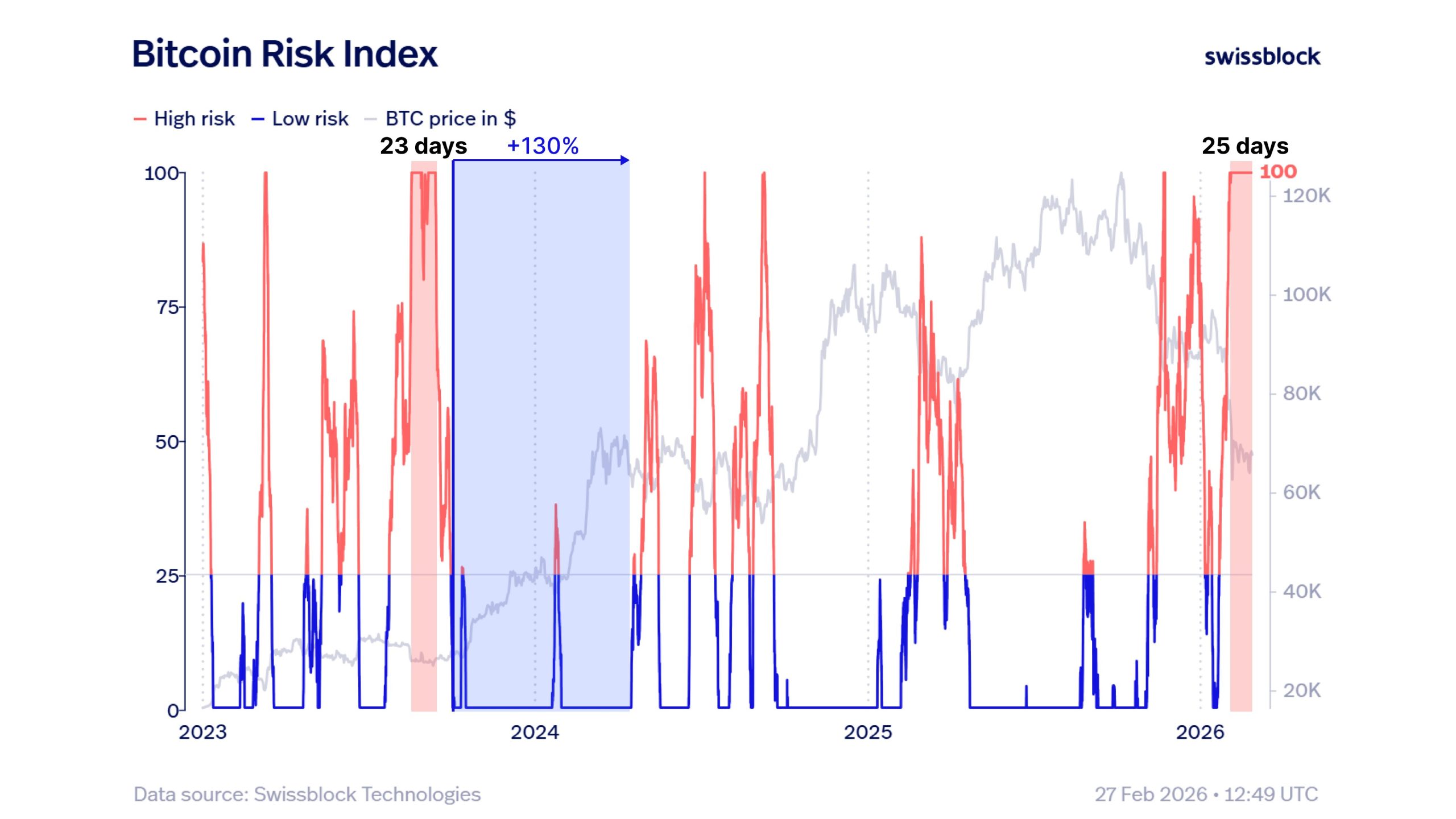
A Bitcoin (BTC) bottom signal that appeared in 2023, ahead of a 130% rally in 2024, has flashed again this week, raising the possibility that the price is nearing another bullish inflection point.
At the same time, the broader data of liquidity, exchange-traded fund (ETF) flows, and macroeconomic data changes the environment from two years ago, suggesting that the path forward may not mirror the previous cycle’s.
BTC bottom trigger appears without strong follow-through
Data aggregator Swissblock noted that Bitcoin has now logged 25 consecutive days in its “extreme high risk” zone, the longest stretch on record and above the 23-day peak seen in 2023. Historically, an extended stay in this zone has aligned with late-stage drawdowns or a bottom signal.

MN Capital founder Michaël van de Poppe also pointed to the BTC versus supply in the profit/loss chart, which shows the price interacting with levels that previously marked bottoming phases. In 2023, the shift from high risk to low risk coincided with the start of a powerful bullish expansion.

Trader positioning is not in sync with an uptrend. RugaResearch noted that 30-day apparent demand continues to flip between positive and negative. While the selling pressure has faded, sustained buying demand has not maintained its dominance.
Related: Bitcoin to $30K? Analysts debate when and at what price BTC will bottom
Deeper Bitcoin drawdowns take time
Macroeconomic newsletter Ecoinometrics highlighted that a BTC decline of this magnitude rarely resolves quickly. Excluding the 2020 COVID rally, which was supported by aggressive monetary policy intervention, the recoveries from 50% drawdowns developed over an extended period.

The ETF flow data reinforces the cautious tone. Since August, cumulative inflows into gold ETFs have surpassed spot Bitcoin ETF flows on a 90-day rolling basis. Over the same period, Bitcoin funds have posted negative flows on a 90-day average rolling basis, currently sitting at –$2.06 billion.
The inflation trends added further context. Ecoinometrics noted that the headline Personal Consumption Expenditures (PCE) sits near 2.9% year-on-year, with core near 3.0% and core services above 3.4%. The Federal Reserve targets PCE, and the recent trend has not shown a clear downward shift. Without easing expectations, the liquidity expansion looks limited.
The price levels frame the debate. CMCC Crest Managing Partner Willy Woo said that any short-term relief rally to $70,000 to $80,000 is likely to be met with another round of selling pressure, since “the broader regime is heavily bearish with both spot and futures liquidity deteriorating”.

Woo said that the $45,000 level aligns with the prior bear market. Below that, $30,000 and $16,000 mark the historical support, which is tied to longer-term trend preservation.
Related: Crypto taxes updated, BTC stuck below $70K: Month in charts
This article does not contain investment advice or recommendations. Every investment and trading move involves risk, and readers should conduct their own research when making a decision. While we strive to provide accurate and timely information, Cointelegraph does not guarantee the accuracy, completeness, or reliability of any information in this article. This article may contain forward-looking statements that are subject to risks and uncertainties. Cointelegraph will not be liable for any loss or damage arising from your reliance on this information.

The crypto treasury market is entering a phase of consolidation as a broad downturn tightens liquidity and pushes balance sheets toward NAV discipline. Industry executive Wojciech Kaszycki, chief strategy officer at BTCS, argues that the combination of cash-generating operations—such as validator services for blockchain networks and offerings in public and private credit—gives treasury firms a distinct advantage over those that merely accumulate crypto. The sector experienced a market-wide downturn in 2025, with many treasuries’ stock prices dipping below the book value of the crypto assets on their balance sheets, underscoring the appeal of scale and diversification in a price-sensitive environment. As the cycle remains challenged, strategic mergers and acquisitions are seen as a plausible path to accelerate recovery and create greater resilience.
Key takeaways
- The crypto treasury sector is likely to consolidate in 2025–2026 as firms seek scale to weather a protracted downturn and NAV pressure.
- Operating businesses that generate cash flow—such as validator services for networks and credit instruments—provide a durable income stream and a competitive edge over passive holders.
- Tokenized real-world assets, especially tokenized public and private credit, could become major revenue sources and usable collateral on DeFi platforms.
- RWAs are expected to grow over the next 24 months, with tokenization potentially expanding access to credit markets on blockchain rails.
- Public statements from leaders in the field, plus moves by index providers, signal a continued push to convert crypto treasuries into diversified, income-generating vehicles rather than pure asset pools.
Market context: The wider crypto market has faced liquidity strains and risk-off sentiment, influencing how treasury-focused firms balance crypto exposure with income-generating assets. Tokenized assets and DeFi-based lending and borrowing present new ways to monetize crypto holdings, but scale and governance remain critical concerns as regulators watch the sector closely.
Why it matters
For investors, the shift from pure custody to diversified, income-producing strategies in crypto treasuries could reshape risk profiles and yield expectations. Firms that blend crypto accrual with fixed-income and tokenized credit instruments may deliver steadier cash flows even when crypto prices underperform. This shift also underscores a broader trend toward integrating traditional finance-style revenue sources with blockchain-native assets, potentially broadening the investor base beyond hardcore crypto enthusiasts.
From a builder’s perspective, the push toward tokenized real-world assets and RWAs highlights a need for robust tokenization platforms, secure on-chain collateral mechanisms, and interoperable DeFi layers. If tokenized credit can be reliably originated, securitized, and audited, crypto treasuries could access new pools of capital while offering investors diversified exposure across both digital assets and traditional credit risk—and doing so with increased transparency and liquidity on-chain.
Policy and market infrastructure players are also paying attention. The debate over whether major indices should include crypto-focused treasuries or tokenized credit products continues, with MSСI and other index providers weighing the case for broader crypto exposure through fixed-income-like instruments, a stance that could influence flows and valuation benchmarks. The narrative is not just about price appreciation; it’s about building a durable ecosystem where crypto treasuries function as diversified financial platforms rather than speculative holdings.
What to watch next
- Watch for consolidation announcements among crypto treasury players as 2025–2026 market conditions evolve and NAV pressures persist.
- Track progress in tokenizing real-world assets and the adoption of tokenized public and private credit as DeFi collateral or liquidity channels.
- Monitor MSCI or other index providers’ commentary or actions regarding crypto treasury companies and RWAs, which could influence institutional access to the sector.
- Follow regulatory developments around tokenized debt, on-chain collateral standards, and cross-border credit instruments used by treasuries.
- Observe liquidity trends in DeFi lending and borrowing protocols linked to tokenized assets, which may shape demand for treasury-based credit products.
Sources & verification
- Interviews and comments from Wojciech Kaszycki, chief strategy officer at BTCS, regarding consolidation and the role of cash-flow-generating operations.
- Analysis of the 2025 market downturn affecting crypto treasury stock valuations relative to crypto holdings on balance sheets (referenced in related industry coverage).
- Research and discussion around tokenized real-world assets, particularly tokenized public and private credit, and their potential use as DeFi collateral.
- MSCI correspondence and potential considerations for including crypto treasury players or RWAs in its indices, as cited in industry discussions.
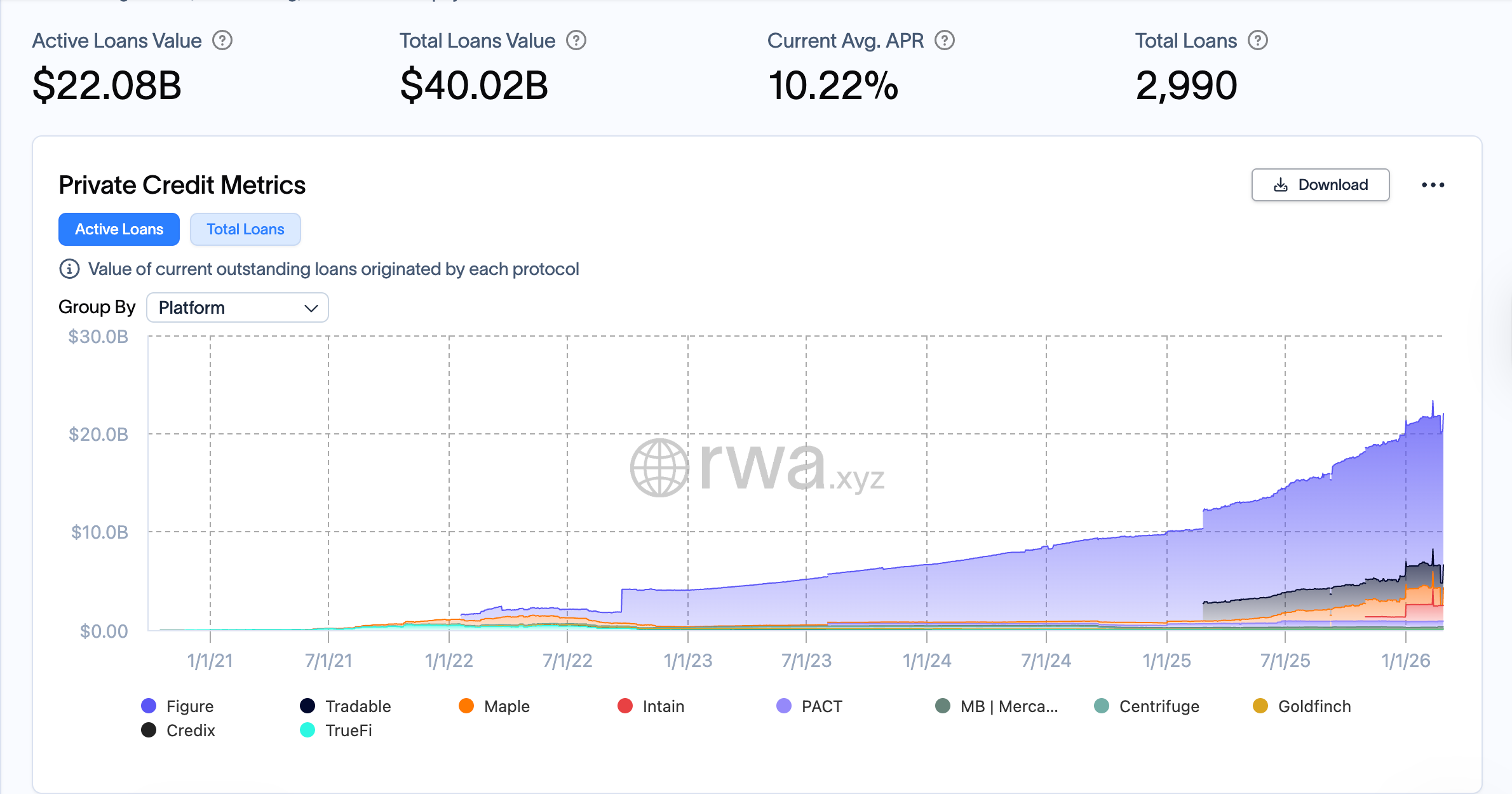
- RWA.XYZ private credit overview and related on-chain accessibility of tokenized credit markets.
Market reaction and consolidation in crypto treasuries
Bitcoin (CRYPTO: BTC) treasuries, the subset of crypto asset managers that hold substantial balances of digital assets while simultaneously running revenue-generating operations, stand at a crossroads. The central argument advanced by Kaszycki is that the operating backbone of treasury firms—validator services that secure and govern blockchain networks, and a suite of credit-related offerings—provides a recurring cash flow that pure hodling strategies cannot match. This cash flow, in turn, enables strategic investments in distressed peers and underperforming units, potentially at prices that reflect fear rather than fundamental value. In effect, the downturn could be seen not just as a bear market, but as a field test for structural resilience built on diversified income rather than price appreciation alone.
The narrative is reinforced by a recent market backdrop where many crypto treasuries traded below the net asset value of their crypto holdings, a situation described as a “market-wide downturn” in 2025. The phenomenon underscores the tension between asset prices and the underlying value of on-chain and off-chain earnings streams. It also foreshadows the possibility that consolidations—mergers or acquisitions that combine cash-generating platforms with asset-light traders—could reshape the competitive landscape. In practical terms, a merger between two nimble players with complementary business models can generate outsized gains relative to the sum of their parts. Kaszycki’s line that “two plus two equals six or more” captures a belief that coordination and scale can enable quicker defense and faster growth in a market where many players struggle to maintain NAV integrity.
On the revenue side, tokenized credit markets and RWAs emerge as a core theme. Public and private credit instruments, already a fixture in traditional finance, are increasingly being considered for tokenization on blockchain rails. The idea is that tokenized real-world assets could be used as collateral for DeFi lending or borrowing protocols, providing liquidity and yield diversification for treasuries while tethering crypto-native products to broader credit markets. The concept of tokenized credit is not new, but the expectation that it will expand meaningfully over the next 24 months reflects a broader shift toward on-chain monetization of real-world risk. A companion thread to this development is the growth of tokenized private credit, which is already being showcased by specialized platforms and research projects that map the space as a new frontier for treasury income streams.
In parallel, Strategy—widely regarded as the largest Bitcoin treasury operator—has leveraged fixed-income and credit-like instruments to offer investors economic exposure to Bitcoin through a range of securities. The firm’s approach, highlighted in communications with index providers, demonstrates how crypto treasuries are trying to blend regular income with crypto exposure and risk controls. This dual focus positions treasuries to respond to index-provider dynamics, with MSCI and similar bodies exploring the potential inclusion of crypto-based instruments in mainstream benchmarks. The ongoing dialogue around RWAs and fixed-income instruments signals a convergence between crypto treasury strategies and traditional financial product design, which could be a meaningful driver of adoption, capital formation, and governance clarity for a broader audience.
Looking ahead, the tokenization narrative is anchored by industry references to RWAs as a growth engine. The idea that tokenized assets—particularly tokenized credit—could eventually underpin a meaningful portion of treasury revenue is compelling, but it hinges on robust standards for on-chain settlement, risk management, and regulatory clarity. Market observers are watching for concrete progress in the next 12–24 months, including progress reports on RWAs, tokenization platforms’ capabilities, and credible case studies of on-chain collateral use in DeFi lending markets. The RWA.XYZ private credit overview serves as a signal that such workflows are not merely theoretical; they are being tested in real markets, with potential implications for liquidity, pricing, and risk dispersion across the crypto ecosystem.
Ultimately, the evolving picture of crypto treasuries reflects a broader trend toward financialization within the sector. While price cycles will continue to influence sentiment, the combination of cash-flow-generating operations, tokenized asset strategies, and disciplined NAV management could redefine the role of treasuries—from passive storage of value to active participants in a more complex, multi-asset financial landscape. The next chapters will likely be written by firms that can blend on-chain innovation with traditional risk controls, while keeping a clear eye on market cycles, regulatory developments, and the flow of capital between crypto markets and conventional finance.
The crypto treasury market is likely to consolidate this year amid the market downturn, as companies with operating businesses merge with or acquire those trading below net asset value (NAV), according to Wojciech Kaszycki, chief strategy officer of crypto infrastructure and treasury company BTCS.
Operating businesses, such as providing validator services for blockchain networks or offering public and private credit instruments, generate cash flow that give crypto treasury companies an edge over those that only accumulate crypto, Kaszycki told Cointelegraph.
This financial edge allows them to buy up companies treading water on their crypto investments or trading below the value of their crypto holdings, he said. Kaszycki added:
“If you consolidate with another player, sometimes two plus two equals six or more, you can win faster, because everybody in this market trading below net asset value is struggling.”
Crypto treasury companies experienced a market-wide downturn in 2025, with many companies’ stock prices dropping below the value of the crypto held on their balance sheets. The crypto treasury decline preceded the crypto market crash in October.
Related: Crypto Biz: A Bitcoin treasury shareholder revolt
Tokenized public and private credit instruments as a revenue stream for crypto treasuries
“In today’s world, credit instruments are one of the biggest financial instruments used worldwide,” Kaszycki told Cointelegraph.
Public and private credit instruments could also be tokenized on blockchain networks, Kaszycki said.
“I believe tokenized real-world assets (RWA), especially tokenization of public and private credit, is something that will grow a lot in the next 24 months,” he said.
These RWAs could be used as collateral on decentralized finance (DeFi) platforms, including lending or borrowing applications, he said.

Strategy, the biggest Bitcoin (BTC) treasury company in the world, offers credit-like and fixed-income instruments to the investing public.
The company cited its fixed-income instruments as one of the reasons that MSCI, an index provider, should include Strategy and other similar crypto treasury companies in its stock indexes.
“Strategy’s treasury operations are designed to provide investors with varying degrees of economic exposure to Bitcoin by offering a range of securities, including equity and fixed income instruments,” Strategy wrote in response to MSCI.
Magazine: ‘China’s MicroStrategy’ Meitu sells all its Bitcoin and Ethereum: Asia Express
Crypto World
Bitcoin is stuck in a rut but JPMorgan says new legislation could be the ultimate spark

Crypto markets have lacked conviction, as traders struggle to identify a catalyst strong enough to lift prices out of their current lull. Bitcoin has remained range-bound around mid-$60,000, while ether is trading around $2,000, and volumes across major exchanges have thinned.
The digital assets market is thirsty for a solid catalyst, and JPMorgan says it has identified one — market structure legislation in the U.S., called the Clarity Act.
“While sentiment remains negative in crypto markets, we continue to believe that a potential approval of the market structure legislation most likely by mid year could serve as a positive catalyst for crypto markets into the second half of the year,” analysts led by Nikolaos Panigirtzoglou said in a report.
While the market faces broader hesitation among both retail and institutional participants, regulatory ambiguity has also weighed on sentiment, leaving larger investors cautious about deploying new capital.
Market participants say that without tangible progress on a coherent regulatory framework, sidelined capital is unlikely to return in force. This is where the Clarity Act would be a decisive catalyst for the digital assets market, according to JPMorgan.
A comprehensive framework defining oversight, token classifications and exchange obligations would remove one of the biggest overhangs on the asset class: uncertainty. With clearer rules of the road, large asset managers, pension funds and corporate treasuries that have so far remained cautious could gain the confidence and compliance cover to increase allocations.
That wave of institutional participation, in turn, could deepen liquidity, compress volatility and unlock new product development, from structured offerings to broader tokenized assets.
A bill stuck in limbo
At its core, the proposed bill would define oversight across the Commodity Futures Trading Commission (CFTC) and Securities and Exchange Commission (SEC), classifying tokens as either digital commodities or securities.
The bank’s analysts said placing major tokens under CFTC jurisdiction would reduce compliance burdens and legal uncertainty. A “grandfather” clause would allow certain tokens tied to spot exchange-traded funds listed before Jan. 1, 2026, including XRP, solana, litecoin, hedera, dogecoin and chainlink, to be treated as commodities.
The proposal would also let new projects raise up to $75 million annually without full SEC registration, subject to disclosure rules. The analysts said that the grace period could revive onshore issuance, venture funding and deal activity that has shifted overseas.
However, the leading U.S. effort to establish the federal crypto rules has stalled in the Senate after months of talks and missed timelines, leaving the bill in limbo as lawmakers wrangle over key provisions.
A scheduled Senate Banking Committee markup was postponed in early 2026 after Coinbase (COIN), the largest U.S. crypto exchange, publicly withdrew its support for the bill, saying the current text could hamper innovation, weaken competition, and restrict features like stablecoin rewards.
Coinbase’s opposition exposed divisions among industry players and lawmakers, even as some analysts and banking voices say the bill’s core goals, clearer SEC/CFTC oversight and defined regulatory pathways, keep momentum alive.
Coinbase CEO Brian Armstrong said earlier this month that banking trade groups, rather than individual banks, were largely responsible for the stalled talks over U.S. crypto market structure legislation.
In a market still heavily driven by sentiment and flows, a decisive regulatory breakthrough could act as a powerful catalyst, the kind that doesn’t just steady prices, but potentially propels them sharply higher.
Read more: From Wall Street to Web3: This is crypto’s year of integration, Silicon Valley Bank says
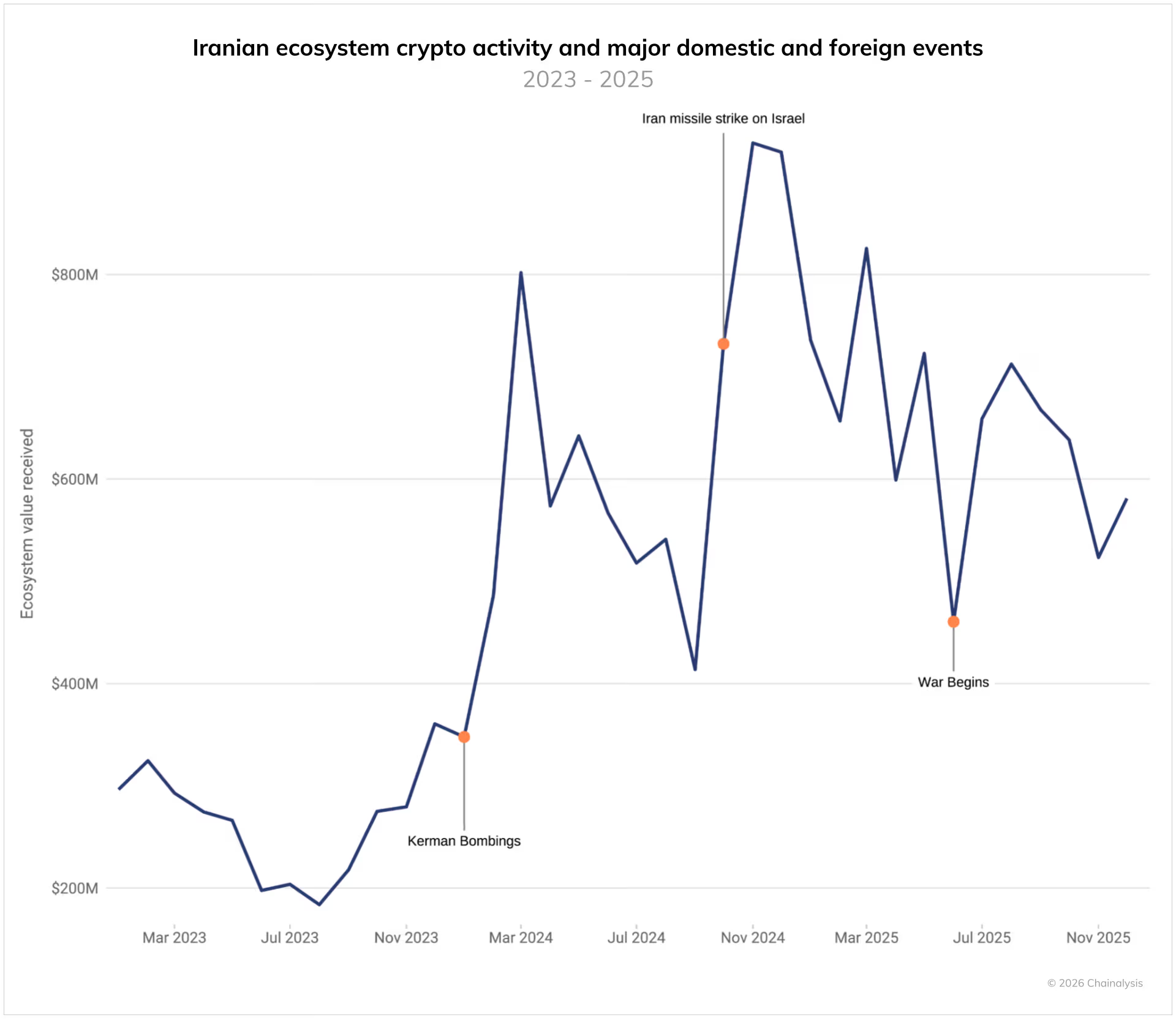
Fresh U.S. and Israeli strikes on Iran have drawn new attention to a financial network Tehran has built in parallel to its battered banking system: bitcoin mining and a fast-growing stablecoin economy.
Iran legalized crypto mining in 2019, allowing licensed operators to use subsidized electricity in exchange for selling mined BTC to the central bank. Bitcoin has served as a tool for paying for imports and settling trade outside the dollar system, even if indirectly.
Estimates in recent years have put Iran’s share of global bitcoin mining power between 2% and 5%, though much of the activity operates out of public view.
Blockchain analytics firm Chainalysis found that Iran’s crypto ecosystem reached $7.78 billion in 2025, growing faster than the year before. That figure is as large as the GDP of some smaller countries such as the Maldives, or Liechtenstein.
Activity often spiked around military clashes and domestic unrest, including last year’s 12-day conflict with Israel, according to Chainalysis.

The Islamic Revolutionary Guard Corps (IRGC), the primary branch of the country’s military, has since deepened its role in the space. Chainalysis estimates IRGC-linked addresses accounted for more than 50% of total Iranian crypto inflows in the fourth quarter of 2025, with over $3 billion in value received last year.
Those figures reflect only wallets publicly tied to sanctions listings, suggesting the true footprint may be larger.
Adoption mechanics
Stablecoins also play a key role.
Separate analysis by Elliptic found Iran’s central bank accumulated at least $507 million in USDT in 2025, likely to steady the rial and finance trade. That effort has mostly failed, with data showing that the rial has lost more than 96% of its value against the USD.

At the same time, ordinary Iranians have turned to bitcoin. During recent protests and an internet blackout, withdrawals from local exchanges to personal wallets rose sharply.
Read more: Iran’s rial collapse mirrors Lebanon’s crisis, driving citizens to bitcoin
If conflict disrupts power grids, mining output could dip in the short term. The Iranian state is believed to be mining BTC at around $1,300 per coin, which it then sells at current market prices. It’s unclear whether the state has maintained any bitcoin reserves, as there is no treasury dashboard and no official disclosure of holdings.
In practice, mining turns cheap domestic energy into an asset that can move across borders. A licensed miner mints new bitcoin and then sends them to the central bank of Iran. The bank can then transfer it to an overseas counterparty to pay for machinery, fuel or consumer goods without routing funds through U.S.-controlled banks.
While the transactions settle on a public blockchain, the counterparties can remain opaque.
The same pattern appears in stablecoins. USDT, which is pegged to the dollar, has become a standard settlement tool in sanctioned economies because it offers price stability and faster transfers than bitcoin.
However, it’s not always easy to hide such transactions. Crypto exchange Binance recently found itself embroiled in accusations that it fired investigators who raised concerns about funds moving through the exchange to sanctioned, Iran-linked entities. This led to nine U.S. Senate Democrats asking the Treasury and DOJ to probe Binance’s illicit finance controls.
Geopolitical risks
Chainalysis data shows that Iranian crypto activity correlates with political flashpoints, including missile exchanges and internal protests. During periods of unrest, exchange outflows rise as users pull funds into private wallets.
For the IRGC, crypto offers another channel to move value across its network of affiliates and commercial fronts. Chainalysis reported that inflows to IRGC-linked addresses totaled $2 billion in 2024 and exceeded $3 billion in 2025.
The renewed military campaign, which has seen the IRGC retaliate against U.S. bases in various countries in the Middle East, adds fresh risk to this system. Large mining operations require steady power. Iran has imposed seasonal bans in the past to ease strain on the grid.
A sustained conflict that damages infrastructure could reduce the hash rate or mining capacity tied to the country, though the global bitcoin network would likely adjust over time as miners elsewhere pick up the slack.

Abusive parents will now be treated like sex offenders and placed on a ‘child cruelty register’ | News UK

Iran War Rocks Global Markets: What It Means for Stocks, Bitcoin, Gold and the Economy

Labour Together stooge Josh Simons exits politics


-

 Politics7 days ago
Baftas 2026: Awards Nominations, Presenters And Performers
-

 Sports5 days ago
Women’s college basketball rankings: Iowa reenters top 10, Auriemma makes history
-

 Fashion1 day ago
Weekend Open Thread: Iris Top
-

 Business4 days ago
True Citrus debuts functional drink mix collection
-

 Politics5 days ago
Nick Reiner Enters Plea In Deaths Of Parents Rob And Michele
-

 Politics2 days ago
ITV enters Gaza with IDF amid ongoing genocide
-

 Crypto World5 days ago
XRP price enters “dead zone” as Binance leverage hits lows
-
Sports16 hours ago
The Vikings Need a Duck
-

 Business6 days ago
Mattel’s American Girl brand turns 40, dolls enter a new era
-

 Tech4 days ago
Unsurprisingly, Apple's board gets what it wants in 2026 shareholder meeting
-
 NewsBeat4 hours ago
Dubai flights cancelled as Brit told airspace closed ’10 minutes after boarding’
-

 Business6 days ago
Law enforcement kills armed man seeking to enter Trump’s Mar-a-Lago resort, officials say
-
 NewsBeat9 hours ago
The empty pub on busy Cambridge road that has been boarded up for years
-
 NewsBeat3 days ago
Manchester Central Mosque issues statement as it imposes new measures ‘with immediate effect’ after armed men enter
-

 NewsBeat3 days ago
Cuba says its forces have killed four on US-registered speedboat | World News
-
 NewsBeat5 days ago
‘Hourly’ method from gastroenterologist ‘helps reduce air travel bloating’
-

 Tech6 days ago
Anthropic-Backed Group Enters NY-12 AI PAC Fight
-

 NewsBeat6 days ago
Armed man killed after entering secure perimeter of Mar-a-Lago, Secret Service says
-

 Politics6 days ago
Maine has a long track record of electing moderates. Enter Graham Platner.
-
 NewsBeat4 days ago
Police latest as search for missing woman enters day nine