Pope Leo XIV has broken his silence following the attacks on Saturday
Husna Anjum, Annette Belcher and Husna Anjum Senior Live News Reporter
20:47, 01 Mar 2026
Pope Leo XIV has urged for “peace,” calling for world leaders to stop the “cycle of violence” following the Israeli-US missile strikes that led to the death of Iran’s Supreme Leader Ayatollah Ali Khamenei.
Further retaliation strikes were launched by Iran with the Pope expressing “deep concern” in what he called a “tumultuous time”. The Express reports he added: “Stability and peace are not achieved through mutual threats, nor through the use of weapons, which sow destruction, suffering, and death, but only through reasonable, sincere, and responsible dialogue.
Advertisement
“Faced with the possibility of a tragedy of enormous proportions, I address to the parties involved a heartfelt appeal to assume the moral responsibility to stop the spiral of violence before it becomes an irreparable abyss!”
The Holy Father also prayed for nations during the weekly address at St. Peter’s Square and urged to revisit diplomatic solutions in order to secure peace.
“May diplomacy recover its role and may the good of peoples be promoted, peoples who long for peaceful coexistence founded on justice,’ he noted, ‘And let us continue to pray for peace.”
The first American-born pope has previously voiced concern over the Trump administration’s foreign policy, warning of a “zeal for war” following U.S. military operations in the Caribbean and the capture of Venezuelan leader Nicolás Maduro.
His most recent comments come as tensions in the region sharply escalated following the joint U.S.–Israeli operation targeting Iranian leadership and military sites. Washington has defended the strikes as necessary for security, while Tehran has vowed retaliation, raising fears the conflict could spread across the wider Middle East.
The pontiff did not name any country directly but urged leaders to recognise the humanitarian consequences of further escalation. He warned that ordinary civilians would bear the heaviest cost if fighting continues.
Want to see more of the stories you love from Belfast Live? Making us your preferred source on Google means you’ll get more of our exclusives… To add Belfast Live as a preferred source, simply click here.
The 22-year-old had been seen as a potential option for Wales going forward
Welsh-qualified centre Riley Higgins has signed for Edinburgh in a blow to Steve Tandy’s hopes of strengthening his playing options.
Advertisement
Despite the Welsh Rugby Union scrapping its Exiles programme last year, the need to expand Wales’ player pool is more pressing than ever, with high-ranking figures within the union casting the net across the globe to find new names. Higgins, who currently plays for Super Rugby Pacific outfit the Hurricanes, was one player seen as a potential option for Tandy, with the 22-year-old qualifying for Wales through a grandmother.
However, the New Zealander is also eligible for Scotland through his Ayrshire-born grandmother, and he has seemingly signalled his international intentions by signing for Edinburgh on a three-year deal from next season.
Higgins – who can play at 12, 13 or on the wing – is highly thought of in New Zealand rugby circles, making his Super Rugby debut before playing any NPC rugby.
Advertisement
He has also represented New Zealand U20s and an All Blacks XV and has unsurprisingly attracted a lot of interest from around the globe in recent times, with English, Japanese and other Super Rugby clubs also thought to be keen on securing his signature.
But while he was previously seen as a player who could potentially add some x-factor to the Wales midfield, Higgins has decided the next step of his career will come in Scotland, and he will more than likely come into contention for international selection by Gregor Towsend from next season.
“I can’t wait to get stuck in with Edinburgh,” he said as his signing was confirmed on Sunday. “It’s a big move but the challenge of testing myself in a new competition, with such a great team and such passionate fans is very exciting.
“The club has a great feel to it, and I can’t wait to grow my game with Edinburgh Rugby over the next few years. I’m still young and learning but I’m hungry to improve as a player and person on and off the field, and help the team wherever I can in the hope of winning some titles.
Advertisement
“Fans can expect a hard-working player who will never give up, and someone who brings an exciting style of play,” Higgins added. “I can’t wait to see you all soon!”
Edinburgh head coach Sean Everitt added: “Riley is an outstanding talent and this is a significant signing for Edinburgh Rugby.
“He has already proven himself at the highest level in the southern hemisphere – a player who was keeping All Blacks out of the Hurricanes’ starting lineup before his 24th birthday – and we believe the best is still very much to come from him.
“The fact that he has chosen to turn down a potential All Blacks future, and has rejected higher offers elsewhere, to come to Edinburgh tells you everything about his ambition to succeed in Scotland. We worked enormously hard over many months to get this deal over the line, and I’m delighted we’ve got it done.
Advertisement
“At 23, Riley still has room to grow, and I genuinely believe the best is still to come from him. Alongside guys like Matt Currie and Mosese Tuipulotu, we are building something really exciting in our midfield, and I know our supporters will enjoy watching this group develop together. I can’t wait to have him with us this summer.”
Local councillors objected to the proposal, calling it ‘unneighbourly’
19:02, 19 Apr 2026Updated 19:04, 19 Apr 2026
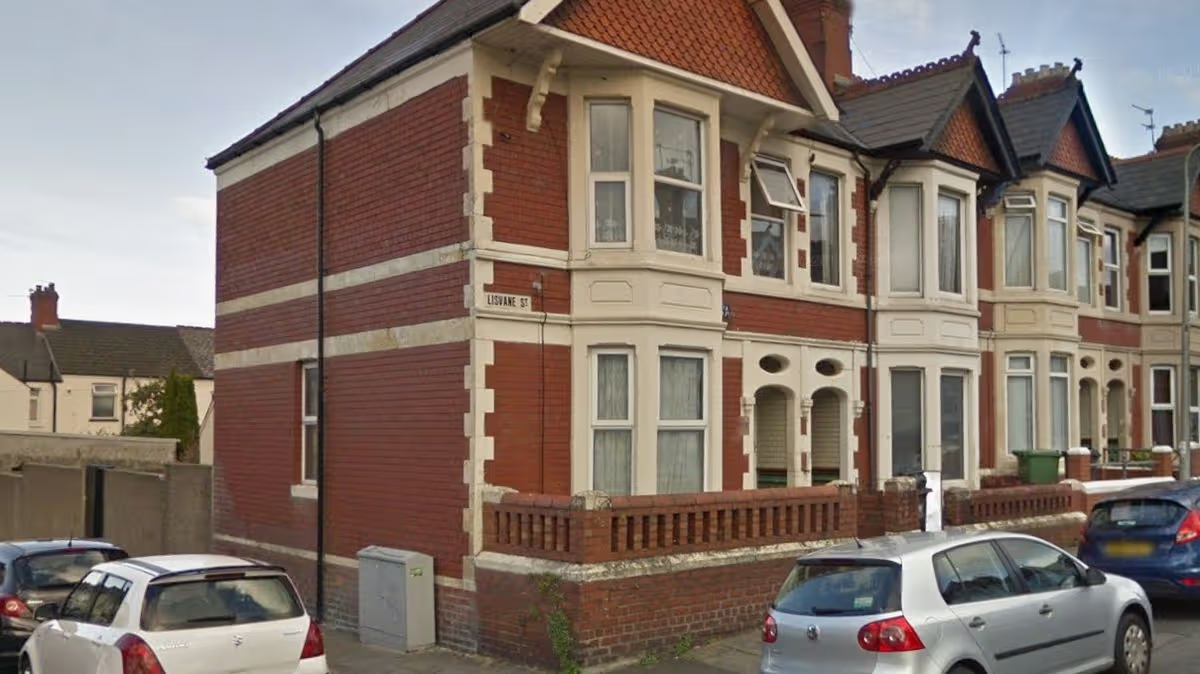
Local councillors are outraged over plans for a flat conversion in Cardiff which they have described as an “unneighbourly development”. The plans propose the conversion of the existing two flats at 15 Lisvane Street in Cathays into three self-contained flats, along with extensions to the building.
Cardiff councillors Sarah Merry, Christopher Weaver and Norma Mackie sent a letter to the council’s planning office objecting to the application on the grounds of it being an “unneighbourly overdevelopment” that will “impact negatively on neighbouring properties”.
Part of the letter reads: “The extension covers the full width of the plot leaving only a small remaining amenity area after the inclusion of cycle parking within 5 metres of the rear boundary wall. Never miss a Cardiff story by signing up to our daily newsletter here
Advertisement
It continues: “Visually as it is the corner property it will be very visible and impact negatively on the character of the area.”
The application reads: “The design aims to achieve an optimal balance between maximizing the use of available space and preserving the character and structural integrity of the original building plus retaining the ground floor shop use.”
It also states that parking, landscaping and waste management will be “addressed” to minimise the impact on the local community.
The applicant, JNR Properties, wrote that the development would be a “harmonious blend of old and new, where the character of the existing building is respected while adapting it to meet contemporary housing needs.”
Advertisement
The planning officer’s report reads: “The scale of the proposal and its relationship with neighbouring properties is considered acceptable.
“It is considered that the proposal would not be overbearing or generally un-neighbourly which would justify concern.”
The councillors’ objections were noted by the report.
All extensions planned for the property were also called “acceptable”.
Advertisement
According to the application, the front of the property will be preserved or “sensitively altered” to “blend seamlessly with the surrounding neighbourhood”.
Planning documents also read: “The design will create high-quality, sustainable, and functional living spaces that enhance the value of the property and positively contribute to the local community.”
Adam Thomas can currently be seen competing on I’m A Celebrity…South Africa but months after it was all filmed, he has broken his silence after scenes involving his controversial campmate aired.
The actor, 37, who is best known for his roles in Emmerdale and Waterloo Road, can currently be seen competing on the all-stars edition of Ant and Dec’s reality survival show, almost a decade after he appeared on the regular edition of the series.
Earlier this week, boxer David, who was already at the centre of at the centre of controversy thanks to comments he made that were branded sexist, tried to bully Adam to take part in Termite Terror, unable to accept that the former Strictly Come Dancing contestant just wasn’t feeling up to it, reports the Mirror.
Adam has arthritis, which he has been open about. Explaining how it affects him, he said previously: “It is an autoimmune disease. Basically means my immune system is attacking my own body. It causes a s**t-load of pain,” and he has now admitted that it has all been a struggle to watch his time on I’m A Celebrity play out on TV.
Alongside an image from the show, which was filmed towards the end of last year, Adam wrote on Instagram on Sunday evening: “Not going to lie, this picture breaks my heart, as I know on the inside what I was dealing with and truth be told I thought it was all my fault. I now know that’s not the reality… My time in I’m a Celebrity South Africa was one of the toughest things I’ve ever been through, physically, mentally, and emotionally.
“Watching it back hasn’t been easy at all. There were moments I felt pushed to my absolute limit, and if I’m honest, times I didn’t even recognise myself. Living with arthritis is something I don’t really talk about, as much as I should do…but in there it really took its toll. My biggest fight was pretending to put on a brave face and trying to hide the pain! that can be exhausting within itself. There were days my body just didn’t want to keep going, but I did.
“I won’t sit here and say I handled everything perfectly, because I didn’t. I wish I spoke up for myself sooner. I wish I stood my ground instead of trying to keep the peace, but I’ve learned that being kind doesn’t mean being weak, and sometimes it takes going through tough moments to find your voice.
“Since coming out, I’ve taken time to process everything, and I’m in a much better place now. I let go of the anger, had the conversations I needed to have, and chose peace.
Advertisement
“What I’m most proud of, is at times like this I wanted to walk, I wanted to quit but I didn’t . Even when I wanted to walk away, even when it felt like too much, I never give up! and that means everything to me.
Advertisement
“He broke me in there, he pushed me to my limits, and I’ve told David this and he’s apologised and that’s that! I’ve moved on now, am not one to hold a grudge. But thank you for all your lovely messages and all the kind words We all face people and situations that try to break us, but sometimes those moments are what rebuild you stronger than ever. Be kind.”
Adam was inundated with comments of support from fans, with one writing: “You came over in there as such a beautiful human @adamthomas21 You know your own truth You were Always my Winner.”
Another said: “Your genuine & kind. You rose above it & kept going. That is strength. You’ve put it behind you & that stands for everything you are. Thats why you have everyone’s support,” whilst a third wrote: “Those living with these awful autoimmune diseases are the real strong ones. Try living in pain daily and still putting a smile on your face and looking as if you’re not in pain. The fatigue is often worse than the pain. And symptoms can creep up on you at any moment. No warnings.”
It all came to blows as Adam tried to sleep and admitted it would be hard for him to undertake a Bushtucker Trial because he was feeling dehydrated. David raged: “Dehydrated?! We’ve all got the same amount of water! Adam is doing it and that’s it!”
Advertisement
“When is your top form gonna come? Why aren’t we forcing this dude to go and do it? Coincidentally, every time there’s something to do, he’s not feeling well.” It was at that point that Gogglebox legend Scarlett Moffatt, who won I’m A Celebrity…Get Me Out Of Here! in 2016, weighed in as she begged David to “stop it.”
Early on in the series, he made comments about his girlfriend Sian. When talking about his partner cooking for them all, he then added: “She’s like tall, blue eyes. She’s lovely. She’s got the personality of a proper ugly bird.”
Despite Scarlett’s suggestion he should stop there, he continued his tirade as he added: “She has. Most ugly girls realise they don’t they’re not pretty enough to… they gotta have a personality to banter and to tell jokes and s**t, so people overlook the fact that they’re not aesthetically amazing, straight away.
Advertisement
“Which is what’s called Ugly Duckling syndrome, where girls are ugly, when they start off, and then they and then they kind of they, they get pretty as they get older. But they still got the personality of when they’re ugly. Does that make sense?”
In the rant, which left angry viewers fuming, he added: “You get a girl who’s pretty from day one, you get a girl who’s different day one. Everyone goes ‘You’re so beautiful. You’re amazing’. She grows up thinking, I’m amazing. Everyone loves me. I can open any door. I can go anywhere I want.
“They don’t have to have a personality, because most super pretty girls are just idiots. But then their ugly friend, they’ve got work a bit harder, be more personable. They got to be nicer to everyone. Gonna get you a drink.”
Get more Daily Record exclusives by signing up for free to Google’s preferred sources. Click HERE
The Irish TV presenter is expecting hers and Spencer Matthews’ fourth child
22:06, 19 Apr 2026Updated 22:33, 19 Apr 2026
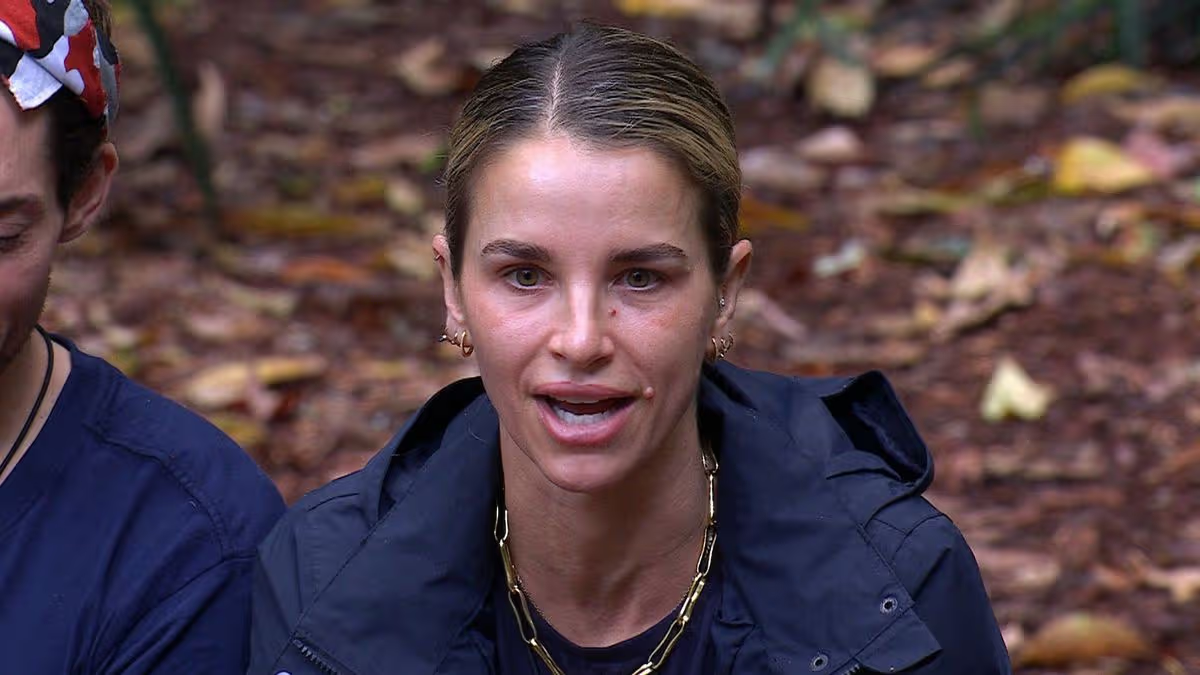
Vogue Williams has revealed that she suffered ‘pregnancy loss’ twice, just days after announcing that she’s pregnant.
The 40-year-old Irish TV presenter, who competed on I’m A Celebrity last year, announced she was pregnant with her and her husband’s, former Made In Chelsea star Spencer Matthews, fourth child on Thursday (April 16).
The couple share three children together; son Theodore, seven, daughter Gigi, five, and a son Otto, three. On top of their parenting duties, they are often presenting the Vogue and Spencer podcast together, where they delve into the ins and outs of their lives.
Advertisement
Click here to get the biggest stories straight to your inbox in our Daily Newsletter
First meeting in 2017 on Channel 4’s The Jump, Vogue and Spencer tied the knot in an intimate ceremony at his family’s Glen Affric estate in Scotland the following year. The couple held a second wedding celebration in 2019.
Vogue confirmed her pregnancy on Instagram, gushing: “BABY NUMBER 4 INCOMING…” as she shared a carousel of pictures from their family holiday in a sunny St Barts. She showed off her bump, with her children in the next picture posing alongside the happy mum and dad to be.
Now, Vogue has taken to her What Does She Even Do? YouTube channel to open up about ‘pregnancy loss’. Vogue said the first happened before the birth of daughter Gigi in 2020, and the second took place last year.
Advertisement
She said: “Trigger warning, pregnancy loss, if anyone doesn’t want to watch, don’t. So it happened to me before I had Gigi, not just me, it happened to Spencer as well obviously, and it was so early on, like so, so early on, we hadn’t had any scans, we hadn’t anything like that, and I must have been maybe a month, if even and it was just one of those things.
“And it was awful but everything happened quite quickly after it as well, so I never really kind of thought about it much. It was really upsetting at the time but then I was pregnant quite quickly after.
“But it actually happened to me last year as well, and it was just, I was literally about to tell the kids… you could kind of start telling I was three months, I just didn’t go for an early scan. I just never even thought about it because I kind of didn’t want to make a fuss.”
Advertisement
Vogue went on to say that she felt ‘quite sick’ but ‘not as sick as I would usually feel during pregnancy’, before discovering that ‘basically the embryo hadn’t grown’.
She added: “Usually you just naturally get a miscarriage, but I didn’t, it just kept like it would have eventually happened, but it just didn’t at the time, and I was three months along, and (the doctor) was just like, I’m really sorry… it’s not really a pregnancy.”
The incidents have left Vogue feeling ‘nervous’ about her current pregnancy,but she is ‘grateful that I feel so sick all the time because then I know it’s there’.
“I wasn’t sure if we wanted to try again because I just felt like I really don’t want to have to go through that again. I’m glad we did, obviously, but now I just have this constant nervousness around hoping that everything is going to be all right,” she stated.
Our thoughts are with those who have lost a loved one
Announcing the passing of a loved one in local news media is a long standing tradition and we are proud of the trust placed in us to make these important announcements. Every notice published to our newspaper and news site also appears on funeral-notices.co.uk – the UK’s number one site for death notices and memoriams. Every notice remains online forever providing friends and families with a lifelong tribute to their loved one, a safe place online to share memories, add tributes, photographs and make donations in memory.
Advertisement
Each week we pay tribute to the loved ones remembered in our area with a funeral notice and online tribute page. To read the latest announcements and add tributes to those from our area who have passed away, or to create a funeral notice yourself, click here. Alternatively, you can create a notice by calling the team on 01482 908084.
Here are a selection of notices published earlier this week.
Passed away at St George’s Court Care Home on Tuesday 31st March 2026, aged 95 years. Beloved wife of the late Kenneth. Loving mum to Linda, Claire, Ian, Keith (deceased), Bruce, and Lesley. Wonderful grandmother to all her grandchildren, great-grandchildren, and great-great-grandchildren. Joyce will be greatly missed by all her family and friends. Funeral service to take place at Cambridge Crematorium, West Chapel on Monday 27th April at 3.15pm. Family flowers only but donations if desired for the benefit of Alzheimer’s Research UK may be made online via Joyce’s personal InMemory page at www.peasgoodandskeates.co.uk. All other enquiries to 617 Newmarket Road Cambridge CB5 8PA 01223 415255
(NÉE FERRIS) Of Peterborough. Passed away on Tuesday 31st March 2026 at Peterborough City Hospital, aged 61 years. Devoted Wife to Jon. Dearly loved Mother to Joseph and Samuel. Treasured Sister to Maria, Brenda, Tom, Eddie and Brian. Bernie shall be deeply missed by all. Funeral service to be held on Thursday 23rd April 2026 at Our Lady of the Assumption and the English Martyrs, Cambridge at 12:15pm followed by the committal at Fulbourn Parish Cemetery. The family welcome all floral tributes. All other enquiries to 617 Newmarket Road Cambridge CB5 8PA Tel: 01223 415255
Passed away peacefully on Sunday 22nd March 2026 aged 76. Loving mum to Tim and Sarah. She will be sadly missed by all who knew her. Funeral to take place at St Andrew’s Church, Sutton on Tuesday 21st April 2026 at 13:30. Donations, should they be desired are for Cancer Research UK. All enquiries to Ely Funeral Service, 4 Tower Road, Ely, Cambs, CB7 4HW. Tel: 01353 666566
(née Lyttle) of Comberton, Cambridge, died peacefully on Thursday 26 March, 2026, aged 77 years. She was the much loved wife of Robert, mother of Graham, Claire and Alasdair, grandma to Eva and Sophia, and mother-in-law to Ruth and Suzi. A service of thanksgiving for Ruth’s life will be held at St Andrew’s Street Baptist Church, 40-43 St Andrew’s Street, Cambridge, on 29 April at 2.15 pm. Family flowers only, but donations in memory of Ruth may be made to Smile Train UK or Samaritan’s Purse UK, and can be forwarded via H. J. Paintin Ltd, 43 High Street, Linton, Cambridge, CB21 4HS.
Leonard, Anne Frances (nee Ward) of Sheringham, previously of Cambridge. Passed away March 17th 2026 aged 90 years. Beloved wife of Roger (dec) dear mum of Susan (dec), Alan, Brian and Karan (dec), mother-in-law to Stephen and Jane, grandmother and great-grandmother at the seaside. Anne’s funeral is at Cromer Crematorium on Friday 17th April 2026 at 1:30pm. Family flowers only but donations made payable to Lakeshore Health Care Limited can be sent c/o Blyth and Sons Funeral Directors, 4 Cremer Street, Sheringham, NR26 8DZ.
(Betty) (Née Nichols) Of Fulbourn, passed away peacefully on Monday 30th March 2026, aged 94 years. Beloved wife of the late Zygmunt, devoted mother of Elizabeth, Ingrid, Anna, Ryszard and Janina, a much loved grandma, great grandma and aunt. Funeral Service at St. Vigor’s Church, Fulbourn on Wednesday 29th April at 12.00 noon, followed by burial at Fulbourn Cemetery. Traditional funeral dress preferred. All flowers may be sent c/o R. J. Pepper & Son Family Funeral Directors, 1, Telegraph Street, Cottenham, Cambridge, CB24 8QU Tel: 01954 251919
Passed away peacefully at Hunters Down Care Home. Beloved Mum, Grandmother and Great-Grandmother. She will be greatly missed by her loving family and friends. Funeral service to take place on Thursday 30th April at 1.15pm at Huntingdon Crematorium, followed by burial at Sapley Road Cemetery. Family flowers only – donations if desired to Alzheimer’s Society. All enquiries to Central Coop Funeralcare 3 St Peters Road Huntingdon PE29 7AA Tel: 01480 410388
(Tony ) Of Milton, passed away peacefully on April 6th 2026 aged 92 years. Beloved Husband of the late Brenda. Dearly loved Dad of Alison. Much loved Grandfather of James and Grace. Loving Great-Grandfather of Skye, Zach and Milo, also a dear Brother, Uncle and Father-In-Law. Funeral Service at All Saints Parish Church, Milton, on Friday May 1st 2026 at 2pm, followed by private cremation. Family flowers only, donations if desired made payable to The Scout Association, may be left at the service, or sent c/o F W Cook Funeral Service 49 Church Street, Willingham Cambs, CB24 5HS
Dearest Rob, 12th April 2016 – 10 years have passed. And we keep you close in our hearts and in our memories always. Jacqui, Kate, Mia, Izzy, Dolly, Mary, Jean; dear friends and all our families.
To add your own tributes to the loved ones from our area, or to publish a notice for your loved one, visit funeral-notices.co.uk
Our thoughts are with the family and friends of those we have lost.
A spokesman for the Local Government Association said: “The lack of public toilets can disproportionately affect vulnerable groups, including older people, people with disabilities, those with medical conditions, babies and children and people that find themselves sleeping rough.
Clwb Rygbi Cymry Caerdydd remain on course for a league and cup double after sealing WRU Division 2 Cup final win at the Principality Stadium, beating Aberavon Quins 34-15.
The Cardiff-based club currently sit second in Division 2 East Central, just two points behind leaders Wattstown but with a game in hand.
14 points from the boot of Lewis Rutledge proved crucial on their way to cup success – but player of the match Gethin Owen insisted the celebrations wouldn’t last too long with the league to focus on as well.
“We’ve been playing down the occasion all week, so to come here, face a really tough side in Aberavon Quins and get a result like that — what more could you ask for?” said the scrum-half.
Advertisement
“We’ll celebrate tonight, but then it’s straight back to it. We’ve got one game left and we’re just a point off the top of the league — it would be great to do the double.”
Three penalties by Rutledge built a first-half lead for CRCC, who showed signs of their expansive game in fits and starts in the opening 40.
Aberavon Quins rarely threatened, but did put together a calculated assault on the tryline at the end of the half.
However, after some relentless pressure, second-row Callum Beynon was held up over the line.
Advertisement
They would start the second-half by finally troubling the scorers, with fly-half Ryan Pugh knocking over a penalty.
However, that was short-lived – with hooker Jon Buhler sin-binned shortly after.
Opposite number Rhodri Williams capitalised almost immediately, scoring from the driving maul that followed.
Advertisement
Following that try, things started to click for CRCC.
Rhydian Williams broke into the Aberavon half, before impressive fly-half Remiel Wharton ran a lovely line before offloading to No. 8 Harry Moyle to score.
Even when Aberavon were back up to a full compliment, CRCC remained difficult to stop.
Full-back Williams burst onto Cai Hayes’ short ball to cross for their third in the final quarter.
Advertisement
Quins would have some joy, with Drew Kinsey scoring after a superb break and offload by full-back Luis Price.
The boot of Rutledge gave CRCC some breathing space before a hectic end to the match.
After yellow cards to Harri Jones and Hayes left CRCC down to 13 men, Quins No. 8 Dylan McLachlan dived over.
Advertisement
However, CRCC would have the final say – with wing Tomos Jones crossing straight from the kick-off to kickstart the celebrations.
Aberavon Harlequins
Tries: Drew Kinsey, Dylan McLachlan; Cons: Ryan Pugh; Pens: Ryan Pugh.
Clwb Rygbi Cymry Caerdydd
Advertisement
Tries: Rhodri Williams, Harry Moyle, Rhydian Williams, Tomos Jones; Cons: Lewis Rutledge; Pens: Lewis Rutledge x4.
Aberavon Quins: Luis Price; Rhys Edmunds, Conor O’Callaghan, Lewis Cronin, Keanu Piles; Ryan Pugh, Max Phillips; Mikey Burgess, Jon Buhler, Dan Helson, Jack Davies, Callum Beynon, Tyler Hopkins, Drew Kinsey, Dylan McLachlan.
Replacements: Josh Pugh, Graeme Harvey, Dale Bowen, Morgan Evans, Sean Howells, Cam Shine, Morgan Kennerly, Jack Dacey.
Clwb Rygbi Cymry Caerdydd: Rhydian Williams; Lewis Rutledge, Cai Hayes, Carwyn James, Tomos Jones; Remiel Wharton, Gethin Owen; Dafydd Jones, Rhodri Williams, Harri Evans, James Tanner, Ifan Roberts, Rhys Luckwell, Sion Davies, Harry Moyle.
Advertisement
Replacements: Iwan Madoc-Jones, Hedd Jones, Ifan Jones, Elis Jones, George Hobbs, Rhodri Davies-Hughes, Guto Ebbsworth, Harri Jones.
NEW YORK (AP) — Oil prices rose in early trading Sunday as a standoff between Iran and the U.S. prevented tankers from using the Strait of Hormuz, the Persian Gulf waterway that is crucial to global energy supplies.
The price of U.S. crude oil increased 6.4% to $87.88 per barrel after trading resumed on the Chicago Mercantile Exchange. The price of Brent crude, the international standard, climbed 6.5% to $96.25 per barrel.
The market reaction followed more than two days of growing hopes and dashed expectations involving the strait. Iran, which effectively controls the passage, said Friday that it would fully reopen the passage off its coast to commercial traffic. Crude prices plunged more than 9% on the news.
Tehran reversed its decision on Saturday, after President Donald Trump said a U.S. Navy blockade of Iranian ports would remain in effect. Over the weekend, Iran’s Revolutionary Guard fired on several vessels. Trump reported the forcible seizure of an Iranian-flagged cargo ship that tried to get around the blockade.
Advertisement
The US-Israeli war against Iran, now in its eighth week, has created one of the worst global energy crises in decades. Countries in Asia and Europe that import much of their oil from the Middle East have felt the most impact of halted supplies and production cuts, although rapidly rising gasoline, diesel and jet fuel prices are affecting businesses and consumers worldwide.
Asked when he thought U.S. motorists would again see gas cost less than $3 a gallon on average, Energy Secretary Chris Wright said prices at the pump might not go down that much until next year.
“But prices have likely peaked, and they’ll start going down,” Wright told CNN’s “State of the Union” on Sunday.
The price of crude oil — the main ingredient in gasoline — has fluctated dramatically since the U.S. and Israel attacked Iran on Feb. 28, and as Iran retaliated with airstrikes on other Gulf states. Crude traded at roughly $70 a barrel before the conflict, spiked to more than $119 at times, and previously closed Friday at $82.59 for U.S. oil and $90.38 for Brent.
Advertisement
Industry analysts have repeatedly warned that the longer the strait is closed, the worse prices could get.
A fragile, two-week ceasefire between the U.S. and Iran is set to expire Wednesday, while escalating tensions in the Strait of Hormuz puts the fate of new talks to end the war into question.
Even if a lasting deal to reopen the Strait of Hormuz emerges, analysts say it could take months for oil shipments to return to normal levels and for fuel prices to go down. Backed-up tanker traffic, shipowners concerned about another sudden escalation, and energy infrastructure damaged during the war are factors that could impede production and shipment volumes from returning to pre-war levels.
A gallon of regular gas cost an average of nearly $4.05 a gallon in the U.S. on Sunday, according to motor club federation AAA. That’s about 8 cents lower than a week ago, but far higher than $2.98 before the war.
To mark the 20th anniversary of Alan Shearer’s final appearance for Newcastle United FC, one Tyneside brewery is paying tribute with a special edition can of its best-selling Shearer’s Beer.
Heaton-based Anarchy Brewery has released the Shearer’s Foundation Brew 260 Special Edition can, with 50p from every can sold going to the Alan Shearer Centre in Newcastle.
The centre offers free use of sensory spaces and specialist leisure facilities for families living with disabilities.
Advertisement
The launch of the special edition can also coincides with a 12-month fundraising campaign, The Million Pound Mission, which was launched by the Foundation to raise £1m to build a second hydrotherapy pool at the Alan Shearer Centre.
With memberships reaching 10,000, the hydrotherapy pool has become oversubscribed, leaving some families waiting or missing out on access for consistent sessions.
A second pool would alleviate this by increasing capacity and decreasing wait times to continue to support families.
The sales of Shearer’s Beer, a 4.2% pale ale, have already raised more than £6,000 to help the centre support families in need.
Advertisement
Manager of Anarchy Brewery, Phil Beaty, said he hopes beer and football fans will love and support the new Limited Edition can.
“As a brewery rooted in the North East, this release is more than just a beer,” he said.
“It is a tribute to one of the region’s greatest ever sporting icons. A player whose loyalty, leadership and legacy continue to define Newcastle and inspire generations.”
Shearer’s Beer is available at bars and retail outlets across the North East, including The Strawberry, Fenwick, STACK St James, The One Eyed Stag in Whickham, The Blackbird in Ponteland, Enjoy Beer, at Morpeth and the Northumberland Arms at Felton and many more across the region.
During Sunday’s (April 19) episode, millionaire hotel owners Gez and Rosy Chetal swapped their lavish lifestyle with the Bloor family.
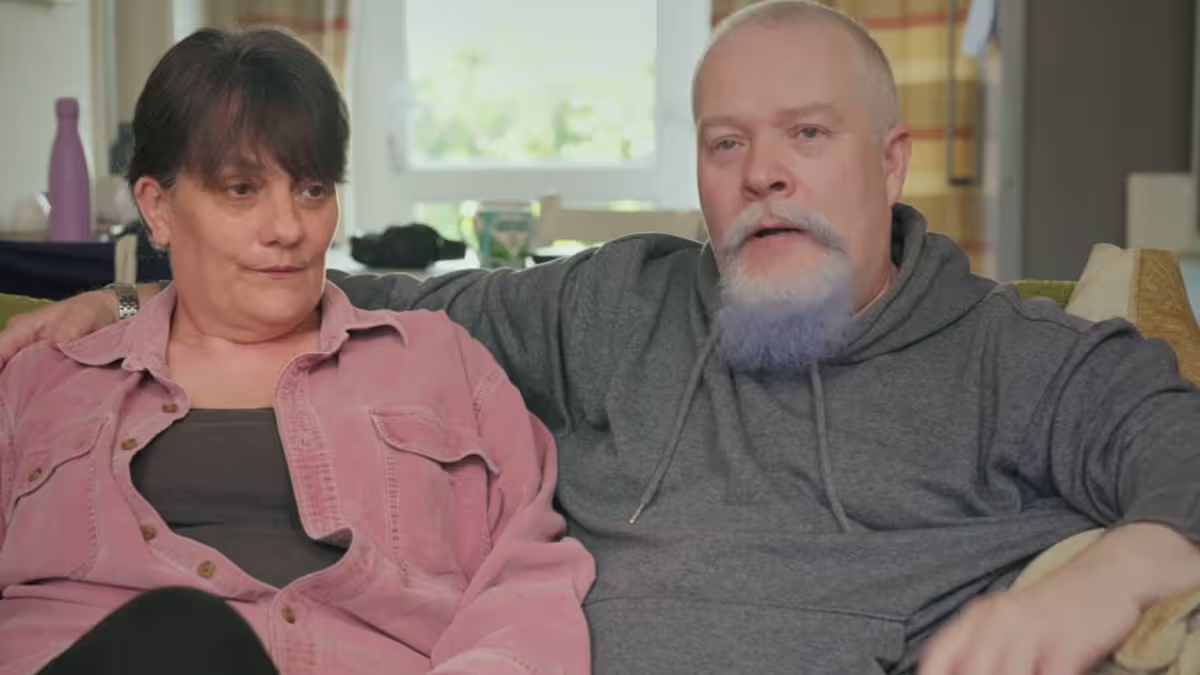
In Norfolk, John and his wife Ann live with their three children in a three-bedroom rented terraced house. Following essential household expenses, they have merely £79 per week to cover everything else, from groceries and transport to leisure activities.
Mother Ann is employed as a cook in a mental health care facility, while husband John puts in lengthy shifts as a bus driver, though both share a love of cooking.
Despite working tirelessly, the couple find it difficult to balance the books and have previously declared bankruptcy for £36,000, yet they aspire to operate a music café of their own someday.
Advertisement
Discovering how the wealthiest 1% exist, they swapped homes for a week with hotel proprietors Gez and Rosy Chetal, who resided in their opulent £1.7 million 11-bedroom bespoke hotel with their 19 year old daughter Saanchi.
Given his hectic schedule as an entrepreneur, the couple wished to use the exchange as an opportunity to enjoy some quality time together.
They exchanged their hotel — complete with a wine cellar, a spacious dining room and a private chef — for a week-long stay in the Bloor family’s home.
While Gez and Rosy were required to manage on a weekly budget of £79, John, his wife Ann and their children were given a taste of the high life with £1,800 to spend.
Advertisement
However, it soon became apparent that the Bloor family struggled to adapt to their unfamiliar surroundings in the hotel, as Ann admitted: “My kids are not comfortable.”
Following a restless night, Ann was visibly emotional as she told husband John: “The children are really uncomfortable. They can’t be in their pyjamas because it’s a hotel, they can’t just go and get a drink, they can’t just go and get a sandwich.” John interjected, adding: “It’s not a home is it?”
Turning to John, Ann explained: “It’s nothing about the hotel. If it was just me and you.. I’d absolutely love it but actually to me we can’t really stay in the hotel.”
Advertisement
The couple then took the bold step of abandoning the hotel and using their remaining budget to book a luxury Airbnb, at a considerable cost of £1,200.
When the two families were finally reunited at the conclusion of their swap, Ann went on to say: “We loved the hotel, unfortunately the children didn’t. They felt very separated from us.” Gez added: “It’s just a big house really, with 11 rooms.”
Rich House, Poor House airs Sunday night from 9pm on Channel 5.














































You must be logged in to post a comment Login