

Crypto World
Khamenei’s death raises questions about Trump’s China trip


A monitor plays footage of US President Donald Trump announcing US and Israeli strikes against Iran in the James Brady Press Briefing Room of the White House in Washington, DC, U.S., on Saturday, Feb. 28, 2026.
Bloomberg | Bloomberg | Getty Images
BEIJING — Uncertainty is growing over U.S. President Donald Trump‘s high-stakes trip to China after Washington targeted a second foreign leader in two months.
Trump announced over the weekend that joint U.S.-Israel strikes on Iran killed its Supreme Leader Ayatollah Ali Khamenei. In early January, the U.S. also captured Venezuelan leader Nicolas Maduro and his wife from their residence.
Analysts say those actions could complicate Trump’s high-stakes trip to Beijing.
“President Xi Jinping won’t feel easy about the death of the top leader of Iran,” said George Chen, partner at The Asia Group, noting Beijing’s relatively good relations with Tehran and Caracas.
“How can Xi feel everything is normal and alright and be prepared to welcome Trump to visit in [a] happy mood?” he said. Chen added that “investors should manage their expectations on what Trump can achieve for his China trip — if he still goes.”
Trump is scheduled to visit Beijing from March 31 to April 2, following a fragile trade truce with China reached in late October. It would mark the first trip by a sitting U.S. president since 2017.
But Beijing has yet to confirm the dates.
China’s Foreign Ministry on Sunday condemned Khamenei’s killing and called it “a grave violation of Iran’s sovereignty and security.” Beijing urged for an immediate ceasefire, although it was less direct about the U.S. role than it had been after Maduro’s capture.
“I worry the U.S. side might use Iran, if it’s going poorly, to delay the trip,” said a foreign business executive tracking meeting preparations very closely, who requested anonymity due to the sensitivity of the matter.
“I think the risk [of the trip falling apart] is on the U.S. side more than the Chinese side,” the executive added.

U.S.-based prediction markets signaled a greater likelihood of a delayed Trump trip.
As of late Monday morning, Polymarket showed a sharp drop in expectations that Trump would visit China by March 31, to 42%, from 83.9% on Feb. 21, while wagers on a visit by April 30 remained high at 81%.
Kalshi showed a slight drop in expectations that Trump would visit China by 2027, though it remained a high 91%.
While many analysts still expect the trip to proceed, it’s less clear how U.S. businesses will navigate plans for deals in the world’s second-largest economy.
Several U.S. executives had been expected to accompany Trump on his Beijing trip, following a pattern of business delegations following leaders of different countries on their trips this year to China in a bid to strike deals.
“Prior to the attack on Iran, many American CEOs were already unwilling to go with Trump to China. Now the situation is even more tricky,” according to an active member of the American business community in China, who also requested anonymity due to the sensitivity of the matter.
The White House and China’s Foreign Ministry did not immediately respond to a CNBC request for comment.
The Chinese readout so far indicates an “unusually softer tone,” said Jack Lee, analyst at China Macro Group. He expects Trump to visit Beijing as planned, but is watching whether Washington signals restraint on arms sales to Taiwan.
The democratically self-ruled island, claimed by Beijing, remains a central flashpoint in U.S-China relations.
Risks of prolonged conflict
Trump, meanwhile, told British newspaper the Daily Mail that U.S. strikes on Iran could last four weeks — a point that Chinese state media highlighted Monday morning. That timeframe would run into the planned March 31 start date for his trip to China.
“If the conflict escalates into a regional war beyond what the U.S. originally planned, it’s not impossible that Trump might delay the trip,” said Yue Su, principal economist at the Economist Intelligence Unit.
“Still, I expect Trump and [Xi] to have a phone conversation about this at some point,” she said. Her base case remains that Trump goes ahead with his China trip later this month.
China this week kicks off an annual parliamentary meeting, where top diplomat Wang Yi typically speaks to the press. In mid-February, Wang told U.S. Secretary of State Marco Rubio on the sidelines of the Munich Security Conference that the U.S. and China should work to expand areas of cooperation.
In foreign policy, Beijing has prioritized its own interests by forging bilateral ties while encouraging multilateral engagement. Official statements around past U.S.-China meetings have noted the need to create “conditions” for developing bilateral relations.

Subscribe now
The U.S. actions in Iran have eroded trust between the two countries, said Dong Shaopeng, a senior researcher at Renmin University of China. While he still expects Trump and Xi to meet in a few weeks, he said he hopes the conflict does not spread to other countries in the Middle East.
State-affiliated Chinese columnist “Niutanqing” on Monday described the Iran “war” as more intense than the conflict in Ukraine, drawing several lessons. Of the several lessons from the turn of events, the columnist said that Khamenei’s death revealed “traitors” can emerge from within, and that negotiations may conceal the true intentions of an adversary, according to a CNBC translation of the post in Chinese.
If the Trump-Xi meeting proceeds as planned, it could offer an opportunity for broader peace talks while addressing strained U.S.-China relations.
“The issues that they have to work out, China-U.S. trade, are pretty important, and the meeting has been scheduled to be in place for a long time, and so cancelling it would be pretty radical at this point,” said Gary Dvorchak, managing director at Blueshirt Group.
“I don’t think it would … help the situation to cancel the meeting for any reason.”


TLDR
-
Block’s price target was lifted to $78 by Cantor Fitzgerald, up from $70, with the firm keeping its Overweight stance.
-
Fiscal 2026 projections indicate gross profit reaching approximately $12.2 billion with EPS around $3.66.
-
The fintech company surpassed Q4 expectations for both gross profit and adjusted earnings metrics.
-
A major restructuring will see Block eliminate approximately 40% of its staff to focus on AI integration.
-
Wall Street analysts anticipate that expense reductions will enhance profitability and drive sustainable growth.
Following impressive quarterly results and forward-looking guidance, Block (XYZ) secured an upgraded price target from Cantor Fitzgerald. The investment firm elevated its target from $70 to $78 while continuing to rate the stock as Overweight.
This reassessment comes after Block delivered fourth-quarter numbers that exceeded Wall Street’s projections. The payment technology firm beat consensus estimates on both gross profit and adjusted EPS.
Block’s diluted earnings came in at $2.10 per share for the trailing twelve-month period. The company’s gross profit figure also topped analyst predictions, prompting several firms to revise their outlooks upward.
Following management’s fiscal 2026 outlook, Cantor adjusted its financial models accordingly. Block anticipates generating approximately $12.2 billion in gross profit alongside adjusted operating income near $3.2 billion.
For the full fiscal 2026 year, adjusted EPS is expected to reach roughly $3.66. The company’s first-quarter outlook calls for gross profit around $2.8 billion with adjusted EPS approximately $0.67.
Wall Street Perspective and Stock Metrics
The revised $78 target from Cantor reflects a 16x multiple applied to its calendar 2027 EPS projection of $4.85. This represents an upgrade from the prior methodology using a 14x multiple on more conservative earnings estimates.
Block’s stock price has jumped approximately 25.5% in the last week alone. Trading recently around $63.70, the company commands a market cap approaching $38.2 billion.
Block trades at approximately 30 times earnings currently. Analysts noted the valuation looks reasonable when measured against anticipated earnings expansion and discounted cash flow analysis.
Additional Wall Street firms have reaffirmed bullish stances following the earnings report and restructuring reveal. UBS, RBC Capital, and Bernstein each maintained Buy or Outperform designations with targets spanning the mid-$80s to $90 range.
Truist kept its Hold recommendation with a $72 target. Raymond James reduced its objective to $79 while retaining an Outperform view, pointing to potential execution challenges.
Staff Reductions and AI Transformation
Block disclosed plans to eliminate roughly 40% of its employee base in a significant restructuring. Leadership characterized this as a strategic realignment designed to integrate artificial intelligence throughout the business.
Company executives indicated the workforce adjustments will result in a more streamlined cost structure and improved organizational efficiency. Analysts project these modifications could bolster operating margins going forward.
Block highlighted that its Cash App platform delivered substantial contributions to recent gross profit expansion. The Cash App ecosystem remains central to the company’s revenue generation and profitability.
Leadership noted that updated fiscal guidance incorporates strong business momentum from the end of Q4 2025. The revised forecasts include elevated projections across gross profit, operating income, and per-share earnings.
Block’s stock has experienced significant price swings over the trailing year but surged dramatically after the restructuring disclosure. Market participants are closely tracking the implementation of cost initiatives and achievement of updated financial targets.



Key takeaways
-
After paying a $45-million settlement in 2023 and exiting the market, Nexo has reentered the US with a redesigned product model focused on regulatory alignment rather than direct yield issuance.
-
The 2023 crackdown centered on unregistered securities concerns. The SEC alleged that Nexo’s Earn Interest Product functioned as an unregistered security, raising questions about retail yield marketing, transparency, custody practices and counterparty risk.
-
The new model relies on licensed US partners. Instead of directly offering yield products, Nexo now operates through regulated US intermediaries, including licensed entities and, where required, SEC-registered investment advisers.
-
The Bakkt partnership anchors the compliance strategy. By collaborating with Bakkt, a publicly traded US crypto firm with regulatory licenses, Nexo shifts from a direct issuer model to a partner-delivered framework embedded within regulated infrastructure.
Three years after departing the US and paying a $45-million settlement to federal and state regulators, Nexo has formally reentered the US market. But this is not a straightforward relaunch. Rather, it is a structural overhaul.
What changed is not merely the timing or the political climate; it is how the product is designed, delivered and regulated.
This article examines why Nexo exited in 2023, what regulators objected to and how its 2026 return is structured differently. It also explores what US users should watch before engaging with crypto-backed loans or yield-style products.
The 2023 crackdown: Why Nexo left the US
Nexo, co-founded by former Bulgarian lawmaker Antoni Trenchev, developed much of its initial US footprint through its Earn Interest Product (EIP), which enabled users to deposit crypto and earn yield.
In January 2023, the US Securities and Exchange Commission (SEC) accused Nexo of offering and selling unregistered securities through this product. The SEC contended that the EIP met the legal definition of a security and, therefore, required proper registration.
Nexo consented to a settlement:
-
It paid a total of $45 million in fines to the SEC and various state regulators.
-
It neither admitted nor denied the allegations.
-
It ceased offering the product to US investors.
Soon after, Nexo withdrew from the US retail market.
Why regulators targeted “earn” products
The enforcement action stemmed from a wider post-2022 crypto lending fallout. Major failures across the lending industry had revealed liquidity mismatches, rehypothecation risks and retail exposure to opaque yield structures.
Regulators were particularly concerned about:
-
The promotion of yield products to retail investors
-
Transparency regarding how returns were generated
-
Custody practices and credit counterparty risks
-
Whether these offerings functioned as investment contracts.
The crackdown extended beyond Nexo and signaled a broader regulatory overhaul for centralized crypto yield offerings.
Did you know? Borrowing against volatile assets is not a new concept. Traditional stock margin lending has existed for decades, but crypto’s 24/7 trading makes liquidation mechanics far more dynamic and automated.
What changed in 2026
Nexo’s 2026 comeback rests on a core claim: The product is now structured differently and provided through licensed US partners.
Instead of directly delivering yield-like products to US investors under its former approach, Nexo states that its updated structure:
-
Relies on properly licensed US partners
-
Incorporates an SEC-registered investment adviser when required
-
Has phased out the product addressed in the 2023 order.
This difference is significant: Rather than operating as an independent provider of an earn program, Nexo is now positioned within a regulated infrastructure framework.
According to Nexo, it will offer crypto-backed loans and yield-generating products. These services will be provided through licensed US partners.
Crypto-backed loans differ from the unsecured lending models that failed in 2022. Users deposit digital assets as collateral and borrow against them. Liquidation occurs if the collateral falls below set loan-to-value thresholds.
The Bakkt partnership: Compliance by design
A key factor in the relaunch is Nexo’s collaboration with Bakkt, a publicly traded US crypto firm.
Bakkt provides regulated trading infrastructure and holds multiple US licenses. By channeling US operations through regulated entities, Nexo is effectively moving from a direct issuer model to a partner-delivered model.
In practical terms, this means:
-
Trading, custody or advisory services could reside with regulated entities.
-
Product elements may be distributed across licensed intermediaries.
-
Supervision may occur across multiple regulatory layers.
This framework is designed to address the regulatory objections that led to the 2023 settlement.
Did you know? Unlike banks, most crypto lending platforms do not benefit from federal deposit insurance, meaning customer protections depend heavily on custody structures and legal agreements rather than government backstops.
A shifting regulatory landscape
Timing is a factor in Nexo’s return to the US. Under President Donald Trump’s administration, the SEC has terminated or scaled back multiple crypto enforcement actions. The enforcement environment has shifted from an intense crackdown to a period of readjustment.
For instance, the SEC moved to drop a lawsuit involving the Gemini Earn program following investor recoveries. This does not indicate that crypto lending issues are entirely resolved, but it points to a more adaptable regulatory stance than in early 2023.
Nevertheless, the US regulatory framework remains fragmented. Federal agencies, state securities regulators, money transmitter statutes and consumer lending rules may all apply depending on the structure.
What US users need to watch
Even if products are offered through regulated intermediaries, users should assess:
-
Who is your legal counterparty? Is the agreement with Nexo, with a US-licensed entity or with multiple entities?
-
Where does custody sit? Are assets held by a qualified custodian? Under which regulatory regime?
-
How are returns generated? Are yields derived from lending, staking, market-making or other activities?
-
What are the liquidation terms for crypto-backed loans?
What is the loan-to-value (LTV) threshold?
How quickly can liquidation occur?
Are there additional fees?
-
What disclosures exist? Look for:
Risk disclosures
Rehypothecation clauses
Conflict-of-interest statements
Jurisdiction clauses.
“Compliant structure” does not equal “risk-free product.”
Did you know? Money transmitter licensing in the US is state-based, which means a crypto company may need approvals in dozens of jurisdictions. This is one reason partner-led models are gaining popularity.
Why this comeback matters for the industry
Nexo’s return could indicate a wider transformation in US crypto lending:
-
Phase 1 (Pre-2023): Direct-to-consumer yield models with minimal registration
-
Phase 2 (2023-2025): Regulatory enforcement, withdrawals and reorganization
-
Phase 3 (2026 onward): Partner-led models employing licensed intermediaries and segregated functions.
If this framework proves viable, other international crypto companies may reenter the US through comparable compliance layers instead of direct issuance models.
The real shift: It is about the wrapper, not just the product
The primary takeaway from Nexo’s return is structural.
The fundamental economic idea of generating yield on digital assets or borrowing against crypto remains intact. What has evolved is the regulatory framework surrounding it.
Rather than pushing the limits of securities law, the updated model integrates into licensed infrastructure.
Whether this method satisfies regulators over the long term will hinge on:
-
Disclosure quality
-
Risk management practices
-
Transparency of revenue sources
-
Ongoing federal and state coordination.
For now, Nexo’s comeback reflects a more prudent crypto industry that recognizes that in the US, structure dictates survival.
Cointelegraph maintains full editorial independence. The selection, commissioning and publication of Features and Magazine content are not influenced by advertisers, partners or commercial relationships.


Crypto outflows from Iran’s largest exchange jumped 700% within minutes of the first U.S.-Israeli airstrikes on Tehran, blockchain analytics firm Elliptic said in a Monday blog post.
Elliptic said transaction volumes leaving Nobitex spiked almost immediately after the strikes, suggesting a rush to move funds offshore. Initial blockchain tracing indicates the crypto was sent to overseas exchanges that have historically received significant inflows from Iran.
The activity “potentially represents capital flight from Iran that bypasses the traditional banking system,” according to Dr. Tom Robinson, Elliptic’s co-founder and chief scientist.
Over the weekend, coordinated U.S. and Israeli airstrikes struck multiple targets in Iran, killing Supreme Leader Ayatollah Ali Khamenei and escalating a wider Middle East conflict. The attacks stoked market volatility as investors priced in potential disruptions to oil supplies through the strategic Strait of Hormuz, sending global crude prices sharply higher and triggering broad sell-offs in equities and safe-haven buying across assets.
Nobitex allows users to convert Iranian rials into crypto and withdraw funds to external wallets, offering a route around traditional banking channels.
The exchange processed $7.2 billion in crypto transactions in 2025 and claims more than 11 million users, making it central to Iran’s digital asset ecosystem, Robinson said.
Elliptic has previously linked the exchange to IRGC-aligned financial activity and reported in January that Iran’s central bank appeared to use Nobitex in efforts to support the weakening rial.
Iran’s crypto ecosystem
Previous reports have detailed Iran’s growing use of cryptocurrencies as a hedge against a weakening rial and as a potential workaround to international sanctions, with U.S. authorities probing whether digital-asset platforms have enabled state-linked actors to move funds and access hard currency outside the traditional banking system. Blockchain research cited in those reports estimates that Iran-linked crypto activity has reached into the billions of dollars annually, spanning retail users as well as, according to officials, sanctioned entities.
Robinson also flagged additional surges in Iranian crypto outflows earlier this year. The largest came on Jan. 9, following widespread anti-regime demonstrations and a subsequent government-imposed internet blackout.
Two additional surges followed U.S. sanctions announcements targeting Iranian actors, the report said, suggesting crypto may be used to mitigate the impact of sanctions.
Bitcoin and major altcoins dropped sharply in the immediate aftermath of the strikes, with BTC briefly falling below $64,000 before recovering to the mid-$60,000s, underscoring crypto’s sensitivity to geopolitical tensions. Ether (ETH) and other tokens also declined, though several remained above pre-strike levels, pointing to a relatively swift rebound after the initial sell-off.
The world’s largest cryptocurrency was over 2% lower at publication time, trading around $65,500. Ether, the second-largest crypto by market cap, was 3.8% lower at around $1,930.
Read more: Iran crisis puts the regime’s $7.8 billion crypto shadow economy in spotlight
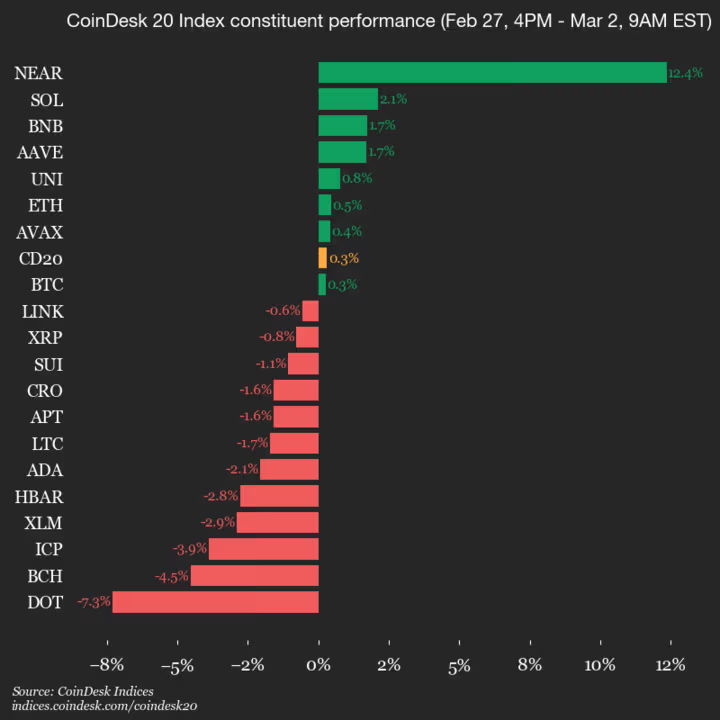
CoinDesk Indices presents its daily market update, highlighting the performance of leaders and laggards in the CoinDesk 20 Index.
The CoinDesk 20 is currently trading at 1907.12, up 0.3% (+5.99) since 4 p.m. ET on Friday.
Eight of the 20 assets are trading higher.

Leaders: NEAR (+12.4%) and SOL (+2.1%).
Laggards: DOT (-7.3%) and BCH (-4.5%).
The CoinDesk 20 is a broad-based index traded on multiple platforms in several regions globally.


Strategy Inc has purchased 3,015 Bitcoin for about $204 million, lifting its total holdings to 720,737 BTC despite ongoing market weakness.
Summary
- Strategy bought 3,015 BTC at an average price of $67,700.
- Total holdings now stand at 720,737 BTC worth about $54.77B.
- The purchase was funded mainly through ATM share sales.
Strategy has added more Bitcoin (BTC) to its balance sheet after spending over $200 million on a fresh purchase, continuing its long-running effort to build one of the largest corporate crypto treasuries in the world.
On March 2, Strategy Inc revealed in a regulatory filing that it bought 3,015 BTC between February 23 and March 1 at an average price of $67,700 per coin, taking total holdings to 720,737 BTC.
Funding the latest Bitcoin purchase
The company spent about $204.1 million on the acquisition, using mainly proceeds from its at-the-market share sales and preferred stock offerings. During the same period, Strategy raised roughly $237.1 million, leaving part of the funds as a cash reserve.
With this purchase, Strategy’s total Bitcoin acquisition cost has reached around $54.77 billion. Its average cost basis now stands at about $75,985 per BTC.
At current market prices, the company’s Bitcoin holdings are valued at roughly $47 billion to $47.5 billion. This places Strategy at an estimated unrealized loss of between $7 billion and $9 billion, depending on price movements.
Strategy’s Class A shares trade on the Nasdaq Global Select Market under the ticker MSTR. The stock is down about 50% over the past year and 18% year-to-date, tracking Bitcoin’s recent decline.
The latest deal marks the company’s tenth straight weekly Bitcoin purchase. Its approach remains focused on raising capital and converting it directly into BTC to increase per-share exposure.
Financial pressure and long-term strategy
While Strategy continues to buy, the weak market has weighed on its financial results. Since early 2025, the company has used fair-value accounting for digital assets, which requires marking Bitcoin holdings to market.
In the fourth quarter of 2025, Strategy reported a $12.4 billion net loss, driven largely by unrealized crypto losses. Its core software business remains small, making overall performance closely tied to Bitcoin prices.
To limit dilution from issuing new common shares, the company has relied more on preferred stock. In February, it raised the dividend rate on its Variable Rate Series A preferred shares to 11.50%.
Executive chairman Michael Saylor has continued to support the company’s long-term holding strategy, arguing that Bitcoin should be treated as a primary reserve asset.
Analysts remain divided. Supporters say buying during downturns could pay off if prices recover above the company’s cost basis. Critics warn that extended weakness could deepen losses and strain investor confidence.

In a provocative spoof set in the 2030s, Energym imagines a world where automation has displaced 80% of workers, turning a gym into a symbolic power plant for AI systems. The satire arrived as a reflection of real-world shifts, where automation accelerates and investors wrestle with what AI may mean for employment, productivity, and growth. In late February 2026, Block announced it would cut more than 4,000 roles as part of a broader move to streamline operations and deploy more intelligence tools across teams. Separate labor-market data showed cooling demand for office roles, with finance and insurance openings dipping to 134 per month in December 2025—roughly half the level from the previous year. These signals fed a mood of caution about the pace of technological disruption and its implications for wages, markets, and policy. The rapid deployment of AI tools—often produced with little human coding—spurred entrepreneurs to imagine new ownership models that could empower individuals rather than central platforms. Against this backdrop, crypto-native visions that center user control over AI agents began to surface as potential antidotes to the Energym scenario, offering a different path for value creation in an era of automation.
Key takeaways
- Block’s decision to cut over 4,000 jobs signals a broader push toward AI-enabled lean operations, aligning with a trend where firms favor automation to reduce labor costs.
- Labor data from December 2025 shows cooling demand for office roles in the US, with finance and insurance openings down to 134 per month—50% lower than the prior year.
- A Citrini Research scenario, framed as a hypothetical, depicted AI agents triggering cascading layoffs, eroding wages, and a potential market downturn later this decade, intensifying investor jitters in software and payments stocks.
- Crypto projects that emphasize ownership of AI agents—such as Valory and Olas Network—pose an alternative to centralized AI infrastructure, aiming to redistribute control and incentives away from monolithic platforms.
- Market chatter tied to AI policy and macro expectations has fed a narrative that Bitcoin tailwinds could emerge if AI-driven policies pave easier monetary conditions, a theme echoed in industry analyses.
Sentiment: Bearish
Price impact: Negative. The sell-off in software and payments stocks followed the Citrini scenario, with several large names retreating in a single session.
Market context: The era of AI-led disruption is broadening beyond labs into the software, payments, and financial services ecosystems, influencing risk appetite, liquidity conditions, and policy debates. Investors are weighing how quickly automation could erode demand for human labor and how policy responses might shape pricing, capital allocation, and market resilience.
Why it matters
The Energym satire captures a core debate about AI’s economic structure: will automation simply replace tasks, or will it redefine value capture by enabling new forms of ownership and collaboration? The Block restructuring underscores how firms are recalibrating headcount and capabilities in a world where code generation and decision automation can outpace human labor in many roles. As the US labor market data show a cooling in openings for office-based work, the risk that automation could compress wages or slow cycle growth becomes more tangible for investors looking at software, fintech, and adjacent sectors.
For the crypto community, the conversation shifts from dystopian fiction to practical experimentation. Valory, a crypto venture focused on autonomous agents, and the Olas Network, which contemplates co-owned AI systems, argue that giving people direct ownership and governance over AI agents could prevent the Energym scenario from taking hold. In this view, tokenized ownership and on-chain governance align incentives with human labor and oversight, offering a model where AI serves as a collaborative partner rather than a substitute for labor. The discussion around “AI agents” also intersects with broader debates about platform power, data ownership, and labor rights in an increasingly automated economy.
At the same time, the broader market backdrop remains uneasy. A 7,000-word scenario from Citrini Research, pitched as a scenario rather than a forecast, highlighted potential risks: AI agents, cascading layoffs, shrinking wages, and a deep market downturn by the end of the decade. The reactions in software and payments stocks—Uber, American Express, and Mastercard—reflected a re-pricing of risk as investors reassessed how swiftly AI could reshape demand for human labor. These dynamics have fed headlines about tailwinds for certain crypto narratives, including Bitcoin, in environments where policy responses or macro shifts could influence liquidity and risk sentiment. For those watching the relationship between traditional finance and crypto, the message is clear: the pace and direction of AI-driven disruption will influence both corporate strategy and the incentives that shape decentralized tech ecosystems.
Within this context, some observers point to Ethereum and other ecosystems as proving grounds for new tooling and governance models. The idea of AI-assisted software development—sometimes described as “vibe coding”—has been discussed as a way to accelerate roadmaps while maintaining human oversight. If this trend accelerates, it could alter how quickly blockchain platforms implement upgrades and how communities plan for scaling. The broader question is whether AI will concentrate power in a handful of labs and cloud providers, or whether crypto-native approaches can distribute control to developers and users, creating more resilient networks.
What to watch next
- Block’s upcoming quarterly results and any guidance on further efficiency initiatives or hiring plans.
- New data on US labor demand, especially for office-based and finance-related roles, to gauge the persistence of the cooling trend.
- Any announcements from crypto projects focused on AI agents about governance models, ownership structures, or real-world deployments.
- Regulatory developments related to AI ownership, accountability, and the integration of autonomous systems into financial services and markets.
- Industry analyses on whether Bitcoin (CRYPTO: BTC) and other crypto assets could benefit from shifts in monetary-policy expectations tied to AI-driven productivity and policy adaptation.
Sources & verification
- Block announces cutting more than 4,000 roles as part of a lean AI-driven restructuring.
- US Bureau of Labor Statistics data showing December 2025 finance and insurance job openings at 134 per month, about 50% lower than the prior year.
- Citrini Research’s 7,000-word scenario exploring AI agents, layoffs, wages, and a potential mid-to-late-2020s market downturn.
- Coverage of stock movements in Uber, American Express, and Mastercard following AI-valuation reassessments.
- NYDIG’s discussion of Bitcoin tailwinds if AI prompts easier monetary policy.
Market reaction and key details
The Energym concept arrived as a provocative mirror to the real trajectory of AI deployment in business. The outreach and engagement around the clip—featuring AI-aged figures resembling Elon Musk, Sam Altman, and Jeff Bezos—captured how quickly technology narratives can morph into cultural commentary. The Block layoff announcement and the December 2025 BLS data reinforce a pattern: enterprises are trying to squeeze more productivity out of fewer humans by leaning into AI automation, a move that can compress labor costs and recalibrate growth expectations in the near term. In this environment, investors are weighing the implications for both tech equities and crypto markets as policy and macro conditions shift in response to productivity gains, wage dynamics, and inflation trajectories.
From a crypto perspective, the discussion shifts toward resilience and ownership. Projects like Valory and Olas Network are pitched as options to decentralize control over AI agents, potentially aligning incentives across developers, users, and founders rather than concentrating decision power in a few large platforms. If such models gain traction, they could influence the design of autonomous tooling, smart contracts, and governance structures—areas where blockchain-based coordination could offer more robust alignment between human values and automated processes. The debate about whether AI’s benefits will be distributed or captured by a few centralized ecosystems remains central to both policy debates and market expectations.
In the near term, the sentiment remains cautious. The Citrini scenario and the stock-market reactions it helped catalyze remind investors that even with AI’s promised gains, the path to stable returns is nuanced. The possibility of softer wage growth, more automation-driven productivity, and a shift in labor-market dynamics could reshape both traditional and crypto markets. In this environment, the question for readers is not only how fast AI will replace tasks, but how quickly communities and ecosystems can adapt—whether through crypto-native ownership models, more transparent governance, or policy frameworks that encourage responsible innovation. The dialogue between dystopian fiction and practical innovation is ongoing, and it will likely influence both investor behavior and the development of next-generation AI tools within decentralized networks.
What to watch next
- Block’s next earnings call and any updates to staffing or automation initiatives.
- US labor-market data releases that illuminate the durability of the December 2025 trend.
- Announcements from crypto projects pursuing AI-agent ownership and on-chain governance experiments.
- Regulatory developments shaping AI accountability, data rights, and platform liability in 2026.
Sources & verification
- Block cuts 4,000 jobs in AI-driven restructuring — Cointelegraph article and related reporting.
- US Bureau of Labor Statistics December 2025 finance and insurance openings data (JTU5200JOL).
- Citrini Research’s AI-agent scenario report and market implications.
- Reporting on Uber, American Express, Mastercard stock movements tied to AI expectations.
- NYDIG analysis suggesting Bitcoin tailwinds under certain monetary-policy scenarios.
What the Energym narrative means for users and builders
The Energym confrontation with automation is not merely a cautionary tale; it’s a prompt for builders to consider how technology can be deployed in ways that preserve agency and opportunity. For users, it underscores the importance of understanding who controls the tools that shape daily life and work. For investors and builders in the crypto space, it highlights opportunities to experiment with ownership, governance, and incentive structures that can align human labor with automated capabilities rather than replace it. The integration of AI with blockchain-based coordination could yield new business models that distribute value more broadly while maintaining accountability—an evolution that might help bridge the gap between existential concerns and practical, verifiable improvements in productivity and quality of life.
How this shapes the future of automation and finance
Looking ahead, the interplay between AI-enabled efficiency and the demand for human labor will shape both policy and market structure. The tension between centralized AI platforms and decentralized, user-owned AI agents will likely influence how capital, data, and governance flow through the tech economy. As firms continue to experiment with automation, the crypto sector could offer alternative paths for value creation and risk sharing, potentially leading to more resilient systems that reflect broad community interests rather than narrow corporate imperatives. The Energym debate thus serves as a barometer for how society negotiates the benefits of AI with the fundamental need for meaningful work, fair compensation, and transparent governance.

Disclosure: The views and opinions expressed here belong solely to the author and do not represent the views and opinions of crypto.news’ editorial.
Every major wave of political repression in the last two decades has followed the same playbook. First, control the media. Then, monitor communication. Finally, isolate people from one another. The tools change, but the vulnerability remains constant: centralized communication systems create centralized points of failure. And in an age where messaging apps have become the nervous system of civil society, that failure is no longer theoretical; it is lethal.
Summary
- Encryption is not enough: Centralized messengers still expose metadata — contact graphs, timestamps, and location data — which authorities can weaponize without ever reading message content.
- Centralization creates single points of failure: Servers can be subpoenaed, hacked, or shut down, turning communication infrastructure into a surveillance map during political crises.
- Resilience requires decentralization: Peer-to-peer and metadata-minimizing systems remove subpoena targets and reduce network visibility, making repression materially harder.
While debates around digital freedom often focus on encryption, the real danger lies elsewhere. Who controls the servers? Who can access the metadata? Who can be compelled to reveal communication patterns? History has already answered these questions.
When communication becomes a weapon
Governments have long understood that silencing dissent doesn’t always require censorship of content. Sometimes, simply knowing who is talking to whom is enough. Very often, detained demonstrators reported interrogators confronting them with printed Telegram conversations, contact graphs, and phone records. In some documented cases, authorities reactivated Telegram accounts of detainees while they were imprisoned in order to monitor incoming messages and identify associates. Even more chilling, accounts belonging to deceased protesters were reportedly brought back online to map activist networks.
Journalists all over the world face imprisonment, or worse, if their communication trails are exposed. Many rely on familiar tools like WhatsApp, Telegram, or even Signal, believing encryption alone protects them. It doesn’t.
Even when message content is encrypted, centralized messengers still generate metadata: who contacted whom, when, how often, and from where. That information is routinely subpoenaed, hacked, or quietly handed over under legal or extralegal pressure. Metadata has led directly to arrests, disappearances, and worse.
In many environments around the world, the existence of communication becomes incriminating.
The forgotten lesson of past uprisings
This is not a new realization. Each generation confronting repression relearns the same lesson: centralized communication fails precisely when it is needed most.
One of the more recent cases has been the Gen Z–led protest in Nepal in 2025, where the government imposed sweeping bans on major social media and messaging platforms, including Facebook, WhatsApp, and YouTube, in an attempt to suppress mobilization and control information flow. In response, protesters adapted quickly. Decentralized and offline-capable messaging tools such as Bitchat, which rely on peer-to-peer connectivity rather than centralized servers, saw increased use as activists sought ways to communicate beyond state-controlled infrastructure.
Without a central service to shut down or monitor, these tools allowed information to continue circulating even as mainstream platforms went dark. The episode demonstrated a recurring pattern: when centralized messengers become pressure points, people are forced to seek alternatives that are resilient by design.
Why encryption alone isn’t enough
The tech industry has trained users to equate privacy with encryption. This framing is incomplete. Encryption protects message content, but it does nothing to prevent:
- Network mapping through contact graphs;
- Identification of organizers through communication frequency;
- Retroactive analysis of relationships after device seizure;
- Legal or covert access to server logs.
For journalists, this means sources can be exposed even if messages remain unread. Communication patterns can be subpoenaed from centralized servers, revealing relationships that no encryption key can hide.
For activists, metadata allows authorities to dismantle movements without ever reading a single message. Leaders, coordinators, and connectors stand out clearly once networks are visualized.
For human rights defenders documenting abuses, centralized storage creates a single breach point where evidence and identities can be compromised simultaneously.
In these contexts, conversation history itself becomes a liability.
The case for decentralized messengers
A decentralized messenger changes the threat model entirely. Without a central server, there is no database to subpoena, hack, or quietly access. Without centralized metadata, communication patterns cannot be easily reconstructed. Without persistent identities tied to servers, networks become opaque rather than legible to surveillance.
For journalists, this means sources can communicate without leaving a trail that can later be uncovered. Not just encrypted content, but hidden relationships.
For activists in repressive states, it means coordination tools that cannot be mapped through metadata analysis. When no central authority sees the whole network, mass arrests become harder to orchestrate.
For human rights defenders, it allows evidence to be shared without revealing who collected it or how it moved through the network.
These systems also address a second, often overlooked threat: coercion after arrest. Features such as self-deleting messages, ephemeral identities, and emergency data deletion ensure there is no historical record to weaponize during interrogation, even if a device is seized or an account compromised. In places where interrogators demand passwords at gunpoint, privacy must be designed for failure.
Convenience has a cost
Centralized messengers dominate because they are easy. They sync instantly, store everything forever, and abstract complexity away from the user. But convenience is not neutral.
Every centralized design decision, such as account recovery, cloud backup,s and contact discovery, creates another surface for abuse. In stable democracies, this is mostly invisible. In authoritarian states, it is catastrophic.
The uncomfortable truth is that many of today’s most popular “secure” messengers were never designed for adversarial environments. They assume good-faith legal systems, independent courts, and limits on state power. Millions of people do not live under those assumptions.
Rebuilding the right to communicate
Free expression is meaningless without the ability to communicate safely. Safe communication cannot depend on centralized intermediaries whose incentives, jurisdictions, or survival may change overnight.
Decentralized messengers are not a silver bullet. They require new mental models, new UX compromises, and new infrastructure. But they align technology with the realities faced by journalists, activists, and dissidents, not with the comfort of Silicon Valley.
The question is no longer whether decentralized communication is necessary. The question is how many more examples we need before we treat it as essential.

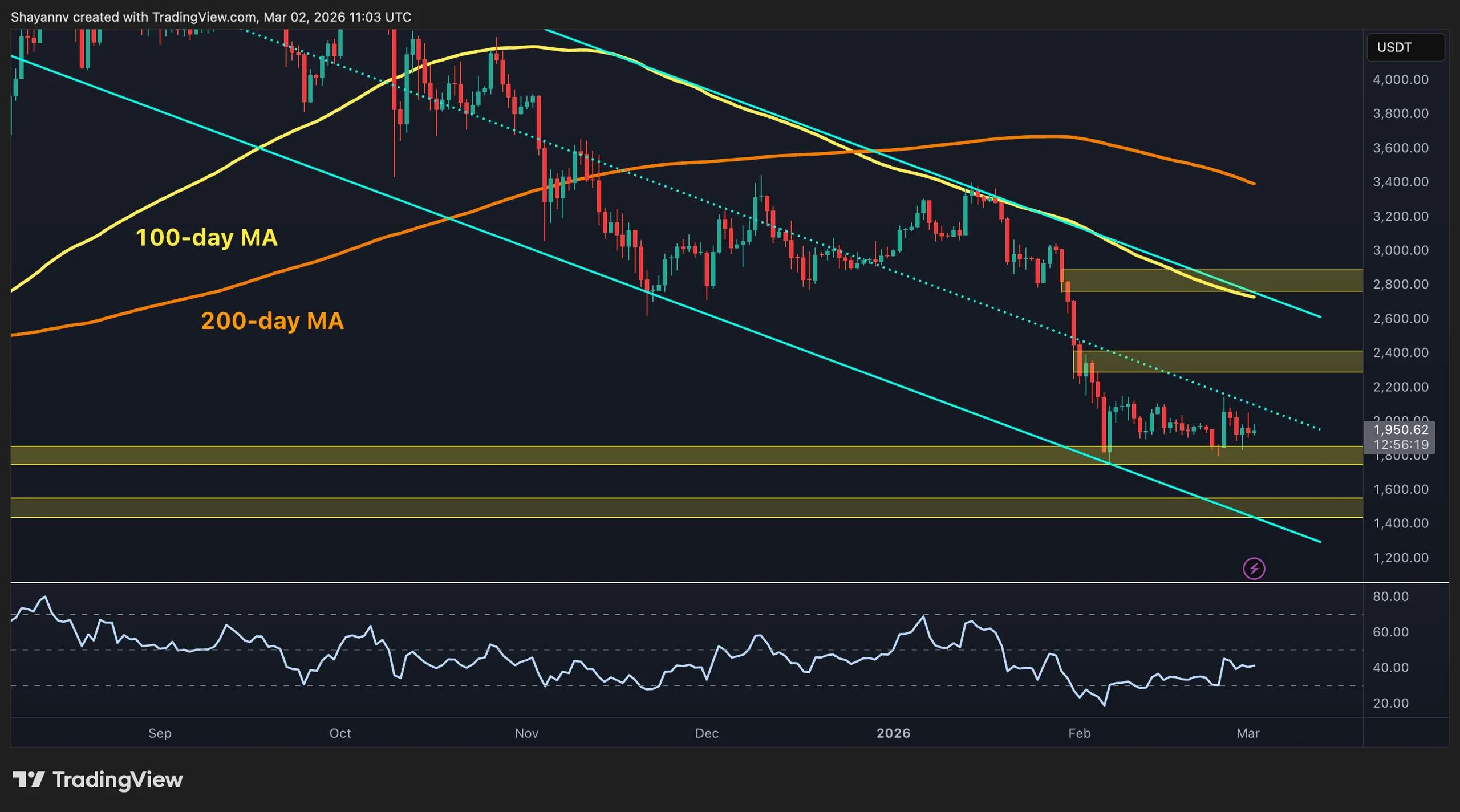
Ethereum is still trading with a heavy bearish bias after the sharp late-January breakdown, and the market is now trying to form a base around the $1.9K area. On the higher timeframe, the price structure remains bearish, and amid the war in the Middle East, any rebound is currently best viewed as a relief move unless ETH can reclaim key resistance levels and flip them into support.
Ethereum Price Analysis: The Daily Chart
On the daily chart, ETH is still pinned below both the 100-day and 200-day moving averages, located around the $2,700 and $3,400 marks, respectively. Both moving averages are sloping lower and acting as dynamic resistance. The asset also remains inside a broader descending structure, and the last impulsive leg down left a clear distribution-to-breakdown footprint. The nearest overhead supply zone sits around $2,300K–$2,400 area, where a bearish order block is located.
The constructive part is that ETH has stopped trending lower for now and is building a base above the $1,800–$1,900 support band. Daily momentum is also seemingly stabilizing. The RSI has recovered from oversold conditions and is hovering in the mid zone, which often happens during consolidation phases. Still, the burden of proof is on the buyers, as losing the $1,800 again would reopen the downside toward the next demand zones around $1,500.
ETH/USDT 4-Hour Chart
On the 4-hour chart, ETH is moving sideways after the capitulation move, and the price action is compressing in a range with defined edges. The line in the sand overhead is around $2,150, which has acted as a repeated pivot/ceiling; buyers have struggled to hold above it, and pullbacks keep dragging the asset back into the range. If ETH can reclaim $2,150 cleanly and hold above it, the next upside magnet is the $2,300-$2,400 supply zone.
Until that breakout happens, the market is still vulnerable to another sweep lower. The key downside level remains the $1,800 base. It has been defended multiple times, but repeated tests weaken support. So, a clean breakdown increases the odds of a fast move toward $1,600, with $1,500 as the deeper capitulation support zone if risk sentiment deteriorates again.

Sentiment Analysis
For the market sentiment read, the Coinbase Premium Index has started to climb back toward (and around) the neutral line after spending an extended stretch in deep negative territory since November 2025. In simple terms, that suggests U.S. spot demand is no longer as consistently discounted versus offshore venues, which can be an early sign that selling pressure is easing and dip-buying interest is returning.
That said, the broader context still matters. The premium recovering while the price remains stuck near $1,900 is more consistent with stabilization than a full trend reversal. If the premium can stay positive while ETH regains $2,150 and pushes higher, it would strengthen the case that spot buyers are back in control. Otherwise, it would signal that the bid is still fragile, and that the market may be setting up for another leg down rather than a sustained recovery.

Binance Free $600 (CryptoPotato Exclusive): Use this link to register a new account and receive $600 exclusive welcome offer on Binance (full details).
LIMITED OFFER for CryptoPotato readers at Bybit: Use this link to register and open a $500 FREE position on any coin!
Disclaimer: Information found on CryptoPotato is those of writers quoted. It does not represent the opinions of CryptoPotato on whether to buy, sell, or hold any investments. You are advised to conduct your own research before making any investment decisions. Use provided information at your own risk. See Disclaimer for more information.


Turkey’s ruling AK Party has introduced a sweeping economic bill in parliament that would formalize crypto taxation while revising a range of tax and spending rules.
The draft, now before the Turkish Grand National Assembly, would amend the Income Tax Law and Expenditure Taxes Law to create a new framework for cryptocurrencies, the country’s state news agency Anadolu Ajansı reports.
Crypto platforms regulated under the country’s Capital Markets Law would withhold a 10% tax on gains each quarter, regardless of whether the investor is an individual or company, resident or non-resident.
Service providers would also pay a 0.03% transaction tax on the sale amount or market value of crypto assets they broker.
Crypto brokers and other intermediaries would be on the hook for tax checks based on the records they keep. If a user provides wrong or incomplete information, tax authorities would pursue that person for any shortfall, the news outlet writes.
The bill also makes clear that key terms such as “crypto asset,” “wallet,” and “platform” carry the same meaning as in Turkey’s Capital Markets Law, tying the tax regime to existing financial rules.
The country’s president would also have the power to lower the 10% withholding tax to 0% or raise it to 20%, depending on the type of token, how long it was held, who issued it, or the type of wallet used.
The bill exempts crypto deliveries subject to the transaction tax from value-added tax (VAT) and excludes foundation university hospitals from corporate tax exemptions starting in 2027.
The crypto provisions would take effect two months after publication if approved.

Key Takeaways
-
COIN shares have dropped approximately 20% year-to-date in 2026 amid weakening cryptocurrency valuations and reduced market-wide trading activity.
-
Fourth-quarter financial results fell short of Wall Street projections, driven by diminished transaction volumes and weaker digital asset demand.
-
The exchange operator is diversifying its platform through the “Everything Exchange” initiative, introducing traditional stock and ETF trading.
-
Major institutional stakeholders maintain substantial positions in the company, collectively owning approximately 69% of shares.
-
Wall Street analysts have reduced their price objectives while the overall consensus remains at a Hold recommendation.
Coinbase (COIN) stock has experienced a roughly 20% decline through the first months of 2026 as digital currency valuations softened and market participants pulled back from trading. The shares have encountered selling pressure after the company’s latest quarterly report disappointed investors.
During the fourth quarter, the cryptocurrency exchange posted earnings of $0.66 per share, falling short of the $0.83 consensus estimate. Revenue for the period reached $1.78 billion, trailing the anticipated $1.86 billion and representing a 21.6% decline from the prior year.
The stock has been trading near the $175 level, giving the company a market valuation of approximately $46 billion. This price point sits significantly below the 52-week peak of $444.64.
Institutional investment firms control roughly 68.8% of Coinbase shares outstanding. Multiple asset managers have modified their stakes in the company throughout recent reporting periods.
Sierra Summit Advisors established a fresh position comprising approximately 20,302 shares worth around $6.85 million. Additional institutional investors have disclosed modest acquisitions or stake increases.
Diversification Push and New Services
Coinbase is broadening its service portfolio beyond digital currency transactions. The platform now supports trading of U.S. equities and exchange-traded funds as part of its “Everything Exchange” vision.
This strategic direction aims to create multiple revenue streams and boost overall platform engagement across various asset categories. The technical backbone for these expanded trading capabilities comes from Apex Fintech Solutions.
Coinbase has additionally introduced prediction market functionality through a collaboration with Kalshi. These developments are meant to broaden the spectrum of available trading instruments.
The platform maintains its role as a digital asset custodian serving institutional clients. It also functions as the safekeeping provider for numerous cryptocurrency investment funds.
In 2023, Coinbase introduced its Base blockchain infrastructure to facilitate decentralized finance applications and asset tokenization projects. This network has found adoption in payment systems, tokenized securities, and decentralized applications.
The firm is marketing Crypto-as-a-Service solutions targeted at traditional financial institutions. These offerings enable banks and asset managers to integrate digital currency capabilities leveraging Coinbase’s existing technology.
Wall Street Outlook and Trading Trends
Research analysts have reduced their price objectives following the disappointing quarterly report and increased market turbulence. However, most firms continue to recommend either buying or holding the shares.
The mean price target among covering analysts sits at approximately $270.67. The aggregate recommendation across Wall Street research desks currently registers as a Hold.
Several brokerage houses pointed to shrinking cryptocurrency spot trading volumes as a short-term challenge. Reduced platform activity directly impacts the company’s transaction-driven revenue streams.
Executive stock sales also took place over the recent three-month period. Company leadership offloaded roughly 513,775 shares totaling approximately $95 million.
Chief Executive Officer Brian Armstrong and Chief Financial Officer Alesia Haas participated in these share dispositions. Company executives and directors collectively own about 16.56% of outstanding equity.
Coinbase continues advancing its product diversification initiatives while navigating fluctuations linked to cryptocurrency valuations and market participation rates. The stock’s performance remains closely correlated with broader digital asset market trends and user engagement patterns.

Nipsey Hussle’s Brother Takes Cover at Restaurant Opening Shooting, on Video

The House Article | Councils are leading the way on using tech to reform public services

NFL Draft prospect hits back at critics of his speech


-

 Sports7 days ago
Women’s college basketball rankings: Iowa reenters top 10, Auriemma makes history
-

 Politics7 days ago
Nick Reiner Enters Plea In Deaths Of Parents Rob And Michele
-

 Fashion3 days ago
Weekend Open Thread: Iris Top
-

 Business6 days ago
True Citrus debuts functional drink mix collection
-

 Politics4 days ago
ITV enters Gaza with IDF amid ongoing genocide
-

 Tech1 day ago
Unihertz’s Titan 2 Elite Arrives Just as Physical Keyboards Refuse to Fade Away
-
Sports2 days ago
The Vikings Need a Duck
-

 Crypto World6 days ago
XRP price enters “dead zone” as Binance leverage hits lows
-

 NewsBeat5 days ago
Cuba says its forces have killed four on US-registered speedboat | World News
-
 NewsBeat2 days ago
Dubai flights cancelled as Brit told airspace closed ’10 minutes after boarding’
-

 Tech6 days ago
Unsurprisingly, Apple's board gets what it wants in 2026 shareholder meeting
-
 NewsBeat5 days ago
Manchester Central Mosque issues statement as it imposes new measures ‘with immediate effect’ after armed men enter
-
 NewsBeat2 days ago
The empty pub on busy Cambridge road that has been boarded up for years
-

 NewsBeat24 hours ago
‘Significant’ damage to boarded-up Horden house after fire
-

 NewsBeat2 days ago
Abusive parents will now be treated like sex offenders and placed on a ‘child cruelty register’ | News UK
-
 NewsBeat6 days ago
Police latest as search for missing woman enters day nine
-

 Entertainment6 hours ago
Baby Gear Guide: Strollers, Car Seats
-

 Business4 days ago
Discord Pushes Implementation of Global Age Checks to Second Half of 2026
-

 Business4 days ago
Only 4% of women globally reside in countries that offer almost complete legal equality
-
 Tech3 days ago
NASA Reveals Identity of Astronaut Who Suffered Medical Incident Aboard ISS