

Crypto World
46% of Bitcoin supply now in loss, near 2022 bear levels



Around 46% of BTC, or 9.09m coins, sit at a loss in early 2025, nearing 2022 bear‑market loss concentrations after the 2024–2025 rally unwound.
Summary
- About 9.09m BTC, roughly 46% of the 19.8m circulating supply, are below their last on‑chain transaction price, the second‑highest loss reading since mid‑2022’s ~10m‑coin peak.
- Previous cycle lows saw 50–60% of BTC supply in loss; current levels mirror late‑2022 conditions but at much higher absolute prices, as many 2024–2025 entrants are now underwater.
- CryptoQuant data show net realized profits flipping to net losses since late 2025, with holders realizing up to 69k BTC in aggregate losses, resembling the 2021–2022 bull‑to‑bear transition
Approximately 9.09 million Bitcoin (BTC), representing roughly 46% of the cryptocurrency’s circulating supply, is currently held at a loss as of early 2025, according to data from CryptoQuant.
The figure marks the second-highest loss concentration recorded in CryptoQuant’s dataset spanning from July 2020 through early 2026, falling just below the peak reached during the 2022 bear market.
The BTC Supply in Profit/Loss chart from CryptoQuant displays coins held at a loss as a negative figure, with the current reading of negative 9.09 million coins approaching the deepest loss concentration visible on the chart. That record was set in mid-2022, when approximately 10 million coins were underwater as Bitcoin fell following the Luna and FTX contagion events.
The circulating supply of Bitcoin totals approximately 19.8 million coins, meaning nearly half of all Bitcoin that has moved on-chain is currently held below its last transaction price.
A key distinction separates the current period from the 2022 bear market. While a comparable number of coins were held at a loss during both periods, Bitcoin’s absolute price level remains significantly higher now than in 2022. The current loss concentration reflects holders who entered the market during the 2024-2025 rally and are now underwater, according to the data.
High supply-in-loss readings create specific market dynamics, according to market analysts. Holders facing losses experience pressure to either sell or maintain positions through corrections. Those with the highest cost basis relative to current prices typically exhibit lower conviction in long-term recovery.
The 2022 period provides a historical reference point. The supply-in-loss figure peaked near 10 million coins in late 2022 before declining as the market bottomed and new buying brought coins back into profit. That decline from peak loss concentration preceded the sustained price recovery that extended through 2023 and 2024.
Whether the current 9.09 million coin reading represents a peak depends on price stabilization at current levels or further decline, according to analysts tracking the metric.



Institutional engagement with digital assets is no longer a uniform story. In recent years, major financial institutions have taken markedly different approaches to blockchain-based markets. Some have focused on tokenization, putting traditional instruments into programmable form. Banks, meanwhile, have explored tokenized deposit models and internal settlement rails as well as issuing their own digital assets like stablecoins.
Amid the growing wave of institutional capital entering digital assets, the more revealing question is not who participates, but how participation is governed inside the institution. Regulatory requirements, operational standards, and internal conviction often determine whether a strategy moves forward or stalls.
Speaking exclusively with BeInCrypto at Liquidity Summit 2026 in Hong Kong, Samar Sen, Head of International Markets at Talos, shared how those internal dynamics play out when institutions evaluate digital asset opportunities.
Adoption Requires More Than Rules
According to Sen, regulatory clarity remains the most decisive factor in institutional participation. He noted that progress across jurisdictions has helped reduce uncertainty, but clear rules remain essential for large-scale adoption.
“We’ve seen a lot of advancements in regulation all over the world,” Sen acknowledged.
While once the dominant concern, infrastructure has matured significantly. Institutional-grade custody, execution platforms, and portfolio management systems now operate across major markets, addressing many of the operational gaps that previously slowed adoption.
Yet even where regulatory frameworks have advanced, and infrastructure is in place, in many institutions, the remaining hurdle is internal. He said:
“There may be management that is still evaluating the underlying tech or still need some time to get around understanding the potential of the tech to revolutionize finance.”
That hesitation often reflects unfamiliarity rather than outright resistance, he added. For institutions built on decades of precedent, conviction takes time. As a result, digital asset initiatives can stall even when the external conditions appear favorable.
The Compliance Checklist Behind Institutional Trust
When asked what signals actually build trust for institutions evaluating crypto counterparties, Sen pushed back on the idea that visibility alone carries weight. While he acknowledged that industry gatherings and brand presence may help with awareness, institutional trust is earned differently.
“Typically, what builds trust will be, first of all, licensed or regulated entities within their jurisdictions,” Sen said.
He also added that institutions look for demonstrable internal controls, such as SOC 2 Type II certifications, audit trails, and operational safeguards. Track record also matters, particularly if leadership has experience in traditional finance and has built a reputation for delivering under regulatory scrutiny.
Peer adoption plays a role as well. Institutions often look outward, assessing who else is using the same infrastructure and how widely it has been adopted across the industry. He explained:
“If you’re a big bank, and you go to talk to a vendor to provide you with technology, if that vendor is providing that technology to some of your peers and competitors, that’s another way that can establish some kind of trust.”
Not All Institutions Move at the Same Speed
Although regulatory clarity and operational safeguards form the foundation, institutions are not entering digital assets uniformly. Sen described three distinct profiles emerging in the market.
Some organizations act as early movers. These firms understand the structural shift underway in capital markets and are willing to commit resources ahead of full certainty. They tend to invest in building internal digital asset teams and engage proactively with new infrastructure providers.
Others take a more measured approach. These fast followers prefer to wait for clearer regulatory direction or proof of concept before scaling exposure. Their risk appetite is lower, and they often rely on external validation before committing capital.
Then there are institutions that remain behind the curve. In some cases, leadership has yet to develop conviction around the underlying technology. In others, digital asset initiatives exist but lack internal coordination, resulting in fragmented or misaligned strategies.
Sen noted that institutions should not be expected to move in lockstep. He added that different risk tolerances and internal mandates shape the pace of adoption.
“And that’s okay because with digital assets and the underlying technology, there are many entry points to participate in the asset class, to get comfortable with the new providers and ecosystem participants. We are here to help navigate that.”

While regulation continues to loosen around crypto in the United States, largely thanks to a president who accepts bribes via his own meme and stablecoins, the opposite is occurring in China.
Indeed, dozens of Chinese nationals have taken to social media to report that just putting “Dogecoin” or “USDT” in the memo field of a transfer ends with the bank account being frozen — and the individuals have almost no recourse for their money getting unfrozen thereafter.
Drastic difference in banking regulations
Despite the near total normalization of buying, selling, trading, and creating cryptocurrencies in the US — including a stablecoin endorsed and partially owned by the president — China and its retail banks have taken on a much stricter set of rules and regulations.
In one instance, according to a site called Techub.info in China, two clients of China Construction Bank (the third largest bank in the world) had their accounts frozen after transferring a mere 250 yuan, or $35, between one another with the memo “Dogecoin this week.”
After sending the money the bank flagged the transfer under its virtual currency control risk management program.
Rednote users warn Chinese citizens
On Rednote, users are sharing the story with words of warning for others in China: never put bitcoin, virtual currency, any memecoin, or USDT as the reason for a fund transfer or you will absolutely face an account freeze.

Read more: China’s Regulation 42 forces Tether to kill its CNHT stablecoin
They add that the only way to get one’s bank account unfrozen is to prove to to bank officials that money wasn’t in fact used to purchase cryptocurrencies, write a statement as to why a cryptocurrency was referenced, and wait for the statements to be reviewed.
The entire process can take weeks to occur, if the account is unfrozen at all.
Needless to say, Chinese citizens are being more cautious than ever before when it comes to using their bank accounts for cryptocurrency trading.
Got a tip? Send us an email securely via Protos Leaks. For more informed news and investigations, follow us on X, Bluesky, and Google News, or subscribe to our YouTube channel.

Check out which tokens may plummet by 90% if such a scenario unfolded.
The global geopolitical tension escalated over the weekend after the USA and Israel carried out mutual attacks on Iran, creating a sudden surge of uncertainty that quickly spread across the region and beyond.
The military operation struck many targets and eventually led to the liquidation of Ali Khamenei (the supreme leader of the Asian country). Iran retaliated against several nations in the region, including the UAE, Bahrain, Qatar, and Saudi Arabia. The American president, Donald Trump, warned that the war may continue for up to four weeks, while leading European economies (some of which are nuclear powers), such as France, Germany, and the UK, have hinted that they may “defend their interest” and join the conflict soon.
Right now, the world is watching the Middle East with growing concern, as the risk of a wider conflict and even a potential World War III seems more real than it has in years. Beyond the countless human lives this devastating event would claim, it would also send shockwaves through global financial and crypto markets. To explore the potential impact, we asked four of the most popular AI-powered chatbots which digital assets would be hit the hardest if such a scenario unfolded.
Small Alts, Memes, and More
ChatGPT started with a disclaimer, stating that a world war will not be just “bad news” but cause a “systemic liquidity shock.” It predicted that such a conflict would lead to immediate market panic, with equities dumping and credit freezing. In that kind of environment, crypto would get hit just as hard as everything else.
The chatbot suggested that small-cap altcoins are at the highest risk because they have thin liquidity, few real buyers, and heavy retail exposure. It alerted that cryptocurrencies, whose market capitalization is under $100 million and whose use-cases are dubious, may collapse by up to 90% in a World War III scenario.
Another sector that may experience a real carnage is the meme coin niche. According to ChatGPT, tokens like PEPE, BONK, WIF, and FLOKI can plummet to zero since they are sentiment-driven and notorious for their enhanced volatility:
“In a true risk-off event like a global war, speculative appetite collapses first, and liquidity in meme tokens can disappear within hours.”
Google’s Gemini agreed with ChatGPT’s assumption. It forecasted that such a major conflict could have a devastating effect on small and mid-cap altcoins and meme coins due to mass panic selling and total lack of buyers.
You may also like:
Perplexity focused specifically on the biggest meme coins by market cap, Dogecoin (DOGE) and Shiba Inu (SHIB), estimating they would likely suffer the most due to their “extreme sensitivity to risk-off sentiment and lack of fundamental utility.”
Grok, the chatbot integrated within X, presented a rather different thesis. It claimed that stablecoins like Tether’s USDT and Circle’s USDC could be among the biggest victims due to their connection to the American dollar:
“Stablecoins are pegged 1:1 to fiat currencies like the USD, backed by reserves in banks, Treasuries, or other assets. In WW3, if major economies like the US face hyperinflation, debt defaults, or banking freezes (as seen in historical wars), these reserves could become worthless or inaccessible. In a global war, peg breaks could lead to total devaluation, turning them into “digital IOUs” for a collapsing dollar.”
How About BTC?
All four chatbots we consulted argued that Bitcoin would plunge substantially immediately after a potential announcement of a global war, but would remain the most resilient asset in the crypto sector. They also suggested that, despite the initial shock, BTC could recover its losses relatively quickly compared to the rest of the market.
“BTC would likely drop sharply alongside other risk assets as investors rush to liquidity. However, if the conflict leads to monetary instability or aggressive money printing, BTC could recover faster than most altcoins as its decentralziation and “digital gold” narrative regain strength,” ChatGPT stated.
Binance Free $600 (CryptoPotato Exclusive): Use this link to register a new account and receive $600 exclusive welcome offer on Binance (full details).
LIMITED OFFER for CryptoPotato readers at Bybit: Use this link to register and open a $500 FREE position on any coin!
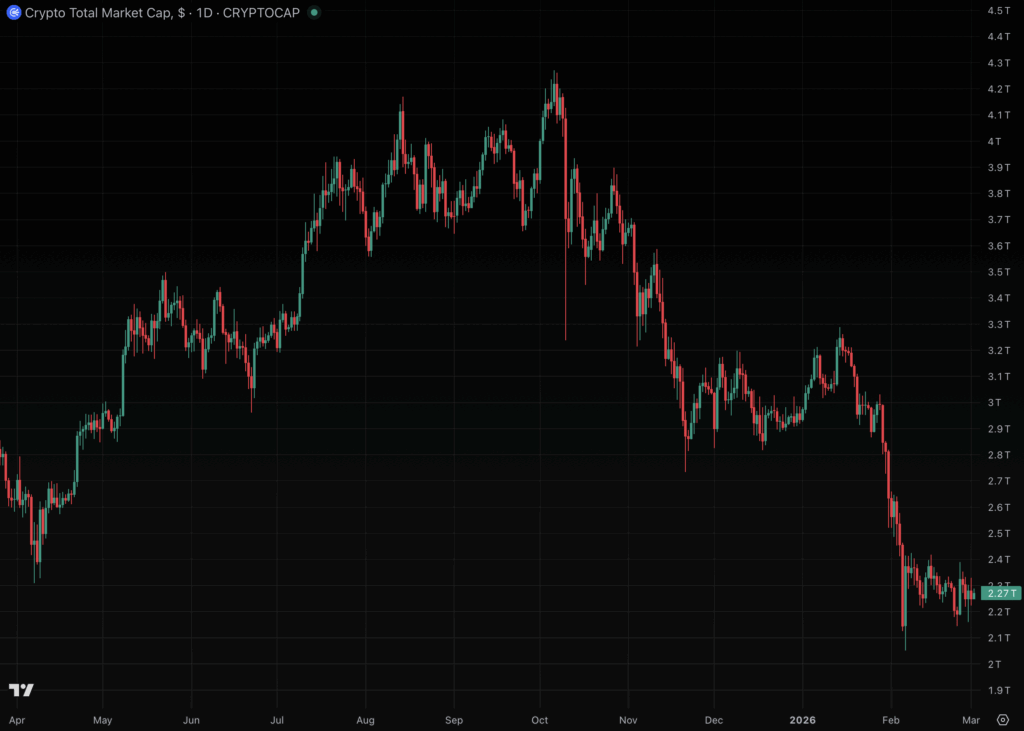
The highest level of margin utilization by US traders in history has, unfortunately, led to historic underperformance in crypto prices as speculators re-learned timeless wisdom: leverage works both ways.
After spending 2025 through January 2026 building their largest leveraged positions in history, bets on digital assets have unraveled with unnerving speed.
In January 2026, US margin debt had surged to a record $1.28 trillion — its ninth consecutive monthly increase and a 50% rise from April 2025. That financial leverage added bids to crypto assets which made new all-time highs in May, July, August, and October 2025.
Then, despite investors continuing to pile on more margin debt than ever, prices collapsed 47% and shed $2 trillion in combined market capitalization as a sector rotation to AI and precious metals ensued.
Crypto losses since October are staggering.
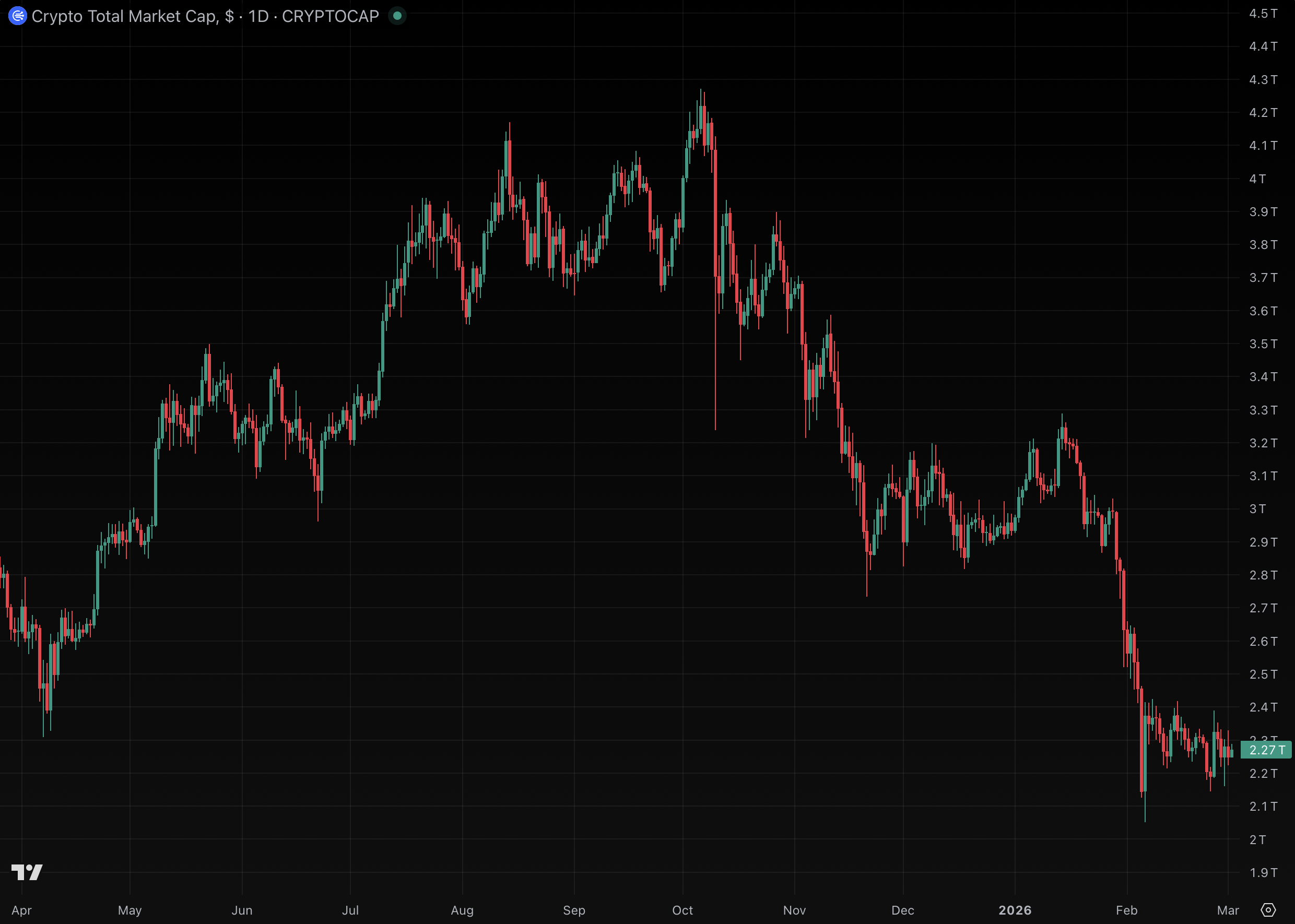
US margin debt increased $53 billion from December to January alone. Worse, the ratio of margin to real disposable personal income exceeded 6.0% in January for the first time on record.
That ratio measures more financial leverage in January 2026 relative to income than the dot-com mania.
Leverage-fueled demand flows into crypto instruments like bitcoin (BTC) futures, spot and leveraged ETFs, call options, and publicly traded crypto companies. Although more leverage can amplify gains, it also amplifies crashes.
Although traditional margin statistics are an incomplete measure of total systemic risk on crypto, which has vast quantities of opaque exchanges and trade data APIs controlled by offshore entities with little to no regulatory oversight, it can nonetheless inform some analysis about the causes of crypto volatility.
A supernova of crypto leverage that wiped out $2 trillion
Some crypto derivatives traders spent mid-2025 building their largest leveraged positions in history, then watched all of their paper gains evaporate.
Aggregate crypto futures open interest peaked above $220 billion on October 6, 2025. Within a week, the industry began to crash and never looked back.
October 10 produced more than $19 billion in total liquidations across exchanges, according to CoinGlass data — the single largest day of forced closures in crypto history.
Many saw Binance as a convenient scapegoat.
Read more: Crypto traders consider lawsuits after $600B market meltdown
Record-setting volatility continued amid record-setting margin levels. On February 5, 2026, another flash-crash drove BTC from $73,000 to $62,000 and wiped out 10-figure position values within a single day.
Worst day of realized losses from BTC liquidations
Glassnode estimated that February 5’s crash produced $3.2 billion in realized losses from liquidated BTC trades — the largest single-day realized loss in Glassnode’s recorded history that surpassed even October 10, 2025, the FTX bankruptcy in November 2022, or the May 2022 collapse of Terra/Luna.
By late February, crypto’s margin trading hangover had set in.
CoinGlass’ Crypto Fear & Greed Index fell to five out of 100 — a never-before-seen rating that exceeded its Three Arrows Capital bankruptcy low of six in June 2022, and its COVID-19 low of seven in March 2020.
As of writing, the index still remains near historic lows at nine, or “extreme fear.”
Losses amid record margin levels have also drawn out spot BTC from US ETFs. Specifically, spot BTC ETFs lost $4.5 billion in net outflows through the first eight weeks of 2026, according to Investing.com.
The leveraged unwind of Strategy
Adding insult to injury, software company-turned-leveraged BTC acquirer Strategy became the most-shorted large cap stock in the US last month, according to data from FactSet cited by multiple outlets.
The company held 717,722 BTC over this weekend, purchased at an average cost near $76,020 per coin. With BTC trading in the mid-$60,000s, the company faces unrealized losses in the billions.
Margined short-sales against Strategy and its BTC, in this case, have actually stood out as a rare success story amid crypto’s margin mania of January 2026.
Leverage always works both ways. Although US margin debt at $1.28 trillion is an incredible headline, the real story is that leverage has seeped into every layer of crypto valuations — from listed securities in brokerage accounts to perpetual swap venues in tax havens.
With losses liquidating collateral and forcing cascading sales, each layer’s losses have been feeding the next since October.
Got a tip? Send us an email securely via Protos Leaks. For more informed news, follow us on X, Bluesky, and Google News, or subscribe to our YouTube channel.


The “Aave Will Win” governance proposal has successfully passed the Temp Check vote, garnering 52.58% support, and is now progressing to the Aave Request for Final Comment (ARFC) stage, marking a significant step for Aave’s future development.
In a closely watched governance decision for one of DeFi’s largest protocols, the “Aave Will Win” framework has passed its initial Temp Check vote, moving the proposal forward in Aave DAO’s multi-stage governance process.
The off-chain Snapshot vote, designed to gauge community sentiment ahead of more binding stages, closed with approximately 52.58% in favor, 42% against, and roughly 5% abstaining. This approval clears the first formal hurdle and advances the framework to the Aave Request for Final Comment (ARFC) phase, where structural and implementation details will be refined based on community feedback before any on-chain vote occurs.
A Token-Centric Model
The “Aave Will Win” framework proposes a fundamental shift in how Aave’s economic value is distributed and how Aave Labs is funded: it would direct 100% of product revenue generated by Aave products to the AAVE token and DAO treasury, aligning incentives between token holders and the protocol’s builders.
Stani Kulechov, founder of Aave and long-time steward of the protocol, confirmed the result on social media shortly after the vote closed, framing the outcome as a step toward a fully token-centric model for the ecosystem.
“Temp Check for the Aave Will Win proposal has passed,” Kulechov wrote. “This brings Aave Labs closer to a fully token-centric model, directing 100% of product revenue to the $AAVE token,” he wrote, underscoring the strategic shift.”
Kulechov followed up with additional remarks reaffirming the protocol’s direction and the DAO’s role in shaping the final structure as the proposal progresses.
Governance Debate and Split Vote
Despite the ultimate approval, the vote exposed ongoing tensions within Aave’s governance community. The margin was relatively narrow, and earlier debate on the forums and in governance reports highlighted deep divisions over funding levels, the size of token allocations to Aave Labs, and how decentralized authority should evolve.
Following the vote, Marc Zeller, founder of the Aave Chan Initiative, published a detailed post-mortem analyzing the Temp Check results, noting that when excluding votes from several large Aave Labs–linked addresses, the broader community actually tilted against the proposal.
Zeller’s analysis argued that while many delegates support the general direction of “Aave Will Win,” concerns remain about fiscal guardrails, capital deployment phases, and independence from Labs’ influence.
What Comes Next
With the Temp Check cleared, the Aave Will Win proposal now enters the ARFC stage, where community feedback will be folded into a more detailed governance proposal that may ultimately be put to an on-chain Aave Improvement Proposal (AIP) vote. Only through an AIP vote would any commitments become binding.
If the framework ultimately garners approval in that final vote, it could reshape Aave’s economic and governance model, formalizing revenue alignment with token holders and setting V4 as the long-term technical foundation for future growth.
With the proposal’s advancement, the focus now shifts to the ARFC stage, where further community input will shape the final outcome. The proposal’s progress is a testament to the robust governance framework that empowers Aave’s community to steer its future direction.
This article was generated with the assistance of AI workflows.
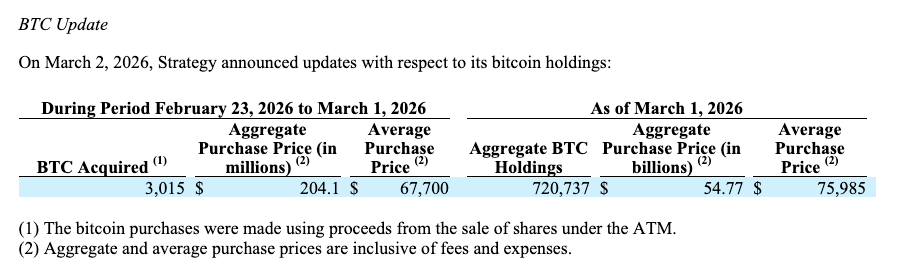
Michael Saylor’s Strategy, the world’s largest public holder of Bitcoin, completed its 101st Bitcoin purchase, pushing its total holdings above 720,000 BTC.
The company acquired 3,015 Bitcoin (BTC) for $204.1 million last week, according to a US Securities and Exchange Commission filing on Monday.

The average buy price of its latest purchase was $67,700 per BTC, marking another purchase well below the company’s average acquisition price of $75,985.
The purchase brings its holdings to 720,737 BTC, acquired for a total cost of about $54.8 billion, the company disclosed.
Another buy below Strategy’s cost basis
The latest buy is one of a small number of Strategy purchases made below the company’s average cost basis, according to data compiled by SaylorTracker, a website that tracks Strategy’s bitcoin acquisitions.
The first such purchase occurred on Feb. 9, when the company bought 1,142 BTC as market prices dipped below $76,051 during the week. Strategy reported the average acquisition price of that batch at $78,815, above the market price at the time.

Strategy encountered a similar situation around 2022-2023, when BTC price dipped below its cost basis of around $30,600. The company completed a total of seven purchases of 28,560 BTC during that below-cost period.
MSTR shares rise modestly while Bitcoin trades near $65,800
Strategy (MSTR) shares saw some upward momentum last week, rising from around $125 on Monday to nearly $130 by Friday, according to TradingView.
Bitcoin, however, remained largely flat over the same period. The crypto asset started the week near $65,000, briefly surged above $69,000 on Wednesday, and dipped below $64,000 before stabilizing. At the time of publication, Bitcoin was trading at $65,834, according to TradingView.
Related: Strategy yield wrapper lands in Europe as 21Shares lists STRC ETP
The news came after Strategy chairman Saylor announced on Sunday that the company is raising the dividend on its STRC preferred stock, also known as “Stretch,” to 11.50% for March 2026, from the previous 11.25%.
The capital raised through the stock can be used for corporate purposes, including potential Bitcoin acquisitions.
Magazine: 6 massive challenges Bitcoin faces on the road to quantum security
TLDR
-
Natural gas prices across Europe experienced dramatic increases following disruptions to LNG transportation routes through the Strait of Hormuz linked to Iranian conflict.
-
Production facilities operated by QatarEnergy were forced offline following drone strikes, creating immediate global LNG supply constraints.
-
Benchmark Dutch TTF gas contracts climbed by up to 49% in intraday trading amid mounting supply anxieties.
-
LNG imports have become critical for Europe’s energy security after the continent pivoted away from Russian gas in 2022.
-
Market experts caution that extended supply disruptions could drive European gas prices significantly higher while straining worldwide energy availability.
Natural gas markets in Europe experienced substantial price increases as Middle Eastern geopolitical tensions threatened critical energy transportation corridors. Trading activity reflected heightened concerns over liquefied natural gas delivery reliability.
During early trading hours, European gas valuations jumped approximately 25%. The Dutch TTF benchmark contract subsequently accelerated, posting gains approaching 49% at peak levels.
Price movements came as regional military tensions escalated dramatically. Disruptions connected to Iranian military activities have impacted maritime operations through the Strait of Hormuz, one of the world’s most vital energy chokepoints.
This narrow waterway facilitates substantial volumes of international LNG trade. Vessel movements have declined considerably as security threats mounted.
Following drone strikes on its infrastructure, QatarEnergy suspended operations at natural gas production sites. The government-controlled operator supplies approximately 20% of worldwide LNG exports.
European Vulnerability to Supply Shocks
European nations face significant vulnerability to LNG supply interruptions. The continent dramatically reduced Russian pipeline gas dependence following 2022’s energy upheaval.
Qatari sources now provide substantial volumes of Europe’s LNG requirements. Numerous cargoes transit the Strait of Hormuz en route to European import facilities.
Storage levels decline throughout winter heating demand periods. European nations must consequently increase LNG purchases to replenish stockpiles.
Market analysts drew comparisons to circumstances observed during 2022’s crisis. That episode produced industrial closures and accelerated inflation throughout European economies.
Goldman Sachs projected that a one-month suspension of LNG transits through the Strait would likely more than double European gas valuations. Benchmark prices could reach €74 per megawatt hour in such circumstances.
Should disruptions extend beyond two months, prices might exceed €100 per megawatt hour. Historical data shows such elevated pricing previously forced substantial demand destruction across the continent.
Broader Energy Market Impacts
Commodity markets swiftly incorporated supply risk assessments. Oil prices advanced as market participants factored in potential regional disruption scenarios.
Approximately 80 million tonnes of LNG flow through the Strait of Hormuz annually. This volume constitutes roughly 19% of total global supply.
Crude oil movements through this strategic waterway similarly underpin global energy systems. Roughly 20% of worldwide petroleum production traverses these waters.
Reports emerged over the weekend of three oil tankers sustaining damage in regional waters. Shipping uncertainties have amplified price fluctuations.
Transportation costs for crude carriers have escalated sharply in recent trading periods. Certain Gulf-to-Asia shipping routes have experienced threefold rate increases over thirty days.
Asian LNG markets confront comparable price pressure risks. Interconnected global gas trading means supply disruptions in one region ripple across others.
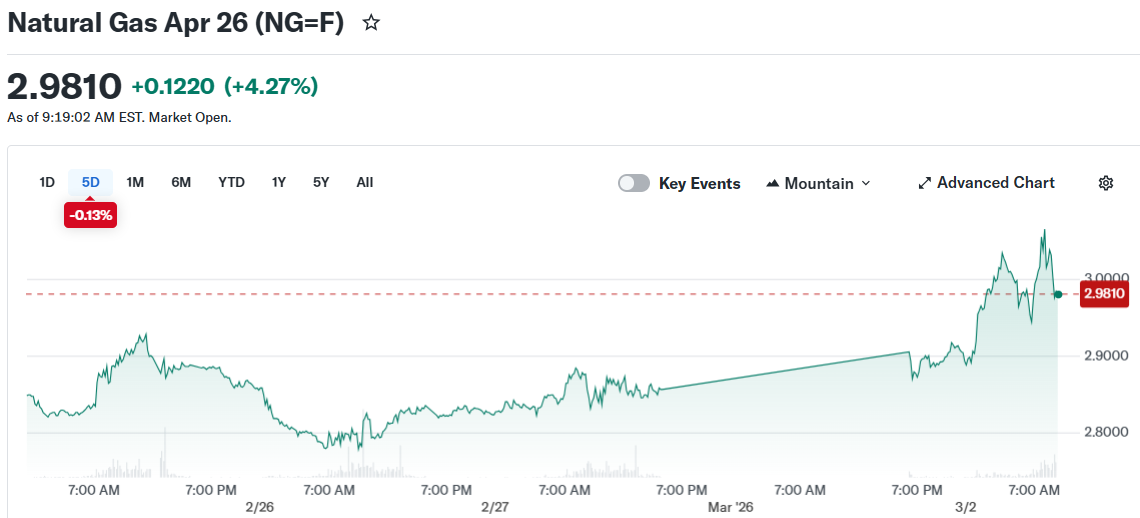
Domestic U.S. natural gas pricing has demonstrated relatively muted responses thus far. Export infrastructure operates near maximum capacity, constraining the ability to rapidly boost outbound volumes.
European market participants continue monitoring LNG supply chain resilience closely. Trading sentiment hinges on whether Strait of Hormuz shipping operations normalize within upcoming weeks.


TLDR
-
Block’s price target was lifted to $78 by Cantor Fitzgerald, up from $70, with the firm keeping its Overweight stance.
-
Fiscal 2026 projections indicate gross profit reaching approximately $12.2 billion with EPS around $3.66.
-
The fintech company surpassed Q4 expectations for both gross profit and adjusted earnings metrics.
-
A major restructuring will see Block eliminate approximately 40% of its staff to focus on AI integration.
-
Wall Street analysts anticipate that expense reductions will enhance profitability and drive sustainable growth.
Following impressive quarterly results and forward-looking guidance, Block (XYZ) secured an upgraded price target from Cantor Fitzgerald. The investment firm elevated its target from $70 to $78 while continuing to rate the stock as Overweight.
This reassessment comes after Block delivered fourth-quarter numbers that exceeded Wall Street’s projections. The payment technology firm beat consensus estimates on both gross profit and adjusted EPS.
Block’s diluted earnings came in at $2.10 per share for the trailing twelve-month period. The company’s gross profit figure also topped analyst predictions, prompting several firms to revise their outlooks upward.
Following management’s fiscal 2026 outlook, Cantor adjusted its financial models accordingly. Block anticipates generating approximately $12.2 billion in gross profit alongside adjusted operating income near $3.2 billion.
For the full fiscal 2026 year, adjusted EPS is expected to reach roughly $3.66. The company’s first-quarter outlook calls for gross profit around $2.8 billion with adjusted EPS approximately $0.67.
Wall Street Perspective and Stock Metrics
The revised $78 target from Cantor reflects a 16x multiple applied to its calendar 2027 EPS projection of $4.85. This represents an upgrade from the prior methodology using a 14x multiple on more conservative earnings estimates.
Block’s stock price has jumped approximately 25.5% in the last week alone. Trading recently around $63.70, the company commands a market cap approaching $38.2 billion.
Block trades at approximately 30 times earnings currently. Analysts noted the valuation looks reasonable when measured against anticipated earnings expansion and discounted cash flow analysis.
Additional Wall Street firms have reaffirmed bullish stances following the earnings report and restructuring reveal. UBS, RBC Capital, and Bernstein each maintained Buy or Outperform designations with targets spanning the mid-$80s to $90 range.
Truist kept its Hold recommendation with a $72 target. Raymond James reduced its objective to $79 while retaining an Outperform view, pointing to potential execution challenges.
Staff Reductions and AI Transformation
Block disclosed plans to eliminate roughly 40% of its employee base in a significant restructuring. Leadership characterized this as a strategic realignment designed to integrate artificial intelligence throughout the business.
Company executives indicated the workforce adjustments will result in a more streamlined cost structure and improved organizational efficiency. Analysts project these modifications could bolster operating margins going forward.
Block highlighted that its Cash App platform delivered substantial contributions to recent gross profit expansion. The Cash App ecosystem remains central to the company’s revenue generation and profitability.
Leadership noted that updated fiscal guidance incorporates strong business momentum from the end of Q4 2025. The revised forecasts include elevated projections across gross profit, operating income, and per-share earnings.
Block’s stock has experienced significant price swings over the trailing year but surged dramatically after the restructuring disclosure. Market participants are closely tracking the implementation of cost initiatives and achievement of updated financial targets.


Key takeaways
-
After paying a $45-million settlement in 2023 and exiting the market, Nexo has reentered the US with a redesigned product model focused on regulatory alignment rather than direct yield issuance.
-
The 2023 crackdown centered on unregistered securities concerns. The SEC alleged that Nexo’s Earn Interest Product functioned as an unregistered security, raising questions about retail yield marketing, transparency, custody practices and counterparty risk.
-
The new model relies on licensed US partners. Instead of directly offering yield products, Nexo now operates through regulated US intermediaries, including licensed entities and, where required, SEC-registered investment advisers.
-
The Bakkt partnership anchors the compliance strategy. By collaborating with Bakkt, a publicly traded US crypto firm with regulatory licenses, Nexo shifts from a direct issuer model to a partner-delivered framework embedded within regulated infrastructure.
Three years after departing the US and paying a $45-million settlement to federal and state regulators, Nexo has formally reentered the US market. But this is not a straightforward relaunch. Rather, it is a structural overhaul.
What changed is not merely the timing or the political climate; it is how the product is designed, delivered and regulated.
This article examines why Nexo exited in 2023, what regulators objected to and how its 2026 return is structured differently. It also explores what US users should watch before engaging with crypto-backed loans or yield-style products.
The 2023 crackdown: Why Nexo left the US
Nexo, co-founded by former Bulgarian lawmaker Antoni Trenchev, developed much of its initial US footprint through its Earn Interest Product (EIP), which enabled users to deposit crypto and earn yield.
In January 2023, the US Securities and Exchange Commission (SEC) accused Nexo of offering and selling unregistered securities through this product. The SEC contended that the EIP met the legal definition of a security and, therefore, required proper registration.
Nexo consented to a settlement:
-
It paid a total of $45 million in fines to the SEC and various state regulators.
-
It neither admitted nor denied the allegations.
-
It ceased offering the product to US investors.
Soon after, Nexo withdrew from the US retail market.
Why regulators targeted “earn” products
The enforcement action stemmed from a wider post-2022 crypto lending fallout. Major failures across the lending industry had revealed liquidity mismatches, rehypothecation risks and retail exposure to opaque yield structures.
Regulators were particularly concerned about:
-
The promotion of yield products to retail investors
-
Transparency regarding how returns were generated
-
Custody practices and credit counterparty risks
-
Whether these offerings functioned as investment contracts.
The crackdown extended beyond Nexo and signaled a broader regulatory overhaul for centralized crypto yield offerings.
Did you know? Borrowing against volatile assets is not a new concept. Traditional stock margin lending has existed for decades, but crypto’s 24/7 trading makes liquidation mechanics far more dynamic and automated.
What changed in 2026
Nexo’s 2026 comeback rests on a core claim: The product is now structured differently and provided through licensed US partners.
Instead of directly delivering yield-like products to US investors under its former approach, Nexo states that its updated structure:
-
Relies on properly licensed US partners
-
Incorporates an SEC-registered investment adviser when required
-
Has phased out the product addressed in the 2023 order.
This difference is significant: Rather than operating as an independent provider of an earn program, Nexo is now positioned within a regulated infrastructure framework.
According to Nexo, it will offer crypto-backed loans and yield-generating products. These services will be provided through licensed US partners.
Crypto-backed loans differ from the unsecured lending models that failed in 2022. Users deposit digital assets as collateral and borrow against them. Liquidation occurs if the collateral falls below set loan-to-value thresholds.
The Bakkt partnership: Compliance by design
A key factor in the relaunch is Nexo’s collaboration with Bakkt, a publicly traded US crypto firm.
Bakkt provides regulated trading infrastructure and holds multiple US licenses. By channeling US operations through regulated entities, Nexo is effectively moving from a direct issuer model to a partner-delivered model.
In practical terms, this means:
-
Trading, custody or advisory services could reside with regulated entities.
-
Product elements may be distributed across licensed intermediaries.
-
Supervision may occur across multiple regulatory layers.
This framework is designed to address the regulatory objections that led to the 2023 settlement.
Did you know? Unlike banks, most crypto lending platforms do not benefit from federal deposit insurance, meaning customer protections depend heavily on custody structures and legal agreements rather than government backstops.
A shifting regulatory landscape
Timing is a factor in Nexo’s return to the US. Under President Donald Trump’s administration, the SEC has terminated or scaled back multiple crypto enforcement actions. The enforcement environment has shifted from an intense crackdown to a period of readjustment.
For instance, the SEC moved to drop a lawsuit involving the Gemini Earn program following investor recoveries. This does not indicate that crypto lending issues are entirely resolved, but it points to a more adaptable regulatory stance than in early 2023.
Nevertheless, the US regulatory framework remains fragmented. Federal agencies, state securities regulators, money transmitter statutes and consumer lending rules may all apply depending on the structure.
What US users need to watch
Even if products are offered through regulated intermediaries, users should assess:
-
Who is your legal counterparty? Is the agreement with Nexo, with a US-licensed entity or with multiple entities?
-
Where does custody sit? Are assets held by a qualified custodian? Under which regulatory regime?
-
How are returns generated? Are yields derived from lending, staking, market-making or other activities?
-
What are the liquidation terms for crypto-backed loans?
What is the loan-to-value (LTV) threshold?
How quickly can liquidation occur?
Are there additional fees?
-
What disclosures exist? Look for:
Risk disclosures
Rehypothecation clauses
Conflict-of-interest statements
Jurisdiction clauses.
“Compliant structure” does not equal “risk-free product.”
Did you know? Money transmitter licensing in the US is state-based, which means a crypto company may need approvals in dozens of jurisdictions. This is one reason partner-led models are gaining popularity.
Why this comeback matters for the industry
Nexo’s return could indicate a wider transformation in US crypto lending:
-
Phase 1 (Pre-2023): Direct-to-consumer yield models with minimal registration
-
Phase 2 (2023-2025): Regulatory enforcement, withdrawals and reorganization
-
Phase 3 (2026 onward): Partner-led models employing licensed intermediaries and segregated functions.
If this framework proves viable, other international crypto companies may reenter the US through comparable compliance layers instead of direct issuance models.
The real shift: It is about the wrapper, not just the product
The primary takeaway from Nexo’s return is structural.
The fundamental economic idea of generating yield on digital assets or borrowing against crypto remains intact. What has evolved is the regulatory framework surrounding it.
Rather than pushing the limits of securities law, the updated model integrates into licensed infrastructure.
Whether this method satisfies regulators over the long term will hinge on:
-
Disclosure quality
-
Risk management practices
-
Transparency of revenue sources
-
Ongoing federal and state coordination.
For now, Nexo’s comeback reflects a more prudent crypto industry that recognizes that in the US, structure dictates survival.
Cointelegraph maintains full editorial independence. The selection, commissioning and publication of Features and Magazine content are not influenced by advertisers, partners or commercial relationships.


Crypto outflows from Iran’s largest exchange jumped 700% within minutes of the first U.S.-Israeli airstrikes on Tehran, blockchain analytics firm Elliptic said in a Monday blog post.
Elliptic said transaction volumes leaving Nobitex spiked almost immediately after the strikes, suggesting a rush to move funds offshore. Initial blockchain tracing indicates the crypto was sent to overseas exchanges that have historically received significant inflows from Iran.
The activity “potentially represents capital flight from Iran that bypasses the traditional banking system,” according to Dr. Tom Robinson, Elliptic’s co-founder and chief scientist.
Over the weekend, coordinated U.S. and Israeli airstrikes struck multiple targets in Iran, killing Supreme Leader Ayatollah Ali Khamenei and escalating a wider Middle East conflict. The attacks stoked market volatility as investors priced in potential disruptions to oil supplies through the strategic Strait of Hormuz, sending global crude prices sharply higher and triggering broad sell-offs in equities and safe-haven buying across assets.
Nobitex allows users to convert Iranian rials into crypto and withdraw funds to external wallets, offering a route around traditional banking channels.
The exchange processed $7.2 billion in crypto transactions in 2025 and claims more than 11 million users, making it central to Iran’s digital asset ecosystem, Robinson said.
Elliptic has previously linked the exchange to IRGC-aligned financial activity and reported in January that Iran’s central bank appeared to use Nobitex in efforts to support the weakening rial.
Iran’s crypto ecosystem
Previous reports have detailed Iran’s growing use of cryptocurrencies as a hedge against a weakening rial and as a potential workaround to international sanctions, with U.S. authorities probing whether digital-asset platforms have enabled state-linked actors to move funds and access hard currency outside the traditional banking system. Blockchain research cited in those reports estimates that Iran-linked crypto activity has reached into the billions of dollars annually, spanning retail users as well as, according to officials, sanctioned entities.
Robinson also flagged additional surges in Iranian crypto outflows earlier this year. The largest came on Jan. 9, following widespread anti-regime demonstrations and a subsequent government-imposed internet blackout.
Two additional surges followed U.S. sanctions announcements targeting Iranian actors, the report said, suggesting crypto may be used to mitigate the impact of sanctions.
Bitcoin and major altcoins dropped sharply in the immediate aftermath of the strikes, with BTC briefly falling below $64,000 before recovering to the mid-$60,000s, underscoring crypto’s sensitivity to geopolitical tensions. Ether (ETH) and other tokens also declined, though several remained above pre-strike levels, pointing to a relatively swift rebound after the initial sell-off.
The world’s largest cryptocurrency was over 2% lower at publication time, trading around $65,500. Ether, the second-largest crypto by market cap, was 3.8% lower at around $1,930.
Read more: Iran crisis puts the regime’s $7.8 billion crypto shadow economy in spotlight

Cart Confidential Vol. 33

Israel escalates attacks and prepares for ground invasion of Lebanon

GMP public appeal to trace family of Bolton man who died


-

 Sports7 days ago
Women’s college basketball rankings: Iowa reenters top 10, Auriemma makes history
-

 Politics7 days ago
Nick Reiner Enters Plea In Deaths Of Parents Rob And Michele
-

 Fashion3 days ago
Weekend Open Thread: Iris Top
-

 Business6 days ago
True Citrus debuts functional drink mix collection
-

 Politics4 days ago
ITV enters Gaza with IDF amid ongoing genocide
-

 Tech1 day ago
Unihertz’s Titan 2 Elite Arrives Just as Physical Keyboards Refuse to Fade Away
-
Sports2 days ago
The Vikings Need a Duck
-

 Crypto World6 days ago
XRP price enters “dead zone” as Binance leverage hits lows
-

 NewsBeat5 days ago
Cuba says its forces have killed four on US-registered speedboat | World News
-
 NewsBeat2 days ago
Dubai flights cancelled as Brit told airspace closed ’10 minutes after boarding’
-

 Tech6 days ago
Unsurprisingly, Apple's board gets what it wants in 2026 shareholder meeting
-
 NewsBeat5 days ago
Manchester Central Mosque issues statement as it imposes new measures ‘with immediate effect’ after armed men enter
-
 NewsBeat2 days ago
The empty pub on busy Cambridge road that has been boarded up for years
-

 NewsBeat1 day ago
‘Significant’ damage to boarded-up Horden house after fire
-

 NewsBeat2 days ago
Abusive parents will now be treated like sex offenders and placed on a ‘child cruelty register’ | News UK
-
 NewsBeat6 days ago
Police latest as search for missing woman enters day nine
-

 Entertainment7 hours ago
Baby Gear Guide: Strollers, Car Seats
-

 Business4 days ago
Discord Pushes Implementation of Global Age Checks to Second Half of 2026
-

 Business4 days ago
Only 4% of women globally reside in countries that offer almost complete legal equality
-
 Tech3 days ago
NASA Reveals Identity of Astronaut Who Suffered Medical Incident Aboard ISS