

Crypto World
Bitcoin Rebound Tactical Not Structural Bear Market: Analysts

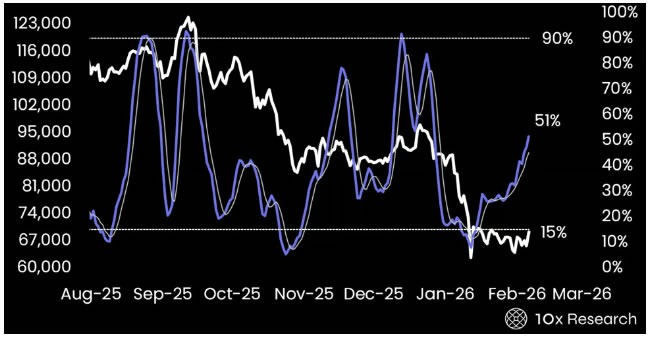
Bitcoin’s recent price behavior could indicate that crypto selling pressure has begun to wane — though analysts warn there are not yet signs of a reversal from a bear market.
“Bitcoin failed to accelerate lower on risk-off headlines, a signal that downside pressure may be losing momentum,” said 10x Research in a market update on Tuesday.
The analysts noted that Bitcoin (BTC) was reclaiming the 20-day moving average near $68,500, and Bollinger Bands were tightening, with conditions “forming for potential range expansion.”
BTC returned to just above $70,000 on Coinbase in late trading on Monday but had retreated to $68,400 at the time of writing, according to TradingView.
The $62,500 level has held on three separate tests, “reinforcing it as meaningful support,” the analysts said.
At the same time, “bullish divergences are emerging,” with both RSI [relative strength index] and stochastic indicators trending higher, “early signs that momentum may be stabilizing even within a broader bearish structure.”

A tactical shift but no structural reversal
The analysts concluded that the evidence “points to a meaningful tactical shift, but not yet a confirmed structural turn.”
Volatility is compressing, ETF flows have strengthened, and the Coinbase discount has disappeared, “these are not characteristics of a market accelerating into a fresh leg lower,” they said.
“However, our broader allocation framework still classifies Bitcoin as being in a bear market regime, meaning any bullish exposure remains tactical rather than structural.”
Related: Crypto analyst says Bitcoin selling pressure is nearly exhausted
Justin d’Anethan, head of research at Arctic Digital, told Cointelegraph on Tuesday that there have been a lot of macro and crypto-native events that have pushed the price down, but lately, “we’ve moved from frantic to somewhat measured,” which bodes well for “a consolidation, accumulation, or at least, a range-bound time.”
“The fact that selling pressure isn’t having that much impact despite tariffs, prospect of a war, or previously disappointing rate cut expectations seems to say that sellers themselves are exhausted or that there are genuine buyers averaging in at these levels.”
Deeply negative funding rates caused a price bounce
Meanwhile, Bitrue research lead Andri Fauzan Adziima told Cointelegraph that Bitcoin’s downside momentum is fading but said it was “primarily due to deeply negative funding rates” on derivatives markets.
This has created “overcrowded short positions in perpetual futures and triggered a classic short squeeze as price bounced sharply from $63,000 lows, forcing heavy liquidations and easing selling pressure through tactical relief.”
Negative funding rates mean that short sellers are paying the longs to maintain their positions.
He added that no confirmed trend reversal has occurred yet “because structural inflows remain absent, macro catalysts are lacking,” and the broader downtrend from the all-time high “persists with fragile liquidity and resistance ahead.”
Magazine: Telegram avoids Philippines ban, yen carry trade now onchain: Asia Express



NEAR Protocol, Virtuals, and Morpho crypto stood as some of the best performers on Tuesday amid a broader market rebound back above the $2.4 trillion mark.
Summary
- NEAR Protocol, Virtuals and Morpho led altcoin gains with double-digit rallies on Tuesday.
- NEAR, VIRTUALS benefited from positive developments across the AI sector alongside project-specific catalysts.
- Morpho rallied following the launch of the OKX Onchain Earn product on the protocol.
According to data from CoinGecko, the global crypto market rose 5% to $2.45 trillion before stabilizing around $2.4 trillion at press time. The market recovery was largely fueled by Bitcoin, the bellwether’s rally on Monday with the flagship crypto jumping from intraday lows near $65,000 to over $69,800 in a matter of hours.
Besides this, investor appetite for risk assets also returned after U.S. manufacturing data exceeded market expectations, fueling optimism surrounding Fed rate cuts this year.
The crypto market recovery triggered a short squeeze across major crypto assets. Data from CoinGlass shows nearly $202 million worth of short positions were liquidated in the past 24 hours, out of the total $331 million liquidated from both sides across leveraged markets.
Amidst this volatility, NEAR Protocol, Virtuals, and Morpho emerged as the standout winners. These assets capitalized on the easing market sentiment to post double-digit gains.
NEAR Protocol (NEAR) was the strongest gainer of the day with its 24% rally to a 5-week high of $1.45 on Monday. The surge extended its weekly gains to over 50%.
The AI token’s gains follow AI chip-making giant Nvidia announcing a multiyear strategic partnership with Coherent Corp, a global leader in photonics and networking, to advance its optical interconnect technology.
As part of the agreement, Nvidia would be investing $2 billion in Coherent to support research and development, along with expanding manufacturing capacity.
NVIDIA shares rose by 2.93% shortly after the announcement, sparking a broader rally in AI-focused cryptocurrencies. The partnership also comes just days after the chip giant revealed bullish quarterly earnings, easing fears of a slowdown in AI spending.
As Nvidia is the market bellwether for artificial intelligence, its bullish earnings and stock rally serve as a major impetus for related assets such as NEAR Protocol.
Project-specific catalysts, including the launch of Near FM and Near Intents has also supported the recent rally.
Virtuals Protocol
Virtuals Protocol (VIRTUAL) rose over 15% today to $0.79, its highest price since late January this year. The gains followed after it broke out of a consolidation from the $0.60-$0.75 range it had been stuck within over the past week.
Besides sharing the AI market hype surrounding Nvidia news and its stock gains, the agentic AI coin also benefited from strengthening fundamentals supporting it.
In a recent X post, the Virtuals Protocol team revealed that agent transactions on the network soared by around 128% over the past two weeks, as 3,421 agents competed in Epoch 2 of its AI revenue incentives program. Agent-to-agent revenue reached $2.8 million during the period, with roughly $200,000 distributed to builders.
The team also outlined upgrades for Epoch 3 aimed at tightening reward quality and making it materially harder to manufacture artificial signal, with a stronger focus on genuine demand and sustained utility.
Morpho
Morpho (MORPHO) rose 11% on the day to $1.97, extending its weekly gains to around 25%.
Morpho’s gains today can be largely attributed to a surge in network activity following the launch of the OKX Onchain Earn product on the Morpho protocol. The event includes a 65 million KAT (Katana Network) reward pool for users staking USDT on the protocol.
At the same time, there’s also noticeable chatter around Apollo Global’s recent commitment to the protocol, which has provided a strong fundamental backstop for the current price action. Under a newly established four-year cooperation agreement, the $940 billion asset manager is authorized to acquire up to 90 million MORPHO tokens, representing roughly 9% of the total supply.
Disclosure: This article does not represent investment advice. The content and materials featured on this page are for educational purposes only.


Chainlink has enabled transfers of Coinbase’s wrapped Bitcoin token, cbBTC, from Base to the Monad blockchain using its cross-chain interoperability protocol (CCIP), enabling more than $5 billion worth of cbBTC to move into the Monad ecosystem.
According to Monday’s announcement from Monad, the integration brings cbBTC into the Monad DeFi ecosystem, where a bevy of applications, including Curvance and Neverland, are adopting cbBTC markets.
The move introduces Bitcoin-backed liquidity to lending, borrowing and other decentralized finance (DeFi) applications on Monad, an EVM-compatible layer-1 blockchain designed for high-throughput trading and financial use cases.
“As Bitcoin-backed assets grow into the tens of billions, the infrastructure moving them has to meet that scale,” said William Reilly, head of strategic initiatives at Chainlink Labs. CCIP was built with multiple layers of decentralized validation to reduce cross-chain risks and maintain consistent 1:1 backing across networks, he added.
Monad touts throughput of up to 10,000 transactions per second and sub-second finality, positioning itself as infrastructure for transaction-intensive financial applications.
Coinbase launched cbBTC in September 2024 as a wrapped Bitcoin token on Ethereum and Base, backed 1:1 by BTC held in custody and designed to automatically mint and redeem against Bitcoin deposits on the exchange.
Related: Bitcoin company Fold pays off $66M debt, frees up BTC collateral
New products aim to make Bitcoin a yield-bearing asset
Unlike proof-of-stake networks such as Ethereum (ETH) and Solana (SOL), where users can earn rewards by staking tokens, Bitcoin’s proof-of-work design does not natively generate yield. That constraint has historically limited onchain income options for holders of the biggest cryptocurrency, but new financial structures have started to address the gap.
Last May, Solv Protocol co-founder Ryan Chow said demand for Bitcoin yield strategies was accelerating, particularly among companies seeking liquidity without selling Bitcoin. He pointed to proof-of-stake integrations and delta-neutral trading strategies as expanding ways Bitcoin can generate returns while supporting network security and liquidity.
That same month, Coinbase launched the Coinbase Bitcoin Yield Fund targeting 4% to 8% annual net returns for institutional investors outside the US. About a month later, Kraken introduced a Bitcoin staking product through an integration with Babylon Labs, allowing users to lock up their BTC and delegate it to secure proof-of-stake networks without bridging or wrapping.
Wrapped Bitcoin has also continued to expand across networks. In November, WBTC integrated with the Hedera network with support from BitGo and LayerZero, extending the largest tokenized version of Bitcoin into another smart contract ecosystem.
Last week, Telegram’s built-in TON Wallet added vaults enabling users to earn yield on Bitcoin within the messaging app through underlying decentralized finance infrastructure.
Magazine: Would Bitcoin really be at $200K if not for Jane Street? Trade Secrets
Crypto World
More than 95% of all bitcoin has already been mined, rest will take more than a century
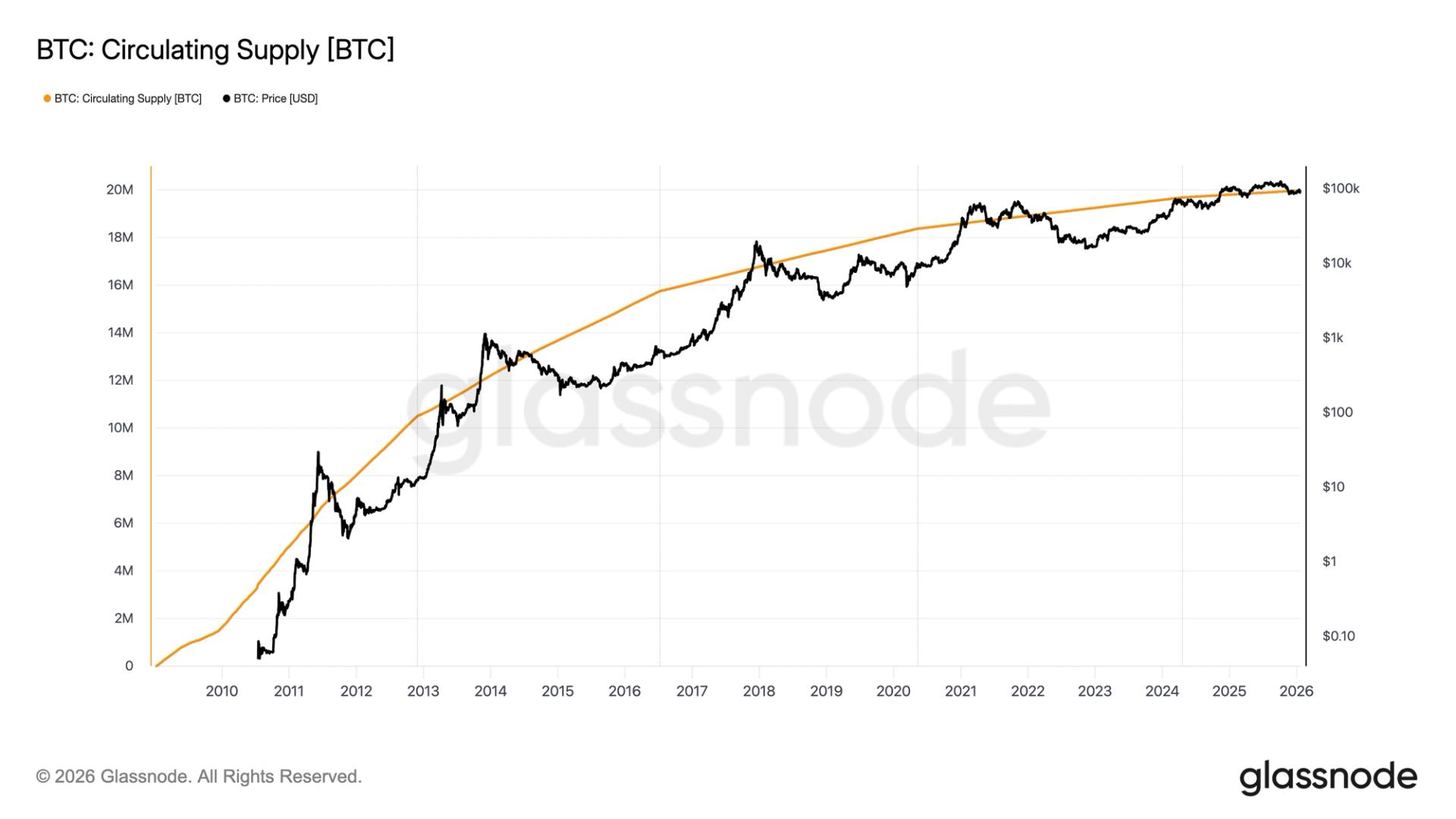
Bitcoin is on the brink of reaching a major symbolic milestone with the issuance of its 20 millionth coin.
According to the Clark Moody Dashboard, 19,996,979 BTC have been mined, leaving just roughly 3,000 BTC remaining before the 20 millionth bitcoin is reached, roughly seven days away at current issuance rates. Once that threshold is crossed, more than 95% of the fixed 21 million supply will be in circulation, with just 1 million coins left to be mined over the next century.
Satoshi Nakamoto hard coded the 21 million cap into bitcoin’s protocol to create a form of money with absolute scarcity, contrasting sharply with fiat currencies that can be expanded by central banks. Although Satoshi never fully explained the specific number, the fixed limit established credibility around predictable supply. For bitcoin maximalists, the cap is foundational. Any suggestion of changing it is seen as undermining Bitcoin’s core value proposition as “hard money.”
Bitcoin’s scarcity is often compared to gold or oil. But while commodity supply can respond to higher prices through increased production or new discoveries, bitcoin’s issuance cannot accelerate. Its supply curve is transparent and immutable.
Issuance has slowed through halvings, which cut miner rewards roughly every four years, pushing inflation below 1%, with about 450 BTC mined daily. At this pace, 99% of supply will be mined by January 2035. The final full bitcoin is expected around 2105, with fractional issuance continuing until about 2140.
After that, miners will rely entirely on transaction fees. For supporters, the 20 million milestone reinforces bitcoin’s scarcity narrative as new supply dwindles. While for miners it underscores the long term shift toward a fee driven revenue model that will ultimately determine the network’s security and economics.


The Bank of Japan will conduct technical experiments using blockchain technology to settle deposits held at the central bank by financial institutions, according to BOJ Governor Kazuo Ueda.
In a speech posted Tuesday titled “The New Financial Ecosystem and the Role of Central Banks,” Ueda said a sandbox project is underway to test settlement using central bank money “in the form of current account deposits on a system that uses blockchains.”
The experiments will explore “methods of connection with the existing system” and examine use cases, including “domestic interbank settlement and securities settlement.”
The project centers on settlement using central bank current account deposits, which are held by financial institutions at the BOJ. Ueda said the BOJ plans to proceed with support from external experts, framing the work as a controlled technical test rather than a policy rollout.
Sandbox targets interoperability and settlement design
The sandbox will study interoperability with current systems, including the Bank of Japan Financial Network System, known as BOJ-NET. Ueda said insights from the project could also be used to improve BOJ-NET.
Ueda added that integrating artificial intelligence and blockchain could enable enhanced financial services built on transaction and settlement data recorded on distributed systems.
Related: Metaplanet CEO rejects claims it hid details of Bitcoin trades
Ueda also warned of design risks tied to smart contracts. “When the design of the smart contracts is inadequate, however, there is a risk that the stability of financial markets and payment systems will be threatened,” he said.
Japan’s broader digital asset framework
The sandbox comes as Japan refines its digital asset regulatory framework.
In 2025, the Financial Services Agency held public consultations on reclassifying certain tokens under the Financial Instruments and Exchange Act, a move that could subject select digital assets to securities-style disclosure and market conduct rules.
The government has also framed blockchain and tokenization as part of its broader “New Capitalism 2025” growth strategy, positioning digital infrastructure as a pillar of financial modernization.
Japan is also expanding stablecoin integration at the private sector level. On Oct. 27, 2025, JPYC launched Japan’s first yen-backed stablecoin under the country’s revised Payment Services Act, which recognizes stablecoins as electronic payment instruments.
On March 2, Sony Bank and stablecoin issuer JPYC signed a memorandum of understanding to study real-time transfers enabling customers to purchase yen-backed stablecoins directly from bank accounts.
Magazine: Bitdeer sells all Bitcoin, Metaplanet rejects misconduct claims: Asia Express
Crypto World
Solana Price Analysis: SOL Shows Recovery Signs After Reclaiming Critical Technical Level
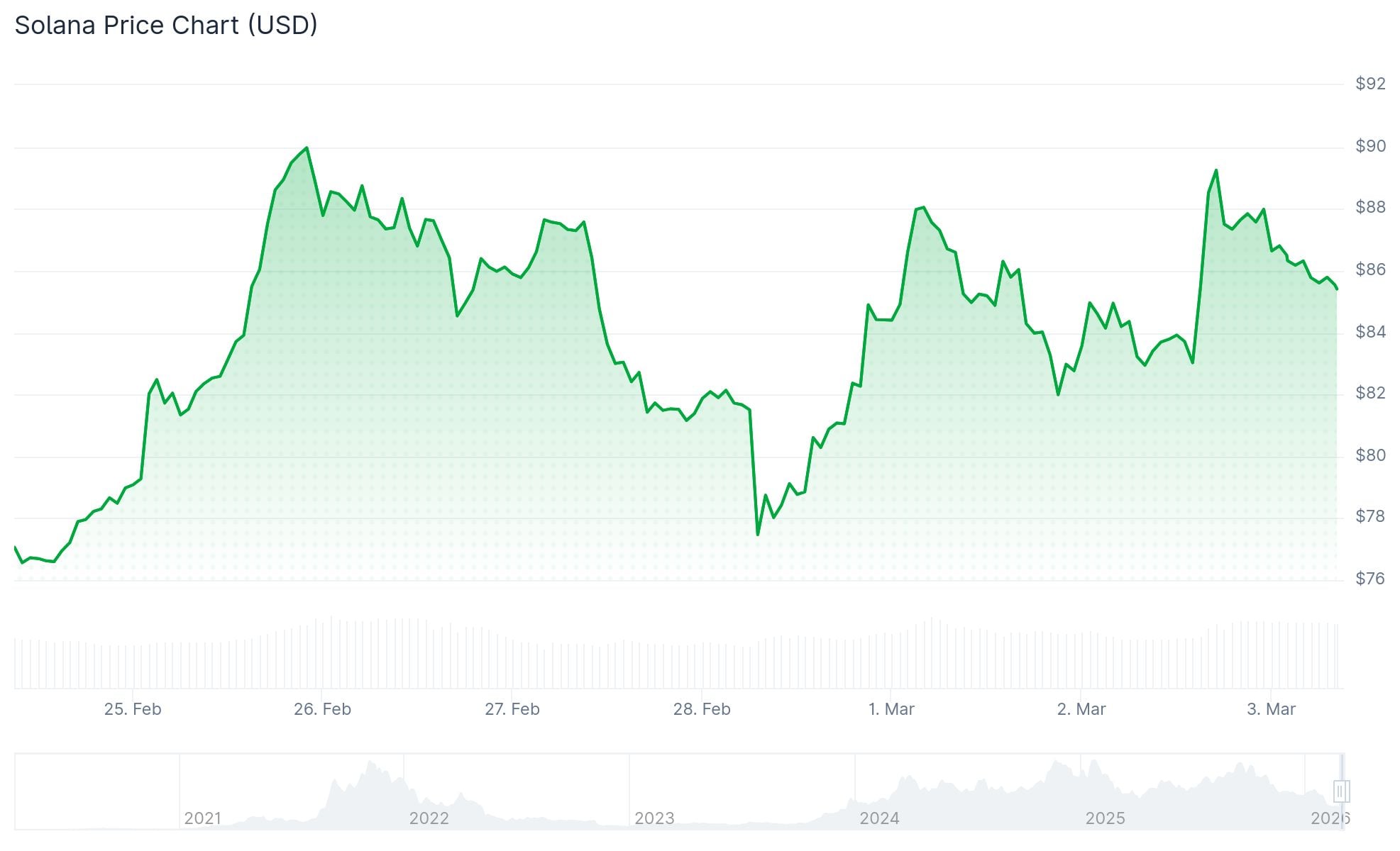
TLDR
- SOL retreated from $90 to test support around $85 before stabilizing near $87
- The Relative Strength Index reads 47.68 — indicating neutral momentum without decisive bullish pressure
- For the first time since January, SOL has moved back above the Ichimoku cloud on 4-hour timeframes
- Technical observers identify $88.60 as a critical resistance threshold; clearing it may trigger moves toward $95–$100
- A bullish crossover occurred as the 50MA moved above the 100MA, suggesting improving short-term momentum
Solana (SOL) is currently changing hands in the $87–$88 range following a retreat from its recent peak of $90.29. The digital asset tested levels below both $88 and $87 before stabilizing above the crucial $85 support zone.
The token maintains its position above the 100-hourly simple moving average at present. Trading activity over the past day totals $9.99 billion in volume, while market capitalization stands at $49.91 billion. Price action reflects a 4.70% gain across the 24-hour period.
This recent retracement pushed SOL beneath the 50% Fibonacci retracement level calculated from the $81.71 low to the $90.29 high. Chart technicians have identified a bullish trend line developing on hourly timeframes, with support clustering near $85—a level that coincides with the 61.8% Fibonacci retracement.
On March 2, market analyst BitGuru suggested that SOL might be transitioning from correction into consolidation territory. His assessment highlighted the formation of higher lows near established support zones, indicating diminishing downside momentum.
Technical observers have zeroed in on $88.60 as the immediate level that needs reclaiming. According to market commentator More Crypto Online, a successful push above Sunday’s high at $88.60 would demonstrate renewed buyer strength.
Key Resistance Levels to Watch
Immediate resistance appears at $88, followed by $90 and $92. Successfully closing above $92 would potentially clear the way for tests of $96 and subsequently $100.
Should SOL struggle to overcome the $90 barrier, downside targets emerge at $84 and then $82. Breaking below $82 could expose the token to further weakness toward $76.50.
The Relative Strength Index currently registers 47.68—positioned in neutral territory without extreme conditions. The MACD indicator shows 1.80, marginally positive but still trailing the signal line at -4.29. While bearish pressure appears to be diminishing, bullish momentum hasn’t fully established dominance.
Solana remains positioned considerably below its major moving averages across longer timeframes. The 50-day SMA stands at $103.66, while the 100-day rests at $117.73, and the 200-day sits at $156.34.
Ichimoku Cloud Break Signals Shift
Analyzing the 4-hour timeframe reveals that SOL has successfully reclaimed position above the Ichimoku cloud—marking the first such occurrence since January. During the entire month of February, all upward movements met resistance at this cloud formation.
Additionally, the 50-period moving average has executed a bullish crossover above the 100-period moving average on 4-hour charts. Technical analyst CryptoCurb characterized this development as representing a meaningful shift in underlying trend structure.
Both moving averages are now beginning to slope upward. Chart projections presented by CryptoCurb indicate potential for movement toward $100 and higher levels, provided the token sustains its position above recently reclaimed technical zones.
Currently, SOL is valued at $87.64 with preliminary recovery indicators emerging, though a definitive trend reversal remains unconfirmed at this stage.



The crypto market has faced a significant drawdown this year, extending the decline that followed the October market crash.
However, in its latest market commentary, Grayscale Investments noted that now may be an appropriate time for long-term investors to consider allocating to crypto.
Grayscale Report Highlights AI’s Resilience Amid Crypto Market Decline
Grayscale highlighted that the crypto markets saw a notable decline in early February, following the downturn in high-growth software stocks and other equity sectors tied to early-stage technology. Market data showed that during the first week alone, the total crypto market cap dropped by around 10.8%.
The market experienced a notable decline towards the end of the first week, with Bitcoin (BTC) falling to $60,000, while other major assets also saw significant losses.
The FTSE/Grayscale Crypto Sectors Index dropped 26% from January 30 to February 5. The report also revealed that the artificial intelligence (AI) segment emerged as the top performer in February among crypto sectors. The sector experienced a more modest drawdown compared to others.
Follow us on X to get the latest news as it happens
“The outperformance seemed due to renewed enthusiasm around AI agents — autonomous software that can work independently on your behalf to pursue a complex set of objectives. Technological innovation appears to be accelerating with the rise of agent-based systems, particularly OpenClaw — a locally hosted productivity assistant that became one of the fastest-growing open-source projects in history,” the report read.
Kite AI, centered on agent-native stablecoin payments, and Pippin AI, which develops on-chain AI agents, both saw strong performance.
However, Grayscale’s report indicated a rebound, with the FTSE/Grayscale Crypto Sectors Index recovering 4% by the end of the month. The report added that metrics such as trading volumes and implied volatility have also “settled down.”
Grayscale Identifies Key Reasons for Long-Term Crypto Allocation
With market conditions stabilizing, Grayscale presents three core arguments for long-term accumulation. First, is the relationship between blockchain and AI. The report asserts that AI and blockchain are complementary, not competing.
“In fact, blockchains will likely be the financial rails for AI agents, given certain advantages over traditional bank-based finance — as discussed in the popular report by Citrini Research on possible AI disruptions,” Grayscale wrote.
While crypto assets declined alongside software stocks amid the market slump, the report suggested that investors may eventually differentiate between technologies disrupted by AI and those that complement it.
Second, the report pointed to stablecoin and tokenization trends. According to Grayscale, regulatory clarity, including the passing of the GENIUS Act last year, is encouraging institutional investment in stablecoins and tokenized assets. Recent actions by companies like Meta, Stripe, and BlackRock further demonstrate the sector’s growth potential.
“In February, reports indicated that Meta may reinvest in stablecoins after shelving its Libra/Diem project amid regulatory headwinds, and Stripe said in its annual letter that ‘stablecoin payments are advancing quietly and inexorably as real-world uptake continues apace.’ Separately, BlackRock said it would integrate its tokenized money market fund BUIDL with UniswapX,” the report highlighted.
Although the Clarity Act is delayed in the Senate, Grayscale highlights that its potential passage could facilitate institutional capital inflows into the asset class.
Lastly, the firm stated that the US economy remains healthy, with some indicators suggesting further potential growth. While there is uncertainty regarding the new Fed Chair nominee, Grayscale views the overall macro environment as supportive of risk assets.
“Overinvestment in AI is a medium-term risk, but the pace of innovation remains rapid and there are still shortages of data center capacity. The market reacted negatively to the nomination of Kevin Warsh to replace Jerome Powell as Fed Chair, but we doubt he will be as hawkish in practice as some of his viewpoints while Fed governor (2006-2011) might suggest,” Grayscale said.
Thus, Grayscale Investments presents a compelling case for long-term crypto growth. However, investors must carefully assess their risk appetite and time horizon, as the crypto market’s unpredictability can affect short-term returns despite long-term opportunities.
Subscribe to our YouTube channel to watch leaders and journalists provide expert insights

BitMEX co-founder Ben Delo has pledged 20 million British pounds ($27 million) to the London Institute for Mathematical Sciences (LIMS), ranking it among the largest private donations ever made to a United Kingdom research institution outside Oxford and Cambridge, British magazine Times Higher Education reported on Tuesday.
The commitment includes $13.3 million paid upfront and a further $13.3 million to be released once the Mayfair-based institute matches the amount through additional fundraising, Times Higher Education reported. The gift launches a wider campaign aimed at building an $80 million endowment to secure LIMS’ long-term future, per the report.
“I would like to see LIMS winning Fields Medals and Nobel Prizes – they are already doing some world-class things and I want to help,” Delo told the magazine.
Delo said he chose to support LIMS over a larger university because it allows leading researchers to focus solely on research without teaching or administrative burdens.“They are also approaching research in an innovative way – even offering coaching on research,” he said, while criticizing UK’s “lacklustre and inconsistent approach to scientific funding.”
Related: New donation widget lets creators accept crypto payments 24/7
Delo paid $10 million fine before receiving Trump pardon
Delo, who co-founded crypto exchange BitMEX in 2014, pleaded guilty in 2022 to US banking violations alongside his co-founders and paid a $10 million fine. He received a presidential pardon from Donald Trump in March 2025.
Delo is also a LIMS trustee, and has previously backed several causes, including neurodiversity, academic freedom and mathematical education and research. In 2025, he funded the creation of the Ben Delo Fellowship at the London Institute.

Founded in 2011 by physicist Thomas Fink, LIMS operates from the Royal Institution, in rooms once occupied by chemist Michael Faraday. The institute focuses exclusively on research, backing three-year fellowships in theoretical physics, pure mathematics and artificial intelligence. In recent years, it has supported exiled Russian and Ukrainian scientists and attracted researchers from the US.
Cointelegraph reached out to LIMS for comment, but had not received a response by publication.
Related: Top UK Labour lawmakers push to ban political donations made in crypto
UK lawmakers call for temporary ban on crypto political donations
Last week, the chair of the UK’s national security committee called for an immediate temporary ban on political donations made in cryptocurrency, warning that such payments could enable foreign interference in British elections.
The move comes after Reform UK received a record $12 million donation last year from early cryptocurrency investor Christopher Harborne, marking the largest single political contribution ever made by a living individual in Britain.
Magazine: Bitcoin may take 7 years to upgrade to post-quantum — BIP-360 co-author

AI Summary
- In the fast-evolving world of crypto neo-banking, traditional approaches are no longer sufficient.
- The future lies in Agentic AI, a sophisticated system that brings autonomous intelligence to the forefront.
- This technology goes beyond mere analysis, actively executing tasks with minimal human intervention.
- By seamlessly integrating with blockchain infrastructure, Agentic AI streamlines complex DeFi processes, enhances regulatory compliance, and optimizes user experience.
- In the competitive landscape of white-label neo banking, Agentic AI offers a range of benefits, from automating compliance and improving operational efficiency to enhancing treasury management and mitigating fraud risks.
“The future of crypto neo-banking won’t be built by dashboards – it will be governed by autonomous intelligence.”
Across the globe, regulators are tightening oversight, liquidity cycles are accelerating, and cross-border rails are fragmenting. White label neo banks can no longer rely on static compliance workflows or manual treasury oversight. They need infrastructure that thinks, reacts, and enforces policy in real time. Explore Agentic AI, not as a feature, but as a sovereign-grade control layer. From programmable compliance and self-adjusting liquidity engines to travel-rule automation and on-chain threat containment, agentic systems transform crypto neo-banking into a continuously adaptive, regulator-aligned machine. For enterprises and governments, this is no longer innovation theater. It’s operational survival and competitive advantage, engineered into the core.
Why Agentic AI Matters In Crypto Neo-Banking Development Space?
- Autonomy and action: Agentic AI doesn’t just analyze; it plans and executes tasks (sets goals, signs/submits transactions, and calls smart contracts) with limited human supervision. That makes it a natural fit where speed, continuous monitoring, and automated execution matter (e.g., liquidity management, treasury ops, automated compliance).
- Web3-native execution: On-chain agents can observe blockchain state, reason over real-time signals, and directly interact with smart contracts, making automation verifiable and composable with DeFi primitives. That capability is different from off-chain AI acting as an advisor.
- Simplifying DeFi and Neo-bank App UX: Agents can abstract complex DeFi steps for retail users (route swaps, managing gas, and harvesting yields) so that enterprises with neo-banking platforms can offer “one-click” Web3 products without exposing users to manual on-chain complexity.
What Extra Does Agentic AI In White Label Neo Banking Bring To The Table?
1. Delivers continuous, automated regulatory compliance (policy-as-code): Encode jurisdictional rules and platform policies as machine-readable policies so agents enforce them before any customer-facing action. This turns ad hoc manual compliance into deterministic, auditable enforcement, ideal for white-label BaaS vendors that must serve many license regimes and clients.
2. Reduces operational cost and time-to-market for licensees: White-label neo banking service providers promise rapid launches and lower OPEX; agentic automation accelerates routine back-office tasks (KYC triage, AML screening, reconciliation) and reduces human review volumes. This shortens onboarding cycles and improves unit economics for merchants and partners.
3. Enables safer autonomous treasury & liquidity operations: Agents continuously monitor liquidity, on-chain pools, and fiat corridors, then recommend or execute hedges, peg-support actions, or tranche rebalances within pre-approved guardrails, crucial for neo-banks offering tokenized products or stablecoin rails.
4. Improves customer UX while hiding Web3 complexity: Agents orchestrate multi-step DeFi flows (swap → stake → settle) and handle gas optimization, routing, and fallback logic so end users see “one-click” products without exposure to on-chain failure modes. This preserves the white-label brand experience across client deployments.
5. Provides a programmable, auditable “autonomy layer” that scales for many tenants: White-label neo banking platforms must operate multi-tenant rule sets. Agentic AI combined with policy-as-code delivers per-tenant policy profiles, versioning, and immutable decision logs, enabling auditability for both regulators and the platform’s customers.
6. Delivers near-real-time fraud detection and response: Agents spot anomalous sequences across on-chain and off-chain signals and can enact containment actions (temporary holds, multisig freezes, and session invalidation) with preconfigured escalation logic, reducing losses and reputational damage.
7. Supports composable, modular product extension (plug-and-play for partners): Because white-label offerings are built for reuse, agentic components (KYC agent, treasury agent, and payments agent) can be offered as modular microservices that clients enable/disable, accelerating product customization without code rewrites. Industry frameworks already encourage reusable agent patterns.
8. Enables explainability, governance, and human-in-the-loop controls: Best practice: agents operate with three authority modes: observe, propose, and execute. Critical/high-impact actions require multisig/human signoff; all agent decisions produce replayable rationales and evidence bundles for audits. This preserves regulatory comfort while unlocking autonomy.
9. Drives product differentiation and revenue enablement: Agentic features (autonomous savings, instant FX optimization, proactive fee-reduction routing) become premium modules that white-label operators can upsell to clients (merchant plans, high-volume remitters, cross-border SMEs). Agents make advanced automation a monetizable capability.
10. Mitigates vendor risk through policy and provenance controls: Agents should be cryptographically identifiable, have verifiable provenance (signed decision logs), and run within hardened key custody (HSMs/multisig). This reduces impersonation and audit risk for white-label vendors operating across multiple banking partners and regulators.
Now, let us have a closer look at how one of the hottest markets globally faces challenges in its financial market, and that can only be solved by integrating Agentic AI into white label crypto neo banking solutions that can overcome their pain points in a click.
Top Regulatory Markets Where Agentic AI Enhances White-Label Crypto Neo-Banking
1. United States
Major challenge
Fragmented regulator expectations, heavy custody & AML obligations, and fast-moving guidance that makes product roadmaps risky for banks offering crypto services.
How is agentic AI in neo banking helping them?
- Regulatory surveillance agents: continuously ingest regulator releases, rule changes, and enforcement actions; extract obligations; and auto-generate compliance checklists mapped to product features.
- Treasury-stress agents: run continuous scenario simulations (liquidity shocks and stablecoin runs); recommend hedges or rebalance steps; and prepare human-approved execution plans.
- Evidence-pack creation agents: when a suspicious flow is detected, agents collate on-chain traces + off-chain identity data into audit-grade packets for investigators.
2. United Kingdom
Major challenge
Retail transfers to regulated exchanges are frequently blocked or delayed by incumbent banks and payment rails, creating UX breakdowns and market fragmentation.
The Only Solution To The Problems: Agentic AI White Label Neo Bank App
- Payment-route intelligence agents: predict the likelihood of a rails approval using historical failure signals, merchant metadata, and bank rule heuristics; pre-choose compliant rails or suggest off-ramp alternatives to users.
- Auto-remediation agents: when a payment stalls, automatically surface the failure code, prepare corrective messages (pre-filled forms/evidence), and open the right banking/exchange ticket with the required attachments.
3. Singapore
Major challenge
High MAS expectations for KYC/AML, consumer protection, and strict data-privacy tradeoffs when combining on-chain transparency with off-chain identity.
Agentic AI-Based Neo Banking Acts As A Solution
- Policy-as-code agents: MAS rules and DPT (digital payment token) obligations encoded as machine-readable policies; agents enforce limits and trigger enhanced due diligence automatically.
- Privacy-aware orchestration agents: decide whether to store attestations off-chain or to submit zero-knowledge proofs on-chain, thus preserving auditability while respecting PDPA-like constraints.
4. Switzerland
Major challenge
High AML standards, reputational risk for banks that take crypto clients, and the need for continuous counterparty & contract monitoring.
Is an Agentic AI-powered customized BaaS platform, the solution to it?
- Continuous counterparty-risk agents: fuse on-chain behavior (mixing, sourcing of funds) with KYC/OSINT signals to produce evolving risk scores and recommended mitigations (transaction limits, additional attestations).
- Smart-contract guardian agents: run attack-surface simulations and detect anomalous contract state changes; when thresholds hit, trigger multisig freezes or emergency settlement paths.
5. United Arab Emirates
Major challenge
Rapid licensing growth (VARA/ADGM) meets uneven banking partner acceptance and strict local advertising/product rules, creating operational friction for entrants.
How does agentic AI in crypto neo banking help?
- Regulatory-fit assistants: automatically scan product copy, onboarding flows, and partner contracts against VARA/ADGM rule sets and flag non-compliant language or missing controls.
- Partnership-optimization agents: analyze historical acceptance patterns and generate tailored documentation bundles to improve bank partner approval odds.
Launch Your Agentic AI-Powered Banking Solutions Today
6. Nigeria
Major challenge
High grassroots stablecoin adoption for remittances and dollar-hedging amid FX instability; regulators worry about dollarization and capital flight.
How does agentic AI help?
- Stablecoin-peg & liquidity agents: monitor local liquidity, on-chain pool depths, and OTC lanes; automatically route swaps and on/off ramps to preserve peg and minimize slippage for retail users.
- Cost-optimal remittance agents: detect the lowest-cost, compliant corridor (stablecoin payment rails vs. traditional FX) and present the user with a single-click, auditable trail.
7. El Salvador
Major challenge
Volatility, limited merchant adoption, public distrust, and infrastructure constraints were exposed by nationwide policy experiments.
How does agentic AI help?
- User-protection agents: auto-offer instant fiat-backs or stable-value settlement for merchant receipts and protect small savers from token volatility via optional auto-convert rules.
- Resource-aware orchestration agents: if national initiatives tie to mining or local validation, agents in crypto-friendly neo-banking solutions schedule heavy compute/mining tasks for low-impact periods and prefer renewables where possible.
8. India
Major challenge
Tight KYC/AML enforcement, mandatory FIU registration, travel-rule implementation with zero thresholds, and frequent regulatory updates that raise compliance overhead.
How does agentic AI help?
- Travel-rule automation agents: collect, validate, and transmit originator/beneficiary data in real-time to meet India’s no-threshold travel-rule requirements and generate audit trails for FIU-Ind.
- Adaptive KYC orchestration agents: dynamically escalate to Enhanced Due Diligence (EDD) based on behavior and maintain replayable decision logs for enforcement queries.
Concrete Crypto-Friendly Neo-Banking Use Cases
- Autonomous treasury & liquidity management: agents rebalance stablecoin reserves, shift assets between pools, or top up liquidity automatically based on thresholds and forecasts.
- Programmatic compliance & continuous KYC/AML monitoring: agents scan transactions, flag anomalies, and open tickets or freeze flows for human review.
- Personalized, active wealth management: per-user agents that rebalance portfolios, auto-stake, or switch yield strategies based on risk profile and market signals.
- Smart contract guardians: watch contracts for exploits (or upgrade opportunities) and execute emergency multisig flows or circuit breakers when rules are breached.
- Autonomous onboarding & UX helpers: agents assist users with wallet linking, gas estimation, and transaction bundling to reduce friction and errors.
Wrapping It Up!
Agentic AI is not a marketing checkbox; it’s an operational and product architecture that transforms white-label neo-banking from a static tech stack into an adaptive, policy-driven platform. When coupled with strong policy governance, explainability, and human gates, agentic AI is a practical and defensible way to reduce costs, accelerate launches, and offer premium automation to partners and end users.
Are you planning to launch your solution with the best team of experts? Get in touch with us! Antier, being the leading white-label neo bank development company, is at the forefront of this transformation. Combining advanced blockchain domain expertise with AI-native automation, our team architects modular, policy-driven agent stacks and secure custody layers that accelerate launches and harden operational controls. Our proven delivery cadence, spanning from full white-label deployments within seven days that are combined with enterprise-grade decisioning and deterministic audit trails, empowers clients to launch faster, operate smarter, and monetize automation.
Get in touch with us today and share your requirements or plan to start the execution.
Frequently Asked Questions
01. What is Agentic AI and how does it impact crypto neo-banking?
Agentic AI is an autonomous intelligence system that enhances crypto neo-banking by enabling real-time compliance, liquidity management, and automated execution of tasks with minimal human supervision, transforming traditional banking operations into adaptive, regulator-aligned processes.
02. How does Agentic AI improve regulatory compliance in white label neo banks?
Agentic AI automates regulatory compliance by encoding jurisdictional rules and platform policies as machine-readable policies, ensuring deterministic and auditable enforcement before any customer-facing actions, which is essential for white-label banking service providers.
03. What benefits does Agentic AI offer to enterprises using neo-banking platforms?
Agentic AI reduces operational costs and accelerates time-to-market for enterprises by automating complex processes, allowing for rapid launches of services and the delivery of user-friendly Web3 products without exposing users to the complexities of on-chain interactions.
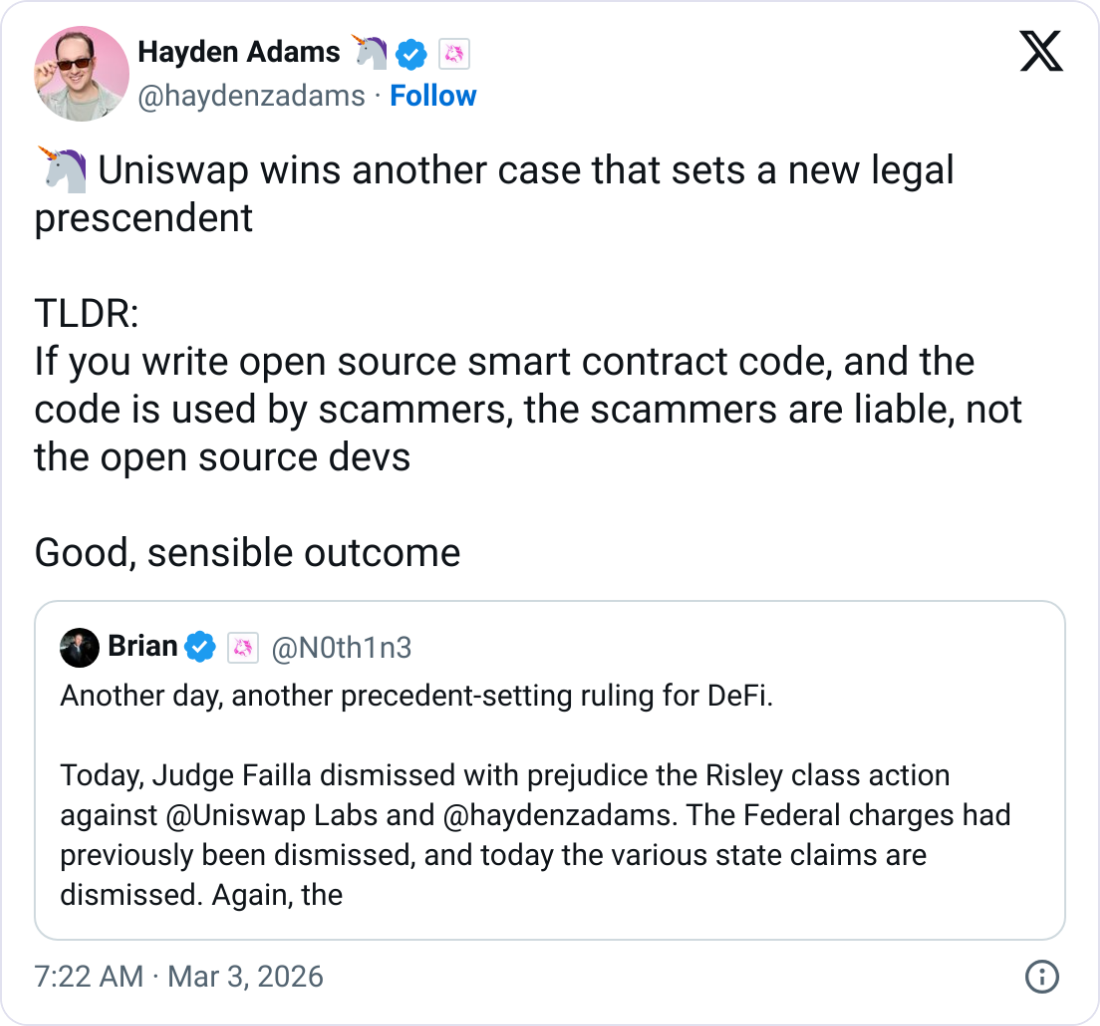
Uniswap Labs and founder Hayden Adams have won a class action lawsuit that sought to hold them liable for scam cryptocurrencies traded on its platform, ending a four-year legal saga.
Manhattan federal judge Katherine Polk Failla dismissed a suit against Uniswap on Monday with prejudice, saying the class group can’t hold Uniswap liable for the misconduct of unknown third-party token issuers.
It was the class group’s second attempt to sue Uniswap, which amended their complaint in May to focus on claims of state-level consumer protection violations, arguing that Uniswap allowed “rug pulls and pump and dump schemes,” according to Judge Polk Failla’s order.
The group, led by Nessa Risley, first sued Uniswap, Adams and venture firms Paradigm, Andreessen Horowitz and Union Square Ventures in April 2022. Their lawsuit was dismissed in August 2023, a decision that was later upheld on appeal.
Uniswap’s Adams posted on X that the ruling was a “good, sensible outcome” that sets a new legal precedent.

“If you write open source smart contract code, and the code is used by scammers, the scammers are liable, not the open source devs,” he added.
Class group failed to claim that Uniswap helped with fraud
In her latest opinion, Judge Polk Failla said the class group had failed to adequately allege that Uniswap “had knowledge of the fraud and substantially assisted in its commission.”
She added that “merely creating an environment where fraud could exist is not the same as affirmatively assisting in its perpetration.”
Related: New York judge blocks Binance bid to force US crypto claims into arbitration
“No matter how they try to dress up their allegations, Plaintiffs are basically alleging that Defendants substantially assisted fraud by providing ordinary services that anyone could use for lawful purposes, but that some used for unlawful purposes,” the judge wrote.
“Such an argument fails for the same reasons why a bank does not substantially assist a money launderer who washes his cash through the bank’s accounts, and why WhatsApp does not substantially assist a drug dealer who coordinates a sale on its messaging service: Simply providing the platform on which a fraud takes place is not the same as substantially assisting that fraud,” she added.
Big questions: Should you sell your Bitcoin for nickels for a 43% profit?
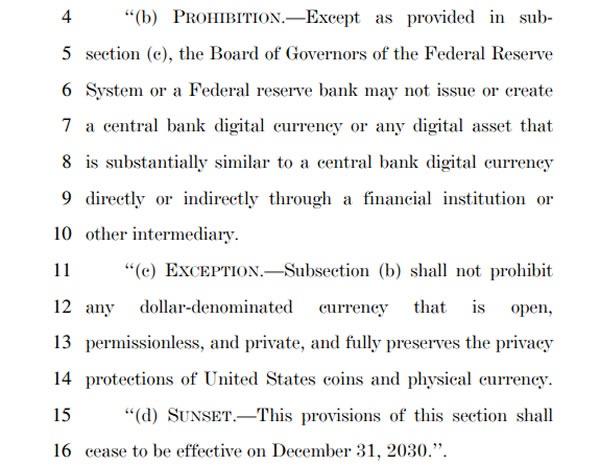
An amendment has been proposed to the Federal Reserve Act to ban the US central bank from issuing a central bank digital currency (CBDC) until 2030.
The language appears near the end of the 300-page “21st Century ROAD to Housing Act” (HR 6644), released by the Senate Committee on Banking, Housing, and Urban Affairs on Monday.
Section 10 of the proposed legislation states that the board of governors of the Federal Reserve System or a Federal Reserve bank “may not issue or create a central bank digital currency or any digital asset that is substantially similar to a central bank digital currency directly or indirectly through a financial institution or other intermediary.”
The bill also contains an exception for stablecoins, stating that the Fed “shall not prohibit any dollar-denominated currency that is open, permissionless, and private,” and fully preserves the privacy protections of the physical currency.
The proposed prohibition includes a sunset clause that expires on December 31, 2030, after which new legislation would be needed to maintain the ban.
The White House issued a statement supporting the Act and opposing a CBDC, which it said could “pose significant threats to personal privacy and liberty.”

The Senate advanced it overwhelmingly on a procedural cloture vote (84-6) on Monday, limiting debate and moving forward, clearing the way for full floor consideration.
Not the first attempt at blocking CBDCs
This version of the housing bill revives language from prior failed attempts to prevent a US CBDC and is not the original legislation.
The “No CBDC Act” (S 464) is a standalone bill introduced by Senator Mike Lee in February 2025 that would prohibit the Fed or Treasury from issuing a CBDC; however, it stalled in Congress.
Related: ‘No privacy’ CBDCs will come, warns billionaire Ray Dalio
Further legislation prohibiting the Fed from issuing a CBDC was introduced in June 2025 by Congressman Tom Emmer under the “Anti-CBDC Surveillance State Act” (HR 1919).
The bill passed a House vote on July 17, but has yet to pass full Senate approval.
China, Russia and India are testing CBDCs
Only three countries have officially deployed a CBDC: Nigeria, Jamaica, and The Bahamas, according to the Atlantic Council’s CBDC tracker.
A further 49 nations are actively testing CBDCs, including China, Russia, India and Brazil, while 20 nations have CBDCs in development and 36 are still researching them.
In February, Germany’s central bank president, Joachim Nagel, touted the benefits of CBDCs for the European Union, which is in the pilot phase.
Magazine: Would Bitcoin really be at $200K if not for Jane Street? Trade Secrets

The World’s Most Genius Crypto Heist

Alan Cumming apologises for ‘all the pain Black people have felt’ after Baftas slur

Analysis-Toyota’s buyout deal is a bigger win for Elliott than for governance


-

 Politics4 days ago
ITV enters Gaza with IDF amid ongoing genocide
-

 Fashion4 days ago
Weekend Open Thread: Iris Top
-

 Tech2 days ago
Unihertz’s Titan 2 Elite Arrives Just as Physical Keyboards Refuse to Fade Away
-

 Business7 days ago
True Citrus debuts functional drink mix collection
-
Sports3 days ago
The Vikings Need a Duck
-

 NewsBeat5 days ago
Cuba says its forces have killed four on US-registered speedboat | World News
-
 NewsBeat3 days ago
Dubai flights cancelled as Brit told airspace closed ’10 minutes after boarding’
-

 Tech7 days ago
Unsurprisingly, Apple's board gets what it wants in 2026 shareholder meeting
-
 NewsBeat5 days ago
Manchester Central Mosque issues statement as it imposes new measures ‘with immediate effect’ after armed men enter
-
 NewsBeat3 days ago
The empty pub on busy Cambridge road that has been boarded up for years
-

 NewsBeat2 days ago
‘Significant’ damage to boarded-up Horden house after fire
-

 NewsBeat2 days ago
Abusive parents will now be treated like sex offenders and placed on a ‘child cruelty register’ | News UK
-
 NewsBeat6 days ago
Police latest as search for missing woman enters day nine
-

 Entertainment1 day ago
Baby Gear Guide: Strollers, Car Seats
-

 Business5 days ago
Discord Pushes Implementation of Global Age Checks to Second Half of 2026
-

 Business4 days ago
Only 4% of women globally reside in countries that offer almost complete legal equality
-
 Tech4 days ago
NASA Reveals Identity of Astronaut Who Suffered Medical Incident Aboard ISS
-

 Crypto World6 days ago
Entering new markets without increasing payment costs
-
Politics2 days ago
FIFA hypocrisy after Israel murder over 400 Palestinian footballers
-
 NewsBeat2 days ago
Emirates confirms when flights will resume amid Dubai airport chaos