Connect with us
DAPA Banner

Business

Spring Statement 2026: Budget watchdog downgrades growth forecast for 2026 as Rachel Reeves defends Government’s plan

Published

on

Business Live

Chancellor speaks against backdrop of Middle East war

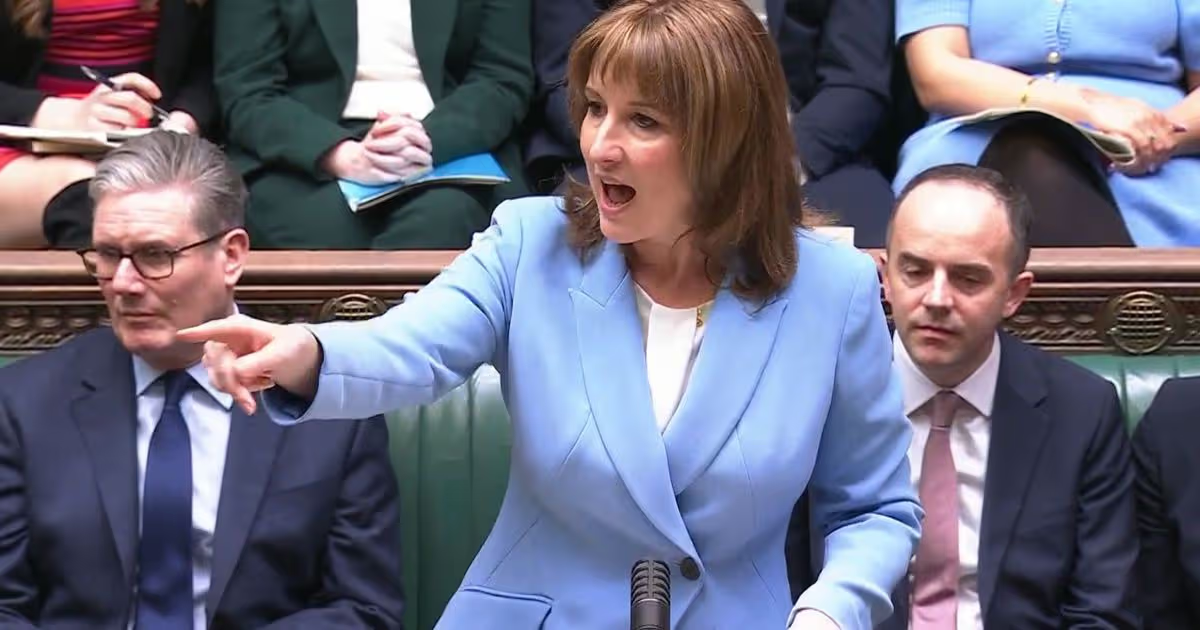
Screen grab of Chancellor of the Exchequer Rachel Reeves delivers her spring statement to MPs in the House of Commons

Chancellor of the Exchequer Rachel Reeves delivers her spring statement to MPs in the House of Commons(Image: House of Commons/UK Parliament/PA Wire)

Chancellor Rachel Reeves has used her Spring Statement to insist she had the “right economic plan” for the UK despite the budget watchdog cutting its growth forecast for this year.

The Office for Budget Responsibility indicated gross domestic product will increase by 1.1% in 2026, down from the 1.4% it forecast in November. But the watchdog upgraded its forecasts for 2027 and 2028 from 1.5% to 1.6%.

Advertisement

Speaking in the House of Commons against a backdrop of conflict in the Middle East, Ms Reeves said: “This Government has the right economic plan for our country, a plan that is even more important in a world that in the last few days has become yet more uncertain.”

She added: “The new forecasts from the Office for Budget Responsibility confirm that our plan is the right one – inflation is down, borrowing is down, living standards are up and the economy is growing.”

The Chancellor told the Commons: “With the unfolding conflict in Iran and the Middle East, it is incumbent on me and on this Government to chart a course through that uncertainty, to secure our economy against shocks and protect families from the turbulence that we see beyond our borders.”

She added: “I want to reassure this House that I am in regular contact with the governor of the Bank of England (Andrew Bailey), with my international counterparts and with key affected industries, including our maritime sector, and tomorrow, I will meet with our North Sea industry leaders to discuss the implications that they face and work with them to manage this uncertain period.

Advertisement

“In an increasingly dangerous world, I am proud to be the Chancellor that is delivering the biggest uplift in defence spending since the Cold War, with £650 million committed in January to upgrade our typhoon fighter jets, a new Royal Navy frigate launched from Rosyth last week, and just yesterday, our £1 billion helicopter deal with Leonardo.

“I am in no doubt about Britain’s ability to navigate the challenges we face.

“The plan that I have been driving forward since the election is the right one – stability in our public finances, investment in our infrastructure including our Armed Forces, and reform for Britain’s economy.”

The Chancellor told MPs her Labour Government has “restored economic stability”, as she pledged to leave families “better off”.

Advertisement

She said: “Stability is the single most important precondition for economic growth, that is why we have committed to a single major fiscal event each year, limiting major policy changes to the budget and giving businesses and households the certainty they need.

“Today, the new forecasts from the Office for Budget Responsibility confirm that our plan is the right one: inflation is down, borrowing is down, living standards are up, and the economy is growing.

“This Government has restored economic stability. The previous government let inflation skyrocket to over 11%, stoked interest rates to 15-year highs, and delivered the first Parliament on record where people were poorer at the end than they were at the start.

“I recognise the impact that had on families. We promised change at the election, and I understand the responsibility on me to deliver that change. I know that the question people will ask themselves at the next general election is this: are me and my family better off? I am determined that the answer will be yes.”

Advertisement

READ MORE: Exporters pivot away from America and look to Europe and Asia as Chancellor urged to support UK growthREAD MORE: Why new £1bn Leonardo deal means Yeovil will be a global helicopter centre for years to come

The Office for Budget Responsibility has “adjusted the profile of GDP so that it grows slightly slower in 2026 and faster in 2027 and 2028”, growing by 1.1% in 2026, 1.6% in 2027 and 2028, and 1.5% in 2029 and 2030, Rachel Reeves said.

She added: “Last year, we demonstrated the resilience of Britain’s economy in the face of global headwinds, with the fastest growth of any G7 country in Europe.

“Today, the Office for Budget Responsibility has updated its growth forecasts, including reflecting lower net migration – average growth across the forecast period is largely unchanged, while the OBR has adjusted the profile of GDP so that it grows slightly slower in 2026, and faster in 2027 and 2028.

Advertisement

“GDP is forecast to grow by 1.1% in 2026, 1.6% in both 2027 and 2028, and 1.5% in both 2029 and 2030. And GDP per capita is set to grow more than was expected in the autumn, with growth of 5.6% over the Parliament, after falling under the Tories in the last Parliament.

“And by the next election, after accounting for inflation, people are forecast to be over £1,000 a year better off.”

Unemployment is set to peak later this year and then drop, the Chancellor said. She told the Commons: “I know that the economy is not yet working for everyone and that the deep economic scars left by the party opposite (the Conservatives) and their mates in Reform are still blighting the lives of too many people.

READ MORE: CBI Survey: Private sector set to decline but City bucks trendREAD MORE: Wetherspoons boss Tim Martin warns minimum wage is lowering living standards

Advertisement

“In today’s forecasts, unemployment is set to peak later this year and then fall in every year of the forecast period, ending the forecast period at 4.1%, lower than it was at the start of the Parliament, but young people in particular are still suffering from the aftermath of years of Tory mismanagement.

“In the last five years of the previous government, the number of young people not in education, employment or training (Neet) increased by 113,000, the number of inactive people reached record highs under their government, and over the last decade, apprenticeship starts by young people fell by 40%.

“This Government will not leave an entire generation of young people behind – we are already taking action with additional investment to reform apprenticeships to prioritise young people, and through the £820 million youth guarantee, providing young people with employment support and the guaranteed job.

“And in the coming weeks, I will set out more reforms to undo the Tory legacy of neglect and give young people the support and the opportunity that they deserve.”

Advertisement

Borrowing is set to reduce by “nearly £18 billion compared to the autumn”, with public sector net borrowing expected to fall from 4.3% this year to 3.6% next year, before hitting 1.8% in 2029-30, Rachel Reeves said.

The Chancellor said: “In their forecasts today, the Office for Budget Responsibility show that we are set to reduce borrowing by nearly £18 billion compared to the autumn.

“This year we are set to borrow less than the G7 average, something the Tories never achieved in fourteen years. The forecast today shows that Public Sector Net Borrowing is set to fall from 4.3% this year, to 3.6% next year, then 2.9%, 2.5%, and 1.8% in 2029-30.”

Meanwhile, the Chancellor said she has “confidence” the Government can outperform economic forecasts, as she warned “progress” was opposed by her rivals in the Conservatives, Reform UK, the Liberal Democrats and the Green Party.

Advertisement

READ MORE: British Business Bank commits £60m to NorthEdge investment fundREAD MORE: Pub landlord’s plea for support turns into UK-wide movement

She said: “In the face of global uncertainty, we beat the forecast last year. In the year ahead, the choices that we are making give me confidence that we will beat them again.

“And in the year ahead, more of the choices that we have already made will come into effect – discounts on business energy costs, trade deals with India, the US and the EU, reforms to back our entrepreneurs, investments in our infrastructure, skills funding for further education and more planning reforms.

“Progress – opposed by the Conservatives, opposed by Reform, opposed by the Liberal Democrats, and opposed by the Green Party too, because it is Labour, and only Labour, that has the right plan for our country.

Advertisement

“Our plan for growth is grounded in a profound rejection of the failed economic dogmas of the past, the trickle-down, trickle-out thinking that produced ever diminishing returns for working people.”

Rachel Reeves pledged to rebuild Britain’s credibility, as she told the Commons “if we stick to our plan” there could be an additional £15 billion a year “for the priorities of working people”.

The Chancellor said “headroom against the stability rule in 2029-30 has increased from £21.7 billion to £23.6 billion, with headroom against the investment rule also higher at £27.1 billion and debt is set to be lower in every year of the forecast compared to the autumn”.

She added: “I have never accepted that we have to choose between social justice and fiscal responsibility because there is nothing progressive, nothing Labour, about spending over £100 billion a year – that’s one in every £10 of public money – on servicing debt racked up by the Tories.

Advertisement

“After their disastrous mini-budget, our debt interest rates soared towards the highest in the G7, and since my budget, while average yields have risen for the rest of the G7, yields on UK Government debt have fallen. The Tories squandered Britain’s credibility and my plan is rebuilding it.

“Already, we are expected to spend £3 billion a year less on debt interest by the end of the Parliament than was forecast in the autumn.

“And if we stay the course and stick to our plan, and our debt interest rates return to the G7 average, we will have £15 billion a year more for the priorities of working people and to make working people better off: that is the prize on offer, that is the prize within our grasp.”


Advertisement
Continue Reading
Click to comment

You must be logged in to post a comment Login

Leave a Reply

Business

How small businesses could save thousands on fuel as gas prices rise: expert

Published

on

How small businesses could save thousands on fuel as gas prices rise: expert

High gas prices continue to squeeze small businesses across the U.S., but cutting one costly habit could help owners save significantly.

New data from Ford Pro, the commercial vehicle division of Ford Motor Company, shows that unnecessary idling — leaving a car running while parked — can cost fleet operators thousands of dollars each year, cutting directly into margins at a time when fuel prices remain high.

Advertisement

According to the U.S. Department of Energy, the average fleet vehicle idles between one and two hours per day, burning up to two gallons of fuel daily per vehicle. With gas prices rising, those costs can add up quickly.

As of Sunday, the national average price for unleaded gas stood at $4.04, up from $3.88 just a month ago, according to AAA.

BESSENT WARNS GAS STATIONS THAT TREASURY DEPT WILL KEEP THEM ‘HONEST’ AFTER SPIKE IN PRICES

2019 Ford Motor Co. F-150 pickup trucks are displayed at a car dealership in Orland Park, Illinois, U.S., on Friday, Sept. 27, 2019. Auto sales in the U.S. probably took a big step back in September, setting the stage for hefty incentive spending by carmakers struggling to clear old models from dealers' inventory

Ford Motor Co. F-150 pickup trucks are displayed at a car dealership in Orland Park, Illinois, on Sept. 27, 2019.  (Daniel Acker/Bloomberg via Getty Images / Getty Images)

“You can burn up one to two gallons of gas just doing that,” Matt Krukin, who leads software and digital growth for Ford Pro, told FOX Business. “So if that happens per day… that’s $8 a day that’s idling.”

Advertisement

For businesses operating multiple vehicles, the impact can be substantial. A 20-vehicle fleet idling for two hours a day could waste more than $160 in fuel every day, according to Ford Pro.

Excessive idling is particularly common in North America, where about 29% of fleet vehicles idle unnecessarily, compared to just 10% in Europe, Krukin noted.

To help address the issue, Ford Pro is investing in software and data-driven tools.

FORD SEEKS TRUMP ALUMINUM TARIFF RELIEF AFTER FIRES AT MAJOR US FACTORY, REPORT SAYS

Advertisement
Gas being pumped

A person pumps gas into a car. (Sean Gallup/Getty Images / Getty Images)

Its newly launched artificial intelligence (AI) assistant allows fleet managers to monitor vehicle behavior in real time, identify inefficiencies and coach drivers to adopt more fuel-efficient habits. 

Ford Pro says customers using these tools have seen measurable improvements, including a 52% reduction in idling.

While reducing idling is one of the simplest ways to cut costs, other driving behaviors — such as aggressive acceleration, rapid braking, and speeding — can also increase fuel consumption and wear on vehicles, according to Krukin.

The system can even limit acceleration, while in-cab alerts provide real-time feedback.

Advertisement

FORD BUILDS ONE-OF-A-KIND EXPLORER FOR POPE LEO XIV

Cars driving on the highway

Cars are seen driving on the highway. (Jonas Walzberg/picture alliance via Getty Images / Getty Images)

“It’s like the fleet manager’s right next to them to coach them along the way,” Krukin said.

Users have also seen a 25% drop in speeding, a 16% decrease in hard braking and an 11% reduction in harsh acceleration, according to Ford Pro.

GET FOX BUSINESS ON THE GO BY CLICKING HERE

Advertisement

“We’re not just recommending solutions for the heck of it,” Krukin said. “… At the end of the day, it’s really about bringing it all together, so that these fleets actually get a pleasurable experience with the tools and technology coming together.”

Continue Reading

Business

BOJ’s hawkish hints keep rate hike on the cards

Published

on

BOJ’s hawkish hints keep rate hike on the cards


BOJ’s hawkish hints keep rate hike on the cards

Continue Reading

Business

Eli Lilly in advanced talks to acquire Kelonia Therapeutics for over $2 billion, WSJ says

Published

on

Eli Lilly in advanced talks to acquire Kelonia Therapeutics for over $2 billion, WSJ says


Eli Lilly in advanced talks to acquire Kelonia Therapeutics for over $2 billion, WSJ says

Continue Reading

Business

World Bank Highlights AI Boom as a Bright Spot Amid Slowing Growth in East Asia and the Pacific

Published

on

Asia Pacific Defies Global Slowdown in Sustainable Finance

Growth across East Asia and the Pacific is losing momentum this year, weighed down by an energy shock, rising trade barriers, and persistent domestic vulnerabilities, but a surge in artificial intelligence-related trade and investment is offering a rare point of optimism, according to the World Bank’s latest regional economic report.

Key takeaways

  • AI-related exports and investment surged across East Asia and the Pacific in 2025, with Malaysia, Thailand, and Viet Nam leading the way.
  • Regional growth is forecast to slow to 4.2% in 2026, pressured by the Middle East energy shock, trade barriers, and weak domestic demand.
  • Closing gaps in connectivity and skills is essential for the region to fully capture the productivity benefits of AI.

Regional growth is projected to slow to 4.2% in 2026, down from 5.0% in 2025, as the energy shock stemming from the Middle East conflict compounds the adverse impact of elevated trade barriers, global policy uncertainty, and domestic economic difficulties.

China, the region’s largest economy, is expected to decelerate from 5.0% growth in 2025 to 4.2% in 2026 and 4.3% in 2027, as weak domestic demand and property sector challenges persist and the global slowdown weighs on exports. The rest of the region is forecast to slow to 4.1% in 2026 before rebounding to 5.0% in 2027 as geopolitical tensions ease.

Against that difficult backdrop, the World Bank’s East Asia and Pacific Economic Update: Industrial Policy in the Digital Age identifies AI as a meaningful bright spot. The report highlights surging AI-related exports and investment in 2025, particularly in Malaysia, Thailand, and Viet Nam, as a notable positive development for the region.

Yet the Bank cautions that the full benefits of AI remain out of reach for much of the region. Adoption is constrained by gaps in connectivity and skills, with only 13 to 17% of multinational subsidiaries in China and Thailand currently using AI, roughly one third of the proportion seen in industrialised countries.

Advertisement

The report also examines how rising energy costs could deepen hardship for ordinary households. A sustained 50% increase in fuel prices could result in a 3 to 4% loss in income for households across the region, with the poor and small and medium enterprises identified as the most vulnerable.

On a longer-term strategy, the update argues that industrial policy, if carefully designed, can help unlock productivity gains. Targeted support for specific industries in the Republic of Korea, Malaysia, and, more recently, Viet Nam proved effective in part because those countries had strengthened their economic foundations, including infrastructure, education, and regulatory institutions, and had liberalised trade and investment. The Bank warns that similar efforts elsewhere have delivered weaker results where those foundations remain fragile.

World Bank Vice President for East Asia and the Pacific Carlos Felipe Jaramillo noted that while the region continues to outperform much of the world, sustaining growth will require confronting structural challenges and seizing the opportunities of the digital age to increase productivity and create more jobs.

World Bank Group Director of Research Aaditya Mattoo cautioned that present difficulties could increase economic distress and inhibit productivity growth, adding that measured support for people and firms could preserve jobs today while reviving stalled structural reforms could unleash growth tomorrow.

Advertisement

Continue Reading

Business

Two US officials supporting local authorities die in car accident in Mexico

Published

on


Two US officials supporting local authorities die in car accident in Mexico

Continue Reading

Business

Sidus Space prices $58.5 million stock offering at $4.35/share

Published

on


Sidus Space prices $58.5 million stock offering at $4.35/share

Continue Reading

Business

S&P 500: I Sold Too Early, What Now? (Technical Analysis) (SP500)

Published

on

S&P Global Dividend 100 Index: Where High Yield Meets Quality

This article was written by

Andrew McElroy is Chief Analyst at Matrixtrade, author of the ebook ‘Fractal Market Mastery’ and producer of the ‘Daily Edge.’ The ‘Daily Edge’ is emailed before each US session and outlines actionable ideas, directional bias, and important levels in the S&P500. It also looks at ‘What’s Hot,’ on any particular day, whether it is commodities, stocks, crypto, or forex. Andrew has developed a top-down proprietary system that starts with his weekend Seeking Alpha article focusing on the higher timeframes. Fractals, Elliott Wave, and Demark exhaustion signals are all incorporated, as are macro drivers and analysis of the market narrative. It is much more than just a few lines on a chart – it is a system developed over 15 years and proven to deliver a consistent edge. An independent trader since 2009, Andrew manages a family portfolio of stocks and ETFs with his wife and fellow Seeking Alpha contributor Macrogirl.

Analyst’s Disclosure: I/we have a beneficial long position in the shares of VOO either through stock ownership, options, or other derivatives. I wrote this article myself, and it expresses my own opinions. I am not receiving compensation for it (other than from Seeking Alpha). I have no business relationship with any company whose stock is mentioned in this article.

Seeking Alpha’s Disclosure: Past performance is no guarantee of future results. No recommendation or advice is being given as to whether any investment is suitable for a particular investor. Any views or opinions expressed above may not reflect those of Seeking Alpha as a whole. Seeking Alpha is not a licensed securities dealer, broker or US investment adviser or investment bank. Our analysts are third party authors that include both professional investors and individual investors who may not be licensed or certified by any institute or regulatory body.

Advertisement
Continue Reading

Business

ServiceNow Q1 Preview: Earnings Growth It Needs Is Too High To Justify A Buy (NYSE:NOW)

Published

on

ServiceNow Q1 Preview: Earnings Growth It Needs Is Too High To Justify A Buy (NYSE:NOW)

This article was written by

I aim to provide alpha-generating investment ideas. I am an independent investor managing my family’s portfolio, primarily via a Self Managed Super Fund. My articles deliver 5-Minute Pitches focused on the core fundamental and technical drivers of the security.I have a generalist approach as I explore, analyze and invest in any sector so long there is perceived alpha potential vs the S&P500. The typical holding period ranges between a few months to multiple years.I am very much focused on adding value via alpha generation. I always start with a Performance Assessment section for each follow-up article. I publish unusually detailed analytics on my long-only, zero-leverage global equity portfolio performance on my Hunting Alphas website every month. At Hunting Alphas, you can also access the models to all the tickers I publish on.A bit about how I approach research and coverage of a stock:I build and maintain spreadsheets showing historical data on the financials, key metric disclosures, data on the guidance and surprise trends vs consensus estimates, time-series values of the valuations vs peers, data on key coincident or leading indicators of performance and other monitorables. In addition to the company’s filings, I also keep tabs on relevant industry news and reports plus other people’s coverage of the stock. In some cases, such as during times of a CEO change, I will do a deep dive on a key leader’s background and his/her past performance record.I very rarely build DCFs and project financials many years out into the future as I don’t think it adds much value. Instead, I find it more useful to assess how a company has delivered and the broad outlook on the 5 key drivers of a DCF valuation: revenues, costs and margins, cash flow conversion, capex and investments and the interest rates (which affect the discount rate/opportunity cost of capital). In some cases, especially for companies trading at very high multiples on a TTM or 1-yr fwd basis, I do a reverse DCF to make sense of the implied growth CAGR implications.Note: Hunting Alphas is related to VishValue Research on Seeking Alpha.

Analyst’s Disclosure: I/we have no stock, option or similar derivative position in any of the companies mentioned, and no plans to initiate any such positions within the next 72 hours. I wrote this article myself, and it expresses my own opinions. I am not receiving compensation for it (other than from Seeking Alpha). I have no business relationship with any company whose stock is mentioned in this article.

Seeking Alpha’s Disclosure: Past performance is no guarantee of future results. No recommendation or advice is being given as to whether any investment is suitable for a particular investor. Any views or opinions expressed above may not reflect those of Seeking Alpha as a whole. Seeking Alpha is not a licensed securities dealer, broker or US investment adviser or investment bank. Our analysts are third party authors that include both professional investors and individual investors who may not be licensed or certified by any institute or regulatory body.

Advertisement
Continue Reading

Business

Germany’s Merz, Brazil’s Lula stress close European-Brazilian cooperation

Published

on

Germany’s Merz, Brazil’s Lula stress close European-Brazilian cooperation


Germany’s Merz, Brazil’s Lula stress close European-Brazilian cooperation

Continue Reading

Business

Ukraine pushes for Europe to build defense system against ballistic weapons

Published

on

Ukraine pushes for Europe to build defense system against ballistic weapons


Ukraine pushes for Europe to build defense system against ballistic weapons

Continue Reading

Trending

Copyright © 2025