He was behaving in a threatening manner and using abusive language
Paul Higgins and Annette Belcher
19:24, 03 Mar 2026Updated 19:32, 03 Mar 2026
A PE teacher at a top grammar school has been sentenced after he flew into a drunken rage during a flight.
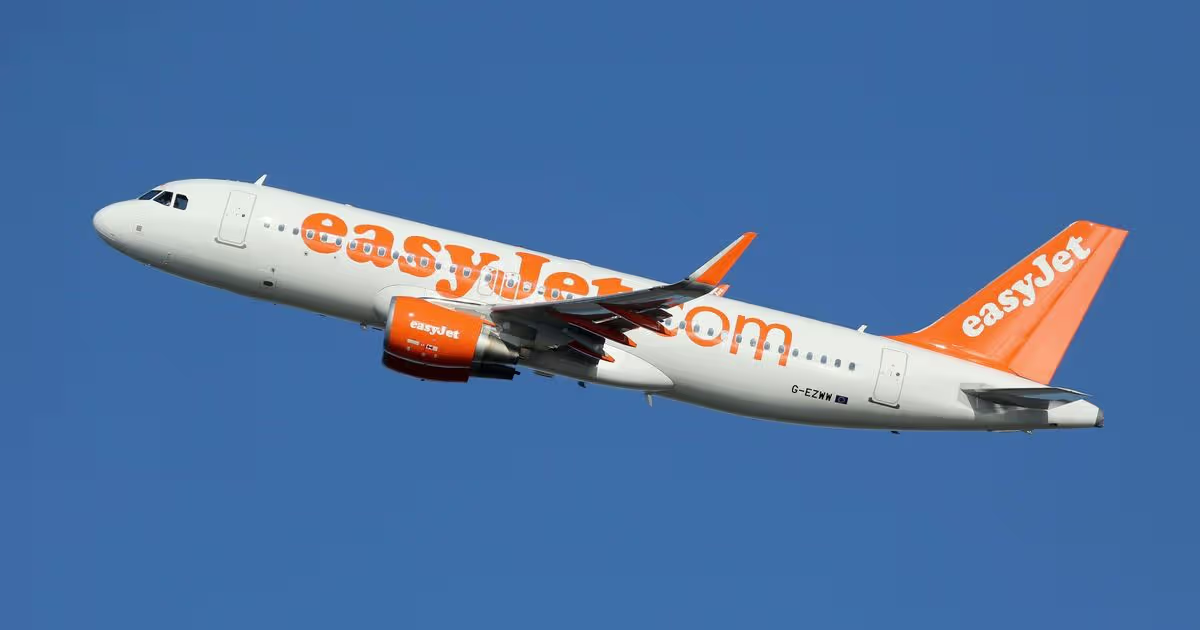
A court has heard how Peter Shepherd was behaving threating manner and using abusive behaviour on board an EasyJet flight.
Advertisement
Antrim Magistrates Court, sitting in Ballymena, heard that once the case against Peter Shepherd has concluded, his position will be referred to the Board of Governors at Royal Belfast Academical Institution.
“What is the position with his job, is that in jeopardy?” District Judge Nigel Broderick enquired, BelfastLive reports.
Defence counsel Peter Sands confirmed that while the 49-year-old “continues to work while being supported, they have told him that they will assess the situation once the case has concluded.”
At an earlier hearing, Shepherd, from Whinfield in Larne, had entered guilty pleas to four charges arising from an incident on an EasyJet flight from Hurghada in Egypt on April 20 last year.
Advertisement
The 49-year-old admitted assaulting the female cabin crew manager, using disorderly behaviour, being drunk on an aircraft and behaving in a threatening and abusive manner.
Opening the facts of the case today, a prosecuting lawyer told the court how police were called to Belfast International Airport in the early hours of April 20 following reports of an assault on board the flight.
Officers spoke to the victim who reported that Shepherd had been “acting in a disruptive manner” towards crew members. His behaviour was such that at one point during the flight, a passenger approached her and asked if they “would like for him to be restrained.”
Advertisement
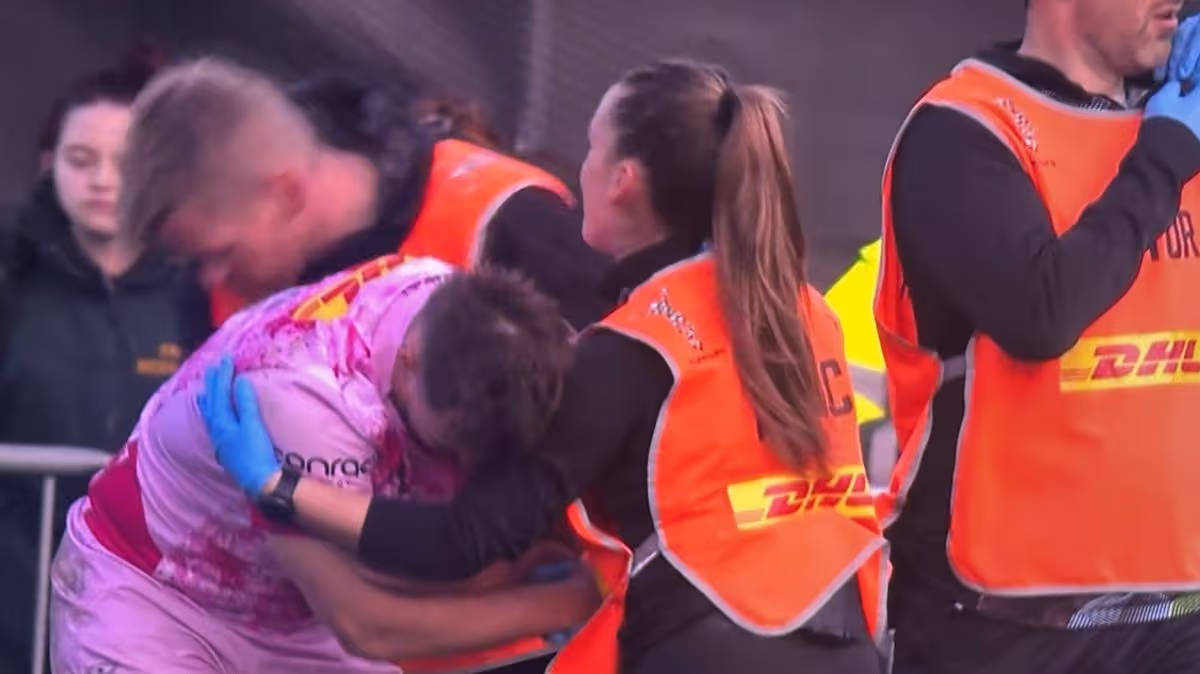
Describing how Shepherd was behaving in a threatening manner and using abusive language, the prosecutor said the assault had been a physical assault, rather than an apprehension.
The court heard that when the cabin manager was speaking to Shepherd about his behaviour, he initially walked away but when he came back at her, he “pressed his forehead into the right side of her face.”
Throughout the assault, Shepherd had been “shouting abuse at her.”
During police interviews, Shepherd “denied the allegations” but admitted he had consumed “a couple of drinks before boarding” and that whilst mid air, he had been drinking from his hip flask.
Advertisement
Lodging a plea in mitigation, Mr Sands, instructed by Reid Black Solicitors, emphasised the PE teacher had admitted his guilt and has “expressed shame, regret and remorse.”
“Clearly, it was very poor behaviour,” the barrister conceded, adding that as “someone who isn’t keen on flying, to put it mildly” Shepherd had consumed more alcohol than he usually would.
Having heard that the defendant’s children were on the flight too, Judge Broderick commented that his behaviour “isn’t a very good example” for them, “not to mention the other passengers.”
“It is a source of embarrassment and shame,” Mr Sands told him.
Advertisement
The judge said he had made the point before that he treated such behaviour on a plane in a serious manner because, “it is a confined space.”
“It’s not like a boat or a train where other passengers can get up and walk away,” he told the court.
As regards the appropriate disposal, Mr Sands confirmed there was “no reason” why Shepherd could not engage in community service.
Judge Broderick told Shepherd it was clear that having admitted his guilt, he had “expressed appropriate remorse, regret and shame.”
Advertisement
He said while he was aware the case “may have an impact on your employment, that is a matter for the school.”
Emphasising that the cabin crew, and particularly the manager, “in no way deserved” to be subjected to such verbal and physical abuse, he imposed a 120-hour community service order “as an alternative to imprisonment.”
In addition to the CSO, Shepherd was also fined a total of £500 and ordered to pay £500 compensation to the lady he assaulted.
Get more Daily Record exclusives by signing up for free to Google’s preferred sources. Click HERE

Study in the British Medical Journal looks at metabolic health of 23,000 participants and how our blood sugar is impacted by sleep
Scientists have analysed what is the optimum amount of sleep needed for good blood sugar control.
Advertisement
Previous studies have found that sleep duration is strongly linked with the risk of insulin resistance which is the precursor for type 2 diabetes. A study of 23,000 Americans looked at their sleep and estimated glucose disposal rate (eGDR) to examine insulin resistance. This is calculated by examining a person’s blood sugar levels after fasting, their waist circumference and their blood pressure.
The optimal length of sleep was seven hours and 19 minutes for avoiding insulin resistance, they found. Any more or less had an impact on eGDR. It also suggested that catching up on sleep at the weekend may actually be detrimental to a person’s health.
Ensure our latest headlines always appear at the top of your Google Search by making us a Preferred Source. Click here to activate or add us as your Preferred Source in your Google search settings.
Professor Hui Shi, of Nantong University in China, said: “These correlational findings suggest that sleep patterns, particularly weekend recovery sleep, may be relevant for metabolic regulation in diabetes.”
According to the NHS, the average amount of sleep needed by adults is seven to nine hours each night, while children need around nine to thirteen hours. But the more sleep you get is not necessarily better for you.
Insulin resistance is the primary driver behind poor blood sugar control. When cells resist insulin, they fail to absorb glucose efficiently, causing sugar to build up in the bloodstream. This leads to higher blood sugar levels which can progress to prediabetes and then type 2 diabetes.
Advertisement
People involved in the new study reported an average of seven and a half hours of sleep in the week. Half said that they also had catch-up sleep at the weekend. For those sleeping less than the optimal amount during the week, one to two hours of weekend catch-up sleep was associated with higher eGDR.
And those sleeping more than the optimal weekday sleep, as well as more than two hours of weekend catch-up sleep, had a lower eGDR – indicating a greater risk of insulin resistance.
The study, published in the journal BMJ Open Diabetes Research and Care, concluded that weekend catch up sleep is “beneficial only in moderation and specifically for those with weekday sleep debt, whereas it may be detrimental for those who already sleep sufficiently”.
Researchers said there was a “bidirectional relationship” with sleep and metabolism. Prof Shi added: “This creates a potential vicious cycle wherein metabolic dysregulation disrupts normal sleep patterns, and the resultant abnormal sleep (including extended duration) further aggravates metabolic health.”
Advertisement
The British Heart Foundation recommends getting seven to nine hours of sleep per night. Getting too little sleep can be bad for us but getting too much can be a sign of poor health.
The NHS website says regular exercise and a good diet can also improve sleep. It states: “A good sleep routine should include having a set time to start winding down – and a way to relax is important too. Going to bed and getting up at fixed times is another good sleep habit. Ideally, a sleep routine should be the same every day, including weekends.”
The uplift comes amid renewed debate over youth employment and Labour’s pledge to scrap age bands in the wage system – a commitment Prime Minister Keir Starmer has insisted will be honoured.
Chancellor Rachel Reeves added: “There are more people in work than there were this time a year ago.
“But I do recognise that there are challenges, particularly around young people leaving school, college and university, the Covid generation of young people who did miss out on so much during those years.
Advertisement
“As a Government, we are determined to do everything we can to support them.”
Her comments come as figures from the Office for National Statistics show unemployment among 16 to 24-year-olds rose to 16.1% in the three months to December at the highest level since early 2015.
What changes from April 2026?
National Living Wage (21 and over)
Rising 4.1% from £12.21 to £12.71 per hour
Worth around £900 extra per year for a full-time worker
Expected to benefit approximately 2.4 million low-paid workers
National Minimum Wage (18–20-year-olds)
Increasing 8.5% from £10 to £10.85 per hour
Equivalent to around £1,500 extra annually for a full-time worker
Narrows the gap with the adult rate as part of plans to phase out age bands
National Minimum Wage (16–17-year-olds)
Apprentice rate
Increasing 6% from £7.55 to £8 per hour
Applies to apprentices under 19, or those 19 and over in the first year of their apprenticeship
After turning 19 and completing year one, apprentices must receive the age-appropriate minimum wage
Workers are legally entitled to at least the National Minimum Wage depending on their age and stage of apprenticeship.
Business groups have warned the increases will add further pressure to struggling firms
Andy Slee, chief executive of the Society of Independent Brewers and Associates (SIBA), said: “Cost of living pressures are very real for people and we all want to see living standards rise.
Advertisement
“However, the responsibility of delivering wage increases are most felt by small businesses including small independent breweries who are already facing significant pressures.
“Brewing is a skilled job and we want to encourage more young people to enter the sector, but continuing to close the aged based pay gap does not take account of the additional training and development that young people need.”
Tamsin Powell, consumer finance expert at Creditspring, added: “An increase to the minimum wage will be welcomed by many workers across the UK, particularly those on lower incomes.
“However, while pay rises sound positive on paper, they don’t always translate into real financial gains once inflation and benefit tapering are factored in.
Advertisement
“Some employers may also struggle to absorb higher wage costs, meaning we could see knock-on effects like reduced working hours or slower recruitment.
“For households already battling high living costs, this could mean that the benefits of a pay rise are quickly eroded.
“Boosting wages is a vital part of improving financial resilience, but it has to be paired with policies that ensure those gains aren’t lost to higher prices or reduced employment opportunities.”
How to check your pay to make sure you are being paid the correct wage
Andrew Bartlett, chief executive of Advice Direct Scotland, urged young workers to check their entitlements.
“Every penny counts, and young Scots should check their payslips to make sure they’re getting the right National Minimum Wage,” he said.
“This is your hard-earned money, so don’t let employers allow it to slip through the cracks.
“If you’re under 23, it’s also worth checking if you have an unclaimed Child Trust Fund.
Advertisement
Recommended reading:
“These tax-free savings accounts could give you a financial boost as you step into adulthood.
“Too many young workers don’t realise they’re being underpaid, and it’s vital to know your rights.”
With wage floors rising across every age bracket, April 2026 marks one of the most significant annual increases in recent years – delivering a pay boost for millions, while reigniting debate over jobs, costs and Labour’s longer-term ambition to create a single adult minimum wage.
The Northern Echo understands that the roller is not from Lidl directly and that the company is still awaiting the planning decision on its proposals for a new store.
The ground rollers spotted on site (Image: THE NORTHERN ECHO)

The derelict site, which formerly housed the Marton Hotel and Country Club, has stood empty for years. The hotel closed down in 2017 and a major fire destroyed the landmark building in June 2019.
Marton Country Club, Middlesbrough after the fire
Further progress is now being made in the endeavour to build a new Lidl in Marton.
It was reported in summer 2024 that Lidl would be launching a public consultation over proposals to build a store on the site.
Advertisement
There are currently two Lidl branches in Middlesbrough, on Newport Road and Cargo Fleet Lane.
The proposed new Lidl site in Marton, Middlesbrough (Image: LIDL)
The supermarket chain is also seeking permission to build a store on the site of the former Northern School of Art, on the corner of Green Lane and Roman Road in Linthorpe.
It is hoped that a decision on Lidl’s wider proposals for the Marton site will be made later this year, alongside an outcome on its Linthorpe ambitions.
Today, President Trump has publicly criticised Keir Starmer saying “This is not Winston Churchill we’re dealing with”.
The comments came during a press conference at the White House alongside the German Chancellor Friedrich Merz. President Trump said he was “not happy with the UK” because of the initial refusal from London to let Washington use the British base at Diego Garcia in the Indian Ocean during its first strikes on Iran.
It comes as the UK government has announced it is sending “helicopters with counter drone capabilities” and a warship to the region, after attacks on it’s base in Cyprus. Financial markets have also reacted to the uncertainty with oil and gas prices rising, and share prices down.
Advertisement
Adam and Chris are joined by Jane Corbin, Panorama Film Maker and Dharshini David Deputy Economics Editor.
You can now listen to Newscast on a smart speaker. If you want to listen, just say “Ask BBC Sounds to play Newscast”. It works on most smart speakers.
You can take part in the Newscast census here – https://bbc.in/newscastcensus
You can now listen to Newscast on a smart speaker. If you want to listen, just say “Ask BBC Sounds to play Newscast”. It works on most smart speakers.
Advertisement
You can join our Newscast online community here: https://bbc.in/newscastdiscord
Get in touch with Newscast by emailing newscast@bbc.co.uk or send us a WhatsApp on +44 0330 123 9480.
New episodes released every day. If you’re in the UK, for more News and Current Affairs podcasts from the BBC, listen on BBC Sounds: https://bbc.in/4guXgXd
Newscast brings you daily analysis of the latest political news stories from the BBC. The presenter was Adam Fleming. It was made by Jack Maclaren with Shiler Mahmoudi and Kris Jalowiecki. The social producer was Sophie Millward. The technical producer was Jack Graysmark. The assistant editor is Chris Gray. The senior news editor is Sam Bonham.
US President Donald Trump has said he “does not care” if Iran take part in this summer’s 2026 World Cup.
Trump’s comments come amid US and Israeli strikes on Iran, which has responded by launching attacks on US-allied states in the Gulf in an escalating conflict.
The US is co-hosting the World Cup which takes place between 11 June and 19 July, along with Canada and Mexico.
Silent Witness star David Caves has hinted at the BBC crime drama’s future after the latest series concluded
Silent Witness star David Caves has dropped a hint about the future of the show as the current series concluded.
Advertisement
The 29th series of the BBC crime drama, which centres on a team of pathologists probing mysterious deaths, finished on Tuesday night (March 3) with a nail-biting episode where Dr Nikki Alexander (Emilia Fox) found herself in peril after being drugged.
The programme has been a huge success with audiences and has been airing since 1996, so fans are hopeful for a 30th instalment, reports the Express.
As the final episode aired, David – who portrays Nikki’s spouse and colleague Jack Hodgson – gave a clue on X (formerly Twitter), posting: “Can’t believe that’s it for another series. To everyone who has watched and supported – thank you!”
“Here’s to the stories we’ve told – and to those still to come…” he added, tagging co-stars Emilia, Francesca Mills and Maggie Steed.
Advertisement
The latest series of the show kicked off in February and has featured several gripping tales including two-part finale Shame, which began on Monday (March 2).
It saw the team investigating what seemed to be the suicide of a British-Chinese pro-democracy activist, whose body was found floating in a lake.
However, as Nikki and Harriet Maven (Maggie Steed) delved deeper into the woman’s fate, evidence started to suggest something far more sinister had transpired and it became evident that things were not as they appeared.
Advertisement
There has already been a hint that Silent Witness is poised for a 30th series, after a photo emerged last month showing some cast and crew seemingly on location.
The image was posted on Instagram by Bodenham Arboretum in Worcestershire, accompanied by a caption which read: “For those of you who have visited Bodenham in the last two weeks you may have wondered what was going on… cryptic signage, trailers, security etc, occupying two of our car parks… well now all can be revealed..
“Bodenham had the privilege of being chosen as the BBC drama’s Silent Witness base camp whilst filming locally for the 30th series.”
Advertisement
For the latest showbiz, TV, movie and streaming news, go to the new **Everything Gossip** website.
Ensure our latest headlines always appear at the top of your Google Search by making us a Preferred Source.** Click here to activate**** or add us as your Preferred Source in your Google search settings.**
Silent Witness airs on BBC One and is available on BBC iPlayer
The UK chancellor of the exchequer would not have wanted to deliver her spring statement against the background of a fresh threat to the world economy.
For while Rachel Reeves announced that she has the “right economic plan for the country” in a “yet more uncertain world”, the conflict in the Middle East will undoubtedly complicate the UK’s economic prospects. And the latest economic forecast by the independent Office for Budget Responsibility (OBR), to which she was responding, may already be out of date.
It was too late, for example, for the OBR calculations to include any potential shocks in the global supply chain, or a spike in energy prices that may result from the US-Israeli strikes on Iran. At a press conference after Reeves’ statement however, an OBR representative warned that it could have “a very significant impact”. And they added that even before the crisis unfolded, the UK had faced an unusually high degree of uncertainty.
But otherwise, the OBR report – little changed from the autumn – paints a mixed picture for the UK economy. Weaker economic and job growth is somewhat balanced by the prospects of lower inflation and lower interest rates.
Advertisement
The government’s future “headroom” (the space for extra spending later on) is only slightly better than previously thought. And the OBR says that by 2031, government debt will still be 95% of GDP. At the same press conference, it added that this high level of debt relative to other countries makes the UK more vulnerable to external risks.
But Reeves bullishly told MPs: “We beat the forecasts last year […] we will beat them again” adding that stronger government finances will allow the UK to weather the storm and keep to its current spending plans.
Yet the war could well affect those spending plans and the government’s hopes of tackling the high cost of living. Oil and gas prices are already soaring, and stock markets are falling. The OBR itself accepts that “significant risks, including from conflict in the Middle East”, can significantly change its projections.
For example, gas prices have already spiked after the major Middle East supplier Qatar closed its main refinery following Iranian attacks. The effective closure of the strait of Hormuz will threaten the huge flow of oil to major Asian economies such as China, Japan, Korea and Taiwan.
Advertisement
The UK government may have capped household gas prices, but a long-term wholesale gas price increase would boost inflation and reduce the chances of a further interest rate cut by the Bank of England.
And while the UK gets relatively little gas from the Middle East, gas and oil prices are set internationally. Europe is much more dependent on gas from that region, so the disruption of supply could threaten both higher inflation and lower growth in the UK’s largest export market.
It also could be an existential threat to the high-performing export economies of Asia, which are driving global growth.
A worldwide slowdown will have serious consequences for the UK economy as it is highly dependent on foreign trade. US president Donald Trump’s unhappiness with prime minister Keir Starmer’s conditional support for his war may threaten the restoration of the UK’s favourable tariff deal.
Advertisement
An airstrike in Tehran. EPA/ABEDIN TAHERKENAREH
A weaker UK economy – which is already growing at only slightly more than 1% a year – would have major consequences for government spending, tax receipts and the government’s headroom. This could mean both lower tax revenues and increased borrowing, with the costs of financing the government’s huge debts rising, reversing recent falls.
This may all make it difficult for the government to contemplate any electorally beneficial tax cuts ahead of the 2029 general election. It may even have to extend the freeze on tax thresholds further, squeezing workers’ pay packets.
These negative developments come as the government also faces major additional pressures on spending – which it has tried to delay in the hope of a stronger balance sheet later on.
These include costly reforms to increase spending on students with special educational needs and disabilities, and plans to reduce student debt. Other major long-term challenges include providing social care for an ageing population, meeting ambitious housing targets (which are well behind schedule) and providing for cash-strapped local government.
Advertisement
Rising geopolitical tensions could also force the government to accelerate plans to boost UK defence spending from 2.5% to 3.5% of GDP, at a cost of around £40 billion. This could well mean tax rises or further cuts in other departments.
A short and decisive war could lessen all these pressures. But uncertainty in itself can inhibit investment and threaten the UK’s ability to tackle its long-term productivity problem – the key to raising living standards.
JERUSALEM (AP) — The unfolding war in the Middle East has ricocheted across the region, with nearly every country sustaining damage from missile hits or shrapnel, many reporting casualties, and key embassies, economic engines and passageways closing down.
Foreign governments are urging their citizens to leave on any available commercial flight as Gulf airspaces largely close, cruise ships can’t pass through the Strait of Hormuz, and major airlines cancel flights. The U.S. State Department says it has evacuated nonemergency personnel and families in six nations, adding the United Arab Emirates to its list on Tuesday. It also has advised citizens from 14 countries to leave. Governments from Russia to Germany and France also scrambled to run repatriation flights.
Here’s a country-by-country breakdown of the impact of the war so far.
All airspace information is from the real-time flight-tracking service Flightradar 24, as of Tuesday, or national authorities.
Advertisement
Iran
Large fire and plume of smoke is visible after, according to the authorities, debris of an Iranian intercepted drone hit the Fujairah oil facility, in Fujairah, United Arab Emirates, Tuesday, March 3, 2026. (AP Photo/Altaf Qadri)
Advertisement
Large fire and plume of smoke is visible after, according to the authorities, debris of an Iranian intercepted drone hit the Fujairah oil facility, in Fujairah, United Arab Emirates, Tuesday, March 3, 2026. (AP Photo/Altaf Qadri)
A Syrian man carries a child as they cross the Syrian-Lebanese border into Syria, fleeing Lebanon due to Israeli airstrikes, in Jdeidet Yabous, Syria, Tuesday, March 3, 2026. (AP Photo/Ghaith Alsayed)
Advertisement
A Syrian man carries a child as they cross the Syrian-Lebanese border into Syria, fleeing Lebanon due to Israeli airstrikes, in Jdeidet Yabous, Syria, Tuesday, March 3, 2026. (AP Photo/Ghaith Alsayed)
Advertisement
Advertisement
Advertisement
Protesters react to tear gas fired by Riot police during to disperse a protest against U.S. and Israeli attacks on Iran, at a bridge leading to the fortified Green Zone where the U.S. Embassy is located, in Baghdad, Iraq, Monday, March 2, 2026. (AP Photo/Hadi Mizban)
Advertisement
Advertisement
Advertisement
The Qatari Foreign Ministry condemned the attacks, calling them a “flagrant violation” of its sovereignty which “cannot be accepted under any justification or pretext”.
Advertisement
Overseas Filipino worker Norlie Lorenzana waits for updates on her cancelled flight to Kuwait at Manila’s International Airport, Philippines on Monday, March 2, 2026. (AP Photo/Aaron Favila)
Advertisement
Overseas Filipino worker Norlie Lorenzana waits for updates on her cancelled flight to Kuwait at Manila’s International Airport, Philippines on Monday, March 2, 2026. (AP Photo/Aaron Favila)
Advertisement
Advertisement
Advertisement
Advertisement
Firefighters inspect the rubble as smoke rises from a building hit by an Israeli airstrike in Dahiyeh, a southern suburb of Beirut, Lebanon, Tuesday, March 3, 2026. (AP Photo/Hassan Ammar)
Advertisement
Firefighters inspect the rubble as smoke rises from a building hit by an Israeli airstrike in Dahiyeh, a southern suburb of Beirut, Lebanon, Tuesday, March 3, 2026. (AP Photo/Hassan Ammar)
Advertisement
Advertisement
Advertisement
Damage and casualties: Iran has by far the highest reported death toll of countries in the region. The Iranian Red Crescent Society said the U.S.-Israeli operation has killed at least 787 people. That includes more than 160 the state-run IRNA news agency says were killed by a strike on an elementary school in Minab. Israel says it was not involved in the incident. When asked by reporters about it, Secretary of State Marco Rubio said he did not have details but that the U.S. would not deliberately target a school.
Advertisement
Residents and officials attend the funeral of people killed in what Iranian officials said was an Israeli-U.S. strike Feb. 28 on a girls’ elementary school in Minab, Iran, Tuesday, March 3, 2026. (Abbas Zakeri/Mehr News Agency via AP)
Advertisement
Residents and officials attend the funeral of people killed in what Iranian officials said was an Israeli-U.S. strike Feb. 28 on a girls’ elementary school in Minab, Iran, Tuesday, March 3, 2026. (Abbas Zakeri/Mehr News Agency via AP)
Advertisement
Advertisement
Coffins holding the bodies of mostly children sit in a room as they are prepared for the funeral of those killed in what Iranian officials said was an Israeli-U.S. strike Feb. 28 at a girls’ elementary school in Minab, Iran, Tuesday, March 3, 2026. (Amirhossein Khorgooei/ISNA via AP)
Advertisement
Coffins holding the bodies of mostly children sit in a room as they are prepared for the funeral of those killed in what Iranian officials said was an Israeli-U.S. strike Feb. 28 at a girls’ elementary school in Minab, Iran, Tuesday, March 3, 2026. (Amirhossein Khorgooei/ISNA via AP)
Advertisement
Advertisement
U.S.-Israeli strikes have targeted nuclear infrastructure, missile launchers, government buildings in Tehran and leadership compounds, killing Supreme Leader Ali Khamenei and other top military officials. Satellite images of Iran’s Natanz nuclear facility taken Monday show several damaged buildings, compared with imagery from the previous day, along with additional damage across the facility’s complex.
Airspace: Closed.
Advertisement
Israel and the Palestinian territories
Officers from Israel’s Home Front Command inspect a damaged apartment building after an Iranian missile strike in Ramat Gan, Israel, Tuesday, March 3, 2026. (AP Photo/Ohad Zwigenberg)
Advertisement
Officers from Israel’s Home Front Command inspect a damaged apartment building after an Iranian missile strike in Ramat Gan, Israel, Tuesday, March 3, 2026. (AP Photo/Ohad Zwigenberg)
Advertisement
Advertisement
Advertisement
Damage and casualties: Several locations have been hit by Iranian missiles, killing 11 people. The extent of damage to Israeli military bases and other sensitive locations is unknown; the military does not reveal that information.
Advertisement
Airspace: Closed for commercial flights.
Lebanon
Damage and casualties: The Iranian-supported militant group Hezbollah fired missiles at Israel on Monday, prompting Israel to retaliate. At least 52 people have been killed and 154 wounded, Lebanese authorities said.
Israel hit Beirut with more airstrikes early Tuesday, saying it was targeting “Hezbollah command centers and weapons storage facilities,” and sent ground troops into southern Lebanon border areas. Hezbollah also said it launched drones targeting an Israeli air base. The Israeli military said it downed two drones.
The U.S. Embassy in Lebanon said Tuesday it was closing to the public until further notice.
Airspace: Lebanon’s airspace is not fully closed. Flights are coming and going, but many airlines have canceled flights.
Saudi Arabia
Damage and casualties: Iran struck the U.S. Embassy in Saudi Arabia’s capital early Tuesday. The attack from two drones on the U.S. Embassy in Riyadh caused a “limited fire” and minor damage, according to Saudi Arabia’s Defense Ministry, and the embassy urged Americans to avoid the compound.
Saudi Arabia’s Ras Tanura oil refinery also came under attack from drones, but its defenses downed the aircraft, a military spokesman told the state-run Saudi Press Agency. The refinery has a capacity of over half a million barrels of crude oil a day.
Advertisement
Airspace: Partially closed in the area bordering Iraq and the Persian Gulf.
Kuwait
Damage and casualties: On Monday, the U.S. Embassy compound in Kuwait was struck. On Tuesday, it announced it was closing to the public until further notice.
Six U.S. soldiers in a logistics unit were killed by a strike in Kuwait, according to a U.S. official who was not authorized to comment publicly and spoke on condition of anonymity.
The Kuwaiti Health Ministry said Sunday that one person was killed and 32 injured in an Iranian strike, all migrant workers from unnamed countries.
Advertisement
Airspace: Closed
United Arab Emirates
Damage and casualties: Three people were killed in the UAE — foreign workers from Nepal, Bangladesh and Pakistan. The city of Dubai, with a global reputation as the safest place in the Middle East and a hub for global investment, has sustained damage to its international airport and, according to CENTCOM, hotels along its coastline. Iran also targeted two Amazon data centers in the UAE, the company said Tuesday.
Airspace: Closed for commercial flights. Some evacuation flights began Monday.
Egypt
Damage and casualties: The ripple effects of the war have hit Egypt’s struggling economy, as global shipping firms decided to reroute vessel fleets away from the Suez Canal. The canal, which connects the Mediterranean and Red Seas, is a major source of foreign currency for the cash-strapped country.
Advertisement
Airspace: Commercial flights are leaving the country, though there have been cancellations, and most countries are recommending residents travel through Taba and Sharm al-Sheikh instead of Cairo.
Jordan
Damage and casualties: Jordanian police announced Sunday that five people were injured by falling shrapnel after Iranian projectiles were intercepted in the kingdom’s airspace.
Airspace: The Jordanian Civil Aviation Authority said the airspace will be closed from 6 p.m. to 7 a.m. daily until further notice.
Qatar
Damage and casualties: Iran has hit energy facilities in Qatar.
Damage and casualties: Strikes on Iranian proxy sites by the U.S. or Israel have killed militia members. Multiple drone and missile attacks have been launched at the U.S. bases and consulate in Irbil, and protesters attempted to storm the U.S. Embassy in Baghdad.
Iraq’s Ministry of Oil said Tuesday that it would stop production in a key oil field because of disruptions in the Strait of Hormuz, causing crude oil prices to surge worldwide. The ministry cited a shortage of tankers entering the Gulf, forcing them to “stop production and pumping” from the southern Rumaila fields near the city of Basra.
Airspace: Closed.
Advertisement
Bahrain
Damage and casualties: Bahrain’s Interior Ministry said fire from a strike killed one Asian worker and seriously wounded two others early Monday morning. There was also a drone impact near an Amazon data center, the company said Tuesday.
Airspace: Closed.
Syria
Damage and casualties: Several people, including children, suffered minor injuries in the countryside outside Damascus from Iranian missile debris, Syria’s state news agency SANA said. Some areas in Syria’s southern provinces also saw missile debris fall from Iranian projectiles fired toward Israel, with no additional injuries or material damage reported, SANA said.
Airspace: Closed.
Advertisement
Oman
Damage and casualties: Oman has been attacked by drones multiple times since the Iran war started. The attacks targeted the country’s largest port of Salalah, as well as Duqm port. At least one vessel also was hit off the country’s coast.
Airspace: Open, but many commercial flights are canceled.
___
AP writers Abby Sewell in Beirut, Samy Magdy in Cairo and Konstantin Toropin in Washington contributed to this report.
“I was a fly-half at the time, which didn’t last long because Fin was better than me!
“I had to learn a few other skills, which pushed me out to 12.
“We went through the whole system together and I made my Premiership debut and my first Premiership start outside him, which was quite comforting.”
When Worcester went into administration in autumn 2022, both soon picked up new clubs with Atkinson heading to Gloucester and Smith signed by Northampton.
Advertisement
Atkinson says their relationship remains strong despite no longer being in the same club dressing room – and it will be something he leans on when they come under pressure in Rome’s Stadio Olimpico.
“He’s easy to talk to, someone who I know I can ask questions to and pick his brains and also tell each other what our expectations are of each other,” added Atkinson.
“You need to have those conversations before the game so that in the game you sort of know subconsciously what’s going to happen.
“Just having that sort of that link and a bit of composure between the two of you is definitely a big thing, so hopefully that gives us a good opportunity.”
Advertisement
Head coach Steve Borthwick admitted the shared history of his 10 and 12 was a factor in a selection that lacks established Test and club combinations, and added Atkinson has an under-rated all-round game.
“He is a really good distributor of the ball, he sees space and is able to get the ball to space,” said Borthwick.
“As well as that, he has that carry threat and his running ability to cover ground is exceptional. He has multiple strengths.”
A really special treat, afternoon tea services in Wales are prolific – but this one’s definitely worth trying one day
As someone who went for a lot of afternoon teas during the mid-2010s cake-on-a-tiered plate boom, I got pretty bored of them and these days, my bar is still pretty high if my presence is required for the odd hen tea, baby celebration or birthday.
Advertisement
But there’s one destination in Wales I would never turn down and I was lucky enough to take my mother there for a Mother’s Day treat in recent times.
Grove of Narberth is a multi-award-winning boutique hotel from the Seren Collection, with a Michelin and Good Food Guide approved restaurant, The Fernery, and chef, Douglas Bailish. They also have an afternoon tea service which is very high on my crumbly cake and tiny sandwich Richter scale.
As you weave your way down to the hotel, tucked away in a glade, overlooking a pond and surrounded by cherry blossom trees and the wilder Welsh countryside, it’s a magical place to visit on the frostiest morning in mid-winter or sunny evening during summer.
The food stands toe-to-toe with the stunning setting and cosy luxury of the Grove. It would definitely be a destination dining experience I’d repeat for a special occasion, hopefully soon.
Coming in currently at £36 for their classic afternoon tea, you get a savory selection of sausage roll, smoked salmon, cheese scone and pastrami sandwich, as well as assorted cakes and sweets that change with the seasons and a buttermilk scone with preserve and clotted cream. Of course it comes with a choice of tea or coffee.
You can also upgrade to a gin afternoon tea, and there’s a Champagne version, too. For the latest restaurant news and reviews, sign up to our food and drink newsletter here
On our visit we picked one regular afternoon tea and one gluten-free afternoon tea, as I’d heard that the chefs here provide just as great care and attention to the gluten-free options as they do with the regular tea. I didn’t want to be disappointed – and I wasn’t.
Beautifully presented, the scones were hot and fresh and melt in the mouth, even the GF one.
But did the taste match up with the presentation? It absolutely did. For my mother, the sausage roll was the “nicest I’ve tasted” with crisp, buttery pastry casing a melty, flavourful hunk of sausage meat in the centre and the puffy cheese and chive scone was gone in an instant but its crispy exterior and the bite of cheddar flavour left its mark – great elements to add to a meal that we often find has too much sweet stuff.
For the GF option, I was really impressed by the alternates on this visit, it takes a lot to replace a top-tier sausage roll, but the mini fishcake, topped with sweet/sour crunchy pickles, elevated my expectations – there really is no excuse for rubbery or chewy gluten-free snacks. The arancini had loads of flavour and crunch, too, without its garlic element being overpowering.
Sandwiches were nice, filled with salmon and cream cheese and smoked ham, with the free-from bread a step above – it had a lovely lightness and bounce that’s often missing from drastically overpriced, flavourless, gluten-free bread.
I’ve not had an afternoon tea like it since I drastically cut down on gluten and wheat, and I would recommend it. The regular one too was simply one of the best I’ve seen. The care, attention and effort put into creating the tea menu is right there in front of you.
Advertisement
Grove of Narberth is an obvious choice to book if you’re after a bonafide treat, not only does it have maximum effort put into its dishes and menu, it’s somewhere you’ll recieve a warm welcome and an escape from the everyday.
Grove of Narberth, Molleston, Narberth SA67 8BX | Book here: grovenarberth.co.uk