

Crypto World
JP Morgan CEO Jamie Dimon says stablecoin issuers paying interest should be regulated as banks



JPMorgan Chase CEO Jamie Dimon said banks want stablecoin issuers that pay interest on customer balances to face the same rules as traditional lenders, sharpening an ongoing debate over U.S. crypto legislation.
In an interview with CNBC on Tuesday, Dimon addressed reported tensions with Coinbase CEO Brian Armstrong, who pulled support for the proposed CLARITY Act just one day before the Senate Banking Committee was scheduled to vote on it. Dimon argued that there needs to be a line between rewards paid on transactions and interest paid on stored balances.
“Rewards are the same as interest,” Dimon said. “If you are going to be holding balances and paying interest, that’s the bank. You should be regulated by a bank.”
Banks would accept a compromise in which crypto platforms offer rewards tied to transactions, he said. But firms that function like deposit-taking institutions should meet the same standards as banks, including capital and liquidity rules, anti-money laundering controls and federal deposit insurance requirements.
Dimon framed the issue as one of fairness and safety.
“Level playing field by product,” he said, arguing that companies offering similar financial services should operate under similar oversight. Without that parity, he warned, risks could build outside the regulated system. Armstrong, on the other hand, has said he believes that banks should be forced to compete instead.
Dimon, however, stressed that JPMorgan does support competition and uses blockchain in its own operations. The bank has developed a deposit token and processes payments and data transfers on distributed ledger systems. “We’re in favor of competition,” he said. “But it’s got to be fair and balanced.”
He also pointed to the broader compliance burden banks carry, from anti-money laundering checks to community lending obligations. Those requirements, he said, are designed to protect the financial system.
“For the safety of the system, not just the fairness of competition,” Dimon said.
The debate over stablecoin oversight has become a central issue in Washington as lawmakers weigh how to regulate digital assets without pushing activity into less transparent corners of the market. Lawmakers are reviewing new draft language circulated by the White House, though the banking and crypto industries have yet to reach agreement on whether stablecoin issuers should be allowed to offer yield on customer balances.


Voters in North Carolina, Texas and Arkansas head to the polls as the 2026 midterm cycle begins to take shape, with crypto policy emerging as a cross-cutting issue in several congressional contests. In Texas, Democratic Representative Jasmine Crockett is pursuing a risky bid for the Senate seat held by Republican John Cornyn. Crockett’s campaign intersects with a broader narrative about funding from crypto-aligned groups and industry money aimed at shaping regulatory outcomes. The primary season features debates over stablecoin payments, market structure bills, and the balance between innovation and consumer protections. As crypto-focused political action committees mobilize substantial fundraising and media campaigns, the question for voters is whether these interests will tilt policy in Washington in the run-up to the 2026 midterms.
Key takeaways
- Texas’s Senate primary has drawn substantial crypto-connected spending, with AdImpact reporting more than $122 million in total on both sides as of February 27.
- Representative Jasmine Crockett’s voting history includes support for the GENIUS Act stabilizing payments and for FIT21, the former iteration of a digital asset market structure bill, while she opposed the CLARITY Act.
- Crypto-focused PACs, including Fairshake and Web3 Forward, have deployed large sums in past cycles—Fairshake alone reported hundreds of millions in activity to influence media coverage and candidate support.
- Advocacy groups and crypto donors have claimed that the 2024 cycle produced a notably pro-crypto Congress, a claim tied to subsequent legislative momentum on GENIUS Act provisions and related market frameworks.
- The 2026 landscape features a wide slate of contests—33 Senate seats and all 435 House seats are up for grabs—making crypto-aligned fundraising a more persistent factor in down-ballot races beyond Texas.
Sentiment: Neutral
Market context: The intersection of political fundraising and crypto policy is increasingly prominent as lawmakers weigh stablecoin regulation, asset definitions, and market infrastructure bills amid broader macro and regulatory uncertainties.
Why it matters
The Texas race encapsulates a broader trend wherein crypto donors and advocacy groups are actively seeking to shape who sits in Congress and, by extension, the policy environment around digital assets. Crockett’s prior support for GENIUS Act-related provisions signals a willingness to engage with federal efforts aimed at simplifying or clarifying how stablecoins and other digital assets operate within traditional financial rules. Her voting history, including positions on FIT21 and CLARITY Act, provides a hinge point for how a Democratic candidate might approach a closely watched policy corridor as 2026 unfolds. The infusion of crypto money into the race—via committees backed by the industry and independent groups—highlights a persistent strategy: use media influence and targeted messaging to press for favorable regulatory outcomes, even as some campaigns insist they accept no corporate PAC money.
The broader backdrop is equally instructive. The rise of crypto-aligned PACs like Fairshake and its affiliates has underscored how fundraising can translate into policy visibility, particularly when a field is navigating complex questions about whether crypto should be treated as a security, a commodity, or a new category altogether. In the 2024 cycle, Fairshake and allied groups reported significant media spending to bolster pro-crypto candidates, a pattern described by industry advocates as contributing to what some labeled the “most pro-crypto Congress” in history. That sentiment fed into legislative activity around the GENIUS Act and related market structure initiatives, signaling that money and policy are increasingly entwined in the crypto policy conversation. For readers watching the Texas contest or statewide dynamics, this confluence matters because it can alter committee priorities, regulatory tempo, and the speed with which new laws or amendments are considered.
The narrative is reinforced by ongoing disclosures and public statements from PACs and industry figures. A January interview with Crockett, coupled with media investments from crypto-aligned groups, illustrates how candidates navigate a crowded field of political support while maintaining positions on core issues. The scene is further complicated by the involvement of well-known industry players and donors, including those linked to high-profile campaigns and political action committees that have historically funneled significant sums into pivotal races. This environment implies a higher degree of scrutiny on any candidate’s external funding sources and on how policy platforms align with those financial backers.
In parallel, the political rhythm around crypto policy remains dynamic. The original GENIUS Act line, the FIT21 framework, and the CLARITY Act have all featured in debates over how federal regulation should intersect with digital assets and stablecoins. The evolving narrative around those bills—along with public endorsements and criticisms from industry players—shapes not only candidate strategies but also the posture of regulators and the timing of potential policy updates. It is not just about one seat or one state; the 2026 cycle is shaping expectations for how Congress will respond to rapid changes in the crypto landscape and how those responses might affect market access, compliance costs, and innovation pipelines across a wide cross-section of the U.S. economy.
The discussion is further enriched by frequent references to related developments, including high-profile mentions such as the BitMEX co-founder pledge and other industry-linked contributions that have fed into broader debates about governance, accountability, and the role of money in politics. The evolving policy conversation—spurred by committee hearings, executive leadership changes, and continuing advocacy—may determine how quickly the U.S. moves from broader principles to concrete regulatory action. This is the kind of environment where a few primary races can become bellwethers for the future balance of power on crypto policy and, by extension, the direction of the sector in the years ahead.
To get a sense of the media and political dynamics at play, viewers can reference a related discussion that ties crypto fundraising to policy outcomes, including coverage of PAC activity and industry perspectives. The material includes a YouTube discussion and related reporting on how donor networks influence campaign messaging and policy debates. The ongoing conversation underscores that the 2026 cycle is as much about narrative control and fundraising strategy as it is about concrete policy proposals.
As the primary season continues, observers will also watch for additional data points on how crypto donors organize around specific candidates and districts. The narrative around Alabama, Texas, and other key states—where crypto-linked committees have already signaled intent to engage—offers a window into the mechanics of political influence in the digital-asset space. In the months ahead, campaigns and policymakers alike will need to address a complex matrix of questions: How will stablecoins be regulated? Will Congress advance a comprehensive market-structure framework? And how will donors calibrate their support in a way that aligns with voters’ broader economic priorities?
The broader context includes conventional political dynamics, such as party competition and voter sentiment, but the crypto dimension adds a distinct layer of financial leverage to the electoral process. The 2026 midterms will test whether the crypto-policy impulse can translate into durable legislative changes or if it remains a financing and messaging force within a noisy, highly scrutinized political environment. For readers tracking policy evolution, the coming weeks and months will be a critical period to observe where the money flows, which ideas gain traction, and how candidates like Crockett position themselves on one of the most volatile segments of the policy spectrum.
What to watch next
- Follow the Texas primary results for Crockett, Cornyn, Paxton and other contenders as crypto donors weigh their preferred outcomes.
- Monitor committee actions and floor votes related to the GENIUS Act, FIT21/FIT era bills, and the evolving market structure framework.
- Track forthcoming disclosures from crypto PACs and their media allocations ahead of key primaries and the broader 2026 cycle.
- Observe statements and ratings from Stand With Crypto and similar groups about candidates’ crypto stances, particularly in Texas and Alabama.
Sources & verification
- AdImpact data showing more than $122 million in spending on the Texas Senate primary as of February 27.
- Crockett’s voting history on GENIUS Act, FIT21, and CLARITY Act-related measures.
- Reports on Fairshake and related PACs’ 2024 media spend and $193 million treasury ahead of the midterms.
- Public statements and coverage related to the “most pro-crypto Congress” narrative and its connection to GENIUS Act progress.
- Affiliates and ratings from crypto advocacy groups, including Stand With Crypto’s positions on specific lawmakers.
Election finance and crypto policy momentum in 2026
The Texas Senate race illustrates how campaign finance dynamics and policy ambitions converge in a high-stakes political environment. Crockett’s engagement with GENIUS Act-style provisions signals a willingness to engage with federal policy that could influence not only how stablecoins are treated but how the broader digital-asset market is defined and regulated. Her opponents’ positions, the industry’s fundraising playbook, and the broader narrative around what constitutes a pro-crypto Congress all feed into a broader pattern: money, messaging, and policy formulation are increasingly entangled as crypto assets move from niche technology to a mainstream political issue.
In the weeks ahead, the story will pivot on concrete legislative steps—whether committees will advance a cohesive framework for digital assets, where new regulatory guardrails may form, and how voters assess candidates’ ties to crypto money alongside traditional policy platforms. The 2026 midterms are not just about party lines; they are about how much weight the crypto policy perspective carries in determining the balance of power in Congress and, ultimately, the shape of regulation that could influence the technology’s adoption and the market’s competitive landscape.


Wirex, a leading stablecoin card issuer and principal member of Visa and Mastercard serving 7+ million users globally, today announced Wirex Agents – a non-custodial infrastructure layer enabling AI agents to create stablecoin cards, open virtual accounts, and execute autonomous financial transactions directly onchain.
AI is already managing workflows like subscription operations, payout routing, and cost settlement, but execution still often stops at the payment step. Wirex Agents closes that gap by enabling AI-driven transactions on stablecoin rails without requiring the agent to take custody of funds.
Wirex Agents is available now for developers and partners building agentic commerce, AI-native financial workflows, and programmable money movement. Learn more: https://wirexapp.com/agents
Pavel Matveev, Co-Founder of Wirex, said: “We believe the next wave of financial innovation will not be driven by apps, but by autonomous systems. Wirex Agents provides the infrastructure AI needs to store value, issue cards, and transact globally, without custody risk and without friction. The agent economy requires real payment rails, not experimental tooling. With Wirex BaaS, we’re delivering production-grade infrastructure designed for both humans and machines.”
Built for machine-native transactions on Wirex BaaS
Wirex Agents is powered by Wirex BaaS, Wirex’s non-custodial stablecoin payment layer designed for programmable finance and machine-native transactions. Through Wirex’s regulated connectivity while preserving non-custodial architecture, AI agents can access:
- Stablecoin-powered Visa cards
- Stablecoin virtual bank accounts
- Push-to-card payments
- Cross-border transfers
- Cashback-as-a-service infrastructure
This launch builds on payment rails Wirex already operates at scale, reflecting the operational maturity required for real-world settlement and card-linked money movement. Wirex’s onchain payment volume exceeds $840M annualised, transparently trackable at: https://paymentscan.xyz/issuers/wirex
MCP server and reusable agent skills for developers
As part of the release, Wirex is launching two components designed to make financial execution practical inside modern agent workflows:
1. MCP server (Machine Commerce Protocol)
A server layer enabling AI systems to interact directly with Wirex payment rails for stablecoin card issuance, payouts, and treasury automation.
2. Agent skills
Reusable payment capabilities that can be integrated across agent clients and frameworks, including Claude Code and other agent toolchains, so teams can add real execution without building proprietary payment infrastructure.
Technical documentation: https://docs.wirexapp.com/docs/agent-skills
What Wirex Agents enables
The agent economy represents a shift where AI systems manage subscriptions, settle compute costs, execute arbitrage, pay vendors, and run treasury operations autonomously.
Wirex Agents is designed to support those workflows through:
- Non-custodial stablecoin infrastructure
- Direct Visa payment rails
- Global settlement via ACH, SEPA, FPS, SWIFT, and push-to-card
- 1:1 stablecoin conversion with zero spreads
- Merchant acceptance at 80M+ locations
- By combining card issuance, banking connectivity, and programmable payments, Wirex is positioning stablecoins as usable machine-native money, built for real-world commerce, not just onchain transfers.
Learn more: https://wirexapp.com/agents
Developers: https://www.wirexapp.com/developers
About Wirex
Wirex is a global payments platform serving both consumers and businesses, offering card-based payment products alongside card issuance and banking infrastructure for partners. For end users, Wirex provides payment cards and banking features designed for everyday spending. For businesses, Wirex offers Banking-as-a-Service APIs, card issuance, and payment rails that enable digital platforms to launch compliant, globally accepted card programs. Trusted by over 7 million users since 2014, Wirex has processed $20 billion+ in transactions across 130 countries. As a principal Visa and Mastercard member, it makes crypto spendable anywhere — instantly and effortlessly.
Crypto World
Trump Family-backed American Bitcoin (ABTC) expands mining fleet 12% as rivals pivot toward AI


As many publicly traded bitcoin miners shift their business plans and capital into AI infrastructure, the Trump family-backed American Bitcoin (ABTC) is doubling down on BTC mining.
The company announced Tuesday the purchase of 11,298 ASIC miners, a move that it said will increase its mining capacity by approximately 12%.
Read more: End of bitcoin ‘HODL’: public miners going all-in on AI, signaling more BTC selling
The miners are scheduled for delivery and deployment in March 2026 at its Drumheller site, located in Alberta, Canada.
Based on current network data, the added 3.05 EH/s would account for about 0.3% of global hashrate. That share could produce roughly 42 bitcoin per month, or about 515 bitcoin per year. At a bitcoin price near $68,000, that equals around $2.9 million in monthly gross revenue and about $35 million annually, before power costs, fees and difficulty changes.
“As bitcoin matures, the priority is clear: grow an American-owned, professionally operated hashrate,” said Eric Trump, co-founder and chief strategy officer at American Bitcoin. “That’s how we protect the network, drive innovation, and lead the future of bitcoin in America.”
ABTC shares are lower by 2.6% to $0.99 in Tuesday trading.


Voters in North Carolina, Texas and Arkansas will decide on some of the first candidates for the 2026 midterm elections in the United States as primary season kicks off, potentially influencing the future of Congress and crypto legislation.
In Texas, Democratic Representative Jasmine Crockett is running for Republican John Cornyn’s US Senate seat for Texas. Crockett, a member of the House of Representatives since 2023, voted for the stablecoin payments bill GENIUS Act in July and FIT21, the previous version of the digital asset market structure bill before the CLARITY Act, which she voted against.
Crockett came under scrutiny in 2022 after the political action committee (PAC) Protect Our Future, whose backers included former FTX CEO Sam Bankman-Fried, spent $1 million supporting her run for the US House of Representatives. Web3 Forward, another PAC associated with the crypto industry, reportedly spent another $1 million on Crockett’s race.
The Democratic candidate said in a January interview that she had not accepted “any corporate PAC money” for her 2026 Senate campaign, but that doesn’t stop committees backed by the crypto industry from supporting her candidacy through media buys or criticizing her opponents through negative ads. According to political tracking platform AdImpact, the Texas Senate primary has resulted in more than $122 million in spending on both sides as of Feb. 27.
Related: BitMEX co-founder pledges $27M to London maths institute after Trump pardon
Crockett will face off in the Democratic primary against state Representative James Talarico, while Cornyn, the Republican incumbent, faces challenges from Texas Attorney General Ken Paxton and others. The race is just one of many in 2026 that could potentially change the balance of power in Congress, with 33 Senate seats and all 435 House seats up for grabs.
A repeat of 2024 for crypto interest groups?
Fairshake, the Super PAC backed by many crypto companies including Ripple Labs and Coinbase, spent more than $133 million on media in 2024 supporting Bernie Moreno’s run for the Ohio Senate and other key races.
The result, according to advocates including Coinbase CEO Brian Armstrong and then-Blockchain Association CEO Kristin Smith, was the “most pro-crypto Congress” in history, which went on to pass the GENIUS Act and move closer to passing a comprehensive market structure bill.
Fairshake said in January that it had $193 million in its coffers ahead of the midterm elections, some of which Fairshake has already used to attempt to influence races in Alabama and Texas. Cointelegraph reached out to a spokesperson for comment on Tuesday’s primary, but had not received a response at the time of publication.
The PAC’s affiliate, Protect Progress, reportedly said in February that it had earmarked $1.5 million to oppose the reelection of Texas Representative Al Green, specifically citing the lawmaker’s “actively hostile towards a growing Texas crypto community.”
The crypto advocacy organization Stand With Crypto listed Green as “strongly against crypto” based on his public statements and voting record in Congress, while his primary challenger, Christian Menefee, received a “strongly supports crypto” rating.
US President Donald Trump, whose campaign was also supported by many in the crypto industry, won the presidency in 2024. He went on to replace Gary Gensler as chair of the Securities and Exchange Commission with his pick, Paul Atkins, in a campaign promise to the industry, pardon crypto figures including former Binance CEO Changpeng Zhao, and sign the GENIUS Act into law.
However, the president continues to face claims of conflicts of interest from many lawmakers due to his family’s ties to crypto. Trump’s term ends in January 2029.
Magazine: Clarity Act risks repeat of Europe’s mistakes, crypto lawyer warns
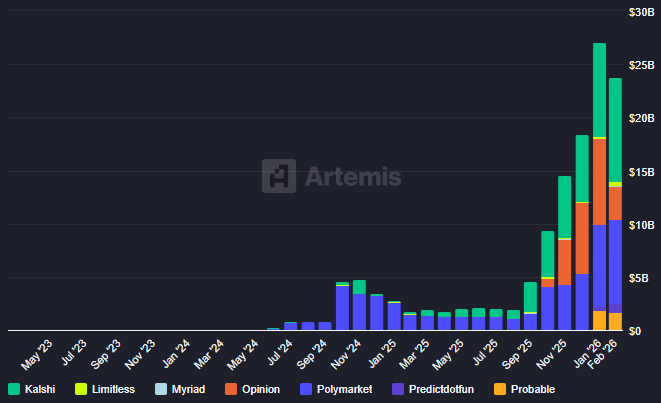
Monthly prediction market volumes dipped in February for the first time since August 2025.
In February, the prediction market sector recorded a drop in monthly trading volumes after five straight months of gains, as activity on BNB Chain-based Opinion Labs fell sharply to $3.1 billion from over $10 billion.
According to data from Artemis, prediction markets processed $23.4 billion of trades in February, down roughly 12% from January’s record $27.1 billion.

Kalshi solidified its lead, with its February trading volume reaching an all-time high of $9.8 billion.
Meanwhile, Polymarket volumes grew slightly to $7.9 billion in February compared to $7.7 billion in January.
Prediction markets have evolved from a niche sector to a mainstream financial tool, utilized for forecasting events such as elections and economic indicators.
It should be noted that concerns remain about Opinion Labs’ data integrity. This underscores the importance of transparency in the rapidly expanding prediction market space.
Also today, Kalshi announced a collaboration with Bezel, a luxury watch marketplace. Recent research also suggests that Kalshi’s markets have outperformed traditional Wall Street surveys, further establishing its authority in the field.
This article was generated with the assistance of AI workflows.
President Donald Trump accused US banks of threatening the GENIUS Act and holding the CLARITY Act hostage, escalating a months-long standoff between the banking and crypto industries over stablecoin yield.
The clash threatens to derail the CLARITY Act before the 2026 midterms, leaving the US crypto regulatory framework incomplete at a critical moment.
Trump Takes Aim at Banks Over Stablecoin Yield Fight
In a Truth Social post on Tuesday, Trump said the GENIUS Act — the landmark stablecoin law he signed last July — “is being threatened and undermined by the Banks,” and called on Congress to pass market structure legislation immediately.
“Americans should earn more money on their money. The Banks are hitting record profits, and we are not going to allow them to undermine our powerful Crypto Agenda that will end up going to China, and other Countries if we don’t get The Clarity Act taken care of,” Trump wrote.
The statement marks the sharpest presidential intervention yet in the legislative battle over stablecoin rewards — a dispute that has stalled the broader crypto regulatory agenda in Washington.
Stablecoin Yield: The Core Dispute
At the center of the conflict is a provision in the GENIUS Act that prohibits stablecoin issuers from paying interest directly to holders. However, the law does not explicitly prevent third-party platforms such as Coinbase and Kraken from passing yield on to users — a gap that banks have labeled a “loophole.”
This arrangement allows crypto exchanges to capture yield on reserve assets such as US Treasury bills and distribute it to customers, creating a competitive edge over traditional savings accounts that often pay as little as 0.01%.
Banking trade groups, led by the Bank Policy Institute, have warned that this structure could trigger deposit outflows of up to $6.6 trillion — a figure drawn from a US Treasury Department analysis. Bank of America CEO Brian Moynihan echoed the concern in January, stating that interest-bearing stablecoins could divert roughly 30–35% of all commercial bank deposits.
The banking lobby has pushed to close this gap through the CLARITY Act, the crypto market structure bill currently under Senate consideration. The bill would assign specific oversight roles to the SEC and CFTC, but has become a vehicle for the stablecoin yield debate.
Dimon Draws a Line
Trump’s post came on the same day that JPMorgan Chase CEO Jamie Dimon delivered pointed remarks on stablecoin regulation. Speaking on CNBC, Dimon argued that firms offering yield on stablecoin balances are functionally operating as banks and should be regulated accordingly.
Dimon suggested a compromise in which platforms could offer rewards tied to transactions rather than idle balances, but drew a firm line at interest-like payments on holdings. He cited capital requirements, FDIC insurance, anti-money-laundering obligations, and community lending mandates as standards that banks must meet — but that crypto firms currently do not.
However, Coinbase CEO Brian Armstrong has publicly rejected such framing. Armstrong predicted that banks would eventually reverse course and lobby for the ability to pay interest on stablecoins, once competitive pressure from digital assets becomes unavoidable.
A coalition of more than 125 crypto companies, including Coinbase, Gemini, and Kraken, launched a coordinated campaign against the banking lobby last year, arguing that reopening the GENIUS Act’s yield provisions would undermine the certainty that markets and innovators depend on.
Legislative Clock Is Ticking
The White House had set a tentative March 1 deadline for a deal between the two sides. That deadline passed without resolution. The CLARITY Act remains stuck in the Senate Banking Committee, with no markup date announced.
According to Elliptic’s regulatory analysis, the Senate Banking Committee had planned to vote on the bill in mid-January, but indefinitely postponed the session after Coinbase withdrew support over a proposed amendment restricting stablecoin rewards. Two White House meetings in early February failed to produce a compromise.
The OCC further complicated matters last week by publishing a 376-page proposed rulemaking under the GENIUS Act, with provisions that crypto insiders say could restrict how stablecoin issuers’ partners pay out rewards.
Senator Cynthia Lummis reposted Trump’s message, adding: “America can’t afford to wait. Congress must move quickly to pass the Clarity Act.”
With the 2026 midterm election cycle accelerating and a summer recess ahead, the legislative window is narrowing. If no deal emerges in the coming weeks, the US risks losing momentum on the crypto regulatory framework that both the White House and the industry view as critical to maintaining global competitiveness.


Brazil’s central bank will force licensed crypto exchanges to prove asset sufficiency daily from Jan. 1, 2027.
Summary
- Brazil’s central bank will require daily asset sufficiency reports from licensed crypto exchanges starting Jan. 1, 2027
- New rules mandate full segregation of client and platform assets, plus on‑balance‑sheet recognition of crypto under a dedicated accounting manual
- The announcement comes as major assets like BTC and ETH trade lower amid broader risk‑off sentiment in crypto markets
Brazil’s central bank has introduced a new regulatory framework that will require all licensed cryptocurrency trading platforms in the country to submit daily reports proving they hold sufficient assets to cover operational and security risks, starting Jan. 1, 2027. The measures, published via market communications on March 3, target exchanges’ resilience against hacking, operational failures, and misuse of client funds by aligning crypto intermediaries with commercial banking standards on capital, data protection, and confidentiality. The rules also expand oversight of cross‑border flows and aim to tighten controls on how crypto assets are recorded on balance sheets, signaling a more stringent, bank‑style prudential regime for Brazil’s growing digital asset sector.
Under the new framework, exchanges operating in Brazil will need to deliver daily attestations demonstrating they have adequate fiat and crypto reserves to withstand cyberattacks, liquidity shocks, and other material risks associated with running a trading venue. Supervisors are expected to use these reports to monitor whether platforms maintain asset sufficiency in line with internal risk models and regulatory expectations, reducing the likelihood that a sudden shortfall in funds will cascade into customer losses. The move reflects lessons learned from high‑profile failures of offshore exchanges, where lack of transparency around reserves and intra‑group flows contributed to insolvencies and prolonged withdrawals.
A core pillar of the regime is the strict segregation of customer and platform assets. Exchanges must fully separate their own fiat and cryptocurrency accounts from those belonging to clients, preventing the commingling of operational capital with custodied funds. This requirement is designed to make it harder for platforms to rehypothecate or use customer balances for proprietary trading or unsecured lending, while giving regulators a clearer view of which assets are legally attributable to users in the event of resolution or bankruptcy. In practice, this pushes Brazilian exchanges closer to a custodial model, in which they act as fiduciaries for client holdings rather than counterparties taking balance‑sheet risk.
Regulators are also mandating that crypto assets be recognized on exchanges’ balance sheets under a specialized accounting manual tailored to digital instruments. Instead of treating crypto solely as off‑balance‑sheet custodial items, platforms will have to follow standardized guidance on classification, valuation, and impairment, making financial statements more comparable across the sector. This step aligns Brazil with an emerging global trend, where supervisors in jurisdictions influenced by frameworks like MiCA are pushing for consistent accounting treatment of tokens held or intermediated by regulated entities. By clarifying how assets and liabilities are booked, authorities hope to reduce information asymmetries between exchanges, investors, and auditors.
Beyond balance‑sheet transparency, the new rules extend to data protection and confidentiality obligations that mirror those imposed on commercial banks. Exchanges will be required to implement robust controls around customer data, transaction records, and internal communications, limiting the risk of leaks or unauthorized access. This is particularly relevant in a market where on‑chain and off‑chain identifiers can be combined to build detailed profiles of user behavior, creating potential targets for cybercrime and surveillance. Treating crypto platforms more like banks in this respect underscores the central bank’s view that large exchanges play systemically important roles in Brazil’s retail investment and payments landscape.
In addition to domestic prudential rules, Brazilian authorities will impose tighter restrictions and audits on cross‑border transfers involving crypto assets. Exchanges facilitating international flows will face enhanced scrutiny of the origin and destination of funds, as well as the on‑chain pathways used to move value between wallets and jurisdictions. Supervisors intend to leverage blockchain analytics and reporting obligations to improve the traceability of transactions, making it more difficult for actors to use crypto for money laundering, tax evasion, or financing criminal networks.
This focus on traceability echoes steps taken in other jurisdictions, where regulators have pushed intermediaries to adopt travel‑rule style data sharing and transaction monitoring standards. In Brazil’s case, the central bank is likely to coordinate with tax authorities, financial intelligence units, and international partners to harmonize reporting formats and risk indicators. Exchanges will need to build or integrate compliance systems capable of flagging suspicious cross‑border flows in near real time, while maintaining sufficient documentation to satisfy audits.
The policy shift comes as global regulators intensify their attention on crypto intermediaries rather than solely targeting individual users or protocol‑level activity. Recent measures in countries such as Turkey and Japan have focused on taxation and anti‑money‑laundering controls for both centralized platforms and related service providers, reflecting concern that unregulated gateways can undermine existing capital flow and sanctions regimes. Brazil’s approach, anchored in its central bank, positions the country among those seeking to fold crypto markets into the perimeter of traditional financial supervision instead of relying purely on securities‑style oversight.
For exchanges, the daily reporting requirement and asset segregation rules will likely increase operational costs, particularly for smaller platforms that lack sophisticated risk management and compliance teams. They may need to hire additional staff, upgrade custody solutions, and integrate third‑party tools for reserve verification and transaction monitoring. Larger venues with existing institutional infrastructure, including those already serving global clients or partnering with firms like Coinbase or Visa, may find it easier to absorb these changes and use compliance as a competitive differentiator. Over time, the regulatory burden could accelerate consolidation in Brazil’s exchange market as less capitalized players exit or merge.
Market participants will be watching how the new framework interacts with broader trends in crypto prices and liquidity. At the time of the announcement, BTC and ETH were trading lower amid a wider drawdown across major tokens, with selling pressure reflecting both macro risk‑off conditions and positioning after recent rallies. While the rules do not target any specific asset like SOL, the signal that a large emerging‑market economy is imposing bank‑grade standards on exchanges could affect perceptions of regulatory risk and premium in local markets. Some institutional investors may view the clarity as a positive step toward de‑risking on‑ramp exposure, while retail traders could initially focus on potential costs or friction.
On‑chain data and exchange volume metrics in the coming months will provide clues about how Brazilian users respond to the new regime. If domestic platforms see sustained or rising spot and derivatives activity despite tighter controls, it may indicate that users value the added protections and are willing to trade under stricter oversight. Conversely, a notable shift toward offshore venues or direct peer‑to‑peer markets would suggest that some traders prefer less regulated channels, even at the cost of legal certainty. For regulators, the challenge will be calibrating enforcement and implementation timelines to avoid sudden disruptions while still closing gaps that have historically allowed misuse of crypto rails.
The Brazilian central bank’s push to require daily proof of asset sufficiency, strict client fund segregation, and enhanced cross‑border audits underscores a broader policy objective: integrating crypto asset intermediaries into the core of the country’s financial system without granting them a regulatory free pass. By aligning exchanges with commercial banking standards on reporting, data protection, and accounting, authorities hope to reduce systemic risk while preserving the innovative aspects of digital asset markets. How effectively exchanges adapt to this new environment will shape both the structure of Brazil’s crypto industry and its role in the global digital finance ecosystem over the next several years.
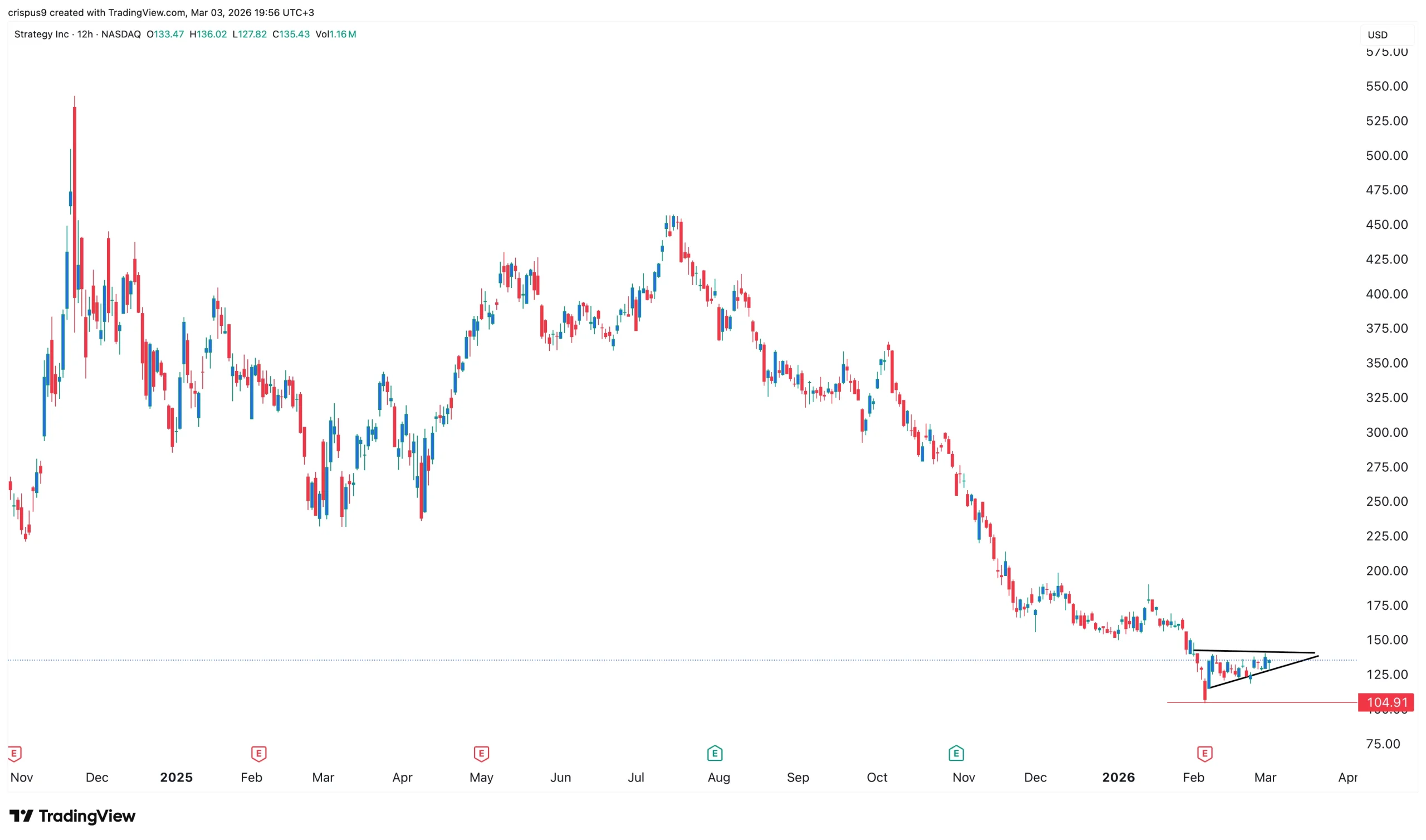
The price of MSTR stock has remained within a narrow range since early February, closely tracking Bitcoin’s performance, which has stagnated between $60,000 and $70,000.
Summary
- MSTR stock price has formed a triangle pattern on the 12-hour chart.
- This pattern points to a big move in either direction.
- Strategy’s short interest has jumped to 12.6%.
Strategy stock was trading at $134 on Tuesday, up by nearly 30% from its lowest level in February. It remains substantially lower than its all-time high of $545.
Seeking Alpha data shows that more investors are shorting the company, hoping to benefit from its crash. The company’s short interest rose to 12.6%, much higher than last year’s low of 5%.
Short-sellers likely see the stock having numerous red flags. The first major one is the fact that Bitcoin (BTC) could be at risk of dropping to $50,000 in the coming weeks. It has formed a bearish pennant pattern, and the ongoing war in Iran has pushed investors to dump risk assets.
Additionally, while Strategy has continued to buy Bitcoin, it has done so by selling its common stock, a move that has led to substantial dilution. Its outstanding shares have jumped to over 310 million from less than 80 million a few years ago.
Strategy has also lost the premium it had a few years ago, with the net asset value falling below 1. At the same time, analysts have continued to pare back their estimates. Mizuho slashed the target from $403 to $320, while BTIG moved it from $630 to $250.
MSTR stock price chart analysis
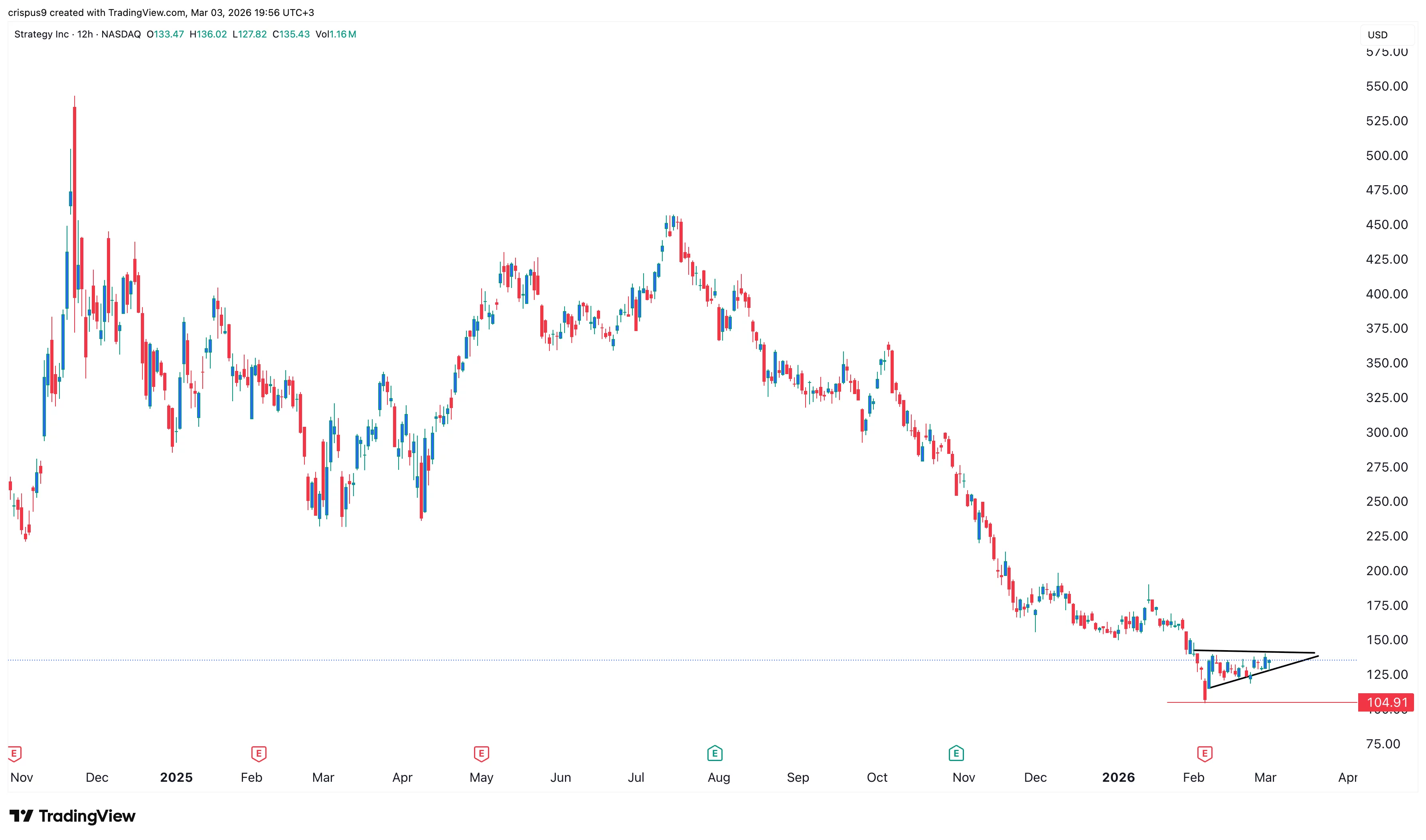
The 12-hour chart shows that the Strategy share price has wavered in the last month. By so-doing, the stock has formed a symmetrical triangle pattern, while the volatility has dropped. The Average True Range, which measures volatility, has continued falling.
A keener look shows that the two lines of the triangle pattern are nearing their confluence. Therefore, this triangle pattern mean that the stock is about to have a big move in either direction in the near term.
In case of a bearish breakout, the stock will likely retest the year-to-date low at $104, followed by $100. On the other hand, a strong bullish breakout may see it jump to the psychological point at $150 and above.


A new US housing bill includes a provision that temporarily bans the Federal Reserve from issuing a digital dollar to consumers until 2030.
The move represents a shift from previous strong opposition to Central Bank Digital Currencies (CBDCs).
Senate Advances Housing Bill With CBDC Ban
The Senate on Monday advanced the 21st Century ROAD to Housing Act, a bipartisan bill focused on housing affordability.
The legislation aims to merge the housing priorities of both the House and Senate with the Trump administration’s efforts to prevent large institutional investors from acquiring single-family homes.
Senators voted 84-6 to move the bill forward after Banking Committee Chairman Tim Scott and Ranking Member Elizabeth Warren unveiled updated legislative text for the proposal.
Of the 303 pages in the proposal, just two were dedicated to a provision banning the Federal Reserve from issuing a retail CBDC. Notably, this provision is set to expire in less than five years.
“The Board of Governors of the Federal Reserve System or a Federal reserve bank may not issue or create a central bank digital currency or any digital asset that is substantially similar to a central bank digital currency directly or indirectly through a financial institution or other intermediary,” the bill read.
According to POLITICO, the White House stated that the Trump administration strongly supports the bill. If presented in its current form, Trump’s advisers would recommend he sign it into law.
The legislation language was seen as a victory for lawmakers who have long raised privacy concerns about CBDCs. The disquiet stemmed from the possibility that digital currencies could enable government surveillance and control over individuals’ financial activities.
However, the 2030 expiration date has led some to view the ban as ineffective.
Expiry Date Undermines Trump’s CBDC Stance
If the bill is signed into law as it stands, the Federal Reserve would be allowed to issue CBDCs after the 2030 deadline. The news has upset some, who saw it as contrary to the Trump administration’s long-standing opposition to the digital dollar.
During his campaign trail, Trump emphatically opposed the creation of a US CBDC, describing it as a form of tyranny.
“Such a currency would give a federal government — our federal government — absolute control over your money. They could take your money and you wouldn’t even know it’s gone,” the president said during a January 2024 campaign stop in New Hampshire.
Just four days after his inauguration, Trump signed an executive order entitled “Strengthening American Leadership in Digital Financial Technology.” Among its many provisions, the order explicitly detailed measures to protect Americans from the risks posed by CBDCs.
The stipulations included “prohibiting the establishment, issuance, circulation, and use of a CBDC within the jurisdiction of the United States.”
The recent legislation’s 2030 expiration date created uncertainty about the ban’s long-term impact.
While offering temporary relief for those concerned about government surveillance, the bill also opens the door for future CBDC discussions.
Ethereum price faces $2,000 support as exchange withdrawals surge to the highest level since November, indicating potential shifts in market supply and momentum.
Summary
- Ethereum trades at $2,001, down 4.3% in the last 24 hours.
- Exchange withdrawals hit 31.6M ETH in February, highest since November.
- $2,000 support is critical; break below risks $1,850, upside targets $2,300–$2,400.
Ethereum (ETH) is trading at $2,001 at press time, down 4.3% in the past 24 hours. The seven-day range stands between $1,841 and $2,099. ETH is still up 7.7% over the past week but down 14% in the last 30 days.
From its August 2025 all-time high of $4,946, the price has retraced about 59%. Spot trading volume reached $25 billion in the past 24 hours, a 21% drop in the last day.
Data from CoinGlass shows a cooling in the derivatives market. Trading volume has slipped 7.8% to $59 billion, and open interest has declined 5.6% to $25 billion.
As ETH approaches a critical price zone, many traders appear to be trimming positions and lowering risk.
Exchange withdrawals surge
At the same time, on-chain activity tells a different story. According to a March 3 report by CryptoQuant contributor Arab Chain, February recorded nearly 31.6 million ETH in exchange withdrawals, the largest monthly outflow since November.
A significant portion of that came from Binance, where about 14.45 million ETH was moved off the platform. About 1.04 million ETH were withdrawn from Kraken and approximately 3.83 million ETH were removed from OKX.
Large withdrawals from exchanges usually mean the assets are being moved into cold storage or set aside for longer-term holding. Once tokens leave trading platforms, there’s less supply readily available, which can ease immediate selling pressure.
This kind of shift often suggests that investors are choosing to hold onto their positions or adjust their strategy during periods of market volatility.
Ethereum price technical analysis
The $2,000 level carries both psychological and structural importance. Because that price level coincides with an important technical area on the chart and has psychological weight for investors, both bulls and bears are pay close attention to it.
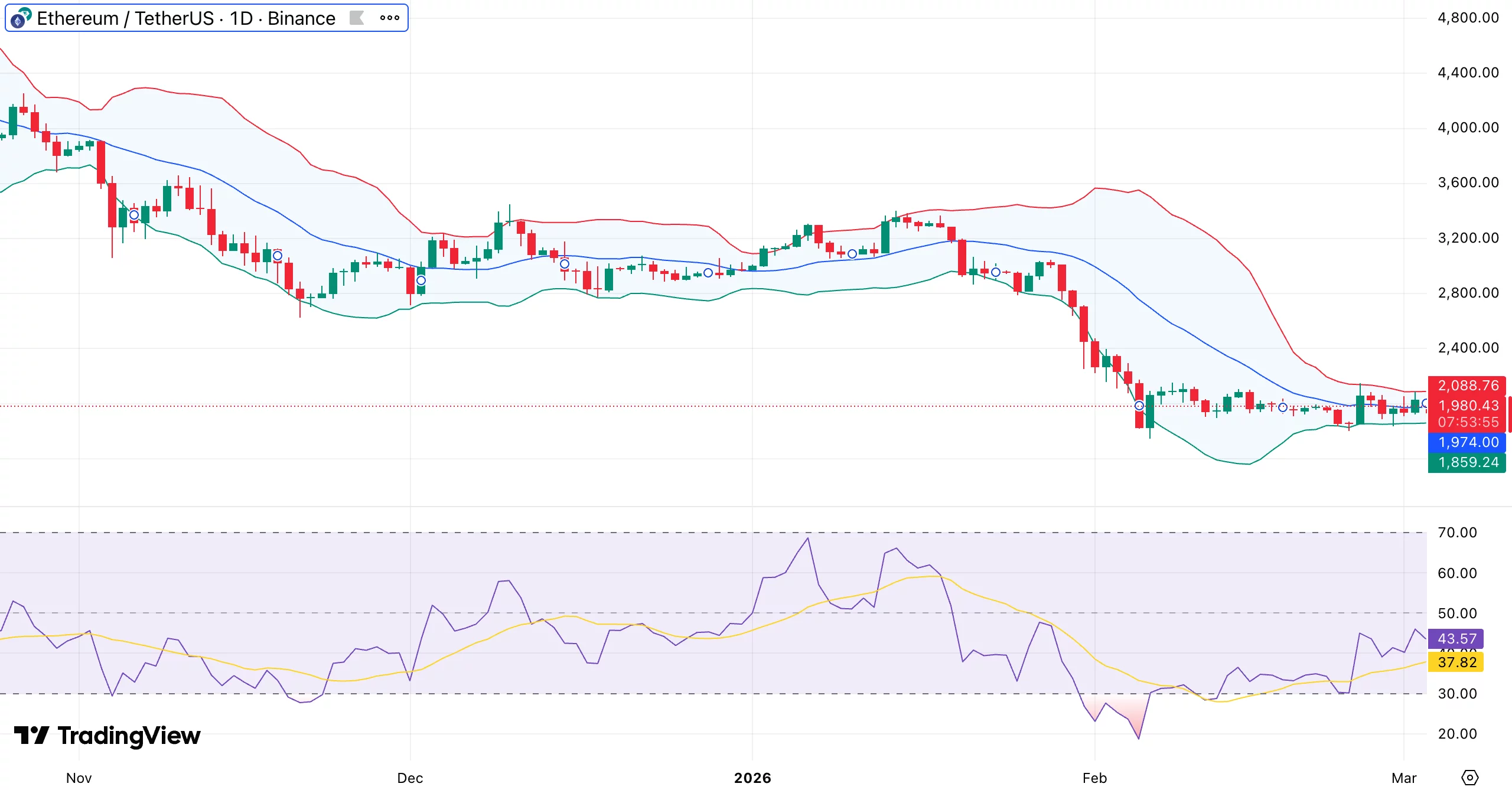
Buyers have stepped in on dips, but support is under pressure. A daily close below $1,950 would expose the $1,850–$1,900 area, where prior liquidity sits. Below that, $1,700 becomes a deeper downside target.
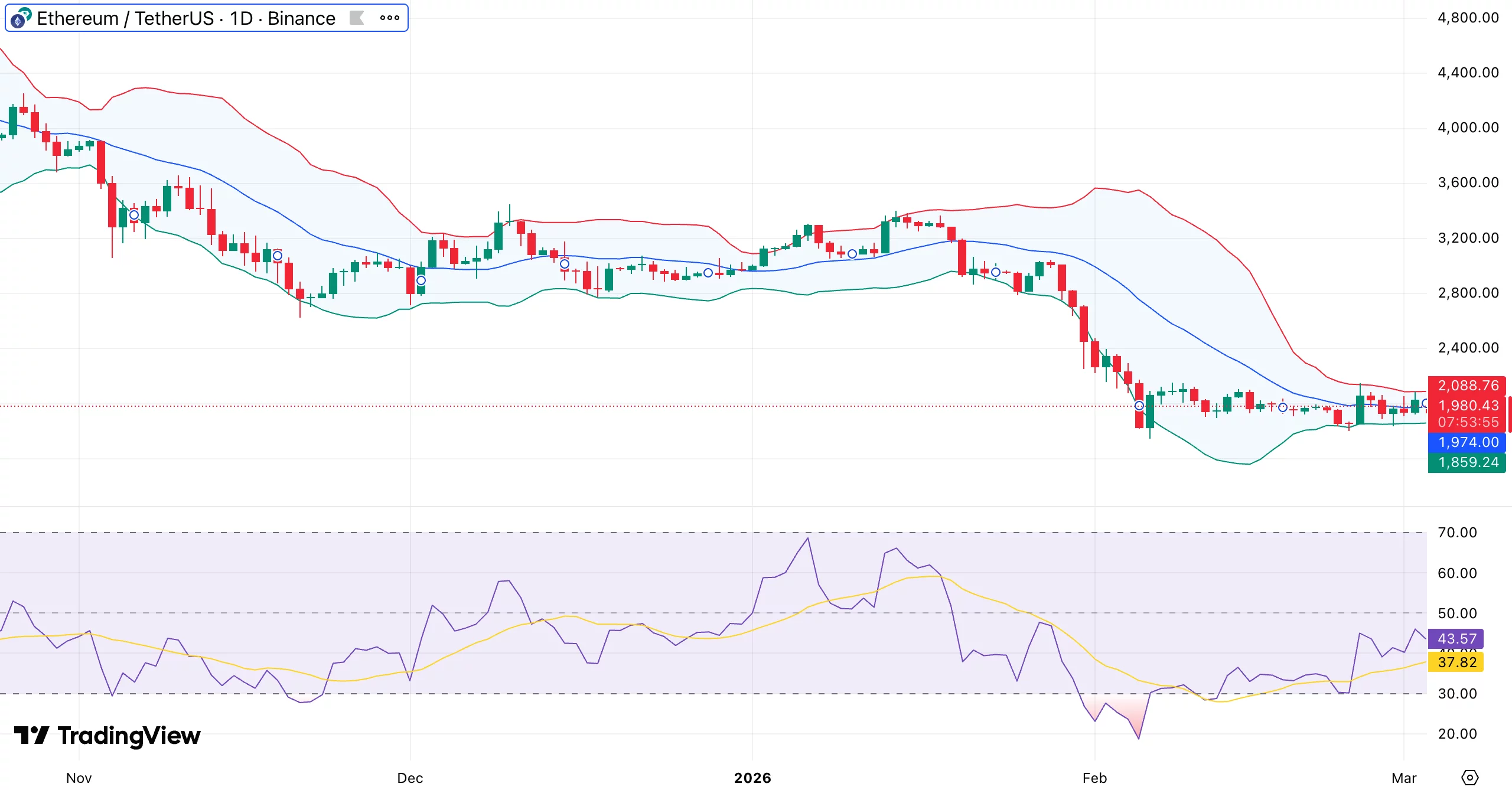
ETH recently moved down to the lower Bollinger Band, a level that often suggests the asset may be oversold in the short term. At the same time, the bands have begun to tighten, a pattern that usually precedes a more significant price movement in either direction.
A recovery toward the middle band in the $2,050 to $2,100 range may occur if buyers are able to hold the $2,000 level. The relative strength index has rebounded from near 30 and is attempting to recover. A push above 45–50 would show improving momentum.
Until then, the broader pattern of lower highs stays intact. ETH remains below its 50-day moving average, and a move above $2,150–$2,200 would be needed to shift short-term structure.
If ETH holds above $2,000 and breaks $2,150 with stronger momentum, upside targets sit near $2,300 and $2,400. If $2,000 fails on a daily close, the path toward $1,850 opens quickly. The next few sessions will likely decide whether ETH stabilizes or enters another leg lower.

CISA flags VMware Aria Operations RCE flaw as exploited in attacks

what ejection from a fighter jet does to the body

US stocks fall as Middle East tensions drive oil prices higher


-

 Politics5 days ago
ITV enters Gaza with IDF amid ongoing genocide
-

 Fashion4 days ago
Weekend Open Thread: Iris Top
-

 Politics16 hours ago
Alan Cumming Brands Baftas Ceremony A ‘Triggering S**tshow’
-

 Tech3 days ago
Unihertz’s Titan 2 Elite Arrives Just as Physical Keyboards Refuse to Fade Away
-

 NewsBeat6 days ago
Cuba says its forces have killed four on US-registered speedboat | World News
-
Sports4 days ago
The Vikings Need a Duck
-
 NewsBeat3 days ago
Dubai flights cancelled as Brit told airspace closed ’10 minutes after boarding’
-

 NewsBeat2 days ago
‘Significant’ damage to boarded-up Horden house after fire
-
 NewsBeat6 days ago
Manchester Central Mosque issues statement as it imposes new measures ‘with immediate effect’ after armed men enter
-
 NewsBeat4 days ago
The empty pub on busy Cambridge road that has been boarded up for years
-

 NewsBeat3 days ago
Abusive parents will now be treated like sex offenders and placed on a ‘child cruelty register’ | News UK
-

 Entertainment2 days ago
Baby Gear Guide: Strollers, Car Seats
-

 Business6 days ago
Discord Pushes Implementation of Global Age Checks to Second Half of 2026
-

 Business5 days ago
Only 4% of women globally reside in countries that offer almost complete legal equality
-
 Tech5 days ago
NASA Reveals Identity of Astronaut Who Suffered Medical Incident Aboard ISS
-
 NewsBeat3 days ago
Emirates confirms when flights will resume amid Dubai airport chaos
-
Politics3 days ago
FIFA hypocrisy after Israel murder over 400 Palestinian footballers
-

 Crypto World5 days ago
From Crypto Treasury to RWA: ETHZilla Retreats and Relaunches as Forum Markets on Nasdaq
-

 NewsBeat1 day ago
Is it acceptable to comment on the appearance of strangers in public? Readers discuss
-

 Tech3 days ago
Viral ad shows aged Musk, Altman, and Bezos using jobless humans to power AI