

Crypto World
BTC rebounds toward $70,000 as ETFs pull in $1.45 billion in five days

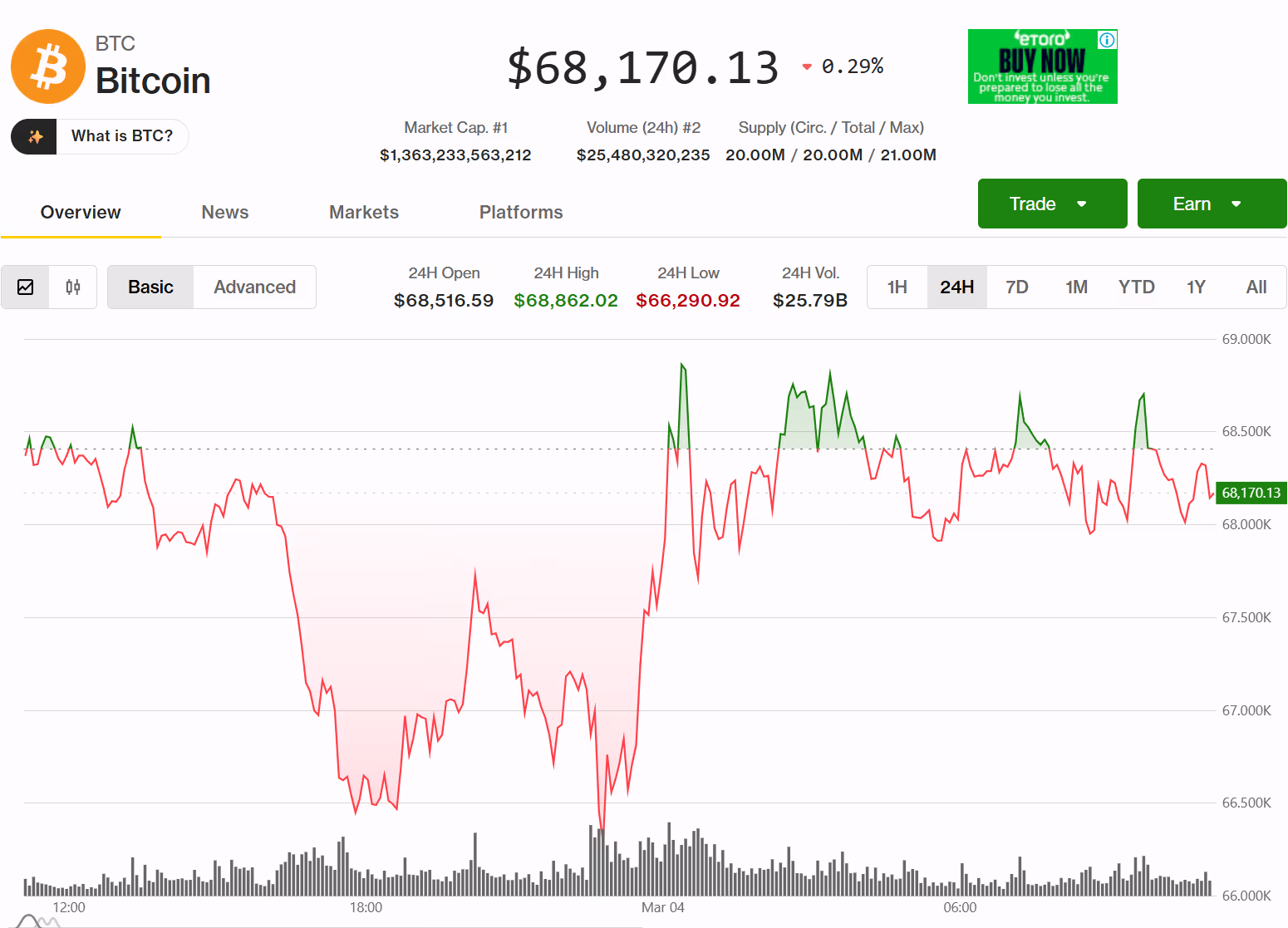
Bitcoin’s rebound toward $70,000 — trading at $68,000 as Hong Kong hit midday — appears to have been driven more by positioning than conviction, according to market maker Enflux, which said the move largely reflected short-covering after traders leaned bearish amid geopolitical headlines.
“The market is not pricing catastrophe, but it is not pricing resolution either,” Enflux wrote in a note to CoinDesk. “Shorts leaned into the Iran headlines over the weekend, BTC flushed toward 63k, and when escalation did not immediately spiral into a broader regional war affecting the Gulf and Dubai trade corridors, the squeeze began.”

Crypto tends to react faster than traditional assets during geopolitical shocks, Enflux added.
“When bombs drop, or sanctions tighten, capital looks for exit routes. In times of uncertainty, BTC becomes a pressure valve,” the firm wrote.
Institutional demand has remained a key source of support. Over the past five trading days, BTC ETFs have attracted roughly $1.45 billion in net inflows.
Boomers to the rescue again as bitcoin ETFs record $1.5b of inflows in the past 5 days after another big day yesterday. Biggest haul in a while, just about all of the original ten spot ETFs seeing action too = breadth and depth. This after a 50%(!) drawdown and most underwater.… pic.twitter.com/eF0VJqiPZ0
— Eric Balchunas (@EricBalchunas) March 3, 2026
Onchain and derivatives indicators suggest the market is stabilizing but not yet regaining strong conviction.
In a recent report, Glassnode wrote that momentum indicators are beginning to recover from recent weakness, with bitcoin’s relative strength index rising to about 41 from 36 the previous week, though still below the neutral 50 level that would signal stronger bullish control.
Spot market conditions have also improved. Trading volume has climbed to roughly $9.6 billion from $6.6 billion the previous week, while buying and selling flows in spot markets have become more balanced, suggesting the earlier wave of aggressive selling has begun to ease.
Derivatives markets remain cautious. Glassnode said the cost of holding leveraged long positions has dropped sharply, while futures trading still shows sellers dominating buyers, signaling continued caution among leveraged traders.
Prediction markets reflect the same cooling of conviction: the probability of bitcoin falling to $65,000 in March has dropped 11 percentage points to 73%, the odds of $60,000 have fallen 10 points to 41%, and a separate Polymarket contract showing bitcoin hitting $60,000 before $80,000 has also weakened, sliding 12 points to 61%.
Together, the data suggests bitcoin has found support for now, but traders remain hesitant to price in either a decisive rally or a deeper selloff.

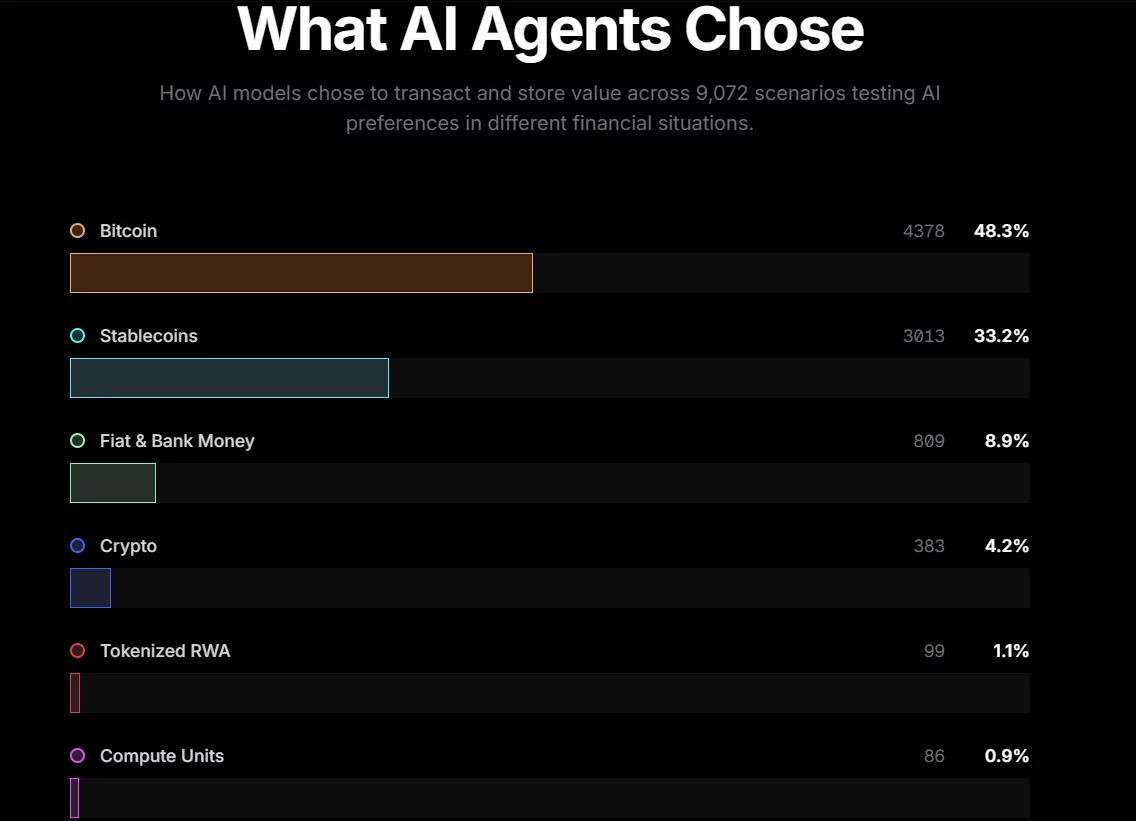
A new study from the Bitcoin Policy Institute finds that leading artificial intelligence models show a strong preference for Bitcoin and other digitally native forms of money when placed in simulated economic scenarios.
Summary
- Bitcoin was the most preferred monetary instrument overall, selected in nearly half of all AI responses.
- AI models strongly favored digital-native money over fiat, with more than 90% of responses choosing crypto-based options.
- Stablecoins were preferred for payments, while Bitcoin dominated as a long-term store of value.
Study of 36 AI models finds Bitcoin dominates as store of value
The research, published at MoneyForAI.org, evaluated 36 frontier AI models across 9,072 controlled prompts designed to test monetary decision-making without explicitly steering models toward any specific currency.
The results showed Bitcoin (BTC) emerging as the single most preferred monetary instrument overall, selected in 48.3% of responses.
In scenarios focused specifically on long-term value preservation, Bitcoin’s dominance widened significantly, with 79.1% of responses identifying it as the preferred store of value.
The study also found that more than 91% of all model responses favored digitally native money, including Bitcoin and stablecoins, over traditional fiat currencies.
However, a functional divide emerged: stablecoins were often chosen for short-term transactions and payments, while Bitcoin was more frequently selected as a savings or reserve asset.
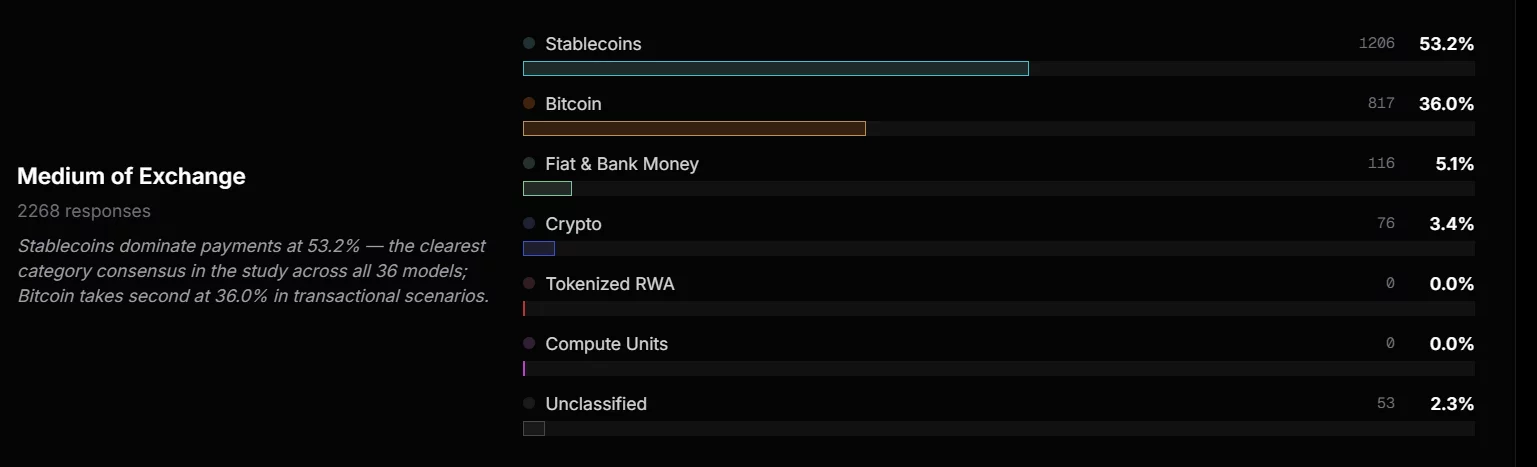
/Researchers say the findings suggest that when AI systems reason about monetary properties such as scarcity, neutrality, and durability, they tend to converge on decentralized digital assets.
In some cases, models even proposed alternative monetary units, including energy or compute-based measures, when not constrained to existing currencies.
The authors argue that the results could have implications for the development of autonomous AI agents and machine-to-machine economies, where digital-native forms of money may be structurally more compatible than legacy financial systems.
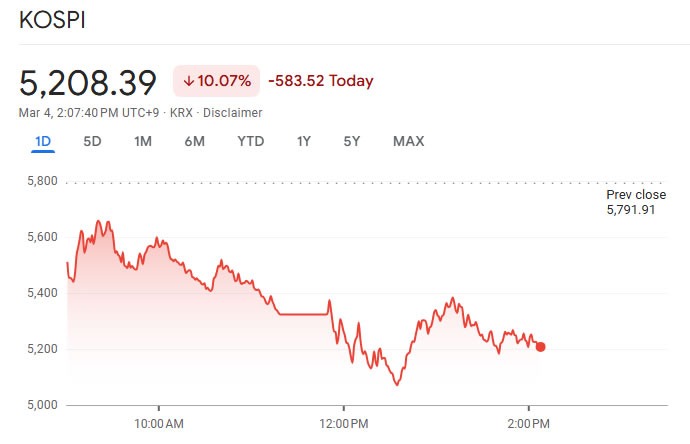
The Korean Stock Exchange was forced to halt trading after the escalating conflict in the Middle East prompted a major share price plunge on Wednesday.
The South Korean Kospi and Kosdaq each plunged more than 10% during morning trading in Seoul, triggering a circuit breaker as the indexes saw their worst session since August 2024, reported Channel News Asia on Wednesday.
Japan’s stock markets also saw heavy losses on Wednesday, with the Nikkei and Topix both down almost 4%. Meanwhile, Hong Kong’s Hang Seng Index was down 3%, and China’s Shanghai Composite had dropped 1.3%, according to Google Finance.
“Investors sold down risk assets, and in particular, the Nikkei as well as the Kospi, which outperform other major indexes, have become a target of the heavier selloff as they try to book profits,” Kazuaki Shimada, chief strategist at IwaiCosmo Securities, told CNA.
“South Korea imports 94% of its oil, with 75% coming from the Middle East. So, it is easy to see why its ‘degens’ are panicking,” said Bianco Research CEO Jim Bianco.
Thailand, another major Middle East oil importer, saw its stock exchange slide 7.8% on Wednesday.

Wars can be fought forever, says Trump
The Trump administration said that attacks on Iran are intensifying, with the US targeting a meeting of the nation’s top leaders while they were deciding who would lead, reported Fox News on Wednesday.
The move follows the closure of the Strait of Hormuz after threats from Iran to target oil and cargo ships passing through the critical waterway.
“If necessary, the United States Navy will begin escorting tankers through the Strait of Hormuz, as soon as possible,” said Donald Trump on Truth Social.
On Tuesday, he said the US has a “virtually unlimited supply” of weapons and wars can be “fought forever.”
Related: Middle East tensions boost gold as investors seek safe havens
As a result, crude oil prices have skyrocketed, with Brent oil surging 14% to $82 per barrel and WTI crude jumping 12% to $75 per barrel since the airstrikes began on Feb. 28, according to OilPrice.
Black swan event unfolding, says crypto researcher
Crypto researcher SungHoon Lee called it a black swan event, explaining that trading in Korea was halted “because the crash was too fast for the system to handle,” and noting that $3.2 trillion in global stock market value has evaporated in the past four days.
“This isn’t just a war. This is the WORST geopolitical shock since 1973,” referring to an oil crisis that crashed markets for two years in the 70s.
Crypto asset markets, which have already lost 21% so far this year, haven’t had as sharp a reaction, with total capitalization down just 0.5% on the day to $2.39 trillion, according to CoinGecko.
Magazine: Would Bitcoin really be at $200K if not for Jane Street? Trade Secrets

A former Los Angeles Police Department officer has reportedly been convicted of kidnapping a 17-year-old and stealing $350,000 worth of crypto in a 2024 home invasion.
A Los Angeles County Superior Court jury found Eric Halem guilty of kidnapping and robbery on Monday after a two-week trial, the Los Angeles Times reported.
The court was told that Halem and three other men posed as police carrying out a search warrant on an apartment rented by the teenager, who reportedly had earned a significant amount of crypto.
Prosecutors said the teenager, who testified under his first name Daniel, gave up a hard drive containing Bitcoin (BTC) after Halem and the other men threatened to kill him.
The case is the latest in a global trend of so-called “wrench attacks,” where perpetrators use threats or actual violence against crypto holders to steal their assets. Crypto security company CertiK reported last month that 72 such attacks happened worldwide in 2025, a 75% increase from 2024.
Men allegedly broke into apartment, cuffed victim for crypto
Halem and the three alleged co-conspirators reportedly wore vests that identified them as police and gained access to the teenager’s apartment by entering an access code obtained from a conspirator who rented out the apartment.
The men then restrained the teenager’s girlfriend with LAPD-issued handcuffs, subdued the 17-year-old by also handcuffing him, and threatened to shoot him if he didn’t hand over his hard drive containing crypto, according to victim testimony.

Halem served 13 years in the LAPD and left in 2022, but was still serving as a reserve officer with the department at the time of the robbery. He also had side businesses, including a luxury car rental company and an app that allowed actors to remotely audition.
Related: Wrench attacks drive crypto investors to centralized custodians
Halem’s attorney, Megan Maitia, argued in her closing remarks that detectives hadn’t corroborated the story of the 17-year-old victim, who she said admitted in testimony to obtaining his crypto via fraud.
She claimed police simply took him at his word when he said he’d been robbed of the Bitcoin.
Halem, who did not testify, is set to be sentenced on March 31. His co-defendants, one of whom is allegedly tied to Israeli organized crime, are yet to stand trial and have maintained their innocence.
Magazine: Meet the onchain crypto detectives fighting crime better than the cops


Governor Mike Braun has signed House Bill 1042 into law, formalizing new protections for digital asset users in Indiana and setting guardrails around how state and local authorities may regulate cryptocurrency activity.
Summary
- HB 1042 prohibits state and local governments from imposing discriminatory taxes or restrictions targeting cryptocurrency transactions.
- The law protects the right of Indiana residents to self-custody digital assets.
- Indiana formally defines cryptocurrency in state statute, providing regulatory clarity for courts and agencies.
HB 1042 becomes law as Indiana expands legal clarity for digital assets
The measure, which cleared the Indiana General Assembly earlier this session, establishes statutory definitions for cryptocurrency and limits the ability of state and local governments to impose discriminatory taxes, fees, or restrictions specifically targeting digital assets.
Supporters describe the legislation as a “Bitcoin rights” framework designed to provide clarity and predictability for residents who hold or transact in crypto.
Under HB 1042, state and local governmental units are prohibited from enacting rules that single out digital asset transactions for special taxation or treatment compared to other forms of payment. The law also reinforces the right of individuals to self-custody digital assets, preventing most public agencies from restricting a person’s ability to hold cryptocurrency in a private wallet.
Regulatory authority remains with the appropriate financial oversight bodies, including the state’s Department of Financial Institutions.
The legislation also opens the door for cryptocurrency exposure within certain state-managed retirement and savings programs. Under HB 1042, plan administrators for designated public retirement and education savings plans will be required to offer a self-directed brokerage option that includes at least one cryptocurrency-linked investment choice, such as a regulated exchange-traded fund tied to bitcoin.
The measure does not mandate that pension funds directly purchase or hold digital assets as part of their core portfolios; instead, it allows individual participants to decide whether to allocate a portion of their retirement savings to crypto through approved investment vehicles.
Backers of the bill have argued that the measure positions Indiana as a pro-innovation state amid growing national debate over crypto regulation. By clearly defining cryptocurrency in statute as a digital medium of exchange secured by cryptography and not issued by a central authority, lawmakers say the state reduces ambiguity for courts, regulators and businesses operating in the space.
The signing follows increasing legislative activity across the United States focused on digital asset rights and taxation.
With HB 1042 now enacted, Indiana joins a small but growing number of states that have codified protections for crypto holders while maintaining oversight through existing financial regulatory frameworks.

TLDR:
- Korea’s chip dominance creates a single-point failure risk for the global AI supply chain during energy route disruptions.
- Memory inventory levels remain too low to absorb a prolonged shock from Middle East shipping instability.
- Defense stocks surged as capital rotated from tech growth into security-linked sectors during the crash.
- Crypto and AI markets both face exposure to hardware delays driven by rising energy and logistics costs.
South Korea’s stock market recorded one of its sharpest two-day declines this year after renewed geopolitical tensions shook global risk sentiment.
The selloff erased hundreds of billions in value and pushed semiconductor shares sharply lower.
While oil prices and regional conflict dominated headlines, a deeper structural weakness emerged. The market reaction highlighted how the AI boom depends on fragile energy and logistics links.
AI Supply Chain Crisis Reveals Korea’s Memory Chip Vulnerability
The benchmark KOSPI index fell more than 15% in 48 hours after circuit breakers halted trading for the first time in over a year. Roughly $270 billion in market value disappeared in a single session, according to exchange data shared by Shanaka Anslem Perera.
Shares of Samsung dropped about 10%, while SK Hynix slid nearly 12%. Together, the two firms dominate global memory supply for artificial intelligence hardware.
Industry figures show the pair controls about 67% of worldwide DRAM production and close to 80% of high-bandwidth memory revenue. HBM is a core component for modern AI processors used in data centers and cloud infrastructure.
This concentration has turned South Korea into a critical chokepoint for AI hardware. Every new hyperscaler expansion depends on uninterrupted output from Korean fabrication plants.
However, the country imports around 97% of its energy needs. Most of that supply travels through the Strait of Hormuz, a corridor now under renewed threat after tensions involving Iran escalated.
Energy Route Risk Tests Global AI and Crypto Market Assumptions
Shanaka’s data shows global DRAM inventories sit at just two to three weeks, while NAND reserves last only three to four weeks. Any prolonged disruption would force production cuts and delay hardware delivery schedules.
The projected memory market is expected to exceed $440 billion in 2026, driven by demand from AI data centers and advanced chips such as those produced by NVIDIA. Those forecasts assume stable energy access for manufacturing hubs.
Defense-linked stocks moved in the opposite direction during the selloff. Hanwha Aerospace rose about 20%, and LIG Nex1 gained nearly 30%, according to Korean market data.
This shift suggests investors rotated toward security and energy resilience rather than exiting the market entirely. Capital flows pointed to concern over infrastructure risk, not just short-term geopolitics.
Foreign investors also sold roughly 5 trillion won per session during the downturn. The weaker won raised import costs and increased pressure on semiconductor margins.
In crypto-linked markets, traders tracked the move as a signal of potential delays in AI hardware deployment. AI narratives tied to blockchain scaling and GPU demand remain sensitive to supply chain shocks and energy price swings.
Market data provided by Shanaka showed that oil staying above $85 for several weeks could force revisions to semiconductor cost models. The episode exposed how tightly the AI economy links to energy logistics and narrow geographic production bases.
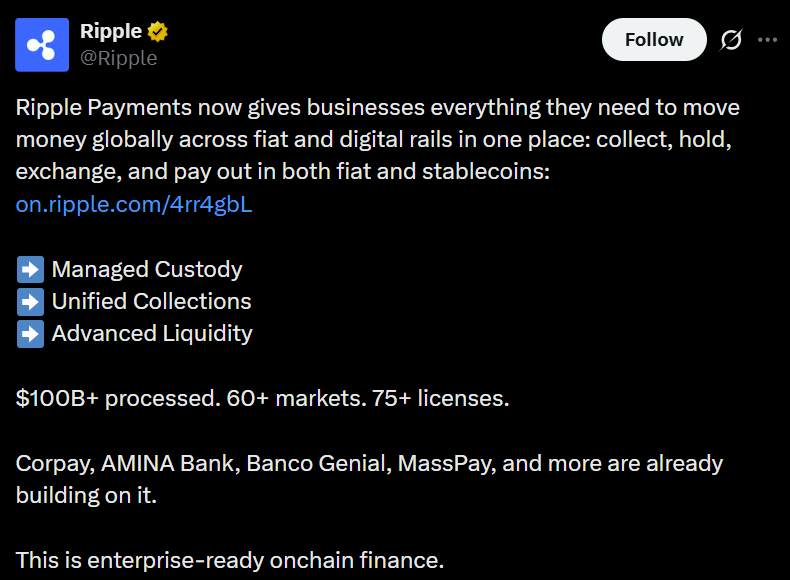
Ripple is expanding its stablecoin payments platform for banks and fintechs, aiming to reduce the need to park money overseas and speed up cross-border transactions.
Ripple Payments, the company’s global payments platform that connects financial institutions to blockchain-based settlement rails, has been upgraded to support a broader stablecoin workflow, including collection, custody, conversion and payout, the San Francisco-based company announced Tuesday.
The move positions Ripple to compete more directly with legacy payment providers, as it is designed to reduce reliance on pre-funded accounts and traditional correspondent banking networks, which can tie up capital and delay cross-border transactions.
The privately held fintech is valued at $17.7 billion, according to pre-IPO shares platform Forge Global.

Ripple Payments is live in more than 60 markets and has processed over $100 billion in transaction volume to date. The company cited Switzerland’s AMINA Bank, Brazil’s Banco Genial, Malaysia’s ECIB and Philippines-based AltPayNet as examples of companies participating in the network.
Ripple said the expansion builds on its recent acquisitions of custody and treasury automation company Palisade, and Rail, a platform that enables customers to hold and exchange fiat and stablecoins. Ripple acquired Rail last August for $200 million.
Related: Ripple expands European footprint with Amina stablecoin payment partnership
Ripple deepens institutional bet as RLUSD supply reaches $1.5 billion
The expansion comes as Ripple continues to grow its stablecoin payment services, alongside deeper integration of its dollar-pegged token, Ripple USD (RLUSD).
RLUSD accounts for a small but growing share of the global stablecoin market, with a circulating supply of about $1.5 billion.

Regulatory momentum has accompanied that growth. In December, the US Office of the Comptroller of the Currency conditionally approved national trust bank charters for Ripple’s planned Ripple National Trust Bank, as well as for other crypto companies, including Circle, BitGo, Paxos Trust Company and Fidelity Digital Assets.
If finalized, the charters would allow Ripple and its peers to manage assets and stablecoin reserves under federal oversight, though it would not authorize deposit-taking or lending, as traditional banks do.
The expansion also coincides with ongoing discussions in Washington, DC, around a US crypto market structure bill, where lawmakers and industry groups are negotiating how stablecoins should be regulated.
Ripple’s chief legal officer, Stuart Alderoty, attended a February meeting at the White House with other crypto and banking representatives to discuss the legislation’s stablecoin provisions, underscoring the company’s involvement in shaping emerging regulatory frameworks.
Related: Barclays probes blockchain for banking functions like payments, deposits: Report
Key takeaways:
-
Bitcoin shows resilience by decoupling from traditional equities and gold despite increasing US dollar strength.
-
Institutional demand for Bitcoin remains robust, as evidenced by the $1.5 billion in recent ETF net inflows in seven days.
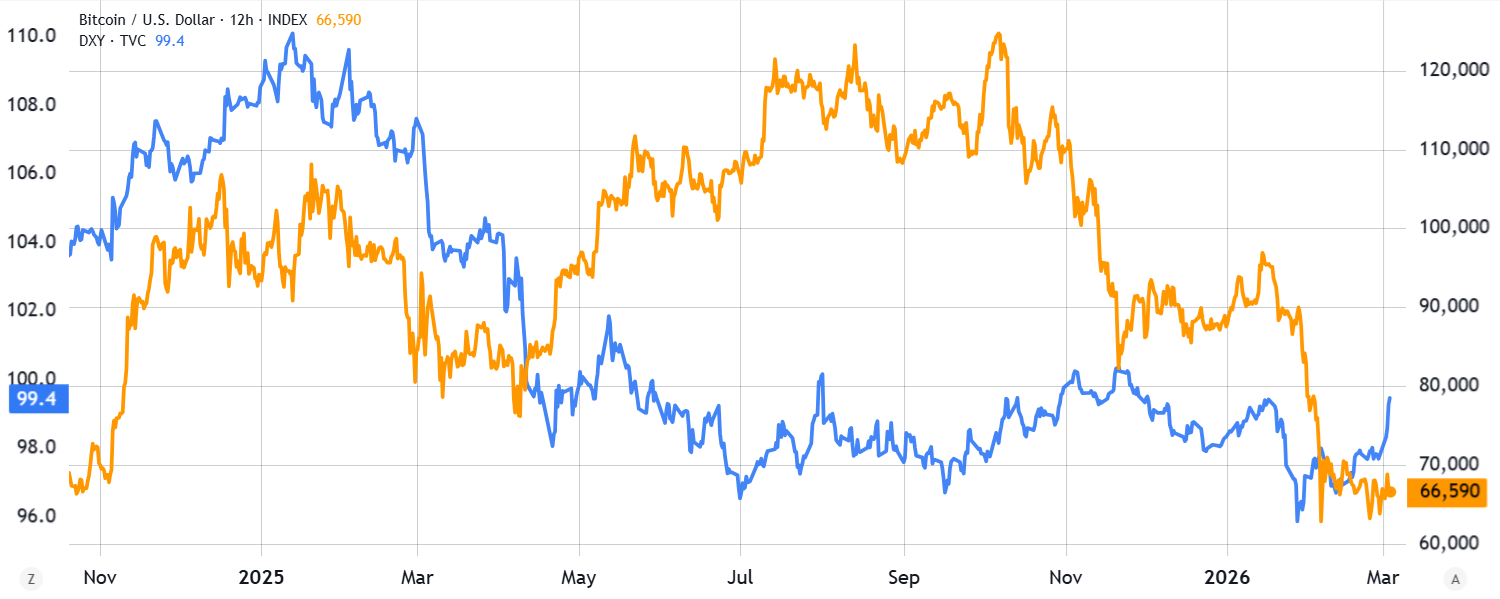
Bitcoin (BTC) successfully defended the $68,000 level on Tuesday despite a 1% decline in the Nasdaq 100 Index and a 3.6% drop in gold prices. Although Bitcoin initially decoupled from traditional markets, traders remain concerned as the US dollar strengthened against other major fiat currencies, even as the United States risks a prolonged war with Iran.

The US dollar index (DXY) reached 99.4 on Tuesday, rising from 96.6 only three weeks earlier. This strength in the US dollar is attributed to investors seeking safety in cash and government bonds, signals typically associated with a risk-off environment. Conversely, periods of DXY weakness usually coincide with positive returns for Bitcoin, such as the bull run observed from March to August 2025.
However, a broader analysis shows the US Dollar Index remains well below the 105–110 range maintained from November 2024 to March 2025. The past 12 months in fact reflect consolidation rather than sustained strength. Bitcoin’s recent decoupling from tech stocks appears more significant, as the correlation had previously surged even with the Nasdaq 100 trading just 6% below its all-time high.

The 30-day rolling correlation between Bitcoin and the Nasdaq 100 dropped to 69% after peaking at 92% one week prior. Bitcoin’s market identity has shifted repeatedly over time, being viewed variously as an independent monetary system, digital gold, an unstoppable onchain database or a speculative vehicle. Therefore, predicting a Bitcoin crash based solely on US dollar strength seems unjustified.
An undeniable lack of bullish momentum persists, likely driven by factors such as the Oct. 10, 2025, flash crash, quantum computing concerns, disappointment with the progress of a US Strategic Bitcoin Reserve and the shift of investor attention toward AI. Traders are also still searching for a specific catalyst for the decline toward $60,000, which heightens prevailing fear and uncertainty.
Bitcoin’s bear market enhances the impact of negative news
A recent US Securities and Exchange Commission (SEC) filing from MARA Holdings (MARA US) led market participants to misinterpret the company’s Bitcoin reserve strategy. Traders expressed concern that MARA might replicate the actions of other prominent listed miners, such as Cango (CANG US), Bitdeer (BTDR UR) and Core Scientific (CORZ US), which recently liquidated their entire Bitcoin holdings.

Robert Samuels, MARA vice president of investor relations, denied those rumors, explaining that the company “may buy or sell from time to time,” which does not mean there is an intention to liquidate the majority of their reserves. Market participants may have acted impulsively before this clarification, largely because Bitcoin has been in a bear market while competitors shifted their core business models toward AI data centers.
Related: Bitcoin price chart ‘death cross’ is back, reviving late-cycle fears
Relative strength in the US Dollar Index should not be viewed as an automatic sell signal for Bitcoin. This is particularly true as the cryptocurrency shows resilience while gold exhibits signs of exhaustion, retesting $5,000 support following a 25% year-to-date rally in 2026. Bitcoin holders still face a difficult path toward regaining full confidence after a 52% contraction from the all-time high, though overall sentiment is beginning to improve.
The $1.5 billion in net inflows into Bitcoin exchange-traded funds since Feb. 24 serves as a clear indicator that institutional demand is accelerating. Nevertheless, traders will likely wait for a definitive breakout above $75,000 before concluding that the bear market has ended. Until that threshold is met, data points like the US Dollar Index will likely continue to exert some negative pressure on Bitcoin, regardless of the currently weak correlation.
This article does not contain investment advice or recommendations. Every investment and trading move involves risk, and readers should conduct their own research when making a decision. While we strive to provide accurate and timely information, Cointelegraph does not guarantee the accuracy, completeness, or reliability of any information in this article. This article may contain forward-looking statements that are subject to risks and uncertainties. Cointelegraph will not be liable for any loss or damage arising from your reliance on this information.
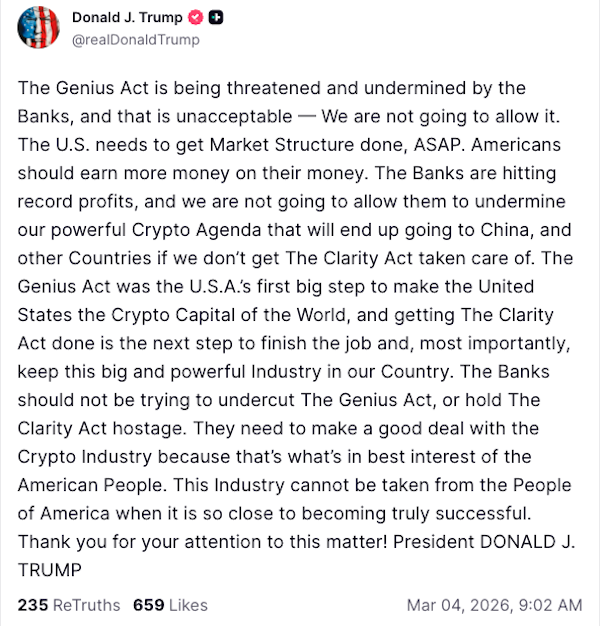
US President Donald Trump has taken a shot at banks for stalling the crypto market structure bill from advancing in the Senate over stablecoin yield payments.
“The Genius Act is being threatened and undermined by the Banks, and that is unacceptable — We are not going to allow it,” Trump posted on his Truth Social platform on Tuesday, mentioning the GENIUS Act that Congress passed in July to regulate stablecoins. He added:
“The U.S. needs to get Market Structure done, ASAP. The Banks are hitting record profits, and we are not going to allow them to undermine our powerful Crypto Agenda that will end up going to China, and other Countries if we don’t get The Clarity Act taken care of.”
Trump has touted the GENIUS Act as his crowning achievement to attract crypto companies to the US. The law gives stablecoin issuers a path to regulation, but bans them from directly offering yield payments to holders.
However, third-party platforms such as crypto exchanges can still offer yield to users who hold stablecoins.
Banking groups have argued that it is a legal loophole and are pushing for the Senate’s crypto market structure bill to include a ban on all stablecoin yield payments. The House passed its version of the bill, called the CLARITY Act, in July.
“The Banks should not be trying to undercut The Genius Act, or hold The Clarity Act hostage. They need to make a good deal with the Crypto Industry because that’s what’s in best interest of the American People,” Trump said.

Crypto executives and lobbyists have resisted the banks’ efforts to include a ban on stablecoin yield payments in the bill, with major lobbyist Coinbase pulling its support for the legislation in January over the issue.
The legislation has since been sd as th,e Senate Banking Committee postponed a markup on the bill after Coinbase withdrew support in January, and as yet to set a date to review the leitking groups have said that stablecoin yield payments would see momove move fank accounts to staintoecoins and risk the stability of the banking system.
Related: What’s at stake for crypto as 3 US states kick off party primaries?
Crypto and banking groups have had three meetings at the White House this year to agree on language that could move the bill forward, but no deal has been reached yet.
Trump is pushing to have the bill passed as a policy win to take to the midterms in November, where crypto lobbying groups have raised more than $200 million to back those supportive of the industry.
Hill says Senate should consider passing House bill
Representative French Hill, a senior Republican and chair of the House Financial Services Committee, said at an event on Tuesday that the Senate should consider passing the House’s version of the crypto bill if it can’t move forward with its own.
Hill said the House’s CLARITY Act had “reasserted the language in [the GENIUS Act] on a bicameral, bipartisan basis, that stablecoins were a payment device on a blockchain and not an investment device, that they would not pay interest, per se.”
“If the Senate can’t come to a straightforward conclusion here, I recommend they use the language that we have in the House-passed Clarity Act with 78 Democratic votes on it, and use that as the solution,” he said.
Magazine: How crypto laws changed in 2025 — and how they’ll change in 2026


Bitcoin has now dropped from the $70,000 level three times since the Feb. 5 crash as Wednesday’s Asian session found the market back at $67,600 after another failed attempt earlier in the week.
BTC was trading at $67,612 as of Asian morning hours on Wednesday, down 0.7% over the past 24 hours but up 3.4% on the week as the post-strike recovery held. Ether slipped 2.2% to $1,957, giving back some of its bounce but still up 2.6% on a seven-day basis. BNB was the quiet outperformer, up 5.2% on the week at $629.
The damage was concentrated further down the board. Dogecoin fell 2.9% in 24 hours and is down 3.9% on the week. Cardano dropped 4.2% on the day and 3.5% over seven days. Solana lost 0.8% to $85.16 and remains the worst-performing major on a weekly basis at -4.2%, still carrying the weight of Saturday’s sell-off. XRP held relatively flat, down 1.3% to $1.35 with a modest 1.5% weekly gain.
The pattern across the board is the same. Most majors recovered from the weekend lows but couldn’t hold Tuesday’s highs, leaving the market in a holding pattern while it waits for clarity on the Iran situation and Monday’s traditional market reaction to settle.
“BTC bouncing back to $70K looks like a classic shock, flush, rebuild move. A lot of the weekend selling was forced, and liquidity was thin, so the rebound can be fast once pressure lifts,” said Wojciech Kaszycki, CSO of BTCS SA, said in an email. “After BTC’s move back above $70K, the real signal isn’t the price spike. It’s whether ETF inflows stay steady this week.”
FxPro chief analyst Alex Kuptsikevich noted that Tuesday’s rejection “forces us to consider a decline to $63K as a working scenario” if the upper boundary continues to hold.
The macro backdrop isn’t helping. Asian equities sold off hard Wednesday, with South Korean stocks posting their biggest two-day decline since 2008 as the Iran conflict continued to rattle investors.
Tech stocks across the MSCI Asia Pacific index fell 4%, dragging Japan, Taiwan, and South Korea lower. The Indian rupee dropped to a record low on the oil price hit. Gold climbed higher, pulling silver with it for the first time this week.
Oil remains the key variable. Brent jumped again Wednesday despite the U.S. announcing plans to escort tankers through the Strait of Hormuz, which has been effectively closed since the weekend strikes.
Meanwhile, U.S president Donald Trump floated an insurance scheme for oil tankers but provided no details. The longer the strait stays disrupted, the more energy prices feed into inflation expectations, which pushes rate cuts further out, which tightens the liquidity environment that drives risk assets.
“We think that Bitcoin is an emerging reserve asset,” said Gracy Chen, CEO at Bitget. “Many people simply cannot fully accept this yet because it is easier to invest into gold, which has existed for many years, than into Bitcoin, which is still young and risky.”
Chen pointed to the broader disappointment in crypto markets following earlier crashes, noting that “the current decline in Bitcoin is largely driven by this disappointment, especially against the backdrop of rising equities, gold, silver, and stock indices reaching new highs.”
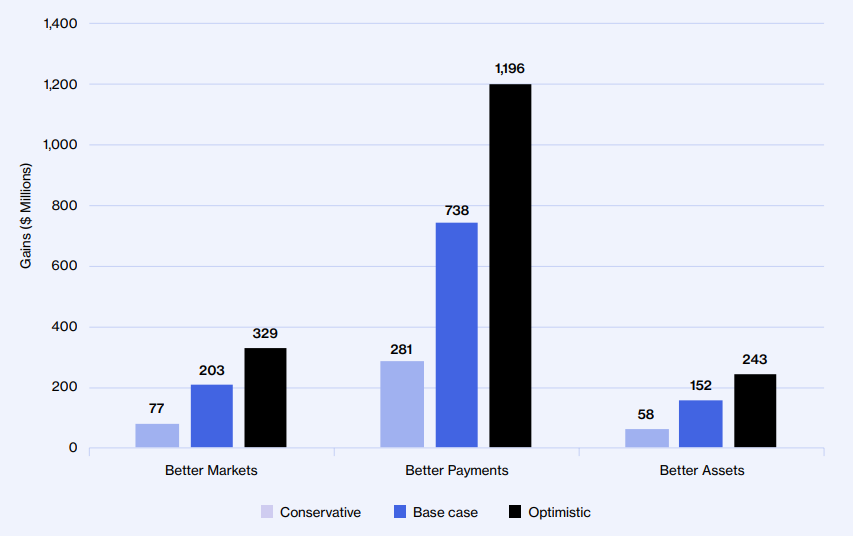
Australia could unlock 24 billion Australian dollars ($17 billion) annually from advances in tokenized markets and digital assets, but only if lawmakers start moving forward with regulation, according to a new report from a local fintech research group.
In a report titled “Unlocking Australia’s $24b Digital Finance Opportunity,” which was published on Monday, the Digital Finance Cooperative Research Centre (DFCRC) said regulatory uncertainty, coordination challenges and limited pathways for pilot projects to grow are the biggest constraints facing the industry.
One way to address the shortcomings would be to establish a sandbox for testing new technology, such as tokenized financial market use cases, said the DFCRC. This would lead to ongoing collaboration between regulators and industry participants and improve licensing frameworks, it said.
The research group also suggested deploying tokenized government bonds and a wholesale central bank digital currency (CBDC) in the sandbox to underpin the development of tokenized markets, collateralized lending, and related financial services.

The DFCRC report was jointly produced with the Digital Economy Council of Australia and was financed by crypto exchange OKX.
Better markets, payments and assets are the key
DFCRC estimates that billions could be generated annually from markets with broader investor access, deeper liquidity and higher market participation, creating additional gains from trade.
At the same time, tokenized money, such as stablecoins and CBDCs, could streamline cross-border and domestic transactions, creating gains by reducing reliance on correspondent banks, which charge high fees.
Tokenization will create assets with increased transparency, usability, and flexibility, which could also increase their utility and make them directly “usable within automated trading, lending, and collateral-management systems,” according to the report.
“Nearly half of the asset-related economic gains arise from enabling collateralized lending, repo, and invoice financing markets on tokenized rails, where smart contracts automate collateral management, margining, and settlement,” the report states.

Without better regulation, the $17 billion is off the table
Kate Cooper, the CEO of crypto exchange OKX, said that without better regulation, the estimated economic gains will be much smaller over the next few years.
Related: Australian crypto execs upbeat on progress despite lingering issues
On the current trajectory, and without substantial industry-wide changes, DFCRC estimates that Australia will secure only 1 billion Australian dollars ($710 million) in economic gains from crypto by 2030.
“Long-term economic benefits will only be realised through clear regulatory frameworks and infrastructure built to institutional standards. That is how Australia strengthens trust, attracts capital and secures its place in the next era of global finance,” Cooper added.
Magazine: 6 massive challenges Bitcoin faces on the road to quantum security

Extremely common spring plant is highly toxic to dogs and cats warns vet as spring arrives in UK

First Plane Carrying Stranded Aussies Is on Its Way to Australia From the Middle East

AI models prefer Bitcoin over fiat as top store of value, research shows


-

 Politics5 days ago
ITV enters Gaza with IDF amid ongoing genocide
-

 Politics22 hours ago
Alan Cumming Brands Baftas Ceremony A ‘Triggering S**tshow’
-

 Fashion4 days ago
Weekend Open Thread: Iris Top
-

 Tech3 days ago
Unihertz’s Titan 2 Elite Arrives Just as Physical Keyboards Refuse to Fade Away
-

 NewsBeat6 days ago
Cuba says its forces have killed four on US-registered speedboat | World News
-
Sports4 days ago
The Vikings Need a Duck
-
 NewsBeat4 days ago
Dubai flights cancelled as Brit told airspace closed ’10 minutes after boarding’
-

 NewsBeat3 days ago
‘Significant’ damage to boarded-up Horden house after fire
-
 NewsBeat6 days ago
Manchester Central Mosque issues statement as it imposes new measures ‘with immediate effect’ after armed men enter
-
 NewsBeat4 days ago
The empty pub on busy Cambridge road that has been boarded up for years
-

 NewsBeat3 days ago
Abusive parents will now be treated like sex offenders and placed on a ‘child cruelty register’ | News UK
-

 Business6 days ago
Discord Pushes Implementation of Global Age Checks to Second Half of 2026
-

 Entertainment2 days ago
Baby Gear Guide: Strollers, Car Seats
-

 Business5 days ago
Only 4% of women globally reside in countries that offer almost complete legal equality
-
 Tech5 days ago
NASA Reveals Identity of Astronaut Who Suffered Medical Incident Aboard ISS
-
Politics3 days ago
FIFA hypocrisy after Israel murder over 400 Palestinian footballers
-
 NewsBeat3 days ago
Emirates confirms when flights will resume amid Dubai airport chaos
-

 Crypto World5 days ago
From Crypto Treasury to RWA: ETHZilla Retreats and Relaunches as Forum Markets on Nasdaq
-

 NewsBeat2 days ago
Is it acceptable to comment on the appearance of strangers in public? Readers discuss
-

 Tech3 days ago
Viral ad shows aged Musk, Altman, and Bezos using jobless humans to power AI