
Crypto World
Gas Futures & Blockspace Hedging


Locking in Tomorrow’s Transaction Costs Today. In decentralized finance, everyone obsesses over yield, leverage, and tokenomics. But there’s a quieter, far more structural variable that shapes everything: blockspace.
On networks like Ethereum, blockspace is the scarce resource. Every transaction competes for inclusion in a block, and users pay gas fees to win that competition. When demand surges—NFT mints, memecoin frenzies, liquidation cascades—fees can explode in minutes.
Now imagine if you could hedge that risk.
Welcome to the idea of Gas Futures & Blockspace Hedging: markets where users lock in future transaction costs—like airline tickets, but for blockchain execution.
Why Gas Is a Financial Risk
Gas fees are not just a UX annoyance. They’re a real economic variable.
High gas costs:
-
Wipe out DeFi yield strategies
-
Make liquidations unprofitable
-
Block DAO governance participation
-
Kill arbitrage spreads
-
Force traders to delay execution
For funds, market makers, NFT projects, and on-chain businesses, gas volatility is operational risk.
And what do markets do with risk?
They price it.
The Core Idea: Gas as a Tradable Commodity
Blockspace is finite per block. That makes it:
-
Scarce
-
Auctioned
-
Variable in price
In other words, perfect for derivatives.
A gas futures market would allow users to:
-
Lock in a maximum gas price for a future time window
-
Buy guaranteed transaction inclusion rights
-
Hedge against expected congestion
Instead of reacting to network chaos, you pre-purchase execution capacity.
How Gas Futures Could Work
Here are a few possible models:
1. Fixed-Price Forward Contracts
A user agrees today to pay a fixed gas price next month.
If market gas spikes above that level, they win.
If it stays low, the seller profits.
Think: Over-the-counter blockspace forwards.
2. Blockspace Options
Buy the right—but not obligation—to transact at a specific gas ceiling.
If network demand surges, you exercise.
If not, you let it expire.
This mirrors commodity options markets.
3. Block Inclusion Tokens
Validators could tokenize future block capacity
For example:
-
“Slot #X in Epoch Y” becomes tradable
-
Users buy inclusion guarantees in advance
-
Validators receive upfront capital
This transforms execution priority into a financial instrument.
Who Would Actually Use This?
This isn’t for casual users sending $20.
The real demand would come from:
🏦 On-Chain Funds
Need predictable execution costs for rebalancing or liquidation defense.
🖼 NFT Projects
Launching during peak hype? Pre-locking gas ensures mint success.
⚖️ MEV Searchers
Guaranteed inclusion = edge preservation.
🏛 DAOs
Governance proposals executed without being priced out.
Why This Doesn’t Exist (Yet)
Several structural challenges:
1. Validator Coordination
On networks using Proof-of-Stake like Ethereum, block proposers rotate frequently. Futures would require coordination across validators or protocol-level changes.
2. Demand Uncertainty
Gas prices are reflexive. If everyone hedges, pricing models must adjust dynamically.
3. MEV Interaction
Blockspace is not just space—it contains MEV opportunities. Pricing execution without pricing MEV is incomplete.
The Bigger Picture: Financializing Infrastructure
We’ve already seen:
Gas futures are the next logical layer: derivatives on execution itself.
This turns blockchain infrastructure into a financial market of its own.
Instead of:
“I hope gas isn’t high tomorrow.”
It becomes:
“I’ve hedged my execution risk.”
That’s a fundamental shift.
What This Unlocks
If gas futures become liquid and reliable:
-
DeFi strategies become more stable
-
DAO governance becomes more predictable
-
Launches become more structured
-
On-chain businesses can forecast operational costs
It transforms blockchain from a chaotic fee auction into a hedgeable production environment.
Final Thought
Most people treat gas like weather—unpredictable and annoying.
But blockspace isn’t weather.
It’s a commodity.
And once a commodity becomes hedgeable, it becomes programmable.
Gas futures wouldn’t just smooth transaction costs—they’d complete the financial stack of decentralized networks.
The real alpha isn’t in the token.
It’s in owning tomorrow’s blockspace.
REQUEST AN ARTICLE


TLDR:
- A $292M rsETH exploit enabled massive borrowing on Aave, leaving the protocol with unbacked collateral exposure.
- Aave’s ETH pool reached full utilization, restricting withdrawals as panic-driven outflows exceeded $5.4 billion.
- Technical indicators show AAVE weakening after rejection near $120, with momentum still favoring downside pressure.
- Critical support near $90 remains under watch as markets assess stability following one of 2026’s largest DeFi events.
Aave’s lending markets faced acute stress after a large exploit tied to Kelp DAO triggered a liquidity crunch. The incident drained hundreds of millions in assets and pushed Aave’s ETH pool to full utilization, limiting withdrawals across the protocol.
Liquidity Crunch Follows Kelp DAO Exploit
A sudden exploit involving Kelp DAO’s rsETH token triggered widespread concern across decentralized finance markets.
The attacker reportedly drained 116,500 rsETH, valued at about $292 million, from a LayerZero bridge. The stolen assets were then deployed in a strategy that strained Aave’s liquidity.
According to Coin Bureau, the attacker deposited the compromised rsETH as collateral on Aave V3. This move allowed the borrowing of nearly $236 million in wrapped ETH.
However, the rsETH backing those positions is now considered invalid, leaving the loans without proper collateral support.
As a result, Aave is facing an estimated $280 million in unrecoverable debt. The protocol’s ETH pool reached 100% utilization, meaning nearly all available liquidity has been borrowed. Users attempting to withdraw ETH encountered delays or were unable to exit positions.
Market reaction was swift, with large-scale withdrawals reported across the platform. Data suggests over $5.4 billion in ETH outflows occurred خلال the panic phase. High-profile withdrawals added to the pressure, including a reported 65,584 ETH withdrawal by Justin Sun.
This situation marks a major stress event for Aave’s risk management systems. It also serves as a real-time test for its Umbrella safety module, which is designed to handle extreme conditions. The unfolding events continue to draw attention across the crypto sector.
AAVE Price Faces Pressure After Failed Rally
Market data shows that AAVE experienced a sharp rejection after attempting a breakout toward the $115–$120 range. The price has since retreated to around $93.90 on the 4-hour chart. Despite a modest recovery within the session, broader momentum remains weak.
Earlier price action reflected a steady decline from the $120 region toward $90 levels. This phase was followed by a period of sideways consolidation between $92 and $102. The recent rally attempt failed to hold, leading to renewed selling pressure.
Technical indicators show a bearish short-term structure. The Relative Strength Index is currently at 34.55, approaching oversold territory but not fully there. Its position below the moving average suggests continued downward momentum.
At the same time, the MACD indicator remains in negative territory. The widening histogram signals sustained selling activity, with no clear crossover indicating a reversal yet. This aligns with the broader price rejection seen on the chart.
Key support is now concentrated around the $90 level, with $89.50 acting as a critical breakdown point. If this zone fails, the next downside targets could fall between $85 and $80. On the upside, resistance remains firm near $100 and higher around $110.
Traders are closely monitoring whether the price can stabilize above the current support levels. A rebound would require improving momentum signals and renewed buying activity. Until then, the market structure continues to reflect caution following the recent exploit.

TLDR:
- PEPE remains within a strong weekly demand zone, signaling possible accumulation despite an 88% correction from highs.
- A breakout above $0.000006 resistance could confirm trend reversal and open room for major upside targets.
- Historical fractal patterns suggest potential for explosive rallies if the current support structure holds steady.
- Failure to hold above $0.0000017 may invalidate the bullish setup and extend consolidation further.
PEPE traded near a major support zone after a steep correction, with price stabilizing around $0.00000376. The weekly structure showed a potential re-accumulation phase forming, as traders monitored whether the current demand area could sustain a recovery.
Weekly Accumulation Zone Draws Market Attention
The latest chart showed PEPE sitting within a high-confluence support region formed by a fair value gap, order block, and horizontal demand. This area ranged between $0.0000030 and $0.0000018, where price activity remained steady.
A tweet from Crypto Patel described this setup as a rare fractal structure, noting similarities with a previous accumulation phase. The post referenced a past 4,515% move that followed a similar pattern during the earlier cycle.
Price data confirmed that the current level aligned with historical consolidation zones before large upward expansions. The chart also showed price maintaining position above the lower boundary, which remained critical for structural stability.
At the same time, the analysis noted that invalidation would occur below $0.0000017. Holding above this level kept the accumulation structure intact, while a breakdown could shift the market into a deeper consolidation phase.
Resistance Levels and Price Structure Define Next Move
The chart marked a key resistance zone near $0.000006 to $0.000007123, where previous support turned into resistance. Price attempts to reclaim this level, which had failed during earlier retests following the breakdown.
Trendline analysis showed that two ascending supports were broken before the decline accelerated. Each breakdown was followed by rejection, forming a consistent pattern of lower highs across the weekly timeframe.
The chart also presented projected upside targets if the price breaks and holds above resistance. These targets ranged between $0.000028 and $0.0001, based on earlier expansion patterns.
At the same time, historical data showed projected moves of 3,079% and 5,592% during bullish cycles. These projections aligned with prior market behavior observed during strong upward phases.
Current price action remained below resistance, keeping the structure within a defined range. Short-term movement showed minor upward attempts, although no confirmed breakout had formed.
The chart also showed an 88.99% correction into the current zone, reflecting deep pullbacks seen in previous cycles. This retracement brought the price back into a demand area where accumulation had occurred before.
Traders continued to watch whether the price could reclaim the resistance level and confirm a shift in structure. Until then, the market remained within a consolidation phase defined by support holding and resistance capping upward movement.


Three wallets, one denial, and $5.7 billion in market cap gone in 48 hours.
RaveDAO’s RAVE crashed 90% over 24 hours as crypto exchanges Binance and Bitget opened investigations into the trading activity that catapulted the token to a $6 billion market cap last week.
Bitget CEO Gracy Chen confirmed the probe on X, and Binance co-CEO Richard Teng subsequently said the exchange was reviewing the matter and would “always” do its part to examine signs of market misconduct. Gate.io was also named in the original allegations from onchain investigator ZachXBT, who has offered a $25,000 bounty for whistleblowers with evidence of the parties involved.
The collapse accelerated after the project’s Saturday denial rather than stabilizing on it.
RaveDAO posted a six-part X thread stating the team “is not engaged in, nor responsible for, recent price action.”
The thread did not address any of the specific onchain allegations that prompted the scrutiny, including the concentration of roughly 90% of the 1 billion RAVE supply across three Gnosis Safe multi-signature wallets attributed to the team, or the millions of tokens transferred to exchanges shortly before the rally began.
The original rally took RAVE from about $0.25 to $27.33 in nine days, a 10,800% move that triggered $44 million in liquidations on Friday, just behind bitcoin and ether, with the bulk of them from short sellers positioned against the token.
Investigators flagged a “bait and liquidate” pattern in which visible token transfers to exchanges suggested incoming sell pressure, drawing traders into short positions before those tokens were withdrawn and prices ripped higher, forcing shorts to cover at progressively worse levels.
RaveDAO presents itself as a Web3 entertainment platform offering onchain ticketing for electronic music events, tracing its origins to a 2023 Istanbul afterparty. The project reported about $3 million in 2025 revenue and lists partnerships with Binance, OKX, Bitget, and Polygon.
RaveDAO’s thread did confirm the team plans to “liquidate portions of unlocked tokens” when appropriate to fund operations and marketing, and said it was “exploring appropriate models, including price-triggered or performance-triggered locks, that tie team incentives to ecosystem growth.”
It did not commit to any specific lockup mechanism or timeline, however.
Crypto World
Grayscale Files Spot TAO ETF as Bittensor Network Rebounds from Covenant AI Exit and 38% Drawdown
TLDR:
- Grayscale raised TAO weighting to 43.06% in its AI fund, its largest single-asset reallocation ever made.
- Community miners restored SN3, SN39, and SN81 from open-source code with no central operator involvement needed.
- Bitwise and Grayscale both filed TAO ETF applications on April 2, with an SEC decision tracked for August 2026.
- Teutonic targets a 1-trillion-parameter training run in May, timed with the ETF’s peak SEC review window.
Bittensor proved antifragile after a 38% drawdown triggered by Covenant AI’s sudden exit from three major subnets. Community miners restored SN3, SN39, and SN81 entirely from open-source code, with no central operator involved.
Around 70% of supply remained staked throughout the disruption. Spot outflows exceeded $70 million on multiple consecutive days after the crash.
Grayscale’s spot TAO ETF filing and a series of protocol upgrades are now drawing renewed attention to $TAO’s recovery case.
Grayscale’s ETF Filing and Institutional Moves Signal Confidence in Bittensor
Grayscale raised its TAO weighting to 43.06% inside its AI fund on April 7. That move marked the largest single-asset reallocation the fund has ever executed.
It came three days before the Covenant crash became public. The timing led observers to conclude that Grayscale had been running independent structural analysis on the network.
On April 2, Grayscale filed an S-1 Amendment for a spot TAO ETF on NYSE Arca. Bitwise filed a parallel TAO strategy ETF on the same day.
The SEC decision window is currently tracked for August 2026. However, market analysts note the repricing may not wait for formal approval.
Crypto analyst @Karamata2_2 pointed to Bitcoin and Ethereum as precedents for pre-approval price movement. Both assets moved significantly during their respective SEC review windows.
That pattern places the current filing period as a meaningful near-term catalyst. The $218–$240 demand zone remains the key structural level for $TAO to hold.
Supporting the institutional picture, GeneralTensor closed a $5 million funding round in March. The round was anchored by a Goldman-backed fund, with DCG also participating.
The TAO Institute launched on April 15 with a dedicated subnet risk index. Together, these moves reflect sustained institutional engagement despite the recent network turbulence.
Protocol Upgrades and Active Subnets Reinforce Bittensor’s Antifragile Case
BIT-0011, the Conviction Mechanism, is a core protocol upgrade shaping Bittensor’s next phase. Subnet founders and stakers lock alpha tokens to earn conviction scores across 30-day intervals.
The staker holding the highest score gains ownership of the subnet. Tokens locked during the active period cannot exit until the interval concludes.
The community restart of SN3, SN39, and SN81 without founder intervention served as a real stress test. Chain emissions and ownership routing continued without interruption throughout that period.
Karamata2_2 described the outcome as the best live demonstration of antifragility the network could have produced. BIT-0011 formalizes that model at the protocol level going forward.
Teutonic, formerly Templar, is targeting a 1-trillion-parameter decentralized training run for mid-to-late May. Should that milestone land during the ETF application’s most visible SEC review window, attention may return sharply.
The narrative shifts from a network that survived its biggest blowup to one that is still actively scaling. That framing matters most precisely because Covenant’s exit raised doubts about the technology’s depth.
Active subnets continue producing measurable output across the ecosystem. Chutes AI accounts for 14.39% of daily emissions and processes over 50 billion tokens per day, with a revenue-funded buyback already live.
TargonCompute co-authored an Intel TDX whitepaper and projects $10.4 million in ARR. With 128 active subnets expanding toward 256 and a subnet alpha market cap near $1.03 billion, Bittensor’s operational picture remains intact.
Crypto World
President Trump accuses Iran of ceasefire breach as Bitcoin reacts to market uncertainty


U.S. President Donald Trump has accused Iran of breaching a ceasefire agreement.
Summary
- Trump accused Iran of ceasefire violation following reports of activity in Strait of Hormuz.
- Iran denied allegations and claimed United States actions breached agreement under international law frameworks.
- Bitcoin price showed volatility, dropping from recent highs amid rising geopolitical uncertainty and market caution.
The claim follows reports that Iran opened fire in the Strait of Hormuz during the truce period.
Trump described the situation as a “serious violation” and warned that further action could follow if negotiations fail. He stated ”it will happen, one way or another” while referring to ongoing efforts to reach a resolution.
Despite the tension, Trump indicated that discussions are still active. He expressed confidence that a deal could be reached before the ceasefire deadline set for April 22.
Iranian officials responded by rejecting the accusations and placing blame on the United States. A spokesperson from Iran’s Ministry of Foreign Affairs stated that U.S. actions had breached the terms of the ceasefire.
The spokesperson said ”the blockade of ports is unlawful and violates international law” in a statement shared publicly. The response also referenced international legal frameworks, including provisions under the United Nations Charter.
Iran’s statement described the situation as escalating tensions rather than a one-sided breach. Both sides have continued to exchange claims, adding to uncertainty around the ceasefire status.
Bitcoin Price Reacts to Geopolitical Developments
Bitcoin has shown price movement in response to the developments. The asset declined from around $76,300 to near $75,500 as reports of renewed tension emerged.
Market data indicates that Bitcoin had earlier risen above $78,000 after initial reports suggested progress in negotiations. The reversal followed conflicting updates from both sides regarding the ceasefire.
Crypto markets often react to geopolitical events, with price swings linked to investor sentiment and risk perception during uncertain periods.
Moreover, the broader crypto market has also experienced volatility during the same period. Traders have adjusted positions as new information continues to emerge from diplomatic discussions.
Bitcoin remains sensitive to external developments, especially those linked to global stability and economic outlook. Market participants are monitoring updates related to the ceasefire and any potential policy response.
Price fluctuations have remained within a narrow range over the past sessions, reflecting cautious trading behavior. The situation continues to evolve as negotiations between the United States and Iran remain ongoing.
Disclosure: This article does not represent investment advice. The content and materials featured on this page are for educational purposes only.
Crypto World
France faces the brunt of an increasing violent crime wave against the crypto community


France is facing a rise in crypto-related kidnappings as so-called “wrench attacks” become more frequent, brazen and violent.
That shift was visible this week amid the staging of an annual international blockchain and crypto conference. A police motorcade escorted VIP guests to a dinner at the Palace of Versailles. And security was also notably reinforced at the Carrousel du Louver, where the conference was taking place.
Wrench attacks in France have put the country so notably under the international spotlight that government officials took the stage at the conference in Paris to acknowledge their alarm at the scale of the problem. They said that this year alone, the country has suffered at least 41 crypto-related kidnappings and home invasions. That’s one every two to three days.
Jean-Didier Berger, Minister Delegate to the Interior Ministry, said a new set of measures is being prepared with Interior Minister Laurent Nuñez to tackle the growing issue. A prevention platform has already drawn thousands of registrations, but authorities say further steps are needed as incidents continue to rise.
Wrench attack epicenter
The country has become the epicenter of a global rise in wrench attacks. Across multiple jurisdictions, attacks on crypto holders are becoming more frequent and more violent, according to security researchers and law enforcement data.
Globally, the trend is also on the rise. In 2025, there were 72 verified physical coercion incidents globally, a 75% increase from the previous year, according to Certik and crypto researcher Jameson Lopp’s data, which tracks 188 attacks since 2014. Many more go unreported, he said. Cases involving physical assault rose even faster, up 250% year-over-year.
The term “wrench attack” refers to the use of physical force to extract access to digital assets. For some attackers, it is easier to coerce a person than to break encryption.
“Every time a wrench attack is successful, it tells the world that crypto owners are juicy targets,” Lopp told CoinDesk.
Unlike traditional bank transfers, crypto transactions cannot be reversed. Once a victim authorizes a transfer under duress, the funds can be moved quickly across wallets and chains.
Attackers seek points of weakness
Researchers say the way attackers identify victims has also changed.
“We’re seeing a shift from ‘find a wallet’ to ‘hunt a person,’” Phil Ariss of TRM Labs told CoinDesk. Rather than scanning for technical vulnerabilities, attackers build profiles, he added. They look at social media activity, public appearances and leaked datasets. They track routines and identify points of weakness.
“The biggest avoidable mistake is tying real-world identity, location and routine too tightly to visible crypto wealth,” Ariss said.
The problem is exacerbated when attackers get a helping hand from government officials. In one widely known case, in which a French tax official sold wrench attackers sensitive data. The case raised concerns among security experts that insider leaks and compromised state data were feeding directly into wrench attacks.
The pool of potential victims has widened, with mid-level holders increasingly being targeted, sometimes based on limited or indirect signals.
Anybody is a potential victim
Cases now include families, with children targeted alongside crypto-holding parents, making the attacks harder to categorize by severity.
In January 2025, Ledger co-founder David Balland was kidnapped in France along with his partner. During the attack, one of his fingers was severed and sent to associates as part of a ransom demand. He was rescued after a police operation.
Other cases have involved prolonged captivity and torture, such as one in New York, where a crypto investor was held for more than two weeks. In Canada, a home invasion escalated into waterboarding and sexual violence as attackers attempted to force access to funds.
Lopp said both opportunistic and organized groups are involved, but there are signs of increasing coordination. “We do seem to be seeing more organized groups now,” he said.
TRM Labs’s Ariss says his team has observed similar patterns, noting some groups operate with defined roles and pre-planning, including surveillance and follow-home tactics.
“These look less like one-off robberies and more like small kidnap or robbery crews specializing in crypto jobs,” Ariss said.
After funds are obtained, attackers tend to move quickly and frequently the crypto assets they attain are converted into stablecoins and routed across multiple chains, making recovery more difficult.
France’s role in this trend may reflect a mix of factors, Lopp said, including cases involving leaked personal data and cross-border criminal networks.
Rising prices, heftier loot
More broadly, rising asset prices have increased the potential payoff from a single attack, while improvements in digital security have reduced the effectiveness of purely technical exploits.
“It’s far easier than trying to rob a bank,” Lopp said.
Another issue is visibility: wrench attacks might be significantly underreported because many are reported as standard robberies or home invasions, with no mention of crypto.
“A large share of incidents are still recorded as simple robberies,” Ariss said, adding that the crypto element is often left out at the time of reporting, which can make it harder for authorities to connect cases or identify broader patterns.
The increase in attacks has raised questions about the risks of self-custody, a core principle of cryptocurrency.
Some security experts point to measures such as multi-signature setups, withdrawal delays and spending limits as ways to reduce risk by limiting how much can be accessed under duress.
“If coercion cannot produce immediate access to the majority of funds, the risk and return changes,” Ariss said. Such measures do not eliminate the threat but may reduce the incentive for attackers.
As crypto adoption grows, attacks are becoming more frequent and severe, turning what was once a niche concern into a broader security risk.
TLDR:
- Bitcoin trades near $75K as ETF inflows exceed $1B weekly, reversing a four-month outflow trend
- Stable US jobs data and easing geopolitics support risk assets across crypto and equity markets
- Solana and Ethereum upgrades improve efficiency, supporting network growth and user activity
- Institutional moves and rising stablecoin supply strengthen liquidity across crypto markets
Global markets are moving in a steady range as equities reach new highs while Bitcoin trades near $75,000. At the same time, ETF inflows, policy signals, and network upgrades are shaping current crypto market conditions.
Liquidity Conditions and Capital Flows Drive Market Stability
Market activity reflects a shift toward risk assets as liquidity conditions improve across global markets. Stocks are recording fresh highs, while Bitcoin continues consolidating within a narrow price range near $75,000.
A recent post by Nick Research outlined the current drivers influencing both crypto and traditional markets. The tweet noted strong ETF inflows exceeding $1 billion weekly, ending a four-month outflow streak. It also pointed to easing geopolitical tensions and steady earnings supporting a risk-on environment.
These ETF inflows indicate renewed institutional participation in digital assets. Capital movement into Bitcoin products shows improving sentiment among large investors after a prolonged period of reduced exposure.
At the same time, macroeconomic data in the United States remains stable. Job growth has shown recovery, while unemployment levels remain relatively low. This stability continues to support investor confidence across markets.
Geopolitical developments are also playing a role in shaping sentiment. Reports of easing tensions linked to a possible Iran ceasefire are contributing to a more favorable risk environment.
Monetary policy expectations are shifting gradually. The Federal Reserve is expected to ease at a slower pace, with rates projected near 3% by year-end. Quantitative tightening has paused, easing pressure on liquidity conditions.
Bitcoin is also showing increased correlation with traditional markets. The asset is now moving closely with the S&P 500 and gold, reflecting broader macro alignment.
Institutional Activity and Blockchain Upgrades Support Momentum
Beyond macro factors, institutional actions and blockchain upgrades are shaping current market conditions. Regulatory developments remain active, with the CLARITY Act expected to move into Senate markup in the coming weeks.
Institutional involvement continues to expand within the crypto sector. Deutsche Börse has committed $200 million to Kraken, signaling continued engagement from established financial firms.
In addition, Goldman Sachs has filed for a Bitcoin ETF, adding to the list of institutional products targeting digital asset exposure. These filings show continued integration between traditional finance and crypto markets.
Network upgrades are also contributing to improved efficiency across blockchain ecosystems. The Solana SIMD-266 upgrade is expected to reduce data costs by up to 98%, improving network performance.
Ethereum is preparing for upcoming upgrades, including Pectra and Glamsterdam. These updates are designed to enhance scalability and maintain network competitiveness.
Supply conditions remain another factor shaping the market. The post-halving environment continues to limit Bitcoin supply, while stablecoin supply is expanding toward the $1 trillion level.
This growth in stablecoin supply reflects increasing liquidity within the digital asset ecosystem. It also supports trading activity and broader market participation.
Together, macro stability, institutional flows, and network upgrades are shaping current market direction. These elements are driving activity across both crypto and traditional financial markets.
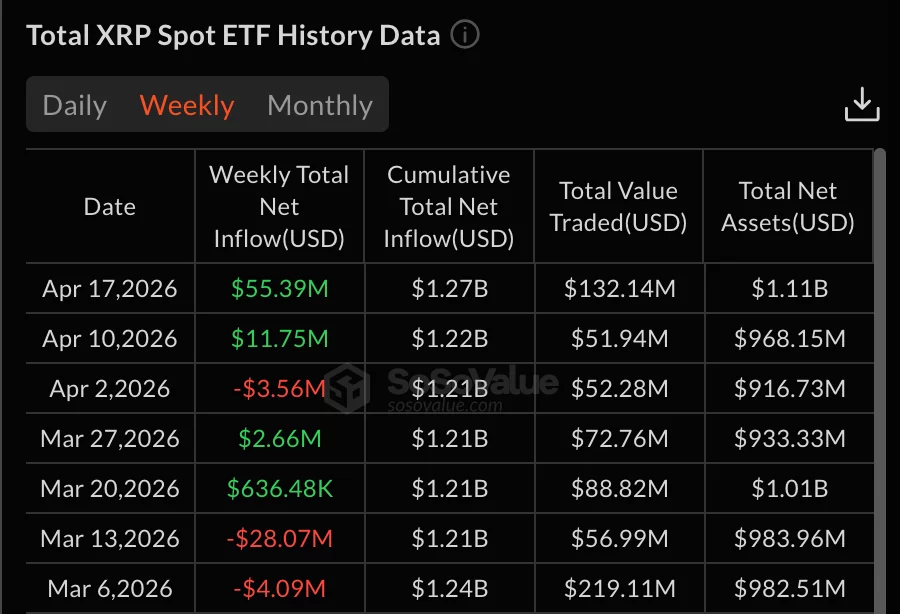
XRP exchange-traded products have recorded their strongest weekly inflows of the year.
Summary
- XRP ETFs recorded $55.39 million in weekly inflows, the highest level seen in 2026.
- Institutional investors increased exposure after XRP price rose more than 7 percent last week.
- Analysts note XRP remains within long-term bullish structure despite short-term market volatility signals.
The increase comes after renewed interest from both retail and institutional investors across the broader crypto market.
Data from SoSoValue showed that XRP ETFs attracted $55.39 million in net inflows over the past week. This marks the first time in 2026 that inflows have reached this level after several weeks of weaker performance.
The ETF products did not record any daily outflows during the week, indicating steady demand across all trading sessions.
Institutional investors increased exposure to XRP-linked investment products following a recent rise in price activity. XRP recorded a price gain of more than 7 percent over the same period.
Market data showed consistent inflows throughout the week, with the lowest daily intake at $1.46 million on April 13. Other trading days recorded higher levels of capital movement into XRP ETFs.
The broader crypto market also showed improved sentiment during the same period, which supported demand for digital asset investment products.
Market position and price performance
At press time, XRP traded near $1.43 with a market capitalization of approximately $88 billion. The asset recorded a slight daily decline but maintained a positive weekly performance.
Trading volume remained above $2 billion in the last 24 hours, reflecting continued market participation. XRP also appears positioned to end a multi-month period of negative returns, after six consecutive months of losses that began in late 2025.
The market movement follows volatility linked to earlier macroeconomic conditions, including a sharp correction in October 2025.
Meanwhile, market commentary from analyst EGRAG CRYPTO has focused on long-term chart patterns. The analyst stated “”the Bifrost Bridge is still our guide”” when describing XRP’s current structure.
The analysis suggests XRP remains inside a broader channel despite short-term pattern breakdowns. The commentary also noted that descending triangle formations may not fully reflect the wider trend.
The analyst added “”this is not a breakdown, this is a setup”” when referring to projected price levels between $9 and $13. The view is based on long-term accumulation phases and market structure interpretation.
Disclosure: This article does not represent investment advice. The content and materials featured on this page are for educational purposes only.
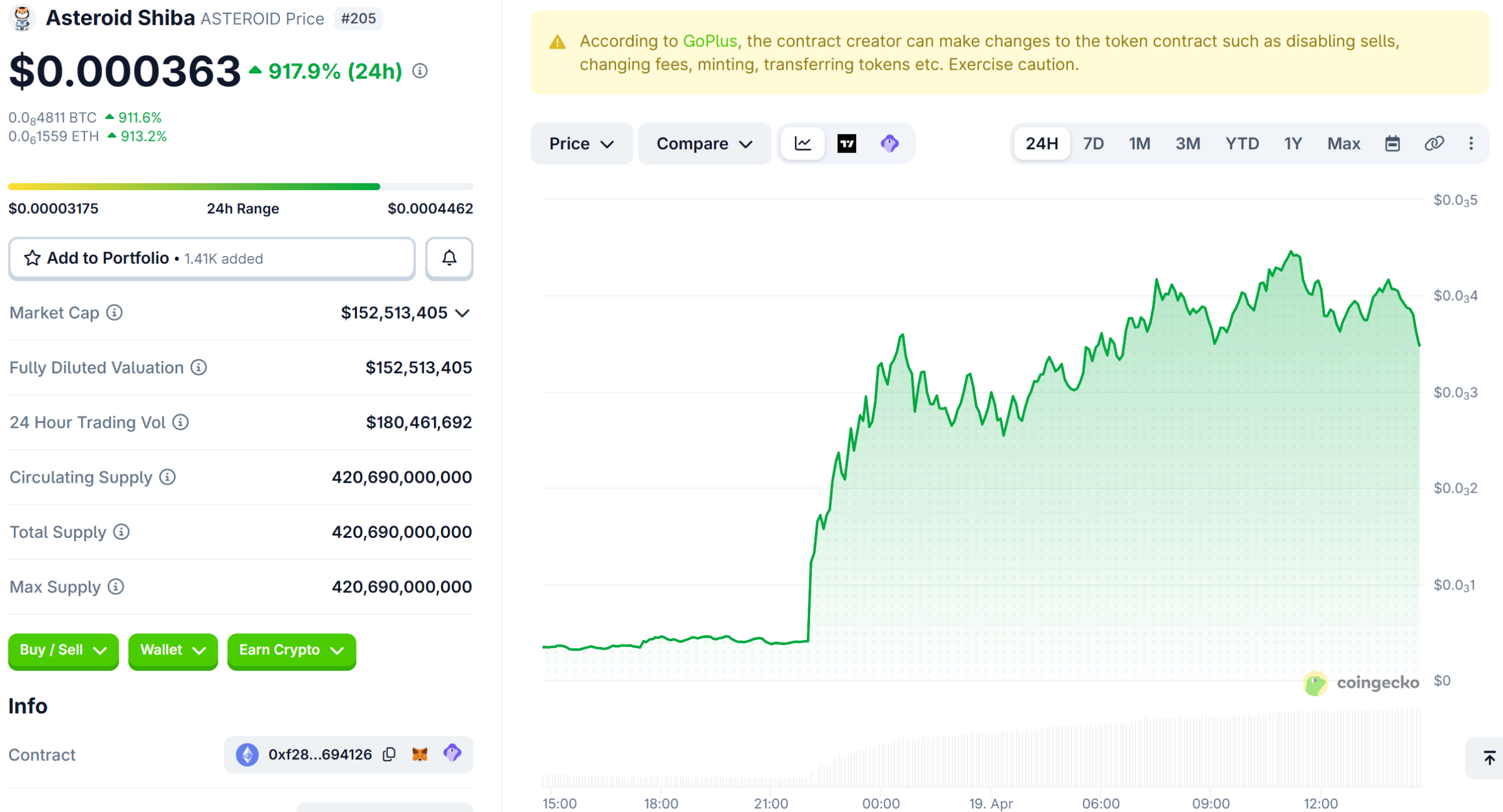
A trader sold 7.43 billion Asteroid Shiba (ASTEROID) tokens for $405 just one day before the meme coin rallied over 920%, turning that same position into a $2.6 million windfall.
On-chain data from Lookonchain revealed that wallet 0x5811 had bought the tokens 80 days earlier for $542. The sale locked in a $137 loss, erasing what would have been a life-changing gain.
What Triggered the Asteroid Shiba Rally
The rally began after Elon Musk replied to eight questions left behind by Liv Perrotto, a 15-year-old who died in January after a five-year battle with cancer.
Perrotto had designed a plush Shiba Inu named Asteroid as the zero-gravity indicator for SpaceX’s Polaris Dawn mission in September 2024.
For her final question, she asked Musk to make Asteroid the official SpaceX mascot. He agreed.
The Asteroid Shiba price is up by almost 920%, and nearly 68,000% in the last week.
Her mother, Rebecca Perrotto, responded on X, thanking him for keeping her daughter’s memory alive.
“You didn’t just honor a young girl’s dream, you are keeping her spirit alive. Liv’s love, her laughter, her unbreakable fight lives on through Asteroid,” she wrote.
Winners, Losers, and Risk
While wallet 0x5811 missed millions, another trader turned roughly $1,800 in ETH into nearly $500,000 within hours of Musk’s post.
However, Musk’s ability to move meme coins has shown signs of fading. Previous Musk-linked rallies in tokens like GORK and KEKIUS were short-lived.
Musk himself has previously compared meme coins to gambling. ASTEROID has no product, roadmap, or team behind it. The token carries significant risk for anyone buying after the initial move.
“If you expect to win at meme coins, you’re being foolish. You’re not going to win with meme coins. Don’t sink your life savings into a meme coin,” he said in an interview with The Joe Rogan Experience podcast.
The post Asteroid Shiba Gains 920% After Musk Names SpaceX Mascot, But One Trader Misses Big appeared first on BeInCrypto.
Crypto World
Arbitrum (ARB) Breaks Descending Trendline After 96% Crash: Analyst Eyes 7400% Return to $5+
TLDR:
- ARB has dropped 96.36% from its all-time high, now trading at $0.12 after a prolonged descending channel.
- A liquidity sweep below dynamic support confirmed capitulation, triggering a 57% rally from the $0.07–$0.095 demand zone.
- Bullish structure remains valid only if ARB reclaims and holds above $0.27; a breach of $0.065 invalidates the setup.
- Analyst bull cycle targets for ARB range from $0.27 to $5+, representing a potential upside of over 7400% from lows.
Arbitrum (ARB) has broken out of a multi-year descending trendline following a 96% drawdown from its all-time high. The token, currently trading at $0.12, is drawing fresh attention after printing a 57% rally from its cycle lows.
Analysts are now pointing to a potential 7400% return from current levels, with targets stretching to $5 and beyond.
The breakout comes after a prolonged accumulation phase that appears to have absorbed the final wave of selling pressure.
Trendline Break Follows Months of Capitulation and Liquidity Sweeps
ARB spent the better part of its post-2024 cycle trapped inside a brutal descending channel. Every bounce within that structure attracted retail buyers, only to be met with another wave of distribution. The repeated pattern of fake reversals kept bearish pressure firmly in control throughout the decline.
Crypto analyst Crypto Patel flagged a high-risk accumulation zone between $0.095 and $0.07 well before the recent move.
According to the analyst, price completed a full liquidation phase inside that zone before reversing. That sweep of stops below dynamic support confirmed what technicians call a liquidity grab or SSL sweep.
Following that sweep, ARB rallied 57% from its lows, breaking above the descending trendline that had capped price for over a year.
Crypto Patel noted that traders who entered from the previous accumulation call are now sitting on approximately 50% gains. That kind of follow-through after a capitulation event carries more weight than a typical relief rally.
The trendline break, combined with the liquidity sweep below dynamic support, sets up a textbook post-accumulation structure.
However, traders should note that a single breakout candle does not guarantee continuation. Price action in the coming weeks will determine whether this move holds or fades back into the prior range.
Analyst Maps Out Targets as ARB Eyes Structural Recovery
For the bullish case to remain intact, ARB must reclaim and hold above $0.27 on higher timeframes. That level serves as the primary support-resistance flip zone and the first gate for confirming trend recovery. A failure to reclaim $0.27 keeps the structure vulnerable to another distribution leg.
Crypto Patel outlined a full ladder of bull cycle targets starting at $0.27, followed by $0.50, $1.20, $2.50, and $5 or higher.
The previous cycle high of $2.425 is marked as an exit liquidity zone, meaning price could push through it before facing heavier resistance. A move to $5 from current levels would represent a gain of over 7400%.
The invalidation level sits at a two-week close below $0.065. A confirmed close at that level would signal that the accumulation thesis has failed. Until that line breaks, the broader setup remains active for traders who entered near the demand zone.
ARB’s 96.36% macro correction places it among the hardest-hit assets in the current altcoin cycle. Whether the trendline break marks a genuine turning point depends entirely on how price behaves around the $0.27 reclaim in the sessions ahead.

Beiwacht notches second G1 in 2026 All Aged Stakes at Randwick

Cyberpunk platformers, gallivanting geckos and other new indie games worth checking out

Man in 20s dies after being hit by car on A189 North Tyneside


-
 NewsBeat7 days ago
Pep Guardiola and Gary Neville agree over Arsenal title problem that benefits Man City
-

 Crypto World6 days ago
The SEC Conditionalises DeFi Platforms to Be Avoided for Broker Registration
-

 Fashion2 days ago
Weekend Open Thread: Theodora Dress
-

 Politics7 days ago
World Cup exit makes Italy enter crisis mode
-

 Crypto World6 days ago
SEC Signals Exemption for Crypto Interfaces From Broker Registration
-

 News Videos4 days ago
Secure crypto trading starts with an FIU-registered
-

 Sports2 days ago
NWFL Suspends Two Players Over Post-Match Clash in Ado-Ekiti
-

 Crypto World5 days ago
SEC Proposes Certain Crypto Interfaces Don’t Need to Register as Brokers
-

 NewsBeat5 days ago
Trump and Pope Leo: Behind their disagreement over Iran war
-

 Politics2 days ago
Palestine barred from entering Canada for FIFA Congress
-

 Crypto World2 days ago
Russia Pushes Bill to Criminalize Unregistered Crypto Services
-

 Sports6 days ago
NWFL opens Pathway for new Clubs ahead of 2026 Season
-
 Business3 days ago
Creo Medical agree sale of its manufacturing operation
-

 Crypto World6 days ago
Trump whales load up ahead of Mar-a-Lago luncheon.
-

 Politics5 hours ago
Zack Polanski demands ‘council homes not luxury flats for foreign investors’
-
Business6 days ago
Kering slides after Morgan Stanley downgrade, Gucci woes loom
-

 Tech6 days ago
Google adds E2E encryption to Gmail for iOS and Android enterprise users
-
 Entertainment6 days ago
Brand New Day’ Footage Reveals the Devastating Impact of ‘Now Way Home’
-
Crypto World7 days ago
Sei Network Enters Quiet Reset Phase as On-Chain Metrics Signal a Slowdown in 2026
-

 Tech6 days ago
Apple glasses won’t go brand shopping like Meta did with Ray-Ban and Oakley
You must be logged in to post a comment Login