Connect with us

Business

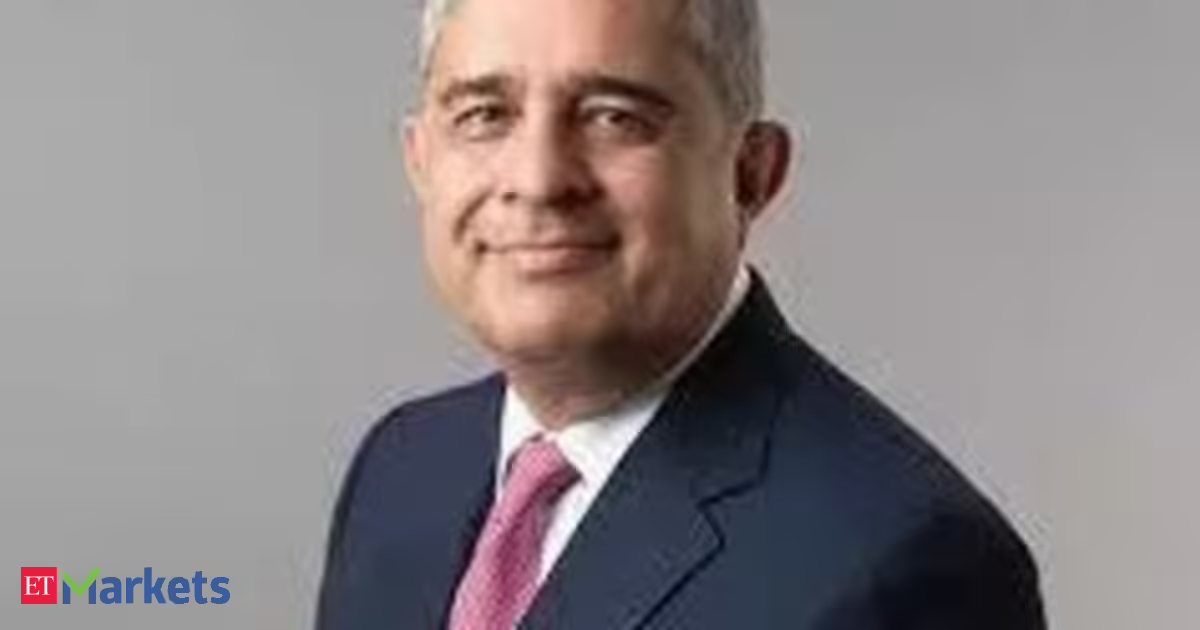
Fiscal prudence a positive, markets spooked by STT and borrowings: Amitabh Chaudhry

Published

on

Fiscal prudence a positive, markets spooked by STT and borrowings: Amitabh Chaudhry
The Union Budget has evoked mixed reactions from the markets, with investors weighing fiscal discipline and long-term reform signals against near-term concerns over borrowings and higher transaction taxes. In an interaction with ET Now, Amitabh Chaudhry said the Budget largely met expectations, emphasising stability and continuity rather than big-bang reforms.

“The expectations of the budget to start with were low. Already some of the big reforms had been executed by the government and to expect another set of reforms or big bang announcements would have been a bit unfair,” Chaudhry said. He added that maintaining fiscal prudence and policy stability was a key positive. “The fact that they have maintained fiscal prudence, the fact that they have continued in the direction of ensuring that there is stability in policies is a very important statement in the budget.”

Chaudhry highlighted several focus areas, including pharmaceuticals, semiconductors, container manufacturing, MSME schemes, dedicated freight and railway corridors, and infrastructure in tier II and tier III cities. He also pointed to measures aimed at deepening corporate bond markets and enabling municipalities to issue bonds.

“Their whole focus seems to be keeping Atmanirbharta as the lodestar of the Budget,” he said, adding that while there are positives, markets are reacting to headline concerns. “The market is spooked a little bit because of the higher borrowings. Market is spooked because they have increased the STT rates. There were people who were expecting some concessions for the foreign investors in the sense of capital gains taxes, that has not come through.”

Advertisement

According to Chaudhry, as investors go through the finer details, sentiment could stabilise. “When they go through the details, they will realise that we need to get back to business. There are a lot of positives also in the budget. While people are seeing the negatives, hopefully they will start seeing some of the positives and the market will settle.”


Banking Committee and Mega Banks
On the proposal to set up a high-level committee on banking to align the sector with India’s next growth phase, Chaudhry said it was premature to react without clarity on the committee’s scope and composition. However, he welcomed the intent.
“The fact that the government believes that something of this nature is required is itself a positive step,” he said, noting that financial inclusion and customer protection are expected to be key pillars alongside the future of banking.He also flagged structural changes in the banking ecosystem. “The nature of the banking industry is changing… the kind of deposits which the banks are getting, where are the deposits coming from, all that has undergone a meaningful change over the last couple of years.” He added that there could be discussions around FDI and the role of global banks.

Emphasising the need for scale, Chaudhry said, “If India wants to be and will be one of the largest economies in the world, India does need very large banks, and so whatever that can be done to push that agenda always will be welcome.”

Consolidation, NBFC Restructuring
On policy measures related to financial services, including the restructuring of public sector NBFCs like PFC and REC, Chaudhry said the government’s direction was consistent with its broader push for scale.

“The government has hinted that they would like the banks to become bigger, so they can be more meaningful in the marketplace and that process will continue,” he said. He added that larger institutions are better positioned to meet the growing needs of the economy. “You do need institutions with much larger balance sheets to be able to have that impact and difference which is needed for an economy of our size and the projections we have and the aspirations we have.”

Advertisement

He also said the fiscal assumptions appeared credible and noted potential flexibility from RBI dividends. “The fiscal assumptions, like some of the previous years, look reasonable and credible. And there is some flexibility available in terms of what comes in the form of RBI dividend.”

Axis Bank’s ROA Aspiration
Asked about Axis Bank’s return on assets (ROA) target of 1.8% amid a subdued market reaction, Chaudhry reiterated that it remains a long-term aspiration.

“As a management team, as an institution, our aim is to get to 1.8 ROA and that aspiration does not change. Obviously, the macroeconomic situation changes, the geopolitical situation changes, but we have to keep executing on our aspiration and I am very confident that as we keep plugging away we will get there over a period of time.”

When pressed on timelines, he added with a smile, “We will keep trying.”

Advertisement

Overall, Chaudhry described the budget as a “mixed bag,” but one that stays the course on fiscal credibility, institutional scale, and long-term self-reliance — even as markets digest near-term pressures.

Continue Reading
Click to comment

Leave a Reply

Your email address will not be published. Required fields are marked *

Business

India must boost capital markets so Indians grow with economy: Larry Fink, chief executive, BlackRock

Published

on

India must boost capital markets so Indians grow with economy: Larry Fink, chief executive, BlackRock
India needs to urgently focus on building deeper capital markets instead of relying on foreign inflows, Larry Fink, chairman and chief executive of BlackRock, told Sruthijith KK in an interview in Mumbai. That will allow Indians to meaningfully participate in the country’s economic growth, which has the potential to expand at 6-10% over the next decade. India is at the “cutting edge of financial infrastructure” from digital payments to the future tokenisation of financial assets, said Fink, 73, who cofounded BlackRock-the world’s largest asset manager- in 1988. Its assets under management hit a record $14 trillion at the end of 2025. Fink dismissed concerns of an AI bubble, arguing that demand for compute far exceeds supply. The bigger risk is underinvestment, particularly in the US, at a time when China is rapidly advancing. Edited excerpts.

The US and India just managed a diplomatic and trade breakthrough. Do you think this marks the end of a difficult phase in the relationship?

I’m really not focused on any one trade agreement, but I do believe over time, our two countries have to be closer. That doesn’t mean we don’t have volatility in that relationship, like every other relationship, but over a long horizon, I think the two countries need to find a pathway to which we can be growing together. We have a lot of similarities, we have a lot of differences.

Continue Reading

Business

Sony Developing Two New Xperia Smartphones for 2026 Release, Leaks Confirm Flagship and Mid-Range Models

Published

on

Samsung Galaxy S26 Ultra Set for February 25 Unveiling at

Sony Group Corp. is actively developing two new Xperia smartphones for launch in 2026, with recent database filings and leaks pointing to the flagship Xperia 1 VIII and the mid-range Xperia 10 VIII, according to multiple industry sources and certification records reported in early February.

The developments follow a challenging period for Sony’s mobile division, which faced disappointing sales and technical issues with the Xperia 1 VII in 2025. Despite these setbacks, fresh evidence from global IMEI databases and regional carrier listings confirms ongoing work on the successors, signaling Sony’s continued commitment to its niche Android lineup known for professional-grade cameras, 4K displays and minimal software bloat.

Prominent leaks from tech blogs and certification sites first surfaced in late 2025, with model numbers resurfacing in the GSMA IMEI database as recently as February 2026. The flagship series carries codes such as PM-1520-BV through PM-1525-BV, corresponding to regional variants like XQ-GE54 and XQ-GE74. The mid-range line appears under PM-1530-BV to PM-1535-BV, linked to XQ-GH models. These entries, reported by outlets including PhoneArena, Android Headlines and Notebookcheck, indicate broad availability across Europe, Asia and Japan, though a U.S. launch remains unlikely based on Sony’s recent patterns.

The Xperia 1 VIII is expected to serve as Sony’s 2026 flagship, building on the cinematic focus of predecessors with a 6.5-inch 4K OLED display, likely powered by Qualcomm’s Snapdragon 8 Elite Gen 5 or a similar next-gen chipset. Rumors suggest enhancements to the triple-camera array, potentially incorporating advanced Exmor T sensors across all lenses for superior low-light performance and video capabilities. Sony’s signature features — including a 3.5mm headphone jack, expandable storage via microSD, IP68 water resistance and a high-refresh-rate screen optimized for content creators — are anticipated to return.

Advertisement

Speculation from YouTube channels and leaker communities points to a May or June 2026 unveiling, aligning with Sony’s traditional spring flagship cycle. Pricing could start around $1,200–$1,400, consistent with prior models, though exact figures remain unconfirmed. The device is positioned to compete in a crowded premium segment dominated by Samsung Galaxy S-series, Google Pixel and iPhone flagships, emphasizing pro-level photography and clean Android software.

Complementing the flagship, the Xperia 10 VIII targets the mid-range market with a more affordable price point, likely $400–$600. Leaks suggest a refreshed design, possibly retaining the slim profile and side-mounted fingerprint sensor of recent Xperia 10 models. Expected upgrades include a Snapdragon mid-tier processor, improved battery life and a triple-camera setup tuned for everyday use.

The mid-ranger’s regional variants indicate strong European and Asian focus, where Sony maintains a loyal following among enthusiasts seeking headphone jacks and expandable storage in budget-friendly packages.

Sony’s strategy appears to streamline its lineup, dropping the compact Xperia 5 series in recent years to concentrate on the premium Xperia 1 and accessible Xperia 10 lines. This approach follows 2025’s issues with the Xperia 1 VII, including power-related defects that prompted a replacement program and temporary sales suspension in Europe. The company resumed sales in August 2025 after fixes, but the episode highlighted vulnerabilities in a low-volume business segment.

Advertisement

Analysts note Sony’s Xperia division operates on thin margins amid intense competition and limited market share. A 2025 executive statement emphasized the lineup’s importance, with the company investing in AI-enhanced imaging, Bravia-derived display tech and ecosystem integration with PlayStation and other Sony products. The 2026 models could incorporate deeper Galaxy AI-like features for photography and productivity, though details are speculative.

No official confirmation has come from Sony, which typically reveals specifications closer to launch events. The company did not respond to requests for comment on the leaks or development status.

For fans, the dual-model approach offers hope for continued innovation in a niche that prioritizes creator tools over mass-market appeal. If the Xperia 1 VIII delivers meaningful camera and performance gains, it could regain momentum among photographers and videographers. The Xperia 10 VIII, meanwhile, provides an alternative for users seeking reliable mid-range hardware without flagship pricing.

As development progresses, more certifications and potential renders are expected in the coming months. Sony’s 2026 Xperia releases, if executed well, could reinforce the brand’s reputation for unique, high-quality Android experiences in select global markets.

Advertisement
Continue Reading

Business

Fragile ceasefire holds at the Thai-Cambodia border

Published

on

Fragile ceasefire holds at the Thai-Cambodia border

A ceasefire between Thailand and Cambodia appears to be holding after weeks of fighting over disputed border areas, which displaced a million people. Al Jazeera’s Assed Baig visited a changing frontline, highlighting efforts toward peace. The conflict’s resolution is crucial for stability in the region.


The Battleground and Current State of the Conflict

Once the frontline between Cambodian and Thai forces, the area is now scarred by war, with roads cratered by mortar fire, shrapnel, and spent bullet casings. Despite being outnumbered and outgunned, Cambodian soldiers refused to abandon their positions, leaving behind the physical remnants of weeks of fighting. As we crossed into no man’s land, Thai troops are visible on the opposite side, with the Thai flag flying on what remains Cambodian territory. Both militaries are adhering to a ceasefire agreement, halting at their current positions without advancing or reinforcing their holdings. However, uncertainty lingers about whether Thai forces will eventually withdraw from Cambodian territory.

Human Impact and Abandoned Communities

The region is eerily deserted, with villages abandoned and streets silent. Civilians are too afraid to return, often only risking brief visits to assess damage, as homes are riddled with shrapnel and explosions have deformed steel structures. Many families previously protected themselves with bunkers but had to flee as fighting intensified, sometimes abandoning pets in their hurried escape. Some young men have briefly returned to make charcoal, but the danger, including unexploded ordinances scattered across the area, remains a serious threat.

Advertisement

The Fragile Ceasefire and Opportunities for Peace

Although the ceasefire holds for now, the underlying causes of the conflict remain unresolved, casting uncertainty over future peace prospects. The ongoing tension prevents civilians from resettling, and the situation remains volatile. However, the temporary halt to hostilities offers a glimmer of hope that, with continued calm, there is potential for lasting peace. As the guns remain silent, efforts related to diplomacy and understanding are crucial to prevent the conflict from reigniting, fostering a chance for stability in this disputed border region.

source

Continue Reading

Advertisement
Continue Reading

Business

Reeling in bear market, should investors buy smallcap stocks after India-US trade deal?

Published

on

Reeling in bear market, should investors buy smallcap stocks after India-US trade deal?
After two years of exceptional gains, India’s smallcap stocks have gone through a sharp and painful correction. The question now facing investors is whether the recent India-US trade deal marks a turning point for the segment.

Smallcap stocks were among the biggest winners of the post-pandemic bull market. The smallcap index delivered returns of 47.5% in 2023 and 29.3% in 2024, driven by strong domestic liquidity, rising retail participation and optimism around India’s long-term growth story.

That momentum has reversed sharply in 2025. The smallcap index fell nearly 10% last year, making it the worst year for the segment since 2018. Even in January, over half of the smallcap universe corrected over 20%. Many smallcap stocks are still trading 25% to 50% below their peaks.

Why the India-US trade deal has changed the mood

Advertisement

Sentiment shifted sharply on Tuesday after India and the US finalised a trade deal that reduced reciprocal tariffs on Indian exports from 25% to 18% and fully withdrew an additional punitive levy linked to Indo-Russian oil trade. Broader indices such as the Nifty Midcap 100 and Smallcap 100 jumped nearly 3% each in a single session. Export-facing sectors saw strong buying, reflecting expectations of better earnings visibility and improved competitiveness in the US market.

India’s tariff rate is now lower than several competing Asian exporters. Countries such as Bangladesh, Sri Lanka, Taiwan and Vietnam face tariffs of around 20%, while Indonesia, Malaysia, Thailand and the Philippines face tariffs close to 19%. This relative advantage is seen as a meaningful positive for Indian exporters.
Veteran investor Ashish Kacholia said the trade deal could mark the end of the smallcap bear phase, calling it a turning point after months of relentless selling pressure.
Relief rally or start of a new cycle?

Despite the sharp bounce, analysts caution against assuming that the trade deal automatically translates into a broad-based smallcap rally. Ravi Singh, Chief Research Officer at Master Capital Services, says the trade deal should be viewed as a supportive tailwind rather than a trigger for an indiscriminate surge across the smallcap universe.

“Smallcap companies operate with narrow product lines or concentrated business models. For such firms, the benefits of lower tariffs will be meaningful only if they have direct exposure to export-linked sectors,” he said, while adding the current market phase is very different from the liquidity-driven rallies of the past.

“Earnings quality, cash flows and balance sheet strength are now back in focus. Investors expecting the kind of across-the-board momentum seen in earlier cycles may be disappointed.”

Export-oriented smallcaps stand out

Advertisement

Where the trade deal could make a real difference is in export-heavy smallcap companies. Sectors such as pharmaceuticals, textiles, IT services, engineering goods and auto ancillaries are seen as the most direct beneficiaries.

Lower tariff barriers improve price competitiveness in the US market and reduce uncertainty around order flows. For small companies operating on thin margins, even modest improvements in export pricing or volumes can have an outsized impact on profitability.

Kush Gupta of SKG Investment & Advisory says the deal has improved the risk-reward equation for export-oriented smallcaps. He notes that the announcement has already sparked a sentiment shift, with smallcap indices posting their best single-day gains in months.

However, there are structural challenges. Valuations remain elevated in parts of the smallcap space. As of late 2025, the segment was trading at close to 30 times forward earnings, while expected earnings growth was only around 11%. A large number of smallcap companies have also underperformed earnings expectations in recent quarters.

Advertisement

“The trade deal is unlikely to fix these issues overnight. It should be seen as a sentiment booster and a sector-specific opportunity rather than a cure-all for the entire segment,” said Gupta.

Are valuations finally becoming attractive?

One positive emerging from the correction is that valuations for several quality smallcap stocks have cooled. Analysts estimate that over a third of the smallcap universe, representing nearly Rs 16 lakh crore in market cap, is now trading at fair or even undervalued levels.

Arjun Guha Thakurta of Anand Rathi Wealth says the recent correction has created a disconnect between stock prices and business performance. While many smallcap stocks have fallen sharply, earnings growth in the segment has remained reasonably healthy.

He notes that much of the selling pressure was driven by sentiment, foreign outflows and risk aversion rather than a collapse in fundamentals. With foreign investors having largely exited speculative positions, the supply overhang appears to be easing.

Advertisement

“When weak hands have already sold, even modest improvements in confidence can lead to sharp recoveries, especially in segments that have underperformed for extended periods,” he said.

How should investors approach smallcaps now?

Most analysts agree that this is not the time for blind index-level bets on smallcaps. The consensus view is that investors should adopt a selective, bottom-up approach rather than chasing momentum. A phased allocation strategy is widely recommended. Instead of deploying large sums at once, investors can gradually increase exposure, focusing on companies with strong balance sheets, sustainable cash flows and clear earnings visibility.

Risk management remains critical. Smallcaps are inherently volatile, and while the trade deal reduces external uncertainty, it does not eliminate company-specific risks or broader market swings. Analysts suggest limiting smallcap exposure to a level aligned with one’s risk appetite and investment horizon.

Advertisement

Arunagiri of TrustLine Holdings says the recovery in small and midcaps is likely to unfold over time rather than in a straight line. He believes the current phase offers opportunities for stock-specific alpha but warns against expecting a rapid return to the speculative excesses of the past.

(Disclaimer: Recommendations, suggestions, views and opinions given by the experts are their own. These do not represent the views of Economic Times)

Continue Reading

Business

Will secondary market SGB maturity returns now be taxed? Budget 2026 has changed the rules

Published

on

Will secondary market SGB maturity returns now be taxed? Budget 2026 has changed the rules
The Union Budget 2026 has introduced an important clarification on the taxation of Sovereign Gold Bonds (SGBs), raising fresh concerns for investors who bought these bonds on the secondary market. The update challenges the long-held belief that all SGB holders would receive tax-free redemption benefits at maturity.

With new issuances already discontinued, the latest clarification has important implications for thousands of retail investors who bought SGBs through stock exchanges rather than directly from the government at the time of issuance.

Also Read | Silver & gold ETFs rally up to 9% as bullion boom continues. Should you invest now?

This is the case of Rishi, an SGB investor and viewer of The Money Show on ET Now. He has bought it from the secondary market and wants to know what the changes are and how they are likely to affect his return now.

The expert financial planner, Pankaj Mathpal, explained how the interpretation of tax benefits has now changed under Budget 2026.

Advertisement


Mathpal said that traditionally, Sovereign Gold Bonds offered a clear tax benefit, which means that if an investor bought an SGB at the time of issuance and held it till maturity, the capital gains at maturity were tax-free.
Over time, many investors assumed that this benefit applied even to those who purchased SGBs from the secondary market. “But earlier it was assumed if somebody has bought from the issuer and somebody buys now in the secondary market, so when you are buying from the secondary market, holding till maturity in that case also it was tax-free,” said Mathpal.For example, if an investor bought an older SGB series from the stock exchange that had already completed five years of its tenure and planned to hold it for the remaining three years till maturity, it was widely believed that the maturity proceeds would also be tax-free.

According to the clarification made in Budget 2026, the tax-free benefit at maturity will apply only to primary investors — those who purchased Sovereign Gold Bonds directly from the issuer (the government) at the time of original issuance. If an investor buys an SGB from the secondary market, the redemption or maturity proceeds will no longer be tax-free in their hands.

This means that investors who purchased SGBs from the stock exchange, even if they hold them till maturity, will now be liable to pay tax on the gains at redemption.

For investors like Rishi, who bought Sovereign Gold Bonds from the secondary market, this change directly affects the post-tax return calculation. Earlier, investors expected full tax-free maturity proceeds, which made secondary market purchases attractive, especially for bonds close to maturity. With the new clarification, the final return will now be reduced by applicable capital gains tax, making the investment less efficient from a tax perspective.

Also Read | Best large cap mutual funds to invest in February 2026

Advertisement

Finance Minister Nirmala Sitharaman announced the move in her Budget 2026 speech, made on Sunday. She said the relief will be given only to those individual investors who have bought it from the Reserve Bank of India (RBI) and hold it till maturity.

“It is proposed to provide that the exemption from capital gains tax in respect of Sovereign Gold Bonds shall be available only where such bonds are subscribed to by an individual at the time of original issue and are held continuously until redemption on maturity,” FM Sitharaman said in her speech. “It is also proposed to provide that this exemption applies uniformly to all issuances of Sovereign Gold Bonds by the Reserve Bank of India,” she added.

The provisions of section 70(1)(x) of the Act provide an exemption from capital gains tax on income arising from the redemption of SGBs issued by the RBI under the scheme that was launched in 2015. The SGBs were issued on a recurring basis through multiple series notified from time to time, each constituting a separate issuance.

According to Nirmala Sitharaman, this move is meant to differentiate SGBs from trading instruments as the government wants to reward committed investors, not speculators.

Advertisement

“SGBs are meant to be a safe, hassle-free alternative to buying physical gold jewellery or coins for your family’s future. By ensuring only patient, buy-and-hold investors get the tax exemption, the policy reinforces that SGBs are about wealth creation through disciplined savings, not quick profits. The uniformity across all RBI issuances also means every investor gets the same fair treatment, regardless of when they invest,” she added.

(Disclaimer: Recommendations, suggestions, views and opinions given by the experts are their own. These do not represent the views of The Economic Times)

If you have any mutual fund queries, message on ET Mutual Funds on Facebook/Twitter. We will get it answered by our panel of experts. Do share your questions on ETMFqueries@timesinternet.in alongwith your age, risk profile, and twitter handle

Advertisement
Add ET Logo as a Reliable and Trusted News Source

Continue Reading

Business

A10 Networks, Inc. (ATEN) Q4 2025 Earnings Call Transcript

Published

on

OneWater Marine Inc. (ONEW) Q1 2026 Earnings Call Transcript

Operator

Greetings. Welcome to A10 Networks Fourth Quarter and Full Year 2025 Financial Results Conference Call. [Operator Instructions]

I will now turn the conference over to your host, Tom Baumann. Sir, you may begin.

Advertisement

Tom Baumann

Thank you. And thank you all for joining us today. This call is being recorded and webcast live and may be accessed for at least 90 days via the A10 Networks’ website at a10networks.com.

Hosting the call today are Dhrupad Trivedi, A10’s President and CEO; and CFO, Michelle Caron.

Before we begin, I would like to remind you that shortly after the market closed today, A10 Networks issued a press release announcing its fourth quarter 2025 financial results. Additionally, A10 published a presentation and supplemental trended financial statements. You may access the press release, presentation and trended financial statements on the Investor Relations section of the company’s website.

Advertisement

During the course of today’s call, management will make forward-looking statements, including statements regarding projections for future operating results, demand, industry and customer trends, macroeconomic factors, strategy, potential new products and solutions, our capital allocation strategy, profitability, expenses and investments, positioning and our dividend program. These statements are based on current expectations and beliefs as of today, February 4, 2026. These forward-looking statements involve a number of risks and uncertainties, some of which are beyond our control that could cause actual results to differ materially, and you should not rely on them as predictions of future events. A10 does not intend to update information contained in

Continue Reading

Business

Southwest Super Bowl ad ‘celebrates’ assigned seating launch change

Published

on

Southwest Super Bowl ad 'celebrates' assigned seating launch change

Southwest Airlines will debut a new ad during the Super Bowl poking fun at its new assigned seating policy.

The ad, “Boarding Royale,” will air on Peacock and broadcast and local cable channels in six markets, including San Diego, Chicago, Denver, Austin, Dallas and Honolulu, during the big game Sunday, according to a Southwest news release.

Advertisement

The ad, which appears set in a forest, features numerous guests running to get to their seats after a voice says, “Southwest boarding begins now.”  

‘SUPER BOWL BREAKFAST’ RETURNS WITH FOCUS ON LEADERSHIP AND LEGACY AHEAD OF NFL SHOWCASE

In what seems to be a hyperbolic expression of how travelers would react during the company’s open seating boarding process, people in the video chaotically run to grab a seat.

People running to sit in chairs in the middle of a field

Southwest will debut a new Super Bowl ad, poking fun at its former open seating policies. (Southwest / Unknown Source)

“I thought you checked us in last night?” a woman in the advertisement asks.

Advertisement

“I was one minute late,” the man who appeared to be traveling with her replied.

HOSTING A SUPER BOWL PARTY? EXPECT A HIGHER FOOD BILL THIS YEAR

The video also features a woman swinging on a tree vine while screaming in what appears to be an effort to make it to her seat on time.

Ticker Security Last Change Change %
LUV SOUTHWEST AIRLINES CO. 52.60 +1.42 +2.77%

On-screen text then appears that says, “That was wild,” followed by a couple calmly sitting in their seats with another on-screen text card that says, “Assigned seating is here.”

Advertisement

The ad “celebrates” the airline’s new assigned seating model while “clapping back to the days of open seating,” the company said in the release.

A man asking another man if he can sit in the chair next to him

During the ad, a passenger appears to save the seat next to him while another person asks if the seat is taken. The ad comes amid new assigned seating policies. (Southwest)

The company shared that viewers should recognize Southwest’s “self-aware humor” the airline says it’s known for.

Southwest says the new assigned seating policy should “position the airline for the future.”

SOUTHWEST OFFERING $67 FLIGHTS IN NOD TO VIRAL INTERNET MEME: ‘TRENDY’ SALE

Advertisement

“While open seating played a huge role in Southwest’s history and helped it grow from a regional carrier into one of the largest airlines in America, the new assigned seating policy positions the airline for the future and addresses customers’ needs,” Southwest said in the release.

The airline’s new seating policy went into effect Jan. 27. Customers now have the choice between an “extra legroom seat,” “preferred seat” and a standard seat.

Passengers run into a field with seats in the middle

Southwest Airlines’ new ad will air in six markets, including Dallas, Austin and San Diego. (Southwest)

The company said the policy “gives [customers] more choices when [they] travel,” according to the airline’s website.

“For your comfort, we’re introducing seat options that allow you to choose the experience you prefer,” the airline said on its seating information page.

Advertisement

GET FOX BUSINESS ON THE GO BY CLICKING HERE

The Seattle Seahawks will face off against the New England Patriots Sunday in the Super Bowl at Levi’s Stadium in Santa Clara, California.

Despite the changes, Southwest reassured customers they should still expect the same “legendary” hospitality.

“Southwest’s bold personality and humor have always been unique in the industry,” it said in the release. “No matter the seat configuration, the legendary hospitality that customers expect at Southwest remains.”

Advertisement
Continue Reading

Business

Nu Holdings: Why I Remain Constructive Heading Into 2026

Published

on

Nu Holdings: Why I Remain Constructive Heading Into 2026

Nu Holdings: Why I Remain Constructive Heading Into 2026

Continue Reading

Business

LARRY KUDLOW: For the midterms, it’s still early in the game

Published

on

LARRY KUDLOW: For the midterms, it’s still early in the game

Lots of smart people think President Trump and the Republicans have a very steep uphill climb if they expect to win the midterms, especially the House. Newt Gingrich thinks if the election were today the GOP would lose. I’ve been exhorting GOP leaders to tout the red-hot economy with numbers and repetition, as often as possible, at every campaign stop.

More positive numbers came out today for the Institute for Supply Managers, where the combined purchasing managers’ indexes for manufacturing and services are the best they’ve been in nearly two years. And there’s a business boom. And there’s a productivity boom. And wages are outstripping inflation. Yet it’s a story that has got to be told, including the Trump Accounts, which can turn working-class minority children into millionaires. Where the next generation of youngsters can be a nation of owners, democratizing stock ownership, and understanding the miracles of free-market capitalism. That, too, is a story that has to be told over and over again.

Yet not all is lost. The latest Harvard CAPS Harris poll shows some improvement in personal financial situations, and though it’s still underwater, it’s getting better. That same poll shows a strong support for Mr. Trump closing the border. And 73 percent say criminal illegal aliens should be deported, 67 percent say local jails should hand over criminal illegals to federal authorities for deportation, which is exactly what the border czar, Tom Homan, is trying to do. And roughly 60 percent see the Democrats as encouraging resistance to deporting criminal illegals.

Advertisement

Another part of that poll shows that 60 percent favor a platform described as reduced government spending, lower taxes, tougher trade deals, lower prescription drug costs, and a closed border, which is of course, the Trump package. And only 40 percent prefer more government spending, liberal immigration, more taxes, and higher healthcare subsidies. Polls are not votes, but good polls are informative.

And finally, money matters. Politico is reporting that Mr. Trump raised $26 million through his joint fundraising committee in the back half of last year. And another $8 million directly into his leadership political action committee. A super PAC linked to him has more than $300 million in the bank. That’s a lot of money. All in, they estimate the president’s orbit has $375 million of firepower. And the president is outstripping everybody in fundraising by a long shot.

So, all is not lost. It’s still early in the game.

Advertisement
Continue Reading

Business

Tim Scott says Fed Chair Powell didn’t commit crime during testimony

Published

on

Tim Scott says Fed Chair Powell didn't commit crime during testimony

Senate Banking Committee Chair Tim Scott said Wednesday that he doesn’t think Federal Reserve Chair Jerome Powell committed a crime during his testimony last summer about the central bank’s costly renovation project.

Scott, R-S.C., said in an appearance on FOX Business’ “Mornings with Maria” that while he has other issues with how Powell has led the central bank and its monetary policy moves, he doesn’t believe that the Fed chair committed a crime in his testimony.

Advertisement

“As it relates to the DOJ investigation, I’ll tell you what I would tell a prosecutor if they came into my office. I was the one asking the questions, Jay Powell was responding to me. Obviously, he and I have very, very strong disagreements on many issues, No. 1,” Scott said. “No. 2, I believe that it’s time for a new Federal [Reserve] chair. Thank God almighty, we’re getting ready to get one.” 

“No. 3, I found him to be inept at doing his job, but ineptness or being incompetent is not a criminal act. I believe what he did was make a gross error in judgment, he was not prepared for that hearing. I do not believe that he committed a crime during the hearing,” Scott said.

TRUMP SAYS HE WILL NOT DROP DOJ CRIMINAL PROBE INTO FED CHAIR JEROME POWELL

Tim Scott, President Donald Trump, and Jerome Powell tour the new Federal Reserve facility wearing hard hats.

Senate Banking Chair Tim Scott, R-S.C., (left) said he doesn’t think Fed Chair Jerome Powell (right) committed any crime in his testimony last summer. (Andrew Caballero-Reynolds/AFP)

The Department of Justice opened a criminal inquiry into whether Powell misled Congress during his testimony before the Senate Banking Committee last summer about the Federal Reserve’s headquarters renovation, which has run over budget.

Advertisement

The criminal probe came against the backdrop of an effort by President Donald Trump and his allies to pressure Powell and the Fed into cutting interest rates to spur the economy. 

Powell denied wrongdoing and called the probe a pretext for exerting political influence over monetary policy decisions.

TRUMP’S FED PICK KEVIN WARSH FACES UNEXPECTED ROADBLOCK OVER ONGOING POWELL PROBE

Fed Chair Jerome Powell

Fed Chair Jerome Powell said the DOJ’s investigation is a pretext for pressuring the central bank’s monetary policy moves. (Kent Nishimura/Getty Images)

A key member of the Senate Banking Committee, Sen. Thom Tillis, R-N.C., responded to the probe by vowing to block any Federal Reserve nomination until the DOJ’s investigation of Powell concludes.

Advertisement

“If there were any remaining doubt whether advisors within the Trump administration are actively pushing to end the independence of the Federal Reserve, there should now be none. It is now the independence and credibility of the Department of Justice that are in question,” Tillis said last month.

POWELL OFFERS ADVICE FOR NEXT FED CHAIR, ADDRESSES FUTURE AT CENTRAL BANK

A photo of President Donald Trump walking behind Federal Reserve chairman Jerome Powell at the White House.

Trump nominated Powell as Fed chair in 2017, but has repeatedly criticized his handling of monetary policy since he was confirmed to the role in 2018. (Olivier Douliery/Bloomberg/Getty Images)

Scott told Bartiromo on Wednesday that he thinks the investigation of Powell will be resolved and that will clear the path for considering the nomination of former Fed Governor Kevin Warsh to serve as the next chair of the central bank. 

Trump nominated Warsh to the role last week, and Tillis reiterated his stance that he won’t consider Fed nominees until the DOJ probe is over.

Advertisement

GET FOX BUSINESS ON THE GO BY CLICKING HERE

“I believe that we’re going to resolve that issue, we’re going to move forward and Thom Tillis will be voting for Kevin Warsh as the next chairman of the Federal Reserve. That’s my prediction,” Scott said.

Continue Reading

Trending

Copyright © 2025