
Crypto World
CME Group Mulls Proprietary Token for Collateral and Margin


Chicago-based derivatives exchange CME Group is examining how tokenized assets could reshape collateral and margin across financial markets, CEO Terry Duffy said during a recent earnings call. The conversations revolve around tokenized cash and a CME-issued token that could run on a decentralized network, potentially used by other market participants as margin. Duffy argued that the quality of collateral matters, suggesting that instruments issued by a systemically important financial institution would provide more confidence than tokens from smaller banks attempting to issue margin tokens. The comments signal a broader industry push to experiment with tokenized collateral as traditional markets increasingly explore blockchain-based settlement and liquidity tools.
Key takeaways
- CME Group is evaluating tokenized cash alongside a possible CME-issued token designed to operate on a decentralized network for margin purposes.
- Registry-style collateral could be favored if issued by systemically important financial institutions, rather than tokens from smaller banks.
- The discussion ties into a March collaboration with Google Cloud around tokenization and a universal ledger, indicating a concrete technical path for pilots.
- CME plans 24/7 trading for cryptocurrency futures and options in early 2026, subject to regulatory approval, reflecting a broader push toward continuous pricing and settlement.
- In parallel, CME has outlined growth in regulated crypto offerings, including futures tied to Cardano, Chainlink and Stellar, and a joint effort with Nasdaq to unify crypto index products.
Tickers mentioned: $ADA, $LINK, $XLM
Market context: The CME move comes as traditional banks and asset managers accelerate experiments with tokenized assets and stablecoins, while policymakers in the United States weigh regulatory frameworks for digital currencies and centralized versus decentralized settlement rails. The sector-wide trend includes both institutional pilots and ongoing regulatory scrutiny surrounding stablecoins and token-based payments.
Why it matters
The potential introduction of a CME-issued token or the broader use of tokenized collateral could redefine how institutions post margin and manage risk during periods of market stress. If a CME token were to gain traction among major market participants, it could provide a recognizable, regulated anchor for on-chain settlement workflows, potentially reducing settlement latency and settlement risk across a spectrum of asset classes. The emphasis on collateral quality—favoring instruments from systemically important institutions—helps address credibility concerns that have accompanied attempts by other entities to issue margin-related tokens in the past.
The development sits within a wider institutional push into tokenization and digital assets. Banks have been advancing their own experiments with tokenized cash and stablecoins to streamline cross-border payments and interbank settlements. For example, large banks have publicly discussed stablecoin exploration and related payment technologies, underscoring a broader demand for faster, more efficient settlement rails. Yet this momentum coexists with a regulatory push to address potential risks, coverage, and disclosure standards around tokenized instruments and stablecoins, including debates over yield-bearing stablecoins and the evolving legal framework in the CLARITY Act era.
Beyond the tokenization plans, CME’s broader crypto strategy—ranging from planned futures on leading tokens to a unified Nasdaq-CME Crypto Index—signals an intent to align traditional derivatives infrastructure with blockchain-enabled assets. The push toward 24/7 crypto derivatives trading marks a notable shift in market structure, as exchanges and market participants increasingly expect around-the-clock access to price discovery and settlement. The timing aligns with a confluence of industry experiments and policy discussions, creating a testing ground for tokenized collateral to become a practical, regulated element of mainstream finance.
What to watch next
- Regulatory clearances for 24/7 crypto derivatives trading expected in early 2026; approval status will shape CME’s execution timeline.
- Details on the CME-issued token’s design, governance, and interoperability with decentralized networks remain to be seen—watch for formal disclosures or filings.
- Progress of the Google Cloud-based Universal Ledger pilot for wholesale payments and asset tokenization; any case studies or results will inform practical feasibility.
- Updates on CME’s planned futures tied to Cardano (ADA), Chainlink (LINK) and Stellar (XLM) and how liquidity and risk controls will be implemented under the Nasdaq-CME alignment.
Sources & verification
- CME Group CEO Terry Duffy’s remarks on tokenized cash and potential CME-issued token during a Q4-2025 earnings call (Seeking Alpha transcript referenced in coverage).
- March press release announcing CME Group and Google Cloud’s tokenization initiative using Google Cloud’s Universal Ledger to enhance capital-market efficiency.
- Cointelegraph reporting on the CME-Google Cloud tokenization pilot and related technology discussions.
- CME’s January disclosures about expanding regulated crypto offerings with futures on Cardano (ADA), Chainlink (LINK) and Stellar (XLM) and the Nasdaq-CME Crypto Index integration.
- Regulatory context and policy discussions surrounding stablecoins and tokenization, including debates around the GENIUS Act and related rulemaking.
Key figures and next steps
Market participants will be watching for concrete technical details behind any CME-issued token, including how it would be stored, audited, and reconciled with existing collateral frameworks. The form and governance of a token designed for margin would influence whether such an asset could be widely adopted by clearing members and other systemically important institutions. As CME progresses its discussions with regulators and industry stakeholders, the potential for tokenized collateral to function as an accepted, high-credibility instrument will hinge on demonstrating robust risk controls, liquidity, and interoperability with existing settlement ecosystems.
Key figures and next steps
In the near term, observers should monitor updates on 24/7 crypto derivatives trading plans, potential regulatory approvals, and any incremental disclosures on how tokenized cash and a CME-issued token would be integrated into margin requirements. The collaboration with Nasdaq to unify crypto index offerings also merits close attention, as it could influence how institutional investors gauge exposure to digital assets in a standardized framework.
Why it matters (expanded)
For users and investors, the emergence of tokenized collateral could offer new pathways to manage liquidity and collateral agility, potentially reducing funding costs for participants who post margin across exchanges. For builders and platform teams, this trend underscores a need to design secure, auditable on-chain representations of traditional assets and to ensure that risk models and governance processes are aligned with regulated markets. For the market at large, CME’s exploration highlights how the line between on-chain assets and regulated, traditional finance is becoming more permeable, creating opportunities and challenges in equal measure.
What to watch next
- Regulatory approvals for 24/7 crypto derivatives trading anticipated in early 2026.
- Detailed disclosures on the CME-issued token’s architecture and governance in forthcoming filings or announcements.
- Milestones from the Google Cloud universal ledger pilot, including any pilot results or expansion plans.


TLDR
- Kraken confirmed that it confidentially filed for an initial public offering, according to co-CEO Arjun Sethi.
- The company secured a $13.3 billion valuation in April, down from its $20 billion peak in late 2025.
- Arjun Sethi said Kraken plans to offer institutional-grade trading tools to retail users.
- Kraken obtained a master account with the Federal Reserve Bank of Kansas City for direct dollar settlement access.
- Deutsche Börse agreed to invest $200 million for a 1.5% fully diluted stake in Payward Inc.
- Kraken disclosed insider-related security incidents that affected about 2,000 accounts without compromising client funds.
Kraken confirmed it confidentially filed for an initial public offering, according to co-CEO Arjun Sethi. He disclosed the move on Tuesday at the Semafor World Economy summit in Washington, D.C. The filing follows a prior pause in listing plans as its valuation fell to $13.3 billion.
Kraken Advances IPO Plan as Valuation Adjusts
Kraken confirmed it submitted a confidential IPO filing, and Arjun Sethi announced the update during a public event. He spoke at the Semafor World Economy conference in Washington, D.C., and addressed earlier reports. The company had paused earlier listing plans after crypto markets weakened and trading volumes dropped.
The San Francisco-based exchange secured a $13.3 billion valuation in an April funding round. That figure marked a decline from its $20 billion peak recorded in late 2025. The round included backing from Citadel Securities and reflected changing investor sentiment.
Sethi said Kraken wants to expand institutional-grade trading tools to retail clients. He compared the company’s goals to services offered by Jane Street and JPMorgan Chase. He stated, “We aim to bring institutional-grade tools to retail users,” while outlining product ambitions.
Kraken recently obtained a master account with the Federal Reserve Bank of Kansas City. The account grants direct access to U.S. payment systems, including Fedwire. This access allows dollar settlements without intermediary banks, though it excludes interest on reserves and lending facilities.
Deutsche Börse Investment and Insider Security Incidents
Deutsche Börse disclosed a $200 million investment in Kraken through a secondary share purchase. The transaction grants a 1.5% fully diluted stake in Payward Inc, pending regulatory approval. The companies expect the deal to close in Q2 2026.
The investment expands a partnership announced in December 2025 between Kraken and Deutsche Börse. The collaboration targets regulated crypto trading, derivatives, tokenized assets, and institutional liquidity services. Both firms said the agreement seeks to connect traditional financial infrastructure with digital asset markets.
Kraken also reported two insider-related security incidents involving support staff. The employees accessed limited client data through internal systems without authorization. About 2,000 accounts, representing 0.02%, were affected, and no client funds or trading systems were compromised.
A criminal group later attempted extortion, claiming it possessed internal videos linked to the incidents. Kraken refused to pay and revoked access for the responsible individuals. The company notified affected users and cooperated with law enforcement while strengthening internal controls.
Galaxy Digital reported a separate cybersecurity incident during the same week. The firm disclosed unauthorized access to a development environment. It stated that no client data or funds were impacted by that breach.

Crypto World
Popular DeFi platform CoW Swap warns users to stay away from its site after security breach


CoW Swap, a decentralized trading interface, said Tuesday it temporarily halted its services after detecting a domain name system (DNS) hijacking incident affecting its website, underscoring ongoing security risks at the front-end layer of DeFi platforms.
In a post on X, the team said the attack occurred at 14:54 UTC and warned users to avoid interacting with its interface until further notice. While the protocol’s underlying infrastructure, including its backend and APIs, was not directly compromised, both were paused “as a precaution” as the team worked to resolve the issue.
DNS hijacking allows attackers to redirect users from a legitimate domain to a malicious lookalike site, often with the goal of draining crypto wallets or harvesting private data. The attack vector has become a persistent weak point in decentralized finance, where users typically rely on web-based interfaces to access otherwise secure smart contracts.
CoW Swap operates as a decentralized exchange aggregator, sourcing liquidity across venues and using a mechanism known as “Coincidence of Wants” to match trades directly between users or batch them for more efficient execution. Orders are handled by competing “solvers” that optimize trade outcomes, a design intended to reduce slippage and limit exposure to maximal extractable value (MEV).
MEV is a practice on the blockchain where bots reorder transactions to extract profit at users’ expense, making mitigation key to ensuring fair pricing and protecting traders.
The platform is governed by CoW DAO, a decentralized autonomous organization spun out of the Gnosis ecosystem. The project has positioned itself as a user-protective alternative in DeFi trading, emphasizing execution quality and fairer trading outcomes.
“We are now actively working to resolve the situation. Please continue to refrain from using swap dot cow dot fi until we confirm that it is safe to use,” the team wrote on X.
Read more: DEX Aggregator CoW Swap Targets 33% Trading Boost With Collaboration Feature, More Rewards
TLDR
- Tim Draper expects the Bitcoin price to reach $250,000 within the next 18 months.
- He links his forecast to growing global adoption and weakening fiat currencies.
- Draper first attempted to acquire Bitcoin when it traded at $4 through a mining partnership.
- He later lost his Bitcoin holdings during the collapse of Mt. Gox exchange.
- In 2014, he purchased Bitcoin at $632 per coin during a US Marshals auction.
Venture capitalist Tim Draper has renewed his projection that Bitcoin will reach $250,000 within 18 months. He shared the forecast in a recent public statement and linked it to rising adoption trends. He also cited the weakening of fiat currencies as a driver of future demand.
Bitcoin Price Outlook and Long-Term Target
Draper stated that he expects the Bitcoin price to climb to $250,000 within 18 months. He said growing usage will fuel the projected rise. He added that weakening fiat currencies will also boost demand.
He said, “I have reason to believe that Bitcoin will reach $250k in 18 months.” He linked his view to broader use cases across global markets. He maintained that expanding adoption will sustain the rally.
Draper acknowledged that some past forecasts did not meet timelines. However, he said he continues to stand by his current target. He stressed that he bases his outlook on adoption data and currency trends.
He previously predicted that Bitcoin would reach $10,000 within three years. He made that call shortly after buying confiscated coins in 2014. The asset later met that target within the projected period.
Early Bitcoin Mining and Mt. Gox Losses
Draper said he first attempted to acquire Bitcoin when it traded at $4. He partnered with Peter Viscenne to mine the cryptocurrency. They ordered mining chips from hardware maker Butterfly Labs.
However, Draper alleged that Butterfly Labs used the chips to mine for itself. He said the company delayed shipping the hardware. By the time they received the equipment, Bitcoin traded above $30.
Draper later lost his holdings during the collapse of Mt. Gox. The exchange served as the leading Bitcoin trading platform at that time. Despite the failure, the Bitcoin price remained resilient.
He said, “It turned out that Bitcoin was being used for remitting money.” He added that people used it to pay unbanked employees and create new economies. He said these use cases supported price stability.
In 2014, Draper purchased Bitcoin through a US Marshals auction. Authorities had seized the coins from the Silk Road marketplace. He paid $632 per coin during that auction process.
Shortly after the purchase, Draper predicted a $10,000 Bitcoin price within three years. A television host reacted with confusion during the interview. The asset later reached that level within the timeframe.
Draper admitted that later price targets were less accurate. However, he reiterated confidence in his current forecast. He again pointed to adoption growth and fiat currency erosion as key factors.


Japan’s e-commerce giant Rakuten is adding XRP to its Rakuten Pay app, allowing its 44 million users to use Ripple’s cryptocurrency as a payment method with more than 5 million merchant locations across the country.
In an announcement via X on Tuesday, Tatsuya Kohrogi, Ripple’s senior ecosystem growth manager, said Rakuten is also enabling its users to spot trade XRP via the app. He said they will also be able to purchase XRP with Rakuten points and hold it in their Rakuten Wallet.
The move ties XRP into one of Japan’s largest loyalty systems, where more than 3 trillion points—worth roughly $23 billion—are in circulation and can now be converted into XRP, Kohrogi said.
“Starting April 15, Rakuten Wallet will launch XRP as both a listed asset and a payment method, meaning users can buy XRP directly with Rakuten Points and charge their Rakuten Cash with XRP to spend it at over 5 million merchant locations across Japan,” Kohrogi said, calling the development “one of the most significant XRP milestones.”
The Ripple executive also said Rakuten is one of Japan’s most trusted consumer brands. “The fact that XRP is now embedded into its loyalty and payments infrastructure is a powerful signal of where digital asset adoption is heading,” he added.
Rakuten began allowing users to spend bitcoin, ether and bitcoin cash in 2023. In 2021, the Japanese e-commerce giant announced the launch of its own Rakuten Coin, a token it said would be used as part of its points-based loyalty rewards system.
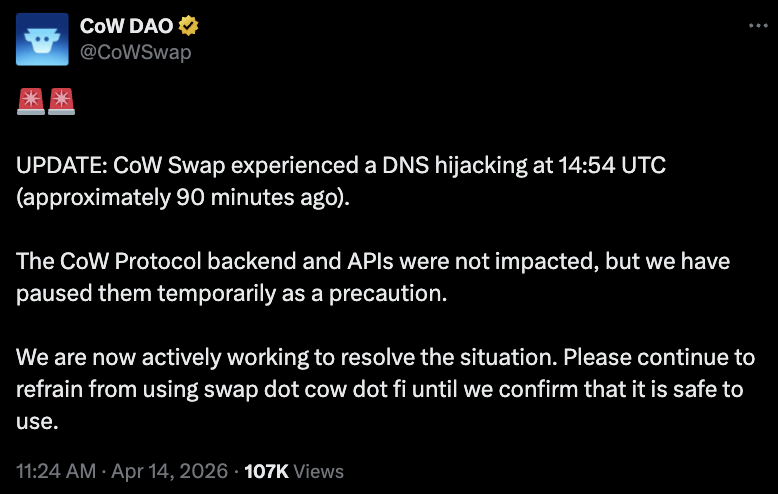
The decentralized exchange aggregator said users should refrain from visiting its website after a frontend exploit.
Decentralized exchange aggregator CoW Swap is calling on users to refrain from using its website after an unknown party hijacked its domain.
In a Tuesday X post, the decentralized autonomous organization (DAO) behind CoW Swap said its website had experienced a “DNS [Domain Name System] hijacking,” leading to a pause of its backend and APIs. The frontend exploit, through the website http://swap.cow.fi, was ongoing at the time of publication.
“We are now actively working to resolve the situation,” said CoW Swap. “Please continue to refrain from using swap dot cow dot fi until we confirm that it is safe to use.”

DNS attacks like the one CoW Swap reported are not uncommon among crypto and blockchain companies where user funds are at risk from phishing attempts. Decentralized exchange Balancer reported a domain attack in 2023, while Curve Finance said it has experienced multiple DNS hijackings.
Related: Firestorm erupts in Aave governance forum over CoW Swap fees
The price of the CoW Protocol’s COW token dropped more than 3% amid news of the domain hijacking, to $0.2159 from $0.2229.
Web3 hacks, driven by phishing, resulted in a half billion dollars in losses in Q1 2026
Blockchain security company Hacken reported on Tuesday that Web3 projects lost $482 million to hacks and scams in the first quarter of 2026. According to Hacken, there were 44 incidents over Q1 2026, most of which were phishing and social engineering attacks.
Magazine: Are DeFi devs liable for the illegal activity of others on their platforms?
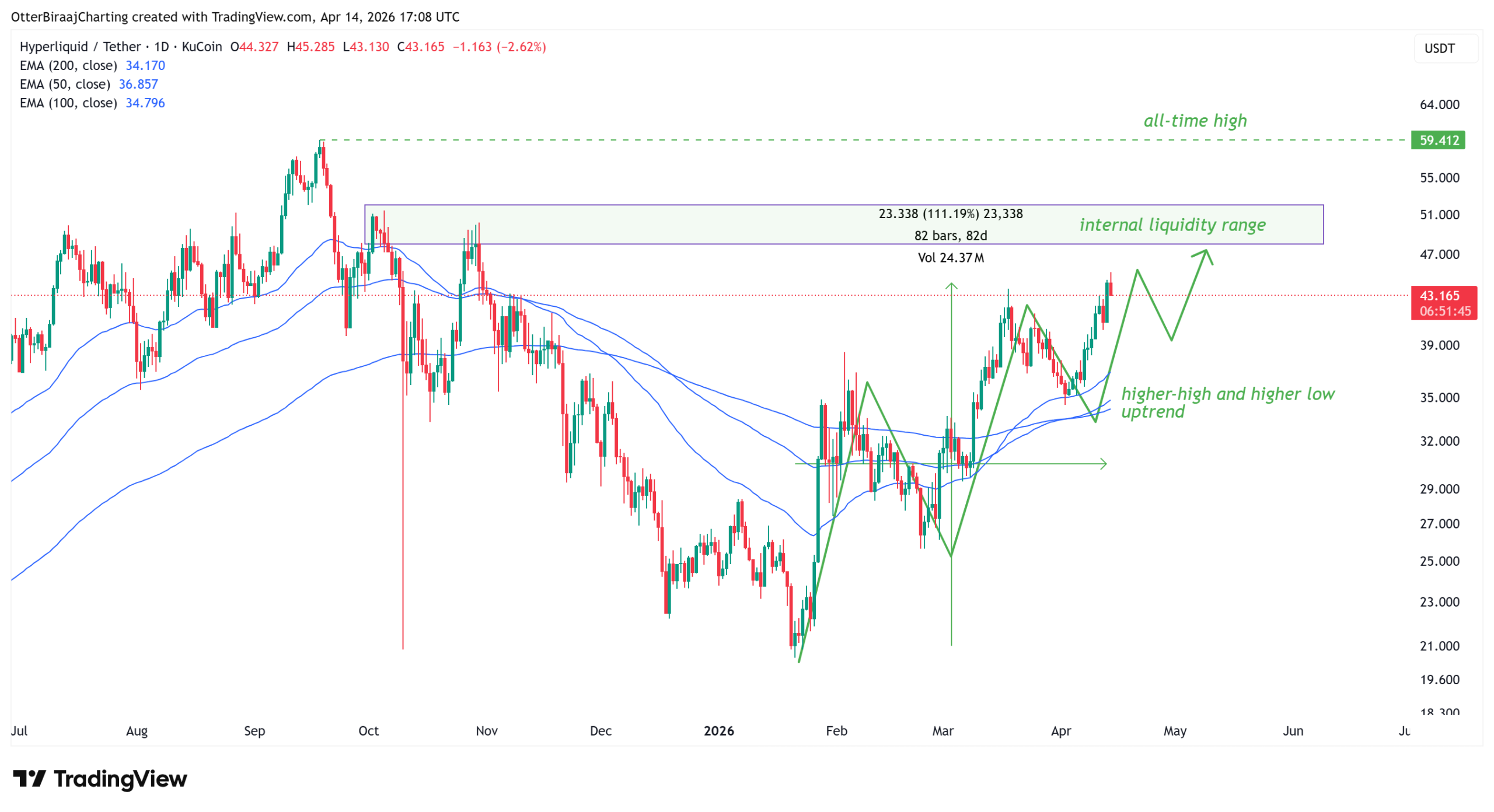
Hyperliquid’s native token HYPE (HYPE) re-tested $45 on Tuesday, marking its highest value since October 31, 2025. The rally extends a 108% rally from its yearly low at $21 on Jan. 21.
With HYPE price pushing toward all-time highs, market demand signals remain mixed, as weak spot buying activity threatens to slow the rally’s momentum.

HYPE price trend and onchain data diverge
HYPE currently trades 26% below its all-time high of $59, with relatively thin resistance between the current levels and its peak. The next liquidity zone lies between $52 and $48 and could be reached if momentum sustains. However, the HYPE spot and futures trading data suggest the rally is not entirely conviction-driven.
The spot cumulative volume delta (CVD) has gradually declined to -$41.48 million, even as prices have risen. This divergence suggests the rally is being supported more by passive demand without aggressive spot buying.
Meanwhile, the futures CVD has stayed mostly flat near -$748 million over the past month, after recovering from lows near -$900 million.

The open interest (OI) has risen steadily to $1.38 billion, near local highs and signaling an increased market participation.
However, rising OI alongside weak futures CVD suggests traders may be in positions without strong conviction in the bullish price trend.
As a result, the market may become more vulnerable to sharp, liquidation-driven moves once the bullish trend fades.
Related: Tether launches self-custodial wallet with cloud backup option
BitMEX founder say HYPE may gain 200% by August
In March, BitMEX co-founder Arthur Hayes said HYPE could reach $150 if Hyperliquid expands its dominance in the futures market and its product suite.
Hayes’ thesis centers on the continued market-share gains from centralized exchanges and the rising protocol revenue.
Hyperliquid’s 30-day annualized revenue run rate stood at $843 million in March, and it would need to reach $1.4 billion by August. That implies a 66% increase within five months.
Hyperliquid allocates up to 97% of its revenue to buying HYPE from the open market, creating a direct link between trading activity and token demand.
HIP-3, a protocol upgrade enabling trading of non-crypto assets like commodities, contributes close to 10% of revenue and could drive further expansion, especially as assets like gold and oil gain traction on the platform.
RWA trading on Hyperliquid continues to reach new ATHs week after week, surpassing $2.3B in open interest pic.twitter.com/R9uDCAx3fo
— Hyperliquid (@HyperliquidX) April 6, 2026
The real-world asset (RWA) trading activity on Hyperliquid has also accelerated sharply, with open interest rising to $2.3 billion on April 6. This marks an increase of over 190% from March levels and nearly 800% from early-year lows.
This growth pace for the protocol and its market-share gains could play a key role in any extended price move for the altcoin.
Related: XRP consolidation may transform into explosive rally if $1.40 is topped: Data
This article is produced in accordance with Cointelegraph’s Editorial Policy and is intended for informational purposes only. It does not constitute investment advice or recommendations. All investments and trades carry risk; readers are encouraged to conduct independent research before making any decisions. Cointelegraph makes no guarantees regarding the accuracy or completeness of the information presented, including forward-looking statements, and will not be liable for any loss or damage arising from reliance on this content.
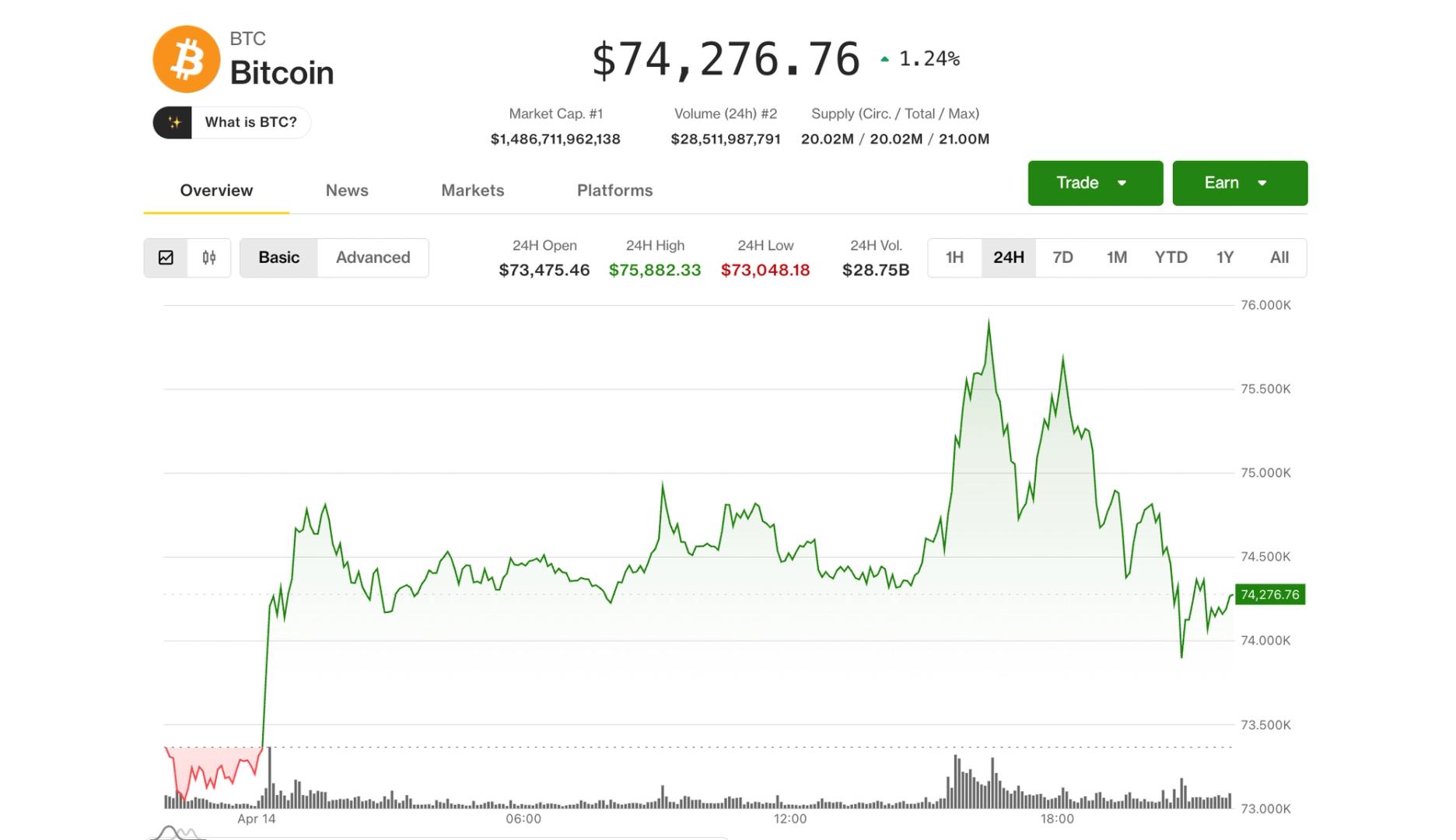
Bitcoin started the day with a promising chance for a breakout, but the rally fizzled out at a familiar brick wall that has kept a lid on prices for more than two months.
After briefly topping $76,000 — a key resistance level — the largest crypto reversed course, slipping below $74,000 later in the session. It still held onto a 1.3% gain over the past 24 hours, recently changing hands near $74,300.
Ether (ETH) followed a similar path, pulling back from above $2,400, but still outperformed, advancing 2.5% daily.
Traditional markets saw no such reversal, with the Nasdaq closing at its session high, up 2%. The S&P 500 rose 1.2% and now stands within a handful of points of hitting a new record high — a sharp contrast to bitcoin, which remains about 40% below its record of $126,000.
Still, the conditions are ripe for a squeeze higher in crypto even as Tuesday’s breakout didn’t hold.
According to Vetle Lunde, head of research at K33 Research, funding rates on Binance’s bitcoin perpetuals have remained negative for 11 consecutive periods despite the recent rally, signaling traders are still leaning bearish even as prices push higher. At the same time, open interest has been rising, suggesting new short positions are being added rather than closed, he said.
That combination has historically set the stage for sharp upside moves, he said.
The 30-day average funding rate has now been negative for 46 straight days, Lunde added, matching the extended bearish positioning seen during past market stress periods, such as after the FTX crash in late 2022 and the mid-2021 bear market when China banned bitcoin mining.
“Comparable risk-off regimes have historically been attractive entry points for BTC,” Lunde said, as crowded short trades were forced to unwind.


U.S. equities closed sharply higher on Tuesday, with the Nasdaq Composite climbing 1.96% and locking in gains for 10 consecutive trading days, underscoring renewed risk appetite in big‑cap technology.
Summary
- Nasdaq jumps nearly 2% to log 10 straight days of gains.
- Dow and S&P 500 also close higher, powered by mega‑cap tech.
- Chinese tech stocks rally, with iQIYI and JD.com surging in U.S. trading.
The S&P 500 added 1.1%, while the Dow Jones Industrial Average rose 0.66%, according to market data from Gate.
Chipmaker Nvidia and e‑commerce giant Amazon each advanced 3.8%, extending a powerful rebound in U.S. growth stocks that have led major indices back toward record territory. Electric‑vehicle maker Tesla also gained more than 3%, adding further momentum to the tech‑heavy Nasdaq’s winning streak.
The performance of these mega‑cap names continues to exert an outsized influence on U.S. benchmarks, with investors rotating back into longer‑duration growth assets as earnings optimism builds. Their simultaneous surge helped push the Nasdaq to its 10‑day run, a relatively rare stretch that points to strong short‑term bullish sentiment in the sector.
The Nasdaq Golden Dragon China Index, which tracks Chinese companies listed on U.S. exchanges, closed up 2.3% on the day. Within the basket, streaming platform iQIYI jumped 11%, while e‑commerce heavyweight JD.com soared nearly 8%, signaling renewed investor interest in U.S.‑traded Chinese tech.
The sharp move in Chinese ADRs highlights how global growth and tech narratives are increasingly intertwined across U.S. and Asian markets. As Wall Street’s rally broadens beyond U.S. mega‑caps, moves in indices such as the Golden Dragon China suggest investors are again willing to add exposure to higher‑beta internet and platform plays listed in New York.
TLDR
- High Roller Technologies announced plans to launch a U.S. prediction market in partnership with Crypto.com.
- The company will offer event-based contracts across finance, sports, and entertainment sectors.
- Crypto.com Derivatives North America will provide the infrastructure as a CFTC-registered exchange and clearinghouse.
- High Roller’s stock surged by as much as 130% following the announcement.
- The shares later traded about 65% higher at $8.32 during the same trading session.
High Roller Technologies Inc. announced plans to launch a U.S. event-based prediction market with Crypto.com. The announcement triggered a sharp rise in the company’s stock price. Investors responded immediately as shares surged during early trading.
ROLR Shares Surge After Prediction Market Plan
High Roller Technologies revealed its intention to introduce event contracts for U.S. customers. The Las Vegas-based online casino operator plans to offer contracts across finance, sports, and entertainment sectors.
The company confirmed that Crypto.com Derivatives North America will provide the event contracts. CDNA operates as a CFTC-registered exchange and clearinghouse in the United States.
Following the announcement, High Roller’s stock climbed as much as 130% during trading. Shares later stabilized, trading 65% higher at $8.32.
Company representatives emphasized regulatory compliance and operational readiness. A spokesperson stated, “This collaboration expands our product offering while adhering to U.S. regulatory standards.”
High Roller did not disclose a specific launch date for the prediction market. However, the company indicated that preparations for the rollout are already underway.
Market participants viewed the development as an expansion of High Roller’s digital gaming services. The company aims to integrate prediction markets into its existing customer platform.
Crypto.com Collaboration and Market Outlook
The partnership with Crypto.com strengthens High Roller’s entry into regulated prediction markets. Crypto.com’s affiliate, CDNA, will supply the infrastructure and clearing services.
Crypto.com’s CRO token reacted positively to the announcement. The token gained approximately 3% and traded near $0.07 following the news.
Prediction markets have evolved into platforms that aggregate probabilities of real-world events. Leading participants include Kalshi, a regulated U.S. exchange, and Polymarket, a decentralized marketplace.
High Roller stated that the prediction market sector could exceed $1 trillion in trading volume by 2030. The company highlighted increasing institutional and retail interest in event-based contracts.
Industry data indicates steady revenue growth within prediction markets. A recent Citizens report estimated annualized revenue above $3 billion.
The same report projected that revenues could reach $10 billion by 2030. These figures reflect expanding adoption across finance, sports, and entertainment categories.
High Roller reiterated its commitment to regulatory compliance and customer engagement. The company plans to provide accessible event contracts through its digital gaming ecosystem.
Crypto.com confirmed its role as infrastructure provider for the initiative. CDNA will manage trading and clearing operations once the platform becomes operational.
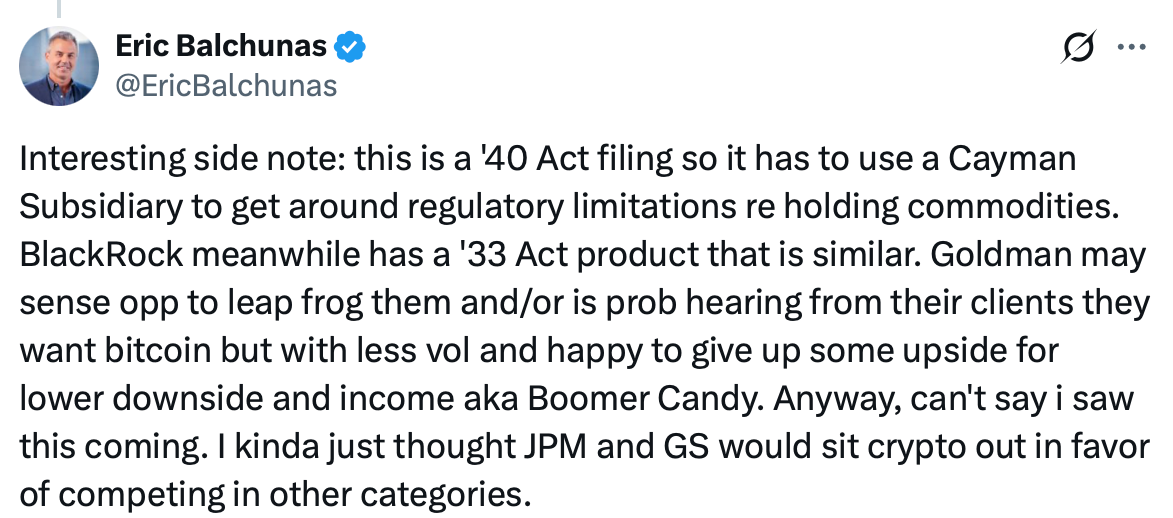
Goldman Sachs has filed with the US Securities and Exchange Commission (SEC) to launch a Bitcoin-linked exchange-traded fund designed to generate income while limiting exposure to the cryptocurrency’s volatility, according to a preliminary prospectus dated April 14.
The proposed Goldman Sachs Bitcoin Premium Income ETF would aim to deliver current income alongside capital appreciation by investing primarily in spot Bitcoin exchange-traded products (ETPs) and related options, rather than holding Bitcoin (BTC) directly.
The fund would generate yield by selling call options on Bitcoin-linked ETPs, a strategy that can produce premium income but may cap upside in rising markets.
According to the filing, the actively managed fund would maintain at least 80% exposure to Bitcoin-linked assets and could allocate as much as 25% of its holdings through a Cayman Islands subsidiary, a structure commonly used to gain commodities exposure under the US Investment Company Act.
The fund expects to vary its options “overwrite” strategy — that is, selling call options against its holdings — between roughly 40% and 100% of its Bitcoin exposure depending on market conditions, and may distribute a significant portion of returns as income or return of capital.
It would gain exposure through a mix of spot Bitcoin ETPs and derivatives, combining direct holdings with options-based positions. The strategy may perform better in flat or moderately rising markets but could underperform during strong rallies as upside is capped.
Eric Balchunas, ETF analyst at Bloomberg, described the product as “Boomer Candy” in a post on X, suggesting the structure may appeal to investors seeking income and lower volatility over full upside exposure.

Separately, Goldman Chair and CEO David Solomon told analysts on Monday that the company last week closed on its acquisition of Innovator Capital Management, an issuer of defined outcome exchange-traded funds. The addition of Innovator’s 170 ETFs puts Goldman in the top 10 of global active ETF providers, Solomon said on the first-quarter earnings call.
Related: Bitcoin ETFs clock $291M outflows as BTC blasts past $74K
Active crypto ETFs gain traction as strategies evolve beyond price tracking
The filing from Goldman Sachs comes as asset managers move beyond basic price-tracking crypto funds, with more complex and actively managed strategies gaining traction across the ETF market.
In January, Bitwise Asset Management launched an actively managed ETF designed to hedge against currency debasement. The fund allocates across assets including Bitcoin, precious metals and mining equities, reflecting a broader push to integrate digital assets into diversified, macro-focused portfolios.
In March, T. Rowe Price amended its filing with the SEC for a proposed actively managed crypto ETF that would invest directly in digital assets. The updated prospectus outlines a portfolio that may include assets such as Bitcoin, Ethereum (ETH) and Solana (SOL).
Fund issuer 21Shares is also expanding into more sophisticated strategies. In February, the company launched a Europe-listed ETP tied to Strategy’s preferred stock (STRC), offering exposure to a yield-generating instrument linked to the company’s Bitcoin-focused capital strategy.
Speaking to Cointelegraph, 21Shares President Duncan Moir said the shift reflects broader demand for more advanced products, noting that crypto is “particularly well-suited to active management.”
According to a March report compiled by Morningstar and Goldman Sachs Asset Management, active ETFs held nearly $1.8 trillion in assets globally at the end of 2025, with flows significantly outpacing passive products.

Magazine: Should users be allowed to bet on war and death in prediction markets?

Former Treasury head Hank Paulson says Trump-Xi meeting at risk over Iran war
Kraken Moves Toward IPO as Valuation Drops to $13.3B

Bold and the Beautiful: Ivy’s Epic Meltdown – Fired and Brutally Kicked Out of the Family!


-

 Politics4 days ago
US brings back mandatory military draft registration
-
 Sports4 days ago
Man United discover Nico Schlotterbeck transfer fee as defender reaches Dortmund agreement
-

 Fashion4 days ago
Weekend Open Thread: Veronica Beard
-

 Tech7 days ago
How Long Can You Drive With Expired Registration? What Florida Law Says
-

 Politics5 days ago
Malcolm In The Middle OG Turned Down ‘Buckets Of Money’ To Appear In Reboot
-

 Politics2 days ago
World Cup exit makes Italy enter crisis mode
-

 Crypto World5 days ago
Canary Capital Files SEC Registration for PEPE ETF
-

 Business4 days ago
Tesla Model Y Tops China Auto Sales in March 2026 With 39,827 Registrations, Beating Cheaper EVs and Gas Cars
-

 Crypto World1 day ago
The SEC Conditionalises DeFi Platforms to Be Avoided for Broker Registration
-

 Crypto World23 hours ago
SEC Signals Exemption for Crypto Interfaces From Broker Registration
-

 Crypto World6 days ago
Bitcoin recovers as US and Iran Agree a Ceasefire Deal
-
 NewsBeat2 days ago
Pep Guardiola and Gary Neville agree over Arsenal title problem that benefits Man City
-

 Business4 days ago
OpenAI Halts Stargate UK Data Centre Project Over Energy Costs and Copyright Row
-

 Business3 days ago
Ireland Fuel Protests Enter Day 5 as Blockades Spark Shortages and Government Prepares Support Package
-

 Politics5 days ago
LBC Presenter Mocks Trump Over Iran War Failures
-

 Crypto World4 days ago
Federal judge blocks Arizona from bringing criminal charges against Kalshi
-
 NewsBeat3 days ago
JD Vance announces ‘no agreement’ with Iran over nuclear weapons fear
-

 Tech5 days ago
A version of Windows 10 released a decade ago is now eligible for additional security patches
-

 Crypto World16 hours ago
SEC Proposes Certain Crypto Interfaces Don’t Need to Register as Brokers
-

 Business4 days ago
IMF retains floor for precautionary balances at SDR 20 billion
You must be logged in to post a comment Login