

Crypto World
Bitcoin Bulls Rally as Momentum Surges, Still Tough to Top $78K


error code: 524
This article was originally published as Bitcoin Bulls Rally as Momentum Surges, Still Tough to Top $78K on Crypto Breaking News – your trusted source for crypto news, Bitcoin news, and blockchain updates.

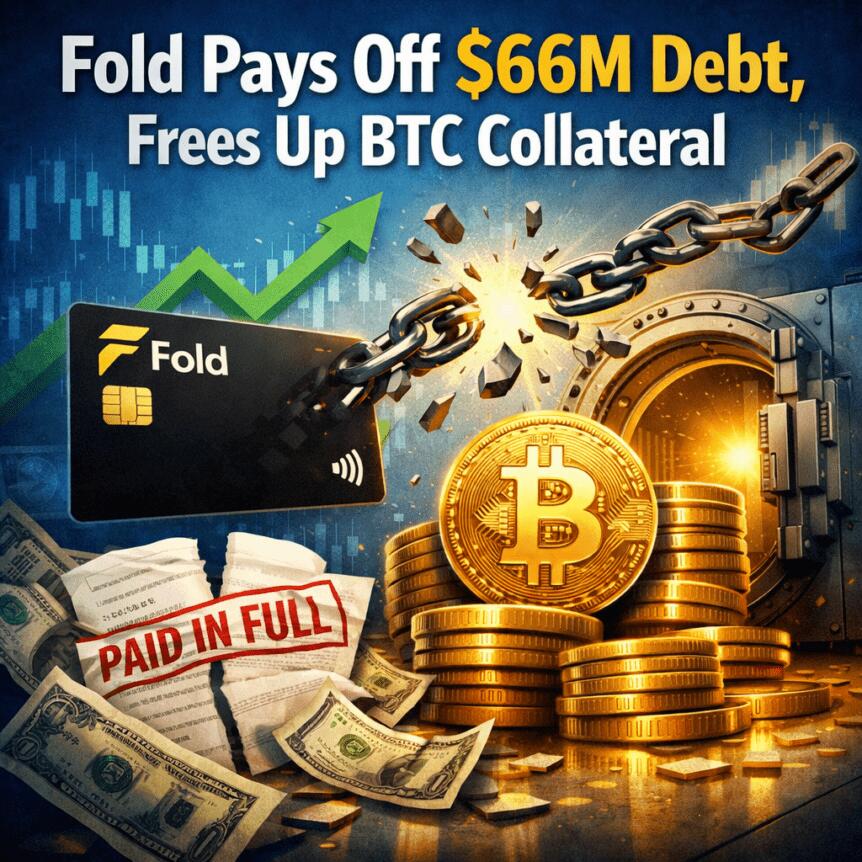
Fold, a Nasdaq-listed Bitcoin financial services firm, has removed a major liability from its balance sheet after eliminating $66.3 million in convertible debt. The move also released 521 Bitcoin previously pledged as collateral, giving the company direct access to assets that had been locked against its financing obligations. By removing convertible notes that could have been turned into equity, Fold has reduced potential share dilution while gaining more operational flexibility. The restructuring comes as the company prepares to expand its consumer-facing product lineup, including a Bitcoin rewards credit card designed to attract mainstream users interested in accumulating digital assets through everyday spending.
Key takeaways
- Fold retired $66.3 million in convertible debt, removing the possibility of future equity dilution tied to those notes.
- The repayment freed 521 Bitcoin previously used as collateral, restoring full corporate control over the assets.
- With the debt eliminated, the company says it now operates under fewer financing constraints.
- Fold is preparing to launch a consumer Bitcoin rewards credit card as part of its growth strategy.
- The firm became publicly listed in February 2025 after completing a SPAC merger with FTAC Emerald Acquisition.
- Competition among crypto rewards cards is intensifying, with multiple platforms offering similar spending incentives.
Tickers mentioned: $BTC, $FLD
Sentiment: Neutral
Price impact: Neutral. The balance sheet improvement may strengthen fundamentals, but no immediate market reaction is indicated.
Market context: Crypto-financial companies are increasingly exploring debit and credit card products that reward users in digital assets, reflecting broader efforts to integrate cryptocurrency with everyday payments.
Why it matters
Balance sheet restructuring can significantly affect how financial technology companies operate in volatile markets. By removing convertible debt, Fold eliminates a potential source of dilution that could have impacted shareholders if the notes were converted into stock. For investors, this simplifies the company’s capital structure and clarifies its long-term financial obligations.
The release of more than 500 Bitcoin also increases the firm’s strategic flexibility. Digital asset reserves can be used for corporate operations, liquidity management or ecosystem initiatives, particularly as competition among crypto-financial platforms continues to intensify.
More broadly, Fold’s focus on rewards-based Bitcoin accumulation highlights a growing trend within the industry. Instead of positioning cryptocurrency primarily as a speculative asset, many platforms are now embedding it within consumer finance tools, potentially accelerating mainstream adoption.
What to watch next
- The rollout timeline and adoption metrics for Fold’s planned Bitcoin rewards credit card.
- How the newly released Bitcoin holdings are allocated within the company’s corporate strategy.
- Potential financial disclosures showing the impact of the debt restructuring on Fold’s balance sheet.
- Competitive responses from other crypto card providers expanding into consumer payment services.
Sources & verification
- Fold’s official disclosure announcing the elimination of its convertible debt.
- Public filings and investor communications regarding the company’s capital restructuring.
- Market data showing Fold’s share performance following its Nasdaq listing.
- Public announcements from crypto payment platforms offering reward-based cards.
Fold removes debt overhang as crypto rewards competition intensifies
Fold, a publicly traded financial technology company focused on Bitcoin (CRYPTO: BTC) services, has eliminated $66.3 million in convertible debt, a move that simplifies its financial structure and restores access to digital assets that had previously been pledged as collateral. The decision removes a potential source of future shareholder dilution while improving the company’s operational flexibility as it prepares to expand its consumer products.
According to the company’s disclosure, Fold repaid two outstanding convertible notes. These financial instruments allow lenders to convert debt into equity at a later date under predetermined terms. While such financing can provide early-stage capital, it also carries the possibility of share dilution if creditors exercise conversion rights.
By retiring the notes entirely, Fold removed that risk. The company’s management indicated that the repayment strengthens the balance sheet and clarifies its capital structure, which can be particularly important for publicly traded firms navigating volatile market conditions.
The restructuring also released 521 Bitcoin that had been locked as collateral for the debt. With the notes settled, the digital assets are no longer encumbered and can be redeployed for corporate use. This may include treasury management, strategic initiatives or other operational needs as the company continues expanding its services.
Access to those holdings could become increasingly important as Bitcoin-focused financial companies look to build new products around digital asset accumulation and spending. While Fold has not detailed how it intends to deploy the newly available BTC, the company emphasized that the removal of financing restrictions provides greater flexibility for future initiatives.
Founded in 2019, Fold built its reputation through a consumer rewards platform that allows users to earn Bitcoin while making everyday purchases. The company’s core offering includes a debit card linked to a rewards system in which spending in traditional currency generates BTC cashback instead of points or fiat rewards.
That model aims to encourage gradual accumulation of cryptocurrency without requiring users to directly buy or trade digital assets. For many consumers, rewards-based programs offer a simpler entry point into the crypto ecosystem.
Fold entered public markets in February 2025 following a special purpose acquisition company merger with FTAC Emerald Acquisition. The transaction resulted in Fold shares trading on the Nasdaq under the ticker FLD (NASDAQ: FLD), making it one of the first companies dedicated to Bitcoin-based financial services to list on a major US exchange.
Since its public debut, the company has faced the same volatility affecting many crypto-related equities. Market data shows that the stock has declined significantly since listing, reflecting broader market uncertainty and the fluctuating performance of digital asset markets.
Despite these challenges, Fold continues to focus on expanding its consumer-facing offerings. One of the company’s most anticipated upcoming products is a Bitcoin rewards credit card. Unlike the existing debit-based rewards system, the new card would allow customers to accumulate BTC through credit purchases, potentially increasing engagement and transaction volumes.
The launch comes amid rising competition in the crypto rewards card market. Several companies are now targeting consumers who want exposure to digital assets through everyday financial tools rather than direct trading.
For example, the Coinbase Card enables users to spend cryptocurrency balances while earning crypto rewards on transactions. The product forms part of Coinbase’s broader strategy to integrate payments, trading and financial services into a unified digital platform.
Other providers have adopted slightly different models. The Nexo Card allows customers to borrow against their crypto holdings and spend fiat without liquidating their assets, while still earning rewards on purchases.
Meanwhile, exchanges such as Bybit and Crypto.com offer Visa-branded cards that distribute rewards in tokens associated with their platforms. These products aim to create loyalty incentives while also encouraging users to remain within each company’s ecosystem.
Traditional financial networks are also entering the space. Mastercard has collaborated with MetaMask to introduce a crypto-linked payment card that converts digital assets into fiat at the point of sale, enabling purchases at any merchant accepting Mastercard.
Such developments highlight the increasing overlap between cryptocurrency infrastructure and mainstream financial services. As payment networks, fintech firms and exchanges compete for users, reward-based incentives have become a central strategy for attracting and retaining customers.
Fold’s debt repayment and product expansion plans therefore arrive at a time when the sector is becoming more crowded and technologically advanced. The company’s focus on Bitcoin accumulation rather than direct spending positions it somewhat differently from competitors that emphasize transactional crypto payments.
Whether that strategy resonates with a broader consumer base will depend on adoption of its forthcoming credit card and the effectiveness of its rewards program. If successful, the model could appeal to users who prefer gradually earning Bitcoin through spending rather than purchasing it outright.
For now, the elimination of convertible debt represents a structural improvement for Fold’s financial position. By removing potential dilution and reclaiming control of its BTC collateral, the company has taken a step toward strengthening its balance sheet at a time when crypto-focused businesses continue to navigate rapidly evolving market dynamics.
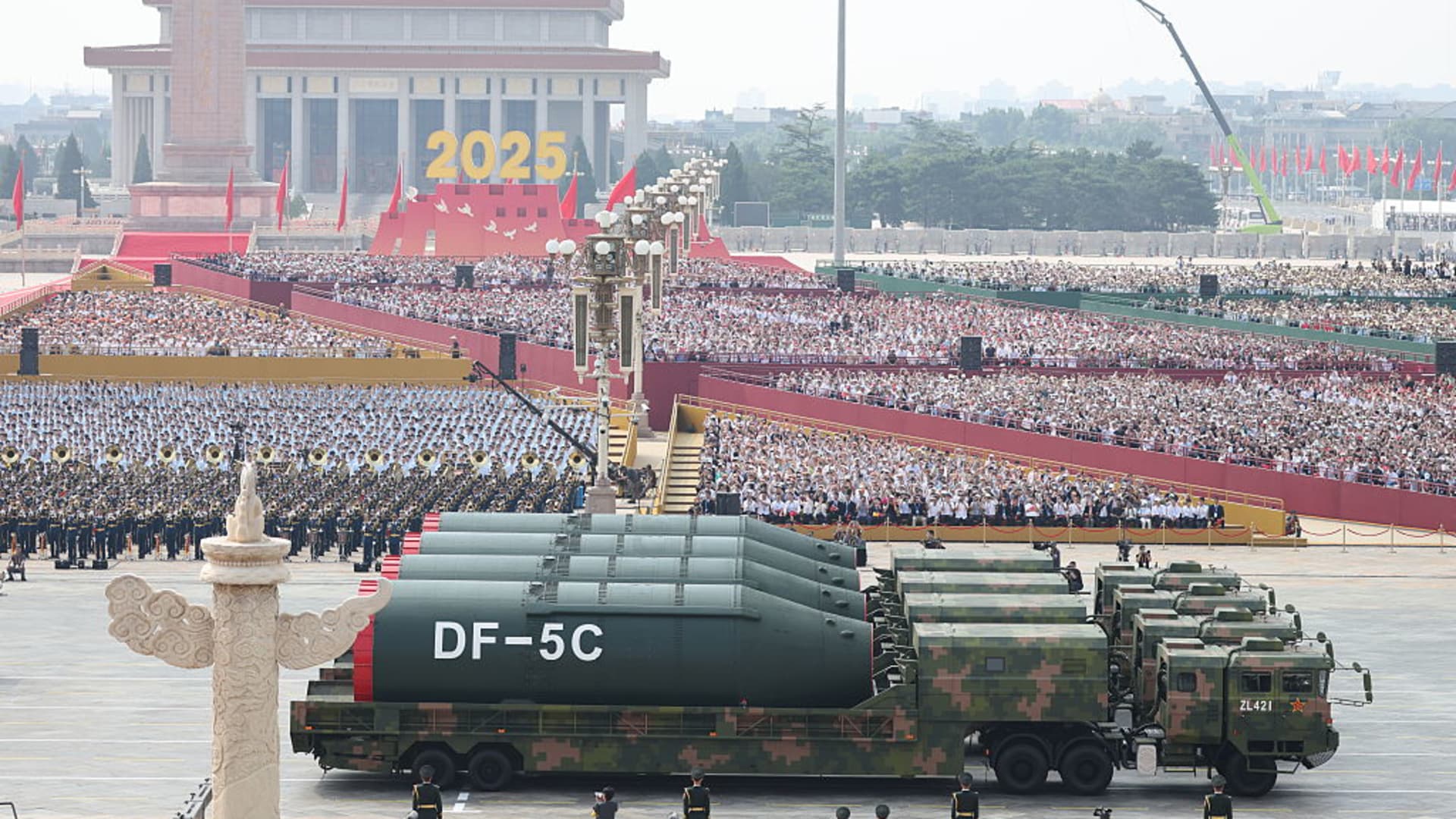
China’s liquid-fueled intercontinental strategic nuclear missiles DongFeng-5C, which have a global strike range, pass through Tian’anmen Square during the V-Day military parade on September 3, 2025 in Beijing, China.
China News Service | China News Service | Getty Images
BEIJING — China plans to increase its defense spending by 7% this year, Reuters reported Thursday, citing official documents due for public release later in the day.
That would mark the slowest increase in its annual military expenditure since 2021.
The proposal comes as conflict in the Middle East has escalated, amid a broader rise in geopolitical tensions.
For the last three years, China has budgeted a 7.2% annual increase in defense spending. Beijing had increased spending by 7.1% in 2022 and 6.8% in 2021, according to official data.
China will support the faster development of advanced combat capabilities, Reuters said, as well as the “high-quality” modernization of its national defense and armed forces.
Some of Beijing’s latest weapon systems, including long-range missiles, were displayed during a military parade in September.
China is set to kick off its 8-day National People’s Congress on Thursday, an annual parliamentary meeting that officially approves the budget and development goals for the year.
Last year, China proposed a national defense budget of 1.78 trillion yuan ($244.99 billion at the time).
Beijing accounted for nearly 44% of Asia’s defense spending in 2025, up from 39% in 2017, according to the International Institute for Strategic Studies.
China is also second to the U.S. in terms of military spending.
The U.S. budgeted $849.77 billion for defense during the 2025 fiscal year. But estimates from non-profit USAFacts indicate the U.S. ended up spending about $919.2 billion during that time, up 2% from the prior year and accounting for 13% of the federal budget.
Kraken has secured a Federal Reserve “master account,” giving its banking arm direct access to the Fed’s core payment systems and making it the first crypto firm to operate on the same rails as traditional financial institutions.
The company said its unit, Kraken Financial, received approval for a Federal Reserve “master account,” the Wall Street Journal first reported. The account provides direct access to Fedwire, a major interbank payment network that processes trillions of dollars in transfers each day.
Until now, Kraken had to rely on partner banks to send or receive U.S. dollars. Direct access changes that flow as the firm can now settle payments itself, which may speed up deposits and withdrawals for large traders and institutional clients.
“This approval is a watershed moment for the digital asset industry,”U.S. Senator Cynthia Lummis said in a press release.
“The Federal Reserve has acknowledged what I’ve always said was the case — that a digital asset company can balance innovation with strong risk management,” she added. “[This] is going to create the 21st century financial services industry.”
Kraken Financial operates under a Wyoming charter designed for crypto-focused banks. The Federal Reserve Bank of Kansas City oversaw the application.
“This news has been a long time coming, but Wyoming welcomes it nonetheless,” said Wyoming Governor Mark Gordon. “This approval of a master account for Kraken by the Federal Reserve signals support for Wyoming’s banking and digital asset laws.”
The approval is limited, however. Kraken will not receive the full set of services available to traditional banks, as it won’t earn interest on reserves or tap the Fed’s emergency lending.
Kraken, a cryptocurrency exchange founded in 2011, has been slowly moving towards an initial public offering (IPO). Several of its rivals, including Gemini, Coinbase, and CoinDesk’s parent company Bullish, have already made their public market debut.
Its parent company, Payward, has been on an acquisition spree, adding the token management platform Magna last month. Last year, it acquired U.S. futures trading platform NinjaTrader for $1.5 billion and U.S.-licensed derivatives trading venue Small Exchange for $100 million.
It also moved into the tokenization space with the acquisition of tokenized stock specialist Backed Finance, the issuer of xStocks.
UPDATE (March 4, 3:55pm UTC): Adds comments from Cynthia Lummis’ press release.
Crypto World
Alchemy Pay Obtains Delaware MTL, Reaches 15 U.S. State Licenses for Fiat-Crypto Payments

TLDR:
- Alchemy Pay now holds Money Transmitter Licenses in 15 U.S. states after securing Delaware approval.
- The Delaware MTL authorizes Alchemy Pay to offer regulated money transmission services in the state.
- Alchemy Pay plans to launch a stablecoin and develop Alchemy Chain, backed by its growing MTL network.
- Beyond the U.S., Alchemy Pay holds regulatory approvals in Australia, South Korea, Switzerland, and Hong Kong.
Alchemy Pay has received a Money Transmitter License in Delaware, marking another regulatory step in the United States.
The fiat-crypto payment company now holds such licenses in 15 states nationwide. Delaware law requires entities transmitting money to be licensed under the state bank commissioner’s office.
This approval supports Alchemy Pay’s broader goal of building a compliant payment infrastructure across the country, including future plans for a stablecoin and a dedicated blockchain network.
Expanding Regulated Operations Across U.S. States
Under Delaware law, transmitting money through checks, drafts, or monetary instruments is a regulated activity. Businesses must operate under the Delaware Office of the State Bank Commissioner.
Alchemy Pay has fulfilled these requirements and now holds a valid license. It can therefore offer fully compliant money transmission services within the state.
The Delaware approval brings the company’s total U.S. MTL count to fifteen states. The list includes Arkansas, Iowa, Minnesota, New Hampshire, New Mexico, Oklahoma, Oregon, and Wyoming. Arizona, South Carolina, Kansas, West Virginia, South Dakota, and Nebraska also hold Alchemy Pay MTLs. More state applications remain active and are currently under regulatory review.
Alchemy Pay announced this milestone on social media, confirming the company’s progress:
“With this approval, #AlchemyPay now holds MTLs in 15 U.S. states, further strengthening its compliant fiat-crypto payment infrastructure and laying the groundwork for future stablecoin initiatives.”
This wider regulatory coverage helps the company reach more users across the country. It also supports access to compliant fiat-crypto on-ramps and off-ramps at a larger scale. The continued expansion reflects a deliberate, compliance-first growth strategy.
These licenses also lay the groundwork for Alchemy Pay’s future financial products. The company plans to launch a proprietary stablecoin, which requires strong regulatory backing.
It is also developing Alchemy Chain, a blockchain infrastructure built around stablecoin use. Both initiatives depend on the compliance foundation that these MTLs are building.
Regulatory Progress Extends Across Global Markets
Alchemy Pay has also made meaningful regulatory progress in markets outside the U.S. The company registered as a Digital Currency Exchange Provider in Australia.
In South Korea, it completed an Electronic Financial Business registration. Both approvals strengthen its position in key Asia-Pacific financial markets.
In Switzerland, Alchemy Pay joined the VQF, a recognized Self-Regulatory Organisation. This admission places the company within a well-established Swiss financial oversight framework.
The VQF is an official SRO recognized by Swiss regulators. Membership confirms that the company meets quality assurance standards in Swiss financial services.
The company also gained regulated exposure to Hong Kong’s financial market. It did so through an investment in HTF Securities Limited.
HTF holds Hong Kong SFC Type 1, 4, and 9 licenses. This indirect participation adds another regulated market to Alchemy Pay’s global reach.
Taken together, these approvals show a pattern of consistent regulatory engagement worldwide. Alchemy Pay has pursued compliance across different legal systems and financial frameworks.
Each approval reinforces the company’s credibility with regulators, users, and institutional partners. The strategy positions the company to support the next generation of global digital payments.


Coupang Pay, the fintech arm of South Korean e-commerce giant Coupang, is actively recruiting in-house legal counsel specializing in stablecoins. The hiring signals a significant escalation in the company’s digital asset ambitions.
The move positions Coupang as one of Asia’s most aggressive non-financial corporations to bet on stablecoin infrastructure ahead of imminent Korean legislation.
Legal Team as Strategy Unit
The company posted two simultaneous job listings on its careers page. One targets junior attorneys within two years of qualification. The other seeks senior or principal-level counsel with at least three years of relevant experience. Both postings list identical responsibilities across three areas: domestic fintech payments, stablecoin and virtual asset regulation, and global payment partnerships.
The stablecoin-specific duties are notably detailed. Candidates will review business structures for stablecoin issuance, utilization, and distribution. They will also handle regulatory engagement with Korea’s Financial Intelligence Unit and the Financial Services Commission. The senior role adds a telling requirement: the ability to “translate new regulatory domains into business opportunities.”
Coupang Pay framed its legal team in explicitly strategic terms. The team “designs new business models while maintaining regulatory compliance,” the company said in its postings. That language positions the legal function closer to a product strategy unit than a traditional compliance department.
Already Inside the Infrastructure
Listed on the New York Stock Exchange, Coupang operates across South Korea and Taiwan and regularly remits significant sums to its US parent.
Coupang is no stranger to stablecoin infrastructure. In the second half of 2024, the company joined as an early partner of Tempo, a Layer 1 blockchain developed by Stripe. Tempo is purpose-built for stablecoin payments. Partners, including Visa, Deutsche Bank, and Standard Chartered, have been piloting real-world payment environments on-chain since late last year.
The financial incentive is clear. Coupang recorded approximately $33 billion in revenue last year. Assuming a 1% card fee rate, stablecoin adoption could save roughly $340 million annually. Cross-border remittance costs to its US parent add further pressure. Industry estimates put total annual savings between $155 million and $200 million, even after infrastructure costs.
Coupang operates across South Korea and Taiwan, where it also runs the Farfetch luxury platform. The job postings explicitly mention Coupang Taiwan, Farfetch, and a “global integrated app” as targets for overseas payment legal review. This suggests stablecoin integration is being planned well beyond Korea’s borders.
Legislative Tailwind, Political Headwind
The timing aligns with Korea’s legislative calendar. South Korea’s ruling party and the National Assembly are actively discussing a regulatory framework for KRW-backed stablecoin issuance, though no legislation has been finalized. It would mark the first time domestic won-denominated stablecoin issuance has been legally permitted in nearly nine years.
However, Coupang carries political baggage into this push. The company faced significant backlash last year following a personal data leak incident. Its decision to conduct an internal “self-investigation” rather than cooperate fully with regulators drew sharp criticism. Industry observers note this friction could slow domestic regulatory approvals for new financial services.
Korea’s stablecoin race is accelerating. Coupang appears determined not to be left behind.
GMX DAO has approved a plan to redirect rewards and concentrate liquidity on its own rails.
Summary
- GMX DAO will send a larger share of protocol rewards to its treasury instead of direct staking payouts.
- The plan concentrates liquidity on GMX-native infrastructure rather than relying on external venues to set the market.
- GMX traded higher alongside broader DeFi tokens as on-chain volumes and open interest rose with Bitcoin (BTC) reclaiming key levels.
GMX DAO has passed a proposal to overhaul how value flows through the derivatives protocol, aiming to restore clearer price discovery and reduce dependence on centralized exchanges and fragmented liquidity pools. Under the new framework, a larger portion of protocol rewards will be routed to the DAO treasury instead of going straight to stakers, giving the community more flexibility to fund buybacks, incentives, and long-term development. At the same time, liquidity is being steered toward GMX’s own infrastructure, with an emphasis on deeper native markets rather than thin order books scattered across multiple venues. Backers of the proposal argue that concentrating liquidity and control inside the protocol can make prices less vulnerable to abrupt swings driven by external market makers and short-term speculative flows.
The changes come after a period in which GMX’s token performance lagged broader market rebounds, even as volumes on leading perpetuals venues climbed and blue-chip DeFi names saw renewed interest. Community discussions highlighted concerns that incentives were overly focused on short-term yield and that too much effective price discovery was occurring off-platform, where order flow and liquidity conditions are harder for the DAO to influence. By building a larger treasury and emphasizing native liquidity, GMX is attempting to align token economics more tightly with the actual usage and profitability of the protocol. The move echoes steps taken by other DeFi projects listed on platforms like Coinbase, which have shifted toward models that prioritize sustainable fee capture over aggressive emissions.
Protocol value and market structure
From a market-structure perspective, the GMX decision reflects a broader trend in DeFi, where protocols are reassessing how they balance user incentives, governance, and long-term resilience. Rather than relying on perpetual token emissions or external liquidity mining, more projects are experimenting with treasury-driven strategies, dynamic fee sharing, and targeted buybacks. This approach is influenced in part by the growing presence of institutional actors and payment firms that demand more predictable frameworks, similar to how companies like Visa structure reward flows and capital allocation in traditional finance. For GMX, building a sizable treasury war chest creates optionality: the DAO can respond to market stress, fund new product lines, or adjust incentive schemes without having to dilute holders through new token issuance.
The timing of the shift also intersects with a healthier, spot-led environment in major crypto assets such as Bitcoin (BTC), where leverage has normalized and ETF-driven flows are stabilizing. In that context, a derivatives protocol’s ability to offer deep, reliable on-chain markets becomes more important than simply broadcasting high nominal yields. As regulatory frameworks like MiCA advance and exchanges refine their listings of DeFi tokens, projects with transparent, treasury-backed value flows may be better positioned to attract both retail and professional liquidity. For GMX holders and users, the key question is whether the new model can translate into tighter spreads, more robust on-chain volumes, and a stronger link between protocol revenue and token performance without sacrificing the competitive incentives that first drew traders to the platform.
error code: 524
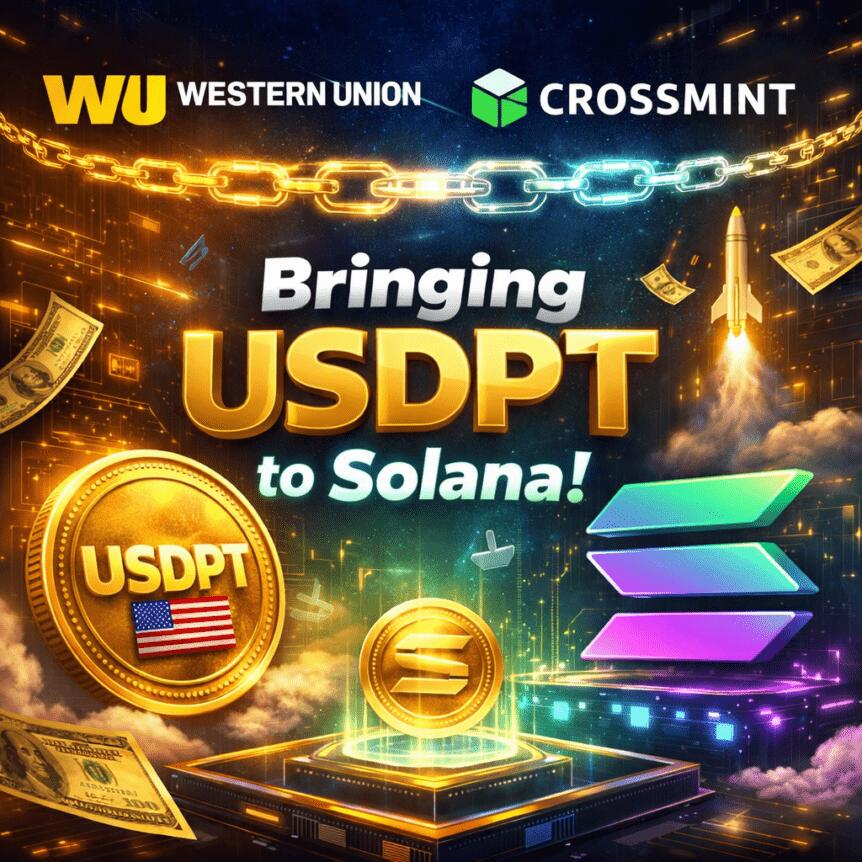
This article was originally published as Western Union Partners with Crossmint to Bring USDPT to Solana on Crypto Breaking News – your trusted source for crypto news, Bitcoin news, and blockchain updates.
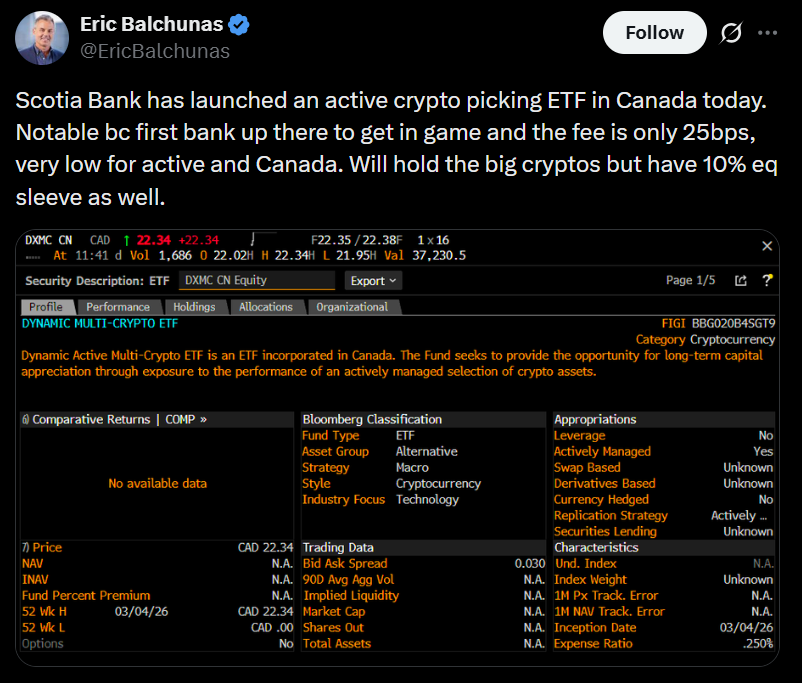
The bank’s asset manager and 3iQ debut an actively managed crypto ETF to Canadian investors, offering exposure to Bitcoin, Ether, Solana and XRP at a competitive 0.25% fee.
Scotiabank, one of Canada’s top-five banks by assets, has launched a new cryptocurrency exchange-traded fund in partnership with digital asset manager 3iQ, highlighting growing institutional adoption in a market that approved spot Bitcoin ETFs years before the United States.
Dynamic Funds, Scotiabank’s asset management arm, unveiled the Dynamic Active Multi-Crypto ETF on Wednesday. The liquid alternative fund will trade on Cboe Canada under the ticker DXMC, offering investors exposure to several digital assets, including Bitcoin (BTC), Ether (ETH), Solana (SOL) and XRP (XRP).
Bloomberg ETF analyst Eric Balchunas described the launch as highly competitive from a fee perspective. Dynamic said it reduced the fee from 0.45% to 0.25% until March 1, 2027.

Multi-asset crypto ETFs are gaining popularity because they offer investors exposure to a basket of digital assets within a single fund. Instead of buying and storing tokens individually on cryptocurrency exchanges, investors can access multiple assets through a single regulated product traded on a traditional stock exchange.
Related: Canada’s CIRO formalizes interim crypto custody framework
Canada’s early lead in crypto ETFs
While ETFs have dominated the conversation in the United States, especially after regulators approved nearly a dozen spot Bitcoin ETFs in early 2024, Canada was actually an early mover in the asset class, with companies like 3iQ leading the charge.
The asset manager launched one of the world’s first publicly traded spot Bitcoin funds in Canada in 2021, years before the US Securities and Exchange Commission approved similar products. The fund quickly surpassed 1 billion Canadian dollars in assets under management, a notable milestone in that country’s smaller ETF market.
Canada has since expanded its crypto ETF market to include spot Ether (ETH) funds and other digital-asset products listed on exchanges such as the Toronto Stock Exchange and Cboe Canada, giving investors regulated exposure to several major cryptocurrencies.
As Cointelegraph previously reported, 3iQ was recently acquired by Japanese cryptocurrency exchange Coincheck for $111.84 million. The deal is expected to close in the second quarter of this year.
Related: Spot Bitcoin ETFs see $458M in inflows as Mideast conflict widens


The Sui Foundation has introduced USDsui, a native stablecoin built to power digital payments and decentralized finance across the Sui network.
Summary
- Sui Foundation and Bridge launched USDsui on mainnet on March 4, 2026.
- The stablecoin is issued through Stripe’s infrastructure and supports DeFi and cross-border payments.
- Sui processed over $111B in stablecoin transfers in January 2026, supporting large-scale adoption.
The token went live on mainnet on March 4, 2026. USDsui is issued through Bridge, a subsidiary of Stripe, using its Open Issuance platform.
The platform offers robust enterprise controls and built-in compliance features, enabling institutions to gain better oversight. At launch, several popular decentralized finance apps and Sui (SUI) wallets were integrated with USDsui, making it easily accessible.
Built for high-volume payments
USDsui was designed for speed and efficiency, so transactions settle quickly with low, predictable fees. Companies and developers can access on-chain liquidity directly, which helps them build scalable financial and payment tools.
Transactions are kept within the Sui network, which is expected to simplify peer-to-peer payments, cross-border transfers, and remittances. Users can move value natively within the ecosystem instead of relying on third-party stablecoins.
Sui has been making waves due to its scalability and speed. In January 2026 alone, the network handled over $111 billion in stablecoin transactions, indicating the growing demand for a reliable payment system on Sui.
Meanwhile, Bridge’s issuance framework is streamlining the launch of compliant digital assets. This approach allows stablecoins to go live faster while still adhering to established regulatory guidelines.
Growing adoption in DeFi and institutions
Momentum around USDsui is building. Across several prominent DeFi protocols on Sui, the stablecoin is now live for lending, trading, and liquidity provision. To jumpstart activity, several platforms have introduced incentive programs designed to attract early users and deepen liquidity.
Sui has also attracted more institutional interest. Products connected to the network have been introduced by investment firms such as Bitwise Asset Management, Franklin Templeton, Grayscale Investments, and VanEck. Traditional investor access was further expanded when U.S.-listed Sui staking ETFs started trading in February 2026.
With steady network growth, institutional-grade infrastructure, and rising investor participation, USDsui is positioned to play a central role in payments and settlement on Sui. Over time, it may serve as a bridge between traditional finance and on-chain markets.
Crypto World
The crypto crowd is so convinced this rally is a fakeout, it might trigger short squeeze
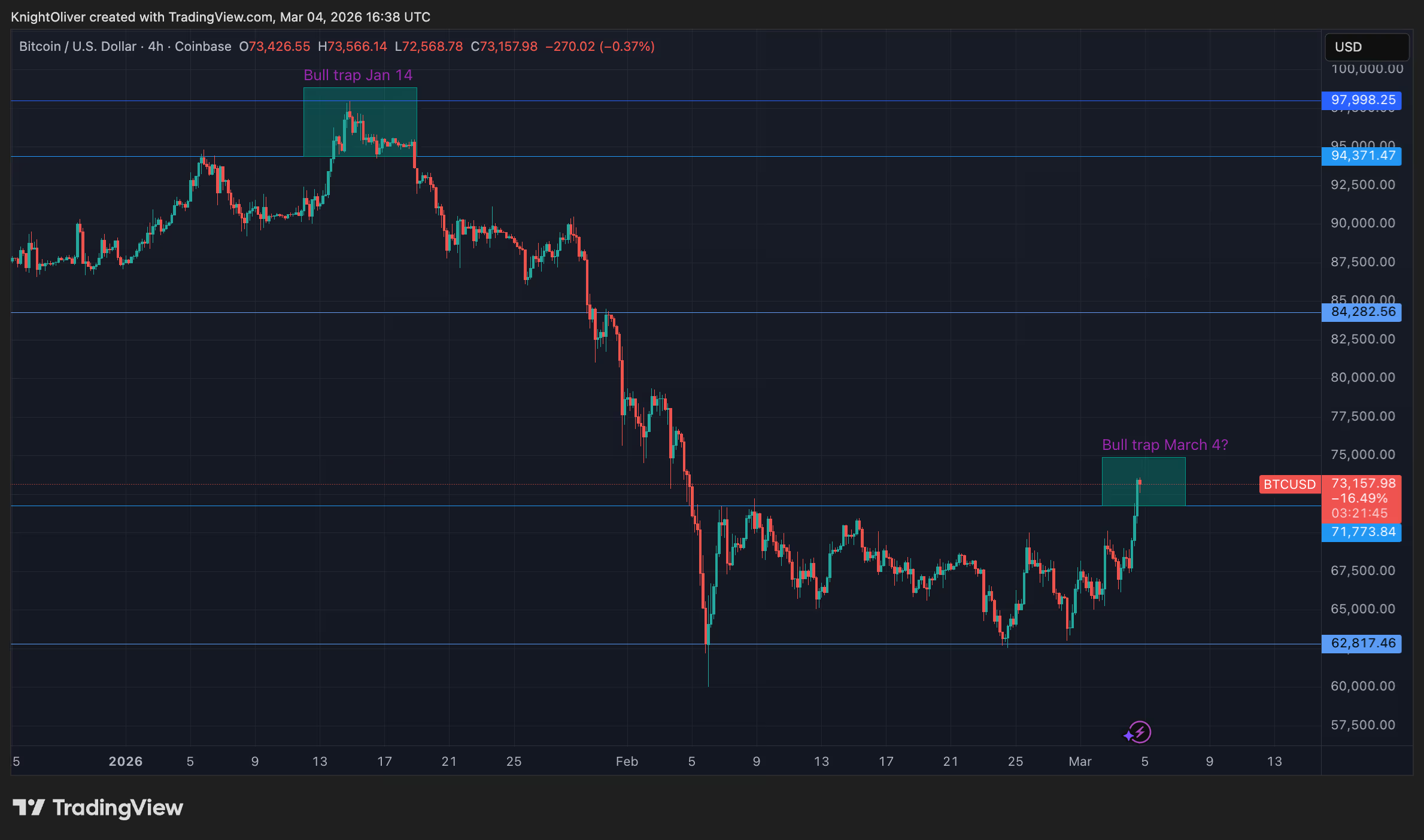
Bitcoin pushed above $73,000 this week, reclaiming a key psychological level that had capped the market for weeks. Yet the breakout has been met with an unusual reaction across crypto markets: widespread skepticism.
Many traders are warning that the move could become a classic bull trap — a brief breakout that lures in late buyers before reversing lower. Analysts have pointed to heavy overhead supply and positioning in derivatives markets as potential risks, with some suggesting a rally into the $72,000–$76,000 range could attract sellers rather than confirm a sustained recovery.
The caution stems partly from recent history. Earlier this year, Bitcoin appeared to break out of a consolidation range, only to reverse violently. The move trapped momentum traders and triggered a cascade of liquidations as the price plunged from around $98,000 to roughly $60,000 within two weeks — a reminder of how quickly sentiment can flip in crypto.

But the current setup may present a paradox: the trade has become crowded on the bearish side.
Across crypto Twitter, analysts and chartists are widely calling for a bull trap. That consensus itself raises the possibility of the opposite outcome — a squeeze higher that forces short sellers to cover. In leveraged markets, strong directional agreement often creates the liquidity needed for moves in the other direction.
Macro uncertainty could also complicate the outlook. Geopolitical tensions following the Iran conflict have already pushed gold higher and lifted oil price expectations, while some Asian equity markets have shown signs of stress. Radu Tunaru, professor of finance and risk management at Henley Business School, argues geopolitical shocks have historically played a role in major market sell-offs. He points to the 1987 Black Monday crash, which he believes was partly triggered by U.S.–Iran tensions that first rattled Asian markets before spreading globally.
For now, Bitcoin’s breakout above $73,000 has revived bullish momentum — but price action over the coming days will determine whether a bottom is truly in or if this is an accurately predicted bull trap.
To regain a bullish macro structure, bitcoin needs to trade back into the $98,000 region to snap the grueling lower high formed by the previous bull trap in January.

DUP voices opposition to basic income for artists in Northern Ireland

Broadcom sees over $100 billion in AI chip sales by 2027 on robust custom chip demand

Fold Pays Off $66M Debt, Frees Up BTC Collateral


-

 Politics6 days ago
ITV enters Gaza with IDF amid ongoing genocide
-

 Politics2 days ago
Alan Cumming Brands Baftas Ceremony A ‘Triggering S**tshow’
-

 Fashion5 days ago
Weekend Open Thread: Iris Top
-

 Tech4 days ago
Unihertz’s Titan 2 Elite Arrives Just as Physical Keyboards Refuse to Fade Away
-
Sports5 days ago
The Vikings Need a Duck
-
 NewsBeat4 days ago
Dubai flights cancelled as Brit told airspace closed ’10 minutes after boarding’
-

 NewsBeat3 days ago
‘Significant’ damage to boarded-up Horden house after fire
-
 NewsBeat5 days ago
The empty pub on busy Cambridge road that has been boarded up for years
-

 NewsBeat4 days ago
Abusive parents will now be treated like sex offenders and placed on a ‘child cruelty register’ | News UK
-

 Entertainment3 days ago
Baby Gear Guide: Strollers, Car Seats
-

 Business7 days ago
Discord Pushes Implementation of Global Age Checks to Second Half of 2026
-
 Tech6 days ago
NASA Reveals Identity of Astronaut Who Suffered Medical Incident Aboard ISS
-

 Business6 days ago
Only 4% of women globally reside in countries that offer almost complete legal equality
-
 NewsBeat4 days ago
Emirates confirms when flights will resume amid Dubai airport chaos
-
Politics4 days ago
FIFA hypocrisy after Israel murder over 400 Palestinian footballers
-

 Crypto World6 days ago
From Crypto Treasury to RWA: ETHZilla Retreats and Relaunches as Forum Markets on Nasdaq
-

 NewsBeat2 days ago
Is it acceptable to comment on the appearance of strangers in public? Readers discuss
-

 Tech4 days ago
Viral ad shows aged Musk, Altman, and Bezos using jobless humans to power AI
-

 Business6 days ago
World Economic Forum boss Borge Brende quits after review of Jeffrey Epstein links
-

 Video7 days ago
Xii English top Selected mcq “Money Madness” Board Exam 2026, #chseodisha #hksir #mychseclass