

Crypto World
Hyperdrive introduces a way to use predictable leverage markets for crypto



Disclosure: This article does not represent investment advice. The content and materials featured on this page are for educational purposes only.
Hyperdrive launches Leverage Markets to address structural instability and cascading liquidations in crypto trading.
Summary
- Hyperdrive launches Leverage Markets to tackle crypto’s long-standing liquidation and volatility risks.
- The new model replaces real-time price feeds with redemption-based collateral values to prevent cascades.
- Built for tokenized treasuries and LSTs, Hyperdrive aims to make on-chain leverage more stable and usable.
Today, Hyperdrive announced the launch of its Leverage Markets, designed to combat the structural risks that make leverage on cryptoassets unstable.
Crypto leverage relies on real-time market pricing and continuous liquidity. That architecture creates extreme volatility, which may trigger forced and cascading liquidations. The fragile nature of on-chain leverage has resulted in the reluctance of traders to use credit, one of the fundamental drivers of economic expansion and growth.
Hyperdrive’s Leverage Markets protocol says it removes these vulnerabilities by designing leverage around known redemption prices rather than fluctuating market values. The goal is to create leverage that works more than structural credit than margin trading, with no crashes or no liquidations.
The protocol has emerged at a time when over $180 billion in tokenized treasuries and private credit are live, but can’t be used as collateral safely in existing lending protocols, more than $50 billion in LSTs (stETH, rETH, HYPED etc.) need better capital efficiency than current 70% LTVs allow, and TradFi players need leverage that doesn’t blow up during volatility
Traditional crypto leverage (Aave, Compound, Morpho) values collateral using real-time market prices. When prices drop, liquidators must sell collateral into thin markets, often triggering cascades that wipe out entire positions. Hyperdrive’s model operates differently. Instead of finding out what a token is worth on a DEX at a particular moment, it seeks to know what a particular token can be redeemed for contractually.
For instance, a tokenized treasury fund that’s redeemable for $1.05 USDC is worth $1.05 — even if secondary markets show $0.80 during a panic. According to Hyperdrive, its value is at the redemption rate, not the market price.
When a position needs to close, the protocol executes the actual redemption process (T+30, T+90, whatever the asset specifies) rather than dumping into a DEX. Liquidations become settlements, not emergencies.
According to Cain O’Sullivan, Co-founder of Hyperdrive, the issue isn’t leverage itself, but how the company has built it. When collateral has a contractual redemption path, traders don’t need oracles or DEX liquidity. Positions close deterministically, not by force.
Hyperdrive’s leverage model introduces three concepts that collectively address the fragility of conventional on-chain lending. Collateral is valued using its redemption rate (contractual NAV), not secondary market prices. This aims to eliminate oracle manipulation risk and NAV-market divergence.
When positions become unhealthy, the protocol initiates redemptions through the asset’s native redemption mechanism.
The self-liquidation concept allows borrowers to close positions atomically by paying a fixed fee, enabling deleveraging without relying on external liquidity. This could be a more cost-effective method than unwinding through DEX liquidity and much faster than manual deleveraging.
Hyperdrive’s leverage can be applied to a range of use cases, including Liquid Staking Tokens (LSTs), tokenized credit, and treasury products.
Hyperdrive’s initial markets are live in testnet, with mainnet launch following security audits. The production deployment is planned for Q2 2026 on Ethereum, with expansion to Avalanche and Hyperliquid expected to follow afterward.
Disclosure: This content is provided by a third party. Neither crypto.news nor the author of this article endorses any product mentioned on this page. Users should conduct their own research before taking any action related to the company.


TLDR:
- Swiss lawmakers warned UBS to reduce CEO Ermotti’s public profile amid the capital reform lobbying row.
- Finance Minister Keller-Sutter rejected a cross-party compromise proposal, deepening the two-year standoff.
- UBS’s board is in talks with Ermotti about extending his tenure past his planned April 2027 departure date.
- UBS has identified internal successors including Iqbal Khan, Robert Karofsky, Ivanovic, and Bea Martin.
UBS has been advised to dial back its lobbying campaign against Swiss government capital reform plans. Swiss lawmakers privately warned the bank to reduce CEO Sergio Ermotti’s public profile in opposing the changes.
The government is seeking to raise UBS capital requirements by up to $26 billion. The standoff has now stretched nearly two years, and a recent compromise proposal was firmly rejected.
Meanwhile, the bank’s board is actively exploring an extension of Ermotti’s tenure beyond April 2027.
Swiss Lawmakers Push Back on UBS Lobbying Strategy
UBS’s aggressive campaign against capital reforms has drawn notable criticism from Swiss parliamentarians. Lawmakers warned the bank that its current approach was working against its own cause.
One lawmaker acknowledged that many in parliament actually agree with UBS on a key point of contention. Even so, Ermotti’s public statements were described as unhelpful to the broader negotiation process.
A cross-party group of Swiss politicians presented a set of compromise proposals back in December 2025. Those proposals were widely regarded as a potential turning point in the prolonged dispute.
However, Finance Minister Karin Keller-Sutter rejected the compromise proposals entirely. That rejection effectively closed a door many had believed was starting to open.
The relationship between UBS leadership and Keller-Sutter has since deteriorated further. A member of Switzerland’s upper house privately advised the bank to reconsider its lobbying strategy.
The parliamentarian singled out Ermotti’s public-facing statements as a specific concern. Those statements, lawmakers argued, were hardening positions rather than encouraging dialogue.
Despite these warnings, UBS has shown no sign of pulling Ermotti back from the public stage. One person familiar with the bank’s lobbying efforts said reducing his profile was not being considered.
UBS publicly confirmed that Ermotti would remain Group CEO until at least early 2027. The bank maintained its position on capital reform remains both justified and well-founded.
Ermotti’s Tenure Extension Enters Board-Level Discussions
UBS’s board of directors is now open to keeping Ermotti in his role beyond his planned exit. The board has entered talks with Ermotti about staying past his originally planned April 2027 departure.
The aim is for him to lead the bank until there is greater certainty around its capital position. A final decision on whether he remains beyond that date has not yet been made.
Ermotti, who is 65, initially planned to step down once the Credit Suisse integration was complete. He returned to lead UBS in 2023 following the state-orchestrated takeover of Credit Suisse.
He had previously stated he would lead the bank until “at least” late 2026 or early 2027. Swiss newspaper NZZ was the first to report UBS was exploring an extended tenure for him.
The board has identified a shortlist of potential successors within the bank. Among those being considered are wealth management co-heads Iqbal Khan and Robert Karofsky.
Asset management chief Aleksandar Ivanovic and Chief Operating Officer Bea Martin are also on the list. UBS confirmed the board would evaluate both internal and external candidates when the time comes.
UBS noted the Credit Suisse integration would be substantially complete by end of 2026. The bank said it was premature to discuss a specific timeline for Ermotti’s departure.
There remains considerable work ahead in preparing the bank for its next strategic phase. The ongoing capital reform dispute continues to shape UBS’s leadership planning in meaningful ways.
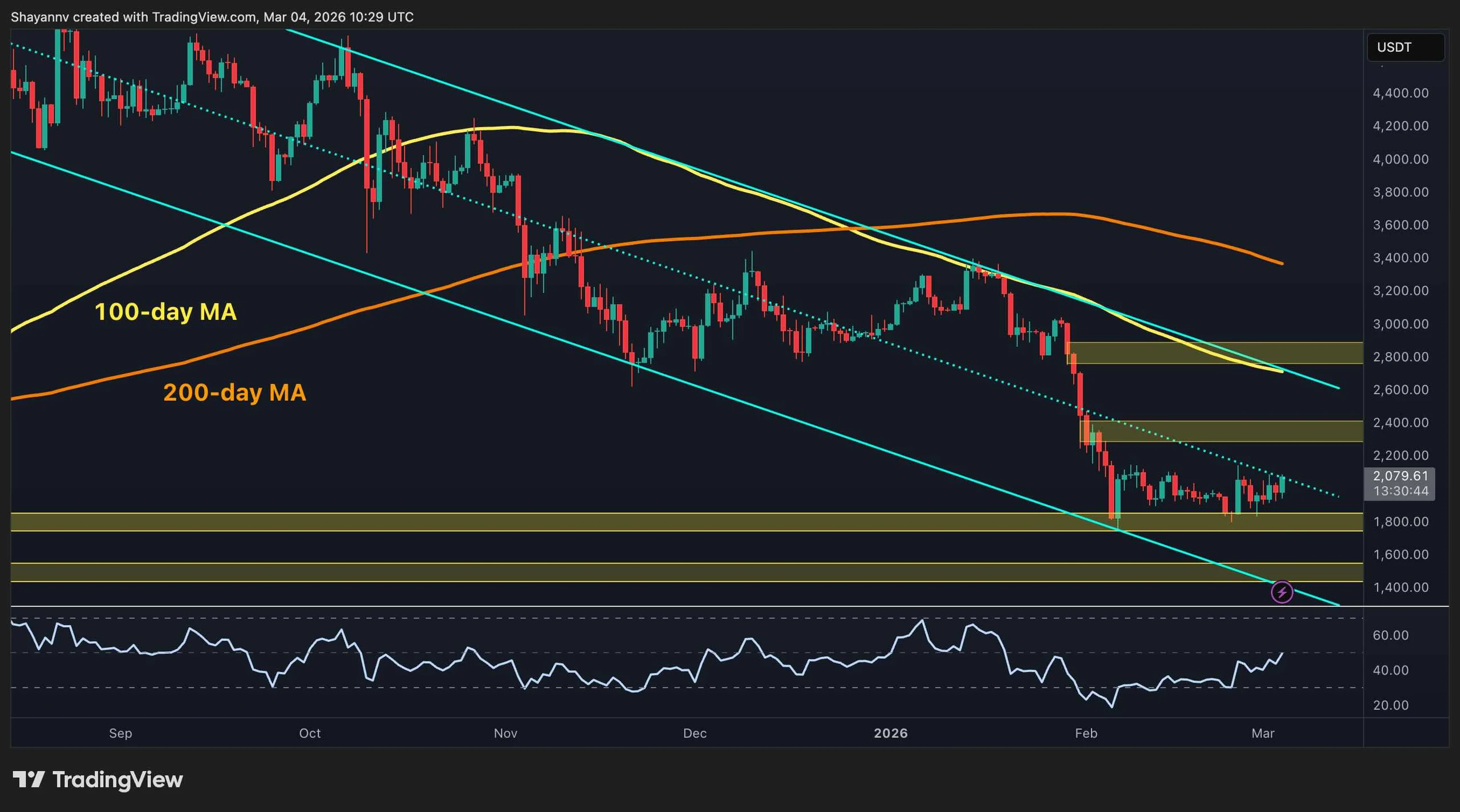
Ethereum is still trying to transition from capitulation into stabilization, with the price holding above the key $1,800 demand zone while repeatedly pressing into resistance near $2,150. The higher timeframe trend remains bearish, but the short-term structure is improving, so the next clean break from this range will likely set the tone for the next multi-week move.
Ethereum Price Analysis: The Daily Chart
On the daily chart, ETH is still trading below the 100-day moving average and the 200-day moving average, and both are sloping lower, which keeps the broader bias bearish. The asset is also respecting a descending channel, and the latest bounce is happening from the lower end of that structure rather than from a reclaimed trend level. The nearest overhead supply remains the $2,300 to $2,400 zone, which has acted as a pivot area during the previous distribution phase.
The most important support remains $1,800, which has been tested and defended after the sharp breakdown. If ETH loses $1,800 on a daily close, the next downside magnets are $1,600 and then $1,400, where prior demand zones sit on the chart. On the upside, a daily reclaim of $2,400 would be the first meaningful step toward shifting structure, with the next major resistance band near $2,800 to $3,000.
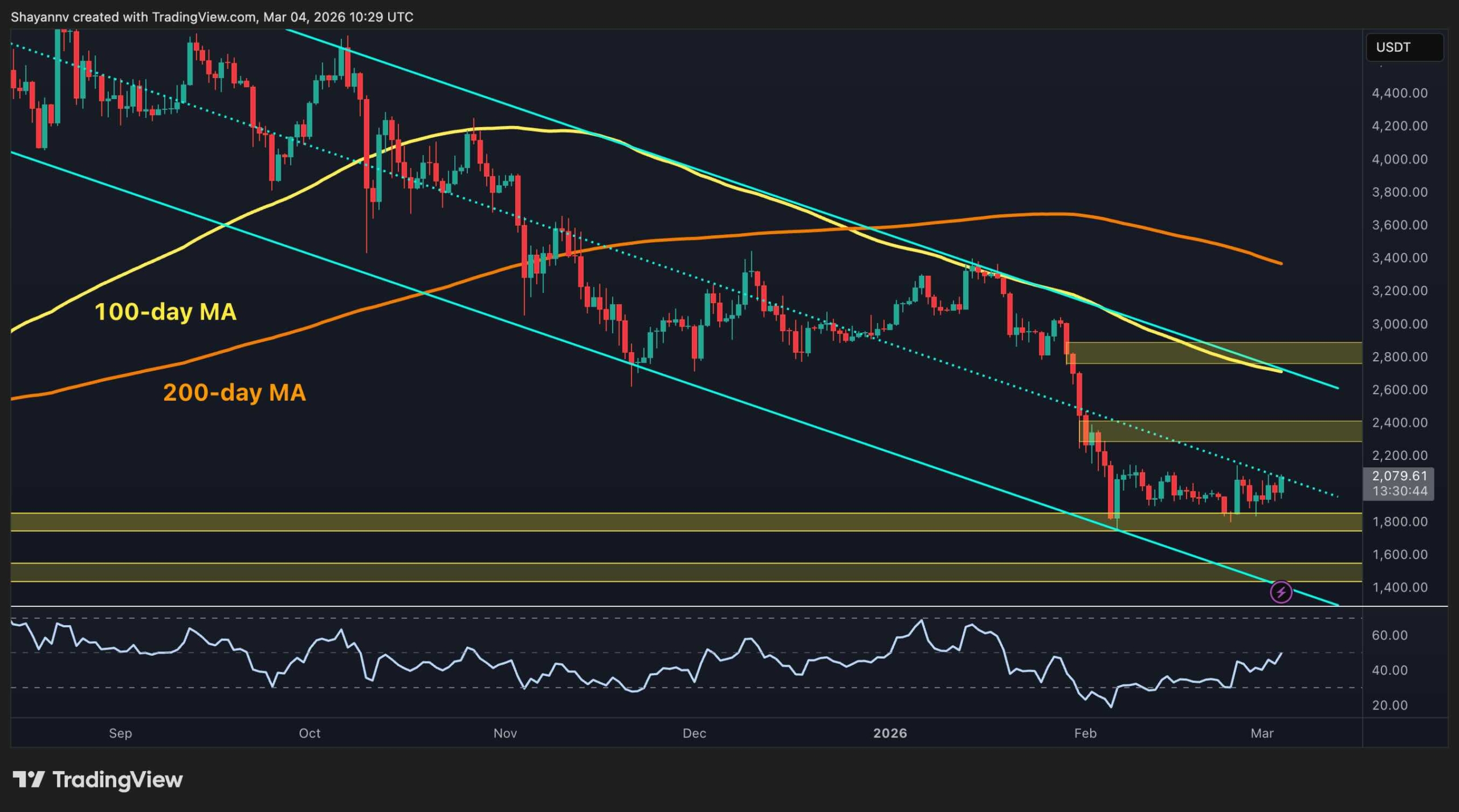
ETH/USDT 4-Hour Chart
On the 4-hour chart, ETH has been carving out a clear range, with buyers defending the $1,800 support area while sellers repeatedly cap the price near the $2,150 mark. This kind of consolidation after a hard sell-off often becomes a decision point, because liquidity builds at both ends, and the breakout can travel quickly. A clean push above $2,150 that holds would put $2,300 to $2,400 back in play as the next target zone.
If ETH fails again at $2,150 and rolls over, the immediate focus returns to the $1,800 area. The risk with repeated support tests is that each bounce can weaken the bid over time, especially if broader market sentiment stays fragile. A breakdown below $1,800 would likely trigger another volatility expansion move because it removes the main demand shelf that has been absorbing selling pressure.

On-Chain Analysis
The exchange reserve chart shows a sustained downtrend in ETH held on exchanges, falling toward roughly 15.9 million ETH. In general, declining exchange reserves are associated with reduced immediate sell-side supply, because fewer coins are sitting on venues where they can be quickly sold. That can support stronger rebounds when demand returns, especially if the price is already basing near support.
The key nuance is timing. During a bear phase, reserve declines can reflect a mix of cold storage withdrawals, staking, and migration to on-chain venues, not necessarily aggressive accumulation. If reserves keep falling while price holds above $1,800 and starts reclaiming resistance, it would strengthen the case for a recovery move. If reserves flatten or begin rising again while ETH remains rejected under $2,150, it can signal renewed distribution and increase the odds of another sweep back into the $1,800 support area.

Binance Free $600 (CryptoPotato Exclusive): Use this link to register a new account and receive $600 exclusive welcome offer on Binance (full details).
LIMITED OFFER for CryptoPotato readers at Bybit: Use this link to register and open a $500 FREE position on any coin!
Disclaimer: Information found on CryptoPotato is those of writers quoted. It does not represent the opinions of CryptoPotato on whether to buy, sell, or hold any investments. You are advised to conduct your own research before making any investment decisions. Use provided information at your own risk. See Disclaimer for more information.
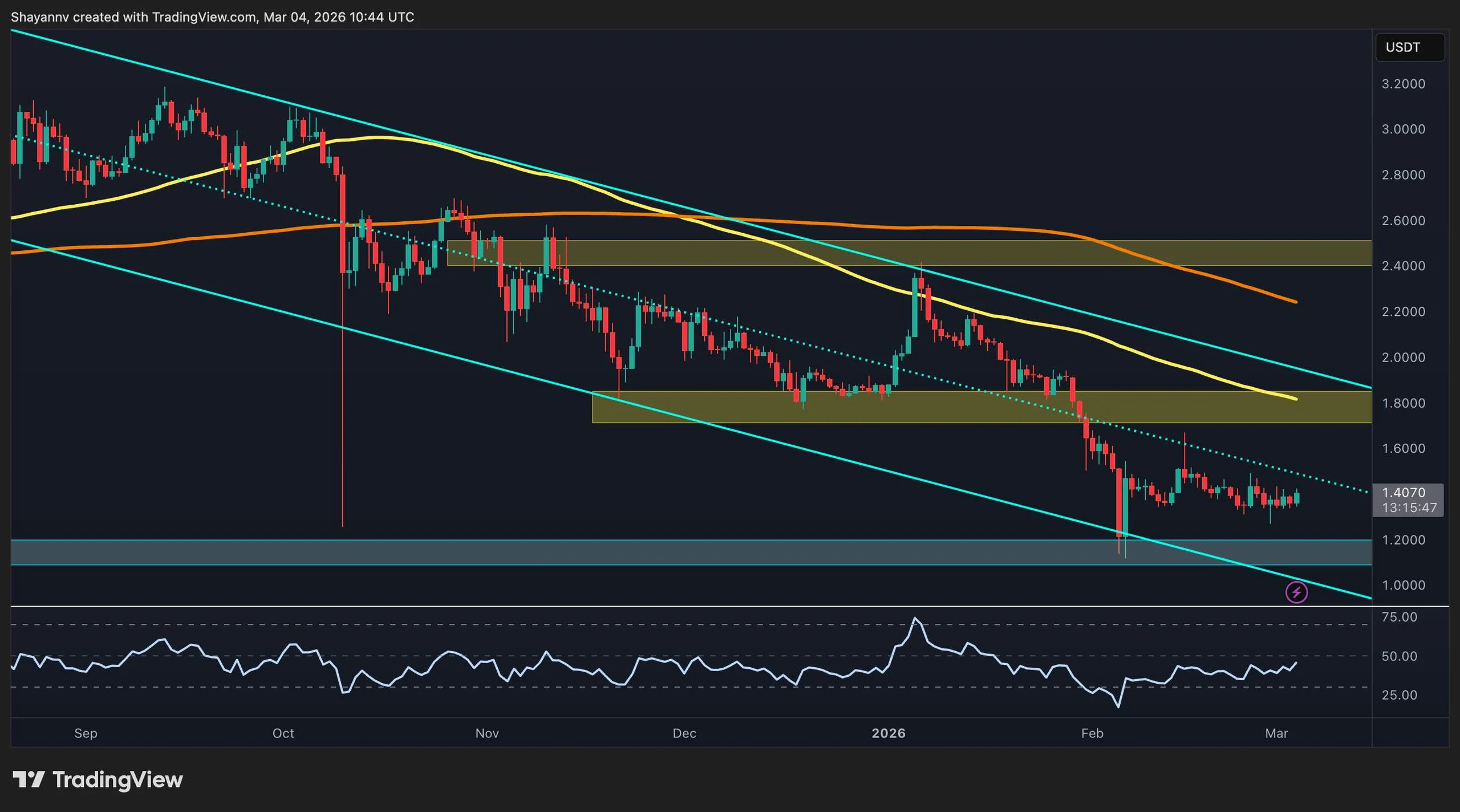
XRP is still trading under a broader bearish structure, but the recent price action looks like a base attempt after the sharp drawdown. For buyers, the main job is to reclaim key resistance zones and break the downtrend structure. Otherwise, this remains a sideways pause inside a larger downtrend.
Ripple Price Analysis: The USDT Pair
On the daily XRPUSDT chart timeframe, Ripple’s token is trading around $1.40 inside a descending channel and below both the 100-day and 200-day moving averages, which are still acting as overhead pressure. The nearest resistance sits around $1.70 to $1.80, where prior demand flipped into supply and where the 100-day moving average area is also located. The higher boundary of the descending channel is also located just above this area.
On the other side, support is defined around $1.20 to $1.10, which is the key floor that has to hold to keep the base intact. If XRP can reclaim $1.85, the next major upside zone is around $2.45 to $2.50, but if $1.20 fails, downside risk expands quickly because it breaks the current support shelf.
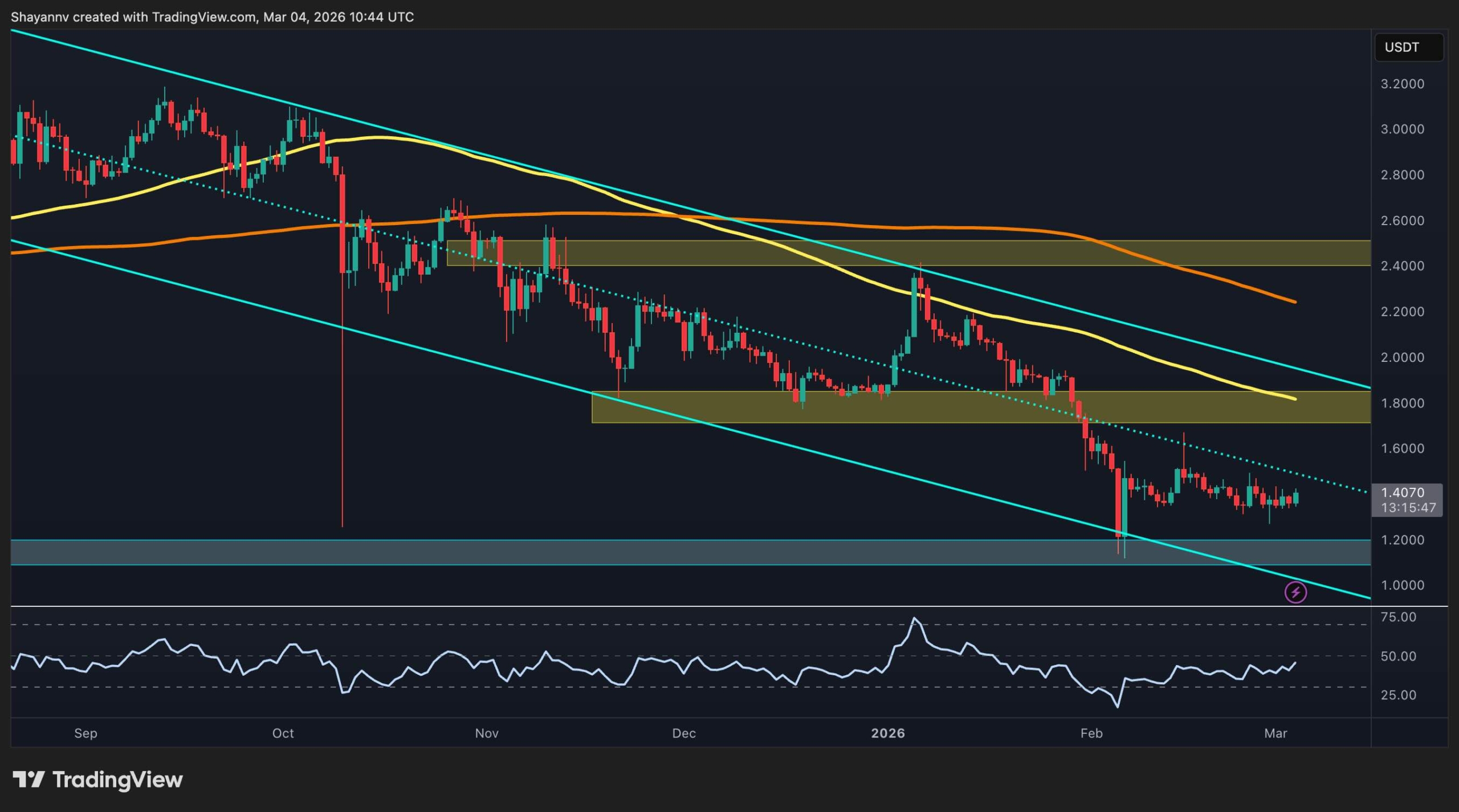
The BTC Pair
On the daily XRPBTC chart, the token is pressing into a key support region near 2,000 sats. The asset is also sitting below the 100-day and 200-day moving averages, so relative strength versus Bitcoin is still weak.
If 2,000 sats hold and XRP can reclaim 2,200 and 2,500 sats, the next upside target becomes 2,700 sats, with 3,000 sats as the key, higher resistance zone. However, if the 2,000 sats support zone breaks on a clean daily close, the next major demand area comes in way deeper at around the 1,500 sats zone.

Binance Free $600 (CryptoPotato Exclusive): Use this link to register a new account and receive $600 exclusive welcome offer on Binance (full details).
LIMITED OFFER for CryptoPotato readers at Bybit: Use this link to register and open a $500 FREE position on any coin!
Disclaimer: Information found on CryptoPotato is those of writers quoted. It does not represent the opinions of CryptoPotato on whether to buy, sell, or hold any investments. You are advised to conduct your own research before making any investment decisions. Use provided information at your own risk. See Disclaimer for more information.


China’s National People’s Congress opened on March 5 with signals that will reshape crypto capital flows for years to come. A stable yuan, record fiscal spending, and a structural push toward equity financing and RWA markets — these are the numbers that matter for digital asset investors.
However, the headlines stopped at China’s growth target of 4.5–5%, the lowest range since 1991. They shouldn’t, because the math tells a bigger story.
A Small Percentage of a Very Large Number
China’s economy surpassed $20 trillion for the first time in 2025, cementing its status as the world’s second-largest economy. Even at the floor of the new target range, China still adds roughly $900 billion to global output this year. The Netherlands, Saudi Arabia, Poland, and Switzerland each run economies of roughly $1 trillion to $1.3 trillion, and China is generating nearly that much in new economic activity, on top of what it already has.
In 2025, China contributed around 30% of total global economic expansion, reinforcing its role as the world’s primary growth engine. That share holds even if 2026 comes in at the lower end of the stated range. The rate of growth is decelerating, but the sheer weight behind it is not shrinking.
Why the Framing Matters for Markets
On the property side, Beijing stopped well short of a sweeping bailout. Policymakers pledged to coordinate orderly risk resolution across real estate, local government debt, and smaller financial institutions. The “white list” mechanism for housing projects continues, and unsold homes will be purchased for government-subsidised use — but there is no aggressive reflation of the sector. That measured stance keeps a lid on near-term expectations for iron ore and copper demand.
For crypto, Beijing’s broader policy package carries more signal than the growth target itself. China reaffirmed loose monetary policy and flagged RRR and interest rate cuts as active options going forward. Total general public budget expenditure hits 30 trillion yuan for the first time, with the overall deficit at 5.89 trillion yuan.
Macquarie’s chief China economist noted that if exports falter, Beijing will dial up domestic stimulus to defend the GDP target. The floor under Chinese liquidity is meaningfully higher than the headline growth figure suggests.
Yuan Stability Is the Real Signal
Beijing’s commitment to a basically stable yuan matters more than the growth number for near-term currency and crypto flows. Analysts see Beijing tolerating gradual yuan appreciation toward 6.70 against the dollar, while resisting sharper moves that would erode China’s hard-won competitive edge. A controlled, modestly stronger yuan reduces the pressure from capital flight that has historically driven Chinese retail demand toward Bitcoin and dollar-pegged stablecoins.
The 15th Five-Year Plan: Quality Over Speed
The annual growth target is only part of what the NPC unveiled on March 5. Beijing simultaneously released the 15th Five-Year Plan, setting the strategic framework through 2030. Previously, the headline theme was technological innovation; now, a modernized industrial system stands at the forefront, with innovation following directly after. The sequencing is intentional — turning lab breakthroughs into scalable production capacity, not just patents.
Central to the plan is an R&D spending target of more than 3.2% of GDP, a record high aimed at overcoming what Beijing calls “chokepoint” technologies. Advanced manufacturing, semiconductors, next-generation IT, and aerospace are the designated priority sectors.
The digital economy’s targeted share of 12.5% of GDP by 2030, combined with an embedded “AI-Plus” consumption model, is the number most relevant for crypto and digital asset markets. This planning cycle is less about acceleration and more about reengineering the vehicle itself — and at $20 trillion in scale, that vehicle is large enough that even a cautious rebuild moves global markets.
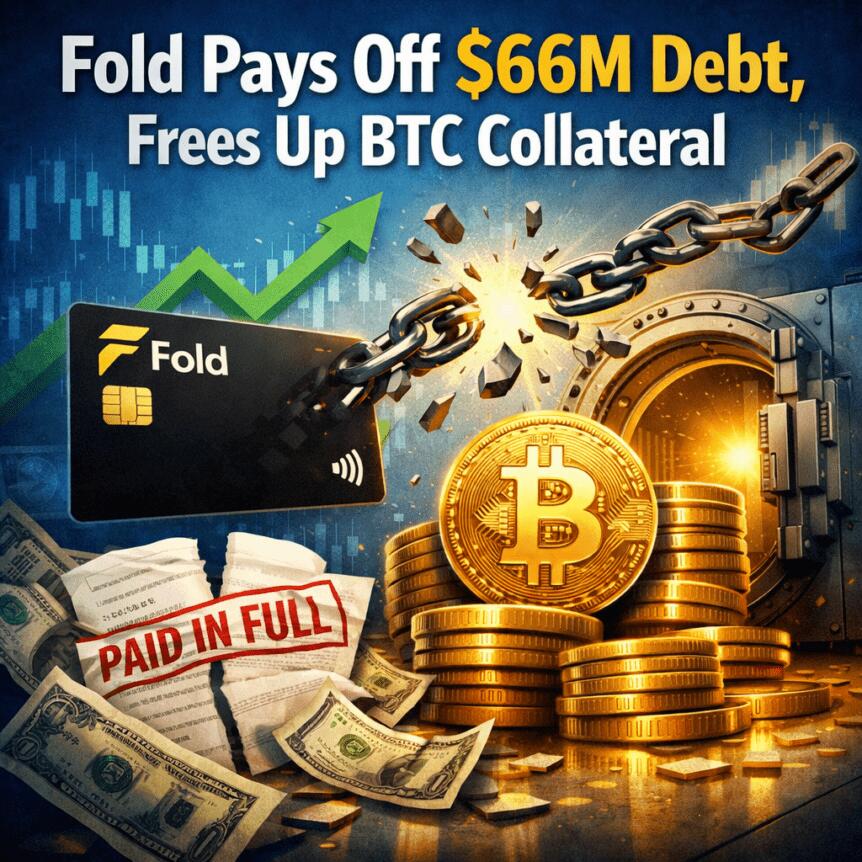
Fold, a Nasdaq-listed Bitcoin financial services firm, has removed a major liability from its balance sheet after eliminating $66.3 million in convertible debt. The move also released 521 Bitcoin previously pledged as collateral, giving the company direct access to assets that had been locked against its financing obligations. By removing convertible notes that could have been turned into equity, Fold has reduced potential share dilution while gaining more operational flexibility. The restructuring comes as the company prepares to expand its consumer-facing product lineup, including a Bitcoin rewards credit card designed to attract mainstream users interested in accumulating digital assets through everyday spending.
Key takeaways
- Fold retired $66.3 million in convertible debt, removing the possibility of future equity dilution tied to those notes.
- The repayment freed 521 Bitcoin previously used as collateral, restoring full corporate control over the assets.
- With the debt eliminated, the company says it now operates under fewer financing constraints.
- Fold is preparing to launch a consumer Bitcoin rewards credit card as part of its growth strategy.
- The firm became publicly listed in February 2025 after completing a SPAC merger with FTAC Emerald Acquisition.
- Competition among crypto rewards cards is intensifying, with multiple platforms offering similar spending incentives.
Tickers mentioned: $BTC, $FLD
Sentiment: Neutral
Price impact: Neutral. The balance sheet improvement may strengthen fundamentals, but no immediate market reaction is indicated.
Market context: Crypto-financial companies are increasingly exploring debit and credit card products that reward users in digital assets, reflecting broader efforts to integrate cryptocurrency with everyday payments.
Why it matters
Balance sheet restructuring can significantly affect how financial technology companies operate in volatile markets. By removing convertible debt, Fold eliminates a potential source of dilution that could have impacted shareholders if the notes were converted into stock. For investors, this simplifies the company’s capital structure and clarifies its long-term financial obligations.
The release of more than 500 Bitcoin also increases the firm’s strategic flexibility. Digital asset reserves can be used for corporate operations, liquidity management or ecosystem initiatives, particularly as competition among crypto-financial platforms continues to intensify.
More broadly, Fold’s focus on rewards-based Bitcoin accumulation highlights a growing trend within the industry. Instead of positioning cryptocurrency primarily as a speculative asset, many platforms are now embedding it within consumer finance tools, potentially accelerating mainstream adoption.
What to watch next
- The rollout timeline and adoption metrics for Fold’s planned Bitcoin rewards credit card.
- How the newly released Bitcoin holdings are allocated within the company’s corporate strategy.
- Potential financial disclosures showing the impact of the debt restructuring on Fold’s balance sheet.
- Competitive responses from other crypto card providers expanding into consumer payment services.
Sources & verification
- Fold’s official disclosure announcing the elimination of its convertible debt.
- Public filings and investor communications regarding the company’s capital restructuring.
- Market data showing Fold’s share performance following its Nasdaq listing.
- Public announcements from crypto payment platforms offering reward-based cards.
Fold removes debt overhang as crypto rewards competition intensifies
Fold, a publicly traded financial technology company focused on Bitcoin (CRYPTO: BTC) services, has eliminated $66.3 million in convertible debt, a move that simplifies its financial structure and restores access to digital assets that had previously been pledged as collateral. The decision removes a potential source of future shareholder dilution while improving the company’s operational flexibility as it prepares to expand its consumer products.
According to the company’s disclosure, Fold repaid two outstanding convertible notes. These financial instruments allow lenders to convert debt into equity at a later date under predetermined terms. While such financing can provide early-stage capital, it also carries the possibility of share dilution if creditors exercise conversion rights.
By retiring the notes entirely, Fold removed that risk. The company’s management indicated that the repayment strengthens the balance sheet and clarifies its capital structure, which can be particularly important for publicly traded firms navigating volatile market conditions.
The restructuring also released 521 Bitcoin that had been locked as collateral for the debt. With the notes settled, the digital assets are no longer encumbered and can be redeployed for corporate use. This may include treasury management, strategic initiatives or other operational needs as the company continues expanding its services.
Access to those holdings could become increasingly important as Bitcoin-focused financial companies look to build new products around digital asset accumulation and spending. While Fold has not detailed how it intends to deploy the newly available BTC, the company emphasized that the removal of financing restrictions provides greater flexibility for future initiatives.
Founded in 2019, Fold built its reputation through a consumer rewards platform that allows users to earn Bitcoin while making everyday purchases. The company’s core offering includes a debit card linked to a rewards system in which spending in traditional currency generates BTC cashback instead of points or fiat rewards.
That model aims to encourage gradual accumulation of cryptocurrency without requiring users to directly buy or trade digital assets. For many consumers, rewards-based programs offer a simpler entry point into the crypto ecosystem.
Fold entered public markets in February 2025 following a special purpose acquisition company merger with FTAC Emerald Acquisition. The transaction resulted in Fold shares trading on the Nasdaq under the ticker FLD (NASDAQ: FLD), making it one of the first companies dedicated to Bitcoin-based financial services to list on a major US exchange.
Since its public debut, the company has faced the same volatility affecting many crypto-related equities. Market data shows that the stock has declined significantly since listing, reflecting broader market uncertainty and the fluctuating performance of digital asset markets.
Despite these challenges, Fold continues to focus on expanding its consumer-facing offerings. One of the company’s most anticipated upcoming products is a Bitcoin rewards credit card. Unlike the existing debit-based rewards system, the new card would allow customers to accumulate BTC through credit purchases, potentially increasing engagement and transaction volumes.
The launch comes amid rising competition in the crypto rewards card market. Several companies are now targeting consumers who want exposure to digital assets through everyday financial tools rather than direct trading.
For example, the Coinbase Card enables users to spend cryptocurrency balances while earning crypto rewards on transactions. The product forms part of Coinbase’s broader strategy to integrate payments, trading and financial services into a unified digital platform.
Other providers have adopted slightly different models. The Nexo Card allows customers to borrow against their crypto holdings and spend fiat without liquidating their assets, while still earning rewards on purchases.
Meanwhile, exchanges such as Bybit and Crypto.com offer Visa-branded cards that distribute rewards in tokens associated with their platforms. These products aim to create loyalty incentives while also encouraging users to remain within each company’s ecosystem.
Traditional financial networks are also entering the space. Mastercard has collaborated with MetaMask to introduce a crypto-linked payment card that converts digital assets into fiat at the point of sale, enabling purchases at any merchant accepting Mastercard.
Such developments highlight the increasing overlap between cryptocurrency infrastructure and mainstream financial services. As payment networks, fintech firms and exchanges compete for users, reward-based incentives have become a central strategy for attracting and retaining customers.
Fold’s debt repayment and product expansion plans therefore arrive at a time when the sector is becoming more crowded and technologically advanced. The company’s focus on Bitcoin accumulation rather than direct spending positions it somewhat differently from competitors that emphasize transactional crypto payments.
Whether that strategy resonates with a broader consumer base will depend on adoption of its forthcoming credit card and the effectiveness of its rewards program. If successful, the model could appeal to users who prefer gradually earning Bitcoin through spending rather than purchasing it outright.
For now, the elimination of convertible debt represents a structural improvement for Fold’s financial position. By removing potential dilution and reclaiming control of its BTC collateral, the company has taken a step toward strengthening its balance sheet at a time when crypto-focused businesses continue to navigate rapidly evolving market dynamics.

China’s liquid-fueled intercontinental strategic nuclear missiles DongFeng-5C, which have a global strike range, pass through Tian’anmen Square during the V-Day military parade on September 3, 2025 in Beijing, China.
China News Service | China News Service | Getty Images
BEIJING — China plans to increase its defense spending by 7% this year, Reuters reported Thursday, citing official documents due for public release later in the day.
That would mark the slowest increase in its annual military expenditure since 2021.
The proposal comes as conflict in the Middle East has escalated, amid a broader rise in geopolitical tensions.
For the last three years, China has budgeted a 7.2% annual increase in defense spending. Beijing had increased spending by 7.1% in 2022 and 6.8% in 2021, according to official data.
China will support the faster development of advanced combat capabilities, Reuters said, as well as the “high-quality” modernization of its national defense and armed forces.
Some of Beijing’s latest weapon systems, including long-range missiles, were displayed during a military parade in September.
China is set to kick off its 8-day National People’s Congress on Thursday, an annual parliamentary meeting that officially approves the budget and development goals for the year.
Last year, China proposed a national defense budget of 1.78 trillion yuan ($244.99 billion at the time).
Beijing accounted for nearly 44% of Asia’s defense spending in 2025, up from 39% in 2017, according to the International Institute for Strategic Studies.
China is also second to the U.S. in terms of military spending.
The U.S. budgeted $849.77 billion for defense during the 2025 fiscal year. But estimates from non-profit USAFacts indicate the U.S. ended up spending about $919.2 billion during that time, up 2% from the prior year and accounting for 13% of the federal budget.


Kraken has secured a Federal Reserve “master account,” giving its banking arm direct access to the Fed’s core payment systems and making it the first crypto firm to operate on the same rails as traditional financial institutions.
The company said its unit, Kraken Financial, received approval for a Federal Reserve “master account,” the Wall Street Journal first reported. The account provides direct access to Fedwire, a major interbank payment network that processes trillions of dollars in transfers each day.
Until now, Kraken had to rely on partner banks to send or receive U.S. dollars. Direct access changes that flow as the firm can now settle payments itself, which may speed up deposits and withdrawals for large traders and institutional clients.
“This approval is a watershed moment for the digital asset industry,”U.S. Senator Cynthia Lummis said in a press release.
“The Federal Reserve has acknowledged what I’ve always said was the case — that a digital asset company can balance innovation with strong risk management,” she added. “[This] is going to create the 21st century financial services industry.”
Kraken Financial operates under a Wyoming charter designed for crypto-focused banks. The Federal Reserve Bank of Kansas City oversaw the application.
“This news has been a long time coming, but Wyoming welcomes it nonetheless,” said Wyoming Governor Mark Gordon. “This approval of a master account for Kraken by the Federal Reserve signals support for Wyoming’s banking and digital asset laws.”
The approval is limited, however. Kraken will not receive the full set of services available to traditional banks, as it won’t earn interest on reserves or tap the Fed’s emergency lending.
Kraken, a cryptocurrency exchange founded in 2011, has been slowly moving towards an initial public offering (IPO). Several of its rivals, including Gemini, Coinbase, and CoinDesk’s parent company Bullish, have already made their public market debut.
Its parent company, Payward, has been on an acquisition spree, adding the token management platform Magna last month. Last year, it acquired U.S. futures trading platform NinjaTrader for $1.5 billion and U.S.-licensed derivatives trading venue Small Exchange for $100 million.
It also moved into the tokenization space with the acquisition of tokenized stock specialist Backed Finance, the issuer of xStocks.
UPDATE (March 4, 3:55pm UTC): Adds comments from Cynthia Lummis’ press release.
Crypto World
Alchemy Pay Obtains Delaware MTL, Reaches 15 U.S. State Licenses for Fiat-Crypto Payments
TLDR:
- Alchemy Pay now holds Money Transmitter Licenses in 15 U.S. states after securing Delaware approval.
- The Delaware MTL authorizes Alchemy Pay to offer regulated money transmission services in the state.
- Alchemy Pay plans to launch a stablecoin and develop Alchemy Chain, backed by its growing MTL network.
- Beyond the U.S., Alchemy Pay holds regulatory approvals in Australia, South Korea, Switzerland, and Hong Kong.
Alchemy Pay has received a Money Transmitter License in Delaware, marking another regulatory step in the United States.
The fiat-crypto payment company now holds such licenses in 15 states nationwide. Delaware law requires entities transmitting money to be licensed under the state bank commissioner’s office.
This approval supports Alchemy Pay’s broader goal of building a compliant payment infrastructure across the country, including future plans for a stablecoin and a dedicated blockchain network.
Expanding Regulated Operations Across U.S. States
Under Delaware law, transmitting money through checks, drafts, or monetary instruments is a regulated activity. Businesses must operate under the Delaware Office of the State Bank Commissioner.
Alchemy Pay has fulfilled these requirements and now holds a valid license. It can therefore offer fully compliant money transmission services within the state.
The Delaware approval brings the company’s total U.S. MTL count to fifteen states. The list includes Arkansas, Iowa, Minnesota, New Hampshire, New Mexico, Oklahoma, Oregon, and Wyoming. Arizona, South Carolina, Kansas, West Virginia, South Dakota, and Nebraska also hold Alchemy Pay MTLs. More state applications remain active and are currently under regulatory review.
Alchemy Pay announced this milestone on social media, confirming the company’s progress:
“With this approval, #AlchemyPay now holds MTLs in 15 U.S. states, further strengthening its compliant fiat-crypto payment infrastructure and laying the groundwork for future stablecoin initiatives.”
This wider regulatory coverage helps the company reach more users across the country. It also supports access to compliant fiat-crypto on-ramps and off-ramps at a larger scale. The continued expansion reflects a deliberate, compliance-first growth strategy.
These licenses also lay the groundwork for Alchemy Pay’s future financial products. The company plans to launch a proprietary stablecoin, which requires strong regulatory backing.
It is also developing Alchemy Chain, a blockchain infrastructure built around stablecoin use. Both initiatives depend on the compliance foundation that these MTLs are building.
Regulatory Progress Extends Across Global Markets
Alchemy Pay has also made meaningful regulatory progress in markets outside the U.S. The company registered as a Digital Currency Exchange Provider in Australia.
In South Korea, it completed an Electronic Financial Business registration. Both approvals strengthen its position in key Asia-Pacific financial markets.
In Switzerland, Alchemy Pay joined the VQF, a recognized Self-Regulatory Organisation. This admission places the company within a well-established Swiss financial oversight framework.
The VQF is an official SRO recognized by Swiss regulators. Membership confirms that the company meets quality assurance standards in Swiss financial services.
The company also gained regulated exposure to Hong Kong’s financial market. It did so through an investment in HTF Securities Limited.
HTF holds Hong Kong SFC Type 1, 4, and 9 licenses. This indirect participation adds another regulated market to Alchemy Pay’s global reach.
Taken together, these approvals show a pattern of consistent regulatory engagement worldwide. Alchemy Pay has pursued compliance across different legal systems and financial frameworks.
Each approval reinforces the company’s credibility with regulators, users, and institutional partners. The strategy positions the company to support the next generation of global digital payments.


Coupang Pay, the fintech arm of South Korean e-commerce giant Coupang, is actively recruiting in-house legal counsel specializing in stablecoins. The hiring signals a significant escalation in the company’s digital asset ambitions.
The move positions Coupang as one of Asia’s most aggressive non-financial corporations to bet on stablecoin infrastructure ahead of imminent Korean legislation.
Legal Team as Strategy Unit
The company posted two simultaneous job listings on its careers page. One targets junior attorneys within two years of qualification. The other seeks senior or principal-level counsel with at least three years of relevant experience. Both postings list identical responsibilities across three areas: domestic fintech payments, stablecoin and virtual asset regulation, and global payment partnerships.
The stablecoin-specific duties are notably detailed. Candidates will review business structures for stablecoin issuance, utilization, and distribution. They will also handle regulatory engagement with Korea’s Financial Intelligence Unit and the Financial Services Commission. The senior role adds a telling requirement: the ability to “translate new regulatory domains into business opportunities.”
Coupang Pay framed its legal team in explicitly strategic terms. The team “designs new business models while maintaining regulatory compliance,” the company said in its postings. That language positions the legal function closer to a product strategy unit than a traditional compliance department.
Already Inside the Infrastructure
Listed on the New York Stock Exchange, Coupang operates across South Korea and Taiwan and regularly remits significant sums to its US parent.
Coupang is no stranger to stablecoin infrastructure. In the second half of 2024, the company joined as an early partner of Tempo, a Layer 1 blockchain developed by Stripe. Tempo is purpose-built for stablecoin payments. Partners, including Visa, Deutsche Bank, and Standard Chartered, have been piloting real-world payment environments on-chain since late last year.
The financial incentive is clear. Coupang recorded approximately $33 billion in revenue last year. Assuming a 1% card fee rate, stablecoin adoption could save roughly $340 million annually. Cross-border remittance costs to its US parent add further pressure. Industry estimates put total annual savings between $155 million and $200 million, even after infrastructure costs.
Coupang operates across South Korea and Taiwan, where it also runs the Farfetch luxury platform. The job postings explicitly mention Coupang Taiwan, Farfetch, and a “global integrated app” as targets for overseas payment legal review. This suggests stablecoin integration is being planned well beyond Korea’s borders.
Legislative Tailwind, Political Headwind
The timing aligns with Korea’s legislative calendar. South Korea’s ruling party and the National Assembly are actively discussing a regulatory framework for KRW-backed stablecoin issuance, though no legislation has been finalized. It would mark the first time domestic won-denominated stablecoin issuance has been legally permitted in nearly nine years.
However, Coupang carries political baggage into this push. The company faced significant backlash last year following a personal data leak incident. Its decision to conduct an internal “self-investigation” rather than cooperate fully with regulators drew sharp criticism. Industry observers note this friction could slow domestic regulatory approvals for new financial services.
Korea’s stablecoin race is accelerating. Coupang appears determined not to be left behind.


GMX DAO has approved a plan to redirect rewards and concentrate liquidity on its own rails.
Summary
- GMX DAO will send a larger share of protocol rewards to its treasury instead of direct staking payouts.
- The plan concentrates liquidity on GMX-native infrastructure rather than relying on external venues to set the market.
- GMX traded higher alongside broader DeFi tokens as on-chain volumes and open interest rose with Bitcoin (BTC) reclaiming key levels.
GMX DAO has passed a proposal to overhaul how value flows through the derivatives protocol, aiming to restore clearer price discovery and reduce dependence on centralized exchanges and fragmented liquidity pools. Under the new framework, a larger portion of protocol rewards will be routed to the DAO treasury instead of going straight to stakers, giving the community more flexibility to fund buybacks, incentives, and long-term development. At the same time, liquidity is being steered toward GMX’s own infrastructure, with an emphasis on deeper native markets rather than thin order books scattered across multiple venues. Backers of the proposal argue that concentrating liquidity and control inside the protocol can make prices less vulnerable to abrupt swings driven by external market makers and short-term speculative flows.
The changes come after a period in which GMX’s token performance lagged broader market rebounds, even as volumes on leading perpetuals venues climbed and blue-chip DeFi names saw renewed interest. Community discussions highlighted concerns that incentives were overly focused on short-term yield and that too much effective price discovery was occurring off-platform, where order flow and liquidity conditions are harder for the DAO to influence. By building a larger treasury and emphasizing native liquidity, GMX is attempting to align token economics more tightly with the actual usage and profitability of the protocol. The move echoes steps taken by other DeFi projects listed on platforms like Coinbase, which have shifted toward models that prioritize sustainable fee capture over aggressive emissions.
Protocol value and market structure
From a market-structure perspective, the GMX decision reflects a broader trend in DeFi, where protocols are reassessing how they balance user incentives, governance, and long-term resilience. Rather than relying on perpetual token emissions or external liquidity mining, more projects are experimenting with treasury-driven strategies, dynamic fee sharing, and targeted buybacks. This approach is influenced in part by the growing presence of institutional actors and payment firms that demand more predictable frameworks, similar to how companies like Visa structure reward flows and capital allocation in traditional finance. For GMX, building a sizable treasury war chest creates optionality: the DAO can respond to market stress, fund new product lines, or adjust incentive schemes without having to dilute holders through new token issuance.
The timing of the shift also intersects with a healthier, spot-led environment in major crypto assets such as Bitcoin (BTC), where leverage has normalized and ETF-driven flows are stabilizing. In that context, a derivatives protocol’s ability to offer deep, reliable on-chain markets becomes more important than simply broadcasting high nominal yields. As regulatory frameworks like MiCA advance and exchanges refine their listings of DeFi tokens, projects with transparent, treasury-backed value flows may be better positioned to attract both retail and professional liquidity. For GMX holders and users, the key question is whether the new model can translate into tighter spreads, more robust on-chain volumes, and a stronger link between protocol revenue and token performance without sacrificing the competitive incentives that first drew traders to the platform.

Games Inbox: Will Resident Evil Requiem get a Mercenaries mode?

(VIDEO) BTS Unveils ‘ARIRANG’ Tracklist With Title Track ‘SWIM’ Ahead of Highly Anticipated March 20 Comeback

Swiss Lawmakers Warn UBS Over Ermotti’s Role in $26B Capital Reform Battle

Smart energy pays enters the US market, targeting scalable financial infrastructure

Why Israel is blocking foreign journalists from entering

Bitcoin: We’re Entering The Most Dangerous Phase

CEO of Orlando company arrested in alleged $328M cryptocurrency Ponzi scheme

Crypto & Gold Analysis || 26 FEB || The Trade Room – Mayank Raj

What is Accounting & What is Finance? Simple Explanation #Accounting #Finance #Education #CareerTips
-

 Politics6 days ago
ITV enters Gaza with IDF amid ongoing genocide
-

 Politics2 days ago
Alan Cumming Brands Baftas Ceremony A ‘Triggering S**tshow’
-

 Fashion5 days ago
Weekend Open Thread: Iris Top
-

 Tech4 days ago
Unihertz’s Titan 2 Elite Arrives Just as Physical Keyboards Refuse to Fade Away
-
Sports5 days ago
The Vikings Need a Duck
-
 NewsBeat4 days ago
Dubai flights cancelled as Brit told airspace closed ’10 minutes after boarding’
-

 NewsBeat3 days ago
‘Significant’ damage to boarded-up Horden house after fire
-
 NewsBeat5 days ago
The empty pub on busy Cambridge road that has been boarded up for years
-

 NewsBeat4 days ago
Abusive parents will now be treated like sex offenders and placed on a ‘child cruelty register’ | News UK
-

 Entertainment3 days ago
Baby Gear Guide: Strollers, Car Seats
-

 Business7 days ago
Discord Pushes Implementation of Global Age Checks to Second Half of 2026
-
 Tech6 days ago
NASA Reveals Identity of Astronaut Who Suffered Medical Incident Aboard ISS
-

 Business6 days ago
Only 4% of women globally reside in countries that offer almost complete legal equality
-
 NewsBeat4 days ago
Emirates confirms when flights will resume amid Dubai airport chaos
-
Politics4 days ago
FIFA hypocrisy after Israel murder over 400 Palestinian footballers
-
 Crypto World6 days ago
From Crypto Treasury to RWA: ETHZilla Retreats and Relaunches as Forum Markets on Nasdaq
-

 NewsBeat3 days ago
Is it acceptable to comment on the appearance of strangers in public? Readers discuss
-

 Tech4 days ago
Viral ad shows aged Musk, Altman, and Bezos using jobless humans to power AI
-

 Business6 days ago
World Economic Forum boss Borge Brende quits after review of Jeffrey Epstein links
-

 Video7 days ago
Xii English top Selected mcq “Money Madness” Board Exam 2026, #chseodisha #hksir #mychseclass